Category Archives: Economist Dan Mitchell

We got to reform Social Security now!!!

We got to reform Social Security now!!!

Washington is filled with debate and discussion about the economic burden of the federal income tax, which collected $1.13 trillion in FY2012 ($1.37 trillion if you include the corporate income tax).

Yet politicians rarely consider the economic impact of payroll taxes, even though these levies totaled $.85 trillion during the same fiscal year.

Yes, we had a gimmicky payroll tax holiday for the past few years. And it’s true that Obama has signaled that he wants to increase the payroll tax burden at some point to prop up the Social Security system.

But there’s rarely, if ever, a discussion of wholesale reform.

That’s actually a good thing. Compared to the income tax, the payroll tax does far less damage. And it’s not just because it collects less money. On a per-dollar-raised basis, the payroll tax is considerably less destructive than the income tax.

Why? Because it’s actually a form of flat tax.

  • It has only one tax rate. There’s a 12.4 percent tax for Social Security and a 2.9 percent tax for Medicare, which means a flat tax of 15.3 percent.
  • There’s almost no double taxation. The payroll tax applies to wage and salary income, as well as personal earnings from business activities (sometimes known as “Schedule C” income). But dividends, interest, and capital gains are generally spared – other than the 3.8 percent Obamacare surtax.
  • There are no loopholes or deductions for politically connected interest groups.

And because of these three features, the tax is remarkably simple and doesn’t even require a tax form unless taxpayers have Schedule C income.

None of this, by the way, means the payroll tax is a good or desirable levy.

  • It takes for too much money from the American people and is far and away the biggest tax paid by the majority of American workers.
  • Those revenues are used for two programs – Social Security and Medicare – that are actuarially bankrupt and contributing to the nation’s long-run fiscal collapse.
  • The 15.3 percent tax undermines work incentives by driving a wedge between pre-tax income and post-tax consumption.
  • And the tax is very non-transparent, particularly since many taxpayers don’t even realize that the “F.I.C.A.” tax on their pay stub only reflects 50 percent of their payroll tax burden. In a hidden form of pre-withholding, employers pay an equal amount to the government on behalf of their workers – funds that otherwise would be part of worker compensation.

In other words, the payroll tax is a bad imposition. That being said, it still does considerably less damage, on a per-dollar-collected basis, than the income tax.

With that in mind, I’m puzzled that some folks want to keep the income tax and get rid of the payroll tax.

My friends at the Heritage Foundation, for instance, have a tax reform proposal that would fold the payroll tax into the income tax. Since they’re also proposing to turn the income tax into a form of flat tax, with one rate and no double taxation, the overall proposal clearly is a big improvement over today’s tax system. But all of the improvement is because of reforms to the income tax.

The Washington Examiner has an even stranger position. The paper recently editorialized in favor of abolishing the Social Security portion of the payroll tax and expanding the income tax.

The payroll tax — 12.4 percent, split between workers and their employers to help finance Social Security – is one of the worst taxes on the books for several reasons. A basic economic principle is that when the government taxes something, the nation gets less of it. Because the payroll tax makes it more expensive and administratively burdensome for businesses to hire workers, it’s a drag on employment. Also, even the employer’s share of the tax is effectively passed on to workers in the form of lower salaries and benefits.

There’s nothing overtly wrong with the above passage. The tax does all those bad things. But the income tax does all those things as well, but in an even more destructive fashion.

The editorial addresses a couple of potential objections, starting with the notion that the payroll tax is a revenue dedicated to social Security.

There are two main objections to scrapping the payroll tax. The first is the theoretical idea that payroll taxes are a dedicated revenue stream for Social Security. In practice, it just isn’t true. All government expenditures ultimately come from the same place. Payroll taxes help subsidize other government functions, and the government will use other tax revenue and borrowing to pay for Social Security when revenues are short.

They’re right that all taxes basically get dumped into the same pile of money and that the relationship between payroll taxes and Social Security benefits is imprecise.

But since my argument has nothing to do with this issue, I don’t think it matters.

Here’s the part of the editorial that doesn’t make sense.

The other objection is the massive revenue hit to the federal government. In 2010 (the last year before the recent payroll tax holiday), social insurance taxes raised $865 billion in revenue, according to the Congressional Budget Office. But there are a number of ways to recoup that revenue. As stated above, eliminating the payroll tax would make it easier to get rid of a lot of credits, loopholes and deductions. Also, if lower-income Americans aren’t paying payroll taxes, they can pay a bit more in income taxes. This would also deal with a conservative complaint that the income tax system needs to be reformed so everybody has at least some skin in the game.

This passage has a policy mistake and a political mistake.

The policy mistake is that the proposed swap almost surely would make the overall tax code more hostile to growth. The Examiner is proposing to get rid of an $865 billion tax that does a modest amount of damage per dollar collected, and somehow make up for that foregone revenue by collecting an additional $865 billion from the income tax system – which we know does a very large amount of damage per dollar collected.

To be sure, it’s possible to collect that extra money by eliminating distortions such as the state and local tax deduction or the healthcare exclusion. Compared to raising marginal tax rates, those are much-preferred ways of generating more revenue. But even in a best-case scenario – with politicians miraculously trying to collect an extra $865 billion without making the income tax system even worse, it’s hard to envision a better fiscal regime if we swap the payroll tax for a bigger income tax.

The political mistake is the assumption that more people will have “skin in the game” if the income tax is expanded. That’s almost surely not true. The poor don’t pay income tax, but the payroll tax grabs 15.3 percent of every penny earned by low-income households. And since very few taxpayers pay attention to which tax is shrinking their paychecks, it doesn’t really matter whether the “skin” is a payroll tax or an income tax.

Since the Examiner isn’t proposing a specific plan, there’s no way of making a definitive statement, but it’s 99 percent likely that eliminating the Social Security payroll tax would result in low-income households paying even less money to Washington. I think everybody should send less to Washington, but I don’t think shifting a greater share of the tax burden onto the middle class and the rich is the right way of achieving that goal.

I have one final objection, and this applies to both the Heritage Foundation plan and the Examiner proposal.

Notwithstanding everything I just wrote, I actually agree with them that we should eliminate the Social Security payroll tax. But we should get rid of the tax as part of a transition to a system of personal retirement accounts.

This is a reform that has been successfully implemented in about 30 nations and it also should happen in the United States. But an integral feature of this reform is that workers would be allowed to shift their payroll taxes into personal accounts. Needless to say, that’s not possible if the payroll tax has disappeared.

This video explains why genuine Social Security reform is so desirable.

And let’s not forget that the Medicare portion of the payroll tax could and should be part of a broader agenda of entitlement reform. But that’s also less likely if the payroll tax is folded into the income tax.

California dismal experience of trying to soak the rich

Is our country learning from history? California keeps raising their taxes on the wealthy and people keep moving from California to Texas. What does our federal government do? They also have been raising taxes on the wealthy lately. Take a look at this excellent video below and then read a great article by Dan Mitchell of the Cato Institute on what is happening in California right now.

Will Higher Tax Rates Balance the Budget?

Published on Apr 11, 2012

As the U.S. debt and deficit grows, some politicians and economist have called for higher tax rates in order to balance the budget. The question becomes: when the government raises taxes, does it actually collect a larger portion of the US economy?

Professor Antony Davies examines 50 years of economic data and finds that regardless of tax rates, the percentage of GDP that the government collects has remained relatively constant. In other words, no matter how high government sets tax rates, the government gets about the same portion. According to Davies, if we’re concerned about balancing the budget, we should worry less about raising tax revenue and more about growing the economy. The recipe for growth? Lower tax rates and a simplified tax code.

Like most people, I’m a sucker for a heartwarming story around the holidays.

Sometimes, you get that nice feeling when good things happen to good people, like you find at the end of a classic movie like “It’s a Wonderful Life.”

But since I’m a bit of a curmudgeon, I also feel all warm and fuzzy when bad things happen to bad people.

That’s why I always smile when I read stories about taxpayers moving across borders, thus preventing greedy tax-hiking politicians from collecting more revenue.

“Where’s our tax revenue?!?”

I’m glad when that happens to French politicians. I’m glad when it happens to Italian politicians. I’m glad when it happens to Illinois politicians. And British politicians. And Spanish politicians. And Maryland politicians. I could continue, but I think you get the point.

I’m even glad when it happens to the politicians in Washington.

I smile because I envision the moment when some budget geek tells these sleazy politicians that projected revenues aren’t materializing and they don’t have more money to spend.

So I wish I could be a fly on the wall when this moment of truth happens to California politicians. They convinced voters in the state to enact Prop 30, a huge tax increase targeting those evil, awful, bad rich people.

Governor Brown and his fellow kleptocrats in Sacramento doubtlessly are salivating at the thought of more money to waste.

But notwithstanding a satirical suggestion from Walter Williams, there aren’t guard towers and barbed-wire fences surrounding the state. Productive people can leave, and that’s happening every day. And they take their taxable income with them.

Usually in ways that don’t attract attention. But sometimes a bunch of them leave at the same times, and that is newsworthy. Here’s an example of that happening, as reported by the San Francisco Chronicle.

Chevron Corp. will move up to 800 jobs – about a quarter of its current headquarters staff – from the Bay Area to Houston over the next two years but will remain based in San Ramon, the oil company told employees Thursday. …The company already employs far more people in Houston – about 9,000 full-time employees and contractors – than it does in San Ramon.

We don’t know a lot of details, but these were positions at the company’s headquarters and they were “technical positions dealing with information and advanced energy technologies…tied to Chevron’s worldwide oil exploration and production business.”

Let’s assume these highly skilled employees earn an average of $250,000. I imagine that’s a low-ball estimate, but this is just for purposes of a thought experiment. Now multiply that average salary by 800 workers and you get $200 million of income.

And every penny of that $200 million no longer will be subject to tax by the kleptocrats in the state’s capital.

In other words, we’re seeing the Laffer Curve in action.

Politicians can raise tax rates all day long, but that doesn’t automatically translate into more tax revenue. Politicians keep forgetting that taxable income is not a fixed variable.

What’s happening in a big way with Chevron is happening in small ways every single day with investors, entrepreneurs, small business owners, and other “rich’ people.

That’s good for the people escaping. And it also will warm my heart when California’s despicable politicians discover next year that there’s an “unexpected” revenue shortfall.

P.S. It’s just an anecdote that the Chevron jobs are going to Texas. But when you add together a bunch of anecdotes, you get data. And according to the data, Texas is kicking the you-know-what out of California. Maybe there’s a lesson to be learned?

Capital gains tax rate and the Obama administration


It seems to me if you raise the capital gains tax rate and the revenue declines and if you lower it and it increases revenue that would be prudent and lower it.

Once Obama’s Policies Are Implemented Next Year, U.S. Capital Gains Tax Rate Will be 70 percent Higher than Global Average

December 30, 2012 by Dan Mitchell

Back in September, I shared a very good primer on the capital gains tax from the folks at the Wall Street Journal, which explained why this form of double taxation is so destructive.

I also posted some very good analysis from John Goodman about the issue.

Unfortunately, even though the United States already has a very anti-competitive system – as shown by these two charts, some folks think that the tax rate on capital gains should be even higher.

And it looks like they’re going to succeed, either because we go over the fiscal cliff or because Republicans acquiesce to Obama’s punitive proposal.

But this won’t be good for American competitiveness. Here’s some of what my colleague Chris Edwards just wrote about the issue.

Capital Gains Rates US v OECDNearly every country has reduced tax rates on individual long-term capital gains, with some countries imposing no tax at all. …If the U.S. capital gains tax rate rises next year as scheduled, it will be much higher than the average OECD rate. …Capital gains taxes raise less than five percent of federal revenues, yet they do substantial damage. Higher rates will harm investment, entrepreneurship, and growth, and will raise little, if any, added federal revenue. …Figure 1 shows that the U.S. capital gains tax rate of 19.1 percent in 2012 is higher than the OECD average rate of 16.4 percent.  These figures include both federal and average state-level tax rates on long-term capital gains. Next year, the expiration of the Bush tax cuts will push up the U.S. rate by 5 percentage points, and the new investment tax imposed under the 2010 health care law will push up the rate another 3.8 percent. As a result, the top U.S. capital gains tax rate will be 27.9 percent, which will be far higher than the OECD average. The federal alternative minimum tax and other provisions can increase the U.S. capital gains tax rate even higher.

The worst country is Denmark, at 42 percent, followed by France (32.5 percent), Finland (32 percent), Sweden and Ireland (both 30 percent), and the United Kingdom and Norway (both 28 percent).

Every other developed nations will have a capital gains tax rate below the United States level. And even some of those above the U.S. level often have provisions that spare many taxpayers from this pernicious form of double taxation.

Some countries have exemptions for smaller investors. In Britain, for example, individuals can exempt from tax the first $17,000 of capital gains each year. Eleven OECD countries do not impose taxes on longterm capital gains, nor do some jurisdictions outside of the OECD, such as Hong Kong, Malaysia, and Thailand.

The nations on the list that don’t tax capital gains are Belgium, Czech Republic, Greece, Luxembourg, Mexico, Netherlands, New Zealand, Slovenia, South Korea, Switzerland, and Turkey.

I’m not surprised to see Switzerland on that list since that nation has some very sensible fiscal policies. And the Netherlands, notwithstanding its welfare state and long-run fiscal challenges, is very focused on global competitiveness.

But who would have thought Greece had any good policies?!? Or Belgium? Though maybe that’s one of the reasons why many successful French taxpayers are choosing that nation as a refuge.

Heck, even Russia has abolished its capital gains tax.

In his paper, Chris also gives a good explanation of the underlying tax theory in the capital gains tax debate. Simply stated, the statists like the “Haig-Simons” approach because it justifies class-warfare tax policy.

To maximize growth, we should “tax the fruit of the tree, but not the tree itself.” That is, we should tax the flow of consumption produced by capital assets, not the capital that will provide for future consumption. A Haig-Simons tax base—which includes capital gains—taxes the tree itself.  Why does a Haig-Simons tax base garner support if it is impractical and anti-growth? It appears to be because the liberal idea of “fairness” includes heavy taxation of high earners. Since high earners save more than others, they would be taxed heavily under a Haig-Simons tax base. …Today, many economists favor shifting from an income to a consumption tax base… Under a consumption tax base, savings would not be double-taxed, and capital gains would not face separate taxation because the cashflow from realized gains would be taxed when consumed. With regard to “fairness,” a Haig-Simons tax base penalizes frugal people and rewards the spendthrift. That’s because earnings are taxed a second time when saved, while immediate consumption does not face a further tax. That makes no sense because it is frugal people—savers—who are the benefactors of the economy since their funds get invested in the new businesses and new capital equipment that generates growth.

The right approach is to have a “consumption tax base,” which simply is another way of saying that income shouldn’t be taxed more than one time (as shown in this flowchart).

My video elaborates on all these issues and explains why the right capital gains tax rate is zero.

Writing about the death tax yesterday, I mentioned that it also is a perverse form of double taxation. And just as with the death tax, it’s worth noting that all the major pro-growth tax reform plans  – such as the flat tax or national sales tax – also have no capital gains tax.

It’s bad enough when the IRS gets to tax our income one time. They shouldn’t be allowed more than one bite of the apple.

P.S. Chris makes a very important point about higher capital gains taxes collecting little, if any revenue. Simply stated, there’s a large Laffer Curve effect since investors can choose not to sell an asset if the tax penalty is too high.

Republicans need to stand up to President Obama on fiscal cliff


No one could communicate better than Milton Friedman the principles of freedom and liberty. When taxes are raised then it cuts down our freedom. I am hoping the Republicans will stand up to President Obama on this issue of the fiscal cliff and raising the debt limit.

There’s No Good Outcome to the Fiscal Cliff Fight

December 26, 2012 by Dan Mitchell

We’ve opened all our presents, spent time with family, and enjoyed some tasty food.

Notwithstanding all this good cheer, there’s a a cloud of doom on the horizon. And that horizon is Washington, DC, America’s work-free drug city.

It appears that there’s no way of avoiding a tax increase. Either we go over the cliff, meaning across-the-board hikes for those who pay federal income tax, or Republicans acquiesce to Obama’s class-warfare tax agenda.

No wonder Santa left one unwanted present.

Santa Higher Taxes

I explain the grim outlook for Fox Business News, though my display of sartorial Christmas splendor somewhat offsets the dour topic.

In the interview, I don’t say what should happen, though I’ve previously argued that it’s better to go over the cliff rather than give Obama a victory that will set the stage for further defeats over the next two years.

Better to have a bigger tax hike now, in other words, than to create a precedent that will lead to even larger losses in 2013 and 2014.

Besides, it’s quite possible that Obama is bluffing and this is the right way to get all the tax cuts extended.

But I admit there’s lots of guessing and speculation in those sentences.

There is one thing, however, that I can say with complete confidence. We don’t need a tax increase to balance the budget. We can get rid of red ink in just 10 years simply restraining spending so that it grows by only 2.5 percent per year.

P.S. Notwithstanding the last sentence, our main fiscal goal should be smaller government, not a balanced budget.

P.P.S. I was glad to have an opportunity in the interview to defend Robin Hood’s reputation. As I’ve explained, he was a Tea Party guy, helping to reclaim and return money that was taken by the tax collectors of Prince John and the Sheriff of Nottingham. Here’s another Ken Catalino cartoon that sort of makes this point.

Obama Reverse Robin Hood

I’ve also had to correct Cal Thomas on Robin Hood’s philosophical bona fides, so this is a very common mistake.

P.P.P.S. This is my second attempt at creating a video in the absence of the Cato expert. There’s a hiccup around the 2:25 mark, but I think the picture quality is much better than my first effort.

P.P.P.P.S. If you like the red jacket, previous attempts to be on the cutting edge of fashion can be seen here and here.

California burdensome government causing some of business community to leave for Texas

Does Government Have a Revenue or Spending Problem?

People say the government has a debt problem. Debt is caused by deficits, which is the difference between what the government collects in tax revenue and the amount of government spending. Every time the government runs a deficit, the government debt increases. So what’s to blame: too much spending, or too little tax revenue? Economics professor Antony Davies examines the data and concludes that the root cause of the debt is too much government spending.

____________

When you try and tax and spend too much then the business community will try and relocate to another state. That is exactly what is happening in California today. We need to lower taxes if we want to grow the economy.

Over the years, I’ve shared some outrageous examples of overpaid bureaucrats.

Hopefully we’re all disgusted when insiders rig the system to rip off taxpayers. And I suspect you’re not surprised to see that the worst example on that list comes from California, which is in a race with Illinois to see which state can become the Greece of America.

Well, the Golden State has a new über-bureaucrat. Here are some of the jaw-dropping details from a Bloomberg report.

The numbers are even larger in California, where a state psychiatrist was paid $822,000, a highway patrol officer collected $484,000 in pay and pension benefits and 17 employees got checks of more than $200,000 for unused vacation and leave. The best-paid staff in other states earned far less for the same work, according to the data.

Wow, $822,000 for a state psychiatrist. Not bad for government work. So what is Governor Jerry Brown doing to fix the mess? As you might expect, he’s part of the problem.

…the state’s highest-paid employees make far more than comparable workers elsewhere in almost all job and wage categories, from public safety to health care, base pay to overtime. …California has set a pattern of lax management, inefficient operations and out-of-control costs. …In California, Governor Jerry Brown hasn’t curbed overtime expenses that lead the 12 largest states or limited payments for accumulated vacation time that allowed one employee to collect $609,000 at retirement in 2011. …Last year, Brown waived a cap on accrued leave for prison guards while granting them additional paid days off. California’s liability for the unused leave of its state workers has more than doubled in eight years, to $3.9 billion in 2011, from $1.4 billion in 2003, according to the state’s annual financial reports. …The per-worker costs of delivering services in California vastly exceed those even in New York, New Jersey, Illinois and Ohio.

Actually, it’s not just that he’s part of the problem. He’s making things worse, having seduced voters into approving a ballot measure to dramatically increase the tax burden on the upper-income taxpayers.

I suppose the silver lining to that dark cloud is that many bureaucrats now rank as part of the top 1 percent, so they’ll have to recycle some of their loot back to the political vultures in Sacramento.

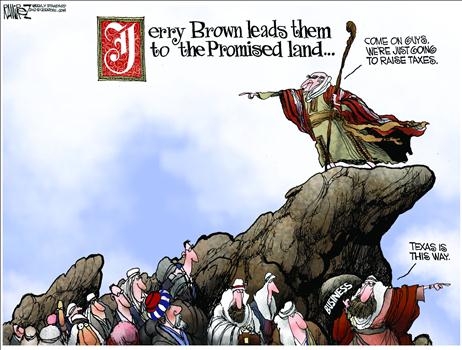
Cartoon California Promised Land

But the biggest impact of the tax hike – as shown in the Ramirez cartoon – will be to accelerate the shift of entrepreneurs, investors, and small business owners to states that don’t steal as much. Indeed, a study from the Manhattan Institute looks at the exodus to lower-tax states.

The data also reveal the motives that drive individuals and businesses to leave California. One of these, of course, is work. …Taxation also appears to be a factor, especially as it contributes to the business climate and, in turn, jobs. Most of the destination states favored by Californians have lower taxes. States that have gained the most at California’s expense are rated as having better business climates. The data suggest that many cost drivers—taxes, regulations, the high price of housing and commercial real estate, costly electricity, union power, and high labor costs—are prompting businesses to locate outside California, thus helping to drive the exodus.

Yet another example of why tax competition is such an important force for economic liberalization. It punishes governments that are too greedy and gives taxpayers a chance to protect their property from the looter class.

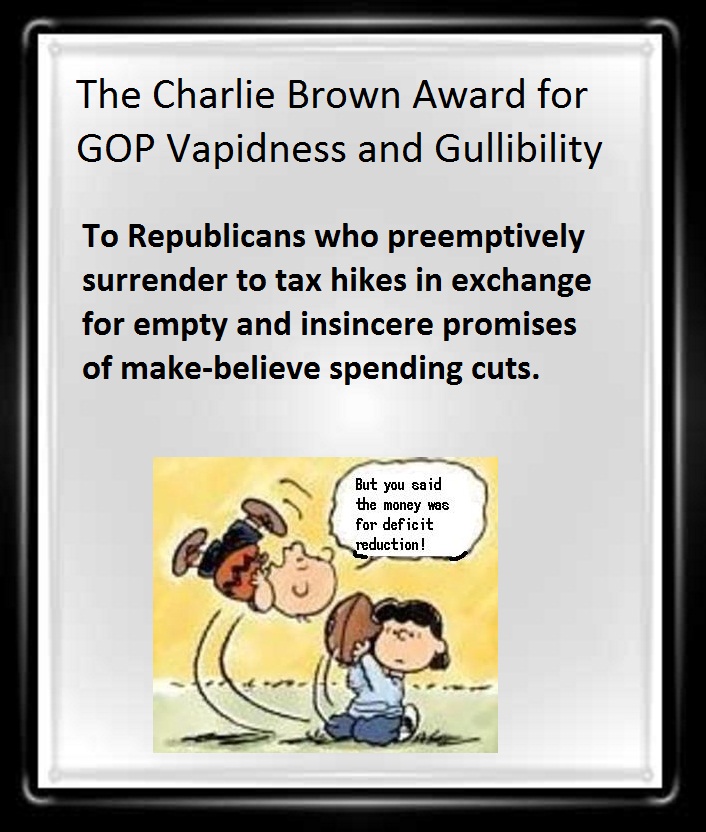
Why does the “Lucy move the football” reference apply to Republicans on the fiscal cliff?

I truly do wonder how smart our elected representatives are in Washington. I got up on 12-20-12 and read this article below from the Heritage Foundation with the reference to Charlie Brown getting fooled by Lucy again when he runs up and tries  to kick the football and of course she moves it again.

Liberals in Congress have always tried to fool conservatives by promising future cuts if they provide higher taxes now. (This article below appeared on www.heritage.org on 12-20-12.)

Obama’s “Lucy Move the Football” Fiscal Cliff Plan Still Not Balanced

Alison Acosta Fraser

December 18, 2012 at 3:25 pm

Volleys of negotiating counter-offers are coming in faster now that Christmas break and the looming fiscal cliff are just around the corner.

While there is much unsatisfactory with Speaker of the House John Boehner’s (R–OH) Sunday night proposal, let us not forget that the reason we are watching this needless, high stakes drama unfold is due to President Obama’s intractable insistence on tax increases on America’s high earners. After all, he and Congress could simply and quickly pass a bill to extend all current policies and avoid the fiscal cliff entirely—if he wanted to. No, this is really about hiking taxes on high earners. Thus the charade of deficit reduction continues.

Obama’s latest counteroffer is no more acceptable than his first offer. Short on details concerning actual spending reductions, especially on entitlements, it is replete with his requisite tax hikes and (we are shocked) new stimulus spending. The cherry on top is an extension of the debt limit for two years, essentially handing over authority to raise it to the President.

Right.

The President originally called for around $800 billion in tax hikes on America’s “highest” earners—those earning $250,000 and up. A ridiculous demand when the economy is still struggling under his big spending and regulatory policies, and one which would squarely hit smaller businesses. You know, the ones who actually create jobs.

Yet, just like Lucy and the football, when Boehner and company offered up $800 billion in tax hikes, Obama quickly doubled his demand to $1.5 trillion in tax hikes—again, all from the highest earners. They, he tells us, can afford to pay a little more. Never mind, of course, that the top 1 percent of earners already pay 37 percent of all income taxes. Somehow we are to believe this is a “balanced approach.”

Obama pitches all this on the pretext that we can simply go back to the tax rates we had under Clinton. Wrong! His dirty little tax secret is that he has already hiked taxes on high earners under Obamacare. First the law added a surtax of 0.9 percent in addition to the Medicare payroll tax on those earning over $250,000. For the first time ever, Obamacare will apply this higher rate of 3.8 percent to investment income on January 1. Obama won’t tell you that going back to Clinton-era tax rates will actually result in higher taxes on wages, dividends, and capital gains.

They say if you want less of something, then tax it. For Obama, this works fine on financial transactions, carbon emissions, driving, and junk food. But evidently, for him, not so much on a strong vibrant economy. And those Clinton boom years? They weren’t ushered in after the Clinton tax hikeonly after the Clinton–Gingrich tax cut!

Rather than working with Republicans on tax proposals that will actually grow the economy, Obama is now simply fighting over his definition of “high income” while we are left to wonder how much this $1.2 trillion tax hike will slow the economy.

As for the $1.2 trillion spending reductions, the only reason they are there is because Boehner insisted on them. But $100 billion in cuts would whack the defense budget, which is already reeling from earlier budget cuts. Yet the real spending and debt crisis comes from unaffordable entitlement programs. While Obama is insisting on balance on the tax side, he is sorely lacking in leadership here. As a recent Washington Post editorial opined:

Elections do have consequences, and Mr. Obama ran on a clear platform of increasing taxes on the wealthy. But he was clear on something else, too: Deficit reduction must be “balanced,” including spending cuts as well as tax increases. Since 60 percent of the federal budget goes to entitlement programs such as Medicare, Medicaid and Social Security, there’s no way to achieve balance without slowing the rate of increase of those programs.

We know Obama is open to changing the inflation calculation and slowing the benefit growth in Social Security. But what else? What about the proposals in his own budget, which would increase premiums on Medicare? He could easily broaden his proposals with additional uncontroversial steps to begin the process of strengthening and reining in Social Security and Medicare. All he needs to do is lead.

Some polls may show that Americans think taxes should be part of a deficit deal; but what the polls do not always show is their utter distrust that Washington would use new revenues to actually reduce the deficit. Here, Obama does not let them down. He reportedly wants $80 billion in new spending on infrastructure and unemployment benefits.

In exchange for all of this, he wants to raise the debt limit by enough to fuel his big spending goals for two years. This is utterly unacceptable. Americans know you cannot reduce the deficit when you plan to actually spend more. Americans also know that when Washington lifts the debt limit, it will not control spending. The debt limit puts the very pressure lawmakers need to account for out-of-control spending and make vital course corrections to bring spending under control, lest we face a Euro-style debt crisis in the future.

White House Press Secretary Jay Carney is actually insisting that “[t]he President’s proposal is the only proposal we have seen that achieves the balance that is so necessary.” Balance, evidently, is in the eyes of the beholder. As the Post noted, 60 percent of the budget stems from entitlements.

In just 13 short years—by the time today’s kindergarteners enter college—entitlements and interest on the debt will eat up all tax revenues. A truly balanced approach must start where the problem starts—with substantive reforms to entitlements. While the President maintains that you cannot cut your way to prosperity, you certainly cannot tax your way there.

_______________

Below is a speech by George W. Bush honoring Milton Friedman:

Milton Friedman Honored for Lifetime Achievements 2002/5/9

Milton Friedman said that getting George Bush I to be his vice president was his biggest mistake because he knew that Bush was not a true conservative and sure enough George Bush did raise taxes when he later became President. I wonder if Jeb Bush has the same genes as his father.

What we need is some people in Washington that are brave enough to say that we have taken too much of the american people’s money and we have to make the painful spending cuts in order to balance the budget and not ask for any more tax increases!!!! Arkansas’ congressman Rick Crawford has also made the Charlie Brown mistake but he has backed off it since.

Even though America’s fiscal problem is entirely the result of too much government spending, I wrote earlier this year that there were all sorts of scenarios where I would agree to a tax increase.

But I then pointed out that all of those scenarios were total fantasies and that it would be more realistic to envision me playing center field for the New York Yankees.

The fundamental problem is that politicians never follow through on promises to reduce spending – even if you use the dishonest Washington definition that a spending cut occurs whenever the budget doesn’t rise as fast as previously planned.

And to make matters worse, they always seem to want class-warfare tax hikes that do heavy economic damage rather than the loophole closers that at least get rid of some of the inefficient corruption in the tax code.

That’s why I like the anti-tax pledge of Americans for Tax Reform. You don’t solve America’s fiscal problems by saying no to all tax increases, but at least you don’t move in the wrong direction at a faster rate.

Notwithstanding the principled and pragmatic arguments against putting tax increases on the table, some Republicans – in a triumph of hope over experience – are preemptively acquiescing to tax hikes.

Here’s what Jeb Bush said.

Jeb Bush, the former Florida governor, said Friday that he could back a broad deficit plan that increased taxes, a stance that puts him at odds with other prominent Republicans. Bush told a House panel he could get behind a plan that combined 10 dollars in spending cuts for every dollar of new revenue… “The problem is the 10 never materializes,” [Congressman Paul] Ryan said after Bush said he could support a revenue-increasing deficit deal. Norquist also has criticized deficit deals crafted in 1982 and 1990 – the latter agreed to by then-President George H.W. Bush, Jeb’s father – for failing to deliver on the spending side.

Kudos to Paul Ryan for making the obvious point about make-believe spending cuts. And Grover is correct about the failure of previous budget deals.

Indeed, I cited a New York Times column that inadvertently revealed that the only budget deal that worked was the 1997 pact that cut taxes rather than raised them.

Jeb Bush isn’t the only apostate. Here’s what Senator Graham had to say.

Sen. Lindsey Graham (R-S.C.) said Tuesday he believed Republicans should consider eliminating loopholes in the tax code even if they aren’t replaced by additional tax cuts, a move that would break with an anti-tax pledge many GOP lawmakers have signed with activist Grover Norquist. “When you eliminate a deduction, it’s OK with me to use some of that money to get us out of debt. That’s where I disagree with the pledge,” Graham told ABC News. …”I’m willing to move my party, or try to, on the tax issue. I need someone on the Democratic side being willing to move their party on structural changes to entitlements.” Graham said, for instance, he would support a plan that included $4 in spending cuts for every $1 in tax increases. During a Republican debate last August, all eight Republican candidates in attendance said they would reject a proposal to trade $10 in spending cuts for even $1 in tax increases.

In some sense, Senator Graham’s comments are reasonable. With real spending cuts and less-damaging forms of tax hikes, an acceptable deal is possible. But only in Fantasia, not in Washington.

In the real world, all that Senator Graham has done is to move the debate slightly to the left.

I’ve noted that tax increases are political poison for the Republican Party, but I don’t lose sleep worrying about the GOP.

But I do have nightmares about government getting even bigger, and that’s why I don’t want tax increases on the table. I don’t even want them in the room. Or the house. Or the neighborhood.

That’s why Jeb Bush and Lindsey Graham are the newest winners of the Charlie Brown Award. They’ve put blood in the water. I wonder if they’ll act surprised when hungry sharks show up looking for a meal?

_____________

In 1982 the Democrats promised future spending cuts if Ronald Reagan would agree to a tax increase, but you guessed it, the taxes were increased and the spending cuts never came. THE REAL PROBLEM IS NOT THAT WE DON’T HAVE ENOUGH TAXES BUT WE DON’T WANT TO CUT SPENDING!!!

Washington Could Learn a Lot from a Drug Addict

Concerning spending cuts Reagan believed, that members of Congress “wouldn’t lie to him when he should have known better.” However, can you believe a drug addict when he tells you he is not ever going to do his habit again? Congress is addicted to spending too much money.  Lee Edwards wrote in his article “Golden Years” about Ronald Reagan:

Sometimes Reagan went along with a pragamatist like chief of staff James Baker, who persuaded the president to accept the Tax Equity and Fiscal Responsibility Act of 1982 (TEFRA), which turned out to be the great tax increase of 1982 — $98 billion over the next three years. That was too much for eighty-nine House Republicans (including second-term Congressman Newt Gingrich of Georgia) or for prominent conservative organizations from the American Conservative Union like the Conservative Caucus and the U.S. Chamber of Commerce, which all opposed the measure.

Baker assured his boss that Congress would approve three dollars in spending cuts for every dollar of tax increase. To Reagan, TEFRA looked like a pretty good “70 percent” deal. But Congress wound up cutting less than twenty-seven cents for every new tax dollar. What had seemed to be an acceptable 70-30 compromise turned out to be a 30-70 surrender. Ed Meese described TEFRA as “the greatest domestic error of the Reagan administration,” although it did leave untouched the individual tax rate reductions approved the previous year. (TEFRA was built on a series of business and excise taxes plus the removal of business tax deductions.)[xxx]

The basic problem was that Reagan believed, as Lyn Nofziger put it, that members of Congress “wouldn’t lie to him when he should have known better.”[xxxi] As a result of TEFRA, Reagan learned to “trust but verify,” whether he was dealing with a Speaker of the House or a president of the Soviet Union.

_________

Related posts:

Open letter to President Obama (Part 201)Tea Party favorite Representative links article “Prescott and Ohanian: Taxes Are Much Higher Than You Think”

    (Emailed to White House on 12-21-12.) President Obama c/o The White House 1600 Pennsylvania Avenue NW Washington, DC 20500 Dear Mr. President, I know that you receive 20,000 letters a day and that you actually read 10 of them every day. I really do respect you for trying to get a pulse on […]

Open letter to President Obama (Part 200.2)Tea Party Republican Representative takes on the President concerning fiscal cliff

(Emailed to White House on 12-21-12.) President Obama c/o The White House 1600 Pennsylvania Avenue NW Washington, DC 20500 Dear Mr. President, I know that you receive 20,000 letters a day and that you actually read 10 of them every day. I really do respect you for trying to get a pulse on what is […]

Open letter to President Obama (Part 200.1)Tea Party favorite Representative shares link on facebook

 (Emailed to White House on 12-21-12) President Obama c/o The White House 1600 Pennsylvania Avenue NW Washington, DC 20500 Dear Mr. President, I know that you receive 20,000 letters a day and that you actually read 10 of them every day. I really do respect you for trying to get a pulse on what is […]

Open letter to President Obama (Part 199) Tea Party favorite takes on President

  The federal government has a spending problem and Milton Friedman came up with the negative income tax to help poor people get out of the welfare trap. It seems that the government screws up about everything. Then why is President Obama wanting more taxes? _______________ Milton Friedman – The Negative Income Tax Published on […]

Tea Party Heroes Rep. David Schweikert (R-AZ),Justin Amash (R-MI), Tim Huelskamp (R-KS) have been punished by Boehner

I was sad to read that the Speaker John Boehner has been involved in punishing tea  party republicans. Actually I have written letters to several of these same tea party heroes telling them that I have emailed Boehner encouraging him to listen to them. Rep. David Schweikert (R-AZ),Justin Amash (R-MI), and Tim Huelskamp (R-KS). have been contacted […]

Some Tea Party heroes (Part 10)

Michael Tanner of the Cato Institute in his article, “Hitting the Ceiling,” National Review Online, March 7, 2012 noted: After all, despite all the sturm und drang about spending cuts as part of last year’s debt-ceiling deal, federal spending not only increased from 2011 to 2012, it rose faster than inflation and population growth combined. […]

Dan Mitchell answers the question “Is the media biased?”

I enjoy reading Dan’s answers every week.


Most of the questions I received were in the past couple of days and almost all of them dealt with gun control. But I think what I wrote earlier today is a good response to those queries.

So let’s deal with a question (actually two questions) from Minnesota, both of which are very simple and direct: “You deal with reporters a lot. Is the media biased? Or are people on the right just whining?”

First, I’m glad that someone else posed the question, because I wouldn’t be sure whether to ask “Are the media biased” or “Is the media biased.” I’m sure there’s a Grammar Nazi out there who knows the answer.

But back to the point of this post, I think the answer to both questions is yes. Conservatives and libertarians are whining, but that’s very understandable because the press does try to help the other side. And I have several examples.

But I want to emphasize a key point. Media bias very rarely involves dishonesty. Deception yes, but not inaccuracies. It’s almost always about story selection and what gets emphasized.

Even when there’s a clear-cut mistake, such as the jaw-dropping New York Times assertion about lower education spending, I suspect it’s the result of group-think rather than a deliberate decision to lie.

But there often are deliberate decisions to steer the debate in a certain direction, and I there’s a very good example in a new expose by the Daily Caller. They caught the folks at Bloomberg highlighting poll data that helped Obama and burying the results that might give aid and comfort to the GOP.

A poll conducted last week by an Iowa-based firm showed Americans are conflicted about whether or not to support raising tax rates on wealthy Americans to avert the so-called “fiscal cliff.” But that’s not how Bloomberg News, which commissioned the poll, reported the results Thursday. In a story headlined “Americans Back Obama Tax-Rate Boost Tied to Entitlements,” Bloomberg emphasized only that the poll showed most Americans support President Barack Obama’s insistence on increasing taxes for high-income earners. “A majority of Americans say President Barack Obama is right to demand that tax-rate increases for the highest earners be a precondition for a budget deal that cuts U.S. entitlement programs,” the story, written by reporter Julie Hirschfeld Davis, began. …But in the same poll, American adults were asked “whether it is better to raise the top tax rate the wealthy pay, or to limit the amount people can claim in tax breaks, such as mortgage interest and charitable contributions, so they end up paying tax on a bigger share of their income.” Fifty-two percent responded that they preferred limited tax breaks to a tax-rate hike. Only 39 percent said they would rather see tax rates on the wealthy increase. Nine percent indicated they weren’t sure. …Bloomberg mentioned the second question in the story’s 20th paragraph, and gave no indication that the results suggested support for Boehner or House Republicans.

Kudos to the Daily Caller for catching the folks at Bloomberg with the hands in the cookie jar.

Notice, though, that there are (presumably) no falsehoods or fabrications in the Bloomberg report. The bias shows up in terms of what gets prominent coverage and what gets buried.

You’ll be happy to know, by the way, that “Bloomberg News editor and political reporter Jeanne Cummings conceded to The Daily Caller that the poll’s results are apparently contradictory.”

Gee, what a big concession to fairness.

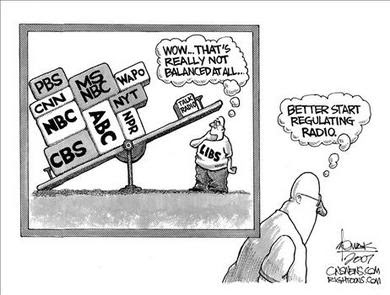
P.S. You can see a couple of good cartoons about media bias in this post, and another good one at the bottom of this post.