Category Archives: Economist Dan Mitchell

Since 2000 USA expanded the welfare state faster than almost every European nation!!!

____________

Dan Mitchell Discussing Food Stamps, Dependency and Faux Compassion on Kudlow’s CNBC Show

________________

Since 2000 USA expanded the welfare state faster than almost every European nation!!!

There’s an old joke about two guys camping in the woods, when suddenly they see a hungry bear charging over a hill in their direction. One of the guys starts lacing up his sneakers and his friend says, “What are you doing? You can’t outrun a bear.” The other guys says, I don’t have to outrun the bear, I just need to outrun you.”

That’s reasonably amusing, but it also provides some insight into national competitiveness. In the battle for jobs and investments, nations can change policy to impact their attractiveness, but they also can gain ground or lose ground because of what happens in other nations.
The corporate tax rate in the United States hasn’t been changed in decades, for instance, but the United States has fallen further and further behind the rest of the world because other nations have lowered their rates.

Courtesy of a report in the UK-basedTelegraph, here’s another example of how relative policy changes can impact growth and competitiveness.

The paper looks at changes in the burden of welfare spending over the past 14 years. The story understandably focuses on how the United Kingdom is faring compared to other European nations.

Welfare spending in Britain has increased faster than almost any other country in Europe since 2000, new figures show.  The cost of unemployment benefits, housing support and pensions as share of the economy has increased by more than a quarter over the past thirteen years – growing at a faster rate than in most of the developed world. Spending has gone up from 18.6 per cent of GDP to 23.7 per cent of GDP – an increase of 27 per cent, according to figures from the OECD, the club of most developed nations. By contrast, the average increase in welfare spending in the OECD was 16 per cent.

This map from the story shows how welfare spending has changed in various nations, with darker colors indicating a bigger expansion in the welfare state.

Welfare Spending - Europe

American readers, however, may be more interested in this excerpt.

In the developed world, only the United States and the stricken eurozone states of Ireland, Portugal and Spain – which are blighted by high unemployment – have increased spending quicker than Britain.

Yes, you read correctly. The United States expanded the welfare state faster than almost every European nation.

Here’s another map, but I’ve included North America and pulled out the figures for the countries that suffered the biggest increases in welfare spending. As you can see, only Ireland and Portugal were more profligate than the United States.
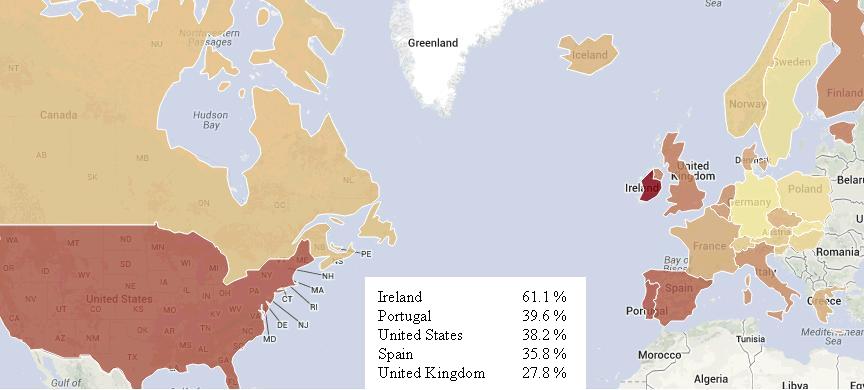
Welfare Spending - NA + WE

Needless to say, this is not a good sign for the United States.

But the situation is not hopeless. The aforementioned numbers simply tell us the rate of change in welfare spending. But that doesn’t tell us whether countries have big welfare states or small welfare states.

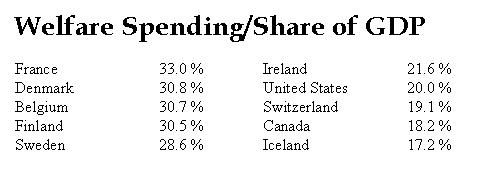
That’s why I also pulled out the numbers showing the current burden of welfare spending – measured as a share of economic output – for countries in North America and Western Europe.

This data is more favorable to the United States. As you can see, America still has one of the lowest overall levels of welfare spending among developed nations.
Welfare Spending - NA + WE -Share GDP

Ireland also is in a decent position, so the real lesson of the data is that the United States and Ireland must have been in relatively strong shape back in 2000, but the trend over the past 14 years has been very bad.

It’s also no surprise that France is the most profligate of all developed countries.

Let’s close by seeing if any nations have been good performers. The Telegraphdoes note that Germany has done a good job of restraining spending. The story even gives a version of Mitchell’s Golden Rule by noting that good policy happens when spending grows slower than private output.

Over the thirteen years from 2000, Germany has cut welfare spending as a share of GDP by 1.5 per cent… Such reductions are possible by increasing welfare bills at a lower rate than growth in the economy.

But the more important question is whether there are nations that get good scores in both categories. In other words, have they controlled spending since 2000 while also having a comparatively low burden of welfare outlays?

Welfare Spending - The Frugal FiveHere are the five nations with the smallest increases in welfare spending since 2000. You can see that Germany had the best relative performance, but you’ll notice from the previous table that Germany is not on the list of five nations with the smallest overall welfare burdens. Indeed, German welfare spending consumes 26.2 percent of GDP, so Germany still has a long way to go.

The nation that does show up on both lists for frugality is Switzerland. Spending has grown relatively slowly since 2000 and the Swiss also have the third-lowest overall burdens of welfare spending.

Hmmm…makes you wonder if this is another sign that Switzerland’s “debt brake” spending cap is a policy to emulate.

By the way, Canada deserves honorable mention. It has the second-lowest overall burden of welfare spending, and it had the sixth-best performance in controlling spending since 2000. Welfare outlays in our northern neighbor grew by 10 percent since 2000, barely one-fourth as fast as the American increase during the reckless Bush-Obama years.

No wonder Canada is now much higher than the United States in measures of economic freedom.


Related posts:

If you want to cut government waste then stop allowing people to get addicted to government programs!!!!

______________ If you want to cut government waste then stop allowing people  to get addicted to government programs!!!! November 3, 2013 1:07PM Lindbeck’s Law: The Self-Destructive Nature of Expanding Government Benefits By Alan Reynolds Share Relevant foresight from Swedish economist Assar Lindbeck, “Hazardous Welfare State Dynamics,” American Economic Review, May 1995: The basic dilemma of […]

We got to shutdown government waste now!!!

We got to shutdown government waste now!!! October 2, 2013 11:16AM Shutdown Could Shut Down Waste By Chris Edwards Share A benefit of the government shutdown may be that it slows the stream of waste and bad behavior flowing from the federal bureaucracy. Catching up on my reading, I noticed these items in just the […]

Open letter to President Obama (Part 440) A suggestion to cut some wasteful spending out of the government Part 6 (includes editorial cartoon)

(Emailed to White House on 3-15-13.) President Obama c/o The White House 1600 Pennsylvania Avenue NW Washington, DC 20500 Dear Mr. President, I know that you receive 20,000 letters a day and that you actually read 10 of them every day. I really do respect you for trying to get a pulse on what is […]

Open letter to President Obama (Part 438) A suggestion to cut some wasteful spending out of the government Part 5 (includes editorial cartoon)

(Emailed to White House on 3-15-13.) President Obama c/o The White House 1600 Pennsylvania Avenue NW Washington, DC 20500 Dear Mr. President, I know that you receive 20,000 letters a day and that you actually read 10 of them every day. I really do respect you for trying to get a pulse on what is […]

Open letter to President Obama (Part 436) A suggestion to cut some wasteful spending out of the government Part 4 (includes editorial cartoon)

(Emailed to White House on 3-15-13.) President Obama c/o The White House 1600 Pennsylvania Avenue NW Washington, DC 20500 Dear Mr. President, I know that you receive 20,000 letters a day and that you actually read 10 of them every day. I really do respect you for trying to get a pulse on what is […]

Open letter to President Obama (Part 434) A suggestion to cut some wasteful spending out of the government Part 3 (includes editorial cartoon)

(Emailed to White House on 3-15-13.) President Obama c/o The White House 1600 Pennsylvania Avenue NW Washington, DC 20500 Dear Mr. President, I know that you receive 20,000 letters a day and that you actually read 10 of them every day. I really do respect you for trying to get a pulse on what is […]

Open letter to President Obama (Part 432) A suggestion to cut some wasteful spending out of the government Part 2 (includes editorial cartoon)

(Emailed to White House on 3-15-13.) President Obama c/o The White House 1600 Pennsylvania Avenue NW Washington, DC 20500 Dear Mr. President, I know that you receive 20,000 letters a day and that you actually read 10 of them every day. I really do respect you for trying to get a pulse on what is […]

Open letter to President Obama (Part 430) A suggestion to cut some wasteful spending out of the government Part 1 (includes editorial cartoon)

(Emailed to White House on 3-15-13.) President Obama c/o The White House 1600 Pennsylvania Avenue NW Washington, DC 20500 Dear Mr. President, I know that you receive 20,000 letters a day and that you actually read 10 of them every day. I really do respect you for trying to get a pulse on what is […]

We need to stop wasteful government spending by privatizing the post office!!

We need to stop wasteful government spending by privatizing the post office!! Postal Service Won’t Shut Down but Will Default on Its Debt James Gattuso October 1, 2013 at 9:30 am Newscom The U.S. Postal Service (USPS) defaulted on its debt last night. No, it has nothing to do with the partial shutdown of the […]

President Obama and government spending (GSA Govt waste tip of iceberg)

I wish President Obama would try to cut spending instead of increasing spending and our debt. Two Very Good GSA Waste Cartoons April 21, 2012 by Dan Mitchell One of my first blog posts back in 2009 featured a column about the Social Security Administration squandering $750,000 on a “conference” at a fancy golf resort in […]
Open letter to President Obama (Part 500) (The United Nations is full of gun control nuts)

Open letter to President Obama (Part 500)

(Emailed to White House on 4-15-13.)

President Obama c/o The White House 1600 Pennsylvania Avenue NW Washington, DC 20500

Dear Mr. President,

I know that you receive 20,000 letters a day and that you actually read 10 of them every day. I really do respect you for trying to get a pulse on what is going on out here.

___________________

Why do you believe taking guns away from honest people will lower violence?

The United Nations is full of gun control nuts.

Citing the analysis of America’s former Ambassador to the United Nations, I wrote last year about a treaty being concocted at the United Nations that would threaten our right to keep and bear arms.

Well, with the aid of the Obama Administration, this new treaty has been approved. Fortunately, there probably are not 67 votes in the Senate to ratify the measure.

And that’s a good thing. The Wall Street Journal has a column by John Bolton and John Yoo explaining why the new U.N . treaty is so misguided and dangerous.

…the new treaty also demands domestic regulation of “small arms and light weapons.” The treaty’s Article 5 requires nations to “establish and maintain a national control system,” including a “national control list.” …Gun-control advocates will use these provisions to argue that the U.S. must enact measures such as a national gun registry, licenses for guns and ammunition sales, universal background checks, and even a ban of certain weapons. The treaty thus provides the Obama administration with an end-run around Congress to reach these gun-control holy grails.

But doesn’t the Second Amendment protect our rights, regardless?

Unfortunately, that’s not clearly the case, as Bolton and Yoo note.

The Constitution establishes treaties in Article II (which sets out the president’s executive powers), rather than in Article I (which defines the legislature’s authority)—so treaties therefore aren’t textually subject to the limits on Congress’s power. Treaties still receive the force of law under the Supremacy Clause, which declares that “This Constitution, and the Laws of the United States which shall be made in Pursuance thereof; and all Treaties made, or which shall be made, under the Authority of the United States, shall be the supreme Law of the Land.” …this difference in language between laws and treaties allows the latter to sweep more broadly than the former.

One thing we can state with certainty is that opponents of individual rights will use the treaty to push an anti-gun agenda inside the United States. And since the Supreme Court has upheld the Second Amendment by only one vote, I’m not overly confident that we can rely on the judiciary anyhow.

Ultimately, our fundamental rights to protect ourselves and our families only exist because politicians are scared of getting voted out of office and losing the best job most of them will ever have.

And remember that the “slippery slope” is a very relevant concern. Many anti-gun activists think only government should have the right to possess guns, and they view incremental gun control measures as building blocks to that ultimate goal.

Even though government monopolies on gun possession have been associated with some of the world’s most brutal dictatorships!

I’m not worried that the United States is going to turn into some Venezuelan-style anti-gun totalitarian regime, so I actually disagree with the results of my poll on the biggest reason to oppose gun control.

If I was asked to give my worst-case scenario for why we need private gun ownership, it would involve fiscal and societal breakdown because of an ever-growing welfare state.

But regardless of why you believe in the Second Amendment, this U.N. treaty would be a very bad development.


______________________

Thank you so much for your time. I know how valuable it is. I also appreciate the fine family that you have and your commitment as a father and a husband.

Sincerely,

Everette Hatcher III, 13900 Cottontail Lane, Alexander, AR 72002, ph 501-920-5733, lowcostsqueegees@yahoo.com

Related posts:

Comparison of crime data and concealed carry gun laws between Houston and Chicago (includes funny gun control posters)

Sometimes you just have to look at the facts!!! An Inside Look at Left-Wing Social Science Gun Research March 20, 2013 by Dan Mitchell In a presumably futile effort to change their minds by learning how they think, I periodically try to figure out the left-wing mind. Why, for instance, do some people believe in Keynesian […]

Michael Moore’s idea that pictures from Sandy Hook will help gun control argument (includes editorial picture)

I do love Michael Moore’s movie “Canadian Bacon” and I have blogged about it before. However, I am not a big Michael Moore fan. Take a look at this excellent article by Trevor Burrus of the Cato Institute on Moore’s latest stupid claim. March 15, 2013 3:50PM Some Pictures for Michael Moore By Trevor Burrus […]

Open letter to President Obama (Part 256) (on gun control)

(This letter was mailed before October 1, 2012) President Obama c/o The White House 1600 Pennsylvania Avenue NW Washington, DC 20500 Dear Mr. President, I know that you receive 20,000 letters a day and that you actually read 10 of them every day. I really do respect you for trying to get a pulse on what […]

Letter from David Kopel of Cato Institute to Senator Cruz on constitutional issues in federal gun control proposals (Great yardsign on gun control)

  Great yardsign on gun control from Dan Mitchell’s blog. Here’s a quiz. What do you do after seeing this sign? Letter to Senator Cruz on constitutional issues in federal gun control proposals David Kopel • February 11, 2013 2:25 pm On Tuesday, the U.S. Senate Judiciary Committee Subcommittee on the Constitution, Civil Rights and Human […]

Gun control posters from Dan Mitchell’s blog Part 5

The rear of the Bath School after the May 18, 1927 bombing. Wikimedia Commons ___________ I have put up lots of cartoons and posters from Dan Mitchell’s blog before and they have got lots of hits before. Many of them have dealt with the economy, eternal unemployment benefits, socialism,  Greece,  welfare state or on gun control. Did […]

Gun control posters from Dan Mitchell’s blog Part 4

I have put up lots of cartons and posters from Dan Mitchell’s blog before and they have got lots of hits before. Many of them have dealt with the economy, eternal unemployment benefits, socialism,  Greece,  welfare state or on gun control. There is no doubt that Hitler took away guns from those he wanted to persecute and […]

Ilya Shapiro’s Feb 8, 2013 testimony before Senate subcommittee on proposals to reduce gun violence (gun control cartoon)

  Max Brantley of The Arkansas Times again on 2-18-13 is complaining about those who believe strongly in the 2nd amendment. Another good cartoon from Dan Mitchell’s blog on gun control. It seems that Colorado is the only state that has passed sensible gun control laws after a gun tragedy and that was after the […]

Gun control posters from Dan Mitchell’s blog Part 3

I have put up lots of cartoons and posters from Dan Mitchell’s blog before and they have got lots of hits before. Many of them have dealt with the economy, eternal unemployment benefits, socialism,  Greece,  welfare state or on gun control. Raising My Daughter Right March 26, 2010 by Dan Mitchell I got her this t-shirt at the […]

Gun control posters from Dan Mitchell’s blog Part 2

I have put up lots of cartons and posters from Dan Mitchell’s blog before and they have got lots of hits before. Many of them have dealt with the economy, eternal unemployment benefits, socialism,  Greece,  welfare state or on gun control. Amusing Gun Control Picture – Circa 1999 April 3, 2010 by Dan Mitchell Dug this gem out […]

Gun control posters from Dan Mitchell’s blog Part 1

I have put up lots of cartons and posters from Dan Mitchell’s blog before and they have got lots of hits before. Many of them have dealt with the economy, eternal unemployment benefits, socialism,  Greece,  welfare state or on gun control. On 2-6-13 the Arkansas Times Blogger “Sound Policy” suggested,  “All churches that wish to allow concealed […]

Obama is far behind other presidents on job creation!!!!

__________

Obama is far behind other presidents on job creation!!!!

According to the most recent numbers from the Bureau of Labor Statistics, the unemployment rate has dropped to 6.7 percent. Is this good news?

Well, it’s depends on your benchmark. Compared to France’s anemic economyand double-digit levels of unemployment, America is in decent shape.

But if you use data from the Minneapolis Federal Reserve to compare the current business cycle to previous downturns and upturns in the U.S. economy, then the outlook is very grim. Simply stated, the American economy is enduring the worst performance for labor markets since the Great Depression.

Moreover, the Washington Post put together a chart in 2012 showing that Obama was far behind other presidents on job creation (a point humorously reinforced by Michael Ramirez).

Let’s look at some additional data to assess the President’s track record on jobs.

We’ll start with a chart, versions of which I’ve been sharing for nearly four years. It shows the unemployment rate that the White House claimed we would have back in 2009 if the so-called stimulus was enacted, compared to what actually happened.

Obama Unemployment

As you can see, this is hardly a ringing endorsement for the Keynesian notionthat more government spending is good for job creation (or for Nancy Pelosi’s laughable claim that you create jobs by paying people not to work).

But even though I’ve used variations of that chart several times, I don’t think it’s the best measure of either employment markets or the President’s performance. The White House can argue, with some validity, that the chart merely shows that the recession was more severe than they first forecast.

And critics of the Obama Administration can argue, also with validity, that the unemployment rate is an inadequate measure because it doesn’t capture the extent to which people drop out of the job market.

That’s why I’ve always liked the Labor Department’s figures showing the employment-population ratio. It’s a very straightforward number, showing the share of the working-age population that is employed.

And this data series is perhaps even more unfavorable if we’re giving Obama a grade for jobs.

The big drop took place before the President took office, so that’s definitely not his fault. But he can be blamed for the fact that the labor market didn’t bounce back, which usually happens after a recession.

Having millions of people leave the labor force translates into less economic output.

…economic output is a function of labor and capital. And if you want an economy to produce more, your only choices are to somehow achieve one or more of the following:

  • More capital.
  • More labor.
  • More efficient use of capital.
  • More productive use of labor.

In other words, labor and capital are the two ingredients that determine economic performance.

Needless to say, if you have less of one of the ingredients, you’re not going to produce as much.

Let’s look at another chart that reveals the Administration’s poor performance on jobs. James Pethokoukis of the American Enterprise Institute combines concepts by replicating the White House’s chart (including their prediction of joblessness in the absence of a so-called stimulus), but also including red dots showing what the unemployment rate would be today based on the various labor force participation rates that we might expect in a healthier economy.

The startling takeaway from this chart is that the unemployment rate today would be more than 10 percent if people hadn’t dropped out of the labor market!

Very sobering data, indeed.

And the main response from the White House is to argue for more unemployment benefits. That’s not very compassionate, as Senator Rand Paul and I explained in a piece for USA Today.

BLS LFP ForecastBy the way, there is no reason to think that labor force was supposed to shrink. Here’s what the Bureau of Labor Statistics predicted in 2007 compared to what’s actually happened.

So we have to ask ourselves why did so many workers leave the labor market? Was it the overall increase in the burden of government? The increase in the minimum wage? The disability scamSubsidized unemployment? The welfare trap?

The honest answer is either “I don’t know” or “all of the above.” Or maybe something in between.

But I do know that it’s a very bad sign.

And it’s especially discouraging that we’re seeing a significant drop if labor force participation among males of prime working age.

That may reflect an erosion of social capital, and once a society loses the spirit of self reliance and the work ethic, it’s very difficult to restore those valuable norms. And once a nation has too many people riding in the wagon and not enough people pulling the wagon, that doesn’t bode well.

Since this post has been filled withe depressing data, let’s close by sharing some amusing cartoons.

Nate Beeler has produced some gems, so let’s start with this cartoon showing that some people have been stuck in a deep freeze.

Cartoon Obama Unemployment 3

And here’s Beeler’s take on the “drop” in labor force participation.

Cartoon Obama Unemployment 2

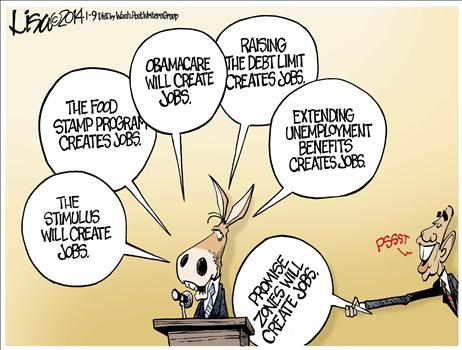
Lisa Benson, meanwhile, mocks the President’s empty talking points.

Cartoon Obama Unemployment 4

And Glenn McCoy shows the President’s version of compassion.

Cartoon Obama Unemployment 1

These cartoons remind me of the ones I shared last August.

P.S. Careful readers will have noticed that this piece cites both the employment-population ratio and the labor force participation rate. These two data series are sometimes used interchangeably, though I prefer the former for reasons explained in this article for the BLS’s Monthly Labor Review.

P.P.S. On a totally separate topic, I want to share some good news about the International Monetary Fund. The IMF is a statist international bureaucracy that pushed for bad policy, both in America and other nations. Last year, I reported that the Obama Administration proposed to give the IMF more money and authority, but that lawmakers on Capitol Hill wisely rejected the request. Well, the same positive outcome  happened again as part of the spending bill just approved by Congress.

Here’s some of what the New York Times reported.

Administration officials concede that Congress’s decision not to make the changes will be an embarrassment to President Obama internationally…congressional Republicans would not budge… The structural changes to the fund have languished since Mr. Obama agreed to the “rebalancing” with great fanfare at the G-20 meeting in Seoul, South Korea, in 2010.  …Since the 2010 accord, every nation involved but the United States has ratified it. But the United States remains the monetary fund’s largest contributor, and without Congress’s approval, the restructuring cannot happen.

P.P.P.S. And since I’m sharing random news, here’s something else that may interest readers. Time has a non-political personality quiz that supposedly reveals whether you are liberal or conservative. For what it’s worth, I’m 83 percent conservative and 17 percent liberal. I’m not sure what to think of the test, but it’s definitely better than the “social attitude test” I took last year, which concluded that I’m a “moderate” and “a centrist with few strong opinions.” I much prefer Professor Bryan Caplan’s libertarian purity quiz, where I scored a 94 out of 160, which may not sound impressive, but it was enough to put me in “the heady realm of hard-core libertarianism.”

____________

Dan Mitchell Discussing Food Stamps, Dependency and Faux Compassion on Kudlow’s CNBC Show

________________

Related posts:

If you want to cut government waste then stop allowing people to get addicted to government programs!!!!

______________ If you want to cut government waste then stop allowing people  to get addicted to government programs!!!! November 3, 2013 1:07PM Lindbeck’s Law: The Self-Destructive Nature of Expanding Government Benefits By Alan Reynolds Share Relevant foresight from Swedish economist Assar Lindbeck, “Hazardous Welfare State Dynamics,” American Economic Review, May 1995: The basic dilemma of […]

We got to shutdown government waste now!!!

We got to shutdown government waste now!!! October 2, 2013 11:16AM Shutdown Could Shut Down Waste By Chris Edwards Share A benefit of the government shutdown may be that it slows the stream of waste and bad behavior flowing from the federal bureaucracy. Catching up on my reading, I noticed these items in just the […]

Open letter to President Obama (Part 440) A suggestion to cut some wasteful spending out of the government Part 6 (includes editorial cartoon)

(Emailed to White House on 3-15-13.) President Obama c/o The White House 1600 Pennsylvania Avenue NW Washington, DC 20500 Dear Mr. President, I know that you receive 20,000 letters a day and that you actually read 10 of them every day. I really do respect you for trying to get a pulse on what is […]

Open letter to President Obama (Part 438) A suggestion to cut some wasteful spending out of the government Part 5 (includes editorial cartoon)

(Emailed to White House on 3-15-13.) President Obama c/o The White House 1600 Pennsylvania Avenue NW Washington, DC 20500 Dear Mr. President, I know that you receive 20,000 letters a day and that you actually read 10 of them every day. I really do respect you for trying to get a pulse on what is […]

Open letter to President Obama (Part 436) A suggestion to cut some wasteful spending out of the government Part 4 (includes editorial cartoon)

(Emailed to White House on 3-15-13.) President Obama c/o The White House 1600 Pennsylvania Avenue NW Washington, DC 20500 Dear Mr. President, I know that you receive 20,000 letters a day and that you actually read 10 of them every day. I really do respect you for trying to get a pulse on what is […]

Open letter to President Obama (Part 434) A suggestion to cut some wasteful spending out of the government Part 3 (includes editorial cartoon)

(Emailed to White House on 3-15-13.) President Obama c/o The White House 1600 Pennsylvania Avenue NW Washington, DC 20500 Dear Mr. President, I know that you receive 20,000 letters a day and that you actually read 10 of them every day. I really do respect you for trying to get a pulse on what is […]

Open letter to President Obama (Part 432) A suggestion to cut some wasteful spending out of the government Part 2 (includes editorial cartoon)

(Emailed to White House on 3-15-13.) President Obama c/o The White House 1600 Pennsylvania Avenue NW Washington, DC 20500 Dear Mr. President, I know that you receive 20,000 letters a day and that you actually read 10 of them every day. I really do respect you for trying to get a pulse on what is […]

Open letter to President Obama (Part 430) A suggestion to cut some wasteful spending out of the government Part 1 (includes editorial cartoon)

(Emailed to White House on 3-15-13.) President Obama c/o The White House 1600 Pennsylvania Avenue NW Washington, DC 20500 Dear Mr. President, I know that you receive 20,000 letters a day and that you actually read 10 of them every day. I really do respect you for trying to get a pulse on what is […]

We need to stop wasteful government spending by privatizing the post office!!

We need to stop wasteful government spending by privatizing the post office!! Postal Service Won’t Shut Down but Will Default on Its Debt James Gattuso October 1, 2013 at 9:30 am Newscom The U.S. Postal Service (USPS) defaulted on its debt last night. No, it has nothing to do with the partial shutdown of the […]

President Obama and government spending (GSA Govt waste tip of iceberg)

I wish President Obama would try to cut spending instead of increasing spending and our debt. Two Very Good GSA Waste Cartoons April 21, 2012 by Dan Mitchell One of my first blog posts back in 2009 featured a column about the Social Security Administration squandering $750,000 on a “conference” at a fancy golf resort in […]

Open letter to President Obama (Part 498) (Three Cheers for Governor Bobby Jindal’s Plan to Abolish the Income Tax)

Open letter to President Obama (Part 498)

(Emailed to White House on 4-10-13.)

President Obama c/o The White House 1600 Pennsylvania Avenue NW Washington, DC 20500

Dear Mr. President,

I know that you receive 20,000 letters a day and that you actually read 10 of them every day. I really do respect you for trying to get a pulse on what is going on out here.

___________________

Will Taxing the Rich Fix the Deficit?

Published on Jul 2, 2012

The government’s budget deficit in 2009 was $1.5 trillion. Many have suggested raising taxes on the rich to cover the difference between what the government collected in revenue and what it spent. Is that a realistic solution? Economics professor Antony Davies uses data to demonstrate why taxing the rich will not be sufficient to make the budget deficit disappear. He says, “The budget deficit is so large that there simply aren’t enough rich people to tax to raise enough to balance the budget.” Instead, it’s time to work on legitimate solutions, like cutting spending.

____________

I got to hear Bobby Jindal speak a few months ago in Hot Springs and he is the real deal. It is my view that if he is able to abolish the income tax in Louisiana then he will be able to grow the economy so much that other states will follow his lead and it will transform our nation. I wish the federal government would buy into the idea of cutting taxes too!!!

Two months ago exactly, I appeared on TV to talk about the concept of eliminating the personal and corporate income tax in Louisiana.

Now Governor Jindal has unveiled a specific proposal.

The plan will eliminate two major tax types: personal income tax and corporate income and franchise tax. Eliminating income taxes in a revenue-neutral manner and improving sales tax administration will dramatically simplify Louisiana’s tax system and reduce administrative problems for families and small businesses. The effective start date of the program is January 1, 2014. …The plan will ensure revenue neutrality by…[b]roadening the state sales tax base and raising the state rate to 5.88%.

This is a superb plan.

Of all the possible ways for a state to generate revenue, the income tax is the most destructive.

My new man crush

That’s why researchers consistently have found that states without this punitive levy grow faster and create more jobs.

It’s also worth noting that jurisdictions such as Monaco, Bermuda, and the Cayman Islands manage to be very prosperous in the absence of an income tax, though the incredible wealth of these places is partly a function of bad policy elsewhere, so the comparison isn’t perfect.

Anyhow, Gov. Jindal expands on this research with some very powerful data.

Over the last ten years, more than 60 percent of the three million new jobs in American were created by the nine states without an income tax. Every year for the past 40 years, states without an income tax had faster growth than states with the highest income taxes.  Economic growth in the nine states without income taxes was 50 percent faster than in the nine states with the highest top income tax rates.  Over the past decade, states without income taxes have seen nearly 60 percent higher population growth than the national average. …While we have reversed the more than two-decade problem of out-migration, we can do more to keep people here. Here are a couple of staggering statistics. Between 1995 and 2010, according to IRS data, Louisiana lost $3 billion in adjusted gross income to Texas.

Amen.

I particularly like that he recognizes the power of tax competition as an argument for better tax policy. Taxpayers win when Texas and Louisiana compete to have less oppressive tax systems.

Indeed, this should help explain why I am so fixated on the importance of making governments compete with each other. Simply stated, governments are very prone to over-tax and over-spend if they think taxpayers have no escape options.

So let’s keep our fingers crossed that Gov. Jindal’s proposal gets a friendly reception from the state legislature.

If he succeeds, I imagine he will vault himself to the top tier of Republicans looking to replace Obama.

And, who knows, maybe he can reinvigorate the argument that we can replace the corrupt internal revenue code with a national sales tax?

P.S. Jindal is good on more than just tax policy. He’s already implemented some good school choice reform, notwithstanding wretched and predictable opposition from the state’s teachers’ union.

Here’s a Lisa Benson cartoon that makes a similar point, but it focuses on Obama’s class-warfare tax policy.

Cartoon Grinch Spending

What makes the cartoon especially effective is that it not only shows that higher tax burden is designed to finance more spending, but also it makes clear that soaking-the-rich won’t be enough.

______________________

Thank you so much for your time. I know how valuable it is. I also appreciate the fine family that you have and your commitment as a father and a husband.

Sincerely,

Everette Hatcher III, 13900 Cottontail Lane, Alexander, AR 72002, ph 501-920-5733, lowcostsqueegees@yahoo.com

Open letter to President Obama (Part 496) (Challenge for Keynesian Anti-Sequester Hysterics: Why Did America’s Economy Boom When Reagan and Clinton Reduced the Burden of Spending?)

Open letter to President Obama (Part 496)

(Emailed to White House on 4-10-13.)

President Obama c/o The White House 1600 Pennsylvania Avenue NW Washington, DC 20500

Dear Mr. President,

I know that you receive 20,000 letters a day and that you actually read 10 of them every day. I really do respect you for trying to get a pulse on what is going on out here.

___________________

You make  me long for the good ole days when the economy was expanding. Why not take a close look at the way Reagan cut taxes? We have to get the big government off of our backs.

Triggered by an appearance on Canadian TV, I asked yesterday why we should believe anti-sequester Keynesians. They want us to think that a very modest reduction in the growth of government spending will hurt the economy, yet Canada enjoyed rapid growth in the mid-1990s during a period of substantial budget restraint.

I make a similar point in this debate with Robert Reich, noting that  the burden of government spending was reduced as a share of economic output during the relatively prosperous Reagan years and Clinton years.

Dan Mitchell Debating Robert Reich on Keynesian Sequester Hysteria

Being a magnanimous person, I even told Robert he should take credit for the Clinton years since he was in the cabinet as Labor Secretary. Amazingly, he didn’t take me up on my offer.

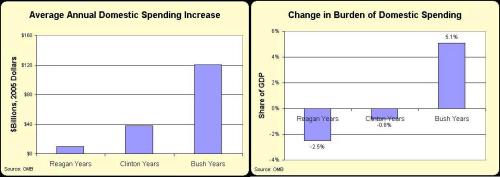
Anyhow, these two charts show the stark contrast between the fiscal policy of Reagan and Clinton compared to Bush..

Reagan-Clinton-Bush Domestic Spending

And there’s lots of additional information comparing the fiscal performance of various presidents here, here, and here.

For more information on Reagan and Clinton, this video has the details.

Which brings us back to the original issue.

The Keynesians fear that a modest reduction in the growth of government (under the sequester, the federal government will grow $2.4 trillion over the next 10 years rather than $2.5 trillion) will somehow hurt the economy.

But government spending grew much slower under Reagan and Clinton than it has during the Bush-Obama years, yet I don’t think anybody would claim the economy in recent years has been more robust than it was in the 1980s and 1990s.

And if somebody does make that claim, just show them this remarkable chart (if they want to laugh, this Michael Ramirez cartoon makes the same point).

So perhaps the only logical conclusion to reach is that government is too big and that Keynesian economics is wrong.

I don’t think I’ll every convince Robert Reich, but hopefully the rest of the world can be persuaded by real-world evidence.

I shared a remarkable chart last year exposing Obama’s terrible record on job creation.

It showed that the economy enjoyed big employment increases during the Reagan and Clinton years, but it also revealed anemic data for the Obama years.

That’s not a surprise since Reagan was the most pro-freedom President since World War II and Clinton almost surely comes in second place.

Yes, Clinton did raise tax rates in his first year, but he put together a very strong record in subsequent years. He was particularly good about restraining the burden of government spending and overall economic freedom expanded during his reign.

He was no Reagan, to be sure, and the anti-government Congress that took power after the 1994 elections may deserve much of the credit for the good news during the Clinton years. Regardless, we had good economic performance during that period – unlike what we’ve seen during the Obama years.

Which makes this Michael Ramirez cartoon both amusing (in a tragic way) and economically accurate.

Obama v Reagan + Clinton

Since we’ve had relatively weak numbers for both jobs and growth this entire century, it would have been even better if the cartoon showed Bush and Obama both trying to raise the bar.

The real lesson is that big government is bad for jobs and growth, regardless of whether politicians have an “R” or “D” after their names.

P.S. Interestingly, now that the election is over, even the Washington Post is willing to publish charts confirming that Obama’s economic track record is miserable.

______________________

Thank you so much for your time. I know how valuable it is. I also appreciate the fine family that you have and your commitment as a father and a husband.

Sincerely,

Everette Hatcher III, 13900 Cottontail Lane, Alexander, AR 72002, ph 501-920-5733, lowcostsqueegees@yahoo.com

Related posts:

Ronald Reagan and the Founding Fathers

I really enjoyed this article. A Constitutional President: Ronald Reagan and the Founding By Edwin Meese III , Lee Edwards, Ph.D. , James C. Miller III and Steven Hayward January 26, 2012 Abstract: Throughout his presidency, Ronald Reagan was guided by the principles of the American founding, especially the idea of ordered liberty. In the opening of his first inaugural address in 1981, […]


March for Life March in Little Rock on Jan 20, 2013!!!Ronald Reagan’s videos and pictures displayed here on the www.thedailyhatch.org

Ronald Reagan was the greatest pro-life president ever. He appointed Dr. C. Everett Koop to his administration and Dr. Koop was responsible for this outstanding pro-life film below: I was thinking about the March for Life that is coming up on Jan 20, 2013 in Little Rock and that is why I posted this today. […]


Ronald Reagan’s pro-life tract

1/30/84 Part 1 of a speech to the National Religious Broadcasters. June 10, 2004, 10:30 a.m. Abortion and the Conscience of the Nation Ronald Reagan’s pro-life tract. EDITOR’S NOTE: While president, Ronald Reagan penned this article for The Human Life Review, unsolicited. It ran in the Review‘s Spring 1983, issue and is reprinted here with permission. The case […]


Ronald Reagan’s videos and pictures displayed here on the www.thedailyhatch.org

President Reagan, Nancy Reagan, Bill Clinton and Hillary Clinton attending the Dinner Honoring the Nation’s Governors. 2/22/87. Ronald Reagan is my favorite president and I have devoted several hundred looking at his ideas. Take a look at these links below: President Reagan and Nancy Reagan attending “All Star Tribute to Dutch Reagan” at NBC Studios(from […]


Ronald Reagan and Johnny Carson discussing Balanced Budget Amendment on “Tonight Show”

Ronald Reagan Talks About Balancing the Budget on “The Tonight Show” Uploaded by johnnycarson on Jul 30, 2011 Ronald Reagan talks about balancing the budget on “The Tonight Show” in 1975. _____________ Ronald Reagan was one of my favorite presidents. Mike Lee is one of my favorite lawmakers of today!!! Look at what he says about […]


Robert Bork and Ronald Reagan

I always liked both Robert Bork and Ronald Reagan. They had a lot in common. Lee Edwards noted concerning Bork and Reagan: Reagan’s most dramatic defeat came in 1987 when he nominated Judge Robert Bork to the Supreme Court.[xli] Bork’s confirmation became an ugly battle against liberal organizations like the American Civil Liberties Union, the […]


Ronald Reagan’s videos and pictures displayed here on the www.thedailyhatch.org

President Reagan, Nancy Reagan, Bill Clinton and Hillary Clinton attending the Dinner Honoring the Nation’s Governors. 2/22/87. Ronald Reagan is my favorite president and I have devoted several hundred looking at his ideas. Take a look at these links below: President Reagan and Nancy Reagan attending “All Star Tribute to Dutch Reagan” at NBC Studios(from […]


Abortion and the Conscience of the Nation:Ronald Reagan’s pro-life tract

Obama finds himself answering for a vote he made back in the Illinois state Senate. See Barack Obama’s exclusive interview with CBN New’s David Brody, and what he says about his views on abortion and the Born Alive Infant Protection Act. June 10, 2004, 10:30 a.m. Abortion and the Conscience of the Nation Ronald Reagan’s […]


Ronald Reagan Quotes

    Secret Service agents react after President Reagan is shot as he exits a side doorway of the Washington Hilton on March 30, 1981. A great moment in modern conservatism. 1980 Republican National Convention speech by Ronald Reagan. But there are advantages to being elected President. The day after I was elected, I had […]


Many academic studies show that extending unemployment benefits lead to more joblessness!!

_______________

Many  academic studies show that extending unemployment benefits lead to more joblessness!!

Washington is in the middle of another debate about redistributing money.

But that’s hardly newsworthy. Politics, after all, is basically a never-ending racket in which insiders buy votes and accumulate power with other people’s money.

The current debate about extending unemployment benefits is remarkable, though (at least from an economic perspective), because certain politicians want to give people money on the condition that they don’t get a job. Needless to say, that leads to a very perverse incentive structure.

There is a problem with joblessness, to be sure, but it’s misguided to think that extending unemployment benefits is the compassionate response.

Senator Paul and I wrote a column for USA Today about a better way of helping the unemployed. Looking at the empirical evidence, we argue that it’s time to unleash the private sector by reducing the burden of government.

We started with an assessment of the labor market, which has been dismal under Obama’s reign.

The nation is enduring the weakest recovery since the Great Depression, 11 million people remain unemployed, and millions more have dropped out of the labor force. For minorities, it’s even worse. The black unemployment rate is more than twice that of whites. And the weak job market means that even those who are employed are having a hard time climbing the economic ladder.

We explain that more unemployment benefits is a misguided approach.

There’s a lot of talk about helping those down on their luck, but there’s a big divide on the best approach. Our view is that America needs a growth agenda based on reducing the burden of government. The unemployed need a strong job market, not endless handouts that create dependency. …There’s an understandable desire in Washington to “do something,” and extending benefits once again certainly is the easy route for policy makers. But if we are serious about keeping workers out of the long-term unemployment trap, we must have a debate about which policies cause unemployment and which policies create jobs.

The column cites many of the academic studies showing that unemployment benefits lead to more joblessness.

I’ve made this point during television interviews, and this Michael Ramirez cartoon echoes our thinking in a more entertaining fashion.

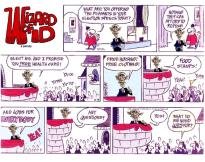
And we definitely can’t overlook this superb Wizard-of-Id parody. It doesn’t focus specifically on unemployment benefits, but it makes a great point about labor supply incentives.

But let’s get back to the column. Our main goal is to identify the types of policies that would generate jobs and growth.

Simply stated, genuine compassion should be defined by helping people get back to work so they don’t need to be wards of the state.

And easing the burden of government is the best way to make that happen. Our column looks at some evidence – from both overseas and here at home – about the policies that are associated with better economic performance.

Big government is responsible for today’s unemployment situation. …Since President Obama was elected, we have spent $560 billion on unemployment benefits. It’s likely many more jobs would have been created had the government not diverted that money from the economy’s productive sector. …Instead of copying stagnant European nations with bigger public sectors, we should learn from countries that have achieved better performance by lowering the burden of government. Singapore and Hong Kong are examples of jurisdictions with small governments and free markets that enjoy strong and sustained growth with very low levels of joblessness. …look at Canada, which has significantly boosted its jobs market with pro-growth reforms, or Switzerland, which has cemented its traditionally strong labor markets with reforms to control the growth of government. This is not a partisan argument. Or at least it shouldn’t be. The United States enjoyed strong levels of job creation during both the Reagan and Clinton years. But in both cases, public policy was largely the same, featuring an increase in economic freedom.

Some people may wonder whether Reagan and Clinton belong in the same category.

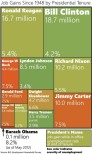
Well, as illustrated by this chart, they both presided over periods with impressive job creation.

And they both presided over periods with generally good economic policy.

Reagan moved the country in the right direction on purpose. Clinton, by contrast, may have wanted to move the nation in the other direction, but he was unsuccessful.Indeed, the evidence is very strong that the overall burden of government fell during his tenure.

Whether by accident or design, America needs another period of free markets and shrinking government.

For further details on the recipe for good policy, here’s the video I narrated for the Center for Freedom and Prosperity, which explains the conditions that lead to strong and sustained growth.

Free Markets and Small Government Produce Prosperity

Uploaded on Feb 17, 2009

Now that the so-called stimulus has been enacted, hopefully policy makers will turn their attention to policies that actually improve economic performance. This Center for Freedom and Prosperity Foundation video reviews the key finding in the Fraser Institute’s Economic Freedom of the World and explains that, contrary to the policies of Presidents Bush and Obama, smaller government and free markets are the way to boost economic growth. For more information: http://www.freedomandprosperity.org

__________________

P.S. I’m obviously a fan of Senator Rand Paul. Not only does he choose good people as op-ed partners, he also gave me public credit for a good Obamacare joke.

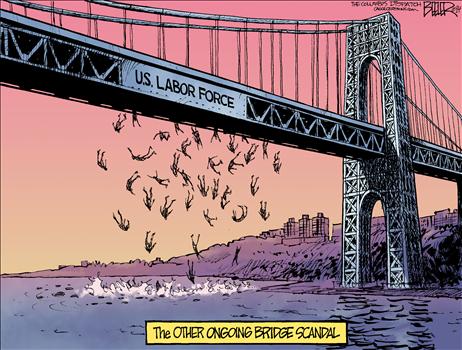
P.P.S. On a separate topic, I wrote in December 2012 that the strongest evidence for media bias is which stories get covered. A perfect example is that journalists already have given 17 times as much coverage of the Chris Christie “bridgegate” scandal as they gave to the IRS scandal over the past six months

Related posts:

If you want to cut government waste then stop allowing people to get addicted to government programs!!!!

______________ If you want to cut government waste then stop allowing people  to get addicted to government programs!!!! November 3, 2013 1:07PM Lindbeck’s Law: The Self-Destructive Nature of Expanding Government Benefits By Alan Reynolds Share Relevant foresight from Swedish economist Assar Lindbeck, “Hazardous Welfare State Dynamics,” American Economic Review, May 1995: The basic dilemma of […]

Lots of Waste at the Federal Mediation and Conciliation Service!!!!

____________ Lots of Waste at the Federal Mediation and Conciliation Service!!!! November 5, 2013 12:50PM ICYMI: FMCS By Jim Harper Share During the hullaballoo around the government shutdown, the Washington Examiner published a jaw-dropping series of stories about blatant waste in an obscure federal agency called the Federal Mediation and Conciliation Service. These stories shouldn’t […]

Open letter to President Obama (Part 440) A suggestion to cut some wasteful spending out of the government Part 6 (includes editorial cartoon)

(Emailed to White House on 3-15-13.) President Obama c/o The White House 1600 Pennsylvania Avenue NW Washington, DC 20500 Dear Mr. President, I know that you receive 20,000 letters a day and that you actually read 10 of them every day. I really do respect you for trying to get a pulse on what is […]

Open letter to President Obama (Part 495) (Wasting our tax dollars!!!)

Open letter to President Obama (Part 495)

(Emailed to White House on 5-4-13.)

President Obama c/o The White House 1600 Pennsylvania Avenue NW Washington, DC 20500

Dear Mr. President,

I know that you receive 20,000 letters a day and that you actually read 10 of them every day. I really do respect you for trying to get a pulse on what is going on out here.

______________

Sad that the government wastes so much of our money and it wants more from us under President Obama.

Remember the Spending Quiz from 2010, which asked people to guess whether absurd examples of government waste were true or false?

Well, we have a new video on government waste, though bureaucrats and politicians have become so profligate it doesn’t even bother to trick people with fake examples.

Your Tax Dollars at Work

While very well done, I do have two small complaints about the video.

First, it asks whether we should cut spending or raise taxes to deal with the national debt. I think that’s too narrow. We shouldn’t be wasting money even if the budget was balanced and there wasn’t a penny of debt.

In other words, the problem isn’t deficits. Red ink is just a symptom. The real problem is that government is too big.

Second, the video sort of acquiesces to the dishonest Washington terminology by asking whether we should cut spending or raise taxes, implying those are the only two options. I favor genuine spending cuts, of course, but the most accurate way of phrasing the question is to ask whether we should cut spending, restrain spending, or let government grow on auto-pilot.

As I explained earlier this year, we can balance the budget in just 10 years if spending grows “only” 3.4 percent per year. When people understand that detail, there’s almost no support for higher taxes.

But I’m nitpicking. Overall, a very good video.

P.S. If the examples of pork-barrel spending in the video get you angry, you’ll probably have a stroke if you also watch the waste video from the folks at Government Gone Wild.

_______________________

Thank you so much for your time. I know how valuable it is. I also appreciate the fine family that you have and your commitment as a father and a husband.

Sincerely,

Everette Hatcher III, 13900 Cottontail Lane, Alexander, AR 72002, ph 501-920-5733, lowcostsqueegees@yahoo.com

Related posts:

Dan Mitchell explains what happened in Cyprus

Dan Mitchell explains what happened in Cyprus.   What Really Happened in Cyprus? April 14, 2013 by Dan Mitchell Did Cyprus become an economic basket case because it is a tax haven, as some leftists have implied? Did it get in trouble because the government overspent, which I have suggested? The answers to those questions are […]

Dan Mitchell on Obamacare (includes cartoons on Obamacare)

Some very good points by Dan Mitchell of the Cato Institute on Obamacare: Why We Should Be Optimistic about Repealing Obamacare and Fixing the Healthcare System April 10, 2013 by Dan Mitchell I’m going to make an assertion that seems utterly absurd. The enactment of Obamacare may have been good news. Before sending a team of medical […]

Dan Mitchell’s blog has great cartoon that demonstrates what President Obama has been doing the last 4 years!!!

I have put up lots of cartoons from Dan Mitchell’s blog before and they have got lots of hits before. Many of them have dealt with the economy, eternal unemployment benefits, socialism,  Greece,  welfare state or on gun control.     I’ve Obtained a Secret Pre-Release Copy of Obama’s Budget April 9, 2013 by Dan Mitchell The President is supposed to release […]

Dan Mitchell’s tribute to Margaret Thatcher

Very well said by Dan Mitchell. A Tribute to Margaret Thatcher April 8, 2013 by Dan Mitchell The woman who saved the United Kingdom has died. A Great Woman I got to meet Margaret Thatcher a couple of times and felt lucky each time that I was in the presence of someone who put her nation’s […]

Dan Mitchell, Ron Paul, and Milton Friedman on Immigration Debate (includes editorial cartoon)

I like Milton Friedman’s comments on this issue of immigration   and Ron Paul and Dan Mitchell do well on the issue too. Question of the Week: What’s Your Take on the Immigration Debate? April 7, 2013 by Dan Mitchell A reader from overseas wonders about my views on immigration, particularly amnesty. I confess that this is one of […]

Dan Mitchell on Texas v. California (includes editorial cartoon)

We should lower federal taxes because jobs are going to states like Texas that have low taxes. What Can We Learn by Comparing the Employment Situation in Texas vs. California? April 3, 2013 by Dan Mitchell One of the great things about federalism, above and beyond the fact that it both constrains the power of governments […]

Cartoons from Dan Mitchell’s blog on Obamacare

Third-Party Payer is the Biggest Economic Problem With America’s Health Care System Published on Jul 10, 2012 This mini-documentary from the Center for Freedom and Prosperity Foundation explains that “third-party payer” is the main problem with America’s health care system. This is why undoing Obamacare, while desirable, is just a small first step if we […]

Obamacare cartoons from Dan Mitchell’s blog

I have put up lots of cartoons from Dan Mitchell’s blog before and they have got lots of hits before. Many of them have dealt with the economy, eternal unemployment benefits, socialism,  Greece,  welfare state or on gun control. The funniest cartoon is the one with “Nurse Sebelius” stuffing the huge capsule down the kid’s throat!!! Obamacare […]

Editorial cartoon from Dan Mitchell’s blog on California’s sorry state of affairs

I have put up lots of cartoons from Dan Mitchell’s blog before and they have got lots of hits before. Many of them have dealt with the sequester, economy, eternal unemployment benefits, socialism,  minimum wage laws, tax increases, social security, high taxes in California, Obamacare,  Greece,  welfare state or on gun control. President Obama’s favorite state must be California because […]

Dan Mitchell of the Cato Institute:HUD has to go!!!! (includes political cartoon)

You want a suggestion on how to cut the government then start at HUD. I would prefer to eliminate all of it. Here are Dan Mitchell’s thoughts below: Sequestration’s Impact on HUD: Just 358 More Days and Mission Accomplished March 12, 2013 by Dan Mitchell As part of my “Question of the Week” series, I had […]

Open letter to President Obama (Part 494) (Does Government Have a Revenue or Spending Problem?)

Open letter to President Obama (Part 494)

(Emailed to White House on 4-10-13.)

President Obama c/o The White House 1600 Pennsylvania Avenue NW Washington, DC 20500

Dear Mr. President,

I know that you receive 20,000 letters a day and that you actually read 10 of them every day. I really do respect you for trying to get a pulse on what is going on out here.

___________________

Does Government Have a Revenue or Spending Problem?

People say the government has a debt problem. Debt is caused by deficits, which is the difference between what the government collects in tax revenue and the amount of government spending. Every time the government runs a deficit, the government debt increases. So what’s to blame: too much spending, or too little tax revenue? Economics professor Antony Davies examines the data and concludes that the root cause of the debt is too much government spending.

______________

So many times politicians tell us that we have to raise taxes in order to balance the budget but the only way to balance the budget is to control spending. That is exactly what happened between 1994 and 1998.

I wrote about the Ryan budget two days ago, praising it for complying with Mitchell’s Golden Rule and reforming Medicare and Medicaid.

But I believe in being honest and nonpartisan, so I also groused that it wasn’t as good as the 2011 and 2012 versions.

Now it’s time to give the same neutral and dispassionate treatment to the budget proposed by Patty Murray, the Washington Democrat who chairs the Senate Budget Committee.

But I’m going to focus on a theme rather than numbers.

One part of her budget got me particularly excited. Her Committee’s “Foundation for Growth” blueprint makes a very strong assertion about the fiscal and economic history of the Clinton years.

The work done in the 1990s helped grow the economy, create jobs, balance the budget, and put our government on track to eliminate the national debt.

As elaborated in this passage, the 42nd President delivered very good results.

President Bill Clinton entered office in 1993 at a time when the country was facing serious deficit and debt problems. The year before, the federal government was taking in revenue equal 17.5 percent of GDP, but spending was 22.1 percent of the economy—a deficit of 4.7 percent. …The unemployment rate went from 7 percent at the beginning of 1993 to 3.9 percent at the end of 2000. Between 1993 and 2001, our economy gained more than 22 million jobs and experienced the longest economic expansion in our history.

And the Senate Democrats even identified one of the key reasons why economic and fiscal policy was so successful during the 1990s.

…federal spending dropped from 22.1 percent of GDP to 18.2 percent of GDP.

I fully agree with every word reprinted above. That’s the good news.

So what, then, is the bad news?

Well, Senator Murray may have reached the right conclusion, but she was wildly wrong in her analysis. For all intents and purposes, she claims that the 1993 tax hike produced most of the good results.

President Clinton’s 1993 tax deal…brought in new revenue from the wealthiest Americans and…our country created 22 million new jobs and achieved a balanced budget. President Clinton’s tax policies were not the only driver of economic growth, but our leaders’ ability to agree on a fiscally sustainable and economically sound path provided valuable certainty for American families and businesses.

First, let’s dispense with the myth that the 1993 tax hike balanced the budget. I obtained the fiscal forecasts that were produced by both the Congressional Budget Office and the Office of Management and Budget in early 1995 because I wanted to see whether a balanced budget was predicted.

As you can see in the chart, both of those forecasts showed perpetual deficits of about $200 billion. And these forecasts were made nearly 18 months after the Clinton tax hike was implemented.

So if even the White House’s own forecast from OMB didn’t foresee a balanced budget, what caused the actual fiscal situation to be much better than the estimates?

The simple answer is that spending was restrained. You can give credit to Bill Clinton. You can give credit to the GOP Congress that took power in early 1995. You can give the credit to both.

But regardless of who gets the credit, the period of spending restraint that began at that time was the change that produced a budget surplus, not the tax hike that was imposed 18 months earlier and which was associated with perpetual red ink.

But spending restraint tells only part of the story. With the exception of the 1993 tax hike, the Clinton years were a period of shrinking government and free market reform.

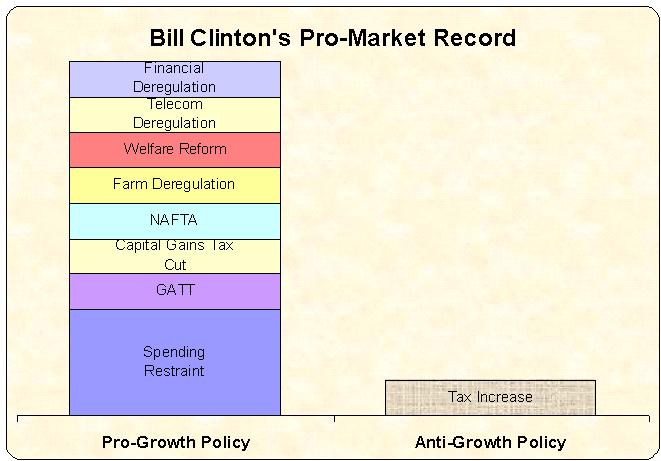
Clinton RecordTake a look at my homemade bar chart to compare the good policies of the 1990s with the bad policies. It’s not even close.

You may be thinking that my comparison is completely unscientific, and you’re right. I probably overlooked some good policies and some bad policies.

And my assumptions about weighting are very simplistic. Everything is equally important, with a big exception in that I made the government spending variable three times as important as everything else.

Why? Well, I think reducing the burden of government spending during the Clinton years was a major achievement.

But maybe we shouldn’t rely on my gut instincts. So let’s set aside my created-at-the-spur-of-the-moment bar chart and look at something that is scientific.

This chart is taken directly from Economic Freedom of the World, which uses dozens of variables to measure the overall burden of government.

As you can see, the United States score improved significantly during the Clinton years, showing that economic freedom was expanding and the size and scope of government was shrinking.

In other words, Patty Murray is correct. She is absolutely right to claim that Bill Clinton’s policies “helped grow the economy, create jobs, balance the budget.”

Now she needs to realize that those policies were small government and free markets.

Let me start this post by stating that George W. Bush was a bigger spender than Barack Obama (though the numbers are somewhat distorted by TARP, which caused a big increase in the burden of spending during Bush’s last fiscal year and artificially dampened outlays in Obama’s first fiscal year since repayments from the banks counted as negative spending).

So I’m not trying to make a partisan point by sharing these cartoons. I don’t like it when Democrats increase the burden of government spending and I’m equally dismayed when Republicans engage in same type of profligacy.

That being said, I was a big dumbfounded when President Obama recently claimed that there’s not a spending problem in Washington.

We know that the United States has a huge long-run problem with deficits and debt according to both the Bank for International Settlements and the Organization for Economic Cooperation and Development.

We also know that tax revenues, measured as a share of GDP, will soon be above their post-World War II average and that the tax burden is expected to increase in coming decades.

So a person would have to be in serious denial to claim that spending isn’t a problem.

Which is the point Eric Allie makes in this cartoon.

Spending Problem Cartoon 1

And the point Robert Ariail makes in this cartoon.

Spending Problem Cartoon 2

Ditto for Bob Gorrell.

Spending Problem Cartoon 3

And Gary Varvel.

Spending Problem Cartoon 4

Last but not least, the great Michael Ramirez.

Spending Problem Cartoon 5.jpg

Gee, it’s almost like we’re seeing a pattern.

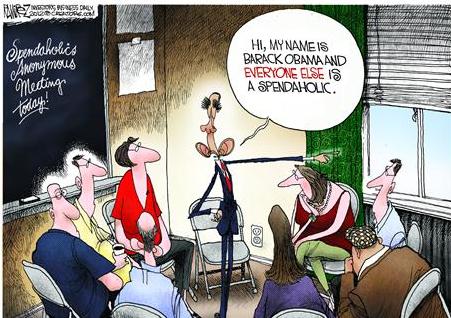
And if you like this spendaholic-in-denial theme, you can click here and here for further amusement.

P.S. Oh, by the way, if anybody’s actually interested in how to solve the spending problem (you know, the one that doesn’t exist), we do know the answer.

P.P.S. Remember when Obama claimed the private sector was doing fine? Well, here’s how cartoonists mocked him for that absurd comment.

______________________

Thank you so much for your time. I know how valuable it is. I also appreciate the fine family that you have and your commitment as a father and a husband.

Sincerely,

Everette Hatcher III, 13900 Cottontail Lane, Alexander, AR 72002, ph 501-920-5733, lowcostsqueegees@yahoo.com

Making people more dependent on the government hurts our society!!!

_______________

Making people more dependent on the government hurts our society!!!

I’ve shared many charts over the years, but two of the most compelling ones deal with poverty.

Poverty Rate DataThe numbers in this chart, which are based on Census Bureau data and scholarly studies (see here, here, here, and here), show that the poverty rate was steadily falling in the United States – until the federal government decided to launch a so-called War on Poverty.

Once Washington got more involved and started spending trillions of dollars, we stopped making progress. The poverty rate has changed a bit with shifts in economic conditions, but it’s stayed remarkably steady between 11 percent and 15 percent of the population.

So why have we stopped making progress? This second chart shows how redistribution programs create a dependency trap. The plethora of handouts from government make self-reliance and work comparatively unattractive, particularly since poor people are hit with very high implicit marginal tax rates.

And just as rich people respond logically to incentives, the same is true of poor people.

In a recent debate with a representative of the Center for American Progress, I tried to make these points. I doubt I had any effect on her outlook, but hopefully viewers began to see that the welfare state has been bad news for taxpayers and bad news for poor people.

Dan Mitchell Debating the Federal Government’s War on Poverty

Published on Jan 8, 2014

No description available.

_____________________________________________

Our debate was cut short by the host, but I think it was a fair representation of each side’s views.

And if you want more information on this topic, my former colleague from my days at the Heritage Foundation, Robert Rector, assesses the War on Poverty for today’s Wall Street Journal.

He starts with some very sobering numbers.

Fifty years later, we’re losing that war. Fifteen percent of Americans still live in poverty, according to the official census poverty report for 2012, unchanged since the mid-1960s. Liberals argue that we aren’t spending enough money on poverty-fighting programs, but that’s not the problem. …The federal government currently runs more than 80 means-tested welfare programs that provide cash, food, housing, medical care and targeted social services to poor and low-income Americans. Government spent $916 billion on these programs in 2012 alone, and roughly 100 million Americans received aid from at least one of them, at an average cost of $9,000 per recipient. …Federal and state welfare spending, adjusted for inflation, is 16 times greater than it was in 1964. If converted to cash, current means-tested spending is five times the amount needed to eliminate all official poverty in the U.S.

He then explains that poor people don’t suffer from material deprivation (which may explain why the Obama Administration wants to manipulate the numbers to justify more welfare spending).

…the typical American living below the poverty level in 2013 lives in a house or apartment that is in good repair, equipped with air conditioning and cable TV. His home is larger than the home of the average nonpoor French, German or English man. He has a car, multiple color TVs and a DVD player. More than half the poor have computers and a third have wide, flat-screen TVs. The overwhelming majority of poor Americans are not undernourished and did not suffer from hunger for even one day of the previous year.

Robert then gets to the heart of the issue, explaining that the welfare state has expanded dependency and exacerbated social pathologies.

…consider LBJ’s original aim. He sought to give poor Americans “opportunity not doles,” planning to shrink welfare dependence not expand it.  …By that standard, the war on poverty has been a catastrophe. The root “causes” of poverty have not shrunk but expanded as family structure disintegrated and labor-force participation among men dropped. A large segment of the population is now less capable of self-sufficiency than when the war on poverty began. …In 1963, 6% of American children were born out of wedlock. Today the number stands at 41%. As benefits swelled, welfare increasingly served as a substitute for a bread-winning husband in the home. …children raised in the growing number of single-parent homes are four times more likely to be living in poverty than children reared by married parents of the same education level. …Even in good economic times, a parent in the average poor family works just 800 hours a year, roughly 16 hours weekly, according to census data. Low levels of work mean lower earnings and higher levels of dependence.

Mr. Rector also has some specific suggestions in his column, most of which seem sensible, but this is where I think my idea of sweeping decentralization and federalism is very appropriate.

P.S. Thomas Sowell’s indictment of the welfare state is must reading.

P.P.S. Some honest leftists now acknowledge that big government creates worrisome forms of dependency.

P.P.P.S. If you want to know how dependency varies by state, here’s a map showing welfare payments and another map showing food stamp usage.

P.P.P.P.S. Shifting to a bigger stage, my least favorite international bureaucracy has made the preposterous claim that poverty is a bigger problem in America than it is in basket-case nations such as Greece and Portugal. Not that we should be surprised since the OECD actively urges a bigger welfare state in the United States.

P.P.P.P.P.S. And don’t forget our Moocher Hall of Fame if you want examples of the human cost of the welfare state.


___________

Related posts:


We need to repeal Obamacare and get away from third-party payer system and get a genuine free market!!!!

______ We need to repeal Obamacare and get away from third-party payer system and get a genuine free market!!!! The Continuing Obamacare Disaster November 11, 2013 by Dan Mitchell You know things are going poorly for the Obama White House when even the New York Times is writing about the “third world experience” of Obamacare. Heck, […]

The food stamp bill would be more costly than the Obama Stimulus!!!!!

The food stamp bill would be more costly than the Obama Stimulus!!!!! Farm Bills Would Cost More Than Obama Stimulus Daren Bakst October 28, 2013 at 3:56 pm The House and Senate are considering farm bill legislation this week whose costs should raise red flags for all Americans. In fact, the House and Senate versions […]

Dear Senator Pryor, here are some spending cut suggestions (“Thirsty Thursday”, Open letter to Senator Pryor)

Senator Pryor pictured below:  Why do I keep writing and email Senator Pryor suggestions on how to cut our budget? I gave him hundreds of ideas about how to cut spending and as far as I can tell he has taken none of my suggestions. You can find some of my suggestions here, here, here, here, here, here, here, here, here, here, here, here, here, here, here, here, here, here, here,  here, and  here, and they […]

Americans know that we must have work requirements for food stamps!!!!

____________ Americans know that we must have work requirements for food stamps!!!! Americans Support Stronger Work Requirements for Food Stamps Rachel Sheffield October 30, 2013 at 12:02 pm Newscom Nearly three-quarters of Americans believe that the food stamps program should include stronger work requirements, according to the October Food Demand Survey (FooDS) out of Oklahoma […]

Food stamp reform must be done in order to cut bloated spending in Washington!!

Food stamp reform must be done in order to cut bloated spending in Washington!! Farm Bill: A Response to President Obama Daren Bakst October 17, 2013 at 5:31 pm In his recent remarks, President Obama made a push to get a new farm bill enacted by the end of the year. Sound agriculture and food […]

Open letter to President Obama (Part 490) (includes editorial cartoon)

Open letter to President Obama (Part 490)

(Emailed to White House on 4-15-13.)

President Obama c/o The White House 1600 Pennsylvania Avenue NW Washington, DC 20500

Dear Mr. President,

I know that you receive 20,000 letters a day and that you actually read 10 of them every day. I really do respect you for trying to get a pulse on what is going on out here.

___________________

Why not try and copy the same recipe that Reagan used to get us out of a recession? Reagan cut taxes on the job creators!!!

Barack Obama has stated that he wants to be like Reagan, at least in the sense of wanting to be a transformational figure.

But almost certainly he has failed.

Yes, Obama has increased the burden of government spendingraised tax rates, and created more dependency, but there’s nothing particularly special about Obama’s tenure that makes him different from other statist Presidents such as Nixon, Carter, and Bush.

Nor is there any evidence that he has fundamentally changed the attitudes of the American people.

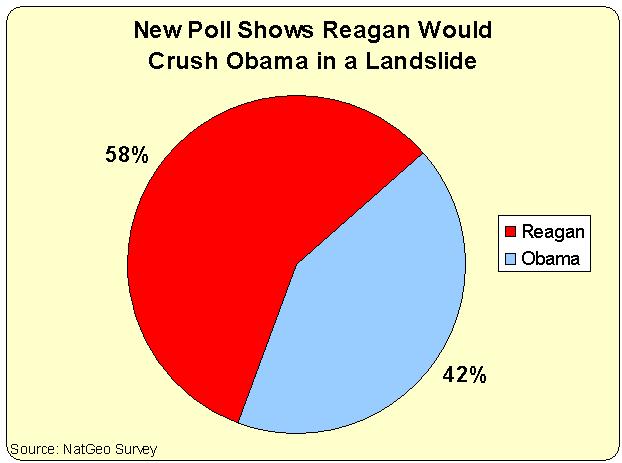
That may sound like a bold – and overly optimistic – assertion, but check out the amazing results from a new poll. According to a survey of 1,000 adults, Reagan would kick the you-know-what out of Obama, winning a hypothetical contest by a staggering 58-42 margin.

Reagan Obama Poll

By the way, the margin might be even bigger than I’m reporting. As you can see from this press excerpt, all we know is that 58 percent of respondents said they would vote for Reagan. I’m assuming that 42 percent would vote for Obama, but it’s possible there was also a “don’t know” or “other” category, so maybe Obama would be under 40 percent!

…just about everything about the era — from the politics, leaders and safety to the music, TV shows and blockbuster movies — are seen as being better than they are today. In fact, 3 in 4 Americans (74%) thought that our country was better off then and even safer (76%). The same amount (76%) believe that government ran better in the 1980s than it does today. And if a presidential election were held today, 58 percent would vote for Ronald Reagan over Barack Obama. Americans ages 18 to 34 were evenly split, with 51 percent favoring Reagan and 49 percent Obama.

Even young people preferred Reagan over Obama, which is remarkable since they didn’t experience the Reagan years and largely have learned about the Gipper from the media and schools, both of which are very hostile to Reagan.

We shouldn’t be too surprised by these polling results. Just take a look at this amazing infographic, which shows Obama’s horrible record on jobs compared to Reagan and other Presidents. Michael Ramirez makes the same point in this very funny cartoon.

Or look at these powerful charts based on Minneapolis Federal Reserve data, which compare the strong results of Reaganomics with the pathetic results of Obamanomics.

In other words, good policy leads to good outcomes, and good outcomes yield political rewards. That simple lesson has been lost on the weak gaggle of big-government GOPers who followed Reagan.

But our hypothetical polling results show that Americans today are still ready to rally behind a candidate who offers a compelling message of freedom and prosperity. That’s yet another reason why I’m still optimistic about the fight for liberty.

P.S. Here’s some snarky humor comparing the Gipper with Obama. And if you liked the story of what happens when you try socialism in the classroom, you’ll also enjoy this video of Reagan schooling Obama.

P.P.S. If you want to be inspired, click here and here to see two short clips of Reagan in action.

______________________

Thank you so much for your time. I know how valuable it is. I also appreciate the fine family that you have and your commitment as a father and a husband.

Sincerely,

Evere

I’ve already posted on Obama’s class-warfare approach to tax policy, and I’ve also posted about the pitfalls of a tax system that exempts 50 percent of the population.

Well, here’s a cartoon that cleverly combines both themes.


tte Hatcher III, 13900 Cottontail Lane, Alexander, AR 72002, ph 501-920-5733, lowcostsqueegees@yahoo.com


Related posts:

“Friedman Friday” Transcript and video of Milton Friedman on Bill Clinton and Ronald Reagan (Part 2)

Below is a discussion from Milton Friedman on Bill Clinton and Ronald Reagan. February 10, 1999 | Recorded on February 10, 1999 audio, video, and blogs » uncommon knowledge PRESIDENTIAL REPORT CARD: Milton Friedman on the State of the Union with guest Milton Friedman Milton Friedman, Senior Research Fellow, Hoover Institution and Nobel Laureate in […]

“Friedman Friday” Transcript and video of Milton Friedman on Bill Clinton and Ronald Reagan (Part 1)

Below is a discussion from Milton Friedman on Bill Clinton and Ronald Reagan. February 10, 1999 | Recorded on February 10, 1999 audio, video, and blogs » uncommon knowledge PRESIDENTIAL REPORT CARD: Milton Friedman on the State of the Union with guest Milton Friedman Milton Friedman, Senior Research Fellow, Hoover Institution and Nobel Laureate in […]

Ronald Reagan and the Founding Fathers

I really enjoyed this article. A Constitutional President: Ronald Reagan and the Founding By Edwin Meese III , Lee Edwards, Ph.D. , James C. Miller III and Steven Hayward January 26, 2012 Abstract: Throughout his presidency, Ronald Reagan was guided by the principles of the American founding, especially the idea of ordered liberty. In the opening of his first inaugural address in 1981, […]

March for Life March in Little Rock on Jan 20, 2013!!!Ronald Reagan’s videos and pictures displayed here on the www.thedailyhatch.org

Ronald Reagan was the greatest pro-life president ever. He appointed Dr. C. Everett Koop to his administration and Dr. Koop was responsible for this outstanding pro-life film below: I was thinking about the March for Life that is coming up on Jan 20, 2013 in Little Rock and that is why I posted this today. […]

Ronald Reagan’s pro-life tract

1/30/84 Part 1 of a speech to the National Religious Broadcasters. June 10, 2004, 10:30 a.m. Abortion and the Conscience of the Nation Ronald Reagan’s pro-life tract. EDITOR’S NOTE: While president, Ronald Reagan penned this article for The Human Life Review, unsolicited. It ran in the Review‘s Spring 1983, issue and is reprinted here with permission. The case […]

Ronald Reagan’s videos and pictures displayed here on the www.thedailyhatch.org

President Reagan, Nancy Reagan, Bill Clinton and Hillary Clinton attending the Dinner Honoring the Nation’s Governors. 2/22/87. Ronald Reagan is my favorite president and I have devoted several hundred looking at his ideas. Take a look at these links below: President Reagan and Nancy Reagan attending “All Star Tribute to Dutch Reagan” at NBC Studios(from […]

Ronald Reagan and Johnny Carson discussing Balanced Budget Amendment on “Tonight Show”

Ronald Reagan Talks About Balancing the Budget on “The Tonight Show” Uploaded by johnnycarson on Jul 30, 2011 Ronald Reagan talks about balancing the budget on “The Tonight Show” in 1975. _____________ Ronald Reagan was one of my favorite presidents. Mike Lee is one of my favorite lawmakers of today!!! Look at what he says about […]

Robert Bork and Ronald Reagan

I always liked both Robert Bork and Ronald Reagan. They had a lot in common. Lee Edwards noted concerning Bork and Reagan: Reagan’s most dramatic defeat came in 1987 when he nominated Judge Robert Bork to the Supreme Court.[xli] Bork’s confirmation became an ugly battle against liberal organizations like the American Civil Liberties Union, the […]

Abortion and the Conscience of the Nation:Ronald Reagan’s pro-life tract

Obama finds himself answering for a vote he made back in the Illinois state Senate. See Barack Obama’s exclusive interview with CBN New’s David Brody, and what he says about his views on abortion and the Born Alive Infant Protection Act. June 10, 2004, 10:30 a.m. Abortion and the Conscience of the Nation Ronald Reagan’s […]