A Walking Contradiction
Cash’s daughter, singer-songwriter Rosanne Cash, once pointed out that “my father was raised a Baptist, but he has the soul of a mystic. He’s a profoundly spiritual man, but he readily admits to a continual attraction for all seven deadly sins.””There’s nothing hypocritical about it,” Johnny Cash told Rolling Stonescribe Anthony DeCurtis. “There is a spiritual side to me that goes real deep, but I confess right up front that I’m the biggest sinner of them all.” To Cash, even his near deadly bout with drug addiction contained a crucial spiritual element. “I used drugs to escape, and they worked pretty well when I was younger. But they devastated me physically and emotionally—and spiritually … [they put me] in such a low state that I couldn’t communicate with God. There’s no lonelier place to be. I was separated from God, and I wasn’t even trying to call on him. I knew that there was no line of communication. But he came back. And I came back.”Years after his return to the land of the living, Cash once got a visit from U2 members Bono and Adam Clayton who were driving across the U.S., taking in the local colors. The three of them sat around a table before their meal, and Cash floored the two Irishmen with an incredible prayer of thanksgiving to God. Then, without skipping a beat, he raised his head and quipped, “Sure miss the drugs, though.”Cash sums up his soul’s murky landscape—if that’s possible—better than anybody else: “I’m still a Christian, as I have been all my life. Beyond that I get complicated. I endorse Kris Kristofferson’s line about me: ‘He’s a walking contradiction, partly truth and partly fiction.’ I also like Rosanne’s line: ‘He believes what he says, but that don’t make him a saint.’ I dobelieve what I say. There are levels of honesty, though.”Sigh.At this juncture, you may be asking why the book you’re holding is attempting to figure out the spiritual nature of this man. A puzzling personality who once implored, “Please don’t tell anybody how I feel about anything … unless I told you in the last few days.”The answer? It’s attempting nothing of the sort. The sole purpose of this book is to focus on the wild, incredible ups and downs of Cash’s spiritual journey. It’s a chronicle of his highs and lows, a record of the ebb and flow of his soul’s story.And like many such journeys, Cash’s was a roller coaster experience—though his twists and turns and plunges have been more intense than the average person’s … and, well, there were a lot more of them.Cash began life close to church, close to the earth, and close to gospel music; but his earliest singles for Sun Records hit the secular path rather than the gospel road he hoped Sam Phillips would let him follow; Phillips’ preference for the former led to big hits from Cash right from the start, and he immediately became a slave to the road, soon making millions of dollars and winning over millions of fans; he battled through a lot of death through the years—including his big brother Jack’s, his parents’, his longtime guitarist Luther Perkins’, and especially his wife of 35 years, June Carter Cash’s—but Cash somehow eluded the Grim Reaper’s snares despite feeding his frame with truckloads of uppers and downers over the better part of the 1960s; he enjoyed a creative and spiritual renaissance in the late ’60s and early ’70s, a run that not only sealed his status as the father of American music but proved a blueprint for what would soon become contemporary Christian music; and then, just when it appeared his career was sputtering to a halt in the late ’80s and early ’90s, Cash confounded everyone by becoming the “it” artist once again, boldly interpreting eclectic song mixtures that mined alternative rock and bygone standards.
And while his body suffered recently under the strain wrought by years of abuse, Cash’s mind stayed strong … and his spirit stayed stronger.
This is mildly amusing casuistry which—aside from its recommendation of Wodehouse—contains nothing that distinguishes it from Islam or Hinduism or indeed humanism. Were I a Christian, I would be highly unsettled by the huge number of concessions that Wilson makes.
Since I am not a Christian, I mutter a mild “thank you” for his admission that morality has nothing at all to do with the supernatural. My book argues that religious belief has now become purely optional and cannot be mandated by anything revealed or anything divine. It is one among an infinite number of private “faiths,” which do not disturb me in the least as long as its adherents agree to leave me alone.
Since Wilson does not even attempt to persuade me that Christ died for my sins (and can yet vicariously forgive them) or that I am the object of a divine design or that any of the events described in the two Testaments actually occurred or that extreme penalties will attend any disagreement with his view, I am happy to leave our disagreement exactly where it is: as one of the decreasingly interesting disputes between those who cling so tentatively to man-made “Holy Writ” and those who have no need to consult such texts in pursuit of truth or beauty or an ethical life. The existence or otherwise of an indifferent cosmos (the overwhelmingly probable state of the case) would no more reduce our mutual human obligations than would the quite weird theory of a celestial dictatorship, whether Aztec or Muslim or (as you seem to insist) Christian.
The sole difference is that we would be acting out of obligation toward others out of mutual interest and sympathy but without the impulse of terrifying punishment or selfish reward. Some of us can handle this thought and some, evidently, cannot. I have a slight suspicion as to which is more moral.
On a recent visit to Arkansas, I ran into a huge billboard near the Little Rock airport which simply said “JESUS.” This struck me as saying too much as well as too little, and I had almost forgotten it until Wilson’s evasions brought it back to mind.
Christopher Hitchens – Against Abortion Uploaded by BritishNeoCon on Dec 2, 2010 An issue Christopher doesn’t seem to have addressed much in his life. He doesn’t explicitly say that he is against abortion in this segment, but that he does believe that the ‘unborn child’ is a real concept. ___________________________ I was suprised when I […]
Max Brantley in the Arkansas Times Blog reports that Ron Paul is leading in Iowa. Maybe it is time to take a closer look at his views. In the above clip you will see Chistopher Hitchens discuss Ron Paul’s views. In the clip below you will find Ron Paul’s latest commercial. Below is a short […]
DEBATE William Lane Craig vs Christopher Hitchens Does God Exist 07 Below are some reactions of evangelical leaders to the news of Christopher Hitchens’ death: Christian leaders react to Hitchens’ death Posted on Dec 16, 2011 | by Michael Foust DEBATE William Lane Craig vs Christopher Hitchens Does God Exist 08 Author and […]
DEBATE William Lane Craig vs Christopher Hitchens Does God Exist 04 Below are some reactions of evangelical leaders to the news of Christopher Hitchens’ death: Christian leaders react to Hitchens’ death Posted on Dec 16, 2011 | by Michael Foust DEBATE William Lane Craig vs Christopher Hitchens Does God Exist 05 Author and speaker Christopher […]
DEBATE William Lane Craig vs Christopher Hitchens Does God Exist 01 Below are some reactions of evangelical leaders to the news of Christopher Hitchens’ death: Christian leaders react to Hitchens’ death Posted on Dec 16, 2011 | by Michael Foust Author and speaker Christopher Hitchens, a leader of an aggressive form of atheism that eventually […]
Open letter to Speaker of the House John Boehner (Part 2 on raising taxes)
John Boehner, Speaker of the House
H-232, The Capital, Washington, DC 20515
Dear Mr. Speaker,
I know that you will have to meet with newly re-elected President Obama soon and he will probably be anxious for you to raise taxes and federal spending, but he will want you to leave runaway entitlement programs alone. DON’T RAISE TAXES BECAUSE THE DEMOCRATS WILL JUST SPEND MORE.
Below is a speech by George W. Bush honoring Milton Friedman:
Milton Friedman Honored for Lifetime Achievements 2002/5/9
Milton Friedman said that getting George Bush I to be his vice president was his biggest mistake because he knew that Bush was not a true conservative and sure enough George Bush did raise taxes when he later became President. I wonder if Jeb Bush has the same genes as his father.
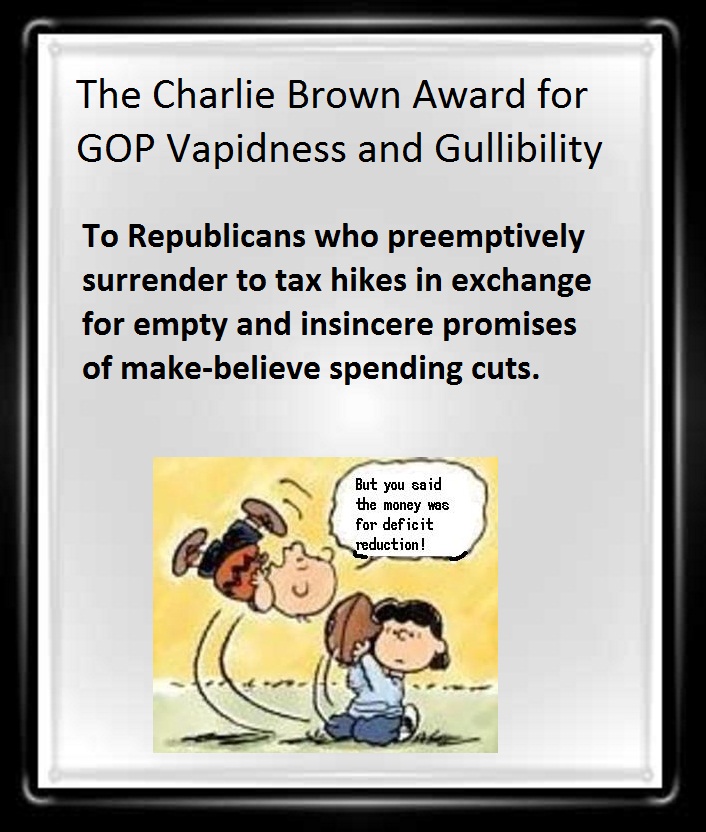
What we need is some people in Washington that are brave enough to say that we have taken too much of the american people’s money and we have to make the painful spending cuts in order to balance the budget and not ask for any more tax increases!!!! Arkansas’ congressman Rick Crawford has also made the Charlie Brown mistake.
But I then pointed out that all of those scenarios were total fantasies and that it would be more realistic to envision me playing center field for the New York Yankees.
That’s why I like the anti-tax pledge of Americans for Tax Reform. You don’t solve America’s fiscal problems by saying no to all tax increases, but at least you don’t move in the wrong direction at a faster rate.
Notwithstanding the principled and pragmatic arguments against putting tax increases on the table, some Republicans – in a triumph of hope over experience – are preemptively acquiescing to tax hikes.
Jeb Bush, the former Florida governor, said Friday that he could back a broad deficit plan that increased taxes, a stance that puts him at odds with other prominent Republicans. Bush told a House panel he could get behind a plan that combined 10 dollars in spending cuts for every dollar of new revenue… “The problem is the 10 never materializes,” [Congressman Paul] Ryan said after Bush said he could support a revenue-increasing deficit deal. Norquist also has criticized deficit deals crafted in 1982 and 1990 – the latter agreed to by then-President George H.W. Bush, Jeb’s father – for failing to deliver on the spending side.
Kudos to Paul Ryan for making the obvious point about make-believe spending cuts. And Grover is correct about the failure of previous budget deals.
Indeed, I cited a New York Times column that inadvertently revealed that the only budget deal that worked was the 1997 pact that cut taxes rather than raised them.
Sen. Lindsey Graham (R-S.C.) said Tuesday he believed Republicans should consider eliminating loopholes in the tax code even if they aren’t replaced by additional tax cuts, a move that would break with an anti-tax pledge many GOP lawmakers have signed with activist Grover Norquist. “When you eliminate a deduction, it’s OK with me to use some of that money to get us out of debt. That’s where I disagree with the pledge,” Graham told ABC News. …”I’m willing to move my party, or try to, on the tax issue. I need someone on the Democratic side being willing to move their party on structural changes to entitlements.” Graham said, for instance, he would support a plan that included $4 in spending cuts for every $1 in tax increases. During a Republican debate last August, all eight Republican candidates in attendance said they would reject a proposal to trade $10 in spending cuts for even $1 in tax increases.
In some sense, Senator Graham’s comments are reasonable. With real spending cuts and less-damaging forms of tax hikes, an acceptable deal is possible. But only in Fantasia, not in Washington.
In the real world, all that Senator Graham has done is to move the debate slightly to the left.
But I do have nightmares about government getting even bigger, and that’s why I don’t want tax increases on the table. I don’t even want them in the room. Or the house. Or the neighborhood.
That’s why Jeb Bush and Lindsey Graham are the newest winners of the Charlie Brown Award. They’ve put blood in the water. I wonder if they’ll act surprised when hungry sharks show up looking for a meal?
DEBT LIMIT – A GUIDE TO AMERICAN FEDERAL DEBT MADE EASY. Uploaded by debtlimitusa on Nov 4, 2011 A satirical short film taking a look at the national debt and how it applies to just one family. Watch the guy from the Ferris Bueller Superbowl Spot! Produced by Seth William Meier, DP/Edited by Craig Evans, […]
Rep Himes and Rep Schweikert Discuss the Debt and Budget Deal Michael Tanner of the Cato Institute in his article, “Hitting the Ceiling,” National Review Online, March 7, 2012 noted: After all, despite all the sturm und drang about spending cuts as part of last year’s debt-ceiling deal, federal spending not only increased from 2011 […]
Michael Tanner of the Cato Institute in his article, “Hitting the Ceiling,” National Review Online, March 7, 2012 noted: After all, despite all the sturm und drang about spending cuts as part of last year’s debt-ceiling deal, federal spending not only increased from 2011 to 2012, it rose faster than inflation and population growth combined. […]
Here is a study done on the votes of the 87 incoming freshman republicans frm the Club for Growth. Freshman Vote Study In the 2010 election, 87 freshmen House Republicans came to Washington pledging fealty to the Tea Party movement and the ideals of limited government and economic freedom. The mainstream media likes to say […]
Tea Party Conservative Senator Mike Lee interview Here is an excellent interview above with Senator Lee with a fine article below from the Heritage Foundation. Sen. Mike Lee (R-UT) came to Washington as the a tea-party conservative with the goal of fixing the economy, addressing the debt crisis and curbing the growth of the federal […]
I feel so strongly about the evil practice of running up our national debt. I was so proud of Rep. Todd Rokita who voted against the Budget Control Act of 2011 on August 11, 2011. He made this comment: For decades now, we have spent too much money on ourselves and have intentionally allowed our […]
Rep. Quayle on Fox News with Neil Cavuto __________________ We have to get people realize that the most important issue is the debt!!! Recently I read a comment by Congressman Ben Quayle (R-AZ) made after voting against the amended Budget Control Act on August 1, 2011. He said it was important to compel “Congressional Democrats and […]
What future does our country have if we never even attempt to balance our budget. I read some wise words by Congressman Jeff Landry (R, LA-03) regarding the debt ceiling deal that was passed on August 1, 2011:”Throughout this debate, the American people have demanded a real cure to America’s spending addiction – a Balanced Budget […]
I read some wise comments by Idaho First District Congressman Raúl R. Labrador concerning the passage of the Budget Control Act on August 1, 2011 and I wanted to point them out: “The legislation lacks a rock solid commitment to passage of a balanced budget amendment, which I believe is necessary to saving our nation.” I just […]
Congressmen Tim Huelskamp on the debt ceiling I just don’t understand why people think we can go on and act like everything is okay when we have a trillion dollar deficit. Sometimes you run across some very wise words like I did the other day. Kansas Congressman Tim Huelskamp made the following comment on the […]
What is our business, by contrast, is what politicians are doing with the money they confiscate from us. This Lisa Benson cartoon helps to make that point, though it would be even better if she had written “Romney’s Stash for His Own Money” and “Obama’s Stash for Our Money.”
Obama, needless to say, is an expert at squandering other people’s money, as illustrated by money pits such as the faux stimulus and the green energy scam.
P.S. Lest anyone think I’m being partisan, the headline of this would be just as accurate if I added “How Bush Spent My Money” or “How Romney Would Spend My Money.” Bush, after all, followed the same fiscal agenda as Obama, and Romney’s track record suggests he will be similarly profligate.
P.P.S. Which makes me miss Bill Clinton, who was frugal by comparison. Or Ronald Reagan, who actually did the right things for the right reason.
Thank you so much for your time. I know how valuable it is. I also appreciate the fine family that you have and your commitment as a father and a husband.
Sincerely,
Everette Hatcher III, 13900 Cottontail Lane, Alexander, AR 72002, ph 501-920-5733, lowcostsqueegees@yahoo.com
I got to hear Johnny Cash sing in person back in 1978 at a Billy Graham Crusade in Memphis. Here is a portion of an article about his Christian Testimony.
Cash also made major headlines when he shared his faith on The Johnny Cash Show, a popular variety program on ABC that ran from 1969 to 1971: “Well, folks,” he began, “I’ve introduced lots of hymns and gospel songs on this show. I just want to make it clear that I’m feeling what I’m singing about in this next one. I am a Christian … I want to dedicate this song to the proposition that God is the victor in my life. I’d be nothing without him. I want to get in a good lick right now for Number One.” (Yet there are those in the Church who questioned his decision, during one momentous episode of show, to sing the controversial lyric, “wishing Lord that I was stoned” from Kris Kristofferson’s hit “Sunday Morning Coming Down.”)
And while Cash longed to play only gospel music from the start—and would have if Sam Phillips hadn’t nixed his desires as economically unfeasible for Sun Records—he never shied away from performing secular-themed songs in the studio or on the concert stage throughout his career.
A huge influence on Cash in this potentially problematic area was, believe or not, evangelist Billy Graham, who sought out Johnny in the early ’70s when he heard of his commitment to God.
“He and I spent a lot of time talking the issues over, and we determined that I wasn’t called to be an evangelist …” Cash recalled of his first face-to-face conversations with Graham. “He had advised me to keep singing ‘Folsom Prison Blues’ and ‘A Boy Named Sue’ and all those other outlaw songs if that’s what people wanted to hear and then, when it came time to do a gospel song, give it everything I had. Put my heart and soul into all my music, in fact; never compromise; take no prisoners. ‘Don’t apologize for who you are and what you’ve done in the past,’ he told me. ‘Be who you are and do what you do.'”
“I think I just like to share my faith, you know?” he said in recent years. “I don’t preach to people. I don’t ever push it on anybody, and I wouldn’t sing a gospel song on any show if I didn’t think the people would enjoy it. They seem to enjoy those as much or more than anything else. It’s not that I’m proselytizing. I’m not out there tryin’ to convince people, just to spread a little good news.”
As it turns out, Cash quickly became a welcome figure at both Billy Graham Crusades and on the ostentatious stages of Las Vegas. And while he insisted that these (seemingly) diametrically opposed venues were equally home in his heart and mind, U2’s Bono wasn’t convinced: “Johnny Cash doesn’t sing to the damned, he sings with the damned, and sometimes you feel he might prefer their company … ”
I want to begin by thanking you for agreeing to—as the diplomats might put it—a “frank exchange of views.” And I certainly want to thank the folks at Christianity Today for hosting us.
P. G. Wodehouse once said that some minds are like soup in a poor restaurant—better left unstirred. I am afraid that I find myself sympathizing with him as I consider atheism. I had been minding my own business on this subject for a number of years when I saw Sam Harris’s book on the desk of a colleague, and that led to my book in response, not to mention a review of Richard Dawkins’s most recent book, and now a series of responses to your God Is Not Great, all culminating in this exchange. I am afraid that my problem is this: The more I stir the bowl, the more certain fumes, mystery meats, and questions keep floating to the surface. Here are a few of them.
Your first point was that the Christian faith cannot credit itself for all that “Love your neighbor” stuff, not to mention the Golden Rule, and the reason for this is that such moral precepts have been self-evident to everybody throughout history who wanted to have a stable society. You then move on to the second point, which contains the idea that the teachings of Christianity are “incredibly immoral.” In your book, you make the same point about other religions. Apparently, basic morality is not all that self-evident. So my first question is: Which way do you want to argue this? Do all human societies have a grasp of basic morality, which is the theme of your first point, or has religion poisoned
everything, which is the thesis of your book? The second thing to observe in this regard is that Christians actually do not claim that the gospel has made the world better by bringing us turbo-charged ethical information. There have been ethical advances that are due to the propagation of the faith, but that is not where the action is.
Christians believe—as C. S. Lewis argued in The Abolition of Man—that nonbelievers do understand the basics of morality. Paul the apostle refers to the Gentiles, who did not have the law but who nevertheless knew by nature some of the tenets of the law (Rom. 2:14). But the world is not made better because people can understand the ways in which they are being bad. It has to be made better by Good News—we must receive the gift of forgiveness and the resultant ability to live more in conformity to a standard we already knew (but were necessarily failing to meet). So the gospel does not consist of new and improved law. The gospel makes the world better through Good News, not through guilt trips or good advice.
In your second objection, you gaily dismiss the Old Testament, “which speaks hotly in recommending genocide, slavery, genital mutilation, and other horrors.” Setting aside for the moment whether your representation of the Old Testament is judicious or accurate, let me assume for the sake of discussion that you have accurately summarized the essence of Mosaic ethics here. You then go on to say that we who teach such stories to children have been “damned by history.” But why should this “damnation by history” matter to any of us reading Bible stories to kids, or, for that matter, to any of the people who did any of these atrocious things, on your principles? These people are all dead now, and we who read the stories are all going to be dead.
Why should any of us care about the effeminate judgments of history?
Should the propagators of these “horrors” have cared? There is no God, right? Because there is no God, this means that— you know—genocides just happen, like earthquakes and eclipses. It is all matter in motion, and these things happen.
If you are on the receiving end, there is only death, and if you are an agent delivering this genocide, the long-term result is brief victory and death at the end. So who cares? Picture an Israelite during the conquest of Canaan, doing every bad thing that you say was occurring back then. During one of his outrages, sword above his head, should he have stopped for a moment to reflect on the possibility that you might be right? “You know, in about three and a half millennia, the consensus among historians will be that I am being bad right now. But if there is no God, this disapproval will certainly not disturb my oblivion. On with the rapine and slaughter!” On your principles, why should he care?
In your third objection, you say that if “Christianity is to claim credit for the work of outstanding Christians or for the labors of famous charities, then it must in all honesty accept responsibility for the opposite.” In short, if we point to our saints, you are going to demand that we point also to our charlatans, persecutors, shysters, slave-traders, inquisitors, hucksters, televangelists, and so on. Now allow me the privilege of pointing out the structure of your argument here. If a professor takes credit for the student who mastered the material, aced his finals, and went on to a career that was a benefit to himself and the university he graduated from, the professor must (fairness dictates) be upbraided for the dope-smoking slacker that he kicked out of class in the second week. They were both formally enrolled, is that not correct? They were both students, were they not?
What you are doing is saying that Christianity must be judged not only on the basis of those who believe the gospel in truth and live accordingly but also on the basis of those baptized Christians who cannot listen to the Sermon on the Mount without a horse laugh and a life to match. You are saying that those who excel in the course and those who flunk out of it are all the same. This seems to me to be a curious way of proceeding.
You conclude by objecting to the sovereignty of God, saying that the idea makes the whole world into a ghastly totalitarian state, where believers say that God (and who does He think He is?) runs everything. I would urge you to set aside for a moment the theology of the thing and try to summon up some gratitude for those who built our institutions of liberty. Many of them were actually inspired by the idea that since God is exhaustively sovereign, and because man is a sinner, it follows that all earthly power must be limited and bounded. The idea of checks and balances came from a worldview that you dismiss as inherently totalitarian. Why did those societies where this kind of theology predominated produce, as a direct result, our institutions of civil liberty?
One last question: In your concluding paragraph you make a great deal out of your individualism and your right to be left alone with the “most intimate details of [your] life and mind.” Given your atheism, what account are you able to give that would require us to respect the individual?
How does this individualism of yours flow from the premises of atheism? Why should anyone in the outside world respect the details of your thought life any more than they respect the internal churnings of any other given chemical reaction? That’s all our thoughts are, isn’t that right? Or, if there is a distinction, could you show how the premises of your atheism might produce such a distinction?
Christopher Hitchens – Against Abortion Uploaded by BritishNeoCon on Dec 2, 2010 An issue Christopher doesn’t seem to have addressed much in his life. He doesn’t explicitly say that he is against abortion in this segment, but that he does believe that the ‘unborn child’ is a real concept. ___________________________ I was suprised when I […]
Max Brantley in the Arkansas Times Blog reports that Ron Paul is leading in Iowa. Maybe it is time to take a closer look at his views. In the above clip you will see Chistopher Hitchens discuss Ron Paul’s views. In the clip below you will find Ron Paul’s latest commercial. Below is a short […]
DEBATE William Lane Craig vs Christopher Hitchens Does God Exist 07 Below are some reactions of evangelical leaders to the news of Christopher Hitchens’ death: Christian leaders react to Hitchens’ death Posted on Dec 16, 2011 | by Michael Foust DEBATE William Lane Craig vs Christopher Hitchens Does God Exist 08 Author and […]
DEBATE William Lane Craig vs Christopher Hitchens Does God Exist 04 Below are some reactions of evangelical leaders to the news of Christopher Hitchens’ death: Christian leaders react to Hitchens’ death Posted on Dec 16, 2011 | by Michael Foust DEBATE William Lane Craig vs Christopher Hitchens Does God Exist 05 Author and speaker Christopher […]
DEBATE William Lane Craig vs Christopher Hitchens Does God Exist 01 Below are some reactions of evangelical leaders to the news of Christopher Hitchens’ death: Christian leaders react to Hitchens’ death Posted on Dec 16, 2011 | by Michael Foust Author and speaker Christopher Hitchens, a leader of an aggressive form of atheism that eventually […]
I know that you will have to meet with newly re-elected President Obama soon and he will probably be anxious for you to raise taxes and federal spending, but he will want you to leave runaway entitlement programs alone. When that happens then you have one thing you can hold over his head and that is the debt ceiling.
A satirical short film taking a look at the national debt and how it applies to just one family. Watch the guy from the Ferris Bueller Superbowl Spot! Produced by Seth William Meier, DP/Edited by Craig Evans, 1st AC Brian Andrews, Sound Mixer Gus Salazar, Written and Directed by Brian Stepanek. Help us spread the word by clicking ads or at www.debtlimitusa.org
_________________
I read some wise words by Rep. Justin Amash (R-MI) and I wanted to pass them on. He sees how dangerous it is to keep kicking the can down the street: “The Budget Control Act trades $21 billion in cuts next year for a debt ceiling increase of $2.1 trillion. That’s one penny in cuts for each dollar of new debt. The bill does not seriously address the drivers of the federal government’s fiscal crisis. It does not improve entitlement programs. It does not include a balanced budget amendment to the Constitution.”
After all, despite all the sturm und drang about spending cuts as part of last year’s debt-ceiling deal, federal spending not only increased from 2011 to 2012, it rose faster than inflation and population growth combined.
We need some national statesmen (and ladies) who are willing to stop running up the nation’s credit card.
This week the Club for Growth released a study of votes cast in 2011 by the 87 Republicans elected to the House in November 2010. The Club found that “In many cases, the rhetoric of the so-called “Tea Party” freshmen simply didn’t match their records.” Particularly disconcerting is the fact that so many GOP newcomers cast votes against spending cuts.
The study comes on the heels of three telling votes taken last week in the House that should have been slam-dunks for members who possess the slightest regard for limited government and free markets. Alas, only 26 of the 87 members of the “Tea Party class” voted to defund both the Economic Development Administration and the president’s new Advanced Manufacturing Technology Consortia program (see my previous discussion of these votes here) and against reauthorizing the Export-Import Bank (see my colleague Sallie James’s excoriation of that vote here).
One of those Tea Party heroes was Justin Amash of Michigan. Last year I posted this below concerning his conservative views and his willingness to vote against the debt ceiling increase:
Washington, D.C. – Rep. Justin Amash (R-MI) issued the following statement after the vote on the Budget Control Act of 2011:
“The Budget Control Act trades $21 billion in cuts next year for a debt ceiling increase of $2.1 trillion. That’s one penny in cuts for each dollar of new debt. The bill does not seriously address the drivers of the federal government’s fiscal crisis. It does not improve entitlement programs. It does not include a balanced budget amendment to the Constitution. I cannot in good conscience vote for so little reform when so much is at stake.
“I had hoped that Democrats and Republicans would work together to develop a reasonable compromise that is fiscally responsible. I would favor a package that combines eliminating special tax breaks and subsidies with a well-structured balanced budget amendment. I believe that type of package would have broad-based support from the American people. Instead, Congress continues to kick the can down the road.
“We can do better. I look forward to working with my colleagues on both sides of the aisle over the next several months to adopt structural reforms that will put the government back on a sustainable path.”
DEBT LIMIT – A GUIDE TO AMERICAN FEDERAL DEBT MADE EASY. Uploaded by debtlimitusa on Nov 4, 2011 A satirical short film taking a look at the national debt and how it applies to just one family. Watch the guy from the Ferris Bueller Superbowl Spot! Produced by Seth William Meier, DP/Edited by Craig Evans, […]
Rep Himes and Rep Schweikert Discuss the Debt and Budget Deal Michael Tanner of the Cato Institute in his article, “Hitting the Ceiling,” National Review Online, March 7, 2012 noted: After all, despite all the sturm und drang about spending cuts as part of last year’s debt-ceiling deal, federal spending not only increased from 2011 […]
Michael Tanner of the Cato Institute in his article, “Hitting the Ceiling,” National Review Online, March 7, 2012 noted: After all, despite all the sturm und drang about spending cuts as part of last year’s debt-ceiling deal, federal spending not only increased from 2011 to 2012, it rose faster than inflation and population growth combined. […]
Here is a study done on the votes of the 87 incoming freshman republicans frm the Club for Growth. Freshman Vote Study In the 2010 election, 87 freshmen House Republicans came to Washington pledging fealty to the Tea Party movement and the ideals of limited government and economic freedom. The mainstream media likes to say […]
Tea Party Conservative Senator Mike Lee interview Here is an excellent interview above with Senator Lee with a fine article below from the Heritage Foundation. Sen. Mike Lee (R-UT) came to Washington as the a tea-party conservative with the goal of fixing the economy, addressing the debt crisis and curbing the growth of the federal […]
I feel so strongly about the evil practice of running up our national debt. I was so proud of Rep. Todd Rokita who voted against the Budget Control Act of 2011 on August 11, 2011. He made this comment: For decades now, we have spent too much money on ourselves and have intentionally allowed our […]
Rep. Quayle on Fox News with Neil Cavuto __________________ We have to get people realize that the most important issue is the debt!!! Recently I read a comment by Congressman Ben Quayle (R-AZ) made after voting against the amended Budget Control Act on August 1, 2011. He said it was important to compel “Congressional Democrats and […]
What future does our country have if we never even attempt to balance our budget. I read some wise words by Congressman Jeff Landry (R, LA-03) regarding the debt ceiling deal that was passed on August 1, 2011:”Throughout this debate, the American people have demanded a real cure to America’s spending addiction – a Balanced Budget […]
I read some wise comments by Idaho First District Congressman Raúl R. Labrador concerning the passage of the Budget Control Act on August 1, 2011 and I wanted to point them out: “The legislation lacks a rock solid commitment to passage of a balanced budget amendment, which I believe is necessary to saving our nation.” I just […]
Congressmen Tim Huelskamp on the debt ceiling I just don’t understand why people think we can go on and act like everything is okay when we have a trillion dollar deficit. Sometimes you run across some very wise words like I did the other day. Kansas Congressman Tim Huelskamp made the following comment on the […]
Some of the Republican Party‘s most controversial House members are clinging to narrow leads in races where only a few votes are left to count.
Rep. Michele Bachmann, the chairwoman of the Tea Party Caucus, appeared to have held on to her seat by a narrow margin. The Associated Press said she defeated Democratic challenger Jim Graves by about 3,000 votes out of 350,000 cast at last count.
Rep. Allen West of Florida, one of the most outspoken Republicans in the House of Representatives, trailed Patrick Murphy by fewer than 3,000 votes with all precincts reporting. The race is still too close to call, according both to ABC News and the Associated Press, but barring surprises, West looks poised to lose.
The Democratic Party of Florida has already released a statement: “We congratulate Congressman-elect Patrick Murphy on defeating tea party crony Allen West,” said Rod Smith, the chair of the Florida Democratic Party. “Tonight, the people of this district rejected divisive, hateful rhetoric in favor a fresh-faced, bipartisan approach centered around the issues important to Florida’s middle class families.”
Most of the other freshmen Republicans from 2010 were able to hold on to their seats. Of 87 Republican freshmen, just nine have lost their bids for a second term at last count. There is a common perception that the freshman class was stocked with tea partyers, but just 19 of 87 GOP freshmen joined the Tea Party Caucus after the 2010 landslide. Two freshmen Democrats, Reps. Mark Critz of Pennsylvania and Kathy Hochul of western New York, also lost.
Of the 60 members of the Tea Party Caucus, 46 have already clinched victory. Four others, including Bachmann and West, remain in races too close to call. Six Tea Party caucus members were defeated at the polls, plus another seven who retired, lost a primary or sought higher office. Both tea party candidates who ran for the Senate, Reps. Denny Rehberg of Montana and Todd Akin of Missouri lost, while Rep. Mike Pence won his bid for governor of Indiana.
Blue Dog Democrats also saw their numbers shrink from 24 to 15, including six members who retired, sought higher office, or were defeated in primaries earlier this year. Reps. Ben Chandler, Larry Kissell, and Leonard Boswell all lost Tuesday.
One Blue Dog, Rep. Jim Matheson of Utah, fended off an intense challenge from Mia Love, a small-town mayor who was running to become the first black woman Republican elected to Congress. With 100 percent of the precincts reporting, Matheson defeated Love by nearly 3,000 votes. She issued a statement offering her congratulations to Matheson early Tuesday morning.
“Congratulations to Jim on a hard fought victory,” Love said. “It was a close race, but ultimately the voters of Utah have spoken.”
In considering the above question (for which my thanks are due to your generosity and hospitality in inviting my response), I have complete confidence in replying in the negative. This is for the following reasons.
1) Although Christianity is often credited (or credits itself) with spreading moral precepts such as “Love thy neighbor,” I know of no evidence that such precepts derive from Christianity. To take one instance from each Testament, I cannot believe that the followers of Moses had been indifferent to murder and theft and perjury until they arrived at Sinai, and I notice that the parable of the good Samaritan is told of someone who by definition cannot have been a Christian.
To these obvious points, I add that the “Golden Rule” is much older than any monotheism, and that no human society would have been possible or even thinkable without elementary solidarity (which also allows for self-interest) between its members. Though it is not strictly relevant to the ethical dimension, I would further say that neither the fable of Moses nor the wildly discrepant Gospel accounts of Jesus of Nazareth may claim the virtue of being historically true. I am aware that many Christians also doubt the literal truth of the tales but this seems to me to be a problem for them rather than a difficulty for me. Even if I accepted that Jesus—like almost every other prophet on record—was born of a virgin, I cannot think that this proves the divinity of his father or the truth of his teachings. The same would be true if I accepted that he had been resurrected.
There are too many resurrections in the New Testament for me to put my trust in any one of them, let alone to employ them as a basis for something as integral to me as my morality.
2) Many of the teachings of Christianity are, as well as being incredible and mythical, immoral. I would principally wish to cite the concept of vicarious redemption, whereby one’s own responsibilities can be flung onto a scapegoat and thereby taken away. In my book, I argue that I can pay your debt or even take your place in prison but I cannot absolve you of what you actually did. This exorbitant fantasy of “forgiveness” is unfortunately matched by an equally extreme admonition—which is that the refusal to accept such a sublime offer may be punishable by eternal damnation. Not even the Old Testament, which speaks hotly in recommending genocide, slavery, genital mutilation, and other horrors, stoops to mention the torture of the dead. Those who tell this evil story to small children are not damned by me, but have been damned by history and should also be condemned by those who shrink from cruelty to children (a moral essential that underlies all cultures).
The late C. S. Lewis helps make this point for me by emphasizing that the teachings of Jesus only make sense if the speaker is the herald of an imminent kingdom of heaven. Otherwise, would it not be morally unsafe to denounce thrift, family, and the “taking of thought for the morrow”?
Some of your readers may believe that this teaching is either true—in the sense of an imminent redemption—or moral. I believe that they would have a difficult time believing both things at once, and I notice the futility as well as the excessive strenuousness (sometimes called “fanaticism” in tribute to the way that the two things pull in opposite directions) of their efforts.
Another way of phrasing this would be to say that if Christianity was going to save us by its teachings, it would have had to perform better by now. And so to my succeeding point.
3) if Christianity is to claim credit for the work of outstanding Christians or for the labors of famous charities, then it must in all honesty accept responsibility for the opposite. I shall not condescend to your readers in specifying what these “opposites” are, but I suggest once more that you pay attention to the Golden Rule. If hymns and psalms were sung to sanctify slavery—just to take a recent example—and then sung by abolitionists, then surely the non-fanatical explanation is that morality requires no supernatural sanction? Every Christian church has had to make some apology for its role in the Crusades, slavery, anti-Semitism, and much else. I do not think that such humility discredits faith as such, because I tend to think that faith is a problem to begin with, but I do think that humility will lead to the necessary conclusion that religion is man-made.
On the other hand from humility, the fantastic idea that the cosmos was made with man in mind strikes me as the highest form of arrogant self-centeredness. And this brings me to what must be (within the limits of this short essay) my closing point. We are not without knowledge on these points, and the boundaries are being expanded at a rate which astonishes even those who do not look for a single cause of such vast and diverse phenomena. There is more awe and more reverence to be derived from a study of the heavens or of our DNA than can be found in any book written by a fearful committee in the age of myth (when Aquinas took astrology seriously and Augustine invented “limbo”).
I cannot, of course, prove that there is no supervising deity who invigilates my every moment and who will pursue me even after I am dead. (I can only be happy that there is no evidence for such a ghastly idea, which would resemble a celestial North Korea in which liberty was not just impossible but inconceivable.) But nor has any theologian ever demonstrated the contrary. This would perhaps make the believer and the doubter equal—except that the believer claims to know, not just that God exists, but that his most detailed wishes are not merely knowable but actually known. Since religion drew its first breath when the species lived in utter ignorance and considerable fear, I hope I may be forgiven for declining to believe that another human being can tell me what to do, in the most intimate details of my life and mind, and to further dictate these terms as if acting as proxy for a supernatural entity. This tyrannical idea is very much older than Christianity, of course, but I do sometimes think that Christians have less excuse for believing, let alone wishing, that such a horrible thing could be true. Perhaps your response will make me reconsider?
Christopher Hitchens – Against Abortion Uploaded by BritishNeoCon on Dec 2, 2010 An issue Christopher doesn’t seem to have addressed much in his life. He doesn’t explicitly say that he is against abortion in this segment, but that he does believe that the ‘unborn child’ is a real concept. ___________________________ I was suprised when I […]
Max Brantley in the Arkansas Times Blog reports that Ron Paul is leading in Iowa. Maybe it is time to take a closer look at his views. In the above clip you will see Chistopher Hitchens discuss Ron Paul’s views. In the clip below you will find Ron Paul’s latest commercial. Below is a short […]
DEBATE William Lane Craig vs Christopher Hitchens Does God Exist 07 Below are some reactions of evangelical leaders to the news of Christopher Hitchens’ death: Christian leaders react to Hitchens’ death Posted on Dec 16, 2011 | by Michael Foust DEBATE William Lane Craig vs Christopher Hitchens Does God Exist 08 Author and […]
DEBATE William Lane Craig vs Christopher Hitchens Does God Exist 04 Below are some reactions of evangelical leaders to the news of Christopher Hitchens’ death: Christian leaders react to Hitchens’ death Posted on Dec 16, 2011 | by Michael Foust DEBATE William Lane Craig vs Christopher Hitchens Does God Exist 05 Author and speaker Christopher […]
DEBATE William Lane Craig vs Christopher Hitchens Does God Exist 01 Below are some reactions of evangelical leaders to the news of Christopher Hitchens’ death: Christian leaders react to Hitchens’ death Posted on Dec 16, 2011 | by Michael Foust Author and speaker Christopher Hitchens, a leader of an aggressive form of atheism that eventually […]
Johnny Cash was not ashamed of his Christian faith—though it was sometimes a messy faith—and even got some encouragement from Billy Graham along the way.
A writer once tried to paint [Johnny] Cash into a corner, baiting him to acknowledge a single denominational persuasion at the center of his heart. Finally, Cash laid down the law: “I—as a believer that Jesus of Nazareth, a Jew, the Christ of the Greeks, was the Anointed One of God (born of the seed of David, upon faith as Abraham has faith, and it was accounted to him for righteousness)—am grafted onto the true vine, and am one of the heirs of God’s covenant with Israel.”
“I’m a Christian,” Cash shot back. “Don’t put me in another box.”
Despite his Baptist/Pentecostal upbringing, Cash was never terribly concerned about denominations. Or about nickel-and-dime theology. Or about tedious doctrinal parsing. “In my travels to Europe, Asia, and Australia, many times I have remembered and realized more fully that the gospel is the only doctrine that really works, and it works for all men,” he once declared. “But when this or that denomination begins to feel, or still worse, begins to teach that their particular interpretation of the Word opens the only door to heaven, then I feel it’s dangerous.”
So, exactly what “kind” of Christian was Cash?
A staunch, conservative, Bible thumper? It sure seems so if you read the introduction to his 1986 novel about the life of the apostle Paul, Man in White: “Please understand that I believe the Bible, the whole Bible, to be the infallible, indisputable Word of God. I have been careful to take no liberties with the timeless Word.”
But based on a passage from his 1997 autobiography, Cash doesn’t seem as steadfast: “Once I learned what the Bible is—the inspired Word of God (most of it anyway) … ” (To be fair, he continues this shadow of doubt with a gushing endorsement of Scripture, noting how “truly exciting” it is to discover new interpretations and applications to his own life.)
Further, it certainly can be argued that Cash was a private man and preferred to keep his faith to himself. Stu Carnall, an early tour manager, recalled, “Johnny’s an individualist, and he’s a loner. He’s also unpredictable… . He’s a talker, and he can talk plenty about anything—but not about religion. We’d be on the road for weeks at a time, staying at motels and hotels along the way. While the other members of the troupe would sleep in, Johnny would disappear for a few hours. When he returned, if anyone asked where he’d been, he’d answer straight faced, ‘to church.'”
“I don’t compromise my religion,” Cash once declared. “If I’m with someone who doesn’t want to talk about it, I don’t talk about it. I don’t impose myself on anybody in any way, including religion. When you’re imposing you’re offending, I feel. Although I am evangelical, and I’ll give the message to anyone that wants to hear it, or anybody that is willing to listen. But if they let me know that they don’t want to hear it, they ain’t never going to hear it from me. If I think they don’t want to hear it, then I will not bring it up.”
In short, “telling others is part of our faith all right, but the way we live it speaks louder than we can say it,” Cash said. “The gospel of Christ must always be an open door with a welcome sign for all.”
But put Cash in front of a microphone … and, as you might have guessed, anything could happen.
“I’m not here tonight to exalt Johnny Cash,” he told an audience during a show following his dramatic rededication to Christ in the early ’70s. “I’m standing here as an entertainer, as a performer, as a singer who is supporting the Gospel of Jesus Christ. I’m here to invite you to listen to the good news that will be laid out for you, to analyze it, and see if you don’t think it’s the best way to live.”