Category Archives: Cato Institute

Reagan and Clinton had good fiscal policies according to Cato Institute

Uploaded by on Dec 16, 2010

http://blog.heritage.org/2010/12/16/new-video-pork-filled-spending-bill-just-… Despite promises from President Obama last year and again last month that he opposed reckless omnibus spending bills and earmarks, the White House and members of Congress are now supporting a reckless $1.1 trillion spending bill reportedly stuffed with roughly 6,500 earmarks.

________________________

Below you see an article and videos by Dan Mitchell of the Cato Institute concerning Reagan and Clinton. First lets look at where we are now with Obama.

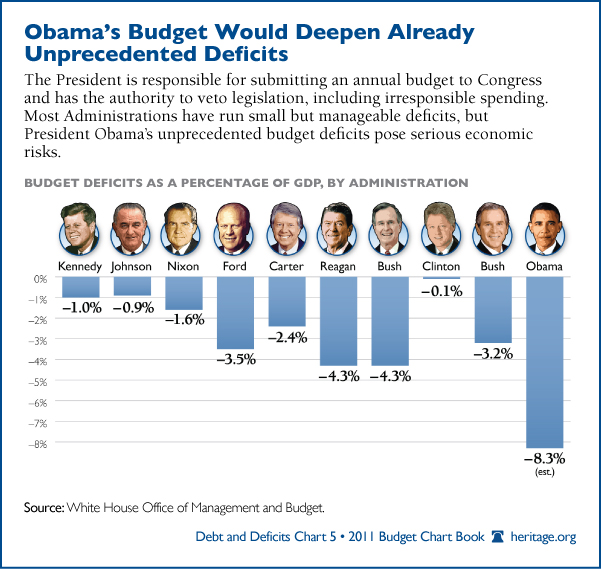
Over the last 10 presidents was have had 16.9% of GDP of deficits total from five Republican presidents and 12.7% total from Democratic presidents. However, what is most disturbing is that 8.3% of the 12.7% comes from the Obama administration who is currently in power and we are no longer in the cold war era. That is almost double the total of all the other four Democratic presidents combined under just one president. Take a look at the chart below from the Heritage Foundation:

Rob Bluey

January 1, 2012 at 9:56 am

Over the past 50 years, 10 U.S. presidents have made annual budget requests to Congress, projecting deficits both big and small. But no other president compares to Barack Obama when it comes to the size and scale of the current budget deficit facing the United States.

The country is facing an 8.3 percent estimated average national deficit of a two-term Obama administration — the biggest of the past 50 years. By comparison, the current estimate for Obama is nearly double the percentage under Presidents Ronald Reagan and George H.W. Bush — and they were fighting the Cold War.

Political party doesn’t tell the whole story, however. President Bill Clinton leads the pack of presidents since 1961, according to data from the White House Office of Management and Budget. Heritage put together this graphic as part of our Budget Chart Book.

So what does the current trajectory mean for the United States? We’re certainly no longer looking at a continuation of manageable deficits in the years to come. This is a dramatic change in the magnitude of annual shortfalls at the federal level. That’s one reason Heritage came up with a plan to fix the debt crisis.

If you have a suggestion for a chart we should feature in the future, please post a comment below, email us at scribe@heritage.org, or send me at tweet @RobertBluey.

_______________________
Here is a perspective from Dan Mitchell of the Cato Institute:

To Fix the Budget, Bring Back Reagan…or Even Clinton

Posted by Daniel J. Mitchell

President Obama unveiled his fiscal year 2012 budget today, and there’s good news and bad news. The good news is that there’s no major initiative such as the so-called stimulus scheme or the government-run healthcare proposal. The bad news, though, is that government is far too big and Obama’s budget does nothing to address this problem.

But perhaps the folks on Capitol Hill will be more responsible and actually try to save America from becoming a big-government, European-style welfare state. The solution may not be easy, but it is simple. Lawmakers merely need to restrain the growth of government spending so that it grows slower than the private economy.

Actual spending cuts would be the best option, of course, but limiting the growth of spending is all that’s needed to slowly shrink the burden of government spending relative to gross domestic product.

Fortunately, we have two role models from recent history that show it is possible to control the federal budget. This video from the Center for Freedom and Prosperity uses data from the Historical Tables of the Budget to demonstrate the fiscal policy achievements of both Ronald Reagan and Bill Clinton.

Spending Restraint, Part I: Lessons from Ronald Reagan and Bill Clinton

Uploaded by on Feb 14, 2011

Ronald Reagan and Bill Clinton both reduced the relative burden of government, largely because they were able to restrain the growth of domestic spending. The mini-documentary from the Center for Freedom and Prosperity uses data from the Historical Tables of the Budget to show how Reagan and Clinton succeeded and compares their record to the fiscal profligacy of the Bush-Obama years.

_____________________


Some people will want to argue about who gets credit for the good fiscal policy of the 1980s and 1990s.

Bill Clinton’s performance, for instance, may not have been so impressive if he had succeeded in pushing through his version of government-run healthcare or if he didn’t have to deal with a Republican Congress after the 1994 elections. But that’s a debate for partisans. All that matters is that the burden of government spending fell during Bill Clinton’s reign, and that was good for the budget and good for the economy. And there’s no question he did a much better job than George W. Bush.

Indeed, a major theme in this new video is that the past 10 years have been a fiscal disaster. Both Bush and Obama have dramatically boosted the burden of government spending — largely because of rapid increases in domestic spending.

This is one of the reasons why the economy is weak. For further information, this video looks at the theoretical case for small government and this video examines the empirical evidence against big government.

Another problem is that many people in Washington are fixated on deficits and debt, but that’s akin to focusing on symptoms and ignoring the underlying disease. To elaborate, this video explains that America’s fiscal problem is too much spending rather than too much debt.

Last but not least, this video reviews the theory and evidence for the “Rahn Curve,” which is the notion that there is a growth-maximizing level of government outlays. The bad news is that government already is far too big in the United States. This is undermining prosperity and reducing competitiveness.

Spending Restraint, Part II: Lessons from Canada, Ireland, Slovakia, and New Zealand

Uploaded by on Feb 22, 2011

Nations can make remarkable fiscal progress if policy makers simply limit the growth of government spending. This video, which is Part II of a series, uses examples from recent history in Canada, Ireland, Slovakia, and New Zealand to demonstrate how it is possible to achieve rapid improvements in fiscal policy by restraining the burden of government spending. Part I of the series examined how Ronald Reagan and Bill Clinton were successful in controlling government outlays — particularly the burden of domestic spending programs. http://www.freedomandprosperity.org


The Cato Institute: The state of the economy under Obama

The Cato Institute: The state of the economy under Obama

It is truly said how far to the left our country has gone.

Happy Fiscal New Year (with an Unhappy Obama Hangover)

Posted by Daniel J. Mitchell

Today, October 1, is the first day of the 2012 fiscal year.

And if you’re wondering why America’s economy seems to have a hangover (this cartoon is a perfect illustration), it’s because politicians had a huge party with our money in FY2011.

We don’t have final numbers for the fiscal year that just ended, but let’s look at the CBO Monthly Budget Report, the CBO Economic and Budget Update, and the OMB Historical Tables, and see whether there’s anything worth celebrating.

o The federal government spent about $3.6 trillion in FY2011, more money than any government has ever spent in a 12-month period in the history of the world.

o The FY2011 budget is nearly double the burden of federal spending just 10 years earlier, when federal outlays consumed “only” $1.86 trillion.

o The federal budget in FY2011 consumed about 24 percent of national output, up sharply compared to a spending burden in FY2001 of “just” 18.2 percent of GDP.

o Defense spending is too high, and has increased by about $400 billion since 2001, but the vast majority of the additional spending is for domestic spending programs.

o Federal tax revenue in FY2011 will be about $2.25 trillion, an increase of 7-8 percent over FY2010 levels.

o Economic stagnation has affected tax revenues, which are lower than the $2.6 trillion level from FY2007.

o Federal receipts amount to about 15.3 percent of GDP, below the long-run average of 18 percent of GDP.

o The Congressional Budget Office does predict that revenues will rise above the 18-percent average – without any tax increases – by the end of the decade.

o Record levels of government spending, combined with low revenues caused by a weak economy, will result in a $1.3 trillion deficit.

o This is the third consecutive deficit of more than $1 trillion.

o The publicly-held national debt (the amount borrowed from the private sector) is now more than $10 trillion.

With budget numbers like these, no wonder America has a fiscal hangover.

And let’s be blunt about assigning blame. Yes, Obama has been a reckless big spender, but he is merely continuing the irresponsible statist policies of his predecessor.

Fortunately, there is a solution. All we need to do is restrain the growth of federal spending, as explained in this video.

___________________

But we also know that it is difficult to convince politicians to do what’s right for the nation. And if they don’t change the course of fiscal policy, and we leave the federal government on autopilot, then America is doomed to become another Greece.

The combination of poorly designed entitlement programs (mostly Medicare and Medicaid) and an aging population will lead to America’s fiscal collapse.

Ron Paul has made his position on healthcare clear in the past

Ron Paul has made his position on healthcare clear in the past

Ron Paul sets the liberals straight on the solution for our healthcare problem in this video clip above during one of the presidential debates.

Despite Flaws, U.S. Health Care the Best

by Michael D. Tanner

Michael Tanner is a senior fellow at the Cato Institute, a libertarian think tank, and the co-author of Healthy Competition: What’s Holding Back Health Care and How to Free It.

Added to cato.org on October 18, 2011

This article appeared in USA Today on October 18, 2011.

Similarly, when Canadian Human Resources Minister Belinda Stronach needed treatment for breast cancer, she had it done at a California hospital. And, when then-Newfoundland Premier Danny Williams needed to have a leaky heart valve repaired, he had it done at the Mount Sinai Medical Center in Florida.

These high-profile patients were following in the footsteps of tens of thousands of patients from around the world who come to the United States for treatment every year.

We aren’t perfect, but if you’re sick, the United States is still the place you want to be.

They come here because they know that despite its flaws, the U.S. health care system still provides the highest quality care in the world. Whether the disease is cancer, pneumonia, heart disease or AIDS, the chances of a patient surviving are far higher in the U.S. than in other countries.

According to a study published in the British medical journal The Lancet, the U.S. is at the top of the charts when it comes to surviving cancer. For example, more than two-thirds of women diagnosed with cancer will survive for at least five years in the U.S. That’s 6 percentage points better than the next best country, Sweden.

Michael Tanner is a senior fellow at the Cato Institute, a libertarian think tank, and the co-author of Healthy Competition: What’s Holding Back Health Care and How to Free It.


More by Michael D. Tanner

Moreover, the U.S. drives much of the innovation and research on health care worldwide. Eighteen of the last 25 winners of the Nobel Prize in medicine are either U.S. citizens or work here. U.S. companies have developed more than half of all new major medicines introduced worldwide over the past 20 years. And Americans played a key role in 80% of the most important non-pharmaceutical medical advances of the past 40 years.

Does U.S. health care cost too much? Sure. But on a year-to-year basis, the cost in other countries is rising about as fast. Do we need to expand coverage? Certainly. But at least we’ve avoided the government-imposed rationing that afflicts so many countries. We aren’t perfect, but if you’re sick, the United States is still the place you want to be.

Cato Institute: Government spending is 41% of GDP

Cato Institute: Government spending is 41% of GDP

I love the Cato Institute because they give us the facts that liberals just can’t refute. Instead of trying to raise our taxes, President Obama should be cutting spending.

American Government Spending: 41% of GDP

Posted by Chris Edwards

My good friend Kathy Ruffing at CBPP takes me to task for testifying that government spending in the United States is 41 percent of GDP, which in my view is a very high and harmful level.

Kathy says that recent U.S. spending data is “exaggerated” because of the recession, and indeed, spending has soared not only here, but in most major countries because of the unfortunate popularity of Keynesian pump-priming theories. My point was that the American smaller-government advantage eroded both during the Bush growth years and during the Obama recession years, as seen in Figure 2 of my testimony.  

Kathy noted that the OECD data I used are different than U.S. national income accounts data published by the Bureau of Economic Analysis. Well, that’s right. Every country has quirks in the way they do their national income data. The advantage of using OECD data is that the economists at the OECD adjust for these quirks and create spending data that is comparable across countries. If Kathy has more accurate international comparisons, I’d love to see them.

Finally, Kathy says that just because American government spending divided by GDP is about 40 percent, that “doesn’t mean that government controls about 40 percent of the U.S.economy.” I don’t agree. She means that government does not produce 40 percent of gross domestic product, which is true. The broader figure of 40 or 41 percent includes not just government production but government transfers. And transfers do entail government control over resources because both the taxing and spending activities involved in transfer programs distort private sector behavior. Thus, the government misallocates resources both when it “produces” useless solar power activities in its own labs and when it subsidizes failed private solar companies.   

Anyway, thanks to Kathy for raising the important issue of the overall size of government because it is something that the policy community should focus more attention on. For data geeks, the OECD has all kinds of cross-country comparison data here. Government spending is Table 25.

Federal Spending per Household Is Skyrocketing

Everyone wants to know more about the budget and here is some key information with a chart from the Heritage Foundation and a video from the Cato Institute.

The federal government is spending more per household than ever before. Since 1965, spending per household has grown by nearly 162 percent, from $11,431 in 1965 to $29,401 in 2010. From 2010 to 2021, it is projected to rise to $35,773, a 22 percent increase.

INFLATION-ADJUSTED DOLLARS (2010)

Download

Federal Spending per Household Is Skyrocketing

Source: U.S. Census Bureau, White House Office of Management and Budget, and Congressional Budget Office.

Chart 1 of 42

In Depth

  • Policy Papers for Researchers

  • Technical Notes

    The charts in this book are based primarily on data available as of March 2011 from the Office of Management and Budget (OMB) and the Congressional Budget Office (CBO). The charts using OMB data display the historical growth of the federal government to 2010 while the charts using CBO data display both historical and projected growth from as early as 1940 to 2084. Projections based on OMB data are taken from the White House Fiscal Year 2012 budget. The charts provide data on an annual basis except… Read More

  • Authors

    Emily GoffResearch Assistant
    Thomas A. Roe Institute for Economic Policy StudiesKathryn NixPolicy Analyst
    Center for Health Policy StudiesJohn FlemingSenior Data Graphics Editor

The Cato Institute takes on Kim Kardashian

Great article  by Dan Mitchell of the Cato Institute:

Will the Last Job Creator to Leave California Please Turn Off the Lights?

Posted by Daniel J. Mitchell

I’ve written before about whether California is the Greece of America, in part because of crazy policies such as overpaid bureaucrats and expensive forms of political correctness,

And we all know that California has one of the nation’s greediest governments, imposing confiscatory tax rates on a shrinking pool of productive citizens.

So it is hardly surprising that the Golden State is falling behind, losing jobs and investment to more sensible states such as Texas.

But not everybody is learning the right lessons from California’s fiscal and economic mess.

There’s a group of crazies who want to increase the top tax rate by five percentage points, an increase of about 50 percent. And they have made Kim Kardashian the poster child for their proposed ballot initiative.

I’m relatively clueless about popular culture, but even I’m aware that there is a group of people know as the Kardashian sisters. I don’t know who they are or what they do, but I gather they are famous in sort of the same way Paris Hilton was briefly famous.

And they have cashed in on their popularity, which may not reflect well on the tastes of the American people, but it’s not my job to tell other people how to spend their money.

But not everybody share this live-and-let-live attitude, which is why the pro-tax crowd in California produced this video.

I suppose I could criticize the petty dishonesty of the proponents, since they deliberately blurred of the difference between “tax rates” and “taxes paid.”

Or I could expose their economic illiteracy by pointing out that higher tax rates would accelerate the emigration of investors, entrepreneurs, small business owners, and other rich taxpayers to zero-tax states such as Nevada.

But I won’t do those things. Instead, like the Nevada Realtors Association and Arizona Business Relocation Department, I’m going to support this ballot initiative.

Not because I overdid the rum and eggnog at Christmas, but because it’s good to have negative role models, whether they are countries like Greececities such as Detroit, or states like California.

So here’s my challenge to the looters and moochers of the Golden State. Don’t just boost the top tax rate by five-percentage points. That’s not nearly enough. Go for a 20 percent top tax rate. Or 25 percent. After all, think of all the special interests that could use the money more than Ms. Kardashian.

And if somebody tells you that she will move to South Beach or Las Vegas, or that the other rich people will move to Texas, Wyoming, or Tennessee, just ignore them. Remember, it’s good intentions that count.

In closing, I apologize to the dwindling crowd of productive people in California. It’s rather unfortunate that you’re part of this statist experiment. But you know what they say about eggs and omelets.

By the way, here’s some humor about the Golden State, including a joke about the bloated bureaucracy and a comparison with Texas.

Consumer spending is caused by growth of economy

Will liberals ever learn?

The Consumer Spending Fallacy behind Keynesian Economics

Posted by Daniel J. Mitchell

I’m understandably fond of my video exposing the flaws of Keynesian stimulus theory, but I think my former intern has an excellent contribution to the debate with this new 5-minute mini-documentary.

Keynesian Economics Is Wrong: Economic Growth Causes Consumer Spending, Not the Other Way

Uploaded by on Nov 29, 2010

Politicians and journalists who fixate on consumer spending are putting the cart before the horse. Consumer spending generally is a consequence of growth, not the cause of growth. This Center for Freedom and Prosperity video helps explain how to achieve more prosperity by looking at the differences between gross domestic product and gross domestic income. http://www.freedomandprosperity.org

________________

The main insight of the mini-documentary is that Gross Domestic Product (GDP) only measures how national output is allocated between consumption, investment, and government. That’s useful information in many ways, but if we want more output, we should focus on Gross Domestic Income (GDI), which measures how national income is earned.

Focusing on GDI hopefully would lead lawmakers to consider ways of boosting employee compensation, corporate profits, small business income, and other components of national income. Focusing on GDP, by contrast, is misguided since any effort to boost consumption generally leads to less investment. This is why Keynesian policies only redistribute national income, but don’t boost overall output.

Consumer spending is caused by growth of economy

You may recognize Hiwa. She narrated a very popular video earlier this year on the nightmare of income-tax complexity.

Do you think protectionism would help, in the long run, if we don’t implement pro-growth reforms?

Do you think protectionism would help, in the long run, if we don’t implement pro-growth reforms?

Sometimes I wonder what are the motives of those who oppose free trade.

Eight Questions for Protectionists

Posted by Daniel J. Mitchell

When asked to pick my most frustrating issue, I could list things from my policy field such as class warfare or income redistribution.

But based on all the speeches and media interviews I do, which periodically venture into other areas, I suspect protectionism vs. free trade is the biggest challenge.

So I want to ask the protectionists (though anybody is free to provide feedback) how they would answer these simple questions.

1. Do you think politicians and bureaucrats should be able to tell you what you’re allowed to buy?

As Walter Williams has explained, this is a simple matter of freedom and liberty. If you want to give the political elite the authority to tell you whether you can buy foreign-produced goods, you have opened the door to endless mischief.

2. If trade barriers between nations are good, then shouldn’t we have trade barriers between states? Or cities?

This is a very straightforward challenge. If protectionism is good, then it shouldn’t be limited to national borders.

3. Why is it bad that foreigners use the dollars they obtain to invest in the American economy instead of buying products?

Little green pieces of paper have little value to foreign companies. They only accept those dollars in exchange for products because they intend to use them, either to buy American products or to invest in the U.S. economy. Indeed, a “capital surplus” is the flip side of a “trade deficit.” This generally is a positive sign for the American economy (though I freely admit this argument is weakened if foreigners use dollars to “invest” in federal government debt).

4. Do you think protectionism would be necessary if America did pro-growth reforms such as a lower corporate tax rate, less wasteful spending, and reduced red tape?

There are thousands of hard-working Americans that have lost jobs because of foreign competition. At some level, this is natural in a dynamic economy, much as candle makers lost jobs when the light bulb was invented. But oftentimes American producers can’t meet the challenge of foreign competition because of bad policy from Washington. When I think of ordinary Americans that have lost jobs, I direct my anger at the politicians in DC, not a foreign company or foreign workers.

5. Do you think protectionism would help, in the long run, if we don’t implement pro-growth reforms?

If we travel down the path of protectionism, politicians will use that as an excuse not to implement pro-growth reforms. This condemns America to a toxic combination of two bad policies – big government and trade distortions. This will destroy far more jobs and opportunity that foreign competition.

6. Do you recognize that, by creating the ability to offer special favors to selected industries, protectionism creates enormous opportunities for corruption?

Most protectionism in America is the result of organized interest groups and powerful unions trying to prop up inefficient practices. And they only achieve their goals by getting in bed with the Washington crowd in a process that is good for the corrupt nexus of interest groups-lobbyists-politicians-bureaucrats.

7. If you don’t like taxes, why would you like taxes on imports?

A tariff is nothing but a tax that politicians impose on selected products. This presumably makes protectionism inconsistent with the principles of low taxes and limited government.

8. Can you point to nations that have prospered with protectionism, particularly when compared to similar nations with free trade?

Some people will be tempted to say that the United States was a successful economy in the 1800s when tariffs financed a significant share of the federal government. That’s largely true, but the nation’s rising prosperity surely was due to the fact that we had no income tax, a tiny federal government, and very little regulation. And I can’t resist pointing out that the 1930 Smoot-Hawley tariff didn’t exactly lead to good results.

We also had internal free trade, as explained in this excellent short video on the benefits of free trade, narrated by Don Boudreaux of George Mason University and produced by theInstitute for Humane Studies.

Uploaded by  on Aug 31, 2011

According to Prof. Don Boudreaux, free trade is nothing more than a system of trade that treats foreign goods and services no differently than domestic goods and services. Protectionism, on the other hand, is a system of trade that discriminates against foreign goods and services in an attempt to favor domestic goods and services. In theory, free trade outperforms protectionism by bringing lower cost goods and services to consumers. In practice, the benefits of free trade can be seen in countries like America and Hong Kong. Both countries have a relatively high degree of free trade, and, as a consequence, have experienced an explosion of wealth.

________

Free Trade v. Protectionism

My closing argument is that people who generally favor economic freedom should ask themselves whether it’s legitimate or logical to make an exception in the case of foreign trade.

Rick Perry says Social Security is a Ponzi scheme

Rick Perry says Social Security is a Ponzi scheme

Rick Perry and Mitt Romney went after each other at the debate over this term “Ponzi scheme.”

Over and over Rick Perry has said that Social Security is a Ponzi scheme and I agree with him. 

__________

The Social Security Rorschach Test

by William Shipman

This article appeared on The Daily Caller on September 21, 2011

Comments by Rick Perry and Mitt Romney on Social Security during the last two Republican presidential debates may have provided more insight into these two men than expected — something to ponder with the next debate coming up.

Mr. Romney told us that he is “committed to saving Social Security” and that “under no circumstances would I ever say by any measure it’s a failure.”

Mr. Perry called the system a “Ponzi scheme” and said it’s “a monstrous lie” to tell young workers that their payroll taxes will provide them with Social Security benefits.

Bill Shipman is chairman of CarriageOaks Partners, LLC and co-chairman of the Cato Institute Project on Social Security Choice.


More by William G. Shipman

 Mr. Romney replied that Mr. Perry’s position could disqualify him as the GOP nominee. Apparently, a line has been drawn.

In his 2005 State of the Union Address, President Bush spent about 20 percent of his time talking about Social Security reform, specifically personal investment accounts. Democrats fought this idea with all their strength. Although it’s less well known, Republicans engaged in a family brawl in which many fought Mr. Bush’s investment-accounts idea, too. They were afraid that if they supported the president, they would lose their next elections.

But now the brawl has broken through the Republican skin and is in the open. What can we learn from this?

First, reflect upon Governor Romney’s point that Social Security is not a failure “by any measure,” and try to square that with the fact that Social Security is mandatory. Each worker is compelled to pay 10.6% of his wage, on up to $106,800, to the government for the retirement portion of the system. That means the average-wage earner has no choice on how to allocate 10.6% of his wage income for retirement. That’s bad enough, but it’s made worse by the fact that his Social Security benefits are very low: about half of what his Social Security taxes would provide if they were invested in a diversified portfolio of stocks and bonds.

Second, in 1950, when there were 16 workers per beneficiary, the payroll tax rate was just 3% on $3,000 of wages. Since then the tax rate increased 18 times, and the wage subject to the tax increased 43 times. After adjusting for inflation the maximum tax jumped 1,322%. Benefits rose as well, but proportionally much less. The squeeze in benefits relative to taxes has progressively made the system a worse deal.

Third, Social Security’s actuaries estimate that the mismatch between future taxes and benefits is just under $7 trillion. That number represents what must be invested right now, in addition to all future payroll taxes, in order to pay scheduled benefits.

Finally, in the 1960 Flemming v. Nestor case, the Supreme Court ruled that workers have no property rights to their scheduled benefits. The government can reduce them at will, which it did in 1983 by increasing the retirement age from 65 to 67; or it can increase the tax at will, which it consistently has done. Also, when one member of an elderly couple dies, the government — in most cases — reduces Social Security benefits by a third. Sort of a death tax.

This system of no choice, low benefits relative to taxes, significant tax increases, a massive unfunded liability, the absence of personal property rights and a death tax apparently does not rise to the level of failure “by any measure” according to Gov. Romney.

For his part, Gov. Perry has called Social Security a Ponzi scheme: a fraudulent investment operation that pays subscribers not from investment earnings but from new subscribers’ funds. To entice subscribers, such schemes must provide unusually high and/or stable returns. Given that the high returns require endless new subscribers to pay off previous ones, such schemes ultimately fail.

Although Mr. Perry’s Ponzi analogy is not technically correct, it has some validity in that Social Security benefits are financed by ever more subscribers — that is, wage earners. But unlike a Ponzi scheme, Social Security is not fraudulent, and it doesn’t pay large benefits relative to taxes. Indeed, it pays low benefits. A Ponzi scheme promises high returns. That’s why people freely, although foolishly, play the game. Social Security promises low returns. That’s why people are forced to play the game.

Mr. Romney has stated that the Republican nominee must be committed to saving Social Security, not abolishing it. It’s not clear what he means. Does he want to save the objective of Social Security, which is, broadly speaking, the provision of retirement benefits? Or does he want to save its structure wherein today’s young finance benefits for today’s old?

Mr. Perry says the system is a Ponzi scheme and a lie. Does this mean that he wants to get rid of the structure yet keep the objective? Or does it mean that he wants to get rid of both?

The two candidates’ differences on this issue may shed light on bigger philosophical disagreements they may have. Do they see government as bungling but benign, only in need of a seasoned CEO who can more successfully manage the enterprise? Or do they see government as overreaching, stifling, oppressive and hurtful in its reach, and in need of a strong and principled leader to shove it out of the way?

How these candidates deal with Social Security, the government’s largest program, may shed light on who they really are.

Is the USA heading down the same path as Greece?

Too many riding in the wagon and not enough pulling the wagon. Is the USA heading down the same path as Greece?

U.S. Should Learn from Europe’s Welfare State Mistakes

by Daniel J. Mitchell 

Daniel J. Mitchell is a top expert on tax reform and supply-side tax policy at the Cato Institute.

Added to cato.org on November 8, 2011

This article appeared in US News and World Report on November 7, 2011.

Our long-run outlook is grim, but at least we still have time to reform the entitlement programs and save America from Greek-style fiscal collapse.

The conventional wisdom among economists is that a nation gets in deep trouble when government debt reaches 90 percent of GDP. That’s generally true, but it would be much more accurate to say that a nation gets in deep trouble when debt approaches 90 percent of GDP and the fiscal outlook shows even more red ink.

But this distinction doesn’t really matter much for the United States and Europe. Thanks to a combination of entitlement programs and aging populations, both face a bleak fiscal future. A 2010 study from the Bank for International Settlement shows that government debt in most industrialized nations will soar above 200 percent of GDP (in some cases, much higher) within the next few decades.

At some point, investors are going to realize that the United States is on an unsustainable path.

The only major difference is that European nations are farther down the path to fiscal collapse. The welfare state was adopted earlier in Europe and government spending among euro nations now consumes a staggering 49 percent of economic output. This heavy fiscal burden, especially when combined with onerous tax systems, helps explain why growth is anemic.

But the United States is only a couple of decades behind. According to long-run forecasts from the Congressional Budget Office, the burden of federal spending will reach European levels as the baby boom generation retires.

At some point, investors are going to realize that the United States is on an unsustainable path. Whether that’s 10 years from now or 20 years from now is anybody’s guess.

Daniel J. Mitchell is a top expert on tax reform and supply-side tax policy at the Cato Institute.


More by Daniel J. Mitchell

What we do know, however, is that Greece, Portugal, and Ireland already have stuck their snouts in the bailout trough, and it’s probably just a matter of time before Italy, Spain, and Belgium are in the same category. Heck, they’re already receiving indirect bailouts from the European Central Bank, which is buying up their dodgy debt in hopes of postponing the day of reckoning.

The one silver lining to this dark cloud is that the United States still can turn things around. Greece, Italy, and other welfare states have probably passed the point of no return, but it’s still possible for American lawmakers to fix the entitlement crisis by turning Medicaid over to the states , modernizing Medicare into a premium-support system, and transitioning to a system of personal retirement accounts for younger workers.

If those reforms don’t take place, the consequences won’t be pleasant. To be blunt, there won’t be an IMF to bail out the United States.

Ken Aden: Social Security is not a Ponzi Scheme and those who want to cut it are criminals

Ken Aden is running for Congress against Steve Womack in Arkansas’ third district. He believes Social Security is not a Ponzi Scheme and those who want to cut it are criminals. I was reading on the leftwing blog “Blue Arkansas” about Ken Alden and I got this video clip which is below:

It is my view that the wise thing would be to allow people to invest in personal retirement funds with a portion of the money that is going to Social Security now.

Saving Social Security with Personal Retirement Accounts

Uploaded by  on Jan 10, 2011

There are two crises facing Social Security. First the program has a gigantic unfunded liability, largely thanks to demographics. Second, the program is a very bad deal for younger workers, making them pay record amounts of tax in exchange for comparatively meager benefits. This video explains how personal accounts can solve both problems, and also notes that nations as varied as Australia, Chile, Sweden, and Hong Kong have implemented this pro-growth reform. http://www.freedomandprosperity.org

____________________

Governor Rick Perry got in trouble for calling Social Security a Ponzi scheme and I totally agree with that. This is a series of articles that look at this issue.

Social Security Demagoguery from Mitt Romney and Michele Bachmann: Economically Wrong, Politically Wrong

Posted by Daniel J. Mitchell

Governor Rick Perry of Texas is being attacked by two rivals in the GOP presidential race. His sin, if you can believe it, is that he told the truth (as acknowledged by everyone from Paul Krugman to Milton Friedman) about Social Security being a Ponzi scheme.

Here’s an excerpt from Philip Klein’s column in the Examiner, looking at how Mitt Romney is criticizing Perry.

Mitt Romney doubled down on his attack against Texas Gov. Rick Perry this afternoon, warning in an interview with Sean Hannity that his critique of Social Security amounted to “terrible politics” that would cost Republicans the election. Romney’s decision to pile on suggests that he’s willing to play the “granny card” against Perry if it will help him get elected, a tactic more becoming of the likes of DNC chairwoman Debbie Wasserman Schultz than a potential Republican nominee.

And here’s a Byron York column from the Examiner looking at how Michele Bachmann is taking the same approach.

…another Republican rival, Michele Bachmann, is preparing to hit Perry on the same issue. “Bernie Madoff deals with Ponzi schemes, not the grandparents of America,” says a Bachmann adviser.  “Clearly she feels differently about the value of Social Security than Gov. Perry does.  She believes Social Security needs to be saved, that it’s an important safety net for Americans who have paid into it all their lives.” … “She strongly disagrees with his position on that…”

Shame on Romney and Bachmann. With an inflation-adjusted long-run shortfall of about $28 trillion, Social Security is a Ponzi scheme on steroids.

But as I explain in this video, that’s just part of the problem. The program also is a terrible deal for workers, particularly young people and minorities.

Here’s what’s so frustrating. Romney and Bachmann almost certainly understand that Social Security is actuarially bankrupt. And they probably realize that personal retirement accounts are the only long-run answer.

But they’re letting political ambition lure them into saying things that they know are not true. Why? Because they think Perry will lose votes and they can improve their respective chances of getting the GOP nomination.

Sounds like a smart approach, assuming truth and morality don’t matter.

But here’s what’s so ironic. The Romney and Bachmann strategy is only astute if Social Security is sacrosanct and personal accounts are political poison.

But as I noted last year, the American public supports personal accounts by a hefty margin. And former President Bush won two elections while supporting Social Security reform. And election-day polls confirmed that voters supported personal accounts.

I’m not a political scientist, so maybe something has changed, but I wouldn’t be surprised if Perry benefited from the left-wing demagoguery being utilized by Romney and Bachmann.

P.S. This does not mean Perry has the right answer. As far as I know, he hasn’t endorsed personal accounts. But at least he’s telling the truth about Social Security being unsustainable.

Related posts:

Social Security is a Ponzi scheme (Part 12)

U.S. Senator Rand Paul Speaks at Cato University 2011 Uploaded by catoinstitutevideo on Sep 6, 2011 http://www.cato.org/multimedia/subscribe.php U.S. Senator Rand Paul (R-KY) spoke at this year’s Cato University on everything from national healthcare and the commerce clause to spending cuts and social security reform. Cato University is the Cato Institute’s premier educational event of the […]


Social Security is a Ponzi scheme (Part 11)

Dan Mitchell on Social Security Uploaded by catoinstitutevideo on Aug 19, 2010 Discussing the troubles facing social security, with Mark Walsh, Left Jab host and Dan Mitchell, Cato Institute. Social Security is a Ponzi scheme (Part 4) Governor Rick Perry got in trouble for calling Social Security a Ponzi scheme and I totally agree with […]


Milton Friedman discusses Reagan and Reagan discusses Friedman

Uploaded by YAFTV on Aug 19, 2009 Nobel Laureate Dr. Milton Friedman discusses the principles of Ronald Reagan during this talk for students at Young America’s Foundation’s 25th annual National Conservative Student Conference MILTON FRIEDMAN ON RONALD REAGAN In Friday’s WSJ, Milton Friedman reflectedon Ronald Reagan’s legacy. (The link should work for a few more […]


Social Security is a Ponzi scheme (Part 10)

Milton Friedman – The Social Security Myth Uploaded by LibertyPen on Mar 5, 2010 Using Social Security as his prime example, Professor Friedman explodes the myth that the major expansions in government resulted from popular demand. In a speech delivered more than 30 years ago, he directly relates this dynamic to today’s health care debate. […]


Rick Perry’s answer in Republican debate of October 11, 2011 (with video clip)

I really like Rick Perry because he was right when he called Social Security a “Ponzi Scheme” which it is. How did he do in the last debate? You be the judge by watching his response above. Rick Perry’s Moment Posted by Roger Pilon Last night POLITICO Arena asked: Who won the Reagan debate? My […]


Cain’s 9-9-9 plan center stage at Republican debate of October 11, 2011 (with video clip)

Herman Cain’s 9-9-9 plan did steal the show at the Republican debate of October 11, 2011. Take a look at this article below: The Republican presidential debate in Hanover, N.H. (AP) There was one clear winner from Tuesday’s Republican presidential debate, based on the simple metrics of name recognition: businessman Herman Cain’s “9-9-9 Plan.” Virtually […]


Social Security is a Ponzi scheme (Part 9)

Sen. Hutchison Speaks at the Heritage Foundation Forum on Saving Social Security Uploaded by SenatorHutchison on Jun 21, 2011 Senator Kay Bailey Hutchison delivered remarks regarding her landmark proposal on entitlement reform, the Defend and Save Social Security Act at the Heritage Foundation’s “Saving Social Security” event. Sen. Hutchison announced that Senator Jon Kyl (R-AZ), […]


Social Security is a Ponzi scheme (Part 8)

IOUSA Solutions: Part 1 of 5 Uploaded by LibertyPen on Jan 8, 2009 Professor Williams explains what’s ahead for Social Security Governor Rick Perry got in trouble for calling Social Security a Ponzi scheme and I totally agree with that. This is a series of articles that look at this issue. The Case for (Carve-Out) […]


Social Security is a Ponzi scheme (Part 7)

Social Security is a Ponzi scheme (Part 7) IOUSA Solutions: Part 2 of 5 Governor Rick Perry got in trouble for calling Social Security a Ponzi scheme and I totally agree with that. This is a series of articles that look at this issue. Personal Accounts Build More Than Just Assets by Andrew Biggs This article […]


Social Security is a Ponzi scheme (Part 6)

Further Reforms to Modernize Social Security — Saving the American Dream Uploaded by HeritageFoundation on May 24, 2011 http://www.savingthedream.org | Currently deep in debt, America’s Social Security program doesn’t look very secure. Today there is a new plan to get it back on track. David John, Senior Research Fellow in Retirement Security at The Heritage […]


Republicans need to tackle runaway entitlement spending

Republicans need to tackle runaway entitlement spending Uploaded by NatlTaxpayersUnion on Feb 15, 2011 Dan Mitchell, Senior Fellow at the Cato Institute, speaks at Moving Forward on Entitlements: Practical Steps to Reform, NTUF’s entitlement reform event at CPAC, on Feb. 11, 2011. __________________________ I am disappointed in some of the Republicans who do not want […]


Ron Paul, Rick Perry and Mitt Romney have the money coming in

I really like Ron Paul and Rick Perry. Only three Republican presidential candidates are worth any money _ campaign money, that is. Mitt Romney, Rick Perry and Ron Paul have banked millions. But the other GOP candidates are struggling or broke, putting their candidacies in question four months before the first nominating contests take place. […]


Rick Perry says Social Security is a Ponzi scheme

Rick Perry says Social Security is a Ponzi scheme Rick Perry and Mitt Romney went after each other at the debate over this term “Ponzi scheme.” Over and over Rick Perry has said that Social Security is a Ponzi scheme and I agree with him. John Brummett asserted,”Rick Perry was last week’s savior, but then he […]


Social Security is a Ponzi scheme (Part 5)

 IOUSA Solutions: Part 3 of 5 Uploaded by IOUSAtheMovie on Aug 25, 2010 The award-winning documentary I.O.U.S.A. opened up America’s eyes to the consequences of our nation’s debt and the need for our government to show more fiscal responsibility. Now that more Americans and elected officials are aware of our fiscal challenges, the producers of […]


Social Security is a Ponzi scheme (Part 4)

Social Security is a Ponzi scheme (Part 4) Governor Rick Perry got in trouble for calling Social Security a Ponzi scheme and I totally agree with that. This is a series of articles that look at this issue. Trains, Pensions, and Economic Freedom by Timothy B. Lee This article appeared on Forbes.com on August 17, 2011. recently […]


Social Security is a Ponzi scheme (Part 3)

Social Security is a Ponzi scheme (Part 3) Governor Rick Perry got in trouble for calling Social Security a Ponzi scheme and I totally agree with that. This is a series of articles that look at this issue. Personal Accounts and the Savings Rate by Timothy B. Lee This article appeared on Forbes.com on September 11, 2011 […]


Rick Perry’s Ponzi-scheme claim is in no way unprecedented

Rick Perry and Mitt Romney went after each other at the debate over this term “Ponzi scheme.” Janet M. LaRue   Romney’s Ponzi Phobia 9/19/2011 When it comes to Social Security, Republicans should stop treating seniors like the feeble-minded demographic portrayed in commercials written by 13-year-olds on Madison Avenue. It’s like the home security commercial […]


Social Security is a Ponzi scheme (Part 2)

Social Security is a Ponzi scheme (Part 2) John Stossel – Government’s Ponzi Scheme Uploaded by LibertyPen on Apr 21, 2010 A look at the Social Security system. By contrast, Bernie Madoff seems like a shoplifter. http://www.LibertyPen.com Uploaded by LibertyPen on Jan 8, 2009 Professor Williams explains what’s ahead for Social Security ______________________________ Governor Rick […]


Only difference between Ponzi scheme and Social Security is you can say no to Ponzi Scheme jh2d

Is Social Security  a Ponzi Scheme? I just started a series on this subject. In this article below you will see where the name “Ponzi scheme” came from and if it should be applied to the Social Security System. Ponzi! Ponzi! Ponzi! 9/14/2011 | Email John Stossel | Columnist’s Archive Ponzi! Ponzi! Ponzi! There, I […]


Despite Brantley’s view,Social Security really is a Ponzi scheme (Part 1) (jh1d)

Social Security is a Ponzi scheme (Part 1) Governor Rick Perry got in trouble for calling Social Security a Ponzi scheme and I totally agree with that. Max Brantley wants to keep insisting that this will be Perry’s downfall but  think that truth will win out this time around. This is a series of articles […]