I wonder what the people would have said if Rutherford Hayes had spent 24.7% of GDP a year? Obama laughs at the thought of Rutherford on Mount Rushmore, but with the economic mess we have now I don’t there is much of a chance that President Obama will end up on there either. Here is an excellent article by Dan Mitchell of the Cato Institute:
But I feel the need to rise to the defense of Rutherford B. Hayes, who was mocked recently by the current President. This Mark Steyn column is a deliciously vicious commentary on Obama’s speech, so no need for me to delve into the details.
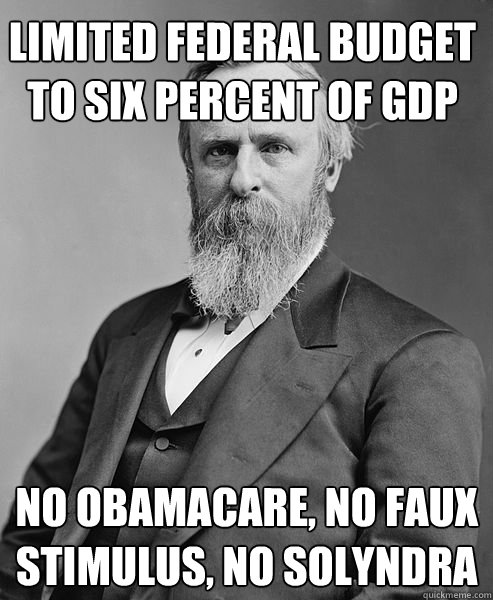
Instead, I want to jump on the bandwagon and produce some posters comparing the 19th President and the 44th President (if you’re not aware, posters of Pres. Hayes with self-created captions have been all over the Internet).
You won’t be surprised to learn that I’m focused on the policy differences between Hayes and Obama.
Most important, Hayes largely was true to the Founding Fathers’ vision of a limited central government. Government spending averaged only about 6 percent of economic output during his tenure (probably less, the data are not very robust, so I took the worst-case numbers) and America was blessedly free of the income tax.
Members of the Occupy Little Rock group have set up camp outside the Clinton Library, video contributor Gabe Gentry reports. Around 65 are gathered currently with chimineas and grills and pizzas. Thirty plan to camp and remain indefinitely, Gentry said, though a police cruiser had just arrived on the scene to idle 30 yards from the protesters around 8:15 p.m.
I’m going to go take a look as soon as I’m able. More when I’ve got it.
UPDATE: It looks like the police aren’t going to try to disperse the crowd. The protesters have a chiminea going now that they lit only after first getting permission from one of the police officers on the scene.
Some people have tried to praise Occupy Wall St, but they do have any good solutions. The most simple explanation I have seen was by a reader who commented on the story above saying maybe the 99% COULD SCARE THE 1%.
Cato’s Tom Palmer discusses the Occupy Wall Street movement and the Tea Party in a debatewith The Nation‘s Peter Rothberg at PolicyMic:
The Tea Party has a coherent message: Stop the bailouts, stop the cronyism, and stop swindling today’s voters with empty promises and sinking future generations under mountains of debt…
What caused the crisis, the indebtedness, the unemployment, the stagnation? The culprits are state agencies and enterprises, including our Federal Reserve…
The Occupiers have the wrong address. The subprime crisis was designed in Washington, not New York…
Government debts and printing-press money will harm future generations. It’s unfair. It’s immoral. And it’s going to be solved not by occupying Phoenix, or Wall Street, or Atlanta, but by demanding that spendthrift politicians stop the bailouts and the cronyism, put the brakes on spending, and pay attention to a truly radical concept: arithmetic. Those are sound Tea Party values.
I have posted a lot about Steve Jobs and I have the links below after this fine aricle: Steve Jobs to Obama in 2010: ‘You’re Headed for a One-Term Presidency’ Lachlan Markay October 21, 2011 at 12:04 pm Steve Jobs, the late Apple founder and digital pioneer, told President Obama in a 2010 meeting […]
Steve Brawner made the comment: For now, the Occupy movement doesn’t seem to be offering a lot of concrete solutions for the nation’s problems, and until it does, it won’t accomplish much. Captain America is a loyal reader of Brawner and he pointed to a great article on the subject and here it is: Confusing […]
Republican debate Oct 18, 2011 (last part) with video clips and transcript Below are video clips and the transcript. pt 5 pt 6 pt 7 COOPER: We’re going to move on to an issue very important here in the state of Nevada and throughout the West. We have a question from the hall. QUESTION: Yeah, […]
I have written a lot about Steve Jobs recently and I wanted to link those posts below. Here is an interesting article for those who think that government officials are smart as those like Steve Jobs who are able to survive in the private market place and thrive. Indian Bureaucrats Are No Steve Jobs by […]
Dan Mitchell is right about the “Occupy Wall St crowd” Here is some video and pictures of the Occupy Arkansas March of October 15, 2011 followed by an excellent article by Jason Tolbert. Steve Brawner has rightly said: For now, the Occupy movement doesn’t seem to be offering a lot of concrete solutions for the […]
Steve Jobs was raised as a conservative Lutheran but he chose to leave those beliefs behind. Below is a very good article on his life. COVER STORY ARTICLE | Issue: “Steve Jobs 1955-2011″ October 22, 2011 A god of our age Who was Steve Jobs? A revered technology pioneer and a relentless innovator, the Apple […]
Demonstrators march through the streets of Little Rock on Saturday in a protest organized by Occupy Little Rock. (John Lyon photo) Occupy Arkansas got cranked up today in Little Rock with their first march and several hundred showed up. It was unlike the pro-life marches that I have been a part of that have had […]
COUNTER-DEMONSTRATION: At Kappa Sigma house in Fayetteville. The Drew Wilson photo above went viral last night — at least in Arkansas e-mail and social media users — after the Fayetteville Flyer posted it in coverage of an Occupy Northwest Arkansas demonstration in Fayetteville. The 1 percent banner was unfurled briefly on the Kappa Sigma frat […]
I found this article interesting from the Wall Street Journal: OCTOBER 10, 2011 The Corporate Exec: Hollywood Demon Nazis are getting old, moviemakers don’t want to offend foreign audiences, so corporate types top the list of evil stereotypes By EDWARD JAY EPSTEIN It is not surprising that pop-culture protesters are now intent on occupying Wall […]
The Arkansas Times Blog reported today: Around 100 were on hand for tonight’s Occupy Little Rock planning meeting, the second since the group formed in Little Rock earlier this month. Organizers and attendees struggled with a somewhat complicated voting-by-hand-signals process, but the assembly did get some key points ironed out, including the start time and […]
In his article, “Medicaid and the consequences,” Arkansas Democrat-Gazette, March 20, 2012, (paywall), Brummett admits, “Medicaid will break the bank of state government if we don’t do something.” However, he never gets around to saying that Obamacare is going to ruin the state financially. It will expand this failing welfare program by putting over half of the reduction in uninsured into the Medicaid program that is already broke. SMOKE AND MIRRORS IS ALL WE ARE GOING TO GET FROM OBAMACARE. Instead, Brummett wants to move around the chairs on the financial Titanic we will have here in Arkansas!!!!!
Brummett was in favor of Obamacare all along but he never does even mention Obamacare once in his article. Below is a study done by the Heritage Foundation on the future impact of Obamacare on states budgets.
Roughly half of the anticipated gains in insurance coverage from the Patient Protection and Affordable Care Act (PPACA)[1] are achieved through a massive expansion of Medicaid, the joint federal–state health insurance program for the poor. The Medicaid program, with its soaring price tag and dubious level of care for recipients, is in serious need of reform, not expansion. Increasing enrollment in this program by a third is a major flaw of the new health care law.[2]
Summary
Section 2001(a) of PPACA requires states to increase Medicaid eligibility to cover all Americans below 138 percent of the federal poverty level (FPL) beginning January 1, 2014.[3] At that time, the FPL will be about $33,000 for a family of four, excluding the value of any welfare benefits. Section 1201 of the reconciliation bill (H.R. 4872) specifies that the federal government will pick up 100 percent of the cost of providing coverage for the expansion population (those who qualify under the new requirements but were ineligible under the previous state eligibility criteria) between 2014 and 2016. The federal reimbursement for the newly eligible will gradually decline thereafter until 2020, when the federal share of the cost will stay at 90 percent.
States will not receive such a high reimbursement for individuals who apply for Medicaid and were eligible under the previous state eligibility criteria in place when PPACA was signed into law.[4] States will be reimbursed for these individuals at their traditional federal reimbursement, which ranges from 50 percent in the wealthiest states to nearly 75 percent in the poorest states. Nationally, about 12 million individuals are eligible for Medicaid but are not yet enrolled.[5] The state cost of the Medicaid expansion will largely be affected by how many of these individuals sign up for the program, which will probably be increased because of the publicity likely to surround the penalties in the law for not maintaining health insurance.
One provision of PPACA, the maintenance of effort (MOE) requirement in Section 2001(b), impacts states immediately. Under PPACA’s MOE, a state would lose all federal Medicaid funding if it makes eligibility more restrictive than the standards in effect for the state’s program at the time the law was enacted.[6] This essentially freezes the state’s eligibility requirements regardless of the impact on its bottom line.
Not only are states forced to keep eligibility at that level, but they are being forced to raise payments to primary care physicians. Section 1202 of H.R. 4872 requires that states increase Medicaid reimbursement rates for primary care physicians (PCPs) to the same level as the applicable Medicare payment rates for 2013 and 2014. The legislation specifies that the federal government will pay this entire cost—temporarily. This requirement, along with the federal funding for it, expires on January 1, 2015. At that time, states will have to either maintain the physician payment rate themselves or make drastic cuts.
Impact
Instead of reforming Medicaid—by targeting taxpayer dollars to populations truly deserving of public assistance and pursuing fundamental reform of the basic structure—PPACA doubles down on the program’s existing flaws. This will lead to a substantial increase in cost to taxpayers and a dramatic swelling in the number of individuals dependent on the government paying their health care bills.
Increases in Taxes and Pressure on Other Areas of Public Spending. The Congressional Budget Office (CBO) and the Centers for Medicare and Medicaid Services (CMS) project that PPACA will increase federal spending on Medicaid by between $75 billion and $100 billion annually.[7] This dramatic increase is irresponsible given current annual federal budget deficits well in excess of $1 trillion. Further spending on Medicaid will necessitate an increase in federal taxes or cuts to other public programs. Given the evidence of poor health outcomes for Medicaid recipients,[8] the expansion likely fails a cost–benefit analysis.
Massive Increase in Government Dependence and Crowding Out of Private Coverage. CBO projects that PPACA will increase national enrollment in Medicaid by 16 million individuals in 2019, while CMS projects 20 million individuals.[9] The Heritage Foundation estimates that the growth in Medicaid caseloads will range from 9 percent in Massachusetts to 66 percent in Nevada.[10] Recent research by economists Jonathan Gruber and Kosali Simon finds that “the number of privately insured falls by about 60 percent as the number of publicly insured rises.”[11] This means several million individuals below the new income threshold who currently have private coverage will be swept into Medicaid when PPACA takes effect.
Worsening State Budget Problems and Limits on State Options. States are already required to cover children and pregnant women below 133 percent of the FPL, but they have had flexibility to cover or not cover additional populations. That flexibility vanished with the passage of PPACA. In the short term, states cannot reduce eligibility criteria at all in order to deal with budget crises, and after 2014 state Medicaid programs must cover everyone below 138 percent of the FPL.[12] Most states will be forced to either cut benefits or cut provider payment rates. This is a significant problem in many states that already have low payment rates, particularly for PCPs. Setting payment rates lower will further reduce Medicaid patients’ access to providers and will increase use of emergency rooms for basic care needs.[13]
Creation of a Medicaid “Doc Fix.” The federal requirement that states boost Medicaid PCP rates to Medicare levels in 2013 and 2014 seems like a win for states, since federal taxpayers will finance it. However, this requirement will actually create problems for states. The increase in Medicaid payment rates for PCPs may cause other providers to lobby government to increase their rates as well. This would increase the cost to the state. When the federal funds go away, states could reduce payment rates again, but both physicians and their patients are likely to lobby against such a move. The state also has to be concerned with too many doctors leaving the Medicaid program.
Bureaucratic Nightmare and Intergovernmental Tension. The interaction of the Medicaid expansion and the creation of federal subsidies to purchase health insurance on the new state exchanges will create headaches and tensions for policymakers at the federal and state levels. Individuals below 138 percent of the FPL will be enrolled in state Medicaid programs, while many individuals between 138 percent and 400 percent of the FPL will be eligible for subsidies. There will be a lag between income on a household’s W-2 (for the prior year) and current income for eligibility purposes. It also invites a conflict of interest between state policymakers—who are incentivized for individuals to receive subsidies (so the federal government pays the full cost)—and federal policymakers, who will prefer states to share the costs through Medicaid.
A New Direction
Instead of expanding the nation’s fastest-growing entitlement, policies should move toward a fundamental restructuring of the Medicaid program to ensure fiscal sustainability, promote a patient-centered financing model, mainstream families into private coverage, and maintain a limited safety net for those individuals truly in need.
The federal financing structure, which encourages states to overspend, needs to be replaced with a structure that is more fiscally sustainable. In the short term, federal policymakers should, at the very least, allow states greater flexibility with eligibility and benefits so states can better manage their programs, control their costs, and balance their priorities.
Brian Blase is Policy Analyst in the Center for Health Policy Studies at The Heritage Foundation and is a Doctoral Candidate in Economics at George Mason University.
http://blog.heritage.org | Today marks the 1,000th day since the United States Senate has passed a budget. While the House has put forth (and passed) its own budget, the Senate has failed to do the same. To help illustrate how extraordinary this failure has been, our new video highlights a few of impressive feats in history that have been accomplished in less time.
President Obama c/o The White House
1600 Pennsylvania Avenue NW
Washington, DC 20500
I have to be frank and it seems that this budget proposal presented on 2-13-2012 to Congress was just an attempt by a President to get himself re-elected by promising a lot of free lunches to a lot of special interest groups.
In his recent State of the Union address, President Obama said that he wanted an American economy that is “built to last.” Today’s release of his fiscal 2013 budget proposal shows that the president still thinks he can build economic prosperity with more spending, taxes, and debt. Those are the building materials for an economic time-bomb that will explode on future generations.
The following charts show that federal spending and debt as a share of the economy would remain at elevated levels under the president’s budget proposal:
Given that policymakers always seem to find an excuse to spend more money than was planned – and that there are virtually no limits on what the government can spend money on – these figures could prove to be optimistic.
So forget about the president’s cheap sloganeering about “investing in our future.” And ignore the double-talk about “re-establish[ing] fiscal responsibility.” The fact is the president is proposing to spend $47 trillion dollars over the next ten years – almost $6 trillion of which would go toward interest on the debt alone. This budget isn’t about creating an economy that’s built to last – it’s about keeping the president’s Democratic constituencies satisfied in November and selling voters on the impossible promise of more free lunches.
Thank you so much for your time. I know how valuable it is. I also appreciate the fine family that you have and your committment as a father and a husband.
Sincerely,
Everette Hatcher III, 13900 Cottontail Lane, Alexander, AR 72002, ph 501-920-5733, lowcostsqueegees@yahoo.com
That video looked at the relationship between economic freedom and various indices that measure quality of life. Not surprisingly, free markets and small government lead to better results.
For years the United States has been a world leader in economic freedom. But runaway government spending and burdensome regulations have caused a decline in economic freedom in the United States. If our economic freedom continues to fall, how will it affect our quality of life?
_________
The entire video is superb, but there are two things that merit special praise, one because of intellectual honesty and the other because of intellectual effectiveness.
1. The refreshingly honest aspect of the video is its non-partisan tone. It explains, in a neutral fashion, that Bush undermined prosperity by making government bigger and that Obama is undermining prosperity by increasing the burden of government.
It’s also worth pointing out that there are several policies that impact on economic performance. The Koch Institute video focuses primarily on the key issues of fiscal policy and regulation, but trade, monetary policy, property rights, and rule of law are examples of other policies that also are very important.
This video, narrated by yours truly, looks at economic growth from this more comprehensive perspective.
Now that the so-called stimulus has been enacted, hopefully policy makers will turn their attention to policies that actually improve economic performance. This Center for Freedom and Prosperity Foundation video reviews the key finding in the Fraser Institute’s Economic Freedom of the World and explains that, contrary to the policies of Presidents Bush and Obama, smaller government and free markets are the way to boost economic growth. For more information: http://www.freedomandprosperity.org
________
The moral of the story from both videos is very straightforward. If the answer is bigger government, you’ve asked a very strange question.
In the clip above we see President Obama in his earlier debate with Hillary Clinton and he answered the question concerning the drop in the capital tax by Bill Clinton and the resulting increase in revenues, that he still would raise the capital gains tax on the 100,000 million Americans that owned stock because of the issue of fairness.
It seems that the corporate tax in the USA is almost double the world average and it should be reduced. In fact, Canada reduced theirs dramatically and still brought in about the same revenue.
Chris Edwards is the director of tax policy studies at the Cato Institute and the editor of Downsizing Government.org.
Added to cato.org on March 13, 2012
This article appeared in Daily Caller on March 13, 2012.
The President Obama and most members of Congress agree that the U.S. corporate tax rate should be cut. Thankfully, it is finally sinking in that having a 40 percent corporate tax rate when the world average is just 23 percent is suicide in a globalized economy.
The sticking point on slashing the corporate tax rate has been the fear that the federal government might lose revenues under such a reform. To prevent an expected revenue loss, policymakers have searched for tax loopholes to close in order to “pay for” a corporate rate cut. The problem is that members never find any loophole closings that they can agree on.
I’ve concluded that the effort to close corporate loopholes is a big waste of time. It is simply blocking desperately needed reforms to the tax rate. If I was drafting a corporate tax reform bill, I’d match a tax rate cut with federal spending cuts, but that idea hasn’t caught on either.
The good news is that a corporate tax rate cut without any changes to the tax base probably wouldn’t lose the government any money over the long term. Good evidence comes from Canada’s corporate tax cuts of the 1980s and 2000s.
The chart shows Canada’s federal corporate tax revenues as a share of gross domestic product (GDP) and the federal corporate tax rate. The tax rate plunged from 38 percent in 1980 to just 15 percent by 2012. Amazingly, there has been no obvious drop in tax revenues over the period.
Canadian corporate tax revenues have fluctuated, but the changes are correlated with economic growth, not the tax rate. In the late 1980s, a tax rate cut was followed by three years of stable revenues. In the early 1990s, a plunge in revenues was caused by a recession, and then in the late 1990s revenues soared as the economy grew.
In 2000, Canadian policymakers enacted another round of corporate tax rate cuts, which were phased in gradually. Corporate tax revenues initially dipped, but then they rebounded strongly in the late 2000s.
The rate cuts enacted in 2000 were projected to cause substantial revenue losses to the Canadian government. That projection indicates that the reform didn’t have much in the way of legislated loophole closing. But the chart shows that the positive taxpayer response to the rate cut was apparently so large that the government did not lose much, if any, revenue at all.
In 2009, Canada was dragged into a recession by the elephant economy next door, and that knocked the wind out of corporate tax revenues. However, it is remarkable that even with a recession and a tax rate under 20 percent, tax revenues as a share of GDP have been roughly as high in recent years as they were during the 1980s, when there was a much higher rate. Jason Clemens of the Macdonald-Laurier Institute notes that Canadian corporate tax revenues have been correlated with corporate profits, not the tax rate.
If a corporate tax rate is high, there is a “Laffer effect” when the rate is cut, meaning that the tax base expands so much that the government doesn’t lose any money. Estimates from Jack Mintz and other tax experts show that cutting corporate tax rates when they are above about 25 percent won’t lose governments any revenues over the long run.
The overall Canadian rate this year is about 27 percent when the average provincial rate is included. By contrast, the average federal-state rate in the United States is 40 percent, which is roughly 15 points above the revenue-maximizing rate. That means that Congress can proceed with a corporate rate cut and everyone would win — taxpayers, the economy and even the government.
Corporate tax reform with loophole closing is a wild-goose chase. Congress never seems to agree on which loopholes to close, with the result that our economy continues to suffer under a super-high rate. If we matched Canada by cutting our federal corporate rate from 35 percent to 15 percent, it would generate a large increase in reported income as corporate investment boomed and tax avoidance fell. The tax base would automatically expand without Congress even legislating reductions to deductions, credits or other loopholes.
In 2012, Canada will collect about 1.9 percent of GDP in federal corporate income tax revenues with a 15 percent tax rate. The United States will collect about 1.6 percent of GDP with a 35 percent tax rate. Do we need any more evidence that our high corporate tax rate makes no sense?
Unfortunately, it turns out the President was speaking to the Parliament of Ghana and apparently his recommendation for good policy didn’t apply inside the United States.
With this in mind, I’m not sure whether I should get too excited about his remarks yesterday that it is better to “let the market work on its own.”
Here are a few reasons why I am less than enthusiastic about this remarkable statement.
Instead, when he said that we should “let the market work on its own,” he was referring to the very narrow issue of China’s production and distribution of certain minerals.
In other words, if presidential statements came with asterisks, the fine print at the bottom of the page would read “offer good in China only.”
However, a journey of a thousand miles begins with a first step. So if he thinks it’s a good idea to reduce government intervention in China, maybe someday he will apply the same wisdom to the American economy.
My question to Crawford would be this: “Would the tax money collected during that 5 year period be refunded?”
In 1982 the Democrats promised future spending cuts if Ronald Reagan would agree to a tax increase, but you guessed it, the taxes were increased and the spending cuts never came. THE REAL PROBLEM IS NOT THAT WE DON’T HAVE ENOUGH TAXES BUT WE DON’T WANT TO CUT SPENDING!!!
Washington Could Learn a Lot from a Drug Addict
Concerning spending cuts Reagan believed, that members of Congress “wouldn’t lie to him when he should have known better.” However, can you believe a drug addict when he tells you he is not ever going to do his habit again? Congress is addicted to spending too much money. Lee Edwards wrote in his article “Golden Years” about Ronald Reagan:
Sometimes Reagan went along with a pragamatist like chief of staff James Baker, who persuaded the president to accept the Tax Equity and Fiscal Responsibility Act of 1982 (TEFRA), which turned out to be the great tax increase of 1982 — $98 billion over the next three years. That was too much for eighty-nine House Republicans (including second-term Congressman Newt Gingrich of Georgia) or for prominent conservative organizations from the American Conservative Union like the Conservative Caucus and the U.S. Chamber of Commerce, which all opposed the measure.
Baker assured his boss that Congress would approve three dollars in spending cuts for every dollar of tax increase. To Reagan, TEFRA looked like a pretty good “70 percent” deal. But Congress wound up cutting less than twenty-seven cents for every new tax dollar. What had seemed to be an acceptable 70-30 compromise turned out to be a 30-70 surrender. Ed Meese described TEFRA as “the greatest domestic error of the Reagan administration,” although it did leave untouched the individual tax rate reductions approved the previous year. (TEFRA was built on a series of business and excise taxes plus the removal of business tax deductions.)[xxx]
The basic problem was that Reagan believed, as Lyn Nofziger put it, that members of Congress “wouldn’t lie to him when he should have known better.”[xxxi] As a result of TEFRA, Reagan learned to “trust but verify,” whether he was dealing with a Speaker of the House or a president of the Soviet Union.
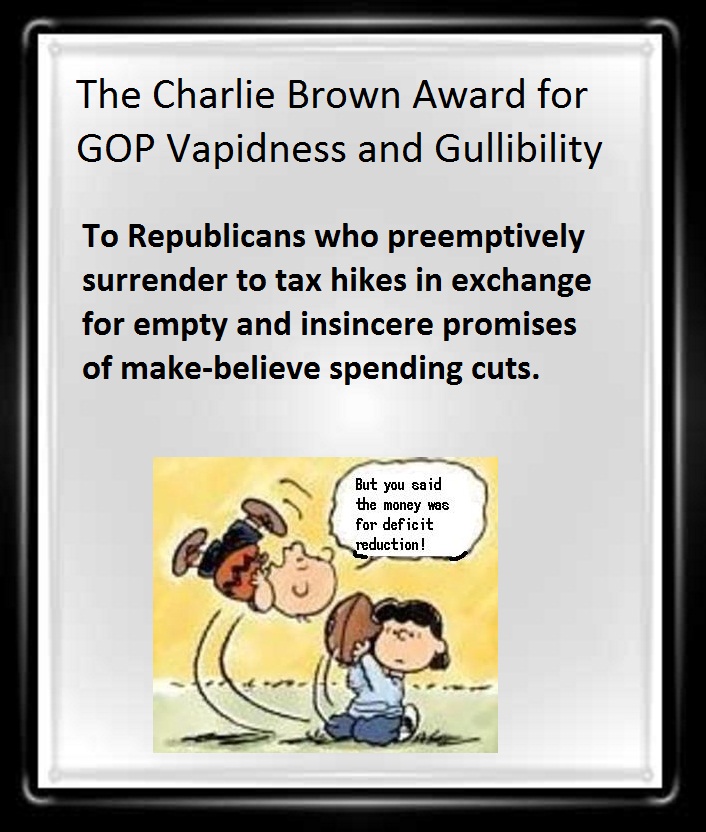
I’ve remarked before that Democrats are the evil party and Republicans are the stupid party. Well, if anyone needs additional proof about GOPers being clueless and tone deaf, exhibit A is Congressman Rick Crawford of Arkansas, who has decided to preemptively capitulate in favor of higher tax rates.
Freshman Republican Rep. Rick Crawford will propose a surtax on millionaires Thursday morning, a crack in the steadfast GOP opposition to extracting more money from the nation’s top earners. The Arkansas Republican will unveil the plan during a local television interview Thursday morning, and plans to introduce legislation when the House returns next week, according to sources familiar with his thinking. Crawford will propose the additional tax— expected to be north of 2.5 percent — on individual income over $1 million as part of a broader fiscal responsibility package.
I have no idea if Congressman Crawford is simply naive, unaware that tax-increase deals inevitably lead to higher spending and more red ink. Or perhaps he’s trying to become the kind of Republican who thinks he can advance his career by saying things that will earn him pats on the head from the establishment media.
But I do know that America’s fiscal problem is a government that is far too big. You don’t solve the problem with more taxes, just as you don’t cure alcoholics by giving them more to drink.
Congressman Crawford, though, wants to give away the keys to a liquor store without even asking for an insincere commitment for future sobriety in exchange. Indeed, the Congressman’s naiveté is so impressive that he is the first winner of the Charlie Brown Award for Vapidness and Gullibility.
There’s a rumor that he is sending former President George H.W. “read my lips” Bush to collect his award, but I’m unable to confirm at this point.
This new award is part of a series, with the “Bob Dole Award” having been announced earlier this year.
Crawford’s Democrat opponents have called him opportunist and they are right. People go into the booth to vote for the welfare party or the conservative job creating party and they can tell when someone is talking out of both sides of their mouth. It is sad when a newbie don’t talk to someone who has been in the conservative trenches for years fighting the good fight.
In the debate of job creation and how best to pursue it as a policy goal, one point is forgotten: Government doesn’t create jobs. Government only diverts resources from one use to another, which doesn’t create new employment.
Video produced by Caleb Brown and Austin Bragg.
___________________________
I have a son named Wilson Daniel Hatcher and he is named after two of the most respected men I have ever read about : Daniel from the Old Testament and Ronald Wilson Reagan.
One of the thrills of my life was getting to hear President Reagan speak in the beginning of November of 1984 at the State House Convention Center in Little Rock. Immediately after that program I was standing outside on Markham with my girlfriend Jill Sawyer (now wife of 25 years) and we were alone on a corner and the President was driven by and he waved at us and we waved back.
My former pastor from Memphis, Adrian Rogers, got the opportunity to visit with President Ronald Reagan on several occasions and my St Senator Jeremy Hutchinson got to meet him too. I am very jealous.
Today we are going to compare Reagan’s record to that of Obama:
Those two charts showed that the current recovery was very weak compared to the boom of the early 1980s.
But perhaps that was an unfair comparison. Maybe the Reagan recovery started strong and then hit a wall. Or maybe the Obama recovery was the economic equivalent of a late bloomer.
So let’s look at the same charts, but add an extra year of data. Does it make a difference?
Meh…not so much.
Let’s start with the GDP data. The comparison is striking. Under Reagan’s policies, the economy skyrocketed. Heck, the chart prepared by the Minneapolis Fed doesn’t even go high enough to show how well the economy performed during the 1980s.
Under Obama’s policies, by contrast, we’ve just barely gotten back to where we were when the recession began. Unlike past recessions, we haven’t enjoyed a strong bounce. And this means we haven’t recovered the output that was lost during the downturn.
Unfortunately, the jobs chart is probably even more discouraging. As you can see, employment is still far below where it started.
This is in stark contrast to the jobs boom during the Reagan years.
So what does this mean? How do we measure the human cost of the foregone growth and jobs that haven’t been created?
Writing in today’s Wall Street Journal, former Senator Phil Gramm and budgetary expert Mike Solon compare the current recovery to the post-war average as well as to what happened under Reagan.
If in this “recovery” our economy had grown and generated jobs at the average rate achieved following the 10 previous postwar recessions, GDP per person would be $4,528 higher and 13.7 million more Americans would be working today. …President Ronald Reagan’s policies ignited a recovery so powerful that if it were being repeated today, real per capita GDP would be $5,694 higher than it is now—an extra $22,776 for a family of four. Some 16.9 million more Americans would have jobs.
By the way, the Gramm-Solon column also addresses the argument that this recovery is anemic because the downturn was caused by a financial crisis. That’s certainly a reasonable argument, but they point out that Reagan had to deal with the damage caused by high inflation, which certainly wreaked havoc with parts of the financial system. They also compare today’s weak recovery to the boom that followed the financial crisis of 1907.
But I want to make a different point. As I’ve written before, Obama is not responsible for the current downturn. Yes, he was a Senator and he was part of the bipartisan consensus for easy money, Fannie/Freddie subsidies, bailout-fueled moral hazard, and a playing field tilted in favor of debt, but his share of the blame wouldn’t even merit an asterisk.
My problem with Obama is that he hasn’t fixed any of the problems. Instead, he has kept in place all of the bad policies – and in some cases made them worse. Indeed, I challenge anyone to identify a meaningful difference between the economic policy of Obama and the economic policy of Bush.
Bush increased government spending. Obama has been increasing government spending.
Bush adopted Keynesian “stimulus” policies. Obama adopted Keynesian “stimulus” policies.
Bush bailed out politically connected companies. Obama has been bailing out politically connected companies.
Bush supported the Fed’s easy-money policy. Obama has been supporting the Fed’s easy-money policy.
Bush created a new healthcare entitlement. Obama created a new healthcare entitlement.
Bush imposed costly new regulations on the financial sector. Obama imposed costly new regulations on the financial sector.
I could continue, but you probably get the point. On economic issues, the only real difference is that Bush cut taxes and Obama is in favor of higher taxes. Though even that difference is somewhat overblown since Obama’s tax policies – up to this point – haven’t had a big impact on the overall tax burden (though that could change if his plans for higher tax rates ever go into effect).
This is why I always tell people not to pay attention to party labels. Bigger government doesn’t work, regardless of whether a politician is a Republican or Democrat. The problem isn’t Obamanomics, it’s Bushobamanomics. But since that’s a bit awkward, let’s just call it statism.
But we also know that it is difficult to convince politicians to do what’s right for the nation. And if they don’t change the course of fiscal policy, and we leave the federal government on autopilot, then America is doomed to become another Greece.
The combination of poorly designed entitlement programs (mostly Medicare and Medicaid) and an aging population will lead to America’s fiscal collapse.
This testimony was delivered on September 20, 2011.
Conclusions
Federal spending is soaring, and government debt is piling up at more than a trillion dollars a year. Official projections show rivers of red ink for years to come unless policymakers enact major budget reforms. Unless spending and deficits are cut, the United States is headed for economic ruin as growth falls and rising debt threatens further financial crises.
Policymakers should turn their full attention to long-run spending reforms. They should begin terminating the many unneeded and damaging federal programs that draw resources out of the private sector and sap the economy’s strength. The essays on Cato’s website http://www.DownsizingGovernment.org describe many federal programs that produce low or negative returns. Programs often create economic distortions, damage the environment, restrict individual freedom, or have high levels of fraud and abuse.
I’ve proposed a plan to cut spending on entitlements, defense, and discretionary spending over 10 years to balance the budget.25 Spending reforms should aim to revive constitutional federalism and reverse the expansion of the federal government into areas better left to state and local governments, businesses, charities, and individuals.
Some analysts worry that spending cuts would hurt the economy, but other high-income nations have cut spending with very positive results. In the mid-1990s, for example, Canada faced a debt crisis caused by runaway spending — similar to our current situation. But the Canadian government changed course and slashed total spending 10 percent in just two years — which would be like us chopping annual spending by $360 billion in two years.26 Total government spending in Canada was cut by more than 10 percentage points of GDP over a decade. The Canadian economy did not sink into a recession as Keynesian economists might fear, but instead was launched on a 15-year economic boom.
A recent Joint Economic Committee report summarizes other international examples of spending cuts coinciding with strong economic growth.27 Thus, spending cuts should not be viewed as bad tasting medicine needed only to cure our debt disease, but as an opportunity to create positive and lasting benefits to the economy and society.

 You won’t be surprised to learn that I’m focused on the policy differences between Hayes and Obama.


 Canadian corporate tax revenues have fluctuated, but the changes are correlated with economic growth, not the tax rate. In the late 1980s, a tax rate cut was followed by three years of stable revenues. In the early 1990s, a plunge in revenues was caused by a recession, and then in the late 1990s revenues soared as the economy grew.
 “Free market for thee, not for me”


 The Daily Hatch