Category Archives: Cato Institute

Obama is easy to make fun of at times

Exempting half the people from paying income tax does not seem like a bright idea. President Obama has a funny way of spinning that.  Dan Mitchell’s blog has a good way of presenting that.

I’ve already posted on Obama’s class-warfare approach to tax policy, and I’ve also posted about the pitfalls of a tax system that exempts 50 percent of the population.

Well, here’s a cartoon that cleverly combines both themes.

Related posts with material from Dan Mitchell of the Cato Institute:

Corrupt scams like Solyndra and bailouts make people resent paying their taxes and look for tax havens

The Economic Case for Tax Havens Uploaded by afq2007 on Sep 10, 2008 Statist politicians and international bureaucracies such as the OECD and UN routinely attack tax havens, claiming that they lead to “harmful tax competition.” Yet at no point do critics bother to provide any evidence for this claim. This mini-documentary from the Center […]

Dan Mitchell of the Cato Institute on President Obama’s “Social Darwinism speech”

Dan Mitchell of the Cato Institute rightly has pointed out that President Obama is off base to be critical of Paul Ryan’s budget since it allows the government to grow by over 3% each year and he wished that the Republicans would taking a sharper knife to the budget cuts!!!! Appearing on PBS to Debate […]

The real truth about Obamacare can be seen on the www.thedailyhatch.org

Michael Cannon on Medicare and Healthcare You want to know the real truth about Obamacare then check out these videos and articles linked below: American people do not want Obamacare and the regulations that go with it March 7, 2012 – 8:02 am In this article below you will see that the American people do not […]

Videos by Dan Mitchell of the Cato Institute found here on www.thedailyhatch.org

Dan Mitchell of the Cato Institute has some great videos and I have posted lots of them on my blog. I like to go to Dan’s blog too. Take a look at some of them below and then the links to my blog. It’s Simple to Balance The Budget Without Higher Taxes Uploaded by afq2007 […]

Massive government spending encourages fraud and discourages hard work in private market

The Rahn Curve and the Growth-Maximizing Level of Government Uploaded by afq2007 on Jun 29, 2010 Government spending can promote economic growth if money is used for core “public goods” such as rule of law and property rights. But the burden of government spending in the United States and other industrialized nations is far higher […]

Cato Institute praises Bill Clinton’s restraint to spend, President Obama calls that level of spending “social darwinism”

Dan Mitchell always has some great cartoons he posts: Michael Ramirez is a first-rate cartoonist for Investor’s Business Daily. Here are two of his recent gems. As always, humor works when it is based on something true. With that in mind, do you prefer this cartoon, which shows Obama scolding the Founding Fathers for their […]

Obamacare expands dependence on government health care

Tim Sandefur Discusses ObamaCare’s Medicaid Expansion Uploaded by catoinstitutevideo on Mar 26, 2012 http://www.cato.org/event.php?eventid=9074 Tim Sandefur of the Pacific Legal Foundation explains some of the implications of the Affordable Care Act’s Medicaid expansion. ___________________ Great chart from Heritage Foundation on Obamacare: Obamacare expands dependence on government health care DOWNLOAD HIGH-RES (JPG, Color) Slide 1 | […]

Obama wants millionaires to at least pay what their secretaries pay, here is the solution

Take a lot at these figures from the Cato Institute: New Academic Study Confirms Previous IMF Analysis, Shows that Lower Tax Rates Are the Best Way to Reduce Tax Evasion Posted by Daniel J. Mitchell Leftists want higher tax rates and they want greater tax compliance. But they have a hard time understanding that those […]

An open letter to President Obama (Part 54)

Uploaded by WSJDigitalNetwork on Feb 23, 2012 Editorial board member Steve Moore breaks down Mitt Romney’s and President Obama’s tax plans. _____________________ President Obama c/o The White House 1600 Pennsylvania Avenue NW Washington, DC 20500 Dear Mr. President, I know that you receive 20,000 letters a day and that you actually read 10 of them […]

Ernie Dumas:Tax cuts explode deficit

Ernie Dumas in the Arkansas Times, Jan 18, 2012 argued: A big majority of Americans are concerned about growing income inequality and government favor for the rich, and they understand that lower taxes do directly affect federal budget deficits, which Republican orthodoxy for 30 years has denied. However, I like most Republicans would argue the […]

Corrupt scams like Solyndra and bailouts make people resent paying their taxes and look for tax havens

The Economic Case for Tax Havens

Uploaded by on Sep 10, 2008

Statist politicians and international bureaucracies such as the OECD and UN routinely attack tax havens, claiming that they lead to “harmful tax competition.” Yet at no point do critics bother to provide any evidence for this claim. This mini-documentary from the Center for Freedom and Prosperity looks at the empirical data and scholarly research and reports that tax havens actually have a very positive impact on the global economy.

______________

The size of government needs to be reduced. Eventually people will revolt against the tremendous amount of taxes they are forced to pay. Furthermore, corrupt scams like Solyndra and bailouts make people resent paying their taxes and people will look for tax havens in other countries if taxes are not reduced.

I wrote last year about a backlash from long-suffering Greek taxpayers. These people – the ones pulling the wagon rather than riding in the wagon – are being raped and pillaged by a political class that is trying to protect the greedy interest groups that benefit from Greece’s bloated public sector.

We now have another group of taxpayers who are fighting back against greedy government. My ancestors in Ireland have decided that enough is enough and there is widespread civil disobedience against a new property tax.

Here are the key details from an AP report.

The Serfs Fight Back

Ireland is facing a revolt over its new property tax. The government said less than half of the country’s 1.6 million households paid the charge by Saturday’s deadline to avoid penalties. And about 5,000 marched in protest against the annual conference of Prime Minister Enda Kenny’s Fine Gael party. Emotions ran raw as police backed by officers on horseback stopped demonstrators from entering the Dublin Convention Centre. …One man mistakenly identified as the government minister responsible for collecting the tax had to be rescued by police from an angry scrum. Kenny said his government had no choice, but to impose the new charge as part of the nation’s efforts to emerge from an international bailout. …The charge this year is a flat-fee €100 ($130) per dwelling, but is expected to rise dramatically next year once Ireland starts to vary the charge based on a property’s estimated value. Anti-tax campaigners have urged the public to ignore the tax demand, arguing that the government doesn’t have the power to collect it.

What makes this new tax so outrageous is that Irish taxpayers already have been victimized with higher income tax rates and a more onerous value-added tax. Yet they weren’t the ones to cause the nation’s fiscal crisis. Ireland is in trouble for two reasons, and both deal with the spending side of the fiscal equation.

1. The burden of government spending exploded last decade, more than doubling in less than 10 years. This wiped out all the gains from fiscal restraint in the 1980s and 1990s.

2. Irish politicians decided to give a bailout not only to depositors of the nation’s failed banks, but also to bondholders. This is a grotesque transfer of wealth from ordinary people to those with higher incomes – and therefore a violation of Mitchell’s Guide to an Ethical Bleeding Heart.

It’s worth noting that academic studies find that tax evasion is driven largely by high tax rates. This makes sense since there is more incentive to hide money when the government is being very greedy. But there is also evidence that tax evasion rises when people perceive that government is wasting money and being corrupt.

Heck, no wonder the Irish people are up in arms. They’re being asked to cough up more money to finance a bailout that was both corrupt and wasteful.

Let’s close by looking at American attitudes about tax evasion. Here’s part of a column from Forbes, which expresses surprise that Americans view tax evasion more favorably than behaviors such as shoplifting and littering.

A new survey suggests Americans consider cheating on their taxes more socially acceptable than shoplifting, drunk driving or even throwing trash out the window of a moving car. …only 66% of  the participants said they “completely agree” that “everyone who cheats on their taxes should be held accountable”  and only 72% completely agreed that “it’s every American’s civic duty to pay their fair share of taxes”–suggesting, as the Shelton study does, that perhaps disapproval of tax evasion is not as strong as, say, disapproval of stealing from private businesses.

I’m not sure, though, why anybody would be shocked by these results. We have a government in Washington that is pervasively corrupt, funneling money to corrupt scams like Solyndra.

These same people want higher tax rates, which will further encourage people to protect their income.

If we really want to promote better tax compliance, whether in the U.S., Ireland, or anywhere in the world, there are two simple answers. First, enact a simple and fair flat tax to keep rates low. Second, shrink government to its proper size, which will automatically reduce waste and limit opportunities for corruption.

But none of this is in the interests of the political class, so don’t hold your breath waiting for these reforms.

________

The Moral Case for Tax Havens

Uploaded by on Oct 22, 2008

This Center for Freedom and Prosperity Foundation video demonstrates that low-tax jurisdictions offer millions of people around the world a safe haven from tyrannical and oppressive government. For this, and many other reasons, there is a powerful moral case for preserving and promoting tax havens. This mini-documentary is the second installment of a three-part series on the beneficial impact of low-tax jurisdictions. In addition to showing how tax havens promote human rights and individual liberty, the video exposes the hypocritical anti-tax competition efforts of statist international bureaucracies such as the Organization for Economic Cooperation and Development. For more information: http://www.freedomandprosperity.org Link to Part 1 — The Economic Case for Tax Havens: http://www.youtube.com/watch?v=yi0lkJBTi58

Related posts:

Here are some posts that include videos from Dan Mitchell:

Videos by Cato Institute on failed stimulus plans

In this post I have gathered several videos from the Cato Institute concerning the subject of failed stimulus plans. _____ Government Spending Doesn’t Create Jobs Uploaded by catoinstitutevideo on Sep 7, 2011 Share this on Facebook: http://on.fb.me/qnjkn9 Tweet it: http://tiny.cc/o9v9t In the debate of job creation and how best to pursue it as a policy […]

Balanced Budget Amendment the answer? Boozman says yes, Pryor no, Part 28 (Input from Norm Coleman, former Republican Senator from MN)

  It’s Simple to Balance The Budget Without Higher Taxes Steve Brawner in his article “Safer roads and balanced budgets,” Arkansas News Bureau, April 13, 2011, noted: The disagreement is over the solutions — on what spending to cut; what taxes to raise (basically none ever, according to Boozman); whether or not to enact a […]

Obama’s plan is not too smart on taxes

Dan Mitchell did a great article concerning the affect of raising taxes in these two areas and horrible results: How Can Obama Look at these Two Charts and Conclude that America Should Have Higher Double Taxation of Dividends and Capital Gains? Posted by Daniel J. Mitchell As discussed yesterday, the most important number in Obama’s […]

______________

Tax Havens: Myths vs. Facts

Uploaded by on Dec 1, 2008

The Center for Freedom and Prosperity Foundation has produced videos showing the economic and moral benefits of so-called tax havens. This final video in the three-part series addresses some of the most common myths put forth by politicians from high-tax nations. Using academic research and data from international organizations, the video shows that the most common attacks made against low-tax jurisdictions are empty demagoguery.

Dan Mitchell of the Cato Institute on President Obama’s “Social Darwinism speech”

Dan Mitchell of the Cato Institute rightly has pointed out that President Obama is off base to be critical of Paul Ryan’s budget since it allows the government to grow by over 3% each year and he wished that the Republicans would taking a sharper knife to the budget cuts!!!!

I posted yesterday about Obama’s demagoguery against the Ryan budget and criticized the President for sloppy budget math, tedious class warfare, and a deeply flawed grasp of America’s founding principles.

This was followed by an opportunity yesterday evening to debate Jared Bernstein on the PBS NewsHour.

Here’s the interview, though I warn you that excerpts of Obama’s  speech take up the first 3:17 of the video, and you won’t get to the debate until about 4:20.

Uploaded by on Apr 3, 2012

In a blistering attack on the House-Passed Republican budget Tuesday, President Obama called the plan proposed by Rep. Paul Ryan a “Trojan Horse” and “a prescription for decline.” Judy Woodruff, Jared Bernstein of the Center on Budget and Policy Priorities and the CATO Institute’s Daniel Mitchell discuss the GOP budget plan.

__________

A few observations about the interview (other than that I need a haircut).

By the way, Jared Bernstein is a co-author of the infamous White House report that claimed unemployment would never rise above 8 percent if we squandered $800 billion on a faux stimulus package based on Keynesian economics. But I’m a nice guy, so I chose not to raise that issue.

Related posts:

The real truth about Obamacare can be seen on the www.thedailyhatch.org

Michael Cannon on Medicare and Healthcare You want to know the real truth about Obamacare then check out these videos and articles linked below: American people do not want Obamacare and the regulations that go with it March 7, 2012 – 8:02 am In this article below you will see that the American people do not […]

Videos by Dan Mitchell of the Cato Institute found here on www.thedailyhatch.org

Dan Mitchell of the Cato Institute has some great videos and I have posted lots of them on my blog. I like to go to Dan’s blog too. Take a look at some of them below and then the links to my blog. It’s Simple to Balance The Budget Without Higher Taxes Uploaded by afq2007 […]

Cato Institute praises Bill Clinton’s restraint to spend, President Obama calls that level of spending “social darwinism”

Dan Mitchell always has some great cartoons he posts: Michael Ramirez is a first-rate cartoonist for Investor’s Business Daily. Here are two of his recent gems. As always, humor works when it is based on something true. With that in mind, do you prefer this cartoon, which shows Obama scolding the Founding Fathers for their […]

Obamacare expands dependence on government health care

Tim Sandefur Discusses ObamaCare’s Medicaid Expansion Uploaded by catoinstitutevideo on Mar 26, 2012 http://www.cato.org/event.php?eventid=9074 Tim Sandefur of the Pacific Legal Foundation explains some of the implications of the Affordable Care Act’s Medicaid expansion. ___________________ Great chart from Heritage Foundation on Obamacare: Obamacare expands dependence on government health care DOWNLOAD HIGH-RES (JPG, Color) Slide 1 | […]

An open letter to President Obama (Part 47, A response to your budget)

Corker Says President’s 2012 Budget Proposal Shows “Lack of Urgency” on Spending Uploaded by senatorcorker on Feb 14, 2011 In remarks on the Senate floor today, U.S. Senator Bob Corker, R-Tenn., expressed disappointment in President Obama’s 2012 budget proposal, saying it displayed a “lack of urgency” to get federal spending under control. Corker has introduced […]


Videos by Dan Mitchell of the Cato Institute found here on www.thedailyhatch.org

Dan Mitchell of the Cato Institute has some great videos and I have posted lots of them on my blog. I like to go to Dan’s blog too. Take a look at some of them below and then the links to my blog.

It’s Simple to Balance The Budget Without Higher Taxes

Uploaded by on Oct 4, 2010

Politicians and interest groups claim higher taxes are necessary because it would be impossible to cut spending by enough to get rid of red ink. This Center for Freedom and Prosperity video shows that these assertions are nonsense. The budget can be balanced very quickly by simply limiting the annual growth of federal spending.

_______

Six Reasons Why the Capital Gains Tax Should Be Abolished

Uploaded by on May 3, 2010

The correct capital gains tax rate is zero because there should be no double taxation of income that is saved and invested. This is why all pro-growth tax reform plans, such as the flat tax and national sales tax, eliminate the capital gains tax. Unfortunately, the President wants to boost the official capital gains tax rate to 20 percent, and that is in addition to the higher tax rate on capital gains included in the government-run healthcare legislation. http://www.freedomandprosperity.org


______________

Keynesian Economics Is Wrong: Bigger Gov’t Is Not Stimulus

Uploaded by on Dec 15, 2008

Based on a theory known as Keynesianism, politicians are resuscitating the notion that more government spending can stimulate an economy. This mini-documentary produced by the Center for Freedom and Prosperity Foundation examines both theory and evidence and finds that allowing politicians to spend more money is not a recipe for better economic performance.

___________________

Obama’s So-Called Stimulus: Good For Government, Bad For the Economy

Uploaded by on Jan 26, 2009

President Obama wants Congress to dramatically expand the burden of government spending. This CF&P Foundation mini-documentary explains why such a policy, based on the discredited Keynesian theory of economics, will not be successful. Indeed, the video demonstrates that Obama is proposing – for all intents and purposes – to repeat Bush’s mistakes. Government will be bigger, even though global evidence shows that nations with small governments are more prosperous.

____________

Big Government Is Not Stimulus: Why Keynes Was Wrong (The Condensed Version)

Uploaded by on Jan 13, 2009

The CF&P Foundation has released a condensed version of our successful mini-documentary explaining why so-called stimulus schemes do not work. Based on a theory known as Keynesianism, politicians are resuscitating the notion that more government spending can stimulate an economy. This mini-documentary produced by the Center for Freedom and Prosperity Foundation examines both theory and evidence and finds that allowing politicians to spend more money is not a recipe for better economic performance.

_________________

Eight Reasons Why Big Government Hurts Economic Growth

Uploaded by on Aug 17, 2009

This Center for Freedom and Prosperity Foundation video analyzes how excessive government spending undermines economic performance. While acknowledging that a very modest level of government spending on things such as “public goods” can facilitate growth, the video outlines eight different ways that that big government hinders prosperity. This video focuses on theory and will be augmented by a second video looking at the empirical evidence favoring smaller government.

___________________

Now that I have been critical of the Democrat President, I wanted to show that I am not concerned about taking up for Republicans but looking at the facts. President Clinton did increase government spending at a slower rate than many other presidents. Here are two  videos that praise both Reagan and Clinton for both accomplished this feat.

Spending Restraint, Part I: Lessons from Ronald Reagan and Bill Clinton

Uploaded by on Feb 14, 2011

Ronald Reagan and Bill Clinton both reduced the relative burden of government, largely because they were able to restrain the growth of domestic spending. The mini-documentary from the Center for Freedom and Prosperity uses data from the Historical Tables of the Budget to show how Reagan and Clinton succeeded and compares their record to the fiscal profligacy of the Bush-Obama years.

______________

Spending Restraint, Part II: Lessons from Canada, Ireland, Slovakia, and New Zealand

Uploaded by on Feb 22, 2011

Nations can make remarkable fiscal progress if policy makers simply limit the growth of government spending. This video, which is Part II of a series, uses examples from recent history in Canada, Ireland, Slovakia, and New Zealand to demonstrate how it is possible to achieve rapid improvements in fiscal policy by restraining the burden of government spending. Part I of the series examined how Ronald Reagan and Bill Clinton were successful in controlling government outlays — particularly the burden of domestic spending programs. www.freedomandprosperity.org

Here are some posts that include videos from Dan Mitchell:

Videos by Cato Institute on failed stimulus plans

In this post I have gathered several videos from the Cato Institute concerning the subject of failed stimulus plans. _____ Government Spending Doesn’t Create Jobs Uploaded by catoinstitutevideo on Sep 7, 2011 Share this on Facebook: http://on.fb.me/qnjkn9 Tweet it: http://tiny.cc/o9v9t In the debate of job creation and how best to pursue it as a policy […]

Balanced Budget Amendment the answer? Boozman says yes, Pryor no, Part 28 (Input from Norm Coleman, former Republican Senator from MN)

  It’s Simple to Balance The Budget Without Higher Taxes Steve Brawner in his article “Safer roads and balanced budgets,” Arkansas News Bureau, April 13, 2011, noted: The disagreement is over the solutions — on what spending to cut; what taxes to raise (basically none ever, according to Boozman); whether or not to enact a […]

Obama’s plan is not too smart on taxes

Dan Mitchell did a great article concerning the affect of raising taxes in these two areas and horrible results: How Can Obama Look at these Two Charts and Conclude that America Should Have Higher Double Taxation of Dividends and Capital Gains? Posted by Daniel J. Mitchell As discussed yesterday, the most important number in Obama’s […]

______________

Massive government spending encourages fraud and discourages hard work in private market

The Rahn Curve and the Growth-Maximizing Level of Government

Uploaded by on Jun 29, 2010

Government spending can promote economic growth if money is used for core “public goods” such as rule of law and property rights. But the burden of government spending in the United States and other industrialized nations is far higher than needed to finance such activities. Citing scholarly studies, this CF&P Foundation video examines the Rahn Curve, which graphically illustrates the negative impact of excessive government spending. www.freedomandprosperity.org

___________

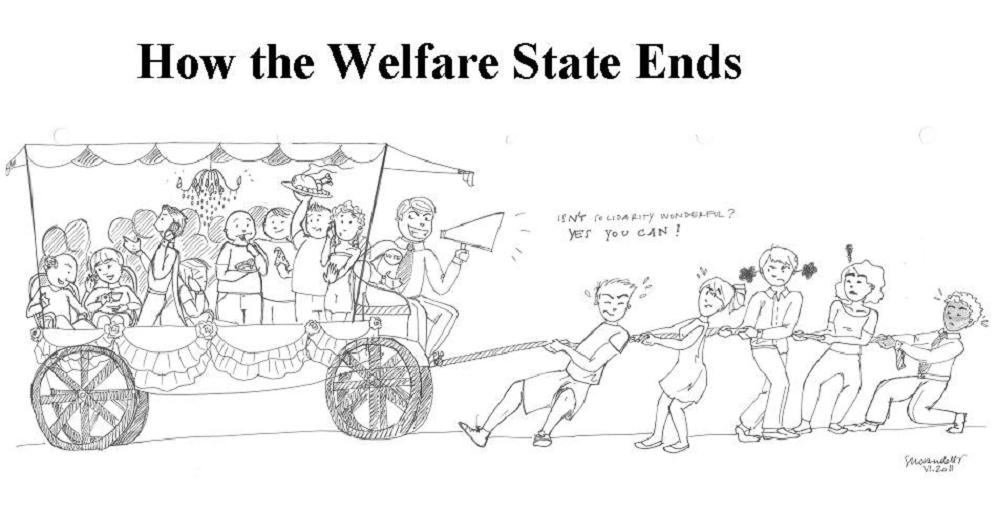
These images are remarkably accurate. The welfare state starts with small programs targeted at a handful of genuinely needy people. But as  politicians figure out the electoral benefits of expanding programs and people figure out the that they can let others work on their behalf, the ratio of producers to consumers begins to worsen.

_________

When the government gets so big that it distorts the behavior of the private market then it is too big. The federal government is  now spending 24.8% of GDP and traditionally for the first 150 years of our nation’s history we spent under 5% unless in wartime. This massive spending now by the federal encourages people to lie in order to get money for the government too instead of trying to work hard to earn money in the private market.

Why is big government bad for an economy? The easy answer is that big government usually means high tax rates, and this penalizes work, saving, investment, and entrepreneurship. And perhaps some of the spending is financed by borrowing, and this diverts money from private investment.

That’s a correct answer, but it’s only part of the story. In most cases, there is added damage because politicians spend money in ways that further undermine incentives to produce.

For instance, let’s assume a government spends $1 billion on some sort of redistribution program. Extracting that money from the productive sector of the economy obviously will cause some damage, but it’s also important to estimate how the supposed beneficiaries of the money will react. What if they decide to earn less income in order to be eligible for the handouts, as even the statists at the OECD have recognized?

In other words, it hurts the economy when government collects money, and it often hurts the economy when government spends money. Sort of a perverse 2-for-1 special (though “Rahn Curve” analysis does show that some types of spending – on core public goods – is correlated with better economic performance)

Let’s look at an example from Greece, showing how handouts distort behavior and corrupt people. Here are some remarkable tidbits from a Wall Street Journal story.

The Greek health ministry is investigating on Zakynthos after local officials flagged records showing what they said is an implausibly high number of disability claims for blindness. About 1.8% of the island’s population of 39,000 claimed the benefit last year, according to the health ministry. That is around nine times the prevalence of blindness estimated for many European countries in a 2004 study published in a World Health Organization journal. Among those who put in for the blindness benefit on Zakynthos, a local official said, were a taxi driver and a bird hunter. …But the island is hardly alone, according to health ministry officials, who say fraudulent disability claims are a problem across the nation… Zakynthos Mayor Stelios Bozikis on a Greek television talk show said residents angry about the benefits crackdown and other financial overhauls pelted him with yogurt at a recent event.

Before sneering at the Greeks, keep in mind that “disability” claims also are rising in the United States, which is rather remarkable since jobs have become less arduous over time. Heck, the Social Security Administration decided to give disability payments to a grown man who gets his jollies by wearing diapers.

I’m not sure if that’s better or worse than the Greek government deciding to reward pedophiles with disability payments, but taxpayers are getting screwed in both examples.

Let’s go back to the story and look at a rough estimate of how much fraud exists.

In an attempt to root out fraud, the Greek health ministry recently required disability claimants nationwide to register in a centralized database, appearing in person or sending a representative. The registration resulted in 36,000 fewer disability claims than in 2011, the health ministry said. The ministry alleges these dropped claims were fraudulent, in many cases reflecting multiple claims for the same disability or payments in the name of dead beneficiaries. It also alleges that some doctors accepted money for false diagnoses and some local politicians signed off on the benefits to win support, and said it is giving public prosecutors information about areas where it suspects a high level of fraud. Only 190 of the nearly 700 people it says had been collecting the blindness benefit on Zakynthos participated in the registration, the ministry said.

I have no idea if Zakynthos is representative, but that’s an incredibly high fraud rate. And this is just a glimpse at the workings of one government program. Now multiply that by some large number and you’ll begin to understand the damage caused by government.

And America is not immune. When politicians make it easier to ride in the wagon than to pull the wagon (as this cartoon illustrates), society sooner or later gets in trouble.

Cato Institute praises Bill Clinton’s restraint to spend, President Obama calls that level of spending “social darwinism”

Dan Mitchell always has some great cartoons he posts:

Michael Ramirez is a first-rate cartoonist for Investor’s Business Daily. Here are two of his recent gems.

As always, humor works when it is based on something true.

With that in mind, do you prefer this cartoon, which shows Obama scolding the Founding Fathers for their extreme libertarian views?

Or what about this cartoon, which makes the obvious point that growth is rather difficult when the productive sector of the economy is hobbled by too much government.

Obama on Ryan Plan: “It’s Laughable. It Is a Trojan Horse. It’s Thinly-Veiled Social Darwinism.”

Dan Mitchell of the Cato Institute has hit a home run with this post. If Congressman Paul Ryan could get criticized for wanting to bring down our federal spending to around 20% in 11 years  and earn the label of “social darwinist” from President Obama then surely President Obama would have thought President Clinton’s effort to cut spending to 18.2 % of GDP in 2001 as extremely devilish.

Actually, Bill Clinton must be something even worse than a social Darwinist. That’s because the title of this post is wrong. Obama said that Paul Ryan’s plan (which allows spending to grow by an average of 3.1 percent per year over the next decade) is a form of “social Darwinism.”

Proponent of social Darwinism?

But the proposal from the House Budget Committee Chairman only reduces the burden of federal spending to 20.25 percent of GDP by the year 2023.

Yet when Bill Clinton left office in 2001, following several years of spending restraint, the federal government was consuming 18.2 percent of economic output.

And by the President’s reasoning, this must make Clinton something worse than a Darwinist. Perhaps Marquis de Sade or Hannibal Lecter.

Here’s a blurb from the New York Times on Obama’s speech.

Mr. Obama’s attack, in a speech during a lunch with editors and reporters from The Associated Press, was part of a broader indictment of the Republican economic blueprint for the nation. The Republican budget, and the philosophy it represents, he said in remarks prepared for delivery, is “antithetical to our entire history as a land of opportunity and upward mobility for everyone who’s willing to work for it.” …“Disguised as a deficit reduction plan, it’s really an attempt to impose a radical vision on our country. It’s nothing but thinly veiled social Darwinism,” Mr. Obama said. “By gutting the very things we need to grow an economy that’s built to last — education and training, research and development — it’s a prescription for decline.”

I’m particularly amused by the President’s demagoguery that Ryan’s plan is “antithetical to our entire history” and “a radical vision.”

Is he really unaware that a small and constrained central government is part of America’s history and vision? Doesn’t he know that the federal government, for two-thirds of our nation’s history, consumed less than 5 percent of GDP?

Of course, that was back in the dark ages when people in Washington actually believed that the Constitution’s list of enumerated powers in Article 1, Section 8, actually enumerated the powers of the federal government. How quaint.

No wonder this Ramirez cartoon is so effectively amusing. It certainly seems to capture the President’s view of America’s founding principles.

An open letter to President Obama (Part 56)

President Obama c/o The White House
1600 Pennsylvania Avenue NW
Washington, DC 20500

Dear Mr. President,

I know that you receive 20,000 letters a day and that you actually read 10 of them every day. I really do respect you for trying to get a pulse on what is going on out here.

When you look at how good the private enterprise does with deliveries and then compare it to how bad the federal government does with the same duties it is laughable. The answer to the federal post office problem is to encourage private entrepreneurs to fill the gap and provide competition for the post office in the delivery of first class mail.

I grew up in Memphis and I am very familar with a company called Federal Express and its president Fred Smith. Actually I have lived in Little Rock since 1983 and Federal Express was started in Little Rock in 1971 and then moved to Memphis in 1972. Entrepreneurs like Fred Smith need to be encouraged, not discouraged by government. Here is a funny Fed Ex Commercial from the 1980’s.

 
On July 3, 1981, I was in Prague, Czechoslovakia in the middle of a 20 country student tour. Our group of 48 American students had the opportunity to speak to a Communist government official for over an hour. We asked him several questions. My questions were quite direct and I share some of them at a later time.
 
However, I did want to share one question that I asked. I told the official about an entrepreneur from Memphis named Fred Smith. Back in the early 1970’s we heard about how Smith had this crazy idea about delivering overnight packages from LA to San Francisco via Memphis. Sounded like it would not work, but Smith was able to invest all his money and eventually it paid off. His idea was successful.
 
I asked the simple question: Could something like this happen here in Communist Czechoslovakia? He responded, “No. That is because no private citizen is allowed to own that much capital. The government must do things like that.”
 
There was no chance for entrepreneurs to exist in communist countries. I was simply pointing out that economic freedom allows an environment for entrepreneurs. Why would someone put the time and energy in putting together a grand plan like Fed Ex when the benefit and reward would just go to a communist government? Entrepreneurship should be encouraged, but many times today in the USA we find that our lawmakers pass laws that discourage entrepreneurs.

USPS: Stuck With the Government Business Model

Posted by Tad DeHaven

The U.S. Postal Service has released a new five-year plan for congressional consideration that it says would get the beleaguered government mail monopoly on sounder financial footing and thus avoid a taxpayer bailout. The plan repeats previous suggestions (i.e., workforce reductions, postal network consolidations, elimination of Saturday delivery, elimination of the retiree healthcare benefit funding requirement) and proposes an increase in the price of a first-class stamp from forty-five to fifty cents.

Whether or not it would achieve what the USPS hopes, it probably doesn’t matter given that asking Congress for greater operational flexibility is like asking a two year old to stop playing with their food. That’s why the focus should be on completely transitioning the USPS from a government-run business to a privately-run business (or perhaps businesses).

Over at the Courier Express and Postal Observer blog, Alan Robinson says that “just like all plans that came before, [the new USPS plan] started with the assumption that the Postal Service remains a quasi-governmental entity.” As a result, Robinson notes that the plan is missing two key ingredients for success that foreign posts have utilized: private capital and an expanded range of products and services.

In an essay on the U.S. Postal Service, I discuss how liberalization in other countries has enabled foreign mailers to diversify into non-postal activities:

Consultants at Accenture have found that diversification not only has a measurable impact on the performance of international posts, but that it is what ultimately distinguishes high performers from low performers. America’s relatively dynamic economy is particularly suited for the diversification opportunities that would arise under postal liberalization.

Germany’s former postal monopoly, Deutsche Post, illustrates the type of transformation possible by liberalization. Today, the private Deutsche Post World Net has changed its compensation structure, imported managers from other industries, modernized the mail and parcels network within Germany, and developed new products such as hybrid mail and e-commerce. The company now has interests in not only the traditional mail and parcels business but also express mail logistics, banking, and more.

Given that the USPS’s plan is going to be unpopular with various postal stakeholders (i.e., special interests), Alan says that they should consider the advantages of privatization:

It is clear that the business plan that the Postal Service has chosen is not the one that has worked in other countries. The plan avoids talking about either private capital or expanding the breadth of service offerings as neither is on the legislative table.    Introducing thinking about how private capital could be introduced and the product offerings could be expanded forces stakeholders to think about privatization, an idea that is nearly as unpopular as the changes that the proposed business model introduced.   However, as this brief post notes, privatization offers significant financial advantages that could reduce the operating and price changes envisions by the Postal Service’s business plan. Therefore, those who see the greatest harm from this plan need to see if the advantages of privatization could benefit their interests sufficiently to overcome long-held objections to the idea.

I think Robinson is right, but I suspect that the “stakeholders” believe there’s a good chance that Congress will ultimately come to their aid with some sort of taxpayer bailout. Therefore, it’s possible that they believe that it is in their best interest to continue fighting for the status quo. Unfortunately, the recent bipartisan federal bailouts of the financial industry and the automakers suggest that they could be correct.


Thank you so much for your time. I know how valuable it is. I also appreciate the fine family that you have and your committment as a father and a husband.

Sincerely,

Everette Hatcher III, 13900 Cottontail Lane, Alexander, AR 72002, ph 501-920-5733, lowcostsqueegees@yahoo.com

On Bloomberg, Sessions Discusses Astounding Gimmicks In President’s Budget

Uploaded by on Feb 13, 2012

Related posts:

Privatize the post office

The Arkansas Times rightly jumped on Republicans for whining about the local post office branches that were closing.  (It is sad to me that Republican Presidential Candidates are not very brave about offering any spending cuts.) The real answer is privatizing the post office. Here is a good article from the Cato Institute:   The USPS […]

Post Office on the brink of financial collapse

Post Office on the brink of financial collapse You’ve Got (No) Mail: Is the End Near for the Postal Service? By James Gattuso September 29, 2011 The United States Postal Service (USPS) stands on the brink of financial collapse. According to the Postmaster General, by next month, USPS coffers will be down to a week’s […]

An open letter to President Obama (Part 55)

_______________

President Obama c/o The White House
1600 Pennsylvania Avenue NW
Washington, DC 20500

Dear Mr. President,

I know that you receive 20,000 letters a day and that you actually read 10 of them every day. I really do respect you for trying to get a pulse on what is going on out here.

It seems to me that during the 1980’s we saw the largest growth of our economy because private industry was encouraged to expand because the top tax rate went down from 70 to almost half of that.

It reminded me of the 1960’s when the top income rate went from 91 to almost half of that and the same thing happened. We need to get back to the same atmosphere of taxing cutting and the expansion of private industry. Instead we have today the government offering handouts everywhere we look. Here is a case that makes this very point below:

Franken to Chu: Doggone It, Like My State’s Company

Posted by Tad DeHaven

The Senate Energy and Natural Resources Committee held a hearing last week on the Department of Energy’s budget request for fiscal 2013. Chris Edwards tipped me off to a particularly galling exchange between Energy secretary Steven Chu and Sen. Al Franken (D-MN). Sen. Franken uses his allotted time to badger Chu about a federal loan that Energy conditionally committed to a Minnesota company in 2010 that apparently has yet to be approved.

The exchange begins around the 61 minute mark here. Our trusty interns, Devon Sanchez and Stephen Wooten, transcribed the exchange, which I’ll share a portion of:

Sen. Franken:

One such project is from a company in Minnesota called SAGE Electrochromics. I know you are aware of that. Sage has developed energy efficient windows that are cutting edge, better than anything in the world and uses photo-voltaic cells to control the window how dark it gets during the summer to block out UV light and lower air conditioning costs and to let it all in, lower heating costs in the summer. And it’s really…I’ve been there and it’s just an amazing tech. In the Spring of 2010, the DoE promised the company it would receive a $72 million loan guarantee under the 1703 Program to build a new manufacturing facility that would create 160 manufacturing jobs and 200 construction jobs in southern Minnesota. It’s now been two years since SAGE has been notified that it will receive a loan guarantee and the deal has not yet been closed. While the Department of Energy prolongs closing the deal, time and money are running out for SAGE. There are high-tech manufacturing construction jobs at stake here. It’s been going forward with the project assuming they get this loan guarantee but they’re running out of time and they may have to sell themselves to a French company. My first question is that the SAGE loan guarantee was going to be submitted to the credit committee on August 23rd, but it was stopped. Why is the Department of Energy continuing to delay closing and executing the SAGE loan guarantee?

Secretary Chu tells Sen. Franken that he can’t discuss the details and advises the senator to speak with SAGE. A frustrated Sen. Franken takes another crack at getting Chu to explain the holdup, but doesn’t get anywhere and his speaking time runs out. Anyhow, the exchange is sad commentary on the state of affairs in Washington. Sen. Franken sitting there singing the virtues of handing out other people’s money to commercial interests in general would have been problem enough. That he instead used his time to grovel for a handout to a company in his state just goes to show that too many policymakers see the federal government as a favor dispenser.

If this company is producing such “amazing tech,” then perhaps Sen. Franken should lend SAGE some of his money? (Maybe he could use the royalties he receives from DVD sales of “Stuart Saves His Family” to help the company.) Wisecracks aside, a quick Google search shows that SAGE has already received private capital. If this company is so great then it should have no trouble finding additional investors to lend it the money it needs. Then again, Franken says that it’s running out of money so perhaps it isn’t so great. But that’s the way Washington works: taxpayers get the losses while private companies get the profits…and arrogant senators get to pat themselves on the back for “creating jobs.”

See here for more on downsizing the Department of Energy.

______________
 
Do you see what I mean? We need to the free market more and less to government intervention to solve our economic problems.
 

Thank you so much for your time. I know how valuable it is. I also appreciate the fine family that you have and your committment as a father and a husband.

Sincerely,

Everette Hatcher III, 13900 Cottontail Lane, Alexander, AR 72002, ph 501-920-5733, lowcostsqueegees@yahoo.com

On Bloomberg, Sessions Discusses Astounding Gimmicks In President’s Budget

Uploaded by on Feb 13, 2012

Obama wants millionaires to at least pay what their secretaries pay, here is the solution

Take a lot at these figures from the Cato Institute:

New Academic Study Confirms Previous IMF Analysis, Shows that Lower Tax Rates Are the Best Way to Reduce Tax Evasion

Posted by Daniel J. Mitchell

Leftists want higher tax rates and they want greater tax compliance. But they have a hard time understanding that those goals are inconsistent.

Simply stated, people respond to incentives. When tax rates are punitive, folks earn and report less taxable income, and vice-versa.

In a previous post, I quoted an article from the International Monetary Fund, which unambiguously concluded that high tax burdens are the main reason people don’t fully comply with tax regimes.

Macroeconomic and microeconomic modeling studies based on data for several countries suggest that the major driving forces behind the size and growth of the shadow economy are an increasing burden of tax and social security payments… The bigger the difference between the total cost of labor in the official economy and the after-tax earnings from work, the greater the incentive for employers and employees to avoid this difference and participate in the shadow economy. …Several studies have found strong evidence that the tax regime influences the shadow economy.

Indeed, it’s worth noting that international studies find that the jurisdictions with the highest rates of tax compliance are the ones with reasonable tax systems, such as Hong Kong, Switzerland, and Singapore.

Now there’s a new study confirming these findings. Authored by two economists, one from the University of Wisconsin and the other from Jacksonville University, the new research cites the impact of tax burdens as well as other key variables.

Here are some key findings from the study.

According to the results provided in Table 2, the coefficient on the average effective federal income tax variable (AET) is positive in all three estimates and statistically significant for the overall study periods (1960-2008) at beyond the five percent level and statistically significant at the one percent level for the two sub-periods (1970-2007 and 1980-2008). Thus, as expected, the higher the average effective federal income tax rate, the greater the expected benefits of tax evasion may be and hence the greater the extent of that income tax evasion. This finding is consistent with most previous studies of income tax evasion using official data… In all three estimates, [the audit variable] exhibits the expected negative sign; however, in all three estimates it fails to be statistically significant at the five percent level. Indeed, these three coefficients are statistically significant at barely the 10 percent level. Thus it appears the audit rate (AUDIT) variable, of an in itself, may not be viewed as a strong deterrent to federal personal income taxation [evasion].

Translating from economic jargon, the study concludes that higher tax burdens lead to more evasion. Statists usually claim that this can be addressed by giving the IRS more power, but the researchers found that audit rates have a very weak effect.

The obvious conclusion, as I’ve noted before, is that lower tax rates and tax reform are the best way to improve tax compliance – not more power for the IRS.

Incidentally, this new study also finds that evasion increases when the unemployment rate increases. Given his proposals for higher tax rates and his poor track record on jobs, it almost makes one think Obama is trying to set a record for tax evasion.

The study also finds that dissatisfaction with government is correlated with tax evasion. And since Obama’s White House has been wasting money on corrupt green energy programs and a failed stimulus, that also suggests that the Administration wants more tax evasion.

Indeed, this last finding is consistent with some research from the Bank of Italy that I cited in 2010.

…the coefficient of public spending inefficiency remains negative and highly significant. …We find that tax morale is higher when the taxpayer perceives and observes that the government is efficient; that is, it provides a fair output with respect to the revenues.

And I imagine that “tax morale” in the United States is further undermined by an internal revenue code that has metastasized into a 72,000-page monstrosity of corruption and sleaze.

On the other hand, tax evasion apparently is correlated with real per-capita gross domestic product. And since the economy has suffered from anemic performance over the past three years, that blows a hole in the conspiratorial theory that Obama wants more evasion.

All joking aside, I’m sure the President wants more tax compliance and more prosperity. And since I’m a nice guy, I’m going to help him out. Mr. President, this video outlines a plan that would achieve both of those goals.

The Flat Tax: How it Works and Why it is Good for America

Uploaded by on Mar 29, 2010

This Center for Freedom and Prosperity Foundation video shows how the flat tax would benefit families and businesses, and also explains how this simple and fair system would boost economic growth and eliminate the special-interest corruption of the internal revenue code. www.freedomandprosperity.org

__________________________________

Given his class-warfare rhetoric, I’m not holding my breath in anticipation that he will follow my sage advice.

An open letter to President Obama (Part 54)

Uploaded by on Feb 23, 2012

Editorial board member Steve Moore breaks down Mitt Romney’s and President Obama’s tax plans.

_____________________

President Obama c/o The White House
1600 Pennsylvania Avenue NW
Washington, DC 20500

Dear Mr. President,

I know that you receive 20,000 letters a day and that you actually read 10 of them every day. I really do respect you for trying to get a pulse on what is going on out here.

I really respect Dan Mitchell of the Cato Institute and he does a great job below looking at this proposal concerning your corporate tax proposal.

President Obama’s Corporate Tax Reform Rearranges the Deck Chairs on the Titanic

Posted by Daniel J. Mitchell

American companies are hindered by what is arguably the world’s most punitive corporate tax system. The federal corporate rate is 35 percent, which climbs to more than 39 percent when you add state corporate taxes. Among developed nations, only Japan is in the same ballpark, and that country is hardly a role model of economic dynamism.

But the tax rate is just one piece of the puzzle. It’s also critically important to look at the government’s definition of taxable income. If there are lots of corrupt loopholes — such as ethanol — that enable some income to escape taxation, then the “effective” tax rate might be rather modest.

On the other hand, if the government forces companies to overstate their income with policies such as worldwide taxation and depreciation, then the statutory tax rate understates the actual tax burden.

The U.S. tax system, as the chart suggests, is riddled with both types of provisions.

This information is important because there are good and not-so-good ways of lowering tax rates as part of corporate tax reform. If politicians decide to “pay for” lower rates by eliminating loopholes, that creates a win-win situation for the economy since the penalty on productive behavior is reduced and a tax preference that distorts economic choices is removed.

But if politicians “pay for” the lower rates by expanding the second layer of tax on U.S. companies competing in foreign markets or by changing depreciation rules to make firms pretend that investment expenditures are actually net income, then the reform is nothing but a re-shuffling of the deck chairs on the Titanic.

Now let’s look at President Obama’s plan for corporate tax reform.

  • The good news is that he reduces the tax rate on companies from 35 percent to 28 percent (still more than 32 percent when state corporate taxes are added to the mix).
  • The bad news is that he exacerbates the tax burden on new investment and increases the second layer of taxation imposed on American companies competing for market share overseas.

In other words, to paraphrase the Bible, the President giveth and the President taketh away.

This doesn’t mean the proposal would be a step in the wrong direction. There are some loopholes, properly understood, that are scaled back.

But when you add up all the pieces, it is largely a kiss-your-sister package. Some companies would come out ahead and others would lose.

Unfortunately, that’s not enough to measurably improve incomes for American workers. In a competitive global economy, where even Europe’s welfare states recognize reality and have lowered their corporate tax rates, on average, to 23 percent, the President’s proposal at best is a tiny step in the right direction.

Thank you so much for your time. I know how valuable it is. I also appreciate the fine family that you have and your committment as a father and a husband.

Sincerely,

Everette Hatcher III, 13900 Cottontail Lane, Alexander, AR 72002, ph 501-920-5733, lowcostsqueegees@yahoo.com

On Bloomberg, Sessions Discusses Astounding Gimmicks In President’s Budget

Uploaded by on Feb 13, 2012