Today is the 113th anniversary of the birth of F. A. Hayek, perhaps the most subtle social thinker of the 20th century.
He was awarded the Nobel Prize in Economics in 1974. He met with President Reagan at the White House, and Margaret Thatcher banged The Constitution of Liberty on the table at Conservative headquarters and declared “This is what we believe.” Milton Friedman described him as “the most important social thinker of the 20th century,” and Lawrence H. Summers called him the author of “the single most important thing to learn from an economics course today.”
He is the hero of The Commanding Heights, the book and PBS series by Daniel Yergin and Joseph Stanislaw. His most popular book, The Road to Serfdom, has never gone out of print and sold 125,000 copies last year. John Cassidy wrote in the New Yorker that “on the biggest issue of all, the vitality of capitalism, he was vindicated to such an extent that it is hardly an exaggeration to refer to the 20th century as the Hayek century.”
Last year the Cato Institute invited Bruce Caldwell, Richard Epstein, and George Soros to discuss the new edition of The Constitution of Liberty, edited by Ronald Hamowy. In a report on that session, I concluded:
Hayek was not just an economist. He also published impressive works on political theory and psychology.
He’s like Marx, only right.
Cato published two original interviews with Hayek, in 1983 and 1984.
Find more on Hayek, including an original video lecture, at Libertarianism.org.
The medicine for the sickness of spending is real budget cuts but no one in liberal europe wants to hear that. Sadly we are on the same road in the USA.
I wrote a detailed blog post yesterday, showing that European governments have been very reluctant to restrain the burden of government spending.
Part of the problem is that the debate in Europe is a no-win exercise, pitting proponents of higher taxes (which is largely how Europe’s political elite defines “austerity”) against proponents of higher spending (notwithstanding a long track record of failure, the Keynesians have come out of woodwork and are claiming that bigger government stimulates “growth”).
I used to think that we must double the defense budget when we were in the cold war, but I did wonder why we were not letting Germany and Japan (who are two of our biggest trade partners) build up their defenses. I was given the old tired answer that we could not trust them because of what happened in World War II. However, there is no reason that should be a factor now.
SOMETIMES THE LIBERALS ARE RIGHT. On the Arkansas Times Blog the person going by the name “Couldn’t be better” rightly noted, “…we spend more on Defense than the rest of the ENTIRE WORLD combined…” I looked it up and in fact we spend 49% of the entire money spent in the whole world on defense.
This article appeared in CNN.com on February 3, 2012.
For some time now, Republican hawks like Sen. John McCain and Rep. Howard P. “Buck” McKeon have been saying that our military budget is inadequate for the threats we face. They like to gripe that President Barack Obama is orchestrating the decline of American power.
Some of this is pure partisanship. Republicans criticize Democrats just as Democrats criticized President George W. Bush. The hawks, though, have a special devotion to the military budget. In their view, some military spending is good; more is even better. But if overspending on the military and promoting the United States as global policeman are benchmarks of approval, they should have little to complain about with our current president.
Contrary to his rhetoric of change, the president sounded like a neoconservative when he declared during his recent State of the Union address that the United States was, and would remain, the world’s “indispensable nation.” Obama’s proposed Pentagon budget, released last week, affirmed his intention to retain most of the U.S. military’s current missions, even when they aren’t needed to safeguard the United States’ vital security interests.
Our fiscal crisis has created an opportunity to revisit our commitments abroad.
Meanwhile, the Pentagon’s latest strategy document was carefully designed to convince allies and adversaries alike that the United States can continue to prosecute multiple armed conflicts in far-flung corners of the globe. Taken together, Obama’s strategy document, budget and State of the Union remarks articulate a coherent philosophy on military spending and global engagement that ought to hold a lot of appeal for the neoconservatives in the GOP.
But partisan politics aside, what our foreign policy leaders have consistently ignored is an argument that should have strong sway at a time of economic uncertainty: This country’s tax dollars can be better spent than on defending wealthy allies who are more than capable of protecting themselves.
The administration plans to withdraw some U.S. troops from Europe, but as many as 70,000 are likely to remain. Meanwhile, the number of troops in Asia will be increased. These troops serve to reassure our allies of our commitment to defend them. It is working as designed: Other countries do not spend enough to satisfy their defense needs.
The end result is that Americans pay more. The Obama administration’s budget will cost every American nearly $2,000 next year. The figure rises by hundreds of dollars when one accounts for homeland security, payments to veterans, and the few billion dollars tucked away in the Department of Energy for the nation’s bloated nuclear arsenal. All told, every American will likely shell out more than $2,700 on spending classified as national defense. That is at least 2½ times what the British spend, five times more than what the Germans spend, and six times what the Japanese spend.
It is hard to see how that is good news for Americans struggling to make ends meet. Obama’s magnanimity is especially ironic given his emphasis on “fairness” and “shared sacrifice.” His rhetoric apparently does not apply to people living outside the United States. American troops will continue to be tasked with policing the world, and American taxpayers will be on the hook to pay for it.
The administration has proposed to restrain the growth of military spending. But total U.S. military spending will remain well above pre-9/11 levels. The Obama administration is requesting $525 billion for the Pentagon’s base budget in 2013, plus another $88.4 billion to pay for the war in Afghanistan. To put this in perspective, that is more than the annual average during Ronald Reagan’s time in office (about $526 billion in today’s dollars). One seldom hears GOP hawks speak of Reagan as a misguided dove who left the country vulnerable to attack.
Focusing only on budget numbers, however, misses the big picture. Instead, we must focus on what we will spend and why. The answer is clear: Our military budget is large by historical standards because Washington is unwilling to revisit the premise that Americans are responsible for everything that happens in the world, even things that have no connection to American security or prosperity.
Our fiscal crisis has created an opportunity to revisit our commitments abroad. We should focus American power on our core interests, and call on other countries to take responsibility for their own defense.
Intuitively, that exercise should satisfy both liberal demands that “everyone pay their fair share” and conservative demands that our government “live within its means.” But given the rhetoric we have heard so far, it is doubtful that this election cycle will produce a leader who will seriously contemplate how we can most prudently provide for our common defense.
I have been writing President Obama letters and have not received a personal response yet. (He reads 10 letters a day personally and responds to each of them.) However, I did receive a form letter in the form of an email on May 9, 2012. I don’t know which letter of mine generated this response so I have linked several of the letters I sent to him below with the email that I received. However, this letter below may have been the one that did it:
President Obama c/o The White House
1600 Pennsylvania Avenue NW
Washington, DC 20500
The government can not spend themselves out of a recession. It doesn’t work. Japan did 8 stimulus packages in the last 20 years but it has never worked. The best approach to get out of a recession was done by Ronald Reagan in the early 1980’s when he cut taxes then we experienced 7% economic growth. However, somehow Max Brantley of the Arkansas Times claims today that the stimulus did work and that we should have done more!!!
Mired in excruciating negotiations over the budget and the debt ceiling, President Barack Obama might reflect that things didn’t have to turn out this way. The impasse grows mainly out of one major decision he made early on: pushing through a giant stimulus.
When he took office in January 2009, this was his first priority. The following month, Obama signed the American Recovery and Reinvestment Act, with a price tag eventually put at $862 billion.
It was, he said at the time, the most sweeping economic recovery package in our history,” and would “create or save three and a half million jobs over the next two years.”
The president was right about the first claim. As a share of gross domestic output, it was the largest fiscal stimulus program ever tried in this country. But the second claim doesn’t stand up so well. Today, total nonfarm employment is down by more than a million jobs.
What Obama didn’t foresee is that his program would spark a populist backlash and give rise to the tea party. Where would Michele Bachmann be if the stimulus had never been enacted — or if it had been a brilliant success?
To say it has not been is to understate the obvious. The administration says the results look meager because the economy was weaker than anyone realized. Maybe so, but fiscal policy is a clumsy and uncertain tool for stimulating growth, which the past two years have not vindicated.
The package had three main components: tax cuts, aid to state governments and spending on infrastructure projects. Tax cuts would induce consumers to buy stuff. State aid would prop up spending by keeping government workers employed. Infrastructure outlay would generate hiring to build roads, bridges and other public works.
That was the alluring theory, which vaporized on contact with reality. The evidence amassed so far by economists indicates that the stimulus has come up empty in every possible way.
Consider the tax cuts. Wage-earners saw their take-home pay rise as the IRS reduced withholding. But as with past rebates and one-time tax cuts, consumers proved reluctant to perform their assigned role.
Claudia Sahm of the Federal Reserve Board and Joel Slemrod and Matthew Shapiro of the University of Michigan found that only 13 percent of households indicated they would spend most of the windfall. The rest said they preferred to put it in the bank or pay off debts — neither of which boosts the sale of goods and services.
This puny yield was even worse than that of the 2008 tax rebate devised by President George W. Bush. Neither attempt, the study reported, “was very effective in stimulating spending in the near term.”
The idea behind channeling money to state governments is that it would reduce the paring of government payrolls, thus preserving the spending power of public employees. But the plan went awry, according to a paper by Dartmouth College economists James Feyrer and Bruce Sacerdote published by the National Bureau of Economic Research.
“Transfers to the states to support education and law enforcement appear to have little effect,” they concluded. Most likely, they said, states used the money to avoid raising taxes or borrowing money.
That’s right: The federal government took out loans that it will have to cover with future tax increases … so states don’t have to. It’s like paying your Visa bill with your MasterCard.
The public works component could have been called public non-works. It sounds easy for Washington to pay contractors to embark on “shovel-ready projects” that needed only money to get started. The administration somehow forgot that even when the need is urgent, the government moves at the speed of a glacier.
John Cogan and John Taylor, affiliated with Stanford University and the Hoover Institution, reported earlier this year that out of that $862 billion, a microscopic $4 billion has been used to finance infrastructure. Even Obama has been chagrined.
“There’s no such thing as shovel-ready projects,” he complained last year.
Even if jobs were somehow created or saved by this ambitious effort, they came at a prohibitive price. Feyrer and Sacerdote say the costs may have been as high as $400,000 perjob.
Based on all this evidence, we don’t really know whether the federal government can use fiscal policy to engineer a recovery. We do know it can go broke trying.
__________________________
Thank you so much for your time. I know how valuable it is. I also appreciate the fine family that you have and your committment as a father and a husband.
Sincerely,
Everette Hatcher III, 13900 Cottontail Lane, Alexander, AR 72002, ph 501-920-5733, lowcostsqueegees@yahoo.com
May 9, 2012
Dear Everette:
Thank you for writing. I have heard from many Americans about Government spending and our national debt. I appreciate your perspective.
I am committed to working in a bipartisan way to solve the financial challenges before us and to construct an economy where every hard-working American gets a fair shot, does their fair share, and plays by the same rules. By focusing on job creation, security for working families, and fiscal responsibility, we can get people the help they need, prepare for the future, and reduce the Federal deficit.
This is a make-or-break moment for the middle class and those trying to reach it. After decades of eroding middle-class security and after a recession that plunged our economy into a crisis from which we are still fighting to recover, it is time to construct an economy built to last. To put our Nation back on a path of living within our means, we must cut wasteful spending, ask all Americans to shoulder their fair share, and make tough choices on some things we cannot afford. The Federal Government, like families across America, is going to have to cut spending while protecting investments that are vital to growing our economy and creating jobs. My proposed budget for Fiscal Year 2013 targets scarce Federal resources to the areas critical to growing our economy and restoring middle-class security: education and skills for American workers, innovation and manufacturing, clean energy, and infrastructure. This proposal will reduce our deficit by $4 trillion by 2022 and will help put our country back on a more sustainable fiscal path.
An economy built to last also demands we renew the American values of fair play and shared responsibility—principles that must guide our approach to solving our Nation’s deficit problem. As we extend middle-class tax cuts to help working families, I am pursuing the end of costly tax breaks and special deductions for the wealthiest Americans and biggest corporations. I have repeatedly called on Congress to stop giving away $4 billion a year in oil subsidies to an industry that has never been more profitable, and instead, to pass clean energy tax credits to cultivate a market for innovation in clean energy technology. I also proposed a fee on big banks and other major financial institutions to recoup taxpayer assistance that was crucial to saving the economy.
To prevent Congress from worsening our deficit outlook, I pushed for and signed into law pay-as-you-go rules for Congress—rules critical to creating the surpluses of the 1990s. Additionally, I established the Campaign to Cut Waste, which is aggressively rooting out misspent tax dollars, and sent Congress the Consolidating and Reforming Government Act to reinstate the authority past presidents have had to streamline the Executive Branch and create a leaner, more efficient Federal Government. Through these and other efforts, we can reduce the deficit and ensure a more stable future for our children.
To learn more about our budget, please visit www.Budget.gov. Thank you, again, for writing.
Sen. Toomey responds to State of the Union address 2012 Leader Cantor On CNN Responding To President Obama’s State of the Union Address Uploaded by EricCantor on Jan 25, 2012 Sen. Paul Delivers State of the Union Response – Jan. 24, 2012 President Obama c/o The White House 1600 Pennsylvania Avenue NW Washington, DC 20500 […]
Rick Santorum’s (entire) Speech at Chattanooga Tea Party’s Liberty Forum Uploaded by TinShipProd on Feb 25, 2012 http://www.tinshipproductions.com Chattanooga Tea Party’s Liberty Forum Saturday, February 25, 2012 This speech is unedited and shown in it’s entire 55 minutes. ___________________ President Obama c/o The White House 1600 Pennsylvania Avenue NW Washington, DC 20500 Dear Mr. President, […]
President Obama c/o The White House 1600 Pennsylvania Avenue NW Washington, DC 20500 Dear Mr. President, I know that you receive 20,000 letters a day and that you actually read 10 of them every day. I really do respect you for trying to get a pulse on what is going on out here. The government […]
Uploaded by CFPEcon101 on May 3, 2011 This Economics 101 video from the Center for Freedom and Prosperity gives seven reasons why the political elite are wrong to push for more taxes. If allowed to succeed, the hopelessly misguided pushing to raise taxes would only worsen our fiscal mess while harming the economy. The seven […]
President Obama c/o The White House 1600 Pennsylvania Avenue NW Washington, DC 20500 Dear Mr. President, I know that you receive 20,000 letters a day and that you actually read 10 of them every day. I really do respect you for trying to get a pulse on what is going on out here. I know […]
President Obama c/o The White House 1600 Pennsylvania Avenue NW Washington, DC 20500 Dear Mr. President, I know that you receive 20,000 letters a day and that you actually read 10 of them every day. I really do respect you for trying to get a pulse on what is going on out here. The result […]
Rick Santorum’s (entire) Speech at Chattanooga Tea Party’s Liberty Forum Uploaded by TinShipProd on Feb 25, 2012 http://www.tinshipproductions.com Chattanooga Tea Party’s Liberty Forum Saturday, February 25, 2012 This speech is unedited and shown in it’s entire 55 minutes. __________________ President Obama c/o The White House 1600 Pennsylvania Avenue NW Washington, DC 20500 Dear Mr. President, […]
I have been writing President Obama letters and have not received a personal response yet. (He reads 10 letters a day personally and responds to each of them.) However, I did receive a form letter in the form of an email on April 16, 2011. First you will see my letter to him which was mailed around April 9th. […]
President Obama c/o The White House 1600 Pennsylvania Avenue NW Washington, DC 20500 Dear Mr. President, I know that you receive 20,000 letters a day and that you actually read 10 of them every day. I really do respect you for trying to get a pulse on what is going on out here. I fear […]
Uploaded by CFPEcon101 on May 3, 2011 This Economics 101 video from the Center for Freedom and Prosperity gives seven reasons why the political elite are wrong to push for more taxes. If allowed to succeed, the hopelessly misguided pushing to raise taxes would only worsen our fiscal mess while harming the economy. The seven […]
Rep Michael Burgess response Uploaded by MichaelCBurgessMD on Jan 25, 2012 President Obama c/o The White House 1600 Pennsylvania Avenue NW Washington, DC 20500 Dear Mr. President, I know that you receive 20,000 letters a day and that you actually read 10 of them every day. I really do respect you for trying to get […]
President Obama c/o The White House 1600 Pennsylvania Avenue NW Washington, DC 20500 Dear Mr. President, I know that you receive 20,000 letters a day and that you actually read 10 of them every day. I really do respect you for trying to get a pulse on what is going on out here. In this […]
Sen. Toomey responds to State of the Union address 2012 Leader Cantor On CNN Responding To President Obama’s State of the Union Address President Obama c/o The White House 1600 Pennsylvania Avenue NW Washington, DC 20500 Dear Mr. President, I know that you receive 20,000 letters a day and that you actually read 10 of them […]
I have been writing President Obama letters and have not received a personal response yet. (He reads 10 letters a day personally and responds to each of them.) However, I did receive a form letter in the form of an email on April 3, 2011. I don’t know which letter of mine generated this response so I have linked […]
I have been writing letters to President Obama almost all of 2012. I have received several responses from the White House but none of the responses have been personal responses from the President. Below is a letter I wrote to the President and a form letter response that I got followed by links to other […]
Leader Cantor On CNN Responding To President Obama’s State of the Union Address Uploaded by EricCantor on Jan 25, 2012 ______________ President Obama c/o The White House 1600 Pennsylvania Avenue NW Washington, DC 20500 Dear Mr. President, I know that you receive 20,000 letters a day and that you actually read 10 of them every day. I […]
Sen. Paul Delivers State of the Union Response – Jan. 24, 2012 Uploaded by SenatorRandPaul on Jan 24, 2012 Sen. Rand Paul delivered the following Republican response to President Barack Obama’s State of the Union Address this evening. _________________ President Obama c/o The White House 1600 Pennsylvania Avenue NW Washington, DC 20500 Dear Mr. President, […]
I have been writing President Obama letters and have not received a personal response yet. (He reads 10 letters a day personally and responds to each of them.) However, I did receive a form letter in the form of an email on March 7, 2011. I don’t know which letter of mine generated this response so I have […]
I have been writing President Obama letters and have not received a personal response yet. (He reads 10 letters a day personally and responds to each of them.) However, I did receive a form letter in the form of an email on January 27, 2011. I don’t know which letter of mine generated this response so I have […]
I have been writing President Obama letters and have not received a personal response yet. (He reads 10 letters a day personally and responds to each of them.) However, I did receive a form letter in the form of an email on January 25, 2011. I don’t know which letter of mine generated this response so I have […]
One of my liberal opponents on the Arkansas Times Blog is a person who uses the username of “Sound Policy.” He recently asserted:
Here, try some sobering facts for a change of diet:
http://www.taxpolicycenter.org/taxfacts/displayafact.cfm?Docid=200 The 4th column (surplus or deficit in current dollars) is annual federal budget deficits/surpluses. The Bill Clinton years? Why, amazingly every year after Clinton took his oath of office the deficit dropped lower and lower until it completely disappeared and magically turned into a record surplus which he left as a present for W Bush.
And W’s team? They took that surplus and turned it into a record deficit of $1.4+ trillion in Fiscal Year 2009 when they left office.
I am not happy at all with the way that George Bush spent money and I am very pleased that Newt Gingrinch and President Bill Clinton were able to put in real spending cuts and balance our budget.
In Bush’s last two years there was a Democratic congress that he had to deal with. In 2009 President Obama went in and had a 60-40 margin in the Senate. Since 2009 the deficit has been in the worst condition of any nonwartime president.
Below you see an article and videos by Dan Mitchell of the Cato Institute concerning Reagan and Clinton. First lets look at where we are now with Obama.
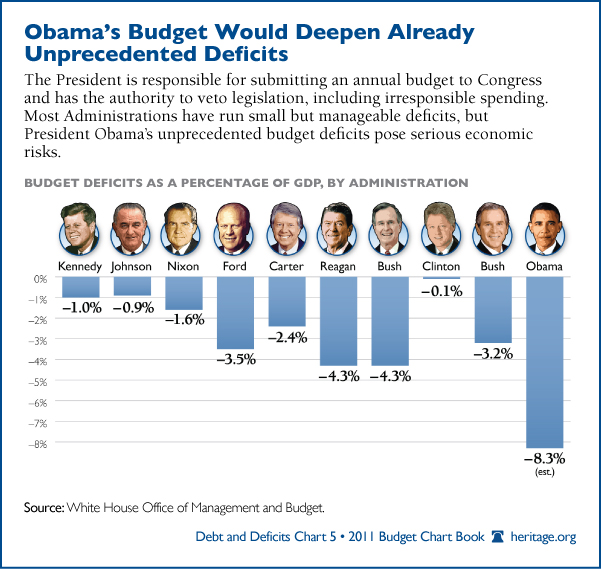
Over the last 10 presidents was have had 16.9% of GDP of deficits total from five Republican presidents and 12.7% total from Democratic presidents. However, what is most disturbing is that 8.3% of the 12.7% comes from the Obama administration who is currently in power and we are no longer in the cold war era. That is almost double the total of all the other four Democratic presidents combined under just one president. Take a look at the chart below from the Heritage Foundation:
Over the past 50 years, 10 U.S. presidents have made annual budget requests to Congress, projecting deficits both big and small. But no other president compares to Barack Obama when it comes to the size and scale of the current budget deficit facing the United States.
The country is facing an 8.3 percent estimated average national deficit of a two-term Obama administration — the biggest of the past 50 years. By comparison, the current estimate for Obama is nearly double the percentage under Presidents Ronald Reagan and George H.W. Bush — and they were fighting the Cold War.
Political party doesn’t tell the whole story, however. President Bill Clinton leads the pack of presidents since 1961, according to data from the White House Office of Management and Budget. Heritage put together this graphic as part of our Budget Chart Book.
So what does the current trajectory mean for the United States? We’re certainly no longer looking at a continuation of manageable deficits in the years to come. This is a dramatic change in the magnitude of annual shortfalls at the federal level. That’s one reason Heritage came up with a plan to fix the debt crisis.
If you have a suggestion for a chart we should feature in the future, please post a comment below, email us at scribe@heritage.org, or send me at tweet @RobertBluey.
President Obama unveiled his fiscal year 2012 budget today, and there’s good news and bad news. The good news is that there’s no major initiative such as the so-called stimulus scheme or the government-run healthcare proposal. The bad news, though, is that government is far too big and Obama’s budget does nothing to address this problem.
Actual spending cuts would be the best option, of course, but limiting the growth of spending is all that’s needed to slowly shrink the burden of government spending relative to gross domestic product.
Fortunately, we have two role models from recent history that show it is possible to control the federal budget. This video from the Center for Freedom and Prosperity uses data from the Historical Tables of the Budget to demonstrate the fiscal policy achievements of both Ronald Reagan and Bill Clinton.
Spending Restraint, Part I: Lessons from Ronald Reagan and Bill Clinton
Ronald Reagan and Bill Clinton both reduced the relative burden of government, largely because they were able to restrain the growth of domestic spending. The mini-documentary from the Center for Freedom and Prosperity uses data from the Historical Tables of the Budget to show how Reagan and Clinton succeeded and compares their record to the fiscal profligacy of the Bush-Obama years.
_____________________
Some people will want to argue about who gets credit for the good fiscal policy of the 1980s and 1990s.
Bill Clinton’s performance, for instance, may not have been so impressive if he had succeeded in pushing through his version of government-run healthcare or if he didn’t have to deal with a Republican Congress after the 1994 elections. But that’s a debate for partisans. All that matters is that the burden of government spending fell during Bill Clinton’s reign, and that was good for the budget and good for the economy. And there’s no question he did a much better job than George W. Bush.
Indeed, a major theme in this new video is that the past 10 years have been a fiscal disaster. Both Bush and Obama have dramatically boosted the burden of government spending — largely because of rapid increases in domestic spending.
Last but not least, this video reviews the theory and evidence for the “Rahn Curve,” which is the notion that there is a growth-maximizing level of government outlays. The bad news is that government already is far too big in the United States. This is undermining prosperity and reducing competitiveness.
Nations can make remarkable fiscal progress if policy makers simply limit the growth of government spending. This video, which is Part II of a series, uses examples from recent history in Canada, Ireland, Slovakia, and New Zealand to demonstrate how it is possible to achieve rapid improvements in fiscal policy by restraining the burden of government spending. Part I of the series examined how Ronald Reagan and Bill Clinton were successful in controlling government outlays — particularly the burden of domestic spending programs. http://www.freedomandprosperity.org
I got to see Arthur Laffer speak in 1981 in Memphis and he predicted what would happen the next few years with tax revenue as a result of the Reagan Tax Cuts and he was right on every prediction.
But I haven’t specifically responded to some recent studies which make rather outlandish claims that the revenue-maximizing tax rate is 70 percent or above.
President Obama and others are demanding that we raise taxes on the “rich,” and two recent academic papers that have gotten a lot of attention claim to show that there will be no ill effects if we do. The first paper, by Peter Diamond of MIT and Emmanuel Saez of the University of California, Berkeley, appeared in the Journal of Economic Perspectives last August. The second, by Mr. Saez, along with Thomas Piketty of the Paris School of Economics and Stefanie Stantcheva of MIT, was published by the National Bureau of Economic Research three months later. Both suggested that federal tax revenues would not decline even if the rate on the top 1% of earners were raised to 73%-83%.
How do they arrive at such high numbers? Alan explains.
The authors arrive at their conclusion through an unusual calculation of the “elasticity” (responsiveness) of taxable income to changes in marginal tax rates. According to a formula devised by Mr. Saez, if the elasticity is 1.0, the revenue-maximizing top tax rate would be 40% including state and Medicare taxes. That means the elasticity of taxable income (ETI) would have to be an unbelievably low 0.2 to 0.25 if the revenue-maximizing top tax rates were 73%-83% for the top 1%. The authors of both papers reach this conclusion with creative, if wholly unpersuasive, statistical arguments.
Is this assumption warranted? Hardly. Alan elaborates, making the same points I’ve made about rich people being different than the rest of us.
But the ETI for all taxpayers is going to be lower than for higher-income earners, simply because people with modest incomes and modest taxes are not willing or able to vary their income much in response to small tax changes. So the real question is the ETI of the top 1%. Harvard’s Raj Chetty observed in 2009 that “The empirical literature on the taxable income elasticity has generally found that elasticities are large (0.5 to 1.5) for individuals in the top percentile of the income distribution.” In that same year, Treasury Department economist Bradley Heim estimated that the ETI is 1.2 for incomes above $500,000 (the top 1% today starts around $350,000).
Alan cites other studies as well, all of which show that Saez, Piketty, Diamond, and Stantcheva, are well outside the mainstream.
For all intents and purposes, they cherry-picked data and made unrealistic assumptions in order to justify class-warfare tax policies.
It’s understandable that the Obama Administration is concerned about the issue. These four charts show that the labor market is in terrible shape.
But how can we convince the President that more government is just making a bad situation even worse? What will it take to educate him about the need to reduce government-imposed barriers to job creation?
The statists are making a big issue out of income inequality, hoping to convince ordinary Americans that redistribution is their only hope for a better life.
Simply stated, it doesn’t make sense – or help anybody – if inequality is reduced by policies that hurt everyone, but happen to hurt upper-income people more than lower-income people.
People on all levels of income are better off than they were in 1979. The hon. Gentleman is saying that he would rather that the poor were poorer, provided that the rich were less rich. That way one will never create the wealth for better social services, as we have. What a policy. Yes, he would rather have the poor poorer, provided that the rich were less rich. That is the Liberal policy.
_______________
While it’s inspiring to watch Thatcher in action, it’s also painful to realize that the current crop of GOP presidential candidates seems generally incapable of making similar arguments. Can you imagine, for instance, Mitt Romney making these remarks?
Last but not least, Thatcher’s remarks remind me about Churchill’s famous quote, which is very appropriate for this discussion.
The inherent vice of capitalism is the unequal sharing of blessings; the inherent virtue of socialism is the equal sharing of misery.
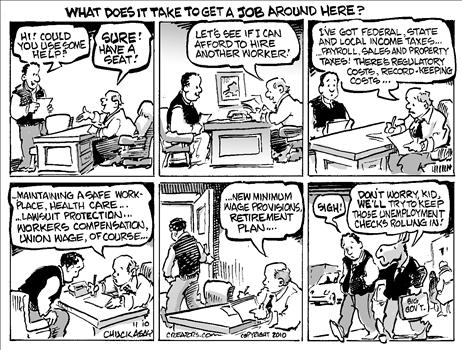
In the debate of job creation and how best to pursue it as a policy goal, one point is forgotten: Government doesn’t create jobs. Government only diverts resources from one use to another, which doesn’t create new employment.
Video produced by Caleb Brown and Austin Bragg.
___________________________
Keynesian Catastrophe: Big Money, Big Government & Big Lies
Based on a theory known as Keynesianism, politicians are resuscitating the notion that more government spending can stimulate an economy. This mini-documentary produced by the Center for Freedom and Prosperity Foundation examines both theory and evidence and finds that allowing politicians to spend more money is not a recipe for better economic performance.
___________________
Obama’s So-Called Stimulus: Good For Government, Bad For the Economy
President Obama wants Congress to dramatically expand the burden of government spending. This CF&P Foundation mini-documentary explains why such a policy, based on the discredited Keynesian theory of economics, will not be successful. Indeed, the video demonstrates that Obama is proposing – for all intents and purposes – to repeat Bush’s mistakes. Government will be bigger, even though global evidence shows that nations with small governments are more prosperous.
____________
Big Government Is Not Stimulus: Why Keynes Was Wrong (The Condensed Version)
The CF&P Foundation has released a condensed version of our successful mini-documentary explaining why so-called stimulus schemes do not work. Based on a theory known as Keynesianism, politicians are resuscitating the notion that more government spending can stimulate an economy. This mini-documentary produced by the Center for Freedom and Prosperity Foundation examines both theory and evidence and finds that allowing politicians to spend more money is not a recipe for better economic performance.
_________________
Eight Reasons Why Big Government Hurts Economic Growth
This Center for Freedom and Prosperity Foundation video analyzes how excessive government spending undermines economic performance. While acknowledging that a very modest level of government spending on things such as “public goods” can facilitate growth, the video outlines eight different ways that that big government hinders prosperity. This video focuses on theory and will be augmented by a second video looking at the empirical evidence favoring smaller government.
___________________
Keynesian Economics Is Wrong: Economic Growth Causes Consumer Spending, Not the Other Way
Politicians and journalists who fixate on consumer spending are putting the cart before the horse. Consumer spending generally is a consequence of growth, not the cause of growth. This Center for Freedom and Prosperity video helps explain how to achieve more prosperity by looking at the differences between gross domestic product and gross domestic income. www.freedomandprosperity.org
_____________
Deficits, Debts and Unfunded Liabilities: The Consequences of Excessive Government Spending
Huge budget deficits and record levels of national debt are getting a lot of attention, but this video explains that unfunded liabilities for entitlement programs are Americas real red-ink challenge. More important, this CF&P mini-documentary reveals that deficits and debt are symptoms of the real problem of an excessive burden of government spending. www.freedomandprosperity.org
___________
Now that I have been critical of the Democrat President, I wanted to show that I am not concerned about taking up for Republicans but looking at the facts. President Clinton did increase government spending at a slower rate than many other presidents. Here are two videos that praise both Reagan and Clinton for both accomplished this feat.
Spending Restraint, Part I: Lessons from Ronald Reagan and Bill Clinton
Ronald Reagan and Bill Clinton both reduced the relative burden of government, largely because they were able to restrain the growth of domestic spending. The mini-documentary from the Center for Freedom and Prosperity uses data from the Historical Tables of the Budget to show how Reagan and Clinton succeeded and compares their record to the fiscal profligacy of the Bush-Obama years.
______________
Spending Restraint, Part II: Lessons from Canada, Ireland, Slovakia, and New Zealand
Nations can make remarkable fiscal progress if policy makers simply limit the growth of government spending. This video, which is Part II of a series, uses examples from recent history in Canada, Ireland, Slovakia, and New Zealand to demonstrate how it is possible to achieve rapid improvements in fiscal policy by restraining the burden of government spending. Part I of the series examined how Ronald Reagan and Bill Clinton were successful in controlling government outlays — particularly the burden of domestic spending programs. www.freedomandprosperity.org
Lawmakers are considering extending temporary payroll tax cuts. But the policy is based on faulty Keynesian theories and misplaced confidence in the government’s ability to micromanage short-run growth.
In textbook Keynesian terms, federal deficits stimulate growth by goosing “aggregate demand,” or consumer spending. Since the recession began, we’ve had a lot of goosing — deficits were $459 billion in 2008, $1.4 trillion in 2009, $1.3 trillion in 2010, and $1.3 trillion in 2011. Despite that huge supposed stimulus, unemployment remains remarkably high and the recovery has been the slowest since World War II.
Policymakers should ignore the Keynesians and their faulty models, and instead focus on reforms to aid long-run growth…
Yet supporters of extending payroll tax cuts think that adding another $265 billion to the deficit next year will somehow spur growth. That “stimulus” would be on top of the $1 trillion in deficit spending that is already expected in 2012. Far from helping the economy, all this deficit spending is destabilizing financial markets, scaring businesses away from investing, and imposing crushing debt burdens on young people.
For three years, policymakers have tried to manipulate short-run economic growth, and they have failed. They have put too much trust in macroeconomists, who are frankly lousy at modeling the complex workings of the short-run economy. In early 2008, the Congressional Budget Office projected that economic growth would strengthen in subsequent years, and thus completely missed the deep recession that had already begun. And then there was the infamously bad projection by Obama’s macroeconomists that unemployment would peak at 8 percent and then fall steadily if the 2009 stimulus plan was passed.
Some of the same Keynesian macroeconomists who got it wrong on the recession and stimulus are now claiming that a temporary payroll tax break would boost growth. But as Stanford University economist John Taylor has argued, the supposed benefits of government stimulus have been “built in” or predetermined by the underlying assumptions of the Keynesian models.
Policymakers should ignore the Keynesians and their faulty models, and instead focus on reforms to aid long-run growth, which economists know a lot more about. Cutting the corporate tax rate, for example, is an overdue reform with bipartisan support that would enhance America’s long-run productivity and competitiveness.
If Congress is intent on cutting payroll taxes, it should do so within the context of long-run fiscal reforms. One idea is to allow workers to steer a portion of their payroll taxes into personal retirement accounts, as Chile and other nations have done. That reform would feel like a tax cut to workers because they would retain ownership of the funds, and it would begin solving the long-term budget crisis that looms over the economy.
Dan Mitchell discusses the effectiveness of the stimulus Uploaded by catoinstitutevideo on Nov 3, 2009 11-2-09 When I think of all our hard earned money that has been wasted on stimulus programs it makes me sad. It has never worked and will not in the future too. Take a look at a few thoughts from […]
Government Spending Doesn’t Create Jobs Uploaded by catoinstitutevideo on Sep 7, 2011 Share this on Facebook: http://on.fb.me/qnjkn9 Tweet it: http://tiny.cc/o9v9t In the debate of job creation and how best to pursue it as a policy goal, one point is forgotten: Government doesn’t create jobs. Government only diverts resources from one use to another, which doesn’t […]
In his recent article Ernie Dumas sticks to his guns that we should balance the budget without being forced to with a “Balanced Budget Amendment,” but I wonder how well that has worked so far? I have made this a key issue for this blog in the past as you can tell below: Dear Senator […]
(Picture from Arkansas Times Blog) When I think about all the anger and hate coming from the Occupy Wall Street crowd, I wonder if they have read this story below? Solyndra: Crooked Politics or Just Bad Economics? Posted by David Boaz Amy Harder has a good take on the Solyndra issue in National Journal Daily […]
Dear Senator Pryor, why not pass the Balanced Budget Amendment? (Part 13 Thirsty Thursday, Open letter to Senator Pryor) Office of the Majority Whip | Balanced Budget Amendment Video In 1995, Congress nearly passed a constitutional amendment mandating a balanced budget. The Balanced Budget Amendment would have forced the federal government to live within its […]
Andrew Demillo pointed this out and also Jason Tolbert noted: PRYOR OPPOSES THE OBAMA JOBS BILL THAT HE VOTED TO ADVANCE Sen. Mark Pryor has been traveling around the state touting a six-part jobs plan that he says “includes a number of bipartisan initiatives, is aimed at creating jobs by setting the table for growth, encouraging new […]
Is a lack of money the problem for our public schools? Everything You Need to Know About Public School Spending in Less Than 2½ Minutes Posted by Adam Schaeffer Neal McCluskey gutted the President’s new “Save the Teachers” American Jobs Act sales pitch a good while back, as did Andrew Coulson here. Thankfully, it seems […]
There’s an old saying that insanity is doing the same thing over and over again while expecting different results. This certainly is a good description of Keynesians, who relentlessly push more government spending as some sort of magic potion for the economy – notwithstanding a record of failure.
The latest example if Larry Summers, the former economist for the Obama White House, who says Europeans need to make government bigger.
European efforts to contain crisis have fallen short. …Much of what is being urged on and in Europe is likely to be not just ineffective but counterproductive to maintaining the monetary union, restoring normal financial conditions and government access to markets, and reestablishing economic growth. The premise of European policymaking is that countries are overindebted and so unable to access markets on reasonable terms, and that the high interest rates associated with excessive debt hurt the financial system and inhibit growth. The strategy is to provide financing while insisting on austerity, in hopes that countries can rein in their excessive spending enough to restore credibility, bring down interest rates and restart economic growth.
The good news is that Summers recognizes that there has been “excessive spending.” The bad news is that he uses the wrong definition of austerity.
Many European nations seem to think higher taxes are a sign of fiscal conservatism (see this post by Veronique de Rugy for a good discussion of this confusion). Summers accepts that approach, and says that policy makers should choose a Keynesian policy instead.
Unfortunately, Europe has misdiagnosed its problems in important respects and set the wrong strategic course. …Europe’s problem countries are in trouble because the financial crisis underway since 2008 has damaged their financial systems and led to a collapse in growth. High deficits are much more a symptom than a cause of their problems. And treating symptoms rather than underlying causes is usually a good way to make a patient worse. …The right focus for Europe is on growth; in this dimension, increased austerity is a step in the wrong direction.
There’s more good news. Summers is right in stating that Europe suffers from low growth. And I agree with him that the European version of austerity – higher taxes – is not a solution.
But, as always, there is a catch. Summers has the wrong approach on how to encourage growth. He wants Keynesian spending, and here is his defense.
Skeptics will rightly wonder how a prescription for more spending by countries that already have trouble borrowing can be correct. The answer lies in the difference between borrowing by individuals and countries. Normally, an individual helps his creditors by borrowing less; but a person who stops borrowing to finance commuting to his job does his creditors no favor. A country’s income is determined by spending, so a country that pursues austerity to the point where its economy is driven into a downward spiral does its creditors no favor.
Sounds semi-reasonable. After all, everyone understands that it is important to get to their place of employment. Sometimes you spend money to make money.
But here’s the problem. Can anyone name anything in so-called stimulus schemes that actually increase a nation’s productive capacity? As we saw with Obama’s failed stimulus, lots of money gets distributed, but the main purpose seems to be buying votes and creating dependency.
Adding insult to injury, you probably won’t be surprised to learn that American taxpayers are supposed to pick up the lion’s share of the tab for the new spending in Europe since Summers wants the IMF to be the sugar daddy.
Going forward, the IMF and international community should condition further support not merely on individual countries’ actions but on a common European commitment to growth.
This approach is illogical, as explained in this video.
And let’s consider the historical record. Nations that have tried this type of “stimulus” have not fared well. Big spending increase under Hoover and Roosevelt failed in the 1930s. Japan tried several Keynesian packages and failed in the 1990s. Bush failed in 2008 and Obama failed in 2009.

 He was awarded the Nobel Prize in Economics in 1974. He met with President Reagan at the White House, and Margaret Thatcher banged The Constitution of Liberty on the table at Conservative headquarters and declared “This is what we believe.” Milton Friedman described him as “the most important social thinker of the 20th century,” and Lawrence H. Summers called him the author of “the single most important thing to learn from an economics course today.”





 The Daily Hatch