Category Archives: Cato Institute

Don’t fear the Free Market like Obama wants you to

Michael Savage May 17 2012 hr 3 segment 3.wmv

Published on May 17, 2012 by

The Savage Nation

Savage guest Mark Calabria from the Cato Institute discusses J P Morgan in this segment.

www.cato.org

_________________

The free market works much better than federal officials do. Take a look at how how our money is managed every year by the federal government. The federal government has 2.1 trillion coming in and 3.6 trillion going out!! I sincerely hope the federal government will stay out of Wall Street business!!! TARP was a joke and it ended up with a government takeover of GM.

Mike Brownfield

May 15, 2012 at 8:55 am

The lingering headline on the front pages this week is that JP Morgan Chase suffered a massive loss on a hedging strategy, costing them $2 billion. That’s no small mistake, and it’s an example of how bad decisions in the free market can cost big money. But just because mistakes have consequences doesn’t mean that the mighty hand of government needs to step in to save us from ourselves. However, that’s what some on the left are now calling for.

The news of this blunder hit last week when JP Morgan CEO Jamie Dimon revealed that the bank took a $2 billion loss over the past six weeks in a strategy intended to hedge against risks to the bank’s assets that could come from market volatility caused by the Euro crisis. On Sunday’s Meet the Press, Dimon admitted, “In hindsight, we took far too much risk. The strategy we had was badly vetted. It was badly monitored. It should never have happened.”

The company is certainly paying the price in losses, as are those responsible for the bad decision making. The Los Angeles Times reports that the bank’s stock fell 12% since it disclosed the loss last week, the executive who oversaw the department responsible for the loss retired on Monday, and JP Morgan’s reputation as an extremely well managed bank has been damaged.

But does the flawed strategy and the resulting loss mean that Washington should step in with more regulation of Wall Street? Yesterday, White House press secretary Jay Carney used the news of JP Morgan’s loss to call for more regulations, remarking, “The president fought very hard against Republicans and Wall Street lobbyists to get Wall Street reform passed . . . I think that this event merely reinforces why the President was right to take on this fight and why we still need to make sure it’s implemented.”

Likewise, former Obama adviser Elizabeth Warren called for Dimon to resign from the New York Federal Reserve Board and slammed Wall Street. “What happened here is not just about JP Morgan case, it’s about the kind of attitudes, that the bank should be regulating themselves instead of having real oversight,” Warren said. “We have to say as a country, no, the banks cannot regulate themselves.”

What’s needed is some perspective, not more regulation from Washington. Heritage’s David C. John explains that while JP Morgan’s loss represents a clear failure of management, it’s not a systemic problem that requires or would be fixed by additional regulation. For starters, JP Morgan is a $2.3 trillion bank with a net worth of $189 billion, meaning that this loss reduced the bank’s capital ratio from 8.4 percent to 8.2 percent. In other words, the bank can absorb the loss, and it’s nowhere close to needing any form of federal intervention.

Some more perspective could be gleaned by examining the $3.2 billion loss the U.S. Post Office experienced in the most recent quarter, or the billions lost on risky green energy bets made by President Obama and Energy Secretary Steven Chu. Only those losses weren’t incurred by private investors, but by you the taxpayer.

What’s more, John explains, the regulations that are now being called for — particularly the so-called Volcker Rule — would not have prevented the losses since it would not have affected this transaction. Finally, John writes, the system worked as is. “JPMorgan Chase losses were not discovered by regulators; they were discovered by the bank itself conducting its own management reviews.”

What America is witnessing is the left using the news of JP Morgan’s bad judgment as an excuse for more government regulation. But as even Carney acknowledged, regulations “can’t prevent bad decisions from being made on Wall Street.”

For all the wrangling over JP Morgan’s loss, John points out that the bank is still expected to make a healthy profit for all of 2012. Yes, it made a mistake, and yes, that mistake cost a lot of money. But risks, mistakes and costs are part of capitalism. They’re the price we pay for all the benefits that a free market affords us.

Dan Mitchell demonstrates again that spending is our problem but it can be solved

Sometimes it appears that our problems are impossible to solve. Take a look at a good solution:

New Congressional Budget Office Numbers Once Again Show that Modest Spending Restraint Would Eliminate Red Ink

Posted by Daniel J. Mitchell

Back in 2010, I crunched the numbers from the Congressional Budget Office and reported that the budget could be balanced in just 10 years if politicians exercised a modicum of fiscal discipline and limited annual spending increases to about two percent yearly.

When CBO issued new numbers early last year, I repeated the exercise and again found that the same modest level of budgetary restraint would eliminate red ink in about 10 years.

And when CBO issued their update last summer, I did the same thing and once again confirmed that deficits would disappear in a decade if politicians didn’t let the overall budget rise by faster than two percent each year.

Well, the new CBO 10-year forecast was released this morning. I’m going to give you three guesses about what I discovered when I looked at the numbers, and the first two don’t count.

Yes, you guessed it. As the chart illustrates (click to enlarge), balancing the budget doesn’t require any tax increases. Nor does it require big spending cuts (though that would be a very good idea).

Even if we assume that the 2001 and 2003 tax cuts are made permanent, all that is needed is for politicians to put government on a modest diet so that overall spending grows by about two percent each year. In other words, make sure the budget doesn’t grow faster than inflation.

Tens of millions of households and businesses manage to meet this simple test every year. Surely it’s not asking too much to get the same minimum level of fiscal restraint from the crowd in Washington, right?

At this point, you may be asking yourself whether it’s really this simple. After all, you’ve probably heard politicians and journalists say that deficits are so big that we have no choice but to accept big tax increases and “draconian” spending cuts.

But that’s because politicians use dishonest Washington budget math. They begin each fiscal year by assuming that spending automatically will increase based on factors such as inflation, demographics, and previously legislated program changes.

This creates a “baseline,” and if they enact a budget that increases spending by less than the baseline, that increase magically becomes a cut. This is what allowed some politicians to say that last year’s Ryan budget cut spending by trillions of dollars even though spending actually would have increased by an average of 2.8 percent each year.

Needless to say, proponents of big government deliberately use dishonest budget math because it tilts the playing field in favor of bigger government and higher taxes.

There are two important caveats about these calculations.

1. We should be dramatically downsizing the federal government, not just restraining its growth. Even if he’s not your preferred presidential candidate, Ron Paul’s proposal for an immediate $1 trillion reduction in the burden of federal spending is a very good idea. Merely limiting the growth of spending is a tiny and timid step in the right direction.

2. We should be focusing on the underlying problem of excessive government, not the symptom of too much red ink. By pointing out the amount of spending restraint that would balance the budget, some people will incorrectly conclude that getting rid of deficits is the goal.

Last but not least, here is the video I narrated in 2010 showing how red ink would quickly disappear if politicians curtailed their profligacy and restrained spending growth.

___________________________

Other than updating the numbers, the video is just as accurate today as it was back in 2010. And the concluding message—that there is no good argument for tax increases—also is equally relevant today.

P.S. Some people will argue that it’s impossible to restrain spending because of entitlement programs, but this set of videos shows how to reform Social Security, Medicare, and Medicaid.

P.P.S. Some people will say that the CBO baseline is unrealistic because it assumes the sequester will take place. They may be right if they’re predicting politicians are too irresponsible and profligate to accept about $100 billion of annual reductions from a $4,000 billion-plus budget, but that underscores the core message that there needs to be a cap on total spending so that the crowd in Washington isn’t allowed to turn America into Greece.

Got to avoid raising taxes if we want the economy to grow and eventually balance the budget

Dan Mitchell on Austerity in Europe 2012

In order to balance the budget we must make deep cuts. Take a look at the study refers to below by Dan Mitchell of the Cato Institute in his fine article on the French mess. Raising taxes has not worked in the thirty countries studied.

Having written several times about crazy French statism, you will understand why I like this cartoon.

Though, to be fair, France hasn’t gotten to the point where it’s being bailed out (it’s probably just a matter of time).

If you want some good analysis of the situation in Europe, Veronique de Rugy of the Mercatus Center hits the nail on the head in her column in today’s Washington Examiner.

France has yet to cut spending. In fact, to the extent that the French are frustrated with “budget cuts,” it’s only because the increase in future spending won’t be as large as they had planned. The same can be said about the United Kingdom. Spain, Italy and Greece have had no choice to cut some spending. However, in the case of these particular countries, the cuts were implemented alongside large tax increases. …This approach to austerity, also known in the United States as the “balanced approach,” has unfortunately proven a recipe for disaster. In a 2009 paper, Harvard University’s Alberto Alesina and Silvia Ardagna looked at 107 attempts to reduce the ratio of debt to gross domestic product over 30 years in countries in the Organisation for Economic Co-operation and Development. They found fiscal adjustments consisting of both tax increases and spending cuts generally failed to stabilize the debt and were also more likely to cause economic contractions. On the other hand, successful austerity packages resulted from making spending cuts without tax increases. They also found this form of austerity is more likely associated with economic expansion rather than with recession. …While the debate over austerity continues, the evidence seems to point to the conclusion that austerity can be successful, if it isn’t modeled after the “balanced approach.” It’s a lesson for the French and other European countries, as well as for American lawmakers who often seem tempted by the lure of closing budget gaps with higher taxes.

This is similar to my recent analysis, and Veronique also is kind enough to cite my analysis of how the Baltic nations have done the right thing and cut spending.

There are obvious lessons from Europe for the United States. If politicians don’t reform entitlement programs, we’re doomed to have our own fiscal crisis at some point in the not-too-distant future.

Only there won’t be anybody there to bail us out.

Obama’s stupid idea that did not work!!!


Why did Obama’s idea not work in 2009?

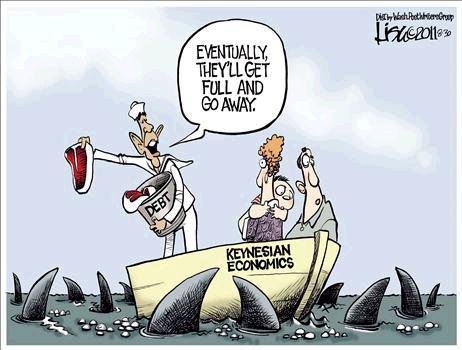
Keynesian Economics in a Cartoon

September 1, 2011 by Dan Mitchell

I’ve written extensively about the flaws of Keynesian economics, and I’ve even narrated a video on the flaws of Keynesian theory.

But this clever cartoon may be more effective than anything I’ve ever done.

If you like cartoons that teach economics, check out this gem. It’s not on Keynesianism, but it’s very good.

Open letter to President Obama (Part 84.1)

President Obama c/o The White House
1600 Pennsylvania Avenue NW
Washington, DC 20500

Dear Mr. President,

I know that you receive 20,000 letters a day and that you actually read 10 of them every day. I really do respect you for trying to get a pulse on what is going on out here.

It seems that government was in control of the desert then we would have a shortage of sand as Milton Friedman used to quip and that is why I am so against Obamacare.

There is another issue that concerns me very much about this fight at the Supreme Court over Obamacare. I know that many people feel strongly that we live in a democracy and because the people want Obamacare then they should be able to get it. However, that is not exactly true that we live in a pure democracy.

My daily email containing the editorials and opinion columns from the Washington Post included an item written by E.J. Dionne entitled “Supreme Court activists: Conservative justices forget we’re a democracy.”

Surely this was a mistake.

I suspect he does understand, at least with regard to the first question. For instance, I’d bet a lot of money that he was correctly in favor of the Court’s decision to protect flag burning as a form of political speech, notwithstanding public opinion and congressional approval.

But he seems to join with other leftists in treating the interstate commerce clause as some sort of blank check for federal intervention into every aspect of our lives. And it shows up in various ways in his column.

…conservative justices are prepared to act as an alternative legislature…discussing whether parts of the law could stand if other parts fell… Sotomayor asked what was wrong with leaving as much discretion as possible “in the hands of the people who should be fixing this, not us.” It was nice to be reminded that we’re a democracy, not a judicial dictatorship. …This is what conservative justices will do if they strike down or cripple the health-care law. …a court that…sees no limits on its power, no need to defer to those elected to make our laws.

At the risk of being blunt, the conservative justices are doing exactly what they should be doing. They’re deciding if a law enacted by Congress is consistent with the powers granted to Congress by the Constitution.

America has a democratic form of government, but we are not a democracy. At least not in the sense that 51 percent of the people have the unlimited right to rape and pillage 49 percent of the people.

I have no idea of the Supreme Court will make the right decision, but I am overwhelmingly confident that the Founding Fathers didn’t envision mandated health insurance as a function of the federal government.

But maybe I’m just too old fashioned, because when I peruse the enumerated powers, I don’t see any authority for a Department of Energy either. Or a Department of Agriculture. Or a Department of Commerce. Or Department of Housing and Urban Development. Or Department of Education. Or a Department of Transportation. Or…well, you get the idea.

Thank you so much for your time. I know how valuable it is. I also appreciate the fine family that you have and your commitment as a father and a husband.

Sincerely,

Everette Hatcher III, 13900 Cottontail Lane, Alexander, AR 72002, ph 501-920-5733, lowcostsqueegees@yahoo.com

Religious Liberty: Obamacare’s First Casualty

Uploaded by on Feb 22, 2012

http://blog.heritage.org/2012/02/22/morning-bell-religious-liberty-under-attack/ | The controversy over the Obama Administration’s anti-conscience mandate and the fight for religious liberty only serves to highlight the inherent flaws in Obamacare. This conflict is a natural result of the centralization laid out under Obamacare and will only continue until the law is repealed in full.

Government shutdown coming, will there be any tea party heroes available to stand up to Obama?

DEBT LIMIT – A GUIDE TO AMERICAN FEDERAL DEBT MADE EASY.

Uploaded by on Nov 4, 2011

A satirical short film taking a look at the national debt and how it applies to just one family. Watch the guy from the Ferris Bueller Superbowl Spot! Produced by Seth William Meier, DP/Edited by Craig Evans, 1st AC Brian Andrews, Sound Mixer Gus Salazar, Written and Directed by Brian Stepanek. Help us spread the word by clicking ads or at www.debtlimitusa.org

_________________

I was so proud of the 66 brave Republicans who stood up to President Obama and voted against his deal that raised the debt limit. I hope we can find more brave souls this tme around.

One of the big stories from Washington is that there may be another fight over the debt limit, which could mean…gasp, hide the women and children…gridlock, downgrades, government shutdown, default, and tooth decay.

Okay, perhaps not tooth decay, but the DC establishment nonetheless is aghast.

Last year, there were actually two big confrontations between House Republicans and President Obama.

The first fight occurred early in the year and revolved around spending levels for the remainder of the 2011 fiscal year. I explained in February of that year how advocates of smaller government could prevail in a government shutdown fight, especially since the “essential” parts of the government wouldn’t be affected.

But I wasn’t surprised when GOPers buckled under pressure and accepted a deal that – at best – could be categorized as a kiss-your-sister compromise (and, as I noted elsewhere, our sister wasn’t Claudia Schiffer).

Then we had the big debt limit fight later in the year, which led to absurd claims that failure to increase the debt limit would lead to default – even though the federal government was collecting ten times as much revenue as was needed to pay interest on the debt.

Once again, Republicans were unable to withstand the demagoguery and they basically gave Obama what he wanted after agreeing to a “supercommittee” that was designed to seduce them into a tax increase.

Now the game is about to start over. It’s deja vu all over again, as Yogi Berra might say.

Here’s some of what the L.A. Times reported.

Republicans in Congress are heading into summer much the way they did last year — instigating a showdown with the White House by demanding massive federal budget cuts in exchange for what used to be the routine task of raising the nation’s debt limit to pay the government’s bills. House Speaker John A. Boehner (R-Ohio) is doubling down on the strategy that ended in mixed results last year after the country came to the brink of a federal default before a deal was struck with President Obama. In that go-round, both sides saw their approval ratings with voters plummet and the nation’s credit was downgraded. …The risk for Republicans is not only in presenting another high-stakes showdown at a time when voters have grown weary of the gridlock in Washington.

The reporter’s assertion that the debt limit fight led to the downgrade is a bit silly, as I explain here, but that’s now part of the official narrative.

On a separate matter, I can’t help but shake my head with frustration that GOPers still haven’t learned that America’s fiscal problem is too much spending, and that deficits and debt are symptoms of that problem. Here’s another passage from the L.A. Times story.

“The issue is the debt,” Boehner said Sunday on ABC’s ”This Week With George Stephanopoulos.” “Dealing with our deficit and our debt would help create more economic growth in the United States and it would lift this cloud of uncertainty that’s causing employers to wonder what’s next.”

No, Mr. Speaker. The problem is spending, spending, spending.

Returning to the main issue, the debt limit isn’t the only big fiscal fight that may happen this year. There will also be the spending bills for the 2013 fiscal year, which starts on October 1 of this year. That will mean another fight, particularly since the left has no intention of abiding by the spending limit that was part of last year’s debt limit deal.

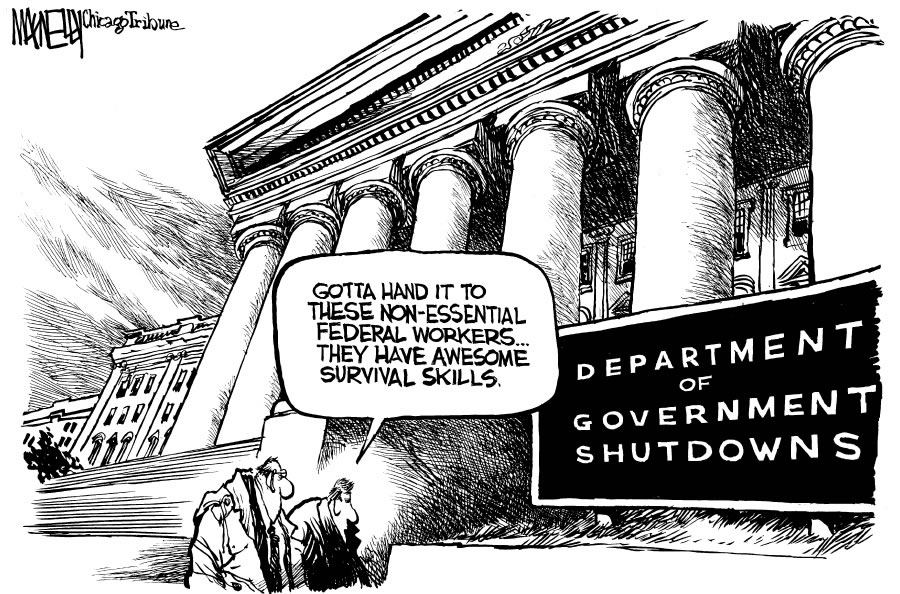
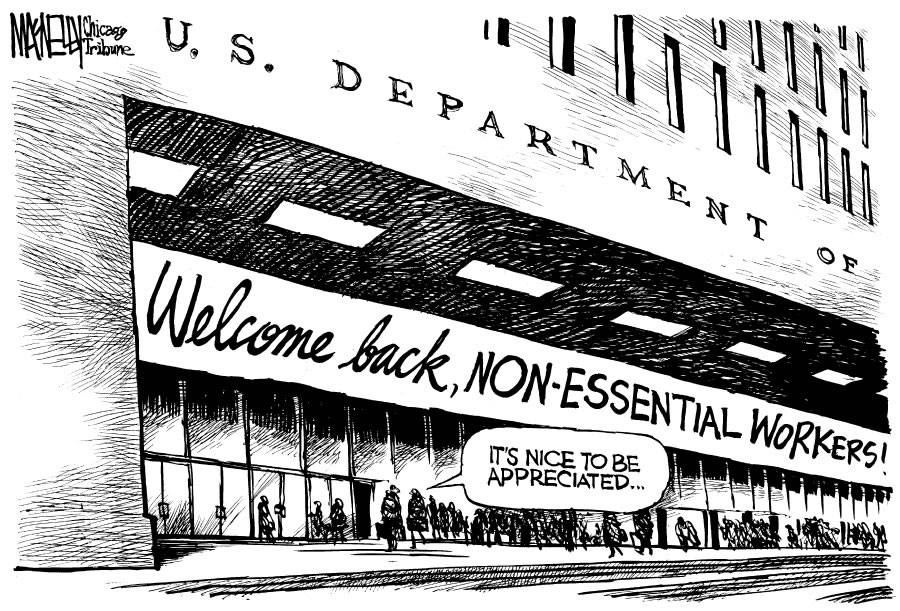
And if Republicans hold firm, that means another “government shutdown.” Though it really should be called a “government slowdown” since it’s only the non-essential bureaucrats who get sent home.

In any event, since I’m glum about the likelihood of anything good happening, let’s at least enjoy some good cartoons from Jeff MacNelly. He passed away a number of years ago, but these cartoons from the mid-1990s are just as applicable today as they were then.

These are amusing cartoons, so long as you don’t actually think about the fact that government is bloated in part because Washington is littered with programs, departments, and agencies that are filled with non-essential bureaucrats. And don’t forget that these bureaucrats are overpaid, getting, on average, twice the compensation of workers in the productive sector of the economy.

But I don’t want to end this post on a sour note, so here are some good jokes from the late-night comics about government shutdowns.

________

Related post:

Some Tea Party heroes (Part 1)

DEBT LIMIT – A GUIDE TO AMERICAN FEDERAL DEBT MADE EASY. Uploaded by debtlimitusa on Nov 4, 2011 A satirical short film taking a look at the national debt and how it applies to just one family. Watch the guy from the Ferris Bueller Superbowl Spot! Produced by Seth William Meier, DP/Edited by Craig Evans, […]


President Obama should go into movies after being kicked out of office this November!!!

Nassim Taleb: Time to Nationalize US Banking System?

President Obama’s liberal agenda has not worked out too good in the last four years.

Most people know that Ronald Reagan was an actor before he became a great President.

So I guess it makes sense for Barack Obama to do the same thing, but in reverse. He’s starting as a bad President, but then will become a Hollywood star.

Some clever person already has put together some potential starring roles. Let’s start with the Wizard of Oz, with some updated dialogue that captures the President’s approach to tax policy.

And here’s another classic, Gone with the Wind, but updated to show how the President doesn’t care that his policies will accelerate America’s slide to European-style stagnation.

There’s also a starring role for the President in a remake of the Godfather, which seems appropriate given his Chicago roots and support for cronyism.

Bonnie and Clyde is another option, though this one is unfair. Obama supports TARP, which means he wants to rob taxpayers to subsidize banks.

Last but not least, we have a new version of “It’s a Wonderful Life.” Though, to be fair, the President seems to want entitlement checks for everybody.

If I was clever enough to manipulate pictures, I would do one from the scene in Braveheart where Mel Gibson is on horseback, motivating the Scots to fight against the English. But instead of Mel Gibson talking about freedom, we could have the President urging “dependency.”

I’m sure Julia would approve.

Dan Mitchell shows why soak-the-rich tax policy does not work

Dan Mitchell of the Cato Institute shows why Obama’s plan to tax the rich will not solve our deficit problem.  

Explaining in the New York Post Why Obama’s Soak-the-Rich Tax Policy Is Doomed to Failure

April 17, 2012 by Dan Mitchell

I think high tax rates on certain classes of citizens are immoral and discriminatory. If the government is going to collect revenue, all taxpayers should be treated equally, with something akin to a simple flat tax.

But most people don’t seem to care about having the law apply the same to all people, so I make a strictly utilitarian case for low tax rates in today’s New York Post. Here some of what I wrote.

Whether it’s through the Buffett Rule, higher income-tax rates or double taxation of dividends and capital gains, President Obama often demands that “rich” taxpayers and big corporations send more money to Washington. But…trying to get more money from upper-income taxpayers is like playing whack-a-mole. So long as tax rates are high, rich people will figure out ways to protect their income.It doesn’t take a tax genius; any rich person can make a phone call or hit a few computer keys and shift his or her investments to tax-free municipal bonds. It’s not good for the economy when capital gets diverted to help finance the excess spending of Detroit or California, but it’s an effective way of stiff-arming the IRS. Or the rich can play the green-energy scam, getting all sorts of credits to offset their tax liabilities. …Even if lawmakers abolished the various tax-code distortions, they might still be disappointed. The one sure way for rich people to lower their tax bills is by generating less income. …This isn’t some sort of modern-day revelation. Andrew Mellon, a Treasury secretary during the 1920s, noted that “the history of taxation shows that taxes which are inherently excessive are not paid. The high rates inevitably put pressure upon the taxpayer to withdraw his capital from productive business.”

I then provide a specific example, looking at how Reagan’s lower tax rates resulted in a lot more revenue from the rich.

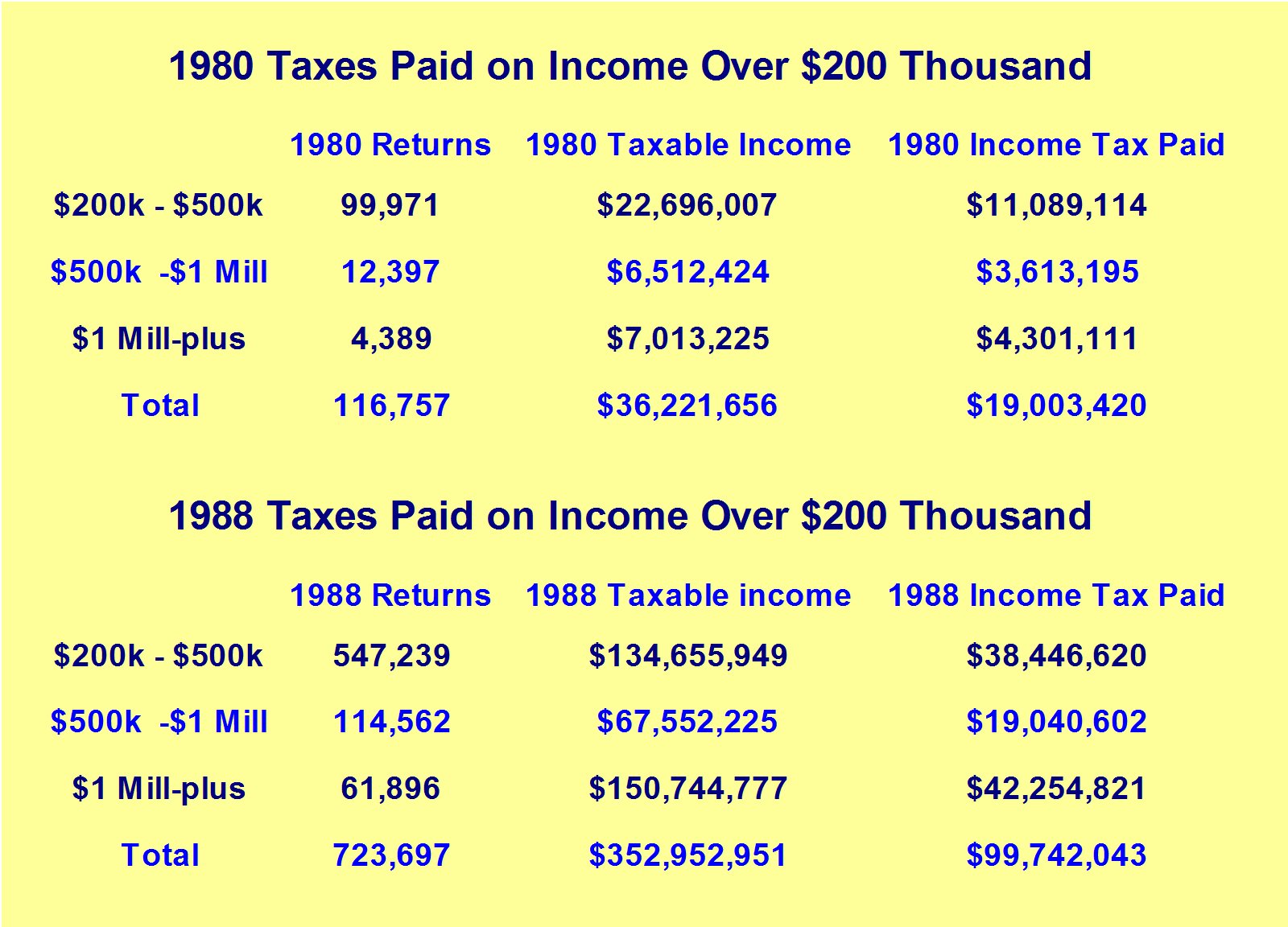
Unlike the rest of us, the rich have a great ability to alter the timing, amount and composition of their income. That’s because, according to IRS data, those with more than $1 million of adjusted gross income get only 33 percent of it from wages and salaries. The super-rich (those with income above $10 million) rely on wages and salaries for only 19 percent of their income. In 1980, when the top tax rate was 70 percent, rich people (those with incomes of more than $200,000) reported about $36 billion of income; the IRS collected about $19 billion of that amount. So what happened when President Ronald Reagan lowered the top tax rate to 28 percent by 1988? Did revenue fall proportionately, to about $8 billion? Folks on the left thought that would happen, complaining that Reagan’s “tax cuts for the rich” would starve the government of revenue and give upper-income taxpayers a free ride. But if we look at the 1988 IRS data, rich people paid more than $99 billion to Uncle Sam. That is, because rich taxpayers were willing to earn and report much more income, the government collected five times as much revenue with a lower rate.

I also included above, for readers of this blog, a table with the raw numbers from the IRS. Feel free to click for a larger image and see how the “rich” responded to better tax policy.

I then close with a warning about Obama’s class warfare policy.

Obama wants to run the experiment in reverse. He hasn’t proposed to push the top tax rate up to 70 percent, thank goodness, but the combined effect of his class-warfare policies would mean a big increase in marginal tax rates. That might be good for workers in China, India or Ireland, because American jobs and investment would migrate to those places. But it’s not the right policy for the United States.

In other words, even if you’re a leftist and your main goal is giving the government more revenue, higher tax rates are a bad idea. The rich will simply figure out ways to protect their earnings while the rest of us suffer because the economy loses some of its dynamism.

______________

Bush tax cuts work? Is Clinton’s approach better? (Part 2)

The Laffer Curve, Part II: Reviewing the Evidence

This video reviews real-world evidence showing that changes in marginal tax rates can have a significant impact on taxable income, thus leading to substantial amounts of revenue feedback. In a few cases, tax-rate reductions even “pay for themselves,” though the key lesson is the more modest point that pro-growth changes in tax policy will have a positive impact on economic performance and that good tax cuts therefore do not “cost” the government much in terms of foregone tax revenue.

This video is second installment of a three-part series. Part I reviews theoretical relationship between tax rates, taxable income, and tax revenue. Part III discusses how the revenue-estimating process in Washington can be improved. For more information please visit the Center for Freedom and Prosperity’s web site: www.freedomandprosperity.org.

_________________

On the Arkansas Times Blog the person using the username “Couldn’t be better” commented on what I said by responding, “Saline, where are all the jobs that Bush promised in 2001 and 2003. Still waiting for the trinkle down…”

Bush tax cuts work? This is a series of posts aimed at answering that question.

Setting the Tax Record Straight: Clinton Hikes Slowed Growth, Bush Cuts Promoted Recovery

By Curtis Dubay
September 6, 2011

Abstract: Despite evidence to the contrary, President Obama and his supporters insist that a tax increase will not impede economic recovery. They claim that the Clinton tax hikes spurred the boom of the 1990s and that the subsequent Bush tax cuts hurt the economy. Members of Congress must reject this faulty notion—and reject the President’s call for burdening Americans with higher taxes and an even slower economy.

President Barack Obama and his allies in Congress and elsewhere continue to press for tax increases, whether as part of a deal to raise the government’s debt ceiling, or for any other reason. Even though common sense would dictate not raising taxes in the face of a badly weakened economy and almost non-existent job growth, the President and his supporters argue that tax hikes will not imperil the still-nascent recovery because the economy grew during the 1990s after President Bill Clinton raised taxes. The inference being that today’s economy could also absorb the blow of tax hikes and grow despite them. They also argue the converse: that the tax cuts passed during President George W. Bush’s tenure slowed growth and cost jobs.

This cursory and errant analysis of recent history has serious implications for policymaking today. If Congress raises taxes based on the faulty notion that tax hikes have no ill effects on economic growth, it will impede the still-struggling recovery and keep millions of Americans on the unemployment rolls far too long.

Bush Tax Cuts Promoted Strong Growth

Liberals also like to argue that the Bush tax relief hurt the economy and cost jobs. Again, the evidence runs to the contrary.

Unlike President Clinton, who entered office with a strong economic wind at his back, President Bush came into office on the precipice of a recession caused by the bursting of the “dot-com” bubble. President Bush entered office in January 2001; the recession began in March.

In addition to the recession, the peaceful conditions President Clinton enjoyed reversed course. The terrorist attacks of 9/11 brought on the beginning of the war on terrorism. There was no growth-enhancing advancement comparable to the tech boom to further boost the economy; energy prices were creeping up. Instead of swimming with the current, the economy was now fighting squarely against it to achieve even modest growth.

Faced with this new reality, President Bush pushed for tax cuts to revive the economy and set it on a stronger foundation for economic growth.

In June 2001, President Bush signed into law the first wave of tax cuts. The relief included reductions of marginal income tax rates and tax relief for families, for example, doubling the child tax credit from $500 to $1,000. To reduce the budgetary impact, Congress phased in the tax cuts over several years.

Since the tax cuts were slow to go into effect, they were slow to help the economy. In fact, the economy continued to lose jobs after the tax cuts even though the recession officially ended in November 2001.

Realizing the error of its ways, in May 2003 Congress accelerated the tax cuts to make them effective immediately. In addition to reducing marginal income tax rates, Congress also lowered the tax rates on capital gains and dividends.

It was at this point that economic growth took off. From May 2003 until December 2007 (when the recession caused by the global financial meltdown occurred) the economy created 8.1 million jobs, or 145,000 a month. By comparison, after the beginning of the 2001 recession and before the 2003 tax cuts, the economy was losing 103,000 jobs a month.[7]

2003 Bush Tax Cuts Prompted Surge in Employment

Those opposed to the tax relief argue that it blew a hole in the budget and dramatically increased deficits. Again, a look at the numbers disproves that argument. While receipts were below the historical level of 18 percent of GDP in 2003 as a result of the sluggish economy, they rebounded to above their historical norm by 2006 and grew further above their historical level in 2007.[8] They clearly would have continued growing thereafter had it not been for the housing bust and global recession.

Tax revenue rebounded quickly because the tax cuts encouraged economic growth by increasing the incentives to work, save, invest, and take on new risk. These are the basic elements of economic growth. When those activities increase, tax revenues increase because more Americans work and earn more money. From 2003 to 2007, the number of tax filers rose by 9.6 percent, and taxable income, by 44 percent. By contrast, in the last four years of the previous expansion, from 1997 to 2001, these numbers grew by 6.4 percent and 23.6 percent, respectively.[9] With income and taxpayers growing at such a fast clip it is not hard to see why tax revenue did not suffer from the tax cuts.

Number of Taxpayers and Taxable Income Grew Faster During Bush's Expansion than Clinton's

To be clear: The Bush tax cuts did not pay for themselves. Revenues, on balance, are lower as a result of the Bush tax relief. However, the Bush tax cuts did accelerate the recovery markedly, and they did, and still do, create the possibility of a permanently stronger economy which, in turn, means the net revenue cost of the Bush tax cuts is far less than the traditional static score implies.

In 2008, the last full year of the Bush presidency, the economy entered a severe recession brought on by the global financial meltdown. The 2001 and 2003 tax relief packages had made the economy more resilient against economic shocks, but no tax policy can protect an economy against the storm that struck that year. The tax cuts certainly did not contribute in any way to recession, nor can anyone credibly claim that these policies had something to do with the financial implosion that was global in origin and impact.

Even with a recession at the beginning of his presidency and another severe recession at the end, the economy still created more than 1 million net jobs during President Bush’s tenure. The tax cuts he pushed Congress to pass are a major reason for that job growth.

—Curtis S. Dubay is a Senior Analyst in Tax Policy in the Thomas A. Roe Institute for Economic Policy Studies at The Heritage Foundation.

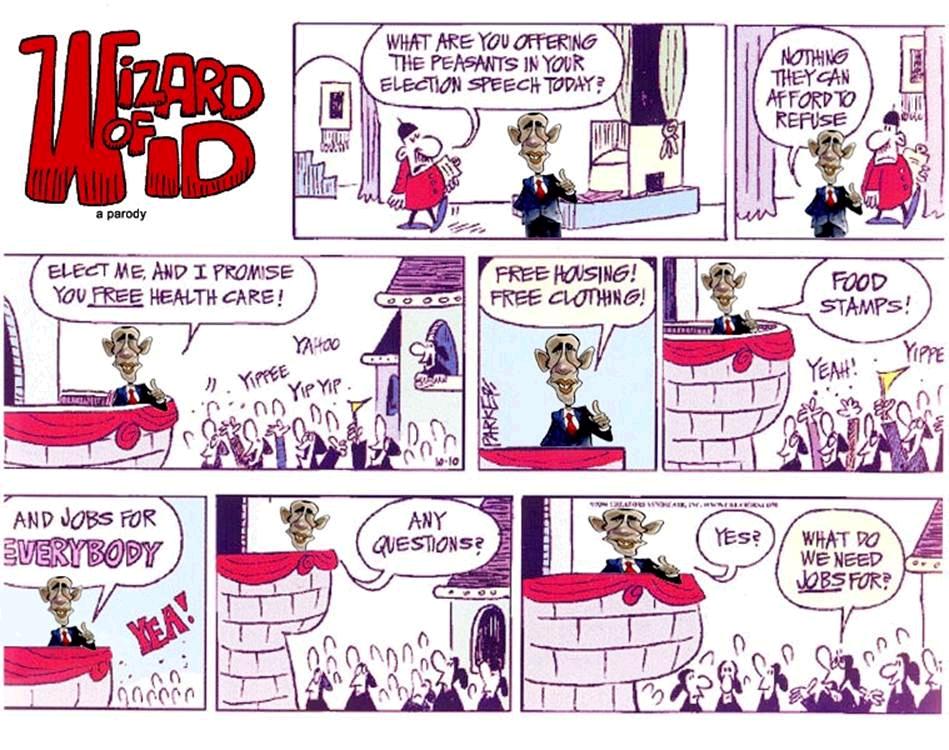
Obama has plans to give everyone everything free!!!!

Daniel J. Mitchell – USA: Drowning In Debt?

Uploaded by on Jun 1, 2009

Debating whether the United States has gone too far in accumulating debt, with Dan Mitchell, Cato Institute; Christian Weller, Center for American Progress; and CNBC’s Erin Burnett.

_______________

Does anyone care about growing the economy anymore?

Economists often do a crummy job of teaching people about the impact of fiscal policy on the labor force, largely because we put people to sleep with boring discussions about “labor supply” decisions (my blog post from last year perhaps being an example of this tendency).

From now on, I will try to remember to use this cartoon. It’s a parody of Obama’s policies, but the last slide (or is it a panel?) is a great teaching tool about what happens when politicians turn the safety net into a hammock.