Thank you so much for your time. I know how valuable it is. I also appreciate the fine family that you have and your commitment as a father and a husband.
Sincerely,
Everette Hatcher III, 13900 Cottontail Lane, Alexander, AR 72002, ph 501-920-5733, lowcostsqueegees@yahoo.com
http://blog.heritage.org/2012/02/22/morning-bell-religious-liberty-under-attack/ | The controversy over the Obama Administration’s anti-conscience mandate and the fight for religious liberty only serves to highlight the inherent flaws in Obamacare. This conflict is a natural result of the centralization laid out under Obamacare and will only continue until the law is repealed in full.
I’m going to jump into the debate about austerity in Europe because it is being closely followed in Latin America, and many people are drawing the wrong conclusions about how austerity is strangling the European economies. But first, we have to be clear about what we mean by “austerity.”
As the debate between Veronique de Rugy of the Mercatus Center and Ryan Avent at The Economist shows, there are different definitions of austerity. The term could mean fiscal consolidation only by spending cuts. It could mean a mixture of spending cuts and tax increases (the so called “balanced approach”), and it could even be just tax increases. So when people blame “austerity” for Europe’s economic malaise, we could be talking about a very different set of policies in each country.
Let’s look at Britain, which just entered into a double dip recession because of, according to Paul Krugman, “the evident failure” of austerity policies. If we look at spending levels in the UK both in nominal and real terms, we can clearly see that despite the announcement of deep cuts, government spending continues to rise:
Source: European Commission, Economic and Financial Affairs.
It’s clear that, at least in nominal terms, the rate of growth of spending has declined, but that hardly constitutes brutal cuts as Krugman and others want us to believe. If we look at total government spending as a percentage of the economy, Britain reached a peak in 2009 at 51.5%, and that came down to 49.9% in 2011. Can anyone seriously argue that Britain is in a recession because of that tiny drop in spending as a share of the economy?
Now, let’s remember that the Conservative-Liberal Democrat coalition government that came to power in May 2010 adopted what The Economisthailed as a balanced approach of fiscal consolidation based on £1 of tax increases for £3 of spending cuts. To be fair, the British magazine also said that if economic recovery proved hard to achieve, the government should consider a reprieve in tax increases, but not on spending cuts. We all know that the tax increases already took place (the VAT rate went up from 17.5% to 20%, for example). But as we can see, spending cuts haven’t taken place at all. Thus, austerity in Britain consists only of tax increases.
It’s hard to estimate the impact of tax increases on the British economy. Certainly the economic turmoil in Continental Europe has played a role in taking the U.K. into a second recession. But those who claim that “austerity” is responsible for Britain’s economic malaise should be honest and acknowledge that by austerity they mean only tax increases, not spending cuts.
Was ObamaCare doomed from the start, an unpopular proposal that was unlikely to ever catch on with the public?
My response:
Let’s remember how ObamaCare was passed — without a single Republican vote, and after the “Cornhusker Kickback,” the “Louisiana Purchase,” the Florida Flim-Flam,” and countless other shenanigans, including a phony 10-year price tag of $938 billion that the CBO now tells us will be $1.76 trillion. And remember too that ObamaCare’s passage was followed by the massive repudiation of the 2010 elections. Is it any wonder that it continues to be unpopular?
But the Supreme Court next week will be looking not at ObamaCare’s unpopularity but at its unconstitutionality — or so 26 states and others have claimed, and for good reason. The Act, if upheld, would effectively end constitutionally limited government in America. A government that can order individuals to engage in commerce is limited only by politics, not law. A federal government that can compel states to expand their Medicaid roles on pain of losing the federal tax dollars the state’s citizens must continue to pay is no longer a government subject to checks by the states.
The American people aren’t stupid. They know a massive power-grab when they see it. What makes this power-grab special is that it concerns not retirement or education, or the many other areas in which the federal government has usurped constitutionally unauthorized power over the years but that most intimate of human concerns, health care. Bad as our health care system is today, due to government meddling in the past, ObamaCare will transform it into one massive bureaucracy — high costs, poor service — and the American people know it. That’s why it continues to be so unpopular.
Thank you so much for your time. I know how valuable it is. I also appreciate the fine family that you have and your commitment as a father and a husband.
Sincerely,
Everette Hatcher III, 13900 Cottontail Lane, Alexander, AR 72002, ph 501-920-5733, lowcostsqueegees@yahoo.com
Randy Barnett Discusses ObamaCare at the Supreme Court
Cato Institute Senior Fellow and Georgetown University law professor Randy E. Barnett discusses the arguments to be presented to the Supreme Court beginning March 26.
I have always opposed Obamacare because it the government control of giving anyone the right to have an abortion paid for by the government and I think that is wrong. However, there are some constitution problems with this power grab of Obamacare too. This article below from the Cato Institute makes this point:
Harvard law professor Noah Feldman opines that U.S. Solicitor General Don Verrilli ”faltered” yesterday when Supreme Court justices asked whether the Obama administration’s claim that the Constitution empowers Congress to force people to purchase health insurance contains any limiting principle. Put differently, if the power “To regulate commerce…among the several States” allows the government to force you to buy health insurance, can the government also force you to buy broccoli?
Feldman laments that Verrilli’s “failure to offer a sharp distinction could be disastrous for the government’s case,” but assures us, “There is a good, sharp answer to this wholly reasonable question.” Here is the preface to Feldman’s answer:
[W]hen it comes to the strange and unusual case of health insurance, inaction causes the whole market to break down. By not buying health insurance, the healthiest person is depriving everyone of a public good. By sitting on their hands — and acting rationally — people who do not purchase insurance are unintentionally causing the market to fail.
One problem here is that if Congress can compel you to buy something whenever not buying it would deprive someone else of a public good, then Congress can also force you to purchase — not just tax and provide to you, but force you to purchase — tanks, fighter jets, and military bases; lighthouses; software; fireworks displays; e-books; comparative-effectiveness research (or really any type of research); a subscription to Consumer Reports; landscaping services; parks; rare and endangered species; street lights; et cetera ad nauseam. That isn’t much of a limiting principle.
Another problem is that economists use the term ”market failure” to describe a situation where one or more features of a free market cause that market to fall short of the efficiency-maximizing outcome. Feldman misuses it to mean, “This market isn’t doing what I want.” That is not market failure. Nor is it much of a limiting principle. If the Commerce Clause empowered Congress to force people to buy things to correct every perceived shortcoming in every market, Congress’ powers would be without limit. Even worse, Feldman doesn’t even bother identify whether the outcome he deplores is caused by some feature of a free market or government intervention (see below).
But that was just preface to Feldman’s supposed limiting principle. Here’s the meat of it:
The government can penalize inaction only when that inaction deprives everyone else of a public good…There must be an asymmetry of information about the relevant facts governing insurance — like the difference between my knowledge of how healthy I am and the insurance company’s ability to suss it out. And the market must be one in which that information asymmetry leads to adverse selection.
Though Feldman begins by stating government can force you to purchase any public good – another economic concept he seems to misunderstand — by the end of the paragraph he narrows his limiting principle to situations where asymmetric information causes market failures in insurance. Sorry, but that’s still not much of a limiting principle. For one thing, it would enable Congress to force Americans to purchase basically any type of insurance.
Asymmetries of information, in the absence of regulation, lead to adverse selection in all insurance markets. Insurers typically remedy this problem by adjusting premiums to reflect the risk posed by the purchaser, but there will always be situations where some purchasers know they pose a greater risk of filing claims than carriers realize. Fortunately, the risk-aversion of other purchasers acts as a counterweight and prevents those markets from collapsing. But since all adverse selection causes at least some mutually beneficial insurance purchases not to occur — the sort of welfare loss that constitutes an actual market failure — Feldman’s so-called limiting principle would allow Congress to force you to buy any type of insurance it wants, so long as Congress finds even a sliver of adverse selection. That opens to door for Congress to mandate that everyone purchase life, auto, disability, flood, mortgage, renter’s, terrorism, earthquake, deposit, pet, earthquake, divorce, and long-term care insurance. Congress could even require you to purchase reinsurance — i.e., insurance against the that risk that your other insurance policies won’t pay. No doubt adverse selection prevents some unfortunate professional athletes and performers from insuring against the failure of their hair, legs, hands, teeth, vocal chords, fingers, ankles, tongues, and entire bodies. Ditto the threat of a paternity suit. If so, then Feldman’s “limiting principle” would let Congress mandate that everyone purchase those insurance policies, too.
Feldman’s limiting principle would even allow Congress to force Americans to purchase types of insurance that currently don’t exist. What if adverse selection so bedevils the markets for BAC-level insurance, positive-drug-test insurance, short-term-suicide insurance, overgrown-grass insurance, and oversleeping insurance that no carriers even offer such policies? Under Feldman’s rule, Congress could fix that by forcing carriers to offer such insurance and forcing you to buy it.
And that’s only what Congress could do in the presence of whatever scant adverse selection exists in unregulated insurance markets. But regulation typically encourages adverse selection–a point that Feldman elides, as if the catastrophic adverse selection that ObamaCare’s “community rating” price controls will cause were the market’s fault rather than Congress’. So what Feldman is actually saying is that Congress can force you to purchase insurance even if Congress itself caused the adverse selection. Which brings us back to broccoli.
Remember broccoli? Feldman writes, “If I choose not to buy broccoli, others can still buy it at a market price.” Perhaps that is true today. But let’s assume Feldman subscribes to the Obama administration’s argument that the Commerce Power enables Congress to regulate the timing and method of payment for a good that moves in interstate commerce. That would mean that Feldman believes Congress could pass a law stating that all broccoli purchasers must henceforth purchase it through a new method of payment called “broccoli insurance,” where all purchasers pay broccoli insurers a flat fee based on average broccoli consumption within the insurer’s pool of customers, regardless of how much broccoli an individual customer may consume. What would happen if Congress did that?
Well, those who consume the most broccoli would be thrilled. They could eat as much broccoli as they want — they could even stucco or decorate their houses with it — while paying much less than they did before. Those who rarely buy broccoli, on the other hand, would see their broccoli bills skyrocket. They may decide not to buy broccoli at all. When they leave the broccoli market, average consumption by those in the market will rise, as will broccoli premiums. That will cause more low-end broccoli consumers to leave the market, and the cycle will repeat itself.
Feldman will recognize this process as — you guessed it — adverse selection caused by asymmetric information. Which, under his limiting principle, means that Congress can swoop down and mandate that Americans purchase broccoli insurance. After all, those people choosing not to buy broccoli are “depriving everyone of [what Feldman calls] a public good.” In sum, Feldman’s limiting principle would allow Congress to force all Americans to buy broccoli. Which is to say, it’s not a limiting principle at all.
Like every other so-called limiting principle offered by ObamaCare’s defenders, Feldman’s has no basis in the Constitution or any other law. It is a post hoc rationalization, made by people who are shocked to find themselves before the Supreme Court, defending the constitutionality of their desire to bully others into submission.
Lord only knows where these guys get all their self-assuredness. Maybe it’s part of Harvard’s employee benefits package.
Update: Prof. Feldman commits another error that I did not initially catch, and therefore perpetuated. It is not asymmetric information that leads to adverse selection in the markets for health/broccoli insurance and causes those markets to collapse. It is the fact that the government’s “community rating” price controls prevent insurance carriers from using information they possess to set premiums in a way that prevents adverse selection. HT: Me.
Thank you so much for your time. I know how valuable it is. I also appreciate the fine family that you have and your commitment as a father and a husband.
Sincerely,
Everette Hatcher III, 13900 Cottontail Lane, Alexander, AR 72002, ph 501-920-5733, lowcostsqueegees@yahoo.com
Randy Barnett Discusses ObamaCare at the Supreme Court
Cato Institute Senior Fellow and Georgetown University law professor Randy E. Barnett discusses the arguments to be presented to the Supreme Court beginning March 26.
This Center for Freedom and Prosperity Foundation video shows how the flat tax would benefit families and businesses, and also explains how this simple and fair system would boost economic growth and eliminate the special-interest corruption of the internal revenue code. www.freedomandprosperity.org
The class-warfare crowd is predictably outraged that Mitt Romney supposedly paid just 13.9 percent of his income to the crowd in Washington. Surely this is a sign of both inequity and iniquity. Meanwhile, previewing a theme for the general election, President Obama said in his State of the Union address that “millionaires and billionaires” should cough up at least 30 percent of their earnings to the IRS.
This is bad policy based on inaccurate data.
Let’s deal first with the flawed numbers. Capital gains taxes and dividend taxes are both forms of double taxation. That income already is hit by the 35 percent corporate income tax. So the real tax rate for people like Mitt Romney is closer to 45 percent. And if you add the death tax to the equation, the effective tax rate begins to approach 60 percent.
Daniel J. Mitchell is a top expert on tax reform and supply-side tax policy at the Cato Institute.
Here’s a simply analogy. Imagine you make $50,000 per year and your employer withholds $5,000 for personal income tax. How would you feel if the IRS then told you that your income was $45,000 and you had to pay full tax on that amount, and that you weren’t allowed to count the $5,000 withholding when you filled out your 1040 form? You would be outraged, correctly yelling and screaming that you should be allowed to count those withheld tax payments.
Welcome to the world of double taxation.
The Obama approach is also bad economics. Every economic theory — even socialism and Marxism — agrees that saving and investment are the key to long-run growth and higher living standards. So does it make sense to deprive the economy of productive capital by imposing punitive layers of double taxation? To make matters worse, double taxation means transferring the money to the buffoons in Washington, where it will be squandered on inefficient and wasteful programs.
Europe’s welfare states are on the brink of collapse because they adopted the mentality that government spending was better than private saving and investment. Should we copy their failures?
The right way to ensure both fairness and growth is the flat tax. Get rid of the 72,000 pages of corruption and complexity in the Internal Revenue Service code and replace it with a postcard-sized flat tax. One low tax rate with no double taxation. That’s good for the economy and competitiveness.
And if Mitt Romney makes 100,000 times more than me, he’ll pay 100,000 times more in tax.
I have always opposed Obamacare because it the government control of giving anyone the right to have an abortion paid for by the government and I think that is wrong. However, there are some constitution problems with this power grab of Obamacare too. This article below from the Cato Institute makes this point:
Michael Tanner is a senior fellow at the Cato Institute and author of Leviathan on the Right: How Big-Government Conservatism Brought Down the Republican Revolution.
In pushing through parts of the New Deal, President Franklin Roosevelt reportedly told one wavering congressman, “I hope you will not permit doubts as to constitutionality, however reasonable, to block the suggested legislation.”
As one listens to the Obama administration and others defend the Patient Protection and Affordable Care Act (a.k.a Obamacare), one gets the impression that Roosevelt’s nostrum has been adopted as the official motto of this administration. Their attitude seems to be that, of course Obamacare is constitutional because, well, because it’s important.
The idea that federal government’s power should be limited is dismissed as a quaint relic of a bygone age. There are important national problems to be solved, and we should not be held back by a document from the past. As Representative Kathy Hochul (D., N.Y.) puts it, “Basically we are not looking at the Constitution… The decision has been made by this Congress that American citizens are entitled to health care.”
The genius of the American system is that we are a government of laws and not of men.
This attitude is on display in other areas as well. Constitutional niceties,legislative rules, and democratic debate are all impediments to be dispensed with when “we can’t wait.”
For example, the administration apparently grew tired of Republican opposition to the appointment of Richard Cordray as head of the new Consumer Financial Protection Agency created under the Dodd-Frank law, so they simply made a recess appointment of Cordray — despite the fact that Congress was not in recess. President Obama used the same non-recess recess appointment to name three new members to the National Labor Relations Board. When asked how he could justify doing so, the president simply shrugged and said, “I refuse to take ‘no’ for an answer. I am not going to stand by while a minority in the Senate puts party ideology ahead of the people we were elected to serve.”
President Bush was justly criticized for his extraordinary use of executive orders and signing statements to avoid the untidiness of the legislative process. But President Obama has adopted the same tactics, choosing to act unilaterally or to disregard parts of legislation that he thinks impinges on his authority. For example, rather than go through the difficult and lengthy process of having Congress revise the No Child Left Behind Act, the president simply gave the states waivers from NCLB if they agreed to adopt the administration’s preferred education policies. It is no defense of NCLB to wonder how the president gets the power to make federal education policy, and for that matter state education policy, through the waiver process.
Then again, this is the administration that unilaterally decided to grant some 1,200 waivers from various provisions of Obamacare.
The president has also felt free to repeatedly commit American troops to action without congressional approval. Indeed, not only has the president refused to seek a declaration of war, but in the case of the U.S. bombing of Libya, he didn’t even bother with the congressional notification required under the War Powers Act. The same is true of the president’s dispatch of troops to Uganda.
Democrats in Congress also seem impatient with the normal give and take of the legislative process. Thus, when Senate Republicans used their power to delay consideration of legislation dealing with Chinese currency manipulation, Democrats simply changed the Senate rules to deny Republicans the ability to offer amendments to the legislation. And hardly a week seems to pass without some Democratic proposal to eliminate or restrict the filibuster.
Of course, we should not forget the health-care law was pushed through in the first place with at best minimal concern for congressional rules.
The genius of the American system is that we are a government of laws and not of men. That often makes for a messy and slow process. But it is far better than the alternative. That’s true even when a president believes “we can’t wait.”
____
Thank you so much for your time. I know how valuable it is. I also appreciate the fine family that you have and your commitment as a father and a husband.
Sincerely,
Everette Hatcher III, 13900 Cottontail Lane, Alexander, AR 72002, ph 501-920-5733, lowcostsqueegees@yahoo.com
The individual mandate to purchase health insurance is the linchpin of the Patient Protection and Affordable Care Act. It is among the issues to be handled by the Supreme Court beginning March 26, 2012.
Michael F. Cannon is the director of health policy studies at the Cato Institute.
____________________
President Obama c/o The White House
1600 Pennsylvania Avenue NW
Washington, DC 20500
I have always opposed Obamacare because it gives anyone the right to have an abortion paid for by the government and I think that is wrong. However, there are some constitution problems with this power grab of Obamacare too. This article below from the Cato Institute makes this point:
The US Supreme Court today heard arguments today on what may be the most important constitutional case in a generation. Some of the nation’s top attorneys are debating the Patient Protection and Affordable Care Act, often known as Obamacare.
The eventual ruling could chart the boundaries of federal power for generations to come — not only for health care, but across the policy spectrum.
A major focus of the Supreme Court hearings is the individual mandate — the law’s requirement that almost all Americans who aren’t covered by employers must purchase a health-care plan, whether they want to or not.
The plaintiffs — including 26 states as well as individuals and businesses — argue that Congress has no authority to force people to buy insurance. Most Americans agree: A recent Gallup poll found that 72 percent — including 56 percent of Democrats – consider the mandate unconstitutional.
If Congress can force us to buy health insurance, what can’t it order us to buy?
Obama administration attorneys counter that Article I, Section 8 of the Constitution, known as “the commerce clause” — giving Congress power to “regulate commerce among the several states” — is more than expansive enough to validate the mandate.
They rely on a list of Supreme Court precedents that stretch the definition of “interstate commerce” pretty far.
In the 1940s, the court allowed Congress to punish a farmer for growing wheat on his own land for his own use, on the theory that wheat prices would be affected if everyone did that. In the 1960s, the court classified civil rights laws as “regulations of commerce” even when they involved businesses that did practically no interstate business. And in 2005, the court ruled that Congress could prohibit someone from growing marijuana in her yard for her personal medical use, because federal laws against drugs are a kind of economic regulation.
Still, the court has never held that the federal government may compel people to participate in commerce. And this is what makes the individual mandate unprecedented: Never before has Congress presumed to order average Americans to purchase a good or a service in the marketplace.
Simply from the standpoint of semantics, the law’s defenders face a challenge. As ordinarily understood, the word, “regulate,” implies rules for activity that people have freely chosen to engage in (running a business, for instance). The word doesn’t imply forcing people, say, to start a business in the first place.
Likewise, “commerce” implies economic activity — but someone who fails to buy health insurance is not engaged in economic activity.
Beyond these disputes over definitions lies a fundamental question about the extent of federal power: If Congress can force us to buy health insurance, what can’t it order us to buy?
Practically any individual decision to buy something, or not to do so, has some theoretical effect on the economy as a whole. And if that’s all that’s needed to justify federal intrusion, limitless dictates could be imagined. For example, what’s to stop Congress from forcing us to buy spa memberships — or electric cars — in the name of making us healthier, or more fuel-efficient, consumers?
As Federal District Court Judge Henry Hudson, who ruled in favor of Virginia’s challenge to the individual mandate in December 2012, put it: The argument for the mandate’s constitutionality “lacks logical limitation.”
Remarkably, the Obama administration has never offered a principled explanation of how to square the mandate with constitutional principles of limited federal government.
Instead, Americans are offered more semantic games. We’re told the mandate only moves forward a purchase that would have happened in any case. People will now pay up-front for health care that they would have eventually paid for, on their own, when they received it.
But again, this is a rationale without “logical limitation.” Some version of this argument could be offered for practically any kind of forced purchase. If Congress commands you to buy something because lawmakers deem it “good for you,” then almost by definition, it’s something you might have bought on your own, eventually — so, voila, the mandate isn’t really a mandate at all!
Bottom line: Upholding the individual mandate would set a treacherous precedent by licensing Congress to start micromanaging every facet of our lives.
Striking down the mandate, on the other hand, could pressure Congress to finally get creative about reforming America’s ailing health care delivery system. With the mandate off the table, Congress could be forced to de-emphasize rigid bureaucratic prescriptions in favor of market-based reforms to expand competition and consumer choice.
So this case is not just a pulse check for constitutional principles of limited government. The health of health care could also be on the line.
____
Thank you so much for your time. I know how valuable it is. I also appreciate the fine family that you have and your commitment as a father and a husband.
Sincerely,
Everette Hatcher III, 13900 Cottontail Lane, Alexander, AR 72002, ph 501-920-5733, lowcostsqueegees@yahoo.com
Dan Mitchell explains in the above video that Europe can grow and prosper, but only if politicians are willing to reduce the burden of government spending and lower tax rates.
_____________
I have a lot of respect for Tea Party heroes like Tim Huelskamp , Idaho First District Congressman Raúl R. Labrador, and Justin Amash who are willing to propose deep spending cuts so we can eventually balance our budget.
It is a fact that we must balance the budget soon. I do not believe that we can wait to balance the budget at some distant time in the future. The financial markets will not allow us a long time to get our house in order. Look at how things have been going the last four years and no matter how anyone tries to spin it, we are going down the financial drain fast.
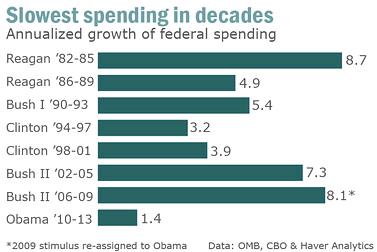
Here’s the chart he prepared, which certainly seems to indicate that Obama is a fiscal conservative. Not only that, it shows that Republicans generally are the big spenders, while Democrats are frugal with other people’s money.
That being said, Nutting’s numbers seemed a bit nutty. Sorry, couldn’t resist. Nutting’s numbers actually seem accurate, including the fact that he decided that Obama should be responsible for $140 billion of the spending in Bush’s last fiscal year (a number he may have taken from one of my posts).
But sometimes accurate can be misleading, so I decided to dig into the data.
But I corrected a big mistake in Nutting’s analysis. I adjusted the numbers for inflation, using OMB’s GDP deflator.
As you can see, this changes the results. My chart isn’t as pretty, but based on the inflation-adjusted average annual growth of outlays, it shows that Clinton was the most frugal president, followed by the first President Bush and Obama.
With his guns-n-butter Keynesianism, it’s no big surprise that LBJ ranks last. And “W” also gets a very low grade.
But then I figured we should take interest payments out of the budget and focus on inflation-adjusted “primary spending.” After all, Presidents shouldn’t be held responsible for the national debt that existed before they took office.
Looking at these numbers, it turns out that Obama does win the prize for being the most fiscally conservative president in recent memory. Reagan jumps to second place. Clinton is in third place, which won’t surprise people who watched this video, while W and LBJ again are in last place.
But I don’t want my Republican friends to get too angry with me, so let’s expand our analysis. Just as we don’t want to blame Presidents for net interest payments on debt that was accrued before their tenure, perhaps we should make sure they don’t get credit or blame for defense outlays that often are dictated by external events.
There’s obviously room for disagreement, but most people will agree that the Cold War and 9/11 meant higher defense spending, regardless of which party controlled the White House. Similarly, the collapse of the Soviet Empire inevitably meant lower military expenditures, regardless of whether Republicans or Democrats were in charge.
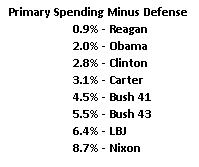
So let’s now look at primary spending after subtracting defense outlays (still adjusting for inflation, of course). All of a sudden, Reagan jumps to the top of the list by a comfortable margin. LBJ and W continue to score poorly, but Nixon takes over last place.
But it’s also worth noting that Obama still scores relatively well, beating Clinton for second place. Inflation-adjusted domestic spending (which is mostly what we’re measuring) has grown by 2.0 percent annually during his three years in office.
So does that mean Obama deserves re-election? Well, before you answer, I want to make one final calculation. Just as there are good reasons to exclude interest payments because they’re not something a president can control, we also should take a look at what spending would be if we don’t count the cost of bailouts.
To be sure, these types of expenditures can be controlled, but if we go with the assumption that the federal government was going to re-capitalize the banking system (whether using the good FDIC-resolution approach or the corrupt TARP approach), then it seems that Presidents shouldn’t get arbitrary blame or credit simply because some financial institutions failed during their tenure.
So let’s take the preceding set of numbers and subtract out the long-run numbers for deposit insurance, as well as the TARP outlays since 2009. And keep in mind that repayments of TARP monies (as well as deposit insurance premiums) show up in the budget as “negative spending.”
As you can see, this produces a remarkable result. All of a sudden, Obama drops from second to second-to-last.
This is because there was a lot of TARP spending in Bush’s last fiscal year (FY2009), which created an artificially high benchmark. And then repayments by banks during Obama’s fiscal years counted as negative spending.
When you subtract out the big TARP spending surge, as well as the repayments, then Bush 43 doesn’t look quite as bad (though still worse than Carter and Clinton), while Obama takes a big fall.
In other words, Obama’s track record does show that he favors an expanding social welfare state. Outlays on those programs have jumped by 7.0 percent annually. And that’s after adjusting for inflation! Not as bad as Nixon, but that’s not saying much since he was one of America’s most statist presidents.
Allow me to conclude with some caveats. None of the tables perfectly captures what any president’s fiscal record. Even my first table may be wrong if you want to blame or credit presidents for the inflation that occurs on their watch. And there certainly are strong arguments that bailout spending and defense spending are affected by presidential policies rather than external events.
And keep in mind that presidents don’t have full power over fiscal policy. The folks on Capitol Hill are the ones who actually enact the bills and appropriate the money.
Moreover, the federal government is akin to a big rusty cargo ship that is traveling in a certain direction, and presidents are like tugboats trying to nudge the boat one way or the other.
But enough equivocating. The four different tables at least show more clearly which presidents presided over faster-growing government or slower-growing government. More importantly, the various tables provide a good idea of where most of the new spending was taking place.
We can presumably say Reagan and Clinton were comparatively frugal, and we can also say that Nixon, LBJ, and Bush 43 were relatively profligate. As for Obama, I think his tugboat is pushing in the wrong direction, but it’s only apparent when you strip out the distorting budgetary impact of TARP.
DEBT LIMIT – A GUIDE TO AMERICAN FEDERAL DEBT MADE EASY. Uploaded by debtlimitusa on Nov 4, 2011 A satirical short film taking a look at the national debt and how it applies to just one family. Watch the guy from the Ferris Bueller Superbowl Spot! Produced by Seth William Meier, DP/Edited by Craig Evans, […]
Congressmen Tim Huelskamp on the debt ceiling I just don’t understand why people think we can go on and act like everything is okay when we have a trillion dollar deficit. Sometimes you run across some very wise words like I did the other day. Kansas Congressman Tim Huelskamp made the following comment on the […]
There are many economic approaches out there but the one that works best is the free market approach of low taxes and low amounts of government spending and intervention.
I posted yesterday about visiting the United Nations to participate in “The High Level Thematic Debate on the State of the World Economy.”
There were five speakers on my panel, including yours truly. Here are my thoughts on what the others said.
Dr. Supachai Panitchpakdi, Secretary-General of the United Nations Conference on Trade and Development, must have been part of the buzz-word contest I mentioned yesterday. Lots of rhetoric that theoretically was inoffensive, but I had the feeling that it translated into a call for more government. But maybe I’m paranoid SOB, so who knows.
Professor Dato’ Dr. Zaleha Kamaruddin, Rector of the International Islamic University of Malaysia, was an interesting mix. At some points, she sounded like Ron Paul, saying nice things about the gold standard and low tax rates. But she also called for debt forgiveness and other forms of intervention. She explicitly said she was providing Islamic insights, so perhaps the strange mix makes sense from that perspective.
Former Senator Alan K. Simpson also was a mixed bag. Simpson was co-chair of Obama’s fiscal commission, which I thought was a disappointment because it endorsed higher taxes and urged sub-par entitlement changes rather than much-needed structural reforms. He also went after Grover Norquist because of the no-tax pledge, which I think is a valuable tool to keep Republicans from selling out for bigger government. All that being said, Senator Simpson is a promoter of smaller government and he wants lower tax rates. So while I disagree with some of his tactical decisions, he was an ally on the panel and would probably do a pretty good job if he was economic czar.
Last but not least, Professor Jeffrey Sachs of Columbia University was a statist, as one would expect based on what I wrote about him last year. We clashed the most, arguing about everything from tax havens to the size of government. Interestingly, we both said nice things about Sweden, but I was focusing on policies such as school choice and pension reform, while he admired the large public sector. But I will admit he was a nice guy. We sat next to each other and did find a bit of common ground in that we both were sympathetic to the way Sweden dealt with its financial crisis about 20 years ago (a version of the FDIC-resolution approach rather than the corrupt TARP bailout approach).
My message, by the way, was very simple. Higher taxes won’t work. The “growth” vs. “austerity” debate in Europe is really a no-win fight between those who want higher spending vs. those who want higher taxes. The only good answer is to restrain spending with…you guessed it, Mitchell’s Golden Rule.
I’m not safely out of New York City, and I promise I didn’t drink any of the Kool-Aid. I’m still a critic of international bureaucracies. And I wouldn’t allow myself to be bought off by a lavish, tax-free job at the United Nations.
If our country is the grow the economy and get our budget balanced it will not be by raising taxes!!! The recipe for success was followed by Ronald Reagan in the 1980’s when he cut taxes and limited spending. As far as limiting spending goes only Bill Clinton (with his Republican Congress) were ability to control the growth of government better than Reagan.
I had the pleasure of hearing Arthur Laffer speak in 1981 and he predicted all the economic growth that we would see because of the Reagan tax cuts and he was right. Unfortunately in California today they have forgotten all of those lessons!!!
President Obama’s fiscal policy is a dismal mixture. On spending, he wants a European-style welfare state. On taxes, he is fixated on class-warfare tax policy.
If we want to know the consequences of that approach, we can look at the ongoing collapse of Greece. Or, if we don’t like overseas examples, we can look at California.
California Controller John Chiang reported last week that April tax collections were a gigantic 20.2%, or $2.44 billion, below 2012-13 budget projections. …Among the biggest surprises is a 21.5% or nearly $2 billion decline in personal income tax payments from what Governor Jerry Brown had anticipated. This reinforces the point that when states rely too heavily on the top 1% of taxpayers to pay the bills, fiscal policy is a roller coaster ride. California is suffering this tax drought even as most other states enjoy a revenue rebound. State tax collections were up nationally by 8.9% last year, according to the Census Bureau, and this year revenues are up by double digits in many states. The state comptroller reports that Texas is enjoying 10.9% growth in its sales taxes (it has no income tax), while California can’t seem to keep up despite one of the highest tax rates in the land.
The WSJ editorial suggests a supply-side response, but you won’t be surprised to learn that the state’s kleptomaniac governor is pushing an Obama-style soak-the-rich tax hike.
This would seem to suggest that California should try cutting tax rates to keep more people and business in the state, but Sacramento is intent on raising them again. Governor Brown and the public-employee unions are sponsoring a ballot initiative in November to raise the state sales tax by a quarter point to 7.5% and to raise the top marginal income-tax rate to 13.3% from 10.3%. This will make the state even more reliant on the fickle revenue streams provided by the rich. Meanwhile, an analysis by Joseph Vranich, who studies migration of businesses from one state to another, finds that since 2009 the flight of businesses out of California “has increased fivefold due to high taxes and regulatory costs.”
But while voters can impose higher taxes, they can’t repeal the laws of economics. So if California voters do the wrong thing, they will learn a hard lesson about the Laffer Curve.






 The Daily Hatch