Category Archives: Cato Institute

Sweden cutting back welfare state and having good results

Milton Friedman

Economics 101: Learning From Sweden’s Free Market Renaissance

Uploaded by on Mar 8, 2010

Sweden is a powerful example of the importance of public policy. The Nordic nation became rich between 1870 and 1970 when government was very small, but then began to stagnate as welfare state policies were implemented in the 1970s and 1980s. The CF&P Foundation video explains that Sweden is now shifting back to economic freedom in hopes of undoing the damage caused by an excessive welfare state. www.freedomandprosperity.org

__________________

Milton Friedman – The Negative Income Tax

Published on May 11, 2012 by

In this 1968 interview, Milton Friedman explained the negative income tax, a proposal that at minimum would save taxpayers the 72 percent of our current welfare budget spent on administration. http://www.LibertyPen.com

Source: Firing Line with William F Buckley Jr.

________________

We got to cut our welfare state. Why not look at other countries like Sweden have learned this lesson of over spending and are trying to cut back now.

Sweden must be a schizophrenic country. Something strange is happening, after all, if a statist like Jeffrey Sachs and a rabid libertarian like yours truly both cited it as a role model in our remarks last month at the United Nations.

So who’s right? Well, it depends what you care about.

In a column for Bloomberg, Anders Aslund elaborates on Sweden’s efforts to reduce the size of the state.

Not so long ago, Sweden could claim world leadership in unmitigated Keynesian economics, with a 90 percent marginal tax rate and a welfare state second to none. …but in the last two decades the country has been reformed. Public spending has fallen by no less than one-fifth of gross domestic product, taxes have dropped and markets have opened up. …no turnabout has been as dramatic as Sweden’s. From 1970 until 1989, taxes rose exorbitantly, killing private initiative, while entitlements became excessive. Laws were often altered and became unpredictable. As a consequence, Sweden endured two decades of low growth. In 1991-93, the country suffered a severe crash in real estate and banking that reduced GDP by 6 percent. Public spending had surged to 71.7 percent of GDP in 1993, and the budget deficit reached 11 percent of GDP. …Sweden’s traditional scourge is taxes, which used to be the highest in the world. The current government has cut them every year and abolished wealth taxes. Inheritance and gift taxes are also gone. Until 1990, the maximum marginal income tax rate was 90 percent. Today, it is 56.5 percent. That is still one of the world’s highest, after Belgium’s 59.4 and there is strong public support for a cut to 50 percent. The 26 percent tax on corporate profits may seem reasonable from an American perspective, but Swedish business leaders want to reduce it to 20 percent.

Interestingly, the Swedish people and the Swedish elite (just like the Estonians, as I discussed in my takedown of Paul Krugman) seem to understand that there’s no going back to the statist era of the 1970s and 1980s.

Where are the left-wing intellectuals to challenge this new order? They have disappeared. The old socialist research organizations have closed down. The Center for Labor Market Studies was a state institution that generated propaganda, not research, and the government closed it. The Trade Union Confederation had a sophisticated research institute, which it eliminated for not being sufficiently political. The union economists, who dominated Swedish economic debate in the 1970s and ’80s, have been replaced by bank economists. The free-market right has influential research centers in Stockholm. After many years of absence from the debate, I attended a conference on the Swedish economy in the southern city of Malmo last month. …the 180 speakers represented the full range of Swedish views. I was amazed to hear how far the consensus had moved to the free- market right, even among Social Democrats and trade-union leaders. …The Social Democrats haven’t only joined the free-market consensus, but seem to attack the current government from the right, pushing for a better business environment. Gone are demands for the restoration of social benefits. Opinion polls have rewarded the Social Democrats for their right turn with sharply improved ratings.

In other words, Sweden is a lot like Canada – a nation that took a misguided turn to the left but since then has moved significantly in the right direction.

I’m not willing to trade places with either nation, but that may change at some point. The Bush-Obama policies of bigger government and more intervention have made America less attractive, while other nations have learned from their mistakes.

If Sweden adopts a flat tax and figures out how to cancel winter, I may have to move there.

P.S. Sweden’s government-run healthcare system can be quite emasculating.

Open letter to President Obama (Part 96)

Government Spending Doesn’t Create Jobs

Uploaded by on Sep 7, 2011

Share this on Facebook: http://on.fb.me/qnjkn9 Tweet it: http://tiny.cc/o9v9t

In the debate of job creation and how best to pursue it as a policy goal, one point is forgotten: Government doesn’t create jobs. Government only diverts resources from one use to another, which doesn’t create new employment.

Video produced by Caleb Brown and Austin Bragg.

___________________________

President Obama c/o The White House
1600 Pennsylvania Avenue NW
Washington, DC 20500

Dear Mr. President,

I know that you receive 20,000 letters a day and that you actually read 10 of them every day. I really do respect you for trying to get a pulse on what is going on out here.

I have said that the stimulus did not work, but the liberals always responded that it needed to be bigger. Who was right? Now the most liberal paper in the country has weighed in on this.

J.D. Foster, Ph.D.

March 6, 2012 at 5:00 pm

Does unprecedented deficit-spending such as on highways stimulate the economy? For the last few years, some have argued it could. Some have argued it might. Some have argued it would if done right.

We have consistently argued that deficit spending on highways or anything else intended to lift aggregate demand, and therefore jobs, must and would fail. The economic evidence that we were right has now been joined by the illustrious trio of The Washington Post, the Associated Press, and the esteemed Alice Rivlin, former director of the Congressional Budget Office and the Office of Management and Budget.

Monday’s edition of the Post carries a story sourced to the Associated Press entitled, “Highway bills pitched as by lawmakers as job creators, but are they really? Economists say no.

Notice especially the subject of the piece: federal highway spending. If ever there was a sympathetic topic for stimulus, it is infrastructure spending, especially highway funding. Remember, these were some of President Obama’s “shovel-ready” projects that turned out to be not so shovel ready, as he later admitted.

So what went wrong? Why is this not short-term stimulus? The widely respected Rivlin explained it clearly and succinctly: “Investments in infrastructure, if well designed, should be viewed as investments in future productivity growth.”

Exactly right—future productivity growth.

She went on to say that if investments in infrastructure “speed the delivery of goods and people, they will certainly do that. They will also create jobs, but not necessarily more jobs than the same money spent in other ways.”

Exactly right—a dollar spent is a dollar spent. A job gained here, a job lost there.

This speaks to a longstanding flaw of highway spending arguments. Proponents argue that this spending creates tens of thousands of jobs, and they are half right. The other half is the tens of thousands of jobs not created (or saved) by shifting spending to highways from other areas in the economy. The valid argument about infrastructure spending is: If done right, it will lift future productivity growth, not current job growth.

The central failing—the essential fiscal alchemy of Keynesian stimulus—is the belief that government can increase total spending in the economy by borrowing and spending. What Keynesians ignore is that we have financial markets whose job in good times and bad is first and foremost to shift funds from savers to investors, from those who have money they do not wish to spend today to those who have a need to borrow to spend as much as they’d like, whether on new business equipment, a home, or a car.

There are no vast sums of “excess funds” just sitting around in bank tellers’ drawers waiting for government to borrow and spend them. Government borrowing means less money available to the private sector to spend. So government deficit spending goes up, and dollar-for-dollar private spending goes down. America’s resources are generally speaking spent less wisely, and the federal debt is unequivocally higher.

If past is prologue, the current infatuation with Keynesian deficit spending as stimulus will fade, just as it always has in the past, in this country as elsewhere. Perhaps this simple WaPo article marks the beginning of the end for the latest incarnation of this fiscal folly.

________________

Do you still want to claim that the stimulus was the right thing to do considering that it passes on the new debt to our children and grandchildren to pay off?

Thank you so much for your time. I know how valuable it is. I also appreciate the fine family that you have and your commitment as a father and a husband.

Sincerely,

Everette Hatcher III, 13900 Cottontail Lane, Alexander, AR 72002, ph 501-920-5733, lowcostsqueegees@yahoo.com

Videos by Cato Institute on failed stimulus plans

In this post I have gathered several videos from the Cato Institute concerning the subject of failed stimulus plans.

_____

Government Spending Doesn’t Create Jobs

Uploaded by on Sep 7, 2011

Share this on Facebook: http://on.fb.me/qnjkn9 Tweet it: http://tiny.cc/o9v9t

In the debate of job creation and how best to pursue it as a policy goal, one point is forgotten: Government doesn’t create jobs. Government only diverts resources from one use to another, which doesn’t create new employment.

Video produced by Caleb Brown and Austin Bragg.

___________________________

Keynesian Catastrophe: Big Money, Big Government & Big Lies

Uploaded by on Jan 19, 2012

The Cato Institute’s Dan Mitchell explains why Obama’s stimulus was a flop! With Glenn Reynolds.

See more at http://www.pjtv.com and http://www.cato.org

___________________

Keynesian Economics Is Wrong: Bigger Gov’t Is Not Stimulus

Uploaded by on Dec 15, 2008

Based on a theory known as Keynesianism, politicians are resuscitating the notion that more government spending can stimulate an economy. This mini-documentary produced by the Center for Freedom and Prosperity Foundation examines both theory and evidence and finds that allowing politicians to spend more money is not a recipe for better economic performance.

___________________

Obama’s So-Called Stimulus: Good For Government, Bad For the Economy

Uploaded by on Jan 26, 2009

President Obama wants Congress to dramatically expand the burden of government spending. This CF&P Foundation mini-documentary explains why such a policy, based on the discredited Keynesian theory of economics, will not be successful. Indeed, the video demonstrates that Obama is proposing – for all intents and purposes – to repeat Bush’s mistakes. Government will be bigger, even though global evidence shows that nations with small governments are more prosperous.

____________

Big Government Is Not Stimulus: Why Keynes Was Wrong (The Condensed Version)

Uploaded by on Jan 13, 2009

The CF&P Foundation has released a condensed version of our successful mini-documentary explaining why so-called stimulus schemes do not work. Based on a theory known as Keynesianism, politicians are resuscitating the notion that more government spending can stimulate an economy. This mini-documentary produced by the Center for Freedom and Prosperity Foundation examines both theory and evidence and finds that allowing politicians to spend more money is not a recipe for better economic performance.

_________________

Eight Reasons Why Big Government Hurts Economic Growth

Uploaded by on Aug 17, 2009

This Center for Freedom and Prosperity Foundation video analyzes how excessive government spending undermines economic performance. While acknowledging that a very modest level of government spending on things such as “public goods” can facilitate growth, the video outlines eight different ways that that big government hinders prosperity. This video focuses on theory and will be augmented by a second video looking at the empirical evidence favoring smaller government.

___________________

Keynesian Economics Is Wrong: Economic Growth Causes Consumer Spending, Not the Other Way

Uploaded by on Nov 29, 2010

Politicians and journalists who fixate on consumer spending are putting the cart before the horse. Consumer spending generally is a consequence of growth, not the cause of growth. This Center for Freedom and Prosperity video helps explain how to achieve more prosperity by looking at the differences between gross domestic product and gross domestic income. www.freedomandprosperity.org

_____________

Deficits, Debts and Unfunded Liabilities: The Consequences of Excessive Government Spending

Uploaded by on May 10, 2010

Huge budget deficits and record levels of national debt are getting a lot of attention, but this video explains that unfunded liabilities for entitlement programs are Americas real red-ink challenge. More important, this CF&P mini-documentary reveals that deficits and debt are symptoms of the real problem of an excessive burden of government spending. www.freedomandprosperity.org

___________

Now that I have been critical of the Democrat President, I wanted to show that I am not concerned about taking up for Republicans but looking at the facts. President Clinton did increase government spending at a slower rate than many other presidents. Here are two  videos that praise both Reagan and Clinton for both accomplished this feat.

Spending Restraint, Part I: Lessons from Ronald Reagan and Bill Clinton

Uploaded by on Feb 14, 2011

Ronald Reagan and Bill Clinton both reduced the relative burden of government, largely because they were able to restrain the growth of domestic spending. The mini-documentary from the Center for Freedom and Prosperity uses data from the Historical Tables of the Budget to show how Reagan and Clinton succeeded and compares their record to the fiscal profligacy of the Bush-Obama years.

______________

Spending Restraint, Part II: Lessons from Canada, Ireland, Slovakia, and New Zealand

Uploaded by on Feb 22, 2011

Nations can make remarkable fiscal progress if policy makers simply limit the growth of government spending. This video, which is Part II of a series, uses examples from recent history in Canada, Ireland, Slovakia, and New Zealand to demonstrate how it is possible to achieve rapid improvements in fiscal policy by restraining the burden of government spending. Part I of the series examined how Ronald Reagan and Bill Clinton were successful in controlling government outlays — particularly the burden of domestic spending programs. www.freedomandprosperity.org

______________

It seems that liberals will never wake up. On 3-8-12 a Arkansas Times blogger pointed out that Obama’s stimulus in 2009 was not made up of just increased but also tax cuts. That is true but the real truth is that there have been about 1/2 dozen stimulus efforts by President Obama and all of them have failed.  Over and over they have tried stimulus plans but they don’t work. Take a look at this excellent article from the Cato Institute:

Keynesian Policies Have Failed

by Chris Edwards

Chris Edwards is the director of tax policy studies at the Cato Institute and the editor of Downsizing Government.org.

Added to cato.org on December 2, 2011

This article appeared on U.S. News & World Report Online on December 2, 2011

Lawmakers are considering extending temporary payroll tax cuts. But the policy is based on faulty Keynesian theories and misplaced confidence in the government’s ability to micromanage short-run growth.

In textbook Keynesian terms, federal deficits stimulate growth by goosing “aggregate demand,” or consumer spending. Since the recession began, we’ve had a lot of goosing — deficits were $459 billion in 2008, $1.4 trillion in 2009, $1.3 trillion in 2010, and $1.3 trillion in 2011. Despite that huge supposed stimulus, unemployment remains remarkably high and the recovery has been the slowest since World War II.

Policymakers should ignore the Keynesians and their faulty models, and instead focus on reforms to aid long-run growth…

Yet supporters of extending payroll tax cuts think that adding another $265 billion to the deficit next year will somehow spur growth. That “stimulus” would be on top of the $1 trillion in deficit spending that is already expected in 2012. Far from helping the economy, all this deficit spending is destabilizing financial markets, scaring businesses away from investing, and imposing crushing debt burdens on young people.

For three years, policymakers have tried to manipulate short-run economic growth, and they have failed. They have put too much trust in macroeconomists, who are frankly lousy at modeling the complex workings of the short-run economy. In early 2008, the Congressional Budget Office projected that economic growth would strengthen in subsequent years, and thus completely missed the deep recession that had already begun. And then there was the infamously bad projection by Obama’s macroeconomists that unemployment would peak at 8 percent and then fall steadily if the 2009 stimulus plan was passed.

Chris Edwards is the director of tax policy studies at the Cato Institute and the editor of Downsizing Government.org.


More by Chris Edwards

Some of the same Keynesian macroeconomists who got it wrong on the recession and stimulus are now claiming that a temporary payroll tax break would boost growth. But as Stanford University economist John Taylor has argued, the supposed benefits of government stimulus have been “built in” or predetermined by the underlying assumptions of the Keynesian models.

Policymakers should ignore the Keynesians and their faulty models, and instead focus on reforms to aid long-run growth, which economists know a lot more about. Cutting the corporate tax rate, for example, is an overdue reform with bipartisan support that would enhance America’s long-run productivity and competitiveness.

If Congress is intent on cutting payroll taxes, it should do so within the context of long-run fiscal reforms. One idea is to allow workers to steer a portion of their payroll taxes into personal retirement accounts, as Chile and other nations have done. That reform would feel like a tax cut to workers because they would retain ownership of the funds, and it would begin solving the long-term budget crisis that looms over the economy.

Related posts:

Stimulus plans do not work (part 2)

Dan Mitchell discusses the effectiveness of the stimulus Uploaded by catoinstitutevideo on Nov 3, 2009 11-2-09 When I think of all our hard earned money that has been wasted on stimulus programs it makes me sad. It has never worked and will not in the future too. Take a look at a few thoughts from […]

Stimulus plans do not work (Part 1)

Government Spending Doesn’t Create Jobs Uploaded by catoinstitutevideo on Sep 7, 2011 Share this on Facebook: http://on.fb.me/qnjkn9 Tweet it: http://tiny.cc/o9v9t In the debate of job creation and how best to pursue it as a policy goal, one point is forgotten: Government doesn’t create jobs. Government only diverts resources from one use to another, which doesn’t […]

Dumas thinks we don’t need Balanced Budget Amendment but should balance it on our own

In his recent article Ernie Dumas sticks to his guns that we should balance the budget without being forced to with a “Balanced Budget Amendment,” but I wonder how well that has worked so far? I have made this a key issue for this blog in the past as you can tell below: Dear Senator […]

Maybe the “Occupy Wall Street” crowd should be angry at Obama

(Picture from Arkansas Times Blog) When I think about all the anger and hate coming from the Occupy Wall Street crowd, I wonder if they have read this story below? Solyndra: Crooked Politics or Just Bad Economics? Posted by David Boaz Amy Harder has a good take on the Solyndra issue in National Journal Daily […]

Dear Senator Pryor, why not pass the Balanced Budget Amendment? (Part 13 Thirsty Thursday, Open letter to Senator Pryor)

Dear Senator Pryor, why not pass the Balanced Budget Amendment? (Part 13 Thirsty Thursday, Open letter to Senator Pryor) Office of the Majority Whip | Balanced Budget Amendment Video In 1995, Congress nearly passed a constitutional amendment mandating a balanced budget. The Balanced Budget Amendment would have forced the federal government to live within its […]

Mark Pryor not for President’s job bill even though he voted for it

Andrew Demillo pointed this out  and also Jason Tolbert noted: PRYOR OPPOSES THE OBAMA JOBS BILL THAT HE VOTED TO ADVANCE  Sen. Mark Pryor has been traveling around the state touting a six-part jobs plan that he says “includes a number of bipartisan initiatives, is aimed at creating jobs by setting the table for growth, encouraging new […]

Is a lack of money the problem for our public schools?

Is a lack of money the problem for our public schools? Everything You Need to Know About Public School Spending in Less Than 2½ Minutes Posted by Adam Schaeffer Neal McCluskey gutted the President’s new “Save the Teachers” American Jobs Act sales pitch a good while back, as did Andrew Coulson here. Thankfully, it seems […]

Obama’s solution to our healthcare problems: MORE FEDERAL OVERSIGHT!!!

A Taxing Distinction for ObamaCare

Published on Jun 28, 2012 by

http://www.cato.org/publications/commentary/it-now-falls-congress
http://www.cato.org/publications/commentary/taxing-decision
http://www.cato-at-liberty.org/supreme-court-unlawfully-rewrites-obamacare-to…
http://www.cato-at-liberty.org/congress-its-not-a-tax-scotus-yes-it-is/

The Cato Institute’s Roger Pilon, Ilya Shapiro, Michael F. Cannon, Michael D. Tanner and Trevor Burrus evaluate today’s ruling on ObamaCare at the Supreme Court.

Video produced by Caleb O. Brown and Austin Bragg.

____________

When I think about how Obamacare would work it turns my attention to how our federal government has run other things so far. When I think of an inner city youth and the opportunities he or her has at our fine public schools today it makes me proud of how our federal government has made such a great educational experience possible for this younger generation. (I guess you have picked up on how I am being very silly and trying to make you laugh.)

The sad truth is that a private voucher program would bring in competition and generate these results but the federal government would rather that does not happen because they want to keep their hand in everything.

We got to get a voucher system in place so inner city youth can have the educational opportunities they deserve.

What DC Schools Can Teach Us about Obamacare

Posted by Andrew J. Coulson

Thanks to today’s Supreme Court ruling, the federal government has gained broad new powers to control the nation’s health care system. This, we are told by the President and his fellow travelers, will save money, expand access, and improve quality. One way to gauge the chances of that is to see what benefits federal oversight has brought to education in the one district in the nation over which Congress has ultimate authority: the District of Columbia public schools.

As I wrote earlier this week, the Census Bureau has now confirmed my finding that DC public schools spend about $30,000 / pupil annually. That is more than double the national average of public schools. Access to schooling may be universal in the District, but access to a quality education is not. As Economist Mark Perry writes, despite its stratospheric spending, DC’s graduation rate of 58.6% is far lower than the national average of 75.5%. The academic performance of its students is also significantly below the national average, and also below the average for other big city districts–in both reading and mathematics. Its achievement gaps by race and socio-economic status are also larger than in other public school districts.

That is how the only public school district in the nation under the control of Congress performs. Nor have nationwide federal education programs shown promise, as the chart below illustrates.

If our experience with education is any guide, a bigger federal role in health care does not bode well.


Milton Friedman on school voucher system

Max Brantley of the Arkansas Times Blog reports today that Mitt Romney is for school vouchers. I am glad to hear that. Over and over we hear that the reason private schools are better is because they don’t have to keep the troubling making kids. It reminds me of this short film that I saw many […]

Brummett wants Charter schools to show public schools how to do it”Friedman Friday”

John Brummett (10-26-11, Arkansas Democrat-Gazette online edition) does not want charter schools to put public schools out of business but he wants them to show public schools how to do it. (Paywall) I seek in these matters a kind of Clintonian third-way finesse: I support charter schools only to the extent that they should be […]

Obama rule apply to vouchers?

Introducing the ‘Obama Rule’ Posted by Neal McCluskey In his latest weekly radio address, President Obama featured what will no doubt be a mainstay of his reelection campaign: the “Buffett Rule,” which says that rich people should pay at least the same tax rate as middle-class folks. It’s named after mega-investor Warren Buffett, who famously declared […]

Listing of transcripts and videos of Free to Choose by Milton Friedman: Episode “What is wrong with our schools?” on www.theDailyHatch.org

Everywhere school vouchers have been tried they have been met with great success. Why do you think President Obama got rid of them in Washington D.C.? It was a political disaster for him because the school unions had always opposed them and their success made Obama’s allies look bad. In 1980 when I first sat […]

HERITAGE FOUNDATION VIDEO:What is School Choice?

What is School Choice? Uploaded by HeritageFoundation on Aug 2, 2011 School choice offers families the opportunity to select schools that meet their child’s needs. Watch the video from Heritage Foundation explaining school choice, how it benefits parents and children and why school choice is needed.

Girl Likens Public School Failure to Ban on Teaching Slaves to Read

  Why have blacks that live in bad areas been condemned to inferior schools? A young lady floated an idea out there and was severly punished for her thoughts: Girl Likens Public School Failure to Ban on Teaching Slaves to Read Posted by Andrew J. Coulson A 13-year-old black girl from Rochester likens the pedagogical […]

Friedman Friday” Free to Choose by Milton Friedman: Episode “What is wrong with our schools?” (Part 6 of transcript and video)

Here is the video clip and transcript of the film series FREE TO CHOOSE episode “What is wrong with our schools?” Part 6 of 6.   Volume 6 – What’s Wrong with our Schools Transcript: FRIEDMAN: But I personally think it’s a good thing. But I don’t see that any reason whatsoever why I shouldn’t have been required […]

Friedman Friday” Free to Choose by Milton Friedman: Episode “What is wrong with our schools?” (Part 5 of transcript and video)

Here is the video clip and transcript of the film series FREE TO CHOOSE episode “What is wrong with our schools?” Part 5 of 6.   Volume 6 – What’s Wrong with our Schools Transcript: Are your voucher schools  going to accept these tough children? COONS: You bet they are. (Several talking at once.) COONS: May I answer […]

Free to Choose by Milton Friedman: Episode “What is wrong with our schools?” (Part 4 of transcript and video)

Here is the video clip and transcript of the film series FREE TO CHOOSE episode “What is wrong with our schools?” Part 4 of 6.   Volume 6 – What’s Wrong with our Schools Transcript: It seems to me that if one is truly interested in liberty, which I think is the ultimate value that Milton Friedman talks […]

Friedman Friday” Free to Choose by Milton Friedman: Episode “What is wrong with our schools?” (Part 3 of transcript and video)

Friedman Friday” Free to Choose by Milton Friedman: Episode “What is wrong with our schools?” (Part 3 of transcript and video) Here is the video clip and transcript of the film series FREE TO CHOOSE episode “What is wrong with our schools?” Part 3 of 6.   Volume 6 – What’s Wrong with our Schools Transcript: If it […]

Cut the government by at least 10% should be our plan

Spending Cut Goal: 10% in Two Years

Posted by Chris Edwards

The new issue of International Economy has an article by Canada’s Liberal finance minister from the 1990s, Paul Martin, who succeeded in shrinking that country’s federal government. If a new President Mitt Romney wants to cut spending in Washington, Martin has some tips for him, such as cutting spending broadly, forecasting conservatively, and aiming to eliminate the deficit in a fixed time frame and sticking to it. (I’d also advise President Obama to follow the Canadian example, but he’s issued four budgets so far and seems to be more interested in following the Greek fiscal approach).

Paul Martin says:

I tabled the 1995 Budget in the House of Commons. No department of government escaped untouched. Transfers to the provinces for healthcare and education were reduced, public sector employment was cut by 20 percent, the Department of Transport was cut deeply, historic subsidies in the Department of Agriculture were eliminated, and spending in the Department of Industry was cut by 65 percent.

These were massive cuts, far greater than anything Canada had ever seen. Nor were the cuts simply reduction in the growth of future spending as is so often the case. These were absolute cuts in existing spending, such that by the end of the process the federal government’s expenditures as a percentage of GDP were lower than they had been at anytime in the previous fifty years.

From a libertarian perspective, Canada’s cuts weren’t actually “massive,” but for a Liberal government in a country with a population that had gotten used to government coddling, it was pretty impressive. As I noted in my recent article on Canada, Martin and his team cut the budget by 10 percent in just two years.

So my suggested goal for Romney and team if elected this Fall: at least match the Canadians and push for $380 billion of cuts out of otherwise expected spending in 2015 of $3.8 trillion. And do what the Canadians did: cut everything, including entitlements, aid to subnational governments, defense, business subsidies, farm subsidies, and much more in one big push. Many in Congress will resist of course, but presidents have their most leverage in the first year. Mitt will have nothing to lose but the country into a vortex of debt and economic despair if he doesn’t at least try.

Chuck Schumer gets Medicaid fraud investigation stopped

Chuck Schumer gets Medicaid fraud investigation stopped

Politics again?

‘Health-Care Executive’s Medicare Fraud Scheme Included Lobbying Washington’

Posted by Michael F. Cannon

In a recent article, I explained:

Politicians routinely subvert anti-fraud measures to protect their constituents. When the federal government began poking around a Buffalo school district that billed Medicaid for speech therapy for 4,434 kids, the New York Times reported, “the Justice Department suspended its civil inquiry after complaints from Senator Charles E. Schumer, Democrat of New York, and other politicians”…

It’s not just the politicians. The Legal Aid Society is pushing back against a federal lawsuit charging that New York City overbilled Medicaid. Even conservatives fight anti-fraud measures, albeit in the name of preventing frivolous litigation, when they oppose expanding whistle-blower lawsuits, where private citizens who help the government win a case get to keep some of the penalty.

An indispensable part of this fraud-protection scam are the lobbyists who work to enable fraud or block credible anti-fraud efforts.  The Washington Post reports:

Miami health-care executive Larry Duran orchestrated one of the largest Medicare frauds in U.S. history, submitting more than $205 million in phony claims and landing a record-breaking 50-year prison sentence for his crimes.

But another piece of Duran’s scheme also caught the eye of prosecutors. They say he extended his fraud through his lobbying efforts, all aimed at getting official Washington to make it easier for mental health centers such as his to make money.

An advocacy group he helped set up, the National Association for Behavioral Health (NABH), has spent more than $750,000 on lobbying efforts over the past five years, including staging “fly-ins” on Capitol Hill and providing advice to group members on how to get around Medicare denials, according to the Justice Department. The group also held fundraisers for lawmakers…

“Duran did not stop with just committing a massive fraud on the Medicare program through his own companies. Duran franchised his fraud to others,” trial lawyer Jennifer Saulino wrote in a sentencing memo. The advocacy group he helped found, she said, “provided Duran a legitimate-looking vehicle to lobby Congress to allocate more money, through Medicare, to Duran and his co-conspirators for their fraudulent schemes”…

Duran said he pleaded guilty in the case to atone for his actions…

The basic scheme, records show, worked like this: Duran and Valera paid up to $400,000 a month in kickbacks to assisted living centers, halfway homes and others to procure a steady stream of patients for their clinics, which claimed to be providing group mental health treatment. Doctors frequently faked records or signed off on charts without seeing any patients.

Patients often suffered from Alzheimer’s disease, dementia or other conditions unsuited for therapy and were frequently left to urinate or defecate on themselves as they waited for treatment that never came, testimony showed…

Part of Duran’s strategy, prosecutors alleged, was to use his connections to push for policy changes to benefit his fraudulent business. Justice Department officials said in court testimony that Duran was an NABH founder, a board member and a leading financial contributor…“He had a very integral part of the lobbying role,” FBI agent Patrick Koeth testified during sentencing. “Basically, his involvement was to keep pushing for those lobbying efforts”…

The group boasts of its success in fighting for higher Medicare rates for partial hospitalization programs — the type of service Duran offered — and solicited money for a “policy defense fund” to fight proposed cuts.

Here’s the sound-and-pictures version of my article:

The basic theorem is this: market actors have greater incentives to prevent fraud, because it’s their own money on the line.  Politicians are spending other people’s money, so their incentive to prevent fraud is far less.  Therefore, fraud will always be higher in government programs than in similar market endeavors.

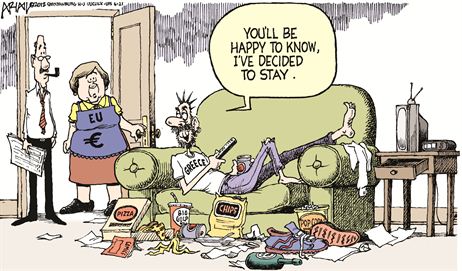
Funny cartoon from Dan Mitchell’s blog on Greece

Sometimes it is so crazy that you just have to laugh a little.

The self-inflicted economic crisis in Europe has generated some good humor, as you can see from these cartoons by Michael Ramirez and Chuck Asay.

But for pure laughter, I don’t think anything will ever match the hilarious “Europe According To…” maps that I posted last year.

That being said, this new cartoon by Robert Ariail ranks high on my list for European humor.

And if you need some more European-oriented laughs, I also recommend this photo-shopped image of “Merkozy” and this Hitler parody about the downgrade.

Open letter to President Obama (Part 94)

President Obama c/o The White House
1600 Pennsylvania Avenue NW
Washington, DC 20500

Dear Mr. President,

I know that you receive 20,000 letters a day and that you actually read 10 of them every day. I really do respect you for trying to get a pulse on what is going on out here.

In your earlier debate with Hillary Clinton during the 2008 primary you answered the question concerning the drop in the capital tax by Bill Clinton and the resulting increase in revenues by saying that you would still would raise the capital gains tax on the 100,000 million Americans that owned stock because of the issue of fairness. That is counterproductive.

The corporate tax in the USA is almost double the world average and it should be reduced. In fact, Canada reduced theirs dramatically and still brought in about the same revenue. Take a look at this fine article below from the Cato Institute:

Canada’s Corporate Tax Cuts

by Chris Edwards

Chris Edwards is the director of tax policy studies at the Cato Institute and the editor of Downsizing Government.org.

Added to cato.org on March 13, 2012

This article appeared in Daily Caller on March 13, 2012.

The President Obama and most members of Congress agree that the U.S. corporate tax rate should be cut. Thankfully, it is finally sinking in that having a 40 percent corporate tax rate when the world average is just 23 percent is suicide in a globalized economy.

The sticking point on slashing the corporate tax rate has been the fear that the federal government might lose revenues under such a reform. To prevent an expected revenue loss, policymakers have searched for tax loopholes to close in order to “pay for” a corporate rate cut. The problem is that members never find any loophole closings that they can agree on.

I’ve concluded that the effort to close corporate loopholes is a big waste of time. It is simply blocking desperately needed reforms to the tax rate. If I was drafting a corporate tax reform bill, I’d match a tax rate cut with federal spending cuts, but that idea hasn’t caught on either.

Chris Edwards is the director of tax policy studies at the Cato Institute and the editor of Downsizing Government.org.


More by Chris Edwards

The good news is that a corporate tax rate cut without any changes to the tax base probably wouldn’t lose the government any money over the long term. Good evidence comes from Canada’s corporate tax cuts of the 1980s and 2000s.

The chart shows Canada’s federal corporate tax revenues as a share of gross domestic product (GDP) and the federal corporate tax rate. The tax rate plunged from 38 percent in 1980 to just 15 percent by 2012. Amazingly, there has been no obvious drop in tax revenues over the period.

Canadian corporate tax revenues have fluctuated, but the changes are correlated with economic growth, not the tax rate. In the late 1980s, a tax rate cut was followed by three years of stable revenues. In the early 1990s, a plunge in revenues was caused by a recession, and then in the late 1990s revenues soared as the economy grew.

In 2000, Canadian policymakers enacted another round of corporate tax rate cuts, which were phased in gradually. Corporate tax revenues initially dipped, but then they rebounded strongly in the late 2000s.

The rate cuts enacted in 2000 were projected to cause substantial revenue losses to the Canadian government. That projection indicates that the reform didn’t have much in the way of legislated loophole closing. But the chart shows that the positive taxpayer response to the rate cut was apparently so large that the government did not lose much, if any, revenue at all.

In 2009, Canada was dragged into a recession by the elephant economy next door, and that knocked the wind out of corporate tax revenues. However, it is remarkable that even with a recession and a tax rate under 20 percent, tax revenues as a share of GDP have been roughly as high in recent years as they were during the 1980s, when there was a much higher rate. Jason Clemens of the Macdonald-Laurier Institute notes that Canadian corporate tax revenues have been correlated with corporate profits, not the tax rate.

If a corporate tax rate is high, there is a “Laffer effect” when the rate is cut, meaning that the tax base expands so much that the government doesn’t lose any money. Estimates from Jack Mintz and other tax experts show that cutting corporate tax rates when they are above about 25 percent won’t lose governments any revenues over the long run.

The overall Canadian rate this year is about 27 percent when the average provincial rate is included. By contrast, the average federal-state rate in the United States is 40 percent, which is roughly 15 points above the revenue-maximizing rate. That means that Congress can proceed with a corporate rate cut and everyone would win — taxpayers, the economy and even the government.

Corporate tax reform with loophole closing is a wild-goose chase. Congress never seems to agree on which loopholes to close, with the result that our economy continues to suffer under a super-high rate. If we matched Canada by cutting our federal corporate rate from 35 percent to 15 percent, it would generate a large increase in reported income as corporate investment boomed and tax avoidance fell. The tax base would automatically expand without Congress even legislating reductions to deductions, credits or other loopholes.

In 2012, Canada will collect about 1.9 percent of GDP in federal corporate income tax revenues with a 15 percent tax rate. The United States will collect about 1.6 percent of GDP with a 35 percent tax rate. Do we need any more evidence that our high corporate tax rate makes no sense?

____________

Thank you so much for your time. I know how valuable it is. I also appreciate the fine family that you have and your commitment as a father and a husband.

Sincerely,

Everette Hatcher III, 13900 Cottontail Lane, Alexander, AR 72002, ph 501-920-5733, lowcostsqueegees@yahoo.com

Open letter to President Obama (Part 92)

Government Spending Doesn’t Create Jobs

Uploaded by on Sep 7, 2011

Share this on Facebook: http://on.fb.me/qnjkn9 Tweet it: http://tiny.cc/o9v9t

In the debate of job creation and how best to pursue it as a policy goal, one point is forgotten: Government doesn’t create jobs. Government only diverts resources from one use to another, which doesn’t create new employment.

Video produced by Caleb Brown and Austin Bragg.

___________________________

President Obama c/o The White House
1600 Pennsylvania Avenue NW
Washington, DC 20500

Dear Mr. President,

I know that you receive 20,000 letters a day and that you actually read 10 of them every day. I really do respect you for trying to get a pulse on what is going on out here.

I don’t understand why people think that big government is the answer for everything when what the federal government should do is get out of the way. Cutting taxes and regulations would help us get out of the recession!!

Obama Has Tried All the Wrong Policies

by Daniel J. Mitchell (Also carried on his blog.)

Daniel J. Mitchell is a top expert on tax reform and supply-side tax policy at the Cato Institute.

Added to cato.org on March 13, 2012

This article appeared in U.S. News & World Report on March 13, 2012

The Minneapolis Federal Reserve Bank has a very useful interactive website that allows anybody to compare recessions and recoveries during the post-World War II era. It takes only a couple of clicks to complete the exercise, and does not reflect well on the current occupant of the White House—as you can see at this link.

This does not mean that Obama caused the economic downturn. That was the result of policies that were implemented during the Bush years (though the current president was a big supporter of the Fannie Mae and Freddie Mac subsidies that played such a big role in the financial crisis). Indeed, the recession officially began in December 2007, more than one year before Obama’s inauguration.

Taking money out of the economy’s productive sector and letting politicians engage in a spending spree is the opposite of prudent policy.

But we can hold the president at least partially responsible for an extraordinarily weak and slow recovery. It’s been nearly three years since the recession officially ended in June 2009, yet jobs are still well below their pre-recession levels. And overall economic output, or gross domestic product, has just now finally gotten back to where it was when the downturn began.

This is an anemic record. Especially since an economy normally enjoys a strong bounce when coming out of a deep recession.

Daniel J. Mitchell is a top expert on tax reform and supply-side tax policy at the Cato Institute.


More by Daniel J. Mitchell

The problem is that Obama has tried all the wrong policies. He tried a big-spending Keynesian package that was supposed to be a “stimulus,” butthat’s the same failed approach that Bush tried in 2008, the same failed approach that Japan tried in the 1990s, and the same failed approach that Hoover and Roosevelt tried in the 1930s. Taking money out of the economy’s productive sector and letting politicians engage in a spending spree is the opposite of prudent policy.

The president also has continuously expanded subsidies for unemployment, even though academic scholars (and even left-wing economists) all agree that such policies cause more joblessness.

And now he’s demanding higher tax rates, holding a Sword of Damocles over entrepreneurs, investors, and small business owners.

The nation recently endured eight years of a big-spending interventionist in the White House. The problem with Obama is that he promised hope and change, but he’s continuing the failed statist policies of his predecessor.

Thank you so much for your time. I know how valuable it is. I also appreciate the fine family that you have and your commitment as a father and a husband.

Sincerely,

Everette Hatcher III, 13900 Cottontail Lane, Alexander, AR 72002, ph 501-920-5733, lowcostsqueegees@yahoo.com

Julia is a moocher

People need to try to better their own lives instead of asking the government to treat them like kids for the rest of their lives.

The Obama campaign’s “Life of Julia” ad is a disturbing sign. It suggests that political strategists, pollsters, and campaign advisers must think that the people living off government are getting to the point where they can out-vote the people paying for government.

If that’s true, America is doomed to become another Greece – which would be an appropriate fate since, for all intents and purposes, Julia is the fictional twin of a real-life Greek woman who thought it was government’s job to give her things.

In general, I think the best response to Julia is mockery, which is why I shared this Iowahawk parody and this Ramirez cartoon.

But we also need a serious discussion of why dependency is a bad thing, which is why I’m glad the Center for Freedom and Prosperity has produced this new “Economics 101″ video.

It’s narrated by Emily O’Neill, who contrasts the moocher mentality of Julia with how she wants her life to develop. To give away the message, she wants the kind of fulfillment that only exists when you earn things.

Emily’s view could be considered Randian libertarianism, conventional conservatism, or both. That’s because there’s a common moral belief in both philosophies that government-imposed coercion and redistribution erode the social capital of a people.

This is perhaps the key issue for America’s future, which is why I hope you’ll share this video widely. Otherwise, we my face a future where this Chuck Asay cartoon becomes reality. Speaking of Asay, this cartoon is a pretty good summary of what the Julia ad is really saying.