Category Archives: Cato Institute

Has President Obama proven himself as a capable businessman? Why does he make it sound so easy?

Obama 7.13.2012: If you’ve got a business — you didn’t build that. Somebody else made that happen.

Published on Jul 15, 2012 by

Obama at campaign event in Roanoke VA 7.13.2012: “If you were successful, somebody along the line gave you some help. There was a great teacher somewhere in your life. Somebody helped to create this unbelievable American system that we have that allowed you to thrive. Somebody invested in roads and bridges. If you’ve got a business — you didn’t build that. Somebody else made that happen.”

__________________-

Has President Obama proven himself as a capable businessman? Why does he make it sound so easy? (Early I pointed out my favorite example of Fred Smith of Fed Ex.)

Mike Huckabee pointed out that those roads and bridges were built because of the taxes that many businesses paid and many successful individuals paid a large portion of that bill. The lower 50% of wage earners don’t even pay any income taxes.

Obama is just trying to set the stage for raising taxes on the job creators. Instead of being in his ivory tower for most of his life he needed to start a business on his own. He would know how the other side feels. Again Huckabee pointed out that one business leader told him that if the government is a partner with him then why when he is still working at midnight he is always alone?

Obama’s Elizabeth Warren Moment

Posted by Aaron Ross Powell

Our president’s channeling Elizabeth Warren. Speaking in Roanoke, Obama hit all her government’s-the-reason-we-have-nice things notes. “I’m going to reduce the deficit in a balanced way,” he said. “We’ve already made a trillion dollars’ worth of cuts. We can make another trillion or trillion-two, and what we then do is ask for the wealthy to pay a little bit more.”

Why should the wealthy–who already pay quite a lot, mind you–pay a little bit more?

[B]ecause [the wealthy] want to give something back. They know they didn’t–look, if you’ve been successful, you didn’t get there on your own. … I’m always struck by people who think, well, it must be because I was just so smart. There are a lot of smart people out there. It must be because I worked harder than everybody else. Let me tell you something–there are a whole bunch of hardworking people out there.

About this, Obama’s right. Lots of very smart people aren’t rich. (I’ll assume that’s what the president means by “successful” and roll with it, while remaining totally aware that there are myriad ways to define “success” that don’t involve accumulated wealth.) Lots of hardworking people aren’t rich, either. Which means getting rich, while often involving both smarts and hard work, depends on other things, too. Such as background, family, networks, opportunities, and just plain luck.

Back to Obama:

If you were successful, somebody along the line gave you some help. There was a great teacher somewhere in your life. Somebody helped to create this unbelievable American system that we have that allowed you to thrive.

Again, true. Every successful person in this county benefited from the help of someone. None of us are capable of getting far at all entirely on our own.

The confusion for Obama and his fellow progressives comes in locating that “someone.” Because for Obama, “someone” isn’t friends, family, colleagues. It’s government.

The point is, is that when we succeed, we succeed because of our individual initiative, but also because we do things together. There are some things, just like fighting fires, we don’t do on our own. I mean, imagine if everybody had their own fire service. That would be a hard way to organize fighting fires.

At some fundamental level, Obama simply doesn’t understand that “we” are not the state. For him, acting together simply is the same thing as legislating, regulating, and taxing. That’s why he can say with a straight face such inanities as his fire service line above. He appears unable to comprehend voluntary, cooperative, non-governmental coordination. The government doesn’t run bookstores, but we don’t each have our own Barnes & Noble or Amazon.com.

And while he’s right that there are some things we probably can’t do without government (or, at least, can’t do as efficiently without government), that class of activities is vanishingly small when compared to all the things Obama wants government to do–and wants you and me to pay for.

The argument against paying more taxes or creating more federal programs is not that we all should keep our money even if it means accomplishing nothing and having no nice things. Rather it’s that if we kept our money and had fewer federal programs, we’d accomplish more and have more nice things. Without the state stifling innovation, hindering entrepreneurs, wasting resources, and crowding out private action, we would get even more done together.

Of course, this doesn’t mean we haven’t each gained something from Obama’s welfare/warfare state. But the fact that we have doesn’t do much to support the president’s call for higher taxes. After all, even an abusive parent can give birthday presents.

There’s a certain class of argument that sounds utterly convincing to those already convinced–and entirely preposterous to those not. Obama’s remarks exemplify it. In order for his argument to get off the ground, Obama has to assume the truth of his conclusions. He asks us to believe that it is only through government that good things happen. He asks to us accept that we’d be helpless without Washington’s officiousness.

Obama wants us to think that we, as free citizens striving to better our own lives and our world, are incapable of the task.

The president hasn’t made an argument so much as he’s demonstrated a failure of the imagination–and a lack of faith in the American people.
Response to John Brummett’s idea of letting the federal government take over our healthcare in Arkansas: Laughter!!!

Third-Party Payer is the Biggest Economic Problem With America’s Health Care System

Published on Jul 10, 2012 by

This mini-documentary from the Center for Freedom and Prosperity Foundation explains that “third-party payer” is the main problem with America’s health care system. This is why undoing Obamacare, while desirable, is just a small first step if we want to reduce costs and boost efficiency

__________

John Brummett in his article “Bad state of mind,” Arkansas Democrat Gazette, July 17, 2012 asserted:

It is self-serving and exciting for us to take three years of full federal funding, and 90 percent federal funding after that, to put a quarter-million more of our desperately poor people on Medicaid.

Brummett disagreed with State Senator Jason Raport that we should not choose to expand Medicaid (as part of Obamacare) and he also takes exception to State Representative Charlie Collins’ view that we should cut the state income tax income tax in order to cause economic growth.

Evidently Brummett thinks that the badly flawed Mechicaid system would withstand the expansion and the government will take care of all of our problems. How good is the government doing with running the post office? How good is the federal government doing at running the Washington D.C. school system? Do the feds even know how to implement Obamacare? To me this is just laughable and that is why I wanted to offer a little humor below:

Cartoons about the Supreme Court’s Obamacare Decision: Laughing in the Face of Tragedy

June 29, 2012 by Dan Mitchell

I’ve already thrown in my two cents on yesterday’s disappointing decision, and I was planning on ignoring the issue for a few days because I’m so irked by the result.

But they say laughter is an effective part of grief therapy, so let’s take some solace in these cartoons.

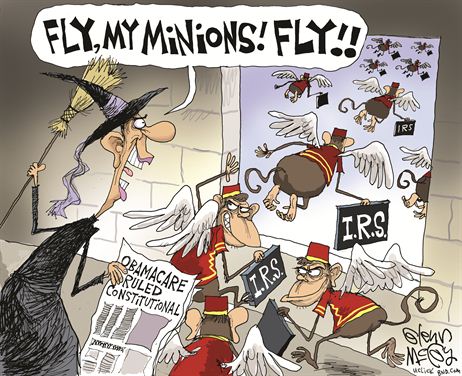
This first one is about the very serious issue of increased authority and power for the IRS.

Technically, the Supreme Court decision didn’t give the IRS any more power than it already had been given under the legislation, but the cartoon isn’t claiming otherwise, so it gets points for being accurate and (tragically) amusing.

By the way, here’s a cartoon making a similar point from back in 2010 when Obamcare was being debated.

Next we have a cartoon about Chief Justice Roberts and his new BFF status with Obama. I almost didn’t include it because Roberts deserves nothing but scorn, but I don’t want my feelings to interfere.

Speaking of Roberts, this next cartoon is accurate in many ways.

It’s designed to blame Bush for appointing a Justice who would put establishment approval before fealty to the Constitution, but I think it’s also true because Obama might not have won – and the Democrats certainly wouldn’t have picked up so many seats in the House and Senate – if Bush had not imposed so much statist legislation and weakened the economy, thus paving the way for big Democrat victories in 2006 and 2008.

And here’s a cartoon making the obvious point that Obama prevaricated.

I’ve saved my favorite for last, showing how the Supreme Court botched its responsibility.

But even though it’s my favorite of the five cartoons, I would make a change (just like I suggested alterations to a very good Chuck Asay cartoon back in April).

In this case, I also would amend this gem by replacing “economy” with “Constitution.”

I hope all these cartoons make you feel a bit better. If not, you can look at some R-rated Obamacare humor here, here, and here. And, just for the heck of it, here’s a PG-rated Obamacare joke to end on a more subdued note.

Open letter to President Obama (Part 116)

It’s Simple to Balance The Budget Without Higher Taxes

Uploaded by on Oct 4, 2010

Politicians and interest groups claim higher taxes are necessary because it would be impossible to cut spending by enough to get rid of red ink. This Center for Freedom and Prosperity video shows that these assertions are nonsense. The budget can be balanced very quickly by simply limiting the annual growth of federal spending.

____________________

President Obama c/o The White House
1600 Pennsylvania Avenue NW
Washington, DC 20500

Dear Mr. President,

I know that you receive 20,000 letters a day and that you actually read 10 of them every day. I really do respect you for trying to get a pulse on what is going on out here. 

People are being told that radical spending cuts are a must if we are to balance the budget, but maybe that is not true. Why don’t you favor holding the line on spending so we can get to a balanced budget? The Republicans are going to beat you up on this issue during the election.

Even though I favor radical reductions in the burden of government, I’ve made the point that good fiscal policy merely requires that government spending grow slower than the private sector – what I call Mitchell’s Golden Rule.

And if lawmakers simply cap the growth of spending, so that it grows by about 2 percent annually, the budget deficit disappears in a decade.

It’s even better to impose more restraint, of course, which is why I’ve said favorable things about Senator Rand Paul’s plan.

There’s also a “Penny Plan” that would reduce primary spending (non-interest spending) by 1 percent each year. As James Carter and Jason Fichtner explain, this degree of fiscal restraint would reduce the burden of government spending to about 18 percent of economic output.

Any viable solution must cut spending growth. Sen. Mike Enzi of Wyoming and Rep. Connie Mack of Florida have introduced legislation in their respective chambers to do just that. Their “Penny Plan” – recently updated to reflect the latest budget developments – calls for reducing federal spending (excluding interest payments) 1 percent a year for five years, balancing the budget in the fifth year. To maintain balance once it’s reached, Mr. Enzi and Mr. Mack would cap federal spending at 18 percent of GDP. By no small coincidence, 18 percent of GDP roughly matches the U.S. long-run average level of taxation since World War II. Is it realistic to think Congress could limit federal spending to 18 percent of GDP? Actually, there is precedent. Federal spending fell as a share of GDP for nine consecutive years before bottoming out at 18.2 percent of GDP in fiscal 2000 and 2001. The Penny Plan would return federal spending, expressed as a share of GDP, near the level achieved during the last two years of the Clinton administration.

The various interest groups that infest Washington would complain about this degree of spending discipline, but Carter and Fichtner make a good point when they say that this simply means the same size government – as a share of GDP – that we had when Bill Clinton left office.

I realize I’m getting old and my memory may not be what it used to be, but I don’t recall people starving in the streets and grannies being ejected from hospitals during the Clinton years. Am I missing something?

__________________

Thank you so much for your time. I know how valuable it is. I also appreciate the fine family that you have and your commitment as a father and a husband.

Sincerely,

Everette Hatcher III, 13900 Cottontail Lane, Alexander, AR 72002, ph 501-920-5733, lowcostsqueegees@yahoo.com

Is it class warfare? Brummett says no, I say yes

Take a look above at this clip.

In his article “Class Warfare versus Pay it forward,” Sept 26, 2011, Arkansas News Bureau, John Brummett tries to make the case that Obama is not involved in class warefare. He quotes Elizabeth Warren to prove his point.

Unfortunately, logically this argument fails because although we all benefit from roads, police, fire departments and education, it is not clear that the rich benefit from all the social welfare programs that Warren wants to keep running. Also how does the rich benefit from Social Security?

Elizabeth Warren, Fair Play, and Soaking the Rich

Posted by Aaron Ross Powell

Elizabeth Warren’s recent remarks on class warfare, made during a campaign stop in her quest for a Massachusetts U.S. Senate seat, provide a nice microcosm of the broader philosophical views behind much contemporary political debate.

The relevant bit that has her supporters so fired up goes like this:

I hear all this, oh this is class warfare, no! There is nobody in this country who got rich on his own. Nobody. You built a factory out there–good for you.

But I want to be clear. You moved your goods to market on the roads the rest of us paid for. You hired workers the rest of us paid to educate. You were safe in your factory because of police forces and fire forces that the rest of us paid for. You didn’t have to worry that marauding bands would come and seize everything at your factory.

Now look. You built a factory and it turned into something terrific or a great idea–God Bless! Keep a Big Hunk of it. But part of the underlying social contract is you take a hunk of that and pay forward for the next kid who comes along.

Fully exploring the thinking behind Warren’s remarks would demand a book at least. We might point out that most of the rich got that way by creating value for others, meaning they gave back in the process of getting rich. Or we might wonder if her thinking implies that, because the state is responsible in part for the environment in which all of us earned what we have, the state is the actual owner of what we have.

To spare you having to read that book, however, I’m going to instead address just two points I find particularly interesting. First, we can tease out the theory of political obligation Warren advances and see if it holds up to scrutiny. Second, we can ask whether her argument, even if we accept it on its own terms, supports a tax increase on high income earners.

In a 1955 essay, H. L. A. Hart articulated what’s come to be known as the “fair play” principle of political obligation.

When a number of persons conduct any joint enterprise according to rules and thus restrict their liberty, those who have submitted to those restrictions when required have a right to a similar submission from those who have benefited by their submission.

Framed in Warren’s language, “the rest of us” restricted our liberty by paying taxes for the creation of roads, the formation of police forces, the funding of fire departments, and so on. And the rich benefited from our submission to taxes by getting rich (in part) because of the existence of roads, police, and fire departments. Therefore, we have a right to a similar submission from the rich in the form of them paying an increased amount in taxes to fund roads, police, and fire departments, too.

So by her account, this can’t be class warfare because it’s a simple matter of obligation. But is that true? Does the so-called “fair play” account of political obligation work?

Not really. Robert Nozick famously knocked it down in Anarchy, State, and Utopia with a thought experiment about a neighborhood public address system. And A. John Simmons went even further—and did so more persuasively—in his 1979 classic, Moral Principles and Political Obligations.

But the basic response to “fair play” is pretty simple: It seems awfully weird to demand that we repay benefits we never had a choice about accepting in the first place.

Nobody approached the rich before they were rich and said, “Hey, we’re all pitching in to pay for roads and police, which we all think are pretty valuable. If you’d like to benefit from those things like we would, we ask that you pay for them. Are you up for that?” A (pre-)rich person might very well say, “Yes, I’m game.” In that case the principle of fair play would apply. But it would only apply if he had a meaningful choice about the matter. On the other hand, he might say, “Yes, I think we do need roads and police, but I also think they’d be better provided by an alternative cooperative scheme (the market, a different government, a different voluntary group, etc.) to the one you’re offering.”

Simmons calls this the distinction between “receiving” benefits and “accepting” them. The fair play principle creates obligations when benefits are accepted, but not when merely received.

With that in mind, Warren would have a difficult time arguing that any of us genuinely accepted the particular roads and police provided by the particular scheme she supports. We’ve received them, yes, and may rather like what we received—but we were never presented with an actual choice.

There may, of course, be plenty of other good reasons to feel obligated to pay our taxes—or to even pay more taxes than our neighbors—but fair play, at least in the form Warren presents it, doesn’t quite get us there.

Still, let’s set such concerns aside and grant to Warren that, if the rich did benefit from the particular services paid for by the rest of us, they have a duty to pay (more) for them. Would that allow us to justify asking the rich to pay more taxes today?

Again, probably not. Just look at the beneficial services Warren draws our attention to.

  1. Roads
  2. Police
  3. Fire departments
  4. Education

She tacks an “and so on” to the list, but there’s something striking about the concrete examples she does give. Namely, they’re all the kinds of things you’d expect even from a much smaller state than the one we have today.

In other words, the need to raise taxes at the present moment (if such a need exists) is precisely not to pay for roads, police, fire departments, and education. We had those—and they were functioning quite nicely—for a good while before the explosion of federal spending under the last two administrations.

If Warren’s claim is that the rich got rich because of certain benefits they received from government and so should pay more to provide those benefits to others, then the overwhelming bulk of government spending is completely outside the scope of her argument.

It’s not obvious that many rich people got to be rich because of Medicare, Medicaid, Social Security, or military expenses. (Those who got rich because of subsidies are another matter, but she doesn’t draw that distinction, nor is she calling for an end to government handouts to the wealthy and politically connected.) But those are where we’ve seen so much of the spending increases that now demand, according to Warren and her peers, that all of us pony up more cash to the federal government.

This means that an easy response to Warren is to grant her general philosophical point but then add that what it leads to is not increased taxes but cutting government back to those programs that do make people rich and only then worry about how much of what remains the rich should pay for.

Of course we might also point out that, even with the bloated leviathan we have in Washington—one that does far more than provide roads, police, fire departments, and schools (which are, after all, chiefly state and local matters)—the rich still pay for most of it. Certainly more than “the rest of us” pay. As the Wall Street Journal pointed out back in May, “the highest-earning 10% of the U.S. population paid the largest share among 24 countries examined, even after adjusting for their relatively higher incomes.” The top 20% of American income earners pay over half the federal taxes. Which means that “the next kid who comes along” already is getting his federal benefits from the rich. To Warren and her supporters, I ask, “How much is enough?”

If Warren’s moral case for increasing the tax burden of the rich doesn’t hold up, can she still maintain her claim that this isn’t class warfare? Probably not. By her arguments, the rich are not obligated to pay more than they already are. Nor will their paying more do much of anything to ameliorate America’s fiscal woes. That means it’s rather difficult to see her speech as anything but a ploy to fire up her base by attacking a disfavored minority.

If that’s not class warfare, I don’t know what is.

Update: I just finished a podcast on the subject of this post with Caleb Brown.

Open letter to President Obama (Part 113)

President Obama c/o The White House
1600 Pennsylvania Avenue NW
Washington, DC 20500

Dear Mr. President,

I know that you receive 20,000 letters a day and that you actually read 10 of them every day. I really do respect you for trying to get a pulse on what is going on out here.

I really don’t think that socialism works in the real world because it destroys the motivation to work hard. How you respond to these facts below?

Another great article from Dan Mitchell (an updated version is also posted).

I posted a video making this point earlier in the year, and I also posted a version of this joke back in 2010, but here’s another version that’s worth sharing because of the five lessons to be learned at the conclusion.

=================================

An economics professor at a local college made a statement that he had never failed a single student before, but had recently failed an entire class. That class had insisted that Obama’s socialism worked and that no one would be poor and no one would be rich, a great equalizer.

The professor then said, “OK, we will have an experiment in this class on Obama’s plan”. All grades will be averaged and everyone will receive the same grade so no one will fail and no one will receive an A…. (substituting grades for dollars – something closer to home and more readily understood by all).

After the first test, the grades were averaged and everyone got a B. The students who studied hard were upset and the students who studied little were happy. As the second test rolled around, the students who studied little had studied even less and the ones who studied hard decided they wanted a free ride too so they studied little.

The second test average was a D! No one was happy.

When the 3rd test rolled around, the average was an F.

As the tests proceeded, the scores never increased as bickering, blame and name-calling all resulted in hard feelings and no one would study for the benefit of anyone else.

To their great surprise, ALL FAILED and the professor told them that socialism would also ultimately fail because when the reward is great, the effort to succeed is great, but when government takes all the reward away, no one will try or want to succeed.
It could not be any simpler than that.

There are five morals to this story:

1. You cannot legislate the poor into prosperity by legislating the wealthy out of prosperity.

2. What one person receives without working for, another person must work for without receiving.

3. The government cannot give to anybody anything that the government does not first take from somebody else.

4. You cannot multiply wealth by dividing it!

5. When half of the people get the idea that they do not have to work because the other half is going to take care of them, and when the other half gets the idea that it does no good to work because somebody else is going to get what they work for, that is the beginning of the end of any nation.

=================================

I’ll make one final point. There are five morals to the story, but there are dozens of nations giving us real-world examples every day.

Sort of makes you wonder why some people still believe this nonsense?

__________________

Thank you so much for your time. I know how valuable it is. I also appreciate the fine family that you have and your commitment as a father and a husband.

Sincerely,

Everette Hatcher III, 13900 Cottontail Lane, Alexander, AR 72002, ph 501-920-5733, lowcostsqueegees@yahoo.com

Rick Crawford again makes conservatives mad

Earlier I posted about Rick Crawford’s mistake where he said he agree to tax increases if the Democrats tried to balance the budget. Now he has allowed a bloated bill that includes Food Stamps to get out of committee and it has angered the conservative Cato Institute.

GOP Freshmen Vote to Move Farm Bill Out of Committee

Posted by Tad DeHaven

In the latest example of the so-called “Tea Party Class” of House Republicans not living up to the hype, GOP freshmen on the House Agriculture Committee voted overwhelmingly to approve a bloated $957 billion farm subsidy/welfare bill.

The overall vote was 35-11. Only 4 Republicans voted against it – the rest appear to be Democrats who weren’t happy that the bill doesn’t spend more money on food stamps. Republican freshmen occupy 16 of the 25 GOP seats on the committee. Only 3 out of the 16 voted against the bill.

  • Bob Gibbs (Ohio)
  • Tim Huelskamp (Kansas)
  • Marlin Stutzman (Indiana)

Here are the names of the 13 GOP freshmen who supported it:

  • Austin Scott (Georgia)
  • Scott Tipton (Colorado)
  • Steve Southerland (Florida)
  • Rick Crawford (Arkansas)
  • Martha Roby (Alabama)
  • Scott DeJarlais (Tennessee)
  • Renee Ellmers (North Carolina)
  • Chris Gibson (New York)
  • Randy Hultgren (Illinois)
  • Vicky Hartzler (MO)
  • Robert Schilling (Illinois)
  • Reid Ribble (Wisconsin)
  • Kristi Noem (South Dakota)

The question now is whether the House Republican leadership will allow the bill to come to the floor. According to the Washington Post, Speaker Boehner hasn’t decided:

Agriculture Chairman Frank Lucas, R-Okla., feels the committee did “an awful lot of good work,” Boehner said at a weekly news conference. But “no decisions about it coming to the floor at this point,” Boehner said…“There are some good reforms in this bill. There are other parts of the farm bill that I have concerns with,” Boehner said. He referred to what he said was “a Soviet-style dairy program in America today and one of the proposals in this farm bill would actually make it worse.”

Boehner has voted against farm bills in the past so he’s probably not eager to get this one to the floor, especially since advocates for free markets and limited government rightly consider the bill to be a disaster. But Boehner helped create this dilemma for himself when his Steering Committee gave Frank Lucas the chairman’s gavel after the 2010 elections. As Chris Edwards and I noted in a recent op-ed, Lucas is a big supporter of farm subsidies and takes pride in having been named a “Wheat Champion” by the National Association of Wheat Growers.

Back in December 2010, I wrote that “An indicator of the incoming House Republican majority’s seriousness about cutting spending will be which members the party selects to head the various committees.” Lucas’s chairmanship indicated that when it comes to bloated farm bills, the House leadership wasn’t serious. If this bill is allowed to reach the floor, any doubts will have been erased.

Russ Vought of the Red State Blog noted:

The fundamental problem with incrementalism is that you can never win the argument, because you never set out to have a debate on principle.

Instead, the debate is always about making some federal program run a little better or cost a little less. It is never about the underlying benefit or activity being fundamentally inconsistent with a limited government or the Constitution. No matter how common sense the reform, the Left immediately demonizes the effort as a “cut,” either scaring the reformers to the sidelines or sparking the same ideological firefight that the reformers were trying to avoid. The reformers get caught unprepared to argue on principle, and the proposed reform itself then proves to be well south of the herculean political effort needed to get it signed into law.

Consider the “farm” bill just passed out of the House Agriculture Committee.

Its $957 billion over ten years. The last farm bill in 2008 was $604 billion over ten years—a 63% increase. 80% of the bill is now food stamp funding. This is because there are now 46 million individuals on food stamps, compared with 17 million in 2000 and 30 million in 2008 respectively. 1 out of every 7 Americans are on food stamps. Chairman Frank Lucas is proposing to tweak the program to save just $16 billion or 2%. The Left is predictably freaking out. The Center on Budget and Policy Priorities claims that the, “Lucas-Peterson proposed farm bill would throw 2 to 3 million people off” food stamps. Assistant Democrat Leader James Clyburn is calling the reforms “an abomination.” This freakout will inevitably result in some compromise that is even more worthless.

This is not the approach that you would take if you were, say, trying to drastically roll back the welfare state. You would take a much harder line. You would break up the food stamp portion from the commodity portion. You would go back to pre-Obama or pre-Bush levels and block grant the program (surely the nation can exist on the same food stamp levels enjoyed by the Clinton Administration, no?). You would be proposing a work requirement for the food stamp program. You might bring back the paper stamps and discontinue the EBT system. In other words, you would force a real debate about food stamps and dependency in America—about what we can afford given our fiscal situation and how to get people off of welfare for their and our benefit.

Despite

Related posts:

Republicans for more food stamps?

Eight Reasons Why Big Government Hurts Economic Growth __________________ We got to cut spending and we must first start with food stamp program and we need some Senators that are willing to make the tough cuts. Food Stamp Republicans Posted by Chris Edwards Newt Gingrich had fun calling President Obama the “food stamp president,” but […]

Obama promotes food stamps but Milton Friedman had a better suggestion

Milton Friedman’s negative income tax explained by Friedman in 1968: We need to cut back on the Food Stamp program and not try to increase it. What really upsets me is that when the government gets involved in welfare there is a welfare trap created for those who become dependent on the program. Once they […]

More Than Half of the President’s Budget Would Be Spent on Entitlement Programs

More Than Half of the President’s Budget Would Be Spent on Entitlement Programs Everyone wants to know more about the budget and here is some key information with a chart from the Heritage Foundation and a video from the Cato Institute. In combination with other entitlements, such as food stamps, unemployment, and housing assistance,Medicare, Medicaid, and Social Security constitute the lion’s share […]

Federal spending continues to skyrocket

Government Spending Doesn’t Create Jobs Uploaded by catoinstitutevideo on Sep 7, 2011 Share this on Facebook: http://on.fb.me/qnjkn9 Tweet it: http://tiny.cc/o9v9t In the debate of job creation and how best to pursue it as a policy goal, one point is forgotten: Government doesn’t create jobs. Government only diverts resources from one use to another, which doesn’t […]

Open letter to President Obama (Part 87)

Uploaded by oversightandreform on Mar 6, 2012 Learn More at http://oversight.house.gov The Oversight Committee is examining reports of food stamp merchants previously disqualified who continue to defraud the program. According to a Scripps Howard News Service report, food stamp fraud costs taxpayers hundreds of millions every year. Watch the Oversight hearing live tomorrow at 930 […]

Obama brags of progress in USA on economy to G-8 audience

1,000 Days Without A Budget Uploaded by HeritageFoundation on Jan 24, 2012 http://blog.heritage.org | Today marks the 1,000th day since the United States Senate has passed a budget. While the House has put forth (and passed) its own budget, the Senate has failed to do the same. To help illustrate how extraordinary this failure has […]

Spending more money on welfare is not the answer

We have spent over 19 trillion on welfare since LBJ started the war on poverty and it has only brought us several generations who are dependent on the government. Welfare: Tackling the Fastest-Growing Part of Government Spending Rachel Sheffield April 20, 2012 at 2:45 pm Multiple reports of welfare abuse have hit the headlines in […]

A handout is not what the poor needs

Welfare Can And Must Be Reformed Uploaded by HeritageFoundation on Jun 29, 2010 If America does not get welfare reform under control, it will bankrupt America. But the Heritage Foundation’s Robert Rector has a five-step plan to reform welfare while protecting our most vulnerable. ______________ I don’t understand why liberals do not see that they […]

Overspending Obama style

This excessive spending by Washington today is not responsible government in action. Obama’s Comments: A Gift that Keeps on Giving Posted by Roger Pilon Today POLITICO Arena asks: Does Senator Grassley’s tweet, that the American people “r not stupid as this x prof of con law,” make an important point or was it disrespectful? Is this […]

400% increase in food stamps since 2000

Welfare Can And Must Be Reformed Uploaded by HeritageFoundation on Jun 29, 2010 If America does not get welfare reform under control, it will bankrupt America. But the Heritage Foundation’s Robert Rector has a five-step plan to reform welfare while protecting our most vulnerable. __________________________ If welfare increases as much as it has in the […]

Open letter to President Obama (Part 110)

The Rahn Curve and the Growth-Maximizing Level of Government

Uploaded by on Jun 29, 2010

Government spending can promote economic growth if money is used for core “public goods” such as rule of law and property rights. But the burden of government spending in the United States and other industrialized nations is far higher than needed to finance such activities. Citing scholarly studies, this CF&P Foundation video examines the Rahn Curve, which graphically illustrates the negative impact of excessive government spending. www.freedomandprosperity.org

___________

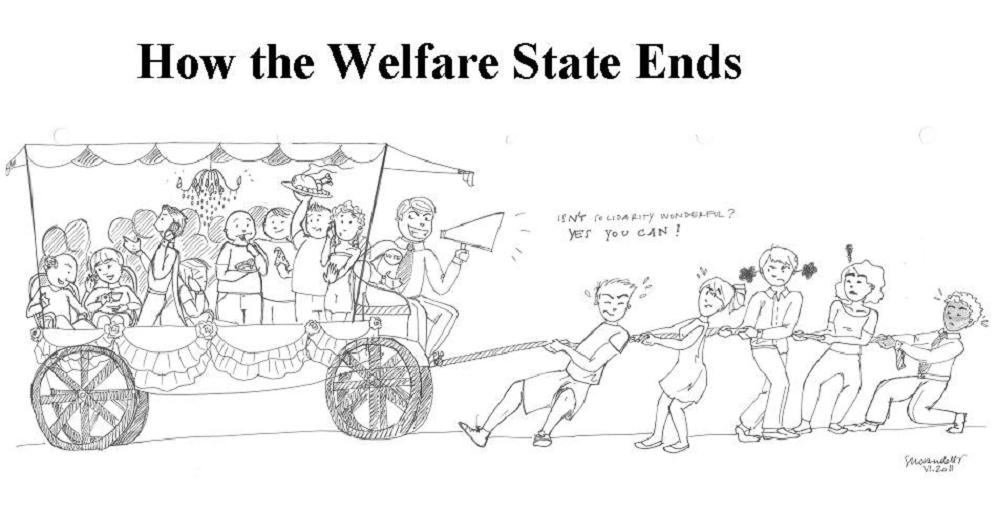
These images are remarkably accurate. The welfare state starts with small programs targeted at a handful of genuinely needy people. But as  politicians figure out the electoral benefits of expanding programs and people figure out the that they can let others work on their behalf, the ratio of producers to consumers begins to worsen.

_________

President Obama c/o The White House
1600 Pennsylvania Avenue NW
Washington, DC 20500

Dear Mr. President,

I know that you receive 20,000 letters a day and that you actually read 10 of them every day. I really do respect you for trying to get a pulse on what is going on out here.

When the government gets so big that it distorts the behavior of the private market then it is too big. The federal government is  now spending 24.8% of GDP and traditionally for the first 150 years of our nation’s history we spent under 5% unless in wartime. This massive spending now by the federal encourages people to lie in order to get money for the government too instead of trying to work hard to earn money in the private market.

Why is big government bad for an economy? The easy answer is that big government usually means high tax rates, and this penalizes work, saving, investment, and entrepreneurship. And perhaps some of the spending is financed by borrowing, and this diverts money from private investment.

That’s a correct answer, but it’s only part of the story. In most cases, there is added damage because politicians spend money in ways that further undermine incentives to produce.

For instance, let’s assume a government spends $1 billion on some sort of redistribution program. Extracting that money from the productive sector of the economy obviously will cause some damage, but it’s also important to estimate how the supposed beneficiaries of the money will react. What if they decide to earn less income in order to be eligible for the handouts, as even the statists at the OECD have recognized?

In other words, it hurts the economy when government collects money, and it often hurts the economy when government spends money. Sort of a perverse 2-for-1 special (though “Rahn Curve” analysis does show that some types of spending – on core public goods – is correlated with better economic performance)

Let’s look at an example from Greece, showing how handouts distort behavior and corrupt people. Here are some remarkable tidbits from a Wall Street Journal story.

The Greek health ministry is investigating on Zakynthos after local officials flagged records showing what they said is an implausibly high number of disability claims for blindness. About 1.8% of the island’s population of 39,000 claimed the benefit last year, according to the health ministry. That is around nine times the prevalence of blindness estimated for many European countries in a 2004 study published in a World Health Organization journal. Among those who put in for the blindness benefit on Zakynthos, a local official said, were a taxi driver and a bird hunter. …But the island is hardly alone, according to health ministry officials, who say fraudulent disability claims are a problem across the nation… Zakynthos Mayor Stelios Bozikis on a Greek television talk show said residents angry about the benefits crackdown and other financial overhauls pelted him with yogurt at a recent event.

Before sneering at the Greeks, keep in mind that “disability” claims also are rising in the United States, which is rather remarkable since jobs have become less arduous over time. Heck, the Social Security Administration decided to give disability payments to a grown man who gets his jollies by wearing diapers.

I’m not sure if that’s better or worse than the Greek government deciding to reward pedophiles with disability payments, but taxpayers are getting screwed in both examples.

Let’s go back to the story and look at a rough estimate of how much fraud exists.

In an attempt to root out fraud, the Greek health ministry recently required disability claimants nationwide to register in a centralized database, appearing in person or sending a representative. The registration resulted in 36,000 fewer disability claims than in 2011, the health ministry said. The ministry alleges these dropped claims were fraudulent, in many cases reflecting multiple claims for the same disability or payments in the name of dead beneficiaries. It also alleges that some doctors accepted money for false diagnoses and some local politicians signed off on the benefits to win support, and said it is giving public prosecutors information about areas where it suspects a high level of fraud. Only 190 of the nearly 700 people it says had been collecting the blindness benefit on Zakynthos participated in the registration, the ministry said.

I have no idea if Zakynthos is representative, but that’s an incredibly high fraud rate. And this is just a glimpse at the workings of one government program. Now multiply that by some large number and you’ll begin to understand the damage caused by government.

And America is not immune. When politicians make it easier to ride in the wagon than to pull the wagon (as this cartoon illustrates), society sooner or later gets in trouble.

____________

Thank you so much for your time. I know how valuable it is. I also appreciate the fine family that you have and your commitment as a father and a husband.

Sincerely,

Everette Hatcher III, 13900 Cottontail Lane, Alexander, AR 72002, ph 501-920-5733, lowcostsqueegees@yahoo.com

Jeb Bush and Lindsey Graham join small naive group of Republicans that want to raise taxes

Below is a speech by George W. Bush honoring Milton Friedman:

Milton Friedman Honored for Lifetime Achievements 2002/5/9

Milton Friedman said that getting George Bush I to be his vice president was his biggest mistake because he knew that Bush was not a true conservative and sure enough George Bush did raise taxes when he later became President. I wonder if Jeb Bush has the same genes as his father.

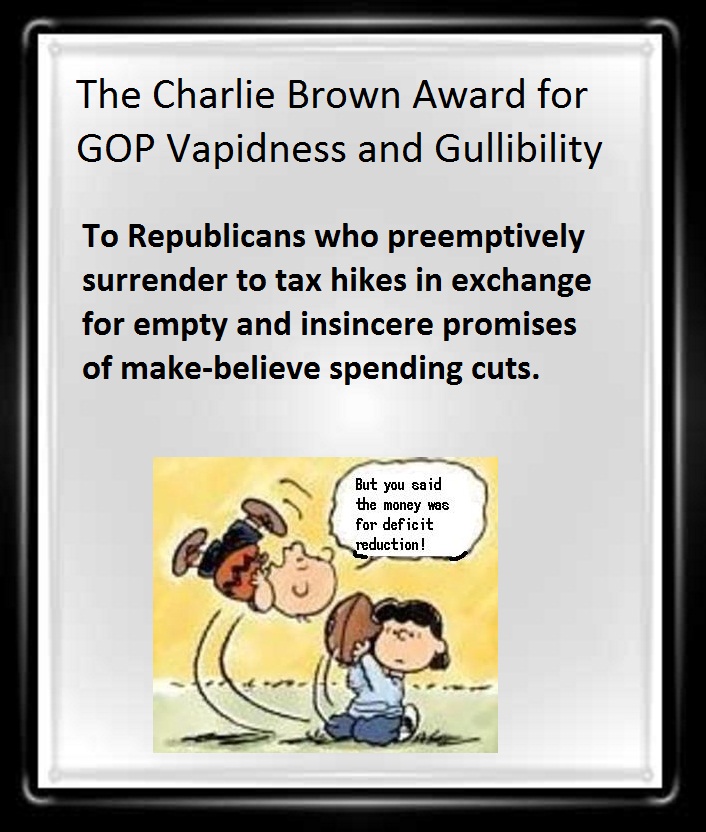
What we need is some people in Washington that are brave enough to say that we have taken too much of the american people’s money and we have to make the painful spending cuts in order to balance the budget and not ask for any more tax increases!!!! Arkansas’ congressman Rick Crawford has also made the Charlie Brown mistake.

Even though America’s fiscal problem is entirely the result of too much government spending, I wrote earlier this year that there were all sorts of scenarios where I would agree to a tax increase.

But I then pointed out that all of those scenarios were total fantasies and that it would be more realistic to envision me playing center field for the New York Yankees.

The fundamental problem is that politicians never follow through on promises to reduce spending – even if you use the dishonest Washington definition that a spending cut occurs whenever the budget doesn’t rise as fast as previously planned.

And to make matters worse, they always seem to want class-warfare tax hikes that do heavy economic damage rather than the loophole closers that at least get rid of some of the inefficient corruption in the tax code.

That’s why I like the anti-tax pledge of Americans for Tax Reform. You don’t solve America’s fiscal problems by saying no to all tax increases, but at least you don’t move in the wrong direction at a faster rate.

Notwithstanding the principled and pragmatic arguments against putting tax increases on the table, some Republicans – in a triumph of hope over experience – are preemptively acquiescing to tax hikes.

Here’s what Jeb Bush said.

Jeb Bush, the former Florida governor, said Friday that he could back a broad deficit plan that increased taxes, a stance that puts him at odds with other prominent Republicans. Bush told a House panel he could get behind a plan that combined 10 dollars in spending cuts for every dollar of new revenue… “The problem is the 10 never materializes,” [Congressman Paul] Ryan said after Bush said he could support a revenue-increasing deficit deal. Norquist also has criticized deficit deals crafted in 1982 and 1990 – the latter agreed to by then-President George H.W. Bush, Jeb’s father – for failing to deliver on the spending side.

Kudos to Paul Ryan for making the obvious point about make-believe spending cuts. And Grover is correct about the failure of previous budget deals.

Indeed, I cited a New York Times column that inadvertently revealed that the only budget deal that worked was the 1997 pact that cut taxes rather than raised them.

Jeb Bush isn’t the only apostate. Here’s what Senator Graham had to say.

Sen. Lindsey Graham (R-S.C.) said Tuesday he believed Republicans should consider eliminating loopholes in the tax code even if they aren’t replaced by additional tax cuts, a move that would break with an anti-tax pledge many GOP lawmakers have signed with activist Grover Norquist. “When you eliminate a deduction, it’s OK with me to use some of that money to get us out of debt. That’s where I disagree with the pledge,” Graham told ABC News. …”I’m willing to move my party, or try to, on the tax issue. I need someone on the Democratic side being willing to move their party on structural changes to entitlements.” Graham said, for instance, he would support a plan that included $4 in spending cuts for every $1 in tax increases. During a Republican debate last August, all eight Republican candidates in attendance said they would reject a proposal to trade $10 in spending cuts for even $1 in tax increases.

In some sense, Senator Graham’s comments are reasonable. With real spending cuts and less-damaging forms of tax hikes, an acceptable deal is possible. But only in Fantasia, not in Washington.

In the real world, all that Senator Graham has done is to move the debate slightly to the left.

I’ve noted that tax increases are political poison for the Republican Party, but I don’t lose sleep worrying about the GOP.

But I do have nightmares about government getting even bigger, and that’s why I don’t want tax increases on the table. I don’t even want them in the room. Or the house. Or the neighborhood.

That’s why Jeb Bush and Lindsey Graham are the newest winners of the Charlie Brown Award. They’ve put blood in the water. I wonder if they’ll act surprised when hungry sharks show up looking for a meal?

Open letter to President Obama (Part 108)

The Economic Case for Tax Havens

Uploaded by on Sep 10, 2008

Statist politicians and international bureaucracies such as the OECD and UN routinely attack tax havens, claiming that they lead to “harmful tax competition.” Yet at no point do critics bother to provide any evidence for this claim. This mini-documentary from the Center for Freedom and Prosperity looks at the empirical data and scholarly research and reports that tax havens actually have a very positive impact on the global economy.

______________

President Obama c/o The White House
1600 Pennsylvania Avenue NW
Washington, DC 20500

Dear Mr. President,

I know that you receive 20,000 letters a day and that you actually read 10 of them every day. I really do respect you for trying to get a pulse on what is going on out here.

The size of government needs to be reduced. Eventually people will revolt against the tremendous amount of taxes they are forced to pay. Furthermore, corrupt scams like Solyndra and bailouts make people resent paying their taxes and people will look for tax havens in other countries if taxes are not reduced. Please look at ways to decrease taxes so people will not flee with their money!!!

I wrote last year about a backlash from long-suffering Greek taxpayers. These people – the ones pulling the wagon rather than riding in the wagon – are being raped and pillaged by a political class that is trying to protect the greedy interest groups that benefit from Greece’s bloated public sector.

We now have another group of taxpayers who are fighting back against greedy government. My ancestors in Ireland have decided that enough is enough and there is widespread civil disobedience against a new property tax.

Here are the key details from an AP report.

The Serfs Fight Back

Ireland is facing a revolt over its new property tax. The government said less than half of the country’s 1.6 million households paid the charge by Saturday’s deadline to avoid penalties. And about 5,000 marched in protest against the annual conference of Prime Minister Enda Kenny’s Fine Gael party. Emotions ran raw as police backed by officers on horseback stopped demonstrators from entering the Dublin Convention Centre. …One man mistakenly identified as the government minister responsible for collecting the tax had to be rescued by police from an angry scrum. Kenny said his government had no choice, but to impose the new charge as part of the nation’s efforts to emerge from an international bailout. …The charge this year is a flat-fee €100 ($130) per dwelling, but is expected to rise dramatically next year once Ireland starts to vary the charge based on a property’s estimated value. Anti-tax campaigners have urged the public to ignore the tax demand, arguing that the government doesn’t have the power to collect it.

What makes this new tax so outrageous is that Irish taxpayers already have been victimized with higher income tax rates and a more onerous value-added tax. Yet they weren’t the ones to cause the nation’s fiscal crisis. Ireland is in trouble for two reasons, and both deal with the spending side of the fiscal equation.

1. The burden of government spending exploded last decade, more than doubling in less than 10 years. This wiped out all the gains from fiscal restraint in the 1980s and 1990s.

2. Irish politicians decided to give a bailout not only to depositors of the nation’s failed banks, but also to bondholders. This is a grotesque transfer of wealth from ordinary people to those with higher incomes – and therefore a violation of Mitchell’s Guide to an Ethical Bleeding Heart.

It’s worth noting that academic studies find that tax evasion is driven largely by high tax rates. This makes sense since there is more incentive to hide money when the government is being very greedy. But there is also evidence that tax evasion rises when people perceive that government is wasting money and being corrupt.

Heck, no wonder the Irish people are up in arms. They’re being asked to cough up more money to finance a bailout that was both corrupt and wasteful.

Let’s close by looking at American attitudes about tax evasion. Here’s part of a column from Forbes, which expresses surprise that Americans view tax evasion more favorably than behaviors such as shoplifting and littering.

A new survey suggests Americans consider cheating on their taxes more socially acceptable than shoplifting, drunk driving or even throwing trash out the window of a moving car. …only 66% of  the participants said they “completely agree” that “everyone who cheats on their taxes should be held accountable”  and only 72% completely agreed that “it’s every American’s civic duty to pay their fair share of taxes”–suggesting, as the Shelton study does, that perhaps disapproval of tax evasion is not as strong as, say, disapproval of stealing from private businesses.

I’m not sure, though, why anybody would be shocked by these results. We have a government in Washington that is pervasively corrupt, funneling money to corrupt scams like Solyndra.

These same people want higher tax rates, which will further encourage people to protect their income.

If we really want to promote better tax compliance, whether in the U.S., Ireland, or anywhere in the world, there are two simple answers. First, enact a simple and fair flat tax to keep rates low. Second, shrink government to its proper size, which will automatically reduce waste and limit opportunities for corruption.

But none of this is in the interests of the political class, so don’t hold your breath waiting for these reforms.

____________

Thank you so much for your time. I know how valuable it is. I also appreciate the fine family that you have and your commitment as a father and a husband.

Sincerely,

Everette Hatcher III, 13900 Cottontail Lane, Alexander, AR 72002, ph 501-920-5733, lowcostsqueegees@yahoo.com

________

The Moral Case for Tax Havens

Uploaded by on Oct 22, 2008

This Center for Freedom and Prosperity Foundation video demonstrates that low-tax jurisdictions offer millions of people around the world a safe haven from tyrannical and oppressive government. For this, and many other reasons, there is a powerful moral case for preserving and promoting tax havens. This mini-documentary is the second installment of a three-part series on the beneficial impact of low-tax jurisdictions. In addition to showing how tax havens promote human rights and individual liberty, the video exposes the hypocritical anti-tax competition efforts of statist international bureaucracies such as the Organization for Economic Cooperation and Development. For more information: http://www.freedomandprosperity.org Link to Part 1 — The Economic Case for Tax Havens: http://www.youtube.com/watch?v=yi0lkJBTi58

Related posts:

Here are some posts that include videos from Dan Mitchell:

Videos by Cato Institute on failed stimulus plans

In this post I have gathered several videos from the Cato Institute concerning the subject of failed stimulus plans. _____ Government Spending Doesn’t Create Jobs Uploaded by catoinstitutevideo on Sep 7, 2011 Share this on Facebook: http://on.fb.me/qnjkn9 Tweet it: http://tiny.cc/o9v9t In the debate of job creation and how best to pursue it as a policy […]

Balanced Budget Amendment the answer? Boozman says yes, Pryor no, Part 28 (Input from Norm Coleman, former Republican Senator from MN)

  It’s Simple to Balance The Budget Without Higher Taxes Steve Brawner in his article “Safer roads and balanced budgets,” Arkansas News Bureau, April 13, 2011, noted: The disagreement is over the solutions — on what spending to cut; what taxes to raise (basically none ever, according to Boozman); whether or not to enact a […]

Obama’s plan is not too smart on taxes

Dan Mitchell did a great article concerning the affect of raising taxes in these two areas and horrible results: How Can Obama Look at these Two Charts and Conclude that America Should Have Higher Double Taxation of Dividends and Capital Gains? Posted by Daniel J. Mitchell As discussed yesterday, the most important number in Obama’s […]

______________

Tax Havens: Myths vs. Facts

Uploaded by on Dec 1, 2008

The Center for Freedom and Prosperity Foundation has produced videos showing the economic and moral benefits of so-called tax havens. This final video in the three-part series addresses some of the most common myths put forth by politicians from high-tax nations. Using academic research and data from international organizations, the video shows that the most common attacks made against low-tax jurisdictions are empty demagoguery.

Open letter to President Obama (Part 107)

Sweden produced ABBA in the 1970’s, but now they are producing some pretty good economic policies.

One of my favorite groups growing up was ABBA. Here are some of my favorite songs:

_______________

President Obama c/o The White House
1600 Pennsylvania Avenue NW
Washington, DC 20500

Dear Mr. President,

I know that you receive 20,000 letters a day and that you actually read 10 of them every day. I really do respect you for trying to get a pulse on what is going on out here.

I have been impressed recently with Sweden’s resolve to cut taxes and how that has caused growth.

Sweden has a very large and expensive welfare state, but it’s actually becoming a bit of a role model for economic reform. I’ve already commented on the country’s impressive school choice system and noted that the Swedes have partially privatized their Social Security system.

I even wrote a Cato study looking at the good and bad features of economic policy in the Nordic nations, and cited a Swedish parliamentarian who explained that his nation became rich because of small government and free markets and how he is hopeful his country is returning to its libertarian roots.

Notwithstanding the many admirable features of Sweden, I never thought they would be moving in the right direction on fiscal policy while the United States was heading in the opposite direction.

Yet that’s the case. We all know that America has had made many mistakes during the Bush-Obama years, particularly with failed stimulus schemes in 2008 and 2009.

Sweden, by contrast, has put in place pro-growth reforms. Here’s what Fraser Nelson wrote for the UK-based Spectator.

Can we trade Geithner for Borg?

When Europe’s finance ministers meet for a group photo, it’s easy to spot the rebel — Anders Borg has a ponytail and earring. What actually marks him out, though, is how he responded to the crash. While most countries in Europe borrowed massively, Borg did not. Since becoming Sweden’s finance minister, his mission has been to pare back government. His ‘stimulus’ was a permanent tax cut. …Three years on, it’s pretty clear who was right. ‘Look at Spain, Portugal or the UK, whose governments were arguing for large temporary stimulus,’ he says. ‘Well, we can see that very little of the stimulus went to the economy. But they are stuck with the debt.’ Tax-cutting Sweden, by contrast, had the fastest growth in Europe last year, when it also celebrated the abolition of its deficit. …‘Everybody was told “stimulus, stimulus, stimulus”,’ he says — referring to the EU, IMF and the alphabet soup of agencies urging a global, debt-fuelled spending splurge. Borg, an economist, couldn’t work out how this would help. ‘It was surprising that Europe, given what we experienced in the 1970s and 80s with structural unemployment, believed that short-term Keynesianism could solve the problem.’ …He continued to cut taxes and cut welfare-spending to pay for it; he even cut property taxes for the rich to lure entrepreneurs back to Sweden. The last bit was the most unpopular, but for Borg, economic recovery starts with entrepreneurs. If cutting taxes for the rich encouraged risk-taking, then it had to be done.

The article notes that government is still far too large in Sweden, but it’s also clear that moving in the right direction generates immediate benefits.

I posted a video back in 2010, narrated by a Swedish economics student, and asked a rhetorical question of why Obama wants to make America more like Sweden when the Swedes are moving in the other direction.

Unfortunately, there was no good answer then and there’s no good answer now.

Let’s close with some irony. Last year, I cited a study showing how large public sectors undermine economic performance. The study was written by two Swedish economists. In addition to trading Geithner for Borg, perhaps we can ship Krugman to Stockholm and bring those economists to America.

______________________

Thank you so much for your time. I know how valuable it is. I also appreciate the fine family that you have and your commitment as a father and a husband.

Sincerely,

Everette Hatcher III, 13900 Cottontail Lane, Alexander, AR 72002, ph 501-920-5733, lowcostsqueegees@yahoo.com