Category Archives: Cato Institute

Dan Mitchell: Maryland to Texas, but Not Okay to Move from the United States to Singapore?

You can’t blame someone for leaving one state for another if they have a better an opportunity to make money.

Maryland to Texas, but Not Okay to Move from the United States to Singapore?

July 12, 2012 by Dan Mitchell

I’ve commented before about entrepreneurs, investors, and small business owners migrating from high tax states such as California to low-tax states such as Texas and nobody gets upset.

Indeed, I just appeared on Fox Business Network to talk about a new study showing an exodus from Maryland following the imposition of some class warfare tax hikes (which simply confirms earlier analysis showing the same trend), and at no point was there any discussion about whether the state’s taxpayers had some sort of moral obligation to stay put and get fleeced by Obama-style tax policy.

_________

But when a successful taxpayer decides to move from the United States to Singapore, there’s a different reaction. All of a sudden, that person becomes selfish, greedy, and unpatriotic.

Even though I’ve defended the right of people to protect themselves from greedy governments by moving across national borders, I can sort of understand why people tend to react in a negative fashion.

Simply stated, we self-identify as Americans (if we have any patriotism) and don’t have instinctive loyalty to individual states. So we don’t think there’s anything wrong when an American flees from New Jersey to Florida. But it rubs us the wrong way when American citizens renounce their citizenship. Even when we rationally understand that they are making the best possible choice for their families.

This issue has become hot again now that another big name has decided to escape the IRS, and I discuss the issue on Fox News. In my first soundbite, I warn that expatriation is driven by a combination of punitive tax policy and a growing perception that America will suffer a Greek-style fiscal crisis thanks to poorly designed entitlement programs.

________________

At this point, I can’t resist a detour. Shepard Smith goofed big time when he remarked that taxpayers would “lose” because of Denise Rich’s expatriation. Nonsense. If my neighbor puts locks on his doors and bars on his windows and no longer is being robbed, that doesn’t impose any cost on me. Indeed, I’m probably helped because thieves may get discouraged and decide to live honestly instead. And even if thieves now target me because my neighbor’s house is less vulnerable, that’s not the fault of my neighbor. We should always remember that the blame should fall on the thieves. Or, in this case, the politicians. As if there’s a difference.

Now, back to the main topic, Fox did the same report at a different point in the day, but they used a different soundbite. In my second appearance (only an excerpt, not the entire segment), I explain that it doesn’t make sense to drive the geese with the golden eggs out of the country.

_____________

Interestingly (or perhaps I should say disturbingly), even France has a better approach to tax expatriation than the U.S. government. That tells us something about how American policy has veered in the wrong direction.

The big picture, as I’ve noted before, is that we want people to have the freedom to cross borders as a means of disciplining politicians who will over-tax and over-spend if they think taxpayers have no choice but to meekly submit.

Which is why all of us should be very happy that tax havens exist. Imagine how high taxes would be if politicians didn’t have to worry that people had escape options.
Tax increases are not the way to go

Tax increases are not the way to go

President Obama just does not get it.

Liberals love tax increases.

Seven Reasons Why Tax Increases Are the Wrong Approach

Uploaded by on May 3, 2011

This Economics 101 video from the Center for Freedom and Prosperity gives seven reasons why the political elite are wrong to push for more taxes. If allowed to succeed, the hopelessly misguided pushing to raise taxes would only worsen our fiscal mess while harming the economy.

The seven reasons provided by the video against this approach are as follows:

1) Tax increases are not needed;
2) Tax increases encourage more spending;
3) Tax increases harm economic performance;
4) Tax increases foment social discord;
5) Tax increases almost never raise as much revenue as projected;
6) Tax increases encourage more loopholes; and,
7) Tax increases undermine competitiveness

________________________

The Real Budget Problem

by Michael D. Tanner

Michael Tanner is a senior fellow at the Cato Institute and coauthor of Leviathan on the Right: How Big-Government Conservatism Brought Down the Republican Revolution.

Added to cato.org on June 15, 2011

This article appeared on National Review (Online) on June 15, 2011.

If you listen to the discussion of the deficit in the mainstream media or the talking points from leading Democrats on the Hill (but I repeat myself), the refrain is that tax increases must be part of any deficit fix.

There is a superficial moderation to that appeal, a sort of splitting the difference between Republicans who want to cut spending and Democrats who want to pay for popular programs. And, frankly, some tax breaks and loopholes should be eliminated — ethanol subsidies, for example — not as revenue raisers, but because they are such bad economic policies.

But raising taxes to reduce the deficit would be bad policy for several reasons:

There’s not really a revenue problem. Democrats correctly point out that federal tax revenues are now just 16.5 percent of GDP, well below the post–World War II average of roughly 18 percent. This would have meant a bigger budget deficit than usual even if spending hadn’t exploded in recent years. But much of that decline is due to the economic slowdown, not to the Bush tax cuts or other policy changes. In fact, the Congressional Budget Office predicts that as economic growth returns, federal tax revenues will grow by an average of 7.3 percent annually over the next ten years. By the end of the decade, taxes will have pushed back through the 18 percent level, and be headed toward 20 percent — all without any changes in tax policy.

Government is too big, too intrusive, and too expensive. It doesn’t take more taxes to fix that.

There is a spending problem. Focusing on taxes implies that the problem is how to pay for spending — taxes or debt — not the spending itself. But, as Milton Friedman constantly pointed out, the real cost of government is the size of government. According to the CBO, the federal government is on track to consume 42 percent of GDP by 2050. (State and local governments will consume another 10 to 15 percent of GDP.) Would we really be better off if we raised taxes enough to pay for all that spending?

You can’t tax enough. The president keeps talking about solving our deficit problems by taxing millionaires and billionaires. Congressional Democrats throw in oil companies. But you could confiscate — not tax, confiscate — every penny belonging to every millionaire in America and cover barely one-tenth of our government’s total indebtedness (including the unfunded liabilities of Social Security and Medicare). Meanwhile the tax breaks for oil and gas companies amount to about $1.4 billion annually. Those tax breaks may or may not be defensible, but they amount to less than 1 percent of this year’s budget deficit.

Bait and switch.  If you look at most of the deficit-cutting proposals, including the president’s, they call for tax increases today in exchange for spending cuts somewhere in the future. I think we’ve seen that movie before. In fact, the president’s proposal actually makes the bait-and-switch game worse. His proposal says that if Congress didn’t actually make those spending cuts, there would be additional tax increases. So Republicans would be agreeing to tax increases today in exchange for . . . more tax increases tomorrow.

Tax hikes are bad for the economy and for freedom. Of course it’s an exaggeration to suggest that all tax cuts pay for themselves, but there is no doubt that high taxes discourage the type of investment and risk-taking necessary to grow the economy and create jobs. Every dollar that the federal government takes in taxes is one less dollar that the private sector can save, invest, or spend as it sees fit. Unless you believe that the government knows better than the private sector what to do with that money, this exchange hurts the economy. And unless you believe that our money really belongs to the government, it means we are less free to make use of the fruits of our labor as we see fit.

Republicans should not fall into the trap of reflexively defending every special-interest loophole in the tax code. But neither should they be seduced by the argument that we need a “balanced” approach to deficit reduction that includes tax increases. Government is too big, too intrusive, and too expensive. It doesn’t take more taxes to fix that.

The lesson from history: We must slow down spending in order to balance the budget

Dan Mitchell Explaining Why “Taxing the Rich” Is a Precursor for Going after the Middle Class

Published on Apr 13, 2012 by

_________________

Raising taxes is not the answer but we must lower spending in order to balance the budget. That is the lesson from history too.

This should be a lesson for Obama and any Republican out there that wants  to raise taxes:

Tax Hikes Are Economically Destructive, Politically Poisonous, and Completely Ineffective at Reducing Red Ink

July 3, 2012 by Dan Mitchell

Back in April, I explained that I would accept a tax increase if “the net long-run effect is more freedom, liberty, and prosperity.”

I even outlined several specific scenarios where that might occur, including giving the politicians more money in exchange for a flat tax or giving them additional revenue in exchange for real entitlement reform.

But I then pointed out that all of those options are unrealistic. And I’ve expanded on that thesis in a new article. Here’s some of what I wrote for The Blaze.

The no-tax pledge of Americans for Tax Reform generates a lot of controversy. With record levels of red ink, the political elite incessantly proclaims that all options must be “on the table.” This sounds reasonable. And when some Republicans say no tax hikes under any circumstances, there’s a lot of criticism about dogmatism. Theoretically, I agree with the elitists.

So does that make me a squish, the fiscal equivalent of Chief Justice John Roberts?

Nope, because I’m tethered to the real world. I know that there is zero chance of getting a good agreement. Once you put taxes “on the table,” any impetus for spending restraint evaporates.

But even though I’m theoretically open to a tax hike, I am a de facto opponent of tax increases for the simple reason that we will never get a good deal. We won’t get sustainable spending cuts. Not even in our dreams. We won’t get real entitlement reforms. Even if we hold our breath ‘til we turn blue. And we won’t get the “Simpson-Bowles” tax reform swap, where taxpayers give up $2 of deductions in exchange for $1 of lower tax rates. Let’s not kid ourselves. In other words, reality trumps theory. Yes, there are tax-hike deals that would be good, but they’re about as realistic as me speculating on whether I’d be willing to play for the New York Yankees, but only if they guarantee me $5 million per year.

I then point out that a budget deal inevitably would lead to bad policy – just as we saw in 1982 and 1990.

Here’s the bottom line: There is no practical way to get a good deal from either the Democrats in the Senate or the Obama Administration. Notwithstanding the good intentions of some people, any grand bargain would be a failure that leads to higher spending and more red ink, just as we saw after the 1982 and 1990 budget deals. The tax increases would not be relatively benign loophole closers. Instead, the economy would be hit by higher marginal tax rates on work, savings, investment, and entrepreneurship. And the entitlement reform would be unsustainable gimmicks rather than structural changes to fix the underlying programs. Ironically, when a columnist for the New York Times complained that Republicans were being unreasonable for opposing tax hikes, she inadvertently revealed that the only successful budget deal was the one in 1997 – the one that had no tax hikes!

The last sentence is worth some additional commentary. As I explained in a previous post, the only bipartisan budget agreement that generated a balanced budget was the 1997 pact – and that deal lowered taxes rather than increasing them.

Some people try to argue that Bill Clinton’s 1993 tax hike deserves some of the credit, but I previously showed that the Administration’s Office of Management and Budget admitted – 18 months later! – that the nation would have triple-digit budget deficits for the foreseeable future.

What changed (and this is where Bill Clinton deserves credit) is that the nation enjoyed a multi-year period of spending restraint in the mid-1990s.

And when policy makers addressed the underlying disease of too much government spending, they solved the symptom of red ink.

Dan Mitchell’s article on Chili and video clip on Milton Friedman’s influence

Milton Friedman and Chile – The Power of Choice

Uploaded by on May 13, 2011

In this excerpt from Free To Choose Network’s “The Power of Choice (2006)”, we set the record straight on Milton Friedman’s dealings with Chile — including training the Chicago Boys and his meeting with Augusto Pinochet. Was the tremendous prosperity unleashed after the Chicago Boys reforms worth the free-market therapy Friedman suggested? You be the judge. But when doing so, just remember the policies leading up to liberalization (land seizures, industry nationalizations and price controls).

________________

Milton Friedman got the ball rolling in Chili a long time ago. Take a look at the video above.

One of the reasons why this blog is called International Liberty is that the world is a laboratory, with some nations (such as France) showing why statism is a mistake, other jurisdictions (such as Hong Kong) showing that freedom is a key to prosperity, and other countries (such as Sweden) having good and bad features.

It’s time to include Chile in the list of nations with generally good policies. That nation’s transition from statism and dictatorship to freedom and prosperity must rank as one of the most positive developments over the past 30 years.

Here’s some of what I wrote with Julia Morriss for the Daily Caller. Let’s start with the bad news.

Thirty years ago, Chile was a basket case. A socialist government in the 1970s had crippled the economy and destabilized society, leading to civil unrest and a military coup. Given the dismal situation, it’s no surprise that Chile’s economy was moribund and other Latin American countries, such as Mexico, Venezuela, and Argentina, had about twice as much per-capita economic output.

Realizing that change was necessary, the nation began to adopt pro-market reforms. Many people in the policy world are at least vaguely familiar with the system of personal retirement accounts that was introduced in the early 1980s, but we explain in the article that pension reform was just the beginning.

Let’s look at how Chile became the Latin Tiger. Pension reform is the best-known economic reform in Chile. Ever since the early 1980s, workers have been allowed to put 10 percent of their income into a personal retirement account. This system, implemented by José Piñera, has been remarkably successful, reducing the burden of taxes and spending and increasing saving and investment, while also producing a 50-100 percent increase in retirement benefits. Chile is now a nation of capitalists. But it takes a lot more than entitlement reform, however impressive, to turn a nation into an economic success story. What made Chile special was across-the-board economic liberalization.

We then show the data (on a scale of 1-10) from the Fraser Institute’s Economic Freedom of the World, which confirm significant pro-market reforms in just about all facets of economic policy over the past three decades.

But have these reforms made a difference for the Chilean people? The answer seems to be a firm yes.

This has meant good things for all segments of the population. The number of people below the poverty line dropped from 40 percent to 20 percent between 1985 and 1997 and then to 15.1 percent in 2009. Public debt is now under 10 percent of GDP and after 1983 GDP grew an average of 4.6 percent per year. But growth isn’t a random event. Chile has prospered because the burden of government has declined. Chile is now ranked number one for freedom in its region and number seven in the world, even ahead of the United States.

But I think the most important piece of evidence (building on the powerful comparison in this chart) is in the second table we included with the article.

Chile’s per-capita GDP has increased by about 130 percent, while other major Latin American nations have experienced much more modest growth (or, in the tragic case of Venezuela, almost no growth).

Perhaps not as impressive as the performance of Hong Kong and Singapore, but that’s to be expected since they regularly rank as the world’s two most pro-market jurisdictions.

But that’s not to take the limelight away from Chile. That nation’s reforms are impressive – particularly considering the grim developments of the 1970s. So our takeaway is rather obvious.

The lesson from Chile is that free markets and small government are a recipe for prosperity. The key for other developing nations is to figure out how to achieve these benefits without first suffering through a period of socialist tyranny and military dictatorship.

Heck, if other developing nations learn the right lessons from Chile, maybe we can even educate policy makers in America about the benefits of restraining Leviathan.

P.S. One thing that Julia and I forgot to include in the article is that Chile has reformed its education system with vouchers, similar to the good reforms in Sweden and the Netherlands.

Dan Mitchell’s video on Social Security mentions Chili:

Uploaded by on Jan 10, 2011

There are two crises facing Social Security. First the program has a gigantic unfunded liability, largely thanks to demographics. Second, the program is a very bad deal for younger workers, making them pay record amounts of tax in exchange for comparatively meager benefits. This video explains how personal accounts can solve both problems, and also notes that nations as varied as Australia, Chile, Sweden, and Hong Kong have implemented this pro-growth reform. http://www.freedomandprosperity.org

“Feedback Friday” Letter to White House generated form letter response July 18, 2012 on Social Security (part 12)

I have been writing President Obama letters and have not received a personal response yet.  (He reads 10 letters a day personally and responds to each of them.) However, I did receive a form letter in the form of an email on July 18, 2012. I don’t know which letter of mine generated this response so I have linked several of the letters I sent to him below with the email that I received. However, I think it was probably this one below:

Sweden produced ABBA in the 1970’s, but now they are producing some pretty good economic policies.

One of my favorite groups growing up was ABBA. Here are some of my favorite songs:

_______________

President Obama c/o The White House
1600 Pennsylvania Avenue NW
Washington, DC 20500

Dear Mr. President,

I know that you receive 20,000 letters a day and that you actually read 10 of them every day. I really do respect you for trying to get a pulse on what is going on out here.

I have been impressed recently with Sweden’s resolve to cut taxes and how that has caused growth.

Sweden has a very large and expensive welfare state, but it’s actually becoming a bit of a role model for economic reform. I’ve already commented on the country’s impressive school choice system and noted that the Swedes have partially privatized their Social Security system.

I even wrote a Cato study looking at the good and bad features of economic policy in the Nordic nations, and cited a Swedish parliamentarian who explained that his nation became rich because of small government and free markets and how he is hopeful his country is returning to its libertarian roots.

Notwithstanding the many admirable features of Sweden, I never thought they would be moving in the right direction on fiscal policy while the United States was heading in the opposite direction.

Yet that’s the case. We all know that America has had made many mistakes during the Bush-Obama years, particularly with failed stimulus schemes in 2008 and 2009.

Sweden, by contrast, has put in place pro-growth reforms. Here’s what Fraser Nelson wrote for the UK-based Spectator.

Can we trade Geithner for Borg?

When Europe’s finance ministers meet for a group photo, it’s easy to spot the rebel — Anders Borg has a ponytail and earring. What actually marks him out, though, is how he responded to the crash. While most countries in Europe borrowed massively, Borg did not. Since becoming Sweden’s finance minister, his mission has been to pare back government. His ‘stimulus’ was a permanent tax cut. …Three years on, it’s pretty clear who was right. ‘Look at Spain, Portugal or the UK, whose governments were arguing for large temporary stimulus,’ he says. ‘Well, we can see that very little of the stimulus went to the economy. But they are stuck with the debt.’ Tax-cutting Sweden, by contrast, had the fastest growth in Europe last year, when it also celebrated the abolition of its deficit. …‘Everybody was told “stimulus, stimulus, stimulus”,’ he says — referring to the EU, IMF and the alphabet soup of agencies urging a global, debt-fuelled spending splurge. Borg, an economist, couldn’t work out how this would help. ‘It was surprising that Europe, given what we experienced in the 1970s and 80s with structural unemployment, believed that short-term Keynesianism could solve the problem.’ …He continued to cut taxes and cut welfare-spending to pay for it; he even cut property taxes for the rich to lure entrepreneurs back to Sweden. The last bit was the most unpopular, but for Borg, economic recovery starts with entrepreneurs. If cutting taxes for the rich encouraged risk-taking, then it had to be done.

The article notes that government is still far too large in Sweden, but it’s also clear that moving in the right direction generates immediate benefits.

I posted a video back in 2010, narrated by a Swedish economics student, and asked a rhetorical question of why Obama wants to make America more like Sweden when the Swedes are moving in the other direction.

Unfortunately, there was no good answer then and there’s no good answer now.

Let’s close with some irony. Last year, I cited a study showing how large public sectors undermine economic performance. The study was written by two Swedish economists. In addition to trading Geithner for Borg, perhaps we can ship Krugman to Stockholm and bring those economists to America.

______________________

Thank you so much for your time. I know how valuable it is. I also appreciate the fine family that you have and your commitment as a father and a husband.

Sincerely,

Everette Hatcher III, 13900 Cottontail Lane, Alexander, AR 72002, ph 501-920-5733, lowcostsqueegees@yahoo.com

The White House, Washington


July 18, 2012

Dear Everette:

Thank you for writing.  I have heard from many Americans about issues affecting seniors.  Today’s economic climate further intensifies the unique challenges they face, and I appreciate your perspective.

My Administration continues to support older Americans encountering unfair treatment, financial hardship, or difficulty obtaining health care.  The historic Affordable Care Act strengthens Medicare by not only preserving, but also expanding benefits for Americans who depend on Medicare every day.  In 2010 and 2011, over 5.1 million seniors and people with disabilities on Medicare saved over $3.2 billion on prescription drugs thanks to the law.  These savings include a one-time $250 rebate check to eligible seniors who fell into the prescription drug coverage gap known as the “donut hole” in 2010.  And more than 32 million seniors have already received one or more free preventive services, including the new Annual Wellness Visit.  To learn about help available through the Center for Medicare and Medicaid Services, visit www.CMS.gov.

The Affordable Care Act also helps prevent and eliminate elder abuse, neglect, and exploitation.  Additionally, this law implements unprecedented measures to fight waste and fraud, and to improve the quality and outcomes of care for Medicare beneficiaries.  It ends unwarranted subsidies to private insurance companies, and takes important steps to reduce unnecessary hospital admissions, improve patient safety, modernize payment systems, and streamline record-keeping.  It also realigns incentives to reward medical providers for the value, not the volume, of their care.  For resources and information on how to prevent, report, and stop Medicare fraud, visit www.StopMedicareFraud.gov.  To learn more about the Affordable Care Act, please visit www.HealthCare.gov.

By protecting Social Security from risky privatization plans, we are preserving its solvency and maintaining it as a reliable income source for seniors.  The American Recovery and Reinvestment Act included an additional payment to supplement Social Security benefits for seniors struggling to make ends meet, and I have called on Congress to extend this relief again.  Together, we will ensure all our citizens—not just a privileged few—can retire with dignity and security.

Finally, as we work to keep America’s promises to senior citizens, we are helping make sure older Americans can continue to enrich communities across our Nation through service and community involvement.  By expanding the Senior Corps and implementing the Edward M. Kennedy Serve America Act, we are creating more opportunities for seniors to share their knowledge and experience with younger generations.  For more information regarding service opportunities in your area, or to share your story of service, please visit www.Serve.gov.

To find assistance for senior citizens and their families, visit www.Eldercare.gov or call 1-800-677-1116.  For help with Medicare, visit www.Medicare.gov or call 1-800-MEDICARE.  Additional information and resources are available at www.USA.gov/Topics/Seniors.shtml.  For assistance using internet resources, I encourage you to visit your local library or community center.

Thank you, again, for being in touch.

Sincerely,

Barack Obama

Related posts:

Open letter to President Obama (Part 97)

Michael Cannon on Medicare and Healthcare President Obama c/o The White House 1600 Pennsylvania Avenue NW Washington, DC 20500 Dear Mr. President, I know that you receive 20,000 letters a day and that you actually read 10 of them every day. I really do respect you for trying to get a pulse on what is […]

Open letter to President Obama (Part 96)

Government Spending Doesn’t Create Jobs Uploaded by catoinstitutevideo on Sep 7, 2011 Share this on Facebook: http://on.fb.me/qnjkn9 Tweet it: http://tiny.cc/o9v9t In the debate of job creation and how best to pursue it as a policy goal, one point is forgotten: Government doesn’t create jobs. Government only diverts resources from one use to another, which doesn’t […]

Videos by Cato Institute on failed stimulus plans

In this post I have gathered several videos from the Cato Institute concerning the subject of failed stimulus plans. _____ Government Spending Doesn’t Create Jobs Uploaded by catoinstitutevideo on Sep 7, 2011 Share this on Facebook: http://on.fb.me/qnjkn9 Tweet it: http://tiny.cc/o9v9t In the debate of job creation and how best to pursue it as a policy […]

“Feedback Friday” Letter to White House generated form letter response June 22, 2012 (part 9)

I have been writing President Obama letters and have not received a personal response yet.  (He reads 10 letters a day personally and responds to each of them.) However, I did receive a form letter in the form of an email on June 22, 2012. I don’t know which letter of mine generated this response so I have […]

An open letter to President Obama jh100

 January 25, 2012 President Obama c/o The White House 1600 Pennsylvania Avenue NW Washington, DC 20500 Dear Mr. President, I know that you receive 20,000 letters a day and that you actually read 10 of them every day. I really do respect you for trying to get a pulse on what is going on out […]

Recent posts on Obamacare (including letters to the president and his responses)

Anyone who has followed this blog knows I have been writing letters to President Obama and he has actually responded 12 times now. Below are some videos and past posts about Obamacare and some of the open letters to the President are included with some of his responses: Dear Senator Pryor, why not pass the […]

Dear Senator Pryor, why not pass the Balanced Budget Amendment? (“Thirsty Thursday”, Open letter to Senator Pryor)

Sadly Senator Pryor has voted against the Balanced Budget Amendment over and over in his long time in the Senate. Senator Pryor: “There are a lot of people who think a balanced-budget amendment solves all the fiscal problems. I completely disagree.” (Peter Urban, Pryor Tilts Balanced Budget, Southwest Times Record, 11/17/11) Dear Senator Pryor, Why […]

Open letter to President Obama (Part 95)

Religious Liberty: Obamacare’s First Casualty Uploaded by HeritageFoundation on Feb 22, 2012 http://blog.heritage.org/2012/02/22/morning-bell-religious-liberty-under-attack/ | The controversy over the Obama Administration’s anti-conscience mandate and the fight for religious liberty only serves to highlight the inherent flaws in Obamacare. This conflict is a natural result of the centralization laid out under Obamacare and will only continue until […]

“Feedback Friday” Letter to White House generated form letter response June 15, 2012 on Healthcare (part 8)

I have been writing President Obama letters and have not received a personal response yet.  (He reads 10 letters a day personally and responds to each of them.) However, I did receive a form letter in the form of an email on June 15, 2012. I don’t know which letter of mine generated this response so I have […]


Dan Mitchell of Cato Institute taking up for Romney


Why not be wise with your money like Romney has done? Why is that a bad thing?

Since Mitt Romney Won’t Defend Himself, I Guess It’s Up to Me to Debunk the Left’s Tax Haven Demagoguery

July 14, 2012 by Dan Mitchell

Earlier this year, I defended Mitt Romney and Bain Capital from the absurd accusation that they did something wrong by utilizing low-tax jurisdictions.

So-called tax havens, as I’ve explained on many occasions, play a valuable role in the world economy. Indeed, they should be emulated rather than persecuted.

In a follow-up post, I mocked ABC News for a ridiculous non-story as they tried to make Romney appear guilty for following good business practices.

The issue has become hot again, so I talked about Romney and tax havens with Jason Riley at the Wall Street Journal.

Dan Mitchell Defending Tax Havens (and Mitt Romney) on Wall Street Journal Online TV

Published on Jul 13, 2012 by

No description available.

_____________

Since nobody has claimed that Romney violated U.S. tax law, this kerfuffle only exists because the left wants to create the impression that tax havens are bad and then tar the GOP’s presumptive nominee with guilt by association.

Brian Garst of the Center for Freedom and Prosperity nails the issue in his column for the Daily Caller.

People who invest or bank overseas do not hate America. Oftentimes, they are simply banking where their money is earned to avoid the hassle of exchange rate and wire transfer fees. …It’s also smart practice to diversify. …Mitt Romney should not be cowed into shame over his banking practices just because he doesn’t strictly park his after-tax earnings in American banks, but should instead seize the opportunity to more aggressively defend against populist attacks on financial privacy and explain the benefits of jurisdictional tax competition.

That’s good advice, but I’m not holding my breath waiting for Romney to defend Switzerland and other jurisdictions with good policy. That would require an underlying belief in freedom and liberty, which seems to be lacking.

But you would think that he might respond by noting that many top Democrats directly invest in tax havens, and that presumably all of them – as I noted in my WSJ interview – are indirectly invested in these financial centers.

P.S. It’s probably a lost cause, but I’m an old-fashioned guy who thinks that people shouldn’t blatantly lie, so here’s my obligatory complaint that many politicians, journalists, and policy folks are repeating the debunked assertion that so-called tax havens deprive the U.S. Treasury of $100 billion per year. Obama threw around that make-believe number in the 2008 campaign, as seen in this video. But as shown in the final video of this post, the $100 billion figure was concocted out of thin air by a former John Kerry staffer, who confessed he made up the number when the Congressional Research Service asked for his methodology.

Open letter to President Obama (Part 116.4)

President Obama c/o The White House
1600 Pennsylvania Avenue NW
Washington, DC 20500

Dear Mr. President,

I know that you receive 20,000 letters a day and that you actually read 10 of them every day. I really do respect you for trying to get a pulse on what is going on out here. 

The medicine for the sickness of spending is real budget cuts but no one in liberal europe wants to hear that. Sadly we are on the same road in the USA.

I wrote a detailed blog post yesterday, showing that European governments have been very reluctant to restrain the burden of government spending.

Part of the problem is that the debate in Europe is a no-win exercise, pitting proponents of higher taxes (which is largely how Europe’s political elite defines “austerity”) against proponents of higher spending (notwithstanding a long track record of failure, the Keynesians have come out of woodwork and are claiming that bigger government stimulates “growth”).

With these terrible choices, no wonder the continent has such a bleak future.

Here’s a recent appearance on Fox Business News, where I discuss these topics.

I explain that Europe can grow and prosper, but only if politicians are willing to reduce the burden of government spending and lower tax rates.

But don’t hold your breath waiting for that to happen.

P.S. Americans shouldn’t get cocky. Our long-term fiscal outlook is equally grim. We can avoid a crisis if entitlement programs are reformed, but that obviously isn’t going to happen anytime soon.

_____________

Thank you so much for your time. I know how valuable it is. I also appreciate the fine family that you have and your commitment as a father and a husband.

Sincerely,

Everette Hatcher III, 13900 Cottontail Lane, Alexander, AR 72002, ph 501-920-5733, lowcostsqueegees@yahoo.com

Democrats’ strategy on taxes going to backfire?

Democrats are playing with fire on this one.

Democrats have openly admitted that their top political objective is to get Republicans to give up their no-tax-hike position.

You would think, therefore, that Republicans would instinctively recognize that they should hold firm. After all, when your enemy wants you to do something, it’s not because he has your best interests at heart.

But there’s a reason that the GOP is known as the “stupid party” and this year’s tax fight may give them an opportunity to further demonstrate their ineptitude. Especially because Democrats have launched a two-pronged attack in hopes of bullying Republicans into surrender.

  1. Democrats are saying that there will be automatic cuts to the defense budget (sequestration) unless Republicans agree to raise taxes.
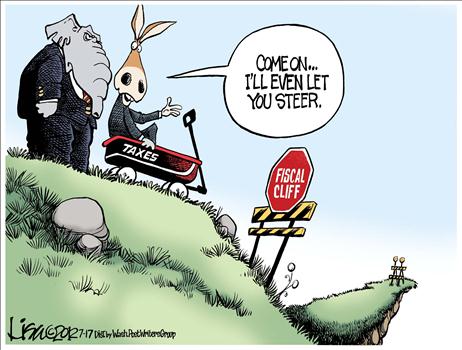
  2. Democrats are saying that they’ll let all the Bush tax cuts expire at the end of the year – thus screwing all taxpayers – unless Republicans agree to Obama’s class-warfare proposals to soak the rich.

I’ve already dealt with the first threat, pointing out that the defense budget still grows by 17 percent over the next 10 years with a sequester, so there’s no need to surrender to a tax hike (especially since the Pentagon accounts for 45 percent of global military spending).

As such, let’s deal with the second threat, which is actually a repeat of the fight we had back in 2010. Back then, Republicans said that extending the 2001 and 2003 tax cuts was an all-or-nothing proposition, while Democrats issued their own ultimatum and said that the rich should be hit with higher tax rates.

Republicans won that fight, even though they were heavily outnumbered in both the House and Senate. So why, given that they control the House and have many more seats in the Senate, isn’t this year’s fight an easy win for the GOP?

Beats me, but the Democrats are playing hardball, perhaps because they think a fight over class warfare is a good way of distracting voters from the weak economy.

One of the Senate’s top Democrats, Patty Murray of Washington, has thrown down the gauntlet and stated that her colleagues are willing to push all taxpayers off the fiscal cliff. Here’s some of what the Wall Street Journal opined about her remarks.

Democrats must feel really good about their election chances, because their latest campaign strategy is to say how willing and eager they are to leap off the January tax cliff. They’re all but daring Republicans to make the Democrats’ day by refusing to raise taxes before the election. …In a speech at the Brookings Institution, she declared that if Republicans won’t raise taxes on income above $250,000 before November, Democrats will gladly let all of the Bush tax rates expire at the end of the year—even on the middle class, and no matter the economic consequences.

The editors at the WSJ are mystified as to why Democrats are willing to undermine an already weak economy with an election just a few months away.

The Murray Democrats are the ones holding the middle-class rates hostage to a GOP vote to raise taxes on the affluent. …Mrs. Murray may think she’s putting Republicans on the political spot, but her real hostage is the already weak economy. Growth in the first quarter was a mere 1.9%, and economists have steadily downgraded their expectations for the second. As the tax cliff approaches, the policy uncertainty is already causing businesses to hold off on hiring and investment. Even the Keynesians at the Congressional Budget Office say that if all of the Bush tax rates expire, growth will fall close to recession territory.

Since the Democrats aren’t coming to me for advice, I’m not sure about their motives. Are they so wedded to class-warfare tax policy that they’re willing to sacrifice other goals in hopes of penalizing success?

Or are they playing a clever political game, figuring that a GOP surrender on taxes will generate so much discord on the right that it will more than offset any electoral downside of a weaker economy?

I suspect the answer to both questions is “yes,” but mostly to the second question. Which is why this Lisa Benson cartoon is an appropriate way to conclude this post.

P.S. You can find more Lisa Benson cartoons here, herehere, here, here, herehere, and here.

P.P.S. If you somehow think that higher taxes are necessary because it’s impossible to otherwise balance the budget, I hope you’ll change your mind when you learn we can balance the budget in just 10 years if politicians merely limit spending increases to 2 percent annually.

Do the feds know what they are doing with Obamacare?

Liberals are going on and on about what a great deal Obamacare is for poor states like Arkansas, but do the feds even know how to implement Obamacare?

Wisconsin Health Secretary: ‘No Such Thing as a State-Run Exchange’

IPosted by Michael F. Cannon

Dennis Smith directed the Medicaid program for President George W. Bush and was a health care analyst at the Heritage Foundation before becoming Wisconsin Gov. Scott Walker’s (R) secretary of health. The following excerpts are from a [subscription only] article at WisPolitics.com:

In his first extensive interview since a U.S. Supreme Court ruling largely upheld the federal law, the Department of Health Services chief said fed deadlines are likely to change and that the lack of guidance on setting up the exchanges makes any state-run exchange “a fantasy.”

Part of the reason why Smith says Wisconsin hasn’t moved forward with a health exchange plan is because he believes the deadlines will be pushed back.

“We have no other plan that we are taking because we think the reality is the federal government cannot meet its deadlines for implementing PPACA,” Smith said. “No one knows what a federal exchange looks like. The two major components that an exchange is supposed to do, which is determine eligibility and to complete the business transaction to pay premiums to health care plans that millions of Americans are supposed to pick, nobody knows what those look like. The administration has failed to release a credible business plan where objective observers could conclude that they’re going to pull this off.

Smith also said that none of the states currently setting up exchanges would likely meet federal regulations and that there’s “no such thing as a state-run exchange.”

“They were going to be asking for the resumes for the people who sit on the board of overseeing an exchange,” Smith said. “They were micromanaging the governance structure. They didn’t have to do that, they chose to do that. But that’s slowing the process and the decision making.”

The secretary especially pointed to questions on who will be eligible for the exchanges and the appropriate level of tax credits for participants. He claimed the rules on determining accuracy of tax credit payments were too “nonchalant,” and could result in the IRS having to recover thousands of dollars because of potential inaccuracies.

“It’s not that they don’t have answers because they’re withholding it from us, it’s that they don’t have answers because they don’t have answers,” Smith said. “These are critical policy issues, critical technical issues. Again, what are you building if you don’t know who’s eligible? What are you building if you don’t know what the flow is out of the treasury to the health plan?”

…”They have a mess on their hands,” Smith said… “You have to fundamentally say, ‘No, that just isn’t working, we have to go back to the drawing board.’

“And that is not being partisan in the slightest. That is facing reality.”

And that’s from a guy who continues to support the concept of a government-created health insurance exchange.

Open letter to President Obama (Part 116.2)

Uploaded by on Feb 26, 2012

_________

President Obama c/o The White House
1600 Pennsylvania Avenue NW
Washington, DC 20500

Dear Mr. President,

I know that you receive 20,000 letters a day and that you actually read 10 of them every day. I really do respect you for trying to get a pulse on what is going on out here. 

I wish we would put in real spending cuts in the USA instead of fake ones like the ones in the United Kingdom.

Looking at ‘Austerity’ in Britain

Posted by Juan Carlos Hidalgo

I’m going to jump into the debate about austerity in Europe because it is being closely followed in Latin America, and many people are drawing the wrong conclusions about how austerity is strangling the European economies. But first, we have to be clear about what we mean by “austerity.”

As the debate between Veronique de Rugy of the Mercatus Center and Ryan Avent at The Economist shows, there are different definitions of austerity. The term could mean fiscal consolidation only by spending cuts. It could mean a mixture of spending cuts and tax increases (the so called “balanced approach”), and it could even be just tax increases. So when people blame “austerity” for Europe’s economic malaise, we could be talking about a very different set of policies in each country.

Let’s look at Britain, which just entered into a double dip recession because of, according to Paul Krugman, “the evident failure” of austerity policies. If we look at spending levels in the UK both in nominal and real terms, we can clearly see that despite the announcement of deep cuts, government spending continues to rise:


Source: European Commission, Economic and Financial Affairs.

It’s clear that, at least in nominal terms, the rate of growth of spending has declined, but that hardly constitutes brutal cuts as Krugman and others want us to believe. If we look at total government spending as a percentage of the economy, Britain reached a peak in 2009 at 51.5%, and that came down to 49.9% in 2011. Can anyone seriously argue that Britain is in a recession because of that tiny drop in spending as a share of the economy?

Now, let’s remember that the Conservative-Liberal Democrat coalition government that came to power in May 2010 adopted what The Economist hailed as a balanced approach of fiscal consolidation based on £1 of tax increases for £3 of spending cuts. To be fair, the British magazine also said that if economic recovery proved hard to achieve, the government should consider a reprieve in tax increases, but not on spending cuts. We all know that the tax increases already took place (the VAT rate went up from 17.5% to 20%, for example). But as we can see, spending cuts haven’t taken place at all. Thus, austerity in Britain consists only of tax increases.

It’s hard to estimate the impact of tax increases on the British economy. Certainly the economic turmoil in Continental Europe has played a role in taking the U.K. into a second recession. But those who claim that “austerity” is responsible for Britain’s economic malaise should be honest and acknowledge that by austerity they mean only tax increases, not spending cuts.

____________

Thank you so much for your time. I know how valuable it is. I also appreciate the fine family that you have and your commitment as a father and a husband.

Sincerely,

Everette Hatcher III, 13900 Cottontail Lane, Alexander, AR 72002, ph 501-920-5733, lowcostsqueegees@yahoo.com