They’re right, though they probably don’t realize the seriousness of that looming crisis.
Here’s what you need to know: America’s fiscal crisis is actually a spending crisis, and that spending crisis is driven by entitlements.
More specifically, the vast majority of the problem is the result of Medicaid, Medicare, and Social Security, programs that are poorly designed and unsustainable.
The Medicaid program imposes high costs while generating poor results. This Center for Freedom and Prosperity Foundation video explains how block grants, such as the one proposed by Congressman Paul Ryan, will save money and improve healthcare by giving states the freedom to innovate and compete.
This Center for Freedom and Prosperity Foundation video explains how a “premium-support” plan would solve Medicare’s fiscal crisis and improve the overall healthcare system. This voucher-based system also would protect seniors from bureaucratic rationing. http://www.freedomandprosperity.org
There are two crises facing Social Security. First the program has a gigantic unfunded liability, largely thanks to demographics. Second, the program is a very bad deal for younger workers, making them pay record amounts of tax in exchange for comparatively meager benefits. This video explains how personal accounts can solve both problems, and also notes that nations as varied as Australia, Chile, Sweden, and Hong Kong have implemented this pro-growth reform. www.freedomandprosperity.org
_______________________
Regular readers know I’m fairly gloomy about the future of liberty, but this is one area where there is a glimmer of hope.
The Chairman of the House Budget Committee actually put together a plan that addresses the two biggest problems (Medicare and Medicaid) and the House of Representatives actually adopted the proposal.
The Senate didn’t act, of course, and Obama would veto any good legislation anyhow, so I don’t want to be crazy optimistic. Depending on how things play out politically in the next six years, I’ll say there’s actually a 20 percent chance to save America.
It’s not much of an exaggeration to say that John Lott has changed the national debate on gun control. His rigorous research and prolific pen have exposed the slip-shod analysis of anti-Constitution advocates.
Responding to some of the demagoguery after the Colorado killings, here’s some of what he wrote for National Review.
…the M&P 15 and the AK-47 are “military-style weapons.” But the key word is “style” — they are similar to military guns in their aesthetics, not in the way they actually operate. The guns covered by the federal assault-weapons ban (which was enacted in 1994 and expired ten year later) were not the fully automatic machine guns used by the military but semi-automatic versions of those guns. The civilian version of the AK-47 uses essentially the same sorts of bullets as deer-hunting rifles, fires at the same rapidity (one bullet per pull of the trigger), and does the same damage.
This is a key point. I suspect most journalists (and far too many people who get their news from these clowns) genuinely think an “assault weapon” is akin to a machine gun.
Lott also shows that there is nothing about “military-style” weapons that enables a bigger magazine.
The Aurora killer’s large-capacity ammunition magazines are also misunderstood. The common perception that so-called “assault weapons” can hold larger magazines than hunting rifles is simply wrong. Any gun that can hold a magazine can hold one of any size. That is true for handguns as well as rifles. A magazine, which is basically a metal box with a spring, is also trivially easy to make and virtually impossible to stop criminals from obtaining.
Lott then discusses some of the research showing that Clinton’s assault-weapons ban didn’t reduce crime.
…despite Obama’s frightening image of military weapons on America’s streets, it is pretty hard to seriously argue that a new ban on “assault weapons” would reduce crime in the United States. Even research done for the Clinton administration didn’t find that the federal assault-weapons ban reduced crime. Indeed, banning guns on the basis of how they look, and not how they operate, shouldn’t be expected to make any difference. And there are no published academic studies by economists or criminologists that find the original federal assault-weapons ban to have reduced murder or violent crime generally. There is no evidence that the state assault-weapons bans reduced murder or violent-crime rates either.
Indeed, it appears that crime has dropped because the ban no longer exists.
Since the federal ban expired in September 2004, murder and overall violent-crime rates have actually fallen. In 2003, the last full year before the law expired, the U.S. murder rate was 5.7 per 100,000 people. Preliminary numbers for 2011 show that the murder rate has fallen to 4.7 per 100,000 people. In fact, murder rates fell immediately after September 2004, and they fell more in the states without assault-weapons bans than in the states with them.
Correlation is not causation, of course, but these results also are consistent with logic and intuition. If law-abiding people have more access to guns, it makes sense that this makes life more difficult for criminals.
P.S. For fans of the Second Amendment, you’ll enjoy these gun control posters (here, here, here, here, and here). And here are some amusing images of t-shirts and bumper stickers on gun control (here, here, and here). In addition, I’ve posted four different videos on gun control (here, here, here, and here). And here’s my interview on NRA-TV.
The federal government spends about 10% on roads and public goods but with the other money in the budget a lot of harm is done including excessive regulations on business. That makes Obama’s comment the other day look very silly.
But since I was talking about the staggering burden of red tape and regulation, I wasn’t being very supportive of the President’s assertion that government deserves a big chunk of the credit when a business is successful.
This cartoon makes the same point, but adds taxation to the mix.
As far as I recall (I sound like a politician under oath when I write something like that), this is the first Branco cartoon I’ve used, but I think it’s the best one in this post, so I’m looking forward to more of his (her?) work.
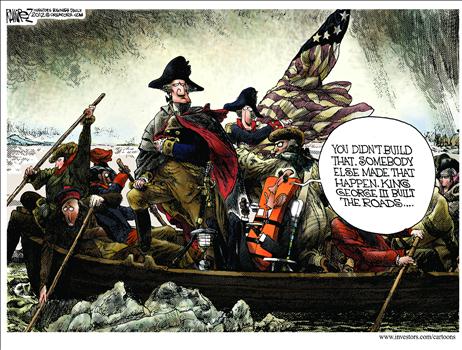
Regular readers know about Michael Ramirez, of course, and he has an amusing take on the you-didn’t-build-that controversy.
Last but not least, we have another Allie cartoon. I think this is the first time I’ve used two cartoons by the same person, but I think you’ll agree they’re worth sharing.
This gives me an opportunity to end on a serious note. The Obama campaign is asserting that the President was simply stating that private sector prosperity is made possible by the provision of “public goods” such as roads and bridges.
Which is why the second Allie cartoon is so good. Even when government does something that is theoretically good, it causes a lot of collateral damage because of the excessive size and scope of the welfare state.
Jeffrey Miron is senior lecturer and director of undergraduate studies at Harvard University and Senior Fellow at the Cato Institute. Miron is the author of Libertarianism, from A to Z and a member of Expert Insight.
In a recent discussion of what his administration might accomplish, Mitt Romney claimed that “by virtue of the policies that we put in place, we’d get the unemployment rate down to 6%, and perhaps a little lower,” over a period of four years.
Is this goal attainable?
It is. Indeed, it is not that tough a task. If the United States avoids new growth-retarding policies, such as the tax hikes scheduled for January 1, the economy’s natural adjustments will lower unemployment substantially. These include downward adjustments in wages, reallocation of job-seekers from slower to faster growing sectors and regions, reduced in-migration plus increased out-migration, and withdrawals from the labor force.
Jeffrey Miron is senior lecturer and director of undergraduate studies at Harvard University and Senior Fellow at the Cato Institute. Miron is the author of Libertarianism, from A to Z and a member of Expert Insight.
These adjustments do not always work quickly or for everyone (not every former construction worker can become a computer technician). But history suggests the adjustments do occur, as they have since the recession began. Over the next four years, they will continue to lower the unemployment rate, if not to 6%, at least near that territory.
The more important task for either presidential candidate is restoring the economy to its prerecession growth path. Real GDP has historically grown about 3% per year, and major downturns have been followed by strong recoveries. Within two to three years, therefore, output is typically “back where it would have been.”
In this recession, the rapid recovery phase has so far been absent; real GDP is still well below where one would have predicted pre-2008, and with average growth under 3% since the recession ended, the gap grows larger every quarter.
So can Romney, or anyone, get us back to a higher growth rate? Yes. Here is a program that will restore U.S. economic performance:
Cancel all the tax increases scheduled to take effect at the end of 2012 and provide tax stability going forward. Make (all) the Bush tax cuts permanent. Repeal the alternative minimum tax. Eliminate the health care law’s increases in the hospital insurance tax. All this will stimulate in the short term and set the stage for long-term growth.
Reform the tax code by eliminating the misguided deductions, exemptions, credits and loopholes that distort incentives and reward special interests. These features include big-ticket items like the deductibility of mortgage interest and employer-paid health insurance premiums, plus myriad small but senseless other provisions.
Lower the corporate income tax rate. The U.S. corporate tax environment is one of the least business-friendly in the world. Driving investment overseas cannot be good policy.
Slow the growth of entitlements. The U.S. can afford a social safety net, but our current programs are not sustainable, even in a robustly growing economy. Everyone should agree, at a minimum, to cuts that are sufficient to prevent these programs — Medicaid, Medicare, and Social Security — from bankrupting the country.
Embrace immigration. Despite recent difficulties, the United States is still an attractive destination for those seeking a better life. By expanding immigration for low-skill workers, we restrain labor costs and reduce out-migration of manufacturing and other business. By easing immigration for high-skill workers — many of them trained in the United States at taxpayer expense — we get a return on our investment and retain industrious and innovative people.
Scale back military involvements around the world. A strong national defense makes sense, but it must focus on protecting the United States, not paying for Europe’s defense or trying to force democracy down the throats of countries that are not receptive.
Cease the campaign against carbon-based fuels. Green energy may have its day, but only when coal, oil and gas become truly scarce. In the foreseeable future, traditional energy is much cheaper, and subsidies for alternative energy are a waste.
Stop scapegoating the rich and pretending that tax-hikes on the 1% can balance the budget. Everyone knows the numbers do not add up.
Respect capitalism. Anti-business rhetoric, which casts all success as undeserved, and which fails to recognize the improvements in material well-being that result from entrepreneurial success, just drive away talented people and guarantee our economic demise.
If the United States adopts these policies, it will not only attain Romney’s 6% unemployment goal, it will once again be the economic beacon of the world.
Social Security is a Ponzi Scheme but Blake who is a blogger said I was off base. Ark Times reader says Social Security is not Ponzi Scheme Social Security Disaster Walter E. Williams Columnist, Townhall.com Politicians who are principled enough to point out the fraud of Social Security, referring to it as a lie and […]
We got to do something soon about Social Security. The Case for Social Security Personal Accounts Posted by Daniel J. Mitchell There are two crises facing Social Security. First the program has a gigantic unfunded liability, largely caused by demographics. Second, the program is a very bad deal for younger workers, making them pay record […]
Senator Obama’s Social Security Tax Plan Uploaded by afq2007 on Jul 23, 2008 In addition to several other tax increases, Senator Barack Obama wants to increase the Social Security payroll tax burden by imposing the tax on income above $250,000. This would be a sharp departure from current law, which only requires that the tax […]
Saving Social Security with Personal Retirement Accounts Uploaded by afq2007 on Jan 10, 2011 There are two crises facing Social Security. First the program has a gigantic unfunded liability, largely thanks to demographics. Second, the program is a very bad deal for younger workers, making them pay record amounts of tax in exchange for comparatively meager benefits. This […]
“Saving the American Dream: The Heritage Plan to Fix the Debt, Cut Spending, and Restore Prosperity,” Heritage Foundation, May 10, 2011 by Stuart Butler, Ph.D. , Alison Acosta Fraser and William Beach is one of the finest papers I have ever read. Over the next few days I will post portions of this paper, but […]
Is Social Security a Ponzi Scheme? I just started a series on this subject. In this article below you will see where the name “Ponzi scheme” came from and if it should be applied to the Social Security System. Ponzi! Ponzi! Ponzi! 9/14/2011 | Email John Stossel | Columnist’s Archive Ponzi! Ponzi! Ponzi! There, I […]
Uploaded by LibertyPen on Jan 8, 2009 Professor Williams explains what’s ahead for Social Security Dan Mitchell on Social Security I have said that Social Security is a Ponzi scheme and sometimes you will hear someone in the public say the same thing. Yes, It Is a Ponzi Scheme by Michael D. Tanner Michael Tanner […]
For all intents and purposes, Cyprus is now bankrupt, and the only question that remains to be answered is whether it will get handouts from the IMF-ECB-EC troika, handouts from Russia, or both. Here’s some of what has been reported by AP.
Cyprus’ president on Thursday defended his government’s decision to seek financial aid from the island nation’s eurozone partners while at the same time asking for a loan from Russia, insisting that the two are perfectly compatible. …Cyprus, with a population of 862,000 people, last week became the fifth country that uses the euro currency to seek a European bailout… The country is currently in talks with the so-called ‘troika’ — the body made up of officials from the European Commission, the European Central Bank and the International Monetary Fund — on how much bailout money it will need and the conditions that will come attached. Locked out of international markets because of its junk credit rating status, Cyprus is paying its bills thanks to a €2.5 billion ($3.14 billion) Russian loan that it clinched last year. But that money is expected to run out by the end of the year.
So what caused this mess? Is Cyprus merely the helpless and innocent victim of economic turmoil in nearby Greece?
That’s certainly the spin from Cypriot politicians, but the budget data shows that Cyprus is in trouble because of excessive spending. This chart, based on data from the International Monetary Fund, shows that the burden of government spending has jumped by an average of 8.3 percent annually since the mid-1990s.
My Golden Rule of fiscal policy is that government spending should grow slower than economic output. Nations that follow that rule generally enjoy good results, while nations that violate that rule inevitably get in trouble.
Interestingly, if Cypriot politicians had engaged in a very modest amount of spending restraint and limited annual budgetary increases to 3 percent, there would be a giant budget surplus today and the burden of government spending would be down to 21.4 percent of GDP, very close to the levels in the hyper-prosperous jurisdictions of Hong Kong and Singapore.
Actually, that’s not true. If the burden of government spending had grown as 3 percent instead of 8.3 percent, economic growth would have been much stronger, so GDP would have been much larger and the public sector would be an ever smaller share of economic output.
Speaking of GDP, the burden of government spending in Cyprus, measured as a share of GDP, has climbed dramatically since 1995.
A simple way to look at this data is that Cyprus used to have a Swiss-sized government and now it has a Greek-sized government. Government spending is just one of many policies that impact economic performance, but is anyone surprised that this huge increase in the size of the public sector has had a big negative impact on Cyprus?
Interestingly, if government spending had remained at 33.9 percent of GDP in Cyprus, the nation would have a big budget surplus today. Would that have required huge and savage budget cuts? Perhaps in the fantasy world of Paul Krugman, but politicians could have achieved that modest goal if they had simply limited annual spending increases to 6 percent.
But that was too “draconian” for Cypriot politicians, so they increased spending by an average of more than 8 percent each year.
What’s the moral of the story? Simply stated, the fiscal policy variable that matters most is the growth of government. Cyprus got in trouble because the burden of government grew faster than the productive sector of the economy.
Europe’s political elite doubtlessly will push for higher taxes, but that approach – at best – simply masks the symptoms in the short run and usually exacerbates the disease in the long run.
Why not pass the Balanced Budget Amendment? As you know that federal deficit is at all time high (1.6 trillion deficit with revenues of 2.2 trillion and spending at 3.8 trillion).
On my blog www.HaltingArkansasLiberalswithTruth.com I took you at your word and sent you over 100 emails with specific spending cut ideas. However, I did not see any of them in the recent debt deal that Congress adopted. Now I am trying another approach. Every week from now on I will send you an email explaining different reasons why we need the Balanced Budget Amendment. It will appear on my blog on “Thirsty Thursday” because the government is always thirsty for more money to spend.
Many of the politicians in Washington, including President Obama during his State of the Union address, piously tell us that there is no way to balance the budget without tax increases. Trying to get rid of red ink without higher taxes, they tell us, would require “savage” and “draconian” budget cuts.
The Congressional Budget Office has just released its 10-year projections for the budget, so I crunched the numbers to determine what it would take to balance the budget without tax hikes. Much to nobody’s surprise, the politicians are not telling the truth.
The chart below shows that revenues are expected to grow (because of factors such as inflation, more population, and economic expansion) by more than 7 percent each year. Balancing the budget is simple so long as politicians increase spending at a slower rate. If they freeze the budget, we almost balance the budget by 2017. If federal spending is capped so it grows 1 percent each year, the budget is balanced in 2019. And if the crowd in Washington can limit spending growth to about 2 percent each year, red ink almost disappears in just 10 years.
These numbers, incidentally, assume that the 2001 and 2003 tax cuts are made permanent (they are now scheduled to expire in two years). They also assume that the AMT is adjusted for inflation, so the chart shows that we can balance the budget without any increase in the tax burden.
We also have international evidence showing that spending restraint – not higher taxes – is the key to balancing the budget. New Zealand got rid of a big budget deficit in the 1990s with a five-year spending freeze. Canada also got rid of red ink that decade with a five-year period where spending grew by an average of only 1 percent per year. And Ireland slashed its deficit in the late 1980s by 10 percentage points of GDP with a four-year spending freeze.
This article appeared in Forbes on October 3, 2011
The desperate search for an acceptable Republican Party presidential candidate continues. Republican leaders apparently are pushing New Jersey Gov. Chris Christie, who previously said no, to jump into the race.
The GOP’s frustration is palpable. Mitt Romney has been running for four years but generates little enthusiasm. Rick Perry was an instant front-runner before losing much of his support after unimpressive debate performances. Michelle Bachmann briefly streaked across the political firmament but now barely registers in the polls. Newt Gingrich committed political seppuku shortly after announcing his candidacy. Ron Paul’s support is fervent but limited.
However, the real Republican problem is positions, not candidates.
The Republican Party cheerfully ran up the national debt before surrendering the keys to Capitol Hill and the White House. President George W. Bush’s promiscuous war-making cost the U.S. thousands of lives and hundreds of billions of dollars, while making Americans less secure. The GOP centralized more power in Washington. Republican lawmakers managed to turn laudable opposition to tax hikes into a deplorable defense of the status quo.
Most of the GOP presidential candidates offer little new. Mitt Romney, the ultimate political weathervane, implemented ObamaCare in Massachusetts before there was ObamaCare. He now fervently defends Social Security, despite its design as a public Ponzi scheme. Gov. Perry talks of domestic budget cuts but on foreign policy appears to be Bush-lite, yet another hawk disconnected from reality. The sharpest dissent from big government conservatism comes from the candidates least likely to win the nomination: Rep. Paul, former Utah Gov. Jon Huntsman, and former New Mexico governor Gary Johnson, who has been excluded from most of the debates.
President Barack Obama obviously is vulnerable, as well he should be. The problem is not that he is responsible for all of America’s economic woes — no president “runs” the $15 trillion U.S. economy. But this president has no solution for slow growth and high unemployment other than spending more money, increasing the deficit, and running up the debt.
Unfortunately for the Republicans, simply denouncing President Obama for every ill known to man may not lead to victory. Voters dislike much current GOP orthodoxy. President Obama could win an election which turns into competitive political demonization and personal destruction.
Republicans should offer a positive agenda while addressing the party’s past failings. First, they should explain that current budget policy is unsustainable on both a short- and a long-term basis. Economist Larry Kotlikoff figures that America’s real public debt is $211 trillion, 15 times the nominal national debt. Public finance in states like California already looks a lot like that in Greece.
Unless Americans want to turn their entire incomes over to government, public spending must be cut, and cut sharply. And it must be cut across-the-board.
However, to regain lost credibility GOP politicians should lead with proposals to cut spending benefiting “their” interest groups. Corporate welfare should top any Republican Party list of budget cuts. Too often Republican apparatchiks have been pro-business rather than pro-free market, attacking financial transfers to the poor while endorsing subsidies for corporate America.
The GOP also needs to support significant reductions in military outlays. There is no more important responsibility for the U.S. government than protecting America. However, most of the Pentagon’s current activities have little to do with protecting America.
Instead, most U.S. forces currently defend prosperous, populous allies around the world. Europe has a larger GDP and population than America, yet continues to rely on Washington to provide most of NATO’s combat capability. Japan long had the world’s second largest economy but nevertheless relied on America for its protection. South Korea has 40 times the GDP of its northern adversary, but nearly 30,000 U.S. military personnel remain in the South, creating a “tripwire” for war.
Equally wasteful and far more costly in human terms have been nation-building exercises in Somalia, Bosnia, Kosovo, Iraq, Afghanistan, and more. Going to war in 2001 to punish the Taliban for hosting terrorist training camps made sense. Staying at war a decade later in an attempt to create a competent, honest centralized government in Kabul is foolish.
Also required is an honest discussion of Social Security’s and Medicare’s funding crises. Neither is financially sustainable and both risk triggering generational conflict. The longer Congress puts off addressing these issues the costlier will be any solution.
The GOP should reaffirm its opposition to tax hikes, but emphasize that taxes can be kept low only if outlays are reduced. Endless borrowing threatens a financial death spiral of increased debt, higher interest payments, slower economic growth, and lower investor confidence. The U.S. now is on the road to fiscal ruin.
Moreover, Republicans should endorse President Obama’s attack on special interest tax breaks. Not all tax preferences are equally bad, but the narrower the tax break the more it approaches a special interest subsidy. The GOP should push legislation that simultaneously kills dubious tax “loopholes” and reduces overall marginal tax rates. Republicans should similarly respond to tax proposals from President Obama or congressional Democrats. Rather than defend the undefendable, the GOP should challenge yet another form of corporate welfare.
With job creation at issue, Republicans should develop a list of regulations and taxes which interfere with a growing economy. Political candidates enjoy denouncing “over-regulation” in the abstract, but they would be more convincing if they targeted specific policies costing real jobs. The House GOP should follow the example of its earlier majority which held hearings on regulatory abuses.
Republicans should challenge politically popular public agencies. For instance, the government-sponsored enterprises Fannie Mae and Freddie Mac were at the epicenter of the housing and financial crises. The GOP rightly criticized Democrats for not including the two GSEs in last year’s financial “reform” bill. But so far House Republicans have done nothing to close Fannie and Freddie, which continue to lose money.
Deregulation should include proposals to make more market friendly controls which are necessary even in a free society. After all, few Americans want to breathe dirty air or swim in dirty water. And there is no simple market solution to such problems. But people don’t want to needlessly waste money and destroy jobs when cleaning up the environment.
The Republicans also should offer a more restrained foreign policy. Doing so is necessary to curtail military outlays — in effect, the defense budget is the price of a nation’s foreign policy, since the more Washington seeks to do in the world, the more military force it requires. So long as the U.S. government is determined to dominate every region of the globe against every power, it will have to spend as much on the military as the rest of the world combined. Indeed, real, inflation-adjusted military outlays have doubled over the last decade, and today are higher than at any point during the Cold War, Korean War, and Vietnam War.
But a more humble foreign policy also would be a better foreign policy. Rather than engage in social engineering abroad, Republican politicians should leave friendly states with responsibility for international problems. If there is a problem in the Balkans or North Africa, Europe should address it. Japan, South Korea, Australia, and other democratic nations should cooperate to restrain potential Chinese aggressiveness. Only the Afghans can create a sustainable political order, of whatever form, in Afghanistan.
The GOP should simultaneously support a globally engaged America and Americans. For instance, international cooperation can help meet humanitarian, environmental, and other problems which transcend national boundaries. Whatever U.S. policy toward illegal aliens, Americans should expand the legal immigration of entrepreneurial professionals.
Trade benefits Americans. Washington’s failure to ratify the free trade agreement with South Korea is beyond foolish. A commercial war with China would hurt Americans while poisoning the most important bilateral relationship of the 21st century.
Other issues also deserve attention — such as expanding educational opportunities for children stuck in poorly performing public schools. Even here, however, the GOP needs to break with recent Republican Party orthodoxy. President Bush and the Republican Congress centralized even more authority in Washington with the “No Child Left Behind” legislation.
Perhaps Chris Christie or some other late electoral entrant will revolutionize the GOP presidential sweepstakes. But without good ideas well-expressed, the GOP could still end up outside the White House looking in. The Republican Party deserves to win in 2012 only if it recognizes that it deserved to lose in 2008.
Some folks say they want “austerity,” but that’s largely a code word for higher taxes. They’re fighting against the people who say they want “growth,” but that’s generally a code word for more Keynesian spending.
And then, to get me even more irritated, lots of people support bailouts because they supposedly are needed to save the euro currency.
When I ask these people why a default in, say, Greece threatens the euro, they look at me as if it’s the year 1491 and I’ve declared the earth isn’t flat.
So I’m delighted that the Wall Street Journal has published some wise observations by a leading French economist (an intellectual heir to Bastiat!), who shares my disdain for the current discussion. Here are some excerpts from Prof. Salin’s column, starting with his common-sense hypothesis.
…there is no “euro crisis.” The single currency doesn’t have to be “saved” or else explode. The present crisis is not a European monetary problem at all, but rather a debt problem in some countries—Greece, Spain and some others—that happen to be members of the euro zone. Specifically, these are public-debt problems, stemming from bad budget management by their governments. But there is no logical link between these countries’ fiscal situations and the functioning of the euro system.
Salin then looks at how the artificial link was created between the euro currency and the fiscal crisis, and he makes a very good analogy (and I think it’s good because I’ve made the same point) to a potential state-level bankruptcy in America.
The public-debt problem becomes a euro problem only insofar as governments arbitrarily decide that there must be some “European solidarity” inside the euro zone. But how does mutual participation in the same currency logically imply that spendthrift governments should get help from the others? When a state in the U.S. has a debt problem, one never hears that there is a “dollar crisis.” There is simply a problem of budget management in that state.
Because European politicians have decided to create an artificial link between national budget problems and the functioning of the euro system, they have now effectively created a “euro crisis.” To help out badly managed governments, the European Central Bank is now buying public bonds issued by these governments or supplying liquidity to support their failing banks. In so doing, the ECB is violating its own principles and introducing harmful distortions.
Last but not least, Salin warns that politicians are using the crisis as an excuse for more bad policy – sort of the European version of Mitchell’s Law, with one bad policy (excessive spending) being the precursor of additional bad policy (centralization).
Politicians now argue that “saving the euro” will require not only propping up Europe’s irresponsible governments, but also centralizing decision-making. This is now the dominant opinion of politicians in Europe, France in particular. There are a few reasons why politicians in Paris might take that view. They might see themselves being in a similar situation as Greece in the near future, so all the schemes to “save the euro” could also be helpful to them shortly. They might also be looking to shift public attention away from France’s internal problems and toward the rest of Europe instead. It’s easier to complain about what one’s neighbors are doing than to tackle problems at home. France needs drastic tax cuts and far-reaching deregulation and labor-market liberalization. Much simpler to get the media worked up about the next “euro crisis” meeting with Angela Merkel.
I got to hear Arthur Laffer speak back in 1981 and he predicted what would happen in the next few years with the Reagan tax cuts and he was right with every prediction.
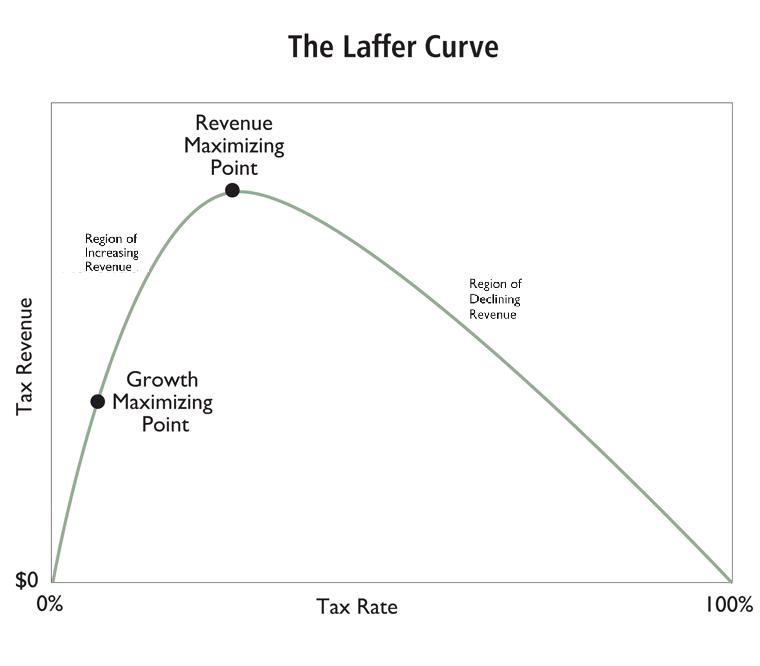
The Laffer Curve Wreaks Havoc in the United Kingdom
Back in 2010, I excoriated the new Prime Minister of the United Kingdom, noting that David Cameron was increasing tax rates and expanding the burden of government spending (including an increase in the capital gains tax!).
I also criticized Cameron for leaving in place the 50 percent income tax rate imposed by his feckless predecessor, and was not surprised when experts began to warn that this class-warfare tax hike might actually result in less revenue because the reduction in taxable income could be more significant than the increase in the tax rate.
In other words, bad policy might lead to a turbo-charged version of the Laffer Curve.
Allow me to elaborate. In most cases, punitive tax hikes do raise revenue, but not as much as politicians predict. As explained in this three-part video series, this is because it takes a very significant reduction in taxable income to offset the revenue-generating impact of the higher tax rate.
With that background knowledge, let’s now take a closer look at David Cameron’s tax increases. They’ve been in place for a while, so we can look at some real-world data. Allister Heath of City AM has the details.
Something very worrying is happening to the UK’s public finances. Income tax and capital gains tax receipts fell by 7.3 per cent in May compared with a year ago, according to official figures. Over the first two months of the fiscal year, they are down by 0.5 per cent. This is merely the confirmation of a hugely important but largely overlooked trend: income and capital gains tax (CGT) receipts were stagnant in 2011-12, edging up by just £414m to £151.7bn, from £151.3bn, a rise of under 0.3 per cent. By contrast, overall tax receipts rose 3.9 per cent.
Is this because the United Kingdom is cutting tax rates? Nope. As we mentioned in the introduction, Cameron is doing just the opposite.
…overall taxes on labour and capital have been hiked: the 50p tax was introduced from April 2010 (and will fall to a still high 45p in April 2013), those earning above £150,000 have lost their personal allowance, CGT has risen to 28 per cent, many workers have been dragged into higher tax thresholds, and so on. In theory, if one were to believe the traditional static model of tax, beloved of establishment economists, this should have meant higher receipts, not lower revenues.
So what’s the problem? Well, it seems that there’s thing called the Laffer Curve.
…there is a revenue-maximising rate of tax – and that if you set rates too high, you raise less because people work less, find ways of avoiding tax or quit the country. The world isn’t static, it is dynamic; people respond to tax rates, just as they respond to other prices. Laffer told a gathering at the Institute of Economic Affairs that this is definitely true in the UK today – and the struggling tax take revealed in the official numbers suggest that he is right. Tax rates and levels are so high as to be counterproductive: slashing capital gains tax would undoubtedly increase its yield, for example. Many self-employed workers are delaying incomes as much as possible until the new, lower top rate of tax kicks in.
…higher VAT is also damaging growth, though it is still yielding more. Some taxes can still raise more – but try doing that with income tax, CGT or corporation tax and the result is now clearly counter-productive. These taxes are maxed out; they have been pushed beyond their ability to raise revenues.
Last but not least, he makes an essential point about the role of bad spending policy.
The problem is that spending is too high – central government current expenditure is up by 3.7 per cent year on year in April-May – not that taxes are too low. The result is that the April-May budget deficit reached £30.7bn, some £6.2bn higher than a year ago.
But that’s not the point of this post. The relevant question is why do politicians pursue bad policy and why do some economists aid and abet bad policy?
For politicians, I think the answer is easy. They simply care about getting elected and holding power. So if they think class-warfare tax policy is the way of achieving those narcissistic goals, they’ll push higher tax rates. Even if it means lower revenue, notwithstanding their usual desire to have more money so they can buy more votes.
I’m more mystified by the behavior of economists. Let’s look at a couple of examples. Justin Wolfers and Mark Thoma recently cited some survey data to claim that the Laffer Curve was universally rejected by the profession.
Those economists did say that a reduction in tax rates, based on current levels, would not cause taxable income to jump by a large enough amount to fully offset the revenue-losing impact of the lower tax rate. But the Laffer Curve says that only happens in extreme circumstances, so there’s zero contradiction.
So why did Wolfers and Thoma create a straw man in an attempt to discredit the Laffer Curve?
I have no idea, but Republican politicians probably deserve some of the blame. Too many of them make silly claims that “all tax cuts pay for themselves,” even when talking about new credits and deductions that have no positive impact on economic performance.
To the extent that Wolfers, Thoma, and others think that’s what the Laffer Curve is all about, then their skepticism is warranted.
But if that’s the case, they should read what Art Laffer actually wrote so they can be more accurate in the future. Or they can watch these three videos.
Part I describes the theory.
Part II describes the evidence.
And Part III explains the sloppy and inaccurate revenue-estimating methodology of the Joint Committee on Taxation.
But if they think I’m too biased or that Art is similarly misguided, then they should look at some of the evidence produced by other economists.






 The Daily Hatch