Category Archives: Cato Institute

Open letter to President Obama (Part 125B)

Obama Calls GOP Budget Plan “Prescription for Decline”

Uploaded by on Apr 3, 2012

In a blistering attack on the House-Passed Republican budget Tuesday, President Obama called the plan proposed by Rep. Paul Ryan a “Trojan Horse” and “a prescription for decline.” Judy Woodruff, Jared Bernstein of the Center on Budget and Policy Priorities and the CATO Institute’s Daniel Mitchell discuss the GOP budget plan.

_______

President Obama c/o The White House
1600 Pennsylvania Avenue NW
Washington, DC 20500

Dear Mr. President,

I know that you receive 20,000 letters a day and that you actually read 10 of them every day. I really do respect you for trying to get a pulse on what is going on out here.

You were really hard on Paul Ryan for his plan, but your plan will NEVER LEAD TO A BALANCED BUDGET.

Obama’s And Paul Ryan’s Conflicting Budget Visions

by Michael D. Tanner

Michael Tanner is a senior fellow at the Cato Institute and author of Leviathan on the Right: How Big-Government Conservatism Brought Down the Republican Revolution.

Added to cato.org on April 6, 2012

This article appeared in Fiscal Times on April 6, 2012.

With his speech to news editors and executives this week, President Obama has made it clear that he plans to run a starkly ideological campaign, contrasting his vision for the future of the country with that of his Republican opponents. And, he plans to make the Republican budget, written by rising GOP star Rep. Paul Ryan of Wisconsin and embraced by presumptive Republican nominee Mitt Romney, exhibit one in that contrast. It would be worthwhile therefore to actually compare that budget with the one proposed by the president.

Deficits and Debt
The president’s budget proposal would reduce future deficits — at least until 2018 — but would never achieve balance. By 2018, the president projects deficits to fall to only $575 billion. After that, they begin rising again, reaching $704 billion by 2022. Overall, the president’s budget would add an additional $6.7 trillion to the national debt over the next 10 years.

Paul Ryan does better when it comes to deficit reduction, but only because the president has set such a low bar. Unlike the president, Ryan would eventually balance the budget — but not until 2040 or so. He does, however, generally run much lower annual deficits than the president would, and adds $3.3 trillion less to the national debt over the next 10 years.

Obama and Ryan have presented two distinct visions of the future.

Over the longer-term, the differences are much more pronounced. By 2050, for instance, Ryan would be running a surplus equal to as much as 3 percent of GDP. The president’s budget, in contrast, projects that we would still face budget deficits in excess of 6 percent of GDP.

Government Spending
Neither President Obama nor Paul Ryan actually cuts government spending. Rather, both are playing the time-honored game of calling a reduction in the rate of increase a “cut.” Thus, the president would increase federal spending from $3.8 trillion in 2013 to $5.82 trillion in 2022. That might not be as big an increase there might otherwise be, but in no way can it be called a cut. Meanwhile, Ryan, who is being accused of “thinly veiled Social Darwinism,” would actually increase spending from $3.53 trillion in 2013 to $4.88 trillion in 2022.

The president warns that Ryan’s spending “cuts” would “gut” the social safety net. And, it is true that Ryan’s budget knife falls more heavily on domestic discretionary spending than does the president’s — but only relatively. Over the next 10 years, Ryan would spend $352 billion less on those programs than would Obama, an average of just $35.2 billion per year in additional cuts. Given that domestic discretionary spending under the president’s budget will total more than $4 trillion over the next decade, Ryan’s cuts look less than draconian.

One area where the president appears to have the better argument is on defense spending. Ryan would undo the defense spending sequester agreed to under last year’s debt-ceiling compromise, and would spend $203 billion more over 10 years than was agreed to. Obama would cut defense by an additional $240 billion. Given our budget problems and the lack of a conventional military threat, Ryan’s plan to spare defense seems shortsighted.

Taxes
The president would increase tax revenue to 20.1 percent of GDP. That’s a huge increase from the current 15.4 percent, and higher than the post-World War II average of 18 percent. His budget includes tax hikes on people and small businesses making as little as $200,000 per year, as well as the usual panoply of tax hikes on energy products, businesses, investment and pretty much anything else the president can think of.

The president also continues to push for the so-called Buffet Rule, a new 30 percent minimum tax on the rich, based on the misleading claim that Warren Buffett pays a lower tax rate than his secretary. The Buffett Rule would raise very little revenue — less than $3.2 billion per year on average according to the Congressional Budget Office — but the president is pushing it as a matter of fairness.

Ryan would also allow taxes to increase as a percentage of GDP, returning to roughly their historical average around 18 percent of GDP. However, he is also calling for a major reform of the U.S. tax code. Ryan would replace the current four tax rates with two: 15 and 25 percent. He would also lower the current 38 percent corporate tax rate, the world’s highest, to 25 percent. At the same time, he would broaden the taxable base by eliminating many current deductions and loopholes. Unfortunately, Ryan has ducked the unpopular task of actually spelling out which loopholes would be eliminated.

Entitlement Reform
Perhaps the biggest disagreement between the president and Ryan is over how to reform the entitlement programs that are driving this country toward bankruptcy. Ryan would restructure Medicare for those under age 55 to give recipients a choice between the traditional program and a voucher that would allow them to purchase private insurance. That plan, drafted together with Democratic Sen. Ron Wyden of Oregon, would have little impact in the short-term — in 2022, it would spend just $21 billion less than the president’s budget — but over the longer term would reduce Medicare’s unfunded liability, which the Medicare trustees put at $24.6 trillion, by trillions of dollars.

The president makes no significant changes to Medicare, relying instead on expansion of changes contained in the new health care law to save a projected $364 billion over the next 10 years.

Ryan would also turn the current Medicaid program to the states in the form of a federal block grant, while reducing spending by $810 billion over 10 years. States would have far more freedom to experiment with ways to reform the system, but would likely receive less federal funds over the long term. Obama, by contrast, leaves the program unchanged, while significantly expanding eligibility under the health care law.

Unsurprisingly in an election year, both Ryan and the president punt on Social Security reform. Neither offers any reform of the troubled retirement system, despite its $21 trillion in unfunded liabilities.

Two Visions
The United States is teetering on the edge of Greek-style bankruptcy. Our total indebtedness, including the unfunded liabilities of Social Security and Medicare, could run as high as $130 trillion, more than 900 percent of GDP. In the face of this looming crisis, Obama and Ryan have presented two distinct visions of the future. The president offers a bigger government, paid for with more debt and higher taxes. Ryan’s vision may be maddeningly timid and vague in places, but it takes important steps toward a smaller, less costly, and less intrusive government.

If that’s the debate that President Obama wants to have, let’s do it.

____________

Thank you so much for your time. I know how valuable it is. I also appreciate the fine family that you have and your commitment as a father and a husband.

Sincerely,

Everette Hatcher III, 13900 Cottontail Lane, Alexander, AR 72002, ph 501-920-5733, lowcostsqueegees@yahoo.com

Differing with Dan Mitchell on one point

Dan Mitchell of the Cato Institute wrote a very good article and I agree with most of it. However, I do take exception to just one part. He is right to get on to USA Today for calling this current Congress the most unproductive since they only passed 61 bills. Dan rightly pointed out that in the first two years of Obama’s term the Democratically controlled Congress turned out lots of law but they included some very bad laws like Obamacare.

How I differ with Mitchell on this one point. In 2011 the Republicans in Congress failed to block the debt ceiling proposal and only 66 brave Republicans in the House voted against it. As a result we have continued to run trillion dollar deficits which in my view (and Dan’s too) makes this Congress the dumbest and most unproductive ever. Dan has actually shown how government involvement in deficit spending can actually hinder economic growth. and Dan did an excellent video series on restraining spending in government and I have included the You Tube clips of those in this post.

Here below is a list of those 66 brave Republicans that voted against the debt ceiling increase listed below in August of 2011.

Full House roll call
By: Associated Press
August 1, 2011 08:46 PM EDT

The 269-161 roll call Monday by which the House passed the compromise bill to raise the debt ceiling and prevent a government default.

A “yes” vote is a vote to pass the measure.

Voting yes were 95 Democrats and 174 Republicans.

Voting no were 95 Democrats and 66 Republicans.

X denotes those not voting.

There are 2 vacancies in the 435-member House.

ALABAMA

Democrats – Sewell, Y.

Republicans – Aderholt, Y; Bachus, Y; Bonner, Y; Brooks, N; Roby, N; Rogers, Y.

ALASKA

Republicans – Young, Y.

ARIZONA

Democrats – Giffords, Y; Grijalva, N; Pastor, N.

Republicans – Flake, N; Franks, N; Gosar, Y; Quayle, N; Schweikert, N.

ARKANSAS

Democrats – Ross, Y.

Republicans – Crawford, Y; Griffin, Y; Womack, Y.

CALIFORNIA

Democrats – Baca, X; Bass, Y; Becerra, N; Berman, Y; Capps, Y; Cardoza, N; Chu, N; Costa, Y; Davis, Y; Eshoo, Y; Farr, N; Filner, N; Garamendi, Y; Hahn, N; Honda, N; Lee, N; Lofgren, Zoe, N; Matsui, N; McNerney, N; Miller, George, N; Napolitano, N; Pelosi, Y; Richardson, N; Roybal-Allard, N; Sanchez, Linda T., N; Sanchez, Loretta, Y; Schiff, Y; Sherman, Y; Speier, Y; Stark, N; Thompson, Y; Waters, N; Waxman, N; Woolsey, N.

Republicans – Bilbray, Y; Bono Mack, Y; Calvert, Y; Campbell, Y; Denham, Y; Dreier, Y; Gallegly, Y; Herger, Y; Hunter, N; Issa, Y; Lewis, Y; Lungren, Daniel E., Y; McCarthy, Y; McClintock, N; McKeon, Y; Miller, Gary, Y; Nunes, N; Rohrabacher, Y; Royce, Y.

COLORADO

Democrats – DeGette, N; Perlmutter, Y; Polis, Y.

Republicans – Coffman, Y; Gardner, Y; Lamborn, N; Tipton, N.

CONNECTICUT

Democrats – Courtney, Y; DeLauro, N; Himes, Y; Larson, N; Murphy, N.

DELAWARE

Democrats – Carney, Y.

FLORIDA

Democrats – Brown, N; Castor, Y; Deutch, Y; Hastings, N; Wasserman Schultz, Y; Wilson, Y.

Republicans – Adams, Y; Bilirakis, Y; Buchanan, Y; Crenshaw, Y; Diaz-Balart, Y; Mack, N; Mica, Y; Miller, Y; Nugent, Y; Posey, N; Rivera, Y; Rooney, Y; Ros-Lehtinen, Y; Ross, N; Southerland, N; Stearns, N; Webster, Y; West, Y; Young, Y.

GEORGIA

Democrats – Barrow, Y; Bishop, Y; Johnson, Y; Lewis, N; Scott, David, Y.

Republicans – Broun, N; Gingrey, N; Graves, N; Kingston, N; Price, Y; Scott, Austin, N; Westmoreland, N; Woodall, Y.

HAWAII

Democrats – Hanabusa, Y; Hirono, Y.

IDAHO

Republicans – Labrador, N; Simpson, Y.

ILLINOIS

Democrats – Costello, Y; Davis, Y; Gutierrez, Y; Jackson, N; Lipinski, Y; Quigley, Y; Rush, Y; Schakowsky, N.

Republicans – Biggert, Y; Dold, Y; Hultgren, N; Johnson, N; Kinzinger, Y; Manzullo, Y; Roskam, Y; Schilling, Y; Schock, Y; Shimkus, Y; Walsh, N.

INDIANA

Democrats – Carson, N; Donnelly, Y; Visclosky, N.

Republicans – Bucshon, Y; Burton, N; Pence, Y; Rokita, N; Stutzman, N; Young, Y.

IOWA

Democrats – Boswell, N; Braley, N; Loebsack, N.

Republicans – King, N; Latham, N.


KANSAS

Republicans – Huelskamp, N; Jenkins, Y; Pompeo, Y; Yoder, N.

KENTUCKY

Democrats – Chandler, Y; Yarmuth, N.

Republicans – Davis, N; Guthrie, Y; Rogers, Y; Whitfield, Y.

LOUISIANA

Democrats – Richmond, Y.

Republicans – Alexander, Y; Boustany, Y; Cassidy, Y; Fleming, N; Landry, N; Scalise, N.

MAINE

Democrats – Michaud, Y; Pingree, N.

MARYLAND

Democrats – Cummings, N; Edwards, N; Hoyer, Y; Ruppersberger, Y; Sarbanes, N; Van Hollen, Y.

Republicans – Bartlett, Y; Harris, N.

MASSACHUSETTS

Democrats – Capuano, N; Frank, N; Keating, Y; Lynch, Y; Markey, N; McGovern, N; Neal, N; Olver, N; Tierney, N; Tsongas, Y.

MICHIGAN

Democrats – Clarke, N; Conyers, N; Dingell, Y; Kildee, Y; Levin, Y; Peters, N.

Republicans – Amash, N; Benishek, Y; Camp, Y; Huizenga, Y; McCotter, Y; Miller, Y; Rogers, Y; Upton, Y; Walberg, Y.

MINNESOTA

Democrats – Ellison, N; McCollum, N; Peterson, Y; Walz, Y.

Republicans – Bachmann, N; Cravaack, N; Kline, Y; Paulsen, Y.

MISSISSIPPI

Democrats – Thompson, N.

Republicans – Harper, Y; Nunnelee, Y; Palazzo, Y.

MISSOURI

Democrats – Carnahan, Y; Clay, Y; Cleaver, N.

Republicans – Akin, N; Emerson, Y; Graves, Y; Hartzler, N; Long, Y; Luetkemeyer, Y.

MONTANA

Republicans – Rehberg, N.

NEBRASKA

Republicans – Fortenberry, Y; Smith, Y; Terry, Y.

NEVADA

Democrats – Berkley, Y.

Republicans – Heck, Y.

NEW HAMPSHIRE

Republicans – Bass, Y; Guinta, Y.

NEW JERSEY

Democrats – Andrews, Y; Holt, N; Pallone, N; Pascrell, Y; Payne, N; Rothman, Y; Sires, Y.

Republicans – Frelinghuysen, Y; Garrett, N; Lance, Y; LoBiondo, Y; Runyan, Y; Smith, Y.


NEW MEXICO

Democrats – Heinrich, Y; Lujan, N.

Republicans – Pearce, N.

NEW YORK

Democrats – Ackerman, N; Bishop, Y; Clarke, N; Crowley, N; Engel, N; Higgins, Y; Hinchey, X; Hochul, Y; Israel, Y; Lowey, Y; Maloney, N; McCarthy, Y; Meeks, Y; Nadler, N; Owens, Y; Rangel, N; Serrano, N; Slaughter, N; Tonko, N; Towns, N; Velazquez, N.

Republicans – Buerkle, N; Gibson, Y; Grimm, Y; Hanna, Y; Hayworth, Y; King, Y; Reed, Y.

NORTH CAROLINA

Democrats – Butterfield, N; Kissell, N; McIntyre, N; Miller, N; Price, N; Shuler, Y; Watt, N.

Republicans – Coble, Y; Ellmers, Y; Foxx, Y; Jones, N; McHenry, Y; Myrick, Y.

NORTH DAKOTA

Republicans – Berg, Y.

OHIO

Democrats – Fudge, N; Kaptur, N; Kucinich, N; Ryan, N; Sutton, N.

Republicans – Austria, Y; Boehner, Y; Chabot, Y; Gibbs, Y; Johnson, Y; Jordan, N; LaTourette, Y; Latta, Y; Renacci, Y; Schmidt, Y; Stivers, Y; Tiberi, Y; Turner, N.

OKLAHOMA

Democrats – Boren, Y.

Republicans – Cole, Y; Lankford, Y; Lucas, Y; Sullivan, Y.

OREGON

Democrats – Blumenauer, N; DeFazio, N; Schrader, Y; Wu, Y.

Republicans – Walden, Y.

PENNSYLVANIA

Democrats – Altmire, Y; Brady, Y; Critz, Y; Doyle, N; Fattah, Y; Holden, Y; Schwartz, Y.

Republicans – Barletta, Y; Dent, Y; Fitzpatrick, Y; Gerlach, Y; Kelly, Y; Marino, Y; Meehan, Y; Murphy, Y; Pitts, Y; Platts, Y; Shuster, Y; Thompson, Y.

RHODE ISLAND

Democrats – Cicilline, Y; Langevin, Y.

SOUTH CAROLINA

Democrats – Clyburn, Y.

Republicans – Duncan, N; Gowdy, N; Mulvaney, N; Scott, N; Wilson, N.

SOUTH DAKOTA

Republicans – Noem, Y.

TENNESSEE

Democrats – Cohen, N; Cooper, Y.

Republicans – Black, Y; Blackburn, Y; DesJarlais, N; Duncan, Y; Fincher, Y; Fleischmann, N; Roe, Y.

TEXAS

Democrats – Cuellar, Y; Doggett, Y; Gonzalez, N; Green, Al, N; Green, Gene, Y; Hinojosa, Y; Jackson Lee, Y; Johnson, E. B., Y; Reyes, N.

Republicans – Barton, Y; Brady, Y; Burgess, Y; Canseco, Y; Carter, Y; Conaway, Y; Culberson, Y; Farenthold, Y; Flores, Y; Gohmert, N; Granger, Y; Hall, N; Hensarling, Y; Johnson, Sam, Y; Marchant, Y; McCaul, Y; Neugebauer, N; Olson, Y; Paul, N; Poe, N; Sessions, Y; Smith, Y; Thornberry, Y.

UTAH

Democrats – Matheson, Y.

Republicans – Bishop, N; Chaffetz, N.

VERMONT

Democrats – Welch, N.

VIRGINIA

Democrats – Connolly, Y; Moran, N; Scott, N.

Republicans – Cantor, Y; Forbes, N; Goodlatte, Y; Griffith, N; Hurt, Y; Rigell, Y; Wittman, Y; Wolf, Y.

WASHINGTON

Democrats – Dicks, Y; Inslee, Y; Larsen, Y; McDermott, N; Smith, N.

Republicans – Hastings, Y; Herrera Beutler, Y; McMorris Rodgers, Y; Reichert, Y.

WEST VIRGINIA

Democrats – Rahall, Y.

Republicans – Capito, Y; McKinley, Y.

WISCONSIN

Democrats – Baldwin, N; Kind, Y; Moore, X.

Republicans – Duffy, Y; Petri, Y; Ribble, Y; Ryan, Y; Sensenbrenner, Y.

WYOMING

Republicans – Lummis, Y.

_____

Although this line is attributed to many people, Wikiquote says that Gideon Tucker was the first to warn us that “No man’s life, liberty, or property are safe while the legislature is in session.”

This cartoon about Keynesian economics sort of makes the same point, but not with the same eloquence.

But that’s not the point of this post. Instead, I want to focus on this grossly misleading headline in USA Today: “This Congress could be least productive since 1947.”

I don’t think it’s a case of media bias or inaccuracy, as we saw with the AP story on poverty, the Brian Ross Tea Party slur, or the Reuters report on job creation and so-called stimulus.

But it does blindly assume that it is productive to impose more laws. Was it productive to enact Obamacare? What about the faux stimulus? Or the Dodd-Frank bailout bill?

Wouldn’t the headline be more accurate if it read, “This Congress could be least destructive since 1947″?

Here are the relevant parts of the USA Today report.

Congress is on pace to make history with the least productive legislative year in the post World War II era. Just 61 bills have become law to date in 2012 out of 3,914 bills that have been introduced by lawmakers, or less than 2% of all proposed laws, according to a USA TODAY analysis of records since 1947 kept by the U.S. House Clerk’s office. In 2011, after Republicans took control of the U.S. House, Congress passed just 90 bills into law. The only other year in which Congress failed to pass at least 125 laws was 1995. …When Democrats controlled both chambers during the 111th Congress, 258 laws were enacted in 2010 and 125 in 2009, including President Obama’s health care law.

To be sure, not all legislation is bad. Now that the Supreme Court has failed in its job, Congress would have to enact a law to repeal Obamacare. Laws also would need to be changed to reform entitlements, or adopt a flat tax.

And some laws are benign, such as the enactment of Dairy Goat Awareness Week or naming a federal courthouse.

But I’m guessing that the vast majority of substantive laws are bad for freedom and result in less prosperity.

So let’s cross our fingers that future Congresses are even less productive (and therefore less destructive) than the current one.

____________

Here is list from Wikipedia of the recent federal budgets:

Social Security time bomb


Liberals that say that Social Security is running fine don’t want to live in the real world but in a make-believe liberal world that doesn’t exist.


I don’t give the issue much attention on this blog, but I’m very interested in Social Security reform. I wrote my dissertation on Australia’s very successful system of personal retirement accounts, for instance, and I narrated this video on Social Security reform in the United States.

So I was very interested to see that the Associated Press put out a story warning about the dismal state of the program’s finances.

Here’s some of what the AP reported.

For nearly three decades Social Security produced big surpluses, collecting more in taxes from workers than it paid in benefits to retirees, disabled workers, spouses and children. The surpluses also helped mask the size of the budget deficit being generated by the rest of the federal government. Those days are over. Since 2010, Social Security has been paying out more in benefits than it collects in taxes… The projected shortfall in 2033 is $623 billion, according to the trustees’ latest report. It reaches $1 trillion in 2045 and nearly $7 trillion in 2086, the end of a 75-year period used by Social Security’s number crunchers because it covers the retirement years of just about everyone working today. Add up 75 years’ worth of shortfalls and you get an astonishing figure: $134 trillion. Adjusted for inflation, that’s $30.5 trillion in 2012 dollars, or eight times the size of this year’s entire federal budget.

First of all, kudos to the AP. I criticized them for a sloppy and biased report on poverty last month, so it behooves me to mention that their story on Social Security is mostly fair and accurate.

My only complaint is that the story does include some analysis of the Social Security Trust Fund, even though that supposed Fund is nothing but a pile of IOUs – money that one part of the government promises to give to another part of the government.

But let’s set that aside. Another interesting tidbit from the story is this quote from one of the kleptocrats at the American Association of Retired Persons. Note that he implicitly rules out any changes other than those that enable the government to “pay the benefits we promised.”  But that shouldn’t be a surprise. AARP is part of the left-wing coalition.

“I’m not suggesting we need to wait 20 years but we do have time to make changes to Social Security so that we can pay the benefits we promised,” said David Certner, AARP’s legislative policy director. “Let’s face it. Relative to a lot of other things right now, Social Security is in pretty good shape.”

But I will say that Mr. Certner is sort of correct about Social Security being in better shape than Medicare and Medicaid. But that’s like saying the guy with lung cancer who is 75 lbs overweight is in better shape than the two guys with brain tumors who are both 150 lbs overweight.

If you have to engage in fiscal triage, it would be smart to first address Medicare and Medicaid, but Social Security also needs reform. And not the kind of statist reform the folks at AARP would like to see.

By the way, you probably won’t be surprised to learn that President Obama’s approach is similar to the left-wingers at AARP. Here’s a video I narrated about his preferred policy.

It seems that the question doesn’t matter with this administration. The answer is always to impose more class-warfare tax policy.

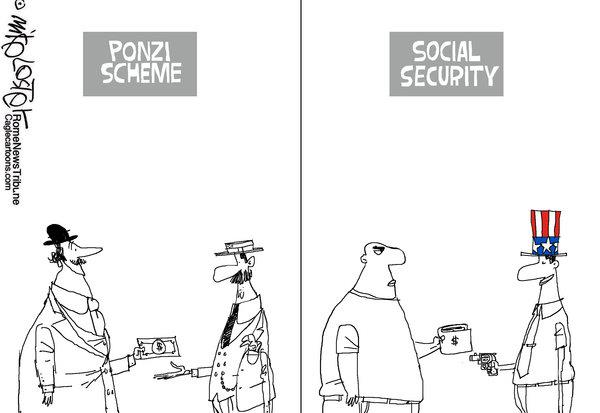
P.S. If you need to be cheered up after reading this post, here’s a good cartoon showing the difference between Social Security and a Ponzi scheme, and here’s another cartoon showing what inspired Bernie Madoff to steal so much money.

.


New Video shows how Obama has run up the national debt

We got to stop all the red ink.

The burden of federal spending in the United States was down to 18.2 percent of gross domestic product when Bill Clinton left office.

But this progress didn’t last long. Thanks to George Bush’s reckless spending policies, the federal budget grew about twice as fast as the economy, jumping by nearly 90 percent in just eight years This pushed federal spending up to about 25 percent of GDP.

President Obama promised hope and change, but he has kept spending at this high level rather than undoing the mistakes of his predecessor.

This new video from the Center for Freedom and Prosperity Foundation uses examples of waste, fraud, and abuse to highlight President Obama’s failed fiscal policy.

Published on Aug 12, 2012 by

This mini-documentary from the Center for Freedom and Prosperity Foundation highlights egregious examples of wasteful spending from the so-called stimulus legislation and explains why government spending hurts economic performance.

____________________

Good stuff, though the video actually understates the indictment against Obama. There is no mention, for instance, about all the new spending for Obamacare that will begin to take effect over the next few years.

But not everything can be covered in a 5-minute video. And I suspect the video is more effective because it closes instead with some discussion of the corrupt insider dealing of Obama’s so-called green energy programs.

Open letter to President Obama (Part 124)

President Obama c/o The White House
1600 Pennsylvania Avenue NW
Washington, DC 20500

Dear Mr. President,

I know that you receive 20,000 letters a day and that you actually read 10 of them every day. I really do respect you for trying to get a pulse on what is going on out here.

Why raise taxes when we have not made real cuts yet? By the way we are about to run out of money!!!!

Question for Leftists: What Happens When There’s Nothing Left to Steal?

December 4, 2011 by Dan Mitchell

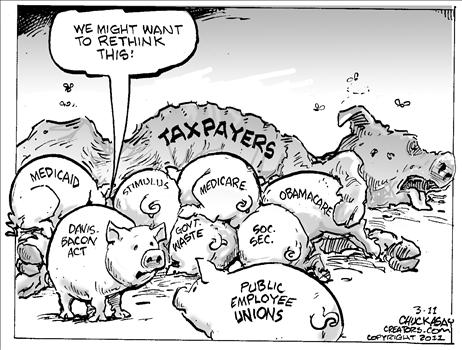
More than two years ago, I explained in a TV interview that the looters and moochers should be careful that they don’t kill the geese that lay the golden eggs. After all, parasites need a healthy host.

The collapse of Europe’s welfare states should be a wake-up call for these people, but that hasn’t stopped the demands for more redistribution in Washington. As Michael Barone noted, the folks on the left assume that there will always be someone to plunder.

But at least the piglets in this Chuck Asay cartoon are finally waking up to reality.

Unfortunately, I don’t expect the crowd in Washington to change. Most politicians don’t think more than a couple of years into the future, so they will continue to lure more people into riding in the wagon and continue to penalize those who pull the wagon.

This won’t end well.

_______________

Thank you so much for your time. I know how valuable it is. I also appreciate the fine family that you have and your commitment as a father and a husband.

Sincerely,

Everette Hatcher III, 13900 Cottontail Lane, Alexander, AR 72002, ph 501-920-5733, lowcostsqueegees@yahoo.com

Clinton spent 19.8% of GDP while Obama average is 24.4%

Spending Restraint, Part I: Lessons from Ronald Reagan and Bill Clinton

Uploaded by on Feb 14, 2011

Ronald Reagan and Bill Clinton both reduced the relative burden of government, largely because they were able to restrain the growth of domestic spending. The mini-documentary from the Center for Freedom and Prosperity uses data from the Historical Tables of the Budget to show how Reagan and Clinton succeeded and compares their record to the fiscal profligacy of the Bush-Obama years.

____________

Why do people want us to believe that President Obama wants to get us back to the way it was under President Clinton when in fact Clinton spent 19.8% of GDP while President Obama’s average is 24.4%

Obama Is No Clinton

by Michael D. Tanner

Michael Tanner is a senior fellow at the Cato Institute and author of Leviathan on the Right: How Big-Government Conservatism Brought Down the Republican Revolution.

Added to cato.org on August 8, 2012

This article appeared on National Review (Online) on August 8, 2012.

Lately President Obama has done everything except seduce an intern in his attempt to morph into Bill Clinton. In virtually every speech, he invokes Clinton’s name, trying to link his policies with those of the popular former president. He has even called upon Clinton to place Obama’s name in nomination at the Democratic National Convention.

But, try as he might, Barack Obama, is no Bill Clinton.

President Obama says that he wants to raise taxes back to the level they were under Clinton, but that’s not quite true. Under President Obama’s proposal, the top tax bracket would be raised to 39.6 percent. The president has also called for phasing out high-income taxpayers’ itemized deductions, adding another 1.2 percentage points to the effective tax rate, bringing it to 40.8 percent. Add in the 2.9 percent Medicare tax and the top marginal rate would be 43.7 percent, roughly equal to what it was during the Clinton years. But Obamacare would increase the Medicare tax for high-wage earners to 3.8 percent, pushing the top marginal tax rate under the Obama plan to 44.6 percent, nearly a full point higher than it was under Clinton.

The same is true for capital-gains taxes, interest, and other investment income. President Obama, who once famously said he favored higher capital-gains taxes even if they resulted in decreased revenue, would raise taxes on investment income from the current 15 percent to the 2002 level of 21.2 percent. But that number ignores the 3.8 percent Unearned Income Medicare Contribution (UIMC) tax on interest and capital gains that was imposed by Obamacare. Thus, President Obama would really raise taxes on investment income to 25 percent, much higher than they were under PresidentClinton.

Our current president wants to tax and spend even more than Clinton did.

Or look at it another way: During the eight years of the Clinton presidency, federal tax revenue averaged 19 percent of GDP. If President Obama gets all the tax hikes he wants, taxes would rise to at least 19.8 percent of GDP, and possibly higher.

We should also note that the economic climate was very different during the Clinton administration. Driven in part by the dot-com bubble, the economy was booming. One might argue that it would have been even better had Clinton not raised taxes, but the economy was still able to handle it. In contrast, our current economy is a mess, balancing on the edge of a double-dip recession, with unemployment stuck above 8 percent. That is why, in a moment of candor, even Clinton has argued against raising taxes now.

Perhaps an argument could be made for Clinton-era tax levels, though, if one also had Clinton-era spending levels. Under President Clinton, federal spending averaged 19.8 percent of GDP and actually hit a low of just 18.3 percent. In contrast, spending under President Obama over the past four years has averaged 24.4 percent of GDP. And going forward, the president’s proposed budgets would never spend less than 22 percent of GDP.

As a result, at least some of the revenue from Clinton’s tax hikes actually was used to reduce the national debt. President Obama’s tax increases, on the other hand, would simply fund more federal spending.

It may well be true that President Clinton would never have shown such budget discipline in the absence of a Republican Congress, but the fact is that there was far more spending restraint during the Clinton years than under either of his successors. Indeed, if the post-Clinton budget had simply grown at the rate of inflation plus population, federal spending this year would be roughly $1 trillion less than it is today. Of course, some of the blame for the current level of spending belongs to President Bush, but President Obama has doubled down on Bush’s profligacy, including by converting one-time Bush spending, such as TARP, into permanent spending.

In the end, President Obama would increase taxes more than Bill Clinton did, and cut spending a lot less.

President Clinton was also willing to consider reform of entitlement programs. Indeed, before the Lewinsky scandal forced Clinton to shore up his left flank to protect himself from impeachment, he was even receptive to the idea of allowing younger workers to privately invest a portion of their payroll taxes through personal accounts. Can anyone imagine President Obama, even for a moment, considering a similarly radical overhaul of Social Security or Medicare?

Of course, the signature accomplishment of the Clinton administration was welfare reform. This too may have been pushed on him by a Republican Congress, but President Clinton not only signed it, he embraced it. President Obama has not only increased total welfare spending by $193 billion since taking office, he has actively worked to dismantle the 1996 welfare reform act. His first stimulus bill included funding to help states pay for additional welfare recipients and eliminated many of the incentives that had encouraged states to reduce their welfare rolls. More recently, the Obama administration has announced plans to waive many of welfare reform’s work requirements.

In fact, even rhetorically Obama and Clinton head in different directions. In the wake of the Republican victory in 1994, Clinton declared, “The era of big government is over.” President Obama argues that “the danger of too much government is matched by the perils of too little.”

Given the last twelve years, a little Clinton nostalgia is understandable. But Bill Clinton will not be on the ballot this fall. Barack Obama will be, and that is a big difference.

The real truth about the financial condition of Social Security can be seen on the www.thedailyhatch.org

Uploaded by on Jan 8, 2009

Professor Williams explains what’s ahead for Social Security

If you want to know the real truth about the financial condition of Social Security then check out these links below:

Ark Times reader says Social Security is not Ponzi Scheme

Social Security is a Ponzi Scheme but Blake who is a blogger said I was off base. Ark Times reader says Social Security is not Ponzi Scheme Social Security Disaster Walter E. Williams Columnist, Townhall.com Politicians who are principled enough to point out the fraud of Social Security, referring to it as a lie and […]

Social Security is a Ponzi scheme that needs to be reformed

We got to do something soon about Social Security. The Case for Social Security Personal Accounts Posted by Daniel J. Mitchell There are two crises facing Social Security. First the program has a gigantic unfunded liability, largely caused by demographics. Second, the program is a very bad deal for younger workers, making them pay record […]

Senator Obama’s ideas on Social Security

Senator Obama’s Social Security Tax Plan Uploaded by afq2007 on Jul 23, 2008 In addition to several other tax increases, Senator Barack Obama wants to increase the Social Security payroll tax burden by imposing the tax on income above $250,000. This would be a sharp departure from current law, which only requires that the tax […]

Social Security is a Ponzi scheme (part 13)

Saving Social Security with Personal Retirement Accounts Uploaded by afq2007 on Jan 10, 2011 There are two crises facing Social Security. First the program has a gigantic unfunded liability, largely thanks to demographics. Second, the program is a very bad deal for younger workers, making them pay record amounts of tax in exchange for comparatively meager benefits. This […]

What does the Heritage Foundation have to say about saving Social Security:Study released May 10, 2011 (Part 7)

“Saving the American Dream: The Heritage Plan to Fix the Debt, Cut Spending, and Restore Prosperity,” Heritage Foundation, May 10, 2011 by  Stuart Butler, Ph.D. , Alison Acosta Fraser and William Beach is one of the finest papers I have ever read. Over the next few days I will post portions of this paper, but […]

Only difference between Ponzi scheme and Social Security is you can say no to Ponzi Scheme jh2d

Is Social Security  a Ponzi Scheme? I just started a series on this subject. In this article below you will see where the name “Ponzi scheme” came from and if it should be applied to the Social Security System. Ponzi! Ponzi! Ponzi! 9/14/2011 | Email John Stossel | Columnist’s Archive Ponzi! Ponzi! Ponzi! There, I […]

Social Security a Ponzi scheme?

Uploaded by LibertyPen on Jan 8, 2009 Professor Williams explains what’s ahead for Social Security Dan Mitchell on Social Security I have said that Social Security is a Ponzi scheme and sometimes you will hear someone in the public say the same thing. Yes, It Is a Ponzi Scheme by Michael D. Tanner Michael Tanner […]

Dan Mitchell on Social Security


Dan Mitchell of Cato Institute discusses Paul Ryan VP pick

I respect the Cato Institute and especially Dan Mitchell and here is an article he just wrote:

The honest answer is that it probably means nothing. I don’t think there’s been an election in my lifetime that was impacted by the second person on a presidential ticket.

And a quick look at Intrade.com shows that Ryan’s selection hasn’t (at least yet) moved the needle. Obama is still in the high 50s.

Moreover, the person who becomes Vice President usually plays only a minor role in Administration policy.

With those caveats out of the way, the Ryan pick is mostly good news.

Here are the reasons why I’m happy.

Here are two reasons why I’m worried.

  • Both Romney and Ryan are somewhat sympathetic to a value-added tax. My worst-case scenario is they win the election, but then can’t get a good budget approved because of some squishy Republican senators who put self interest above national interest. Romney and Ryan then decide that this European-style national sales tax is the only way – on paper – of making the budget balance. In reality, of course, we’ll suffer the same fate as Europe since the VAT revenues will be used to finance ever-larger government.
  • Ryan has some very bad votes in his past, including support for TARP, the auto bailout, the no-bureaucrat-left-behind education legislation, and the reckless Medicare prescription drug entitlement. Everyone says to ignore those votes because Ryan knew he was voting the wrong way, but if he’s already made some deliberately bad decisions for political reasons, what’s to stop him from making more deliberately bad decisions for political reasons?

But as I said above, don’t read too much into Ryan’s selection. if Republicans win, Romney will be the one calling the shots.

Though this does give Ryan a big advantage the next time there’s an open contest for the GOP nomination – either 2016 or 2020.

P.S. I suspect putting Ryan on the ticket will shift Wisconsin into the GOP column. Based on my last prediction, that would be enough to defeat Obama. But I’ll have to contemplate whether the pick hurts Romney’s chances in another state. You’ll have to wait until September 6 for my updated election prediction.

P.P.S. For those who care about politics, some are saying that selecting Ryan was risky because it gives Obama and his allies an opportunity to demagogue the GOP ticket about entitlement reform. I disagree. Even if Romney picked Nancy Pelosi, that demagoguery was going to happen. Heck, they’ve already accused Romney of causing a woman’s death, so I hardly think they’ll be bashful about throwing around other accusations.

Related posts:

Churches, not the government, have traditionally helped the poor in the long history of the USA

If you look at the first 150 years of our nation’s history you will find practically no welfare or assistance to the poor coming from the government. In fact, most of the help came from local churches. During the last few decades the government had created the welfare trap that robs people of responsibility to […]

Obamacare: A Medicaid Monster

Cato’s Michael F. Cannon Discusses ObamaCare’s Individual Mandate Uploaded by catoinstitutevideo on Mar 26, 2012 http://www.cato.org/event.php?eventid=9074 The individual mandate to purchase health insurance is the linchpin of the Patient Protection and Affordable Care Act. It is among the issues to be handled by the Supreme Court beginning March 26, 2012. Michael F. Cannon is the […]

Taxed Enough Already? Just wait until Obamacare kicks in

Tim Sandefur Discusses ObamaCare’s Medicaid Expansion Uploaded by catoinstitutevideo on Mar 26, 2012 http://www.cato.org/event.php?eventid=9074 Tim Sandefur of the Pacific Legal Foundation explains some of the implications of the Affordable Care Act’s Medicaid expansion. ___________________ Obamacare will tax us to death. Here is a chart from the Heritage Foundation: Created on March 23, 2012 DOWNLOAD HIGH-RES […]

Interview with Paul Ryan

Rep. Paul Ryan’s Budget Problem – CBN.com A biblical justification for getting our spending in order. Subsidiarity: An Important Principle in Federal Budget Debates Ryan Messmore April 16, 2012 at 1:00 pm How should one’s faith shape his or her engagement in the policy arena? Political Correspondent David Brody recently asked that question of House […]

Obama wants to claim Reagan again

  I have a son named Wilson Daniel Hatcher and he is named after two of the most respected men I have ever read about : Daniel from the Old Testament and Ronald Wilson Reagan. One of the thrills of my life was getting to hear President Reagan speak in the beginning of November of […]

Obama is easy to make fun of at times

Exempting half the people from paying income tax does not seem like a bright idea. President Obama has a funny way of spinning that.  Dan Mitchell’s blog has a good way of presenting that. Obama’s Understanding of Taxation, Captured by a Cartoon July 11, 2011 by Dan Mitchell I’ve already posted on Obama’s class-warfare approach to […]

Dan Mitchell of the Cato Institute on President Obama’s “Social Darwinism speech”

Dan Mitchell of the Cato Institute rightly has pointed out that President Obama is off base to be critical of Paul Ryan’s budget since it allows the government to grow by over 3% each year and he wished that the Republicans would taking a sharper knife to the budget cuts!!!! Appearing on PBS to Debate […]

Open letter to President Obama (Part 123)

President Obama c/o The White House
1600 Pennsylvania Avenue NW
Washington, DC 20500

Dear Mr. President,

I know that you receive 20,000 letters a day and that you actually read 10 of them every day. I really do respect you for trying to get a pulse on what is going on out here.

I got to see Arthur Laffer speak in 1981 in Memphis and he predicted what would happen the next few years with tax revenue as a result of the Reagan Tax Cuts and he was right on every prediction. Why do you continue to say that this has been tried before and does not work?

I’ve explained that it is silly for Obama and others to think it is easy to squeeze more money from rich taxpayers, and I’ve also provided evidence from the 1980s to show that upper-income people have considerable ability to respond to changes in tax rates by shifting the timing, level, and composition of their income.

But I haven’t specifically responded to some recent studies which make rather outlandish claims that the revenue-maximizing tax rate is 70 percent or above.

Fortunately, my Cato colleague Alan Reynolds has stepped forward. His column in today’s Wall Street Journal decimates these assertions.

President Obama and others are demanding that we raise taxes on the “rich,” and two recent academic papers that have gotten a lot of attention claim to show that there will be no ill effects if we do. The first paper, by Peter Diamond of MIT and Emmanuel Saez of the University of California, Berkeley, appeared in the Journal of Economic Perspectives last August. The second, by Mr. Saez, along with Thomas Piketty of the Paris School of Economics and Stefanie Stantcheva of MIT, was published by the National Bureau of Economic Research three months later. Both suggested that federal tax revenues would not decline even if the rate on the top 1% of earners were raised to 73%-83%.

How do they arrive at such high numbers? Alan explains.

The authors arrive at their conclusion through an unusual calculation of the “elasticity” (responsiveness) of taxable income to changes in marginal tax rates. According to a formula devised by Mr. Saez, if the elasticity is 1.0, the revenue-maximizing top tax rate would be 40% including state and Medicare taxes. That means the elasticity of taxable income (ETI) would have to be an unbelievably low 0.2 to 0.25 if the revenue-maximizing top tax rates were 73%-83% for the top 1%. The authors of both papers reach this conclusion with creative, if wholly unpersuasive, statistical arguments.

Is this assumption warranted? Hardly. Alan elaborates, making the same points I’ve made about rich people being different than the rest of us.

But the ETI for all taxpayers is going to be lower than for higher-income earners, simply because people with modest incomes and modest taxes are not willing or able to vary their income much in response to small tax changes. So the real question is the ETI of the top 1%. Harvard’s Raj Chetty observed in 2009 that “The empirical literature on the taxable income elasticity has generally found that elasticities are large (0.5 to 1.5) for individuals in the top percentile of the income distribution.” In that same year, Treasury Department economist Bradley Heim estimated that the ETI is 1.2 for incomes above $500,000 (the top 1% today starts around $350,000).

Alan cites other studies as well, all of which show that Saez, Piketty, Diamond, and Stantcheva, are well outside the mainstream.

For all intents and purposes, they cherry-picked data and made unrealistic assumptions in order to justify class-warfare tax policies.

That’s why you’re much better off looking at this research from economists at the University of Chicago and the Federal Reserve. Heck, even the IMF is acknowledging that it’s self-defeating to raise tax rates in a nation like Greece – and top tax rates there are less than 50 percent.

P.S. Lest I forget, it’s also worth mentioning that it’s a very bad idea to be at the revenue-maximizing spot on the Laffer Curve. The economic damage, per dollar raised, is enormous. And that’s true whether the revenue-maximizing rate is 20 percent or 70 percent.

_____________

Thank you so much for your time. I know how valuable it is. I also appreciate the fine family that you have and your commitment as a father and a husband.

Sincerely,

Everette Hatcher III, 13900 Cottontail Lane, Alexander, AR 72002, ph 501-920-5733, lowcostsqueegees@yahoo.com
Five Key Reasons to Reject Class-Warfare Tax Policy

Five Key Reasons to Reject Class-Warfare Tax Policy

Uploaded by on Jun 15, 2009

President Obama and other politicians are advocating higher taxes, with a particular emphasis on class-warfare taxes targeting the so-called rich. This Center for Freedom and Prosperity Foundation video explains why fiscal policy based on hate and envy is fundamentally misguided. For more information please visit our web page: www.freedomandprosperity.org.

Is soaking the rich fair?

Soaking the Rich Is Not Fair

by Jeffrey A. Miron

Jeffrey A. Miron is Senior Lecturer and Director of Undergraduate Studies at Harvard University and Senior Fellow at the Cato Institute. Miron blogs at JeffreyMiron.com and is the author of Libertarianism, from A to Z.

Added to cato.org on September 2, 2011

This article appeared on The Huffington Post on September 2, 2011.

What is the “fair” amount of taxation on high-income taxpayers?

To liberals, the answer is always “more.” Liberals view high income — meaning any income that exceeds their own — as the result of luck or anti-social behavior. Hence liberals believe “fairness” justifies government-imposed transfers from the rich to everyone else. Many conservatives accept this view implicitly. They oppose soak-the-rich policies because of concern over growth, but they do not dispute whether such policies are fair.

But high tax rates on the rich are not fair or desirable for any other reason; they are an expression of America’s worst instincts, and their adverse consequences go beyond their negatives for economic growth.

The liberal hatred of the rich is a minority view, not a widely shared American value.

Consider first the view that differences in income result from luck rather than hard work: some people are born with big trust funds or innate skill and talent, and these fortuitous differences explain much of why some people have higher incomes than others.

Never mind that such a characterization is grossly incomplete. Luck undoubtedly explains some income differences, but this is not the whole story. Many trust fund babies have squandered their wealth, and inborn skill or talent means little unless combined with hard work.

But even if all income differences reflect luck, why are government-imposed “corrections” fair? The fact that liberals assert this does not make it true, any more than assertions to the contrary make it false. Fairness is an ill-defined, infinitely malleable concept, readily tailored to suit the ends of those asserting fairness, independent of facts or reason.

Worse, if liberals can assert a right to the wealth of the rich, why cannot others assert the right to similar transfers, such as from blacks to whites, Catholics to Protestants, or Sunni to Shia? Government coercion based on one group’s view of fairness is a first step toward arbitrary transfers of all kinds.

Now consider the claim that income differences result from illegal, unethical, or otherwise inappropriate behavior. This claim has an element of truth: some wealth results from illegal acts, and policies that punish such acts are appropriate.

But most inappropriate wealth accumulations results from bad government policies: those that restrict competition, enable crony capitalism, and hand large tax breaks to politically connected interest groups. These differences in wealth are a social ill, but the right response is removing the policies that promote them, not targeting everyone with high income.

The claim that soaking the rich is fair, therefore, has no basis in logic or in generating desirable outcomes; instead, it represents envy and hatred.

Why do liberals hate the rich? Perhaps because liberals were the “smart” but nerdy and socially awkward kids in high school, the ones who aced the SATs but did not excel at sports and rarely got asked to the prom. Some of their “dumber” classmates, meanwhile, went on to make more money, marry better-looking spouses, and have more fun.

Liberals find all this unjust because it rekindles their emotional insecurities from long ago. They do not have the honesty to accept that those with less SAT smarts might have other skills that the marketplace values. Instead, they resent wealth and convince themselves that large financial gains are ill-gotten.

Jeffrey A. Miron is Senior Lecturer and Director of Undergraduate Studies at Harvard University and Senior Fellow at the Cato Institute. Miron blogs at JeffreyMiron.com and is the author of Libertarianism, from A to Z.

More by Jeffrey A. Miron

The liberal views on fairness and redistribution are far more defensible, of course, when it comes to providing for the truly needy. Reasonable people can criticize the structure of current anti-poverty programs, or argue that the system is overly generous, or suggest that private charity would be more effective at caring for the least vulnerable.

The desire to help the poor, however, represents a generous instinct: giving to those in desperate situations, where bad luck undoubtedly plays a major role. Soaking the rich is a selfish instinct, one that undermines good will generally.

And most Americans share this perspective. They are enthusiastic about public and private attempt to help the poor, but they do not agree that soaking the rich is fair. That is why U.S. policy has rarely embraced punitive income taxation or an aggressive estate tax. Instead, Americans are happy to celebrate well-earned success. The liberal hatred of the rich is a minority view, not a widely shared American value.

For America to restore its economic greatness, it must put aside the liberal hatred of the rich and embrace anew its deeply held respect for success. If it does, America will have enough for everyone.