Category Archives: Cato Institute

Open letter to President Obama (Part 134 B)

President Obama c/o The White House
1600 Pennsylvania Avenue NW
Washington, DC 20500

Dear Mr. President,

I know that you receive 20,000 letters a day and that you actually read 10 of them every day. I really do respect you for trying to get a pulse on what is going on out here.

I feel so strongly about the evil practice of running up our national debt. I was so proud of Rep. Todd Rokita who voted against the Budget Control Act of 2011 on August 11, 2011. He made this comment: 

 For decades now, we have spent too much money on ourselves and have intentionally allowed our kids and grandkids to pay for it.  It is intergenerational theft—literally stealing from our best asset, our posterity.  The correct course of action, as I have said from the beginning, is to enact permanent and structural reform as the price for raising the debt ceiling.  Today’s bill does not do that.

Here he has called it for what it is: THEFT!!!

Ted DeHaven noted his his article, “Freshman Republicans switch from Tea to Kool-Aid,”  Cato Institute Blog, May 17, 2012:

This week the Club for Growth released a study of votes cast in 2011 by the 87 Republicans elected to the House in November 2010. The Club found that “In many cases, the rhetoric of the so-called “Tea Party” freshmen simply didn’t match their records.” Particularly disconcerting is the fact that so many GOP newcomers cast votes against spending cuts.

The study comes on the heels of three telling votes taken last week in the House that should have been slam-dunks for members who possess the slightest regard for limited government and free markets. Alas, only 26 of the 87 members of the “Tea Party class” voted to defund both the Economic Development Administration and the president’s new Advanced Manufacturing Technology Consortia program (see my previous discussion of these votes here) and against reauthorizing the Export-Import Bank (see my colleague Sallie James’s excoriation of that vote here).

One of those Tea Party heroes was Congressman Todd Rokita of Indiana. Last year I posted this below concerning his conservative views and his willingness to vote against the debt ceiling increase:

Rokita Votes Against Debt Ceiling Increase

Aug 1, 2011 Issues: Spending Cuts and Debt


Rep. Todd Rokita voted against the Budget Control Act of 2011 because it fails to implement the long-term permanent and structural reforms necessary to put the nation back on a fiscally sustainable trajectory:

“I have heard a couple different definitions of leadership today.  Let me add mine: leadership is effectively persuading others of the proper course of action.  It is also about standing up for those who have no voice. For decades now, we have spent too much money on ourselves and have intentionally allowed our kids and grandkids to pay for it.  It is intergenerational theft—literally stealing from our best asset, our posterity.  The correct course of action, as I have said from the beginning, is to enact permanent and structural reform as the price for raising the debt ceiling.  Today’s bill does not do that.

This legislation is a Washington deal, and it barely begins to address our long-term spending problem. Our debt crisis is driven by mandatory spending on entitlement programs and this plan fails to address such spending.  Also, this plan only reduces the future debt we will pile on the backs of our kids from $10 trillion to around $7 trillion over the next decade.  It does not begin to reduce our $14 trillion in current debt. 

However, this legislation could eventually lead to the best permanent solution, a balanced budget amendment.  This is certainly worth fighting for and I will lead on that front.  But a vote alone is not worth the $2.5 trillion price tag, again to be paid by future generations. For that price, we should have required passage of a balanced budget amendment for state ratification.

I will continue to fight for a balanced budget amendment, lead our nation to live within its means and tackle out-of-control entitlement spending. It will be a long fight, but the enactment of a balanced budget amendment is the only way to fix the broken system that created this mess, both addressing our long-term fiscal health and giving Americans long-term peace of mind.”  

_______________

Thank you so much for your time. I know how valuable it is. I also appreciate the fine family that you have and your commitment as a father and a husband.

Sincerely,

Everette Hatcher III, 13900 Cottontail Lane, Alexander, AR 72002, ph 501-920-5733, lowcostsqueegees@yahoo.com
Videos by Cato Institute on failed stimulus plans

In this post I have gathered several videos from the Cato Institute concerning the subject of failed stimulus plans.

_____

Government Spending Doesn’t Create Jobs

Uploaded by on Sep 7, 2011

Share this on Facebook: http://on.fb.me/qnjkn9 Tweet it: http://tiny.cc/o9v9t

In the debate of job creation and how best to pursue it as a policy goal, one point is forgotten: Government doesn’t create jobs. Government only diverts resources from one use to another, which doesn’t create new employment.

Video produced by Caleb Brown and Austin Bragg.

___________________________

Keynesian Catastrophe: Big Money, Big Government & Big Lies

Uploaded by on Jan 19, 2012

The Cato Institute’s Dan Mitchell explains why Obama’s stimulus was a flop! With Glenn Reynolds.

See more at http://www.pjtv.com and http://www.cato.org

___________________

Keynesian Economics Is Wrong: Bigger Gov’t Is Not Stimulus

Uploaded by on Dec 15, 2008

Based on a theory known as Keynesianism, politicians are resuscitating the notion that more government spending can stimulate an economy. This mini-documentary produced by the Center for Freedom and Prosperity Foundation examines both theory and evidence and finds that allowing politicians to spend more money is not a recipe for better economic performance.

___________________

Obama’s So-Called Stimulus: Good For Government, Bad For the Economy

Uploaded by on Jan 26, 2009

President Obama wants Congress to dramatically expand the burden of government spending. This CF&P Foundation mini-documentary explains why such a policy, based on the discredited Keynesian theory of economics, will not be successful. Indeed, the video demonstrates that Obama is proposing – for all intents and purposes – to repeat Bush’s mistakes. Government will be bigger, even though global evidence shows that nations with small governments are more prosperous.

____________

Big Government Is Not Stimulus: Why Keynes Was Wrong (The Condensed Version)

Uploaded by on Jan 13, 2009

The CF&P Foundation has released a condensed version of our successful mini-documentary explaining why so-called stimulus schemes do not work. Based on a theory known as Keynesianism, politicians are resuscitating the notion that more government spending can stimulate an economy. This mini-documentary produced by the Center for Freedom and Prosperity Foundation examines both theory and evidence and finds that allowing politicians to spend more money is not a recipe for better economic performance.

_________________

Eight Reasons Why Big Government Hurts Economic Growth

Uploaded by on Aug 17, 2009

This Center for Freedom and Prosperity Foundation video analyzes how excessive government spending undermines economic performance. While acknowledging that a very modest level of government spending on things such as “public goods” can facilitate growth, the video outlines eight different ways that that big government hinders prosperity. This video focuses on theory and will be augmented by a second video looking at the empirical evidence favoring smaller government.

___________________

Keynesian Economics Is Wrong: Economic Growth Causes Consumer Spending, Not the Other Way

Uploaded by on Nov 29, 2010

Politicians and journalists who fixate on consumer spending are putting the cart before the horse. Consumer spending generally is a consequence of growth, not the cause of growth. This Center for Freedom and Prosperity video helps explain how to achieve more prosperity by looking at the differences between gross domestic product and gross domestic income. www.freedomandprosperity.org

_____________

Deficits, Debts and Unfunded Liabilities: The Consequences of Excessive Government Spending

Uploaded by on May 10, 2010

Huge budget deficits and record levels of national debt are getting a lot of attention, but this video explains that unfunded liabilities for entitlement programs are Americas real red-ink challenge. More important, this CF&P mini-documentary reveals that deficits and debt are symptoms of the real problem of an excessive burden of government spending. www.freedomandprosperity.org

___________

Now that I have been critical of the Democrat President, I wanted to show that I am not concerned about taking up for Republicans but looking at the facts. President Clinton did increase government spending at a slower rate than many other presidents. Here are two  videos that praise both Reagan and Clinton for both accomplished this feat.

Spending Restraint, Part I: Lessons from Ronald Reagan and Bill Clinton

Uploaded by on Feb 14, 2011

Ronald Reagan and Bill Clinton both reduced the relative burden of government, largely because they were able to restrain the growth of domestic spending. The mini-documentary from the Center for Freedom and Prosperity uses data from the Historical Tables of the Budget to show how Reagan and Clinton succeeded and compares their record to the fiscal profligacy of the Bush-Obama years.

______________

Spending Restraint, Part II: Lessons from Canada, Ireland, Slovakia, and New Zealand

Uploaded by on Feb 22, 2011

Nations can make remarkable fiscal progress if policy makers simply limit the growth of government spending. This video, which is Part II of a series, uses examples from recent history in Canada, Ireland, Slovakia, and New Zealand to demonstrate how it is possible to achieve rapid improvements in fiscal policy by restraining the burden of government spending. Part I of the series examined how Ronald Reagan and Bill Clinton were successful in controlling government outlays — particularly the burden of domestic spending programs. www.freedomandprosperity.org

______________

It seems that liberals will never wake up. On 3-8-12 a Arkansas Times blogger pointed out that Obama’s stimulus in 2009 was not made up of just increased but also tax cuts. That is true but the real truth is that there have been about 1/2 dozen stimulus efforts by President Obama and all of them have failed.  Over and over they have tried stimulus plans but they don’t work. Take a look at this excellent article from the Cato Institute:

Keynesian Policies Have Failed

by Chris Edwards

Chris Edwards is the director of tax policy studies at the Cato Institute and the editor of Downsizing Government.org.

Added to cato.org on December 2, 2011

This article appeared on U.S. News & World Report Online on December 2, 2011

Lawmakers are considering extending temporary payroll tax cuts. But the policy is based on faulty Keynesian theories and misplaced confidence in the government’s ability to micromanage short-run growth.

In textbook Keynesian terms, federal deficits stimulate growth by goosing “aggregate demand,” or consumer spending. Since the recession began, we’ve had a lot of goosing — deficits were $459 billion in 2008, $1.4 trillion in 2009, $1.3 trillion in 2010, and $1.3 trillion in 2011. Despite that huge supposed stimulus, unemployment remains remarkably high and the recovery has been the slowest since World War II.

Policymakers should ignore the Keynesians and their faulty models, and instead focus on reforms to aid long-run growth…

Yet supporters of extending payroll tax cuts think that adding another $265 billion to the deficit next year will somehow spur growth. That “stimulus” would be on top of the $1 trillion in deficit spending that is already expected in 2012. Far from helping the economy, all this deficit spending is destabilizing financial markets, scaring businesses away from investing, and imposing crushing debt burdens on young people.

For three years, policymakers have tried to manipulate short-run economic growth, and they have failed. They have put too much trust in macroeconomists, who are frankly lousy at modeling the complex workings of the short-run economy. In early 2008, the Congressional Budget Office projected that economic growth would strengthen in subsequent years, and thus completely missed the deep recession that had already begun. And then there was the infamously bad projection by Obama’s macroeconomists that unemployment would peak at 8 percent and then fall steadily if the 2009 stimulus plan was passed.

Chris Edwards is the director of tax policy studies at the Cato Institute and the editor of Downsizing Government.org.


More by Chris Edwards

Some of the same Keynesian macroeconomists who got it wrong on the recession and stimulus are now claiming that a temporary payroll tax break would boost growth. But as Stanford University economist John Taylor has argued, the supposed benefits of government stimulus have been “built in” or predetermined by the underlying assumptions of the Keynesian models.

Policymakers should ignore the Keynesians and their faulty models, and instead focus on reforms to aid long-run growth, which economists know a lot more about. Cutting the corporate tax rate, for example, is an overdue reform with bipartisan support that would enhance America’s long-run productivity and competitiveness.

If Congress is intent on cutting payroll taxes, it should do so within the context of long-run fiscal reforms. One idea is to allow workers to steer a portion of their payroll taxes into personal retirement accounts, as Chile and other nations have done. That reform would feel like a tax cut to workers because they would retain ownership of the funds, and it would begin solving the long-term budget crisis that looms over the economy.

Related posts:

Stimulus plans do not work (part 2)

Dan Mitchell discusses the effectiveness of the stimulus Uploaded by catoinstitutevideo on Nov 3, 2009 11-2-09 When I think of all our hard earned money that has been wasted on stimulus programs it makes me sad. It has never worked and will not in the future too. Take a look at a few thoughts from […]

Stimulus plans do not work (Part 1)

Government Spending Doesn’t Create Jobs Uploaded by catoinstitutevideo on Sep 7, 2011 Share this on Facebook: http://on.fb.me/qnjkn9 Tweet it: http://tiny.cc/o9v9t In the debate of job creation and how best to pursue it as a policy goal, one point is forgotten: Government doesn’t create jobs. Government only diverts resources from one use to another, which doesn’t […]

Dumas thinks we don’t need Balanced Budget Amendment but should balance it on our own

In his recent article Ernie Dumas sticks to his guns that we should balance the budget without being forced to with a “Balanced Budget Amendment,” but I wonder how well that has worked so far? I have made this a key issue for this blog in the past as you can tell below: Dear Senator […]

Maybe the “Occupy Wall Street” crowd should be angry at Obama

(Picture from Arkansas Times Blog) When I think about all the anger and hate coming from the Occupy Wall Street crowd, I wonder if they have read this story below? Solyndra: Crooked Politics or Just Bad Economics? Posted by David Boaz Amy Harder has a good take on the Solyndra issue in National Journal Daily […]

Dear Senator Pryor, why not pass the Balanced Budget Amendment? (Part 13 Thirsty Thursday, Open letter to Senator Pryor)

Dear Senator Pryor, why not pass the Balanced Budget Amendment? (Part 13 Thirsty Thursday, Open letter to Senator Pryor) Office of the Majority Whip | Balanced Budget Amendment Video In 1995, Congress nearly passed a constitutional amendment mandating a balanced budget. The Balanced Budget Amendment would have forced the federal government to live within its […]

Mark Pryor not for President’s job bill even though he voted for it

Andrew Demillo pointed this out  and also Jason Tolbert noted: PRYOR OPPOSES THE OBAMA JOBS BILL THAT HE VOTED TO ADVANCE  Sen. Mark Pryor has been traveling around the state touting a six-part jobs plan that he says “includes a number of bipartisan initiatives, is aimed at creating jobs by setting the table for growth, encouraging new […]

Is a lack of money the problem for our public schools?

Is a lack of money the problem for our public schools? Everything You Need to Know About Public School Spending in Less Than 2½ Minutes Posted by Adam Schaeffer Neal McCluskey gutted the President’s new “Save the Teachers” American Jobs Act sales pitch a good while back, as did Andrew Coulson here. Thankfully, it seems […]

Dan Mitchell of the Cato Institute takes on entitlement reform

It is the elephant in the room that nobody wants to talk about. Here Dan Mitchell takes it on.

Most people have a vague understanding that America has a huge long-run fiscal problem.

They’re right, though they probably don’t realize the seriousness of that looming crisis.

Here’s what you need to know: America’s fiscal crisis is actually a spending crisis, and that spending crisis is driven by entitlements.

More specifically, the vast majority of the problem is the result of Medicaid, Medicare, and Social Security, programs that are poorly designed and unsustainable.

America needs to fix these programs…or eventually become another Greece.

Fortunately, all of the problems can be solved, as these three videos demonstrate.

The first video explains how to fix Medicaid.

Promote Federalism and Replicate the Success of Welfare Reform with Medicaid Block Grants

Uploaded by on Jun 26, 2011

The Medicaid program imposes high costs while generating poor results. This Center for Freedom and Prosperity Foundation video explains how block grants, such as the one proposed by Congressman Paul Ryan, will save money and improve healthcare by giving states the freedom to innovate and compete.

The second video shows how to fix Medicare.

Saving Medicare: Free Market Reforms Are Better than Bureaucratic Rationing

Uploaded by on May 17, 2011

This Center for Freedom and Prosperity Foundation video explains how a “premium-support” plan would solve Medicare’s fiscal crisis and improve the overall healthcare system. This voucher-based system also would protect seniors from bureaucratic rationing. http://www.freedomandprosperity.org

And the final video shows how to fix Social Security.

Saving Social Security with Personal Retirement Accounts

Uploaded by on Jan 10, 2011

There are two crises facing Social Security. First the program has a gigantic unfunded liability, largely thanks to demographics. Second, the program is a very bad deal for younger workers, making them pay record amounts of tax in exchange for comparatively meager benefits. This video explains how personal accounts can solve both problems, and also notes that nations as varied as Australia, Chile, Sweden, and Hong Kong have implemented this pro-growth reform. www.freedomandprosperity.org

_______________________

Regular readers know I’m fairly gloomy about the future of liberty, but this is one area where there is a glimmer of hope.

The Chairman of the House Budget Committee actually put together a plan that addresses the two biggest problems (Medicare and Medicaid) and the House of Representatives actually adopted the proposal.

The Senate didn’t act, of course, and Obama would veto any good legislation anyhow, so I don’t want to be crazy optimistic. Depending on how things play out politically in the next six years, I’ll say there’s actually a 20 percent chance to save America.

Videos by Dan Mitchell of the Cato Institute found here on www.thedailyhatch.org

Dan Mitchell of the Cato Institute has some great videos and I have posted lots of them on my blog. I like to go to Dan’s blog too. Take a look at some of them below and then the links to my blog.

It’s Simple to Balance The Budget Without Higher Taxes

Uploaded by on Oct 4, 2010

Politicians and interest groups claim higher taxes are necessary because it would be impossible to cut spending by enough to get rid of red ink. This Center for Freedom and Prosperity video shows that these assertions are nonsense. The budget can be balanced very quickly by simply limiting the annual growth of federal spending.

_______

Six Reasons Why the Capital Gains Tax Should Be Abolished

Uploaded by on May 3, 2010

The correct capital gains tax rate is zero because there should be no double taxation of income that is saved and invested. This is why all pro-growth tax reform plans, such as the flat tax and national sales tax, eliminate the capital gains tax. Unfortunately, the President wants to boost the official capital gains tax rate to 20 percent, and that is in addition to the higher tax rate on capital gains included in the government-run healthcare legislation. http://www.freedomandprosperity.org


______________

Keynesian Economics Is Wrong: Bigger Gov’t Is Not Stimulus

Uploaded by on Dec 15, 2008

Based on a theory known as Keynesianism, politicians are resuscitating the notion that more government spending can stimulate an economy. This mini-documentary produced by the Center for Freedom and Prosperity Foundation examines both theory and evidence and finds that allowing politicians to spend more money is not a recipe for better economic performance.

___________________

Obama’s So-Called Stimulus: Good For Government, Bad For the Economy

Uploaded by on Jan 26, 2009

President Obama wants Congress to dramatically expand the burden of government spending. This CF&P Foundation mini-documentary explains why such a policy, based on the discredited Keynesian theory of economics, will not be successful. Indeed, the video demonstrates that Obama is proposing – for all intents and purposes – to repeat Bush’s mistakes. Government will be bigger, even though global evidence shows that nations with small governments are more prosperous.

____________

Big Government Is Not Stimulus: Why Keynes Was Wrong (The Condensed Version)

Uploaded by on Jan 13, 2009

The CF&P Foundation has released a condensed version of our successful mini-documentary explaining why so-called stimulus schemes do not work. Based on a theory known as Keynesianism, politicians are resuscitating the notion that more government spending can stimulate an economy. This mini-documentary produced by the Center for Freedom and Prosperity Foundation examines both theory and evidence and finds that allowing politicians to spend more money is not a recipe for better economic performance.

_________________

Eight Reasons Why Big Government Hurts Economic Growth

Uploaded by on Aug 17, 2009

This Center for Freedom and Prosperity Foundation video analyzes how excessive government spending undermines economic performance. While acknowledging that a very modest level of government spending on things such as “public goods” can facilitate growth, the video outlines eight different ways that that big government hinders prosperity. This video focuses on theory and will be augmented by a second video looking at the empirical evidence favoring smaller government.

___________________

Now that I have been critical of the Democrat President, I wanted to show that I am not concerned about taking up for Republicans but looking at the facts. President Clinton did increase government spending at a slower rate than many other presidents. Here are two  videos that praise both Reagan and Clinton for both accomplished this feat.

Spending Restraint, Part I: Lessons from Ronald Reagan and Bill Clinton

Uploaded by on Feb 14, 2011

Ronald Reagan and Bill Clinton both reduced the relative burden of government, largely because they were able to restrain the growth of domestic spending. The mini-documentary from the Center for Freedom and Prosperity uses data from the Historical Tables of the Budget to show how Reagan and Clinton succeeded and compares their record to the fiscal profligacy of the Bush-Obama years.

______________

Spending Restraint, Part II: Lessons from Canada, Ireland, Slovakia, and New Zealand

Uploaded by on Feb 22, 2011

Nations can make remarkable fiscal progress if policy makers simply limit the growth of government spending. This video, which is Part II of a series, uses examples from recent history in Canada, Ireland, Slovakia, and New Zealand to demonstrate how it is possible to achieve rapid improvements in fiscal policy by restraining the burden of government spending. Part I of the series examined how Ronald Reagan and Bill Clinton were successful in controlling government outlays — particularly the burden of domestic spending programs. www.freedomandprosperity.org

Here are some posts that include videos from Dan Mitchell:

Videos by Cato Institute on failed stimulus plans

In this post I have gathered several videos from the Cato Institute concerning the subject of failed stimulus plans. _____ Government Spending Doesn’t Create Jobs Uploaded by catoinstitutevideo on Sep 7, 2011 Share this on Facebook: http://on.fb.me/qnjkn9 Tweet it: http://tiny.cc/o9v9t In the debate of job creation and how best to pursue it as a policy […]

Balanced Budget Amendment the answer? Boozman says yes, Pryor no, Part 28 (Input from Norm Coleman, former Republican Senator from MN)

  It’s Simple to Balance The Budget Without Higher Taxes Steve Brawner in his article “Safer roads and balanced budgets,” Arkansas News Bureau, April 13, 2011, noted: The disagreement is over the solutions — on what spending to cut; what taxes to raise (basically none ever, according to Boozman); whether or not to enact a […]

Obama’s plan is not too smart on taxes

Dan Mitchell did a great article concerning the affect of raising taxes in these two areas and horrible results: How Can Obama Look at these Two Charts and Conclude that America Should Have Higher Double Taxation of Dividends and Capital Gains? Posted by Daniel J. Mitchell As discussed yesterday, the most important number in Obama’s […]

______________

Open letter to President Obama (Part 130)

President Obama c/o The White House
1600 Pennsylvania Avenue NW
Washington, DC 20500

Dear Mr. President,

I know that you receive 20,000 letters a day and that you actually read 10 of them every day. I really do respect you for trying to get a pulse on what is going on out here.

Why does the federal government have to take so much control of our lives? Back in 1929 the federal government spent 3% of GDP and now it spends 24.8%. Back then in 1929 there was 8.9% by State and local governments for a total of 11.9% and our freedom day was February 12th when we turn our attention to spending our money on the things we need. Now the government spends over 50% of our money and we don’t get our freedom day until sometime in July!!!

Milton Friedman on Tax Freedom Day

Posted by Chris Edwards

The Tax Foundation reported that Tuesday was Tax Freedom Day (TFD), which is the day that Americans stop “working for the government” through their tax payments and start working for themselves.

TFD is calculated by taking total federal, state, and local taxes and dividing by national income to get a ratio representing the share of income that the average person pays in all taxes. That ratio is applied to the 365-day calendar. This year the ratio is 29.2 percent, which translates into April 17 for TFD. Time to party!

But maybe not quite yet…

When I worked at Tax Foundation in 1993, I mailed a letter to Milton Friedman asking about his view on TFD. He kindly responded with a letter and a 1974 Newsweek article in which he proposed a “Personal Independence Day.” That day would be based on total government spending, which is larger than total taxes, and thus our day to celebrate freedom from the government hasn’t yet arrived this year.

In his letter to me, Friedman stressed that total spending is the important variable in assessing the burden of government: “If government spends an amount equal to 50 percent of the national income, only 50 percent is left to be available for private purposes, and that is true however the 50 percent that government spends is financed.” And while some economists focus on how government borrowing may “crowd out” private investment, Friedman said, “What does the crowding out is government spending, however financed, not government deficits.”

In its TFD report, Tax Foundation includes a supplemental calculation looking at spending. The thinktank figures that Americans will work until May 14 this year to be free from the burden of federal, state, and local spending. The Foundation is lacking a snappy name for that important day, but now we are reminded that Friedman has already suggested one.  

Friedman hoped that “Personal Independence Day” would complement our national Independence Day of July 4. The latter is the day we celebrate independence from the “Royal Brute of Britain,” as Tom Paine called him in Common Sense. But for Paine and the other Founders, the deeper goal of July 4, 1776 was to create a limited government to ensure the maximum space for the exercise of individual freedom. As Paine noted, private “society in every state is a blessing, but government, even in its best state, is but a necessary evil.”

So Milton Friedman’s Personal Independence Day can be our annual reminder that while our forefathers gave the boot to the “crowned ruffians” of Old Europe, we’ve still got work to do in limiting the power grabbing of our own elected ruffians in Washington.

__________

Thank you so much for your time. I know how valuable it is. I also appreciate the fine family that you have and your commitment as a father and a husband.

Sincerely,

Everette Hatcher III, 13900 Cottontail Lane, Alexander, AR 72002, ph 501-920-5733, lowcostsqueegees@yahoo.com

____________

Open letter to President Obama (Part 129)

Milton Friedman – The Welfare Establishment

Uploaded by on Apr 22, 2011

Professor Friedman looks at the dynamics of the welfare state.
http://www.LibertyPen.com

Source: Milton Friedman Speaks
Buy it: http://www.freetochoose.net/store/product_info.php?products_id=152

_______________

President Obama c/o The White House
1600 Pennsylvania Avenue NW
Washington, DC 20500

Dear Mr. President,

I know that you receive 20,000 letters a day and that you actually read 10 of them every day. I really do respect you for trying to get a pulse on what is going on out here.

Are we heading to Greece? It seems that a lot of people in Greece just sit around and wait for their government check to come in.

Christie the Prophet

by Michael D. Tanner

Michael Tanner is a senior fellow at the Cato Institute and author of Leviathan on the Right: How Big-Government Conservatism Brought Down the Republican Revolution.

Added to cato.org on April 18, 2012

This article appeared in National Review (Online) on April 18, 2012.

New Jersey governor Chris Christie recently warned that America is in danger of becoming a country of “people sitting on the couch waiting for their next government check.” Predictably, the Left was outraged, but Governor Christie wasn’t far off the mark.

During the 2011 debate over raising the debt ceiling, President Obama reminded Americans that the federal government sends out 70 million checks every month. That is probably an underestimate. According to the Washington Post, the president’s number included Social Security, veterans’ benefits, and spending on non-defense contractors and vendors, but not reimbursements to Medicare providers and vendors or electronic transfers to the 21 million households receiving food stamps. (Nor did he include most spending by the Defense Department, which has a payroll of 6.4 million active and retired employees and, on average, cuts checks for nearly 1 million invoices and 660,000 travel-expense claims per month.) The actual number might be closer to 200 million checks every month.

Of course it would be unfair to lump everyone who receives a check from the government in with the people Governor Christie was talking about (though it does say something about the size of government) but, nonetheless, we are becoming a society that relies on government to care for us.

[T]oday, every problem in society prompts calls for government action, response, or funding.

In 1965, just 22 percent of all federal spending was transfer payments. Today it has doubled to 44 percent. That means that nearly half of all federal spending is simply government taking money from one person and giving it to another.

Or look at it another way: In 1965, transfer payments from the federal government made up less than 10 percent of wages and salaries. As recently as 2000, that percentage was just 21 percent. Today, transfer payments are more than a third of salary and wages. Worse, if one includes salaries from government employment, more than half of Americans receive a substantial portion of their income from the government.

Conservatives often criticize transfer payments to the poor, and for good reason. At the federal and state levels combined, we spend nearly $1 trillion per year on anti-poverty or means-tested programs that do more to promote a permanent underclass than to eliminate poverty. But the modern welfare state is much more than programs for the poor. It includes middle-class welfare, such as Social Security and Medicare, which are the real drivers of our future national insolvency. We think of Medicaid as health care for the poor, but as much as two-thirds of Medicaid spending goes to pay for long-term care such as nursing homes for the elderly, much of it for middle-class people sheltering assets. And the modern welfare state also includes corporate welfare, the military-industrial complex, and others living off the taxpayer’s dime. The Export-Import Bank is as much welfare as TANF.

This is the road we are now on. The welfare state started with small programs targeted toward a small number of genuinely needy people. But as politicians figured out the electoral benefits of expanding programs and people realized they could let others work on their behalf, those programs grew until the point at which, today, every problem in society prompts calls for government action, response, or funding.

At the same time, as Governor Christie also noted, this implicitly tells people, “stop dreaming, stop striving.” We demonize those who do succeed, damning them as part of the evil “1 percent.”

This is the real danger of the welfare state. It’s not that it will bankrupt us — though it will. It is that it slowly and insidiously destroys our national character, saps our will to be great, and makes us content with the way things are rather than how they could be. We have seen where this road ends. As Governor Christie warns, it “will not just bankrupt us financially, it will bankrupt us morally.”

Biblical exegesis tells us that the Israelites needed to wander for 40 years in the desert after being released from bondage in Egypt because they couldn’t begin to build a new nation until a new generation grew up that hadn’t been raised in bondage. Those raised in slavery were not trained to think for themselves; they had become dependent on their masters to provide for them. Indeed, when they encountered hardships, many cried for a return to bondage.

Just look to Europe today. The welfare states of Europe are imploding, collapsing under the weight of promises that can no longer be met. Their citizens riot in the streets at the prospect that their government benefits might be reduced.

If anyone wants to know what this next election is really about, Governor Christie just told us.

_____________

Thank you so much for your time. I know how valuable it is. I also appreciate the fine family that you have and your commitment as a father and a husband.

Sincerely,

Everette Hatcher III, 13900 Cottontail Lane, Alexander, AR 72002, ph 501-920-5733, lowcostsqueegees@yahoo.com

Open letter to President Obama (Part 128)

Daniel J. Mitchell – USA: Drowning In Debt?

Uploaded by on Jun 1, 2009

Debating whether the United States has gone too far in accumulating debt, with Dan Mitchell, Cato Institute; Christian Weller, Center for American Progress; and CNBC’s Erin Burnett.

_______________

President Obama c/o The White House
1600 Pennsylvania Avenue NW
Washington, DC 20500

Dear Mr. President,

I know that you receive 20,000 letters a day and that you actually read 10 of them every day. I really do respect you for trying to get a pulse on what is going on out here.

Does anyone care about growing the economy anymore?

Economists often do a crummy job of teaching people about the impact of fiscal policy on the labor force, largely because we put people to sleep with boring discussions about “labor supply” decisions (my blog post from last year perhaps being an example of this tendency).

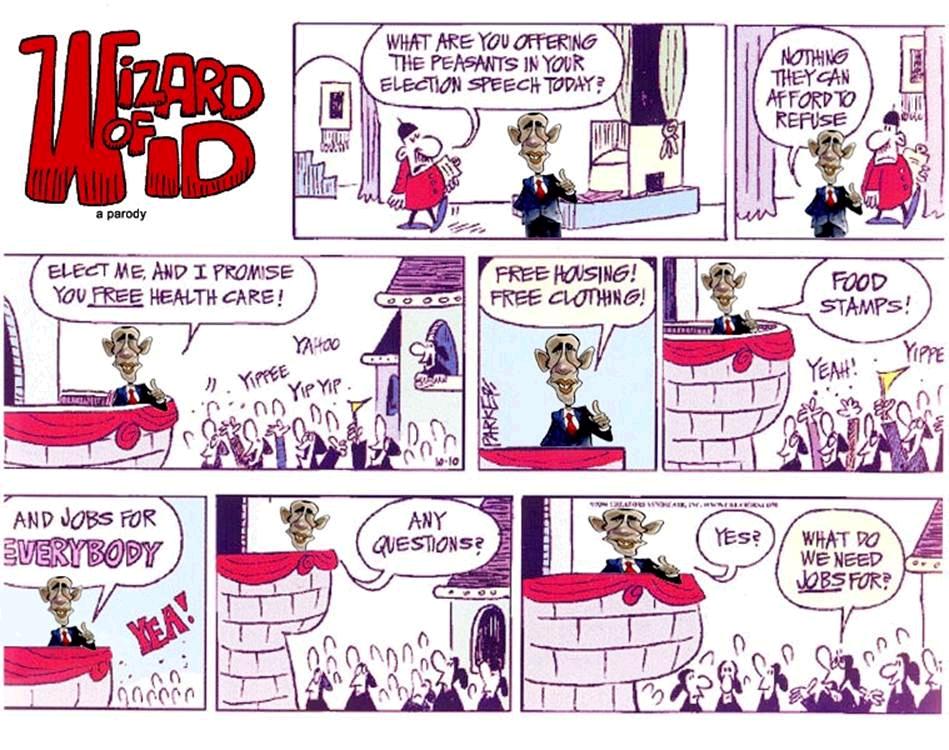
From now on, I will try to remember to use this cartoon. It’s a parody of Obama’s policies, but the last slide (or is it a panel?) is a great teaching tool about what happens when politicians turn the safety net into a hammock.

Thank you so much for your time. I know how valuable it is. I also appreciate the fine family that you have and your commitment as a father and a husband.

Sincerely,

Everette Hatcher III, 13900 Cottontail Lane, Alexander, AR 72002, ph 501-920-5733, lowcostsqueegees@yahoo.com

Daniel Mitchell on Paul Ryan’s budget

One thing that stands out about Dan Mitchell is that is not a Democrat or a Republican but a lover of freedom like Milton Friedman was. Take a look at this article of his below.

Posted by Ryan Minto on August 16, 2012

By DANIEL J. MITCHELL

Thanks to several years of fiscal restraint during the 1990s, the burden of federal spending dropped to 18.2% of gross domestic product by the time Bill Clinton left office. The federal budget today consumes more than 24% of economic output, a one-third increase since 2001 in the share of the U.S. economy allocated by politics rather than market forces. That makes the Republican House budget, which would reverse this trend, extremely important for the economic health of the country.

Both political parties deserve blame for the spending spree that’s put America in a fiscal ditch. President George W. Bush was a big spender and President Obama has compounded the damage with his stimulus spending and other programs.

But the era of bipartisan big government may have come to an end. Largely thanks to Rep. Paul Ryan and the fiscal blueprint he prepared as chairman of the House Budget Committee earlier this year, the GOP has begun climbing back on the wagon of fiscal sobriety and has shown at least some willingness to restrain the growth of government.

The Ryan budget has generated considerable controversy in Washington, and it will become even more of an issue now that Mr. Ryan is Mitt Romney’s running mate. So it’s an appropriate time to analyze the plan and consider what it would mean for America.

image

Chad Crowe

The most important headline about the Ryan budget is that it limits the growth rate of federal spending, with outlays increasing by an average of 3.1% annually over the next 10 years. If spending is left on autopilot, by contrast, it would grow by 4.3% (or nearly 39% faster). If President Obama is re-elected, the burden of spending presumably will climb more rapidly.

This comes as a surprise to many people since the press is filled with stories about the Ryan budget imposing trillions of dollars of “savage” and “draconian” spending cuts. All of these stories, however, are based on Washington’s misleading budget process that automatically assumes an ever-expanding government. The 4.3% “base line” increase is the benchmark for measuring “cuts”—even though spending is rising rather than falling, and it’s only the rate of spending growth that is being slowed.

Even limiting spending so it grows by 3.1% per year, as Mr. Ryan proposes, quickly leads to less red ink. This is because federal tax revenues are projected by the House Budget Committee to increase 6.6% annually over the next 10 years if the House budget is approved (and this assumes the Bush tax cuts are made permanent). Since revenues would climb more than twice as fast as spending, the deficit would drop to about 1% of gross domestic product by the end of the 10-year budget window.

To balance the budget within 10 years would require that outlays grow by about 2% each year. Spending in the Ryan budget means the federal budget reaches balance in 2040. There are many who would prefer that the deficit come down more quickly, but from a jobs and growth perspective, it isn’t the deficit that matters.

Rather, what matters for prosperity and living standards is the degree to which labor and capital are used productively. This is why policy makers should focus on reducing the burden of government spending as a share of GDP—leaving more resources in the private economy.

The simple way of making this happen is to follow what I’ve been calling the golden rule of good fiscal policy: The private sector should grow faster than the government. This is what happens with the Ryan budget. The Congressional Budget Office expects nominal economic output (before inflation) to grow about 5% each year over the next decade. So if federal spending grows 3.1% annually, the burden of federal spending slowly shrinks as a share of GDP.

According to the House Budget Committee, the federal budget would consume slightly less than 20% of economic output if the Ryan budget remained in place for 10 years. This would be remarkable progress considering that the federal government is now consuming 24% of GDP vs. Mr. Clinton’s 18.2% in 2001. If Paul Ryan’s policies are social Darwinism, as Mr. Obama and his allies allege, one can only speculate where Bill Clinton ranks in their estimation.

Spending restraint also creates more leeway for good tax policy. Regardless of what you think about deficits, the political reality is that it is difficult to lower tax rates if government borrowing remains at high or rising levels. If deficit spending continues at current levels, then higher tax rates are almost sure to follow. And higher tax rates can’t create an environment conducive to more investment and jobs.

The Ryan budget avoids this unpleasant outcome by addressing the problem of excessive government spending. This makes it possible to extend the 2001 and 2003 tax-rate reductions. It also clears the way for other pro-growth reforms, such as Gov. Romney’s proposed across-the-board 20% income tax cut, a more competitive 25% corporate tax rate, and less double-taxation of dividends and capital gains.

One of the best features of the Ryan budget is that he reforms the two big health entitlements instead of simply trying to save money. Medicaid gets block-granted to the states, building on the success of welfare reform in the 1990s. And Medicare is modernized by creating a premium-support option for people retiring in 2022 and beyond.

This is much better than the traditional Beltway approach of trying to save money with price controls on health-care providers and means testing on health-care consumers. Price controls are notoriously ineffective—because health-care providers adapt by ordering more tests and procedures—and politically unsustainable due to lobbying pressure. Means testing imposes an indirect penalty on people who save and invest during their working years. That should be a nonstarter for a political party that seeks to encourage productive behavior and discourage dependency.

But good entitlement policy also is a godsend for taxpayers, particularly in the long run. Without reform, the burden of federal spending will jump to 35% of GDP by 2040, compared to 18.75% of output under the Ryan budget.

Assuming the GOP ticket prevails in November, Mitt Romney will make the big decisions on fiscal policy. But there is no escaping the fiscal math. If Mr. Romney intends to keep his no-tax-hike promise, he has to restrain the growth of spending. This doesn’t mean he has to go with every detail of the Ryan budget—but it’s certainly a good place to start.

Mr. Mitchell is a senior fellow at the Cato Institute.

A version of this article appeared August 16, 2012, on page A11 in the U.S. edition of The Wall Street Journal, with the headline: What’s Really in the Ryan Budget.

The flat tax will grow the economy

If we want the economy to grow then we should look closely at a flat tax.

In previous posts, I put together tutorials on the Laffer Curve, tax competition, and the economics of government spending.

Today, we’re going to look at the issue of tax reform. The focus will be the flat tax, but this analysis applies equally to national sales tax systems such as the Fair Tax.

There are three equally important features of tax reform.

  1. A low tax rate – This is the best-known feature of tax reform. A low tax rate is designed to minimize the penalty of work, entrepreneurship, and productive behavior.
  2. No double taxation of saving and investment – All major tax reform plans, such as the flat tax and national sales tax, get rid of the tax bias against income that is saved and invested. The capital gains tax, double tax on dividends, and death tax are all abolished. Shifting to a system that taxes economic activity only one time will boost capital formation, thus facilitating an increase in productivity and wages.
  3. No distorting loopholes – With the exception of a family-based allowance designed to protect lower-income people, the main tax reform plans get rid of all deductions, exemptions, shelters, preference, exclusions, and credits. By creating a neutral tax system, this ensures that decisions are made on the basis of economic fundamentals, not tax distortions.

All three features are equally important, sort of akin to the legs of a stool. Using the flat tax as a model, this video provides additional details.

One thing I don’t mention in the video is that a flat tax is “territorial,” meaning that only income earned in the United States is taxed. This common-sense rule is the good-fences-make-good-neighbors approach. If income is earned by an American in, say, Canada, then the Canadian government gets to decide how it’s taxed. And if income is earned by a Canadian in America, then the U.S. government gets a slice.

It’s also worth emphasizing that the flat tax protects low-income Americans from the IRS. All flat tax plans include a fairly generous “zero-bracket amount,” which means that a family of four can earn (depending on the specific proposal) about $25,000-$35,000 before the flat tax takes effect.

Proponents of tax reform explain that there are many reasons to junk the internal revenue code and adopt something like a flat tax.

  • Improve growth – The low marginal tax rate, the absence of double taxation, and the elimination of distortions combine to create a system that minimizes the penalties on productive behavior.
  • Boost competitiveness – In a competitive global economy, it is easy for jobs and investment to cross national borders. The right kind of tax reform can make America a magnet for money from all over the world.
  • Reduce corruption – Tax preferences and penalties are bad for growth, but they are also one of the main sources of political corruption in Washington. Tax reform takes away the dumpster, which means fewer rats and cockroaches.
  • Promote simplicity – Good policy has a very nice side effect in that the tax system becomes incredibly simple. Instead of the hundreds of forms required by the current system, both households and businesses would need only a single postcard-sized form.
  • Increase privacy – By getting rid of double taxation and taxing saving, investment, and profit at the business level, there no longer is any need for people to tell the government what assets they own and how much they’re worth.
  • Protect civil liberties – A simple and fair tax system eliminates almost all sources of conflict between taxpayers and the IRS.

All of these benefits also accrue if the internal revenue code is abolished and replaced with some form of national sales tax. That’s because the flat tax and sales tax are basically different sides of the same coin. Under a flat tax, income is taxed one time at one low rate when it is earned. Under a sales tax, income is taxed one time at one low rate when it is spent.

Neither system has double taxation. Neither system has corrupt loopholes. And neither system requires the nightmarish internal revenue service that exists to enforce the current system.

This video has additional details – including the one caveat that a national sales tax shouldn’t be enacted unless the 16th Amendment is repealed so there’s no threat that politicians could impose both an income tax and sales tax.

Last but not least, let’s deal with the silly accusation that the flat tax is a risky and untested idea. This video is a bit dated (some new nations are in the flat tax club and a few have dropped out), but is shows that there are more than two dozen jurisdictions with this simple and fair tax system.

P.S. Fundamental tax reform is also the best way to improve the healthcare system. Under current law, compensation in the form of fringe benefits such as health insurance is tax free. Not only is it deductible to employers and non-taxable to employees, it also isn’t hit by the payroll tax. This creates a huge incentive for gold-plated health insurance policies that cover routine costs and have very low deductibles. This is a principal cause (along with failed entitlement programs such as Medicare and Medicaid) of the third-party payer crisis. Shifting to a flat tax means that all forms of employee compensation are taxed at the same low rate, a reform that presumably over time will encourage both employers and employees to migrate away from the inefficient over-use of insurance that characterizes the current system. For all intents and purposes, the health insurance market presumably would begin to resemble the vastly more efficient and consumer-friendly auto insurance and homeowner’s insurance markets.

P.P.S. If you want short and sweet descriptions of the major tax reform plans, here are four highly condensed descriptions of the flat tax, national sales tax, value-added tax, and current system.

Open letter to President Obama (Part 126)

Uploaded by on Jan 18, 2009

Margaret Thatcher’s last House of Commons Speech on November 22, 1990.

________________

President Obama c/o The White House
1600 Pennsylvania Avenue NW
Washington, DC 20500

Dear Mr. President,

I know that you receive 20,000 letters a day and that you actually read 10 of them every day. I really do respect you for trying to get a pulse on what is going on out here.

Prime Minister Margaret Thatcher:

People on all levels of income are better off than they were in 1979. The hon. Gentleman is saying that he would rather that the poor were poorer, provided that the rich were less rich. That way one will never create the wealth for better social services, as we have. What a policy. Yes, he would rather have the poor poorer, provided that the rich were less rich. That is the Liberal policy.

__________

No wonder Ronald Wilson Reagan (who I named my son Wilson after) and Prime Minister Thatcher were good friends. They both saw through the motives of the liberals.

I shared an amazing video last year featuring Margaret Thatcher exposing the left for wanting to keep the poor destitute if that was the price of hurting the so-called rich.

Deroy Murdock makes similar points in a great column for National Review.

For too many liberals like Obama, “fairness” is not about enriching the modest; it’s about impoverishing the moneyed. Multibillionaire Warren Buffett has energized liberals with his still-unverified claim that his tax rate lags his secretary’s. …Somehow, reducing the secretary’s taxes never came up. Instead liberals demand the so-called Buffett Rule, an instrument for bludgeoning the successful rather than boosting the downtrodden. …Here’s how the Right should challenge the Left: “If you dislike income inequality, lift those with the least. Let’s adopt universal school choice, allow personal Social Security retirement accounts (to democratize long-term capital accumulation), radically reduce or eliminate America’s anti-competitive 35 percent corporate tax (to supercharge businesses), and pass right-to-work laws (so the jobless won’t fester outside closed shops). Let’s build the Keystone Pipeline (to create 20,000 blue-collar positions right now and lower everyone’s energy costs), frack for natural gas, and tame the EPA, OSHA, SEC, and other power-mad bureaucracies, so U.S. companies will stay here, and foreign firms will move in.”

Needless to say, the left will not accept Deroy’s challenge.

Too many of them care about enriching teacher unions, for instance, more than they care about educational opportunity for poor children.

And most leftist leaders would like to impose higher tax rates on success, even if the government collects less revenue.

__________

Thank you so much for your time. I know how valuable it is. I also appreciate the fine family that you have and your commitment as a father and a husband.

Sincerely,

Everette Hatcher III, 13900 Cottontail Lane, Alexander, AR 72002, ph 501-920-5733, lowcostsqueegees@yahoo.com