Category Archives: Cato Institute

Open letter to President Obama (Part 142 B)

President Obama c/o The White House
1600 Pennsylvania Avenue NW
Washington, DC 20500

Dear Mr. President,

I know that you receive 20,000 letters a day and that you actually read 10 of them every day. I really do respect you for trying to get a pulse on what is going on out here.

This excessive spending by Washington today is not responsible government in action.

Obama’s Comments: A Gift that Keeps on Giving

Posted by Roger Pilon

Today POLITICO Arena asks:

Does Senator Grassley’s tweet, that the American people “r not stupid as this x prof of con law,” make an important point or was it disrespectful? Is this a sign that Obama’s Supreme Court comments won’t be going away?

There’s enough disrespect to go around – for the president (Grassley), for the Supreme Court (Obama). It’s the larger question about Obama’s comments on the Court and the Constitution that’s more important, because it’s not going away, and for good reason. Look no further than to this morning’s Washington Post, where E.J. Dionne Jr. is falling all over himself in defense of Obama. After the Court’s oral arguments over ObamaCare, it’s finally dawning on modern liberals that their project for ubiquitous government is under serious political and even legal attack, so they’re fighting back.

Like others in the liberal establishment last week, Dionne links Obama’s and Franklin Roosevelt’s attacks on the Court. But he links those in turn to Obama’s ”social Darwinism” attack next day on the Ryan-Romney budget — a budget, Dionne writes, that would cut back “student loans, medical and scientific research grants, Head Start, feeding programs for the poor, and possibly even the weather service.” Indeed, it’s “so far to the right,” Obama said, that it makes the Republicans’ 1994 Contract With America “look like the New Deal.”

What Obama and his liberal apologists fail to accept, of course, is that their welfare-state project is spent, literally. They pose as defenders of welfare programs for the poor and, now, the middle class, while either ignoring the deficits and debt those programs have run up or, at best, arguing that taxing the rich will solve the problem, all evidence to the contrary notwithstanding. Thus the Democratic Senate has failed to pass a budget in over a thousand days, and no one gives the administration’s budget a moment’s thought. Their pose is just that, because unless we come to grips with these systemic problems, there will be no student loans, Head Start, and all the rest, because “entitlements” and service on the debt will consume everything, until they too will go by the way.

Our Constitution for limited government was written to avoid this dilemma. Roosevelt and his “Brain Trust” thought they were wiser than the Framers, much like today’s liberals. Grassley’s mistake was in choosing the wrong word. It’s not “stupid,” it’s “irresponsible.” Santa Claus comes only once a year. The rest of the year we have to behave like adults.

_______________

Thank you so much for your time. I know how valuable it is. I also appreciate the fine family that you have and your commitment as a father and a husband.

Sincerely,

Everette Hatcher III, 13900 Cottontail Lane, Alexander, AR 72002, ph 501-920-5733, lowcostsqueegees@yahoo.com

I have posted many times about the overspending in Washington. Here are a few of those posts listed below:

Conan hires comics to invent mythical wasteful programs

Sometimes it is tragic that you got to laugh about it. Dear Conan, Reckless Government Spending Is Worse Than You Think Brandon Stewart August 10, 2011 at 7:31 pm Late-night comedian Conan O’Brien’s blog has a new post parodying Washington’s excessive spending. “Team Coco has found out why our government is so broke,” the blog explains, “They’ve […]

Stimulus did not work (Great advice from a letter to the editor series)

I read this letter below from the Arkansas Democrat Gazette on August 13,  2011: Time to stop insanity The president has told us for 2 1/2 years that he is focusing “like a laser” on jobs. Well, looks like it’s time to replace this “Jobs Guy” with someone who has actually had some experience running […]

Senator Pryor asks for Spending Cut Suggestions! Here are a few!(Part 142)

Senator Mark Pryor wants our ideas on how to cut federal spending. Take a look at this video clip below: Senator Pryor has asked us to send our ideas to him at cutspending@pryor.senate.gov and I have done so in the past and will continue to do so in the future. On May 11, 2011,  I emailed to […]

Listing of transcripts and videos of “Free to Choose” episode 4 – From Cradle to Grave on www.theDailyHatch.org

In the last few years the number of people receiving Food Stamps has skyrocketed. President Obama has not cut any federal welfare programs but has increased them, and he  has used class warfare over and over the last few months and according to him equality at the finish line is the equality that we should […]

Obama’s big government solutions have not worked

Government Spending Doesn’t Create Jobs Uploaded by catoinstitutevideo on Sep 7, 2011 Share this on Facebook: http://on.fb.me/qnjkn9 Tweet it: http://tiny.cc/o9v9t In the debate of job creation and how best to pursue it as a policy goal, one point is forgotten: Government doesn’t create jobs. Government only diverts resources from one use to another, which doesn’t […]

“Feedback Friday” Letter to White House generated form letter response Jan 25, 2011 (part 1)

I have been writing President Obama letters and have not received a personal response yet.  (He reads 10 letters a day personally and responds to each of them.) However, I did receive a form letter in the form of an email on January 25, 2011. I don’t know which letter of mine generated this response so I have […]

President Obama’s plan is failing and he is attacking all opposing plans

I really believe that we should balance the budget now!!! I really don’t understand how people can seriously think that bringing in 2.2 trillion while spending almost double that can continue very long without us heading to Greece. President Obama recently was critical of Paul Ryan’s plan and he said some very hateful words like […]

Dear Senator Pryor, why not pass the Balanced Budget Amendment? (“Thirsty Thursday”, Open letter to Senator Pryor)

Dear Senator Pryor, Why not pass the Balanced  Budget Amendment? As you know that federal deficit is at all time high (1.6 trillion deficit with revenues of 2.2 trillion and spending at 3.8 trillion). On my blog http://www.HaltingArkansasLiberalswithTruth.com I took you at your word and sent you over 100 emails with specific spending cut ideas. However, […]

Heritage Foundation Videos and Interviews are displayed on www.thedailyhatch.org

Sen. Mitch McConnell: Americans Don’t Approve of Anything Obama Has Done Uploaded by HeritageFoundation on Dec 8, 2011 In an exclusive interview at The Heritage Foundation, Senate Minority Leader Mitch McConnell (R-KY) sharply criticized President Obama for engaging in class warfare and accused him of shifting the focus away from his own failed policies in […]

Dan Mitchell of the Cato Institute on President Obama’s “Social Darwinism speech”

Dan Mitchell of the Cato Institute rightly has pointed out that President Obama is off base to be critical of Paul Ryan’s budget since it allows the government to grow by over 3% each year and he wished that the Republicans would taking a sharper knife to the budget cuts!!!! Appearing on PBS to Debate […]

Videos by Dan Mitchell of the Cato Institute found here on www.thedailyhatch.org

Dan Mitchell of the Cato Institute has some great videos and I have posted lots of them on my blog. I like to go to Dan’s blog too. Take a look at some of them below and then the links to my blog.

It’s Simple to Balance The Budget Without Higher Taxes

Uploaded by on Oct 4, 2010

Politicians and interest groups claim higher taxes are necessary because it would be impossible to cut spending by enough to get rid of red ink. This Center for Freedom and Prosperity video shows that these assertions are nonsense. The budget can be balanced very quickly by simply limiting the annual growth of federal spending.

_______

Six Reasons Why the Capital Gains Tax Should Be Abolished

Uploaded by on May 3, 2010

The correct capital gains tax rate is zero because there should be no double taxation of income that is saved and invested. This is why all pro-growth tax reform plans, such as the flat tax and national sales tax, eliminate the capital gains tax. Unfortunately, the President wants to boost the official capital gains tax rate to 20 percent, and that is in addition to the higher tax rate on capital gains included in the government-run healthcare legislation. http://www.freedomandprosperity.org


______________

Keynesian Economics Is Wrong: Bigger Gov’t Is Not Stimulus

Uploaded by on Dec 15, 2008

Based on a theory known as Keynesianism, politicians are resuscitating the notion that more government spending can stimulate an economy. This mini-documentary produced by the Center for Freedom and Prosperity Foundation examines both theory and evidence and finds that allowing politicians to spend more money is not a recipe for better economic performance.

___________________

Obama’s So-Called Stimulus: Good For Government, Bad For the Economy

Uploaded by on Jan 26, 2009

President Obama wants Congress to dramatically expand the burden of government spending. This CF&P Foundation mini-documentary explains why such a policy, based on the discredited Keynesian theory of economics, will not be successful. Indeed, the video demonstrates that Obama is proposing – for all intents and purposes – to repeat Bush’s mistakes. Government will be bigger, even though global evidence shows that nations with small governments are more prosperous.

____________

Big Government Is Not Stimulus: Why Keynes Was Wrong (The Condensed Version)

Uploaded by on Jan 13, 2009

The CF&P Foundation has released a condensed version of our successful mini-documentary explaining why so-called stimulus schemes do not work. Based on a theory known as Keynesianism, politicians are resuscitating the notion that more government spending can stimulate an economy. This mini-documentary produced by the Center for Freedom and Prosperity Foundation examines both theory and evidence and finds that allowing politicians to spend more money is not a recipe for better economic performance.

_________________

Eight Reasons Why Big Government Hurts Economic Growth

Uploaded by on Aug 17, 2009

This Center for Freedom and Prosperity Foundation video analyzes how excessive government spending undermines economic performance. While acknowledging that a very modest level of government spending on things such as “public goods” can facilitate growth, the video outlines eight different ways that that big government hinders prosperity. This video focuses on theory and will be augmented by a second video looking at the empirical evidence favoring smaller government.

___________________

Now that I have been critical of the Democrat President, I wanted to show that I am not concerned about taking up for Republicans but looking at the facts. President Clinton did increase government spending at a slower rate than many other presidents. Here are two  videos that praise both Reagan and Clinton for both accomplished this feat.

Spending Restraint, Part I: Lessons from Ronald Reagan and Bill Clinton

Uploaded by on Feb 14, 2011

Ronald Reagan and Bill Clinton both reduced the relative burden of government, largely because they were able to restrain the growth of domestic spending. The mini-documentary from the Center for Freedom and Prosperity uses data from the Historical Tables of the Budget to show how Reagan and Clinton succeeded and compares their record to the fiscal profligacy of the Bush-Obama years.

______________

Spending Restraint, Part II: Lessons from Canada, Ireland, Slovakia, and New Zealand

Uploaded by on Feb 22, 2011

Nations can make remarkable fiscal progress if policy makers simply limit the growth of government spending. This video, which is Part II of a series, uses examples from recent history in Canada, Ireland, Slovakia, and New Zealand to demonstrate how it is possible to achieve rapid improvements in fiscal policy by restraining the burden of government spending. Part I of the series examined how Ronald Reagan and Bill Clinton were successful in controlling government outlays — particularly the burden of domestic spending programs. www.freedomandprosperity.org

Here are some posts that include videos from Dan Mitchell:

Videos by Cato Institute on failed stimulus plans

In this post I have gathered several videos from the Cato Institute concerning the subject of failed stimulus plans. _____ Government Spending Doesn’t Create Jobs Uploaded by catoinstitutevideo on Sep 7, 2011 Share this on Facebook: http://on.fb.me/qnjkn9 Tweet it: http://tiny.cc/o9v9t In the debate of job creation and how best to pursue it as a policy […]

Balanced Budget Amendment the answer? Boozman says yes, Pryor no, Part 28 (Input from Norm Coleman, former Republican Senator from MN)

  It’s Simple to Balance The Budget Without Higher Taxes Steve Brawner in his article “Safer roads and balanced budgets,” Arkansas News Bureau, April 13, 2011, noted: The disagreement is over the solutions — on what spending to cut; what taxes to raise (basically none ever, according to Boozman); whether or not to enact a […]

Obama’s plan is not too smart on taxes

Dan Mitchell did a great article concerning the affect of raising taxes in these two areas and horrible results: How Can Obama Look at these Two Charts and Conclude that America Should Have Higher Double Taxation of Dividends and Capital Gains? Posted by Daniel J. Mitchell As discussed yesterday, the most important number in Obama’s […]

______________

Why do the liberals want to increase unemployment more by increasing minimum wage?

Williams with Sowell – Minimum Wage

Why do the liberals want to increase unemployment more by increasing minimum wage?

The unemployment rate has been stuck above 8 percent ever since Obama pushed through his ill-fated stimulus scheme to increase the burden of government spending.

This high level of joblessness presumably reduces Obama’s chances of getting reelected, so you would think that Democrats would be very leery of proposals that increase the cost of job creation.

Yet they’ve relentlessly pushed to subsidize unemployment, even though Paul Krugman and Larry Summers have acknowledged that unemployment insurance reduces the incentive to find a job.

Now there’s talk of pushing for a higher minimum wage. Here are some details from a report in The Hill.

Advocates pushing for a minimum wage increase are looking to turn it into an election-year issue as the campaign season heats up this fall. Such a hike is expected to be included in the Democrats’ 2012 platform — which will be presented to delegates at the party’s convention in Charlotte, N.C., next week — a member of the drafting committee told The Hill. …In the eyes of labor unions, consumer advocates and liberal Democrats, the strategy is a no-brainer in an election season that’s featured the birth of the Occupy Wall St. movement, questions about Mitt Romney’s financial practices and a highly partisan debate over which class of workers deserve an extended tax break next year. …A minimum wage hike is not without political risks, however, as Republicans and business groups are warning that such a move would burden small businesses amid an employment crisis when Congress is urging them to hire.

Regarding the last sentence in the excerpt, I agree that a minimum wage hike entails risk, but I fear those risks are to the economy rather than to politicians. Much to my dismay, a majority of voters generally support this misguided policy.

In my attempts to educate these misguided souls, I try to figure out why they favor certain policies. In the case of the minimum wage, this is my rough-draft list of why some people support this perverse form of government intervention.

1. They understand low-income people will suffer if the minimum wage is increased, but that is acceptable collateral damage in the quest for political power.

2. They understand low-income people will suffer in the short run, but they rationalize this harm because there will be more redistribution in the long run if they obtain political power.

3. They understand low-income people will suffer, but that is an acceptable price to pay since it means unions will have more negotiating leverage once low-income workers are priced out of the market.

4. They think low-income people will benefit because the economy is a fixed pie and a mandate to pay more to low-income workers will merely result in less income for the rich.

5. They think low-income people will benefit because of the magic of Keynesian economics – i.e., beneficiaries will have more income, which will then get spent, thus stimulating the economy.

6. They are impervious to evidence and instead are motivated solely by a sense that there should be a minimum income in a “fair” and “compassionate” society.

It’s quite possible, of course, for someone to support higher minimum wages for more than just one reason. Indeed, I suspect  supporters of the minimum wage can be divided into two groups. The politicians and union bosses tend to believe in higher minimum wages for reasons 1, 2, and 3, while ordinary people are likely to support intervention for reasons 4, 5, and 6.

But regardless of what they believe, they’re wrong. This Cato study has all the evidence you could possibly want. But if you don’t have time to read the paper, this video is well worth a few minutes of your time.

Uploaded by on Jun 14, 2010

Minimum wage laws seem like a good idea, but arbitrarily mandating a certain wage can have terrible consequences. This CF&P Foundation mini-documentary reveals that business are not charities, so if the minimum wage is set above the market level, this eliminates job opportunities — particularly for the less fortunate members of society. Since employees and employers should have freedom of contract, the right minimum wage is zero. http://www.freedomandprosperity.org

____________

Walter Williams also has weighed in on this issue, noting specifically the negative impact of higher minimum wages on minorities.

Sadly, this is one of those issues where it might not make a difference which party wins in November. Romney already has said he favors not only an increase in the minimum wage, but also indexing, which means automatic increases in the future.

P.S. Here’s a very good cartoon showing the impact of raising the minimum wage.

Thomas Sowell – Reducing Black Unemployment

Robin Hood was not a left-wing hero who stole from the rich and redistributed to the poor

Not many people know the truth about Robin Hood. Robin Hood was not a left-wing hero who stole from the rich and redistributed to the poor.

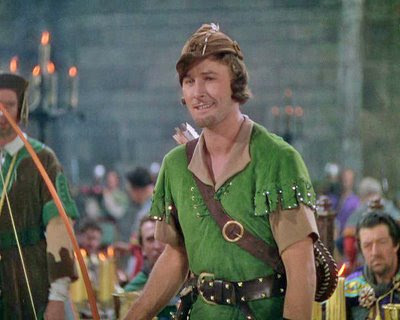
When I was a kid, I was a big fan of Robin Hood. I remember reading at least two books recounting the legend and I watched the Errol Flynn version of the movie several times.

And, as an adult, I saw both the Kevin Costner and Russell Crowe versions of Robin Hood.

“I’m not an occupy-Wall-Street moocher”

None of this makes me an expert, but it does allow me to state with some confidence that Robin Hood was not a left-wing hero who stole from the rich and redistributed to the poor.

Instead, he was a quasi-libertarian tax protestor. Okay, maybe it’s an exaggeration to claim he was a libertarian, but Robin Hood was on the side of ordinary people who were being exploited by incessant tax demands from the ruling class. His main enemies were Prince John and the Sheriff on Nottingham, not the medieval equivalents of Wall Street.

In the Russell Crowe version of the movie, Robin Hood even gives a speech about the importance of liberty.

So you can imagine how irked I get when statists agitate for things such as the “Robin Hood Tax” in this moronic video. But what motivated me today is a story in the Financial Times about a Cesar Chavez wannabee politician from Spain.

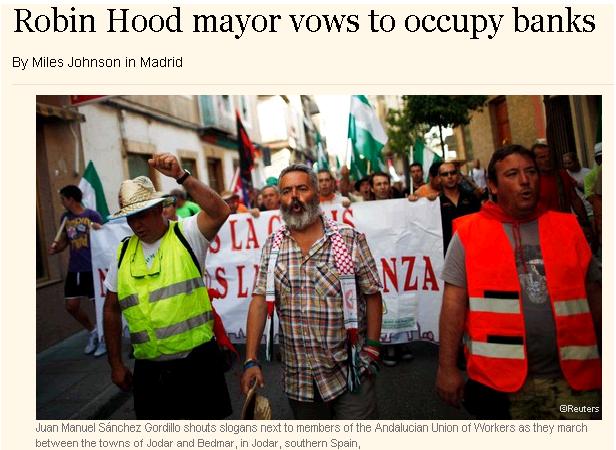
For Spain’s ruling politicians he is a criminal; for his supporters he is Robin Hood, stealing from supermarkets and redistributing the food to the poor. Juan Manuel Sánchez Gordillo, the mayor of Marinaleda, a southern town with a population of 2,600, has been catapulted to cult hero status in Spain after setting out this week on an anti-austerity march across Andalucia – occupying banks and stealing food… “We are fighting a war for the poor … going to jail is not important for me, it would be an honour,” Mr Sánchez Gordillo told the Financial Times. “We are going to occupy all of the banks and supermarkets we are able to in Andalucia. The robbers who have caused this crisis must pay the consequences for what they have done.”

But if the Mayor really wants to make robbers pay, he should march straight to jail and turn himself in. Not for the empty publicity stunt of robbing grocery stores, but for being part of a political class that has dramatically increased the burden of government spending in Spain, from about 30 percent of GDP in 1980 to well over 40 percent today.

But don’t hold your breath waiting for self-awareness from this clown.

Not surprisingly, unions are part of the protest. I’m guessing that Mr. Canamero represents government employees.

On Friday, the marchers, who plan to sleep in the open or in parks, occupied a branch of Banco Santander in the town of Mancha Real in the province of Jaén before leaving later in the day. Diego Canamero, head of the Andalucian Workers Union, was in the branch on Friday. He said critics of the protests were politicians protecting their own interests. “These are symbolic actions against an unsustainable economic situation,” he said. “The bankers rob us, and take our money to tax havens…”

The dig against tax havens is particularly laughable. Ordinary Spaniards should hope and pray that their deposits in the local banks are safely re-deposited in banks based in well-run and honest jurisdictions such as Switzerland, the Cayman Islands, or Singapore.

And if they’re smart, they already cut out the middleman and directly placed their savings in one of these low-tax jurisdictions. That way, they’re not only at much less risk of a bank collapse, but they also have greater ability to protect their assets from the venal and incompetent tax-hungry political elite.

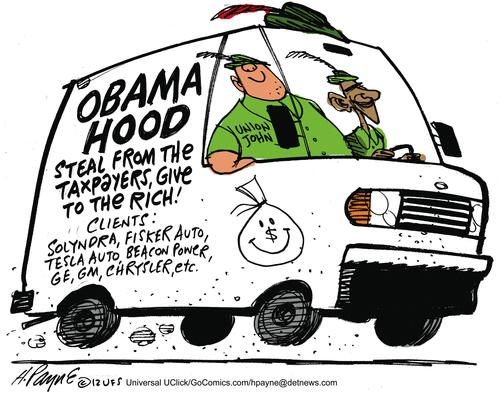
Returning to the mischaracterization of Robin Hood, this Payne cartoon does a good job of capturing my thoughts.

I especially like how Payne shows that the left-wing version of Robin Hood is all about a perniciously corrupt version of redistribution (though he should have included the Export-Import Bank on the side of the van). The genuine poor get crumbs while the well-connected interests make out like bandits.

P.S. Other good Payne cartoons can be seen here, here, herehereherehere, and here.

The real truth about the financial condition of Social Security can be seen on the www.thedailyhatch.org

Uploaded by on Jan 8, 2009

Professor Williams explains what’s ahead for Social Security

If you want to know the real truth about the financial condition of Social Security then check out these links below:

Ark Times reader says Social Security is not Ponzi Scheme

Social Security is a Ponzi Scheme but Blake who is a blogger said I was off base. Ark Times reader says Social Security is not Ponzi Scheme Social Security Disaster Walter E. Williams Columnist, Townhall.com Politicians who are principled enough to point out the fraud of Social Security, referring to it as a lie and […]

Social Security is a Ponzi scheme that needs to be reformed

We got to do something soon about Social Security. The Case for Social Security Personal Accounts Posted by Daniel J. Mitchell There are two crises facing Social Security. First the program has a gigantic unfunded liability, largely caused by demographics. Second, the program is a very bad deal for younger workers, making them pay record […]

Senator Obama’s ideas on Social Security

Senator Obama’s Social Security Tax Plan Uploaded by afq2007 on Jul 23, 2008 In addition to several other tax increases, Senator Barack Obama wants to increase the Social Security payroll tax burden by imposing the tax on income above $250,000. This would be a sharp departure from current law, which only requires that the tax […]

Social Security is a Ponzi scheme (part 13)

Saving Social Security with Personal Retirement Accounts Uploaded by afq2007 on Jan 10, 2011 There are two crises facing Social Security. First the program has a gigantic unfunded liability, largely thanks to demographics. Second, the program is a very bad deal for younger workers, making them pay record amounts of tax in exchange for comparatively meager benefits. This […]

What does the Heritage Foundation have to say about saving Social Security:Study released May 10, 2011 (Part 7)

“Saving the American Dream: The Heritage Plan to Fix the Debt, Cut Spending, and Restore Prosperity,” Heritage Foundation, May 10, 2011 by  Stuart Butler, Ph.D. , Alison Acosta Fraser and William Beach is one of the finest papers I have ever read. Over the next few days I will post portions of this paper, but […]

Only difference between Ponzi scheme and Social Security is you can say no to Ponzi Scheme jh2d

Is Social Security  a Ponzi Scheme? I just started a series on this subject. In this article below you will see where the name “Ponzi scheme” came from and if it should be applied to the Social Security System. Ponzi! Ponzi! Ponzi! 9/14/2011 | Email John Stossel | Columnist’s Archive Ponzi! Ponzi! Ponzi! There, I […]

Social Security a Ponzi scheme?

Uploaded by LibertyPen on Jan 8, 2009 Professor Williams explains what’s ahead for Social Security Dan Mitchell on Social Security I have said that Social Security is a Ponzi scheme and sometimes you will hear someone in the public say the same thing. Yes, It Is a Ponzi Scheme by Michael D. Tanner Michael Tanner […]

Dan Mitchell on Social Security


It is really simple after all to balance the budget according to Dan Mitchell of the Cato Institute

It is really simple after all to balance the budget according to Dan Mitchell of the Cato Institute.

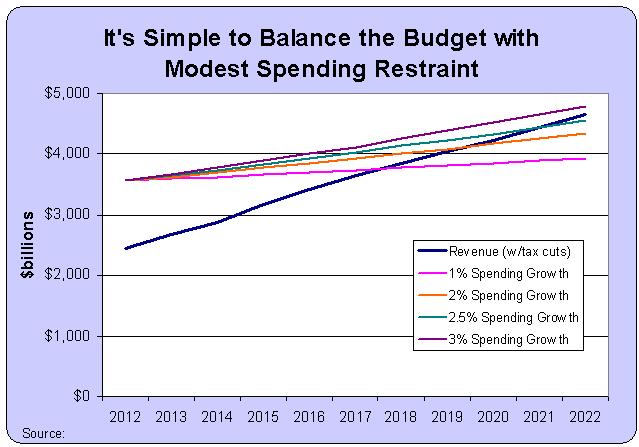
Now that new numbers have been released by the Congressional Budget Office, it’s time once again for me to show how easy it is to balance the budget with modest spending restraint (though please remember our goal should be smaller government, not fiscal balance).

  • I first did this back in September 2010, and showed that we could balance the budget in 10 years if federal spending was limited so it grew by 2 percent annually.
  • I repeated the exercise in January 2011 after new CBO numbers were released, and re-confirmed that a spending cap of 2 percent would eliminate red ink in just 10 years.
  • In August of that year, following the release of the CBO Update, I showed again that the budget could be balanced by limiting spending so it climbed by 2 percent per year.
  • Most recently, back in January after CBO produced the new Economic and Budget Outlook, I crunched the numbers again and showed how a spending cap of 2 percent would balance the budget.

I’m happy to say that the new numbers finally give me some different results. We can now balance the budget if spending grows 2.5 percent annually.

In other words, spending can grow faster than inflation and the budget can be balanced with no tax hikes.

And here’s the video I narrated almost two years ago on this topic. The numbers have changed a bit, but the analysis is exactly the same.

In other words, ignore the politicians, bureaucrats, lobbyists, and special interests when they say we have to raises taxes because otherwise the budget would have to be cut by trillions of dollars. They’re either stupid or lying (mostly the latter, deliberately using the dishonest version of Washington budget math).

Modest fiscal restraint is all that we need, though it would be preferable to make genuine cuts in the burden of government spending.

Don’t we want to cut taxes in order to grow the economy?

Don’t we want to cut taxes in order to grow the economy?

I was a bit surprised couple of years ago to read that an American company re-located to Canada to benefit from better tax policy.

But I wasn’t totally shocked by the news because Canada has been lowering tax rates, reducing the burden of government spending, and taking other steps to make its economy more competitive.

But I am downright stunned to learn that America’s high corporate tax rate is such an outlier that companies are even moving to welfare states such as the United Kingdom.

Here are some excerpts from a story in the Wall Street Journal.

More big U.S. companies are reincorporating abroad despite a 2004 federal law that sought to curb the practice. One big reason: Taxes. Companies cite various reasons for moving, including expanding their operations and their geographic reach. But tax bills remain a primary concern. … Aon plc…relocated to the U.K. in April. Aon has told analysts it expects to reduce its tax rate, which averaged 28% over the past five years, by five percentage points over time, which could boost profits by about $100 million annually. Since 2009, at least 10 U.S. public companies have moved their incorporation address abroad or announced plans to do so, including six in the last year or so, according to a Wall Street Journal analysis of company filings and statements. …Eaton, a 101-year-old Cleveland-based maker of components and electrical equipment, announced in May that it would acquire Cooper Industries PLC, another electrical-equipment maker that had moved to Bermuda in 2002 and then to Ireland in 2009. It plans to maintain factories, offices and other operations in the U.S. while moving its place of incorporation—for now—to the office of an Irish law firm in downtown Dublin. …Eaton’s chief executive, Alexander Cutler, has been a vocal critic of the corporate tax code. “We have too high a domestic rate and we have a thoroughly uncompetitive international tax regime,” Mr. Cutler said on CNBC in January. …In moving from Dallas to the U.K. in 2009, Ensco followed rivals such as Transocean Ltd., Noble Corp. and Weatherford International Ltd. that had relocated outside the U.S. The company said the move would help it achieve “a tax rate comparable to that of some of Ensco’s global competitors.”

Wow. I can understand moving to Ireland, with its 12.5 percent corporate tax rate, but I wouldn’t have thought that the U.K.’s 24 percent rate was overly attractive.

But compared to the punitive 35 percent rate in the United States, I guess 24 percent doesn’t look that bad.

So what’s the solution? The obvious answer is to lower the corporate tax rate. But it also would help to eliminate worldwide taxation, as noted in the article.

Lawmakers of both parties have said the U.S. corporate tax code needs a rewrite and they are aiming to try next year. One shared source of concern is the top corporate tax rate of 35%—the highest among developed economies. By comparison, Ireland’s rate is 12.5%. …Critics of the tax code also say it puts U.S. companies at a disadvantage because it taxes their profits earned abroad. Most developed countries tax only domestic earnings. While executives would welcome a lower tax rate and an end to global taxation, some worry their tax bills could rise under other measures that could be included in a tax-overhaul package.

Both Obama and Romney have said that they favor a slightly lower corporate rate, but I’m skeptical about their true intentions. In any event, neither one of them is talking about a low rate, perhaps 15 percent of below.

For more information, here’s my video on corporate taxation.

And the issue of worldwide taxation may sound arcane, but this video explains why it also is important.

Let’s close by noting that there are two obstacles to pro-growth reform. First, any good reform will deprive politicians of tax revenue. And since they’ve spent the country into a fiscal ditch, that makes it very difficult to enact legislation that – at least on paper – means less money flowing to Washington.

Second, politicians are very reluctant to lower tax rates on groups that can be demagogued, such as “rich people” and “big corporations.” This is the destructive mentality that drives class-warfare tax policy.

So America faces a choice. Jobs, investment, and growth or big government, class warfare, and stagnation. The solution should be obvious…unless you’re a politicians interested in preserving power in Washington.

When are we going to see real spending cuts?

Is Washington Bankrupting America?

Uploaded by on Apr 20, 2010

Be first to receive our videos and other timely info about economic policy. Subscribe at http://www.bankruptingamerica.org
————————-
According to a recent poll, 74 percent of likely voters are extremely or very concerned about the current level of government spending. And 58 percent think the level of spending is unsustainable.

Is the public right? Is Washington bankrupting America? Some facts from the video:

Spending per household has risen over 40 percent in the last 10 years and is set to do so again in the next 10 pushing debt (and interest on the debt) to unprecedented levels. But that’s just a result of PAST spending…

Our government owes $106 trillion in FUTURE spending commitments – that cannot be paid for.

We can solve it, but politicians will have to make tough choices. Increasing taxes can’t do the trick ($106 trillion is equivalent to taking all of the taxable income from every American nine times over), nor is it fair to saddle taxpayers with a problem created by government irresponsibility.

We need real spending reform. Merely returning to the spending per household levels of the 1990s would balance the budget in three years.

___________

When are we going to see REAL SPENDING CUTS? I am tired of this being talked about but not done.

I’m in Slovenia where I just finished indoctrinating educating a bunch of students on the importance of Mitchell’s Golden Rule as a means of restraining the burden of government spending.

And I emphasized that the fiscal problem in Europe is the size of government, not the fact that nations are having a hard time borrowing money. As explained in this video, spending is the disease and deficits are one of the symptoms.

This is also an issue in the United States, and Steve Moore of the Wall Street Journal is worried that the GOP ticket is debt-obsessed and doesn’t have sufficient enthusiasm for lower tax rates and tax reform.

Stylistically, Paul Ryan’s Republican convention speech last night was a grand slam. …But was it the growth message that supply-siders wanted to hear, or debt-clock obsession? There were clearly apocalyptic claims. “Before the math and the momentum overwhelm us all, we are going to solve this nation’s economic problems,” said Mr. Ryan in reference to the federal rea ink. “I’m going to level with you; we don’t have that much time.” …In fact, he talked about turning around the economy with “tax fairness.” Ugh, that’s an Obama term. …Larry Kudlow of CNBC and a former Reagan economist tells me, “Paul’s speech just didn’t have the growth, tax-cutting message. We didn’t even get the words tax reform. I don’t know what happened, but it worries me.” It’s a question of priorities. Are Mitt Romney and Paul Ryan signaling that they will put spending cuts ahead of pro-growth tax-rate cuts?

I share Steve’s concern, but with a twist.

I’m not worried that the Republicans will put spending cuts ahead of tax cuts. I’m worried that they won’t do spending cuts at all (even using the dishonest DC definition) and therefore wind up getting seduced into some sort of tax-increase deal that facilitates bigger government.

As a general rule, it is always good to do spending cuts (however defined). And it is always good to lower tax rates. And if you can do both at the same time, even better.

But since I have low expectations, I’ll be delighted if we “merely” manage to get entitlement reform during a Romney-Ryan Administration. That would mean some progress on the spending side and presumably reduce the risk of bad things (like a VAT!) on the revenue side.

Obama’s advice to other nations is keep government out of the way of private enterprise

Milton Friedman said that getting George Bush I to be Reagan’s vice president was his biggest mistake because he knew that Bush was not a true conservative and sure enough George Bush did raise taxes when he later became President. Below is a speech by George W. Bush honoring Milton Friedman:

Milton Friedman Honored for Lifetime Achievements 2002/5/9

_____________-

The USA’s grand economy was built by the free enterprise system and basically the government got out of the way most of the time. That is what works everywhere you have wealth built up. If socialists get their way then they will piggyback on the success the capitalists have created and many times when socialist policies take over things start to fall apart with the vast welfare states that are created. Take a look at this fine article by Dan Mitchell of the Cato Institute below.

To answer the question in the title, it means you need to read the fine print.

This is because we have a president who thinks the government shouldn’t confiscate more than 20 percent of a company’s income, but he only gives that advice when he’s in Ghana.

And the same president says it’s time to “let the market work on its own,” but he only says that when talking about China’s economy.

Now we have more evidence that the President understands the dangers of class-warfare taxation and burdensome government spending. At least when he’s not talking about American fiscal policy.

After the Greek elections, which saw the defeat of the pro-big government Syriza coalition and a victory for the supposedly conservative New Democracy Party, here’s some of what Politico reported.

President Barack Obama on Monday called the results of Greece’s election a “positive prospect” with the potential to form a government willing to cooperate with Europe.  “I think the election in Greece yesterday indicates a positive prospect for not only them forming a government, but also them working constructively with their international partners in order that they can continue on the path of reform and do so in a way that also offers the prospects for the Greek people to succeed and prosper,” Obama said after a meeting with the G-20 Summit’s host, Mexican President Felipe Calderon.

In other words, it’s “positive” when other nations reject big government and vote for right-of-center parties, but Heaven forbid that this advice apply to the United States.

Interestingly, it’s not just Obama who is rejecting (when talking about other nations) the welfare-state vision of bigger government and higher taxes.

Check out this remarkable excerpt from a Washington Post column by Larry Summers, the former Chairman of the President’s National Economic Council.

… it is far from clear, especially after the French election, that there is any kind of majority or even plurality support for responsible policies.

Remarkable. Larry Summers is dissing Francois Hollande and the French people by implying they want irresponsible policies, even though the Hollande’s views about Keynesian economics and soak-the-rich taxation are basically identical to the nonsense Summers was peddling while in the White House.

It’s almost enough to make you cynical about America’s political elite. Perish the thought!

Dear Senator Pryor, why not pass the Balanced Budget Amendment? (“Thirsty Thursday”, Open letter to Senator Pryor)

Office of the Majority Whip | Balanced Budget Amendment Video

In 1995, Congress nearly passed a constitutional amendment mandating a balanced budget. The Balanced Budget Amendment would have forced the federal government to live within its means. This Balanced Budget Amendment failed by one vote. 16 years later, Congress has the chance to get it right. Our time is now.

______________________

Dear Senator Pryor,

Why not pass the Balanced  Budget Amendment? As you know that federal deficit is at all time high (1.6 trillion deficit with revenues of 2.2 trillion and spending at 3.8 trillion).

On my blog www.HaltingArkansasLiberalswithTruth.com I took you at your word and sent you over 100 emails with specific spending cut ideas. However, I did not see any of them in the recent debt deal that Congress adopted. Now I am trying another approach. Every week from now on I will send you an email explaining different reasons why we need the Balanced Budget Amendment. It will appear on my blog on “Thirsty Thursday” because the government is always thirsty for more money to spend.

The Debt Ceiling and the Balanced Budget Amendment

Posted by David Boaz

The Washington Post editorializes:

A balanced-budget amendment would deprive policymakers of the flexibility they need to address national security and economic emergencies.

A fair point. Statesmen should have the ability to “address national security and economic emergencies.” But the same day’s paper included this graphic on the growth of the national debt:

National Debt

Does this look like the record of policymakers making sensible decisions, running surpluses in good year and deficits when they have to “address national security and economic emergencies”? Of course not. Once Keynesianism gave policymakers permission to run deficits, they spent with abandon year after year. And that’s why it makes sense to impose rules on them, even rules that leave less flexibility than would be ideal if you had ideal statesmen. Indeed, the debt ceiling itself should be that kind of rule, one that limits the amount of debt policymakers can run up. But it has obviously failed.

We’ve become so used to these stunning, incomprehensible, unfathomable levels of deficits and debt — and to the once-rare concept of trillions of dollars — that we forget how new all this debt is. In 1980, after 190 years of federal spending, the national debt was “only” $1 trillion. Now, just 30 years later, it’s sailing past $14 trillion.

Historian John Steele Gordon points out how unnecessary our situation is:

There have always been two reasons for adding to the national debt. One is to fight wars. The second is to counteract recessions. But while the national debt in 1982 was 35% of GDP, after a quarter century of nearly uninterrupted economic growth and the end of the Cold War the debt-to-GDP ratio has more than doubled.

It is hard to escape the idea that this happened only because Democrats and Republicans alike never said no to any significant interest group. Despite a genuine economic emergency, the stimulus bill is more about dispensing goodies to Democratic interest groups than stimulating the economy. Even Sen. Charles Schumer (D., N.Y.) — no deficit hawk when his party is in the majority — called it “porky.”

Annual federal spending rose by a trillion dollars when Republicans controlled the government from 2001 to 2007. It has risen another trillion during the Bush-Obama response to the financial crisis. So spending every year is now twice what it was when Bill Clinton left office. Republicans and Democrats alike should be able to find wasteful, extravagant, and unnecessary programs to cut back or eliminate. They could find some of them here in this report by Chris Edwards.

In the Kentucky Resolutions, Thomas Jefferson wrote, “In questions of power, then, let no more be heard of confidence in man, but bind him down from mischief by the chains of the Constitution.” Just so. When it becomes clear that Congress as a body cannot be trusted with the management of the public fisc, then bind them down with the chains of the Constitution, even — or especially — chains that deny them the flexibility they have heretofore abused.