Category Archives: Cato Institute

Must keep spending down

Got to get rid of all the huge increases in spending. Milton Friedman believed the Balanced Budget Amendment would be the best way to slow down government spending as long as it is tied to a percentage of GDP.

Below is an excellent article by Dan Mitchell on this issue of keeping government spending down.

I have many frustrations in my life, and near the top of the list is the conservative fixation about balancing the budget.

This view is very misguided. Red ink isn’t good, but the fiscal problem in America (as well as Europe, Japan, etc) is that the public sector is too big. Milton Friedman was right when he wrote, “I would rather have government spend one trillion dollars with a deficit of a half a trillion dollars than have government spend two trillion dollars with no deficit.”

To put it in simple terms, government spending is the disease and deficits and debt are the symptoms.

But even that analogy is inadequate. When politicians focus on borrowing rather than spending, it opens a door allowing the left to argue that tax increases are a solution.

Yet we know from historical experience that higher taxes encourage more spending and slow economic growth, and the combination of those two factors leads to more red ink.

Consider, for example, the experience in Europe. Beginning about 20 years ago with the adoption of the Maastricht Treaty, all members of the European Union agreed to limit annual budget deficits to 3 percent of GDP and total national debt to 60 percent of GDP.

And what happened after these rules were instituted? Well, according to data from the OECD, government got bigger, the tax burden rose, and there was more red ink.

Heck, the Europeans are in the middle of a fiscal crisis, so their rules to limit deficits and debt obviously haven’t been very successful.

Seems like maybe it’s time for them to realize that the problem is too much spending. But, no, that would make too much sense.

Amazingly, but not surprisingly, the Europeans now want to double-down on their failed policies by imposing, as part of a new fiscal pact, even more rules to supposedly control deficits and debt.

The EU Observer reports that: “Countries must introduce a ‘debt brake’ into their constitutions or at an “equivalent” legal level, requiring balanced budgets, which are defined as not exceeding deficits of 0.5 percent of GDP.” Furthermore, another EU Observer report says that “rules will have to include automatic correction mechanisms.” Knowing the mindset of the Euro-crats, this probably means automatic tax increases.

The obvious problem, of course, is that the Europeans have adopted the wrong measuring stick. When they talk about a “golden rule,” they mean limits on deficits and debt. Instead, they should be following Mitchell’s Golden Rule, which requires that government spending grow slower than the private economy.

This video is less than six minutes, but it provides all the key arguments about why the goal should be smaller government rather than fiscal balance.

Deficits are Bad, but the Real Problem is Spending

Uploaded by on Dec 15, 2009

Huge deficits and skyrocketing debt levels are creating considerable worry. This Center for Freedom and Prosperity Foundation video explains that that government borrowing is excessive – and will get worse in coming decades. But this mini-documentary explains that deficits and debt are merely the symptoms, and a rising burden of government spending is the real problem.

____________

Last but not least, it’s worth noting that Europe’s new fiscal agreement (assuming it ever gets implemented) is bound to fail. In part, this is because they are targeting red ink, which is the wrong variable.

But it’s also because the supposed enforcement mechanisms won’t work. The tentative pact assumes that European Commission bureaucrats in Brussels somehow will impose fiscal discipline.

To be more specific, a report in the EU Observer says: “The European Commission will carry a big stick: it will look at national budgets before national MPs and make demands.” Does anyone believe this will have any impact on Italian politicians?

And another story in the EU Observer notes: “Under the proposals, almost all fiscal policy-making would be taken out of the hands of national assemblies and delivered up to European civil servants.” Good luck with that. Does anyone think Spanish parliamentarians will cede budget authority to Brussels?

This is why I stand by my original arguments that bailouts won’t work and that a tough-love policy of benign neglect is the only feasible solution.
Why can’t we attack the debt and get rid of it?

It seems like everyone is not concerned with coming up with real solutions to our debt problem.

We Need a Better Debt Debate

by Michael D. Tanner

Michael Tanner is a senior fellow at the Cato Institute and author of Leviathan on the Right: How Big-Government Conservatism Brought Down the Republican Revolution.

Added to cato.org on October 10, 2012

This article appeared on National Review (Online) on October 10, 2012

If there was a bigger loser than President Obama on that Denver debate stage last week, it was the conversation about our national debt and the fiscal crisis threatening this country. Throughout the 90-minute debate, both candidates made frequent references to the deficit, the debt, or balancing the budget, but showed little willingness to actually do anything about it.

As of the night of the debate, last Wednesday, our national debt was $16.153 trillion. Let’s put that in perspective: The New York Yankees have the biggest payroll in baseball. For $16 trillion, you could pay the Yankees for 81,000 years, and still have money left over for a couple of free-agent pitchers. And, speaking of New York, $16 trillion could buy all the real estate in New York City — 20 times over. If we were to stack $16 trillion of one-dollar bills on a football field, it would cover the field to a depth of more than two miles. Alternatively, a single stack of 16 trillion one-dollar bills would be 1.085 million miles high, enough to reach the moon and back, twice over. If we were to pay our national debt back at the rate of $1 per second, we could wipe it out in a mere 507,000 years.

Beginning to get the idea? We are talking about a lot of money. Each American’s share of that debt is nearly $53,000.

Our official national debt numbers do not include the unfunded future liabilities of entitlement programs such as Social Security and Medicare. But even under the most optimistic projections, those liabilities, the difference between projected benefits and revenue, total more than $59 trillion. Other projections suggest that they could run to more than $111 trillion. Thus, our true debt actually is somewhere between $75 trillion and $127 trillion.

Romney and Obama didn’t seriously tackle debt and deficits in their first debate.

But in the face of this looming wave of red ink, both candidates more or less ducked.

Governor Romney laid down a useful marker, promising that he would cut any program that was not worth “borrowing money from China to pay for it.” Yet he was so unwilling to offend any potential voting group that he proposed no serious budget cuts. In fact, Romney seemed to spend most of his time explaining all the spending that he wouldn’t cut: defense spending, Medicare, Social Security, education spending; basically, nothing except Big Bird and Obamacare. Public broadcasting is certainly ripe for the cutting block, but given that PBS accounts for 0.01 percent of federal spending, we’ll still be doing a lot of borrowing from China.

Meanwhile, President Obama has not quite doubled the federal debt, as Governor Romney suggested, but he has increased it by $6 trillion during his first four years in office, compared to a $4.9 trillion increase over George Bush’s eight years. Instead, he attacked Romney for wanting to cut much of anything at all.

The president did trot out the old and discredited $4 trillion deficit-reduction plan that he has periodically offered over the past couple of years. But most of the spending cuts he vaguely hinted at were little more than smoke and mirrors: reductions already enacted as part of last year’s budget agreement, savings from previously scheduled pull-outs from Iraq and Afghanistan, interest savings from these budget gimmicks, etc.

The heart of the president’s plan was another call for raising taxes on the rich (and the not-quite-so rich, such as those earning $250,000 per year). But the president’s idea of balancing the budget on the backs of the evil 1 percent is as much of a myth as his proposed spending cuts. If the president received every penny in tax increases that he wants, he would raise roughly $390 billion annually. That might be enough to wreck the economy, but it isn’t going to come close to solving the problem. In fact, it will barely cover all the new spending that the president wants, let alone pay down the debt. As the president likes to say: It’s not ideology; it’s arithmetic.

On the other hand, Romney rejected any tax hike to reduce the deficit, even if part of a deal that included $10 in spending cuts to $1 in tax hikes. Of course, such a deal is pure fantasy. No Democrat has ever supported anything even close to that. Governor Romney correctly puts the blame for our debt where it belongs; federal spending that has averaged 24.4 percent of GDP during the Obama years, and is projected to reach 43 percent by mid-century.

Given Paul Ryan’s legitimate reputation as both a budget wonk and a deficit hawk, we can expect more of a focus on the debt and deficit at this Thursday’s debate. (We can have a new drinking game every time someone mentions the “Ryan budget.”)

Biden is expected to be on the attack, warning that any cut of anything will cause death and destruction unprecedented since the Bush administration or the Black Death, whichever was worse. No one is better situated than Ryan to answer those charges. The question will be whether the vice-presidential candidates will be more honest than the top of their tickets in telling the American people that the federal government is going to have to cut spending, even on programs that might be politically popular.

Yes, election season is a difficult time to call for such cuts. But as Governor Romney noted during the Denver debate, the debt is “not just an economic issue… it’s a moral issue. I think it’s, frankly, not moral for my generation to keep spending massively more than we take in, knowing those burdens are going to be passed on to the next generation and they’re going to be paying the interest and the principal all their lives.”

One hopes that sometime before November, one of the candidates offers a serious plan to deal with that moral issue.

Taking on liberal Ark Times Blogger about America’s debt problem

Is the USA endanger of going broke? The answer is yes, although liberals don’t want to admit it. Elwood from the Arkansas Times Blog objected, take a look below:

How many paid attention to Cager Griffin on AETN debates using the familiar FEAR TACTIC of “AMERICA IS BROKE” in danger of becoming another “GREECE?” 

…Fayetteville Freethinkers takes the whole myth apart:

“The U.S. government is not broke,” said Marc Chandler, global head of currency strategy for Brown Brothers Harriman & Co. in New York. “There’s no evidence that the market is treating the U.S. government like it’s broke.”

The U.S. today is able to borrow at historically low interest rates, paying 0.68 percent on a two-year note that it had to offer at 5.1 percent before the financial crisis began in 2007. Financial products that pay off if Uncle Sam defaults aren’t attracting unusual investor demand. And tax revenue as a percentage of the economy is at a 60-year low, meaning if the government needs to raise cash and can summon the political will, it could do so…

A person, company or nation would be defined as “broke” if it couldn’t pay its bills, and that is not the case with the U.S. Despite an annual budget deficit expected to reach $1.6 trillion this year, the government continues to meet its financial obligations, and investors say there is little concern that will change.

The cost of insuring for five years a notional $10 million in U.S. government debt is $45,830, less than half the cost in February 2009, at the height of the financial crisis, according to data provider CMA data. That makes U.S. government debt the fifth safest of 156 countries rated and less likely to suffer default than any major economy, including every member of the G20.

___________

The simple fact is that the USA will owe up to 100 trillion in the future if entitlement reform is not put in. A Greece type collapse will result if nothing is done. How can Elwood just dismiss this size of unfunded liability?

Everyone has a cross to bear in life, some sort of burden or obligation, often self-imposed.

For some inexplicable reason, I’ve decided that one of my responsibilities is to educate a backwards and primitive people who seem impervious to common sense, simple logic, and strong principles.

As you’ve probably guessed already, I’m talking about Republicans.

I’ve already identified them at the Stupid Party, but they seem especially ill-informed and clueless on the topic of government borrowing.

I’ve specifically warned that they are economically (and politically) misguided when they focus on deficits and debt as America’s main fiscal problem.

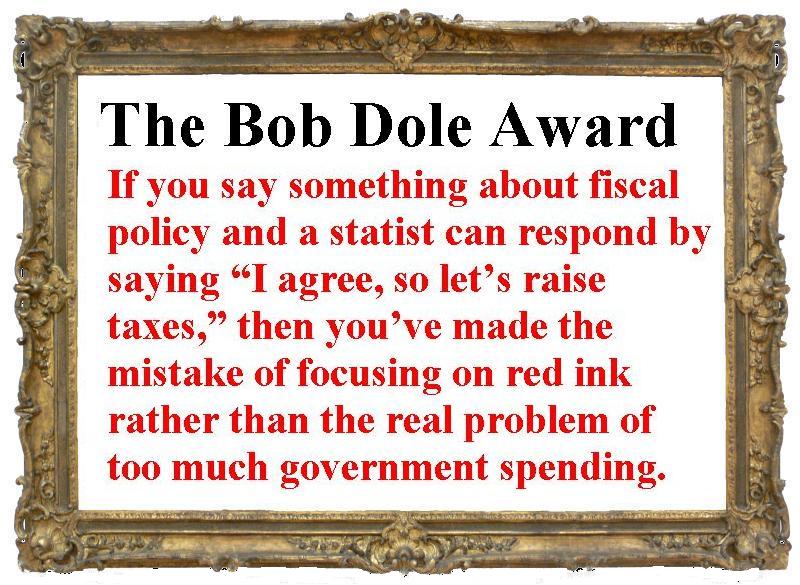
I even created a “Bob Dole Award” in hopes of getting this point across. Simply stated, fixating on debt opens the door for higher taxes.

And does anyone think our economy would be stronger, or our fiscal position would be better, if we replaced some debt-financed spending with some spending financed by class-warfare taxes?

Especially since the higher taxes almost certainly would trigger more spending, so government borrowing would stay the same and the only thing that would change is that we’d be saddled with even more waste.

Notwithstanding all my educational efforts, Republicans couldn’t resist jumping up and down and making loud noises earlier this week when the national debt hit the $16 trillion mark earlier this week (a google search for “$16 trillion debt” returned more than 24 million hits).

So let’s walk through (again) why this is misguided.

First, let’s clear up some numbers that cause confusion. Republicans are complaining about something called the “gross federal debt.” This number is largely meaningless (see table 7.1 of the OMB Historical Tables if you want to look at the details).

It is the combination of a somewhat meaningful number of more than $11 trillion known as “debt held by the public,” which is a measure of how much the federal government has borrowed over time from the private sector, and a totally irrelevant number  of about $4.5 trillion known as “debt held by federal government accounts.”

The latter number is simply a total of the IOUs that the government issues to itself, most notably the ones at the Social Security Trust Fund. But the “assets” in the Trust Fund at the Social Security Administration are offset by the “liabilities” at the Treasury Department. This is an empty bookkeeping gimmick, just as if you took a dollar out of your right pocket, put it in your left pocket, and left an IOU in exchange.

That being said, it is important to recognize that politicians have imposed poorly designed entitlement programs, and future spending on these programs will skyrocket far beyond current revenues. That growing gap, which is explained in this short video, is sometimes known as “unfunded liabilities.”

This number depends on a whole range of assumptions and can be measured in current dollars, constant dollars, and present value. I prefer the middle approach, which adjusts for inflation, and it’s worth noting that “unfunded liabilities” for Social Security and Medicare are more than $100 trillion.

That’s a number we should worry about, not the make-believe $4.5 trillion of IOUs that comprise part of the “gross national debt.”

Now let’s get to the most important issue. The reason we should worry about that $100 trillion number is that it is an estimate of how much the burden of spending will climb in the future. That additional spending will weaken the economy whether it is financed by borrowing or taxes.

Sort of helps to explain why entitlement reform is completely necessary if we want to keep America from a Greek-style fiscal collapse at some point in the future.

Here’s my video on the topic. In an ideal world, Republicans would not be allowed to talk about fiscal policy until they were first strapped in chairs, given a bunch of ADD medicine, and forced to watch this on automatic replay about 50 times.

Deficits are Bad, but the Real Problem is Spending

Uploaded by on Dec 15, 2009

Huge deficits and skyrocketing debt levels are creating considerable worry. This Center for Freedom and Prosperity Foundation video explains that that government borrowing is excessive – and will get worse in coming decades. But this mini-documentary explains that deficits and debt are merely the symptoms, and a rising burden of government spending is the real problem.

_______________

Now for the all-important caveats. Yes, a nation can reach a point where debt becomes a problem. All you have to do is look at the mess in Europe to understand that point.

And I’ve shared numbers from both the Bank for International Settlements and the Organization for Economic Cooperation and Development to indicate that almost all nations – including the U.S. – are going to face similar problems if government policy is left on autopilot.

What I want people to realize, though, is that governments only get into that kind of mess because there’s too much spending.

Government spending is the disease. The various ways of financing that spending – taxes, borrowing, and printing money – are symptoms of the underlying disease.

Will our president attempt to cut the budget?

I hate that so many times in the history of the USA our national leader will not cut the federal budget and attempt to balance it like everyone else has to balance their family budget at home.

I feel like a pendulum this election season. Something will happen that makes me want to eviscerate Obama’s statist policies and I’ll write a foaming-at-the-mouth post warning that the President is turning America into Greece.

But then Romney will do something odious and I’ll sound the warning sign with a we-don’t-need-another-big-spender-like-Bush post.

Today, it’s Obama’s turn on the chopping block. I went on Neil Cavuto’s Fox Business News program and commented on the fact that the President doesn’t have a fiscal plan.

We started by discussing the President’s failure to embrace the findings of his own Fiscal Commission and then shifted to the big-picture issue of whether the American people have become ensnared by the dependency mindset and are willing to vote for Greek-style fiscal policy.

Published on Aug 16, 2012 by

No description available.

________________

One thing I should have added is that Obama actually does have a fiscal plan. He’s just not willing to be as honest as the leftists who have admitted that you need to screw the middle class with higher taxes to fund big government.

My own personal guess is that he would impose a value-added tax if he thought it was politically feasible. Not that I’m showing any great insight. After all, Obama already has made the ridiculous statement that a VAT is “something that has worked for other countries.”

But because he’s running for reelection, he’d rather just demagogue the Ryan plan rather than show his own cards.

P.S. Even the cartoonist for the Washington Post doesn’t think the VAT is something that is working for other countries. This cartoon is a classic and definitely worth sharing. And you can enjoy other VAT cartoons here and here.

We have to resist class warfare and lower taxes for everyone in order to grow our economy

Five Key Reasons to Reject Class-Warfare Tax Policy

Uploaded by on Jun 15, 2009

President Obama and other politicians are advocating higher taxes, with a particular emphasis on class-warfare taxes targeting the so-called rich. This Center for Freedom and Prosperity Foundation video explains why fiscal policy based on hate and envy is fundamentally misguided. For more information please visit our web page: http://www.freedomandprosperity.org.

_________

We got to lower tax rates so we can grow our economy and if the tax rates are raised on the wealthy then punishing the job creators in our country will hurt economic growth. We have to resist class warfare and lower taxes for everyone in order to grow our economy.

Every so often, I come across some statement by President Obama that is either jaw-droppingly misguided or unintentionally revealing, and I place it in my is-this-the-worst-thing-he-ever-said file.

His “spread the wealth” comment to Joe the Plumber is the most famous example, but that was before I started this blog. Previous entries on my list include.

But our Secretary of State also likes saying odd things.

Now we have another Hillary Clinton quote, as reported by the Guardian.

There are rich people everywhere, and yet they do not contribute to their growth of their own countries.

Wow, that’s remarkable. She’s actually claiming that rich people somehow get a lot of money without boosting growth, even though they obviously provided some value and benefit in order get people to voluntarily pay money for whatever it is that made the person wealthy.

But that’s not the most offensive part of her statement. What really stuns me is the assertion that growth will be enhanced if these successful people give a greater share of their money to a corrupt and venal political class.

For all intents and purposes, she is asserting that government in these nations is too small, even though the evidence from western nations shows that small governments were very conducive to growth. Moreover, we’re supposed to believe that high tax rates won’t discourage productive economic behavior.

Which leads me to ask a simple question: Can anybody show me a poor nation that became a rich nation while imposing high tax rates and having a bloated public sector?

P.S. Even though Mrs. Clinton wasn’t making any distinction, allow me to stipulate that there are some rich people who got money dishonestly. I addressed this issue in a post last year and I suspect that some politicians think rich people are sleazy crooks because the rich people they hang out with are sleazy crooks.

P.P.S. Click here to get the answer to the question about nations that became rich with high tax rates and big government.

Privatize the post office now!!!!

We need to privatize the post office.

U.S. Postal Service Default

Posted by Tad DeHaven

No, the U.S. Postal Service won’t close on August 1st because it can’t afford to make a required $5.5 billion payment into a federal fund for postal retiree health benefits. Yes, the entire situation with the USPS is a mess. But when you have politicians ultimately trying to run a commercial operation, constant clean ups in aisle four are to be expected.

Here’s the situation:

1. The USPS is bleeding billions of dollars in red ink and has just about maxed out its line of credit with the U.S. Treasury.

2. In April, the Senate passed a bill that would buy the USPS time by effectively kicking the can down the road.

3. A more aggressive bill in the House sponsored by Rep. Darryl Issa (R-CA) is unpopular with the postal unions, Democrats, and apparently enough Republicans that the votes are reportedly not there to get it passed. And if the votes are there, the House Republican leadership doesn’t appear to be interested in bringing it to the floor.

4. Even if the House passed a bill, it wouldn’t be easy for House and Senate conferees to hammer out a compromise given the differences between the two bills. Because there isn’t much space left on the legislative calendar, and it’s an election year, it’s hard to imagine that there would be enough time to get something done to avert a default.

5. It is possible that language will be added to appropriations legislation that postpones the payment. For example, every year Congress includes language requiring the USPS to deliver mail six days a week.

Again, no, the USPS won’t shut its doors in the event that it defaults on the payment. Beyond that, I’m admittedly not sure what – if anything – would happen. I operate on the assumption that the federal government can do whatever it wants. That means Congress, USPS management, and postal stakeholders will probably just continue to haggle over what to do.

The postal unions will continue to concentrate their fire on the mandatory postal retiree health benefit payments, which they argue Congress should simply make disappear. As I recently explained, however, “eliminating the payments won’t put the USPS in the black, and it would merely set the stage for a major taxpayer bailout down the road.”  In fact, I believe policymakers should be asking themselves why postal employees should continue to receive a benefit that a small – and declining – share of private sector workers enjoy.

From a Cato essay on privatizing the USPS:

Opponents of pre-funding USPS retiree health benefits argue that private companies and the rest of the federal government are not legally required to do so. That is largely irrelevant. Retiree health care coverage is an increasingly rare perk in the private sector, and the federal government’s financial management is nothing to emulate. In 2008, only 17 percent of private sector workers were employed at a business that offered health benefits to Medicare-eligible retirees, down from 28 percent in 1997.

Note: For those interested in postal policy, Michael Schuyler has a new – and very interesting – paper out on the USPS and stamp prices. Of course, I want the USPS to be privatized and the market to set postage prices. However, if given the choice between a taxpayer bailout and a postage hike, I say hike away.

_____

Related posts:

Privatize the post office

Max Brantley has rightly noted that Congress is often the problem when cutting the number of inefficient post office branches is proposed. The Arkansas Times rightly jumped on Republicans for whining about the local post office branches that were closing.  (It is sad to me that Republican Presidential Candidates are not very brave about offering any […]

Federal government should not be involved with post office

I really wish that President Obama would have not had the federal government buy up General Motors. We need to keep the federal government out of the private market as much as possible. This goes for the post office too. It should be in private hands. Senators voted recently to hold off closing some post […]

An open letter to President Obama (Part 56)

President Obama c/o The White House 1600 Pennsylvania Avenue NW Washington, DC 20500 Dear Mr. President, I know that you receive 20,000 letters a day and that you actually read 10 of them every day. I really do respect you for trying to get a pulse on what is going on out here. When you […]

Private entrepreneurs can solve our post office problem

When you look at how good the private enterprise does with deliveries and then compare it to how bad the federal government does with the same duties it is laughable. The answer to the federal post office problem is to encourage private entrepreneurs to fill the gap and provide competition for the post office in […]

Senator Pryor asks for Spending Cut Suggestions! Here are a few!(Part 131)

Senator Mark Pryor wants our ideas on how to cut federal spending. Take a look at this video clip below: Senator Pryor has asked us to send our ideas to him at cutspending@pryor.senate.gov and I have done so in the past and will continue to do so in the future. On May 11, 2011,  I emailed to […]

Privatize the post office

The Arkansas Times rightly jumped on Republicans for whining about the local post office branches that were closing.  (It is sad to me that Republican Presidential Candidates are not very brave about offering any spending cuts.) The real answer is privatizing the post office. Here is a good article from the Cato Institute:   The USPS […]

We need to close U.S.Post Office

We need to close U.S.Post Office There is only one option in my view. We can not keep on losing money every year like the U.S.Postal Service (7 billion this year). Closing Post Offices   PrintThe U.S. Postal Service just posted a $3.1 billion loss for the third quarter and the outlook for the rest […]

Senator Pryor asks for Spending Cut Suggestions! Here are a few!(Part 112)

President Obama’s answer is always more government

Instead of letting the weaker car company go out of business so the others can benefit, President Obama comes in and messes everything up.

I’ve been against the auto bailout from the very beginning because it was a corrupt payoff to lazy corporate fat-cats and an ossified union.

And when folks on the left say the bailout is a success, I explain that any industry can be propped up with a sufficiently large injection of other people’s money.

Now we have new data on how much “other people’s money” has been diverted. It’s a big number, and it seems to get bigger each time there’s a new estimate. Here’s part of a Reuters report.

The U.S. Treasury Department has said the auto industry bailout will cost taxpayers $3.4 billion more than previously thought. Treasury now estimates the 2009 bailout will eventually cost the government $25.1 billion, according to a report sent to Congress on Friday. That is up from the last quarterly estimate of $21.7 billion.

Sort of reminds me of the old joke about the lousy businessman who says he loses money on every sale, but he makes up for it with high volume.

Well, that incompetent businessman has a kindred spirit in the White House. Here’s some of what Politico reported.

President Obama, while villifying Mitt Romney for opposing the auto industry bailout, bragged about the success of his decision to provide government assistance… he said. “Now I want to do the same thing with manufacturing jobs, not just in the auto industry, but in every industry…”

Well, we can’t say we haven’t been warned. He wants to do the same thing in “every industry.” Well, according to the Bureau of Economic Analysis, there are 60 industries in America. At $25 billion each, that means $1.5 trillion.

Stimulus in action

By the way, Mickey Kaus explains that the government’s numbers are incomplete and that the actual damage is significantly higher. And this Reason TV video exposes some of the government’s chicanery.

P.S. If you’re in the mood for some satire, here’s a bailout form showing how you can become a deadbeat and mooch off the government.

P.P.S. Just in case you’re new to this blog and don’t know my history, rest assured that I’m also against Wall Street bailouts.

P.P.P.S. Ethical people should boycott GM and Chrysler, particularly since these companies are now handmaidens of big government.

Milton Friedman helped get Reagan elected

Bob Chitester Discusses Milton Friedman and ‘Free to Choose’

Published on Jul 30, 2012 by

“There are very few people over the generations who have ideas that are sufficiently original to materially alter the direction of civilization. Milton is one of those very few people.”

That is how former Federal Reserve Chairman Alan Greenspan described the Nobel laureate economist Milton Friedman. But it is not for his technical work in monetary economics that Friedman is best known. Like mathematician Jacob Bronowski and astronomer Carl Sagan, Friedman had a gift for communicating complex ideas to a general audience.

It was this gift that brought him to the attention of filmmaker Bob Chitester. At Chitester’s urging, Friedman agreed to make a 10 part documentary series explaining the power of economic freedom. It was called “Free to Choose,” and became one of the most watched documentaries in history.

The series not only reached audiences in liberal democracies, but was smuggled behind the iron curtain where it played, in secret, to large audiences. Reflecting on its impact, Czech president Vaclav Klaus has said: “For us, who lived in the communist world, Milton Friedman was the greatest champion of freedom, of limited and unobtrusive government and of free markets. Because of him I became a true believer in the unrestricted market economy.”

July 31st, 2012 is the 100th anniversary of Friedman’s birth. To commemorate that occasion, we’d like to share an interview with “Free to Choose” producer Bob Chitester. Like this interview, the entire series can now be viewed on-line at no cost at http://www.freetochoose.tv/, thanks to the incredible technological progress brought about by the economic freedom that Milton Friedman celebrated.

Produced by Andrew Coulson, Caleb O. Brown, Austin Bragg, and Lou Richards, with help from the Free to Choose Network.

_____________

We got to stop spending so much money on the federal level. It will bankrupt us. I remember back in 1980 when I really started getting into the material of Milton Friedman as a result of reading his articles in Newsweek and reading his book “Free to Choose,” I really did get facts and figures to back on the view that we need more freedom giving back to us and the government needs to spend less.

As a result of Friedman’s writings I was able to discuss these issues with my fellow students at the university and by the time the 1980 election came around I had been attending political rallies and went out and worked hard for Ronald Reagan’s election. In this article below Dr. Thomas Sowell (who was featured twice in the film “Free to Choose”) notes how much influence Milton Friedman had on the election outcome in 1980:

Milton Friedman at 90

by Thomas Sowell

Thomas Sowell is a senior fellow at the Hoover Institute in Stanford, California.

Added to cato.org on July 25, 2002

This article originally appeared on TownHall.com, July 25, 2002.

Milton Friedman’s 90th birthday on July 31st provides an occasion to think back on his role as the pre-eminent economist of the 20th century. To those of us who were privileged to be his students, he also stands out as a great teacher.

When I was a graduate student at the University of Chicago, back in 1959, one day I was waiting outside Professor Friedman’s office when another graduate student passed by. He noticed my exam paper on my lap and exclaimed: “You got a B?”

“Yes,” I said. “Is that bad?”

Thomas Sowell is a senior fellow at the Hoover Institute in Stanford, California.


“There were only two B’s in the whole class,” he replied.

“How many A’s?” I asked.

“There were no A’s!”

Today, this kind of grading might be considered to represent a “tough love” philosophy of teaching. I don’t know about love, but it was certainly tough.

Professor Friedman also did not let students arrive late at his lectures and distract the class by their entrance. Once I arrived a couple of minutes late for class and had to turn around and go back to the dormitory.

All the way back, I thought about the fact that I would be held responsible for what was said in that lecture, even though I never heard it. Thereafter, I was always in my seat when Milton Friedman walked in to give his lecture.

On a term paper, I wrote that either (a) this would happen or (b) that would happen. Professor Friedman wrote in the margin: “Or (c) your analysis is wrong.”

“Where was my analysis wrong?” I asked him.

“I didn’t say your analysis was wrong,” he replied. “I just wanted you to keep that possibility in mind.”

Perhaps the best way to summarize all this is to say that Milton Friedman is a wonderful human being — especially outside the classroom. It has been a much greater pleasure to listen to his lectures in later years, after I was no longer going to be quizzed on them, and a special pleasure to appear on a couple of television programs with him and to meet him on social occasions.

Milton Friedman’s enduring legacy will long outlast the memories of his students and extends beyond the field of economics. John Maynard Keynes was the reigning demi-god among economists when Friedman’s career began, and Friedman himself was at first a follower of Keynesian doctrines and liberal politics.

Yet no one did more to dismantle both Keynesian economics and liberal welfare-state thinking. As late as the 1950s, those with the prevailing Keynesian orthodoxy were still able to depict Milton Friedman as a fringe figure, clinging to an outmoded way of thinking. But the intellectual power of his ideas, the fortitude with which he persevered, and the ever more apparent failures of Keynesian analyses and policies, began to change all that, even before Professor Friedman was awarded the Nobel Prize in economics in 1976.

A towering intellect seldom goes together with practical wisdom, or perhaps even common sense. However, Milton Friedman not only excelled in the scholarly journals but also on the television screen, presenting the basics of economics in a way that the general public could understand.

His mini-series “Free to Choose” was a classic that made economic principles clear to all with living examples. His good nature and good humor also came through in a way that attracted and held an audience.

Although Friedrich Hayek launched the first major challenge to the prevailing thinking behind the welfare state and socialism with his 1944 book “The Road to Serfdom,” Milton Friedman became the dominant intellectual force among those who turned back the leftward tide in what had seemed to be the wave of the future.

Without Milton Friedman’s role in changing the minds of so many Americans, it is hard to imagine how Ronald Reagan could have been elected president.

Nor was Friedman’s influence confined to the United States. His ideas reached around the world, not only among economists, but also in political circles which began to understand why left-wing ideas that sounded so good produced results that were so bad.

Milton Friedman rates a 21-gun salute on his birthday. Or perhaps a 90-gun salute would be more appropriate.

Harding,Kennedy and Reagan proved that the Laffer Curve works

 I enjoyed this article below because it demonstrates that the Laffer Curve has been working for almost 100 years now when it is put to the test in the USA. I actually got to hear Arthur Laffer speak in person in 1981 and he told us in advance what was going to happen the 1980’s and it all came about as he said it would when Ronald Reagan’s tax cuts took place. I wish we would lower taxes now instead of looking for more revenue through raised taxes. We have to grow the economy:

What Mitt Romney Said Last Night About Tax Cuts And The Deficit Was Absolutely Right. And What Obama Said Was Absolutely Wrong.

Mitt Romney repeatedly said last night that he would not allow tax cuts to add to the deficit.  He repeatedly said it because over and over again Obama blathered the liberal talking point that cutting taxes necessarily increased deficits.

Romney’s exact words: “I want to underline that — no tax cut that adds to the deficit.”

Meanwhile, Obama has promised to cut the deficit in half during his first four years – but instead gave America the highest deficits in the history of the entire human race.

I’ve written about this before.  Let’s replay what has happened every single time we’ve ever cut the income tax rate.

The fact of the matter is that we can go back to Calvin Coolidge who said very nearly THE EXACT SAME THING to his treasury secretary: he too would not allow any tax cuts that added to the debt.  Andrew Mellon – quite possibly the most brilliant economic mind of his day – did a great deal of research and determined what he believed was the best tax rate.  And the Coolidge administration DID cut income taxes and MASSIVELY increased revenues.  Coolidge and Mellon cut the income tax rate 67.12 percent (from 73 to 24 percent); and revenues not only did not go down, but they went UP by at least 42.86 percent (from $700 billion to over $1 billion).

That’s something called a documented fact.  But that wasn’t all that happened: another incredible thing was that the taxes and percentage of taxes paid actually went UP for the rich.  Because as they were allowed to keep more of the profits that they earned by investing in successful business, they significantly increased their investments and therefore paid more in taxes than they otherwise would have had they continued sheltering their money to protect themselves from the higher tax rates.  Liberals ignore reality, but it is simply true.  It is a fact.  It happened.

Then FDR came along and raised the tax rates again and the opposite happened: we collected less and less revenue while the burden of taxation fell increasingly on the poor and middle class again.  Which is exactly what Obama wants to do.

People don’t realize that John F. Kennedy, one of the greatest Democrat presidents, was a TAX CUTTER who believed the conservative economic philosophy that cutting tax rates would in fact increase tax revenues.  He too cut taxes, and he too increased tax revenues.

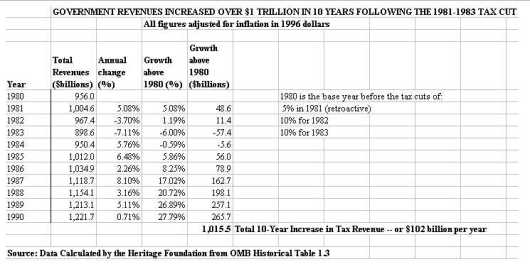
So we get to Ronald Reagan, who famously cut taxes.  And again, we find that Reagan cut that godawful liberal tax rate during an incredibly godawful liberal-caused economic recession, and he increased tax revenue by 20.71 percent (with revenues increasing from $956 billion to $1.154 trillion).  And again, the taxes were paid primarily by the rich:

“The share of the income tax burden borne by the top 10 percent of taxpayers increased from 48.0 percent in 1981 to 57.2 percent in 1988. Meanwhile, the share of income taxes paid by the bottom 50 percent of taxpayers dropped from 7.5 percent in 1981 to 5.7 percent in 1988.”

So we get to George Bush and the Bush tax cuts that liberals and in particular Obama have just demonized up one side and demagogued down the other.  And I can simply quote the New York Times AT the time:

Sharp Rise in Tax Revenue to Pare U.S. Deficit By EDMUND L. ANDREWS Published: July 13, 2005

WASHINGTON, July 12 – For the first time since President Bush took office, an unexpected leap in tax revenue is about to shrink the federal budget deficit this year, by nearly $100 billion.

A Jump in Corporate Payments On Wednesday, White House officials plan to announce that the deficit for the 2005 fiscal year, which ends in September, will be far smaller than the $427 billion they estimated in February.

Mr. Bush plans to hail the improvement at a cabinet meeting and to cite it as validation of his argument that tax cuts would stimulate the economy and ultimately help pay for themselves.

Based on revenue and spending data through June, the budget deficit for the first nine months of the fiscal year was $251 billion, $76 billion lower than the $327 billion gap recorded at the corresponding point a year earlier.

The Congressional Budget Office estimated last week that the deficit for the full fiscal year, which reached $412 billion in 2004, could be “significantly less than $350 billion, perhaps below $325 billion.”

The big surprise has been in tax revenue, which is running nearly 15 percent higher than in 2004. Corporate tax revenue has soared about 40 percent, after languishing for four years, and individual tax revenue is up as well
.

And of course the New York Times, as reliable liberals, use the adjective whenever something good happens under conservative policies and whenever something bad happens under liberal policies: ”unexpected.”   But it WASN’T ”unexpected.”  It was EXACTLY what Republicans had said would happen and in fact it was exactly what HAD IN FACT HAPPENED every single time we’ve EVER cut income tax rates.

The truth is that conservative tax policy has a perfect track record: every single time it has ever been tried, we have INCREASED tax revenues while not only exploding economic activity and creating more jobs, but encouraging the wealthy to pay more in taxes as well.  And liberals simply dishonestly refuse to acknowledge documented history.

Meanwhile, liberals also have a perfect record … of FAILUREThey keep raising taxes and keep not understanding why they don’t get the revenues they predicted.

The following is a section from my article, “Tax Cuts INCREASE Revenues; They Have ALWAYS Increased Revenues“, where I document every single thing I said above:

The Falsehood That Tax Cuts Increase The Deficit

Now let’s take a look at the utterly fallacious view that tax cuts in general create higher deficits.

Let’s take a trip back in time, starting with the 1920s.  From Burton Folsom’s book, New Deal or Raw Deal?:

In 1921, President Harding asked the sixty-five-year-old [Andrew] Mellon to be secretary of the treasury; the national debt [resulting from WWI] had surpassed $20 billion and unemployment had reached 11.7 percent, one of the highest rates in U.S. history.  Harding invited Mellon to tinker with tax rates to encourage investment without incurring more debt. Mellon studied the problem carefully; his solution was what is today called “supply side economics,” the idea of cutting taxes to stimulate investment.  High income tax rates, Mellon argued, “inevitably put pressure upon the taxpayer to withdraw this capital from productive business and invest it in tax-exempt securities. . . . The result is that the sources of taxation are drying up, wealth is failing to carry its share of the tax burden; and capital is being diverted into channels which yield neither revenue to the Government nor profit to the people” (page 128).

Mellon wrote, “It seems difficult for some to understand that high rates of taxation do not necessarily mean large revenue to the Government, and that more revenue may often be obtained by lower taxes.”  And he compared the government setting tax rates on incomes to a businessman setting prices on products: “If a price is fixed too high, sales drop off and with them profits.”

And what happened?

“As secretary of the treasury, Mellon promoted, and Harding and Coolidge backed, a plan that eventually cut taxes on large incomes from 73 to 24 percent and on smaller incomes from 4 to 1/2 of 1 percent.  These tax cuts helped produce an outpouring of economic development – from air conditioning to refrigerators to zippers, Scotch tape to radios and talking movies.  Investors took more risks when they were allowed to keep more of their gains.  President Coolidge, during his six years in office, averaged only 3.3 percent unemployment and 1 percent inflation – the lowest misery index of any president in the twentieth century.

Furthermore, Mellon was also vindicated in his astonishing predictions that cutting taxes across the board would generate more revenue.  In the early 1920s, when the highest tax rate was 73 percent, the total income tax revenue to the U.S. government was a little over $700 million.  In 1928 and 1929, when the top tax rate was slashed to 25 and 24 percent, the total revenue topped the $1 billion mark.  Also remarkable, as Table 3 indicates, is that the burden of paying these taxes fell increasingly upon the wealthy” (page 129-130).

Now, that is incredible upon its face, but it becomes even more incredible when contrasted with FDR’s antibusiness and confiscatory tax policies, which both dramatically shrunk in terms of actual income tax revenues (from $1.096 billion in 1929 to $527 million in 1935), and dramatically shifted the tax burden to the backs of the poor by imposing huge new excise taxes (from $540 million in 1929 to $1.364 billion in 1935).  See Table 1 on page 125 of New Deal or Raw Deal for that information.

FDR both collected far less taxes from the rich, while imposing a far more onerous tax burden upon the poor.

It is simply a matter of empirical fact that tax cuts create increased revenue, and that those [Democrats] who have refused to pay attention to that fact have ended up reducing government revenues even as they increased the burdens on the poorest whom they falsely claim to help.

Let’s move on to John F. Kennedy, one of the most popular Democrat presidents ever.  Few realize that he was also a supply-side tax cutter.

Kennedy said:

“It is a paradoxical truth that tax rates are too high and tax revenues are too low and the soundest way to raise the revenues in the long run is to cut the rates now … Cutting taxes now is not to incur a budget deficit, but to achieve the more prosperous, expanding economy which can bring a budget surplus.”

– John F. Kennedy, Nov. 20, 1962, president’s news conference


“Lower rates of taxation will stimulate economic activity and so raise the levels of personal and corporate income as to yield within a few years an increased – not a reduced – flow of revenues to the federal government.”

– John F. Kennedy, Jan. 17, 1963, annual budget message to the Congress, fiscal year 1964

“In today’s economy, fiscal prudence and responsibility call for tax reduction even if it temporarily enlarges the federal deficit – why reducing taxes is the best way open to us to increase revenues.”

– John F. Kennedy, Jan. 21, 1963, annual message to the Congress: “The Economic Report Of The President”


“It is no contradiction – the most important single thing we can do to stimulate investment in today’s economy is to raise consumption by major reduction of individual income tax rates.”

– John F. Kennedy, Jan. 21, 1963, annual message to the Congress: “The Economic Report Of The President”


“Our tax system still siphons out of the private economy too large a share of personal and business purchasing power and reduces the incentive for risk, investment and effort – thereby aborting our recoveries and stifling our national growth rate.”

– John F. Kennedy, Jan. 24, 1963, message to Congress on tax reduction and reform, House Doc. 43, 88th Congress, 1st Session.


“A tax cut means higher family income and higher business profits and a balanced federal budget. Every taxpayer and his family will have more money left over after taxes for a new car, a new home, new conveniences, education and investment. Every businessman can keep a higher percentage of his profits in his cash register or put it to work expanding or improving his business, and as the national income grows, the federal government will ultimately end up with more revenues.”

– John F. Kennedy, Sept. 18, 1963, radio and television address to the nation on tax-reduction bill

Which is to say that modern Democrats are essentially calling one of their greatest presidents a liar when they demonize tax cuts as a means of increasing government revenues.

So let’s move on to Ronald Reagan.  Reagan had two major tax cutting policies implemented: the Economic Recovery Tax Act (ERTA) of 1981, which was retroactive to 1981, and the Tax Reform Act of 1986.

Did Reagan’s tax cuts decrease federal revenues?  Hardly:

We find that 8 of the following 10 years there was a surplus of revenue from 1980, prior to the Reagan tax cuts.  And, following the Tax Reform Act of 1986, there was a MASSIVE INCREASEof revenue.

So Reagan’s tax cuts increased revenue.  But who paid the increased tax revenue?  The poor?  Opponents of the Reagan tax cuts argued that his policy was a giveaway to the rich (ever heard that one before?) because their tax payments would fall.  But that was exactly wrong.  In reality:

“The share of the income tax burden borne by the top 10 percent of taxpayers increased from 48.0 percent in 1981 to 57.2 percent in 1988. Meanwhile, the share of income taxes paid by the bottom 50 percent of taxpayers dropped from 7.5 percent in 1981 to 5.7 percent in 1988.”

So Ronald Reagan a) collected more total revenue, b) collected more revenue from the rich, while c) reducing revenue collected by the bottom half of taxpayers, and d) generated an economic powerhouse that lasted – with only minor hiccups – for nearly three decades.  Pretty good achievement considering that his predecessor was forced to describe his own economy as a “malaise,” suffering due to a “crisis of confidence.” Pretty good considering that President Jimmy Carter responded to a reporter’s question as to what he would do about the problem of inflation by answering, “It would be misleading for me to tell any of you that there is a solution to it.”

Reagan whipped inflation.  Just as he whipped that malaise and that crisis of confidence.

________

The Laffer Curve, Part III: Dynamic Scoring

The real truth about the financial condition of Social Security can be seen on the www.thedailyhatch.org

Uploaded by on Jan 8, 2009

Professor Williams explains what’s ahead for Social Security

If you want to know the real truth about the financial condition of Social Security then check out these links below:

Ark Times reader says Social Security is not Ponzi Scheme

Social Security is a Ponzi Scheme but Blake who is a blogger said I was off base. Ark Times reader says Social Security is not Ponzi Scheme Social Security Disaster Walter E. Williams Columnist, Townhall.com Politicians who are principled enough to point out the fraud of Social Security, referring to it as a lie and […]

Social Security is a Ponzi scheme that needs to be reformed

We got to do something soon about Social Security. The Case for Social Security Personal Accounts Posted by Daniel J. Mitchell There are two crises facing Social Security. First the program has a gigantic unfunded liability, largely caused by demographics. Second, the program is a very bad deal for younger workers, making them pay record […]

Senator Obama’s ideas on Social Security

Senator Obama’s Social Security Tax Plan Uploaded by afq2007 on Jul 23, 2008 In addition to several other tax increases, Senator Barack Obama wants to increase the Social Security payroll tax burden by imposing the tax on income above $250,000. This would be a sharp departure from current law, which only requires that the tax […]

Social Security is a Ponzi scheme (part 13)

Saving Social Security with Personal Retirement Accounts Uploaded by afq2007 on Jan 10, 2011 There are two crises facing Social Security. First the program has a gigantic unfunded liability, largely thanks to demographics. Second, the program is a very bad deal for younger workers, making them pay record amounts of tax in exchange for comparatively meager benefits. This […]

What does the Heritage Foundation have to say about saving Social Security:Study released May 10, 2011 (Part 7)

“Saving the American Dream: The Heritage Plan to Fix the Debt, Cut Spending, and Restore Prosperity,” Heritage Foundation, May 10, 2011 by  Stuart Butler, Ph.D. , Alison Acosta Fraser and William Beach is one of the finest papers I have ever read. Over the next few days I will post portions of this paper, but […]

Only difference between Ponzi scheme and Social Security is you can say no to Ponzi Scheme jh2d

Is Social Security  a Ponzi Scheme? I just started a series on this subject. In this article below you will see where the name “Ponzi scheme” came from and if it should be applied to the Social Security System. Ponzi! Ponzi! Ponzi! 9/14/2011 | Email John Stossel | Columnist’s Archive Ponzi! Ponzi! Ponzi! There, I […]

Social Security a Ponzi scheme?

Uploaded by LibertyPen on Jan 8, 2009 Professor Williams explains what’s ahead for Social Security Dan Mitchell on Social Security I have said that Social Security is a Ponzi scheme and sometimes you will hear someone in the public say the same thing. Yes, It Is a Ponzi Scheme by Michael D. Tanner Michael Tanner […]

Dan Mitchell on Social Security