What is our business, by contrast, is what politicians are doing with the money they confiscate from us. This Lisa Benson cartoon helps to make that point, though it would be even better if she had written “Romney’s Stash for His Own Money” and “Obama’s Stash for Our Money.”
Obama, needless to say, is an expert at squandering other people’s money, as illustrated by money pits such as the faux stimulus and the green energy scam.
P.S. Lest anyone think I’m being partisan, the headline of this would be just as accurate if I added “How Bush Spent My Money” or “How Romney Would Spend My Money.” Bush, after all, followed the same fiscal agenda as Obama, and Romney’s track record suggests he will be similarly profligate.
P.P.S. Which makes me miss Bill Clinton, who was frugal by comparison. Or Ronald Reagan, who actually did the right things for the right reason.
Thank you so much for your time. I know how valuable it is. I also appreciate the fine family that you have and your commitment as a father and a husband.
Sincerely,
Everette Hatcher III, 13900 Cottontail Lane, Alexander, AR 72002, ph 501-920-5733, lowcostsqueegees@yahoo.com
I have a lot of respect for Max Brantley of the Arkansas Times Blog and Dan Mitchell of the Cato Institute for their political analysis. They both have picked Obama to win today. I parted company and chose Romney to win 301 to 237.
Knowing how Dan Mitchell thinks leads me to believe that he would have a liberal Obama in office who he can be critical of instead of a lukewarm conservative like Romney who will spend like Bush did. I do agree with Mitchell’s writings that are critical of the growing federal government and I hope we can somehow turn it back to the good ole days when Newt was proposing welfare reform to President Clinton and we had a balanced budget. (Clinton made some bad decisions socially for the country and himself too during that time though.)
I am sticking with my prediction and will talk it again tomorrow.
But I have a sneaking suspicion that readers of International Liberty are not quite representative of the overall population (I need more looters and moochers in my audience, sort of like what you see in this cartoon).
Yes, I’m going to be bold and say that Obama will get more than 12.5 percent of the vote.
Indeed, I’m guessing he’ll get at least a plurality of the vote. And I’m specifically predicting he’ll get a majority of the electoral college.
I’ve been predicting that Obama would win re-election for the past six months, and I see no reason to change my mind now that it’s election day. I’m even moving two more states – New Hampshire and Virginia – into Obama’s column, which will be enough to give him a 294-244 margin in the electoral college.
As you can see from the large number of states in the “leaning” category, I don’t have a high level of confidence in my prediction. And plenty of my Republican friends have made strong arguments that the polls are flawed because of “turnout” assumptions.
But I have no competence to judge the veracity of these claims, so I’m going with my gut instinct and calling it for the Spender-in-Chief.
If my guess of an Obama victory turns out to be correct, I suppose I could claim special insight because of my January 1 prediction that Obama would win if the unemployment rate fell under 8 percent. But as you can see from this graph, I’ve always shown Obama ahead, even when the joblessness rate was higher.
For what it’s worth, I don’t think there’s anything terribly unusual or unconventional about my predictions for the electoral college. But I am going to be a non-conformist in my guesses about the partisan breakdown of the U.S. House and U.S. Senate.
Republicans began the year with high hopes of taking control of the Senate, but a series of mis-steps have hurt the GOP and some people even predict they will lose seats. That’s possible, but I’m going out on a limb and predicting a two-seat gain for Republicans.
I’m also going to be a non-conformist in my predictions for the lower chamber, guessing a one-seat pick-up for the GOP.
I’ll also make two final predictions. First, drawing from my post yesterday about key ballot initiatives, I predict that California voters will reject all the proposed tax increases. This will prove that left-wingers are capable of being right-wingers when their own money is on the table.
Second, I’ll offer a prediction that’s about as controversial as asserting that the sun will rise in the east and set in the west. I predict that government will get even bigger over the next four years, which will mean more corruption and weaker economic performance.
P.S. My predictions for the U.S. Senate assume that the independent candidate will win in Maine and will ally himself with the Democrats.
Over and over you read that President Obama just wants to raise taxes on the rich. Is that true? Raising taxes on the rich will not balance the budget. What is he really after?
In other words, politicians often say they want to tax the rich, but the real target is the middle class. Indeed, this is the history of tax policy. In a post earlier this year, warning the folks in the Cayman Islands not to impose an income tax, I noted how the U.S. income tax began small and then swallowed up more and more people.
The introduction of income taxes around the world have tended to follow a very similar pattern over the past couple of centuries. First, we get generally low income tax rates, with most people exempt and with the highest rate only affecting a few people relatively lightly. Eventually, tax rates shoot up for everybody – including to crippling levels for top earners – and millions more are caught by income tax. The next stage is that the ultra-high tax rates for top earners are reduced to manageable levels – but ever more people are brought into the tax system, with the higher brackets also catching vastly more folk.
By the way, you can see that Allister makes a reference to tax rates being reduced for top earners. That’s largely because many politicians learned an important lesson about the Laffer Curve. Sometimes, the best way to “soak the rich” is by lowering their tax rates. Unfortunately, President Obama still needs some remedial education on this topic.
Allister then looks at some specific U.K. data revealing how more and more middle class people are now subject to higher tax rates.
The biggest change in the UK has been the number of people paying what is now the 40p tax rate: up six-fold in thirty years, from 674,000 in 1979-80, 2.5m in 1999-2000 to 4.048m in 2011-12. This number will jump again to around 5m in 2014, according to the Institute for Fiscal Studies. When Margaret Thatcher came to power, just 2.6 per cent of taxpayers paid the top rate; by the time of the next election, 16.7 per cent will.
If Obama and other statists get their way, we’ll see similar statistic in the United States. Higher income tax rates for the rich will mean higher income tax rates for the rest of us. Though I’m even more worried about a value-added tax, which would be a huge burden on ordinary people and a revenue machine for greedy politicians.
I have been writing to the White House about Libya over and over, but I have not got a response yet. The funny thing is that I have not got over 40 responses in the past to my letters, but this time around I have got even one response.
President Obama canceled the annual White House Halloween party. He didn’t want to; he just didn’t want to risk a trick-or-treater asking him a question about Libya.
“Don’t ask, don’t tell” is back. Not for gays in the military — it’s President Obama’s new policy for questions about Libya.
Republicans are accusing the White House of successfully engineering a massive cover-up of the Libyan attack. But, on the plus side, it’s the first time in four years Republicans have given credit to Obama for doing anything successfully.
Know The TRUTH ~ Step By Step ~ Bret Baier’s ~ ‘Death and Deceit in Benghazi’ Published on Oct 19, 2012 by MamaBarracuda Second Presidential Debate 2012- Obama and Romney on Foreign Policy Published on Oct 16, 2012 by AussieNews1 With just 21 days to go until the presidential election in the United States, President […]
Know The TRUTH ~ Step By Step ~ Bret Baier’s ~ ‘Death and Deceit in Benghazi’ Published on Oct 19, 2012 by MamaBarracuda Second Presidential Debate 2012- Obama and Romney on Foreign Policy Published on Oct 16, 2012 by AussieNews1 With just 21 days to go until the presidential election in the United States, […]
President Barack Obama speaks in the Rose Garden of the White House in Washington, Thursday, Oct. 20, 2011, to comment on the death of Libyan leader Moammar Gadhafi. (AP Photo/Pablo Martinez Monsivais) Secretary of State Hillary Rodham Clinton speaking ondeadly attack in Libya, during a speech to the Center for Strategic and International Studies in […]
Know The TRUTH ~ Step By Step ~ Bret Baier’s ~ ‘Death and Deceit in Benghazi’ Published on Oct 19, 2012 by MamaBarracuda Second Presidential Debate 2012- Obama and Romney on Foreign Policy Published on Oct 16, 2012 by AussieNews1 With just 21 days to go until the presidential election in the United States, President […]
Know The TRUTH ~ Step By Step ~ Bret Baier’s ~ ‘Death and Deceit in Benghazi’ Published on Oct 19, 2012 by MamaBarracuda Second Presidential Debate 2012- Obama and Romney on Foreign Policy Published on Oct 16, 2012 by AussieNews1 With just 21 days to go until the presidential election in the United States, President […]
President Barack Obama speaks in the Rose Garden of the White House in Washington, Thursday, Oct. 20, 2011, to comment on the death of Libyan leader Moammar Gadhafi. (AP Photo/Pablo Martinez Monsivais) Secretary of State Hillary Rodham Clinton speaking ondeadly attack in Libya, during a speech to the Center for Strategic and International Studies in […]
Know The TRUTH ~ Step By Step ~ Bret Baier’s ~ ‘Death and Deceit in Benghazi’ Published on Oct 19, 2012 by MamaBarracuda Second Presidential Debate 2012- Obama and Romney on Foreign Policy Published on Oct 16, 2012 by AussieNews1 With just 21 days to go until the presidential election in the United States, […]
Know The TRUTH ~ Step By Step ~ Bret Baier’s ~ ‘Death and Deceit in Benghazi’ Published on Oct 19, 2012 by MamaBarracuda Second Presidential Debate 2012- Obama and Romney on Foreign Policy Published on Oct 16, 2012 by AussieNews1 With just 21 days to go until the presidential election in the United States, President […]
Know The TRUTH ~ Step By Step ~ Bret Baier’s ~ ‘Death and Deceit in Benghazi’ Published on Oct 19, 2012 by MamaBarracuda Second Presidential Debate 2012- Obama and Romney on Foreign Policy Published on Oct 16, 2012 by AussieNews1 With just 21 days to go until the presidential election in the United States, President […]
HILLARY SMIRKS AT REPORTERS – Still Not Sure What to Call the Benghazi Terrorist Attack Published on Oct 24, 2012 by jackohoft Secretary of State Hillary Clinton held a press conference this morning and addressed the Benghazi Consulate attack and cover-up. The Secretary of State would not call the massacre a terrorist attack despite the […]
Second Presidential Debate 2012- Obama and Romney on Foreign Policy Published on Oct 16, 2012 by AussieNews1 With just 21 days to go until the presidential election in the United States, President Obama and his challenger Governor Romney meet for their second debate at Hofstra University in Hempstead, New York. ________________________ President Obama c/o The […]
Second Presidential Debate 2012- Obama and Romney on Foreign Policy Published on Oct 16, 2012 by AussieNews1 With just 21 days to go until the presidential election in the United States, President Obama and his challenger Governor Romney meet for their second debate at Hofstra University in Hempstead, New York. ________________________ President Obama c/o The […]
Second Presidential Debate 2012- Obama and Romney on Foreign Policy Published on Oct 16, 2012 by AussieNews1 With just 21 days to go until the presidential election in the United States, President Obama and his challenger Governor Romney meet for their second debate at Hofstra University in Hempstead, New York. ________________________ President Obama c/o […]
Second Presidential Debate 2012- Obama and Romney on Foreign Policy Published on Oct 16, 2012 by AussieNews1 With just 21 days to go until the presidential election in the United States, President Obama and his challenger Governor Romney meet for their second debate at Hofstra University in Hempstead, New York. ________________________ President Obama c/o The […]
I have emailed and written the President over 200 times in the last year and I have received over 20 emails and 5 letters back from the White House. However, I have been most urgent in my emails and letter writing concerning this issue about the youtube video being blamed for the attack in Libya. […]
Second Presidential Debate 2012- Obama and Romney on Foreign Policy Published on Oct 16, 2012 by AussieNews1 With just 21 days to go until the presidential election in the United States, President Obama and his challenger Governor Romney meet for their second debate at Hofstra University in Hempstead, New York. ________________________ President Obama c/o The […]
Second Presidential Debate 2012- Obama and Romney on Foreign Policy Published on Oct 16, 2012 by AussieNews1 With just 21 days to go until the presidential election in the United States, President Obama and his challenger Governor Romney meet for their second debate at Hofstra University in Hempstead, New York. ________________________ President Obama c/o The […]
Second Presidential Debate 2012- Obama and Romney on Foreign Policy Published on Oct 16, 2012 by AussieNews1 With just 21 days to go until the presidential election in the United States, President Obama and his challenger Governor Romney meet for their second debate at Hofstra University in Hempstead, New York. ________________________ President Obama c/o The […]
The White House Disinformation Campaign on Libya Published on Oct 7, 2012 by HeritageFoundation New evidence shows there were security threats in Libya in the months prior to the deadly September 11 attack that killed U.S. Ambassador Christopher Stevens and three other Americans. Despite these threats, the State Department left its personnel there to fend […]
I’ve shared BIS and OECD data showing that the United States has a bigger long-run fiscal burden than Europe.
That’s a bit of a strained comparison since “Europe” includes fiscally responsible countries such as Switzerland and Estonia, but also soon-to-be failed states such as Greece and France.
But the one common theme, as I explain in this interview for Fox Business News, is that nations get in trouble because they violate Mitchell’s Golden Rule. In other words, the burden of government spending climbs faster than the private sector’s ability to finance it.
It was almost an afterthought, but I also made a very important point about the risks of using bad monetary policy to finance government spending.
In the debate of job creation and how best to pursue it as a policy goal, one point is forgotten: Government doesn’t create jobs. Government only diverts resources from one use to another, which doesn’t create new employment.
Video produced by Caleb Brown and Austin Bragg.
___________________________
Keynesian Catastrophe: Big Money, Big Government & Big Lies
Based on a theory known as Keynesianism, politicians are resuscitating the notion that more government spending can stimulate an economy. This mini-documentary produced by the Center for Freedom and Prosperity Foundation examines both theory and evidence and finds that allowing politicians to spend more money is not a recipe for better economic performance.
___________________
Obama’s So-Called Stimulus: Good For Government, Bad For the Economy
President Obama wants Congress to dramatically expand the burden of government spending. This CF&P Foundation mini-documentary explains why such a policy, based on the discredited Keynesian theory of economics, will not be successful. Indeed, the video demonstrates that Obama is proposing – for all intents and purposes – to repeat Bush’s mistakes. Government will be bigger, even though global evidence shows that nations with small governments are more prosperous.
____________
Big Government Is Not Stimulus: Why Keynes Was Wrong (The Condensed Version)
The CF&P Foundation has released a condensed version of our successful mini-documentary explaining why so-called stimulus schemes do not work. Based on a theory known as Keynesianism, politicians are resuscitating the notion that more government spending can stimulate an economy. This mini-documentary produced by the Center for Freedom and Prosperity Foundation examines both theory and evidence and finds that allowing politicians to spend more money is not a recipe for better economic performance.
_________________
Eight Reasons Why Big Government Hurts Economic Growth
This Center for Freedom and Prosperity Foundation video analyzes how excessive government spending undermines economic performance. While acknowledging that a very modest level of government spending on things such as “public goods” can facilitate growth, the video outlines eight different ways that that big government hinders prosperity. This video focuses on theory and will be augmented by a second video looking at the empirical evidence favoring smaller government.
___________________
Keynesian Economics Is Wrong: Economic Growth Causes Consumer Spending, Not the Other Way
Politicians and journalists who fixate on consumer spending are putting the cart before the horse. Consumer spending generally is a consequence of growth, not the cause of growth. This Center for Freedom and Prosperity video helps explain how to achieve more prosperity by looking at the differences between gross domestic product and gross domestic income. www.freedomandprosperity.org
_____________
Deficits, Debts and Unfunded Liabilities: The Consequences of Excessive Government Spending
Huge budget deficits and record levels of national debt are getting a lot of attention, but this video explains that unfunded liabilities for entitlement programs are Americas real red-ink challenge. More important, this CF&P mini-documentary reveals that deficits and debt are symptoms of the real problem of an excessive burden of government spending. www.freedomandprosperity.org
___________
Now that I have been critical of the Democrat President, I wanted to show that I am not concerned about taking up for Republicans but looking at the facts. President Clinton did increase government spending at a slower rate than many other presidents. Here are two videos that praise both Reagan and Clinton for both accomplished this feat.
Spending Restraint, Part I: Lessons from Ronald Reagan and Bill Clinton
Ronald Reagan and Bill Clinton both reduced the relative burden of government, largely because they were able to restrain the growth of domestic spending. The mini-documentary from the Center for Freedom and Prosperity uses data from the Historical Tables of the Budget to show how Reagan and Clinton succeeded and compares their record to the fiscal profligacy of the Bush-Obama years.
______________
Spending Restraint, Part II: Lessons from Canada, Ireland, Slovakia, and New Zealand
Nations can make remarkable fiscal progress if policy makers simply limit the growth of government spending. This video, which is Part II of a series, uses examples from recent history in Canada, Ireland, Slovakia, and New Zealand to demonstrate how it is possible to achieve rapid improvements in fiscal policy by restraining the burden of government spending. Part I of the series examined how Ronald Reagan and Bill Clinton were successful in controlling government outlays — particularly the burden of domestic spending programs. www.freedomandprosperity.org
Lawmakers are considering extending temporary payroll tax cuts. But the policy is based on faulty Keynesian theories and misplaced confidence in the government’s ability to micromanage short-run growth.
In textbook Keynesian terms, federal deficits stimulate growth by goosing “aggregate demand,” or consumer spending. Since the recession began, we’ve had a lot of goosing — deficits were $459 billion in 2008, $1.4 trillion in 2009, $1.3 trillion in 2010, and $1.3 trillion in 2011. Despite that huge supposed stimulus, unemployment remains remarkably high and the recovery has been the slowest since World War II.
Policymakers should ignore the Keynesians and their faulty models, and instead focus on reforms to aid long-run growth…
Yet supporters of extending payroll tax cuts think that adding another $265 billion to the deficit next year will somehow spur growth. That “stimulus” would be on top of the $1 trillion in deficit spending that is already expected in 2012. Far from helping the economy, all this deficit spending is destabilizing financial markets, scaring businesses away from investing, and imposing crushing debt burdens on young people.
For three years, policymakers have tried to manipulate short-run economic growth, and they have failed. They have put too much trust in macroeconomists, who are frankly lousy at modeling the complex workings of the short-run economy. In early 2008, the Congressional Budget Office projected that economic growth would strengthen in subsequent years, and thus completely missed the deep recession that had already begun. And then there was the infamously bad projection by Obama’s macroeconomists that unemployment would peak at 8 percent and then fall steadily if the 2009 stimulus plan was passed.
Some of the same Keynesian macroeconomists who got it wrong on the recession and stimulus are now claiming that a temporary payroll tax break would boost growth. But as Stanford University economist John Taylor has argued, the supposed benefits of government stimulus have been “built in” or predetermined by the underlying assumptions of the Keynesian models.
Policymakers should ignore the Keynesians and their faulty models, and instead focus on reforms to aid long-run growth, which economists know a lot more about. Cutting the corporate tax rate, for example, is an overdue reform with bipartisan support that would enhance America’s long-run productivity and competitiveness.
If Congress is intent on cutting payroll taxes, it should do so within the context of long-run fiscal reforms. One idea is to allow workers to steer a portion of their payroll taxes into personal retirement accounts, as Chile and other nations have done. That reform would feel like a tax cut to workers because they would retain ownership of the funds, and it would begin solving the long-term budget crisis that looms over the economy.
Dan Mitchell discusses the effectiveness of the stimulus Uploaded by catoinstitutevideo on Nov 3, 2009 11-2-09 When I think of all our hard earned money that has been wasted on stimulus programs it makes me sad. It has never worked and will not in the future too. Take a look at a few thoughts from […]
Government Spending Doesn’t Create Jobs Uploaded by catoinstitutevideo on Sep 7, 2011 Share this on Facebook: http://on.fb.me/qnjkn9 Tweet it: http://tiny.cc/o9v9t In the debate of job creation and how best to pursue it as a policy goal, one point is forgotten: Government doesn’t create jobs. Government only diverts resources from one use to another, which doesn’t […]
In his recent article Ernie Dumas sticks to his guns that we should balance the budget without being forced to with a “Balanced Budget Amendment,” but I wonder how well that has worked so far? I have made this a key issue for this blog in the past as you can tell below: Dear Senator […]
(Picture from Arkansas Times Blog) When I think about all the anger and hate coming from the Occupy Wall Street crowd, I wonder if they have read this story below? Solyndra: Crooked Politics or Just Bad Economics? Posted by David Boaz Amy Harder has a good take on the Solyndra issue in National Journal Daily […]
Dear Senator Pryor, why not pass the Balanced Budget Amendment? (Part 13 Thirsty Thursday, Open letter to Senator Pryor) Office of the Majority Whip | Balanced Budget Amendment Video In 1995, Congress nearly passed a constitutional amendment mandating a balanced budget. The Balanced Budget Amendment would have forced the federal government to live within its […]
Andrew Demillo pointed this out and also Jason Tolbert noted: PRYOR OPPOSES THE OBAMA JOBS BILL THAT HE VOTED TO ADVANCE Sen. Mark Pryor has been traveling around the state touting a six-part jobs plan that he says “includes a number of bipartisan initiatives, is aimed at creating jobs by setting the table for growth, encouraging new […]
Is a lack of money the problem for our public schools? Everything You Need to Know About Public School Spending in Less Than 2½ Minutes Posted by Adam Schaeffer Neal McCluskey gutted the President’s new “Save the Teachers” American Jobs Act sales pitch a good while back, as did Andrew Coulson here. Thankfully, it seems […]
The folks at the Center for Freedom and Prosperity have been on a roll in the past few months, putting out an excellent series of videos on Obama’s economic policies.
Now we have a new addition to the list. Here’s Mattie Duppler of Americans for Tax Reform, narrating a video that eviscerates the President’s tax agenda.
Obamanomics: Class Warfare vs Pro-Growth Tax Policy
Even though he promised to bring Americans together, President Obama has used class-warfare tax policy to persecute and demonize successful entrepreneurs and investors. This mini-documentary from the Center for Freedom and Prosperity Foundation explains why the tax code shouldn’t be used for anything other than fairly and neutrally collecting a minimum amount of revenue to fund the legitimate functions of the federal government.
_______________
I like the entire video, as you can imagine, but certain insights and observations are particularly appealing.
1. The rich already pay a disproportionate share of the total tax burden – The video explains that the top-20 percent of income earners pay more than 67 percent of all federal taxes even though they earn only about 50 percent of total income. And, as I’ve explained, it would be very difficult to squeeze that much more money from them.
2. There aren’t enough rich people to fund big government – The video explains that stealing every penny from every millionaire would run the federal government for only three months. And it also makes the very wise observation that this would be a one-time bit of pillaging since rich people would quickly learn not to earn and report so much income. We learned in the 1980s that the best way to soak the rich is by putting a stop to confiscatory tax rates.
3. The high cost of the death tax – I don’t like double taxation, but the death tax is usually triple taxation and that makes a bad tax even worse. Especially since the tax causes the liquidation of private capital, thus putting downward pressure on wages. And even though the tax doesn’t collect much revenue, it probably does result in some upward pressure on government spending, thus augmenting the damage.
4. High taxes on the rich are a precursor to higher taxes on everyone else – This is a point I have made on several occasions, including just yesterday. I’m particularly concerned that the politicians in Washington will boost income tax rates for everybody, then decide that even more money is needed and impose a value-added tax.
They’re right, though they probably don’t realize the seriousness of that looming crisis.
Here’s what you need to know: America’s fiscal crisis is actually a spending crisis, and that spending crisis is driven by entitlements.
More specifically, the vast majority of the problem is the result of Medicaid, Medicare, and Social Security, programs that are poorly designed and unsustainable.
The Medicaid program imposes high costs while generating poor results. This Center for Freedom and Prosperity Foundation video explains how block grants, such as the one proposed by Congressman Paul Ryan, will save money and improve healthcare by giving states the freedom to innovate and compete.
This Center for Freedom and Prosperity Foundation video explains how a “premium-support” plan would solve Medicare’s fiscal crisis and improve the overall healthcare system. This voucher-based system also would protect seniors from bureaucratic rationing. http://www.freedomandprosperity.org
There are two crises facing Social Security. First the program has a gigantic unfunded liability, largely thanks to demographics. Second, the program is a very bad deal for younger workers, making them pay record amounts of tax in exchange for comparatively meager benefits. This video explains how personal accounts can solve both problems, and also notes that nations as varied as Australia, Chile, Sweden, and Hong Kong have implemented this pro-growth reform. www.freedomandprosperity.org
_______________________
Regular readers know I’m fairly gloomy about the future of liberty, but this is one area where there is a glimmer of hope.
The Chairman of the House Budget Committee actually put together a plan that addresses the two biggest problems (Medicare and Medicaid) and the House of Representatives actually adopted the proposal.
The Senate didn’t act, of course, and Obama would veto any good legislation anyhow, so I don’t want to be crazy optimistic. Depending on how things play out politically in the next six years, I’ll say there’s actually a 20 percent chance to save America.
Dan Mitchell of the Cato Institute has some great videos and I have posted lots of them on my blog. I like to go to Dan’s blog too. Take a look at some of them below and then the links to my blog.
It’s Simple to Balance The Budget Without Higher Taxes
Politicians and interest groups claim higher taxes are necessary because it would be impossible to cut spending by enough to get rid of red ink. This Center for Freedom and Prosperity video shows that these assertions are nonsense. The budget can be balanced very quickly by simply limiting the annual growth of federal spending.
_______
Six Reasons Why the Capital Gains Tax Should Be Abolished
The correct capital gains tax rate is zero because there should be no double taxation of income that is saved and invested. This is why all pro-growth tax reform plans, such as the flat tax and national sales tax, eliminate the capital gains tax. Unfortunately, the President wants to boost the official capital gains tax rate to 20 percent, and that is in addition to the higher tax rate on capital gains included in the government-run healthcare legislation. http://www.freedomandprosperity.org
______________
Keynesian Economics Is Wrong: Bigger Gov’t Is Not Stimulus
Based on a theory known as Keynesianism, politicians are resuscitating the notion that more government spending can stimulate an economy. This mini-documentary produced by the Center for Freedom and Prosperity Foundation examines both theory and evidence and finds that allowing politicians to spend more money is not a recipe for better economic performance.
___________________
Obama’s So-Called Stimulus: Good For Government, Bad For the Economy
President Obama wants Congress to dramatically expand the burden of government spending. This CF&P Foundation mini-documentary explains why such a policy, based on the discredited Keynesian theory of economics, will not be successful. Indeed, the video demonstrates that Obama is proposing – for all intents and purposes – to repeat Bush’s mistakes. Government will be bigger, even though global evidence shows that nations with small governments are more prosperous.
____________
Big Government Is Not Stimulus: Why Keynes Was Wrong (The Condensed Version)
The CF&P Foundation has released a condensed version of our successful mini-documentary explaining why so-called stimulus schemes do not work. Based on a theory known as Keynesianism, politicians are resuscitating the notion that more government spending can stimulate an economy. This mini-documentary produced by the Center for Freedom and Prosperity Foundation examines both theory and evidence and finds that allowing politicians to spend more money is not a recipe for better economic performance.
_________________
Eight Reasons Why Big Government Hurts Economic Growth
This Center for Freedom and Prosperity Foundation video analyzes how excessive government spending undermines economic performance. While acknowledging that a very modest level of government spending on things such as “public goods” can facilitate growth, the video outlines eight different ways that that big government hinders prosperity. This video focuses on theory and will be augmented by a second video looking at the empirical evidence favoring smaller government.
___________________
Now that I have been critical of the Democrat President, I wanted to show that I am not concerned about taking up for Republicans but looking at the facts. President Clinton did increase government spending at a slower rate than many other presidents. Here are two videos that praise both Reagan and Clinton for both accomplished this feat.
Spending Restraint, Part I: Lessons from Ronald Reagan and Bill Clinton
Ronald Reagan and Bill Clinton both reduced the relative burden of government, largely because they were able to restrain the growth of domestic spending. The mini-documentary from the Center for Freedom and Prosperity uses data from the Historical Tables of the Budget to show how Reagan and Clinton succeeded and compares their record to the fiscal profligacy of the Bush-Obama years.
______________
Spending Restraint, Part II: Lessons from Canada, Ireland, Slovakia, and New Zealand
Nations can make remarkable fiscal progress if policy makers simply limit the growth of government spending. This video, which is Part II of a series, uses examples from recent history in Canada, Ireland, Slovakia, and New Zealand to demonstrate how it is possible to achieve rapid improvements in fiscal policy by restraining the burden of government spending. Part I of the series examined how Ronald Reagan and Bill Clinton were successful in controlling government outlays — particularly the burden of domestic spending programs. www.freedomandprosperity.org
Here are some posts that include videos from Dan Mitchell:
In this post I have gathered several videos from the Cato Institute concerning the subject of failed stimulus plans. _____ Government Spending Doesn’t Create Jobs Uploaded by catoinstitutevideo on Sep 7, 2011 Share this on Facebook: http://on.fb.me/qnjkn9 Tweet it: http://tiny.cc/o9v9t In the debate of job creation and how best to pursue it as a policy […]
It’s Simple to Balance The Budget Without Higher Taxes Steve Brawner in his article “Safer roads and balanced budgets,” Arkansas News Bureau, April 13, 2011, noted: The disagreement is over the solutions — on what spending to cut; what taxes to raise (basically none ever, according to Boozman); whether or not to enact a […]
Dan Mitchell did a great article concerning the affect of raising taxes in these two areas and horrible results: How Can Obama Look at these Two Charts and Conclude that America Should Have Higher Double Taxation of Dividends and Capital Gains? Posted by Daniel J. Mitchell As discussed yesterday, the most important number in Obama’s […]
According to the 2012 Index of Economic Freedom, a joint publication of The Heritage Foundation and The Wall Street Journal, global economic freedom has declined over the past year. But what does this mean for America and the world?
Economic freedom empowers ordinary people with greater opportunity and individual choice, and it lets people decide for themselves how best to achieve their highest aspirations. From the amount a government spends, to the individual property rights extended to its citizens, a nation’s economic freedom is closely tied to key values like the elimination of poverty and freedom from corruption.
To learn more about economic freedom and view the 2012 Index country rankings, visit us online at heritage.org/Index
___________
We need less federal government control and more economic freedom in the USA!!!
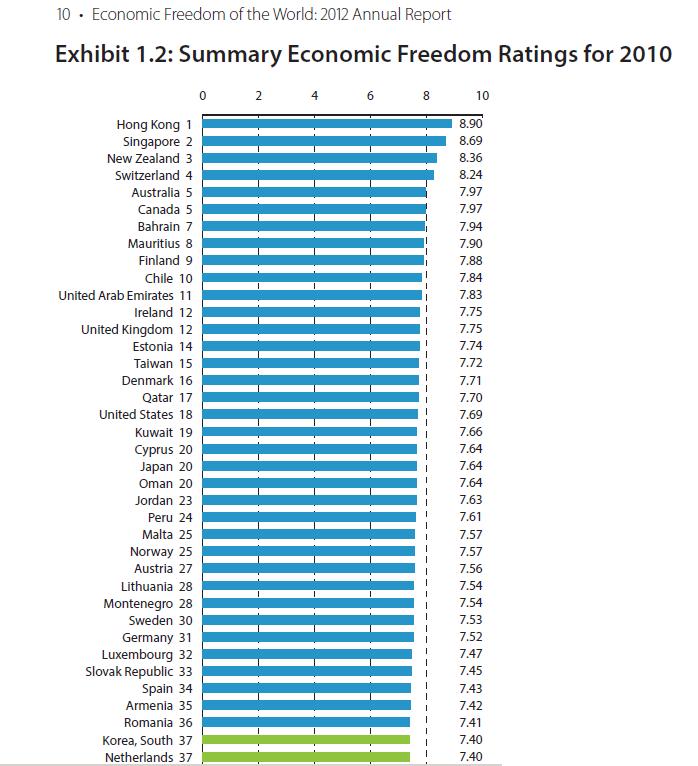
But I’m somewhat shocked to learn that we fell from 10th last year all the way down to 18th this year, as can be seen on the chart (click to enlarge).
Last year, the U.S. fell from 7th to 10th, and I though dropping three spots was bad. But falling by eight spots this past year is a stunning decline.
Who would have thought that Scandinavian welfare states such as Denmark and Finland would rank higher than the United States? Or that Ireland, with all its problems, would be above America?
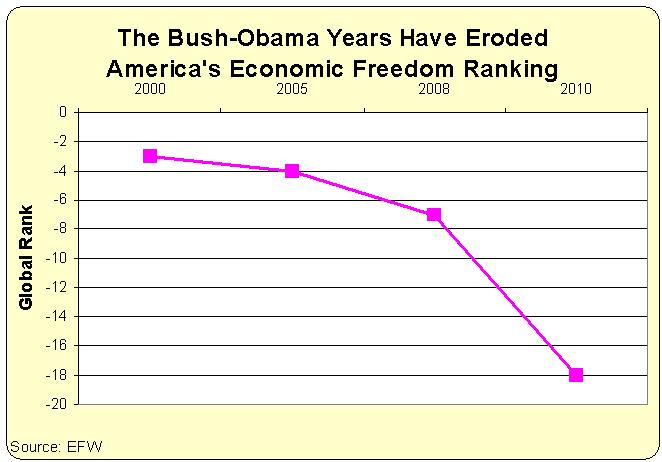
American politicians, by contrast, deserve scorn. Let’s update the chart I posted when last year’s report was issued.
As you can see, it’s an understatement to say that the United States is heading in the wrong direction. We’re still considerably ahead of interventionist welfare states such as France and Italy, though I’m afraid to think about what the U.S. score will be five years from now.
The United States, long considered the standard bearer for economic freedom among large industrial nations, has experienced a substantial decline in economic freedom during the past decade. From 1980 to 2000, the United States was generally rated the third freest economy in the world, ranking behind only Hong Kong and Singapore. After increasing steadily during the period from 1980 to 2000, the chainlinked EFW rating of the United States fell from 8.65 in 2000 to 8.21 in 2005 and 7.70 in 2010. The chain-linked ranking of the United States has fallen precipitously from second in 2000 to eighth in 2005 and 19th in 2010 (unadjusted ranking of 18th).
For those interested in why the United States has dropped, the “size of government” score has fallen from 8.65 in 2000 to 7.70 in the latest report. That’s not a surprise since the burden of government spending has exploded during the Bush-Obama years.
But the trade score also dropped significantly over the same period, from 8.78 to 7.65. So the protectionists should be happy, even though the rest of us have less prosperity.
The most dramatic decline, though, was the in the “legal system and property rights” category, where the U.S. plummeted from 9.23 in 2000 down to 7.12 in the new report. We’re not quite Argentina (3.76!), to be sure, but the trend is very troubling.




 The Daily Hatch