Category Archives: Cato Institute

The USA like Europe is in trouble because of a failure to address the real problem of excessive government spending

The Laffer Curve – Explained

Uploaded by on Nov 14, 2011

This video explains the relationship between tax rates, taxable income, and tax revenue. The key lesson is that the Laffer Curve is not an all-or-nothing proposition, where we have to choose between the exaggerated claim that “all tax cuts pay for themselves” and the equally silly assumption that tax policy doesn’t effect the economy and there is never any revenue feedback. From http://www.freedomandprosperity.org 202-285-0244

____________


The USA like Europe is in trouble because of a failure to address the real problem of excessive government spending.

I shared an astounding chart last month showing that tax increases account for 90 percent of the so-called “austerity” in Europe.

The author the chart, Veronique de Rugy of the Mercatus Center, calls this “private sector austerity” and she correctly argues that her home continent is in desperate need of some austerity on the public sector instead.

The good news is that more analysts have joined the fight, explaining that Europe is in trouble because of a failure to address the real problem of excessive government spending.

Here are some excerpts from a column in USA Today by Matthew Melchiorre from the Competitive Enterprise Institute, beginning with a good summary of how Europe has erred by choosing to impose austerity on the private sector.

The folly of “austerity” composed mainly of tax hikes with less in the way of spending reductions has driven the economies of the Old World into the ground. We’re next unless Congress keeps Uncle Sam out of Americans’ wallets and takes a chainsaw to Washington’s budget. …How is this likely to pan out? To get an idea, we can look at Europe, which has followed a similar strategy and has had little success in reviving growth. Spending cuts have been weak. Today, not a single Euro Zone government is spending less as a percentage of GDP than it did in 2007, according to Eurostat data. Tax increases, on the other hand, have been rampant. The average cyclically adjusted total tax burden among Euro Zone countries increased by about 5% from 2007 to 2010, according to European Commission data.

Wow, spending hasn’t been reduced but taxes are higher. Sounds a lot like Obama’s disingenuous “balanced approach.”

But there are some exceptions to the big-government consensus. Melchiorre notes that Estonia and other Baltic nations decided to impose genuine budget cuts.

Several Baltic countries have broken the European straitjacket of growth-strangling tax “austerity,” and have enjoyed success relative to their peers as a result. Take Estonia, for example. The Estonian government implemented an austerity program in 2009…cutting into public employee wages by 40% and slashing total government spending by a whopping 16% by 2011.

This is music to my ears. I’ve been advocating the Baltic approach for a couple of years. And it turns out that nations following my Golden Rule get good results.

Estonia’s economy…bounced right back with 2 percent growth the following year and has since continued to prosper. For the past two years, Estonian industry has expanded more than twice as fast as that of Germany. …Tax increases don’t bring about prosperity. Shrinking government to live within its means does.

Amen to that, but I think the final point needs to be expanded. It’s not just that tax increases don’t work. It’s that they make matters worse.

The problem in most nations is that government is too big. In a best-case scenario, tax increases are a substitute for spending restraint. More often than not, though, tax hikes lead to higher levels of government spending.

This brings us back to the current fiscal fight in the United States. Obama has dug in his heels and demanded an increase in the top tax rates. He claims that this class-warfare approach is necessary for fiscal responsibility.

But ask yourself a question. We know that America’s long-run fiscal problem is entitlement spending. Will politicians be more likely or less likely to reform those programs if they think tax increases are an option?

If you answered “more likely,” you should move to Greece and see how well your system is working.

The fiscal debate should focus of Washington’s real crisis of excessive spending


It is sad that the Republicans don’t get together and stop the Democrats from raising the debt ceiling limit. If they did that then Obama would do about anything they wanted!!!! It seems to me that the Republicans are a bunch of wimps though. The fiscal debate should focus of Washington’s real crisis of excessive spending

Why Are Republicans Willing to Help Obama Make America More Like Europe When the Welfare State Is Collapsing?

November 30, 2012 by Dan Mitchell

Washington frustrates me. The entire town is based on legalized corruption as an unworthy elite figure out new ways of accumulating unearned wealth by skimming money from the nation’s producers.

But one thing that especially irks me is the way people focus on the trees and forget about the forest. Politicians and journalists are now engaged in an inside-baseball game of analyzing every twist and turn of the fiscal cliff negotiations.

That’s all fine and well, but perhaps it would be a good idea to talk about the need to fix the real crisis of excessive spending instead of arguing about how fast we should be traveling in the wrong direction.

And let’s not delude ourselves. In the absence of real entitlement reform, the United States is doomed to repeat Europe’s mistakes.

And how are things going in Europe? Well, I’m glad you ask. Let’s look at some excerpts from an Associated Press report.

Another month, another record unemployment rate for the economy of the 17 European Union countries that use the euro. Figures released Friday by Eurostat, the EU’s statistics office, showed that the recession in the eurozone pushed unemployment up in the currency bloc to 11.7 percent in October, the highest level since the introduction of the euro in 1999. …Eurostat found that 18.7 million people were out of work across the eurozone, an increase of 173,000 on the previous month and 2.2 million higher than the year before. The wider 27-nation EU that includes non-euro countries such as Britain and Poland had an unemployment rate of 10.7 percent in October and a total of 25.9 million out of work. …”Talk of a `lost generation’ of young people now looks like an alarming possibility,” said Andrea Broughton, principal research fellow at the Institute for Employment Studies.

In other words, we may complain about America’s miserable track record on jobs during the Obama years, but at some point in the future we may someday look back on 8 percent unemployment as good news.

Unfortunately, the crowd in Washington doesn’t want to acknowledge that the real problem is spending. And I’m particularly irked (but not surprised) that Republicans now seem willing to go along with Obama even though they won this fight back in 2010 when they didn’t control the House and had fewer seats in the Senate. Here’s what I said to one of the local DC stations.

I realize I’m sounding glum, so let’s close out this post with a couple of amusing cartoons about America’s European future.

I’ve already shared the “European Lemming” cartoon. This one has the same theme.

Cartoon Obama Iceberg

Other Eric Allie cartoons can be enjoyed here, here , hereherehere, and here.

And here another cartoon with the same theme.

Cartoon Obama Cliff

If you like this Bok cartoon, some of my other favorites can be seen here,  hereherehereherehere, and here.

If you still haven’t cheered up, this bit of Dave Barry humor about the European fiscal crisis is a classic, and I’d also recommend this bit of unintentional satire.

Why are we so accepting of infanticide?

__________

___________________

_____________________________________

Francis Schaeffer “BASIS FOR HUMAN DIGNITY” Whatever…HTTHR

Dr. Francis schaeffer – The flow of Materialism(from Part 4 of Whatever happened to human race?)

Dr. Francis Schaeffer – The Biblical flow of Truth & History (intro)

Francis Schaeffer – The Biblical Flow of History & Truth (1)

Dr. Francis Schaeffer – The Biblical Flow of Truth & History (part 2)

Why is our society so accepting of infanticide? About 40 years ago the door was opened to abortion in the USA and that was the fruit of humanism. Is it much of a surprise that we find our country at the point where it is about to accept infanticide now?

Here is the article that got me thinking about this issue this morning followed by an article by David L. Skeen that agrees with my view on abortion and infanticide.

I’m not easily grossed out or nauseated. Heck, I’m on email lists for a half-dozen softball teams and you can only imagine the strange/filthy/nasty things that guys send to each other.

But I read a story about the death panels in the United Kingdom that left me discombobulated. I can’t even begin to describe how I feel.

Here’s the intro of a disturbing report in the Daily Mail.

Sick children are being discharged from NHS hospitals to die at home or in hospices on controversial ‘death pathways’. Until now, end of life regime the Liverpool Care Pathway was thought to have involved only elderly and terminally-ill adults. But the Mail can reveal the practice of withdrawing food and fluid by tube is being used on young patients as well as severely disabled newborn babies.

And here are some of the horrifying details. Read at your own risk.

One doctor has admitted starving and dehydrating ten babies to death in the neonatal unit of one hospital alone. Writing in a leading medical journal, the physician revealed the process can take an average of ten days during which a  baby becomes ‘smaller and shrunken’. The LCP – on which 130,000 elderly and terminally-ill adult patients die each year – is now the subject of an independent inquiry ordered by ministers. …Earlier this month, an un-named doctor wrote of the agony of watching the protracted deaths of babies. …‘I know, as they cannot, the unique horror of witnessing a child become smaller and shrunken, as the only route out of a life that has become excruciating to the patient or to the parents who love their baby.’ Grim Reaper with Kid…Bernadette Lloyd, a hospice paediatric nurse, has written to the Cabinet Office and the Department of Health to criticise the use of death pathways for children. She said: ‘The parents feel coerced, at a very traumatic time, into agreeing that this is correct for their child whom they are told by doctors has only has a few days to live. It is very difficult to predict death. I have seen a “reasonable” number of children recover after being taken off the pathway. …‘I have also seen children die in terrible thirst because fluids are withdrawn from them until they die. ‘I witnessed a 14 year-old boy with cancer die with his tongue stuck to the roof of his mouth when doctors refused to give him liquids by tube. His death was agonising for him, and for us nurses to watch. This is euthanasia by the backdoor.’

My first reaction is to hope that this story is wildly wrong, filled with exaggerations and lies.

My second reaction (and this is why I got so agitated) is to imagine what it must be like for the parents. They get talked into letting their kids die, which must be agonizing, and then (assuming they stick around) they have to watch them slowly starve to death or die of thirst. Wouldn’t it be better to just give your kid a fatal injection? Setting aside the moral issue of deciding to let a kid die because he’s disabled or something like that, doesn’t simple decency mean that death should be painless rather than agonizing?

My final reaction is to wonder what Paul Krugman would say about this scandalous neglect and mistreatment. During the Obamacare debate, he told us we could ignore stories about what was happening across the ocean, writing that “In Britain, the government itself runs the hospitals and employs the doctors. We’ve all heard scare stories about how that works in practice; these stories are false.” So I guess starving children don’t qualify as a scare story.

P.S. If you want more horror stories about government-run healthcare in the United Kingdom click here, here, here, here, herehereherehereherehereherehere, here and here.

Abortion and infanticide

This article from the UK Telegraph from late February summarizes (and links to) an article in the Journal of Medical Ethics which argues that “newborn babies are not ‘actual persons’ and do not have a ‘moral right to life’. The academics [Alberto Giubilini and Francesca Minerva] also argue that parents should be able to have their baby killed if it turns out to be disabled when it is born.”  Giubilini and Minerva “use the phrase ‘after-birth abortion’ rather than ‘infanticide’ to ‘emphasise that the moral status of the individual killed is comparable with that of a fetus’.”

So less than 40 years after abortion on-demand was legalized in the US, we see an article in an academic journal making the argument that because abortion is morally acceptable, infanticide is also morally acceptable.  For Christians who have opposed abortion for decades, this development is not surprising.

In their 1979 book Whatever Happened to the Human Race?, Francis Schaeffer and C. Everett Koop wrote:

At a population control conference in Washington DC, as reported by editor-writer Norman Podhoretz, one speaker saw “no reason why anyone who accepted abortion should balk at infanticide.”  Another urged certain medical qualifying tests for all newborns.  These would determine their genetic characteristics and, thus, whether their right to life should for forfeited.  Of course, at present only a few hold these ideas, but unfortunately they are presenting these ideas again and again.  Taken a little more seriously each time, they become a little more thinkable each time….

Without the Judeo-Christian base which gives every individual an intrinsic dignity as made in the image of the personal-infinite Creator, each successive horror falls naturally in place.  Combine arbitrary law (in which a small group of people may decide what is good for society at that moment of history) with the Supreme Court ruling on arbitrary abortion and the gates are opened for many kinds of killing under the guise of social good.

In his 1980 book The Right to Live, The Right to Die, Koop wrote:

It is, further, absolutely astounding to me that Justice Blackmun could have included the following sentence in his decision: “We need not resolve the question of when life begins.”  Where does this lead?  It leads to infanticide and eventually to euthanasia.  If the law will not protect the life of a normal, unborn child, what chance does a newborn infant have after birth, if in the eyes of Justice Blackmun, he might be less than normal?…

Koop quoted James Watson, who wrote in an American Medical Association publication (in 1973): “If a child were not declared alive until three days after birth, then all parents could be allowed the choice only a few are given in the present system.”  Koop also quoted Francis Crick (in a 1978 interview): “No newborn infant should be declared human until it has passed certain tests regarding its genetic endowment and that if it fails these tests, it forfeits the right to live.”  So we can see scientific voices (Watson and Crick were Nobel laureates) arguing for infanticide decades ago.

In the US, we have seen our laws become increasingly arbitrary. In some states, euthanasia has been legalized. The Obama administration has given federal funding to embryonic stem cell research, where embryos are destroyed in the hope of finding medical cures.  Perhaps a state will legalize infanticide, probably in limited circumstances at first.  If this occurs, and the statute is challenged in the courts, how would the Supreme Court would rule on it?  In all likelihood, the Court would make another arbitrary ruling.

Our nation has drifted further and further from a fundamental commitment to a God-given right to life, which we had recognized in our Declaration of Independence.  If we continue on this path, we can anticipate successive horrors falling naturally in place.

Related posts:

Francis Schaeffer: “Whatever Happened to the Human Race?” (Episode 2) SLAUGHTER OF THE INNOCENTS

Francis Schaeffer: “Whatever Happened to the Human Race?” (Episode 2) SLAUGHTER OF THE INNOCENTS Published on Oct 6, 2012 by AdamMetropolis This crucial series is narrated by the late Dr. Francis Schaeffer and former Surgeon General Dr. C. Everett Koop. Today, choices are being made that undermine human rights at their most basic level. Practices […]

Francis Schaeffer: “Whatever Happened to the Human Race” (Episode 1) ABORTION OF THE HUMAN RACE

It is not possible to know where the pro-life evangelicals are coming from unless you look at the work of the person who inspired them the most. That person was Francis Schaeffer.  I do care about economic issues but the pro-life issue is the most important to me. Several years ago Adrian Rogers (past president of […]

Dan Mitchell: Subsidizing unemployment means more joblessness


Why do we constantly extend unemployment benefits when we know that subsidizing unemployment means more joblessness?

Government Benefits Encourage Unemployment

November 29, 2012 by Dan Mitchell

It’s not something I should admit since I work at a think tank, which is based on the idea that substantive analysis can impact public policy, but I sometimes think humor and anecdotes are very effective in helping people understand issues.

On the topic of unemployment insurance, for instance, I wouldn’t be surprised to learn that this Michael Ramirez cartoon and this Wizard-of-Id parody have been effective in helping folks grasp the unintended consequences of excessive government benefits.

And I bet this story from Michigan and this example from Ohio will ring a bell with many people because they have some relative or buddy who also has used government benefits as an excuse to stay unemployed.

So when I went on Fox to discuss the issue, I mentioned that I had a couple of friends who goofed off instead of looking for work because they got unemployment benefits…

.

But since I am a think-tank policy wonk, I also explain that even left-wing economists such as Paul Krugman and Larry Summers agree that subsidizing unemployment means more joblessness. The academic research on this topic is virtually unanimous.

Keep in mind, by the way, that the negative impact of unemployment benefits is just the tip of the welfare-state iceberg. Professor Casey Mulligan has some very good work about the negative impact of redistribution programs, and this chart shows how dependency programs create very high implicit marginal tax rates for the less fortunate.

P.S. My opponent got screwed in terms of airtime, something that I can sympathize with since I’m often the one getting the short end of the stick, even when appearing on overseas television. This previous debate on unemployment insurance, by contrast, was very balanced.

P.P.S. If you want an example of unintentional humor, you can watch Nancy Pelosi asserting that paying people not to work is an effective means of creating jobs.

Videos by Cato Institute on failed stimulus plans

In this post I have gathered several videos from the Cato Institute concerning the subject of failed stimulus plans.

_____

Government Spending Doesn’t Create Jobs

Uploaded by on Sep 7, 2011

Share this on Facebook: http://on.fb.me/qnjkn9 Tweet it: http://tiny.cc/o9v9t

In the debate of job creation and how best to pursue it as a policy goal, one point is forgotten: Government doesn’t create jobs. Government only diverts resources from one use to another, which doesn’t create new employment.

Video produced by Caleb Brown and Austin Bragg.

___________________________

Keynesian Catastrophe: Big Money, Big Government & Big Lies

Uploaded by on Jan 19, 2012

The Cato Institute’s Dan Mitchell explains why Obama’s stimulus was a flop! With Glenn Reynolds.

See more at http://www.pjtv.com and http://www.cato.org

___________________

Keynesian Economics Is Wrong: Bigger Gov’t Is Not Stimulus

Uploaded by on Dec 15, 2008

Based on a theory known as Keynesianism, politicians are resuscitating the notion that more government spending can stimulate an economy. This mini-documentary produced by the Center for Freedom and Prosperity Foundation examines both theory and evidence and finds that allowing politicians to spend more money is not a recipe for better economic performance.

___________________

Obama’s So-Called Stimulus: Good For Government, Bad For the Economy

Uploaded by on Jan 26, 2009

President Obama wants Congress to dramatically expand the burden of government spending. This CF&P Foundation mini-documentary explains why such a policy, based on the discredited Keynesian theory of economics, will not be successful. Indeed, the video demonstrates that Obama is proposing – for all intents and purposes – to repeat Bush’s mistakes. Government will be bigger, even though global evidence shows that nations with small governments are more prosperous.

____________

Big Government Is Not Stimulus: Why Keynes Was Wrong (The Condensed Version)

Uploaded by on Jan 13, 2009

The CF&P Foundation has released a condensed version of our successful mini-documentary explaining why so-called stimulus schemes do not work. Based on a theory known as Keynesianism, politicians are resuscitating the notion that more government spending can stimulate an economy. This mini-documentary produced by the Center for Freedom and Prosperity Foundation examines both theory and evidence and finds that allowing politicians to spend more money is not a recipe for better economic performance.

_________________

Eight Reasons Why Big Government Hurts Economic Growth

Uploaded by on Aug 17, 2009

This Center for Freedom and Prosperity Foundation video analyzes how excessive government spending undermines economic performance. While acknowledging that a very modest level of government spending on things such as “public goods” can facilitate growth, the video outlines eight different ways that that big government hinders prosperity. This video focuses on theory and will be augmented by a second video looking at the empirical evidence favoring smaller government.

___________________

Keynesian Economics Is Wrong: Economic Growth Causes Consumer Spending, Not the Other Way

Uploaded by on Nov 29, 2010

Politicians and journalists who fixate on consumer spending are putting the cart before the horse. Consumer spending generally is a consequence of growth, not the cause of growth. This Center for Freedom and Prosperity video helps explain how to achieve more prosperity by looking at the differences between gross domestic product and gross domestic income. www.freedomandprosperity.org

_____________

Deficits, Debts and Unfunded Liabilities: The Consequences of Excessive Government Spending

Uploaded by on May 10, 2010

Huge budget deficits and record levels of national debt are getting a lot of attention, but this video explains that unfunded liabilities for entitlement programs are Americas real red-ink challenge. More important, this CF&P mini-documentary reveals that deficits and debt are symptoms of the real problem of an excessive burden of government spending. www.freedomandprosperity.org

___________

Now that I have been critical of the Democrat President, I wanted to show that I am not concerned about taking up for Republicans but looking at the facts. President Clinton did increase government spending at a slower rate than many other presidents. Here are two  videos that praise both Reagan and Clinton for both accomplished this feat.

Spending Restraint, Part I: Lessons from Ronald Reagan and Bill Clinton

Uploaded by on Feb 14, 2011

Ronald Reagan and Bill Clinton both reduced the relative burden of government, largely because they were able to restrain the growth of domestic spending. The mini-documentary from the Center for Freedom and Prosperity uses data from the Historical Tables of the Budget to show how Reagan and Clinton succeeded and compares their record to the fiscal profligacy of the Bush-Obama years.

______________

Spending Restraint, Part II: Lessons from Canada, Ireland, Slovakia, and New Zealand

Uploaded by on Feb 22, 2011

Nations can make remarkable fiscal progress if policy makers simply limit the growth of government spending. This video, which is Part II of a series, uses examples from recent history in Canada, Ireland, Slovakia, and New Zealand to demonstrate how it is possible to achieve rapid improvements in fiscal policy by restraining the burden of government spending. Part I of the series examined how Ronald Reagan and Bill Clinton were successful in controlling government outlays — particularly the burden of domestic spending programs. www.freedomandprosperity.org

______________

It seems that liberals will never wake up. On 3-8-12 a Arkansas Times blogger pointed out that Obama’s stimulus in 2009 was not made up of just increased but also tax cuts. That is true but the real truth is that there have been about 1/2 dozen stimulus efforts by President Obama and all of them have failed.  Over and over they have tried stimulus plans but they don’t work. Take a look at this excellent article from the Cato Institute:

Keynesian Policies Have Failed

by Chris Edwards

Chris Edwards is the director of tax policy studies at the Cato Institute and the editor of Downsizing Government.org.

Added to cato.org on December 2, 2011

This article appeared on U.S. News & World Report Online on December 2, 2011

Lawmakers are considering extending temporary payroll tax cuts. But the policy is based on faulty Keynesian theories and misplaced confidence in the government’s ability to micromanage short-run growth.

In textbook Keynesian terms, federal deficits stimulate growth by goosing “aggregate demand,” or consumer spending. Since the recession began, we’ve had a lot of goosing — deficits were $459 billion in 2008, $1.4 trillion in 2009, $1.3 trillion in 2010, and $1.3 trillion in 2011. Despite that huge supposed stimulus, unemployment remains remarkably high and the recovery has been the slowest since World War II.

Policymakers should ignore the Keynesians and their faulty models, and instead focus on reforms to aid long-run growth…

Yet supporters of extending payroll tax cuts think that adding another $265 billion to the deficit next year will somehow spur growth. That “stimulus” would be on top of the $1 trillion in deficit spending that is already expected in 2012. Far from helping the economy, all this deficit spending is destabilizing financial markets, scaring businesses away from investing, and imposing crushing debt burdens on young people.

For three years, policymakers have tried to manipulate short-run economic growth, and they have failed. They have put too much trust in macroeconomists, who are frankly lousy at modeling the complex workings of the short-run economy. In early 2008, the Congressional Budget Office projected that economic growth would strengthen in subsequent years, and thus completely missed the deep recession that had already begun. And then there was the infamously bad projection by Obama’s macroeconomists that unemployment would peak at 8 percent and then fall steadily if the 2009 stimulus plan was passed.

Chris Edwards is the director of tax policy studies at the Cato Institute and the editor of Downsizing Government.org.


More by Chris Edwards

Some of the same Keynesian macroeconomists who got it wrong on the recession and stimulus are now claiming that a temporary payroll tax break would boost growth. But as Stanford University economist John Taylor has argued, the supposed benefits of government stimulus have been “built in” or predetermined by the underlying assumptions of the Keynesian models.

Policymakers should ignore the Keynesians and their faulty models, and instead focus on reforms to aid long-run growth, which economists know a lot more about. Cutting the corporate tax rate, for example, is an overdue reform with bipartisan support that would enhance America’s long-run productivity and competitiveness.

If Congress is intent on cutting payroll taxes, it should do so within the context of long-run fiscal reforms. One idea is to allow workers to steer a portion of their payroll taxes into personal retirement accounts, as Chile and other nations have done. That reform would feel like a tax cut to workers because they would retain ownership of the funds, and it would begin solving the long-term budget crisis that looms over the economy.

Related posts:

Stimulus plans do not work (part 2)

Dan Mitchell discusses the effectiveness of the stimulus Uploaded by catoinstitutevideo on Nov 3, 2009 11-2-09 When I think of all our hard earned money that has been wasted on stimulus programs it makes me sad. It has never worked and will not in the future too. Take a look at a few thoughts from […]

Stimulus plans do not work (Part 1)

Government Spending Doesn’t Create Jobs Uploaded by catoinstitutevideo on Sep 7, 2011 Share this on Facebook: http://on.fb.me/qnjkn9 Tweet it: http://tiny.cc/o9v9t In the debate of job creation and how best to pursue it as a policy goal, one point is forgotten: Government doesn’t create jobs. Government only diverts resources from one use to another, which doesn’t […]

Dumas thinks we don’t need Balanced Budget Amendment but should balance it on our own

In his recent article Ernie Dumas sticks to his guns that we should balance the budget without being forced to with a “Balanced Budget Amendment,” but I wonder how well that has worked so far? I have made this a key issue for this blog in the past as you can tell below: Dear Senator […]

Maybe the “Occupy Wall Street” crowd should be angry at Obama

(Picture from Arkansas Times Blog) When I think about all the anger and hate coming from the Occupy Wall Street crowd, I wonder if they have read this story below? Solyndra: Crooked Politics or Just Bad Economics? Posted by David Boaz Amy Harder has a good take on the Solyndra issue in National Journal Daily […]

Dear Senator Pryor, why not pass the Balanced Budget Amendment? (Part 13 Thirsty Thursday, Open letter to Senator Pryor)

Dear Senator Pryor, why not pass the Balanced Budget Amendment? (Part 13 Thirsty Thursday, Open letter to Senator Pryor) Office of the Majority Whip | Balanced Budget Amendment Video In 1995, Congress nearly passed a constitutional amendment mandating a balanced budget. The Balanced Budget Amendment would have forced the federal government to live within its […]

Mark Pryor not for President’s job bill even though he voted for it

Andrew Demillo pointed this out  and also Jason Tolbert noted: PRYOR OPPOSES THE OBAMA JOBS BILL THAT HE VOTED TO ADVANCE  Sen. Mark Pryor has been traveling around the state touting a six-part jobs plan that he says “includes a number of bipartisan initiatives, is aimed at creating jobs by setting the table for growth, encouraging new […]

Is a lack of money the problem for our public schools?

Is a lack of money the problem for our public schools? Everything You Need to Know About Public School Spending in Less Than 2½ Minutes Posted by Adam Schaeffer Neal McCluskey gutted the President’s new “Save the Teachers” American Jobs Act sales pitch a good while back, as did Andrew Coulson here. Thankfully, it seems […]

We got to get some backbone Republicans!!!!


We got get some backbone Republicans!!!!

Talking Fiscal Cliff and GOP Fecklessness with the Instapundit

November 29, 2012 by Dan Mitchell

Unless the law is changed, big tax increases will be imposed on all taxpayers next year. This is the so-called fiscal cliff, and President Obama is using this unpalatable situation as an excuse to push for his class-warfare tax policy.

I talk about the political and economic ramification of this fight with Glenn Reynolds, author of the famous Instapundit blog….

As is my habit, there are a couple of points that deserve some elaboration.

  • Budget deals don’t work – I wrote about this issue back in 2010, but I think the most persuasive piece of evidence came from the New York Times, which inadvertently admitted that the only successful budget deal was the 1997 pact that cut taxes rather than raising them.
  • We should only raise taxes on those who say they want higher taxes – Since the Hollywood left (with some noble exceptions such as Jon Lovitz and Rob Schneider) is in favor of bigger government and higher tax rates, Glenn has suggested a restoration of the federal tax on movie receipts. That hasn’t worked very well in Spain, but I like the idea. In the same spirit, I’ve proposed a tax on CEO salaries since the big business community is trying to curry favor with the political class by endorsing tax hikes.
  • Republicans won this fight in 2010 when they had less power – The same fiscal cliff fight took place two years ago, before the Republicans controlled the House and when they had fewer seats in the House. Yet GOPers prevailed because Senate Republicans stuck together. It would be a sign on remarkable incompetence if they lost this year’s fight since they now have much more power.
  • Long-term incumbents get too comfortable with big government – I joked about politicians who come to Washington thinking it’s a cesspool, but eventually think it’s a hot tub, but that’s actually a very serious point. As I explain in this post, too many GOPers get corrupted by big government.
  • It’s simple to balance the budget with modest spending restraint – According to Congressional Budget Office data, we can make the Bush tax cuts permanent and balance the budget in just 10 years if lawmakers simply exercise some modest fiscal restraint and limit spending so it grows by an average of 2.5 percent yearly.
  • Most important, I sneak in an endorsement of my beloved Bulldawgs at the end of the interview – I’ve been very restrained and have not used this blog as a platform to celebrate Georgia being two wins away from the national title. Actually, the SEC Championship Game this weekend is the de facto national title game, though whichever team that prevails will have to take the pro forma step of mopping the floor with Notre Dame in January. This cartoon shows the state of play.
P.S. I appreciated Glenn’s reference to Lucy, Charlie Brown, and the football. To see my re-creation of that Peanuts classic, look at the cartoon in this post.

Is President Obama going to bankrupt our country by going from 10 trillion to 22 trillion in debt? ( Part 16)

Keynesian Economics Is Wrong: Bigger Gov’t Is Not Stimulus

Uploaded by on Dec 15, 2008

Based on a theory known as Keynesianism, politicians are resuscitating the notion that more government spending can stimulate an economy. This mini-documentary produced by the Center for Freedom and Prosperity Foundation examines both theory and evidence and finds that allowing politicians to spend more money is not a recipe for better economic performance.

_____________

These posts are all dealing with issues that President Obama did not help on in his first term. I am hopeful that he will continue to respond to my letters that I have written him and that he will especially reconsider his view on the following import issue which deals with holding down federal spending. Is President Obama going to bankrupt our country by going from 10 trillion to 22 trillion in debt?

I have a lot of respect for Tea Party heroes like Tim Huelskamp , Idaho First District Congressman Raúl R. Labrador, and Justin Amash who are willing to vote against proposals that increase our spending,  and they want to pass the Balanced Budget Amendment.    

It is a fact that we must balance the budget soon. I do not believe that we can wait to balance the budget at some distant time in the future. The financial markets will not allow us a long time to get our house in order. Look at how things have been going the last four years and no matter how anyone tries to spin it, we are going down the financial drain fast and headed to Greece!!!

Baby Budget Hawks of the GOP

by Michael D. Tanner

Michael Tanner is a senior fellow at the Cato Institute and author of Leviathan on the Right: How Big-Government Conservatism Brought Down the Republican Revolution.

Added to cato.org on May 23, 2012

This article appeared in National Review (Online) on May 23, 2012

The conventional wisdom, pushed for very different reasons by both Republicans and Democrats, is that Republicans in Congress, controlled by radical tea-partiers, have been slashing government spending. Thus it becomes a little hard to understand how, in the few short months since last year’s debt-ceiling deal, the federal debt has increased by more than $1.5 trillion, roughly $13,000 per household. If Republicans are such great budget cutters, how come we continue to spend more, run more deficits, and accumulate more debt?

The latest evidence suggests that it is because, contrary to conventional wisdom, Republicans still aren’t such radical budget hawks after all.

For example, the latest Club for Growth scorecard suggests that, on the whole, Republicans in this congress have actually been less fiscally responsible than those in past congresses. For 2011, the average Republican received a weighted score of 69.5 out of 100. That’s far short of the 86.3 average score in 2010, and it hardly suggests a tea-party-led wave of austerity.

Forty Republicans received scores of 90 or higher, and nine — Representatives Amash (Mich.), Chaffetz (Utah), Flake (Ariz.), Franks (Ariz.), Graves (Ga.), Huelskamp (Kan.), Jordan (Ohio), Labrador (Idaho), and Lamborn (Colo.) — received perfect scores of 100 percent. However, 25 Republicans had scores below 50. In fact six Republicans – Ros-Lehtinen (Fla.), Diaz-Balart (Fla.), McKinley (W.Va.), Smith (N.J.), Young (Alaska), and LoBiando (N.J.) — had scores worse than those of some Democrats, such as Dan Boren (Okla.). Interestingly, for all the attention paid to freshmen representatives who are supposedly in hock to the Tea Party, only three freshmen — Amash, Huelskamp, and Labrador — received perfect scores, while three other freshmen — Representatives Dold (Ill.), Meehan (Pa.), and McKinley — were among the worst-performing Republicans. Compare this with 2010, when 28 Republicans received a perfect score from the Club for Growth and only two had scores below 50.

Republicans still seem unwilling to make the tough choices when it comes to spending cuts.

Of course one could be argue that scorecards that focus on specific votes are not a particularly good measure of a lawmaker’s overall record. Perhaps the votes were tougher this year, or the Club for Growth stopped scoring on a curve. Let’s take a look, then, at a slightly different measure of fiscal responsibility, the National Taxpayer Union’s latest measure of proposed spending increases and cuts by members of Congress. By this measure, there has also been an improvement by Republicans in this congress, but not an overwhelming one.

On an annualized basis, Republicans in the House proposed spending increases of $5.3 billion and cuts of $135 billion. Thus, if every one of their proposals had passed, total federal spending would have been reduced by $130.2 billion, which is 3.6 percent of this year’s projected spending. That would still have left us with a budget deficit this year of $1.17 trillion.

That’s an improvement over last year, when Republicans proposed a net spending reduction of only $45 billion. So it’s a baby step in the right direction — but far from what we need to keep us from falling off the debt-and-deficit cliff.

Moreover, the actual Republican record is not quite as good as even this baby step looks, because nearly all Republicans backed the repeal of Obamacare, which accounts for $40.3 billion of the annualized savings. Supporting repeal was easy, and it had no actual chance of passing. If we take that away, then Republicans called for only $95.3 billion in other cuts, which is roughly 2.6 percent of federal spending. Overall, Republicans still seem unwilling to make the tough choices when it comes to spending cuts.

Those Republicans proposing the biggest net reductions in spending are Representatives Jason Chaffetz (Utah), Trent Franks (Ariz.), and Jeff Duncan (S.C.). Among the freshmen class in the House, Representatives Duncan, Huelskamp, Labrador, and Guinta proposed the largest net reductions, with the first three also receiving near-perfect Club for Growth scores.

On the other side, ten House Republicans actually proposed net spending increases, among them Representatives Chris Smith (N.J.), Chris Gibson (N.Y.) and Patrick Meehan (Pa.). Notably, Representatives Gibson and Meehan were also among those with the worst voting records, according to the Club for Growth.

Let’s look at one more measure of Republican seriousness when it comes to debt and deficit reduction: the most recent budget votes. Nearly all House Republicans, of course, voted in favor of the Ryan budget. While certainly not perfect — it would take more than 20 years to achieve balance — the Ryan budget nonetheless laid down an important marker on entitlement reform and spending restraint. Among the ten House Republicans who voted against the Ryan budget were both those who thought it spent too much money (Representatives Amash and Huelskamp) and those who thought it didn’t spend enough (Representatives Gibson and McKinley, of course).

In the Senate, Republicans were less likely to support the Ryan budget, in part because Senate rules allowed them more alternatives. Still, the results from a fiscal-responsibility perspective were mixed. Only 16 Republicans supported the most fiscally conservative alternative, proposed by Senator Rand Paul of Kentucky. They picked up one more vote for a proposed budget by Senator Mike Lee of Utah. A third proposal by Pennsylvania’s Senator Pat Toomey garnered 32 votes, and the original Ryan budget received 41. Four Republican senators voted against all four alternatives: Brown (Mass.), Collins (Maine), Heller (Nev.), and Snowe (Maine).

Recent weeks have also seen Republicans in the House vote to reauthorize the Export-Import Bank, an example of corporate welfare if there ever was one, and abandon the sequester for cuts in military spending. Senate Republicans also agreed on a highway bill that hikes the deficit in the long run.

None of this suggests that Republicans were not generally more fiscally conservative than Democrats. The average Democrat score on the Club for Growth Scorecard was only 10.95 out of 100. All but three Democrats in the House scored below every Republican, and six Democrats received a score of 0. The average Democrat proposed net spending increases of $496 billion — almost half a trillion dollars in new net spending. Not a single Democrat voted for the Ryan budget, or for any of the lower-spending alternatives.

But better is not good enough.

Unless Washington gets spending under control, we are headed toward a debt crisis of Greek proportions, and time is running out. It’s time for Republicans to live up to the hype and get truly serious about cutting spending.

Videos by Dan Mitchell of the Cato Institute found here on www.thedailyhatch.org

Dan Mitchell of the Cato Institute has some great videos and I have posted lots of them on my blog. I like to go to Dan’s blog too. Take a look at some of them below and then the links to my blog.

It’s Simple to Balance The Budget Without Higher Taxes

Uploaded by on Oct 4, 2010

Politicians and interest groups claim higher taxes are necessary because it would be impossible to cut spending by enough to get rid of red ink. This Center for Freedom and Prosperity video shows that these assertions are nonsense. The budget can be balanced very quickly by simply limiting the annual growth of federal spending.

_______

Six Reasons Why the Capital Gains Tax Should Be Abolished

Uploaded by on May 3, 2010

The correct capital gains tax rate is zero because there should be no double taxation of income that is saved and invested. This is why all pro-growth tax reform plans, such as the flat tax and national sales tax, eliminate the capital gains tax. Unfortunately, the President wants to boost the official capital gains tax rate to 20 percent, and that is in addition to the higher tax rate on capital gains included in the government-run healthcare legislation. http://www.freedomandprosperity.org


______________

Keynesian Economics Is Wrong: Bigger Gov’t Is Not Stimulus

Uploaded by on Dec 15, 2008

Based on a theory known as Keynesianism, politicians are resuscitating the notion that more government spending can stimulate an economy. This mini-documentary produced by the Center for Freedom and Prosperity Foundation examines both theory and evidence and finds that allowing politicians to spend more money is not a recipe for better economic performance.

___________________

Obama’s So-Called Stimulus: Good For Government, Bad For the Economy

Uploaded by on Jan 26, 2009

President Obama wants Congress to dramatically expand the burden of government spending. This CF&P Foundation mini-documentary explains why such a policy, based on the discredited Keynesian theory of economics, will not be successful. Indeed, the video demonstrates that Obama is proposing – for all intents and purposes – to repeat Bush’s mistakes. Government will be bigger, even though global evidence shows that nations with small governments are more prosperous.

____________

Big Government Is Not Stimulus: Why Keynes Was Wrong (The Condensed Version)

Uploaded by on Jan 13, 2009

The CF&P Foundation has released a condensed version of our successful mini-documentary explaining why so-called stimulus schemes do not work. Based on a theory known as Keynesianism, politicians are resuscitating the notion that more government spending can stimulate an economy. This mini-documentary produced by the Center for Freedom and Prosperity Foundation examines both theory and evidence and finds that allowing politicians to spend more money is not a recipe for better economic performance.

_________________

Eight Reasons Why Big Government Hurts Economic Growth

Uploaded by on Aug 17, 2009

This Center for Freedom and Prosperity Foundation video analyzes how excessive government spending undermines economic performance. While acknowledging that a very modest level of government spending on things such as “public goods” can facilitate growth, the video outlines eight different ways that that big government hinders prosperity. This video focuses on theory and will be augmented by a second video looking at the empirical evidence favoring smaller government.

___________________

Now that I have been critical of the Democrat President, I wanted to show that I am not concerned about taking up for Republicans but looking at the facts. President Clinton did increase government spending at a slower rate than many other presidents. Here are two  videos that praise both Reagan and Clinton for both accomplished this feat.

Spending Restraint, Part I: Lessons from Ronald Reagan and Bill Clinton

Uploaded by on Feb 14, 2011

Ronald Reagan and Bill Clinton both reduced the relative burden of government, largely because they were able to restrain the growth of domestic spending. The mini-documentary from the Center for Freedom and Prosperity uses data from the Historical Tables of the Budget to show how Reagan and Clinton succeeded and compares their record to the fiscal profligacy of the Bush-Obama years.

______________

Spending Restraint, Part II: Lessons from Canada, Ireland, Slovakia, and New Zealand

Uploaded by on Feb 22, 2011

Nations can make remarkable fiscal progress if policy makers simply limit the growth of government spending. This video, which is Part II of a series, uses examples from recent history in Canada, Ireland, Slovakia, and New Zealand to demonstrate how it is possible to achieve rapid improvements in fiscal policy by restraining the burden of government spending. Part I of the series examined how Ronald Reagan and Bill Clinton were successful in controlling government outlays — particularly the burden of domestic spending programs. www.freedomandprosperity.org

Here are some posts that include videos from Dan Mitchell:

Videos by Cato Institute on failed stimulus plans

In this post I have gathered several videos from the Cato Institute concerning the subject of failed stimulus plans. _____ Government Spending Doesn’t Create Jobs Uploaded by catoinstitutevideo on Sep 7, 2011 Share this on Facebook: http://on.fb.me/qnjkn9 Tweet it: http://tiny.cc/o9v9t In the debate of job creation and how best to pursue it as a policy […]

Balanced Budget Amendment the answer? Boozman says yes, Pryor no, Part 28 (Input from Norm Coleman, former Republican Senator from MN)

  It’s Simple to Balance The Budget Without Higher Taxes Steve Brawner in his article “Safer roads and balanced budgets,” Arkansas News Bureau, April 13, 2011, noted: The disagreement is over the solutions — on what spending to cut; what taxes to raise (basically none ever, according to Boozman); whether or not to enact a […]

Obama’s plan is not too smart on taxes

Dan Mitchell did a great article concerning the affect of raising taxes in these two areas and horrible results: How Can Obama Look at these Two Charts and Conclude that America Should Have Higher Double Taxation of Dividends and Capital Gains? Posted by Daniel J. Mitchell As discussed yesterday, the most important number in Obama’s […]

______________

Is Michael Cannon of the Cato Institute right about states blocking Obamacare, factchecker says he is wrong.

Cato’s Michael F. Cannon Discusses ObamaCare’s Individual Mandate

Is Michael Cannon of the Cato Institute right about states blocking Obamacare, factchecker says he is wrong.

I Have Been False*

Posted by Michael F. Cannon

*According to PolitiFact.

In an unconscious parody of everything that’s wrong with the “fact-checker” movement in journalism, PolitiFact Georgia (a project of the Atlanta Journal-Constitution) has rated false my claim that operating an ObamaCare Exchange would violate Georgia law. (For some of the “fact-checker” genre’s greatest worst hits, see Ben Domenech’s top 10 list.)

PolitiFact’s analysis is one-sided. It confuses opinions with facts. It was written with “no particular policy domain knowledge.” It therefore not only reaches the wrong result — it analyzes a claim I did not make and never would make.

PolitiFact began by saying that it was fact-checking the following claim, which I made in a November 9 opinion piece at National Review Online:

[O]perating an Obamacare exchange would be illegal in 14 states. Alabama, Arizona, Georgia, Idaho, Indiana, Kansas, Louisiana, Missouri, Montana, Ohio, Oklahoma, Tennessee, Utah, and Virginia have enacted either statutes or constitutional amendments (or both) forbidding state employees to participate in an essential exchange function: implementing Obamacare’s individual and employer mandates.

Lest anyone think I meant it would be illegal for the federal government to operate Exchanges in those states, the context and the text (“forbidding state employees”) of that opinion piece make it clear I was discussing whether states should establish Exchanges. Unfortunately, the context was lost on PolitiFact readers, because PolitiFact provided neither a citation nor a link to the opinion piece it was fact-checking.

In Georgia’s case, the relevant statute is that state’s version of the “Health Care Freedom Act” (GA. CODE ANN. § 31-1-11), enacted in 2010. It reads:

To preserve the freedom of citizens of this state to provide for their health care: No law or rule or regulation shall compel, directly or indirectly, any person, employer, or health care provider to participate in any health care system.

The statute defines “compel” as including “‘penalties or fines.”

PolitiFact notes that I cited that provision to “an Atlanta Journal-Constitution health reporter [Carrie Teegardin] via email.” Thus PolitiFact presumably had access to the rest of my November 9 email to Teegardin, in which I explained why that provision precludes Georgia from establishing an ObamaCare Exchange:

Determining eligibility for and distributing ObamaCare’s “premium assistance tax credits” is a key function of an Exchange. Those tax credits trigger penalties against employers (under the employer mandate) and residents (under the individual mandate).

Indeed, there are many ways Exchanges assist the federal government in the enforcement of those mandates. State-run Exchanges must report to the IRS on which residents have dropped their coverage and when (Section 1311(d)(4)(I)). State-run Exchanges must notify employers when one of their employees receives a tax credit  (Section 1411(e)(4)(B)(iii)). That very notification triggers penalties against the employer (Section 1513/I.R.C. Section 4980H(a)). State-run Exchanges must collect all the information the federal government needs to determine eligibility for tax credits and deliver it to the federal government (Section 1401/I.R.C. Section 36B(f)(3)) – a crucial component of enforcing both the individual and employer mandates. The  Secretary can require state-run Exchanges to verify that information for the federal government (Section 1411(d)), and state-run Exchanges must resolve any inconsistencies between the information provided by applicants and official records (Section 1411(e)). If a state-run Exchange can’t resolve an inconsistency between the application and the official records within a certain time period, it has to notify residents that they will be penalized under the individual mandate (Section 1411(e)(4)(B)(iv)). State-run Exchanges must maintain an appeals process for individuals and employers who believe they were wrongly assessed penalties (Section 1411(f)).

My email to Teegardin continued:

Ergo, if Georgia establishes an Exchange, then a Georgia law and state employees would be indirectly compelling employers and residents to participate in a health care system.

In other words, the activities required of an ObamaCare Exchange are exactly the sorts of things that the Health Care Freedom Acts in Georgia and 13 other states exist to prohibit those states’ employees from doing. In a November 15 opinion piece Atlanta Journal-Constitution, no less, I reiterated that same point: legislatures and voters in those 14 states have enacted state laws that make it illegal (and in some cases unconstitutional) for state employees to operate an ObamaCare Exchange.

Rather than evaluate that claim, PolitiFact asked a handful of Georgia scholars about something completely different: whether Georgia’s Health Care Freedom Act prevents the federal government from creating an Exchange for Georgia, or otherwise trumps federal law. It’s difficult to see how anyone who had read my two opinion pieces, much less my email to Teegardin, could think I was saying anything of the sort. Of course such a claim would be false; that’s why I never made it. (ObamaCare does itself give each state the power to stop the federal government from running an Exchange within its borders. But that’s a topic for another day.)

Then again, I could have set them straight. PolitiFact contacted me for help with this “fact-check.” I politely refused, citing my ongoing boycott of their organization. One might say my refusal to assist with this “fact-check” means I have no right to complain.

Another way of looking at it is that this episode validates my boycott. Consider how they responded to my refusal to help: Cannon won’t speak to us because he says we’re not reputable. Should we try to find someone else who might argue his side? Nah. PolitiFact could have proven me wrong by conducting a thorough analysis. Off the top of my head, I can think of seven other experts they might have consulted. A simple online search would have produced two attorneys who have threatened to sue the State of Arizona under the Health Care Freedom Amendment to its Constitution if state officials establish an Exchange. Instead, PolitiFact considered a discussion of my email auto-signature – “Tyrannis delenda est” — more worthy of inclusion in their “fact-check” than another expert who would take up my side.

My boycott of PolitiFact hasn’t succeeded in bringing about the desired behavior change. But if they keep this up, I don’t see how I can fail.

Related posts:

Can states stop Obamacare from becoming law in their states?

Sen. Max Baucus admits the PPACA conditions tax credits on state compliance Published on Sep 21, 2012 by Michael F. Cannon I really don’t know the answer to this question and would love it if someone would enlighten me. This article below from the Cato Institute makes the case that States can stop Obamacare from […]

Obamacare going to happen?

What is going to happen with Obamacare? November 18, 2012, 5:53 p.m. ET Capretta and Levin: Why ObamaCare Is Still No Sure Thing The majority of state governors are Republicans, and they have the power to disarm the health-care law. By JAMES C. CAPRETTA AND YUVAL LEVIN Champions of ObamaCare want Americans to believe that […]

Open letter to President Obama (Part 168.2)

  President Obama c/o The White House 1600 Pennsylvania Avenue NW Washington, DC 20500 Dear Mr. President, I know that you receive 20,000 letters a day and that you actually read 10 of them every day. I really do respect you for trying to get a pulse on what is going on out here. Obamacare […]

Obamacare going down no matter who wins?

It seems that Obamacare is going to go down according to this article below: GOP Vows to Keep Fighting IRS’s Illegal ObamaCare Taxes if Obama Wins Posted by Michael F. Cannon Roll Call reports that if President Obama wins re-election, House and Senate Republicans will hold votes on rescinding his illegal IRS rule that unlawfully […]


Is President Obama going to bankrupt our country by going from 10 trillion to 22 trillion in debt? (Part 15)

Dan Mitchell explains in the above video that Europe can grow and prosper, but only if politicians are willing to reduce the burden of government spending and lower tax rates.

_____________

These posts are all dealing with issues that President Obama did not help on in his first term. I am hopeful that he will continue to respond to my letters that I have written him and that he will especially reconsider his view on the following import issue which deals with holding down federal spending!!! Is President Obama going to bankrupt our country by going from 10 trillion to 22 trillion in debt?

I have a lot of respect for Tea Party heroes like Tim Huelskamp and Justin Amash who are willing to propose deep spending cuts so we can eventually balance our budget.  

It is a fact that we must balance the budget soon. I do not believe that we can wait to balance the budget at some distant time in the future. The financial markets will not allow us a long time to get our house in order. Look at how things have been going the last four years and no matter how anyone tries to spin it, we are going down the financial drain fast.

That is why I am so thrilled that you are no longer president because you were not willing to make the deep cuts to balance our budget.

A financial columnist named Rex Nutting recently triggered a firestorm of controversy by claiming that Barack Obama is not a big spender.

Here’s the chart he prepared, which certainly seems to indicate that Obama is a fiscal conservative. Not only that, it shows that Republicans generally are the big spenders, while Democrats are frugal with other people’s money.

In some ways, these numbers don’t surprise me. I’ve explained before that Bush bears a lot of blame for the big expansion in the burden of government this century, and I’ve specifically pointed out that he deserves the blame for most of the higher spending from the 2009 fiscal year (which began October 1, 2008).

That being said, Nutting’s numbers seemed a bit nutty. Sorry, couldn’t resist. Nutting’s numbers actually seem accurate, including the fact that he decided that Obama should be responsible for $140 billion of the spending in Bush’s last fiscal year (a number he may have taken from one of my posts).

But sometimes accurate can be misleading, so I decided to dig into the data.

I went to the Historical Tables of the Budget from the Office of Management and Budget, and I calculated all the numbers for every President since LBJ (with the exception of Gerald Ford, whose 2-year reign didn’t seem worth including).

But I corrected a big mistake in Nutting’s analysis. I adjusted the numbers for inflation, using OMB’s GDP deflator.

As you can see, this changes the results. My chart isn’t as pretty, but based on the inflation-adjusted average annual growth of outlays, it shows that Clinton was the most frugal president, followed by the first President Bush and Obama.

With his guns-n-butter Keynesianism, it’s no big surprise that LBJ ranks last. And “W” also gets a very low grade.

But then I figured we should take interest payments out of the budget and focus on inflation-adjusted “primary spending.” After all, Presidents shouldn’t be held responsible for the national debt that existed before they took office.

Looking at these numbers, it turns out that Obama does win the prize for being the most fiscally conservative president in recent memory. Reagan jumps to second place. Clinton is in third place, which won’t surprise people who watched this video, while W and LBJ again are in last place.

But I don’t want my Republican friends to get too angry with me, so let’s expand our analysis. Just as we don’t want to blame Presidents for net interest payments on debt that was accrued before their tenure, perhaps we should make sure they don’t get credit or blame for defense outlays that often are dictated by external events.

There’s obviously room for disagreement, but most people will agree that the Cold War and 9/11 meant higher defense spending, regardless of which party controlled the White House. Similarly, the collapse of the Soviet Empire inevitably meant lower military expenditures, regardless of whether Republicans or Democrats were in charge.

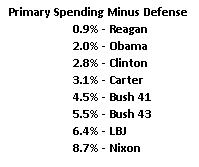
So let’s now look at primary spending after subtracting defense outlays (still adjusting for inflation, of course). All of a sudden, Reagan jumps to the top of the list by a comfortable margin. LBJ and W continue to score poorly, but Nixon takes over last place.

But it’s also worth noting that Obama still scores relatively well, beating Clinton for second place. Inflation-adjusted domestic spending (which is mostly what we’re measuring) has grown by 2.0 percent annually during his three years in office.

So does that mean Obama deserves re-election? Well, before you answer, I want to make one final calculation. Just as there are good reasons to exclude interest payments because they’re not something a president can control, we also should take a look at what spending would be if we don’t count the cost of bailouts.

To be sure, these types of expenditures can be controlled, but if we go with the assumption that the federal government was going to re-capitalize the banking system (whether using the good FDIC-resolution approach or the corrupt TARP approach), then it seems that Presidents shouldn’t get arbitrary blame or credit simply because some financial institutions failed during their tenure.

So let’s take the preceding set of numbers and subtract out the long-run numbers for deposit insurance, as well as the TARP outlays since 2009. And keep in mind that repayments of TARP monies (as well as deposit insurance premiums) show up in the budget as “negative spending.”

As you can see, this produces a remarkable result. All of a sudden, Obama drops from second to second-to-last.

This is because there was a lot of TARP spending in Bush’s last fiscal year (FY2009), which created an artificially high benchmark. And then repayments by banks during Obama’s fiscal years counted as negative spending.

When you subtract out the big TARP spending surge, as well as the repayments, then Bush 43 doesn’t look quite as bad (though still worse than Carter and Clinton), while Obama takes a big fall.

In other words, Obama’s track record does show that he favors an expanding social welfare state. Outlays on those programs have jumped by 7.0 percent annually. And that’s after adjusting for inflation! Not as bad as Nixon, but that’s not saying much since he was one of America’s most statist presidents.

Allow me to conclude with some caveats. None of the tables perfectly captures what any president’s fiscal record. Even my first table may be wrong if you want to blame or credit presidents for the inflation that occurs on their watch. And there certainly are strong arguments that bailout spending and defense spending are affected by presidential policies rather than external events.

And keep in mind that presidents don’t have full power over fiscal policy. The folks on Capitol Hill are the ones who actually enact the bills and appropriate the money.

Moreover, the federal government is akin to a big rusty cargo ship that is traveling in a certain direction, and presidents are like tugboats trying to nudge the boat one way or the other.

But enough equivocating. The four different tables at least show more clearly which presidents presided over faster-growing government or slower-growing government. More importantly, the various tables provide a good idea of where most of the new spending was taking place.

We can presumably say Reagan and Clinton were comparatively frugal, and we can also say that Nixon, LBJ, and Bush 43 were relatively profligate. As for Obama, I think his tugboat is pushing in the wrong direction, but it’s only apparent when you strip out the distorting budgetary impact of TARP.

Related posts:

Some Tea Party heroes (Part 1)

DEBT LIMIT – A GUIDE TO AMERICAN FEDERAL DEBT MADE EASY. Uploaded by debtlimitusa on Nov 4, 2011 A satirical short film taking a look at the national debt and how it applies to just one family. Watch the guy from the Ferris Bueller Superbowl Spot! Produced by Seth William Meier, DP/Edited by Craig Evans, […]

Some Tea Party heroes (Part 2)

Congressmen Tim Huelskamp on the debt ceiling I just don’t understand why people think we can go on and act like everything is okay when we have a trillion dollar deficit. Sometimes you run across some very wise words like I did the other day. Kansas Congressman Tim Huelskamp made the following comment on the […]