And since it’s my job to promote liberty, I’ll confess that it’s easier for me to convince non-French policy makers that free markets and small government are the right approach when there’s more evidence that statism is failing in France.
So why am I smiling? Well, France wasn’t doing so well under the de facto socialist Nicolas Sarkozy, and it seems that things are looking even worse now that the de jure socialist Francois Hollande is in charge.
The French are bleaker about their country’s future than at any time since 2005, a new poll showed on Saturday, with 68 percent saying they are “rather” or “very” pessimistic… Hollande’s government has been reeling from unemployment at a 13-year high and a rash of job cuts in recent weeks at top employers like carmaker Peugeot and retailer Carrefour. The government launched a plan this week to create 150,000 state-sponsored jobs for youth. Only 34 percent of those surveyed were confident in the government’s ability to battle unemployment, and just 20 percent expect the government to be able to improve their buying power. …The poll found that the pessimism extended even to 58 percent of Socialist party supporters.
I’m wondering when the pessimism will spread to investors. France recently lost its triple-A credit rating, but the rating agencies don’t do a good job, so I think it’s much more important to look at the prices of credit default swaps.
In other words, how much does it cost for an investor to insure debt from the French government? According to this CNBC site, France isn’t viewed as being as creditworthy as nations such as Switzerland, Germany, and the United States, but it is closer to those countries than it is to Spain, Italy, or Portugal.
This is just a guess on my part, but I think France is reaching the point where investors are suddenly going to get concerned about the government’s ability to fulfill its promises.
If Hollande follows through on his threat to impose a “patriotic” 75-percent tax rate, for example, that could be the trigger that makes the bond market a lot more skittish. Particularly since it will result in fewer rich people in France.
Actor Johnny Depp has moved out of France and returned to America because he didn’t want to become a permanent French resident and pay income tax there. …Depp has now moved his family out of France after government officials asked him to become a permanent resident, as he feared he would end up paying tax in both countries. He tells Britain’s The Guardian newspaper, “…France wanted a piece of me. They wanted me to become a permanent resident. Permanent residency status – which changes everything. They just want… Dough. Money… ” Depp goes on to explain that if he spends more than 183 days a year in France he will have to pay income tax in both Europe and America, adding, “So you essentially work for free.”
Wow, complaining that he doesn’t want to “work for free.” What is he, some sort of radical libertarian from the Tea Party?
I truly do wonder how smart our elected representatives are in Washington. I got up on 12-20-12 and read this article below from the Heritage Foundation with the reference to Charlie Brown getting fooled by Lucy again when he runs up and tries to kick the football and of course she moves it again.
Liberals in Congress have always tried to fool conservatives by promising future cuts if they provide higher taxes now. (This article below appeared on www.heritage.org on 12-20-12.)
Obama’s “Lucy Move the Football” Fiscal Cliff Plan Still Not Balanced
Volleys of negotiating counter-offers are coming in faster now that Christmas break and the looming fiscal cliff are just around the corner.
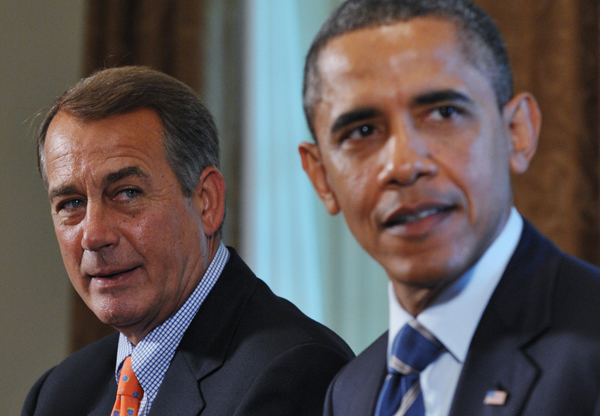
While there is much unsatisfactory with Speaker of the House John Boehner’s (R–OH) Sunday night proposal, let us not forget that the reason we are watching this needless, high stakes drama unfold is due to President Obama’s intractable insistence on tax increases on America’s high earners. After all, he and Congress could simply and quickly pass a bill to extend all current policies and avoid the fiscal cliff entirely—if he wanted to. No, this is really about hiking taxes on high earners. Thus the charade of deficit reduction continues.
Obama’s latest counteroffer is no more acceptable than his first offer. Short on details concerning actual spending reductions, especially on entitlements, it is replete with his requisite tax hikes and (we are shocked) new stimulus spending. The cherry on top is an extension of the debt limit for two years, essentially handing over authority to raise it to the President.
Right.
The President originally called for around $800 billion in tax hikes on America’s “highest” earners—those earning $250,000 and up. A ridiculous demand when the economy is still struggling under his big spending and regulatory policies, and one which would squarely hit smaller businesses. You know, the ones who actually create jobs.
Yet, just like Lucy and the football, when Boehner and company offered up $800 billion in tax hikes, Obama quickly doubled his demand to $1.5 trillion in tax hikes—again, all from the highest earners. They, he tells us, can afford to pay a little more. Never mind, of course, that the top 1 percent of earners already pay 37 percent of all income taxes. Somehow we are to believe this is a “balanced approach.”
Obama pitches all this on the pretext that we can simply go back to the tax rates we had under Clinton. Wrong! His dirty little tax secret is that he has already hiked taxes on high earners under Obamacare. First the law added a surtax of 0.9 percent in addition to the Medicare payroll tax on those earning over $250,000. For the first time ever, Obamacare will apply this higher rate of 3.8 percent to investment income on January 1. Obama won’t tell you that going back to Clinton-era tax rates will actually result in higher taxes on wages, dividends, and capital gains.
They say if you want less of something, then tax it. For Obama, this works fine on financial transactions, carbon emissions, driving, and junk food. But evidently, for him, not so much on a strong vibrant economy. And those Clinton boom years? They weren’t ushered in after the Clinton tax hike—only after the Clinton–Gingrich tax cut!
Rather than working with Republicans on tax proposals that will actually grow the economy, Obama is now simply fighting over his definition of “high income” while we are left to wonder how much this $1.2 trillion tax hike will slow the economy.
As for the $1.2 trillion spending reductions, the only reason they are there is because Boehner insisted on them. But $100 billion in cuts would whack the defense budget, which is already reeling from earlier budget cuts. Yet the real spending and debt crisis comes from unaffordable entitlement programs. While Obama is insisting on balance on the tax side, he is sorely lacking in leadership here. As a recent Washington Post editorial opined:
Elections do have consequences, and Mr. Obama ran on a clear platform of increasing taxes on the wealthy. But he was clear on something else, too: Deficit reduction must be “balanced,” including spending cuts as well as tax increases. Since 60 percent of the federal budget goes to entitlement programs such as Medicare, Medicaid and Social Security, there’s no way to achieve balance without slowing the rate of increase of those programs.
We know Obama is open to changing the inflation calculation and slowing the benefit growth in Social Security. But what else? What about the proposals in his own budget, which would increase premiums on Medicare? He could easily broaden his proposals with additional uncontroversial steps to begin the process of strengthening and reining in Social Security and Medicare. All he needs to do is lead.
Some polls may show that Americans think taxes should be part of a deficit deal; but what the polls do not always show is their utter distrust that Washington would use new revenues to actually reduce the deficit. Here, Obama does not let them down. He reportedly wants $80 billion in new spending on infrastructure and unemployment benefits.
In exchange for all of this, he wants to raise the debt limit by enough to fuel his big spending goals for two years. This is utterly unacceptable. Americans know you cannot reduce the deficit when you plan to actually spend more. Americans also know that when Washington lifts the debt limit, it will not control spending. The debt limit puts the very pressure lawmakers need to account for out-of-control spending and make vital course corrections to bring spending under control, lest we face a Euro-style debt crisis in the future.
White House Press Secretary Jay Carney is actually insisting that “[t]he President’s proposal is the only proposal we have seen that achieves the balance that is so necessary.” Balance, evidently, is in the eyes of the beholder. As the Post noted, 60 percent of the budget stems from entitlements.
In just 13 short years—by the time today’s kindergarteners enter college—entitlements and interest on the debt will eat up all tax revenues. A truly balanced approach must start where the problem starts—with substantive reforms to entitlements. While the President maintains that you cannot cut your way to prosperity, you certainly cannot tax your way there.
_______________
Below is a speech by George W. Bush honoring Milton Friedman:
Milton Friedman Honored for Lifetime Achievements 2002/5/9
Milton Friedman said that getting George Bush I to be his vice president was his biggest mistake because he knew that Bush was not a true conservative and sure enough George Bush did raise taxes when he later became President. I wonder if Jeb Bush has the same genes as his father.
But I then pointed out that all of those scenarios were total fantasies and that it would be more realistic to envision me playing center field for the New York Yankees.
That’s why I like the anti-tax pledge of Americans for Tax Reform. You don’t solve America’s fiscal problems by saying no to all tax increases, but at least you don’t move in the wrong direction at a faster rate.
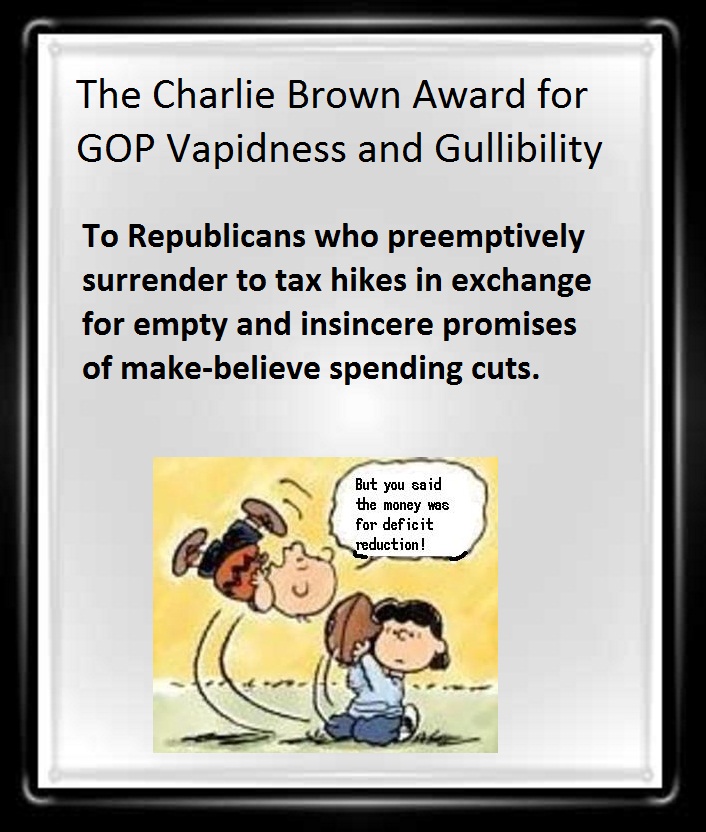
Notwithstanding the principled and pragmatic arguments against putting tax increases on the table, some Republicans – in a triumph of hope over experience – are preemptively acquiescing to tax hikes.
Jeb Bush, the former Florida governor, said Friday that he could back a broad deficit plan that increased taxes, a stance that puts him at odds with other prominent Republicans. Bush told a House panel he could get behind a plan that combined 10 dollars in spending cuts for every dollar of new revenue… “The problem is the 10 never materializes,” [Congressman Paul] Ryan said after Bush said he could support a revenue-increasing deficit deal. Norquist also has criticized deficit deals crafted in 1982 and 1990 – the latter agreed to by then-President George H.W. Bush, Jeb’s father – for failing to deliver on the spending side.
Kudos to Paul Ryan for making the obvious point about make-believe spending cuts. And Grover is correct about the failure of previous budget deals.
Indeed, I cited a New York Times column that inadvertently revealed that the only budget deal that worked was the 1997 pact that cut taxes rather than raised them.
Sen. Lindsey Graham (R-S.C.) said Tuesday he believed Republicans should consider eliminating loopholes in the tax code even if they aren’t replaced by additional tax cuts, a move that would break with an anti-tax pledge many GOP lawmakers have signed with activist Grover Norquist. “When you eliminate a deduction, it’s OK with me to use some of that money to get us out of debt. That’s where I disagree with the pledge,” Graham told ABC News. …”I’m willing to move my party, or try to, on the tax issue. I need someone on the Democratic side being willing to move their party on structural changes to entitlements.” Graham said, for instance, he would support a plan that included $4 in spending cuts for every $1 in tax increases. During a Republican debate last August, all eight Republican candidates in attendance said they would reject a proposal to trade $10 in spending cuts for even $1 in tax increases.
In some sense, Senator Graham’s comments are reasonable. With real spending cuts and less-damaging forms of tax hikes, an acceptable deal is possible. But only in Fantasia, not in Washington.
In the real world, all that Senator Graham has done is to move the debate slightly to the left.
But I do have nightmares about government getting even bigger, and that’s why I don’t want tax increases on the table. I don’t even want them in the room. Or the house. Or the neighborhood.
That’s why Jeb Bush and Lindsey Graham are the newest winners of the Charlie Brown Award. They’ve put blood in the water. I wonder if they’ll act surprised when hungry sharks show up looking for a meal?
_____________
In 1982 the Democrats promised future spending cuts if Ronald Reagan would agree to a tax increase, but you guessed it, the taxes were increased and the spending cuts never came. THE REAL PROBLEM IS NOT THAT WE DON’T HAVE ENOUGH TAXES BUT WE DON’T WANT TO CUT SPENDING!!!
Washington Could Learn a Lot from a Drug Addict
Concerning spending cuts Reagan believed, that members of Congress “wouldn’t lie to him when he should have known better.” However, can you believe a drug addict when he tells you he is not ever going to do his habit again? Congress is addicted to spending too much money. Lee Edwards wrote in his article “Golden Years” about Ronald Reagan:
Sometimes Reagan went along with a pragamatist like chief of staff James Baker, who persuaded the president to accept the Tax Equity and Fiscal Responsibility Act of 1982 (TEFRA), which turned out to be the great tax increase of 1982 — $98 billion over the next three years. That was too much for eighty-nine House Republicans (including second-term Congressman Newt Gingrich of Georgia) or for prominent conservative organizations from the American Conservative Union like the Conservative Caucus and the U.S. Chamber of Commerce, which all opposed the measure.
Baker assured his boss that Congress would approve three dollars in spending cuts for every dollar of tax increase. To Reagan, TEFRA looked like a pretty good “70 percent” deal. But Congress wound up cutting less than twenty-seven cents for every new tax dollar. What had seemed to be an acceptable 70-30 compromise turned out to be a 30-70 surrender. Ed Meese described TEFRA as “the greatest domestic error of the Reagan administration,” although it did leave untouched the individual tax rate reductions approved the previous year. (TEFRA was built on a series of business and excise taxes plus the removal of business tax deductions.)[xxx]
The basic problem was that Reagan believed, as Lyn Nofziger put it, that members of Congress “wouldn’t lie to him when he should have known better.”[xxxi] As a result of TEFRA, Reagan learned to “trust but verify,” whether he was dealing with a Speaker of the House or a president of the Soviet Union.
(Emailed to White House on 12-21-12.) President Obama c/o The White House 1600 Pennsylvania Avenue NW Washington, DC 20500 Dear Mr. President, I know that you receive 20,000 letters a day and that you actually read 10 of them every day. I really do respect you for trying to get a pulse on […]
(Emailed to White House on 12-21-12.) President Obama c/o The White House 1600 Pennsylvania Avenue NW Washington, DC 20500 Dear Mr. President, I know that you receive 20,000 letters a day and that you actually read 10 of them every day. I really do respect you for trying to get a pulse on what is […]
(Emailed to White House on 12-21-12) President Obama c/o The White House 1600 Pennsylvania Avenue NW Washington, DC 20500 Dear Mr. President, I know that you receive 20,000 letters a day and that you actually read 10 of them every day. I really do respect you for trying to get a pulse on what is […]
The federal government has a spending problem and Milton Friedman came up with the negative income tax to help poor people get out of the welfare trap. It seems that the government screws up about everything. Then why is President Obama wanting more taxes? _______________ Milton Friedman – The Negative Income Tax Published on […]
I was sad to read that the Speaker John Boehner has been involved in punishing tea party republicans. Actually I have written letters to several of these same tea party heroes telling them that I have emailed Boehner encouraging him to listen to them. Rep. David Schweikert (R-AZ),Justin Amash (R-MI), and Tim Huelskamp (R-KS). have been contacted […]
Michael Tanner of the Cato Institute in his article, “Hitting the Ceiling,” National Review Online, March 7, 2012 noted: After all, despite all the sturm und drang about spending cuts as part of last year’s debt-ceiling deal, federal spending not only increased from 2011 to 2012, it rose faster than inflation and population growth combined. […]
Max Brantley of the Ark Times takes on Michael Cannon of the Cato Institute today concerning Obamacare. I have posted many links to Cannon’s articles in the past on my blog and on the Arkansas Times liberal blog. The finest article written in my estimation was written on Nov 20, 2012 and here is a link to it. No one has acted like Cannon’s ideas had any chance of working out since the Arkansas Times Blog is made of primarily of Obama supporters.
Below is a portion of the post by Brantley followed by links to some of the past articles and videos by Cannon I have posted before.
Posted by David Ramsey on Fri, Dec 14, 2012 at 12:23 PM
Michael Cannon of the Cato Institute
Today’s the big day for states to decide whether they want to run their own health-insurance exchange or have the federal government do it. Arkansas opted earlier this week for a partnership.
It looks like states will split pretty evenly across the country, with around 20 running their own exchanges, around 20 ceding control to the feds, and the rest opting for a partnership. There’s been a fair amount of fuss over this decision but it probably won’t impact consumers much one way or the other.
We’ve noted that it’s a bit curious that Republican lawmakers, usually strongly in favor of more state control, have led the charge against state-run exchanges.
In the runup to the deadline for the exchange decision, a few conservatives, like Douglas Holtz-Eakin — Director of the Congressional Budget Office under George W. Bush — started to make the ideologically coherent argument that, however much they hate Obamacare, states are better off with more control. Most movement conservatives stronglyrejected these ideas.
Why? Conservatives are devoted to a give-no-quarter approach to Obamacare. Michael Cannon, the Cato Institute’s health-care point man, wrote recently in the National Review that accepting the law amounted to “Vichyism.”
And, they think, it’s not just lost causism. In addition to hoping that it will disrupt the smooth implementation of the law, Cannon wants states to say no to the exchange because he believes that a constitutional challenge can be raised against subsidies provided on the federal exchanges (the law doesn’t explicitly mention subsidies via a federal exchange because lawmakers anticipated that states would run the exchanges). The argument is pretty flimsy, but flimsy arguments have given proponents of the Affordable Care Act reason to sweat before.
The state of Oklahoma has already filed a lawsuit in federal court along these lines and the Wall Street Journal has also floated the idea. Here’s a good summary of Cannon’s Hail Mary play.
___________
Earlier posts about Michael Cannon’s works on Obamacare:
Sen. Max Baucus admits the PPACA conditions tax credits on state compliance Published on Sep 21, 2012 by Michael F. Cannon I really don’t know the answer to this question and would love it if someone would enlighten me. This article below from the Cato Institute makes the case that States can stop Obamacare from […]
It seems that Obamacare is going to go down according to this article below: GOP Vows to Keep Fighting IRS’s Illegal ObamaCare Taxes if Obama Wins Posted by Michael F. Cannon Roll Call reports that if President Obama wins re-election, House and Senate Republicans will hold votes on rescinding his illegal IRS rule that unlawfully […]
Cato’s Michael F. Cannon Discusses ObamaCare’s Individual Mandate Is Michael Cannon of the Cato Institute right about states blocking Obamacare, factchecker says he is wrong. I Have Been False* Posted by Michael F. Cannon *According to PolitiFact. In an unconscious parody of everything that’s wrong with the “fact-checker” movement in journalism, PolitiFact Georgia (a project of […]
Michael Cannon on Medicare and Healthcare You want to know the real truth about Obamacare then check out these videos and articles linked below: American people do not want Obamacare and the regulations that go with it March 7, 2012 – 8:02 am In this article below you will see that the American people do not […]
Gerard Matthews wrote on March 21, 2012 in the Arkansas Times: Children cannot be denied coverage because of a pre-existing condition. Young people can stay on their parents’ health insurance plan until they are 26 years old. Preventive services, which will ultimately help control health care costs, have been added to some plans at no […]
Michael Cannon on Medicare and Healthcare In his article, “Medicaid and the consequences,” Arkansas Democrat-Gazette, March 20, 2012, (paywall), Brummett admits, “Medicaid will break the bank of state government if we don’t do something.” However, he never gets around to saying that Obamacare is going to ruin the state financially. It will expand this failing […]
Michael Cannon on Medicare and Healthcare You want to know the real truth about Obamacare then check out these videos and articles linked below: American people do not want Obamacare and the regulations that go with it March 7, 2012 – 8:02 am In this article below you will see that the American people do not […]
Is Washington Bankrupting America? Uploaded by BankruptingAmerica on Apr 20, 2010 Be first to receive our videos and other timely info about economic policy. Subscribe at http://www.bankruptingamerica.org ————————- According to a recent poll, 74 percent of likely voters are extremely or very concerned about the current level of government spending. And 58 percent think the […]
I have been writing President Obama letters and have not received a personal response yet. (He reads 10 letters a day personally and responds to each of them.) However, I did receive a form letter in the form of an email on June 15, 2012. I don’t know which letter of mine generated this response so I have […]
President Obama c/o The White House 1600 Pennsylvania Avenue NW Washington, DC 20500 Dear Mr. President, I know that you receive 20,000 letters a day and that you actually read 10 of them every day. I really do respect you for trying to get a pulse on what is going on out here. I see […]
Michael Cannon on Medicare and Healthcare President Obama c/o The White House 1600 Pennsylvania Avenue NW Washington, DC 20500 Dear Mr. President, I know that you receive 20,000 letters a day and that you actually read 10 of them every day. I really do respect you for trying to get a pulse on what is […]
These posts are all dealing with issues that President Obama did not help on in his first term. I am hopeful that he will continue to respond to my letters that I have written him and that he will especially reconsider his view on the following import issue which deals with holding down federal spending. Is President Obama going to bankrupt our country by going from 10 trillion to 22 trillion in debt? We better shape up now or other countries will overtake us economically.
If we cut spending and balance our budget and enact pro-market reforms then our economy would boom too.
I’m not quite ready to trade places with Canada, but it may just be a matter of time. Like Germany and Sweden, they seem to be slowly but surely trying to move in the right direction.
But I’ve just been skating along the surface. My Cato colleague Chris Edwards (a Canadian transplant) has just written up a report with some of the key details.
Two decades ago Canada suffered a deep recession and teetered on the brink of a debt crisis caused by rising government spending. The Wall Street Journalsaid that growing debt was making Canada an “honorary member of the third world” with the “northern peso” as its currency. But Canada reversed course and cut spending, balanced its budget, and enacted various pro-market reforms. The economy boomed, unemployment plunged, and the formerly weak Canadian dollar soared to reach parity with the U.S. dollar. …[In] the early 1990s combined federal, provincial, and local spending peaked at more than half of gross domestic product (GDP). In the 1993 elections, Prime Minister Jean Chretien’s Liberals gained power promising fiscal restraint, but this was the party of Trudeau, and so major reforms seemed unlikely. In the first Liberal budget in 1994, Finance Minister Paul Martin provided some modest spending restraint. But in his second budget in 1995, he began serious cutting. In just two years, total noninterest spending fell by 10 percent, which would be like the U.S. Congress chopping $340 billion from this year’s noninterest federal spending of $3.4 trillion. When U.S. policymakers talk about “cutting” spending, they usually mean reducing spending growth rates, but the Canadians actually spent less when they reformed their budget in the 1990s. The Canadian government cut defense, unemployment insurance, transportation, business subsidies, aid to provincial governments, and many other items. After the first two years of cuts, the government held spending growth to about 2 percent for the next three years. With this restraint, federal spending as a share of GDP plunged from 22 percent in 1995 to 17 percent by 2000. The spending share kept falling during the 2000s to reach 15 percent by 2006, which was the lowest level since the 1940s. …The spending reforms of the 1990s allowed the Canadian federal government to balance its budget every year between 1998 and 2008. The government’s debt plunged from 68 percent of GDP in 1995 to just 34 percent today.
Total government spending, including sub-national units such as states and provinces, is still slightly higher in Canada than in the United States. But I suspect that will change within the next five years.
Not surprisingly, good spending policy leads to good tax policy, as Chris explains.
a slimmed-down Canadian government under the Liberals enjoyed large budget surpluses and pursued an array of tax cuts. The Conservatives continued cutting after they assumed power in 2006. During the 2000s the top capital gains tax rate was cut to 14.5 percent, special “capital taxes” on businesses were mainly abolished, income taxes were trimmed, and income tax brackets were fully indexed for inflation. Another reform was the creation of Tax-Free Savings Accounts, which are like Roth IRAs in the United States, except more flexible. The most dramatic cuts were to corporate taxes. The federal corporate tax rate was cut from 29 percent in 2000 to 15 percent in 2012. Most provinces also trimmed their corporate taxes, so that the overall average rate in Canada is just 27 percent today. By contrast, the average U.S. federal-state rate is 40 percent. …Canada’s federal corporate tax rate has been cut from 38 percent in the early 1980s to just 15 percent today. Despite the much lower rate, tax revenues have not declined. Indeed, corporate tax revenues averaged 2.1 percent of GDP during the 1980s and a slightly higher 2.3 percent during the 2000s.
The Laffer Curve effect of higher tax revenue shouldn’t be surprising, though American policymakers still operate in a fantasy world where taxes are assumed to have no impact on the economy and no impact on taxable income.
But that’s a secondary point. The main lesson of this research by Chris is that it is both possible and desirable to shrink the burden of government spending.
And it’s not just Canada that has done the right thing. This video outlines past reforms in Ireland, Slovakia, and New Zealand as well.
P.P.S. The Canadians aren’t know for having a sense of humor, but the person who wrote this parody about emigrating American leftists definitely has a good sense of humor.
How Raising Taxes Will Not Balance the Budget: More Evidence
Published on Nov 15, 2012
Although it may seem counterintuitive, raising taxes on the rich does not actually increase the amount of taxes the government collects. How could this possibly be the case? According to Professor Antony Davies, it is because the many loopholes in federal income taxes, capital gains taxes, and many other taxes, enable people to partially avoid these taxes. Perhaps instead of discussing how to raise tax revenues, we should spend our energy simplifying the tax code. This would make it more difficult for people to avoid taxes and, Davies says, “The less time and money we spend trying to work around a complex tax code, the more time and money we will have available to put to more productive uses.”
Do you think that the tax code is too complicated? Let us know in the comments!
____________
I have done my part by writing letters over and over and over to John Boehner begging him to hold the line on spending and to not give in to President Obama on tax increases. I doubt seriously that he will do that. Here is an article below that shares my same concerns.
Michael Tanner is a senior fellow at the Cato Institute and author of Leviathan on the Right: How Big-Government Conservatism Brought Down the Republican Revolution.
They hadn’t even finished counting the ballots in Florida when House speaker John Boehner indicated that Republicans were preparing to surrender on issues ranging from taxes to health-care reform.
With regard to taxes, Boehner signaled that he was once again open to a “grand bargain” to avoid the looming fiscal cliff. While he kept an increase in tax rates off the table for now, Boehner said that he was open to “additional revenue” as part of a deal. Such additional revenue could, of course, take many forms, such as closing loopholes, raising fees, or counting on increased economic growth. But by preemptively conceding on revenue, Speaker Boehner takes the focus off the need to cut spending.
Giving in on key Republican principles such as taxes is no way to rebuild the party.
Speaker Boehner correctly noted that everyone agrees we can’t keep spending more than we take in. But that implies that the problem is simply the difference between what comes in and what goes out. It’s not.
The Congressional Budget Office projects that, under current policy, federal spending will reach 46 percent of GDP by mid-century — even if we never add another new government program. True, a substantial portion of that spending will be interest on the federal debt. Theoretically, therefore, if taxes were increased enough to cover spending and close the deficit, adding no additional debt, we’d have far lower interest payments, meaning that total levels of government spending would be lower in the future. Lower, but not that low: Even if one assumes that the government accumulated no additional debt beyond the $16.2 trillion it currently owes, federal government spending would still approach 30 percent of GDP by 2050. Throw in state and local spending, and government at all levels would consume roughly half of everything produced in this country. We might have no deficit, but we would have both higher government spending and a bigger tax burden than Greece has today.
Boehner’s willingness to give in so easily on revenues makes it less likely that there will be real spending cuts as part of any deal. We’re likely to get more of the sort of smoke-and-mirrors measures that the president has already proposed, such as reliance on phantom savings from ending the wars in Iraq and Afghanistan, double-counting cuts that were already included in last year’s budget agreement, and the perennial promises to eliminate “fraud, waste, and abuse.” Just look at how illusory the alleged spending cuts in last year’s debt-ceiling deal turned out to be: In the twelve months following that deal, federal spending actually increased by 3.6 percent, an average of $11 billion more every month.
At a minimum, Speaker Boehner seems to have given up any leverage that he might have had to demand the entitlement reforms necessary for any long-term spending restraint. Having conceded on taxes, what does he have left to trade?
For that matter, even his line in the sand about tax rates seems unlikely to hold. Having already surrendered to the idea of tax hikes, the debate becomes one not about whether to raise taxes but about which taxes or whose taxes to increase.
Similarly, the speaker sent conflicting signals on whether or not Republicans will continue to pursue repeal of Obamacare. Boehner first told Diane Sawyer that “Obamacare is the law of the land,” and that Republicans will no longer devote political capital to repealing it, while maintaining that there “may be parts of it that we believe need to be changed.” Later he walked those comments back in a tweet, saying that full repeal remained a Republican goal.
If nothing else, Boehner’s health-care remarks muddy the party’s position on a crucial issue.
It is not as though Obamacare has become significantly more popular. Exit polls showed that even an electorate that reelected President Obama opposed the new health-care law by 49 to 44 percent. And many of the law’s most damaging and unpopular provisions have not even kicked in yet. Next year, for instance, will see the implementation of many of its new taxes, including the medical-device tax, a Medicare payroll-tax hike for those making over $200,000, and a new surtax on investment income for the same group. And, of course, in 2014, just in time for the midterm elections, Americans will be hit by the law’s individual and employer mandates.
Obviously, with the Democrats in control of the Senate and President Obama reelected, Obamacare was not going to be repealed this year. But that doesn’t mean that Republicans should stop fighting it. House Republicans still have the power of the purse, and state governments have been entrusted with the law’s implementation. At least ten states have refused to set up the insurance exchanges that the law stipulates. (Governors Bob McDonell of Virginia and Sam Brownback of Kansas are the latest to announce that their states will not do so.) At least another eight states simply will not be able to set one up before the law’s deadline of January 1, 2014. That means that the Obama administration will have to seek additional funding in order to operate federal exchanges in those states. House Republicans should refuse to appropriate any such funds and should block attempts by HHS to shift funds appropriated for other purposes.
But can Americans count on House Republicans to hold the line in the wake of Boehner’s comments?
Republicans certainly took a drubbing in this year’s elections. Rethinking and repositioning may well be necessary, especially on immigration and social-issues messaging. But let us not forget that Republicans are only two years removed from a historic landslide victory won in part by opposition to government spending, taxes, and Obamacare. And, despite the Democrats’ best attempts to paint House Republicans as plutocrat-loving, grandma-hating obstructionists, the GOP caucus lost a net of only four seats. Indeed, the Tea Party Caucus, for all the criticism it received, lost only three seats.
John Boehner knows that the Republican brand could use some refurbishment, but surrendering on taxes, spending, and health care is hardly an auspicious way to begin the task.
John Boehner, Speaker of the House H-232, The Capital, Washington, DC 20515 Dear Mr. Speaker, I know that you will have to meet with newly re-elected President Obama soon and he will probably be anxious for you to raise taxes and federal spending, but he will want you to leave runaway entitlement programs alone. When that happens then you […]
John Boehner, Speaker of the House H-232, The Capital, Washington, DC 20515 Dear Mr. Speaker, I know that you will have to meet with newly re-elected President Obama soon and he will probably be anxious for you to raise taxes and federal spending, but he will want you to leave runaway entitlement programs alone. DON’T LET THEM RAISE THAT […]
John Boehner, Speaker of the House H-232, The Capital, Washington, DC 20515 Dear Mr. Speaker, I know that you will have to meet with newly re-elected President Obama soon and he will probably be anxious for you to raise taxes and federal spending, but he will want you to leave runaway entitlement programs alone. When that happens then you […]
John Boehner, Speaker of the House H-232, The Capital, Washington, DC 20515 Dear Mr. Speaker, I know that you will have to meet with newly re-elected President Obama soon and he will probably be anxious for you to raise taxes and federal spending, but he will want you to leave runaway entitlement programs alone. DO NOT TAKE THE […]
John Boehner, Speaker of the House H-232, The Capital, Washington, DC 20515 Dear Mr. Speaker, I know that you will have to meet with newly re-elected President Obama soon and he will probably be anxious for you to raise taxes and federal spending, but he will want you to leave runaway entitlement programs alone. When that happens then you […]
Open letter to Speaker of the House John Boehner (Part 2 on raising taxes) John Boehner, Speaker of the House H-232, The Capital, Washington, DC 20515 Dear Mr. Speaker, I know that you will have to meet with newly re-elected President Obama soon and he will probably be anxious for you to raise taxes and federal spending, but […]
John Boehner, Speaker of the House H-232, The Capital, Washington, DC 20515 Dear Mr. Speaker, I know that you will have to meet with newly re-elected President Obama soon and he will probably be anxious for you to raise taxes and federal spending, but he will want you to leave runaway entitlement programs alone. When that happens then you […]
Max Brantley of the Arkansas Times noted: House Speaker John Boehner was spotted in Little Rock yesterday — lunch at Whole Hog Cafe and at Cajun’s Wharf during the evening hours. My spin on John Boehner is very simple. He needs to be brave enough to join those conservatives in the House that really do […]
Social Security is a Ponzi Scheme but Blake who is a blogger said I was off base. Ark Times reader says Social Security is not Ponzi Scheme Social Security Disaster Walter E. Williams Columnist, Townhall.com Politicians who are principled enough to point out the fraud of Social Security, referring to it as a lie and […]
We got to do something soon about Social Security. The Case for Social Security Personal Accounts Posted by Daniel J. Mitchell There are two crises facing Social Security. First the program has a gigantic unfunded liability, largely caused by demographics. Second, the program is a very bad deal for younger workers, making them pay record […]
Senator Obama’s Social Security Tax Plan Uploaded by afq2007 on Jul 23, 2008 In addition to several other tax increases, Senator Barack Obama wants to increase the Social Security payroll tax burden by imposing the tax on income above $250,000. This would be a sharp departure from current law, which only requires that the tax […]
Saving Social Security with Personal Retirement Accounts Uploaded by afq2007 on Jan 10, 2011 There are two crises facing Social Security. First the program has a gigantic unfunded liability, largely thanks to demographics. Second, the program is a very bad deal for younger workers, making them pay record amounts of tax in exchange for comparatively meager benefits. This […]
“Saving the American Dream: The Heritage Plan to Fix the Debt, Cut Spending, and Restore Prosperity,” Heritage Foundation, May 10, 2011 by Stuart Butler, Ph.D. , Alison Acosta Fraser and William Beach is one of the finest papers I have ever read. Over the next few days I will post portions of this paper, but […]
Is Social Security a Ponzi Scheme? I just started a series on this subject. In this article below you will see where the name “Ponzi scheme” came from and if it should be applied to the Social Security System. Ponzi! Ponzi! Ponzi! 9/14/2011 | Email John Stossel | Columnist’s Archive Ponzi! Ponzi! Ponzi! There, I […]
Uploaded by LibertyPen on Jan 8, 2009 Professor Williams explains what’s ahead for Social Security Dan Mitchell on Social Security I have said that Social Security is a Ponzi scheme and sometimes you will hear someone in the public say the same thing. Yes, It Is a Ponzi Scheme by Michael D. Tanner Michael Tanner […]
I’ve repeatedly tried to expose pervasive fiscal dishonesty in Washington.
In these John Stossel and Judge Napolitano interviews, for instance, I explain that the crooks in DC have created a system that allows them to claim they’re cutting the budget when the burden of government spending actually is rising.
This sleazy system is designed in part to deceive the American people, and the current squabbling over the fiscal cliff is a good example. The President claims he has a “balanced approach” that involves budget cuts, but look at the second chart at this link and you will see that he’s really proposing bigger government.
…President Obama and John Boehner are playing by the dysfunctional Beltway rules. The rules work if you like bigger government, but Republicans need a new strategy, which starts by exposing the rigged game of “baseline budgeting.” …numbers have no real meaning because they are conjured in the wilderness of mirrors that is the federal budget process. Since 1974, Capitol Hill’s “baseline” has automatically increased spending every year according to Congressional Budget Office projections, which means before anyone has submitted a budget or cast a single vote. Tax and spending changes are then measured off that inflated baseline, not in absolute terms. …Democrats designed this system to make it easier to defend annual spending increases and to portray any reduction in the baseline as a spending “cut.” Chris Wallace called Timothy Geithner on this “gimmick” on “Fox News Sunday” this week, only to have the Treasury Secretary insist it’s real. …in the current debate the GOP is putting itself at a major disadvantage by negotiating off the phony baseline. …If Republicans really want to slow the growth in spending, they need to stop playing by Beltway rules and start explaining to America why Mr. Obama keeps saying he’s cutting spending even as spending and deficits keep going up and up and up.
But let’s return to the American fiscal situation. Republicans almost certainly will lose the battle over the fiscal cliff because they meekly are playing cards with a rigged deck controlled by the other side.
They key thing to understand is that (barring a recession) tax revenues rise every year. Indeed, the Congressional Budget Office projects that tax revenue will climb by an average of more than 6 percent annually over the next 10 years – even if the 2001 and 2003 tax cuts are made permanent.
So all that’s really needed to bring red ink under control is a modest bit of spending restraint. This video is from 2010, but the analysis is still completely relevant today.
It’s amazing how good things happen when you follow the Golden Rule of fiscal policy.
The politicians claim that they are negotiating about how best to reduce the deficit. That irks me because our fiscal problem is excessive government spending. Red ink is merely a symptom of that underlying problem.
But that’s a rhetorical gripe. My bigger concern is that politicians are prevaricating. They’re really talking about higher taxes in order to enable a bigger burden of government spending, not less red ink. I make this point in an interview on Fox Business Network.
This is the point where I often elaborate on issues raised in the interview, but let’s instead build on the discussion to look at policy and political reasons why the GOP should not surrender to Obama’s tax demands as part of fight over the fiscal cliff.
Here are the policy arguments against higher taxes.
1. There is no need for higher taxes since the budget can be balanced merely by restraining spending so that it grows 2.5 percent each year.
According to the most recent Congressional Budget Office fiscal estimate, the 2001 and 2003 tax cuts can be made permanent and red ink can be wiped out in just 10 years so long as politicians simply control the growth of federal spending so that outlays don’t grow faster than 2.5 percent each year. Other nations have shown that this type of spending restraint is very successful, while no nation has ever taxed its way to fiscal success.
2. Since the tax increases stick and the supposed spending cuts quickly evaporate, budget deals that raise taxes have a long history of failure.
Last year, in an article that was designed to browbeat Republicans for being unreasonable about tax hikes, a New York Times columnist inadvertently revealed that the only budget deal that actually led to a fiscal surplus was the 1997 agreement that lowered taxes instead of increasing them. None of the tax-hike budget deals ever resulted in a balanced budget.
3. America’s short-run fiscal problem is the result of too much government spending, not inadequate tax revenue.
Because of large spending increases during the Bush-Obama years, the burden of federal spending has doubled in just 11 years. This is why today’s fiscal numbers look so grim. Some argue that tax revenues are below their long-run average of 18 percent of GDP, but CBO estimates show that tax collections will be above the long-run average by the end of the decade even if all the 2001 and 2003 tax cuts are made permanent. And the White House recently admitted this was true as well.
4. America’s long-run fiscal problem is the result of too much government spending, not inadequate tax revenue.
In the absence of entitlement reform, the burden of federal spending will double, measured as a share of GDP, and the overall burden of government will exceed the levels that currently exist in every single European welfare state. Tax revenues also will climb as a share of GDP thanks to “real-bracket creep,” so there is no plausible argument that the long-run problem is inadequate revenue.
5. The European evidence shows that genuine spending cuts are the only effective way of solving a fiscal crisis.
Nations such as Italy, Greece, France, Spain, Ireland, Portugal, and the United Kingdom have imposed massive tax increases, yet their fiscal problems remain. Indeed, in some cases, these nations are in worse shape because the tax hikes contributed to anemic economic performances. Some of these countries have belatedly begun to trim their spending burdens, but generally by relying on transitory savings rather than permanent reductions in the obligations of the welfare state. The only relative success stories on the continent are Switzerland, which never got into trouble in the first place thanks to a spending cap, and the Baltic nations, which imposed genuine spending cuts when the crisis first began and now are reaping the rewards of that fiscal discipline.
And here are the political arguments against higher taxes.
1. With Republicans easily retaining control of the House of Representatives, the election was not a mandate to raise taxes.
Nobody argued that there was a mandate to raise taxes before the election, when Republicans controlled the House and Democrats controlled the White House and Senate, so how can there be a mandate to raise taxes today since the election didn’t change anything? Some assert that Obama has a mandate since he campaigned in favor of his soak-the-rich tax plan. That’s true, but House Republicans prevailed after campaigning against class-warfare taxes, so that’s a wash.
2. The GOP prevailed in the exact same tax battle back in 2010, before they controlled the House and when they had fewer seats in the Senate.
This is not the first fiscal cliff battle. The same fight took place at the end of 2010. At the time, Democrats has an overwhelming majority in the House and even stronger control of the Senate than they do today. But by holding firm and staying united, Republicans prevailed. If they lose today, when they have far more political power, it will be a damning indictment of their incompetence.
3. Acquiescing to tax hikes would set a tone of weakness for 2013 and 2014, much as the 2011 “shutdown fight” needlessly gave Obama the upper hand on fiscal battles in 2011 and 2012.
5. Integrity matters, so politicians who promised the people that they wouldn’t raise taxes should honor those commitments.
I realize that it is silly to make an argument about honor and integrity when we’re discussing the actions of politicians, but I’m old fashioned. A promise should mean something. And even if promises don’t mean anything to these guys, they should remember that voters don’t like dishonesty.
I’m not terribly hopeful that any of my advice will be followed, so let’s close this post with some gallows humor.
Not because my leftist opponent grabbed more air time (mostly because the host started challenging him, which also happens periodically when I’m on Kudlow’s show), but because he gave me a giant opening to completely destroy his arguments and I failed to seize the opportunity.
I think the points I made to wrap up the debate were fine, but I would be much happier with my performance if I had pointed out this huge hole in his position.
Thank you so much for your time. I know how valuable it is. I also appreciate the fine family that you have and your commitment as a father and a husband.
Sincerely,
Everette Hatcher III, 13900 Cottontail Lane, Alexander, AR 72002, ph 501-920-5733, lowcostsqueegees@yahoo.com
I do appreciate the fact that Speaker Boehner’s office took time to respond to my many emails to his office recently concerning the runaway spending in our country by the federal government. In this email below Speaker Boehner says he is committed to cutting spending but if that is true then why is he punishing Tea Party Republicans ( Rep. David Schweikert (R-AZ),Justin Amash (R-MI), and Tim Huelskamp (R-KS). ) for voting against new spending.
It is obvious to me that if President Obama gets his hands on more money then he will continue to spend away our children’s future. He has already taken the national debt from 11 trillion to 16 trillion in just 4 years. Over, and over, and over, and over, and over and over I have written Speaker Boehner and the Congressmen (Griffin, Womack, Crawford) in Arkansas concerning this. I am hoping they will stand up against this reckless spending that our federal government has done and will continue to do if given the chance.
Thank you for taking the time to contact me. It’s good to hear from you.
Your ideas, comments, and questions help make possible my goal of leading a House of Representatives that listens and reflects the will of the American people. That’s why I’d like to ask you to keep speaking out by:
Visiting Speaker.gov to sign up for email updates on issues that concern you;
I made a Pledge to America to focus on removing government barriers to private-sector job creation and economic growth – that includes cutting spending to help end the uncertainty facing job creators; repealing the job-crushing health care law and replacing it with common sense reforms that lower costs; reining in excessive regulations; and promoting an American Energy Initiative that increases energy production to create jobs and lower energy prices. I also pledged to lead an effort to reform Congress and rebuild the bonds of trust between the American people and their representatives in Washington. I hope you’ll stay engaged and keep me updated on your thoughts as we work to keep this pledge.
Open letter to Speaker of the House John Boehner (Part 53) John Boehner, Speaker of the House H-232, The Capital, Washington, DC 20515 Dear Mr. Speaker, I know that you will have to meet with newly re-elected President Obama soon and he will probably be anxious for you to raise taxes and federal spending, but […]
Open letter to Speaker of the House John Boehner (Part 52) John Boehner, Speaker of the House H-232, The Capital, Washington, DC 20515 Dear Mr. Speaker, I know that you will have to meet with newly re-elected President Obama soon and he will probably be anxious for you to raise taxes and federal spending, but […]
Open letter to Speaker of the House John Boehner (Part 51) John Boehner, Speaker of the House H-232, The Capital, Washington, DC 20515 Dear Mr. Speaker, I know that you will have to meet with newly re-elected President Obama soon and he will probably be anxious for you to raise taxes and federal spending, but […]
Open letter to Speaker of the House John Boehner (Part 50) John Boehner, Speaker of the House H-232, The Capital, Washington, DC 20515 Dear Mr. Speaker, I know that you will have to meet with newly re-elected President Obama soon and he will probably be anxious for you to raise taxes and federal spending, but […]
Open letter to Speaker of the House John Boehner (Part 49) John Boehner, Speaker of the House H-232, The Capital, Washington, DC 20515 Dear Mr. Speaker, I know that you will have to meet with newly re-elected President Obama soon and he will probably be anxious for you to raise taxes and federal spending, but […]
Open letter to Speaker of the House John Boehner (Part 48) John Boehner, Speaker of the House H-232, The Capital, Washington, DC 20515 Dear Mr. Speaker, I know that you will have to meet with newly re-elected President Obama soon and he will probably be anxious for you to raise taxes and federal spending, but […]
Open letter to Speaker of the House John Boehner (Part 47) John Boehner, Speaker of the House H-232, The Capital, Washington, DC 20515 Dear Mr. Speaker, I know that you will have to meet with newly re-elected President Obama soon and he will probably be anxious for you to raise taxes and federal spending, but […]
Open letter to Speaker of the House John Boehner (Part 46) John Boehner, Speaker of the House H-232, The Capital, Washington, DC 20515 Dear Mr. Speaker, I know that you will have to meet with newly re-elected President Obama soon and he will probably be anxious for you to raise taxes and federal spending, but […]
Open letter to Speaker of the House John Boehner (Part 45) John Boehner, Speaker of the House H-232, The Capital, Washington, DC 20515 Dear Mr. Speaker, I know that you will have to meet with newly re-elected President Obama soon and he will probably be anxious for you to raise taxes and federal spending, but […]
Open letter to Speaker of the House John Boehner (Part 44) John Boehner, Speaker of the House H-232, The Capital, Washington, DC 20515 Dear Mr. Speaker, I know that you will have to meet with newly re-elected President Obama soon and he will probably be anxious for you to raise taxes and federal spending, but […]
Open letter to Speaker of the House John Boehner (Part 43) John Boehner, Speaker of the House H-232, The Capital, Washington, DC 20515 Dear Mr. Speaker, I know that you will have to meet with newly re-elected President Obama soon and he will probably be anxious for you to raise taxes and federal spending, but […]
Open letter to Speaker of the House John Boehner (Part 42) John Boehner, Speaker of the House H-232, The Capital, Washington, DC 20515 Dear Mr. Speaker, I know that you will have to meet with newly re-elected President Obama soon and he will probably be anxious for you to raise taxes and federal spending, but […]
Open letter to Speaker of the House John Boehner (Part 41) John Boehner, Speaker of the House H-232, The Capital, Washington, DC 20515 Dear Mr. Speaker, I know that you will have to meet with newly re-elected President Obama soon and he will probably be anxious for you to raise taxes and federal spending, but […]
Open letter to Speaker of the House John Boehner (Part 40) John Boehner, Speaker of the House H-232, The Capital, Washington, DC 20515 Dear Mr. Speaker, I know that you will have to meet with newly re-elected President Obama soon and he will probably be anxious for you to raise taxes and federal spending, but […]
Open letter to Speaker of the House John Boehner (Part 39) John Boehner, Speaker of the House H-232, The Capital, Washington, DC 20515 Dear Mr. Speaker, I know that you will have to meet with newly re-elected President Obama soon and he will probably be anxious for you to raise taxes and federal spending, but […]
Open letter to Speaker of the House John Boehner (Part 38) John Boehner, Speaker of the House H-232, The Capital, Washington, DC 20515 Dear Mr. Speaker, I know that you will have to meet with newly re-elected President Obama soon and he will probably be anxious for you to raise taxes and federal spending, but […]
Open letter to Speaker of the House John Boehner (Part 37) John Boehner, Speaker of the House H-232, The Capital, Washington, DC 20515 Dear Mr. Speaker, I know that you will have to meet with newly re-elected President Obama soon and he will probably be anxious for you to raise taxes and federal spending, but […]
Open letter to Speaker of the House John Boehner (Part 36) John Boehner, Speaker of the House H-232, The Capital, Washington, DC 20515 Dear Mr. Speaker, I know that you will have to meet with newly re-elected President Obama soon and he will probably be anxious for you to raise taxes and federal spending, but […]
Open letter to Speaker of the House John Boehner (Part 35) John Boehner, Speaker of the House H-232, The Capital, Washington, DC 20515 Dear Mr. Speaker, I know that you will have to meet with newly re-elected President Obama soon and he will probably be anxious for you to raise taxes and federal spending, but […]
Open letter to Speaker of the House John Boehner (Part 34) John Boehner, Speaker of the House H-232, The Capital, Washington, DC 20515 Dear Mr. Speaker, I know that you will have to meet with newly re-elected President Obama soon and he will probably be anxious for you to raise taxes and federal spending, but […]
Open letter to Speaker of the House John Boehner (Part 33) John Boehner, Speaker of the House H-232, The Capital, Washington, DC 20515 Dear Mr. Speaker, I know that you will have to meet with newly re-elected President Obama soon and he will probably be anxious for you to raise taxes and federal spending, but […]
Open letter to Speaker of the House John Boehner (Part 32) John Boehner, Speaker of the House H-232, The Capital, Washington, DC 20515 Dear Mr. Speaker, I know that you will have to meet with newly re-elected President Obama soon and he will probably be anxious for you to raise taxes and federal spending, but […]
Open letter to Speaker of the House John Boehner (Part 31) John Boehner, Speaker of the House H-232, The Capital, Washington, DC 20515 Dear Mr. Speaker, I know that you will have to meet with newly re-elected President Obama soon and he will probably be anxious for you to raise taxes and federal spending, but […]
Open letter to Speaker of the House John Boehner (Part 30) John Boehner, Speaker of the House H-232, The Capital, Washington, DC 20515 Dear Mr. Speaker, I know that you will have to meet with newly re-elected President Obama soon and he will probably be anxious for you to raise taxes and federal spending, but […]
Open letter to Speaker of the House John Boehner (Part 29) John Boehner, Speaker of the House H-232, The Capital, Washington, DC 20515 Dear Mr. Speaker, I know that you will have to meet with newly re-elected President Obama soon and he will probably be anxious for you to raise taxes and federal spending, but […]
Open letter to Speaker of the House John Boehner (Part 28) John Boehner, Speaker of the House H-232, The Capital, Washington, DC 20515 Dear Mr. Speaker, I know that you will have to meet with newly re-elected President Obama soon and he will probably be anxious for you to raise taxes and federal spending, but […]
Open letter to Speaker of the House John Boehner (Part 27) John Boehner, Speaker of the House H-232, The Capital, Washington, DC 20515 Dear Mr. Speaker, I know that you will have to meet with newly re-elected President Obama soon and he will probably be anxious for you to raise taxes and federal spending, but […]
Open letter to Speaker of the House John Boehner (Part 26) John Boehner, Speaker of the House H-232, The Capital, Washington, DC 20515 Dear Mr. Speaker, I know that you will have to meet with newly re-elected President Obama soon and he will probably be anxious for you to raise taxes and federal spending, but […]
Open letter to Speaker of the House John Boehner (Part 25) John Boehner, Speaker of the House H-232, The Capital, Washington, DC 20515 Dear Mr. Speaker, I know that you will have to meet with newly re-elected President Obama soon and he will probably be anxious for you to raise taxes and federal spending, but […]
Open letter to Speaker of the House John Boehner (Part 24) John Boehner, Speaker of the House H-232, The Capital, Washington, DC 20515 Dear Mr. Speaker, I know that you will have to meet with newly re-elected President Obama soon and he will probably be anxious for you to raise taxes and federal spending, but […]

“It’s always time for a tax hike!”

Actor Johnny Depp has moved out of France and returned to America because he didn’t want to become a permanent French resident and pay income tax there. …Depp has now moved his family out of France after government officials asked him to become a permanent resident, as he feared he would end up paying tax in both countries. He tells Britain’s The Guardian newspaper, “…France wanted a piece of me. They wanted me to become a permanent resident. Permanent residency status – which changes everything. They just want… Dough. Money… ” Depp goes on to explain that if he spends more than 183 days a year in France he will have to pay income tax in both Europe and America, adding, “So you essentially work for free.”



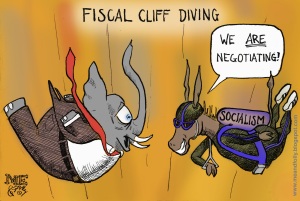 I’m not terribly hopeful that any of my advice will be followed, so let’s close this post with some gallows humor.


 The Daily Hatch