Category Archives: Cato Institute

More Leftists Let Their Masks Slip, Admit They Want Big Tax Hikes on the Middle Class

Washington Could Learn a Lot from a Drug Addict

Uploaded by on Jul 8, 2011

Washington’s chronic overspending is just like a junkie’s addiction to drugs. Unless the cycle of addiction is broken, our economic and unemployment situation will continue to suffer. Washington is out of time. To avoid hitting rock bottom, Washington must cut spending today. To spread this message, Washington Could Learn a Lot has created this video. Learn more at washingtoncouldlearnalot.com.

Update: Now, our economic situation has deteriorated even further. We are now approaching $15 trillion in debt and Congress has raised the debt ceiling 11 times in the past ten years.

Washington Could Learn a Lot is a project of Public Notice Research & Education Fund (PNREF). PNREF is an independent non-profit dedicated to educating the American people about economic policy and the principles of economic freedom.

Through our education and awareness projects, PNREF will explore the future consequences of public policies being enacted today.

_________________

We got to lower spending and not raise taxes. It is sad to me that the left acts like they are taking up for the middle class but they know that the largest amount of money they can raise is from the middle class and they will eventually get around to raising taxes on them.

While I disagree with statists, I sometimes admire their discipline. They are very good at staying “on message.”

I am 100 percent confident, for instance, that they intend big tax hikes on the middle class, even though they would piously swear an oath to the contrary. Indeed, I suspect more than 90 percent of them secretly would like a value-added tax.

It’s not that they necessarily dislike ordinary people, but privately they understand that you can’t finance big government by taxing rich people.

Simply stated, there aren’t enough of the “1 percent.” Moreover, rich people have significant control over the timing, composition, and level of their income, so class-warfare tax hikes inevitably will fail to generate much revenue (yes, the Laffer Curve exists).

So it makes sense that they want to screw the middle class, but it’s also obvious that they don’t want to admit this is their goal. As such, it’s always interesting and revealing when folks on the left slip up and admit their true intentions.

In recent days, more leftists have come out of the we-only-want-to-tax-the-rich closet.

Here’s some of what Jared Bernstein, former economist for Vice President Biden, just wrote for the U.K.’s Financial Times.

That plan will have to include tax increases beyond just the wealthiest households, although that is the right place to start. But what should happen next? …The best thing to do, once the economic recovery is solidly under way, is to simply let the Bush tax cuts expire and return to the tax structure that prevailed under Bill Clinton. …I’d urge Democrats to be forthright with the fact that we’re way below where we need to be in terms of revenue collection.

Bernstein, by the way, was a co-author of the infamous prediction that enacting Obama’s stimulus would keep the unemployment rate below 8 percent.

The Washington Post also is on board with the idea of big tax hikes on ordinary folks.

…it’s impossible to tackle the federal debt by taxing only the wealthy. …the middle class is going to have to pay more…the only way to achieve tax reform with a reasonable increase in revenue is to reset everyone’s rates at Clinton-era levels.

Keep in mind, by the way, that these proposals are just the tip of the iceberg. Once tax rates are pushed back to 2000 levels, then the drumbeat will sound for additional tax hikes.

“The middle class is an easy target”

And, sooner or later, the left will push for its big goal of a value-added tax.

This is not a trivial threat. Obama, for instance, already has expressed support, saying that the VAT is “something that has worked for other countries.” Romney’s also untrustworthy on the issue, having left the door open to this European-style national sales tax.

But the main point of this post is to explain that class-warfare taxes on the rich are a real threat, but they’re also just the camel’s nose under the tent. The left’s real goal is to fleece the middle class.

There’s no way to boost the burden of government spending to European levels without mimicking European tax policies.

And the dirty little secret about European tax policy is that taxes on the rich are about the same on both sides of the Atlantic. The reason government is so much bigger in Europe is that they ransack the middle class.

Videos by Dan Mitchell of the Cato Institute found here on www.thedailyhatch.org

Dan Mitchell of the Cato Institute has some great videos and I have posted lots of them on my blog. I like to go to Dan’s blog too. Take a look at some of them below and then the links to my blog.

It’s Simple to Balance The Budget Without Higher Taxes

Uploaded by on Oct 4, 2010

Politicians and interest groups claim higher taxes are necessary because it would be impossible to cut spending by enough to get rid of red ink. This Center for Freedom and Prosperity video shows that these assertions are nonsense. The budget can be balanced very quickly by simply limiting the annual growth of federal spending.

_______

Six Reasons Why the Capital Gains Tax Should Be Abolished

Uploaded by on May 3, 2010

The correct capital gains tax rate is zero because there should be no double taxation of income that is saved and invested. This is why all pro-growth tax reform plans, such as the flat tax and national sales tax, eliminate the capital gains tax. Unfortunately, the President wants to boost the official capital gains tax rate to 20 percent, and that is in addition to the higher tax rate on capital gains included in the government-run healthcare legislation. http://www.freedomandprosperity.org


______________

Keynesian Economics Is Wrong: Bigger Gov’t Is Not Stimulus

Uploaded by on Dec 15, 2008

Based on a theory known as Keynesianism, politicians are resuscitating the notion that more government spending can stimulate an economy. This mini-documentary produced by the Center for Freedom and Prosperity Foundation examines both theory and evidence and finds that allowing politicians to spend more money is not a recipe for better economic performance.

___________________

Obama’s So-Called Stimulus: Good For Government, Bad For the Economy

Uploaded by on Jan 26, 2009

President Obama wants Congress to dramatically expand the burden of government spending. This CF&P Foundation mini-documentary explains why such a policy, based on the discredited Keynesian theory of economics, will not be successful. Indeed, the video demonstrates that Obama is proposing – for all intents and purposes – to repeat Bush’s mistakes. Government will be bigger, even though global evidence shows that nations with small governments are more prosperous.

____________

Big Government Is Not Stimulus: Why Keynes Was Wrong (The Condensed Version)

Uploaded by on Jan 13, 2009

The CF&P Foundation has released a condensed version of our successful mini-documentary explaining why so-called stimulus schemes do not work. Based on a theory known as Keynesianism, politicians are resuscitating the notion that more government spending can stimulate an economy. This mini-documentary produced by the Center for Freedom and Prosperity Foundation examines both theory and evidence and finds that allowing politicians to spend more money is not a recipe for better economic performance.

_________________

Eight Reasons Why Big Government Hurts Economic Growth

Uploaded by on Aug 17, 2009

This Center for Freedom and Prosperity Foundation video analyzes how excessive government spending undermines economic performance. While acknowledging that a very modest level of government spending on things such as “public goods” can facilitate growth, the video outlines eight different ways that that big government hinders prosperity. This video focuses on theory and will be augmented by a second video looking at the empirical evidence favoring smaller government.

___________________

Now that I have been critical of the Democrat President, I wanted to show that I am not concerned about taking up for Republicans but looking at the facts. President Clinton did increase government spending at a slower rate than many other presidents. Here are two  videos that praise both Reagan and Clinton for both accomplished this feat.

Spending Restraint, Part I: Lessons from Ronald Reagan and Bill Clinton

Uploaded by on Feb 14, 2011

Ronald Reagan and Bill Clinton both reduced the relative burden of government, largely because they were able to restrain the growth of domestic spending. The mini-documentary from the Center for Freedom and Prosperity uses data from the Historical Tables of the Budget to show how Reagan and Clinton succeeded and compares their record to the fiscal profligacy of the Bush-Obama years.

______________

Spending Restraint, Part II: Lessons from Canada, Ireland, Slovakia, and New Zealand

Uploaded by on Feb 22, 2011

Nations can make remarkable fiscal progress if policy makers simply limit the growth of government spending. This video, which is Part II of a series, uses examples from recent history in Canada, Ireland, Slovakia, and New Zealand to demonstrate how it is possible to achieve rapid improvements in fiscal policy by restraining the burden of government spending. Part I of the series examined how Ronald Reagan and Bill Clinton were successful in controlling government outlays — particularly the burden of domestic spending programs. www.freedomandprosperity.org

Here are some posts that include videos from Dan Mitchell:

Videos by Cato Institute on failed stimulus plans

In this post I have gathered several videos from the Cato Institute concerning the subject of failed stimulus plans. _____ Government Spending Doesn’t Create Jobs Uploaded by catoinstitutevideo on Sep 7, 2011 Share this on Facebook: http://on.fb.me/qnjkn9 Tweet it: http://tiny.cc/o9v9t In the debate of job creation and how best to pursue it as a policy […]

Balanced Budget Amendment the answer? Boozman says yes, Pryor no, Part 28 (Input from Norm Coleman, former Republican Senator from MN)

  It’s Simple to Balance The Budget Without Higher Taxes Steve Brawner in his article “Safer roads and balanced budgets,” Arkansas News Bureau, April 13, 2011, noted: The disagreement is over the solutions — on what spending to cut; what taxes to raise (basically none ever, according to Boozman); whether or not to enact a […]

Obama’s plan is not too smart on taxes

Dan Mitchell did a great article concerning the affect of raising taxes in these two areas and horrible results: How Can Obama Look at these Two Charts and Conclude that America Should Have Higher Double Taxation of Dividends and Capital Gains? Posted by Daniel J. Mitchell As discussed yesterday, the most important number in Obama’s […]

______________

We need to stop paying for Germany and Japan’s defense

I have said for years that the USA should not pay for the defense Germany and Japan. Yes, there were many reasons that was true in the past, but now they are two of our biggest friends and trading partners and they are on our side. Why should we limit their military now?

I read the article, “Pawlenty Understands Incentives, Except When It Comes to Defense,” by  Christopher Preble of the Cato Institute and here is a portion of it:

…the U.S. government could cut military spending in half and still spend more than our next two potential rivals, combined.

Our European and East Asian allies are consumers of the security provided by the U.S. military, and all Americans are the third party payers. As my colleague Ben Friedman likes to say, we agree to defend our allies, and they agree to let us. We shouldn’t blame them for under-providing for their own defense; it’s our fault for agreeing to do it for them.

Cato President and Founder Ed Crane’s quick take on Pawlenty’s view on defense military spending is worth repeating:

There is a difference between military spending and defense spending. The Constitution provides for a military to defend the U.S—not to democratize the world. One would hope that presidential candidates would consider America’s commitments overseas very seriously before endorsing those commitments.

Cato scholars have been out in front for years making the case for a principled, constitutional view of “defense” that does not include defending others who can and should defend themselves. If we adopted a strategy of restraint, we could responsibly make significant cuts in military spending, deliver the savings to American taxpayers, and remain the safest and most secure country on the planet. Yesterday, Tim Pawlenty took the opposite tack. He argued that the U.S. military should continue to serve as the world’s policeman/armed social worker, allow other countries to free ride, and require U.S. taxpayers to foot the bill.

Although that might be popular elsewhere in Washington, I can’t imagine it will sell in Cedar Rapids, Iowa, or Manchester, New Hampshire.

Dan Mitchell of the Cato Institute takes on entitlement reform

It is the elephant in the room that nobody wants to talk about. Here Dan Mitchell takes it on.

Most people have a vague understanding that America has a huge long-run fiscal problem.

They’re right, though they probably don’t realize the seriousness of that looming crisis.

Here’s what you need to know: America’s fiscal crisis is actually a spending crisis, and that spending crisis is driven by entitlements.

More specifically, the vast majority of the problem is the result of Medicaid, Medicare, and Social Security, programs that are poorly designed and unsustainable.

America needs to fix these programs…or eventually become another Greece.

Fortunately, all of the problems can be solved, as these three videos demonstrate.

The first video explains how to fix Medicaid.

Promote Federalism and Replicate the Success of Welfare Reform with Medicaid Block Grants

Uploaded by on Jun 26, 2011

The Medicaid program imposes high costs while generating poor results. This Center for Freedom and Prosperity Foundation video explains how block grants, such as the one proposed by Congressman Paul Ryan, will save money and improve healthcare by giving states the freedom to innovate and compete.

The second video shows how to fix Medicare.

Saving Medicare: Free Market Reforms Are Better than Bureaucratic Rationing

Uploaded by on May 17, 2011

This Center for Freedom and Prosperity Foundation video explains how a “premium-support” plan would solve Medicare’s fiscal crisis and improve the overall healthcare system. This voucher-based system also would protect seniors from bureaucratic rationing. http://www.freedomandprosperity.org

And the final video shows how to fix Social Security.

Saving Social Security with Personal Retirement Accounts

Uploaded by on Jan 10, 2011

There are two crises facing Social Security. First the program has a gigantic unfunded liability, largely thanks to demographics. Second, the program is a very bad deal for younger workers, making them pay record amounts of tax in exchange for comparatively meager benefits. This video explains how personal accounts can solve both problems, and also notes that nations as varied as Australia, Chile, Sweden, and Hong Kong have implemented this pro-growth reform. www.freedomandprosperity.org

_______________________

Regular readers know I’m fairly gloomy about the future of liberty, but this is one area where there is a glimmer of hope.

The Chairman of the House Budget Committee actually put together a plan that addresses the two biggest problems (Medicare and Medicaid) and the House of Representatives actually adopted the proposal.

The Senate didn’t act, of course, and Obama would veto any good legislation anyhow, so I don’t want to be crazy optimistic. Depending on how things play out politically in the next six years, I’ll say there’s actually a 20 percent chance to save America.

Videos by Dan Mitchell of the Cato Institute found here on www.thedailyhatch.org

Dan Mitchell of the Cato Institute has some great videos and I have posted lots of them on my blog. I like to go to Dan’s blog too. Take a look at some of them below and then the links to my blog.

It’s Simple to Balance The Budget Without Higher Taxes

Uploaded by on Oct 4, 2010

Politicians and interest groups claim higher taxes are necessary because it would be impossible to cut spending by enough to get rid of red ink. This Center for Freedom and Prosperity video shows that these assertions are nonsense. The budget can be balanced very quickly by simply limiting the annual growth of federal spending.

_______

Six Reasons Why the Capital Gains Tax Should Be Abolished

Uploaded by on May 3, 2010

The correct capital gains tax rate is zero because there should be no double taxation of income that is saved and invested. This is why all pro-growth tax reform plans, such as the flat tax and national sales tax, eliminate the capital gains tax. Unfortunately, the President wants to boost the official capital gains tax rate to 20 percent, and that is in addition to the higher tax rate on capital gains included in the government-run healthcare legislation. http://www.freedomandprosperity.org


______________

Keynesian Economics Is Wrong: Bigger Gov’t Is Not Stimulus

Uploaded by on Dec 15, 2008

Based on a theory known as Keynesianism, politicians are resuscitating the notion that more government spending can stimulate an economy. This mini-documentary produced by the Center for Freedom and Prosperity Foundation examines both theory and evidence and finds that allowing politicians to spend more money is not a recipe for better economic performance.

___________________

Obama’s So-Called Stimulus: Good For Government, Bad For the Economy

Uploaded by on Jan 26, 2009

President Obama wants Congress to dramatically expand the burden of government spending. This CF&P Foundation mini-documentary explains why such a policy, based on the discredited Keynesian theory of economics, will not be successful. Indeed, the video demonstrates that Obama is proposing – for all intents and purposes – to repeat Bush’s mistakes. Government will be bigger, even though global evidence shows that nations with small governments are more prosperous.

____________

Big Government Is Not Stimulus: Why Keynes Was Wrong (The Condensed Version)

Uploaded by on Jan 13, 2009

The CF&P Foundation has released a condensed version of our successful mini-documentary explaining why so-called stimulus schemes do not work. Based on a theory known as Keynesianism, politicians are resuscitating the notion that more government spending can stimulate an economy. This mini-documentary produced by the Center for Freedom and Prosperity Foundation examines both theory and evidence and finds that allowing politicians to spend more money is not a recipe for better economic performance.

_________________

Eight Reasons Why Big Government Hurts Economic Growth

Uploaded by on Aug 17, 2009

This Center for Freedom and Prosperity Foundation video analyzes how excessive government spending undermines economic performance. While acknowledging that a very modest level of government spending on things such as “public goods” can facilitate growth, the video outlines eight different ways that that big government hinders prosperity. This video focuses on theory and will be augmented by a second video looking at the empirical evidence favoring smaller government.

___________________

Now that I have been critical of the Democrat President, I wanted to show that I am not concerned about taking up for Republicans but looking at the facts. President Clinton did increase government spending at a slower rate than many other presidents. Here are two  videos that praise both Reagan and Clinton for both accomplished this feat.

Spending Restraint, Part I: Lessons from Ronald Reagan and Bill Clinton

Uploaded by on Feb 14, 2011

Ronald Reagan and Bill Clinton both reduced the relative burden of government, largely because they were able to restrain the growth of domestic spending. The mini-documentary from the Center for Freedom and Prosperity uses data from the Historical Tables of the Budget to show how Reagan and Clinton succeeded and compares their record to the fiscal profligacy of the Bush-Obama years.

______________

Spending Restraint, Part II: Lessons from Canada, Ireland, Slovakia, and New Zealand

Uploaded by on Feb 22, 2011

Nations can make remarkable fiscal progress if policy makers simply limit the growth of government spending. This video, which is Part II of a series, uses examples from recent history in Canada, Ireland, Slovakia, and New Zealand to demonstrate how it is possible to achieve rapid improvements in fiscal policy by restraining the burden of government spending. Part I of the series examined how Ronald Reagan and Bill Clinton were successful in controlling government outlays — particularly the burden of domestic spending programs. www.freedomandprosperity.org

Here are some posts that include videos from Dan Mitchell:

Videos by Cato Institute on failed stimulus plans

In this post I have gathered several videos from the Cato Institute concerning the subject of failed stimulus plans. _____ Government Spending Doesn’t Create Jobs Uploaded by catoinstitutevideo on Sep 7, 2011 Share this on Facebook: http://on.fb.me/qnjkn9 Tweet it: http://tiny.cc/o9v9t In the debate of job creation and how best to pursue it as a policy […]

Balanced Budget Amendment the answer? Boozman says yes, Pryor no, Part 28 (Input from Norm Coleman, former Republican Senator from MN)

  It’s Simple to Balance The Budget Without Higher Taxes Steve Brawner in his article “Safer roads and balanced budgets,” Arkansas News Bureau, April 13, 2011, noted: The disagreement is over the solutions — on what spending to cut; what taxes to raise (basically none ever, according to Boozman); whether or not to enact a […]

Obama’s plan is not too smart on taxes

Dan Mitchell did a great article concerning the affect of raising taxes in these two areas and horrible results: How Can Obama Look at these Two Charts and Conclude that America Should Have Higher Double Taxation of Dividends and Capital Gains? Posted by Daniel J. Mitchell As discussed yesterday, the most important number in Obama’s […]

______________

The Welfare trap can be destroyed by Milton Friedman’s negative income tax

The best way to destroy the welfare trap is to put in Milton Friedman’s negative income tax.

A Picture of How Redistribution Programs Trap the Less Fortunate in Lives of Dependency

I wrote last year about the way in which welfare programs lead to very high implicit marginal tax rates on low-income people. More specifically, they lose handouts when they earn income. As such, it is not very advantageous for them to climb the economic ladder because hard work is comparatively unrewarding.

Thanks to the American Enterprise Institute, we now have a much more detailed picture showing the impact of redistribution programs on the incentive to earn more money.

It’s not a perfect analogy since people presumably prefer cash to in-kind handouts, but the vertical bars basically represent living standards for any given level of income that is earned (on the horizontal axis).

Needless to say, there’s not much reason to earn more income when living standards don’t improve. May as well stay home and good off rather than work hard and produce.

This is why income redistribution is so destructive, not just to taxpayers, but also to the people who get trapped into dependency. Which is exactly the point made in this video.

P.S. Most of you know that I’m not a fan of the Organization for Economic Cooperation and Development because the Paris-based bureaucracy has such statist impulses. But even the OECD has written about the negative impact of overly generous welfare programs on incentives for productive behavior.

Related posts:

Open letter to President Obama (Part 117B)

Milton Friedman’s Free to Choose – Ep.4 (1/7) – From Cradle to Grave   President Obama c/o The White House 1600 Pennsylvania Avenue NW Washington, DC 20500 Dear Mr. President, I know that you receive 20,000 letters a day and that you actually read 10 of them every day. I really do respect you for […]

Milton Friedman remembered at 100 years from his birth (Part 5)

Testing Milton Friedman – Preview Uploaded by FreeToChooseNetwork on Feb 21, 2012 2012 is the 100th anniversary of Milton Friedman’s birth. His work and ideas continue to make the world a better place. As part of Milton Friedman’s Century, a revival of the ideas featured in the landmark television series Free To Choose are being […]

40% of USA on government dole, need to eliminate welfare and put in Friedman’s negative income tax

Eight Reasons Why Big Government Hurts Economic Growth We got to cut these welfare programs before everyone stops working and wants to get the free stuff. The Bible says if you don’t work then you should not eat. It also says that churches should help the poor but it doesn’t say that the government should […]

Free or equal? 30 years after Milton Friedman’s Free to Choose (Part 2)

Johan Norberg – Free or Equal – Free to Choose 30 years later 2/5 Published on Jun 10, 2012 by BasicEconomics In 1980 economist and Nobel laureate Milton Friedman inspired market reform in the West and revolutions in the East with his celebrated television series “Free To Choose.” Thirty years later, in this one-hour documentary, […]

Milton Friedman remembered at 100 years from his birth (Part 4)

I ran across this very interesting article about Milton Friedman from 2002: Friedman: Market offers poor better learningBy Tamara Henry, USA TODAY By Doug Mills, AP President Bush honors influential economist Milton Friedman for his 90th birthday earlier this month. About an economist Name:Milton FriedmanAge: 90Background: Winner of the 1976 Nobel Prize for economic science; […]

Transcript and video of Milton Friedman on Bill Clinton and Ronald Reagan (Part 2)

Below is a discussion from Milton Friedman on Bill Clinton and Ronald Reagan. February 10, 1999 | Recorded on February 10, 1999 audio, video, and blogs » uncommon knowledge PRESIDENTIAL REPORT CARD: Milton Friedman on the State of the Union with guest Milton Friedman Milton Friedman, Senior Research Fellow, Hoover Institution and Nobel Laureate in […]

If converted to cash and simply given to the recipients welfare check would be $44,000 per family of four

Milton Friedman came up with the idea of eliminating all welfare programs and putting in a negative income tax that would eliminate the welfare trap. However, our federal government just doesn’t listen to reason. Obama Ends Welfare Reform as We Know It, Calls for $12.7 Trillion in New Welfare Spending Robert Rector July 17, 2012 […]

Milton Friedman explains negative income tax to William F. Buckley in 1968

December 06, 2011 03:54 PM Milton Friedman Explains The Negative Income Tax – 1968 0 comments By Gordonskene enlarge Milton Friedman and friends.DOWNLOADS: 36 PLAYS: 35 Embed   The age-old question of Taxes. In the early 1960′s Economist Milton Friedman adopted an idea hatched in England in the 1950′s regarding a Negative Income Tax, to […]

Listing of transcripts and videos of “Free to Choose” episode 4 – From Cradle to Grave on www.theDailyHatch.org

In the last few years the number of people receiving Food Stamps has skyrocketed. President Obama has not cut any federal welfare programs but has increased them, and he  has used class warfare over and over the last few months and according to him equality at the finish line is the equality that we should […]

Milton Friedman remembered at 100 years from his birth (Part 2)

Testing Milton Friedman – Preview Uploaded by FreeToChooseNetwork on Feb 21, 2012 2012 is the 100th anniversary of Milton Friedman’s birth. His work and ideas continue to make the world a better place. As part of Milton Friedman’s Century, a revival of the ideas featured in the landmark television series Free To Choose are being […]

Video: The Moral Case for Free Enterprise

A couple of months ago, I discussed a column by Arthur Brooks, in which he explained that libertarians and conservatives need to make a moral argument for capitalism and not just rely on statistics and economic analysis.

This is correct, I believe, and I cited myself as an example. When the flat tax became an issue in the 1990s, I gave lots of speeches, and I pontificated about lower marginal tax rates and getting rid of double taxation. I quickly learned, though, that people were most excited about getting rid of the corruption in the current system.

Brooks now makes his case for the morality of capitalism in a new video.

A superb job. His insights on earned success are very important. Indeed, this is why the dependency culture is misguided for both taxpayers and recipients.

President of the American Enterprise Institute

And it’s also why I try to stress that bloated government is basically a racket that either allows people to obtain unearned benefits or makes it harder for people to achieve earned success.

P.S. Brooks also is more than capable of making traditional economic arguments, as you can see from what he wrote about Europe’s collapsing welfare states.

P.P.S. And he has produced some first-rate research on the loss of ethics in Europe compared to the United States.

Dan Mitchell: “Bailouts reward past bad behavior”

Uploaded by on Jun 8, 2011

No description available.

I wish the federal government would not play favorites and come in and do bailouts. It simply is not fair.

In the “Opposing View” Column, I Explain Why USA Today Is Wrong about Bailouts

September 17, 2012 by Dan Mitchell

I think it’s a mistake to bail out profligate governments, and I have the same skeptical attitude about bailouts for mismanaged banks and inefficient car companies.

Simply stated, bailouts reward past bad behavior and make future bad behavior more likely (what economists call moral hazard).

But some folks think government was right to put taxpayers on the hook for the sloppy decisions of private companies. Here’s the key passage in USA Today’s editorial on bailouts.

Put simply, the bailouts worked. True, in some cases the government did not do a very good job with the details, and taxpayers are out $142 billion in connection with the non-TARP takeovers of housing giants Fannie Mae and Freddie Mac. But it’s time for the economic purists and the Washington cynics to admit that government can occasionally do something positive, at least when faced with a terrifying crisis.

Well, I guess I’m one of those “economic purists” and “Washington cynics,” so I’m still holding firm to the position that the bailouts were a mistake. In my “opposing view” column, I argue that the auto bailout sets a very bad precedent.

Unfortunately, the bailout craze in the United States is a worrisome sign cronyism is taking root. In the GM/Chrysler bailout, Washington intervened in the bankruptcy process and arbitrarily tilted the playing field to help politically powerful creditors at the expense of others. …This precedent makes it more difficult to feel confident that the rule of law will be respected in the future when companies get in trouble. It also means investors will be less willing to put money into weak firms. That’s not good for workers, and not good for the economy.

If I had more space (the limit was about 350 words), I also would have dismissed the silly assertion that the auto bailout was a success. Yes, GM and Chrysler are still in business, but the worst business in the world can be kept alive with sufficiently large transfusions of taxpayer funds.

And we’re not talking small amounts. The direct cost to taxpayers presently is about $25 billion, though I noted as a postscript in this otherwise humorous post that experts like John Ransom have shown the total cost is far higher.

And here’s what I wrote about the financial sector bailouts.

The pro-bailout crowd argues that lawmakers had no choice. We had to recapitalize the financial system, they argued, to avoid another Great Depression. This is nonsense. The federal government could have used what’s known as “FDIC resolution” to take over insolvent institutions while protecting retail customers. Yes, taxpayer money still would have been involved, but shareholders, bondholders and top executives would have taken bigger losses. These relatively rich groups of people are precisely the ones who should burn their fingers when they touch hot stoves. Capitalism without bankruptcy, after all, is like religion without hell. And that’s what we got with TARP. Private profits and socialized losses are no way to operate a prosperous economy.

The part about “FDIC resolution” is critical. I’ve explained, both in a post criticizing Dick Cheney and in another post praising Paul Volcker, that policymakers didn’t face a choice of TARP vs nothing. They could have chosen the quick and simple option of giving the Federal Deposit Insurance Corporation additional authority to put insolvent banks into something akin to receivership.

Indeed, I explained in an online debate for U.S. News & World Report that the FDIC did handle the bankruptcies of both IndyMac and WaMu. And they could have used the same process for every other poorly run financial institution.

But the politicians didn’t want that approach because their rich contributors would have lost money.

I have nothing against rich people, of course, but I want them to earn money honestly.

Republicans need to stand up to President Obama on fiscal cliff


No one could communicate better than Milton Friedman the principles of freedom and liberty. When taxes are raised then it cuts down our freedom. I am hoping the Republicans will stand up to President Obama on this issue of the fiscal cliff and raising the debt limit.

There’s No Good Outcome to the Fiscal Cliff Fight

December 26, 2012 by Dan Mitchell

We’ve opened all our presents, spent time with family, and enjoyed some tasty food.

Notwithstanding all this good cheer, there’s a a cloud of doom on the horizon. And that horizon is Washington, DC, America’s work-free drug city.

It appears that there’s no way of avoiding a tax increase. Either we go over the cliff, meaning across-the-board hikes for those who pay federal income tax, or Republicans acquiesce to Obama’s class-warfare tax agenda.

No wonder Santa left one unwanted present.

Santa Higher Taxes

I explain the grim outlook for Fox Business News, though my display of sartorial Christmas splendor somewhat offsets the dour topic.

In the interview, I don’t say what should happen, though I’ve previously argued that it’s better to go over the cliff rather than give Obama a victory that will set the stage for further defeats over the next two years.

Better to have a bigger tax hike now, in other words, than to create a precedent that will lead to even larger losses in 2013 and 2014.

Besides, it’s quite possible that Obama is bluffing and this is the right way to get all the tax cuts extended.

But I admit there’s lots of guessing and speculation in those sentences.

There is one thing, however, that I can say with complete confidence. We don’t need a tax increase to balance the budget. We can get rid of red ink in just 10 years simply restraining spending so that it grows by only 2.5 percent per year.

P.S. Notwithstanding the last sentence, our main fiscal goal should be smaller government, not a balanced budget.

P.P.S. I was glad to have an opportunity in the interview to defend Robin Hood’s reputation. As I’ve explained, he was a Tea Party guy, helping to reclaim and return money that was taken by the tax collectors of Prince John and the Sheriff of Nottingham. Here’s another Ken Catalino cartoon that sort of makes this point.

Obama Reverse Robin Hood

I’ve also had to correct Cal Thomas on Robin Hood’s philosophical bona fides, so this is a very common mistake.

P.P.P.S. This is my second attempt at creating a video in the absence of the Cato expert. There’s a hiccup around the 2:25 mark, but I think the picture quality is much better than my first effort.

P.P.P.P.S. If you like the red jacket, previous attempts to be on the cutting edge of fashion can be seen here and here.

California burdensome government causing some of business community to leave for Texas

Does Government Have a Revenue or Spending Problem?

People say the government has a debt problem. Debt is caused by deficits, which is the difference between what the government collects in tax revenue and the amount of government spending. Every time the government runs a deficit, the government debt increases. So what’s to blame: too much spending, or too little tax revenue? Economics professor Antony Davies examines the data and concludes that the root cause of the debt is too much government spending.

____________

When you try and tax and spend too much then the business community will try and relocate to another state. That is exactly what is happening in California today. We need to lower taxes if we want to grow the economy.

Over the years, I’ve shared some outrageous examples of overpaid bureaucrats.

Hopefully we’re all disgusted when insiders rig the system to rip off taxpayers. And I suspect you’re not surprised to see that the worst example on that list comes from California, which is in a race with Illinois to see which state can become the Greece of America.

Well, the Golden State has a new über-bureaucrat. Here are some of the jaw-dropping details from a Bloomberg report.

The numbers are even larger in California, where a state psychiatrist was paid $822,000, a highway patrol officer collected $484,000 in pay and pension benefits and 17 employees got checks of more than $200,000 for unused vacation and leave. The best-paid staff in other states earned far less for the same work, according to the data.

Wow, $822,000 for a state psychiatrist. Not bad for government work. So what is Governor Jerry Brown doing to fix the mess? As you might expect, he’s part of the problem.

…the state’s highest-paid employees make far more than comparable workers elsewhere in almost all job and wage categories, from public safety to health care, base pay to overtime. …California has set a pattern of lax management, inefficient operations and out-of-control costs. …In California, Governor Jerry Brown hasn’t curbed overtime expenses that lead the 12 largest states or limited payments for accumulated vacation time that allowed one employee to collect $609,000 at retirement in 2011. …Last year, Brown waived a cap on accrued leave for prison guards while granting them additional paid days off. California’s liability for the unused leave of its state workers has more than doubled in eight years, to $3.9 billion in 2011, from $1.4 billion in 2003, according to the state’s annual financial reports. …The per-worker costs of delivering services in California vastly exceed those even in New York, New Jersey, Illinois and Ohio.

Actually, it’s not just that he’s part of the problem. He’s making things worse, having seduced voters into approving a ballot measure to dramatically increase the tax burden on the upper-income taxpayers.

I suppose the silver lining to that dark cloud is that many bureaucrats now rank as part of the top 1 percent, so they’ll have to recycle some of their loot back to the political vultures in Sacramento.

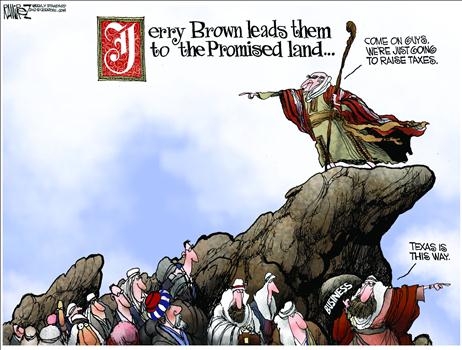
Cartoon California Promised Land

But the biggest impact of the tax hike – as shown in the Ramirez cartoon – will be to accelerate the shift of entrepreneurs, investors, and small business owners to states that don’t steal as much. Indeed, a study from the Manhattan Institute looks at the exodus to lower-tax states.

The data also reveal the motives that drive individuals and businesses to leave California. One of these, of course, is work. …Taxation also appears to be a factor, especially as it contributes to the business climate and, in turn, jobs. Most of the destination states favored by Californians have lower taxes. States that have gained the most at California’s expense are rated as having better business climates. The data suggest that many cost drivers—taxes, regulations, the high price of housing and commercial real estate, costly electricity, union power, and high labor costs—are prompting businesses to locate outside California, thus helping to drive the exodus.

Yet another example of why tax competition is such an important force for economic liberalization. It punishes governments that are too greedy and gives taxpayers a chance to protect their property from the looter class.