I just don’t think it is productive to raise taxes on a sluggish economy when we should be growing the economy which makes for a larger pie and everyone can get a bigger slice.
________
Will Higher Tax Rates Balance the Budget?
Published on Apr 11, 2012
As the U.S. debt and deficit grows, some politicians and economist have called for higher tax rates in order to balance the budget. The question becomes: when the government raises taxes, does it actually collect a larger portion of the US economy?
Professor Antony Davies examines 50 years of economic data and finds that regardless of tax rates, the percentage of GDP that the government collects has remained relatively constant. In other words, no matter how high government sets tax rates, the government gets about the same portion. According to Davies, if we’re concerned about balancing the budget, we should worry less about raising tax revenue and more about growing the economy. The recipe for growth? Lower tax rates and a simplified tax code.
Here’s the class-warfare present that the clowns in Washington are giving us for the New Year.
According to some estimates, this “balanced approach” in this plan has $54 of tax increases for every $1 of spending cuts. That’s even worse than what’s been happening in Europe.
I take the pro-market position in this special report on Fox News.
The discussion focuses on the following questions.
Does government spending create jobs? This is the discredited Keynesian notion that you become richer by switching money from your right pocket to left pocket, and I explain that this approach has never worked.
What does create jobs? I explain we need to shrink the burden of government and I cite my favorite Golden Rule about the importance of making sure the productive sector of the economy grows faster than the public sector.
Should there be more government workers? Anyone who has seen this video knows my answer to that question.
Is it a good idea to raise taxes on the rich? I argue that penalizing success doesn’t make sense, so class warfare tax policy should be rejected.
Would it help to impose higher taxes on corporations? Since the United States already penalizes companies with the world’s highest corporate tax rate, that question answers itself.
In other words, there is no secret to job creation. Just get government out of the way.
________________
Thank you so much for your time. I know how valuable it is. I also appreciate the fine family that you have and your commitment as a father and a husband.
Sincerely,
Everette Hatcher III, 13900 Cottontail Lane, Alexander, AR 72002, ph 501-920-5733, lowcostsqueegees@yahoo.com
Is our country learning from history? California keeps raising their taxes on the wealthy and people keep moving from California to Texas. What does our federal government do? They also have been raising taxes on the wealthy lately. Take a look at this excellent video below and then read a great article by Dan Mitchell of the Cato Institute on what is happening in California right now.
Will Higher Tax Rates Balance the Budget?
Published on Apr 11, 2012
As the U.S. debt and deficit grows, some politicians and economist have called for higher tax rates in order to balance the budget. The question becomes: when the government raises taxes, does it actually collect a larger portion of the US economy?
Professor Antony Davies examines 50 years of economic data and finds that regardless of tax rates, the percentage of GDP that the government collects has remained relatively constant. In other words, no matter how high government sets tax rates, the government gets about the same portion. According to Davies, if we’re concerned about balancing the budget, we should worry less about raising tax revenue and more about growing the economy. The recipe for growth? Lower tax rates and a simplified tax code.
Like most people, I’m a sucker for a heartwarming story around the holidays.
Sometimes, you get that nice feeling when good things happen to good people, like you find at the end of a classic movie like “It’s a Wonderful Life.”
But since I’m a bit of a curmudgeon, I also feel all warm and fuzzy when bad things happen to bad people.
That’s why I always smile when I read stories about taxpayers moving across borders, thus preventing greedy tax-hiking politicians from collecting more revenue.
I smile because I envision the moment when some budget geek tells these sleazy politicians that projected revenues aren’t materializing and they don’t have more money to spend.
So I wish I could be a fly on the wall when this moment of truth happens to California politicians. They convinced voters in the state to enact Prop 30, a huge tax increase targeting those evil, awful, bad rich people.
Governor Brown and his fellow kleptocrats in Sacramento doubtlessly are salivating at the thought of more money to waste.
But notwithstanding a satirical suggestion from Walter Williams, there aren’t guard towers and barbed-wire fences surrounding the state. Productive people can leave, and that’s happening every day. And they take their taxable income with them.
Usually in ways that don’t attract attention. But sometimes a bunch of them leave at the same times, and that is newsworthy. Here’s an example of that happening, as reported by the San Francisco Chronicle.
Chevron Corp. will move up to 800 jobs – about a quarter of its current headquarters staff – from the Bay Area to Houston over the next two years but will remain based in San Ramon, the oil company told employees Thursday. …The company already employs far more people in Houston – about 9,000 full-time employees and contractors – than it does in San Ramon.
We don’t know a lot of details, but these were positions at the company’s headquarters and they were “technical positions dealing with information and advanced energy technologies…tied to Chevron’s worldwide oil exploration and production business.”
Let’s assume these highly skilled employees earn an average of $250,000. I imagine that’s a low-ball estimate, but this is just for purposes of a thought experiment. Now multiply that average salary by 800 workers and you get $200 million of income.
And every penny of that $200 million no longer will be subject to tax by the kleptocrats in the state’s capital.
What’s happening in a big way with Chevron is happening in small ways every single day with investors, entrepreneurs, small business owners, and other “rich’ people.
That’s good for the people escaping. And it also will warm my heart when California’s despicable politicians discover next year that there’s an “unexpected” revenue shortfall.
How can Washington D. C. get enough money to balance the budget and not cut spending. The answer is that everyone’s taxes must go up. Don’t let anyone fool you. There is not enough money to just tax the rich. Instead, entitlements need to be reform and real spending cuts need to be made. The real problem is spending. Washington already has enough of our taxes.
The Washington establishment loves talking about the “distribution” of income and taxes. The CBO has issued a new report on the topic that will no doubt keep the discussion rolling on.
The mindset of many people in government is encapsulated by this sentence in the CBO report: “Market income is very unevenly distributed.” But anyone with a decent appreciation of America’s economy knows that market income is in fact earned in a decentralized fashion by 140 million people and 25 million businesses spread across this vast land. It is not ”distributed” from a big vault in the capital by central-planning czars with a god-given preemptive right to decide how much everyone gets.
Yes, the huge subsidies that the federal government hands out each year are “distributed.” But CBO statisticians seem to be so used to thinking about the entire economy as a giant government-created pie that they say market income is also distributed.
That said, the CBO report has some interesting statistics to consider. Most important are calculations of average federal tax rates, which are total federal taxes paid as a share of income. The chart shows average tax rates by quintiles, which each contain one fifth of U.S. households grouped by income level. The households at the top are hit with the largest burdens by far. Elsewhere, I’ve discussed who some of these high-earning households are and the damage done by nailing them with such high taxes. (For example, see here and here).
Thank you so much for your time. I know how valuable it is. I also appreciate the fine family that you have and your commitment as a father and a husband.
Sincerely,
Everette Hatcher III, 13900 Cottontail Lane, Alexander, AR 72002, ph 501-920-5733, lowcostsqueegees@yahoo.com
Some folks say they want “austerity,” but that’s largely a code word for higher taxes. They’re fighting against the people who say they want “growth,” but that’s generally a code word for more Keynesian spending.
And then, to get me even more irritated, lots of people support bailouts because they supposedly are needed to save the euro currency.
When I ask these people why a default in, say, Greece threatens the euro, they look at me as if it’s the year 1491 and I’ve declared the earth isn’t flat.
So I’m delighted that the Wall Street Journal has published some wise observations by a leading French economist (an intellectual heir to Bastiat!), who shares my disdain for the current discussion. Here are some excerpts from Prof. Salin’s column, starting with his common-sense hypothesis.
…there is no “euro crisis.” The single currency doesn’t have to be “saved” or else explode. The present crisis is not a European monetary problem at all, but rather a debt problem in some countries—Greece, Spain and some others—that happen to be members of the euro zone. Specifically, these are public-debt problems, stemming from bad budget management by their governments. But there is no logical link between these countries’ fiscal situations and the functioning of the euro system.
Salin then looks at how the artificial link was created between the euro currency and the fiscal crisis, and he makes a very good analogy (and I think it’s good because I’ve made the same point) to a potential state-level bankruptcy in America.
The public-debt problem becomes a euro problem only insofar as governments arbitrarily decide that there must be some “European solidarity” inside the euro zone. But how does mutual participation in the same currency logically imply that spendthrift governments should get help from the others? When a state in the U.S. has a debt problem, one never hears that there is a “dollar crisis.” There is simply a problem of budget management in that state.
Because European politicians have decided to create an artificial link between national budget problems and the functioning of the euro system, they have now effectively created a “euro crisis.” To help out badly managed governments, the European Central Bank is now buying public bonds issued by these governments or supplying liquidity to support their failing banks. In so doing, the ECB is violating its own principles and introducing harmful distortions.
Last but not least, Salin warns that politicians are using the crisis as an excuse for more bad policy – sort of the European version of Mitchell’s Law, with one bad policy (excessive spending) being the precursor of additional bad policy (centralization).
Politicians now argue that “saving the euro” will require not only propping up Europe’s irresponsible governments, but also centralizing decision-making. This is now the dominant opinion of politicians in Europe, France in particular. There are a few reasons why politicians in Paris might take that view. They might see themselves being in a similar situation as Greece in the near future, so all the schemes to “save the euro” could also be helpful to them shortly. They might also be looking to shift public attention away from France’s internal problems and toward the rest of Europe instead. It’s easier to complain about what one’s neighbors are doing than to tackle problems at home. France needs drastic tax cuts and far-reaching deregulation and labor-market liberalization. Much simpler to get the media worked up about the next “euro crisis” meeting with Angela Merkel.
Thank you so much for your time. I know how valuable it is. I also appreciate the fine family that you have and your commitment as a father and a husband.
Sincerely,
Everette Hatcher III, 13900 Cottontail Lane, Alexander, AR 72002, ph 501-920-5733, lowcostsqueegees@yahoo.com
It seems to me if you raise the capital gains tax rate and the revenue declines and if you lower it and it increases revenue that would be prudent and lower it.
Unfortunately, even though the United States already has a very anti-competitive system – as shown by these two charts, some folks think that the tax rate on capital gains should be even higher.
And it looks like they’re going to succeed, either because we go over the fiscal cliff or because Republicans acquiesce to Obama’s punitive proposal.
Nearly every country has reduced tax rates on individual long-term capital gains, with some countries imposing no tax at all. …If the U.S. capital gains tax rate rises next year as scheduled, it will be much higher than the average OECD rate. …Capital gains taxes raise less than five percent of federal revenues, yet they do substantial damage. Higher rates will harm investment, entrepreneurship, and growth, and will raise little, if any, added federal revenue. …Figure 1 shows that the U.S. capital gains tax rate of 19.1 percent in 2012 is higher than the OECD average rate of 16.4 percent. These figures include both federal and average state-level tax rates on long-term capital gains. Next year, the expiration of the Bush tax cuts will push up the U.S. rate by 5 percentage points, and the new investment tax imposed under the 2010 health care law will push up the rate another 3.8 percent. As a result, the top U.S. capital gains tax rate will be 27.9 percent, which will be far higher than the OECD average. The federal alternative minimum tax and other provisions can increase the U.S. capital gains tax rate even higher.
The worst country is Denmark, at 42 percent, followed by France (32.5 percent), Finland (32 percent), Sweden and Ireland (both 30 percent), and the United Kingdom and Norway (both 28 percent).
Every other developed nations will have a capital gains tax rate below the United States level. And even some of those above the U.S. level often have provisions that spare many taxpayers from this pernicious form of double taxation.
Some countries have exemptions for smaller investors. In Britain, for example, individuals can exempt from tax the first $17,000 of capital gains each year. Eleven OECD countries do not impose taxes on longterm capital gains, nor do some jurisdictions outside of the OECD, such as Hong Kong, Malaysia, and Thailand.
The nations on the list that don’t tax capital gains are Belgium, Czech Republic, Greece, Luxembourg, Mexico, Netherlands, New Zealand, Slovenia, South Korea, Switzerland, and Turkey.
In his paper, Chris also gives a good explanation of the underlying tax theory in the capital gains tax debate. Simply stated, the statists like the “Haig-Simons” approach because it justifies class-warfare tax policy.
To maximize growth, we should “tax the fruit of the tree, but not the tree itself.” That is, we should tax the flow of consumption produced by capital assets, not the capital that will provide for future consumption. A Haig-Simons tax base—which includes capital gains—taxes the tree itself. Why does a Haig-Simons tax base garner support if it is impractical and anti-growth? It appears to be because the liberal idea of “fairness” includes heavy taxation of high earners. Since high earners save more than others, they would be taxed heavily under a Haig-Simons tax base. …Today, many economists favor shifting from an income to a consumption tax base… Under a consumption tax base, savings would not be double-taxed, and capital gains would not face separate taxation because the cashflow from realized gains would be taxed when consumed. With regard to “fairness,” a Haig-Simons tax base penalizes frugal people and rewards the spendthrift. That’s because earnings are taxed a second time when saved, while immediate consumption does not face a further tax. That makes no sense because it is frugal people—savers—who are the benefactors of the economy since their funds get invested in the new businesses and new capital equipment that generates growth.
The right approach is to have a “consumption tax base,” which simply is another way of saying that income shouldn’t be taxed more than one time (as shown in this flowchart).
Writing about the death tax yesterday, I mentioned that it also is a perverse form of double taxation. And just as with the death tax, it’s worth noting that all the major pro-growth tax reform plans – such as the flat tax or national sales tax – also have no capital gains tax.
It’s bad enough when the IRS gets to tax our income one time. They shouldn’t be allowed more than one bite of the apple.
P.S. Chris makes a very important point about higher capital gains taxes collecting little, if any revenue. Simply stated, there’s a large Laffer Curve effect since investors can choose not to sell an asset if the tax penalty is too high.
The public school system in the inner cities in the USA is appauling. Don’t our inner city kids a better chance of going up the economic ladder? Why did you abolish the opportunity for kids in Washington D.C. to get a better education? It was all over the news a few years ago and at the same time you send your kids to private school.
And here’s a powerful video from Reason TV that combines those themes, noting the unholy alliance of teacher unions and the NAACP.
The spiritual leader of the teacher unions?
Fortunately, the statists seem to be losing this issue. Louisiana recently adopted school choice legislation that will give poor children an opportunity to escape failing government schools.
But the left isn’t losing gracefully. In a move that would make George Wallace proud, they are threatening schools that will participate in the new program.
In some parts of the antebellum South, it was illegal to teach blacks how to read. Are teachers unions in Louisiana trying to turn back the clock? Last week, lawyers for the Louisiana Association of Educators, one of the state’s two major teachers unions, threatened private and parochial schools with lawsuits if the schools accept students participating in a new school choice initiative that starts this year. Education reforms signed into law in April by Governor Bobby Jindal include a publicly funded voucher program that allows low-income families to send their children to private or parochial schools. …lawyers representing the unions faxed letters to about 100 of the 119 schools that are participating in the voucher program. “Our clients have directed us to take whatever means necessary,” the letter reads. Unless the school agrees to turn away voucher students, “we will have no alternative other than to institute litigation.” The letter demanded an answer in writing by the next day. Louisiana’s voucher program is adjusted for family income and is intended above all to give a shot at a decent education to underprivileged minorities, who are more likely to be relegated to the worst public schools. …Demand for vouchers has been overwhelming: There were 10,300 applications for 5,600 slots. Despite claims to the contrary by school-choice opponents, low-income parents can and do act rationally when it comes to the education of their children. State officials have rightly slammed the union’s tactics. A spokesman for the Governor said in a statement that union leaders are “stooping to new lows and trying to strong-arm schools to keep our kids from getting a quality education.” State Superintendent John White said it was “shameful” that the unions were “trying to prevent people from doing what’s right for their children.” The unions claim that vouchers don’t benefit students, but we know from school-choice programs in Washington, D.C., and elsewhere that voucher recipients attend safer schools and enjoy higher graduation rates than their peers in public schools.
Regardless of ideology, any decent person will favor reforms that enable poor kids to escape horrible government schools. Lots of liberals are decent people. The ones who oppose school choice, by contrast, are…well, you can fill in the blank.
P.P.S. Not surprisingly, Thomas Sowell nails the issue, as does Walter Williams, with both criticizing the President for sacrificing the interests of minority children to protect the monopoly privileges of teacher unions.
Thank you so much for your time. I know how valuable it is. I also appreciate the fine family that you have and your commitment as a father and a husband.
Sincerely,
Everette Hatcher III, 13900 Cottontail Lane, Alexander, AR 72002, ph 501-920-5733, lowcostsqueegees@yahoo.com
Your administration has firmly supported a higher death tax. Dan Mitchell notes, “To make matters worse, the United States also has one of the most onerous death taxes in the world.” I just don’t understand why a person has to pay a death tax when he dies. If a person is a very talented pianist is he allowed to pass that teaching and skill along to his children? Parents should not be encouraged to spend their money on wild living versus building up their businesses for their children. How would that affect the economy to encourage people to divide and sell their businesses versus building them up?
Considering that every economic theory agrees that living standards and worker compensation are closely correlated with the amount of capital in an economy (this picture is a compelling illustration of the relationship), one would think that politicians – particularly those who say they want to improve wages – would be very anxious not to create tax penalties on saving and investment.
To make matters worse, the United States also has one of the most onerous death taxes in the world. As you can see from this chart prepared by the Joint Economic Committee, it is more punitive than places such as Greece, France, and Venezuela.
Who would have ever thought that Russia would have the correct death tax rate, while the United States would have one of the world’s worst systems?
Fortunately, not all U.S. tax policies are this bad. Our taxation of labor income is generally not as bad as other industrialized nations. And the burden of government spending in the United States tends to be lower than European nations (though both Bush and Obama have undermined that advantage).
But these mitigating factors don’t change the fact that the U.S. needlessly punishes saving and investment, and workers are the biggest victims. So let’s junk the internal revenue code and adopt a simple and fair flat tax.
__________
Thank you so much for your time. I know how valuable it is. I also appreciate the fine family that you have and your commitment as a father and a husband.
Sincerely,
Everette Hatcher III, 13900 Cottontail Lane, Alexander, AR 72002, ph 501-920-5733, lowcostsqueegees@yahoo.com
The federal government spends less than 10% of their budget on goods that may help businesses out and then much of the rest of the federal budget does nothing to help out businesses and lots of it is for red tape that businesses have to struggle with. That is the point of this letter today. And by the way, do you really think you were taken out of context?
But since I was talking about the staggering burden of red tape and regulation, I wasn’t being very supportive of the President’s assertion that government deserves a big chunk of the credit when a business is successful.
This cartoon makes the same point, but adds taxation to the mix.
As far as I recall (I sound like a politician under oath when I write something like that), this is the first Branco cartoon I’ve used, but I think it’s the best one in this post, so I’m looking forward to more of his (her?) work.
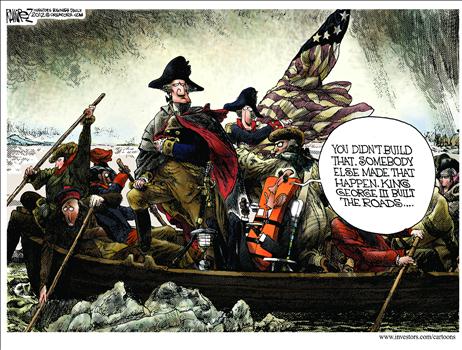
Regular readers know about Michael Ramirez, of course, and he has an amusing take on the you-didn’t-build-that controversy.
Last but not least, we have another Allie cartoon. I think this is the first time I’ve used two cartoons by the same person, but I think you’ll agree they’re worth sharing.
This gives me an opportunity to end on a serious note. The Obama campaign is asserting that the President was simply stating that private sector prosperity is made possible by the provision of “public goods” such as roads and bridges.
Which is why the second Allie cartoon is so good. Even when government does something that is theoretically good, it causes a lot of collateral damage because of the excessive size and scope of the welfare state.
Thank you so much for your time. I know how valuable it is. I also appreciate the fine family that you have and your commitment as a father and a husband.
Sincerely,
Everette Hatcher III, 13900 Cottontail Lane, Alexander, AR 72002, ph 501-920-5733, lowcostsqueegees@yahoo.com
I appeared on CNBC a couple of days ago to discuss a new report which claims that some big U.S. companies “only” paid 9 percent of their income to the government.
While I’m a bit skeptical of the numbers (did it include the taxes paid to foreign governments, for instance, which can be substantial for multinational firms?), I confess I didn’t read the report.
So I focused on the best way of getting rid of corrupt loopholes while simultaneously boosting the competitiveness of America companies.
In other words, I said we should rip up the wretched internal revenue code and implement a simple and fair flat tax.
As is my habit, allow me to emphasize a few points from the interview.
It’s good to keep money in the productive sector of the economy because we shouldn’t feed the spending addiction in DC.
If tax rates are low, there’s much less incentive for companies to lobby for loopholes.




 The Daily Hatch