Category Archives: Cato Institute

Letting the Federal Reserve continue to print money is not the way to go

Letting the Federal Reserve continue to print money is not the way to go.

Ron Paul has made “End the Fed” a popular slogan, but some people worry that this is a radical untested idea. In part, this is because it is human nature to fear the unknown.

But there are plenty of examples of policy reforms that used to be considered radical but are now commonplace.

This list could go on, but the pattern is always the same. People assume something has to be done by government because “that’s the way it’s always been.” Then reform begins to happen and the myth is busted.

But is money somehow different? Not according to some experts.

Here’s some of what John Stossel wrote in a recent column.

Why must our government make currency competition illegal? …Competition is generally good. Why not competition in currencies? Most people I interviewed scoffed at the idea. They said private currency should be illegal. But impressive thinkers disagree. In 1975, a year after he won the Nobel Prize in economics, F.A. Hayek published “Choice in Currency,”which has inspired a generation of “free banking” economists. Hayek taught us that competition not only respects individual liberty, it produces essential knowledge we cannot obtain any other way. Any central bank is limited in its access to such knowledge, and subject to political pressure, no matter how independent it’s supposed to be. “This monopoly of government, like the postal monopoly, has its origin not in any benefit it secures for the people but solely in the desire to enhance the coercive powers of government,” Hayek wrote. “I doubt whether it has ever done any good except to the rulers and their favorites. All history contradicts the belief that governments have given us a safer money than we would have had without their claiming an exclusive right to issue it.” Former Federal Reserve economist David Barker discussed this idea recently with me. “There are a lot of ways that private money might be better,” Barker said. “It might have embedded chips that would make it easier to count.” The chips would also prevent counterfeiting. There used to be private currencies. A businessman who sold iron and tin made coins that advertised his business. The Georgia Railroad Co. also produced its own currency. This became illegal in 1864 — Abraham Lincoln was a fan of central banking.

Stossel’s historical references are particularly important. As I explain in this video, many nations – including the United States – used to have competing currencies.

Uploaded by on Mar 21, 2011

The Federal Reserve has existed for almost 100 years and it has created depressions, recessions, inflation, and bubbles. This CF&P Foundation video explains the origin of central banking and mentions possible alternatives that will be discussed in subsequent mini-documentaries.

________________-

And if you want a thorough analysis of the Fed’s performance, I urge you to watch this George Selgin speech. Then ask yourself whether we would have been in better shape with private currencies.

Videos on government debt

Federal Spending by the Numbers

Uploaded by on Jun 10, 2010

http://blog.heritage.org/2010/06/10/new-video-federal-spending-by-the-numbers The Federal Government is addicted to spending. Watch this video from the Heritage Foundation to learn about the trouble we are in and where to find solutions.

_______

Here’s a riddle for policy wonks. What do you get if you take my videos on the  economics of government spending and mix them in a blender with my videos on America’s entitlement crisis?

You get this concise but compelling video from the Blaise Ingoglia at Government Gone Wild.

Blaise has several other videos I strongly recommend.

You’ll notice a common theme in all his videos: He lays out the facts in a blunt, hard-hitting manner.

And if you watch all of them, you’ll realize that government is the problem, not the solution.

The death tax discourages saving and investing

The death tax discourages saving and investing.

Just before the end of the year, I shared some fascinating research about people dying quicker or living longer when there are changes in the death tax. Sort of the ultimate Laffer Curve response, particularly if it’s the former.

But the more serious point is that the death tax shouldn’t exist at all, as I’ve explained for USA Today. And in this CNBC debate, I argue that it is an immoral form of double taxation.

You’ll see that Jared sneakily tries to include wealth taxes and death taxes together in order to accuse me of an inaccuracy, but the chart (click to enlarge) clearly shows that there are many jurisdictions that wisely avoid this anti-competitive levy.

The data is a few years old, but it’s clear that the United states has one of the most punitive death tax systems in the world.

Unfortunately, this is a good description of many parts of our tax system. We also have the world’s highest corporate tax rate and we also have very high tax burdens on dividends and capital gains (and the tax rates on both just got worse thanks to the fiscal cliff legislation).

But probably the key difference between us is that Jared genuinely thinks government should be bigger and that the tax burden should be much higher.

Though I will give him credit. Not only does he want class-warfare tax hikes, such as a higher death tax, but he openly admits he wants to rape and pillage the middle class as well.

Not surprisingly, I argue that more revenue in Washington will exacerbate the real problem of a federal government that is too big and spending too much.

P.S. Here’s a cartoon that is only funny if you don’t think too deeply about what it means.

P.P.S. You’ll notice that the video in this post has good quality, unlike the fuzzy resolution and discontinuous footage in clips I’ve recently shared. That’s because Cato’s expert on such things is back in the office and we’re no longer relying on my sub-par technical knowledge.

Is the no new tax pledge going to work?

Milton and Rose Friedman with President Bush.

Milton Friedman on Donahue 1979 (2/5)

I believe the “no new tax pledge” ultimately will work. Milton Friedman believed we should starve the beast and that is good enough for me. “If taxes are raised in order to keep down the deficit, the result is likely to be a higher norm for government spending.” Milton Friedman

There’s a debate among policy wonks about whether a no-tax-hike policy is an effective way of restraining the burden of government spending.

At the risk of over-simplifying, the folks who support the “starve the beast” theory argue that there are political and/or economic limits to government borrowing, so if you don’t let politicians tax more, you indirectly impose a cap on total spending (outlays = tax revenue + borrowing limit). We’ll call this the STB approach, for obvious reasons.

Critics of the theory, by contrast, say that a low-tax policy creates fiscal illusion by making government spending seem artificially cheap. After all, standard microeconomic analysis tells us that people will demand more of something when the perceived price is low (get a $1 of spending for 80 cents of tax = recipe for higher outlays). We’ll call this the “pay for government” approach, or PFG.

There’s almost surely some truth to both arguments, but the real issue if whether one effect is dominant – particularly in the long run. In other words, should supporters of small government fight tax increases? Or welcome them?

I’ve never studied this issue, but my gut instinct has been on the “STB” side of the debate. Here are a few of the reasons.

  1. The politicians and interest groups that favor bigger government seem especially anxious to convince anti-tax lawmakers to change their minds. If nothing else, that suggests higher taxes would “feed the beast.” I suppose this could be a clever example of reverse psychology, but something tells me that Harry Reid and Nancy Pelosi lack the cleverness and subtlety to pull off that kind of trick.
  2. The people who pay for government generally aren’t the ones who reap the benefits. And if you keep increasing taxes on the “rich,” as Obama proposes, why would that affect the preferences of the rest of the population? Especially the huge chunk of the population that doesn’t pay income tax? Simply stated, the PFG approach incorrectly assumes that payers and payees are the same.
  3. Casual empiricism certainly suggests that higher taxes are associated with more government, not less red ink. We see this, for instance, in the evidence I recently shared from Europe. Taxes have jumped in recent decades, but government debt also has climbed, which implies all additional revenue was spent, and then some.
  4. Just look at the real world, specifically the fiscal crisis in nations such as Greece. At the risk of stating the obvious, the recent events in Europe confirm that there does come a point when governments lose the ability to borrow. So if taxpayers somehow can prevent politicians from seizing more money, there is a de facto limit on government spending.

Seems like the STB approach makes sense, but not everyone thinks my theoretical musings and generic observations are all that’s needed to settle an argument.

Particularly when there are some very sensible people on the other side. The late Bill Niskanen wrote in the 2006 Cato Journal that:

There are three major problems with the starve-the-beast argument: (1) it is not a plausible economic theory; (2) it is inconsistent with the facts; and (3) it has diverted attention away from the political reforms needed to limit government growth.

I fully agree with Bill that there should be much more focus on restraining the growth of government, so there’s no disagreement on his third point. I think he’s wrong on the first point because half the population no longer pays federal income tax and the top 20 percent pay the lion’s share, but that’s a bit of a judgment call.

What about the facts? Bill does some regression analysis for the 1949-2005 period, where he looks at the change in federal spending as a share of GDP and tests its relationship with the level of tax receipts as a share of GDP, the change in the unemployment rate, and the change in interest payments (the latter two variables are there to hopefully wash out the effects of the business cycle and to limit the analysis to the spending that lawmakers actually can control).

Bill crunches the numbers and concludes:

For no extended period did these estimates reveal a significant positive relation between the change in federal spending as a percent of GDP and the level of federal receipts as a percent of GDP, the necessary condition for the starve-the-beast hypothesis to be confirmed.

Moreover, Bill even found evidence for the PFG approach when he looked solely at the 1981-2005 period.

A 1 percentage point increase in current federal receipts as a share of GDP apparently reduces the change in current federal spending as a share of GDP by about one-seventh of 1 percent a year indefinitely.

I don’t doubt that Bill’s numbers are sound. Indeed, Cato Adjunct Scholar Michael New re-crunched the numbers for the Cato Journal in 2009 and produced similar findings, even when looking only at non-defense discretionary spending.

But I don’t find this research very compelling, and it’s not just because I’m from Austrian school, which sometimes has a reputation for being skeptical about empirical analysis.

Here are some reasons why I’m not convinced, and even the biggest quant jocks in the world should share these concerns.

  1. Is 57 years of data (1949-2005) or 25 years of data (1981-2005) really enough to draw any sweeping conclusions, particularly when there could be many other factors involved? We would be very reluctant to jump to conclusions about the demand for Big Macs by interviewing a handful of customers and looking at just three variables.
  2. More important, why didn’t Bill measure changes in spending against legislated tax changes? After all, lawmakers rarely pay attention to tax receipts as a share of GDP, and that variable rarely if ever is part of the lawmaking process. But politicians are acutely aware of whether they are voting to either reduce taxes or increase them.
  3. And why use spending as a share of GDP rather than nominal spending or inflation-adjusted spending, particularly since Congress votes to spend specific amounts of money, not for outlays as a percent of economic output.
  4. Equally perplexing, why didn’t Bill include lags in his research? I’m not aware of any STB proponents who claim that there’s an instantaneous impact. Instead, they argue that long-term limits on revenue can impose long-run restraints on spending.

To be fair, Bill was breaking some new ground. There was not a lot of empirical analysis to that point, so there was no right or wrong way to test the relationship between taxing and spending. Niskanen picked one approach, and it’s the role of subsequent researchers to poke and prod the results and contemplate alternatives.

That’s exactly what Christina Romer and David Romer did in their article that appeared in the 2009 Brookings Papers on Economic Activity. They investigated the data from several angles and decided it made the most sense to look at legislated tax changes and look at the long-run impact on spending. And, in an attempt to test the STB hypothesis, they looked solely at major tax bills designed to reduce government revenue.

That’s the good news. The bad news is that this gave them only four pieces of data – the Revenue Act of 1948, the Kennedy tax cuts, the Reagan tax cuts, and the 2001/2003 Bush tax cuts.

Setting aside this problem of limited data, what did Romer and Romer discover? Their headline results were similar to Niskanen’s.

The results provide no support for the hypothesis that tax cuts restrain government spending.

That sounds like bad news for STB advocates. But if you dig into their findings, you find out that the real problem is that politicians can’t resist the temptation to feed the beast.

…roughly three-quarters of a long-run tax cut is typically undone by legislated tax increases of various sorts within five years. …The fact that policymakers have been able to largely reverse tax cuts helps to explain why the cuts have not reduced spending.

In other words, you can’t starve the beast if you don’t maintain the diet.

Which is basically what other economists concluded when analyzing the work of Romer and Romer. Here’s what Steven Davis of the University of Chicago wrote.

…if it takes 5 years for a new policymaker to reverse a previous tax cut, so that it remains in effect for 10 years rather than 5, the starve-thebeast effect roughly doubles. In the extreme case where tax cuts cannot be reversed, government spending cuts must eventually absorb the entire adjustment. Clearly, then, tax cuts can produce large starve-the-beast effects if they are sufficiently sticky.

And Jeffrey Miron of Harvard University had a similar interpretation.

…concerns over letting children play with matches—that is, giving politicians access to increased tax revenue—are valid. Thus, advocates of small government would seem to have good reason to oppose tax increases.

All things considered, I think that STB is correct.

But I’ll close by returning to one of Bill Niskanen’s points. He warned that the focus on tax limitation was harmful because it “diverted attention away from the political reforms needed to limit government growth.”

I fully agree. Too many politicians focus on the easy – and more politically popular – job of fighting tax increases. But then they fail to support measures to restrain the burden of government spending.

Or, as we saw during the Bush years, they cut taxes and then opened the spigot on the spending side of the fiscal equation. No wonder Romer and Romer found that tax cuts generally are reversed. Tax cuts are difficult to maintain and preserve if they are simply gimmicks put in place by feckless politicians.

P.S. Another interesting tidbit is that Romer and Romer acknowledge the Laffer Curve.

We also find that the overall rebound in revenue exceeds the portion due to legislated changes. The key source of the nonlegislated change in revenue is almost certainly the effect of the tax cut on economic activity.

Too bad Christina Romer didn’t share that insight with the President when she was at the Council of Economic Advisers.

Videos by Dan Mitchell of the Cato Institute found here on www.thedailyhatch.org

Dan Mitchell of the Cato Institute has some great videos and I have posted lots of them on my blog. I like to go to Dan’s blog too. Take a look at some of them below and then the links to my blog.

It’s Simple to Balance The Budget Without Higher Taxes

Uploaded by on Oct 4, 2010

Politicians and interest groups claim higher taxes are necessary because it would be impossible to cut spending by enough to get rid of red ink. This Center for Freedom and Prosperity video shows that these assertions are nonsense. The budget can be balanced very quickly by simply limiting the annual growth of federal spending.

_______

Six Reasons Why the Capital Gains Tax Should Be Abolished

Uploaded by on May 3, 2010

The correct capital gains tax rate is zero because there should be no double taxation of income that is saved and invested. This is why all pro-growth tax reform plans, such as the flat tax and national sales tax, eliminate the capital gains tax. Unfortunately, the President wants to boost the official capital gains tax rate to 20 percent, and that is in addition to the higher tax rate on capital gains included in the government-run healthcare legislation. http://www.freedomandprosperity.org


______________

Keynesian Economics Is Wrong: Bigger Gov’t Is Not Stimulus

Uploaded by on Dec 15, 2008

Based on a theory known as Keynesianism, politicians are resuscitating the notion that more government spending can stimulate an economy. This mini-documentary produced by the Center for Freedom and Prosperity Foundation examines both theory and evidence and finds that allowing politicians to spend more money is not a recipe for better economic performance.

___________________

Obama’s So-Called Stimulus: Good For Government, Bad For the Economy

Uploaded by on Jan 26, 2009

President Obama wants Congress to dramatically expand the burden of government spending. This CF&P Foundation mini-documentary explains why such a policy, based on the discredited Keynesian theory of economics, will not be successful. Indeed, the video demonstrates that Obama is proposing – for all intents and purposes – to repeat Bush’s mistakes. Government will be bigger, even though global evidence shows that nations with small governments are more prosperous.

____________

Big Government Is Not Stimulus: Why Keynes Was Wrong (The Condensed Version)

Uploaded by on Jan 13, 2009

The CF&P Foundation has released a condensed version of our successful mini-documentary explaining why so-called stimulus schemes do not work. Based on a theory known as Keynesianism, politicians are resuscitating the notion that more government spending can stimulate an economy. This mini-documentary produced by the Center for Freedom and Prosperity Foundation examines both theory and evidence and finds that allowing politicians to spend more money is not a recipe for better economic performance.

_________________

Eight Reasons Why Big Government Hurts Economic Growth

Uploaded by on Aug 17, 2009

This Center for Freedom and Prosperity Foundation video analyzes how excessive government spending undermines economic performance. While acknowledging that a very modest level of government spending on things such as “public goods” can facilitate growth, the video outlines eight different ways that that big government hinders prosperity. This video focuses on theory and will be augmented by a second video looking at the empirical evidence favoring smaller government.

___________________

Now that I have been critical of the Democrat President, I wanted to show that I am not concerned about taking up for Republicans but looking at the facts. President Clinton did increase government spending at a slower rate than many other presidents. Here are two  videos that praise both Reagan and Clinton for both accomplished this feat.

Spending Restraint, Part I: Lessons from Ronald Reagan and Bill Clinton

Uploaded by on Feb 14, 2011

Ronald Reagan and Bill Clinton both reduced the relative burden of government, largely because they were able to restrain the growth of domestic spending. The mini-documentary from the Center for Freedom and Prosperity uses data from the Historical Tables of the Budget to show how Reagan and Clinton succeeded and compares their record to the fiscal profligacy of the Bush-Obama years.

______________

Spending Restraint, Part II: Lessons from Canada, Ireland, Slovakia, and New Zealand

Uploaded by on Feb 22, 2011

Nations can make remarkable fiscal progress if policy makers simply limit the growth of government spending. This video, which is Part II of a series, uses examples from recent history in Canada, Ireland, Slovakia, and New Zealand to demonstrate how it is possible to achieve rapid improvements in fiscal policy by restraining the burden of government spending. Part I of the series examined how Ronald Reagan and Bill Clinton were successful in controlling government outlays — particularly the burden of domestic spending programs. www.freedomandprosperity.org

Here are some posts that include videos from Dan Mitchell:

Videos by Cato Institute on failed stimulus plans

In this post I have gathered several videos from the Cato Institute concerning the subject of failed stimulus plans. _____ Government Spending Doesn’t Create Jobs Uploaded by catoinstitutevideo on Sep 7, 2011 Share this on Facebook: http://on.fb.me/qnjkn9 Tweet it: http://tiny.cc/o9v9t In the debate of job creation and how best to pursue it as a policy […]

Balanced Budget Amendment the answer? Boozman says yes, Pryor no, Part 28 (Input from Norm Coleman, former Republican Senator from MN)

  It’s Simple to Balance The Budget Without Higher Taxes Steve Brawner in his article “Safer roads and balanced budgets,” Arkansas News Bureau, April 13, 2011, noted: The disagreement is over the solutions — on what spending to cut; what taxes to raise (basically none ever, according to Boozman); whether or not to enact a […]

Obama’s plan is not too smart on taxes

Dan Mitchell did a great article concerning the affect of raising taxes in these two areas and horrible results: How Can Obama Look at these Two Charts and Conclude that America Should Have Higher Double Taxation of Dividends and Capital Gains? Posted by Daniel J. Mitchell As discussed yesterday, the most important number in Obama’s […]

______________

Reagan and Clinton put Obama to shame when it comes to creating jobs

Reagan and Clinton put Obama to shame when it comes to creating jobs.

I shared a remarkable chart last year exposing Obama’s terrible record on job creation.

It showed that the economy enjoyed big employment increases during the Reagan and Clinton years, but it also revealed anemic data for the Obama years.

That’s not a surprise since Reagan was the most pro-freedom President since World War II and Clinton almost surely comes in second place.

Yes, Clinton did raise tax rates in his first year, but he put together a very strong record in subsequent years. He was particularly good about restraining the burden of government spending and overall economic freedom expanded during his reign.

He was no Reagan, to be sure, and the anti-government Congress that took power after the 1994 elections may deserve much of the credit for the good news during the Clinton years. Regardless, we had good economic performance during that period – unlike what we’ve seen during the Obama years.

Which makes this Michael Ramirez cartoon both amusing (in a tragic way) and economically accurate.

Obama v Reagan + Clinton

Since we’ve had relatively weak numbers for both jobs and growth this entire century, it would have been even better if the cartoon showed Bush and Obama both trying to raise the bar.

The real lesson is that big government is bad for jobs and growth, regardless of whether politicians have an “R” or “D” after their names.

P.S. Interestingly, now that the election is over, even the Washington Post is willing to publish charts confirming that Obama’s economic track record is miserable.

Funny gun control posters!!!

I have posted some cartoons featured on Dan Mitchell’s blog before and they are very funny.

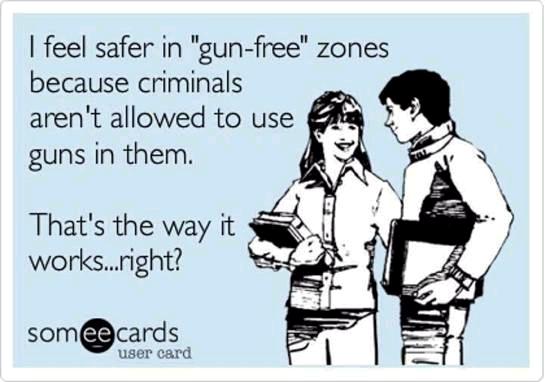
I’ve shared a very clever Chuck Asay cartoon about gun-free zones, so let’s now enjoy four posters on the topic.

Let’s begin with a good jab at one of the anti-Second Amendment groups.

But remember the serious point. If you’re a bad guy and know that a potential victim is sure to be unarmed, does that make you happy or sad?

I realize that an anti-gun zealot will respond by arguing that they want a world where the thugs and crooks also will be disarmed, but how likely is it that such people will turn in their weapons? In any event, most criminals are young men and potential victims need guns to compensate for the inability to match the physical strength of their attackers.

Next let’s look at a poster showing the kind of instructions that statists such as Mayor Bloomberg should post in public places.

These clowns expect us to have blind faith in the ability of public authorities, but the odds of a cop being immediately available when trouble strikes are almost nonexistent.

Here’s a poster that captures the blind naiveté of anti-gun activists. I don’t think I need to add any commentary.

Last but not least, here’s a sign that all anti-gun leftists – assuming they have the courage to publicly celebrate their beliefs – should post outside their homes.

If you enjoy these posters, you can view previous editions here, hereherehere, and here.

Related posts:

Gun Control cartoon hits the internet

Again we have another shooting and the gun control bloggers are out again calling for more laws. I have written about this subject below  and on May 23, 2012, I even got a letter back from President Obama on the subject. Now some very interesting statistics below and a cartoon follows. (Since this just hit the […]

Subjects mentioned in letters from President Obama’s White House

“Feedback Friday” Letter to White House generated form letter response June 22, 2012(part B) on Healthcare (part 11) This letter from President Obama was a response to a letter I wrote that was both emailed and mailed to President Obama and the emailed version included this video below: Below are the subjects that President Obama or his […]

Dan Mitchell takes on gun control nuts!!!

The Colorado tragedy has got a lot of people talking about gun control again. Here are some facts for you from Dan Mitchell’s blog. Assault Weapons: Facts vs. Fiction July 28, 2012 by Dan Mitchell It’s not much of an exaggeration to say that John Lott has changed the national debate on gun control. His rigorous […]

Could Dark Knight mass murder in Colorado been avoided by more gun control?

John Stossel report “Myth: Gun Control Reduces Crime Sadly another mass murder happened last night. This time it was at a midnight showing of “The Dark Knight Rises” in Colorado. Over 50 people were shot by a gunman and many died as the Arkansas Times reported. This will start the gun control debate again and […]

Open letter to President Obama (Part 101)

John Stossel report “Myth: Gun Control Reduces Crime President Obama c/o The White House 1600 Pennsylvania Avenue NW Washington, DC 20500 Dear Mr. President, I know that you receive 20,000 letters a day and that you actually read 10 of them every day. I really do respect you for trying to get a pulse on […]

Fast and Furious: The real story

Published on Apr 19, 2012 by NRAVideos Cam Edwards talks to Katie Pavlich from Townhall about her new book, Fast and Furious: Barack Obama’s Bloodiest Scandal and the Shameless Cover-Up – NRA News – April 18, 2012. _______________ Scribecast: Katie Pavlich on the Scandal of Operation Fast and Furious Rob Bluey April 28, 2012 at […]

“Feedback Friday” Letter to White House generated form letter response May 23, 2012 on gun control (part 7)

I have been writing President Obama letters and have not received a personal response yet.  (He reads 10 letters a day personally and responds to each of them.) However, I did receive a form letter in the form of an email on May 23, 2012. I don’t know which letter of mine generated this response so I have […]

Open letter to President Obama (Part 84.3)

President Obama c/o The White House 1600 Pennsylvania Avenue NW Washington, DC 20500 Dear Mr. President, I know that you receive 20,000 letters a day and that you actually read 10 of them every day. I really do respect you for trying to get a pulse on what is going on out here. Great post […]

Gun control in Europe

I really like this post by Dan Mitchell: Will You Be Able to Protect Your Family if Politicians Destabilize Society? December 5, 2011 by Dan Mitchell About a week ago, I wrote that people in western nations need the freedom to own guns just in case there are riots, chaos, and social disarray when welfare states […]

The experts on gun control speak out

Great post from Dan Mitchell: The Best Poster I’ve Ever Seen on Gun Control, Without Rival April 19, 2010 by Dan Mitchell This image really captures the essence of the issue. Share this with your statist friends and maybe they’ll begin to understand.  

Is Senator Ted Cruz from Texas going to be another Rand Paul?

Ronald Reagan pictured above.
 

Ted Cruz has the right idea about cutting the size of government. He has some good ideas and he reminds me a lot of Rand Paul. He also has a great role model in Ronald Reagan who he quotes in the video clip below.

Less than one week ago, I identified three potential vehicles for some long-overdue fiscal reforms to restrain the burden of government spending.

In that post, I suggested that the “continuing resolution” was the best vehicle since lawmakers obviously would have to consider legislation to provide funding for the rest of the 2013 fiscal year.

The debt limit, by contrast, creates too many opportunities for demagoguery. Geithner and Bernanke have already demonstrated, for instance, that they’re willing to prevaricate and scare financial markets.

It’s much smarter to pick a fight on the “CR” since there not even a make-believe risk of default. Instead, the only thing that happens is that the “non-essential” parts of the federal government are shut down.

So I’m delighted to see that Ted Cruz, the new Senator from Texas, understands that the shutdown fight in 1995 led to very good results. I wrote a piece for National Review making the same point, so I’m delighted to hear someone else singing from the same sheet of music. Pay close attention at the 3:15 mark of this video.

Texas Sen. Ted Cruz on the Deficit, Gun Rights, Immigration

My only quibble is that he mentions the debt limit as the vehicle for the fight, when he should have mentioned the CR.

But I’m nit-picking. Cruz seems to get it. He puts the focus on the disease of too much government rather than fixating on the symptom of too much red ink.

He also understands that high tax rates discourage productive behavior, so he’s obviously not a fan of the President’s class-warfare approach.

Last but not least, you’ll also see he gave a very strong response on protecting the 2nd Amendment immediately following his discussion of fiscal policy.

Seems like there’s a chance he could be a second Rand Paul.

Open letter to President Obama (Part 221)


President Obama c/o The White House
1600 Pennsylvania Avenue NW
Washington, DC 20500

Dear Mr. President,

I know that you receive 20,000 letters a day and that you actually read 10 of them every day. I really do respect you for trying to get a pulse on what is going on out here.

The federal government screws up so many things it is truly amazing. I have been ranting and raving about the U.S. Postal Service on here over and over and over. Now it is time to move on to some other areas where the federal government is involved when they  have no business being. (Read below how the Soviets were very impressed when Reagan put the Air Traffic Controllers union in their place. They looked at each other and said that their days were numbered if Reagan was that direct with them.)

Air Traffic Control Screwups

Posted by Chris Edwards

The Washington Post today describes the latest near-miss disaster at National Airport, apparently the result of screw-ups by our government-run air traffic control (ATC) system. The Post notes that this near-accident is one of many troubling incidents in recent years:

…the near-collision was another among several thousand recorded errors by air traffic controllers nationwide in recent years. National has been the site of some of the most notable incidents, including one revealed last year in which the lone controller supervisor on duty was asleep and didn’t respond when regional controllers sought to hand off planes to National for the final approach.

News of the sleeping controller at National last year led to the revelation that controllers on overnight shifts at several other airports were napping on the job.

Is our ATC system is so troubled because it is

  • a government bureaucracy,
  • a monopoly that doesn’t face competitive pressures to improve quality, or
  • a union-dominated organization?

I don’t know the answer; maybe it’s all three. But news stories like the one today usually don’t mention the role of the unions, and newspaper readers may just conclude that the fault is simply one of a bumbling Federal Aviation Administration (FAA) bureaucracy.

However, I coincidentally received a letter in the mail today from an anonymous FAA official who points to some of the problems caused by the militant National Air Traffic Controllers Association (NATCA). He or she says that the “NATCA union holds the FAA management hostage and little is done to correct the problems … The NATCA union is too powerful and management is too intimidated to do their jobs.”

The letter writer may or may not have all his or her facts straight–the letter is here [PDF] so you can judge for yourself. However, I do think that the media could do a better job probing the role of unionization in the FAA’s substandard performance. People remember Ronald Reagan’s battle with the air traffic controllers, but that was just a blip in a much longer story. Unions have been creating problems for the ATC system since the 1960s, as I mention in this essay.

This is the last portion from an excellent article by Peggy Noonan ”Ronald Reagan at 100,” (Wall Street Journal, Feb 3, 2011).

His most underestimated political achievement? In the spring of 1981 the Professional Air Traffic Controllers Organization called an illegal strike. It was early in Reagan’s presidency. He’d been a union president. He didn’t want to come across as an anti-union Republican. And Patco had been one of the few unions to support him in 1980. But the strike was illegal. He would not accept it. He gave them a grace period, two days, to come back. If they didn’t, they’d be fired. They didn’t believe him. Most didn’t come back. So he fired them. It broke the union. Federal workers got the system back up. The Soviet Union, and others, were watching. They thought: This guy means business. It had deeply positive implications for U.S. foreign policy. But here’s the thing: Reagan didn’t know that would happen, didn’t know the bounty he’d reap. He was just trying to do what was right.

____________

Thank you so much for your time. I know how valuable it is. I also appreciate the fine family that you have and your commitment as a father and a husband.

Sincerely,

Everette Hatcher III, 13900 Cottontail Lane, Alexander, AR 72002, ph 501-920-5733, lowcostsqueegees@yahoo.com


President  and Nancy Reagan with Ray Charles after acceptance speech at the Republican National Convention, Dallas, Texas.  8/23/84.

Related posts:
 

Priv

Milton Friedman discusses Reagan and Reagan discusses Friedman “Friedman Friday”

Uploaded by YAFTV on Aug 19, 2009 Nobel Laureate Dr. Milton Friedman discusses the principles of Ronald Reagan during this talk for students at Young America’s Foundation’s 25th annual National Conservative Student Conference MILTON FRIEDMAN ON RONALD REAGAN In Friday’s WSJ, Milton Friedman reflectedon Ronald Reagan’s legacy. (The link should work for a few more […]

Reagan’s accomplishments

Ronald Reagan was my favorite president. Read this excellent article on his accomplishments from the Heritage Foundation: What Were Ronald Reagan’s Achievements? Julia Shaw February 3, 2012 at 1:00 pm February 6 is Ronald Reagan’s birthday. While the right has long looked to Reagan as the standard-bearer of conservative leadership, over the past few years, even […]

Does the movie “Iron Lady” do Margaret Thatcher justice?

Unfortunately Hollywood has their own agenda many times. Great article from the Heritage Foundation. Morning Bell: The Real ‘Iron Lady’ Theodore Bromund January 11, 2012 at 9:24 am Streep referred to the challenge of portraying Lady Thatcher as “daunting and exciting,” and as requiring “as much zeal, fervour and attention to detail as the real […]

Reagan and Clinton had good fiscal policies according to Cato Institute

Uploaded by HeritageFoundation on Dec 16, 2010 http://blog.heritage.org/2010/12/16/new-video-pork-filled-spending-bill-just-… Despite promises from President Obama last year and again last month that he opposed reckless omnibus spending bills and earmarks, the White House and members of Congress are now supporting a reckless $1.1 trillion spending bill reportedly stuffed with roughly 6,500 earmarks. ________________________ Below you see an […]

Obama wants to claim Reagan again

  I have a son named Wilson Daniel Hatcher and he is named after two of the most respected men I have ever read about : Daniel from the Old Testament and Ronald Wilson Reagan. One of the thrills of my life was getting to hear President Reagan speak in the beginning of November of […]

Ronald Reagan’s videos and pictures displayed here on the www.thedailyhatch.org

President Reagan, Nancy Reagan, Bill Clinton and Hillary Clinton attending the Dinner Honoring the Nation’s Governors. 2/22/87. Ronald Reagan is my favorite president and I have devoted several hundred looking at his ideas. Take a look at these links below: President Reagan and Nancy Reagan attending “All Star Tribute to Dutch Reagan” at NBC Studios(from […]

My favorite president!!!!!

My favorite president is Ronald Wilson Reagan. President Reagan with Nancy Reagan, William Wilson, Betty Wilson, Walter Annenberg, Leonore Annenberg, Earle Jorgensen, Marion Jorgensen, Harriet Deutsch and Armand Deutschat at a private birthday party in honor of President Reagan’s 75th Birthday in the White House Residence. 2/7/86. Milton Friedman’s book “Free to Choose” did influence […]

Ronald Wilson Reagan versus Barrack Obama

Government Spending Doesn’t Create Jobs Uploaded by catoinstitutevideo on Sep 7, 2011 Share this on Facebook: http://on.fb.me/qnjkn9 Tweet it: http://tiny.cc/o9v9t In the debate of job creation and how best to pursue it as a policy goal, one point is forgotten: Government doesn’t create jobs. Government only diverts resources from one use to another, which doesn’t […]


Federal government should not be involved with post office

I really wish that President Obama would have not had the federal government buy up General Motors. We need to keep the federal government out of the private market as much as possible. This goes for the post office too. It should be in private hands. Senators voted recently to hold off closing some post […]

An open letter to President Obama (Part 56)

President Obama c/o The White House 1600 Pennsylvania Avenue NW Washington, DC 20500 Dear Mr. President, I know that you receive 20,000 letters a day and that you actually read 10 of them every day. I really do respect you for trying to get a pulse on what is going on out here. When you […]

Private entrepreneurs can solve our post office problem

When you look at how good the private enterprise does with deliveries and then compare it to how bad the federal government does with the same duties it is laughable. The answer to the federal post office problem is to encourage private entrepreneurs to fill the gap and provide competition for the post office in […]

Senator Pryor asks for Spending Cut Suggestions! Here are a few!(Part 131)

Senator Mark Pryor wants our ideas on how to cut federal spending. Take a look at this video clip below: Senator Pryor has asked us to send our ideas to him at cutspending@pryor.senate.gov and I have done so in the past and will continue to do so in the future. On May 11, 2011,  I emailed to […]

Privatize the post office

The Arkansas Times rightly jumped on Republicans for whining about the local post office branches that were closing.  (It is sad to me that Republican Presidential Candidates are not very brave about offering any spending cuts.) The real answer is privatizing the post office. Here is a good article from the Cato Institute:   The USPS […]

We need to close U.S.Post Office

We need to close U.S.Post Office There is only one option in my view. We can not keep on losing money every year like the U.S.Postal Service (7 billion this year). Closing Post Offices   PrintThe U.S. Postal Service just posted a $3.1 billion loss for the third quarter and the outlook for the rest […]


Open letter to President Obama (Part 220)

President Obama c/o White House
1600 Pennsylvania Avenue NW
Washington, DC 20500

Dear Mr. President,

I know that you receive 20,000 letters a day and that you actually read 10 of them every day. I really do respect you for trying to get a pulse on what is going on out here.

I thought it was great when the Republican Congress and Bill Clinton put in welfare reform but now that has been done away with and no one has to work anymore it seems. In fact, over 40% of the USA is now on the government dole. What is going to happen when that figure gets over 50%? Maybe this cartoon below will be true.  

The all-time, most-viewed post on this blog is this set of cartoons showing how the welfare state begins and how it eventually becomes an unsustainable mess.

The great Chuck Asay has a cartoon that takes the next step, showing what happens when the looters and moochers who ride in the wagon get pitted against those who are pulling the wagon.

Since I’m not a Romney fan (for a bunch of reasons outlined here), I would have preferred if the cartoon didn’t imply anything about the current election and instead focused on the rhetorical question of what happens to a society when those living off the government outnumber those who get stuck picking up the tab.

It also would have been more accurate to have the two slave drivers somehow identified as “politicians” and the “IRS.”

But it’s a very clever cartoon, so it’s worth sharing even if I’m nitpicking.

You can see my favorite Asay cartoons here, here, herehere, here, here, here, here, here, here, herehereherehere, and here.

____________________

Thank you so much for your time. I know how valuable it is. I also appreciate the fine family that you have and your commitment as a father and a husband.

Sincerely,

Everette Hatcher III, 13900 Cottontail Lane, Alexander, AR 72002, ph 501-920-5733, lowcostsqueegees@yahoo.com

Milton Friedman

Related posts:

Open letter to President Obama (Part 120)

President Obama c/o The White House 1600 Pennsylvania Avenue NW Washington, DC 20500 Dear Mr. President, I know that you receive 20,000 letters a day and that you actually read 10 of them every day. I really do respect you for trying to get a pulse on what is going on out here.  Dan Mitchell […]

“Feedback Friday” Letter to White House generated form letter response July 10,2012 on welfare, etc (part 14)

I have been writing President Obama letters and have not received a personal response yet.  (He reads 10 letters a day personally and responds to each of them.) However, I did receive a form letter in the form of an email on July 10, 2012. I don’t know which letter of mine generated this response so I have […]

Welfare reform part 1

Welfare reform was working so good. Why did we have to abandon it? Look at this article from 2003. The Continuing Good News About Welfare Reform By Robert Rector and Patrick Fagan, Ph.D. February 6, 2003 Six years ago, President Bill Clinton signed legislation overhauling part of the nation’s welfare system. The Personal Responsibility and […]

Open letter to President Obama (Part 119B)

Ep. 4 – From Cradle to Grave [3/7]. Milton Friedman’s Free to Choose (1980) President Obama c/o The White House 1600 Pennsylvania Avenue NW Washington, DC 20500 Dear Mr. President, I know that you receive 20,000 letters a day and that you actually read 10 of them every day. I really do respect you for […]

Open letter to President Obama (Part 118B)

President Obama c/o The White House 1600 Pennsylvania Avenue NW Washington, DC 20500 Dear Mr. President, I know that you receive 20,000 letters a day and that you actually read 10 of them every day. I really do respect you for trying to get a pulse on what is going on out here. With the […]

40% of USA on government dole, need to eliminate welfare and put in Friedman’s negative income tax

Eight Reasons Why Big Government Hurts Economic Growth We got to cut these welfare programs before everyone stops working and wants to get the free stuff. The Bible says if you don’t work then you should not eat. It also says that churches should help the poor but it doesn’t say that the government should […]