Category Archives: Cato Institute

Open letter to President Obama (Part 239)

Is Washington Bankrupting America?

Uploaded by on Apr 20, 2010

Be first to receive our videos and other timely info about economic policy. Subscribe at http://www.bankruptingamerica.org
————————-
According to a recent poll, 74 percent of likely voters are extremely or very concerned about the current level of government spending. And 58 percent think the level of spending is unsustainable.

Is the public right? Is Washington bankrupting America? Some facts from the video:

Spending per household has risen over 40 percent in the last 10 years and is set to do so again in the next 10 pushing debt (and interest on the debt) to unprecedented levels. But that’s just a result of PAST spending…

Our government owes $106 trillion in FUTURE spending commitments – that cannot be paid for.

We can solve it, but politicians will have to make tough choices. Increasing taxes can’t do the trick ($106 trillion is equivalent to taking all of the taxable income from every American nine times over), nor is it fair to saddle taxpayers with a problem created by government irresponsibility.

We need real spending reform. Merely returning to the spending per household levels of the 1990s would balance the budget in three years.

___________


President Obama c/o The White House
1600 Pennsylvania Avenue NW
Washington, DC 20500

Dear Mr. President,

I know that you receive 20,000 letters a day and that you actually read 10 of them every day. I really do respect you for trying to get a pulse on what is going on out here.

When are we going to see REAL SPENDING CUTS? I am tired of this being talked about but not done.

I’m in Slovenia where I just finished indoctrinating educating a bunch of students on the importance of Mitchell’s Golden Rule as a means of restraining the burden of government spending.

And I emphasized that the fiscal problem in Europe is the size of government, not the fact that nations are having a hard time borrowing money. As explained in this video, spending is the disease and deficits are one of the symptoms.

This is also an issue in the United States, and Steve Moore of the Wall Street Journal is worried that the GOP ticket is debt-obsessed and doesn’t have sufficient enthusiasm for lower tax rates and tax reform.

Stylistically, Paul Ryan’s Republican convention speech last night was a grand slam. …But was it the growth message that supply-siders wanted to hear, or debt-clock obsession? There were clearly apocalyptic claims. “Before the math and the momentum overwhelm us all, we are going to solve this nation’s economic problems,” said Mr. Ryan in reference to the federal rea ink. “I’m going to level with you; we don’t have that much time.” …In fact, he talked about turning around the economy with “tax fairness.” Ugh, that’s an Obama term. …Larry Kudlow of CNBC and a former Reagan economist tells me, “Paul’s speech just didn’t have the growth, tax-cutting message. We didn’t even get the words tax reform. I don’t know what happened, but it worries me.” It’s a question of priorities. Are Mitt Romney and Paul Ryan signaling that they will put spending cuts ahead of pro-growth tax-rate cuts?

I share Steve’s concern, but with a twist.

I’m not worried that the Republicans will put spending cuts ahead of tax cuts. I’m worried that they won’t do spending cuts at all (even using the dishonest DC definition) and therefore wind up getting seduced into some sort of tax-increase deal that facilitates bigger government.

As a general rule, it is always good to do spending cuts (however defined). And it is always good to lower tax rates. And if you can do both at the same time, even better.

But since I have low expectations, I’ll be delighted if we “merely” manage to get entitlement reform during a Romney-Ryan Administration. That would mean some progress on the spending side and presumably reduce the risk of bad things (like a VAT!) on the revenue side.

_________

Thank you so much for your time. I know how valuable it is. I also appreciate the fine family that you have and your commitment as a father and a husband.

Sincerely,

Everette Hatcher III, 13900 Cottontail Lane, Alexander, AR 72002, ph 501-920-5733, lowcostsqueegees@yahoo.com

Open letter to President Obama (Part 236)


President Obama c/o The White House
1600 Pennsylvania Avenue NW
Washington, DC 20500

Dear Mr. President,

I know that you receive 20,000 letters a day and that you actually read 10 of them every day. I really do respect you for trying to get a pulse on what is going on out here.

Below is an excellent plan to balance the budget through spending cuts from Chris Edwards of the Cato Institute written in April of 2011. Here is the fourth and final part. I hope you will take advantage at least of some of these suggestions below.

A Plan to Cut Spending and Balance the Federal Budget

by Chris Edwards, Cato Institute

Medicare, Medicaid, and Social Security

The projected growth in Medicare, Medicaid, and Social Security is the main cause of America’s looming fiscal crisis. Budget experts and policymakers across the political spectrum understand the need to restructure these programs. The reforms listed in Table 1 include repealing the 2010 health care law and some initial efforts to control health care and Social Security costs.

For Social Security, the growth in initial benefits would be indexed to prices rather than wages, which would slow benefit growth over time. The proposal would save $41 billion annually by 2021 and growing amounts after that, according to the CBO.14 The plan also includes a CBO option to modestly raise the program’s normal retirement age.15

Medicaid should be converted from an open-ended matching grant program to a block grant, which would provide a fixed amount of funds to each state but allow state policymakers more program flexibility. That was the successful approach used for welfare reform in 1996. Converting Medicaid to a block grant would reduce federal costs, while encouraging innovation and cost reductions by the states. Setting the Medicaid block grant at the 2011 level of Medicaid spending would result in saving more than $200 billion annually within a decade.

The plan includes some modest Medicare changes based on CBO estimates, including increasing deductibles for services and increasing premiums for Part B to cover 35 percent of the program’s costs.16 The plan would repeal the 2010 health care law, including the higher revenues and spending. It further assumes that the Medicare improper payment rate, which is at least 10 percent, would be cut in half.

However, much larger reforms to the program are needed. Cato scholars have proposed moving to a system based on individual vouchers, personal savings, and consumer choice for elderly health care.17 The House Budget Committee has similarly proposed a plan to convert Medicare into a consumer-driven health system.18 Such reforms would create strong incentives for providers and patients to improve system quality and efficiency.

Privatization

In recent decades, governments around the world have sold off state-owned assets to private investors.19 Airports, railroads, electric utilities, post offices, and other assets have been privatized. Privatization generally leads to reduced costs, higher-quality services, and increased innovation in formerly moribund government industries.

There are many federal assets that should be privatized. Table 1 includes the privatization of Amtrak, the air traffic control system, and the Army Corps of Engineers. Such reforms would reduce federal budget deficits and help spur economic growth.

Consider the nation’s air traffic control system, which is run by the Federal Aviation Administration.20 The FAA has struggled to expand capacity and upgrade its technology, and its modernization efforts have often fallen behind schedule and gone over budget. A series of incidents in 2011 indicated that the agency has serious workforce management problems. The air traffic control system needs major improvements to meet rising travel demands, but the FAA may not be capable of meeting the challenge.

The good news is that a number of countries have restructured their air traffic control systems and provide good models for U.S. reforms. Canada privatized its air traffic control system in 1996, setting up a private, nonprofit corporation, Nav Canada. The company is self-supporting from charges on aviation users. The Canadian system has received high marks for sound finances, solid management, and investment in new technologies.21 Aside from those advantages, a privatized system in the United States would save about $6 billion a year in general fund taxpayer costs.

Conclusions

Official projections show that without reforms federal spending will soar to more than 40 percent of GDP by 2050, and even higher after that. State and local spending comes on top of that, with the result that governments would consume more than half of the entire U.S. economy.

However, it seems inconceivable that voters and taxpayers would let the government grow to anywhere near that large. Indeed, the results of the 2010 elections indicate that there is already widespread disapproval of big government. It is also unlikely that the government would be able to raise taxes much above current levels to support higher spending because of our increasingly globalized economy.22

The upshot is that we will have to make major spending cuts sooner or later, and it would be better to make them sooner before we accumulate even more debt. Policymakers can start with the menu of cuts presented here, and then they should pursue other reforms such as restructuring Medicare. Leaders of other industrial nations have pursued vigorous cost-cutting when their government debt got out of control, and there is no reason why our political leaders shouldn’t do the same.


2 Congressional Budget Office, “Preliminary Analysis of the President’s Budget for 2012,” March 2011.

3 For these estimates, see Congressional Budget Office, “The Budget and Economic Outlook: Fiscal Years 2011 to 2021,” January 2011, p. 22.

4 For estimates of these adjustments, see Congressional Budget Office, “The Budget and Economic Outlook: Fiscal Years 2011 to 2021,” January 2011, p. 22.

5 This is the president’s budget as estimated by the CBO. See Congressional Budget Office, “Preliminary Analysis of the President’s Budget for 2012,” March 2011.

6 I assume that discretionary spending cuts are phased-in over 10 years, one-tenth each year. The proposed changes to Medicaid, Medicare, and Social Security would begin right away, but the savings would increase over time.

7 I modeled interest costs using CBO baseline projections regarding interest rates. I adjusted for the fact that public debt is projected to grow faster than indicated by the compounding of annual deficits in coming years.

8 In particular, see Budget of the U.S. Government, Fiscal Year 2012, Analytical Perspectives (Washington: Government Printing Office, February 2011), Table 33-1.

10 Budget of the U.S. Government, Fiscal Year 2012, Analytical Perspectives (Washington: Government Printing Office, February 2011). See also Chris Edwards, “Federal Aid-to-State Programs Top 1,100,” Cato Institute Tax and Budget Bulletin no. 63, February 2011. Note that these state aid programs are a subset of the 2,000 total subsidy programs mentioned earlier.

13 Aside from the costs of the Iraq and Afghanistan wars, Department of Defense spending will be about $560 billion in fiscal 2011, up from $290 billion in fiscal 2001.

14 Congressional Budget Office, “Reducing the Deficit: Spending and Revenue Options,” March 2011.

15 Congressional Budget Office, “Reducing the Deficit: Spending and Revenue Options,” March 2011.

16 The savings for these options are from Congressional Budget Office, “Reducing the Deficit: Spending and Revenue Options,” March 2011.

18 House Committee on the Budget, “The Path to Prosperity,” April 2011. See also Rep. Paul Ryan (R-WI), “A Roadmap for America’s Future, Version 2.0,” January 2010.

21 For example, see Glen McDougall and Alasdair S. Roberts, “Commercializing Air Traffic Control: Have the Reforms Worked?” Suffolk University Law School, February 17, 2009.

22 This theme is explored in Chris Edwards and Daniel Mitchell, Global Tax Revolution (Washington: Cato Institute, 2008).

___________

Thank you so much for your time. I know how valuable it is. I also appreciate the fine family that you have and your commitment as a father and a husband.

Sincerely,

Everette Hatcher III, 13900 Cottontail Lane, Alexander, AR 72002, ph 501-920-5733, lowcostsqueegees@yahoo.com

State and local governments should dramatically scale back bond issuance.

 State and local governments should dramatically scale back bond issuance.

Cut State Debt; End the Muni-Bond Exemption

Posted by Chris Edwards

Big government programs and special tax-code carve-outs often lead to corrupting ties between government officials and private interests. The Washington Post today discusses the municipal bond industry:

In just about every election, local governments put measures on their ballots asking voters to allow the sale of bonds so that municipalities can finance roads, schools or other projects. Interested parties often form campaigns to help pass or crush these initiatives.

And sometimes the investment banks that donate to those campaigns get hired to sell the bonds to investors after an initiative passes, raising the possibility that they got a leg up in the selection process because of their monetary support for the ballot bond measure — not because they offered taxpayers the best deal.

…[A] review by the Bond Buyer publication … found “a nearly perfect correlation between broker-dealer contributions to California school bond efforts in 2010 and their underwriting subsequent bond sales.”

…Jay Goldstone, [the] Municipal Securities Ruling Board’s chairman, said he’s concerned about the pattern. “There seems to be a strong relationship between contributions and underwriting business.”

The article discusses solving these problems with greater disclosure and transparency. But the real solution is to eliminate the underlying government preference that creates the influence peddling in the first place.

In this case, the federal income tax exemption for state and local bond interest should be repealed. That could be matched with a reduction in general tax rates on capital income.

As I argue here, state and local governments should dramatically scale back bond issuance. Bonds are just sneaky tax increases. State and local capital investments should be financed “pay-as-you-go,” which would cut out the costly middlemen in the finance industry.

The chart below shows that state and local bond debt has soared to more than $3 trillion. That not only represents a huge deferred tax increase, but it has also created a large playing field for special-interest cronyism. (For chart info, see here).

Open letter to President Obama (Part 235)


President Obama c/o The White House
1600 Pennsylvania Avenue NW
Washington, DC 20500

Dear Mr. President,

I know that you receive 20,000 letters a day and that you actually read 10 of them every day. I really do respect you for trying to get a pulse on what is going on out here.

Below is an excellent plan to balance the budget through spending cuts from Chris Edwards of the Cato Institute written in April of 2011. Why not take advantage of this paper to help balance the budget? Here is the third part.

A Plan to Cut Spending and Balance the Federal Budget

by Chris Edwards, Cato Institute

Introduction
Reducing Spending over 10 Years
Spending Cut Details
Subsidies to Individuals and Businesses
Aid to State and Local Governments
Military Expenses
Medicare, Medicaid, and Social Security
Privatization
Conclusions

Subsidies to Individuals and Businesses

The federal government operates more than 2,000 separate subsidy programs, a doubling of subsidy programs since the mid-1980s.9 The scope of federal activities has greatly expanded in recent decades, along with the size of the federal budget. The federal government subsidizes farm businesses, retirees, school lunches, rural utilities, the energy industry, rental housing, public broadcasting, job training, foreign aid activities, foreign purchases of weapons, urban transit services, and many other types of activities and people.

Each subsidy program costs money, generates a bureaucracy, spawns lobby groups, and encourages more people to demand freebies from the government. Individuals, businesses, and nonprofit groups that become hooked on federal subsidies essentially become tools of the state. They lose their independence, they have less incentive to innovate, and they shy away from criticizing the government.

Table 1 includes cuts to subsidies in agriculture, commerce, energy, housing, foreign aid, and other areas. These cuts wouldn’t eliminate all of the unjustified subsidies in the federal budget, but they would be a good start. Government subsidies are like addictive drugs, undermining America’s traditions of individual reliance, voluntary charity, and entrepreneurialism.

Aid to State and Local Governments

Under the Constitution, the federal government was assigned specific limited powers, and most government functions were left to the states. To ensure that people understood the limits on federal power, the Framers added the Constitution’s Tenth Amendment: “The powers not delegated to the United States by the Constitution, nor prohibited by it to the States, are reserved to the States respectively, or to the people.” The amendment embodies federalism, the idea that federal and state governments have separate areas of activity and that federal responsibilities are supposed to be “few and defined,” as James Madison noted.

Unfortunately, policymakers and the courts have mainly discarded federalism in recent decades. Congress has undertaken many activities that were traditionally reserved to state and local governments through the mechanism of “grants-in-aid.” Grant programs are subsidies that are combined with federal regulatory controls to micromanage state and local activities. In fiscal 2011, federal aid to the states will total $625 billion, which will be distributed through more than 1,100 separate programs.10

The theory behind grants-in-aid is that the federal government can operate programs in the national interest to efficiently solve local problems. However, the federal aid system does not work that way in practice. Most federal politicians are consumed by the competitive scramble to maximize subsidies for their states, regardless of efficiency, fairness, or any appreciation of overall budget limitations.

Furthermore, federal aid stimulates overspending by state governments and creates a web of complex federal regulations that destroy state innovation. At all levels of the aid system, the focus is on regulatory compliance and spending, not on delivering quality public services. The aid system destroys government accountability because each level of government can blame the other levels when programs fail. It is a “triumph of expenditure without responsibility.”

The federal aid system is a roundabout funding system for state and local activities. It serves no important economic purpose. By federalizing state and local activities, we are asking Congress to do the impossible—to efficiently plan for the competing needs of a diverse country of more than 300 million people.

The grants-in-aid system should be dramatically cut. Policymakers need to revive federalism and begin to terminate grant programs. Table 1 includes cuts to grants in the areas of agriculture, education, health care, justice, and transportation. The justice grants, for example, are for funding such items as bulletproof vests for local police.11 There is no reason why such activities should not be funded at the city or county level.

Military Expenses

Cato Institute defense experts Christopher Preble and Benjamin Friedman have proposed a lengthy list of cuts to U.S. military spending totaling $1.2 trillion over 10 years.12 Within 10 years, their proposal would reduce spending by about $150 billion annually, based on a strategy of restraint and reduced intervention abroad.

In proposing their plan, Preble and Friedman argue that the United States would be better off taking a wait-and-see approach to distant threats, while letting friendly nations bear more of the costs of their own defense. They note that U.S. policymakers support many extraneous missions for the military aside from the basic requirement to defend the nation. There is no doubt that America’s military budget is bloated. Even aside from the wars in Iraq and Afghanistan, Department of Defense spending roughly doubled between 2001 and 2011.13

___________

Thank you so much for your time. I know how valuable it is. I also appreciate the fine family that you have and your commitment as a father and a husband.

Sincerely,

Everette Hatcher III, 13900 Cottontail Lane, Alexander, AR 72002, ph 501-920-5733, lowcostsqueegees@yahoo.com

Open letter to President Obama (Part 234)


President Obama c/o The White House
1600 Pennsylvania Avenue NW
Washington, DC 20500

Dear Mr. President,

I know that you receive 20,000 letters a day and that you actually read 10 of them every day. I really do respect you for trying to get a pulse on what is going on out here.

Below is an excellent plan to balance the budget through spending cuts from Chris Edwards of the Cato Institute written in April of 2011. I thought you might find these suggestions helpful. Here is the second part.

A Plan to Cut Spending and Balance the Federal Budget

by Chris Edwards, Cato Institute

Spending Cut Details

Table 1 lists the proposed annual cuts for the balanced budget plan. By 2021, these include $150 billion in defense cuts and $490 billion in cuts to Medicare, Medicaid, Social Security, and the 2010 health care law. The table also includes other discretionary and entitlement cuts valued at $445 billion in 2011. With the assumed revenues, all these spending cuts would be saving the government $260 billion in annual interest costs by 2021.7 All in all, total spending in 2021 under this plan would be about $1.4 trillion lower than under either the CBO baseline or the president’s budget.

As a technical note, most of the figures in Table 1 are outlays for fiscal 2011 from President Obama’s fiscal 2012 budget.8 These cuts are expressed in 2011 dollars, but I’ve assumed that the value of these cuts would grow over time at the same rate as discretionary spending in the CBO baseline. The cuts in Table 1 marked with an asterisk are expressed in 2021 dollars and are generally based on CBO estimates.

The reforms listed in the table are deeper than the “duplication” and “waste” items often mentioned by federal policymakers, such as earmarks. The reality is that the nation faces a fiscal emergency, and we need to cut hundreds of billions of dollars of “meat” from federal departments, not just the obvious “fat.” If the activities to be cut are useful to society, then state governments or private groups should fund them, and those entities would probably be more efficient at doing so.

The cuts in Table 1 are illustrative of how to begin getting the federal budget under control. Further reforms are needed in addition to these cuts, particularly structural changes to Medicare. But the important thing is to start cutting right away because the longer we wait, the deeper the pile of debt we will have to dig out from.

Table 1 includes cuts to individual and business subsidies, cuts to state aid, cuts to military expenses, cuts to the growth in entitlement programs, and privatization of federal activities. The sections following the table discuss these various types of cuts, and further analysis of the cuts is available at www.DownsizingGovernment.org.

Table 1
Proposed Federal Budget Cuts
Agency and Activity   Annual Savings
     
$ billion
Department of Agriculture    
  End farm subsidies   29.5
  Cut food subsidies by 50 percent   52.7
  End rural subsidies   4.2
  Total cuts   86.4
Department of Commerce    
  End telecom subsidies   2.3
  End economic development subsidies   0.6
  Total cuts   2.9
Department of Defense    
  Enact Preble/Friedman reforms**   150.0
Department of Education    
  End K-12 education subsidies   52.7
  End student aid and all other programs   33.1
  Total cuts (terminate the department)   85.8
Department of Energy    
  End subsidies for energy efficiency   10.2
  End subsidies for vehicle technologies   5.2
  End the technology loan program   1.2
  End electricity research subsidies   2.0
  End fossil energy research   1.1
  Privatize the power marketing administrations   0.5
  End nuclear energy subsidies   0.6
  Total cuts   20.8
Department of Health and Human Services    
  Block grant Medicaid and freeze spending**   226.0
  Repeal 2010 health care law**   87.0
  Increase Medicare premiums**   39.8
  Cut non-Medicaid state/local grants by 50%   37.7
  Cut Medicare payment error rate by 50%   28.6
  Increase Medicare deductibles**   12.6
  Tort reform   10.0
  Total cuts   441.7
Department of Housing and Urban Development    
  End rental assistance   28.6
  End community development subsidies   15.0
  End public housing subsidies   8.9
  End housing finance and all other programs   8.3
  Total cuts (terminate the department)   60.8
Department of Justice    
  End state and local grants   5.0
Department of Labor    
  End employment and training services   4.8
  End Job Corps   1.7
  End Community Service for Seniors   0.8
  End trade adjustment assistance   1.3
  Total cuts   8.6
Social Security    
  Price index initial benefits**   41.1
  Raise the normal retirement age**   31.4
  Cut Social Security disability program by 10%   13.2
  Total cuts   85.7
Department of Transportation    
  End urban transit grants (federal fund savings)   5.8
  Privatize air traffic control (federal fund savings)   5.8
  Privatize Amtrak and end rail subsidies   2.9
  Total cuts   14.5
Department of the Treasury    
  Cut earned income tax credit by 50%   22.5
  End refundable part of child tax credit   22.9
  Total cuts   45.4
Other Savings    
  Cut federal civilian compensation costs 10%   29.6
  Cut foreign development aid by 50%   5.2
  Cut NASA spending by 50%   9.8
  Privatize the Corps of Engineers (Civil Works)   10.6
  Repeal Davis-Bacon labor rules   9.0
  End EPA state and local grants   6.5
  End foreign military financing   5.4
  End subsidies for the Corp. for Nat. Comm. Srv.   0.6
  End subsidies to the Corp. for Public Broadcasting   0.5
  End the Neighborhood Reinvestment Corp.   0.2
  Total cuts   77.4
Grand total annual spending cuts   $1,084.9
Note: Data items are outlays for fiscal 2011, but items with ** refer to the value of savings in 2021.

Thank you so much for your time. I know how valuable it is. I also appreciate the fine family that you have and your commitment as a father and a husband.

Sincerely,

Everette Hatcher III, 13900 Cottontail Lane, Alexander, AR 72002, ph 501-920-5733, lowcostsqueegees@yahoo.com

Open letter to President Obama (Part 233)


President Obama c/o The White House
1600 Pennsylvania Avenue NW
Washington, DC 20500

Dear Mr. President,

I know that you receive 20,000 letters a day and that you actually read 10 of them every day. I really do respect you for trying to get a pulse on what is going on out here.

Below is an excellent plan to balance the budget through spending cuts from Chris Edwards of the Cato Institute written in April of 2011. As President you should take the bull by the horns and offer some spending cuts suggestions so we can balance the budget. Here is the first part.

A Plan to Cut Spending and Balance the Federal Budget

by Chris Edwards, Cato Institute

Introduction
Reducing Spending over 10 Years
Spending Cut Details
Subsidies to Individuals and Businesses
Aid to State and Local Governments
Military Expenses
Medicare, Medicaid, and Social Security
Privatization
Conclusions

Introduction

Federal spending is soaring, and government debt is piling up at more than a trillion dollars a year. Official projections show rivers of red ink for years to come unless policymakers enact major budget reforms. Unless spending is cut, the United States is headed for economic ruin.

The results of the 2010 elections made clear that Americans want an end to the spending spree in Washington. People fear that today’s spendthrift policies may lead to large tax increases and a lower standard of living for themselves and their children. The public has given Congress marching orders to start cutting spending and rein in debt.

Policymakers should implement an emergency plan of cuts to defense, domestic, and entitlement programs. This essay proposes spending cuts of more than $1 trillion annually by 2021, which would balance the budget without resorting to damaging tax increases. Federal spending would be reduced to 18.0 percent of gross domestic product by 2021 under the plan, which compares to President Obama’s projected spending that year of 24.2 percent of GDP.

Each of the spending cuts proposed here would make sense whether or not the government was running deficits. That’s because many federal programs reduce individual freedom and cause economic distortions. If these programs were cut, resources would flow from lower-return government activities to higher-return activities in the private sector.

In recent decades, the federal government has expanded into hundreds of areas that should be left to state and local governments, businesses, charities, and individuals. That expansion is sucking the life out of the private economy and creating a top-down bureaucratic society that is alien to American traditions. Cutting federal spending would enhance civil liberties by dispersing power from Washington.

The need to cut spending and debt is urgent. Numerous committees, think tanks, and members of Congress have proposed plans to tackle ongoing deficits, including the House Budget Committee, the House Republican Study Committee, Senator Rand Paul (R-KY), and President Obama’s National Commission on Fiscal Responsibility and Reform. The various plans are not in agreement about the role of taxes in reducing deficits, but there is fairly broad support for substantial spending cuts, particularly cuts to entitlement programs.

The plan presented here does not include tax increases. Official budget projections show that federal debt is exploding because spending is at abnormally high levels. With the 2001 and 2003 tax cuts in place, and with continued relief from the alternative minimum tax, federal revenues are expected to rise to at least 18 percent of GDP in coming years, which is about the average over recent decades. By contrast, it is federal spending—currently at more than 24 percent of GDP—that is above normal levels. During the last two years of the Clinton administration a decade ago, federal spending was just 18 percent of GDP.

Some analysts claim that cutting government spending would hurt the economy, but that idea is based on faulty Keynesian theories. In fact, federal spending cuts would shift resources from often mismanaged and damaging government programs to the more productive private sector, thus increasing overall GDP. Consider Canada’s experience. In the mid-1990s, the country faced a debt crisis caused by runaway government spending—similar to our current situation. The Canadian government changed course and slashed total spending 10 percent in just two years and then held it roughly flat for another three years.1 The Canadian economy did not sink into recession, but was instead launched on a 15-year economic boom.

Policymakers shouldn’t think of spending cuts as a necessary evil needed to reduce debt. Rather, the government’s fiscal mess is an opportunity to make reforms that would spur growth and expand individual freedom. The plan below includes a menu of spending cut options for Congress, and further reforms are described at www.DownsizingGovernment.org.

Reducing Spending over 10 Years

This section illustrates how a reduction in spending could eliminate the federal budget deficit over 10 years. It shows projections of revenues and spending as a share of GDP based on the March 2011 Congressional Budget Office estimates.2 My projections for revenues assume the extension of the 2001 and 2003 income tax cuts, extension of alternative minimum tax relief, and repeal of the tax increases in the 2010 health care law.3 My projections for spending adjust the CBO baseline to include more realistic assumptions regarding troop reductions in Iraq and Afghanistan and the extension of the Medicare “doc fix.”4

In Figure 1, the bottom line shows that federal revenues with tax relief in place are expected to rise to 18.0 percent of GDP by 2021 as the economy recovers and resumes normal growth. The top line shows President Obama’s proposed spending based on his fiscal 2012 budget.5 As a share of GDP, spending is expected to dip the next few years as funding from the 2009 “stimulus” bill peters out and war costs fall, but spending is expected to start rising again after that. That high spending path would lead to higher taxes, higher debt, or both.

Figure 1.
Projected Federal Revenues and Spending Percent of GDP

Figure 1.

The middle line in the chart shows spending under the balanced budget plan. Under this plan, spending cuts of more than $1 trillion annually by 2021 would be phased in over 10 years.6 Those cuts would generate substantial interest savings by 2021, and total federal spending would fall to 18.0 percent of GDP—the same level as federal revenues that year. With those cuts, federal public debt would peak at 75 percent of GDP in 2013 and then fall to 64 percent of GDP by 2021

_____________

Thank you so much for your time. I know how valuable it is. I also appreciate the fine family that you have and your commitment as a father and a husband.

Sincerely,
Everette Hatcher III, 13900 Cottontail Lane, Alexander, AR 72002, ph 501-920-5733, lowcostsqueegees@yahoo.com

Gun control posters from Dan Mitchell’s blog Part 1

I have put up lots of cartons and posters from Dan Mitchell’s blog before and they have got lots of hits before. Many of them have dealt with the economy, eternal unemployment benefits, socialism,  Greece,  welfare state or on gun control.

On 2-6-13 the Arkansas Times Blogger “Sound Policy” suggested,  “All churches that wish to allow concealed weapons may post signs to that effect at all entrances.”

I responded:

I suggest that all churches that don’t allow conceal weapons should post signs that say, “GUN FREE ZONE: In case of emergency  crawl to nearest exit. If help is delayed in arriving, kiss your defenseless butt good-bye. If you survive then maybe this will at least help your prayer life!!!”

The problem of course is that criminals are using strong young males who can over power people. Therefore, if we lived in a perfect gun free world the criminal would still have the advantage. The reality is that under strict gun control it will be only the honest people who surrender the weapons and not the criminals.

I have collected several of these funny gun posters from Dan Mitchell’s blog and here they are below:

I’ve shared a very clever Chuck Asay cartoon about gun-free zones, so let’s now enjoy four posters on the topic.

Let’s begin with a good jab at one of the anti-Second Amendment groups.

But remember the serious point. If you’re a bad guy and know that a potential victim is sure to be unarmed, does that make you happy or sad?

I realize that an anti-gun zealot will respond by arguing that they want a world where the thugs and crooks also will be disarmed, but how likely is it that such people will turn in their weapons? In any event, most criminals are young men and potential victims need guns to compensate for the inability to match the physical strength of their attackers.

Next let’s look at a poster showing the kind of instructions that statists such as Mayor Bloomberg should post in public places.

These clowns expect us to have blind faith in the ability of public authorities, but the odds of a cop being immediately available when trouble strikes are almost nonexistent.

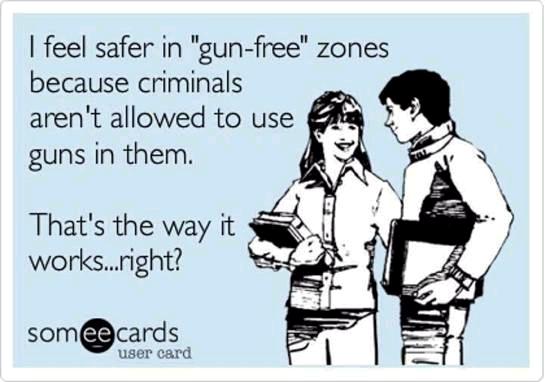
Here’s a poster that captures the blind naiveté of anti-gun activists. I don’t think I need to add any commentary.

Last but not least, here’s a sign that all anti-gun leftists – assuming they have the courage to publicly celebrate their beliefs – should post outside their homes.

If you enjoy these posters, you can view previous editions here, hereherehere, and here.

Related posts:

Taking on Ark Times bloggers on the issue of “gun control” (Part 3) “Did Hitler advocate gun control?”

Gun Free Zones???? Stalin and gun control On 1-31-13 ”Arkie” on the Arkansas Times Blog the following: “Remember that the biggest gun control advocate was Hitler and every other tyrant that every lived.” Except that under Hitler, Germany liberalized its gun control laws. __________ After reading the link  from Wikipedia that Arkie provided then I responded: […]

Taking on Ark Times bloggers on the issue of “gun control” (Part 2) “Did Hitler advocate gun control?”

On 1-31-13 I posted on the Arkansas Times Blog the following: I like the poster of the lady holding the rifle and next to her are these words: I am compensating for being smaller and weaker than more violent criminals. __________ Then I gave a link to this poster below: On 1-31-13 also I posted […]

Taking on Ark Times bloggers on the issue of “gun control” (Part 1) “Bill Clinton responsible some for Ft Hood gun control policy?”

Will “CARRYING HANDGUN IS PROHIBITED” poster work? Dan Mitchell of the Cato Institute on gun control On 1-13-13 on the Arkansas Times Blog the person with the username “ArkDemocrat” stated, “I visited a church in another state that allows guns, and there was a sign similar to the “No Smoking” signs (i.e. smoking cigarette with […]

Great gun control posters from Dan Mitchell’s blog

Poster for November 2008 benefit for Pressly family, held at Peabody Hotel in Little Rock. ______________ Max Brantley of the Ark Times Blog often attacks those on my side of the gun control debate and that makes me argue even harder for the 2nd amendment. Several months ago Lindsey Miller and Max Brantley were talking […]

Funny gun control posters!!!

I have posted some cartoons featured on Dan Mitchell’s blog before and they are very funny. An Amusing Look at Gun-Free Zones September 26, 2012 by Dan Mitchell I’ve shared a very clever Chuck Asay cartoon about gun-free zones, so let’s now enjoy four posters on the topic. Let’s begin with a good jab at one […]

There is no safety crisis in schools as far as mass shootings go!!!

The recent killing by a mad gunman in CT is not indicating a trend. School killings have gone down and probably peaked in 1929. Nick Gillespie reported in the below video, “Across the board, schools are less dangerous than they used be. Over the past 20 years, the rate of theft per 1,000 students dropped […]

The Atlantic’s Jeffrey Goldberg abandons his liberal friends on gun control.

Pretty shocking admissions from the liberal Jeffrey Goldberg on gun control. An Honest Liberal Writes about Gun Control December 16, 2012 by Dan Mitchell I wrote earlier this month about an honest liberal who acknowledged the problems created by government dependency. Well, it happened again. First, some background. Like every other decent person, I was horrified […]

Gun control does not make since unless you suspend your reasoning ability

Despite what Max Brantley of the Arkansas Times Blog (1-9-13) would have you believe gun control does not make since unless you suspend your reasoning ability. There are so many examples that show how silly gun control is. Mocking Gun Control Fanatics October 18, 2012 by Dan Mitchell Last month, I shared some very amusing images […]

Gun control arguments very logical?

It seems to me that most of the gun control arguments I have heard are not very logical. Deciphering How Statists Think about Gun Control September 9, 2012 by Dan Mitchell Even though I don’t own that many guns, I’m an unyielding supporter of the 2nd Amendment. Indeed, I use gun control as a quick and […]

Charlie Collins versus Max Brantley on Gun Control

John Stossel report “Myth: Gun Control Reduces Crime After this horrible shooting in the school the other day it seems the gun control debate has fired up again.  Max Brantley of the Arkansas Times jumped on Charlie Collins concerning his position on concealed weapons but I think that would lower gun crimes and not raise […]

Open letter to President Obama (Part 231)

President Obama c/o The White House
1600 Pennsylvania Avenue NW
Washington, DC 20500

Dear Mr. President,

I know that you receive 20,000 letters a day and that you actually read 10 of them every day. I really do respect you for trying to get a pulse on what is going on out here.

We got to stop all the red ink. How can keep our federal spending at the high level it is at now and not end up in Greece? As the president you should take the bull by the horns and balance the budget!!!!

The burden of federal spending in the United States was down to 18.2 percent of gross domestic product when Bill Clinton left office.

But this progress didn’t last long. Thanks to George Bush’s reckless spending policies, the federal budget grew about twice as fast as the economy, jumping by nearly 90 percent in just eight years This pushed federal spending up to about 25 percent of GDP.

President Obama promised hope and change, but he has kept spending at this high level rather than undoing the mistakes of his predecessor.

This new video from the Center for Freedom and Prosperity Foundation uses examples of waste, fraud, and abuse to highlight President Obama’s failed fiscal policy.

Published on Aug 12, 2012 by

This mini-documentary from the Center for Freedom and Prosperity Foundation highlights egregious examples of wasteful spending from the so-called stimulus legislation and explains why government spending hurts economic performance.

____________________

Good stuff, though the video actually understates the indictment against Obama. There is no mention, for instance, about all the new spending for Obamacare that will begin to take effect over the next few years.

But not everything can be covered in a 5-minute video. And I suspect the video is more effective because it closes instead with some discussion of the corrupt insider dealing of Obama’s so-called green energy programs.

__________

Thank you so much for your time. I know how valuable it is. I also appreciate the fine family that you have and your commitment as a father and a husband.

Sincerely,

Everette Hatcher III, 13900 Cottontail Lane, Alexander, AR 72002, ph 501-920-5733, lowcostsqueegees@yahoo.com

Open letter to President Obama (Part 230)


President Obama c/o The White House
1600 Pennsylvania Avenue NW
Washington, DC 20500

Dear Mr. President,

I know that you receive 20,000 letters a day and that you actually read 10 of them every day. I really do respect you for trying to get a pulse on what is going on out here.

You have seen the figures like I have Mr. President. Social Security will run out of money in the next few decades.

Liberals that say that Social Security is running fine don’t want to live in the real world but in a make-believe liberal world that doesn’t exist.

I don’t give the issue much attention on this blog, but I’m very interested in Social Security reform. I wrote my dissertation on Australia’s very successful system of personal retirement accounts, for instance, and I narrated this video on Social Security reform in the United States.

So I was very interested to see that the Associated Press put out a story warning about the dismal state of the program’s finances.

Here’s some of what the AP reported.

For nearly three decades Social Security produced big surpluses, collecting more in taxes from workers than it paid in benefits to retirees, disabled workers, spouses and children. The surpluses also helped mask the size of the budget deficit being generated by the rest of the federal government. Those days are over. Since 2010, Social Security has been paying out more in benefits than it collects in taxes… The projected shortfall in 2033 is $623 billion, according to the trustees’ latest report. It reaches $1 trillion in 2045 and nearly $7 trillion in 2086, the end of a 75-year period used by Social Security’s number crunchers because it covers the retirement years of just about everyone working today. Add up 75 years’ worth of shortfalls and you get an astonishing figure: $134 trillion. Adjusted for inflation, that’s $30.5 trillion in 2012 dollars, or eight times the size of this year’s entire federal budget.

First of all, kudos to the AP. I criticized them for a sloppy and biased report on poverty last month, so it behooves me to mention that their story on Social Security is mostly fair and accurate.

My only complaint is that the story does include some analysis of the Social Security Trust Fund, even though that supposed Fund is nothing but a pile of IOUs – money that one part of the government promises to give to another part of the government.

But let’s set that aside. Another interesting tidbit from the story is this quote from one of the kleptocrats at the American Association of Retired Persons. Note that he implicitly rules out any changes other than those that enable the government to “pay the benefits we promised.”  But that shouldn’t be a surprise. AARP is part of the left-wing coalition.

“I’m not suggesting we need to wait 20 years but we do have time to make changes to Social Security so that we can pay the benefits we promised,” said David Certner, AARP’s legislative policy director. “Let’s face it. Relative to a lot of other things right now, Social Security is in pretty good shape.”

But I will say that Mr. Certner is sort of correct about Social Security being in better shape than Medicare and Medicaid. But that’s like saying the guy with lung cancer who is 75 lbs overweight is in better shape than the two guys with brain tumors who are both 150 lbs overweight.

If you have to engage in fiscal triage, it would be smart to first address Medicare and Medicaid, but Social Security also needs reform. And not the kind of statist reform the folks at AARP would like to see.

By the way, you probably won’t be surprised to learn that President Obama’s approach is similar to the left-wingers at AARP. Here’s a video I narrated about his preferred policy.

It seems that the question doesn’t matter with this administration. The answer is always to impose more class-warfare tax policy.

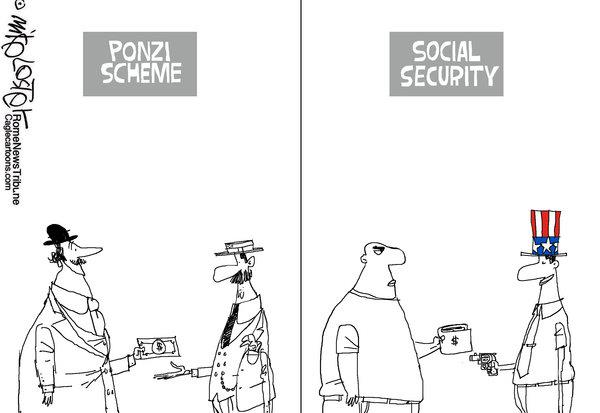
P.S. If you need to be cheered up after reading this post, here’s a good cartoon showing the difference between Social Security and a Ponzi scheme, and here’s another cartoon showing what inspired Bernie Madoff to steal so much money.

__________

Thank you so much for your time. I know how valuable it is. I also appreciate the fine family that you have and your commitment as a father and a husband.

Sincerely,

Everette Hatcher III, 13900 Cottontail Lane, Alexander, AR 72002, ph 501-920-5733, lowcostsqueegees@yahoo.com

.

Milton Friedman warned the computer industry!!!

Milton Friedman was a man of common sense and great foresight. What he said in 1999 has come to pass and the Cato Institute article on 1-28-13 pointed that out.  

  • Updated January 28, 2013, 1:05 a.m. ET

Silicon Valley’s ‘Suicide Impulse’

The industry’s affection for Washington keeps growing. Facebook had 38 lobbyists working in 2012.

It’s a measure of how far Silicon Valley has strayed from its entrepreneurial roots that a top regulator is calling on technology companies to do less lobbying and more competing.In a letter to the editor responding to a report in this column on how Google GOOG -0.39%spent $25 million lobbying to stop an antitrust case against it, Federal Trade Commission Chairman Jon Leibowitz wrote that companies should not draw the lesson that lobbying pays. Instead, he urged: “Stop! Invest your money in expansion and innovation.” Mr. Leibowitz asserted in his letter, published Jan. 18, that “Google’s lobbying expenses had no effect on the care, diligence or analysis of the agency’s incredibly hard-working staff or the decisions reached by any of the FTC’s five commissioners.”Whatever the effect of Google’s big-ticket lobbying, regulators deserve much of the blame for companies calculating that lobbying is a good investment. Still, Mr. Leibowitz has a point: Tech executives should think twice before again lobbying government to get involved in their industry.The precedent for the potential antitrust case against Google was the massive prosecution in the 1990s of Microsoft, MSFT +0.14%the giant of the desktop era. Competitors such as Netscape, Oracle ORCL +0.45%and Sun Microsystems lobbied hard to get regulators to bring the case that did end up paralyzing Microsoft.

Getty ImagesMilton Friedman, a model of prescience regarding tech-industry lobbying.

In 1999, economist Milton Friedman issued a warning to technology executives at a Cato Institute conference: “Is it really in the self-interest of Silicon Valley to set the government on Microsoft? Your industry, the computer industry, moves so much more rapidly than the legal process that by the time this suit is over, who knows what the shape of the industry will be? Never mind the fact that the human energy and the money that will be spent in hiring my fellow economists, as well as in other ways, would be much more productively employed in improving your products. It’s a waste!”

He predicted: “You will rue the day when you called in the government. From now on, the computer industry, which has been very fortunate in that it has been relatively free of government intrusion, will experience a continuous increase in government regulation. Antitrust very quickly becomes regulation. Here again is a case that seems to me to illustrate the suicide impulse of the business community.”

Friedman was right. The Internet undermined Microsoft’s market power years before the litigation ended. Alas, his warning fell on deaf ears—and ironically, it was Microsoft that led the recent lobbying to investigate Google’s dominance of the search industry. Microsoft funded lobbyists under names such as FairSearch.org.

The FTC hired outside lawyers to prepare a case, but after a lengthy investigation concluded what was obvious from the start: There was no case against Google’s practice of delivering answers as well as just links in its search results. It may harm Google’s competitors, but it benefits consumers, whom the antitrust laws are supposed to protect.

Silicon Valley has long prided itself on avoiding the lumbering relationship between big government and most industries, but somehow it has become one of the top lobbyists in Washington. The Center for Responsive Politics reported last year: “Tech firms have doled out more and more lobbying money even as the amount spent on lobbying by all industries has decreased since 2010.”

Google has a former congresswoman, Susan Molinari, running its Washington office. Facebook FB +2.92%employed 38 lobbyists last year, up from 23 in 2011. Over the past few years, Microsoft, Apple, Google and Intel have all hired former top FTC staffers, spinning the revolving door that fuels the growth of lobbying.

The growth in tech lobbying reflects the eagerness of the Obama administration and its regulators to get involved in the industry. FTC and Justice Department investigations into antitrust cases are just part of the problem. The FTC has also involved itself in the core business operations of the Internet.

During the past few years, the FTC has extracted consent decrees from Google, Facebook and Twitter on how they generate advertising revenues by using information about their visitors. These decrees include vague standards such as that the companies must have “privacy controls and procedures appropriate to respondent’s size and complexity, the nature and scope of respondent’s activities, and the sensitivity of the covered information.”

Under this broad privacy umbrella, the FTC thus oversees the key revenue stream for several of the largest companies on the Internet. These consent decrees apply for 20 years, an absurd length of time in the fast-changing technology industry. Internet companies staffed up their Washington offices in part to fend off regulations that would undermine the ad-supported services they provide to consumers.

Rather than lobby government to go after one another, Silicon Valley lobbyists should unite to go after overreaching government. Instead of the “suicide impulse” of lobbying for more regulation, Silicon Valley should seek deregulation and a long-overdue freedom to return to its entrepreneurial roots.

A version of this article appeared January 28, 2013, on page A13 in the U.S. edition of The Wall Street Journal, with the headline: Silicon Valley’s ‘Suicide Impulse’.