Category Archives: Bill Clinton

White House interns again?

Bill Clinton said he always wanted to be like JFK.

Earlier I posted about the recent claim of a White House intern who claimed to have a 18 month affair with JFK. Now I wanted to take a look back at the scandal in 1998 and I have included some info on Newt’s misdeeds and some links. Taken from Wikipedia:

The Lewinsky scandal was a political sex scandal emerging in 1998 from a sexual relationship between United States President Bill Clinton and a 25-year-old White House intern, Monica Lewinsky. The news of this extra-marital affair and the resulting investigation eventually led to the impeachment of President Clinton in 1998 by the U.S. House of Representatives and his subsequent acquittal on all impeachment charges of perjury and obstruction of justice in a 21-day Senate trial.[1]

In 1995, Monica Lewinsky, a graduate of Lewis & Clark College, was hired to work as an intern at the White House during Clinton’s first term, and began a personal relationship with him, the details of which she later confided to her friend and Defense department co-worker Linda Tripp, who secretly recorded their telephone conversations.[2] When Tripp discovered in January 1998 that Lewinsky had signed an affidavit in the Paula Jones case denying a relationship with Clinton, she delivered the tapes to Kenneth Starr, the Independent Counsel who was investigating Clinton on other matters, including the Whitewater scandal, the White House FBI files controversy, and the White House travel office controversy. During the grand jury testimony Clinton’s responses were guarded, and he argued, “It depends on what the meaning of the word ‘is’ is”.[3]

The wide reporting of the scandal led to criticism of the press for over-coverage.[4][5][6] The scandal is sometimes referred to as “Monicagate“,[7]Lewinskygate“,[8]Tailgate“,[9]Sexgate“,[10] and “Zippergate“,[10] following the “gate” nickname construction that has been popular since the Watergate scandal.

Allegations of sexual contact

Lewinsky alleged to have had nine sexual encounters with Bill Clinton:

  1. November 15, 1995
  2. November 17, 1995
  3. December 31, 1995
  4. January 7, 1996
  5. January 21, 1996
  6. February 4, 1996
  7. March 31, 1996
  8. February 28, 1997
  9. March 29, 1997

According to her published schedule, First Lady Hillary Clinton was at the White House for at least some portion of seven of these stated days.[11]

In April 1996, Lewinsky’s superiors relocated her job to the Pentagon because they felt that she was spending too much time around Clinton.[12] According to his autobiography, then-United Nations Ambassador Bill Richardson was asked by the White House in 1997 to interview Lewinsky for a job on his staff at the UN. Richardson did so, and offered her a position, which she declined.[13] The American Spectator alleged that Richardson knew more about the Lewinsky affair than he declared to the grand jury.[14]

Lewinsky confided in a coworker named Linda Tripp about her relationship with Clinton. Tripp convinced Lewinsky to save the gifts that Clinton had given her, and not to dry clean what would later be known as the “infamous blue dress”. Tripp reported these conversations to literary agent Lucianne Goldberg, who advised her to secretly record them,[15] which Tripp began doing in September 1997. Goldberg also urged Tripp to take the tapes to Kenneth Starr and bring them to the attention of people working on the Paula Jones case.[16] In the fall of 1997, Goldberg began speaking to reporters (notably Michael Isikoff of Newsweek) about the tapes.[17]

In January 1998, after Lewinsky had submitted an affidavit in the Paula Jones case denying any physical relationship with Clinton, she attempted to persuade Tripp to lie under oath in the Jones case. Instead, Tripp gave the tapes to Independent Counsel Kenneth Starr who was investigating the Whitewater controversy and other matters. Now armed with evidence of Lewinsky’s admission of a physical relationship with Clinton, he broadened the investigation to include Lewinsky and her possible perjury in the Jones case.

[edit] Denial and subsequent admission

News of the scandal first broke on January 17, 1998, on the Drudge Report website,[18] which reported that Newsweek editors were sitting on a story by investigative reporter Michael Isikoff exposing the affair. The story broke in the mainstream press on January 21 in The Washington Post.[19] The story swirled for several days and, despite swift denials from Clinton, the clamor for answers from the White House grew louder. On January 26, President Clinton, standing with his wife, spoke at a White House press conference, and issued a forceful denial, which contained what would later become one of the best-known sound bites of his presidency:[20]

Now, I have to go back to work on my State of the Union speech. And I worked on it until pretty late last night. But I want to say one thing to the American people. I want you to listen to me. I’m going to say this again: I did not have sexual relations with that woman, Miss Lewinsky. I never told anybody to lie, not a single time; never. These allegations are false. And I need to go back to work for the American people. Thank you.[21]

Pundits debated whether or not Clinton would address the allegations in his State of the Union Address. Ultimately, he chose not to mention them. Hillary Clinton stood by her husband throughout the scandal. On January 27, in an appearance on NBC‘s Today she famously said, “The great story here for anybody willing to find it and write about it and explain it is this vast right-wing conspiracy that has been conspiring against my husband since the day he announced for president.”

For the next several months and through the summer, the media debated whether or not an affair had occurred and whether or not Clinton had lied or obstructed justice, but nothing could be definitively established beyond the taped recordings because Lewinsky was unwilling to discuss the affair or testify about it. On July 28, 1998, a substantial delay after the public break of the scandal, Lewinsky received transactional immunity in exchange for grand jury testimony concerning her relationship with Clinton. She also turned over a semen-stained blue dress (which Linda Tripp had encouraged her to save without dry cleaning) to the Starr investigators, thereby providing unambiguous DNA evidence that could prove the relationship despite Clinton’s official denials.[22]

Clinton admitted in taped grand jury testimony on August 17, 1998, that he had had an “improper physical relationship” with Lewinsky. That evening he gave a nationally televised statement admitting his relationship with Lewinsky which was “not appropriate”.[23]

[edit] Perjury charges

In his deposition for the Jones lawsuit, Clinton denied having “sexual relations” with Lewinsky. Based on the evidence provided by Tripp, a blue dress with Clinton’s semen, Starr concluded that this sworn testimony was false and perjurious.

During the deposition, Clinton was asked “Have you ever had sexual relations with Monica Lewinsky, as that term is defined in Deposition Exhibit 1.” The judge ordered that Clinton be given an opportunity to review the agreed definition. Afterwards, based on the definition created by the Independent Counsel’s Office, Clinton answered “I have never had sexual relations with Monica Lewinsky.” Clinton later stated, “I thought the definition included any activity by [me], where [I] was the actor and came in contact with those parts of the bodies” which had been explicitly listed (and “with an intent to gratify or arouse the sexual desire of any person”). In other words, Clinton denied that he had ever contacted Lewinsky’s “genitalia, anus, groin, breast, inner thigh, or buttocks”, and effectively claimed that the agreed-upon definition of “sexual relations” included giving oral sex but excluded receiving oral sex.[24]

Two months after the Senate failed to convict him, President Clinton was held in civil contempt of court by Judge Susan D. Webber Wright.[25] His license to practice law was suspended in Arkansas for five years and later by the United States Supreme Court.[26] He was also fined $90,000 for giving false testimony.[27]

Newt Gingrich, Representative (R-GA) and leader of the Republican Revolution of 1994,[42] resigned from the House after admitting in 1998 to having had an affair with his intern while he was married to his second wife, and at the same time he was leading the impeachment of Bill Clinton for perjury regarding an affair with his intern Monica Lewinsky.[43][44]

Related posts:

:

Timeline of Newt’s affairs

Here is the timeline of Newt’s affairs from the Huffington Post article dated 7-11-11: On Wednesday, Newt Gingrich is expected to formally announce he’ll be running for President in the 2012 election. The former Speaker of the House, whose past infidelities and messy divorces have long been fixtures in the press, is hardly the only […]

White House interns again?

Bill Clinton said he always wanted to be like JFK. Earlier I posted about the recent claim of a White House intern who claimed to have a 18 month affair with JFK. Now I wanted to take a look back at the scandal in 1998 and I have included some info on Newt’s misdeeds and […]

Picture of Mimi Alford who claims to have had 18 month affair with JFK

The issue of White House interns has come up before. One of the late night shows commented that Newt knew exacting what he was going to do on the first day as president: “Rehire Monica Lewinsky!!!” I have talked about this issue before and have linked several related articles below. There are several articles about […]


Newt goes to church

  Newt makes his way to church on Sunday. By KEITH MORELLI | The Tampa Tribune Published: January 29, 2012 Updated: January 29, 2012 – 3:03 PM » 97 Comments | Post a Comment TAMPA –Republican presidential hopeful Newt Gringrich sat in an aisle seat near the front of Idlewild Baptist Church Sunday morning, listening […]

Why conservatives back Gingrich I will never know.

Newt is a poor excuse for a candidate and I have written those words before. Why so many Christians are supporting him is shocking to me. Tim LaHaye and Don Wildmon were best friends with the late Adrian Rogers of Memphis. In a very well known sermon Rogers noted these verses concerning our national leaders: “It […]

Newt is a poor excuse for a candidate

I used to like Newt back in the 1990′s but a lot has changed since then. Take a look at this fine article from the Cato Institute: Gingrich Rise Is Triumph of Style over Substance by Gene Healy   Gene Healy is a vice president at the Cato Institute and the author of The Cult […]

Adrian Rogers’ sermon on Clinton in 98 applies to Newt in 2012

It pays to remember history. Today I am going to go through some of it and give an outline and quotes from the great Southern Baptist leader Adrian Rogers (1931-2005). Max Brantley of the Arkansas Times started this morning off with some comedy: From pro golfer John Daly’s Twitter account following last night’s Republican debate, […]

Newt and Clinton:Both were Southern Baptists living hypocritcal lives

EXCLUSIVE: Ron Paul Has A Secret Plan To Win America   I used to go to the Immanuel Baptist Church (Clinton was member there) Luncheon every week in Little Rock and in 1995 I visited the large Southern Baptist Church in the Atlanta where Newt was a member. Both men evidently shared some hypocritical habits […]


Bush tax cuts work? Is Clinton’s approach better? (Part 3)

The Laffer Curve, Part III: Dynamic Scoring

A video by CF&P Foundation that builds on the discussion of theory in Part I and evidence in Part II, this concluding video in the series on the Laffer Curve explains how the Joint Committee on Taxation’s revenue-estimating process is based on the absurd theory that changes in tax policy – even dramatic reforms such as a flat tax – do not effect economic growth. In other words, the current system assumes the Laffer Curve does not exist. Because of congressional budget rules, this leads to a bias for tax increases and against tax cuts. The video explains that “static scoring” should be replaced with “dynamic scoring” so that lawmakers will have more accurate information when making decisions about tax policy. For more information please visit the Center for Freedom and Prosperity’s web site: http://www.freedomandprosperity.org

_____________________________

Bush tax cuts work? This is a series of posts aimed at answering that question.

Setting the Tax Record Straight: Clinton Hikes Slowed Growth, Bush Cuts Promoted Recovery

By Curtis Dubay
September 6, 2011

Abstract: Despite evidence to the contrary, President Obama and his supporters insist that a tax increase will not impede economic recovery. They claim that the Clinton tax hikes spurred the boom of the 1990s and that the subsequent Bush tax cuts hurt the economy. Members of Congress must reject this faulty notion—and reject the President’s call for burdening Americans with higher taxes and an even slower economy.

President Barack Obama and his allies in Congress and elsewhere continue to press for tax increases, whether as part of a deal to raise the government’s debt ceiling, or for any other reason. Even though common sense would dictate not raising taxes in the face of a badly weakened economy and almost non-existent job growth, the President and his supporters argue that tax hikes will not imperil the still-nascent recovery because the economy grew during the 1990s after President Bill Clinton raised taxes. The inference being that today’s economy could also absorb the blow of tax hikes and grow despite them. They also argue the converse: that the tax cuts passed during President George W. Bush’s tenure slowed growth and cost jobs.

This cursory and errant analysis of recent history has serious implications for policymaking today. If Congress raises taxes based on the faulty notion that tax hikes have no ill effects on economic growth, it will impede the still-struggling recovery and keep millions of Americans on the unemployment rolls far too long.

Lessons for Today

It is vitally important for the millions of Americans looking for work today that Congress and President Obama learn and accept what really happened when President Clinton raised taxes and President Bush lowered them. The evidence is clear that the Clinton tax hikes stifled what should have been remarkable economic growth and the Bush tax cuts cleared the way for the economy to grow despite growing obstacles in its way.

President Obama insists that tax hikes must be part of a “balanced” approach to reducing the deficit. He defends his tax hike desires by pointing to the Clinton tax hikes as evidence that the economy can withstand higher taxes.

But if the Clinton tax hikes were powerful enough to slow an economy that had everything going in its favor, what would tax hikes today do to an economy that has everything working against it? The unemployment rate remains stuck over 9 percent and there appears to be little hope for it to fall in the near future.[10] The President should not be looking for policies the economy can withstand, but for policies that will encourage it to grow.

At best, tax increases would slow the already stalled recovery, and at worst, would reverse it altogether. A slowed recovery or double-dip recession would further reduce the chances that the more than 14 million Americans currently looking for work would find a job in the near future.[11]

The best way to grow revenues is to promote faster economic growth, which will increase the number of taxpayers and taxable income more rapidly. Tax hikes—whether through higher tax rates or slashing credits, deductions, and exemptions without offsetting reductions elsewhere—will not do the job. Under President Obama’s current policies, spending will continue to grow at a faster rate than can be paid for by tax hikes—even assuming the huge tax increases the President insists upon. To add insult to injury, as history has shown, tax hikes would slow economic growth and make it even harder for unemployed Americans to find a job.

—Curtis S. Dubay is a Senior Analyst in Tax Policy in the Thomas A. Roe Institute for Economic Policy Studies at The Heritage Foundation.

Bush tax cuts work? Is Clinton’s approach better? (Part 2)

The Laffer Curve, Part II: Reviewing the Evidence

This video reviews real-world evidence showing that changes in marginal tax rates can have a significant impact on taxable income, thus leading to substantial amounts of revenue feedback. In a few cases, tax-rate reductions even “pay for themselves,” though the key lesson is the more modest point that pro-growth changes in tax policy will have a positive impact on economic performance and that good tax cuts therefore do not “cost” the government much in terms of foregone tax revenue.

This video is second installment of a three-part series. Part I reviews theoretical relationship between tax rates, taxable income, and tax revenue. Part III discusses how the revenue-estimating process in Washington can be improved. For more information please visit the Center for Freedom and Prosperity’s web site: www.freedomandprosperity.org.

_________________

Bush tax cuts work? This is a series of posts aimed at answering that question.

Setting the Tax Record Straight: Clinton Hikes Slowed Growth, Bush Cuts Promoted Recovery

By Curtis Dubay
September 6, 2011

Abstract: Despite evidence to the contrary, President Obama and his supporters insist that a tax increase will not impede economic recovery. They claim that the Clinton tax hikes spurred the boom of the 1990s and that the subsequent Bush tax cuts hurt the economy. Members of Congress must reject this faulty notion—and reject the President’s call for burdening Americans with higher taxes and an even slower economy.

President Barack Obama and his allies in Congress and elsewhere continue to press for tax increases, whether as part of a deal to raise the government’s debt ceiling, or for any other reason. Even though common sense would dictate not raising taxes in the face of a badly weakened economy and almost non-existent job growth, the President and his supporters argue that tax hikes will not imperil the still-nascent recovery because the economy grew during the 1990s after President Bill Clinton raised taxes. The inference being that today’s economy could also absorb the blow of tax hikes and grow despite them. They also argue the converse: that the tax cuts passed during President George W. Bush’s tenure slowed growth and cost jobs.

This cursory and errant analysis of recent history has serious implications for policymaking today. If Congress raises taxes based on the faulty notion that tax hikes have no ill effects on economic growth, it will impede the still-struggling recovery and keep millions of Americans on the unemployment rolls far too long.

Bush Tax Cuts Promoted Strong Growth

Liberals also like to argue that the Bush tax relief hurt the economy and cost jobs. Again, the evidence runs to the contrary.

Unlike President Clinton, who entered office with a strong economic wind at his back, President Bush came into office on the precipice of a recession caused by the bursting of the “dot-com” bubble. President Bush entered office in January 2001; the recession began in March.

In addition to the recession, the peaceful conditions President Clinton enjoyed reversed course. The terrorist attacks of 9/11 brought on the beginning of the war on terrorism. There was no growth-enhancing advancement comparable to the tech boom to further boost the economy; energy prices were creeping up. Instead of swimming with the current, the economy was now fighting squarely against it to achieve even modest growth.

Faced with this new reality, President Bush pushed for tax cuts to revive the economy and set it on a stronger foundation for economic growth.

In June 2001, President Bush signed into law the first wave of tax cuts. The relief included reductions of marginal income tax rates and tax relief for families, for example, doubling the child tax credit from $500 to $1,000. To reduce the budgetary impact, Congress phased in the tax cuts over several years.

Since the tax cuts were slow to go into effect, they were slow to help the economy. In fact, the economy continued to lose jobs after the tax cuts even though the recession officially ended in November 2001.

Realizing the error of its ways, in May 2003 Congress accelerated the tax cuts to make them effective immediately. In addition to reducing marginal income tax rates, Congress also lowered the tax rates on capital gains and dividends.

It was at this point that economic growth took off. From May 2003 until December 2007 (when the recession caused by the global financial meltdown occurred) the economy created 8.1 million jobs, or 145,000 a month. By comparison, after the beginning of the 2001 recession and before the 2003 tax cuts, the economy was losing 103,000 jobs a month.[7]

2003 Bush Tax Cuts Prompted Surge in Employment

Those opposed to the tax relief argue that it blew a hole in the budget and dramatically increased deficits. Again, a look at the numbers disproves that argument. While receipts were below the historical level of 18 percent of GDP in 2003 as a result of the sluggish economy, they rebounded to above their historical norm by 2006 and grew further above their historical level in 2007.[8] They clearly would have continued growing thereafter had it not been for the housing bust and global recession.

Tax revenue rebounded quickly because the tax cuts encouraged economic growth by increasing the incentives to work, save, invest, and take on new risk. These are the basic elements of economic growth. When those activities increase, tax revenues increase because more Americans work and earn more money. From 2003 to 2007, the number of tax filers rose by 9.6 percent, and taxable income, by 44 percent. By contrast, in the last four years of the previous expansion, from 1997 to 2001, these numbers grew by 6.4 percent and 23.6 percent, respectively.[9] With income and taxpayers growing at such a fast clip it is not hard to see why tax revenue did not suffer from the tax cuts.

Number of Taxpayers and Taxable Income Grew Faster During Bush's Expansion than Clinton's

To be clear: The Bush tax cuts did not pay for themselves. Revenues, on balance, are lower as a result of the Bush tax relief. However, the Bush tax cuts did accelerate the recovery markedly, and they did, and still do, create the possibility of a permanently stronger economy which, in turn, means the net revenue cost of the Bush tax cuts is far less than the traditional static score implies.

In 2008, the last full year of the Bush presidency, the economy entered a severe recession brought on by the global financial meltdown. The 2001 and 2003 tax relief packages had made the economy more resilient against economic shocks, but no tax policy can protect an economy against the storm that struck that year. The tax cuts certainly did not contribute in any way to recession, nor can anyone credibly claim that these policies had something to do with the financial implosion that was global in origin and impact.

Even with a recession at the beginning of his presidency and another severe recession at the end, the economy still created more than 1 million net jobs during President Bush’s tenure. The tax cuts he pushed Congress to pass are a major reason for that job growth.

—Curtis S. Dubay is a Senior Analyst in Tax Policy in the Thomas A. Roe Institute for Economic Policy Studies at The Heritage Foundation.

Bush tax cuts work? Is Clinton’s approach better? (Part 1)

The Laffer Curve, Part I: Understanding the Theory

The Laffer Curve charts a relationship between tax rates and tax revenue. While the theory behind the Laffer Curve is widely accepted, the concept has become very controversial because politicians on both sides of the debate exaggerate. This video shows the middle ground between those who claim “all tax cuts pay for themselves” and those who claim tax policy has no impact on economic performance. This video, focusing on the theory of the Laffer Curve, is Part I of a three-part series. Part II reviews evidence of Laffer-Curve responses. Part III discusses how the revenue-estimating process in Washington can be improved. For more information please visit the Center for Freedom and Prosperity’s web site:www.freedomandprosperity.org

Bush tax cuts work? This is a series of posts aimed at answering that question.

Setting the Tax Record Straight: Clinton Hikes Slowed Growth, Bush Cuts Promoted Recovery

By Curtis Dubay
September 6, 2011

Abstract: Despite evidence to the contrary, President Obama and his supporters insist that a tax increase will not impede economic recovery. They claim that the Clinton tax hikes spurred the boom of the 1990s and that the subsequent Bush tax cuts hurt the economy. Members of Congress must reject this faulty notion—and reject the President’s call for burdening Americans with higher taxes and an even slower economy.

President Barack Obama and his allies in Congress and elsewhere continue to press for tax increases, whether as part of a deal to raise the government’s debt ceiling, or for any other reason. Even though common sense would dictate not raising taxes in the face of a badly weakened economy and almost non-existent job growth, the President and his supporters argue that tax hikes will not imperil the still-nascent recovery because the economy grew during the 1990s after President Bill Clinton raised taxes. The inference being that today’s economy could also absorb the blow of tax hikes and grow despite them. They also argue the converse: that the tax cuts passed during President George W. Bush’s tenure slowed growth and cost jobs.

This cursory and errant analysis of recent history has serious implications for policymaking today. If Congress raises taxes based on the faulty notion that tax hikes have no ill effects on economic growth, it will impede the still-struggling recovery and keep millions of Americans on the unemployment rolls far too long.

Clinton Tax Hikes Slowed Growth

A favorite liberal argument is to attribute the economy’s strong performance during the 1990s to President Clinton’s economic policies, chief among which was a huge tax increase. Clinton signed his tax hike into law in September 1993, the same year he took office. It included an increase of the top marginal tax rate from 31 percent to 39.6 percent; repeal of the cap on the 2.9 percent Medicare tax, applying it to every dollar of income instead of being capped to levels of income like the Social Security tax; a 4.3-cent increase in the gas tax; an increase in the taxable portion of Social Security benefits; and a hike of the corporate income tax rate from 34 percent to 35 percent, among other tax increases.[1]

The economic defense of the Clinton tax hikes does not hold up against the historical facts. The economy did exhibit strong economic growth during the 1990s, but rapid growth did not occur soon after the tax hike—it came much later in the decade, when Congress cut taxes. After the 1993 tax hike, the economy actually slowed to a point below what one would expect, considering the once-in-a-generation favorable economic climate that existed at the time.

As for the overall economic recovery—that started well before President Clinton took office. In January 1993the economy was in the 22nd month of expansion following the recession from July 1990 to March 1991.

In addition to coming into office in the midst of an economic expansion, Clinton also benefited from a very unusual confluence of events that created a remarkably favorable environment for rapid economic growth:

  • The end of the Cold War brought a sigh of relief to the world and a powerful dose of growth-enhancing certainty to the global economy.
  • The price of energy was astoundingly low, with oil prices dropping below $11 per barrel and averaging under $20 per barrel, versus $100 per barrel today.[2]
  • The Federal Reserve had tamed inflation to an extent previously thought impossible, with inflation averaging 2 percent during the Clinton Administration.[3]
  • The biggest wind at the economy’s back was, of course, a tremendous set of new productivity-enhancing information technologies and the explosion of the Internet as a powerful tool for commerce and communication, further increasing productivity.

With these factors clearing the way, the economy should have displayed spectacular and accelerating growth in the years immediately after Clinton entered the White House, but growth of that magnitude did not materialize until later in the decade.

From 1993 until 1997, the economy grew at a pedestrian 3.3 percent per year.[4] While solid, this growth was certainly not exceptional. During that same time, real wages declined, despite the perception that the 1990s were an era of unmitigated abundance.[5]

Tax Hikes Dampened Economy in the 1990s, While Tax Cuts Spurred Growth

It was not until after a 1997 tax cut, passed by the Republican-led Congress—a tax cut President Clinton resisted but ultimately signed—that the spectacular growth kicked in. While small in revenue impact, the 1997 cuts included a reduction of the capital gains rate from 28 percent to 20 percent. This opened the capital floodgates necessary for entrepreneurs to develop, harness, and bring to market the wonders of the new information technologies.

Business investment skyrocketed after the tax cut,[6] and the economy grew at an annualized rate of 4.4 percent (33 percent faster than after the Clinton tax hike) from 1997 through the end of the Clinton presidency. Real wages reversed their downward trend and grew 1.7 percent per year during the same time.

Altogether, how much worse did the economy perform because of the Clinton tax hike? The data from the period do not provide a clear answer. What is clear is that the economy performed well below reasonable expectations given the favorable conditions existing in the years after the tax hike—and took off after the often-forgotten tax cut.

—Curtis S. Dubay is a Senior Analyst in Tax Policy in the Thomas A. Roe Institute for Economic Policy Studies at The Heritage Foundation.

Reagan and Clinton had good fiscal policies according to Cato Institute

Uploaded by on Dec 16, 2010

http://blog.heritage.org/2010/12/16/new-video-pork-filled-spending-bill-just-… Despite promises from President Obama last year and again last month that he opposed reckless omnibus spending bills and earmarks, the White House and members of Congress are now supporting a reckless $1.1 trillion spending bill reportedly stuffed with roughly 6,500 earmarks.

________________________

Below you see an article and videos by Dan Mitchell of the Cato Institute concerning Reagan and Clinton. First lets look at where we are now with Obama.

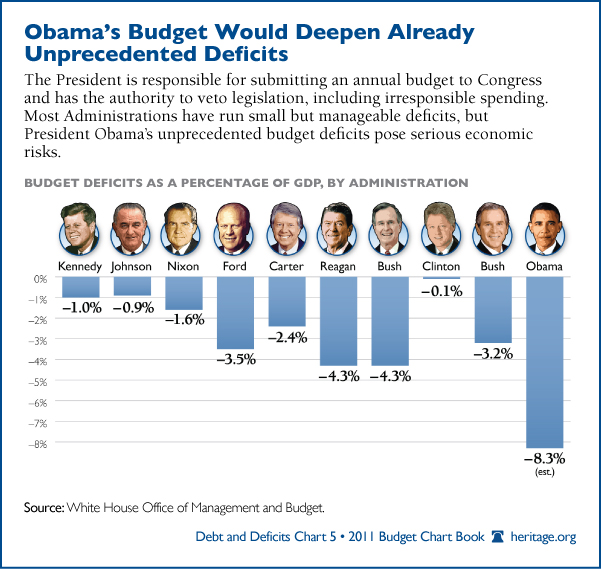
Over the last 10 presidents was have had 16.9% of GDP of deficits total from five Republican presidents and 12.7% total from Democratic presidents. However, what is most disturbing is that 8.3% of the 12.7% comes from the Obama administration who is currently in power and we are no longer in the cold war era. That is almost double the total of all the other four Democratic presidents combined under just one president. Take a look at the chart below from the Heritage Foundation:

Rob Bluey

January 1, 2012 at 9:56 am

Over the past 50 years, 10 U.S. presidents have made annual budget requests to Congress, projecting deficits both big and small. But no other president compares to Barack Obama when it comes to the size and scale of the current budget deficit facing the United States.

The country is facing an 8.3 percent estimated average national deficit of a two-term Obama administration — the biggest of the past 50 years. By comparison, the current estimate for Obama is nearly double the percentage under Presidents Ronald Reagan and George H.W. Bush — and they were fighting the Cold War.

Political party doesn’t tell the whole story, however. President Bill Clinton leads the pack of presidents since 1961, according to data from the White House Office of Management and Budget. Heritage put together this graphic as part of our Budget Chart Book.

So what does the current trajectory mean for the United States? We’re certainly no longer looking at a continuation of manageable deficits in the years to come. This is a dramatic change in the magnitude of annual shortfalls at the federal level. That’s one reason Heritage came up with a plan to fix the debt crisis.

If you have a suggestion for a chart we should feature in the future, please post a comment below, email us at scribe@heritage.org, or send me at tweet @RobertBluey.

_______________________
Here is a perspective from Dan Mitchell of the Cato Institute:

To Fix the Budget, Bring Back Reagan…or Even Clinton

Posted by Daniel J. Mitchell

President Obama unveiled his fiscal year 2012 budget today, and there’s good news and bad news. The good news is that there’s no major initiative such as the so-called stimulus scheme or the government-run healthcare proposal. The bad news, though, is that government is far too big and Obama’s budget does nothing to address this problem.

But perhaps the folks on Capitol Hill will be more responsible and actually try to save America from becoming a big-government, European-style welfare state. The solution may not be easy, but it is simple. Lawmakers merely need to restrain the growth of government spending so that it grows slower than the private economy.

Actual spending cuts would be the best option, of course, but limiting the growth of spending is all that’s needed to slowly shrink the burden of government spending relative to gross domestic product.

Fortunately, we have two role models from recent history that show it is possible to control the federal budget. This video from the Center for Freedom and Prosperity uses data from the Historical Tables of the Budget to demonstrate the fiscal policy achievements of both Ronald Reagan and Bill Clinton.

Spending Restraint, Part I: Lessons from Ronald Reagan and Bill Clinton

Uploaded by on Feb 14, 2011

Ronald Reagan and Bill Clinton both reduced the relative burden of government, largely because they were able to restrain the growth of domestic spending. The mini-documentary from the Center for Freedom and Prosperity uses data from the Historical Tables of the Budget to show how Reagan and Clinton succeeded and compares their record to the fiscal profligacy of the Bush-Obama years.

_____________________


Some people will want to argue about who gets credit for the good fiscal policy of the 1980s and 1990s.

Bill Clinton’s performance, for instance, may not have been so impressive if he had succeeded in pushing through his version of government-run healthcare or if he didn’t have to deal with a Republican Congress after the 1994 elections. But that’s a debate for partisans. All that matters is that the burden of government spending fell during Bill Clinton’s reign, and that was good for the budget and good for the economy. And there’s no question he did a much better job than George W. Bush.

Indeed, a major theme in this new video is that the past 10 years have been a fiscal disaster. Both Bush and Obama have dramatically boosted the burden of government spending — largely because of rapid increases in domestic spending.

This is one of the reasons why the economy is weak. For further information, this video looks at the theoretical case for small government and this video examines the empirical evidence against big government.

Another problem is that many people in Washington are fixated on deficits and debt, but that’s akin to focusing on symptoms and ignoring the underlying disease. To elaborate, this video explains that America’s fiscal problem is too much spending rather than too much debt.

Last but not least, this video reviews the theory and evidence for the “Rahn Curve,” which is the notion that there is a growth-maximizing level of government outlays. The bad news is that government already is far too big in the United States. This is undermining prosperity and reducing competitiveness.

Spending Restraint, Part II: Lessons from Canada, Ireland, Slovakia, and New Zealand

Uploaded by on Feb 22, 2011

Nations can make remarkable fiscal progress if policy makers simply limit the growth of government spending. This video, which is Part II of a series, uses examples from recent history in Canada, Ireland, Slovakia, and New Zealand to demonstrate how it is possible to achieve rapid improvements in fiscal policy by restraining the burden of government spending. Part I of the series examined how Ronald Reagan and Bill Clinton were successful in controlling government outlays — particularly the burden of domestic spending programs. http://www.freedomandprosperity.org


Bill Clinton is funny, there is no doubt about that

Bill Clinton is funny, there is no doubt about that

I first met Bill Clinton in 1983 in a small meeting in Little Rock at the Excelsior Hotel where he later had the run in with Paula Jones in May of 1991. Clinton was late for our meeting with 30 small business owners and he was very funny when he got there. He said he had a crisis in government and he had a very important meeting. It was with Hillary!! Then he went through the room and called almost everyone by name. I was amazed at his memory and humor.

The Arkansas Times Blog had this up a few days ago and it is very funny.

Clinton Foundation Celebrity Brainstorm

Uploaded by on Oct 18, 2011

Bill Clinton and Funny or Die team up for this funny promo with Ben Stiller, Matt Damon, Kevin Spacey, Sean Penn, Kristen Wiig, Jack Black, Ted Danson,and Mary Steenburgen

___________________________

Bill Clinton
Spencer Platt/Getty Images
Bill Clinton

The former president joins all-star cast that includes Ben Stiller, Ted Danson, Kevin Spacey, Matt Damon and Sean Penn to goof on his charitable foundation.

Funny or Die never seems to have trouble getting A-list stars to appear in their low-budget web projects. But it may have outdone itself with its latest video, which is packed with some of the biggest names in Hollywood, alongside a former U.S. president, no less.

The video premiered Saturday on two giant screens at the Hollywood Bowl during a concert benefiting the William Jefferson Clinton Foundation, and Funny or Die posted it online midnight Tuesday.

PHOTO: Best Presidents in Film and Television

The premise has Ben Stiller, Jack Black, Matt Damon, Sean Penn, Kristen Wiig, Ted Danson and Mary Steenburgen making up the Clinton Foundation’s Celebrity Division. Kevin Spacey may or may not be part of that team.

Christin Trogan, who produced the video, said each star dedicated about two hours to the project and that it was shot over five days last month. While it appears most of the actors are in the same room at the same time, that was only the case with Stiller, Danson and Steenburgen.

“It was long days for the crew, for sure, creating that continuity and that world where they’re together, right down to the littlest things, like where a bagel was placed,” Trogan said.

PHOTOS: Actors Who’ve Played Politicians

Clinton was shot at his Foundation office in New York, where he is shown reprimanding Spacey for commandeering his desk, though Spacey’s end of the conversation was shot in California. Black was also in California while the rest of the cast was in New York.

The five-minute video is called Clinton Foundation: Celebrity Brainstorm.

The sketch was written by Funny or Die staff writer Alex Fernie, though the actors ad-libbed here and there and others contributed ideas and dialogue. If there were any stars who declined the opportunity to appear in the video, Funny or Die isn’t saying.

PHOTOS: President George W. Bush on 9/11

“It was one of those things where, when we were going through the bits, we had certain people in mind, and we got really lucky that they were able to be part of it,” Trogan said.  “It was almost like some other force was blessing this video and enabling it to come together.”

Josh Greenbaum directed the short, which he co-wrote with Alex Fernie.

Bill Clinton condemns class-warfare and engages in it in same speech

President Bill Clinton’s Speech Oct 1, 2011 with Joshua & Anna at Little Rock Arkansas

Uploaded by on Oct 2, 2011

_______________________________

Recently while being critical of Lt. Governor Mark Darr, the liberal columnist John Brummett asserted, “Partisan debate is good, indeed vital. Partisan obstruction is not. And not knowing what you’re talking about ought to warrant a demerit…”

Brummett’s criticism could have been leveled against Bill Clinton recently because he is involved in partisan politics for President Obama and in the very same speech he says two things that show that he doesn’t know what he is talking about. 1. He brags about bringing people together while attacking Republicans. 2. He says he did not engage in class-warfare in a speech where he engages in class-warfare. Of course, Brummett will omit pointing this out in his future columns.

In this speech in Little Rock on October 1, 2011 former President Bill Clinton noted:

There is no example of a country in the fix we are in that can balance the budget without a combination of spending cuts, the people who can afford it paying more and growing the economy.

What was the secret of the Clinton Presidency? Clinton tells us in the same speech:

We decided to stop the politics of pitting one American against another by race…income, by anything else.

_________-

President Obama and other politicians are advocating higher taxes, with a particular emphasis on class-warfare taxes targeting the so-called rich. This Center for Freedom and Prosperity Foundation video explains why fiscal policy based on hate and envy is fundamentally misguided. For more information please visit our web page: www.freedomandprosperity.org.

I just don’t understand how a politician can say two things in the same speech that cancel each other out? John Brummett and Max Brantley and  liberal bloggers like Blue Arkansas love to try to act like all of our problems would be solved if we could take the money from the rich guy. Below is an article that makes some great points concerning class-warfare:

Soaking the Rich Is Not Fair

by Jeffrey A. Miron

Jeffrey A. Miron is Senior Lecturer and Director of Undergraduate Studies at Harvard University and Senior Fellow at the Cato Institute. Miron blogs at JeffreyMiron.com and is the author of Libertarianism, from A to Z.

Added to cato.org on September 2, 2011

This article appeared on The Huffington Post on September 2, 2011.

What is the “fair” amount of taxation on high-income taxpayers?

To liberals, the answer is always “more.” Liberals view high income — meaning any income that exceeds their own — as the result of luck or anti-social behavior. Hence liberals believe “fairness” justifies government-imposed transfers from the rich to everyone else. Many conservatives accept this view implicitly. They oppose soak-the-rich policies because of concern over growth, but they do not dispute whether such policies are fair.

But high tax rates on the rich are not fair or desirable for any other reason; they are an expression of America’s worst instincts, and their adverse consequences go beyond their negatives for economic growth.

The liberal hatred of the rich is a minority view, not a widely shared American value.

Consider first the view that differences in income result from luck rather than hard work: some people are born with big trust funds or innate skill and talent, and these fortuitous differences explain much of why some people have higher incomes than others.

Never mind that such a characterization is grossly incomplete. Luck undoubtedly explains some income differences, but this is not the whole story. Many trust fund babies have squandered their wealth, and inborn skill or talent means little unless combined with hard work.

But even if all income differences reflect luck, why are government-imposed “corrections” fair? The fact that liberals assert this does not make it true, any more than assertions to the contrary make it false. Fairness is an ill-defined, infinitely malleable concept, readily tailored to suit the ends of those asserting fairness, independent of facts or reason.

Worse, if liberals can assert a right to the wealth of the rich, why cannot others assert the right to similar transfers, such as from blacks to whites, Catholics to Protestants, or Sunni to Shia? Government coercion based on one group’s view of fairness is a first step toward arbitrary transfers of all kinds.

Now consider the claim that income differences result from illegal, unethical, or otherwise inappropriate behavior. This claim has an element of truth: some wealth results from illegal acts, and policies that punish such acts are appropriate.

But most inappropriate wealth accumulations results from bad government policies: those that restrict competition, enable crony capitalism, and hand large tax breaks to politically connected interest groups. These differences in wealth are a social ill, but the right response is removing the policies that promote them, not targeting everyone with high income.

The claim that soaking the rich is fair, therefore, has no basis in logic or in generating desirable outcomes; instead, it represents envy and hatred.

Why do liberals hate the rich? Perhaps because liberals were the “smart” but nerdy and socially awkward kids in high school, the ones who aced the SATs but did not excel at sports and rarely got asked to the prom. Some of their “dumber” classmates, meanwhile, went on to make more money, marry better-looking spouses, and have more fun.

Liberals find all this unjust because it rekindles their emotional insecurities from long ago. They do not have the honesty to accept that those with less SAT smarts might have other skills that the marketplace values. Instead, they resent wealth and convince themselves that large financial gains are ill-gotten.

Jeffrey A. Miron is Senior Lecturer and Director of Undergraduate Studies at Harvard University and Senior Fellow at the Cato Institute. Miron blogs at JeffreyMiron.com and is the author of Libertarianism, from A to Z.


More by Jeffrey A. Miron

The liberal views on fairness and redistribution are far more defensible, of course, when it comes to providing for the truly needy. Reasonable people can criticize the structure of current anti-poverty programs, or argue that the system is overly generous, or suggest that private charity would be more effective at caring for the least vulnerable.

The desire to help the poor, however, represents a generous instinct: giving to those in desperate situations, where bad luck undoubtedly plays a major role. Soaking the rich is a selfish instinct, one that undermines good will generally.

And most Americans share this perspective. They are enthusiastic about public and private attempt to help the poor, but they do not agree that soaking the rich is fair. That is why U.S. policy has rarely embraced punitive income taxation or an aggressive estate tax. Instead, Americans are happy to celebrate well-earned success. The liberal hatred of the rich is a minority view, not a widely shared American value.

For America to restore its economic greatness, it must put aside the liberal hatred of the rich and embrace anew its deeply held respect for success. If it does, America will have enough for everyone.

Related posts:

Warren Buffett does not endorse Obama’s plan

Addington, McConaghy Debate Obama’s Jobs Plan Published on Sep 9, 2011 by Bloomberg Sept. 9 (Bloomberg) — David Addington, vice president at the Heritage Foundation, and Ryan McConaghy, economic director at Third Way, discuss President Barack Obama’s $447 billion jobs plan. They speak with Deirdre Bolton and Erik Schatzker on Bloomberg Television’s “InsideTrack.” (Source: Bloomberg) […]

Is soaking the rich fair?

Is soaking the rich fair? Five Key Reasons to Reject Class-Warfare Tax Policy Uploaded by afq2007 on Jun 15, 2009 President Obama and other politicians are advocating higher taxes, with a particular emphasis on class-warfare taxes targeting the so-called rich. This Center for Freedom and Prosperity Foundation video explains why fiscal policy based on hate […]

Is it class warfare? Brummett says no

Take a look above at this clip. In his article “Class Warfare versus Pay it forward,” Sept 26, 2011, Arkansas News Bureau, John Brummett tries to make the case that Obama is not involved in class warefare. He quotes Elizabeth Warren to prove his point. Unfortunately, logically this argument fails because although we all benefit […]

Obama’s tax plan would not work even if tried

The Flat Tax: How it Works and Why it is Good for America Uploaded by afq2007 on Mar 29, 2010 This Center for Freedom and Prosperity Foundation video shows how the flat tax would benefit families and businesses, and also explains how this simple and fair system would boost economic growth and eliminate the special-interest […]

Three points where Brummett misses the boat in discussion versus Charlie Collins

Five Key Reasons to Reject Class-Warfare Tax Policy Uploaded by afq2007 on Jun 15, 2009 President Obama and other politicians are advocating higher taxes, with a particular emphasis on class-warfare taxes targeting the so-called rich. This Center for Freedom and Prosperity Foundation video explains why fiscal policy based on hate and envy is fundamentally misguided. […]

President Obama and Alternative Minimum Tax

President Obama and Alternative Minimum Tax Dan Mitchell does it again. He is always right on the mark. CPAs Celebrate as Obama Proposes to Create a Turbo-Charged Alternative Minimum Tax Posted by Daniel J. Mitchell Wow, this is remarkable. The alternative minimum tax (AMT) is one of the most-hated features of the tax code. It […]

Buffett wants the rich soaked but that will not solve our problem in the budget

Max Brantley on the Arkansas Times Blog, August 15, 2011, asserted: Billionaire Warren Buffett laments, again, in a New York Times op-ed how the rich don’t share the sacrifices made by others in the U.S.. He notes his effectiie tax rate of 17 percent is lower than that of many of the working people in his office on account of preferences for […]

Brummett touts Buffett’s math, but it is wrong

Five Key Reasons to Reject Class-Warfare Tax Policy Max Brantley on the Arkansas Times Blog, August 15, 2011, asserted:   Billionaire Warren Buffett laments, again, in a New York Times op-ed how the rich don’t share the sacrifices made by others in the U.S.. He notes his effectiie tax rate of 17 percent is lower than […]

Let’s turn the table on Brummett’s comedy at Republicans’ expense

John Brummett enjoyed an evening of comedy at Republicans’ expense. Let me make two points here.

First, Lorne Michaels who runs Saturday Night Live observed that it is Republicans that are better at laughing at the jokes directed to them than the Democrats. Many times Democrats get offended.

Second, I laugh at all the jokes the same. I know that if a Republican is in charge in the White House then he is fair game. If there is something different about that president then the SNL people will have a field day with him. President Clinton with his womanizing ways gave SNL the most material though.

Here is a story on Lorne Michaels followed by a couple of my favorite skits:

Clinton’s spin on Tea Party is misguided

Before the 2010 elections Clinton came back to Little Rock and said the Democrats would have a tough time winning because the voters had a memory problem. What is his spin on the Tea Party? Max Brantley of the Arkansas Times noted:

A friend sent a link to Politico coverage of a panel discussion and unscripted remarks by Bill ClintonFriday that were part of three days of events marking the 20th anniversary of his announcement of a run for the White House. He responds forcefully here to those who’d credit Republicans for some of his ideas.

I liked what he had to say about the Republican/Tea Party controlling message of the moment:

“I’m telling you this to point out that we need a coherent narrative,” he said. “The No. 1 rule of effective politics, especially if the people you’re running against have a simple narrative — that government is always the problem, there is no such thing as a good tax or a bad tax cut, there’s no such thing as a good program or a bad program cut, no such thing as a good regulation or a bad deregulation — if you’re going to fight that, your counter has to be rooted in the lives of other people.”

His speech included an attack on the tea party governing philosophy.

“We need to understand that one of the things that tends to tilt things toward the Republicans’ anti-government narrative is our country was born out of a suspicion of government,” Clinton said. “King George’s government was not accountable to us. That’s what the Boston tea party was about. When the tea party started out, at least they were against unaccountable behavior from top to bottom. Then it morphed into something different. If you want to go against that grain, you’ve got to tell people you understand it’s a privilege and a responsibility to spend their tax money, but there’s some things we have to do together. And that’s what the purpose of government is, to do the things that we have to do together that we can’t do on our own.”

“If we can make that choice credible,” he added, “then our candidates — starting with the president — and our principles will be fine.”

________________

Liberal Rage Won’t Stop the Tea Party’s Rise

by John Samples

This article appeared in The Philadelphia Inquirer on August 9, 2011.

The tea-party contingent in Congress drove the Republican leadership to bargain harder than it otherwise would have on last week’s debt-ceiling deal. Liberals have rightly concluded that the tea party is changing political outcomes. Their response has been to equate tea-party members with terrorists.

Vice President Biden recently told House Democrats that tea-party Republicans had “acted like terrorists.” And a New York Times columnist claimed that “Tea Party Republicans have waged jihad on the American people.” Many people on the left no doubt take their cues from the vice president and the Times, so we should expect more such venomous rhetoric castigating the movement as an enemy of America.

Ironically, the movement being portrayed this way takes its name from an iconic event in American history. The Boston Tea Party of 1773 helped establish the principle of “no taxation without representation.” And the members of the current tea-party movement clearly believe in the American system of representative government. They worked to change Congress through the election of 2010, and now they expect their efforts to bear fruit in the form of new policies.

Even if their anger is understandable, liberals should be ashamed of their over-the-top anti-tea party rhetoric.

“Tea Party Patriots” — the name of one tea-party organization — is closer to the truth. Far from being enemies of America, these people believe deeply in the nation’s history, promise, and Constitution.

Differing visions
The liberal anger toward the tea party is justified in one sense. The tea-party movement’s vision of America is distinct from the reality of the welfare state the country has built since 1936. So a powerful tea party is understandably disturbing to liberals — even if their recent campaign of vilification against it is reprehensible.

But is the tea-party movement really all that powerful? The budget deal, after all, hardly restrained the growth of spending over the next year, when the government will still run a deficit in excess of $1 trillion. Even with the restraint prescribed by last week’s deal over the long term, the federal government will still be spending $4.25 trillion a year. The deal may lower federal spending, but it clearly will not bring about a substantially smaller government.

The evident rage among liberals, however, may have more to do with the battles to come than it does with the battle they’ve just lost (or won). We stand at the beginning of a long struggle. For the next few years — and maybe many more — our politics will be occupied by the same kind of fights over spending, deficits, and taxes.

These battles will be about more than just money. They reflect two different ideas of what the U.S. government should be. On one side is the tea party’s vision. On the other is the welfare state of Franklin Roosevelt, Lyndon Johnson, and President Obama, which taxes and spends more and more in pursuit of security and fairness for its citizens.

As recently as 2008, the big-government vision seemed poised to win the day. Then came the tea-party mobilization of 2009, which led to the election outcome of 2010.

Here to stay
That victory was remarkable but, in a way, unconvincing. After all, protest movements have emerged, affected elections, and then disappeared before. The Reform Party of Ross Perot comes to mind. Last year, it was far from certain that the tea party would be more than a memory by the summer of 2011.

John Samples is director of the Center for Representative Government at the Cato Institute and the author of The Struggle to Limit Government.

More by John Samples

Even before the election of 2010, tea-party leaders were concerned that electing fiscally responsible members of Congress would not be enough to save the nation from financial ruin. They knew they had to follow up their victory with oversight to ensure that new members would remember who had elected them and why. The recent pressure on House Speaker John Boehner from tea-party representatives reflected that strategic choice.

Political scientists tell us that to bring fundamental change to the nation, political movements must become permanent organizations. The civil rights movement accomplished such a transformation. Will the tea party also become a permanent part of our politics?

It’s too soon to say, of course, but the debt-ceiling deal suggests the answer may be yes. In fact, the Republican Party might be the permanent organization the tea party becomes.

Even if their anger is understandable, liberals should be ashamed of their over-the-top anti-tea party rhetoric. The tea party could become a lasting force in American politics — one that slowly ends the long era that began with the New Deal. Though it’s often criticized as rooted in the past, the tea party may be a harbinger of the future.

Cato Institute gives Bill Clinton credit

Spending Restraint, Part I: Lessons from Ronald Reagan and Bill Clinton

Uploaded by on Feb 14, 2011

Ronald Reagan and Bill Clinton both reduced the relative burden of government, largely because they were able to restrain the growth of domestic spending. The mini-documentary from the Center for Freedom and Prosperity uses data from the Historical Tables of the Budget to show how Reagan and Clinton succeeded and compares their record to the fiscal profligacy of the Bush-Obama years.

_____________________________

Over the years the liberals keep on calling for more spending but our solution is to restrain government growth. The funny thing is that BILL CLINTON BALANCED THE BUDGET BY RESTRAINING SPENDING BUT NOW DEMOCRATS ACT LIKE THEY HAVE FORGOTTEN THE RECIPE FOR SUCCESS.

Real-World Cases Prove: Spending Restraint Works

by Daniel J. Mitchell

Daniel Mitchell is a senior fellow at the Cato Institute in Washington, D.C.

Added to cato.org on March 4, 2011

This article appeared in Investor’s Business Daily on March 4, 2011.

Good fiscal policy doesn’t require miracles — or dramatic showdowns. All politicians have to do is limit the growth of the public sector. Combined with normal revenue growth, this approach eliminates red ink very quickly.

This is what happened in the U.S. during the Clinton-Gingrich years. Between 1994 and 1999, total government spending increased by an average of just 3% annually. The budget deficit, which was projected in early 1995 (18 months after the 1993 tax increase!) to remain above $200 billion for the rest of the century, quickly became a budget surplus once spending was restrained.

Fiscal discipline also works when it is tried in other nations. Data from the Economist Intelligence Unit reveal that four nations — Canada, Ireland, Slovakia and New Zealand — dramatically reduced budget deficits in recent decades by imposing strict limits on government spending.

Daniel Mitchell is a senior fellow at the Cato Institute in Washington, D.C.


More by Daniel J. Mitchell

Interestingly, these data also reveal that the tax burden was stable or falling during these periods of fiscal progress.

Canada, for instance, was in deep fiscal trouble. The burden of government spending had climbed above 53% of gross domestic product in 1992 and the deficit was more than 9% of economic output. Then lawmakers embarked on a new course. Government was put on a diet, and between 1992 and 1997 Canada’s budget rose from $374 billion Canadian to $391 billion, an average annual increase of less than 1%.

This period of frugality paid big dividends. The burden of government spending dropped to 44% of GDP. The budget deficit, meanwhile, completely disappeared. After five years of fiscal discipline, record levels of red ink were transformed into a small budget surplus.

Ireland was in a tailspin by the mid-1980s. The burden of government spending had skyrocketed to more than 60% of GDP and the nation’s deficit was consuming more than 12% of economic output. To avoid a crisis, Irish policy froze the budget. The Irish budget was 14.7 billion euros in 1985, and it was only 14.7 billion euros in 1989.

This four-year spending freeze was enormously successful. The burden of government spending plunged to less than 43% of GDP. The budget deficit also fell dramatically, consuming just 2.7% of economic output at the end of this period.

Slovakia, like many other nations that emerged from the collapse of the Soviet empire, was saddled with a large public sector. To solve the problem, policymakers restrained government. From 2000-03, the Slovakian budget grew from 11.5 billion euros to 11.8 billion euros, an average increase of 1.3%.

This modest period of fiscal discipline had a big impact. The burden of the public sector dropped from 36.9% of GDP down to 29.2% of economic output. During this time, the deficit fell from 8.7% of GDP to 2.0%. Combined with pro-growth policies such as the flat tax and personal retirement accounts, the nation has enjoyed robust growth.

Last but not least, let’s look at New Zealand. The burden of the public sector by the end of the 1980s had climbed to more than one-half of economic output. The Kiwis staged a turnaround by putting a clamp on public-sector spending. Between 1990 and 1995, the New Zealand Budget actually dropped from $39.3 billion New Zealand to $38.8 billion.

This five-year spending freeze put the nation in a much stronger position. The burden of government spending plummeted by more than 10 percentage points of GDP in New Zealand, dropping from 53.5% of economic output down to 43.1%. And a deficit of 4.5% of GDP was transformed during those five years to a surplus of 2.8% of GDP.

This pattern should not be a surprise. Restraining government spending generates good results because the private sector grows faster than the public sector.

Many self-proclaimed deficit hawks in Washington argue that deficit reduction is impossible without substantial tax increases. But American policymakers implemented a big tax cut, in 1997, during the period when the deficit became a surplus.

In other nations, the tax burden actually dropped by significant amounts during the relevant periods — falling by 8.1 percentage points of GDP in Ireland, 1.1 percentage points of GDP in Slovakia, and 3.1 percentage points of GDP in New Zealand. The overall tax burden did rise in Canada, but only by 0.3 percentage point of GDP.

The moral of the story is that limiting the growth of government spending is the right recipe. If the politicians in Washington replicated the spending discipline of these other nations, we would enjoy similar results.

Two percent annual spending increases would lead to fiscal balance by 2021. Limiting spending growth to 1% annually would balance the budget by 2019. A spending freeze would balance the budget by 2017.

Spending Restraint, Part II: Lessons from Canada, Ireland, Slovakia, and New Zealand

Uploaded by on Feb 22, 2011

Nations can make remarkable fiscal progress if policy makers simply limit the growth of government spending. This video, which is Part II of a series, uses examples from recent history in Canada, Ireland, Slovakia, and New Zealand to demonstrate how it is possible to achieve rapid improvements in fiscal policy by restraining the burden of government spending. Part I of the series examined how Ronald Reagan and Bill Clinton were successful in controlling government outlays — particularly the burden of domestic spending programs. http://www.freedomandprosperity.org