Category Archives: Bill Clinton

Bush tax cuts work? Is Clinton’s approach better? (Part 1)

The Laffer Curve, Part I: Understanding the Theory

The Laffer Curve charts a relationship between tax rates and tax revenue. While the theory behind the Laffer Curve is widely accepted, the concept has become very controversial because politicians on both sides of the debate exaggerate. This video shows the middle ground between those who claim “all tax cuts pay for themselves” and those who claim tax policy has no impact on economic performance. This video, focusing on the theory of the Laffer Curve, is Part I of a three-part series. Part II reviews evidence of Laffer-Curve responses. Part III discusses how the revenue-estimating process in Washington can be improved. For more information please visit the Center for Freedom and Prosperity’s web site:www.freedomandprosperity.org

In his post on May 17, 2012 Max Brantley of the Arkansas Times mocks President Bush for wanting to write a book on economic growth.

Bush tax cuts work? This is a series of posts aimed at answering that question.

Setting the Tax Record Straight: Clinton Hikes Slowed Growth, Bush Cuts Promoted Recovery

By Curtis Dubay
September 6, 2011

Abstract: Despite evidence to the contrary, President Obama and his supporters insist that a tax increase will not impede economic recovery. They claim that the Clinton tax hikes spurred the boom of the 1990s and that the subsequent Bush tax cuts hurt the economy. Members of Congress must reject this faulty notion—and reject the President’s call for burdening Americans with higher taxes and an even slower economy.

President Barack Obama and his allies in Congress and elsewhere continue to press for tax increases, whether as part of a deal to raise the government’s debt ceiling, or for any other reason. Even though common sense would dictate not raising taxes in the face of a badly weakened economy and almost non-existent job growth, the President and his supporters argue that tax hikes will not imperil the still-nascent recovery because the economy grew during the 1990s after President Bill Clinton raised taxes. The inference being that today’s economy could also absorb the blow of tax hikes and grow despite them. They also argue the converse: that the tax cuts passed during President George W. Bush’s tenure slowed growth and cost jobs.

This cursory and errant analysis of recent history has serious implications for policymaking today. If Congress raises taxes based on the faulty notion that tax hikes have no ill effects on economic growth, it will impede the still-struggling recovery and keep millions of Americans on the unemployment rolls far too long.

Clinton Tax Hikes Slowed Growth

A favorite liberal argument is to attribute the economy’s strong performance during the 1990s to President Clinton’s economic policies, chief among which was a huge tax increase. Clinton signed his tax hike into law in September 1993, the same year he took office. It included an increase of the top marginal tax rate from 31 percent to 39.6 percent; repeal of the cap on the 2.9 percent Medicare tax, applying it to every dollar of income instead of being capped to levels of income like the Social Security tax; a 4.3-cent increase in the gas tax; an increase in the taxable portion of Social Security benefits; and a hike of the corporate income tax rate from 34 percent to 35 percent, among other tax increases.[1]

The economic defense of the Clinton tax hikes does not hold up against the historical facts. The economy did exhibit strong economic growth during the 1990s, but rapid growth did not occur soon after the tax hike—it came much later in the decade, when Congress cut taxes. After the 1993 tax hike, the economy actually slowed to a point below what one would expect, considering the once-in-a-generation favorable economic climate that existed at the time.

As for the overall economic recovery—that started well before President Clinton took office. In January 1993the economy was in the 22nd month of expansion following the recession from July 1990 to March 1991.

In addition to coming into office in the midst of an economic expansion, Clinton also benefited from a very unusual confluence of events that created a remarkably favorable environment for rapid economic growth:

  • The end of the Cold War brought a sigh of relief to the world and a powerful dose of growth-enhancing certainty to the global economy.
  • The price of energy was astoundingly low, with oil prices dropping below $11 per barrel and averaging under $20 per barrel, versus $100 per barrel today.[2]
  • The Federal Reserve had tamed inflation to an extent previously thought impossible, with inflation averaging 2 percent during the Clinton Administration.[3]
  • The biggest wind at the economy’s back was, of course, a tremendous set of new productivity-enhancing information technologies and the explosion of the Internet as a powerful tool for commerce and communication, further increasing productivity.

With these factors clearing the way, the economy should have displayed spectacular and accelerating growth in the years immediately after Clinton entered the White House, but growth of that magnitude did not materialize until later in the decade.

From 1993 until 1997, the economy grew at a pedestrian 3.3 percent per year.[4] While solid, this growth was certainly not exceptional. During that same time, real wages declined, despite the perception that the 1990s were an era of unmitigated abundance.[5]

Tax Hikes Dampened Economy in the 1990s, While Tax Cuts Spurred Growth

It was not until after a 1997 tax cut, passed by the Republican-led Congress—a tax cut President Clinton resisted but ultimately signed—that the spectacular growth kicked in. While small in revenue impact, the 1997 cuts included a reduction of the capital gains rate from 28 percent to 20 percent. This opened the capital floodgates necessary for entrepreneurs to develop, harness, and bring to market the wonders of the new information technologies.

Business investment skyrocketed after the tax cut,[6] and the economy grew at an annualized rate of 4.4 percent (33 percent faster than after the Clinton tax hike) from 1997 through the end of the Clinton presidency. Real wages reversed their downward trend and grew 1.7 percent per year during the same time.

Altogether, how much worse did the economy perform because of the Clinton tax hike? The data from the period do not provide a clear answer. What is clear is that the economy performed well below reasonable expectations given the favorable conditions existing in the years after the tax hike—and took off after the often-forgotten tax cut.
—Curtis S. Dubay is a Senior Analyst in Tax Policy in the Thomas A. Roe Institute for Economic Policy Studies at The Heritage Foundation.

Reagan and Clinton had good fiscal policies according to Cato Institute

Uploaded by on Dec 16, 2010

http://blog.heritage.org/2010/12/16/new-video-pork-filled-spending-bill-just-… Despite promises from President Obama last year and again last month that he opposed reckless omnibus spending bills and earmarks, the White House and members of Congress are now supporting a reckless $1.1 trillion spending bill reportedly stuffed with roughly 6,500 earmarks.

________________________

Below you see an article and videos by Dan Mitchell of the Cato Institute concerning Reagan and Clinton. First lets look at where we are now with Obama.

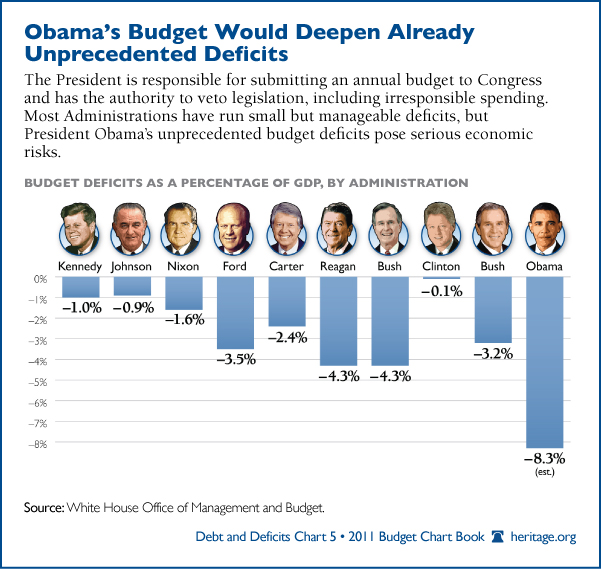
Over the last 10 presidents was have had 16.9% of GDP of deficits total from five Republican presidents and 12.7% total from Democratic presidents. However, what is most disturbing is that 8.3% of the 12.7% comes from the Obama administration who is currently in power and we are no longer in the cold war era. That is almost double the total of all the other four Democratic presidents combined under just one president. Take a look at the chart below from the Heritage Foundation:

Rob Bluey

January 1, 2012 at 9:56 am

Over the past 50 years, 10 U.S. presidents have made annual budget requests to Congress, projecting deficits both big and small. But no other president compares to Barack Obama when it comes to the size and scale of the current budget deficit facing the United States.

The country is facing an 8.3 percent estimated average national deficit of a two-term Obama administration — the biggest of the past 50 years. By comparison, the current estimate for Obama is nearly double the percentage under Presidents Ronald Reagan and George H.W. Bush — and they were fighting the Cold War.

Political party doesn’t tell the whole story, however. President Bill Clinton leads the pack of presidents since 1961, according to data from the White House Office of Management and Budget. Heritage put together this graphic as part of our Budget Chart Book.

So what does the current trajectory mean for the United States? We’re certainly no longer looking at a continuation of manageable deficits in the years to come. This is a dramatic change in the magnitude of annual shortfalls at the federal level. That’s one reason Heritage came up with a plan to fix the debt crisis.

If you have a suggestion for a chart we should feature in the future, please post a comment below, email us at scribe@heritage.org, or send me at tweet @RobertBluey.

_______________________
Here is a perspective from Dan Mitchell of the Cato Institute:

To Fix the Budget, Bring Back Reagan…or Even Clinton

Posted by Daniel J. Mitchell

President Obama unveiled his fiscal year 2012 budget today, and there’s good news and bad news. The good news is that there’s no major initiative such as the so-called stimulus scheme or the government-run healthcare proposal. The bad news, though, is that government is far too big and Obama’s budget does nothing to address this problem.

But perhaps the folks on Capitol Hill will be more responsible and actually try to save America from becoming a big-government, European-style welfare state. The solution may not be easy, but it is simple. Lawmakers merely need to restrain the growth of government spending so that it grows slower than the private economy.

Actual spending cuts would be the best option, of course, but limiting the growth of spending is all that’s needed to slowly shrink the burden of government spending relative to gross domestic product.

Fortunately, we have two role models from recent history that show it is possible to control the federal budget. This video from the Center for Freedom and Prosperity uses data from the Historical Tables of the Budget to demonstrate the fiscal policy achievements of both Ronald Reagan and Bill Clinton.

Spending Restraint, Part I: Lessons from Ronald Reagan and Bill Clinton

Uploaded by on Feb 14, 2011

Ronald Reagan and Bill Clinton both reduced the relative burden of government, largely because they were able to restrain the growth of domestic spending. The mini-documentary from the Center for Freedom and Prosperity uses data from the Historical Tables of the Budget to show how Reagan and Clinton succeeded and compares their record to the fiscal profligacy of the Bush-Obama years.

_____________________


Some people will want to argue about who gets credit for the good fiscal policy of the 1980s and 1990s.

Bill Clinton’s performance, for instance, may not have been so impressive if he had succeeded in pushing through his version of government-run healthcare or if he didn’t have to deal with a Republican Congress after the 1994 elections. But that’s a debate for partisans. All that matters is that the burden of government spending fell during Bill Clinton’s reign, and that was good for the budget and good for the economy. And there’s no question he did a much better job than George W. Bush.

Indeed, a major theme in this new video is that the past 10 years have been a fiscal disaster. Both Bush and Obama have dramatically boosted the burden of government spending — largely because of rapid increases in domestic spending.

This is one of the reasons why the economy is weak. For further information, this video looks at the theoretical case for small government and this video examines the empirical evidence against big government.

Another problem is that many people in Washington are fixated on deficits and debt, but that’s akin to focusing on symptoms and ignoring the underlying disease. To elaborate, this video explains that America’s fiscal problem is too much spending rather than too much debt.

Last but not least, this video reviews the theory and evidence for the “Rahn Curve,” which is the notion that there is a growth-maximizing level of government outlays. The bad news is that government already is far too big in the United States. This is undermining prosperity and reducing competitiveness.

Spending Restraint, Part II: Lessons from Canada, Ireland, Slovakia, and New Zealand

Uploaded by on Feb 22, 2011

Nations can make remarkable fiscal progress if policy makers simply limit the growth of government spending. This video, which is Part II of a series, uses examples from recent history in Canada, Ireland, Slovakia, and New Zealand to demonstrate how it is possible to achieve rapid improvements in fiscal policy by restraining the burden of government spending. Part I of the series examined how Ronald Reagan and Bill Clinton were successful in controlling government outlays — particularly the burden of domestic spending programs. http://www.freedomandprosperity.org


Cato Institute praises Bill Clinton’s restraint to spend, President Obama calls that level of spending “social darwinism”

Dan Mitchell always has some great cartoons he posts:

Michael Ramirez is a first-rate cartoonist for Investor’s Business Daily. Here are two of his recent gems.

As always, humor works when it is based on something true.

With that in mind, do you prefer this cartoon, which shows Obama scolding the Founding Fathers for their extreme libertarian views?

Or what about this cartoon, which makes the obvious point that growth is rather difficult when the productive sector of the economy is hobbled by too much government.

Obama on Ryan Plan: “It’s Laughable. It Is a Trojan Horse. It’s Thinly-Veiled Social Darwinism.”

Dan Mitchell of the Cato Institute has hit a home run with this post. If Congressman Paul Ryan could get criticized for wanting to bring down our federal spending to around 20% in 11 years  and earn the label of “social darwinist” from President Obama then surely President Obama would have thought President Clinton’s effort to cut spending to 18.2 % of GDP in 2001 as extremely devilish.

Actually, Bill Clinton must be something even worse than a social Darwinist. That’s because the title of this post is wrong. Obama said that Paul Ryan’s plan (which allows spending to grow by an average of 3.1 percent per year over the next decade) is a form of “social Darwinism.”

Proponent of social Darwinism?

But the proposal from the House Budget Committee Chairman only reduces the burden of federal spending to 20.25 percent of GDP by the year 2023.

Yet when Bill Clinton left office in 2001, following several years of spending restraint, the federal government was consuming 18.2 percent of economic output.

And by the President’s reasoning, this must make Clinton something worse than a Darwinist. Perhaps Marquis de Sade or Hannibal Lecter.

Here’s a blurb from the New York Times on Obama’s speech.

Mr. Obama’s attack, in a speech during a lunch with editors and reporters from The Associated Press, was part of a broader indictment of the Republican economic blueprint for the nation. The Republican budget, and the philosophy it represents, he said in remarks prepared for delivery, is “antithetical to our entire history as a land of opportunity and upward mobility for everyone who’s willing to work for it.” …“Disguised as a deficit reduction plan, it’s really an attempt to impose a radical vision on our country. It’s nothing but thinly veiled social Darwinism,” Mr. Obama said. “By gutting the very things we need to grow an economy that’s built to last — education and training, research and development — it’s a prescription for decline.”

I’m particularly amused by the President’s demagoguery that Ryan’s plan is “antithetical to our entire history” and “a radical vision.”

Is he really unaware that a small and constrained central government is part of America’s history and vision? Doesn’t he know that the federal government, for two-thirds of our nation’s history, consumed less than 5 percent of GDP?

Of course, that was back in the dark ages when people in Washington actually believed that the Constitution’s list of enumerated powers in Article 1, Section 8, actually enumerated the powers of the federal government. How quaint.

No wonder this Ramirez cartoon is so effectively amusing. It certainly seems to capture the President’s view of America’s founding principles.

Canada’s experience with lowering corporate tax

In the clip above we see President Obama in his earlier debate with Hillary Clinton and he answered the question concerning the drop in the capital tax by Bill Clinton and the resulting increase in revenues, that he still would raise the capital gains tax on the 100,000 million Americans that owned stock because of the issue of fairness.

It seems that the corporate tax in the USA is almost double the world average and it should be reduced. In fact, Canada reduced theirs dramatically and still brought in about the same revenue.

Canada’s Corporate Tax Cuts

by Chris Edwards

Chris Edwards is the director of tax policy studies at the Cato Institute and the editor of Downsizing Government.org.

Added to cato.org on March 13, 2012

This article appeared in Daily Caller on March 13, 2012.

The President Obama and most members of Congress agree that the U.S. corporate tax rate should be cut. Thankfully, it is finally sinking in that having a 40 percent corporate tax rate when the world average is just 23 percent is suicide in a globalized economy.

The sticking point on slashing the corporate tax rate has been the fear that the federal government might lose revenues under such a reform. To prevent an expected revenue loss, policymakers have searched for tax loopholes to close in order to “pay for” a corporate rate cut. The problem is that members never find any loophole closings that they can agree on.

I’ve concluded that the effort to close corporate loopholes is a big waste of time. It is simply blocking desperately needed reforms to the tax rate. If I was drafting a corporate tax reform bill, I’d match a tax rate cut with federal spending cuts, but that idea hasn’t caught on either.

Chris Edwards is the director of tax policy studies at the Cato Institute and the editor of Downsizing Government.org.


More by Chris Edwards

The good news is that a corporate tax rate cut without any changes to the tax base probably wouldn’t lose the government any money over the long term. Good evidence comes from Canada’s corporate tax cuts of the 1980s and 2000s.

The chart shows Canada’s federal corporate tax revenues as a share of gross domestic product (GDP) and the federal corporate tax rate. The tax rate plunged from 38 percent in 1980 to just 15 percent by 2012. Amazingly, there has been no obvious drop in tax revenues over the period.

Canadian corporate tax revenues have fluctuated, but the changes are correlated with economic growth, not the tax rate. In the late 1980s, a tax rate cut was followed by three years of stable revenues. In the early 1990s, a plunge in revenues was caused by a recession, and then in the late 1990s revenues soared as the economy grew.

In 2000, Canadian policymakers enacted another round of corporate tax rate cuts, which were phased in gradually. Corporate tax revenues initially dipped, but then they rebounded strongly in the late 2000s.

The rate cuts enacted in 2000 were projected to cause substantial revenue losses to the Canadian government. That projection indicates that the reform didn’t have much in the way of legislated loophole closing. But the chart shows that the positive taxpayer response to the rate cut was apparently so large that the government did not lose much, if any, revenue at all.

In 2009, Canada was dragged into a recession by the elephant economy next door, and that knocked the wind out of corporate tax revenues. However, it is remarkable that even with a recession and a tax rate under 20 percent, tax revenues as a share of GDP have been roughly as high in recent years as they were during the 1980s, when there was a much higher rate. Jason Clemens of the Macdonald-Laurier Institute notes that Canadian corporate tax revenues have been correlated with corporate profits, not the tax rate.

If a corporate tax rate is high, there is a “Laffer effect” when the rate is cut, meaning that the tax base expands so much that the government doesn’t lose any money. Estimates from Jack Mintz and other tax experts show that cutting corporate tax rates when they are above about 25 percent won’t lose governments any revenues over the long run.

The overall Canadian rate this year is about 27 percent when the average provincial rate is included. By contrast, the average federal-state rate in the United States is 40 percent, which is roughly 15 points above the revenue-maximizing rate. That means that Congress can proceed with a corporate rate cut and everyone would win — taxpayers, the economy and even the government.

Corporate tax reform with loophole closing is a wild-goose chase. Congress never seems to agree on which loopholes to close, with the result that our economy continues to suffer under a super-high rate. If we matched Canada by cutting our federal corporate rate from 35 percent to 15 percent, it would generate a large increase in reported income as corporate investment boomed and tax avoidance fell. The tax base would automatically expand without Congress even legislating reductions to deductions, credits or other loopholes.

In 2012, Canada will collect about 1.9 percent of GDP in federal corporate income tax revenues with a 15 percent tax rate. The United States will collect about 1.6 percent of GDP with a 35 percent tax rate. Do we need any more evidence that our high corporate tax rate makes no sense?

Bill Clinton condemns class-warfare and engages in it in same speech

President Bill Clinton’s Speech Oct 1, 2011 with Joshua & Anna at Little Rock Arkansas

Uploaded by on Oct 2, 2011

_______________________________

In this speech in Little Rock on October 1, 2011 former President Bill Clinton noted:

There is no example of a country in the fix we are in that can balance the budget without a combination of spending cuts, the people who can afford it paying more and growing the economy.

What was the secret of the Clinton Presidency? Clinton tells us in the same speech:

We decided to stop the politics of pitting one American against another by race…income, by anything else.

_________-

President Obama and other politicians are advocating higher taxes, with a particular emphasis on class-warfare taxes targeting the so-called rich. This Center for Freedom and Prosperity Foundation video explains why fiscal policy based on hate and envy is fundamentally misguided. For more information please visit our web page: www.freedomandprosperity.org.

I just don’t understand how a politician can say two things in the same speech that cancel each other out? John Brummett and Max Brantley love to try to act like all of our problems would be solved if we could take the money from the rich guy. Below is an article that makes some great points concerning class-warfare:

Soaking the Rich Is Not Fair

by Jeffrey A. Miron

Jeffrey A. Miron is Senior Lecturer and Director of Undergraduate Studies at Harvard University and Senior Fellow at the Cato Institute. Miron blogs at JeffreyMiron.com and is the author of Libertarianism, from A to Z.

Added to cato.org on September 2, 2011

This article appeared on The Huffington Post on September 2, 2011.

What is the “fair” amount of taxation on high-income taxpayers?

To liberals, the answer is always “more.” Liberals view high income — meaning any income that exceeds their own — as the result of luck or anti-social behavior. Hence liberals believe “fairness” justifies government-imposed transfers from the rich to everyone else. Many conservatives accept this view implicitly. They oppose soak-the-rich policies because of concern over growth, but they do not dispute whether such policies are fair.

But high tax rates on the rich are not fair or desirable for any other reason; they are an expression of America’s worst instincts, and their adverse consequences go beyond their negatives for economic growth.

The liberal hatred of the rich is a minority view, not a widely shared American value.

Consider first the view that differences in income result from luck rather than hard work: some people are born with big trust funds or innate skill and talent, and these fortuitous differences explain much of why some people have higher incomes than others.

Never mind that such a characterization is grossly incomplete. Luck undoubtedly explains some income differences, but this is not the whole story. Many trust fund babies have squandered their wealth, and inborn skill or talent means little unless combined with hard work.

But even if all income differences reflect luck, why are government-imposed “corrections” fair? The fact that liberals assert this does not make it true, any more than assertions to the contrary make it false. Fairness is an ill-defined, infinitely malleable concept, readily tailored to suit the ends of those asserting fairness, independent of facts or reason.

Worse, if liberals can assert a right to the wealth of the rich, why cannot others assert the right to similar transfers, such as from blacks to whites, Catholics to Protestants, or Sunni to Shia? Government coercion based on one group’s view of fairness is a first step toward arbitrary transfers of all kinds.

Now consider the claim that income differences result from illegal, unethical, or otherwise inappropriate behavior. This claim has an element of truth: some wealth results from illegal acts, and policies that punish such acts are appropriate.

But most inappropriate wealth accumulations results from bad government policies: those that restrict competition, enable crony capitalism, and hand large tax breaks to politically connected interest groups. These differences in wealth are a social ill, but the right response is removing the policies that promote them, not targeting everyone with high income.

The claim that soaking the rich is fair, therefore, has no basis in logic or in generating desirable outcomes; instead, it represents envy and hatred.

Why do liberals hate the rich? Perhaps because liberals were the “smart” but nerdy and socially awkward kids in high school, the ones who aced the SATs but did not excel at sports and rarely got asked to the prom. Some of their “dumber” classmates, meanwhile, went on to make more money, marry better-looking spouses, and have more fun.

Liberals find all this unjust because it rekindles their emotional insecurities from long ago. They do not have the honesty to accept that those with less SAT smarts might have other skills that the marketplace values. Instead, they resent wealth and convince themselves that large financial gains are ill-gotten.

Jeffrey A. Miron is Senior Lecturer and Director of Undergraduate Studies at Harvard University and Senior Fellow at the Cato Institute. Miron blogs at JeffreyMiron.com and is the author of Libertarianism, from A to Z.

More by Jeffrey A. Miron

The liberal views on fairness and redistribution are far more defensible, of course, when it comes to providing for the truly needy. Reasonable people can criticize the structure of current anti-poverty programs, or argue that the system is overly generous, or suggest that private charity would be more effective at caring for the least vulnerable.

The desire to help the poor, however, represents a generous instinct: giving to those in desperate situations, where bad luck undoubtedly plays a major role. Soaking the rich is a selfish instinct, one that undermines good will generally.

And most Americans share this perspective. They are enthusiastic about public and private attempt to help the poor, but they do not agree that soaking the rich is fair. That is why U.S. policy has rarely embraced punitive income taxation or an aggressive estate tax. Instead, Americans are happy to celebrate well-earned success. The liberal hatred of the rich is a minority view, not a widely shared American value.

For America to restore its economic greatness, it must put aside the liberal hatred of the rich and embrace anew its deeply held respect for success. If it does, America will have enough for everyone.

Related posts:

Warren Buffett does not endorse Obama’s plan

Addington, McConaghy Debate Obama’s Jobs Plan Published on Sep 9, 2011 by Bloomberg Sept. 9 (Bloomberg) — David Addington, vice president at the Heritage Foundation, and Ryan McConaghy, economic director at Third Way, discuss President Barack Obama’s $447 billion jobs plan. They speak with Deirdre Bolton and Erik Schatzker on Bloomberg Television’s “InsideTrack.” (Source: Bloomberg) […]

Is soaking the rich fair?

Is soaking the rich fair? Five Key Reasons to Reject Class-Warfare Tax Policy Uploaded by afq2007 on Jun 15, 2009 President Obama and other politicians are advocating higher taxes, with a particular emphasis on class-warfare taxes targeting the so-called rich. This Center for Freedom and Prosperity Foundation video explains why fiscal policy based on hate […]

Is it class warfare? Brummett says no

Take a look above at this clip. In his article “Class Warfare versus Pay it forward,” Sept 26, 2011, Arkansas News Bureau, John Brummett tries to make the case that Obama is not involved in class warefare. He quotes Elizabeth Warren to prove his point. Unfortunately, logically this argument fails because although we all benefit […]

Obama’s tax plan would not work even if tried

The Flat Tax: How it Works and Why it is Good for America Uploaded by afq2007 on Mar 29, 2010 This Center for Freedom and Prosperity Foundation video shows how the flat tax would benefit families and businesses, and also explains how this simple and fair system would boost economic growth and eliminate the special-interest […]

Three points where Brummett misses the boat in discussion versus Charlie Collins

Five Key Reasons to Reject Class-Warfare Tax Policy Uploaded by afq2007 on Jun 15, 2009 President Obama and other politicians are advocating higher taxes, with a particular emphasis on class-warfare taxes targeting the so-called rich. This Center for Freedom and Prosperity Foundation video explains why fiscal policy based on hate and envy is fundamentally misguided. […]

President Obama and Alternative Minimum Tax

President Obama and Alternative Minimum Tax Dan Mitchell does it again. He is always right on the mark. CPAs Celebrate as Obama Proposes to Create a Turbo-Charged Alternative Minimum Tax Posted by Daniel J. Mitchell Wow, this is remarkable. The alternative minimum tax (AMT) is one of the most-hated features of the tax code. It […]

Buffett wants the rich soaked but that will not solve our problem in the budget

Max Brantley on the Arkansas Times Blog, August 15, 2011, asserted: Billionaire Warren Buffett laments, again, in a New York Times op-ed how the rich don’t share the sacrifices made by others in the U.S.. He notes his effectiie tax rate of 17 percent is lower than that of many of the working people in his office on account of preferences for […]

Brummett touts Buffett’s math, but it is wrong

Five Key Reasons to Reject Class-Warfare Tax Policy Max Brantley on the Arkansas Times Blog, August 15, 2011, asserted:   Billionaire Warren Buffett laments, again, in a New York Times op-ed how the rich don’t share the sacrifices made by others in the U.S.. He notes his effectiie tax rate of 17 percent is lower than […]

AETN presented fair and balanced view of Clinton on 2-21-12 panel discussion

I have watched the 4 hour series on the Clinton Presidency on PBS, but I was even more impressed with the fair and balanced view of Clinton given by the Arkansas journalists and historians on the AETN show that aired on 2-12-12. The show also included former Bush aide French Hill too.

The documentary had included according to the Washingtonian: 

 There are close friends and advisers: David Gergen, Wesley Clark, Mike McCurry, Dick Morris, Sidney Blumenthal, Harold Ickes, James Carville, Dee Dee Myers, Leon Panetta, Mark Penn, Joe Purvis, Robert Reich, Robert Rubin, John Podesta, Harry Thomason, and Betsy Wright. One wonders, though, where is good friend and first White House chief of staff Mack McLarty?

Meanwhile, a boatload of journalists have their say, including Christiane Amanpour, Jonathan Alter, Max Brantley, John Harris, David Maraniss, and Jeffrey Toobin.

MIAMI, FL - FEBRUARY 19:  Former U.S. President Bill Clinton watches a game between the Miami Heat and the Orlando Magic at American Airlines Arena on February 19, 2012 in Miami, Florida.
Mike Ehrmann, Getty Images

The show started off with all the members of the panel summing up what Bill Clinton meant to Arkansas history.

Max Brantley of the Arkansas Times Blog observed:

From my point of view he began Arkansas history although we had some giants before he came along. I think the test about Bill Clinton is that we still talk about him so much, and he still is a such a large figure on the world stage with his continuing effort to build a legacy through his foundation.

In the film journalist Joe Klein said about the Gennifer Flowers affair, “The rumors of him messing around were out there. Not only did she appear, but she was a lounge singer!”

This brings me to an observation by Dr. Randall Woods, professor of history, University of Arkansas:

I must say and this will get me in trouble, JFK was having affairs with Marilyn Monroe and Angie Dickinson and you get, forgive me, Gennifer Flowers (with Bill Clinton). I am sorry but it creates this trailer trash kind of, not only was Clinton having affairs, he wasn’t having affairs with the right sort of people and JFK was.

I was surprised that there was so much harmony on the panel discussion concerning Clinton’s presidency. When I thought about the main points of the discussion it became apparent to me that unlike President Obama, Clinton was more of a pragmatist who could learn how to deal with the other party when it was necessary. That served Clinton well and got him two full terms. It was pointed out in the show that had not happened for a Democrat since FDR.

Bill Clinton on inauguration day 1997. Photograph courtesy of Flickr user <a href="http://www.flickr.com/photos/pingnews/514592106/" target="blank">pingnews.com</a>.
Bill Clinton on inauguration day 1997.

_________________

A lot of good articles have been written about the Clinton documentary and I have put some links below:

Clinton documentaries | The Televisionist | Arkansas news, politics  (Arkansas Times)

He said, she said, they said – Arkansas Online  (Arkansas Democrat-Gazette, pay wall)

WGBH American Experience . Clinton . Participants List | PBS

Here is a good roundup of the series from of the series from AETN:

‘American Experience’ profiles 42nd president in ‘Clinton’ airing on AETN Feb. 20,21

Posted on 01 Feb 2012

“Clinton,” the latest installment in the critically acclaimed and successful collection of presidential biographies by “American Experience,” explores the story of an American president who rose from a turbulent childhood in Arkansas to become one of the most successful politicians in modern American history and one of the most complex and conflicted characters ever to stride across the public stage. “Clinton” airs on the Arkansas Educational Television Network (AETN) in two parts Monday, Feb. 20, at 8 p.m. and Tuesday, Feb. 21, at 7 p.m.

At the conclusion of part two on Feb. 21 at 9 p.m., AETN will air the locally produced follow-up “The Clinton Years: An Arkansas Perspective.” Among those featured in “Clinton” and the AETN follow-up are Arkansans journalists Max Brantley, editor of the Arkansas Times and former reporter for the Arkansas Gazette, and Ernie Dumas, columnists for the Arkansas Times.

From draft dodging to the Dayton Accords, from Monica Lewinsky to a balanced budget, the presidency of William Jefferson Clinton veered between sordid scandal and grand achievement. It recounts a career of accomplishment and scandal, a marriage that would make history and create controversy, and a presidency that would define the crucial and transformative period between the fall of the Berlin Wall and 9/11. It follows Clinton across his two terms as he confronted some of the key forces that would shape the future, including partisan political warfare and domestic and international terrorism, and struggled, with uneven success, to define the role of American power in a post-Cold War world. Most memorably, it explores how Clinton’s conflicted character made history, even as it enraged his enemies and confounded his friends.

Directed by Emmy and Peabody Award-winner Barak Goodman, “Clinton” features unprecedented access to scores of Clinton insiders, including: White House Press Secretary Dee Dee Myers; White House Counsel Bernard Nussbaum; former White House Chief of Staff Leon Panetta (current Secretary of Defense); former Senator Trent Lott; Deputy Chief of Staff Harold Ickes; as well as interviews with dozens of journalists, members of the Republican opposition, childhood friends, staffers from Clinton’s years as Governor of Arkansas, and biographers.

“William Jefferson Clinton is a lightning rod in American history,” Mark Samels, executive producer of “American Experience,” said. “It’s hard to find anyone who is neutral about the man or his presidency.

“The complex dynamic between his public accomplishments and his personal foibles makes him endlessly fascinating. At ‘American Experience’ we like to explore the people who have shaped the times in which they live, and Bill Clinton, both charismatic and confounding, certainly had a profound effect on the country during his presidency.”

The four-hour program will air in two episodes:

• “The Comeback Kid,” Monday, Feb. 20, at 8 p.m.
“The Comeback Kid” follows Clinton’s bumpy road to the 1992 presidential victory, a triumph over repeated scandals and setbacks, through the first two years of his presidency. From the political backwaters of Arkansas, Clinton emerges as a political force unlike any seen on the national stage in a generation. He is determined from the start to succeed, first in Arkansas, then at Georgetown, Oxford and finally Yale. There he meets a young woman named Hillary Rodham who shares his intellect and idealism. Together they forge a marriage and political partnership that takes them to the Arkansas governor’s mansion and ultimately the White House, an election Clinton wins despite a campaign repeatedly under siege by allegations ranging from draft dodging to womanizing. The tumultuous first two years of the Clinton presidency see the beginning of the Whitewater scandal, the death of Deputy White House Counsel Vince Foster, and the defeat of Hillary’s healthcare bill. Although the administration has its domestic successes, troubles brewing in the remote countries of Somalia and Rwanda and the arrival of a new and formidable rival named Newt Gingrich threaten to derail the Clinton presidency before it ever gets off the ground. When Republicans gain control of Congress in the midterm elections, the entire political landscape shifts to the right, leaving Clinton seemingly bereft of power.

__________________

American Experience | Passing the Budget Bill | PBS

• “The Survivor,” Tuesday, Feb. 21, at 7 p.m.
Shattered by the 1994 Republican victory, Clinton begins to sideline his most trusted advisors in favor of an aggressive political consultant named Dick Morris, who uses extensive polling to diagnose the administration’s weaknesses and develop strategies to correct them. The Republican “Contract with America” is riding high and by spring of 1995, Gingrich and his allies select the ground on which to wage their war: a plan to eliminate the federal budget deficit by drastically cutting Medicare and Medicaid. The plan leads to a government shutdown, and slowly the tide begins to turn toward the president, who reclaims the political center with a stream of new initiatives that will curb big government and appeal to middle class families. Clinton wins the 1996 election in a landslide, pulling off one of the greatest turnarounds in political history. He sails buoyantly into his second term: times are good, the economy is booming, and American prestige and power internationally are at an all-time high. Clinton’s dream of repairing the breach with Republicans seems within reach. But, Clinton’s affair with Monica Lewinsky becomes public after she confides in a co-worker named Linda Tripp. The ensuing scandal gives Independent Counsel Kenneth Starr the ammunition he needs to recharge his stalled investigation of the Whitewater affair. Congress initiates impeachment hearings, but the Republican leadership fails to remove Clinton from office. And when Starr’s report is finally released, the ire of the American public is focused more on the independent counsel than the president. Although Clinton survives the ordeal, he fails to reclaim the drive and zeal with which he began his presidency.

“Clinton” will repeat in its entirety Sunday, Feb. 26, beginning at 12:30 p.m.

Clinton is the 16th episode in the “American Experience” presidents series. Previous programs in the series have included “LBJ,” “Nixon,” “FDR,” “Jimmy Carter,” “Reagan” and “George H.W. Bush.”

Television’s most-watched history series, “American Experience” has been hailed as “peerless” (Wall Street Journal), “the most consistently enriching program on television” (Chicago Tribune), and “a beacon of intelligence and purpose” (Houston Chronicle). On air and online, the series brings to life the incredible characters and epic stories that have shaped America’s past and present. Acclaimed by viewers and critics alike, “American Experience” documentaries have been honored with every major broadcast award, including 14 George Foster Peabody Awards, four duPont-Columbia Awards, and 30 Emmy Awards, including, most recently, Exceptional Merit in Nonfiction Filmmaking for “Freedom Riders.” Exclusive corporate funding for “American Experience” is provided by Liberty Mutual. Major funding provided by the Alfred P. Sloan Foundation, the Corporation for Public Broadcasting and public television viewers. “American Experience” is produced for PBS by WGBH Boston.

Brummett on Clinton TV Special

American Experience | Clinton | Chapter 1 | PBS

John Brummett discusses the Clinton special that comes on tv tonight on PBS. I enjoyed the film a lot but I did notice some things that I did not know. Betsy Wright nixed his run for the presidency in 1988. I never knew that.

I remember seeing Clinton at the movie theater (on Merrill St in Little Rock) with his family the weekend after he made the announcement that he would not run for president in 1988. I remember thinking that he really meant it when he said he was going to concentrate on family time. However, we later learned from a friend of mine in Benton that he had a mistress out there.

I never believed my friend but later I noticed in the newspapers in 1992 that when Flowers came home from Dallas to visit her parents that she always went to Benton. Evidently he planned in 1988 to spend more time with Flowers than he was letting on.

Our Boy Bill

Near-great or disastrous failure?

By John Brummett

This article was published February 19, 2012 at 3:30 a.m

LITTLE ROCK — Even in the early 1980s-that is 30 years ago, for heaven’s sake-someone joked at a charity roast-and-toast in Little Rock that there was nothing left to say about Bill Clinton that had not been said already.

So perhaps you will recoil at the prospect of spending four hours over two nights beholding a televised documentary on his life.

That’s especially the case considering that I am here to tell you that the four hours do not offer anything new. There is certainly nothing as spicy in this film as that woeful public dialogue in which we engaged in 1998 over oral sex.

Nonetheless, I hereby tout for your viewing interest and even edification, if not exactly pleasure, the latest installment of American Experience, the stellar signature documentary series on PBS. It will air from 8 to 10 p.m. Monday and from 7 to 9 p.m. Tuesday to explore the subject of-yes-the life and governorship and presidencyof Our Boy Bill Clinton.

I should tell you that the Washington Post, reviewing an advance screening, calls the program “honest but sometimes tediously predictable.”

_________________

American Experience | Passing the Budget Bill | PBS

It may be that the 1990s are not yet so long ago that we can consider Clinton and his presidency throughany meaningful historical lens. After all, neither Bill nor his wife Hillary has yet left the public square. As the old saying goes: How can I miss you if you will not go away?

The Post wonders why the program comes now. PBS points out in a news release that Monday is “Presidents’ Day.” Otherwise, I cannot rightly say.

But what I can tell you is that I’ve seen the program, thanks to an online download of Part 1 and the gift of a DVD of Part 2 from the Arkansas Education Television Network.

And I can tell you that what I liked most was the very thing the Post noted critically. It is that the film is honest and tediously predictable.

It does not sensationalize. It does not seek contrived or overcooked new revelation for a popular hook.

It does not freshly interview Bill or Hillary, since the film is about them, not by them. But nor does it freshly interview many avowed enemies.

Mainly it interviews friends, aides and journalists, more than 50 of whom make talking-head appearances only in snippets and only to advance the narrative.

The film told me not a single thing I did not know already. But what it did was let a compelling personal story, a great American story, refresh itself by pretty much telling itself.

Ponder for a second where Clinton came from and where he ventured. Ponder all the personal dramas that beset him along the way, morepersonal dramas by far than those experienced by any other politician of our time.

No, on second thought: Don’t ponder that yet. Tune in and let this documentary remind and guide you, which is the film’s presumed purpose and value.

In its most tedious honesty, the program does not dare seek a conclusion as to whether Clinton is good or bad. He is-famously, starkly, uncommonly, incurably-both.

Clinton connects with people genuinely and deeply. Then he lies to their faces.

He is the man who drops to a knee to hug a seated and crying woman in New Hampshire who has just toldhim at a campaign event that she can’t afford her $200-a-month prescription medicine bill.

Then he is the man who phones the profoundly creepy Dick Morris to talk about polling Americans on whether he should tell the truth about what he did with that woman,Miss Lewinsky.

If the question is whether Clinton was a near-great president or a disastrously failed one, then the answer is . . . Which year? Which moment?

Surely history will record that he left the White House with the country a richer and better place. But that assumes history will not linger on his leaving the White House having just pardoned some super-rich con whose wife had anted up for the presidential library.

Arkansas viewers may enjoy most Part 1 covering the Arkansas years.

For one thing, the ’80s are longer ago than the ’90s. For another, several Arkansas scenes are shown and several Arkansas people are presented briefly to advance the narrative. You have Bobby Roberts, Betsey Wright, Paul Fray, Carolyn Staley, Marla Crider, Joe Purvis and three of us who were with the old Arkansas Gazette in those days.

If you cannot bring yourself to watch, maybe you could record these hours for viewing later when historic context might make more sense to you.

Even if the time seems wrong, and even if the honest telling is tedious, the tale is a good one and the film is worthy.

John Brummett is a regular columnist for the Arkansas Democrat-Gazette. Email him at jbrummett@arkansasonline.com. Read his blog at brummett.arkansasonline.com.

Related posts:

Brummett on Wall Street Occupiers

Below is a portion of an article by John Brummett published in the Arkansas Democrat Gazette and my response to it. Speaking for the occupiers By John Brummett …But it seems to me that, while they surely vary, these occupiers don’t necessarily protest anybody’s greed. That’s a personal flaw. Nor do they protest anyone’s success. […]

Brummett wants Charter schools to show public schools how to do it

John Brummett (10-26-11, Arkansas Democrat-Gazette online edition) does not want charter schools to put public schools out of business but he wants them to show public schools how to do it. (Paywall) I seek in these matters a kind of Clintonian third-way finesse: I support charter schools only to the extent that they should be […]

New film on Bill Clinton and Monica

AMERICAN EXPERIENCE | CLINTON | Interviews & Preview | PBS Uploaded by PBS on Jan 30, 2012 Coming to PBS beginning Monday, Feb. 20. From draft dodging to the Dayton Accords, from Monica Lewinsky to a balanced budget, the presidency of William Jefferson Clinton veered between sordid scandal and grand achievement. In CLINTON, the latest […]

New details about Clinton’s thoughts during Lewinsky scandal

Bill Clinton admits to having inappropriate relationship with Monica Lewinsky Uploaded by iconic on Nov 18, 2010 Bill Clinton admits to having inappropriate relationship with Monica Lewinsky. ______________________________ After the story I have some links to related posts. Bill Clinton Struggled to Deal With Lewinsky Affair, Film Says By Huma Khan | ABC News – Mon, Feb […]

Cato Institute gives Bill Clinton credit

Cato Institute gives Bill Clinton credit Spending Restraint, Part I: Lessons from Ronald Reagan and Bill Clinton Uploaded by afq2007 on Feb 14, 2011 Ronald Reagan and Bill Clinton both reduced the relative burden of government, largely because they were able to restrain the growth of domestic spending. The mini-documentary from the Center for Freedom […]

White House interns again?

Bill Clinton said he always wanted to be like JFK. Earlier I posted about the recent claim of a White House intern who claimed to have a 18 month affair with JFK. Now I wanted to take a look back at the scandal in 1998 and I have included some info on Newt’s misdeeds and […]

Bush tax cuts work? Is Clinton’s approach better? (Part 3)

The Laffer Curve, Part III: Dynamic Scoring A video by CF&P Foundation that builds on the discussion of theory in Part I and evidence in Part II, this concluding video in the series on the Laffer Curve explains how the Joint Committee on Taxation’s revenue-estimating process is based on the absurd theory that changes in […]

Bush tax cuts work? Is Clinton’s approach better? (Part 2)

The Laffer Curve, Part II: Reviewing the Evidence This video reviews real-world evidence showing that changes in marginal tax rates can have a significant impact on taxable income, thus leading to substantial amounts of revenue feedback. In a few cases, tax-rate reductions even “pay for themselves,” though the key lesson is the more modest point […]

Bush tax cuts work? Is Clinton’s approach better? (Part 1)

The Laffer Curve, Part I: Understanding the Theory The Laffer Curve charts a relationship between tax rates and tax revenue. While the theory behind the Laffer Curve is widely accepted, the concept has become very controversial because politicians on both sides of the debate exaggerate. This video shows the middle ground between those who claim […]

Reagan and Clinton had good fiscal policies according to Cato Institute

Uploaded by HeritageFoundation on Dec 16, 2010 http://blog.heritage.org/2010/12/16/new-video-pork-filled-spending-bill-just-… Despite promises from President Obama last year and again last month that he opposed reckless omnibus spending bills and earmarks, the White House and members of Congress are now supporting a reckless $1.1 trillion spending bill reportedly stuffed with roughly 6,500 earmarks. ________________________ Below you see an […]

Bill Clinton is funny, there is no doubt about that

Bill Clinton is funny, there is no doubt about that I first met Bill Clinton in 1983 in a small meeting in Little Rock at the Excelsior Hotel where he later had the run in with Paula Jones in May of 1991. Clinton was late for our meeting with 30 small business owners and he was very […]

Bill Clinton condemns class-warfare and engages in it in same speech

President Bill Clinton’s Speech Oct 1, 2011 with Joshua & Anna at Little Rock Arkansas Uploaded by bdbaas1 on Oct 2, 2011 _______________________________ Recently while being critical of Lt. Governor Mark Darr, the liberal columnist John Brummett asserted, “Partisan debate is good, indeed vital. Partisan obstruction is not. And not knowing what you’re talking about […]

New film on Bill Clinton and Monica

AMERICAN EXPERIENCE | CLINTON | Interviews & Preview | PBS

Uploaded by on Jan 30, 2012

Coming to PBS beginning Monday, Feb. 20. From draft dodging to the Dayton Accords, from Monica Lewinsky to a balanced budget, the presidency of William Jefferson Clinton veered between sordid scandal and grand achievement. In CLINTON, the latest installment in the critically acclaimed and successful series of presidential biographies, AMERICAN EXPERIENCE explores the fascinating story of an American president who rose from a broken childhood in Arkansas to become one of the most successful politicians in modern American history and one of the most complex and conflicted characters to ever stride across the public stage. It recounts a career full of accomplishment and rife with scandal, a marriage that would make history and create controversy and a presidency that would define the crucial and transformative period between the fall of the Berlin Wall and 9/11. It follows Clinton across his two terms as he confronted some of the key forces that would shape the future, including partisan political warfare and domestic and international terrorism, and struggled, with uneven success, to define the role of American power in a post-Cold War world. Most memorably, it explores how Clinton’s conflicted character made history, even as it enraged his enemies and confounded his friends. The program features unprecedented access to scores of Clinton insiders including White House Press Secretary Dee Dee Myers, White House Counsel Bernard Nussbaum, White House Chief of Staff Leon Panetta and Deputy Chief of Staff Harold Ickes, as well as interviews with foreign leaders, members of the Republican opposition, childhood friends, staffers from Clinton’s years as governor of Arkansas, biographers and journalists.

___________________

I read this on the Arkansas Times Blog and in the LA Times. The LA Times reported:

Monica Lewinsky has attempted to keep a low-profile after her role in President Bill Clinton‘s impeachment scandal made her name the butt of many late-night jokes. But she’s likely to become a topic of discussion again when PBS airs its much anticipated two-part, four-hour documentaryon the former president, titled “Clinton.”

The documentary, which premieres on PBS as part of its “American Experience” series on Monday, will shed new light on Clinton’s Oval Office affair with his 23-year-old intern through interviews with some of Clinton’s closest advisors, some of whom are speaking publicly about the affair for the first time.

Among the former White House staffers appearing on camera are Secretary of Labor Robert Reich and Clinton’s former reelection campaign manager, Dick Morris.


In the doc, Morris reveals, “When the Lewinsky scandal broke the President paged me and I returned the call. And he said, ‘Ever since I got here to the White House I’ve had to shut my body down, sexually I mean, but I screwed up with this girl. I didn’t do what they said I did, but I may have done so much that I can’t prove my innocence.’ ”

Though she plays a huge role in the story of Bill Clinton’s presidency, Lewinsky herself was not interviewed for the documentary. Producer Barak Goodman said at a Television Critics Assn. panel in January of the decision, “We felt it would tilt [the documentary] toward sensationalism.”

After the scandal, Lewinsky went through a period of alternately embracing and avoiding her celebrity. She attended the Oscars with Sir Ian McKellan, became a spokeswoman for Jenny Craig, hosted a reality show called “Mr. Personality,” was a correspondent for a British news program and sold a line of handbags.

In 2005, she left the U.S. and moved to London, attending the London School of Economics and graduating with a masters in social psychology in 2006. Though she has given interviews on the subject of the Clinton affair, most notably in an HBO special titled “Monica in Black and White,” she has kept an extremely low profile in recent years.

‘Clinton’ is the latest in a series of in-depth documentaries PBS has produced over the years focusing on the careers of U.S. presidents. For those who can’t wait, PBS has made the first part of the documentary available on its website.

This was first published by LATimes.com.

Monica LewinskyMonica Lewinsky at Men’s Health and Best Life magazines book release party for ‘Blunt’ (Scott Gries, Getty Images for Rodale) 

Here also is a summary by the Arkansas Times Max Brantley:

“Clinton,” the latest presidential profile by PBS’ American Experience, airs at what turns out to be a very good time.

These meticulously researched and artfully produced biographies — the two, two-hour episodes of “Clinton” will air Feb. 20-21 on AETN — are completed at a safe remove from the subject’s time in office. Insiders are more willing to talk. History has begun to firm up assessments. “Clinton” has more currency than normal thanks to the race for the Republican presidential nomination and Newt Gingrich’s emergence as a strong contender. Gingrich is a critical player in the second half of the Clinton biography. He led the political insurgency that gave Republicans a House majority and made Gingrich, however briefly, a near royal House speaker. You know, too, how it turned out. Clinton stared down a government shutdown, made Gingrich his poodle and survived the Republican coup attempt. Gingrich resigned amid an ethics scandal, but, like the president himself, has proven himself a “Comeback Kid.” As the documentary attests, his prior time in the limelight doesn’t argue for his presidency today.

And what of Clinton? It’s all there. The empathy, the energy, the appetite, the flaws, the triumphs. If the last happened to be more often political victories than historic achievements, the country did enjoy great prosperity and notable foreign policy achievements. Clinton gets credit even though he spent barely a day without

Republicans or a persecutorial prosecutor in hot pursuit. His triangulation of issues gets careful and properly critical examination — though it comes courtesy of too much explanatory air time for Dick Morris, the reptilian political adviser for whom Clinton had such a deep need.

Award-winning documentary director Barak Goodman concludes that Clinton found no triumph in surviving trial in the Senate, only a loss of the drive with which he began his presidency amid so much hope. If that’s so — and I’m not so sure — he regained his drive soon enough.

He began running, with some success, to be the most popular political figure in the world. He has been helped by a foundation doing nothing less than attempting to solve world hunger and disease. That was worth a documentary postscript, I think.

This documentary focuses more attention on the first lady than most, but Kenneth Starr (yes, he gave an interview) went after her just as hard, maybe harder, than he went after the president himself. She’s secretary of state, you might have heard. He’s president of a Bible college.

For Arkies: Lots of good TV footage and photos of the early years in Arkansas in the first installment.

Related posts:

New details about Clinton’s thoughts during Lewinsky scandal

Bill Clinton admits to having inappropriate relationship with Monica Lewinsky Uploaded by iconic on Nov 18, 2010 Bill Clinton admits to having inappropriate relationship with Monica Lewinsky. ______________________________ After the story I have some links to related posts. Bill Clinton Struggled to Deal With Lewinsky Affair, Film Says By Huma Khan | ABC News – Mon, Feb […]

Cato Institute gives Bill Clinton credit

Cato Institute gives Bill Clinton credit Spending Restraint, Part I: Lessons from Ronald Reagan and Bill Clinton Uploaded by afq2007 on Feb 14, 2011 Ronald Reagan and Bill Clinton both reduced the relative burden of government, largely because they were able to restrain the growth of domestic spending. The mini-documentary from the Center for Freedom […]

White House interns again?

Bill Clinton said he always wanted to be like JFK. Earlier I posted about the recent claim of a White House intern who claimed to have a 18 month affair with JFK. Now I wanted to take a look back at the scandal in 1998 and I have included some info on Newt’s misdeeds and […]

Bush tax cuts work? Is Clinton’s approach better? (Part 3)

The Laffer Curve, Part III: Dynamic Scoring A video by CF&P Foundation that builds on the discussion of theory in Part I and evidence in Part II, this concluding video in the series on the Laffer Curve explains how the Joint Committee on Taxation’s revenue-estimating process is based on the absurd theory that changes in […]

Bush tax cuts work? Is Clinton’s approach better? (Part 2)

The Laffer Curve, Part II: Reviewing the Evidence This video reviews real-world evidence showing that changes in marginal tax rates can have a significant impact on taxable income, thus leading to substantial amounts of revenue feedback. In a few cases, tax-rate reductions even “pay for themselves,” though the key lesson is the more modest point […]

Bush tax cuts work? Is Clinton’s approach better? (Part 1)

The Laffer Curve, Part I: Understanding the Theory The Laffer Curve charts a relationship between tax rates and tax revenue. While the theory behind the Laffer Curve is widely accepted, the concept has become very controversial because politicians on both sides of the debate exaggerate. This video shows the middle ground between those who claim […]

Reagan and Clinton had good fiscal policies according to Cato Institute

Uploaded by HeritageFoundation on Dec 16, 2010 http://blog.heritage.org/2010/12/16/new-video-pork-filled-spending-bill-just-… Despite promises from President Obama last year and again last month that he opposed reckless omnibus spending bills and earmarks, the White House and members of Congress are now supporting a reckless $1.1 trillion spending bill reportedly stuffed with roughly 6,500 earmarks. ________________________ Below you see an […]

Bill Clinton is funny, there is no doubt about that

Bill Clinton is funny, there is no doubt about that I first met Bill Clinton in 1983 in a small meeting in Little Rock at the Excelsior Hotel where he later had the run in with Paula Jones in May of 1991. Clinton was late for our meeting with 30 small business owners and he was very […]

Bill Clinton condemns class-warfare and engages in it in same speech

President Bill Clinton’s Speech Oct 1, 2011 with Joshua & Anna at Little Rock Arkansas Uploaded by bdbaas1 on Oct 2, 2011 _______________________________ Recently while being critical of Lt. Governor Mark Darr, the liberal columnist John Brummett asserted, “Partisan debate is good, indeed vital. Partisan obstruction is not. And not knowing what you’re talking about […]

Let’s turn the table on Brummett’s comedy at Republicans’ expense

John Brummett enjoyed an evening of comedy at Republicans’ expense. Let me make two points here. First, Lorne Michaels who runs Saturday Night Live observed that it is Republicans that are better at laughing at the jokes directed to them than the Democrats. Many times Democrats get offended. Second, I laugh at all the jokes […]

New details about Clinton’s thoughts during Lewinsky scandal

Bill Clinton admits to having inappropriate relationship with Monica Lewinsky

Uploaded by on Nov 18, 2010

Bill Clinton admits to having inappropriate relationship with Monica Lewinsky.

______________________________

After the story I have some links to related posts.

Bill Clinton Struggled to Deal With Lewinsky Affair, Film Says

ABC NewsBy Huma Khan | ABC News – Mon, Feb 13, 2012

George Bridges/AFP/getty Images

Bill Clinton apparently struggled with whether to talk publicly about his affair with White House intern Monica Lewinsky, as his aides were surprised, even dismayed, about his relationship with the 23-year-old.

A new documentary focusing on Clinton’s life and presidency reveals that he contacted pollster Dick Morris to gauge whether he should come out with the truth when news of the affair broke.

“He said, ‘Ever since I got here to the White House I’ve had to shut my body down sexually I mean, but I screwed up with this girl. I didn’t do what they said I did, but I may have done so much that I can’t prove my innocence,'” Morris recalls in the film “Clinton,” which was written and directed by Barak Goodman.

“And I said to him, ‘The problem that presidents have is not the sin, it’s the cover up and you should explore just telling the American people the truth.’ He said, ‘Really, do you think I could do that?’ And I said, ‘Let me test it, let me run a poll.’ So I took a poll and I tested popular attitudes on that and I called him back and I said, ‘They will forgive the adultery, but they won’t easily forgive that you lied,'” Morris says in the documentary to air on PBS next week.

Meanwhile, several of Clinton’s aides were convinced he was set up.

“He’s got all these enemies who are out to get him,” Clinton’s labor secretary, Robert Reich, said in the film. “He wouldn’t be so stupid as to jeopardize his entire presidency. For what? No, that was not the Bill Clinton I knew.”

Clinton first denied the affair that broke out in the news media in 1998, famously saying he “did not have sexual relations with that woman.” He later admitted to oral sex with the young intern and said his relationship with Lewinsky was wrong and inappropriate.

“I am profoundly sorry for all I have done wrong in words and in deeds,” he said Dec. 11 1998. “I never should have misled the country, the Congress, my friends or my family. Quite simply, I gave in to my shame.”

Although his subsequent impeachment made him only the second U.S. president to be impeached, Clinton’s aides say that in a way, the former president himself set up barriers that he could then leap across and he was always confident he could find his way back.

“How many second chances does any one person deserve?” his former press secretary, Dee Dee Myers, said in the film. “Clinton’s view is as many second chances as a person is willing to try to take. As many times as you fail, don’t you deserve the chance to redeem yourself? Isn’t history loaded with people who have fallen and gotten up, fallen and gotten up and done great things?”

The documentary also details the challenges Hillary Clinton faced as first lady. Clinton was, behind the scenes, a powerful force in the White House but aides said her strengths often turned into his weaknesses.

“Voters thought that it was a zero-sum game, that for Hillary to be strong, Bill would have to be weak, and as a result the perception of Hillary’s strength became a perception of Bill’s weakness,” Morris said.

Hillary Clinton was blamed by many for a weak turnout in the 1994 election and for the failure of the administration’s health care reform plan in 1993 that failed to gain momentum.

“She was outspoken, she was smart, she was hard driving, and some people resented her,” Clinton’s Deputy Chief of Staff Harold Ickes said in the film. “Remember during the campaign, it was two for the price of one, well people aren’t electing two for the price of one. They’re electing the president.”

The documentary airs on PBS Feb. 20-21, as part of  its “American Experience” series.

Related posts: 

Timeline of Newt’s affairs

Here is the timeline of Newt’s affairs from the Huffington Post article dated 7-11-11: On Wednesday, Newt Gingrich is expected to formally announce he’ll be running for President in the 2012 election. The former Speaker of the House, whose past infidelities and messy divorces have long been fixtures in the press, is hardly the only […]

White House interns again?

Bill Clinton said he always wanted to be like JFK. Earlier I posted about the recent claim of a White House intern who claimed to have a 18 month affair with JFK. Now I wanted to take a look back at the scandal in 1998 and I have included some info on Newt’s misdeeds and […]

Picture of Mimi Alford who claims to have had 18 month affair with JFK

The issue of White House interns has come up before. One of the late night shows commented that Newt knew exacting what he was going to do on the first day as president: “Rehire Monica Lewinsky!!!” I have talked about this issue before and have linked several related articles below. There are several articles about […]

Schwarzenegger kids dealing with betrayal before whole world

Arnold Schwarzenegger FILE – In this April 4, 2011 file photo, actor and former California Gov. Arnold Schwarzenegger, poses after receiving the insignia of Chevalier in the Order of the Legion of Honor during the MIPTV (International Television Programme Market) in Cannes, southern France. Schwarzenegger delayed his Hollywood comeback Thursday, May 19, 2011 as he […]


Cato Institute gives Bill Clinton credit

Cato Institute gives Bill Clinton credit

Spending Restraint, Part I: Lessons from Ronald Reagan and Bill Clinton

Uploaded by on Feb 14, 2011

Ronald Reagan and Bill Clinton both reduced the relative burden of government, largely because they were able to restrain the growth of domestic spending. The mini-documentary from the Center for Freedom and Prosperity uses data from the Historical Tables of the Budget to show how Reagan and Clinton succeeded and compares their record to the fiscal profligacy of the Bush-Obama years.

_____________________________

Over the years the liberals keep on calling for more spending but our solution is to restrain government growth. The funny thing is that BILL CLINTON BALANCED THE BUDGET BY RESTRAINING SPENDING BUT NOW DEMOCRATS ACT LIKE THEY HAVE FORGOTTEN THE RECIPE FOR SUCCESS.

Real-World Cases Prove: Spending Restraint Works

by Daniel J. Mitchell

Daniel Mitchell is a senior fellow at the Cato Institute in Washington, D.C.

Added to cato.org on March 4, 2011

This article appeared in Investor’s Business Daily on March 4, 2011.

Good fiscal policy doesn’t require miracles — or dramatic showdowns. All politicians have to do is limit the growth of the public sector. Combined with normal revenue growth, this approach eliminates red ink very quickly.

This is what happened in the U.S. during the Clinton-Gingrich years. Between 1994 and 1999, total government spending increased by an average of just 3% annually. The budget deficit, which was projected in early 1995 (18 months after the 1993 tax increase!) to remain above $200 billion for the rest of the century, quickly became a budget surplus once spending was restrained.

Fiscal discipline also works when it is tried in other nations. Data from the Economist Intelligence Unit reveal that four nations — Canada, Ireland, Slovakia and New Zealand — dramatically reduced budget deficits in recent decades by imposing strict limits on government spending.

Daniel Mitchell is a senior fellow at the Cato Institute in Washington, D.C.

More by Daniel J. Mitchell

Interestingly, these data also reveal that the tax burden was stable or falling during these periods of fiscal progress.

Canada, for instance, was in deep fiscal trouble. The burden of government spending had climbed above 53% of gross domestic product in 1992 and the deficit was more than 9% of economic output. Then lawmakers embarked on a new course. Government was put on a diet, and between 1992 and 1997 Canada’s budget rose from $374 billion Canadian to $391 billion, an average annual increase of less than 1%.

This period of frugality paid big dividends. The burden of government spending dropped to 44% of GDP. The budget deficit, meanwhile, completely disappeared. After five years of fiscal discipline, record levels of red ink were transformed into a small budget surplus.

Ireland was in a tailspin by the mid-1980s. The burden of government spending had skyrocketed to more than 60% of GDP and the nation’s deficit was consuming more than 12% of economic output. To avoid a crisis, Irish policy froze the budget. The Irish budget was 14.7 billion euros in 1985, and it was only 14.7 billion euros in 1989.

This four-year spending freeze was enormously successful. The burden of government spending plunged to less than 43% of GDP. The budget deficit also fell dramatically, consuming just 2.7% of economic output at the end of this period.

Slovakia, like many other nations that emerged from the collapse of the Soviet empire, was saddled with a large public sector. To solve the problem, policymakers restrained government. From 2000-03, the Slovakian budget grew from 11.5 billion euros to 11.8 billion euros, an average increase of 1.3%.

This modest period of fiscal discipline had a big impact. The burden of the public sector dropped from 36.9% of GDP down to 29.2% of economic output. During this time, the deficit fell from 8.7% of GDP to 2.0%. Combined with pro-growth policies such as the flat tax and personal retirement accounts, the nation has enjoyed robust growth.

Last but not least, let’s look at New Zealand. The burden of the public sector by the end of the 1980s had climbed to more than one-half of economic output. The Kiwis staged a turnaround by putting a clamp on public-sector spending. Between 1990 and 1995, the New Zealand Budget actually dropped from $39.3 billion New Zealand to $38.8 billion.

This five-year spending freeze put the nation in a much stronger position. The burden of government spending plummeted by more than 10 percentage points of GDP in New Zealand, dropping from 53.5% of economic output down to 43.1%. And a deficit of 4.5% of GDP was transformed during those five years to a surplus of 2.8% of GDP.

This pattern should not be a surprise. Restraining government spending generates good results because the private sector grows faster than the public sector.

Many self-proclaimed deficit hawks in Washington argue that deficit reduction is impossible without substantial tax increases. But American policymakers implemented a big tax cut, in 1997, during the period when the deficit became a surplus.

In other nations, the tax burden actually dropped by significant amounts during the relevant periods — falling by 8.1 percentage points of GDP in Ireland, 1.1 percentage points of GDP in Slovakia, and 3.1 percentage points of GDP in New Zealand. The overall tax burden did rise in Canada, but only by 0.3 percentage point of GDP.

The moral of the story is that limiting the growth of government spending is the right recipe. If the politicians in Washington replicated the spending discipline of these other nations, we would enjoy similar results.

Two percent annual spending increases would lead to fiscal balance by 2021. Limiting spending growth to 1% annually would balance the budget by 2019. A spending freeze would balance the budget by 2017.

Spending Restraint, Part II: Lessons from Canada, Ireland, Slovakia, and New Zealand

Uploaded by on Feb 22, 2011

Nations can make remarkable fiscal progress if policy makers simply limit the growth of government spending. This video, which is Part II of a series, uses examples from recent history in Canada, Ireland, Slovakia, and New Zealand to demonstrate how it is possible to achieve rapid improvements in fiscal policy by restraining the burden of government spending. Part I of the series examined how Ronald Reagan and Bill Clinton were successful in controlling government outlays — particularly the burden of domestic spending programs. http://www.freedomandprosperity.org