Category Archives: Bill Clinton

Reagan and Clinton put Obama to shame when it comes to creating jobs

Reagan and Clinton put Obama to shame when it comes to creating jobs.

I shared a remarkable chart last year exposing Obama’s terrible record on job creation.

It showed that the economy enjoyed big employment increases during the Reagan and Clinton years, but it also revealed anemic data for the Obama years.

That’s not a surprise since Reagan was the most pro-freedom President since World War II and Clinton almost surely comes in second place.

Yes, Clinton did raise tax rates in his first year, but he put together a very strong record in subsequent years. He was particularly good about restraining the burden of government spending and overall economic freedom expanded during his reign.

He was no Reagan, to be sure, and the anti-government Congress that took power after the 1994 elections may deserve much of the credit for the good news during the Clinton years. Regardless, we had good economic performance during that period – unlike what we’ve seen during the Obama years.

Which makes this Michael Ramirez cartoon both amusing (in a tragic way) and economically accurate.

Obama v Reagan + Clinton

Since we’ve had relatively weak numbers for both jobs and growth this entire century, it would have been even better if the cartoon showed Bush and Obama both trying to raise the bar.

The real lesson is that big government is bad for jobs and growth, regardless of whether politicians have an “R” or “D” after their names.

P.S. Interestingly, now that the election is over, even the Washington Post is willing to publish charts confirming that Obama’s economic track record is miserable.

Open letter to President Obama (Part 216)

Thomas Sowell

(This letter was mailed before September 1, 2012)

President Obama c/o The White House
1600 Pennsylvania Avenue NW
Washington, DC 20500

Dear Mr. President,

I know that you receive 20,000 letters a day and that you actually read 10 of them every day. I really do respect you for trying to get a pulse on what is going on out here.

If the welfare reform law was successful then why change it? Wasn’t Bill Clinton the president that signed into law?

Robert Rector and Kiki Bradley

July 12, 2012 at 4:10 pm

Today, the Obama Department of Health and Human Services (HHS) released an official policy directive rewriting the welfare reform law of 1996. The new policy guts the federal work requirements that were the foundation of the reform law. The Obama directive bludgeons the letter and intent of the actual reform legislation.

Welfare Reform under Clinton

Welfare reform replaced the old Aid to Families with Dependent Children with a new program, Temporary Assistance for Needy Families (TANF). The underlying concept of welfare reform was that able-bodied adults should be required to work or prepare for work as a condition of receiving welfare aid.

The welfare reform law is often characterized as simply giving state governments more flexibility in operating welfare programs. This is a serious misunderstanding. While new law (the Personal Responsibility and Work Opportunity Reconciliation Act of 1996) did grants states more flexibility in some respects, the core of the act was the creation of rigorous new federal work standards that state governments were required to implement.

The welfare reform law was very successful. In the four decades prior to welfare reform, the welfare caseload never experienced a significant decline. But, in the four years after welfare reform, the caseload dropped by nearly half. Employment surged and child poverty among affected groups plummeted. The driving force behind these improvements was the rigorous new federal work requirements contained in the TANF law.

Obama’s Trick to Get Around Work Requirements

Today the Obama Administration issued a new directive stating that the traditional TANF work requirements can be waived or overridden by a legal device called the section 1115 waiver authority under the Social Security law (42 U.S.C. 1315).

Section 1115 states that “the Secretary may waive compliance with any of the requirements” of specified parts of various laws. But this is not an open-ended authority: Any provision of law that can be waived under section 1115 must be listed in section 1115 itself. The work provisions of the TANF program are contained in section 407 (entitled, appropriately, “mandatory work requirements”). Critically, this section, as well as most other TANF requirements, are deliberately not listed in section 1115; they are not waiveable.

In establishing TANF, Congress deliberately exempted or shielded nearly all of the TANF program from the section 1115 waiver authority. They did not want the law to be rewritten at the whim of Health and Human Services (HHS) bureaucrats. Of the roughly 35 sections of the TANF law, only one is listed as waiveable under section 1115. This is section 402.

Section 402 describes state plans—reports that state governments must file to HHS describing the actions they will undertake to comply with the many requirements established in the other sections of the TANF law. The authority to waive section 402 provides the option to waive state reporting requirements only, not to overturn the core requirements of the TANF program contained in the other sections of the TANF law.

The new Obama dictate asserts that because the work requirements, established in section 407, are mentioned as an item that state governments must report about in section 402, all the work requirements can be waived. This removes the core of the TANF program; TANF becomes a blank slate that HHS bureaucrats and liberal state bureaucrats can rewrite at will.

Congressional Research Service: “There Are No TANF Waivers”

In a December 2001 document, “Welfare Reform Waivers and TANF,” the non-partisan Congressional Research Service clarified that the limited authority to waive state reporting requirement in section 402 does not grant authority to override work and other major requirements in the other sections of the TANF law (sections that were deliberately not listed under the section 1115 waiver authority):

Technically, there is waiver authority for TANF state plan requirement; however, [the] major TANF requirements are not in state plans. Effectively, there are no TANF waivers.

Obviously, if the Congress had wanted HHS to be able to waive the TANF work requirements laid out in section 407, it would have listed that section as waiveable under section 1115. It did not do that.

Define “Work”…

In the past, state bureaucrats have attempted to define activities such as hula dancing, attending Weight Watchers, and bed rest as “work.” These dodges were blocked by the federal work standards. Now that the Obama Administration has abolished those standards, we can expect “work” in the TANF program to mean anything but work.

The new welfare dictate issued by the Obama Administration clearly guts the law. The Administration tramples on the actual legislation passed by Congress and seeks to impose its own policy choices—a pattern that has become all too common in this Administration.

The result is the end of welfare reform.

_______________

Thank you so much for your time. I know how valuable it is. I also appreciate the fine family that you have and your commitment as a father and a husband.

Sincerely,

Everette Hatcher III, 13900 Cottontail Lane, Alexander, AR 72002, ph 501-920-5733, lowcostsqueegees@yahoo.com

Open letter to President Obama (Part 168.6)

Dan Mitchell Explaining Why “Taxing the Rich” Is a Precursor for Going after the Middle Class

Published on Apr 13, 2012 by

_________________


President Obama c/o The White House
1600 Pennsylvania Avenue NW
Washington, DC 20500

Dear Mr. President,

I know that you receive 20,000 letters a day and that you actually read 10 of them every day. I really do respect you for trying to get a pulse on what is going on out here.

Raising taxes is not the answer but we must lower spending in order to balance the budget. That is the lesson from history too.

This should be a lesson for Obama and any Republican out there that wants  to raise taxes:

Tax Hikes Are Economically Destructive, Politically Poisonous, and Completely Ineffective at Reducing Red Ink

July 3, 2012 by Dan Mitchell

Back in April, I explained that I would accept a tax increase if “the net long-run effect is more freedom, liberty, and prosperity.”

I even outlined several specific scenarios where that might occur, including giving the politicians more money in exchange for a flat tax or giving them additional revenue in exchange for real entitlement reform.

But I then pointed out that all of those options are unrealistic. And I’ve expanded on that thesis in a new article. Here’s some of what I wrote for The Blaze.

The no-tax pledge of Americans for Tax Reform generates a lot of controversy. With record levels of red ink, the political elite incessantly proclaims that all options must be “on the table.” This sounds reasonable. And when some Republicans say no tax hikes under any circumstances, there’s a lot of criticism about dogmatism. Theoretically, I agree with the elitists.

So does that make me a squish, the fiscal equivalent of Chief Justice John Roberts?

Nope, because I’m tethered to the real world. I know that there is zero chance of getting a good agreement. Once you put taxes “on the table,” any impetus for spending restraint evaporates.

But even though I’m theoretically open to a tax hike, I am a de facto opponent of tax increases for the simple reason that we will never get a good deal. We won’t get sustainable spending cuts. Not even in our dreams. We won’t get real entitlement reforms. Even if we hold our breath ‘til we turn blue. And we won’t get the “Simpson-Bowles” tax reform swap, where taxpayers give up $2 of deductions in exchange for $1 of lower tax rates. Let’s not kid ourselves. In other words, reality trumps theory. Yes, there are tax-hike deals that would be good, but they’re about as realistic as me speculating on whether I’d be willing to play for the New York Yankees, but only if they guarantee me $5 million per year.

I then point out that a budget deal inevitably would lead to bad policy – just as we saw in 1982 and 1990.

Here’s the bottom line: There is no practical way to get a good deal from either the Democrats in the Senate or the Obama Administration. Notwithstanding the good intentions of some people, any grand bargain would be a failure that leads to higher spending and more red ink, just as we saw after the 1982 and 1990 budget deals. The tax increases would not be relatively benign loophole closers. Instead, the economy would be hit by higher marginal tax rates on work, savings, investment, and entrepreneurship. And the entitlement reform would be unsustainable gimmicks rather than structural changes to fix the underlying programs. Ironically, when a columnist for the New York Times complained that Republicans were being unreasonable for opposing tax hikes, she inadvertently revealed that the only successful budget deal was the one in 1997 – the one that had no tax hikes!

The last sentence is worth some additional commentary. As I explained in a previous post, the only bipartisan budget agreement that generated a balanced budget was the 1997 pact – and that deal lowered taxes rather than increasing them.

Some people try to argue that Bill Clinton’s 1993 tax hike deserves some of the credit, but I previously showed that the Administration’s Office of Management and Budget admitted – 18 months later! – that the nation would have triple-digit budget deficits for the foreseeable future.

What changed (and this is where Bill Clinton deserves credit) is that the nation enjoyed a multi-year period of spending restraint in the mid-1990s.

And when policy makers addressed the underlying disease of too much government spending, they solved the symptom of red ink.

____________

Thank you so much for your time. I know how valuable it is. I also appreciate the fine family that you have and your commitment as a father and a husband.

Sincerely,

Everette Hatcher III, 13900 Cottontail Lane, Alexander, AR 72002, ph 501-920-5733, lowcostsqueegees@yahoo.com

The stimulus program did not help, but getting government out of the way would!!!!

Government Must Cut Spending

Uploaded by on Dec 2, 2010

The government can cut roughly $343 billion from the federal budget and they can do so immediately.

__________

The stimulus program did not help, but getting government out of the way would!!!! Take a look at this great article that goes over several examples through history.

The great Ronald Reagan famously said (and I am paraphrasing, since I do not remember the exact phrase) that the most dangerous words in the English language were “I am from Washington and I am here to help you.”

Those are very wise words, especially when we think of the damage politicians have done because of their impulse to “do something” when the economy stumbles. The problem is not that there is nothing that needs to be fixed. The problem is that the crowd in Washington is far more likely to make things worse rather than better.

And who better to explain this than Thomas Sowell.

Sowell starts his most recent column by explaining that politicians who want to “do something” almost always want to expand the burden of government spending, but he notes that this approach has meant deeper recessions and more economic suffering. And he cites Warren Harding as an example of a President who rejected the notion that bigger government was some sort of economic elixir.

…you might think that the economy requires government intervention to revive and create jobs. It is Beltway dogma that the government has to “do something.” History tells a different story. For the first 150 years of this country’s existence, the federal government felt no great need to “do something” when the economy turned down. Over that long span of time, the economic downturns were neither as deep nor as long lasting as they have been since the federal government decided that it had to “do something” in the wake of the stock market crash of 1929, which set a new precedent. One of the last of the “do nothing” presidents was Warren G. Harding. In 1921, under President Harding, unemployment hit 11.7 percent — higher than it has been under President Obama. Harding did nothing to get the economy stimulated. Far from spending more money to try to “jump start” the economy, President Harding actually reduced government spending.

Can we learn any lessons from Harding’s anti-Keynesian approach? Assuming we want more growth and less unemployment, the answer is yes (and we can also learn the lesson that Hoover was a moronic statist from the very beginning).

President Harding deliberately rejected the urging of his own Secretary of Commerce, Herbert Hoover, to intervene. The 11.7 percent unemployment rate in 1921 fell to 6.7 percent in 1922, and then to 2.4 percent in 1923. It is hard to think of any government intervention in the economy that produced such a sharp and swift reduction in unemployment as was produced by just staying out of the way and letting the economy rebound on its own. Bill Clinton loudly proclaimed to the delegates to the Democratic National Convention that no president could have gotten us out of the recession in just one term. But history shows that the economy rebounded out of a worse unemployment situation in just two years under Harding, who simply let the market revive on its own, as it had done before, time and time again for more than a century.

Allow me to actually quibble with what Sowell wrote. Harding didn’t “let the market revive on its own.” He helped the economy grow faster by shrinking the federal budget. As Jim Powell explained in National Review, “Federal spending was cut from $6.3 billion in 1920 to $5 billion in 1921 and $3.2 billion in 1922.”

That’s a stunning statistic, akin to cutting more than $1.5 trillion from today’s bloated federal budget.

Sowell  also cites the achievements of the Gipper. Since I’ve posted some powerful comparisons of Reaganomics and Obamanomics, this is music to my ears.

Something similar happened under Ronald Reagan. Unemployment peaked at 9.7 percent early in the Reagan administration. Like Harding and earlier presidents, Reagan did nothing, despite outraged outcries in the media. The economy once again revived on its own. Three years later, unemployment was down to 7.2 percent — and it kept on falling, as the country experienced twenty years of economic growth with low inflation and low unemployment. The Obama party line is that all the bad things are due to what he inherited from Bush, and the few signs of recovery are due to Obama’s policies beginning to pay off. But, if the economy has been rebounding on its own for more than 150 years, the question is why it has been so slow to recover under the Obama administration.

By the way, Sowell also could have mentioned what happened in the United States immediately after World War II. The Keynesians were predicting a return to depression because of big reductions in government spending and the demobilization of millions of troops. But as Richard Vedder and Jason Taylor explained for the Cato Institute, the economy quickly adjusted and rebounded precisely because politicians didn’t revive the New Deal (and, as you can see from this video, President Reagan understood this bit of economic history).

Sowell also explains how FDR made a bad situation worse in the 1930s.

A great myth has grown up that President Franklin D. Roosevelt saved the American economy with his interventions during the Great Depression of the 1930s. But a 2004 economic study concluded that government interventions had prolonged the Great Depression by several years. Obama is repeating policies that failed under FDR.

In previous posts, I have cited both Sowell and the Wall Street Journal to make this very point, but I also call your attention to this post referencing the seminal work of Robert Higgs, as well as this video on the pernicious role of government intervention in the 1930s.

Last but not least, check out this video to understand more about FDR and his malignant views.

P.S. Fans of Professor Sowell can read more of his work here, here, here, here, here, hereherehereherehereherehereherehereherehere, and here. And you can see him in action here.

President Obama is not similar to Clinton when it comes to government spending

Deficits are Bad, but the Real Problem is Spending

Bill Clinton nominating Obama 9-5-12 in Charlotte

Steve Hanke points out, “When President Clinton took office in 1993, government expenditures were 22.1% of GDP, and when he departed in 2000, the federal government’s share of the economy had been squeezed to a low of 18.2%.”

That is not what has happened the last four years!!!! We have got to cut federal government spending  back to the level it was under Clinton in 2000.

Clinton and Obama, Polar Opposites

Posted by Steve H. Hanke

Last night, Bill Clinton introduced President Barack Obama as the Democratic nominee. He went to great lengths to stress their similarities, but failed to mention their divergent views on the appropriate size of government.

When President Clinton took office in 1993, government expenditures were 22.1% of GDP, and when he departed in 2000, the federal government’s share of the economy had been squeezed to a low of 18.2%. As the accompanying table shows, during the Clinton years, federal government expenditures as a percent of GDP fell by 3.9 percentage points. No other modern president has come close.

And, that’s not all. During the final three years of the former President’s second term, the federal government was generating fiscal surpluses. Clinton was even confident enough to boldly claim, in his January 1996 State of the Union address, that “the era of big government is over.”

When it comes to the appropriate size of government, Clinton and Obama are polar opposites.

Comparing Obama’s job creation record to other presidents

You got to lower taxes on the job creators if you want to create jobs!!!

If it wasn’t for the fact that so many people are suffering and being seduced into empty lives of government dependency (symbolized by Julia, the world’s most disappointing daughter), I might feel sorry for President Obama.

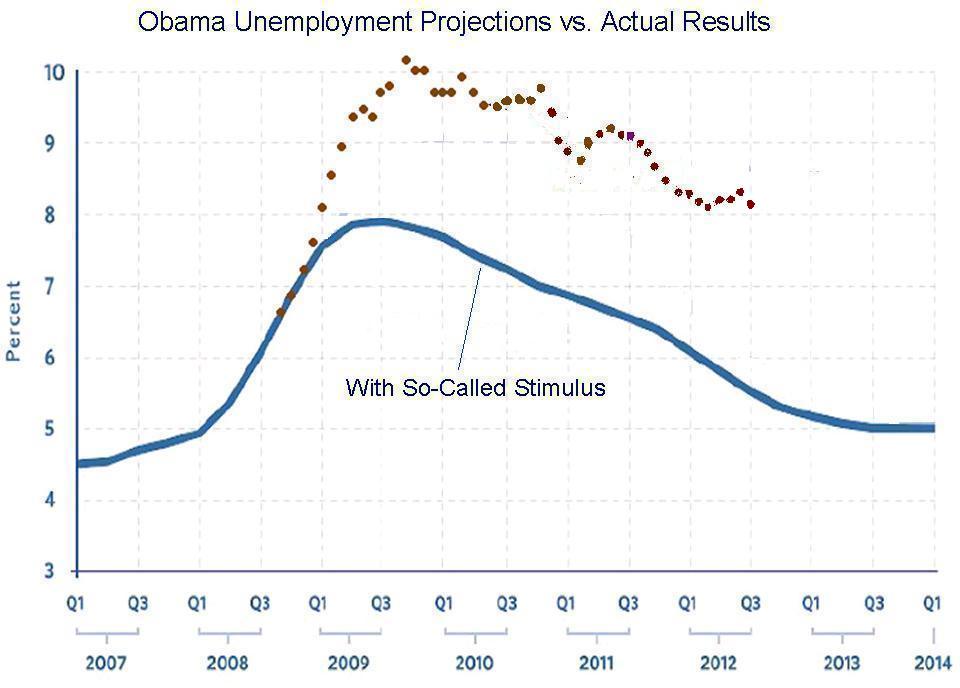
He promised unemployment would never climb above 8 percent if Congress squandered $800 billion on a Keynesian stimulus scheme.

Well, Congress said yes and the results have not been pretty. And every month we get new numbers to show us that the Administration’s policies have failed. It’s like Chinese water torture for the White House.

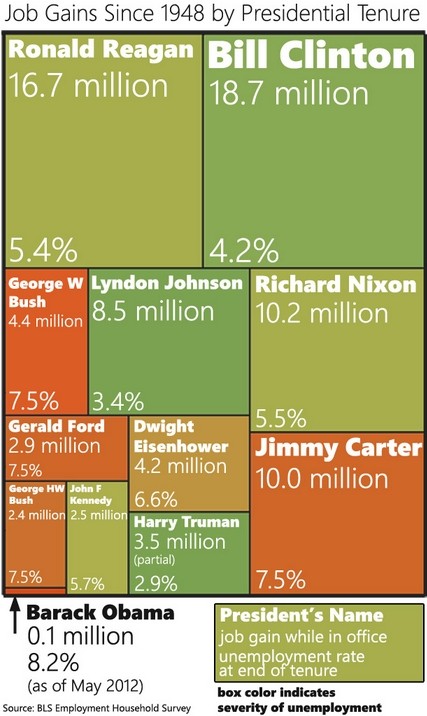
The numbers released this morning from the Department of Labor don’t change the narrative. The Republican and Democratic spin-doctors obviously will spit out their talking points, but here’s a visual put together by Political Math that trumps all the political maneuvering. If you’re wondering where Obama is, look at the lower left portion of the image.

This image is a couple of months old, but job creation has been so anemic that the naked eye wouldn’t be able to tell the difference if it was updated.

Since I normally show a graph with the actual unemployment rate compared to what Obama promised, I’ll add that as well. Not a pretty picture. I wrote that last month’s version would cause anxiety for Obama, and see no reason to change that assessment.

Yes, the official unemployment rate dropped to 8.1 percent, but that was because more Americans dropped out of the labor force.

Most important, the rate of joblessness is about 2-1/2 to 3 percentage points higher than what Obama promised. Now he wants a second term, yet all he’s promising is more of the same.

Actually, I retract that statement. He wants to maintain his current approach, but then add some class-warfare taxes to the mix.

Clinton “We’re all in this together” but where is the free society?

Bill Clinton full DNC Speech 2012

Basically Bill Clinton meant that we are all tied to the federal government to have many of our needs met when he said at the Democratic National Convention, “We’re all in this together.” I reject that philosophy and hope that America will turn away from that kind of slavery to the federal government mentality.

Dragging Us All Down Together

Posted by Roger Pilon

Today POLITICO Arena asks:

 Did Bill Clinton hit a home run for Barack Obama last night?

My response:

The Democrats are counting, as they always have, on widespread economic ignorance. And Bill Clinton captured it perfectly last night when he contrasted the alleged Republican philosophy — “You’re on your own” — with the Democratic philosophy — “We’re all in this together.” I say “alleged” because no Republican says or believes what the Democrats claim, whereas both Clinton and Obama have repeatedly said “We’re all in this together.”

Republicans don’t say that because they recognize the fundamental place of cooperation — whether economic or charitable — in human affairs, and the role of government in providing “public goods” like national defense, clean air, and infrastructure — as well as certain “private goods” if voluntary measures prove insufficient. They believe, in short, in a free society.

By contrast, if “we’re all in this together” — and let’s be clear, when Democrats say that they aren’t talking about voluntary associations but about government programs — then we’re all dependent on government for our retirement, our health care, our education, and on and on. What better example than the Obama campaign’s much ridiculed ”Life of Julia“? The problem with that vision is that it’s a cruel hoax. Wherever it’s been tried, including in America, it’s failed. Social Security, Medicare, and Medicaid are all going broke. And even where our massive public programs hobble on, they’re massively inefficient compared to private alternatives. In pursuit of “fairness” — read, “free goods” — you can tax the rich only so far. That’s the economic ignorance that’s underneath the siren song that “we’re all in this together.”

Famous Arkansan James Paul Clarke biography and video

Capitol Tour with Senator Mark Pryor

Published on Jun 13, 2012 by

Episode 1: Arkansans in the Capitol

__________

I have posted a lot in the past about Mark Pryor and most of the posts have been critical. (“THIRSTY THURSDAY” open letters to Senator Pryor displayed here on the www.thedailyhatch.org).  However, I must give him credit for this excellent video above about famous Arkansans who are recognized in Washington. Yesterday I posted the same video and included a post on Bill Clinton.

Here is what Wikipedia has to say:

James Paul Clarke

From Wikipedia, the free encyclopedia
Jump to: navigation, search
For the Canadian composer, see James P. Clarke (composer).
James Paul Clarke
18th Governor of Arkansas
In office
1895–1897
Preceded by William Meade Fishback
Succeeded by Daniel Webster Jones
United States Senator
from Arkansas
In office
1903–1916
Preceded by James K. Jones
Succeeded by William F. Kirby
Personal details
Born August 18, 1854
Yazoo City, Mississippi
Died October 1, 1916 (aged 62)
Little Rock, Arkansas
Resting place Oakland Cemetery
Political party Democratic
Alma mater University of Virginia
Profession Lawyer

James Paul Clarke (August 18, 1854– October 1, 1916) was a United States Senator and the 18th Governor of Arkansas.

Contents

Biography

Clarke was born in Yazoo City, Mississippi. His father passed away when Clarke was seven years old, and he was raised by his mother. Clarke attended public schools as well as Tutwilder’s Academy in Greenbrier, Alabama.[1] He graduated with a law degree at the University of Virginia in 1878. Clarke was admitted to the bar in 1879, and practiced law at Helena, Arkansas.

Career

Clarke served as a member of the Arkansas House of Representatives from 1886 to 1888. He became a member of the Arkansas Senate from 1888 to 1892, and served as president of the Senate in 1891.

James Paul Clarke

Clarke was elected Attorney General of Arkansas and served from 1892 to 1894. He served as Governor of Arkansas from 1895 to 1896.[2] His term was largely unsuccessful and his legislation to end prizefighting and establish four year terms for state officers failed. After leaving office in 1897, he moved his permanent residence to Little Rock, Arkansas and practiced law.

Clarke was elected to the United States Senate in 1903, and served until his death in 1916. He served as President pro tempore of the United States Senate during the Sixty-third and Sixty-fourth Congresses.

Death and legacy

Clarke died in Little Rock, Arkansas. He is buried at Oakland Cemetery in Little Rock.

Clarke’s statue is one of two statues that was presented by the State of Arkansas to the National Statuary Hall Collection at the United States Capitol.[3]

Quote

  • “A politician thinks of the next election; a statesman of the next generation.”[4]

References

  1. ^ “James Paul Clarke (1895-1897)”. Old State House Museum. Retrieved August 17, 2012.
  2. ^ “Arkansas Governor James Paul Clarke”. National Governors Asociation. Retrieved August 17, 2012.
  3. ^ “James Paul Clarke”. Find A Grave. Retrieved August 17, 2012.
  4. ^ “Past Quotes”. Political Information.com. Retrieved August 17, 2012.

Related posts:

Dear Senator Pryor, why not pass the Balanced Budget Amendment? (“Thirsty Thursday”, Open letter to Senator Pryor)

Dear Senator Pryor, Why not pass the Balanced  Budget amendment? As you know that federal deficit is at all time high (1.6 trillion deficit with revenues of 2.2 trillion and spending at 3.8 trillion). On my blog http://www.HaltingArkansasLiberalswithTruth.com I took you at your word and sent you over 100 emails with specific spending cut ideas. However, […]

Dear Senator Pryor, why not pass the Balanced Budget Amendment? (“Thirsty Thursday”, Open letter to Senator Pryor)

Dear Senator Pryor, Why not pass the Balanced  Budget Amendment? As you know that federal deficit is at all time high (1.6 trillion deficit with revenues of 2.2 trillion and spending at 3.8 trillion). On my blog http://www.HaltingArkansasLiberalswithTruth.com I took you at your word and sent you over 100 emails with specific spending cut ideas. However, […]

Dear Senator Pryor, why not pass the Balanced Budget Amendment? ( “Thirsty Thursday,” Open letter to Senator Pryor)

Dear Senator Pryor, Why not pass the Balanced Budget Amendment? As you know that federal deficit is at all time high (1.6 trillion deficit with revenues of 2.2 trillion and spending at 3.8 trillion). On my blog www.HaltingArkansasLiberalswithTruth.com I took you at your word and sent you over 100 emails with specific spending cut ideas. However, I did […]

Dear Senator Pryor, why not pass the Balanced Budget Amendment? ( “Thirsty Thursday,” Open letter to Senator Pryor)

Dear Senator Pryor, Why not pass the Balanced  Budget Amendment? As you know that federal deficit is at all time high (1.6 trillion deficit with revenues of 2.2 trillion and spending at 3.8 trillion). On my blog www.HaltingArkansasLiberalswithTruth.com I took you at your word and sent you over 100 emails with specific spending cut ideas. However, I did […]

Dear Senator Pryor, why not pass the Balanced Budget Amendment? ( “Thirsty Thursday,” Open letter to Senator Pryor)

Dear Senator Pryor,  Why not pass the Balanced Budget Amendment? As you know that federal deficit is at all time high (1.6 trillion deficit with revenues of 2.2 trillion and spending at 3.8 trillion). On my blog www.HaltingArkansasLiberalswithTruth.com I took you at your word and sent you over 100 emails with specific spending cut ideas. However, I did […]

Dear Senator Pryor, why not pass the Balanced Budget Amendment? (“Thirsty Thursday,” Open letter to Senator Pryor)

Dear Senator Pryor, Why not pass the Balanced Budget Amendment? As you know that federal deficit is at all time high (1.6 trillion deficit with revenues of 2.2 trillion and spending at 3.8 trillion). On my blog www.HaltingArkansasLiberalswithTruth.com I took you at your word and sent you over 100 emails with specific spending cut ideas. However, I did […]

Dear Senator Pryor, why not pass the Balanced Budget Amendment? ( “Thirsty Thursday,” Open letter to Senator Pryor)

Dear Senator Pryor, Why not pass the Balanced Budget Amendment? As you know that federal deficit is at all time high (1.6 trillion deficit with revenues of 2.2 trillion and spending at 3.8 trillion). On my blog www.HaltingArkansasLiberalswithTruth.com I took you at your word and sent you over 100 emails with specific spending cut ideas. However, I did […]


Famous Arkansan Bill Clinton (1946–) biography and video

Capitol Tour with Senator Mark Pryor

Published on Jun 13, 2012 by

Episode 1: Arkansans in the Capitol

__________

I have posted a lot in the past about Mark Pryor and most of the posts have been critical. (“THIRSTY THURSDAY” open letters to Senator Pryor displayed here on the www.thedailyhatch.org).  However, I must give him credit for this excellent video above about famous Arkansans who are recognized in Washington.

Fortieth and Forty-second Governor (1979–1981, 1983–1992)
Forty-second President of the United States (1993–2001)
aka: William Jefferson Clinton

William Jefferson Clinton, a native of Hope (Hempstead County), was the fortieth and forty-second governor of Arkansas and the forty-second president of the United States. Clinton’s tenure as governor of Arkansas, eleven years and eleven months total, was the second longest in the state’s history. Only Orval E. Faubus served longer, with twelve years. Clinton was the second youngest governor in the state’s history, after John Selden Roane, and the third youngest person to become president, after Theodore Roosevelt and John Fitzgerald Kennedy.

Clinton’s years as governor were marked by extensive efforts to reform the public school system and to spur economic growth. He persuaded lawmakers to enact numerous educational reforms, levy substantial taxes to improve education, and enact an array of laws to invite industrial development and spur business investment.

His election as president in 1992 was followed by the longest period of sustained economic growth in U.S. history. A controversial package of spending reductions and tax increases early in his first year in office and further budget changes in 1997 led to the elimination of deficits in the federal budget and to four successive budget surpluses. It had been fifty years since the government ran three or more surpluses in a row (1947–1949) .

Clinton was president during a period of intense partisanship. Throughout his political career, he demonstrated an ability to bounce back from defeats and scandal. His presidency was beset by numerous investigations, one of which resulted in his becoming the first elected American president to be impeached. Still, he left office in 2001 enjoying high popularity.

Early Life
Bill Clinton was born William Jefferson Blythe IV on August 19, 1946, in Hope, the son of William Jefferson Blythe III and Virginia Cassidy Blythe. His father, a traveling salesman, was killed in an automobile accident before Clinton was born. After he became president, Clinton learned that his father had been married at least three times and that he had a half-brother and a half-sister whom he had never met. He changed his name to Clinton after his mother married Roger Clinton, a car dealer. The family moved to Hot Springs (Garland County), where he graduated from high school. After he became president of the United States, he and his mother revealed that Roger Clinton had been an alcoholic who abused Clinton, Clinton’s mother, and Clinton’s younger half-brother, Roger.

Clinton was a precocious student, musically talented and popular. He graduated from Georgetown University in Washington DC, attended Oxford University in Oxford, England, on a Rhodes Scholarship, and received a law degree from Yale University in New Haven, Connecticut, where he met his future wife, Hillary Rodham of Park Ridge, Illinois. After receiving a law degree in 1973, he returned to Arkansas to teach law at the University of Arkansas (UA) in Fayetteville (Washington County). Rodham joined him on the faculty in 1974, and they were married on October 11, 1975.

Early Political Career
Intent on a political career since he was a child, Clinton was selected to offices throughout his student career. While a student at Georgetown, he worked on the staff of the Senate Foreign Relations Committee, which was chaired by Arkansas senator J. William Fulbright, a Democrat. In 1972, he coordinated the presidential campaign of Senator George S. McGovern in Texas. He also handled the Arkansas delegation at the Democratic National Convention.

In 1974, only months after joining the faculty at the University of Arkansas, he ran for United States representative in the state’s Third Congressional District (northwest Arkansas). He won the Democratic nomination but lost—fifty-two percent to forty-eight percent—to Representative John Paul Hammerschmidt, a Republican running for his fifth term. Clinton easily won a race for attorney general in 1976 against Democratic opponents George O. Jernigan Jr. and Clarence Cash. He was unopposed in the general election. He gained popularity when his office opposed rate increases for utilities and fought, on environmental grounds, Arkansas Power and Light’s plans to build a coal-fired plant in Independence County to generate electricity. In 1978, he easily defeated four candidates for the Democratic nomination for governor and then just as handily defeated the Republican candidate, Lynn Lowe of Texarkana (Miller County), compiling 63.4 percent of the votes. He was sworn in as governor in January 1979 at the age of thirty-two.

Governor of Arkansas
In his first term, Clinton proposed modest reforms in education and commercial regulation, particularly to control pollution, but his biggest initiative, a highway program, was expensive fiscally and politically. He persuaded the legislature to increase taxes on motor fuels and to raise other fees on vehicles. Increases in the annual registration fees of automobiles and trucks were particularly unpopular. Clinton would always say that the license fees cost him re-election in 1980, although other initiatives he undertook angered large interests. The trucking industry was irked by his efforts to raise taxes on big rigs and also by his opposition to raising the weight limits for Arkansas highways; poultry interests were irked by the highway weight issue, the wood-products industry by his office’s harsh criticism of clear-cutting forests, and bankers by his suggestion that idle state funds be distributed among banks based on their lending policies. Utility interests, which were particularly powerful, were angry over Clinton’s efforts to stiffen the regulation of rate increases, and he also battled the state’s largest electric utility, Arkansas Power and Light, over the parent company’s successful effort to make Arkansas ratepayers bear a large share of the costs of a big nuclear power plant at Port Gibson, Mississippi. Those interests tended to support his Republican opponent in 1980.

Clinton was also hurt politically by the presence of Cuban refugees at Fort Chaffee, sent there by Clinton’s friend, President Jimmy Carter. Cuba had temporarily lifted its exit restrictions and permitted 120,000 Cubans to go to the United States by boat. Carter sent 18,000 of them to Fort Chaffee. About 300 of the Cubans broke out of the compound in May and rampaged down nearby roads. During the day’s melee, sixty-two people were injured, none seriously, and three buildings at Fort Chaffee were destroyed. A video of the marauding Cubans turned up in an effective campaign ad for Clinton’s opponent in the election. In August, Carter broke a promise to Clinton and the state when he sent all the refugees from northern military posts to Fort Chaffee because the northern posts were not well equipped for winter. Frank D. White, a former banker and state industrial-development official, switched parties to run for governor in 1980. He blamed Clinton for the threat to public safety that the Cubans represented and for higher vehicle license fees. He defeated Clinton in the election with almost fifty-two percent of the vote.

Clinton began practicing law in Little Rock (Pulaski County) and prepared for the 1982 governor’s race. He defeated former Attorney General Joe Purcell and former U.S. Representative Jim Guy Tucker for the Democratic nomination and easily defeated White to regain the office. He was re-elected in 1984, 1986, and 1990 (Arkansas adopted a four-year term for governors starting in 1986).

During the campaign of 1982, Clinton promised to make major strides in education, including a large investment of public money, but he avoided saying he would raise taxes. He was handed the opportunity to raise taxes when the Arkansas Supreme Court in the spring of 1983 ruled that the system of financing the public schools was unconstitutional because it provided unequal resources for school districts. Clinton called a special session of the legislature and proposed higher taxes and a large package of school laws, including a new formula for distributing the state’s dollars among school districts more equitably and a controversial law requiring all teachers and school administrators to pass a test of basic skills. The legislature raised the sales tax from three to four percent and approved most of his other legislation. The Arkansas Board of Education adopted tougher accreditation standards for schools, which were proposed by a study commission headed by the governor’s wife.

The regular legislative session of 1985 was devoted to economic development. The legislature approved almost all of Clinton’s program, which included changes in banking laws, start-up money for technology-oriented businesses, and large tax incentives for Arkansas industries that expanded their production and jobs. Arkansas was one of the best states in new job creation in the next six years, but most of the jobs did not pay high wages, and it remained one of the worst states in average income.

Clinton tried, rather unsuccessfully, in 1987 and 1989 to raise new taxes for education, but after a resounding victory in the 1990 election over a well-financed Republican opponent, Sheffield Nelson, and the defeat of several key legislative opponents, he had major success in 1991. He had called a news conference in 1988 to announce plans to run for president but changed his mind at the last minute, explaining that the campaign and the job would be too hard on his wife and daughter, Chelsea Victoria, who was eight. Although he had promised during the 1990 campaign that he would complete his four-year term, he decided to run for president in 1992. His education reforms and his leadership of several national organizations, including the National Governors’ Conference and the Democratic Leadership Council—a group of moderate Democratic officeholders and businesspeople who sought to alter the liberal bent of the national Democratic Party—strengthened his national stature and gave him important connections.

Presidential Elections
On October 3, 1991, Clinton announced that he would run for president in 1992. He had five Democratic opponents: Senator Robert Kerrey of Nebraska, Senator Tom Harkin of Iowa, former senator Paul Tsongas of Massachusetts, Governor L. Douglas Wilder of Virginia, and former California governor Edmund G. (Jerry) Brown. Although he quickly established himself as the frontrunner, his campaign was nearly derailed by accusations of marital infidelity—including a charge by a Little Rock woman named Gennifer Flowers that she had had a long-running affair with Clinton when he was attorney general and governor—and by revelations that he had taken unusual steps to avoid military service during the Vietnam War. He deflected those controversies and regained momentum. He easily won the Democratic nomination and chose Senator Albert Gore of Tennessee as his vice presidential running mate.

Having successfully led a war against Iraq a year earlier, President George H. W. Bush enjoyed high poll ratings when the campaign began, but a sluggish economy and high unemployment diminished his popularity. Clinton concentrated on the economy, promising to secure health insurance coverage for every American, reform the welfare system, enact a tax cut for the middle class, begin a national service program, reform the system of financing federal campaigns, and invest heavily in the nation’s infrastructure, which he said was deteriorating. H. Ross Perot, a wealthy Texas businessman, ran as an independent and promised to eliminate the federal budget deficit by raising taxes and cutting government spending. Clinton was helped by the weak economy and a perception that President Bush had put little emphasis on improving it, but Clinton also proved a far better campaigner, particularly in the three debates. The contrast between the aging and stiff president and the young and agile governor was especially sharp in the second debate, a town-hall arrangement where Clinton engaged questioners personally. Bush counted on his vast experience in foreign policy and the successful war to liberate Kuwait to give him an edge against the governor of what he described as a small and poor state. He called Clinton a “tax-and-spend liberal.” Clinton received forty-three percent of the popular vote to Bush’s thirty-eight percent and Perot’s nineteen percent and won even more decisively in the Electoral College, 370 to 168.

Although he had been battered by controversy during his first term and his party had lost control of both houses of Congress in 1994, Clinton had an easier election for a second term in 1996. Senator Robert Dole of Kansas, a longtime veteran of Congress and a moderate, won the Republican nomination. Perot ran again, this time as the candidate of the Reform Party, which he organized. Dole attacked Clinton’s character and pointed to his own long service in the military in World War II and in Congress. Dole’s age, seventy-three, was a subtle issue. Clinton was re-elected with forty-nine percent of the popular vote to Dole’s forty-one percent and Perot’s nine percent. Clinton won the electoral vote with 379 votes to Dole’s 159.

Domestic Record
Bitter controversy dogged Clinton from his election until he left office. He had said during his first campaign that he would lift the ban on homosexuals serving in the military, and soon after the election, he indicated that he would move quickly. Protests in Congress and from military leaders dominated the periods before and after his inauguration until he reached a compromise with service leaders: homosexuals could serve if they did not disclose their sexual orientation and did not engage in homosexual conduct. Still, the issue crippled him politically. In his first two years, he did succeed in passing a law that required companies with more than fifty workers to give workers up to twelve weeks of unpaid leave each year to cope with family problems, in addition to another law that established a national service program called AmeriCorps in which young people perform public service work for a period of time.

Two congressional battles in the first two years decided the course of his presidency. Even before he took office, Clinton was persuaded by his new economic team—including Robert E. Rubin (chairman of the National Economic Council), Laura D’Andrea Tyson (chair of the Council of Economic Advisers), Leon Panetta (director of the Office of Management and Budget), Lawrence H. Summers (undersecretary of treasury for international affairs) and Alan S. Blinder (an economic adviser)—that the nation’s critical economic need was to lower the huge federal budget deficit, which had reached $290 billion in President Bush’s last fiscal year (1992–93). Lowering or eliminating the deficit would reassure the bond markets, reduce long-term interest rates, and encourage greater business investment and more jobs. His budget package—which passed both houses of Congress without a vote to spare and without a single Republican vote—reduced spending over five years by $255 billion and increased taxes, mainly on high incomes, by $241 billion. The legislation also expanded the Earned Income Tax Credit, which provided extra income for millions of families earning less than $30,000 a year. The deficit declined sharply over the next two years and disappeared in 1998.

The other congressional battle was over national health insurance. Clinton appointed his wife to chair a task force to study insurance problems and recommend a plan for guaranteeing coverage for everyone. Under that plan, people would join an alliance in each state that would contract with insurance companies and other groups to offer insurance to members. The long, complicated legislation was opposed by many insurance companies and other healthcare groups and by every Republican in Congress. Clinton failed to work out a compromise with moderate Republicans who wanted an expanded insurance system, and the initiative died. That failure and the unpopularity of tax increases cost a number of Democrats their seats in the 1994 congressional elections, and Republicans gained control of the House of Representatives and the Senate, making it difficult for Clinton to get any of his proposals through Congress in his last six years.

After Republicans gained control of Congress, Clinton spent the next six years battling conservatives over the federal budget and social issues such as abortion. The Republican majority, led by the new speaker of the House of Representatives, Newt Gingrich of Georgia, sought to cut federal spending on education, environmental protection, and Medicare and Medicaid. Clinton used his power of veto and the threat of a veto to thwart most of the cuts. Years later, he said halting all the Republican initiatives that he considered so harmful was one of his greatest achievements. When Clinton and the congressional majority could not agree on a budget in 1995 and 1996, the Republicans forced a temporary shutdown of the government. Public opinion seemed to side with the president, and Congress eventually capitulated, which greatly strengthened Clinton’s standing in the presidential election year of 1996.

Despite the stalemate with Republicans on most issues, Clinton succeeded on two major initiatives after 1994. Since 1985, when he was governor, Clinton had advocated a major overhaul of the welfare system to encourage work, and in his 1992 campaign, he had promised to “end welfare as we know it.” When Congress approved a harsher version of his proposal in 1996, he signed it into law over the objections of many in his own administration and in Congress. He had vetoed two earlier measures that were even harsher. The law limited lifetime welfare benefits to five years and required adult recipients to work after two years on welfare. In 1997, he worked out a compromise budget package with Congress that included tax cuts and spending cuts aimed at hastening a balanced budget, which was balanced the next year for the first time since 1969. The legislation also began a new children’s health insurance program, which expanded Medicaid coverage to millions more children from low- and middle-income families. Clinton also signed into law bipartisan measures to combat terrorism, allowing more spending to fight terrorism and making it easier to deport foreigners suspected of terrorism.

Foreign affairs
World communism was no longer the nation’s principal adversary when Clinton took office. Instead, he was confronted with religious and ethnic strife, genocide, and suffering in smaller and weaker countries where the interests of the United States were not clear. He was at first reluctant to commit military forces to such regions, but he developed an expansive view of the country’s strategic interest in protecting human rights and promoting stability. He sent forces to end fighting and protect civilians in Haiti, Bosnia-Herzegovina, and Kosovo in the former republic of Yugoslavia. He would later state his regret that he had not done the same in 1994 when two million people were displaced and hundreds of thousands were slain in the African nation of Rwanda.

Clinton tried to arrange peace between religious and ethnic rivals in the Middle East and in Northern Ireland. His intervention brought an end to religious strife in Northern Ireland, a declaration of peace between Israel and the Palestinian Liberation Organization, and an agreement between Israel and Jordan to end their state of war.

In most foreign interventions, he was opposed by leaders of the Republican Party and sometimes, according to polls, by the public. When the Mexican peso collapsed in 1995, threatening the failure of the Mexican economy, Clinton proposed a loan package to Mexico to ease the crisis. Congress balked when polls showed public opposition to the bailout. Clinton then devised a $20 billion loan package to restore world confidence in Mexico and executed it alone. Mexico rallied and paid off the loans with interest in 1997, three years ahead of schedule.

But the major instrument of Clinton’s foreign policy was not military intervention or diplomacy but trade and economic leverage. He believed that lower tariffs and freer trade with other nations would raise the standard of living in poor nations, increase U.S. exports, and improve the American economy. Over the opposition of many in his own party who thought it would cost too many American jobs, he completed negotiations and won ratification in late 1993 of the North American Free Trade Agreement (NAFTA), which reduced tariffs and created a free-trading bloc among the United States, Canada, and Mexico. He also finished work on a comprehensive world trade agreement called the General Agreement on Tariffs and Trade (GATT), which Congress ratified in 1994.

Investigations and Impeachment
For his entire presidency, Clinton, his wife, and members of his administration were hounded by accusations of wrongdoing. When Republicans gained control of the House of Representatives and the Senate after the 1994 elections, congressional committees conducted investigations and lengthy hearings on accusations of misconduct. Also, an unprecedented seven independent counsels (special prosecutors) were appointed to investigate allegations of misconduct. A law enacted during the Watergate scandals relating to the administration of President Richard Nixon provided for the appointment of independent counsels when there were suspicions of misconduct involving the president, vice president, or other major administration officials. Most of the investigations did not involve the president. Allegations included the following: a White House aide had improperly raised funds through a private group while he ran Clinton’s national service corps, Clinton’s first agriculture secretary had accepted improper gifts from companies that his department regulated (including Arkansas-based Tyson Foods), Clinton’s commerce secretary had engaged in improper financial deals, the secretary of Housing and Urban Development had lied to FBI agents during a background check about the size of payments that he had made to a former mistress while he was a Texas mayor, Clinton’s interior secretary had lied to Congress about his role in granting a federal license for a gambling casino, and Clinton’s labor secretary had taken part in an influence-peddling scheme in a former job as a White House aide. None of those investigations produced evidence of illegal activities, although the Housing and Urban Development secretary admitted that he had not been completely truthful about payments to the mistress.

The most troublesome and damaging investigation involved a real estate deal that Clinton and his wife undertook in 1978, while he was attorney general of Arkansas. The investigation became known as “Whitewater,” after the name of the land development company, Whitewater Development Corp., which the Clintons formed with James D. and Susan McDougal of Little Rock. The four had purchased 230 acres of wilderness near the White River and Crooked Creek in Marion County and had lost money when they could not develop and sell the lots. The principal accusation was that the McDougals, and perhaps the Clintons and their real estate project, had benefited from the operations of a Little Rock savings and loan association that James McDougal formed in Little Rock in the 1980s, which eventually went bankrupt. Business deals between the McDougals and a small business lending company in Little Rock run by David Hale, a Little Rock municipal judge, also became a focus of the investigation. The probe was expanded to look into the 1993 suicide of Vincent Foster Jr.—a Little Rock lawyer who became deputy White House counsel—as well as the firing of the White House travel staff and other activities at the White House.

Yielding to Republican criticism, Clinton asked Attorney General Janet Reno in 1994 to appoint an independent counsel on Whitewater. Her appointee, a Republican lawyer named Robert B. Fiske, was later removed by a panel of judges in Washington and replaced with Kenneth W. Starr, who had been solicitor general under President George H. W. Bush.

Starr continued the investigation through the rest of the Clinton presidency. While several Arkansans were indicted in various property dealings in Arkansas, including Governor Jim Guy Tucker, neither the Clintons nor others in his administration were ever implicated in any wrongdoing in the Whitewater-related activities. The investigations concluded that Foster had committed suicide and that the firing of travel staff involved no wrongdoing.

But one part of Starr’s investigation paid off. Agents conducted lengthy inquiries into reports of marital infidelities by Clinton. A former employee of the Arkansas Industrial Development Department, Paula Corbin Jones, filed a lawsuit in 1994 alleging that Clinton had made unwanted sexual advances toward her in a Little Rock hotel room in 1991, and the U.S. Supreme Court ruled that trying the suit would not distract Clinton from his duties as president. In 1998, Linda Tripp, a confidante of Monica Lewinsky, an intern at the White House, gave Starr recordings in which Lewinsky talked about having oral sex with the president. Although the Lewinsky affair was unrelated to any of the Whitewater issues, Starr justified this investigation by saying it was part of a pattern of obstructing justice at the Clinton White House. On September 9, 1998, Starr gave the House of Representatives a lengthy report on Clinton’s indiscretions with Lewinsky, including his efforts to cover them up during testimony before Starr’s grand jury and during a deposition that he gave in the civil case of Paula Jones.

The House Judiciary Committee accused Clinton of “high crimes and misdemeanors,” the grounds for impeaching and removing a president, and brought four articles of impeachment against him. On December 19, voting largely along party lines, the House adopted two of the articles—perjury before the grand jury and obstruction of justice—by votes of 228 to 206 and 221 to 212. Democrats charged that the impeachment proceedings were a Republican vendetta to destroy a popular president. But only the Senate can remove a president, by a two-thirds vote. On February 12, 1999, after hearing lengthy arguments presented by Republican members of the House and by defenders of the president, including a passionate closing argument by former Arkansas senator Dale Bumpers, the Senate defeated the perjury article, forty-five for and fifty-five against, and the obstruction of justice article, fifty to fifty. Starr said he would seek criminal charges against Clinton for the Lewinsky affair after the president left office, but on the day before he left office in January 2001, Clinton issued a statement apologizing for giving erroneous testimony to the grand jury, and Starr closed the investigation. Starr’s independent counsel office did not close until May 2004. Owing to the admission of giving false testimony and proceedings instituted by the Professional Ethics Committee, Clinton surrendered his license to practice law in Arkansas.

Post-presidency
Clinton’s wife decided early in 1999 to run for the U.S. Senate seat in New York being vacated by Senator Daniel Patrick Moynihan. She and Clinton bought a house in Chappaqua, New York, to establish residency in New York, and she was elected to the U.S. Senate in November 2000. Clinton retired there after leaving office on January 20, opened an office in the Harlem neighborhood, and began to write his autobiography. The book, My Life, was published in 2004 and became a bestseller. Clinton’s presidential library opened in November 2004 on the Little Rock riverfront. He traveled extensively throughout the world, particularly in Africa and Asia, where he instituted efforts to import medicine to combat the AIDS epidemic. In 2005, President George W. Bush appointed Clinton and the elder President Bush to direct humanitarian relief efforts for the victims of a tsunami that killed more than 200,000 people along the coasts of the Indian Ocean on December 26, 2004. Both were also involved in the relief efforts for the victims of Hurricane Katrina in 2005. In 2010, Clinton and George W. Bush created the Clinton Bush Haiti Fund to assist the people of Haiti after an earthquake there in January.

Summary
Clinton was among Arkansas’s most productive governors and brought about extensive reforms in public education. His long tenure ended with an extended period of job creation and moderate economic growth. He was even more ambitious as president but not as successful, partly because he dealt with a largely hostile Congress for the last six years of his presidency. He steered the Democratic Party gently away from its modern liberal tradition that traced back to Franklin D. Roosevelt, Harry Truman, John F. Kennedy, and Lyndon B. Johnson, but he still succeeded in improving the economic well-being of low-income working families by $20 billion a year, with a combination of health insurance for their children, refundable tax credits for work, and tax credits for college expenses. While economists debated the extent to which his policies were responsible, his presidency marked the longest period of sustained economic growth in the nation’s history and yielded four consecutive years of federal budget surpluses. Clinton was president at the peak of U.S. supremacy in the world, and he personally basked in unprecedented global admiration.

For additional information:
Clinton, Bill. Between Hope and History: Meeting America’s Challenges for the 21st Century. New York: Random House, 1996.

———. My Life. New York: Alfred A. Knopf, 2004.

Clinton Presidential Collection. Old State House Museum Online Collections. Clinton Collection (accessed May 18, 2011).

Conason, Joe, and Gene Lyons. The Hunting of the President: The Ten-Year Campaign to Destroy Bill and Hillary Clinton. New York: St. Martin’s Press, 2000.

Dumas, Ernest C., ed. The Clintons of Arkansas: An Introduction by Those Who Know Them Best. Fayetteville: University of Arkansas Press, 1992.

Fallows, James, et. al. “Bill Clinton and His Consequences.” The Atlantic Monthly 287 (February 2001): 45–69.

Hamilton, Nigel. Bill Clinton, An American Journey. New York: Random House, 2003.

Kalb, Marvin. One Scandalous Story: Clinton, Lewinsky & 13 Days that Tarnished American Journalism. New York: Simon and Schuster, 2001.

Klein, Joe. “Eight Years.” The New Yorker 76 (October 16 and 23, 2000): 188-217.

Levin, Robert E. Bill Clinton, The Inside Story. New York: Shapolsky Publishers, Inc., 1992.

Levy, Peter B. Encyclopedia of the Clinton Presidency. Westport, CT: Greenwood Press, 2002.

Maraniss, David. First in His Class: A Biography of Bill Clinton. New York: Simon and Schuster, 1995.

Marcus, Alan. “Bill Clinton in Arkansas: Generational Politics, the Technology of Political Communication and the Permanent Campaign.” Historian 72 (June 2010): 354–385.

Root, Paul, ed. To the Grassroots with Bill Clinton. Arkadelphia, AR: The Pete Parks Center for Regional Studies, Ouachita Baptist University, 2002.

Shields, Todd G., Jeannie M. Whayne, and Donald R. Kelley, eds. The Clinton Riddle: Perspectives on the Forty-second President. Fayetteville: University of Arkansas Press, 2004.

Smith, Stephen A., ed. Preface to the Presidency: Selected Speeches of Bill Clinton, 1974–1992. Fayetteville: University of Arkansas Press, 1996.

Takiff, Michael. A Complicated Man: The Life of Bill Clinton as Told by Those Who Know Him. New Haven, CT: Yale University Press, 2010.

Related posts:

Dear Senator Pryor, why not pass the Balanced Budget Amendment? (“Thirsty Thursday”, Open letter to Senator Pryor)

Dear Senator Pryor, Why not pass the Balanced  Budget amendment? As you know that federal deficit is at all time high (1.6 trillion deficit with revenues of 2.2 trillion and spending at 3.8 trillion). On my blog http://www.HaltingArkansasLiberalswithTruth.com I took you at your word and sent you over 100 emails with specific spending cut ideas. However, […]

Dear Senator Pryor, why not pass the Balanced Budget Amendment? (“Thirsty Thursday”, Open letter to Senator Pryor)

Dear Senator Pryor, Why not pass the Balanced  Budget Amendment? As you know that federal deficit is at all time high (1.6 trillion deficit with revenues of 2.2 trillion and spending at 3.8 trillion). On my blog http://www.HaltingArkansasLiberalswithTruth.com I took you at your word and sent you over 100 emails with specific spending cut ideas. However, […]

Dear Senator Pryor, why not pass the Balanced Budget Amendment? ( “Thirsty Thursday,” Open letter to Senator Pryor)

Dear Senator Pryor, Why not pass the Balanced Budget Amendment? As you know that federal deficit is at all time high (1.6 trillion deficit with revenues of 2.2 trillion and spending at 3.8 trillion). On my blog www.HaltingArkansasLiberalswithTruth.com I took you at your word and sent you over 100 emails with specific spending cut ideas. However, I did […]

Dear Senator Pryor, why not pass the Balanced Budget Amendment? ( “Thirsty Thursday,” Open letter to Senator Pryor)

Dear Senator Pryor, Why not pass the Balanced  Budget Amendment? As you know that federal deficit is at all time high (1.6 trillion deficit with revenues of 2.2 trillion and spending at 3.8 trillion). On my blog www.HaltingArkansasLiberalswithTruth.com I took you at your word and sent you over 100 emails with specific spending cut ideas. However, I did […]

Dear Senator Pryor, why not pass the Balanced Budget Amendment? ( “Thirsty Thursday,” Open letter to Senator Pryor)

Dear Senator Pryor,  Why not pass the Balanced Budget Amendment? As you know that federal deficit is at all time high (1.6 trillion deficit with revenues of 2.2 trillion and spending at 3.8 trillion). On my blog www.HaltingArkansasLiberalswithTruth.com I took you at your word and sent you over 100 emails with specific spending cut ideas. However, I did […]

Dear Senator Pryor, why not pass the Balanced Budget Amendment? (“Thirsty Thursday,” Open letter to Senator Pryor)

Dear Senator Pryor, Why not pass the Balanced Budget Amendment? As you know that federal deficit is at all time high (1.6 trillion deficit with revenues of 2.2 trillion and spending at 3.8 trillion). On my blog www.HaltingArkansasLiberalswithTruth.com I took you at your word and sent you over 100 emails with specific spending cut ideas. However, I did […]

Dear Senator Pryor, why not pass the Balanced Budget Amendment? ( “Thirsty Thursday,” Open letter to Senator Pryor)

Dear Senator Pryor, Why not pass the Balanced Budget Amendment? As you know that federal deficit is at all time high (1.6 trillion deficit with revenues of 2.2 trillion and spending at 3.8 trillion). On my blog www.HaltingArkansasLiberalswithTruth.com I took you at your word and sent you over 100 emails with specific spending cut ideas. However, I did […]


Responding to the liberals at the Arkansas Times concerning tax policy

Spending Restraint, Part I: Lessons from Ronald Reagan and Bill Clinton

Uploaded by on Feb 14, 2011

Ronald Reagan and Bill Clinton both reduced the relative burden of government, largely because they were able to restrain the growth of domestic spending. The mini-documentary from the Center for Freedom and Prosperity uses data from the Historical Tables of the Budget to show how Reagan and Clinton succeeded and compares their record to the fiscal profligacy of the Bush-Obama years.

____________

On 9-18-12 I noted on the Arkansaas Times Blog:

The federal government has how much money? Negative 16 trillion I believe. How can they pay for all our medical needs in the future without turning everything around on us at the state level? I guess liberals are the only ones dumb enough to believe Obama’s empty promises. He took over when there was a federal debt of around 10 trillion and now it is over 16 trillion. I guess we could do even better if we gave him his Obamacare and re-elected him. The only alternative is to elect a Republican House and Senate and President and kill Obamacare. I sure that sounds heartless to the liberals. Everything is working so good right now why change course.

Couldn’t be better responded with a good point,  “Interesting, Saline, that Republicans ran up that $10 trillion in the national debt during good times when they should have been paying it down or totally writing it off.”

I totally agree that Republicans have also had a lot to do with running up the debt. They have got us into wars that we have not budgeted for and we continue to pay for Japan and Germany’s defenses when they are wealthy enough to do it on their own.

However, what is the answer to getting us out of this budget mess? Is raising taxes the answer? Let’s see what the Clinton Administration had to say about that. Below is the last portion of an article by Dan Mitchell of the Cato Institute:

Debunking Myth after Myth in Financial Times Column by Former Clinton White House Economist
September 18, 2012 by Dan Mitchell

Even though I have remarked on many occasions that the burden of government was reduced during the Clinton years, that doesn’t mean Bill Clinton was in favor of smaller government. And it definitely doesn’t mean that his appointees believed in economic liberty.

Consider the case of Laura Tyson, who served as Chair of Clinton’s Council of Economic Advisers. She recently penned a column for the UK-based Financial Times that is riddled with disingenuous assertions.

Even though it deserves to be ignored, I can’t resist the temptation to make corrections.

Tyson myth:

The US economy needs efficient and progressive tax reform and it needs more revenues for deficit reduction. Revenue increases have been a significant component of all major deficit-reduction packages enacted over the past 30 years.

Factual correction:

This is remarkable. I assume Ms. Tyson reads the New York Times, so perhaps she overlooked or deliberate forgot the column that inadvertently revealed that the only successful deficit-reduction package in recent memory was the one that cut taxes instead of raising them.

Interestingly, that successful package was implemented during the Clinton years, but only after she left office.

During Tyson’s tenure at CEA, we did get a tax increase rather than a tax cut. But the Clinton Administration admitted 18 months later that the tax hike was a failure and was not going to balance the budget.

Yet she wants to push the same failed class-warfare tax policy today.

_________

Spending Restraint, Part II: Lessons from Canada, Ireland, Slovakia, and New Zealand

Uploaded by on Feb 22, 2011

Nations can make remarkable fiscal progress if policy makers simply limit the growth of government spending. This video, which is Part II of a series, uses examples from recent history in Canada, Ireland, Slovakia, and New Zealand to demonstrate how it is possible to achieve rapid improvements in fiscal policy by restraining the burden of government spending. Part I of the series examined how Ronald Reagan and Bill Clinton were successful in controlling government outlays — particularly the burden of domestic spending programs. http://www.freedomandprosperity.org