
Red States vs. Blue States, Part IV
In our series on red states vs blue states, we’ve examined different economic variables.
- Part I: Economic growth
- Part II: Unemployment rates
- Part III: Employment growth
Today, let’s add another comparison.
Here’s a map looking at 2022 income growth by state. The three states most known for bad policy – New York, Illinois, and California – were among the handful of states that suffered a decline in personal income.

It’s also worth noting that most of the “weaker than average” states also are known for leaning left.
The Wall Street Journal has an editorial on the performance gap between red states and blue states. Here are some excerpts.
Personal income in California, Illinois and New York declined in 2022 for the first time since 2009… Personal income last year nationwide increased 2% in current dollars, which amounts to a real decline after inflation. …The opposite was true in the fastest-growing states, including Florida (4.7%), Arizona (4.9%), Texas (5%), Utah (5.5%), Colorado (5.8%),
South Dakota (5.8%), Montana (6.1%), Idaho (6.5%), North Dakota (7%), and Delaware (8.8%). …The personal income declines in California, New York, Illinois and some other states would have been larger if not for the continued growth in Medicaid spending owing to the pandemic national emergency, which didn’t end until this spring. A federal food-stamp fillip also continued until March. …California, New York and Illinois used their allotments largely to cover pre-existing budget shortfalls, boost government worker pay, and bake into their budget new spending obligations. Those will become shortfalls once the pandemic money boom ends. Taxpayers, look out.
The last few sentences above are key.
When they get new money, either from tax increases or federal transfers, irresponsible politicians create long-run spending obligations.
And that creates the conditions for future tax increases, just as the WSJ warns.
Here’s one final item for today’s column. Back in July, the Wall Street Journal compared industry performance in red states and blue states.
Here’s a table comparing Texas and Florida vs. New York and California.

Game, set, and match.
The moral of the story is that big government doesn’t work well on the national level, it doesn’t work well on the state level, and it doesn’t work well on the local level.
California is the Greece of the USA, but Texas is not perfect either!!!
Just Because California Is Terrible, that Doesn’t Mean Texas Is Perfect
January 21, 2013 by Dan Mitchell
Texas is in much better shape than California. Taxes are lower, in part because Texas has no state income tax.
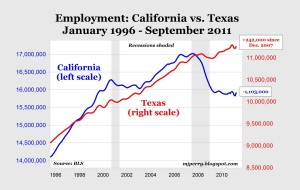 No wonder the Lone Star State is growing faster and creating more jobs.
And the gap will soon get even wider since California voters recently decided to drive away more productive people by raising top tax rates.
But a key challenge for all governments is controlling the size and cost of bureaucracies.
Government employees are probably overpaid in both states, but the situation is worse in California, as I discuss in this interview with John Stossel.
Dan Mitchell Comparing Excessive Bureaucrat Compensation in Texas and California
But being better than California is not exactly a ringing endorsement of Texas fiscal policy.
A column in today’s Wall Street Journal, written by the state’s Comptroller of Public Accounts, points out some worrisome signs.
As the chief financial officer of the nation’s second-largest state, even I have found it hard to get a handle on how much governments are spending, and how much debt they’re taking on. Every level of government is piling up incredible bills. And they’re coming due, whether we like it or not. Even in low-tax Texas, property taxes have risen three times faster than the inflation rate and four times faster than our population growth since 1992. Our local governments, meanwhile, more than doubled their debt load in the last decade, to more than $7,500 in debt for every man, woman and child in the state. In Houston alone, city-employee pension plans are facing an unfunded liability of $2.4 billion. But too many taxpayers aren’t given the information they need to make informed decisions when they vote debt issues. Recently I spent several months holding about 40 town-hall meetings with Texans across our state. Each time, I asked the attendees if they could tell me how much debt their local governments are carrying. Not a single person in a single town had this information.
In other words, taxpayers need to be eternally vigilant, regardless of where they live. Otherwise the corrupt rectangle of politicians, bureaucrats, lobbyists, and interest groups will figure out hidden ways of using the political process to obtain unearned wealth.
P.S. The second-most-viewed post on this blog is this joke about Texas, California, and a coyote, so it must be at least somewhat amusing. If you want some Texas-specific humor, this police exam is amusing and you’ll enjoy this joke about the difference between Texans, liberals and conservatives. And if you want California-specific humor, this Chuck Asay cartoon hits the nail on the head.


 The Daily Hatch