
—
TOP SECRET Dogfight vs Soviet Migs & Shoots Down 4 MiG-15 Fighters | Roy…
Korean War veteran shares story of his epic 35-minute dogfight with Russian MiGs
Royce Williams joined the U.S. Navy as an aviation cadet following the attack on Pearl Harbor. He remained in college and became a naval aviator by the end of World War II. He learned to fly the F9F-5 Panther jet and was assigned to active duty in the Korean War, where he would engage in one of the most impressive airborne battles in naval aviation history.
“I had a fair amount of training under my belt,” Williams told Fox News. “I was eager to do my part and I didn’t in any way think it was going to involve shooting down enemy airplanes.”
On Nov. 18, 1952, Williams was assigned to USS Oriskany which was stationed in the Sea of Japan.
“Our primary mission was air support and anti-air logistics,” Williams said. “There was a major city about halfway between the border and Soviet Union called Chongjin. We basically stationed the carriers and the other ships in that area so that we could hit a city called Hoeryŏng. It had major supplies of manufacturing and warehousing.”
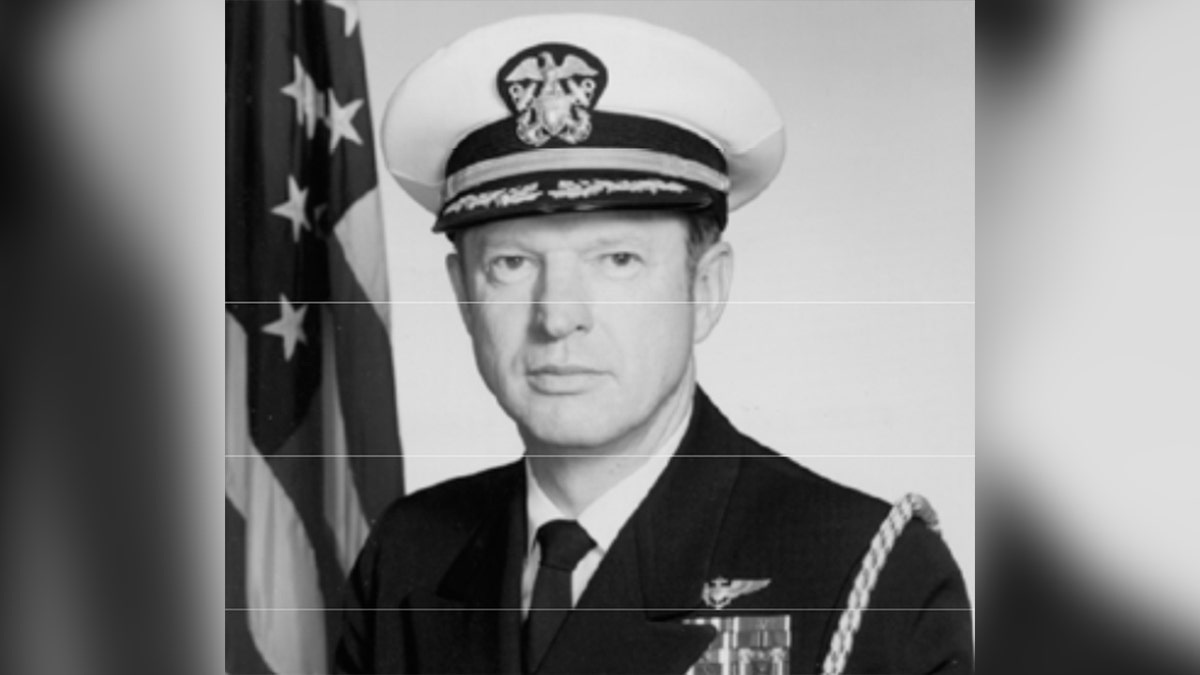
Details of Navy Capt. Royce Williams’ heroics had been classified.(Rep. Darrell Issa)
U.S. NAVY WARSHIP SUCCESSFULLY INTERCEPTS MEDIUM-RANGE BALLISTIC MISSLE IN TEST
Williams was on the first flight out that morning.
“It was ripe with targets, and we struck, and then I went back, landed and was informed to get something to eat because I had the next flight coming up for the combat air patrol.”
Williams and three other Panther pilots would launch in blizzard-like conditions, heavy winds and snow. They climbed 12,000 feet to clear sky. During their ascent, the lead pilot had a warning light on for his plane’s fuel system. He and his wingman were ordered to turn back to the Oriskany. Williams was also receiving communications from the ship, warning him of inbound, unidentified aircraft coming from the north.
“As we popped on top, I scanned and I saw seven aircraft contrails,” Williams said. “I now had the lead and a wingman that I’d never flown with before, but we were assigned to intercept.”
Williams and his wingman climbed in the direction of the MiGs at full throttle. Four broke away and started approaching the Americans, opening fire.
“There was no intention of any harm. We didn’t intend to have any killing going on,” Williams said.
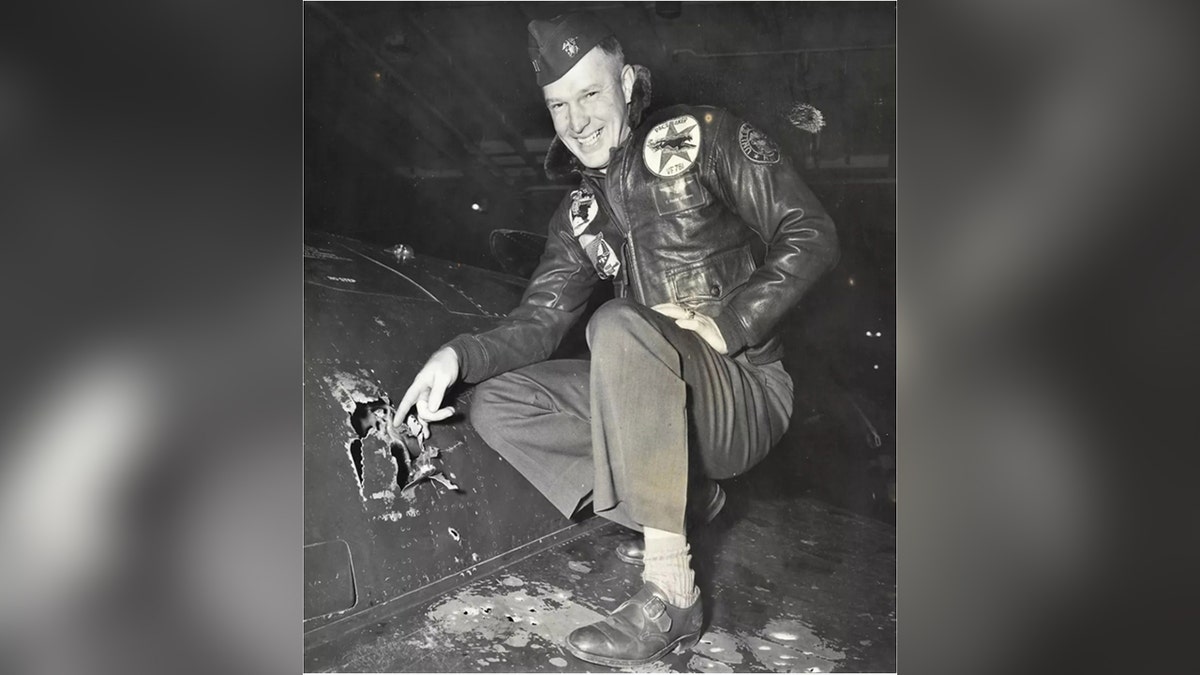
There is a new push to recognize and honor Capt. Royce Williams’ achievements. (Rep. Darrell Issa)
U.S. AIR FORCE SERVICE MEMBER FOUND DEAD IN SAN ANTONIO HOME, OFFICIALS SAY
He later wrote in his once-classified report on the battle, that it was then that he identified the planes as MiGs. Williams returned fire, sending the first plane spiraling into the sea. His wingman broke away to follow the downed plane. Williams continued firing at any planes in sight.
“Two broke right and one left for a coordinated attack. I had planned to attack the single plane but lost him in the sun, so I countered to the right into the first attacking plane.” Williams wrote he tried to get on the tail of the MiGs. It was then he would straighten his flightpath and fire at close range.
“When the MiG was hit or had observed me it seemed to stop in mid-air as though it dropped speed brakes. I had to wrap it up to the right to avoid collision,” he wrote.
The fight would eventually become one of the longest dogfights known in naval aviation.
“35 minutes,” Williams said. “I just had another MiG smoking, losing speed and altitude, and I ran out of ammunition.”
Most dogfights last two or three minutes and exceptional cases last up to five. Williams had taken down at least five MiGs during the 35-minute battle but knew he needed to return to the Oriskany.
“I had the guy go in and quit when I ran out of ammunition, but it gave plenty of time to make me a target,” Williams said. “I looked and I saw him made a quick maneuver, but he got me just as I turned and the damage was done.”
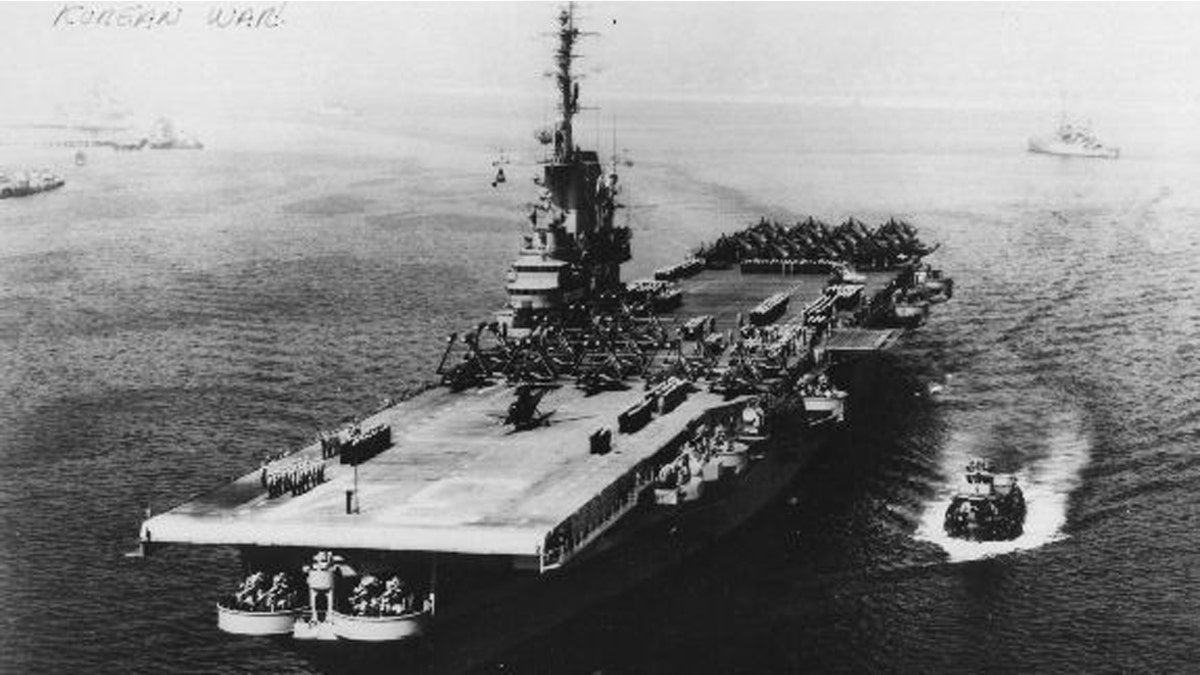
USS Oriskany was named for the Revolutionary War’s Battle of Oriskany. (Rep. Darrell Issa)
IRAN SEIZES SHIP ALL GULF OF OMAN, US NAVY SAYS
His Panther was in bad shape.
“I got all kind of battle-scarred and lost pretty much the capability to fight.”
Williams considered ejecting but decided to try and make it back to the Oriskany. He was able to land safely and counted 263 bullet holes and a 37-millimeter shell gash in the Panther. Another classified report revealed the planes were Soviet MiG-15s and had been ordered to attack the U.S. aircraft. Williams’ battle was also classified as top secret because officials feared the incident might cause a devastating increase in tensions between the U.S. and Soviet Union.
“I had been warned, informed, told not to talk about it. Even that is in direct order,” Williams said. “I didn’t talk to anybody, including my wife.”
The events were declassified nearly 65 years later in 2017. Williams said a friend told him the events were now made public.
“He said, ‘there’s more to the story than has been let out, isn’t there?’ And I said, ‘well, more or less,’” Williams explained. “I didn’t know anyone to tell my story to. I told it to my wife. And she said, ‘Oh, Royce.’”
Rep. Darrell Issa, R-Calif., is working to get Capt. Williams recognized for his accomplishments.
“This is even before the latest redo of ‘Top Gun,’ because here’s somebody who flew off the Oriskany, which is talked about in the first ‘Top Gun,’ downed MiGs, basically single-handedly, and then had it classified so that none of us knew about it for more than a generation,” Issa said.
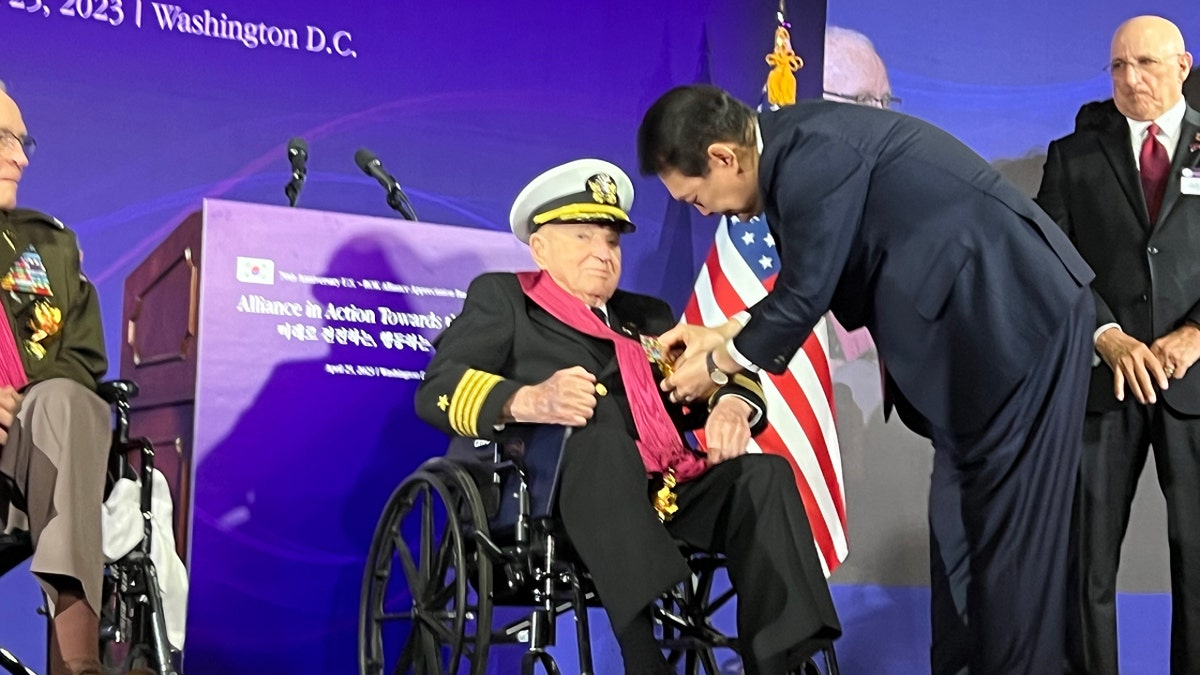
South Korean President Yoon Suk Yeol presented retired Navy Capt. Royce Williams with the Taegeuk Order of Military Merit.(Rep. Darrell Issa)
Issa, a former Army captain, met Williams at a Veterans of Foreign Wars post in California a few years ago. He said he was inspired by the little-known battle.
“It’s an amazing story of what would have had an absolute impact on the war had we known that Captain Williams was in a dogfight with Soviet aircraft,” Issa said. “That would have been essentially World War III.”
President Eisenhower even traveled to Seoul, South Korea, to meet with Williams and to discuss the then-classified information in person.
“It was important for Eisenhower to know what had been classified, but too important for the public to know for half a century,” Issa said.
South Korean President Yoon Suk Yeol was in Washington this week for a state visit. He took the time to honor several Korean War veterans including Williams. Yoon presented him with the Taegeuk Order of Military Merit.
“They’ve been teasing me with presents and whatnot until the moment today. Meeting the president and getting their highest award, the equivalent of the Medal of Honor,” Williams said. “I think it’s a little overblown. But I’ve been thrilled.”
Issa is still working to get Williams the highest U.S. military award, but Defense officials have yet to sign on because they believe upgrading Williams sets a bad precedent since the dogfight is not recorded in official U.S. records.
“The reality is we believe that if the facts get to the president’s desk, he will award the Medal of Honor, as it could not be awarded, but should have been awarded by Eisenhower a generation ago,” Issa explained.
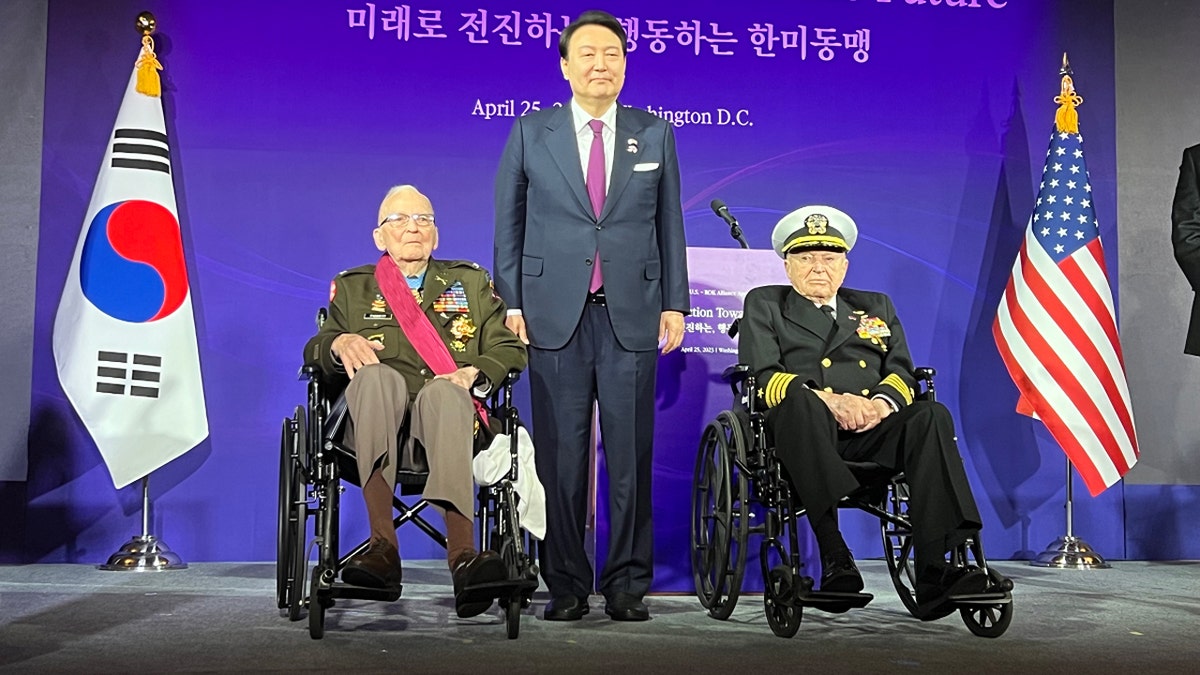
South Korean President Yoon Suk Yeol honoring Capt. Royce Williams, seen at right. (Rep. Darrell Issa)
Williams met with nearly a dozen midshipmen from the Naval Academy during his visit to Washington. He hopes to inspire other young people to join the military.
“My thinking is that the world changes. Now versus the 1920s. We’re not quite the same nation. Nor do I see the same outlet of young people who I feel should be thinking about a career in the military,” Williams said. “If I have any chance to speak to groups, I try and encourage them to think about it. We need them and they’re hard to come by. My purpose, I guess with what time I have, is to try and promote that.”
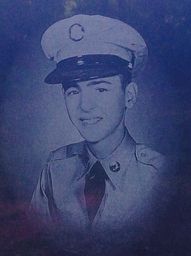
Photo added by Volunteer #46577499
Roy D “Roxy” Oxenrider
| BIRTH | |
|---|---|
| DEATH | 15 Dec 2013 (aged 81) |
| BURIAL |
Benton, Saline County, Arkansas, USA |
| MEMORIAL ID | 121824360 · |
–
Below is an article that was published in November of 2010 in the Saline Courier:
Saline County War Hero
Bryant resident Roy “Roxy” Oxenrider Survived Korean War’s Toughest Battle in 1950
The Battle of Chosin Reservoir took place in Korea from November 26, 1950 to December 11th. The United Nations (UN) forces included soldiers from South Korea, United States, and the United Kingdom. The UN forces numbered 25,000 soldiers and 2836 were killed and 7500 suffered cold related injuries. The Chinese had 120,000 soldiers and 35,000 killed.
China had entered the conflict just days earlier and huge numbers of Chinese Soldiers swept across the Yalu river, surrounding the UN troops at the Chosin Reservoir. A huge battle in freezing weather followed, and the UN troops were able to cut through Chinese lines in what can be described as a fighting withdrawal.
Roy Oxenrider has been a Saline County resident for over 30 years and currently both he and his wife Mildred live in Bryant. He was born near Harrisburg, PA. Below is his story concerning his experience in the Battle of Chosin Reservoir:
On September 13, 1949, age 17, I entered the U.S.Army through the recruiting center in Philadelphia, PA. After basic training in Ft Knox, KY, I was sent to Ft Benning, GA for advanced infantry training with the 3rd Division. Four days after the Korean war broke out, my name was posted on the board for duty in Korea.
I was assigned to 1st Battalion, 32 Regiment, 7th Division, Company A. On December 1, 1950 the weather started to clear around noon and the Corsairs appeared to give us cover. Someone yelled, “Able Company on the road.” I jumped out of my foxhole and started toward the road and realized my ROK soldier, Joung He Su, was not by my side, this was unusual. I was between the road and railroad near the front of the truck column when I turned to look for Joung He Su. As I turned, I heard a plane and just looked up in time to see a napalm dropping from the bottom of the plane, prematurely hitting in our perimeter area. I jumped for a nearby foxhole but did not make it all the way in. You could smell the scorch of my clothing. The men coming across on their way to the front of the truck column were hit by napalm. There were 10 to 12 men completely on fire and several others with blotches of fire on them. We yelled for them to roll in the snow. I believe Joung He Su to be one of those that was on fire because I did not see him anymore. We still were having to fight hand to hand with the Chinese as the men were burning.
A machine gun had started firing on us and small arms fire was coming from the high ground on the left. We managed to cut down enough of them to move up to take our place at the rear of the truck column. The trucks were not moving. A Chinese MG on the high ground to the left was firing. It was accompanied by a hail of small arms fire. My squad went down the bank on the right side of the road to the edge of the reservoir. We used the bank for cover to get behind the MG to knock it out. As we moved along the reservoir edge we came to a little opening, like a cove. As I started across the open space, the MG switched fire zones. I was shot through both thighs, and knocked to the ice. There was no pain. Perhaps because of the extreme cold, I did not yet know that I had been hit.
My buddy and squad leader, Harold Verseman, was behind me, and said, “Come on, Roy, get up. We got work to do.” I thought my feet had slipped from under me on the ice, but as I tried to rise, I couldn’t move. I was paralyzed. I called to Harold, “I can’t get up, I’ve been hit.” Harold turned, came back through a storm of bullets, the ice chipping and shattering around him and me as well. He got me by the arm and pulled me to the bank out of the line of fire. How he escaped being hit, I will never know. Of one thing I am certain, Harold Verseman saved my life. I could not have gotten off the ice by myself. I had dropped my carbine. Harold called a medic, turned to get my carbine, but it was gone. Someone had picked it up. He turned, and said, “Roy. I’m sorry, but I have to go.” He left at a run for the head of the column.
The medics cut my pants in a cross pattern, bandaged my legs, and carried me up the bank to a truck. They moved other wounded forward in the truck bed. I was placed parallel to the tailgate. My head was on the driver’s side. By this time, a Corsair plane had knocked out the Chinese MG. The truck began moving. I was in the last truck in the column. One thing that sticks in my memory is the courage of the soldier/truck drivers who manned those improvised ambulances loaded with wounded. Any man who slipped into the seat of one of those trucks was committing suicide. All knew it, but it stopped none. The trucks never lacked drivers. As one was hit he would be dragged out, another took his place. I think they deserved our nations; highest award. The Medal of Honor. Each of those guys was a hero. There was only one narrow road. The Chinese could concentrate fire on the driver. They had the advantage of the high ground on the left, looking down the driver’s throat. Blown bridges and road blocks also slowed the column. It was a nightmare scenario.
By the time we reached the first blown out bridge our fifth driver had been killed or wounded. This time the truck went into a shallow ditch on the right and leaned at a 45% angle, exposing the rear of the truck to direct enemy fire. The Chinese were firing into the truck, wounding and killing already wounded men. The bullets sounded like great gravel thrown against the truck, only much louder. My arm was jammed against the tailgate, as bullets hit the steel it felt like my arm was being torn off. The Chinese were now streaming down the hillside. John Parker of A Company got out, followed by a wounded officer. I kept trying and finally was able to roll over the top of the tailgate. As I felt, my rib cage hit on the trailer hitch, knocking the wind out of me. I thought, this is it. I can’t move. The Chinese will shoot me because I can not walk.
This thought enabled me to roll into the ditch and crawl into the brush with the wounded officer and Parker. We hid until dark. We heard screams, grenades and shooting. We knew no one else would get off that truck alive. That scene haunts me to this day. Some of those men stuck fast, frozen in the their own blood. I knew there was nothing I could do. Nevertheless, the self questioning has never stopped. I can still hear those cries for help. The bitter cold helped some like myself because blood froze so that one did not bleed to death, but to others it was tragic.
The officer wanted to follow the road. Parker and I did not agree with him. We parted. Parker had no shoes, only socks. He had suffered a stomach wound at the perimeter. The medics had removed his boots since he was unable to change his own socks, and placed his feet in a sleeping bag to prevent frostbite. I had extra socks under my shirt and an extra pair of insoles. We put the insoles on the bottoms of the first pair of socks, then pulled on the second pair to hold the insoles. It wasn’t much in that -25 degree to -40 degree weather, but better than what he had. When it is that cold, a few degrees did not seem to make much difference. I had regained some feeling in my left leg. Finding a tree limb for a crutch, we followed the RR, moving cautiously throughout the night. At one point, the Chinese walked by us. We lay doggo among the dead, there were so many they never noticed us. We left the RR, too many Chinese. We must have gone around the back (west) side of Hill 1221.
Next day we would go a short distance, stop, listen, then go on again. We did this all day. After dark we came to a village. It must have been Sasu. John was in bad shape. he could not walk. His feet were frozen. Pushing open the door of a L-shaped Korean house, I remember the frightened faces of the elderly couple who lived there. There were three other GI’s in the hut, one badly wounded. We decided we three unwounded would leave early in the morning to find our lines. I left my .45 pistol with one round for John, and promised the two of them to send help if we found anyone. Next morning, December 3rd, in total darkness, the three of us left. I moved very slowly, but the other two men did not leave me.
Veterans Day 2011 Part 8 Leon McDaniel of World War II (second post)
Okinawa – At the Emperor’s Doorstep” episode from “WWII: GI Diary”….. This old 1978 TV docu-drama was narrated by Lloyd Bridges and told the stories of real soldiers/sailors/pilots and their first-hand experiences in battle. Archival footage and good background music really made the stories come alive…..about 25 episodes were made. Video converted from really old […]
Veterans Day 2011 Part 7:You have heard of Jimmy Doolittle, but what about Leon A. McDaniel?
President Reagan and Senator Barry Goldwater present the fourth star to General Jimmy Doolittle during a White House ceremony in the Indian Treaty room, OEOB. 6/20/85. I love the movie “Pearl Harbor” with Ben Affleck and it tells the story of Jimmy Doolittle. He was born in 1896 and died in 1993. He is pictured […]
Veterans Day 2011 Part 6 (A look back at Okinawa)
This portion below appeared in an article I did for the Saline Courier about 18 months ago: I went to the First Baptist Church in Little Rock from 1983 to 1997, and during that time I became friends with Walter Dickinson Sr. In fact, we used to attend a weekly luncheon together on Thursdays. Just […]
Veterans Day 2011 Part 5 (A look back at the “Battle of the Bulge”)
The Lost Evidence: The Battle Of The Bulge (1/5) This article was published in the Saline Courier about 18 months ago: When we celebrate July 4th we are focusing on the freedoms that so many soldiers have fought for over the last 234 years. That focus has been highlighted for me since my son Hunter […]
Veterans Day 2011 Part 4
This is taken from an article that appeared in the Saline Courier about a year ago: Bravery is not just limited to one generation, but Americans have had it in every generation. It makes me think about those who are currently serving in our military. Jon Chris Roberts who is graduate of Benton High […]
Veterans Day 2011 Part 3 (A look back at World War 1)
I was born in Tennessee and everyone in Tennessee knows the name of Alvin York. Above is a clip about his accomplishments in War World I. Cara Gist of Shannon Hills tells me that her grandfather Herbert S. Apple of Salado, Arkansas (near Batesville) fought in World War I. He served in France and fought […]
Veterans Day 2011 Part 2 (Bataan Death March)
My longtime friend Craig Carney is originally from Jacksonville, and he told me a couple of years ago about a friend of his parents from Jacksonville, Arkansas named Silas Legrow. Legrow was going to speak at the Jacksonville Museum of Military History on April 17, 2008 about his experience in the March of 1942 when […]
Veterans Day 2011 (Black Hawk Down and North Little Rock’s Donavan “Bull” Briley)
The Background Facts of The Black Hawk Down (1/7) Uploaded by WarDocumentary on Feb 14, 2011 The movie Black Hawk Down was based on an actual event that took place in Mogadishu, Somalia. This documentary explains the event. _______________________________ On October 3, 2003 my son played quarterback at the Arkansas Baptist High School Football game […]


 The Daily Hatch