By the way, if you somehow think IMF data is suspect, you can also look at the UN’s Human Development Index. Over the past couple of decades, only Syria, Libya, and Yemen performed worse than Venezuela.
In his column for the Miami Herald, Andres Oppenheimer documents Venezuela’s descent into misery.
As Venezuelan dictator Nicolás Maduro celebrates his 10th year in office this week, a reality check shows that his presidency has been much more disastrous than people think. Maduro…has performed an economic miracle in reverse: He has turned what used to be one of Latin America’s richest countries into the poorest one, alongside Haiti.…Venezuela’s gross domestic product has plummeted from $350 billion in 2013 to $60 billion today… Venezuela’s poverty rate has soared from 40% of the population in 2013 to 94% today… Venezuela’s annual inflation rate has risen to nearly 350% this year from 56% in 2013… More than 7.2 million Venezuelans have fled the country during the past decade, according to United Nations estimates. That’s the biggest mass exodus in Latin America’s history.
That’s a depressing indictment.
But there’s more bad news to share. Here are some excerpts from an article by Dominic Wightman for the U.K.-based Critic.
Caracas has grown into one such city from hell. …there’s all-round cynicism, the pongs of death and dank deprivation ubiquitous. …The capital city is flatlining, the flatline only spiked by oases of ill-gotten gains underwritten by Russian gangsters, by wannabe Cuban puppet masters and the Chavistas themselves,whose grip on Venezuela has been transitorily perpetuated by narcodollars… No politics class or textbook can prepare a man for fifteen years viewing first-hand this latest chapter in the failure of socialist doctrine. The descent to hell in Venezuela has been swift and gruesome. …Too often in the West we have discussed Socialism as if it were a cheese on a cheeseboard, some kind of edible mushroom from which we might find nourishment, even as a side dish in a broader menu of political possibilities. The truth is that Socialism is poison, whichever way it is prepared or digested. It is appropriate — no, it is vital — to be so black and white about it.
Wightman’s analysis is particularly persuasive since he is married to a Venezuelan woman and has personally witnessed the nation’s decline over many years.
By the way, if you somehow think IMF data is suspect, you can also look at the UN’s Human Development Index. Over the past couple of decades, only Syria, Libya, and Yemen performed worse than Venezuela.
In his column for the Miami Herald, Andres Oppenheimer documents Venezuela’s descent into misery.
As Venezuelan dictator Nicolás Maduro celebrates his 10th year in office this week, a reality check shows that his presidency has been much more disastrous than people think. Maduro…has performed an economic miracle in reverse: He has turned what used to be one of Latin America’s richest countries into the poorest one, alongside Haiti.…Venezuela’s gross domestic product has plummeted from $350 billion in 2013 to $60 billion today… Venezuela’s poverty rate has soared from 40% of the population in 2013 to 94% today… Venezuela’s annual inflation rate has risen to nearly 350% this year from 56% in 2013… More than 7.2 million Venezuelans have fled the country during the past decade, according to United Nations estimates. That’s the biggest mass exodus in Latin America’s history.
That’s a depressing indictment.
But there’s more bad news to share. Here are some excerpts from an article by Dominic Wightman for the U.K.-based Critic.
Caracas has grown into one such city from hell. …there’s all-round cynicism, the pongs of death and dank deprivation ubiquitous. …The capital city is flatlining, the flatline only spiked by oases of ill-gotten gains underwritten by Russian gangsters, by wannabe Cuban puppet masters and the Chavistas themselves,whose grip on Venezuela has been transitorily perpetuated by narcodollars… No politics class or textbook can prepare a man for fifteen years viewing first-hand this latest chapter in the failure of socialist doctrine. The descent to hell in Venezuela has been swift and gruesome. …Too often in the West we have discussed Socialism as if it were a cheese on a cheeseboard, some kind of edible mushroom from which we might find nourishment, even as a side dish in a broader menu of political possibilities. The truth is that Socialism is poison, whichever way it is prepared or digested. It is appropriate — no, it is vital — to be so black and white about it.
Wightman’s analysis is particularly persuasive since he is married to a Venezuelan woman and has personally witnessed the nation’s decline over many years.
The shift toward free markets, which began in the mid-1970s, was especially beneficial for the less fortunate (see here, here, and here).
But it’s quite common for critics to assert that Chile is a bad example because many of the reforms were enacted by General Augusto Pinochet, a dictator who seized power in 1973. And some of those critics also attack Milton Friedman for urging Pinochet to liberalize the economy and reduce the burden of government.
Are these critics right?
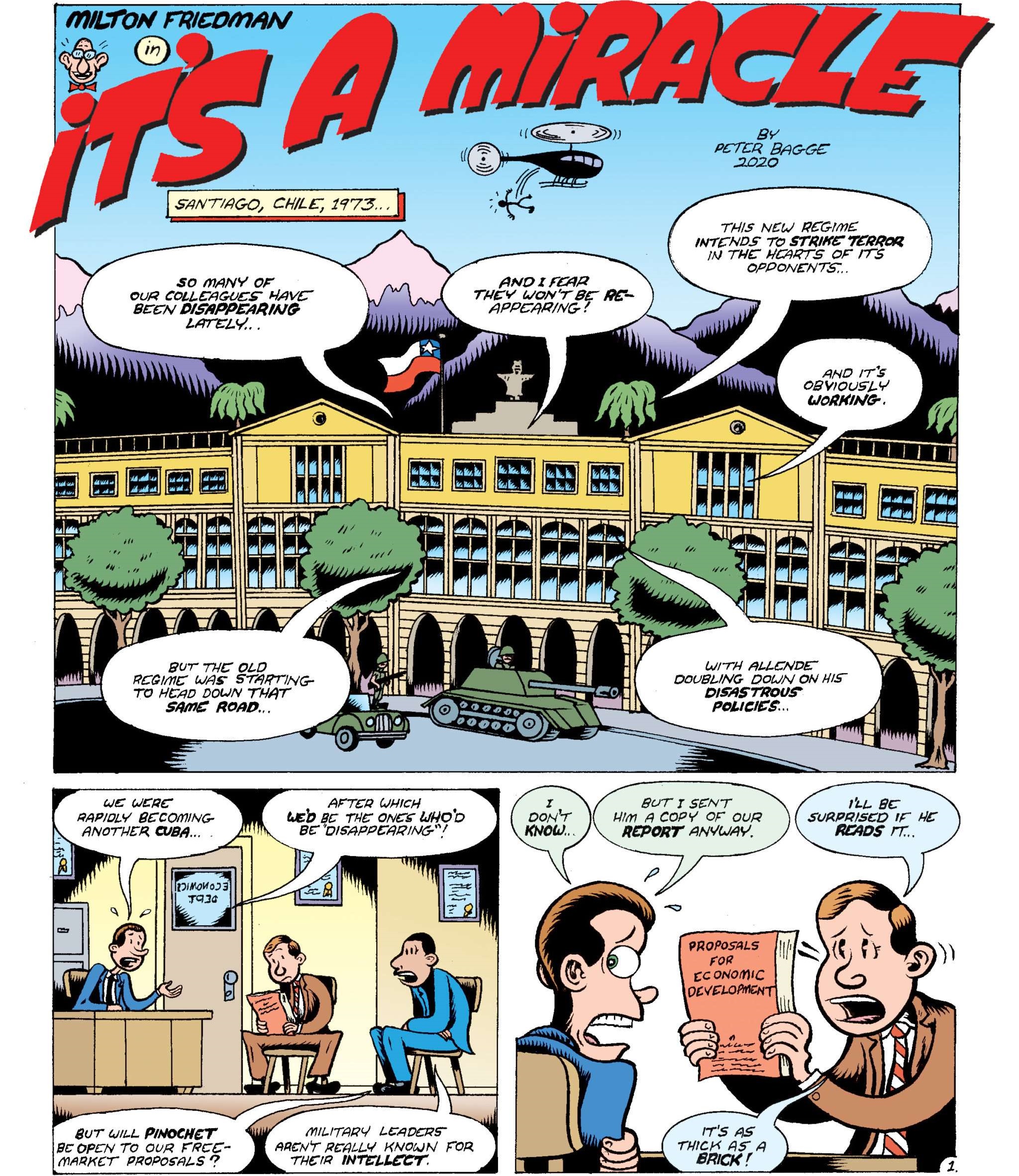
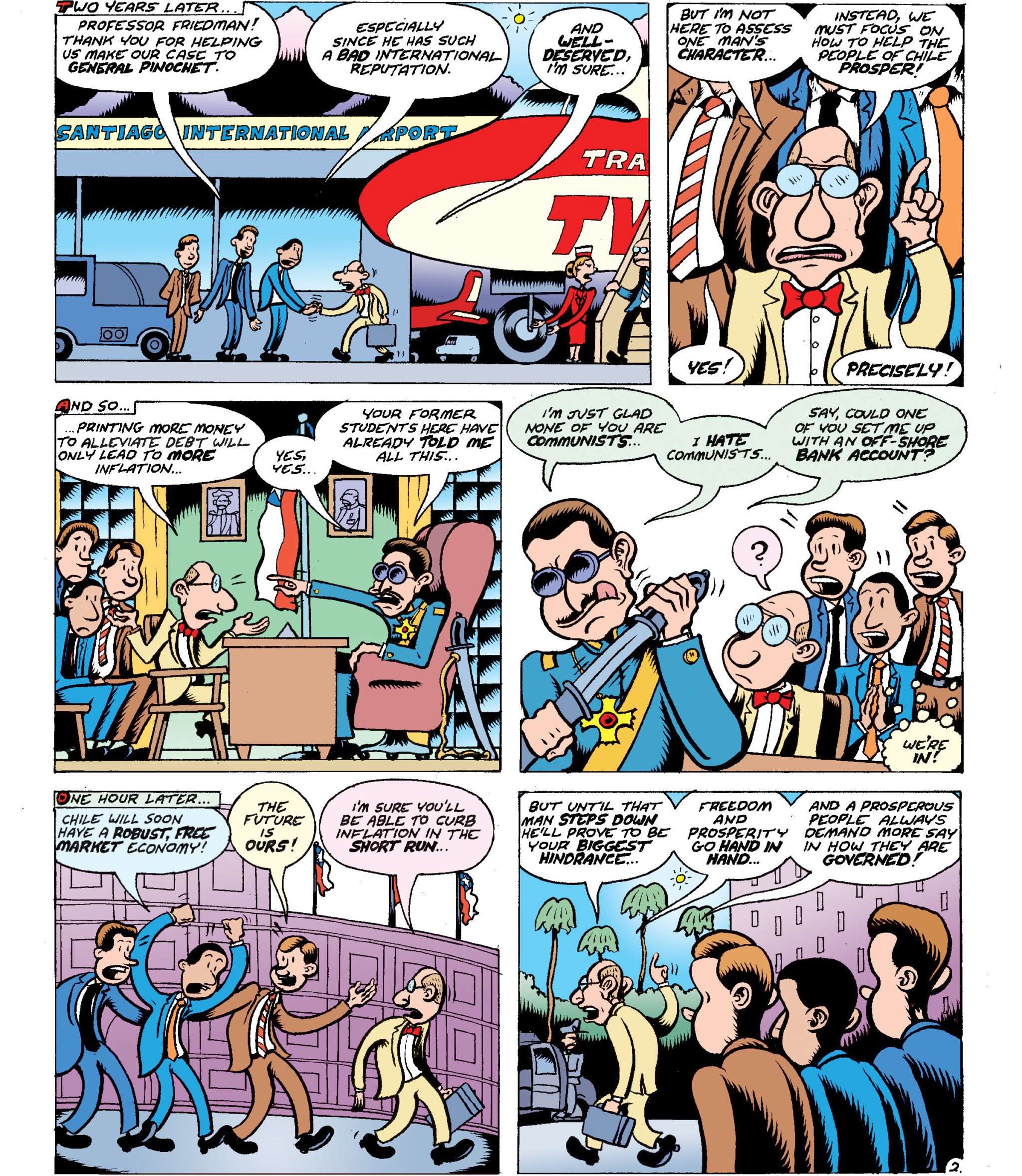
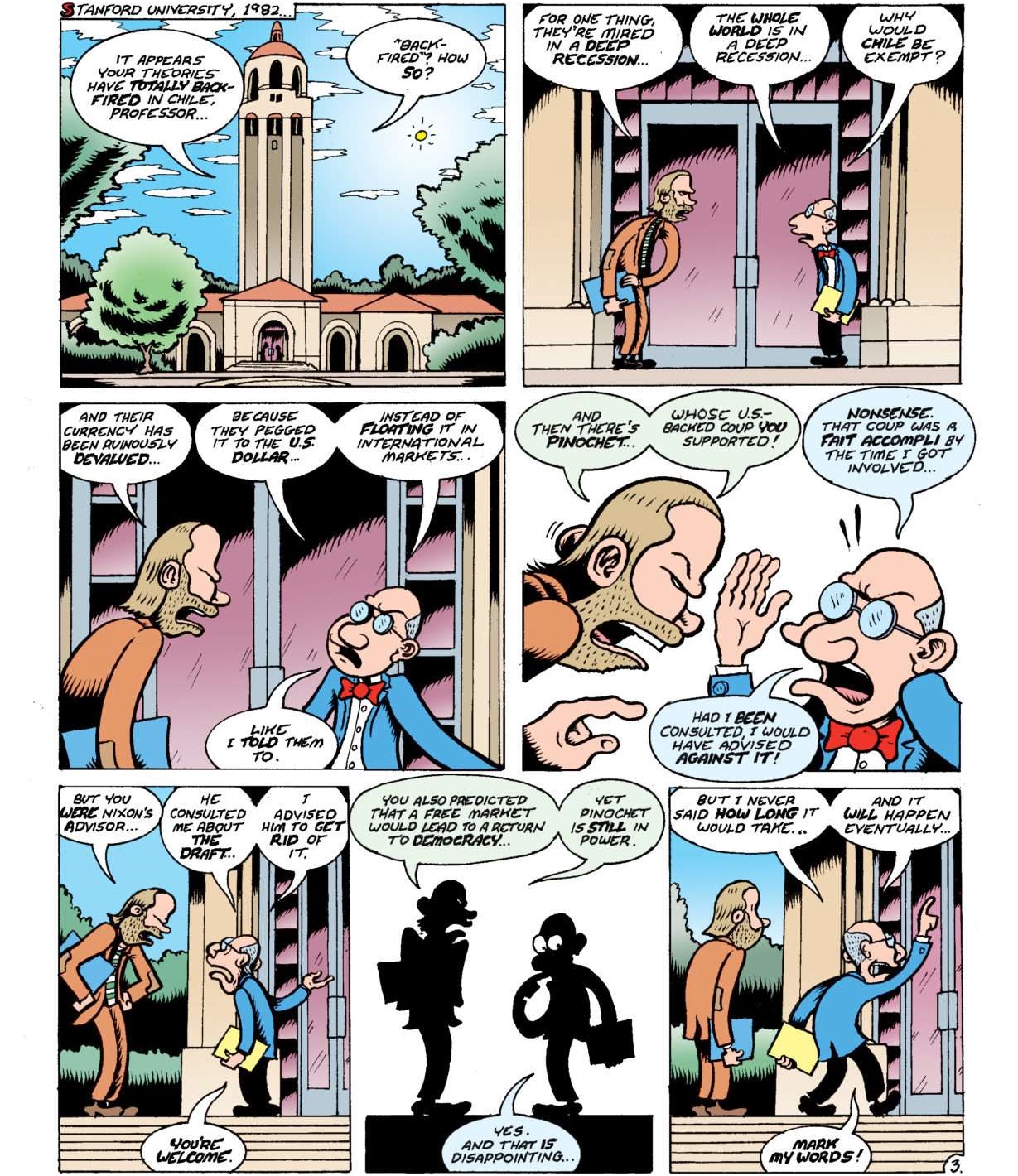
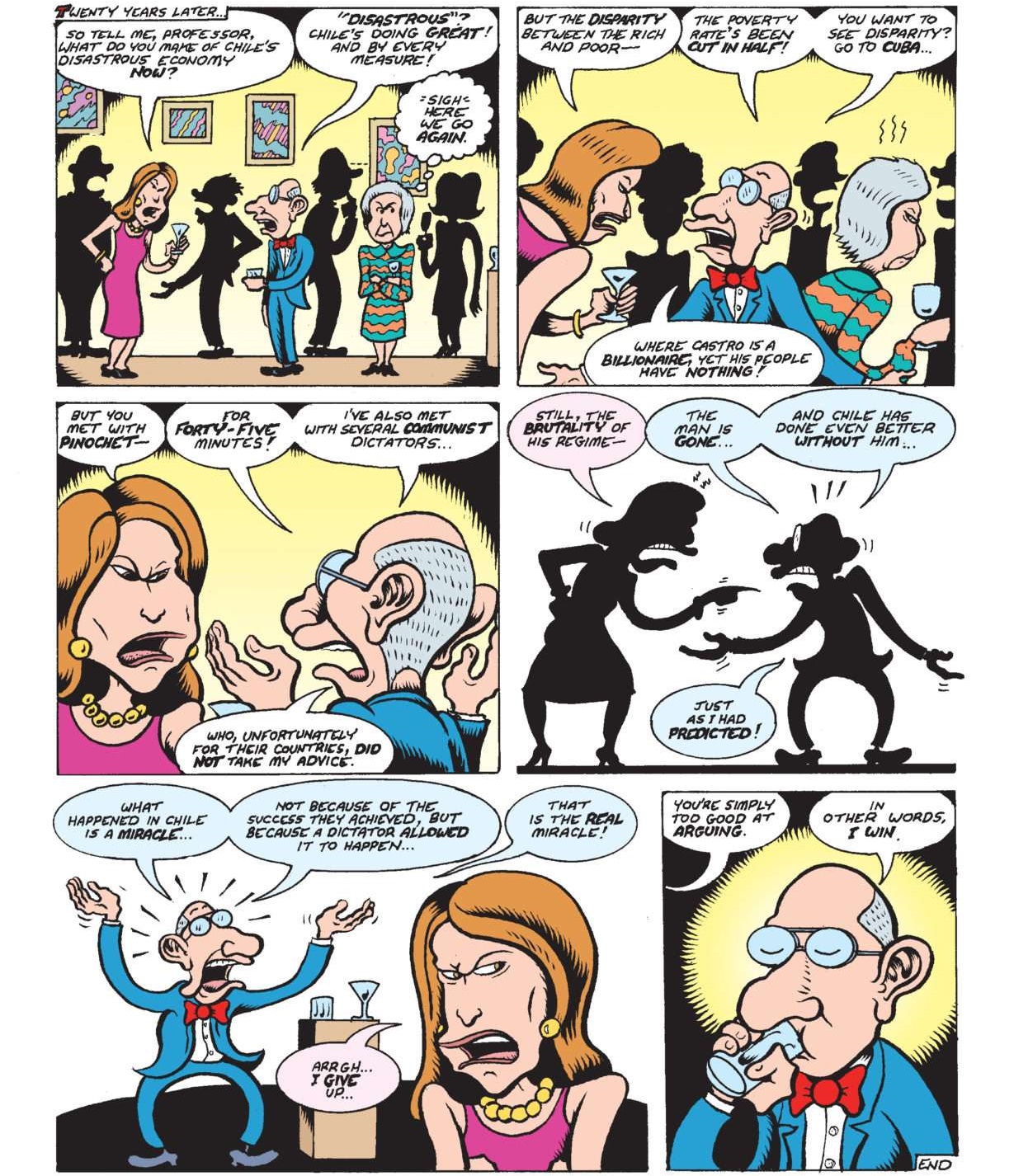
To answer that question, I very much recommend the following cartoon strip by Peter Bagge. Published by Reason, it accurately depicts the efforts of reformers to get good reforms from a bad government.
It starts in 1973, with a group of Chilean economists, known as the “Chicago Boys,” who wanted free markets.
In 1975, they invited Milton Friedman to help make the case for economic reform.
This 1982 strip shows some of the controversies that materialized.
But by the time we got to the 21st century, everything Friedman said turned out to be true.
First, I’ll be able to share it with people who want to delegitimize Chile’s transition to a market-oriented democracy (ranked #14 according to the most-recent edition of Economic Freedom of the World). Simply stated, it was bad that Chile had a dictatorship, but it was good that the dictatorship allowed pro-market reforms (particularly when compared to the alternative of a dictatorship with no reforms). And it was great that Chile became a democracy (a process presumably aided by mass prosperity).
Second, we should encourage engagement with distasteful governments. I certainly don’t endorse China’s government or Russia’s government, but I’ve advised government officials from both nations. Heck, I would even give advice to Cuba’s government or North Korea’s government (not that I’m expecting to be asked). My goal is to promote more liberty and it would make me very happy if I could have just a tiny fraction of Friedman’s influence in pursuing that goal.
P.S. Here’s Milton Friedman discussing his role in Chile.
P.P.S. While I disagree, it’s easy to understand why some people try to delegitimize Chile’s reforms by linking them to Pinochet. What baffles me are the folks who try to argue that the reforms were a failure. See, for instance, Prof. Dani Rodrik and the New York Times.
José Niño is a graduate student based in Santiago, Chile. A citizen of the world, he has lived in Venezuela, Colombia, and the United States. He is currently an international research analyst with the Acton Circle of Chile. Follow@JoseAlNino.
EspañolThe power of ideas to help shape political movements has been grossly underestimated over the years. In truth, some of the largest political transformations in human history have come from ideas that were developed in the secluded confines of an intellectual’s home or in obscure academic institutes. Regardless of the origins, ideas can snowball into powerful vehicles of social change.+
As Friedrich Hayek noted in one of his most powerful works, Intellectuals and Socialism,the triumph of socialist ideas can largely be attributed to the ideas first put forward by various intellectuals. They began with relatively well-off intellectuals and then made their way to “second-hand dealers” — journalists, scientists, doctors, teachers, ministers, lecturers, radio commentators, fiction writers, cartoonists, and artists — who then spread those ideas to the masses.+
Intellectuals like Milton Friedman took it upon themselves to reverse this trend and create an environment that was more favorable to free markets. Steadfast in his beliefs in the power of ideas, Friedman knew that big changes usually start out in small venues.+
It was in Chile where Friedman’s vision was first implemented on a large scale. The results were nothing short of spectacular, as Chile was able to escape a veritable economic collapse and experience an unprecedented boom.+
Chile’s economic success was no mere coincidence; it was the product of ideas that Milton Friedman put forward in the 1950s. To understand how such a radical change was brought about, one must first look at the origins of the Chicago Boys, the group of Chilean economists that played a pivotal role in the transformation of Chile’s economy during the 1970s and 1980s.+
The Chicago Boys
Under the tutelage of the United States Agency for International Development (USAID), the University of Chicago signed a modest agreement with the Pontifical Catholic University of Chile in the 1950s to provide a group of Chilean students training in economics.+
In exchange, the University of Chicago would send four faculty members to help the Catholic University build up their economics department. Of these four faculty members, Arnold Harberger would serve as the Chicago Boys’ principal mentor.+
What at first looked liked just another exchange program between universities would play a substantial role in Chile’s economic rise.+
A Country Mired By Statism
At the start of this program, Chile’s economy was in the doldrums. Another victim of Raúl Prebisch’s Import Substitution Industrialization (ISI) policy, Chile had a very loose central banking policy, featured 15 different exchange rates, heavy tariffs, and a number of import and export controls. Subsequent governments maintained the same neo-mercantilist structure up until the 1970s.+
During this era of economic malaise, the Chicago Boys constructed El Ladrillo(The Brick), a text primarily shaped by economist Sergio de Castro which advocated for economic liberalization in all sectors of the Chilean economy. Sadly, this text was largely ignored at that time.+
It wasn’t until the presidency of Salvador Allende that the Chicago Boys’ talents would be desperately needed.+
On the Road to Cuba 2.0
Though democratically elected by a narrow margin in 1970, Salvador Allende was determined to turn Chile into the next Cuba by undermining all of its democratic institutions. Through price controls, arbitrary expropriations, and lax monetary policy, Allende put the Chilean economy on the verge of collapse. By 1973, inflation reached 606 percent and per capita GDP dropped 7.14 percent.+
Under the command of General Augusto Pinochet, the military deposed Allende’s government. Despite this tumultuous change, the military ruler did not have a clear economic vision for Chile.+
Enter Milton Friedman
Milton Friedman’s visit to Chile in March 1975 proved to be quite fateful. Friedman was on a week-long lecture tour for various think thanks. Eventually, Friedman sat down with the general himself for 45 minutes. Right off the bat, Friedman recognized that Pinochet had very little knowledge of economics. After their meeting, Friedman sent Pinochet a letter with a list of policy recommendations.+
Friedman was blunt is his diagnosis of Chile’s economy: for the country to recover, it had to truly embrace free-market measures.+
Ideas Put in Action
Cooler heads prevailed and Pinochet let the Chicago School disciples occupy various posts in the military government. In April 1975, El Plan de Recuperación Económica (The Economic Recovery Plan) was implemented. Soon Chile curbed its inflation, opened up its markets, privatized state-owned industries, and cut government spending. By the 1990s, Chile was experiencing the largest economic boom in its history.+
A principled libertarian, Friedman criticized Pinochet’s repressive political measures. Friedman understood that economic and political freedoms are not mutually exclusive. The principles laid in Friedman’s book Capitalism and Freedom inspired José Piñera, a notable Chilean reformer, to become a part of Chile’s classical liberal revolution.+
Like Friedman, Piñera understood the link between economic and political freedom. This motivated him to help ratify the Chilean Constitution of 1980. The most classically liberal constitution in Latin America’s history, it established the transition towards free elections and Chile’s return to democracy.+
Additionally, Piñera was the architect of Chile’s private social security system that empowered millions of workers and has fostered the growth of an ownership society. This model has been exported to dozens of countries abroad and has served as a market-based alternative to government-run pension systems.+
The “Chilean Miracle” represented the first major triumph against communism during the Cold War. Chile’s classical-liberal revolution subsequently inspired the Thatcher Revolution of 1979 and the Reagan Revolution of 1980. These ideas had resounding effects all over the globe and marked the beginning of the end for Soviet-style models of economic organization.+
There is still much work to do, as the illegitimate children of Marxist and Keynesian thought still run loose these days throughout Latin America. But one thing is absolutely certain: an idea whose time has come is unstoppable.+
RIP Milton Friedman
Milton Friedman is the short one!!!
Milton Friedman’s Free to Choose (1980), episode 3 – Anatomy of a Crisis. part 1
Milton Friedman The Power of the Market 5-5 How can we have personal freedom without economic freedom? That is why I don’t understand why socialists who value individual freedoms want to take away our economic freedoms. I wanted to share this info below with you from Milton Friedman who has influenced me greatly over the […]

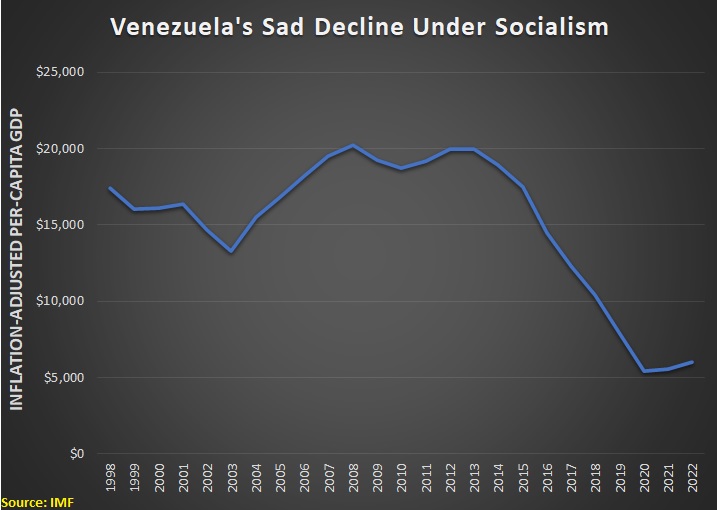
…Venezuela’s gross domestic product has plummeted from $350 billion in 2013 to $60 billion today… Venezuela’s poverty rate has soared from 40% of the population in 2013 to 94% today… Venezuela’s annual inflation rate has risen to nearly 350% this year from 56% in 2013… More than 7.2 million Venezuelans have fled the country during the past decade, according to United Nations estimates. That’s the biggest mass exodus in Latin America’s history.
whose grip on Venezuela has been transitorily perpetuated by narcodollars… No politics class or textbook can prepare a man for fifteen years viewing first-hand this latest chapter in the failure of socialist doctrine. The descent to hell in Venezuela has been swift and gruesome. …Too often in the West we have discussed Socialism as if it were a cheese on a cheeseboard, some kind of edible mushroom from which we might find nourishment, even as a side dish in a broader menu of political possibilities. The truth is that Socialism is poison, whichever way it is prepared or digested. It is appropriate — no, it is vital — to be so black and white about it.


 The Daily Hatch