Monthly Archives: July 2021

Pro-Growth Tax Reform in Arizona By Dan Mitchell

—-

Pro-Growth Tax Reform in Arizona

The best referendum result of 2020 (indeed, the best policy development of the year) was when the people of Illinois voted to preserve their flat tax, thus delivering a crushing defeat to the Prairie State’s hypocritical governor, J.B. Pritzker.

The worst referendum result of 2020 was when the people of Arizona voted for a class-warfare tax scheme that boosted the state’s top tax rate from 4.5 percent to 8 percent.

In one fell swoop, Arizona became a high-tax state for investors, entrepreneurs, innovators, and business owners. That was a very dumb choice, especially since there are zero-income tax states in the region (Nevada, Texas, and Wyoming), as well as two flat-tax states (Utah and Colorado).

You can see Arizona’s problem in this map from the Tax Foundation. It’s great to be grey and good to be yellow, but bad to be orange (like Arizona), red, or maroon.

That’s the bad news.

The good news is that lawmakers in have just approved a plan that will significantly lower tax rates and restore the state’s competitiveness.

The Wall Street Journal opined this morning about this positive development.
Arizona currently taxes income under a progressive rate structure, starting at 2.59% up to 4.5%. The ballot last November carried an initiative to add a 3.5% surtax on earnings above $250,000 for single filers. It narrowly passed, meaning the combined top rate was set to hit 8%, higher than all of Arizona’s neighbors except California. …Mr. Ducey’s budget will cut rates for all taxpayers.The Legislature can’t repeal the voter-approved surtax, so above the 2.5% flat rate, there will still be a second bracket on income over $250,000. But the budget also has a provision adjusting the flat tax downward for those Arizonans, so no one will pay a top rate above 4.5%. …the same as today. …No Arizonan will have to pay the threatened 8% rate, since the provisions forestalling it are immediate. …“Every Arizonan—no matter how much they make—wins with this legislation,” Mr. Ducey said. “It will protect small businesses from a devastating 77 percent tax increase…and it will help our state stay competitive so we can continue to attract good-paying jobs.” That’s worth celebrating.

story from the Associated Press gave the development a much more negative spin.

After slashing $1.9 billion in income taxes mainly benefiting upper-income taxpayers and shielding them from higher taxes approved by voters in an initiative last year, the Republican-controlled House returned Friday and passed more legislation targeting Proposition 208. The House approved the creation of a new tax category for small business, trusts and estates that will eliminate even more of the money that the measure approved by voters in November was designed to raise for schools. The proposal passed despite unified opposition from minority Democrats. …The governor has expressed disdain for the voter-approved tax, saying it would hurt the state’s economy and vowing in March to see it gutted either though Legislation or the courts. …The budget-approved tax cuts set a flat 2.5% tax on all income levels that will be phased in over several years once revenue projections are met, with those subject to the new education tax paying 4.5% at most.

If nothing else, an amusing example of bias from AP.

I have two modest contributions to this discussion.

First, it’s not accurate to say that Arizona adopted a flat tax. Maybe I’m old fashioned, but a flat tax has to have only one rate. Arizona’s reform is praiseworthy, but it doesn’t fulfill that key equality principle.

Second, the main takeaway is not that lawmakers did something good. It’s more accurate to say that they protected the state from something bad.

I’ve updated this 2018 visual to show how the referendum would have pushed Arizona into Column 5, which is the worst category, but the reform keeps the state in column 3.
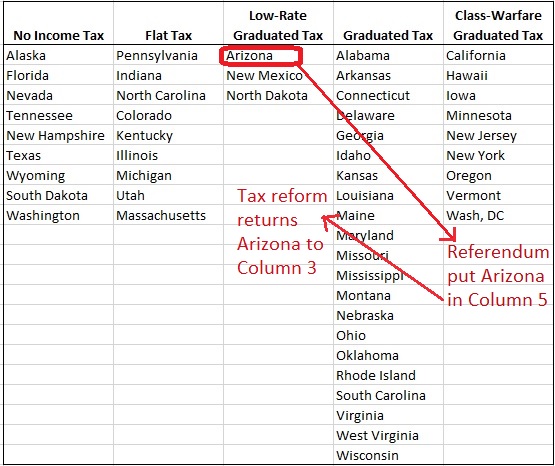
P.S. North Carolina made the biggest shift in the right direction in recent years, followed by Kentucky, while Kansas flirted with a big improvement and settled for a modest improvement. Meanwhile, Mississippi is thinking about making a huge positive jump.

P.P.S. Since Arizona voters made a bad choice and Arizona lawmakers made a wise choice, this is evidence for Prof. Garett Jones’ hypothesis that too much democracy is a bad thing.


More Good News on School Choice

I’m pessimistic about the direction of public policy, especially on fiscal issues such as taxes and spending.

But there is a silver lining to this dark cloud of statism. We’re seeing continuing progress on school choice, most notably a big expansion of educational freedom in West Virginia.

It appears more and more state and local policy makers are reaching the inevitable conclusion that government schoolsoperate for the benefit of teacher unions rather than students.

And this is motivating many legislators to push for school choice, especially since there’s more and more evidence that school choice improves educational outcomes.

For instance, the Wall Street Journal opined last week about a new victory in Indiana.

Ten years ago in these columns, we hailed Indiana for its leadership in establishing one of America’s most ambitious school voucher programs. On Thursday the Indiana Legislature built on that achievement by approving a budget that will take the program to 48,000 students a year from about 37,000. …The teachers unions are unhappy. Their beef is that money to expand choice is taken from traditional public schools. And this year they lobbied local school boards to pass resolutions opposed to school choice. But that common union line about choice robbing public schools isn’t true. …92% of Indiana students will be in traditional public schools, and 93% of all education funding will go to these schools. …Since 2011, when Indiana pushed through its first voucher plan, more than a quarter-million Hoosier students have benefited. In an interview with Today’s Catholic, former Gov. Mitch Daniels explains the moral logic of choice this way: “Providing poor and minority families the same choice of schools that their wealthier neighbors enjoy is the purest example of ‘social justice’ in our society today.”

Meanwhile, Arkansas may be on the verge of adding to the good news.

Here are some excerpts from an article by Jason Bedrick in National Review.
In response to families demanding more educational options, six states have already passed new choice policies or expanded existing ones this year, and similar bills are still making their way through more than a dozen other state legislatures. …the Arkansas state senate…passed Senate Bill 680,which has the support of Governor Asa Hutchinson and the Arkansas Department of Education, by an overwhelming margin. Although only half the size of the previous proposal and limited only to low-income children, the bill still represents a major step toward providing broad access to educational choice. The Arkansas House now has another opportunity to do right by Arkansas families desperate for more educational options. …the Arkansas House Revenue and Taxation Committee voted to recommend that the full House pass the bill.

The superintendents of government schools are fighting to preserve the status quo. Their main argument is that choice will hurt outcomes for students stuck in their schools.

But competition encourages everyone to do better, and Jason shares some of the evidence about government schools doing better when there is school choice .

The research about the effects of educational-choice policies on public schools…overwhelmingly finds that such policies benefit not only participating students, but also the students who remain in their assigned district schools. Out of 27 studies, 25 find that students attending district schools improve their performance on standardized tests after the introduction of a choice program, while only one study found a negative effect, and one found no visible effect. …a recent study by the University of Arkansas found that states with robust educational-choice policies saw significant improvements on the National Assessment of Educational Progress (known as the “Nation’s Report Card”) over the last two decades. …The sky isn’t falling in any of the 29 states that have some form of private-school-choice program. Indeed, the sun is still shining on their public-school systems, which have not only not collapsed but are actually performing better than before.

Fingers crossed that Arkansas lawmakers do what’s right for kids rather than siding with the education bureaucracy.

Let’s conclude with this video from the Institute of Justice, which makes the point that school choice is especially critical for those with low incomes and other challenging backgrounds.


shared a similar video back in 2016 as part of a column about why school choice is critical for black children.

P.S. If you want to learn more about school choice, I recommend this video.

P.P.S. It’s uplifting to see very successful school choice systems operate in nations such as CanadaSwedenChile, and the Netherlands.

Milton Friedman’s School Voucher Idea at 60

ByDAN LIPSJune 24, 2015 8:00 AM

From school choice to personalized lifelong learning.

Sixty years ago, Milton Friedman came up with a profound idea for improving education. Rather than paying public schools to educate the students in their districts, the future Nobel Laureate argued, the government should provide parents with vouchers to allow them to choose what school each child would attend.

In cities such as Milwaukee and Cleveland and Washington, D.C., and states such as Arizona and Florida and Indiana, families across America have benefited from programs designed to give families educational choice. Empirical evidence assessing these programs shows that allowing parents to choose their children’s schools results in greater parental satisfaction, higher student test scores, and improved graduation rates.

But in 2015, the landscape of K–12 and higher education, as well as the economy and the labor market as a whole, are changing. And these changes require us to rethink how choice in education could best help children and adults succeed. Consider two key trends:

First, students of all ages now have unprecedented opportunities to benefit from affordable and high-quality learning experiences. In 2015, a student in the United States — or anywhere in the world — with an Internet connection has the opportunity to learn from a wide variety of terrific teachers.

Many schools are using technology to offer personalized and challenging forms of instruction. Brilliant educators like Salman Khan — the founder of Khan Academy — are providing lessons online, for free, for any student who is willing to do the work. Colleges like MIT and Stanford now offer coursework online for free and even award credentials to those who pass an exam.

For motivated students of all ages, learning is becoming a personalized journey that can happen any day, at any hour, at their own pace, not just within the walls of a traditional classroom or during the school year. Students will experience education through multiple channels, and not just from one school.

Second, it is becoming increasingly clear that the need to learn doesn’t end with earning a diploma. Many adults who have traditional credentials like college degrees are struggling to find well-paying jobs. According to the New York Federal Reserve Bank, 44 percent of recent college graduates are in jobs that don’t require a college degree. Some professions that once were secure livelihoods are being disrupted or replaced by machines, technologies, or new enterprises. As a result, many workers are being forced to acquire new skills in order to change careers.

What do these trends mean for Milton Friedman’s original idea of using school vouchers to improve education?

We should be giving families control of the funds that they will spend on K–12 and higher education throughout their lives.

Instead of simply providing parents with the power to choose which school their child attends during a given school year, we should be giving them — and eventually the students themselves, when they reach adulthood — control of the funds that they will spend on K–12 and higher education throughout their lives. Rather than only allowing parents to answer the question of where a child goes to school, we should let students (or, initially, their parents) control where, when, how, and from whom they learn.

Five states, led by Arizona, have introduced state-funded education savings accounts that give families this control of K–12 funding. Parents can use funds in the account to pay for school tuition, tutoring, online classes, and instructional materials, and if there is anything left in a given year, to save it for future years. The state maintains proper oversight by tracking how funds are spent.

Nevada recently enacted a universal education-savings-account program that will offer the parents of all public-school students the chance to take direct control of their children’s education in this way.

Besides these promising state efforts, Congress has an opportunity to begin giving families direct control over how their education funds are spent over the course of a lifetime. Congress could reform federal 529 savings plans, which allow tax-free saving for college, to include other allowable uses — from preschool and K–12 education to post-college job training.

Transforming 529 accounts into Lifelong Learning Education Savings Accounts would provide an immediate benefit to the families of the 12 million holders of 529 savings accounts. Use of the accounts would likely grow if other expenses were allowed, since 35 states and D.C. offer tax incentives for contributions into 529 accounts. Congress could also give families the option of receiving their share of federal education funds directly into an account if they forgo public programs such as Head Start. This would ensure that disadvantaged students also have the opportunity to benefit.

Parents should be thankful for Milton Friedman’s vision for school choice, which has improved educational opportunities for millions. But in 2015, education savings accounts and lifelong learning offer a more promising answer to the question of how best to equip Americans to learn, succeed, and pursue happiness throughout their lives.

— Dan Lips is a fellow with the Goldwater Institute. In 2005, he wrote a paper for the Institute proposing the nation’s first state-funded K–12 education-savings-account program for Arizona.

Milton Friedman

Related posts:

“Friedman Friday” (“Free to Choose” episode 1 – Power of the Market. part 7 of 7)

March 16, 2012 – 12:25 am

  Michael Harrington:  If you don’t have the expertise, the knowledge technology today, you’re out of the debate. And I think that we have to democratize information and government as well as the economy and society. FRIEDMAN: I am sorry to say Michael Harrington’s solution is not a solution to it. He wants minority rule, I […] By Everette Hatcher III | Posted in Current Events, Milton Friedman | Edit | Comments (0)

“Friedman Friday” (“Free to Choose” episode 1 – Power of the Market. part 6 of 7)

March 9, 2012 – 12:29 am

PETERSON: Well, let me ask you how you would cope with this problem, Dr. Friedman. The people decided that they wanted cool air, and there was tremendous need, and so we built a huge industry, the air conditioning industry, hundreds of thousands of jobs, tremendous earnings opportunities and nearly all of us now have air […] By Everette Hatcher III | Posted in Current Events, Milton Friedman | Edit | Comments (0)

“Friedman Friday” (“Free to Choose” episode 1 – Power of the Market. part 5 of 7)

March 2, 2012 – 12:26 am

Part 5 Milton Friedman: I do not believe it’s proper to put the situation in terms of industrialist versus government. On the contrary, one of the reasons why I am in favor of less government is because when you have more government industrialists take it over, and the two together form a coalition against the ordinary […] By Everette Hatcher III | Posted in Current Events, Milton Friedman | Edit | Comments (0)

“Friedman Friday” (“Free to Choose” episode 1 – Power of the Market. part 4 of 7)

February 24, 2012 – 12:21 am

The fundamental principal of the free society is voluntary cooperation. The economic market, buying and selling, is one example. But it’s only one example. Voluntary cooperation is far broader than that. To take an example that at first sight seems about as far away as you can get __ the language we speak; the words […] By Everette Hatcher III | Posted in Current Events, Milton Friedman | Edit | Comments (0)

“Friedman Friday” (“Free to Choose” episode 1 – Power of the Market. part 3 of 7)

February 17, 2012 – 12:12 am

  _________________________   Pt3  Nowadays there’s a considerable amount of traffic at this border. People cross a little more freely than they use to. Many people from Hong Kong trade in China and the market has helped bring the two countries closer together, but the barriers between them are still very real. On this side […] By Everette Hatcher III | Posted in Current Events, Milton Friedman | Edit | Comments (0)

“Friedman Friday” (“Free to Choose” episode 1 – Power of the Market. part 2 of 7)

February 10, 2012 – 12:09 am

  Aside from its harbor, the only other important resource of Hong Kong is people __ over 4_ million of them. Like America a century ago, Hong Kong in the past few decades has been a haven for people who sought the freedom to make the most of their own abilities. Many of them are […] By Everette Hatcher III | Posted in Current Events, Milton Friedman | Edit | Comments (0)

“Friedman Friday” (“Free to Choose” episode 1 – Power of the Market. part 1of 7)

February 3, 2012 – 12:07 am

“FREE TO CHOOSE” 1: The Power of the Market (Milton Friedman) Free to Choose ^ | 1980 | Milton Friedman Posted on Monday, July 17, 2006 4:20:46 PM by Choose Ye This Day FREE TO CHOOSE: The Power of the Market Friedman: Once all of this was a swamp, covered with forest. The Canarce Indians […]

Milton Friedman The Power of the Market 1-5

Debate on Milton Friedman’s cure for inflation

September 29, 2011 – 7:24 am

If you would like to see the first three episodes on inflation in Milton Friedman’s film series “Free to Choose” then go to a previous post I did. Ep. 9 – How to Cure Inflation [4/7]. Milton Friedman’s Free to Choose (1980) Uploaded by investbligurucom on Jun 16, 2010 While many people have a fairly […]

By Everette Hatcher III | Also posted in Current Events | Tagged dr friedman, expansion history, income tax brackets, political courage, www youtube | Edit | Comments (0)

“Friedman Friday” Milton Friedman believed in liberty (Interview by Charlie Rose of Milton Friedman part 1)

April 19, 2013 – 1:14 am

Charlie Rose interview of Milton Friedman My favorite economist: Milton Friedman : A Great Champion of Liberty  by V. Sundaram   Milton Friedman, the Nobel Prize-winning economist who advocated an unfettered free market and had the ear of three US Presidents – Nixon, Ford and Reagan – died last Thursday (16 November, 2006 ) in San Francisco […] By Everette Hatcher III | Posted in Milton Friedman | Edit | Comments (0)

What were the main proposals of Milton Friedman?

February 21, 2013 – 1:01 am

Stearns Speaks on House Floor in Support of Balanced Budget Amendment Uploaded by RepCliffStearns on Nov 18, 2011 Speaking on House floor in support of Balanced Budget Resolution, 11/18/2011 ___________ Below are some of the main proposals of Milton Friedman. I highly respected his work. David J. Theroux said this about Milton Friedman’s view concerning […] By Everette Hatcher III | Posted in Milton Friedman | Edit | Comments (0)

“Friedman Friday,” EPISODE “The Failure of Socialism” of Free to Choose in 1990 by Milton Friedman (Part 1)

December 7, 2012 – 5:55 am

Milton Friedman: Free To Choose – The Failure Of Socialism With Ronald Reagan (Full) Published on Mar 19, 2012 by NoNationalityNeeded Milton Friedman’s writings affected me greatly when I first discovered them and I wanted to share with you. We must not head down the path of socialism like Greece has done. Abstract: Ronald Reagan […] By Everette Hatcher III | Posted in Milton FriedmanPresident Obama | Edit | Comments (1)

Defending Milton Friedman

July 31, 2012 – 6:45 am

What a great defense of Milton Friedman!!!!   Defaming Milton Friedman by Johan Norberg This article appeared in Reason Online on September 26, 2008  PRINT PAGE  CITE THIS      Sans Serif      Serif Share with your friends: ShareThis In the future, if you tell a student or a journalist that you favor free markets and limited government, there is […]


Dan Mitchell article Untying the Gordian Knot of Critical Race Theory


Untying the Gordian Knot of Critical Race Theory

The most powerful argument for school choice is that children from poor families will be more likely to get a high-quality education. After all, these are the kids most likely to be trapped in failing government schools.

But there are lots of secondary arguments for school choice.

Today, we’re going to add to this list by considering the current controversy over whether “critical race theory” should be taught in schools.

I won’t bother trying to put forth my own definition of CRT.

But, for what it’s worth, I think it’s a good thing if kids learn that the United States (like all nations) has an imperfect history, while it’s wrong if kids are brainwashed into believing that they are either oppressors or victims simply because of skin color.

But what about people who think differently? Should I decide what schools teach, or should other people make those choices?

The right answer is that we don’t need a one-size-fits-all approach. Either mine or anyone else’s.

In a column for Reason, J.D. Tuccille says school choice is a way of letting parents pick the schools that best reflect their values.

…some states are banning the teaching of CRT—an approach that threatens to turn advocates of the ideology into free speech martyrs fighting the entrenched establishment. …families that choose how their children learn—my own included—rather than defaulting to government-run institutions…have largely escaped these battles. By homeschooling, or micro-schooling, or picking private or charter schools, we can avoid curricula permeated with ideas we find toxic… Parents that…support CRT also have alternatives to battling over the content of schoolroom lessons. They can introduce their tykes to Ibram X. Kendi’s Antiracist Baby Picture Book, marinate their kids in CRT-infused homeschooling, or send them to one of many private schools that offer willing families an education steeped in the ideology. …if that’s what they want their kids to learn, let them do so in peace, and without zero-sum arguments about what children are taught in shared institutions.

Amen.

Critical race theory won’t be nearly so controversial if we let parents choose the type of education that’s best for their kids.

And the same is true for other contentious issues, ranging from phonics to prayer.

No wonder more and more states are shifting in the right direction on this issue.

P.S. If you want to learn more about school choice, I recommend this video.

P.P.S. It’s uplifting to see very successful school choice systems operate in nations such as CanadaSwedenChile, and the Netherlands.

January 26, 2021 1:32PM

For The Good of Kids and Teachers, Unions Should Stop Blocking School Choice 

By Neal McCluskeyTwitterLinkedInRedditFacebook

Empty Classroom

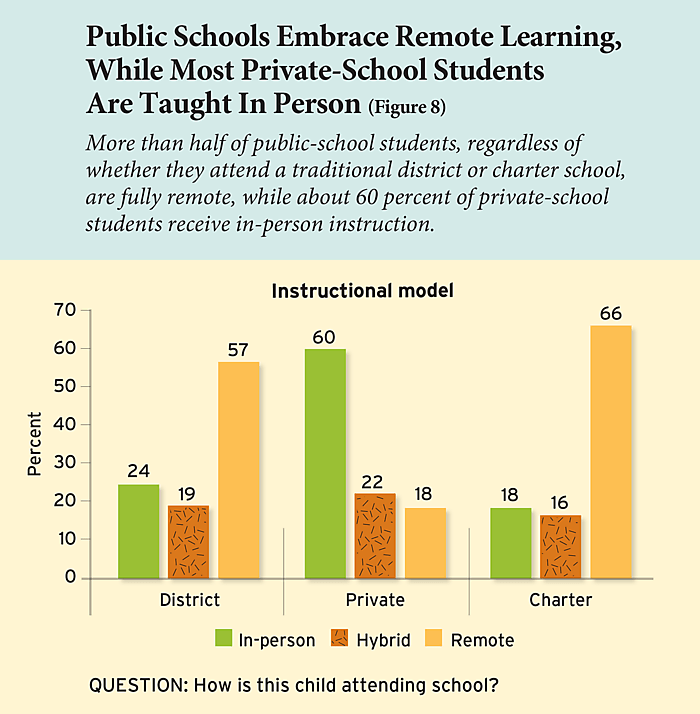
In March, at the beginning of the COVID-19 lockdowns, the CDC reported: “In other countries, those places who closed school (e.g., Hong Kong) have not had more success in reducing spread than those that did not (e.g., Singapore).” Today, that the default for schools should be in‐​person instruction, especially for younger students, has been reinforced myriad times. Add to this the release of COVID vaccines, and many jurisdictions prioritizing teachers to receive them, and you would expect public schools across the nation to be welcoming kids back in droves.

Not so fast. In Chicago, under the direction of their union, thousands of teachers refused to return to in‐​person instruction yesterday. In Fairfax County, Virginia, the teacher association is resisting returning to in‐​person instruction even after all teachers – but not students – have been vaccinated. These are continuations of re‐​opening refusals from unions that we have seen throughout the pandemic.

I’ve pointed out before that the national COVID response has shone a brilliant light on the long‐​existing necessity of school choice. All children have different needs and face different dangers – the child with a learning disability may need in‐​person education, the one living with elderly grandparents may need to stay home – but too often a district or school can offer just one option. Of course, teacher unions have long been the most prominent opponents of school choice, which would seriously threaten their monopolies on labor.

What we have too often missed is that teachers may need choice as much as children do. While the evidence points to the overall safety of reopening schools in‐​person – and private schools have done it in droves(see below) – there is certainly some risk in returning face‐​to‐​face. This is especially true for high‐​risk groups, such as older teachers or those with underlying conditions. But were public opinion to swing to districts providing in‐​person schooling for all students, those teachers would often be out of options other than to quit or retire. And right now, public school teachers who might prefer to work in‐​person are stuck. Teachers need different options to choose from, just like families.

Education Next COVID Survey - Instructional Model

Choice would also be good for teacher pay, by the way. No longer stuck with a monopoly employer, teachers would have the power to demand higher salaries, or better perks, than what their unions decide to accept. And schools, which would compete for students based on the effectiveness of their instruction, among other things, would have strong incentives to pay more for good teachers.

COVID-19 has driven home how important freedom is for children. But it is also important for teachers, even if their unions insist on standing in the way.

—-

January 12, 2021

Office of Barack and Michelle Obama
P.O. Box 91000
Washington, DC 20066

Dear President Obama,

I wrote you over 700 letters while you were President and I mailed them to the White House and also published them on my blog http://www.thedailyhatch.org .I received several letters back from your staff and I wanted to thank you for those letters. 

I have been reading your autobiography A PROMISED LAND and I have been enjoying it. 

Let me make a few comments on it, and here is the first quote of yours I want to comment on:

The story of how this postwar consensus broke down—starting with LBJ’s signing of the Civil Rights Act of 1964 and his prediction that it would lead to the South’s wholesale abandonment of the Democratic Party—has been told many times beforeThe realignment Johnson foresaw ended up taking longer than he had expected. But steadily, year by year—through Vietnam, riots… and Nixon’s southern strategy; through BUSING, Roe v. Wade, urban crime, and WHITE FLIGHT:through affirmative action, the Moral Majority, union busting, and Robert Bork; through assault weapons bans and the rise of Newt Gingrich…and the Clinton impeachment—America’s voters and their representatives became more and more polarized.

I have put many posts up on my blog about school vouchers and how they would lower the cost of good education and give inner city children the chance to go to better schools since their parents would have real school choice!!! Why do you think inner city schools have the worst schools? The answer is those kids are trapped in schools where those educators know their students are trapped!

I suggest checking out these episodes of Milton Friedman’s film series FREE TO CHOOSE: “The Failure of Socialism” and “What is wrong with our schools?”  and “Created Equal”  and  From Cradle to Grave, and – Power of the Market.

Education Week, Part II: The Case for School Choice

November 19, 2019 by Dan Mitchell

School choice is based on the simple premise that we’ll get better results if school budgets are distributed to parents so they can pick from schools that compete for their kids (and dollars).

The current system, by contrast, is an inefficient monopoly that largely caters to the interests of teacher unions and school bureaucrats. Which is why more money and more money and more money and more money and more money (you get the point) never translates into better outcomes.

This is why even the Washington Post has editorialized for choice-based reform.

A few years ago, I shared a bunch of data showing that school choice boosts academic results for kids.

As part of our recognition of National Education Week, let’s augment those results with some more-recent findings.

There’s new evidence, for instance, that Florida’s choice system is producing good results.

…new evidence from the Urban Institute, which…examined a larger data set of some 89,000 students. The researchers compared those who used school vouchers to public-school students with comparable math and reading scores, ethnicity, gender and disability status. …High school voucher students attend either two-year or four-year institutions at a rate of 64%, according to the report, compared to 54% for non-voucher students. For four-year colleges only, some 27% of voucher students attend compared to 19% for public-school peers. …About 12% of voucher students attended private universities, double the rate of non-voucher students. …Voucher students who entered the program in elementary or middle school were 11% more likely to get a bachelor’s degree, while students who entered in high school were 20% more likely. …High schoolers who stayed in the voucher program for at least three years “were about 5 percentage points more likely to earn a bachelor’s degree, a 50 percent increase.”

column published by the Foundation for Economic Education notes the positive outcomes in Wisconsin.

Private schools and independent public charter schools are more productive than district public schools, …according to report author Corey DeAngelis… DeAngelis compares the productivity of schools in cities throughout Wisconsin based on per-pupil funding and student achievement. Wisconsin’s four private-school parental choice programs currently enroll over 40,000 students combined, and more than 43,000 students are enrolled in charter schools. …Compared to Wisconsin district public schools, private schools participating in parental choice programs receive 27 percent less per-pupil funding, and charter schools receive 22 percent less. Yet these schools get more bang for every education buck, according to DeAngelis: “I find that private schools produce 2.27 more points on the Accountability Report Card for every $1,000 invested than district-run public schools [across 26 cities], demonstrating a 36 percent cost-effectiveness advantage for private schools. Independent charter schools produce 3.02 more points on the Accountability Report Card for every $1,000 invested than district-run public schools [throughout Milwaukee and Racine], demonstrating a 54 percent cost-effectiveness advantage for independent charter schools.”

A study looking at 11 school choice programs found very positive results.

Today 26 states and the District of Columbia have some private school choice program, and the trend is for more: Half of the programs have been established in the past five years. …a new study from the Department of Education Reform at the University of Arkansas shows…that voucher students show “statistically significant” improvement in math and reading test scores. The researchers found that vouchers on average increase the reading scores of students who get them by about 0.27 standard deviations and their math scores by about 0.15 standard deviations. In laymen’s terms, this means that on average voucher students enjoy the equivalent of several months of additional learning compared to non-voucher students. …“When you do the math, students achieve more when they have access to private school choice,” says Patrick J. Wolf, who conducted the study with M. Danish Shakeel and Kaitlin P. Anderson. …The Arkansas results aren’t likely to change union minds because vouchers are a mortal threat to their public-school monopoly. But for anyone who cares about how much kids learn, especially the poorest kids, the Arkansas study is welcome news that school choice delivers.

Even if choice is just limited to charter schools, there are positive outcomes, as seen from research on Michigan’s program.

Charter students in Detroit on average score 60% more proficient on state tests than kids attending the city’s traditional public schools. Eighteen of the top 25 schools in Detroit are charters while 23 of the bottom 25 are traditional schools. Two studies from Stanford’s Center for Research on Education Outcomes (2013, 2015) found that students attending Michigan charters gained on average an additional two months of learning every year over their traditional school counterparts. Charter school students in Detroit gained three months.

Back in 2016, Jason Riley of the Wall Street Journal shared some evidence about the benefits of choice.

Barack Obama…spent his entire presidency trying to shut down a school voucher program in Washington, D.C., that gives poor black and brown children access to private schools and, according to the Education Department’s own evaluation, improves their chances of graduating by as much as 21 percentage points. …Democrats continue to throw ever-increasing amounts of taxpayer money at the problem in return for political support from the teachers unions that control public education. …Harvard professor Martin West describes some of the more recent school-choice research. Students at Boston charter high schools “are more likely to take and pass Advance Placement courses and to enroll in a four-year rather than a two-year college,” writes Mr. West. Attending a charter middle school in Harlem “sharply reduced the chances of teen pregnancy (for girls) and incarceration (for boys),” and “a Florida charter school increased students’ earnings as adults.” Mr. West concludes that “attending a school of choice, whether private or charter, is especially beneficial for minority students living in urban areas.”

study by the World Bank found big benefits from choice in Washington, D.C., with minorities being the biggest beneficiaries.

This paper develops and estimates an equilibrium model of charter school entry and school choice. In the model, households choose among public, private, and charter schools, and a regulator authorizes charter entry and mandates charter exit. The model is estimated for Washington, D.C. According to the estimates, charters generate net social gains by providing additional school options, and they benefit non-white, low-income, and middle-school students the most. Further, policies that raise the supply of prospective charter entrants in combination with high authorization standards enhance social welfare. …In order to quantify the net social gains generated by charter schools, we run a counterfactual consisting of not having charters at all in 2007. …charter students who switch into public schools outside Ward 3 experience lower proficiency, quality and value added than before. Proficiency losses are quite severe at the middle school level and for poor black students, who on average lose 6.4 and 5.3 percentage points out of their baseline average proficiency… On average all student groups lose welfare due to the loss of school options, but losses are the greatest for those previously most likely to attend charters. Middle school students, who gain much from the quantity and quality of options offered by charters, are particularly hurt. Further, poor blacks in middle school experience a loss of about 15 percent of their baseline welfare. …The 25 percent of students most hurt by charter removal are non-white, have an average household income of $27,000 and experience an average welfare loss equivalent to 19 percent of their income. …total social benefits fall by about $77,000,000 when the 59 charters are removed.

This map from the study is worth some careful attention.

It reveals that the rich and white families who live in northwestern D.C. don’t have any big need for choice. It’s the poor families (mostly black) elsewhere in the city who are anxious for alternatives.

(Which is why the NAACP’s decision to side with unions over black children is so reprehensible.)

The good news is that there’s ongoing movement to expand choice in some states.

The Wall Street Journal opined about significant progress in Florida.

With little fanfare this autumn, another 18,000 young Floridians joined the ranks of Americans who enjoy school choice. More than 100,000 students, all from families of modest means, already attend private schools using the state’s main tax-credit scholarship. But the wait list this spring ran to the thousands, so in May the state created a voucher program to clear the backlog. …This is a huge victory for school choice. The first cohort of voucher recipients is 71% black and Hispanic, according to state data. Eighty-seven percent have household incomes at or below 185% of the poverty line, or $47,638 for a family of four. The law gives priority to these students… Mr. DeSantis’s opponent, Democrat Andrew Gillum, said he would wind down the scholarships. CNN’s exit poll says 18% of black women voted for Mr. DeSantis… That’s decisive, since the Governor won by fewer than 40,000 ballots.

The final passage is worth emphasis. Reformers can attract votes from minority families who are ill-served by the government’s education monopoly,

Parents in low-income communities aren’t stupid. Once they figure out that government schools are run for the benefit of unions rather than children, they will respond accordingly.

And here’s some positive news from Tennessee.

Governor Bill Lee fulfilled a campaign promise on Friday when he signed a school voucher bill into law. …its passage is a big victory for the Governor and even more for Tennessee children trapped in failing public schools. Beginning in the 2021-22 school year, the measure will provide debit cards averaging $7,300 each year for low-income families to use for education-related expenses. The money can pay for private-school tuition, textbooks or a tutor, among other things. The program is capped at a disappointingly low 15,000 students. Participation is also restricted to only two of the state’s 95 counties—Shelby and Davidson… This is where the need is greatest, given that these two counties have the most failing public schools.

To be sure, the union bosses are fighting back.

Over the years, we’ve seen setbacks in states where we hoped for progress, such as Colorado and Pennsylvania.

Let’s close with this very simple message…

…and this very persuasive video.

P.S. There’s also evidence that school choice is better for children’s mental health since it’s associated with lower suicide rates. That’s a nice fringe benefit, much like the data on school choice and jobs.

P.P.S. Getting rid of the Department of Education would be a good idea, but the battle for school choice is largely won and lost on the state and local level.

Sincerely,

Everette Hatcher III, 13900 Cottontail Lane, Alexander, AR 72002, ph 501-920-5733 everettehatcher@gmail.com

Related posts:

Image result for milton friedman ronald reagan

Ronald Reagan with Milton Friedman Milton Friedman The Power of the Market 2-5


Friedman Friday” Free to Choose by Milton Friedman: Episode “What is wrong with our schools?” (Part 6 of transcript and video)

December 9, 2011 – 12:53 am

Here is the video clip and transcript of the film series FREE TO CHOOSE episode “What is wrong with our schools?” Part 6 of 6.   Volume 6 – What’s Wrong with our Schools Transcript: FRIEDMAN: But I personally think it’s a good thing. But I don’t see that any reason whatsoever why I shouldn’t have been required […]By Everette Hatcher III | Posted in Milton FriedmanVouchers | Edit | Comments (0)

Friedman Friday” Free to Choose by Milton Friedman: Episode “What is wrong with our schools?” (Part 5 of transcript and video)

December 2, 2011 – 12:52 am

Here is the video clip and transcript of the film series FREE TO CHOOSE episode “What is wrong with our schools?” Part 5 of 6.   Volume 6 – What’s Wrong with our Schools Transcript: Are your voucher schools  going to accept these tough children? COONS: You bet they are. (Several talking at once.) COONS: May I answer […]By Everette Hatcher III | Posted in Milton FriedmanVouchers | Edit | Comments (0)

Friedman Friday” Free to Choose by Milton Friedman: Episode “What is wrong with our schools?” (Part 3 of transcript and video)

November 18, 2011 – 7:08 am

Friedman Friday” Free to Choose by Milton Friedman: Episode “What is wrong with our schools?” (Part 3 of transcript and video) Here is the video clip and transcript of the film series FREE TO CHOOSE episode “What is wrong with our schools?” Part 3 of 6.   Volume 6 – What’s Wrong with our Schools Transcript: If it […]By Everette Hatcher III | Posted in Milton FriedmanVouchers | Tagged economic market.educational marketprivate universitiesstate collegesvalue of education | Edit | Comments (0)

Friedman Friday” Free to Choose by Milton Friedman: Episode “What is wrong with our schools?” (Part 2 of transcript and video)

November 11, 2011 – 12:50 am

Here is the video clip and transcript of the film series FREE TO CHOOSE episode “What is wrong with our schools?” Part 2 of 6.   Volume 6 – What’s Wrong with our Schools Transcript: Groups of concerned parents and teachers decided to do something about it. They used private funds to take over empty stores and they […]By Everette Hatcher III | Posted in Milton FriedmanVouchers | Edit | Comments (0)

Friedman Friday” Free to Choose by Milton Friedman: Episode “What is wrong with our schools?” (Part 1 of transcript and video)

November 4, 2011 – 12:01 am

Here is the video clip and transcript of the film series FREE TO CHOOSE episode “What is wrong with our schools?” Part 1 of 6.   Volume 6 – What’s Wrong with our Schools Transcript: Friedman: These youngsters are beginning another day at one of America’s public schools, Hyde Park High School in Boston. What happens when […]

Milton Friedman Friday:(“Free to Choose” episode 4 – From Cradle to Grave, Part 7 of 7)

October 21, 2011 – 12:15 am

I am currently going through his film series “Free to Choose” which is one the most powerful film series I have ever seen. TEMIN: We don’t think the big capital arose before the government did? VON HOFFMAN: Listen, what are we doing here? I mean __ defending big government is like defending death and taxes. […]By Everette Hatcher III | Edit | Comments (0)

Milton Friedman Friday:(“Free to Choose” episode 4 – From Cradle to Grave, Part 6 of 7)

October 14, 2011 – 12:14 am

I am currently going through his film series “Free to Choose” which is one the most powerful film series I have ever seen worked pretty well for a whole generation. Now anything that works well for a whole generation isn’t entirely bad. From the fact __ from that fact, and the undeniable fact that things […]By Everette Hatcher III | Edit | Comments (0)

Milton Friedman Friday:(“Free to Choose” episode 4 – From Cradle to Grave, Part 5 of 7)

October 7, 2011 – 12:13 am

 I am currently going through his film series “Free to Choose” which is one the most powerful film series I have ever seen. PART 5 of 7 MCKENZIE: Ah, well, that’s not on our agenda actually. (Laughter) VOICE OFF SCREEN: Why not? MCKENZIE: I boldly repeat the question, though, the expectation having been __ having […]By Everette Hatcher III | Edit | Comments (0)

Milton Friedman Friday: (“Free to Choose” episode 4 – From Cradle to Grave, Part 4 of 7)

September 30, 2011 – 12:12 am

 I am currently going through his film series “Free to Choose” which is one the most powerful film series I have ever seen. PART 4 of 7 The massive growth of central government that started after the depression has continued ever since. If anything, it has even speeded up in recent years. Each year there […]

By Everette Hatcher III | Edit | Comments (0)

Milton Friedman Friday: (“Free to Choose” episode 4 – From Cradle to Grave, Part 3 of 7)

September 23, 2011 – 12:11 am

 I am currently going through his film series “Free to Choose” which is one the most powerful film series I have ever seen. PART 3 OF 7 Worse still, America’s depression was to become worldwide because of what lies behind these doors. This is the vault of the Federal Reserve Bank of New York. Inside […]

By Everette Hatcher III | Edit | Comments (0)

Milton Friedman Friday:(“Free to Choose” episode 4 – From Cradle to Grave, Part 2 of 7)

September 16, 2011 – 12:10 am

 I am currently going through his film series “Free to Choose” which is one the most powerful film series I have ever seen. For the past 7 years Maureen Ramsey has had to buy food and clothes for her family out of a government handout. For the whole of that time, her husband, Steve, hasn’t […]By Everette Hatcher III | Edit | Comments (0)

Friedman Friday:(“Free to Choose” episode 4 – From Cradle to Grave, Part 1 of 7)

September 9, 2011 – 12:09 am

Friedman Friday:(“Free to Choose” episode 4 – From Cradle to Grave, Part 1 of 7) Volume 4 – From Cradle to Grave Abstract: Since the Depression years of the 1930s, there has been almost continuous expansion of governmental efforts to provide for people’s welfare. First, there was a tremendous expansion of public works. The Social Security Act […]

By Everette Hatcher III | Edit | Comments (0)

“Friedman Friday” (“Free to Choose” episode 1 – Power of the Market. part 7 of 7)

March 16, 2012 – 12:25 am

  Michael Harrington:  If you don’t have the expertise, the knowledge technology today, you’re out of the debate. And I think that we have to democratize information and government as well as the economy and society. FRIEDMAN: I am sorry to say Michael Harrington’s solution is not a solution to it. He wants minority rule, I […]By Everette Hatcher III | Posted in Current EventsMilton Friedman | Edit | Comments (0)

“Friedman Friday” (“Free to Choose” episode 1 – Power of the Market. part 6 of 7)

March 9, 2012 – 12:29 am

PETERSON: Well, let me ask you how you would cope with this problem, Dr. Friedman. The people decided that they wanted cool air, and there was tremendous need, and so we built a huge industry, the air conditioning industry, hundreds of thousands of jobs, tremendous earnings opportunities and nearly all of us now have air […]By Everette Hatcher III | Posted in Current EventsMilton Friedman | Edit | Comments (0)

“Friedman Friday” (“Free to Choose” episode 1 – Power of the Market. part 5 of 7)

March 2, 2012 – 12:26 am

Part 5 Milton Friedman: I do not believe it’s proper to put the situation in terms of industrialist versus government. On the contrary, one of the reasons why I am in favor of less government is because when you have more government industrialists take it over, and the two together form a coalition against the ordinary […]By Everette Hatcher III | Posted in Current EventsMilton Friedman | Edit | Comments (0)

“Friedman Friday” (“Free to Choose” episode 1 – Power of the Market. part 4 of 7)

February 24, 2012 – 12:21 am

The fundamental principal of the free society is voluntary cooperation. The economic market, buying and selling, is one example. But it’s only one example. Voluntary cooperation is far broader than that. To take an example that at first sight seems about as far away as you can get __ the language we speak; the words […]By Everette Hatcher III | Posted in Current EventsMilton Friedman | Edit | Comments (0)

“Friedman Friday” (“Free to Choose” episode 1 – Power of the Market. part 3 of 7)

February 17, 2012 – 12:12 am

  _________________________   Pt3  Nowadays there’s a considerable amount of traffic at this border. People cross a little more freely than they use to. Many people from Hong Kong trade in China and the market has helped bring the two countries closer together, but the barriers between them are still very real. On this side […]By Everette Hatcher III | Posted in Current EventsMilton Friedman | Edit | Comments (0)

“Friedman Friday” (“Free to Choose” episode 1 – Power of the Market. part 2 of 7)

February 10, 2012 – 12:09 am

  Aside from its harbor, the only other important resource of Hong Kong is people __ over 4_ million of them. Like America a century ago, Hong Kong in the past few decades has been a haven for people who sought the freedom to make the most of their own abilities. Many of them are […]By Everette Hatcher III | Posted in Current EventsMilton Friedman | Edit | Comments (0)

“Friedman Friday” (“Free to Choose” episode 1 – Power of the Market. part 1of 7)

February 3, 2012 – 12:07 am

“FREE TO CHOOSE” 1: The Power of the Market (Milton Friedman) Free to Choose ^ | 1980 | Milton Friedman Posted on Monday, July 17, 2006 4:20:46 PM by Choose Ye This Day FREE TO CHOOSE: The Power of the Market Friedman: Once all of this was a swamp, covered with forest. The Canarce Indians […]

Milton Friedman The Power of the Market 1-5 

Debate on Milton Friedman’s cure for inflation

September 29, 2011 – 7:24 am

If you would like to see the first three episodes on inflation in Milton Friedman’s film series “Free to Choose” then go to a previous post I did. Ep. 9 – How to Cure Inflation [4/7]. Milton Friedman’s Free to Choose (1980) Uploaded by investbligurucom on Jun 16, 2010 While many people have a fairly […]

By Everette Hatcher III | Also posted in Current Events | Tagged dr friedmanexpansion historyincome tax bracketspolitical couragewww youtube | Edit | Comments (0)

“Friedman Friday” Milton Friedman believed in liberty (Interview by Charlie Rose of Milton Friedman part 1)

April 19, 2013 – 1:14 am

Charlie Rose interview of Milton Friedman My favorite economist: Milton Friedman : A Great Champion of Liberty  by V. Sundaram   Milton Friedman, the Nobel Prize-winning economist who advocated an unfettered free market and had the ear of three US Presidents – Nixon, Ford and Reagan – died last Thursday (16 November, 2006 ) in San Francisco […]By Everette Hatcher III | Posted in Milton Friedman | Edit | Comments (0)

What were the main proposals of Milton Friedman?

February 21, 2013 – 1:01 am

Stearns Speaks on House Floor in Support of Balanced Budget Amendment Uploaded by RepCliffStearns on Nov 18, 2011 Speaking on House floor in support of Balanced Budget Resolution, 11/18/2011 ___________ Below are some of the main proposals of Milton Friedman. I highly respected his work. David J. Theroux said this about Milton Friedman’s view concerning […]By Everette Hatcher III | Posted in Milton Friedman | Edit | Comments (0)

“Friedman Friday,” EPISODE “The Failure of Socialism” of Free to Choose in 1990 by Milton Friedman (Part 1)

December 7, 2012 – 5:55 am

Milton Friedman: Free To Choose – The Failure Of Socialism With Ronald Reagan (Full) Published on Mar 19, 2012 by NoNationalityNeeded Milton Friedman’s writings affected me greatly when I first discovered them and I wanted to share with you. We must not head down the path of socialism like Greece has done. Abstract: Ronald Reagan […]By Everette Hatcher III | Posted in Milton FriedmanPresident Obama | Edit | Comments (1)

Defending Milton Friedman

July 31, 2012 – 6:45 am

What a great defense of Milton Friedman!!!!   Defaming Milton Friedman by Johan Norberg This article appeared in Reason Online on September 26, 2008  PRINT PAGE  CITE THIS      Sans Serif      Serif Share with your friends: ShareThis In the future, if you tell a student or a journalist that you favor free markets and limited government, there is […]By Everette Hatcher III | Posted in Milton Friedman | Edit | Comments (0)

Milton and Rose Friedman “Two Lucky People”

July 31, 2012 – 6:43 am

Milton Friedman on Hayek’s “Road to Serfdom” 1994 Interview 2 of 2 Uploaded by PenguinProseMedia on Oct 26, 2011 2nd half of 1994 interview. ________________ I have a lot of respect for the Friedmans.Two Lucky People by Milton and Rose Friedman reviewed by David Frum — October 1998. However, I liked this review below better. It […]By Everette Hatcher III | Posted in Current EventsMilton Friedman | Edit | Comments (0)

Video clip:Milton Friedman discusses his view of numerous political figures and policy issues in (Part 2)

July 25, 2012 – 2:16 am

Milton Friedman on Hayek’s “Road to Serfdom” 1994 Interview 1 of 2 Uploaded by PenguinProseMedia on Oct 25, 2011 Says Federal Reserve should be abolished, criticizes Keynes. One of Friedman’s best interviews, discussion spans Friedman’s career and his view of numerous political figures and public policy issues. ___________________ Here is a review of “Two Lucky People.” […]By Everette Hatcher III | Posted in Milton Friedman | Edit | Comments (0)

Milton Friedman believed in liberty (Interview by Charlie Rose of Milton Friedman part 1)

July 24, 2012 – 10:01 am

Charlie Rose interview of Milton Friedman My favorite economist: Milton Friedman : A Great Champion of Liberty  by V. Sundaram   Milton Friedman, the Nobel Prize-winning economist who advocated an unfettered free market and had the ear of three US Presidents – Nixon, Ford and Reagan – died last Thursday (16 November, 2006 ) in San Francisco […]By Everette Hatcher III | Posted in Milton Friedman | Edit | Comments (0)

“The Failure of Socialism” episode of Free to Choose in 1990 by Milton Friedman (Part 1)

June 4, 2012 – 1:59 pm

Milton Friedman: Free To Choose – The Failure Of Socialism With Ronald Reagan (Full) Published on Mar 19, 2012 by NoNationalityNeeded Milton Friedman’s writings affected me greatly when I first discovered them and I wanted to share with you. We must not head down the path of socialism like Greece has done. Abstract: Ronald Reagan […]By Everette Hatcher III | Posted in Milton FriedmanRonald Reagan | Edit | Comments (0)

Open letter to President Obama (Part 293) (Founding Fathers’ view on Christianity, Elbridge Gerry of MA)

April 10, 2013 – 7:02 am

President Obama c/o The White House 1600 Pennsylvania Avenue NW Washington, DC 20500 Dear Mr. President, I know that you receive 20,000 letters a day and that you actually read 10 of them every day. I really do respect you for trying to get a pulse on what is going on out here. There have […]By Everette Hatcher III | Posted in David BartonFounding FathersPresident Obama | Edit |Comments (0)

The Founding Fathers views concerning Jesus, Christianity and the Bible (Part 5, John Hancock)

May 8, 2012 – 1:48 am

There have been many articles written by evangelicals like me who fear that our founding fathers would not recognize our country today because secular humanism has rid our nation of spiritual roots. I am deeply troubled by the secular agenda of those who are at war with religion in our public life. Lillian Kwon quoted somebody […]By Everette Hatcher III | Posted in David BartonFounding Fathers | Edit | Comments (0)

The Founding Fathers views concerning Jesus, Christianity and the Bible (Part 4, Elbridge Gerry)

May 7, 2012 – 1:46 am

There have been many articles written by evangelicals like me who fear that our founding fathers would not recognize our country today because secular humanism has rid our nation of spiritual roots. I am deeply troubled by the secular agenda of those who are at war with religion in our public life. Lillian Kwon quoted somebody […]By Everette Hatcher III | Posted in David BartonFounding Fathers | Edit | Comments (0)

The Founding Fathers views concerning Jesus, Christianity and the Bible (Part 3, Samuel Adams)

May 4, 2012 – 1:45 am

There have been many articles written by evangelicals like me who fear that our founding fathers would not recognize our country today because secular humanism has rid our nation of spiritual roots. I am deeply troubled by the secular agenda of those who are at war with religion in our public life. Lillian Kwon quoted somebody […]By Everette Hatcher III | Posted in David BartonFounding Fathers | Edit | Comments (0)

The Founding Fathers views concerning Jesus, Christianity and the Bible (Part 2, John Quincy Adams)

May 3, 2012 – 1:42 am

There have been many articles written by evangelicals like me who fear that our founding fathers would not recognize our country today because secular humanism has rid our nation of spiritual roots. I am deeply troubled by the secular agenda of those who are at war with religion in our public life. Lillian Kwon quoted somebody […]By Everette Hatcher III | Posted in David BartonFounding Fathers | Edit | Comments (0)

The Founding Fathers views concerning Jesus, Christianity and the Bible (Part 1, John Adams)

May 2, 2012 – 1:13 am

There have been many articles written by evangelicals like me who fear that our founding fathers would not recognize our country today because secular humanism has rid our nation of spiritual roots. I am deeply troubled by the secular agenda of those who are at war with religion in our public life. Lillian Kwon quoted somebody […]By Everette Hatcher III | Posted in Founding Fathers | Edit | Comments (0)

President Obama and the Founding Fathers

May 8, 2013 – 9:20 am

President Obama Speaks at The Ohio State University Commencement Ceremony Published on May 5, 2013 President Obama delivers the commencement address at The Ohio State University. May 5, 2013. You can learn a lot about what President Obama thinks the founding fathers were all about from his recent speech at Ohio State. May 7, 2013, […]By Everette Hatcher III | Posted in Founding FathersPresident Obama | Edit | Comments (0)

Francis Schaeffer’s own words concerning the founding fathers and their belief in inalienable rights

December 5, 2012 – 12:38 am

Dr. C. Everett Koop with Bill Graham. Francis Schaeffer: “Whatever Happened to the Human Race” (Episode 4) THE BASIS FOR HUMAN DIGNITY Published on Oct 7, 2012 by AdamMetropolis The 45 minute video above is from the film series created from Francis Schaeffer’s book “Whatever Happened to the Human Race?” with Dr. C. Everett Koop. This […]By Everette Hatcher III | Posted in Founding FathersFrancis SchaefferProlife | Edit |Comments (1)

David Barton: In their words, did the Founding Fathers put their faith in Christ? (Part 4)

May 30, 2012 – 1:35 am

America’s Founding Fathers Deist or Christian? – David Barton 4/6 There have been many articles written by evangelicals like me who fear that our founding fathers would not recognize our country today because secular humanism has rid our nation of spiritual roots. I am deeply troubled by the secular agenda of those who are at […]By Everette Hatcher III | Posted in David BartonFounding Fathers | Tagged governor of connecticutjohn witherspoonjonathan trumbull | Edit | Comments (1)

Were the founding fathers christian?

May 23, 2012 – 7:04 am

3 Of 5 / The Bible’s Influence In America / American Heritage Series / David Barton There were 55 gentlemen who put together the constitution and their church affliation is of public record. Greg Koukl notes: Members of the Constitutional Convention, the most influential group of men shaping the political foundations of our nation, were […]By Everette Hatcher III | Posted in Founding Fathers | Edit | Comments (0)

John Quincy Adams a founding father?

June 29, 2011 – 3:58 pm

I do  not think that John Quincy Adams was a founding father in the same sense that his  father was. However, I do think he was involved in the  early days of our government working with many of the founding fathers. Michele Bachmann got into another history-related tussle on ABC’s “Good  Morning America” today, standing […]By Everette Hatcher III | Posted in David BartonFounding Fathers | Edit | Comments (0)

“Sanctity of Life Saturday” Taking on Ark Times Bloggers on various issues Part E “Moral absolutes and abortion” Francis Schaeffer Quotes part 5(includes the film SLAUGHTER OF THE INNOCENTS) (editorial cartoon)

July 6, 2013 – 1:26 am

I have gone back and forth and back and forth with many liberals on the Arkansas Times Blog on many issues such as abortion, human rights, welfare, poverty, gun control  and issues dealing with popular culture. Here is another exchange I had with them a while back. My username at the Ark Times Blog is Saline […]By Everette Hatcher III | Posted in Arkansas TimesFrancis SchaefferProlife | Edit |Comments (0)

Article from Adrian Rogers, “Bring back the glory”

June 11, 2013 – 12:34 am

I truly believe that many of the problems we have today in the USA are due to the advancement of humanism in the last few decades in our society. Ronald Reagan appointed the evangelical Dr. C. Everett Koop to the position of Surgeon General in his administration. He partnered with Dr. Francis Schaeffer in making the […]By Everette Hatcher III | Posted in Adrian RogersFrancis Schaeffer | Edit | Comments (0)

“Schaeffer Sundays” Francis Schaeffer’s own words concerning the possibility that minorities may be mistreated under 51% rule

June 9, 2013 – 1:21 am

Francis Schaeffer: “Whatever Happened to the Human Race” (Episode 4) THE BASIS FOR HUMAN DIGNITY Published on Oct 7, 2012 by AdamMetropolis ____________ The 45 minute video above is from the film series created from Francis Schaeffer’s book “Whatever Happened to the Human Race?” with Dr. C. Everett Koop. This book  really helped develop my political […]By Everette Hatcher III | Posted in Francis Schaeffer | Edit | Comments (0)

—-

FRANCIS SCHAEFFER ANALYZES ART AND CULTURE PART 378 (The Clash) I have lots of young people come to us and [they] can’t find any meaning to life. It’s the meaning of the words “punk rock.” SCHAEFFER TAKES LOOK AT NIHILISM AND THE THREAT OF NUCLEAR ANNIHILATION Featured artist is Maya Lin

__

London calling to the faraway towns
Now war is declared and battle come down
London calling to the underworld
Come out of the cupboard, you boys and girls
London calling, now don’t look to us
Phony Beatlemania has bitten the dust
London calling, see we ain’t got no swing
Except for the ring of that truncheon thingThe ice age is coming, the sun is zooming in
Meltdown expected, the wheat is growin’ thin
Engines stop running, but I have no fear
‘Cause London is drowning, and I, I live by the riverLondon calling to the imitation zone
Forget it, brother, you can go it alone
London calling to the zombies of death
Quit holding out and draw another breath
London calling and I don’t want to shout
But when we were talking I saw you nodding out

London calling,… Source: LyricFind

 4 minutes read

Why the Hell is ‘London Calling’ so Controversial?

December 31, 2011


A lot of people confuse punk rockers to only be a green, spiky, mohawked, tattooed, nihilistic bunch of rebels, screaming nonsensically into their mikes, tearing their instruments apart and spitting on people. Well, they should actually be compared to the artsy Bohemians of the Moulin rouge days. Their music is orchestrated and their politically-charged lyrics should be compared to modern-day poetry. What mattered in punk weren’t the clothes or the music, but the DIY attitude behind them.  And, one of the bands who pioneered this attitude was The Clash.

They were one of the earliest  British punk rock bands and have been a major influence for the alternative rock genre for bands such as U2, The Ramones, Green Day, The Hives and even M.I.A of ‘Paper Planes’ fame. Despite their rebellious attitude and their leftist ideologies, they achieved mainstream success and critical acclaim, which was an unheard phenomenon for a punk band at the time.

‘London Calling’ is considered the band’s finest hit even though most mainstream labels received at the post-apocalyptic lyrics with apprehension. The song was the band’s first overseas hit, making it to the top music charts in the US and Australia. The song is reminiscent of the good old disco days. With its swinging rhythms and powerful bass lines, it would make anyone want to dance. But after you are done doing your beer-induced jig, do pay attention to the lyrics.

The Clash manages to critique just about everything under the sun.  The title ‘London Calling’ is with reference to how the BBC radio identified themselves during WWII in British-occupied countries.  The band goes on to talk about how mainstream bands like The Beatles make it difficult for the Punk Movement to thrive.  Frontman Joe Strummer sings about the brutality of the police officers with their ‘truncheon’ (or ‘batons’ as they are better known), about the growing concerns of global warming, starvation, nuclear warfare and even the rising water level of the Thames. At the very end of this song, the Morse code for S-O-S can be heard, reflecting the idea of how Strummer wanted the ‘boys’ and girls’ to come out their ‘closet’ and be a part of their fictional revolution.

So, why is this song so controversial? Maybe it’s because it talks about British misery, injustice and the coldness of London towards the concerns of its citizens. In an interview in 2002, Joe Strummer revealed that the reason why people are terrified of ‘London Calling’ is because it talks about the troubles of the common man and the looming threat of censorship.  It is a song about terrorism but it’s got nothing to do with the kind of terrorism we know today.  However, this did not stop the London police from detaining Harraj Mann, a mobile phone salesman who was humming ‘London Calling’ on the way to the airport. A paranoid taxi driver called the authorities on Harraj after he requested the cabbie to turn up the volume when the song was playing. After being detained for several hours, Harraj missed his flight because of his taste in music.

This wasn’t the first time someone was harassed by the police over a Clash song. In 2004, Mike Devine was questioned by a ‘special task force’ after he texted the lyrics of another song called ‘Tommy Gun’ because they included the words ‘gun’ and jetliner’.  Another one of their songs ‘Rock the Casbah’ was banned from being played on the radio after 9/11. The British did the same during The Gulf War.

Much of The Clash’s ethos can be found in the way the band treated the fans.  It was truly a ‘people’s band’, pricing their tickets and souvenirs at a reasonable fee even at the peak of their popularity. Bono has famously commented that The Clashwrote the rulebook for U2.

What is most ironic about ‘London Calling’ is that, it is now set to be the anthem of the 2012 Olympic Games for their publicity campaign. This is a perfect example of how a song becomes so familiar that its original meaning is lost. The same can be said for Bruce Springsteen’s ‘Born in the USA’ which was originally meant to be an anti-Vietnam ballad but is now misinterpreted to follow patriotic and nationalistic themes.  While the song is meant to be a cry for help for Springsteen because of his loss in national pride, the song was used extensively for Ronald Reagan’s reelection campaign. Sigh. The heights of stupidity never cease to amaze me.

—-

__

—-

Francis Schaeffer noted:

I have lots of young people and older ones come to us from the ends of the earth. And as they come to us, they have gone to the end of this logically and they are not living in a romantic setting. They realize what the situation is. They can’t find any meaning to life. It’s the meaning to the black poetry. It’s the meaning of the black plays. It’s the meaning of all this. It’s the meaning of the words “punk rock.”

“They are the natural outcome of a change from a Christian World View to a Humanistic one…
The result is a relativistic value system. A lack of a final meaning to life — that’s first. Why does human life have any value at all, if that is all that reality is? Not only are you going to die individually, but the whole human race is going to die, someday. It may not take the falling of the atom bombs, but someday the world will grow too hot, too cold. That’s what we are told on this other final reality, and someday all you people not only will be individually dead, but the whole conscious life on this world will be dead, and nobody will see the birds fly. And there’s no meaning to life.

As you know, I don’t speak academically, shut off in some scholastic cubicle, as it were. I have lots of young people and older ones come to us from the ends of the earth. And as they come to us, they have gone to the end of this logically and they are not living in a romantic setting. They realize what the situation is. They can’t find any meaning to life. It’s the meaning to the black poetry. It’s the meaning of the black plays. It’s the meaning of all this. It’s the meaning of the words “punk rock.” And I must say, that on the basis of what they are being taught in school, that the final reality is only this material thing, they are not wrong. They’re right! On this other basis there is no meaning to life and not only is there no meaning to life, but there is no value system that is fixed, and we find that the law is based then only on a relativistic basis and that law becomes purely arbitrary.

OUTLINE OF ECCLESIATES BY SCHAEFFER

_______

William Lane Craig on Man’s predicament if God doesn’t exist

Read Waiting for Godot by Samuel Beckett. During this entire play two men carry on trivial conversation while waiting for a third man to arrive, who never does. Our lives are like that, Beckett is saying; we just kill time waiting—for what, we don’t know.

Thus, if there is no God, then life itself becomes meaningless. Man and the universe are without ultimate significance.

Francis Schaeffer looks at Nihilism of Solomon and the causes of it!!!

Notes on Ecclesiastes by Francis Schaeffer

Solomon is the author of Ecclesiastes and he is truly an universal man like Leonardo da Vinci.

Two men of the Renaissance stand above all others – Michelangelo and Leonardo da Vinci and it is in them that one can perhaps grasp a view of the ultimate conclusion of humanism for man. Michelangelo was unequaled as a sculptor in the Renaissance and arguably no one has ever matched his talents.

The other giant of the Renaissance period was Leonardo da Vinci – the perfect Renaissance Man, the man who could do almost anything and does it better than most anyone else. As an inventor, an engineer, an anatomist, an architect, an artist, a chemist, a mathematician, he was almost without equal. It was perhaps his mathematics that lead da Vinci to come to his understanding of the ultimate meaning of Humanism. Leonardo is generally accepted as the first modern mathematician. He not only knew mathematics abstractly but applied it in his Notebooks to all manner of engineering problems. He was one of the unique geniuses of history, and in his brilliance he perceived that beginning humanistically with mathematics one only had particulars. He understood that man beginning from himself would never be able to come to meaning on the basis of mathematics. And he knew that having only individual things, particulars, one never could come to universals or meaning and thus one only ends with mechanics. In this he saw ahead to where our generation has come: everything, including man, is the machine.

Leonardo da Vinci compares well to Solomon and they  both were universal men searching for the meaning in life. Solomon was searching for a meaning in the midst of the details of life. His struggle was to find the meaning of life. Not just plans in life. Anybody can find plans in life. A child can fill up his time with plans of building tomorrow’s sand castle when today’s has been washed away. There is  a difference between finding plans in life and purpose in life. Humanism since the Renaissance and onward has never found it and it has never found it since. Modern man has not found it and it has always got worse and darker in a very real way.

We have here the declaration of Solomon’s universality:

1 Kings 4:30-34

English Standard Version (ESV)

30 so that Solomon’s wisdom surpassed the wisdom of all the people of the east and all the wisdom of Egypt. 31 For he was wiser than all other men, wiser than Ethan the Ezrahite, and Heman, Calcol, and Darda, the sons of Mahol, and his fame was in all the surrounding nations. 32 He also spoke 3,000 proverbs, and his songs were 1,005. 33 He spoke of trees, from the cedar that is in Lebanon to the hyssop that grows out of the wall. He spoke also of beasts, and of birds, and of reptiles, and of fish. 34 And people of all nations came to hear the wisdom of Solomon, and from all the kings of the earth, who had heard of his wisdom.

_________________________

Here is the universal man and his genius. Solomon is the universal man with a empire at his disposal. Solomon had it all.

Ecclesiastes 1:3

English Standard Version (ESV)

What does man gain by all the toil
    at which he toils under the sun?

Schaeffer noted that Solomon took a look at the meaning of life on the basis of human life standing alone between birth and death “under the sun.” This phrase UNDER THE SUN appears over and over in Ecclesiastes.

(Added by me:The Christian Scholar Ravi Zacharias noted, “The key to understanding the Book of Ecclesiastes is the term UNDER THE SUN — What that literally means is you lock God out of a closed system and you are left with only this world of Time plus Chance plus matter.” )

Man is caught in the cycle

Ecclesiastes 1:1-7

English Standard Version (ESV)

All Is Vanity

The words of the Preacher, the son of David, king in Jerusalem.

Vanity of vanities, says the Preacher,
    vanity of vanities! All is vanity.
What does man gain by all the toil
    at which he toils under the sun?
A generation goes, and a generation comes,
    but the earth remains forever.
The sun rises, and the sun goes down,
    and hastens to the place where it rises.
The wind blows to the south
    and goes around to the north;
around and around goes the wind,
    and on its circuits the wind returns.
All streams run to the sea,
    but the sea is not full;
to the place where the streams flow,
    there they flow again.

All things are full of weariness;
    a man cannot utter it;
the eye is not satisfied with seeing,
    nor the ear filled with hearing.
What has been is what will be,
    and what has been done is what will be done,
    and there is nothing new under the sun.
10 Is there a thing of which it is said,
    “See, this is new”?
It has been already
    in the ages before us.

_____________

Solomon is showing a high degree of comprehension of evaporation and the results of it. Seeing also in reality nothing changes. There is change but always in a set framework and that is cycle. You can relate this to the concepts of modern man. Ecclesiastes is the only pessimistic book in the Bible and that is because of the place where Solomon limits himself. He limits himself to the question of human life, life under the sun between birth and death and the answers this would give.

Ecclesiastes 1:4

English Standard Version (ESV)

A generation goes, and a generation comes,
    but the earth remains forever.

___________________

Ecclesiastes 4:16

English Standard Version (ESV)

16 There was no end of all the people, all of whom he led. Yet those who come later will not rejoice in him. Surely this also is vanity and a striving after wind.

__________________________

In verses 1:4 and 4:16 Solomon places man in the cycle. He doesn’t place man outside of the cycle. Man doesn’t escape the cycle. Man is only cycle. Birth and death and youth and old age. With this in mind Solomon makes this statement.

Ecclesiastes 6:12

12 For who knows what is good for a man during his lifetime, during the few years of his futile life? He will spend them like a shadow. For who can tell a man what will be after him under the sun?

____________________

There is no doubt in my mind that Solomon had the same experience in his life that I had as a younger man. I remember standing by the sea and the moon arose and it was copper and beauty. Then the moon did not look like a flat dish but a globe or a sphere since it was close to the horizon. One could feel the global shape of the earth too. Then it occurred to me that I could contemplate the interplay of the spheres and I was exalted because I thought I can look upon them with all their power, might, and size, but they could contempt nothing and I felt as man as God. Then came upon me a horror of great darkness because it suddenly occurred to me that although I could contemplate them and they could contemplate nothing yet they would continue to turn in ongoing cycles when I saw no more forever and I was crushed.

THIS IS SOLOMON’S FEELING TOO. The universal man, Solomon, beyond our intelligence with an empire at his disposal with the opportunity of observation so he could recite these words here in Ecclesiastes 6:12, “For who knows what is good for a man during his lifetime, during the few years of his futile life? He will spend them like a shadow. For who can tell a man what will be after him under the sun?”

Lack of Satisfaction in life

In Ecclesiastes 1:8 he drives this home when he states, “All things are wearisome; Man is not able to tell itThe eye is not satisfied with seeing, Nor is the ear filled with hearing.” Solomon is stating here the fact that there is no final satisfaction because you don’t get to the end of the thing. THERE IS NO FINAL SATISFACTION. This is related to Leonardo da Vinci’s similar search for universals and then meaning in life. 

In Ecclesiastes 5:11 Solomon again pursues this theme, When good things increase, those who consume them increase. So what is the advantage to their owners except to look on?”  Doesn’t that sound modern? It is as modern as this evening. Solomon here is stating the fact there is no reaching completion in anything and this is the reason there is no final satisfaction. There is simply no place to stop. It is impossible when laying up wealth for oneself when to stop. It is impossible to have the satisfaction of completion. 

Pursuing Learning

Now let us look down the details of his searching.

In Ecclesiastes 1: 13a we have the details of the universal man’s procedure. “And I set my mind to seek and explore by wisdom concerning all that has been done under heaven.”

So like any sensible man the instrument that is used is INTELLECT, and RAITIONALITY, and LOGIC. It is to be noted that even men who despise these in their theories begin and use them or they could not speak. There is no other way to begin except in the way they which man is and that is rational and intellectual with movements of that is logical within him. As a Christian I must say gently in passing that is the way God made him.

So we find first of all Solomon turned to WISDOM and logic. Wisdom is not to be confused with knowledge. A man may have great knowledge and no wisdom. Wisdom is the use of rationality and logic. A man can be very wise and have limited knowledge. Here he turns to wisdom in all that implies and the total rationality of man.

Works of Men done Under the Sun

After wisdom Solomon comes to the great WORKS of men. Ecclesiastes 1:14,  “I have seen all the works which have been done under the sun, and behold, all is [p]vanity and striving after wind.” Solomon is the man with an empire at this disposal that speaks. This is the man who has the copper refineries in Ezion-geber. This is the man who made the stables across his empire. This is the man who built the temple in Jerusalem. This is the man who stands on the world trade routes. He is not a provincial. He knew what was happening on the Phonetician coast and he knew what was happening in Egypt. There is no doubt he already knew something of building. This is Solomon and he pursues the greatness of his own construction and his conclusion is VANITY AND VEXATION OF SPIRIT.

Ecclesiastes 2:18-20

18 Thus I hated all the fruit of my labor for which I had labored under the sun, for I must leave it to the man who will come after me. 19 And who knows whether he will be a wise man or a fool? Yet he will have control over all the fruit of my labor for which I have labored by acting wisely under the sun. This too is vanity. 20 Therefore I completely despaired of all the fruit of my labor for which I had labored under the sun.

He looked at the works of his hands, great and multiplied by his wealth and his position and he shrugged his shoulders.

Ecclesiastes 2:22-23

22 For what does a man get in all his labor and in his striving with which he labors under the sun? 23 Because all his days his task is painful and grievous; even at night his mind does not rest. This too is vanity.

Man can not rest and yet he is never done and yet the things which he builds will out live him. If one wants an ironical three phrases these are they. There is a Dutch saying, “The tailor makes many suits but one day he will make a suit that will outlast the tailor.”

God has put eternity in our hearts but we can not know the beginning or the end of the thing from a vantage point of UNDER THE SUN

Ecclesiastes 1:16-18

16 I said to myself, “Behold, I have magnified and increased wisdom more than all who were over Jerusalem before me; and my mind has observed a wealth of wisdom and knowledge.” 17 And I set my mind to know wisdom and to know madness and folly; I realized that this also is striving after wind.18 Because in much wisdom there is much grief, and increasing knowledge results in increasing pain.

Solomon points out that you can not know the beginnings or what follows:

Ecclesiastes 3:11

11 He has made everything  appropriate in its time. He has also set eternity in their heart, yet so that man will not find out the work which God has done from the beginning even to the end.

Ecclesiastes 1:11

11 There is no remembrance of earlier things; And also of the later things which will occur, There will be for them no remembrance among those who will come later still.

Ecclesiastes 2:16

16 For there is no lasting remembrance of the wise man as with the fool, inasmuch as in the coming days all will be forgotten. And how the wise man and the fool alike die!

You bring together here the factor of the beginning and you can’t know what immediately follows after your death and of course you can’t know the final ends. What do you do and the answer is to get drunk and this was not thought of in the RUBAIYAT OF OMAR KAHAYYAM:

Ecclesiastes 2:1-3

I said to myself, “Come now, I will test you with pleasure. So enjoy yourself.” And behold, it too was futility. I said of laughter, “It is madness,” and of pleasure, “What does it accomplish?” I explored with my mind how to stimulate my body with wine while my mind was guiding me wisely, and how to take hold of folly, until I could see what good there is for the sons of men to do under heaven the few years of their lives.

The Daughter of the Vine:

You know, my Friends, with what a brave Carouse
I made a Second Marriage in my house;
Divorced old barren Reason from my Bed,
And took the Daughter of the Vine to Spouse.

from the Rubaiyat of Omar Khayyam (Translation by Edward Fitzgerald)

A perfectly good philosophy coming out of Islam, but Solomon is not the first man that thought of it nor the last. In light of what has been presented by Solomon is the solution just to get intoxicated and black the think out? So many people have taken to alcohol and the dope which so often follows in our day. This approach is incomplete, temporary and immature. Papa Hemingway can find the champagne of Paris sufficient for a time, but one he left his youth he never found it sufficient again. He had a lifetime spent looking back to Paris and that champagne and never finding it enough. It is no solution and Solomon says so too.

Ecclesiastes 2:4-11

I enlarged my works: I built houses for myself, I planted vineyards for myself; I made gardens and parks for myself and I planted in them all kinds of fruit trees; I made ponds of water for myself from which to irrigate a forest of growing trees. I bought male and female slaves and I had homeborn slaves. Also I possessed flocks and herds larger than all who preceded me in Jerusalem. Also, I collected for myself silver and gold and the treasure of kings and provinces. I provided for myself MALE AND  FEMALE SINGERS AND THE PLEASURES OF MEN–MANY CONCUBINES.

Then I became great and increased more than all who preceded me in Jerusalem. My wisdom also stood by me. 10 All that my eyes desired I did not refuse them. I did not withhold my heart from any pleasure, for my heart was pleased because of all my labor and this was my reward for all my labor.11 Thus I considered all my activities which my hands had done and the labor which I had exerted, and behold all was vanity and striving after wind and there was no profit under the sun.

He doesn’t mean there is no temporary profit but there is no real profit. Nothing that lasts. The walls crumble if they are as old as the Pyramids. You only see a shell of the Pyramids and not the glory that they were. This is what Solomon is saying. Look upon Solomon’s wonder and consider the Cedars of Lebanon which were not in his domain but at his disposal.

Ecclesiastes 6:2

a man to whom God has given riches and wealth and honor so that his soul lacks nothing of all that he desires; yet God has not empowered him to eat from them, for a foreigner enjoys them. This is vanity and a severe affliction.

Can someone stuff himself with food he can’t digest? Solomon came to this place of strife and confusion when he went on in his search for meaning.

 Oppressed have no comforter

Ecclesiastes 4:1

 Then I looked again at all the acts of oppression which were being done under the sun. And behold I saw the tears of the oppressed and that they had no one to comfort them; and on the side of their oppressors was power, but they had no one to comfort them.

Between birth and death power rules. Solomon looked over his kingdom and also around the world and proclaimed that right does not rule but power rules.

Ecclesiastes 7:14-15

14 In the day of prosperity be happy, but in the day of adversity consider—God has made the one as well as the other so that man will not discover anything that will be after him.

15 I have seen everything during my lifetime of futility; there is a righteous man who perishes in his righteousness and there is a wicked man who prolongs his life in his wickedness.

Ecclesiastes 8:14

14 There is futility which is done on the earth, that is, there are righteous men to whom it happens according to the deeds of the wicked. On the other hand, there are evil men to whom it happens according to the deeds of the righteous. I say that this too is futility.

We could say it in 20th century language, “The books are not balanced in this life.”

Pursuing Ladies

If one would flee to alcohol, then surely one may choose sexual pursuits to flee to. Solomon looks in this area too.

Ecclesiastes 7:25-28

25 I directed my mind to know, to investigate and to seek wisdom and an explanation, and to know the evil of folly and the foolishness of madness. 26 And I discovered more bitter than death the woman whose heart is snares and nets, whose hands are chains. One who is pleasing to God will escape from her, but the sinner will be captured by her.

27 “Behold, I have discovered this,” says the Preacher, “adding one thing to another to find an explanation, 28 I have looked for other answers but have found none. I found one man in a thousand that I could respect, but not one woman. (Good News Translation on verse 28)

One can understand both Solomon’s expertness in this field and his bitterness.

I Kings 11:1-3 (New American Standard Bible) 

11 Now King Solomon loved many foreign women along with the daughter of Pharaoh: Moabite, Ammonite, Edomite, Sidonian, and Hittite women, from the nations concerning which the Lord had said to the sons of Israel, “You shall not associate with them, nor shall they associate with you, for they will surely turn your heart away after their gods.” Solomon held fast to these in love. He had seven hundred wives, princesses, and three hundred concubines, and his wives turned his heart away.

An expert but also the reason for his bitterness. Certainly there have been many men over the centuries who have daydreamed of Solomon’s wealth in this area [of women], but at the end it was sorry, not only sorry but nothing and less than nothing. The simple fact is that one can not know woman in the real sense by pursuing 1000 women. It is not possible. Woman is not found this way. All that is left in this setting if one were to pursue the meaning of life in this direction is this most bitter word found in Ecclesiastes 7:28, “I have looked for other answers but have found none. I found one man in a thousand that I could respect, but not one woman.” (Good News Translation on verse 28) He was searching in the wrong way. He was searching for the answer to life in the limited circle of that which is beautiful in itself but not an answer finally in sexual life. More than that he finally tried to find it in variety and he didn’t even touch one woman at the end.

Relative truth/ Chance and time/ death comes to fool and wiseman/ tried pagan religions

He plunged in such a scientific procedure finally into the thought of final relative truth.

Ecclesiastes 8:6-7

For there is a time and a way for everything, although man’s trouble lies heavy on him. For he does not know what is to be, for who can tell him how it will be?

In such a setting he is led into misery. Relative truth is also expressed in Ecclesiastes 3:1, “For everything there is a season, and a time for every matter under heaven…” He is not saying this in a positive sense, but it is in a negative sense here. Relative truth in light of Ecclesiastes 8:6-7. When you come to the concept of relative truth only one more step remains and that is that chance rules. Chance is king.

__

Ecclesiastes 9:11

11 Again I saw that under the sun the race is not to the swift, nor the battle to the strong, nor bread to the wise, nor riches to the intelligent, nor favor to those with knowledge, but time and chance happen to them all.

Chance rules. If a man starts out only from himself and works outward it must eventually if he is consistent seem so that only chance rules and naturally in such a setting you can not expect him to have anything else but finally a hate of life.

Ecclesiastes 2:17-18a

17 So I hated life, because what is done under the sun was grievous to me, for all is vanity and a striving after wind. 18 I hated all my toil in which I toil under the sun…

That first great cry “So I hated life.” Naturally if you hate life you long for death and you find him saying this in Ecclesiastes 4:2-3:

And I thought the dead who are already dead more fortunate than the living who are still alive. But better than both is he who has not yet been and has not seen the evil deeds that are done under the sun.

He lays down an order. It is best never have to been. It is better to be dead, and worse to be alive. But like all men and one could think of the face of Vincent Van Gogh in his final paintings as he came to hate life and you watch something die in his self portraits, the dilemma is double because as one is consistent and one sees life as a game of chance, one must come in a way to hate life. Yet at the same time men never get beyond the fear to die. Solomon didn’t either. So you find him in saying this.

Ecclesiastes 2:14-15

14 The wise person has his eyes in his head, but the fool walks in darkness. And yet I perceived that the same event happens to all of them. 15 Then I said in my heart, “What happens to the fool will happen to me also. Why then have I been so very wise?” And I said in my heart that this also is vanity.

The Hebrew is stronger than this and it says “it happens EVEN TO ME,” Solomon on the throne, Solomon the universal man. EVEN TO ME, even to Solomon.

Ecclesiastes 3:18-21

18 I said in my heart with regard to the children of man that God is testing them that they may see that they themselves are but beasts. 19 For what happens to the children of man and what happens to the beasts is the same; as one dies, so dies the other. They all have the same breath, and man has no advantage over the beasts, for all is vanity.[n] 20 All go to one place. All are from the dust, and to dust all return.21 Who knows whether the spirit of man goes upward and the spirit of the beast goes down into the earth?

What he is saying is as far as the eyes are concerned everything grinds to a stop at death.

Ecclesiastes 4:16

16 There was no end of all the people, all of whom he led. Yet those who come later will not rejoice in him. Surely this also is vanity and a striving after wind.

That is true. There is no place better to feel this than here in Switzerland. You can walk over these hills and men have walked over these hills for at least 4000 years and when do you know when you have passed their graves or who cares? It doesn’t have to be 4000 years ago. Visit a cemetery and look at the tombstones from 40 years ago. Just feel it. IS THIS ALL THERE IS? You can almost see Solomon shrugging his shoulders.

Ecclesiastes 8:8

There is no man that hath power over the spirit to retain the spirit; neither hath he power in the day of death: and there is no discharge in that war; neither shall wickedness deliver those that are given to it. (King James Version)

A remarkable two phrase. THERE IS NO DISCHARGE IN THAT WAR or you can translate it “no casting of weapons in that war.” Some wars they come to the end. Even the THIRTY YEARS WAR (1618-1648) finally finished, but this is a war where there is no casting of weapons and putting down the shield because all men fight this battle and one day lose. But more than this he adds, WICKEDNESS WON’T DELIVER YOU FROM THAT FIGHT. Wickedness delivers men from many things, from tedium in a strange city for example. But wickedness won’t deliver you from this war. It isn’t that kind of war. More than this he finally casts death in the world of chance.

Ecclesiastes 9:12

12 For man does not know his time. Like fish that are taken in an evil net, and like birds that are caught in a snare, so the children of man are snared at an evil time, when it suddenly falls upon them.

Death can come at anytime. Death seen merely by the eye of man between birth and death and UNDER THE SUN. Death too is a thing of chance. Albert Camus speeding in a car with a pretty girl at his side and then Camus dead. Lawrence of Arabia coming up over a crest of a hill 100 miles per hour on his motorcycle and some boys are standing in the road and Lawrence turns aside and dies.

 Surely between birth and death these things are chance. Modern man adds something on top of this and that is the understanding that as the individual man will dies by chance so one day the human race will die by chance!!! It is the death of the human race that lands in the hand of chance and that is why men grew sad when they read Nevil Shute’s book ON THE BEACH. 

————

In 1978 I heard the song “Dust in the Wind” by Kansas when it rose to #6 on the charts. That song told me thatKerry Livgren the writer of that song and a member of Kansas had come to the same conclusion that Solomon had. I remember mentioning to my friends at church that we may soon see some members of Kansas become Christians because their search for the meaning of life had obviously come up empty even though they had risen from being an unknown band to the top of the music business and had all the wealth and fame that came with that. Furthermore, like Solomon and Coldplay, they realized death comes to everyone and “there must be something more.”

Livgren wrote:

“All we do, crumbles to the ground though we refuse to see, Dust in the Wind, All we are is dust in the wind, Don’t hang on, Nothing lasts forever but the Earth and Sky, It slips away, And all your money won’t another minute buy.”

Both Kerry Livgren and Dave Hope of Kansas became Christians eventually. Kerry Livgren first tried Eastern Religions and Dave Hope had to come out of a heavy drug addiction. I was shocked and elated to see their personal testimony on The 700 Club in 1981 and that same  interview can be seen on youtube today. Livgren lives in Topeka, Kansas today where he teaches “Diggers,” a Sunday school class at Topeka Bible Church. Hope is the head of Worship, Evangelism and Outreach at Immanuel Anglican Church in Destin, Florida.

The movie maker Woody Allen has embraced the nihilistic message of the song “Dust in the Wind” by Kansas. David Segal in his article, “Things are Looking Up for the Director Woody Allen. No?” (Washington Post, July 26, 2006), wrote, “Allen is evangelically passionate about a few subjects. None more so than the chilling emptiness of life…The 70-year-old writer and director has been musing about life, sex, work, death and his generally futile search for hope…the world according to Woody is so bereft of meaning, so godless and absurd, that the only proper response is to curl up on a sofa and howl for your mommy.”

The song “Dust in the Wind” recommends, “Don’t hang on.” Allen himself says, “It’s just an awful thing and in that context you’ve got to find an answer to the question: ‘Why go on?’ ”  It is ironic that Chris Martin the leader of Coldplay regards Woody Allen as his favorite director.

Lets sum up the final conclusions of these gentlemen:  Coldplay is still searching for that “something more.” Woody Allen has concluded the search is futile. Livgren and Hope of Kansas have become Christians and are involved in fulltime ministry. Solomon’s experiment was a search for meaning to life “under the sun.” Then in last few words in the Book of Ecclesiastes he looks above the sun and brings God back into the picture: “The conclusion, when all has been heard, is: Fear God and keep His commandments, because this applies to every person. For God will bring every act to judgment, everything which is hidden, whether it is good or evil.”

You can hear Kerry Livgren’s story from this youtube link:

(part 1 ten minutes)

(part 2 ten minutes)

Kansas – Dust In The Wind

Ecclesiastes 1

Published on Sep 4, 2012

Calvary Chapel Spring Valley | Sunday Evening | September 2, 2012 | Pastor Derek Neider

Featured artist is Maya Lin

_____________________

Related posts

_________

__