Two years ago I set off one Sunday from my new home in York, England. I remember it well as I was being slashed furiously by wind and rain as it cut at my ineptitude to buy a new umbrella. Rain-soaked and dripping like a drowned rat, I walked in through the door of Trinity Church York.
It was whilst attending Trinity Church York that I first became aware of a small man (5’ 8’’ or 1.72m) who had a massive and long-lasting influence on post-war evangelicalism. He is none other than theologian and missionary, Francis Schaeffer.
I was in York to study for a Master’s degree in Modern & Contemporary Literature. I’ve always enjoyed reading modernist literature such as the intriguing stream-of-consciousness style of Virginia Woolf and the mad patchwork quilt of literary allusions in T.S. Eliot’s The Waste Land. The minister at Trinity (Matthew Roberts) is a sound preacher of the Word and a great friend. He challenged me to think biblically as I studied modernist and postmodernist thought.
This was where Francis Schaeffer had such an influence on me, as I sought to study for God’s glory. Schaeffer actively encouraged Christians to engage in a dialogue with the secular world with how it was expressed in art and literature. He encouraged me as I studied my Master’s to infiltrate a web of humanist thinking with the truth of the gospel rather than to be moulded and corrupted by it.
There have been many others that have greatly benefitted me in my faith and I praise God for all of them. But allow me to mention eight things about this influential man Francis Schaeffer here:
Schaeffer was one of the most influential theologians in post-war American evangelicalism.
In the late 1940s, along with his wife Edith, he moved to Switzerland as a long- term missionary. Whilst there, they founded a programme called Children for Christ.
In 1955 both he and his wife established L’Abri (The Shelter), an independent ministry organisation that was based in the mountain village of Huemoz. L’Abri became popular with students who the Schaeffers hosted on weekends, discussing religion, philosophy, art, and culture.
In 1960, Time magazine featured an article on Francis Schaeffer and his ministry at L’Abri.
In the late 1970s he sparked a return to political activism among protestant evangelicals.
In 1981 he published A Christian Manifesto, a Christian answer to The Communist Manifesto (1848) and Humanist Manifesto (1933;1973).
Schaeffer wrote a total of 22 books covering a range of topics to do with the faith.
Schaeffer formed the International Presbyterian Church as a missionary of the Reformed Presbyterian Church in the United States. The first congregation started in Ealing, London in 1969.
Brandon Barnard message “LOVE AS YOU HAVE BEEN LOVED” at Fellowship Bible Church on 4-12-15
On 4-12-15 Brandon Barnard a teaching pastor at Fellowship Bible Church of Little Rock spoke on the subject “LOVE AS YOU HAVE BEEN LOVED.”
As the cross approaches, Jesus reminds his disciples why his death is necessary how his love for them and in them can be a powerful witness to the world around them. See the new commandment Jesus gives and how we can live that out in our everyday context. John 13:31-38 English Standard Version (ESV)
A New Commandment
31 When he had gone out, Jesus said, “Now is the Son of Man glorified, and God is glorified in him.32 If God is glorified in him, God will also glorify him in himself, and glorify him at once.33 Little children, yet a little while I am with you. You will seek me, and just as I said to the Jews, so now I also say to you, ‘Where I am going you cannot come.’34 A new commandment I give to you,that you love one another: just as I have loved you, you also are to love one another.35 By this all people will know that you are my disciples, if you have love for one another.”
Jesus Foretells Peter’s Denial
36 Simon Peter said to him, “Lord, where are you going?” Jesus answered him,“Where I am going you cannot follow me now, but you will follow afterward.”37 Peter said to him, “Lord, why can I not follow you now? I will lay down my life for you.”38 Jesus answered, “Will you lay down your life for me? Truly, truly, I say to you, the rooster will not crow till you have denied me three times.
1. God’s plan always brings glory to himself.
2. Jesus loves his disciples.
3. Jesus gives us a model for how to love. (The power loving others is in understanding how Jesus loves us.)
Leviticus 19:18English Standard Version (ESV)
18 You shall not take vengeance or bear a grudge against the sons of your own people, but you shall love your neighbor as yourself: I am the Lord.
Mark 12:29-31English Standard Version (ESV)
29 Jesus answered, “The most important is, ‘Hear, O Israel: The Lord our God,the Lord is one.30 And you shall love the Lord your God with all your heart and with all your soul and with all your mind and with all your strength.’31 The second is this: ‘You shall love your neighbor as yourself.’ There is no other commandment greater than these.”
1 John 4:12English Standard Version (ESV)
12 No one has ever seen God; if we love one another, God abides in us and his love is perfected in us.
4. Jesus tells us the power of love. (The world should recognize us by our love for one another.)
“Yet, without true Christians loving one another, Christ says the world cannot be expected to listen, even when we give proper answers. Let us be careful, indeed, to spend a lifetime studying to give honest answers. For years the orthodox, evangelical church has done this very poorly. So it is well to spend time learning to answer the questions of men who are about us. But after we have done our best to communicate to a lost world, still we must never forget that the final apologetic which Jesus gives is the observable love of true Christians for true Christians.” Francis Schaffer, The Great Evangelical Disaster, pgs. 164-165
Francis Schaeffer founder of the L’Abri Fellowship said:
“A loving community is the visible authentication of the Gospel. Love is the final apologetic”
Tertullian in the second century reported the comments of pagans in his day:
“Behold, how these Christians love one another! How they are ready to die for each other!”
Their mutual love, Bruce Milne, the BST Bible Commentator wrote ”was the magnet which drew pagan multitudes to Christ. It has the potential to do so still.”
Philippians 2:1-7English Standard Version (ESV)
Christ’s Example of Humility
2 So if there is any encouragement in Christ, any comfort from love, anyparticipation in the Spirit, any affection and sympathy,2 complete my joy by being of the same mind, having the same love, being in full accord and of one mind.3 Do nothing from selfish ambition or conceit, but in humility count others more significant than yourselves.4 Let each of you look not only to his own interests, but also to the interests of others.5 Have this mind among yourselves, which is yours in Christ Jesus,[a]6 who, though he was in the form of God, did not count equality with God a thing to be grasped,7 but emptied himself, by taking the form of a servant,[b] being born in the likeness of men.
John 15:9-12English Standard Version (ESV)
9 As the Father has loved me, so have I loved you. Abide in my love.10 If you keep my commandments, you will abide in my love, just as I have kept my Father’s commandments and abide in his love.11 These things I have spoken to you, that my joy may be in you, and that your joy may be full.
12 “This is my commandment, that you love one another as I have loved you.
___________ I have been profiling artists for over a year now and here is some of my past posts: Marina Abramovic, Ida Applebroog, Matthew Barney, Allora & Calzadilla, Christo and Jeanne-Claude, Olafur Eliasson, Tracey Emin, Jan Fabre, Makoto Fujimura, Hamish Fulton, Ellen Gallaugher, Ryan Gander, John Giorno, Cai Guo-Qiang, Arturo Herrera, Oliver Herring, David Hockney, David Hooker, Roni Horn, Peter Howson, Robert Indiana, Jasper Johns, Martin Karplus, Margaret Keane, Mike Kelley, Jeff Koons, Sally […]
____________________ Bill Parkinson, one of the teaching pastors at Fellowship Bible Church in Little Rock delivered the message GOD’S INDESCRIBABLE GIFT on December 14, 2014. In Luke 2, we hear the angels praising God, proclaiming, “Glory to God in the highest, and on earth peace among men on whom His favor rests.” This morning we […]
________________ Brandon Barnard pictured below: On Sunday November 30, 2014 at FELLOWSHIP BIBLE CHURCH in Little Rock our teaching pastor BRANDON BARNARD delivered the message A TALE OF TWO HEARTS based on John 7:1-24: As we look at the passage in John 7 today, we see a tale of two hearts. One that seeks the […]
_____ Brandon Barnard pictured below: Dr. Charles Barg’s book below: Dr. Jack Sternberg below: When I was 15 I joined my family on an amazing trip with our pastor Adrian Rogers to the land of Israel in 1976 and the most notable event to me was our visit to the Western Wall (or Wailing Wall) […]
I Still Haven’t Found What I’m Looking For / U2 The Rolling Stones Satisfaction (rare) If you want to see the path that Kerry Livgren and Dave Hope of the rock group Kansas took to find true satisfaction then listen to their song “Dust in the Wind” and then read their testimony at this link […]
On the show Gene Simmons Family Jewels, Shannon Tweed, 54 yrs old, is the mother of Gene’s two kids and she has been with Gene for 28 yrs but now she is looking for more committment from Gene. She wants him to stop cheating on her. In the July 19th episode Nick said to his […]
Gene Simmons and his son Nick (Refer to end of post for more on Nick and Gene) 28 July 2011 Gene Simmons has proposed to long-term girlfriend Shannon Tweed. The Kiss bassist – who claims to have slept with over 2,000 women and has for a long time vowed never to marry – popped the question […]
Gene Simmons and Shannon Tweed John McArthur The Truth About Divorce, #2 (Mark 10:1-12) On the show Gene Simmons has been arguing the point that he admits that he is selfish, but he still feels he has the right to be selfish. In the conclusion of the final episode of the year on July 24th […]
Gene Simmons Proposes To Shannon Tweed Kiss singer/bassist Gene Simmons proposed to his longtime girlfriend Shannon Tweed in Belize recently, TMZ reports. The couple has been together 28 years and share two children, 22-year-old son Nicholas and 18-year-old daughter Sophie. Simmons popped the question on the A&E reality show ‘Gene Simmons Family Jewels,’ which has followed the life of the Simmons brood since […]
_____________ Brian Harrison (historian) Emeritus Fellow of Corpus Christi College On November 21, 2014 I received a letter from Nobel Laureate Harry Kroto and it said: …Please click on this URL http://vimeo.com/26991975 and you will hear what far smarter people than I have to say on this matter. I agree with them. Harry Kroto __________________________ There […]
In the summer of 1981 friends helped us pack our belongings into a rented truck. The next day we drove from Albuquerque, NM where we had been living to Rochester, MN where we have lived ever since. We could not move into our house when we arrived so we unloaded everything into a storage unit. We visited family and when our house was vacated by its old owners we loaded everything back into another rental truck to unload it in our new home, which our children christened Toad Hall. We had moved to Rochester not because we had a new job here, or because we had friends or family here, but because it was where our spiritual mentors lived.
Thirteen years earlier, the year it was published, someone had given me a copy of The God Who Is There by Francis Schaeffer. I had never read anything remotely like it before. I had been raised in the church but the Christianity I had known was not like this—open to culture, embracing all of life, and vibrant with a love for God, for people, for the gospel, and for seeking honest answers to honest questions without fear or defensiveness. This was the life I desired and a vision of the faith that made sense of things across all of life, reality and culture. Now we were moving to a new home in a new city simply because Francis and Edith Schaeffer lived here. All these years later I do not regret our choice. People need mentors, people who embody the ideas, worldview, values, and lifestyle that shape their vocation. It is an ancient notion but one confirmed by research, wise tradition, and common sense—it is a wonder to me that I haven’t met far more people over the years that have moved at some point for the same reason.
For those who want an introduction to Schaeffer—the man, his life, his impact and his thinking—there are two books, both brief and accessible, that I would recommend.
The first is Francis Schaeffer: A Mind and Heart for God. In 2008 a conference with that title was held at Southeastern Baptist Theological Seminary. The book collects five presentations made by four speakers that knew Schaeffer well. Udo Middelmann (“Francis Schaeffer: the Man”); Jerram Barrs (“His Apologetics” and “His Legacy & His Influence on Evangelicalism”); Ranald Macauley (“Francis Schaeffer in the Twenty-First Century”); and finally a lecture by Dick Keyes on sentimentality that demonstrates the approach Schaeffer used in thinking about culture in the light of the gospel.
My experience of Schaeffer resonates with what these four authors write. To give merely one example, I had grown up in a setting where witnessing had become a legalism, reduced to techniques we were taught and practiced, a rote task you did to prove your spirituality and because nothing else in life had any significance except trying to rescue a few souls from the coming judgment. Some argued for lifestyle evangelism which meant the Christian’s life should be different enough that non-Christians will ask about it. In practice, few if any asked, so for most believers I knew it turned out to be a form of social withdrawal into a privatized faith. Then I came across Schaeffer and was astonished that he cared for people as he did, treating them with dignity and listening intently. He asked them about their story, their interests, their background, their spiritual pilgrimage, their dreams and fears, and so much more. The way I would express it is that he wanted them to flourish as human being across all of life and so he was interested in all of it, and in the process he delighted to discuss the Christian story because it was an emotionally satisfying, intellectually coherent, and imaginatively open worldview that made true flourishing actually possible. This was the Christianity I craved with all my being. It was a faith in which evangelism didn’t need to be taught because it was a natural part of caring for my neighbor as someone made in God’s image, whom I could learn from and be blessed to have a friend. Looking back now I realize that the reason evangelism had become a topic so fraught with tension and artificiality was that the fundamentalist faith it sought to commend did not result in flourishing but in mere conformity to a set of rules and expectations our tradition had come to identify as spiritually acceptable.
“I am often asked,” Jerram Barrs writes, “‘What about Schaeffer made the greatest impression on you?’” I think all of us who had the privilege of working with Schaeffer would respond to such a question: “His compassion for people.”
Some who came to the Schaeffers’ home were believers struggling with doubts and deep hurts. Some were people lost and wandering in the wasteland of twentieth-century Western intellectual thought. Some had experimented with psychedelic drugs or with religious ideas and practices that were damaging their lives. Some were so wounded and bitter because of their treatment by churches, or because of the sorrows of their lives, that their questions were hostile and they would come seeking to attack and to discredit Christianity. But, no matter who they were, or how they spoke, Schaeffer would be filled with compassion for them. He would treat them with respect, he would take their questions seriously (even if he had heard the same question a thousand times before), and he would answer them gently. Always he would pray for them and seek to challenge them with the truth. But this challenge was never given aggressively. He would say to us (and he would model for us): “Always leave someone with a corner to retire gracefully into. You are not trying to win an argument, or to knock someone down. You are seeking to win a person, a person made in the image of God. This is not about your winning; it is not about your ego. If that is your approach all you will do is arouse their pride and make it more difficult for them to hear what you have to say.”
Schaeffer believed and practiced the conviction that it is God who saves people. Indeed, he would frequently encourage people to leave L’Abri for a time and to go off by themselves to think through what they were hearing. He would say that we do not have to try to push and to pressure people into the kingdom… [p. 34-35]
Schaeffer recognized that there are fewer and fewer people who truly hold to a biblical worldview. Consequently he saw that it is absolutely essential with the majority of people we meet to begin at the beginning. The beginning for modern people, and even more for postmodern people, is denial or doubt about the existence of God and denial or doubt about the existence of truth. While these might seem like abstract issues, they are not in fact abstract. Rather, they are very practical. Nothing is more practical, nothing is more basic, than the conviction that there is truth that can be known. Without this conviction, life becomes more and more intolerable and more and more filled with alienation. The more consistently people live with the loss of truth, the more their lives will fall apart, for the center does not hold. [p. 39]
The second book I would recommend is Schaeffer on the Christian Life: Countercultural Spirituality by William Edgar. Edgar, long a professor of apologetics at Westminster Theological Seminary came to faith at L’Abri in the early years of Schaeffer’s ministry. His understanding of Schaeffer is thus both deeply personal and solidly scholarly, and his book reflects those strengths. He writes in an accessible style, covering Schaeffer and his times, Schaeffer’s convictions about spirituality, and how Schaeffer sought to demonstrate practically what it looks like to live under Christ’s Lordship day by day. Edgar’s treatment is especially helpful for those who wish to reflect not merely on Schaeffer and his impact in a historical sense but in terms of what we can learn from Schaeffer and the founding of L’Abri for our lives as Christians outside L’Abri as the 21st century unfolds.
Schaeffer on the Christian Life has the advantage of having a single author, so the voice throughout is consistent and the story told can move consistently forward. Transcriptions of good lectures make for good reading, but they still seem a bit choppy when compared to a good book by a thoughtful author on the same topic. This is not a criticism of the book edited by Bruce Little, but an observation to prepare the reader for the experience of reading both titles. Edgar also weaves Edith Schaeffer into his narrative, her life and books and personality, and that adds another degree of richness to Edgar’s book. Still, I commend both books, and do so warmly.
William Edgar’s Schaeffer on the Christian Life is part of series being published intended to include volumes on a wide variety of the most influential theologians on the Christian life. And that naturally raises the question as to whether Francis Schaeffer should be considered as part of such a series—a questions Edgar addresses at the beginning of the book.
Is Francis Schaeffer in the same league as Saint Augustine, Martin Luther, John Calvin, John Wesley, Dietrich Bonhoeffer, and the other figures in the Theologians on the Christian Life series? Had you asked me twenty years ago, I would have said no. It would be hard to overstate my love for the man. However, I thought he had neither the academic standing nor perhaps the influence wielded by these giants. His writings and films often seemed dated, and his principal legacy is no doubt people, not a movement based on revolutionary ideas. I was always a bit troubled by comparisons made between him and C. S. Lewis, whose stature is nothing if not towering. But today I gladly agree that Schaeffer belongs to this hall of fame.
A legacy of people is just the reason why. Schaeffer’s importance is because of the way he could take God, thinkers, and truth and make them so profoundly exciting—to people! Os Guinness, one of Schaeffer’s closest associates, tells us he has never met anyone like him anywhere “who took God so passionately seriously, people so passionately seriously, and truth so passionately seriously.” While a number of Schaeffer’s ideas or historical assessments could and should be put into question, what is unquestionable is the way Francis Schaeffer moved from the heart of the Christian faith, or “true spirituality,” into every realm of life, with absolute continuity and astonishing freshness, and communicated all of that to so many people. I am honored to be asked to help defend such a legacy. [p. 14]
I do not recommend these books in order to place Francis Schaeffer on some sort of pedestal. I realize he was not perfect, and neither book treats him as such. There are details in his books or lectures that I would dispute, having come to different conclusions about the topic, author, thinker, or event that he was exploring. He was not perfect in life, either, and we lived closely enough to him and his wife in the final years of his life to catch glimpses of the brokenness that wove its way through their relationships, actions, and choices. Still, the foundational principles that he taught and demonstrated—the reality of Christian community, that there are no little people, that doubts and questions are not to be feared but addressed compassionately, the centrality of prayer to the Christian life, that Christianity has something substantial to say to every sphere of life, that the truth of the gospel is to be exhibited by those who claim to believe it, that God has spoken in a way we can understand—all these basic principles remain not just true but essential to Christian faithfulness. And yet, perversely, it is often the central, simple, foundational, essential ideas that can be easily forgotten.
There are two groups to whom I especially commend these books. First, those who like me were influenced by Francis Schaeffer and could use a pleasant and challenging reminder of who he was and what he stood for. This can be especially helpful right now when a number of writers, pundits, and cultural warriors are claiming they are continuing Schaeffer’s “legacy.” Of course those who work in L’Abri Fellowship can make that claim, though they tend to make it not about themselves but about L’Abri. It’s fascinating to me that the only people outside L’Abri who to my mind could plausibly claim such a thing—Jerram Barrs, for example—do not claim it but instead honor Schaeffer’s memory by carrying on living out the gospel as Schaeffer insisted should be done. It seems to me that if you have to claim you are embodying Schaeffer’s legacy you probably aren’t. In any case, I need reminders of the essential things in life, and these books served that purpose admirably.
The second group of Christians to whom I recommend these books are those who have come to faith since Schaeffer’s time and so only have a vague idea of who he was and what he stood for. You have come to adulthood at a period in history when the church has waned in cultural influence so much so that the movers and shakers of society often dismiss the gospel as either dangerous or irrelevant. If you listen to the clamor in the public square you will know that those claiming to speak for the evangelical community often seem more shaped by politics than by the resurrection. If you attend church you will know some churches are theologically orthodox but so solemn and strict as to be stifling while others are so doctrinally relaxed one realizes that their message has nothing unique to offer a fragmented culture populated by people seeking a vision of life that is both whole and compelling. In the midst of all the claims and counter-claims, you may wonder what Christian faithfulness looks like in our postmodern world. To you, I commend these books, not because Schaeffer is the final word in such things, but because he so ably named and tried to embody how the gospel embraces the essential ideas and values, all distinct graces, that are necessary for human beings to flourish. Taking his ideas and the example of his life and applying them creatively to our particular cultural/historical setting can be a fruitful—and robustly countercultural—effort for everyone who names Christ as Savior and Lord.
Questions: –
Source: Francis Schaeffer: A Mind and Heart for God edited by Bruce A. Little (Phillipsburg, PA: P&R Publishing; 2010) 108 pages. Schaeffer on the Christian Life: Countercultural Spirituality by William Edgar (Wheaton, IL: Crossway; 2013) 192 pages + appendix + indices.
It is common to hear Christians grumble and complain about what they perceive to be “wrong” with the country. Many will reference “the way things used to be” without much explanation of what they actually mean by this. While it is true that the general sense of personal and ethical responsibility has changed in this country during the last 50 years, what else has changed that has made the current state of the country so bad? Perhaps America has become “no country for old men” because the young men that currently hold power continue to use the same tactics to remain in power that got them there in the first place. The “good old days” were only good in our collective memory banks; the men of old were just as corrupt as the men of late—the old men were just better at concealing it.At times such as these, the idea of escape—either by going into hiding or leaving it all behind—can become an attractive option. When cornered, men can become like little children, threatening to run away from home because nobody listens to them; or they can become the adults they are meant to be, filled with resolve and courage to not only curse the darkness, but do something about it. The romantic notion of being able to leave it all behind and go looking for a “tropic island nest” has a certain flair that can certainly be tempting to those who count themselves among the “old men.” Paul Gauguin and Vincent van Gogh would empathize.
Gauguin was a successful stockbroker who discovered that he had a talent for painting. His disillusionment with material wealth and the business world led him to leave his wife and five children and pursue a painting career in Paris. As a post-impressionist, Gauguin would portray reality in his paintings in a somewhat distorted fashion, while still retaining the overall details that characterized the Impressionists like Renoir, Manet and Pissarro (one of his mentors). With time, Gauguin’s paintings increasingly became an outworking of his philosophy. His last painting, Where Do We Come From? What Are We? Where Are We Going?, was meant to be his masterpiece, his coup de grace. “Of its entirety he said, ‘I believe that this canvas not only surpasses all my preceding ones, but that I shall never do anything better—or even like it.’” ((http://en.wikipedia.org/wiki/Paul_Gaugin)) His search for universal meaning in life led him to the island of Tahiti. He believed that Tahiti held a more primitive lifestyle, one farther removed from the distractions and material trappings of the Parisian culture.
In the sense of absolute freedom upstairs [of the mind], not only is man not to be bound by revelation, but he is not to be bound by society, the polis, either. This concept of autonomous freedom is clearly seen in Gauguin, the painter. He was getting rid of all the restraints—not just the restraint of God, but also the restraint of the polis, which for Gauguin was epitomized by the highly developed culture of France. He left France and went to Tahiti to be rid of the culture. In doing this, he practiced the concept of the noble savage which Jean-Jacques Rousseau had previously set forth. You get rid of the restraints, you get rid of the polis, you get rid of God or the gods; and then you are free. Unhappily, though not surprisingly, this did not turn out as he expected. ((Francis Schaeffer, “He Is There and He Is Not Silent,” The Complete Works of Francis Schaeffer, Volume One (Wheaton, IL: Crossway, 1982), 310-311.))
Faced with the knowledge that he had just finished painting the pinnacle of his career—his “gospel” as he called it—and unable to find the simplistic universal of meaning that he sought in tropical Tahiti, Gauguin made an unsuccessful attempt on his own life. The reality of his own nihilistic worldview was more than he could bear.
A contemporary and friend of Gauguin, Vincent van Gogh, is another tragic study. His early aspiration was to be a pastor, he wanted to “preach the gospel everywhere.” His desires were not matched by his studies however, and he soon failed out of his theological training. Taking residence with his parents in the country in the early 1880s, Vincent began painting. His style about this time was very impressionistic and grounded in reality. But as Vincent became more depressed and isolated from reality in his own life of recklessness and debauchery, his paintings also began to reflect this attitude. His transformation from Impressionist to Post-Impressionist to Expressionist is very much indicative of where he was as an individual in the various stages of his life. Like Gauguin, he wanted to escape the harsh reality of life and set up a better world—a utopia.
Van Gogh thought to make a new religion in which the sensitive people, the artists, would blaze the trail. For this purpose, he dreamt of starting an artistic community in Arles where he was living. He was joined by Gauguin, but after a few months they began to quarrel violently. Van Gogh’s hope of his new religion was gone and soon after, he committed suicide. ((Francis Schaeffer, “The God Who Is There,” The Complete Works of Francis Schaeffer, Volume One (Wheaton, IL: Crossway, 1982), 28.))
Rejected by the religion he so desperately wanted to be a part of, Van Gogh sought to create one in his own image. When converts were slow in coming, he decided to become the first martyr for his new religion. Van Gogh’s Starry Night is a perfect example of the beauty of God’s created order, marred by the misplaced emotional zeal of a humanistic worldview. The symmetry and balance that exist in such a scene naturally, are distorted in favor of bringing the Creator down to the level of the artist. Vincent couldn’t escape God but he could foolishly try to cut Him down to size. In the end, Van Gogh found it impossible to escape. Like Gauguin, he came to the conclusion that suicide was the only way out. “He who falls on this stone will be broken to pieces; but on whomever it falls, it will scatter him like dust” (Matthew 21:44).
The examples of Gauguin and Van Gogh should remind us that we can’t escape or run away from our problems—they will follow us, even into “utopia.” Although Christians should know that their hope doesn’t lie in political candidates or American jurisprudence, we allow ourselves to get too wrapped up in it anyway. Our hope lies in Christ. We have lost sight of this for far too long. We need to retain our focus of God’s sovereign control over everything and quit complaining about how bad everything has gotten. An attitude like this is not only unproductive, it is counter-productive. Instead of retreating into failed utopian hideaways, we need to be rolling up our sleeves (why they were ever rolled down is a mystery to me) and getting to work. While the Gauguin’s and the Van Gogh’s of the world are busy preaching their gospel, we need to be living ours.
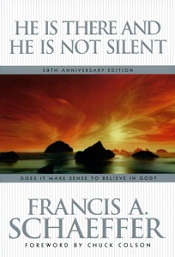
We have now moved through the first two books in what is considered the Schaeffer Trilogy: The God Who is There and Escape from Reason. The final book is He Is There and He Is Not Silent. In the title of the book Schaeffer tips his hat to the content of the book: that God exists and that He has spoken. For those familiar with apologetics you will recognize that these two statements are the fundamental building blocks to the apologetic method presuppositionalism: God exists and He has revealed Himself. He is there and He is not silent the title states. These two simple truths are the fundamental building blocks to all of life.
The basic aim of He Is There and He Is Not Silent is to show “the philosophical necessity of God’s being there and not being silent – in the areas of metaphysics, morals, and epistemology.” (p. 277) That is to say, for these three categories to even exist, let alone be discussed and have some foundation, it is required that God exist and have spoken. These concepts are heavy. Schaeffer addresses metaphysics and morals in one chapter each and epistemology in two chapters. This post will deal with a basic introduction to the concepts, the next will deal with the first two and a third will deal with the last. Let’s briefly introduce them.
Metaphysics – This deals with existence or being. It deals with what is. This deals with the basic philosophical question why is there something rather than nothing?
Morals – Here, Schaeffer addresses the dilemma of man as seen through the fact that man is personal, yet finite. That he has nobility (he is made in the image of God), yet he is cruel. Schaeffer sums it up as “the alienation of man from himself and from all other men in the area of morals.” (p. 279)
Epistemology – This deals with the area of knowing. That is to ask, how do we know and how do we know we know? God’s existence and self-revelation are tied to how we know things and how we know we know things. We’ll explain this more later.
With these basic ideas in place Schaeffer lays some preliminary groundwork in the area of philosophy before he begins to look at how to address the three above areas. Schaeffer is very insistent upon Christians understanding that philosophy is not an enemy of Christianity. They both address the same questions though they have different vocabulary and can have different answers. They should not be thought of as Christianity vs philosophy but rather working together.
What can help us understand this relationship is to see philosophy from two angles. First, philosophy is a discipline in that it is a field of study and those who study it are called philosophers. There are few people in this category. Second, there is philosophy as a worldview. That is, a world and life view. Just as everyone is a theologian so is everyone a philosopher in the sense that everyone has a worldview (whether or not they realize it). In regards to the attitude of Christians to philosophy, Schaeffer rightly notes,
Christians have tended to despise the concept of philosophy. This has been one of the weaknesses of evangelical, orthodox Christianity – we have been proud in despising philosophy, and we have been exceedingly proud in despising the intellect. Our theological seminaries hardly ever relate their theology to philosophy, and specifically to current philosophy. Thus, students go out from the theological seminaries not knowing how to relate Christianity to the surrounding world-view. It is not that they do not know the answers. My observation is that most students graduating from our theological seminaries do not know the questions. (p. 279)
When it comes to addressing the three areas above, Schaeffer points out that there are two ways of answering them. First, one can say that there is no logical rational answer. But any thinking person can realize that this position is impossible to live. In fact, livability is a test criteria for the validity of a worldview. Schaeffer notes, “The first reason the irrational position cannot be held consistently in practice is the fact that the external world is there and it has form and order. It is not a chaotic world.” (p. 280) The second kind of answer is that there is one that is logical and rational.
On a final note to the introductory material for He is There and He is Not Silent, Schaeffer will rightly argue that there is not a range of possible answers to the areas of metaphysics, morals and epistemology but that there is only one answer – Christianity. Next week we will look at metaphysics and morals and then follow up with epistemology in the following week.
Ronald Reagan Bill Clinton with a jar of jelly beans in November of 1992
January 2, 2021
Office of Barack and Michelle Obama P.O. Box 91000 Washington, DC 20066
Dear President Obama,
I wrote you over 700 letters while you were President and I mailed them to the White House and also published them on my blog http://www.thedailyhatch.org .I received several letters back from your staff and I wanted to thank you for those letters.
I have been reading your autobiography A PROMISED LAND and I have been enjoying it.
Let me make a few comments on it, and here is the first quote of yours I want to comment on:
The financial system was in a meltdown and taking the American economy with it. Although Iraq had been the biggest issue at the start of our campaign, I had always made the need for more progressive economic policies a central part of my argument for change. As I saw it, the combination of globalization and revolutionary new technologies had been fundamentally altering the American economy for at least two decades. U.S. manufacturers had shifted production overseas, taking advantage of low-cost labor and shipping back cheap goods to be sold by big-box retailers against which small businesses couldn’t hope to compete. More recently, the internet had wiped out entire categories of office work and, in some cases, whole industries. In this new, winner-take-all economy, those controlling capital or possessing specialized, high-demand skills—whether tech entrepreneurs, hedge fund managers, LeBron James, or Jerry Seinfeld—could leverage their assets, market globally, and amass more wealth than any group in human history. But for ordinary workers, capital mobility and automation meant an ever-weakening bargaining position. Manufacturing towns lost their lifeblood. Low inflation and cheap flat-screen TVs couldn’t compensate for layoffs, fewer hours and temp work, stagnant wages and reduced benefits, especially when both healthcare and education costs (two sectors less subject to cost-saving automation) kept soaring. Inequality also had a way of compounding itself. Even middle-class Americans found themselves increasingly priced out of neighborhoods with the best schools or cities with the best job prospects. They were unable to afford the extras—SAT prep courses, computer camps, invaluable but unpaid internships—that better-off parents routinely provided their kids. By 2007, the American economy was not only producing greater inequality than almost every other wealthy nation but also delivering less upward mobility. I believed that these outcomes weren’t inevitable, but rather were the result of political choices dating back to Ronald Reagan. Under the banner of economic freedom—an “ownership society” was the phrase President Bush used—Americans had been fed a steady diet of tax cuts for the wealthy and seen collective bargaining laws go unenforced. There had been efforts to privatize or cut the social safety net, and federal budgets had consistently underinvested in everything from early childhood education to infrastructure. All this further accelerated inequality, leaving families ill-equipped to navigate even minor economic turbulence. I was campaigning to push the country in the opposite direction. I didn’t think America could roll back automation or sever the global supply chain (though I did think we could negotiate stronger labor and environmental provisions in our trade agreements). But I was certain we could adapt our laws and institutions, just as we’d done in the past, to make sure that folks willing to work could get a fair shake. At every stop I made, in every city and small town, my message was the same. I promised to raise taxes on high-income Americans to pay for vital investments in education, research, and infrastructure. I promised to strengthen unions and raise the minimum wage as well as to deliver universal healthcare and make college more affordable. I wanted people to understand that there was a precedent for bold government action. FDR had saved capitalism from itself, laying the foundation for a post–World War II boom.
—
Free markets were not the cause of the 2008 housing crash but Bill Clinton’s administration is to blame. The article below noted:
Under HUD Secretary Andrew Cuomo, the agency became particularly aggressive, in 2000 making a goal of over $1 trillion in new loans to low-income minority households. Fannie Mae and Freddie Mac were told to make at least half of their loans to low- and moderate-income borrowers, mainly minorities.
In Monday’s debate, Hillary Clinton’s remark about the financial crisis ignored the actual responsibility that she and her husband bear for creating it. (AP)
06:38 PM ET 09/28/2016
Election 2016: During Monday’s presidential debate, Hillary Clinton weighed in on the 2008 financial crisis, blaming “tax cuts” during the Bush years and implying that deregulation was also to blame. It’s another example of the whoppers Hillary Clinton and other Democrats tell about the recession they caused.
If a gold medal were awarded for chutzpah, Hillary Clinton would surely be a multiple winner by now.
“Well, let’s stop for a second and remember where we were eight years ago,” Clinton said. “We had the worst financial crisis, the Great Recession, the worst since the 1930s. That was in large part because of tax policies that slashed taxes on the wealthy, failed to invest in the middle class, took their eyes off Wall Street, and created a perfect storm.”
To be as kind as possible, the idea that “tax policies” — including the 2003 tax cuts — were the root cause of the financial panic is an idea espoused by no one we’re aware of in the economics profession. It was those tax cuts that in fact revived the economy, which had begun failing in the waning months of the Clinton administration.
From 2003 to 2007, the tax cuts helped push real GDP up 15.2%, or more than 3% a year. And, as Avik Roy notes in a recent Forbes piece, “the wealthy actually contributed more in taxes after the ‘cuts’ went into effect.” In 2003, the top 1% in incomes paid $256 billion in taxes. In 2007, they paid $471 billion.
The “failed to invest in the middle class” line is even better, since it is entirely devoid of meaning. Seems we had nearly $8 trillion in added government “investment,” as our soaring national debt now shows, thanks to President Obama, Hillary and the rest of the profligate party she now leads.
Did that go to the middle class? Sure doesn’t look like it.
But what’s most interesting about Hillary’s remark is it ignores the actual responsibility that she and her husband, former President Bill Clinton, bear for creating the financial crisis. It’s hypocrisy that the Clinton Democrats, who created the housing bubble in the 1990s and 2000s with their policies, now have spun a false tale of Wall Street greed, crazy deregulation, and tax cuts as the causes of the crisis.
Here’s the real story, in brief: In 1995, using the powers of the presidency, Bill Clinton turned the 1977 Community Reinvestment Act into an aggressive program that basically forced banks to lend money to “underserved” communities. That meant those with low incomes who couldn’t necessarily repay a loan.
Meanwhile, his Department of Housing and Urban Development got involved in a big way.
Under HUD Secretary Andrew Cuomo, the agency became particularly aggressive, in 2000 making a goal of over $1 trillion in new loans to low-income minority households. Fannie Mae and Freddie Mac were told to make at least half of their loans to low- and moderate-income borrowers, mainly minorities.
Banks suddenly found that regulators had the power to refuse their branch expansions or reject a merger if they weren’t making enough loans to otherwise unqualified minority borrowers. So they played along. They made the loans, and Freddie and Fannie bought the loans right back. It was like a game of musical chairs, and the Fed kept the game going in the early 2000s by cutting interest rates.
Every time Republicans in Congress or President Bush talked about reforming housing programs, Democrats like Rep. Barney Frank of Massachusetts and Sen. Chris Dodd of Connecticut threw fits, threatening to gum up Congress and implying that GOP lawmakers were racists. The Republicans backed off.
From 1997 to 2007, with the Fed slashing interest rates and flooding the banking system with liquidity, home lending soared. Banks abandoned long-standing lending standards to avoid being punished by regulators or singled out by newly empowered “community groups” such as ACORN as anti-minority.
“As a result of these policies,” wrote Peter J. Wallison, a member of the Financial Crisis Inquiry Commission, in a scathing dissent from the group’s official findings, “by the middle of 2007, there were approximately 27 million subprime and Alt-A mortgages in the U.S. financial system— half of all mortgages outstanding — with an aggregate value of over $4.5 trillion.” And by 2008, Fannie and Freddie had on their books more than three-quarters of all U.S. subprime and Alt-A loans made.
When the Fed began raising interest rates to slow inflation, and put a brake on soaring housing prices, many of the loans made to low-income black and Hispanic borrowers predictably fell into delinquency or default — leaving mortgage lenders, Fannie and Freddie, and Wall Street with enormous losses.
The ensuing Great Recession, as Hillary helpfully pointed out Monday night, did indeed cost 9 million people their jobs and wiped out $13 trillion in household wealth — an unparalleled financial disaster.
But let’s be very clear here: Tax cuts had nothing to do with this whatsoever. Nor did the minor tinkering to the 1930s-era Glass-Steagall law in 1999, which was implicated in none of the major Wall Street insolvencies or subsequent bailouts during the crisis. It’s another die-hard Democratic myth, intended to absolve themselves of blame for the crisis. And the economy-killing Dodd-Frank financial regulations passed in 2010 were based on these Democratic myths — which is why we’re now having the worst economic expansion in modern history.
The truth is this: Bill Clinton, working with congressional Democrats in the 1990s, empowered a massive, well-funded bureaucracy to regulate and punish those in the private sector that didn’t go along with Clinton’s plans to lend vast sums of money to people who could never pay the money back.
And when it all went sideways in 2007, they pointed fingers at everyone but themselves. They’re still doing it.
Hillary Clinton knows well what happened in the 1990s while she was First Lady. She was a major supporter of these programs and, as touted at the time, a virtual “co-president.” To now suggest others and “tax cuts” are to blame is just another intentional lie. Maybe the media can fact-check that.
Related:
Sincerely,
Everette Hatcher III, 13900 Cottontail Lane, Alexander, AR 72002, ph 501-920-5733 everettehatcher@gmail.com
President Obama c/o The White House 1600 Pennsylvania Avenue NW Washington, DC 20500 Dear Mr. President, I know that you receive 20,000 letters a day and that you actually read 10 of them every day. I really do respect you for trying to get a pulse on what is going on out here. There have […]By Everette Hatcher III | Posted in David Barton, Founding Fathers, President Obama | Edit |Comments (0)
There have been many articles written by evangelicals like me who fear that our founding fathers would not recognize our country today because secular humanism has rid our nation of spiritual roots. I am deeply troubled by the secular agenda of those who are at war with religion in our public life. Lillian Kwon quoted somebody […]By Everette Hatcher III | Posted in David Barton, Founding Fathers | Edit | Comments (0)
There have been many articles written by evangelicals like me who fear that our founding fathers would not recognize our country today because secular humanism has rid our nation of spiritual roots. I am deeply troubled by the secular agenda of those who are at war with religion in our public life. Lillian Kwon quoted somebody […]By Everette Hatcher III | Posted in David Barton, Founding Fathers | Edit | Comments (0)
There have been many articles written by evangelicals like me who fear that our founding fathers would not recognize our country today because secular humanism has rid our nation of spiritual roots. I am deeply troubled by the secular agenda of those who are at war with religion in our public life. Lillian Kwon quoted somebody […]By Everette Hatcher III | Posted in David Barton, Founding Fathers | Edit | Comments (0)
There have been many articles written by evangelicals like me who fear that our founding fathers would not recognize our country today because secular humanism has rid our nation of spiritual roots. I am deeply troubled by the secular agenda of those who are at war with religion in our public life. Lillian Kwon quoted somebody […]By Everette Hatcher III | Posted in David Barton, Founding Fathers | Edit | Comments (0)
There have been many articles written by evangelicals like me who fear that our founding fathers would not recognize our country today because secular humanism has rid our nation of spiritual roots. I am deeply troubled by the secular agenda of those who are at war with religion in our public life. Lillian Kwon quoted somebody […]By Everette Hatcher III | Posted in Founding Fathers | Edit | Comments (0)
President Obama Speaks at The Ohio State University Commencement Ceremony Published on May 5, 2013 President Obama delivers the commencement address at The Ohio State University. May 5, 2013. You can learn a lot about what President Obama thinks the founding fathers were all about from his recent speech at Ohio State. May 7, 2013, […]By Everette Hatcher III | Posted in Founding Fathers, President Obama | Edit | Comments (0)
Dr. C. Everett Koop with Bill Graham. Francis Schaeffer: “Whatever Happened to the Human Race” (Episode 4) THE BASIS FOR HUMAN DIGNITY Published on Oct 7, 2012 by AdamMetropolis The 45 minute video above is from the film series created from Francis Schaeffer’s book “Whatever Happened to the Human Race?” with Dr. C. Everett Koop. This […]By Everette Hatcher III | Posted in Founding Fathers, Francis Schaeffer, Prolife | Edit |Comments (1)
America’s Founding Fathers Deist or Christian? – David Barton 4/6 There have been many articles written by evangelicals like me who fear that our founding fathers would not recognize our country today because secular humanism has rid our nation of spiritual roots. I am deeply troubled by the secular agenda of those who are at […]By Everette Hatcher III | Posted in David Barton, Founding Fathers | Tagged governor of connecticut, john witherspoon, jonathan trumbull | Edit | Comments (1)
3 Of 5 / The Bible’s Influence In America / American Heritage Series / David Barton There were 55 gentlemen who put together the constitution and their church affliation is of public record. Greg Koukl notes: Members of the Constitutional Convention, the most influential group of men shaping the political foundations of our nation, were […]By Everette Hatcher III | Posted in Founding Fathers | Edit | Comments (0)
I do not think that John Quincy Adams was a founding father in the same sense that his father was. However, I do think he was involved in the early days of our government working with many of the founding fathers. Michele Bachmann got into another history-related tussle on ABC’s “Good Morning America” today, standing […]By Everette Hatcher III | Posted in David Barton, Founding Fathers | Edit | Comments (0)
I have gone back and forth and back and forth with many liberals on the Arkansas Times Blog on many issues such as abortion, human rights, welfare, poverty, gun control and issues dealing with popular culture. Here is another exchange I had with them a while back. My username at the Ark Times Blog is Saline […]By Everette Hatcher III | Posted in Arkansas Times, Francis Schaeffer, Prolife | Edit |Comments (0)
I truly believe that many of the problems we have today in the USA are due to the advancement of humanism in the last few decades in our society. Ronald Reagan appointed the evangelical Dr. C. Everett Koop to the position of Surgeon General in his administration. He partnered with Dr. Francis Schaeffer in making the […]By Everette Hatcher III | Posted in Adrian Rogers, Francis Schaeffer | Edit | Comments (0)
Francis Schaeffer: “Whatever Happened to the Human Race” (Episode 4) THE BASIS FOR HUMAN DIGNITY Published on Oct 7, 2012 by AdamMetropolis ____________ The 45 minute video above is from the film series created from Francis Schaeffer’s book “Whatever Happened to the Human Race?” with Dr. C. Everett Koop. This book really helped develop my political […]By Everette Hatcher III | Posted in Francis Schaeffer | Edit | Comments (0)
In 1972’s Play It Again, Sam, Allen plays a film critic trying to get over his wife’s leaving him by dating again. In one scene, Allen tries to pick up a depressive woman in front of the early Jackson Pollock work. This painting, because of its elusive title, has been the subject of much debate as to what it portrays. This makes for a nifty gag when Allen strolls up and asks the suicidal belle, “What does it say to you?”
______________
Woody Allen in Play It Again Sam
Uploaded on May 20, 2009
Scene from ‘Play it Again Sam’ (1972)
____________
Allan: That’s quite a lovely Jackson Pollock, isn’t it?
Museum Girl: It restates the negativeness of the universe. The hideous lonely emptiness of existence. Nothingness. The predicament of Man forced to live in a barren, Godless eternity like a tiny flame flickering in an immense void with nothing but waste, horror and degradation, forming a useless bleak straitjacket in a black absurd cosmos.
Thinking this was a documentary about Jackson Pollock, I borrowed it from a local library. It turns out to be more of a real-life mystery than a study of Pollock, the man or his work. But along the way, one learns quite a bit about this strange and intriguing figure and his abstract painting (if that is the proper label). The plot-line of this documentary is simple: an uneducated and plucky female truck driver, named Teri Horton, buys a large, odd painting for a friend from a thrift shop for $5. She is later told that it looks like a Jackson Pollock original. She eventually learns who he was (she had no idea, and thought the the painting was essentially junk, since it was nonrepresentational), the tremendous worth of his painting (a new original work would fetch fifty million dollars), and approaches the art world in the hope that it will be authenticated as a genuine Pollock.
The film is about how we know things (epistemology)–in this case, how do we know whether a painting is painted by a particular painter. That is, how to we come to a justified and true belief about this painting? Was it painted by Pollock or not? To answer this, one must consider criteria for authenticity. We find (at least) two cultures in conflict. The culture of the experts in the art world and the culture of forensics. Those in the art world largely rejected the painting as inauthentic. Some rejected it forcefully, others more hesitantly, but no recognized art expert certified the painting as a Pollock for the following reasons. (1) It is unsigned. (2) It has no provenance. Provenance concerns the documented genealogy of the painting, its causal ancestry or pedigree. Mrs. Horton bought it as a thrift shop and was not able to gather information beyond that. That is, it simply appears as a painting without a history. (3) It does not look enough like a Pollock work to the trained eye.
However, there is another angle to pursue–forensic evidence. Mrs. Horton hires a forensic expert who has authenticated several anonymous paintings as legitimate works by well-known artists. He finds a fingerprint on the back of the painting that matches one found in Pollock’s studio. He also finds paint like that used by Pollock. The art world cares nothing for this: forensics is not art criticism. They are two different worlds, with two different sets of criteria.
This epistemological debate is what I found fascinating about the film. I did not warm to the crusty, seventy-three-year old who discovered the painting. One may pity her hard life and appreciate her tenacity, but she strikes me as crass and pointlessly stubborn–refusing to sell a painting of at least questionable pedigree for nine million dollars. She says her unwillingness to sell for anything less than the full worth of a Pollock is a matter of “principle.” But what principle might that be? Apparently, she is convinced it is a Pollock, and hired a professional art dealer to sell it as such (a rather slick and slimy character, to be sure). But is any moral principle violated if one sells a painting for nine million dollars when, in fact, it may be worth fifty million; however? There is, after all, still good reason to question its authenticity.
What criteria are normative for identifying a work of art? When the experts evaluate the work, they size it up rather intuitively, based on previous knowledge of Pollock’s style. But they do not all agree. Moreover, artists do vary their style to some degree. The other side has to do with trying find in the extant painting some forensic (not aesthetic) quality that identifies it as having been painted by Pollack. This involves photography, chemistry, and some speculative history (since documented provenance cannot be established). One large question is whether one can establish a plausible scenario in which Pollack, an established if eccentric painter, somehow lets one of his works lose such that it ends up in a thrift shop in California, as opposed to having it displayed in a New York art museum or as part of an art collector’s collection.
It is difficult to come to a conclusion about the identity of this painting. But working through the questions is fascinating and rewarding. To make a more accurate assessment, one would need much more than simply a film on which to base a judgment.
This is not a film that directly addresses the aesthetic value of Jackson Pollock’s paintings or the worldview behind his work. (At some point, Pollock set up mechanical means by which to make paintings which attempted to leave out his own personality and rely on chance. Francis Schaeffer (1912-1984) assesses this philosophically in his book and film series, How Shall We Then Live?)However, the film stimulates significant thought about the art of knowing. Who is a reliable witness? What are the proper criteria for truth assessment. For those reasons, I delighted in the film and may use it for teaching on these subject.
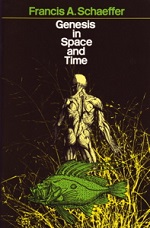
In Genesis in Space and Time, Schaeffer addresses the importance of the first eleven chapters of Genesis as they relate to the flow of Biblical history (a key phrase and concept in this book and Joshua and the Flow of Biblical History). In the first three chapters Schaeffer deals with the six days of creation. Taking cue from Psalms 136, Schaeffer sets the stage for how he interprets Genesis 1-11, as a fact of space-time history.
The opening verse of Genesis, ‘In the beginning God created the heavens and the earth,’ and the remainder of chapter 1 brings us immediately into a world of space and time. Space and time are like warp and woof. Their interwoven relationship is history. Thus the opening sentence of Genesis and the structure of what follows emphasize that we are dealing here with history just as much as if we talked about ourselves at this moment at a particular point of time in a particular geographic place. (7)
With the belief that Genesis 1-11 is presenting space time history there are several important aspects of the narrative that Schaeffer draws out.
First, the beginning of creation does not entail a beginning to God as creator. He must necessarily exist prior to creation itself for it to have a beginning (8). Pointing to Eph. 1:4 & 2 Tim. 1:9 Schaeffer turns our attention to the fact that the Godhead had an eternal relationship before creation. To aid in this discussion Schaeffer chooses the wordsequence as opposed to time as it relates to the existence of things and creatures (9, 14). Further, Gen. 1:2 and Jn. 1:1-14 give us clear indication that each member of the Godhead not only existed before creation but also took part in it. Schaeffer has some great discussion on the intricacies of Jn. 1:1-3 as it relates to Christ and His existence before creation and activity at creation (12-14).
Second, the way in which God created is through His spoken word. This is creation byfiat. God as creator is much different then man as creator. While both may conceive of their creation in their minds, God created something from nothing while man creates something out of what already exists. God speaks things into existence and man shapesthings into existence. Interestingly enough, Schaeffer briefly touches on the big bang theory stating that he does not feel that it can be owned by the Christian worldviewbased in Gen. 1. He states
The simple fact is that what is given in Genesis 1:1 has no relationship to the big bang theory – because from the scriptural viewpoint, the primal creation goes back beyond the basic material or energy. Even if one accepts the big bang theory, Genesis 1:1 would then go beyond it by saying that God created out of nothing the primal stuff present at the big bang. We have a new thing created by God out of nothing by fiat, and this is the distinction (17).
As the big bang theory is proposed it requires something to be present in the universe from which the bang can proceed from. Genesis 1 reaches back farther then that to when nothing existed outside of God and He created everything.
Third, Schaeffer points out that at creation we see differences and divisions between the various things created. For example, the first point of differentiation and division occurs between the unformed and unfilled state of Gen. 1:2 to the creation of light in Gen. 1:3. There is a difference between the darkness that was and the light that was created. Further, the light that was created caused a natural division between the two. In reference to the significance repetition of the word “let” Schaeffer states, “In these places God is not so much making something come into being, or even differentiating it as being, as he is indicating what this sort of being means.” (22) Schaeffer walks the reader through the various states of difference and division such as “bare being to light…differentiated spaces, areas of water and earth, the nonliving and the living plants…..and the day and night on the earth…..between conscious and unconscious life,” and between man and the rest of creation (25-26).
Fourth, Schaeffer ties the complementary nature of Gen. 1 & 2 together with the historicity of Adam and Eve as the first pair of humans God created which to which every person every conceived can trace their lineage back to, thus, giving everyone the same original first progenitors. Schaeffer cites Jesus’ own words in Matt. 19 & Mark 10 in which Jesus refers to both Gen. 1 & 2 as referring to the same people – Adam and Eve. Perhaps the most shining support for the historicity of Adam and Eve as real people comes in Paul’s writings. Rom. 5:12-15, I Cor. 15:21,22, 2 Cor. 11:3, 8-9 and I Tim. 2:13-14 are all passages in which Paul clearly operates on the belief that they were real people just as Jesus Christ was. His theology of Christ is built on this historicity of Adam. “If we tamper with this ordinary way of understanding what is written in the Bible, the structure of Christianity is reduced to only an existential leap.” (29)
Fifth, though he does not linger on this topic, Schaeffer emphasizes the importance of man as created in the image of God which is the climax of creation and definite separation between man and the rest of creation. It is our imaging God that sets us apart from the rest of creation and is the basis for the next aspect of creation – mans dominion over creation.
Sixth, as created in the image of God man is given a form of rulership and authority over all creation. He is a steward and representative of God on the earth to the rest of creation. God formed all space and filled it with living creatures. In a similar way, man forms creation and fills it with more humans who are also created in God’s image (Gen. 5:3). We will get into in more in the next post when we discuss chapter four but Schaeffer quickly notes that the fall has not removed the image of God in man though it has tainted it (34).
Seventh, as we noted earlier, God existed before creation and therefore is independent of it in His existence. Further, creation is not an extension of God but is clearly distinct from it. It is here that we see some of the character of God. First, the mere existence of the world speaks to the existence of God. Second, we can clearly see that the world has order as opposed to chaos. It is because of the order of the universe that man is able to live and explore all God has made. Third, creation speaks to the goodness of creation despite the fallen nature it exists in. It’s goodness was not removed though it is tainted. Fourth, that God is personal is the only explanation for many things we observe in mankind like personality and communication.
Eight, with a beginning (Gen. 1-2) and an end (Rom. 8:21-23 & Rev. 19-21) we see that history is going somewhere (43). There will be an end to time as we currently experience it with the introduction of eternity and the new heavens and earth. The nextsequence of events in the flow of history will begin.
Next week we will look at chapters four and five in Genesis in Space and Time in which Schaeffer will discuss the Fall and its effects on creation.
Francis A. Schaeffer, How Should We Then Live? The Rise and Decline of Western Thought and Culture. L’Abri 50th Anniversary Edition. Wheaton, IL: Crossway Books, 2005. Original publication, 1976. 288 pages.
We should be grateful to Crossway publishers for recently reissuing several important works by Francis A. Schaeffer (1912-1984). At once an evangelist, apologist, theologian, and social critic, Schaeffer’s work inspired a generation of evangelicals to adopt a robust and well-integrated Christian worldview and to live out its convictions courageously. It is a shame and a scandal that some postmodernist-leaning evangelicals have dismissed Schaeffer as an outmoded “rationalist” or “modernist.” There is, in truth, nothing outmoded about this remarkable man’s passion or vision.
I first encountered Schaeffer’s writings a few months after my conversion in the summer of 1976. At the time I was intellectually adrift, unsure of how my faith related to the world of ideas. By reading The God Who is There (InterVarsity Press, 1968) a new, refreshing, and inviting world unfolded before me. Christianity, Schaeffer explained, is not merely something that is personally meaningful and instructive for individual behavior. Christianity is, rather, “true to what is.” It speaks credibly to all the things that matter most. Nothing should be shunted aside as merely “secular,” since Jesus Christ is Lord of all. The Christian has nothing to fear from the world of ideas because the Christian worldview is sufficient to meet the intellectual challenges posed by secular philosophy or by other religions. Moreover, Christianity offers the world “true truth” (as Schaeffer put it) that cannot be found by any other means. Without this revelation, men and women are lost, both philosophically (they do not know who they are) and morally (they do not know how to live).
Schaeffer’s message was heady stuff to young Christian thinkers in the 1970s and early 1980s. He confidently, but not arrogantly, ranged over literature, music, painting, philosophy, theology, and ethics—and seemed to bring it all together conceptually and historically for Christian critique. He painted with a broad and colorful brush, despite his rather lackluster prose. (In his book In Philosophy and Christian Faith [InterVarsity, 1968], Colin Brown referred to his approach as “swashbuckling.”) Despite his lack of professorial status or an earned doctorate, Schaeffer became one of evangelicalism’s most influential thinkers. To borrow a Quaker phrase, he “spoke to the condition” of many searching people. Furthermore, he lived out his convictions about reaching the lost. He considered himself an evangelist above all. His books, which came later in his life, were forged through conversations with young believers and unbelievers who were trying to make sense of intellectual trends sweeping Europe and the United States, such as existentialism, Marxism, and Eastern thought. These conversations were carried on at a retreat center in the Swiss Alps called L’Abri (meaning “shelter”), founded by Schaeffer and his wife Edith (also an author). The Schaeffers lived out a radical theology of community long before the subject became popular among evangelicals.
In this ambitious book, Schaeffer canvasses nothing less than the history of Western civilization up until the time of his writing. (The book was paired with a film series of the same name that is still available.) On one level, scholars might say that the whole project is pretentious. How could this feat be accomplished in one medium-sized volume, especially when written by someone lacking bona fide academic credentials? But Schaeffer did not attempt an encyclopedic effort, as he makes clear in his “Author’s Note.” He focused on how worldviews affect cultures, beginning with ancient Rome, whose polytheistic worldview could not support its civilization. I first read this volume and saw the films while in college in the middle to late 1970s. Schaeffer was covering wide swaths of ground, but what he claimed made sense, given my knowledge as a philosophy major who had taken Western Civilization. (Since most universities stopped requiring Western Civilization courses some years ago, it becomes all the more imperative for those so deprived to study this volume.) Reading the book recently, I was impressed by its clarity, insights, and its qualifications and lack of grandiosity.
Schaeffer argued that there is a flow to biblical history (see his Joshua and the Flow of Biblical History) and a flow to extra-biblical history. As Schaeffer states it in the opening sentences of the book, “There is a flow to history and culture. This flow is rooted and has its wellspring in the thoughts of people. People are unique in the inner life of the mind—what they are in their thought world determines how they act. This is true of their value systems and it is true of their creativity. It is true of their corporate actions, such as political decisions, and it is true of their personal lives” (19).
Schaeffer spends one chapter each on ancient Rome and the Middle Ages, then moves to the Renaissance, which introduced significant themes into the modern West such as the rediscovery of nature as valuable in itself (seen in its art) and, more auspiciously, the sense of human autonomy from Christian claims on reality as expressed in Scripture. As a man of the Reformation, Schaeffer devotes two chapters to that period, explaining both its history and theological convictions clearly and cogently. He notes that the Reformation worldview was felicitous not only for the church, but for culture as a whole. This is because it challenged ecclesiastical authoritarianism and opened the doors to freedom of religion and representative forms of government—not that this was achieved all at once.
The Enlightenment further developed the Renaissance themes of autonomy from received religious authority and gave anchorage to a more secular worldview. While modern science was inspired by an essentially Christian worldview, which taught that nature was knowable and valuable because created by a good and rational God, secularized science removed God from the picture. This made nature a self-enclosed system, the received view of the institutions of science in the West today. Post-Enlightenment philosophy also lost the sense of unity and purpose given by a Christian worldview and struggled to find any objective meaning in human affairs or the universe as a whole. This was especially evident in existentialism, which heralded the meaninglessness of life as well as the need to assert personal meaning in spite of it all (and for no objective reason whatsoever). While the blush is off the rose of existentialism today, secular postmodernists offer similar answers. They too have escaped from reason into a world of nonsense posing as profundity. (On this see my book, Truth Decay: Defending Christianity Against the Challenges of Postmodernism [InterVarsity, 2000].)
A veteran of the Fundamentalist-Modernist split, Schaeffer also warns of the dangers of theological liberalism, a theology drained of biblical content but replete with traditional theological words. Schaeffer rightly exposes this as little more than naturalism in religious garb. The Bible is not a record of humans groping about in hopes of encountering the unnamable sacred. It is, rather, God’s true and rational propositional revelation. Schaeffer further explores the “breakdown” of modern art and culture in general, never without strong feeling for the “lostness of modern man,” as he put it.
The last three chapters lament that modern Western society has lost its worldview moorings; it has largely forfeited the Reformation base that helped constitute its greatness. As such, it is imperiled. As Os Guinness put it in The American Hour (Free Press, 1992), post-Christian Western culture is in the throes of a “crisis of moral authority.” Without a transcendent source for meaning and law, societies move into either anarchy or authoritarianism, such as Marxism. In spite of this dire situation, many in the West (including many Christians) opt for pursuing “personal peace and affluence” above any passion for justice and goodness that honor God. Schaeffer thus warns of “sociological law” that is cut off from any stable source of meaning and authority, and instead relies on either the assertion of “arbitrary absolutes” based on a fifty-one percent majority vote or the dictates of a statist government that is unaccountable to either the people or to God. If the state declares the unborn (or anyone else) to possess no rights, their rights are taken away by legal fiat. (Schaeffer elaborated on this point in Whatever Happened to the Human Race, co-authored with C. Everett Koop in 1979.)
Schaeffer also warned that modern culture is susceptible to manipulation through the media, especially through television. “Television manipulates viewers just by its normal way of operating,” because its images seem so compelling. The truth, however, is otherwise because the viewer is not granted a pristine receipt of objective reality, but an “edited symbol or an edited image of the event” (240).
What Schaeffer warned about is happening in our midst today. While America’s Declaration of Independence declares that “all men are created equal” and “endowed by our Creator with certain inalienable rights,” society allows abortion on demand at any stage of pregnancy. In April of 2005, the world watched as a severely disabled but not terminally ill woman, Terry Schiavo, was dehydrated to death—simply because her legal guardian husband and his lawyer did not want her to live.
One can take issue with Schaeffer at some points. One who paints with a broad bush may blur some themes and obscure others, but the strengths of this book greatly outnumber its weaknesses. How Should We Then Live remains an incisive and prophetic work that should not be ignored. We need big-picture thinkers (or generalists) to help us orient ourselves historically, theologically, and ethically. Francis Schaeffer was such a thinker. Let us give him the last word. “This book is written in the hope that this generation may turn from the greatest wickedness, the placing of any created thing in the place of the Creator, and that this generation may get its feet out of the paths of death and may live” (258).
Douglas Groothuis, Ph.D.
Professor of Philosophy
Denver Seminary
June 2005
Great quote from How Should we then live?: “The [1st century] Christians not only had knowledge about the universe and mankind that people cannot find out by themselves, but they had absolute, universal values by which to live and by which to judge the society and the political state in which they lived.”
It is important to realize what a difference a people’s world view makes in their strength as they are exposed to the pressure of life. That it was the Christians who were able to resist religious mixtures, syncretism, and the effects of the weaknesses of Roman culture speaks of the strength of the Christian world view. This strength rested on God’s being an infinite-personal God and his speaking in the Old Testament, in the life and teaching of Jesus Christ, and in the gradually growing New Testament. He had spoken in ways people could understand. Thus the Christians not only had knowledge about the universe and mankind that people cannot find out by themselves, but they had absolute, universal values by which to live and by which to judge the society and the political state in which they lived. And they had grounds for the basic dignity and value of the individual as unique in being made in the image of God…
…A culture or an individual with a weak base can stand only when the pressure on it is not too great.








 The Daily Hatch