2021 Democrats should remember Dan MitcRegardless of whether it is financed by taxing or borrowing, every penny of spending diverts resources from the productive sector of the economy
Nonetheless, some people seem convinced that deficits and debt are the real problem. While I think that focus is a bit misguided, I certainly agree that there is something utterly immoral about spending today and imposing a fiscal burden on future taxpayers (especially since so much government spending is for current consumption and transfers).
But here’s some really depressing news for the anti-debt crowd. Today’s deficits and debt actually are just the tip of the iceberg. Here’s a new video from the Center for Freedom and Prosperity that reveals the enormous unfunded liabilities resulting from entitlement programs. As the video explains, unfunded liabilities are promises by politicians that impose enormous long-term obligations for more spending and debt.
—
The narrator of the video is Kelly McDonough, a student at American University and a former Cato Institute intern. If this video is anywhere near as successful as the other video narrated by a former Cato intern, perhaps this will become a new tradition.
Republican presidents besides Reagan have done a bad job of slowing the growth of spending.
President Obama wrote in his autobiography on page 415 in A PROMISED LAND:
There was a reason I told Valerie, why Republicans tended to do the opposite—why Ronald Reagan could preside over huge increases in the federal budget, and federal workforce and still be lionized by the GOP faithful as the guy who successfully shrank the federal government.
Take a look at Daniel Mitchell analysis of Presidents’ spending restraints!!!
—
Spending Restraint, Part I: Lessons from Ronald Reagan and Bill Clinton
Ronald Reagan and Bill Clinton both reduced the relative burden of government, largely because they were able to restrain the growth of domestic spending. The mini-documentary from the Center for Freedom and Prosperity uses data from the Historical Tables of the Budget to show how Reagan and Clinton succeeded and compares their record to the fiscal profligacy of the Bush-Obama years.
___________________
Ronald Reagan was my hero and he did slow the growth of federal spending. In this post I did want to admit that Republicans have spent way too much in the past too, but we do have some spending cut heroes too. I have a lot of respect for Tea Party heroes like Tim Huelskamp and Justin Amash who are willing to propose deep spending cuts so we can eventually balance our budget.
John Brummett wrote in the online addition of the Arkansas Democrat-Gazette on May 30, 2012:
Obama did indeed run up the deficit with a stimulus measure to keep the economy from collapsing as he entered office…But in regard to budgets that he actually has proposed as president, beginning with the one for the fiscal year starting nearly a year after his election, Obama has raised spending at a slower rate than Clinton…
Republicans simply are more effective than Democrats at declaring a simple untruth loudly and repetitively through a pliable and powerful echo chamber of talk radio and cable news, thus embedding that untruth beneath the superficial consciousness of people otherwise disengaged.
__________
Now the truth of the matter is that Obama has spent around 25% of GDP when Clinton and most of the other presidents spent 20% or less. This fact allow disproves Brummett’s assertions listed above, but I will admit the Republicans have been guilty of spending too much also.
Dan Mitchell of the Cato Institute sets the record straight concerning the Republican’s spending which has been excessive too at times:
In a post last week, I explained that Obama has been a big spender, but noted his profligacy is disguised because TARP outlays caused a spike in spending during Bush’s last fiscal year (FY2009, which began October 1, 2008). Meanwhile, repayments from banks in subsequent years count as “negative spending,” further hiding the underlying trend in outlays.
When you strip away those one-time factors, it turns out that Obama has allowed domestic spending to increase at the fastest rate since Richard Nixon.
President George W. Bush, for instance, scores below both Clinton and Jimmy Carter, regardless of whether defense outlays are included in the calculations. That’s not a fiscally conservative record, even if you’re grading on a generous curve.
Here’s a simple suggestion for Mitt Romney: Admit that the Democrats have a point. Right before the Memorial Day weekend, Washington was consumed by a debate over how much Barack Obama has spent as president, and it looks like it’s picking up again. …all of these numbers are a sideshow: Republicans in Washington helped create the problem, and Romney should concede the point. Focused on fighting a war, Bush — never a tightwad to begin with — handed the keys to the Treasury to Tom DeLay and Denny Hastert, and they spent enough money to burn a wet mule. On Bush’s watch, education spending more than doubled, the government enacted the biggest expansion in entitlements since the Great Society (Medicare Part D), and we created a vast new government agency (the Department of Homeland Security). …Nearly every problem with spending and debt associated with the Bush years was made far worse under Obama. The man campaigned as an outsider who was going to change course before we went over a fiscal cliff. Instead, when he got behind the wheel, as it were, he hit the gas instead of the brakes — and yet has the temerity to claim that all of the forward momentum is Bush’s fault. …Romney is under no obligation to defend the Republican performance during the Bush years. Indeed, if he’s serious about fixing what’s wrong with Washington, he has an obligation not to defend it. This is an argument that the Tea Party — which famously dealt Obama’s party a shellacking in 2010 — and independents alike are entirely open to. Voters don’t want a president to rein in runaway Democratic spending; they want one to rein in runaway Washington spending.
Jonah’s point about “fixing what’s wrong with Washington” is not a throwaway line. Romney has pledged to voters that he won’t raise taxes. He also has promised to bring the burden of federal spending down to 20 percent of GDP by the end of a first term.
But even those modest commitments will be difficult to achieve if he isn’t willing to gain credibility with the American people by admitting that Republicans helped create the fiscal mess in Washington. Especially since today’s GOP leaders in the House and Senate were all in office last decade and voted for Bush’s wasteful spending.
It actually doesn’t even take much to move fiscal policy in the right direction. All that’s required is to restrain spending so that is grows more slowly than the private sector (with the kind of humility you only find in Washington, I call this “Mitchell’s Golden Rule“). The entitlement reforms in the Ryan budget would be a good start, along with some much-needed pruning of discretionary spending.
2021 Democrats should remember Walter Williams’ words, “Suppose I saw a homeless, hungry elderly woman huddled on a heating grate in the dead of winter. To help the woman, I ask somebody for a $200 donation to help her out. If the person refuses, I then use intimidation, threats and coercion to take the person’s money. I then purchase food and shelter for the needy woman. My question to you: Have I committed a crime? I hope that most people would answer yes. It’s theft to take the property of one person to give to another”
Back in 2012, I shared a sadly amusing image about how the modern political process has degenerated into two wolves and a sheep voting what to have for lunch.
I was making an argument in that column against majoritarianism (and that is a critical issue, as explained in this video), but there’s also a very important moral component to this debate.
Walter Williams addresses this issue in his latest column. He starts by asking a hypothetical question.
Suppose I saw a homeless, hungry elderly woman huddled on a heating grate in the dead of winter. To help the woman, I ask somebody for a $200 donation to help her out. If the person refuses, I then use intimidation, threats and coercion to take the person’s money. I then purchase food and shelter for the needy woman. My question to you: Have I committed a crime? I hope that most people would answer yes. It’s theft to take the property of one person to give to another.
In other words, it doesn’t matter how Person A wants to spend money, it’s wrong for Person A to steal from Person B.
Walter than asks some critical follow-up questions, all of which are designed to make readers realize that theft doesn’t magically become acceptable simply because several people want to take Person B’s money.
Would it be theft if I managed to get three people to agree that I should take the person’s money to help the woman? What if I got 100, 1 million or 300 million people to agree to take the person’s $200? Would it be theft then? What if instead of personally taking the person’s $200, I got together with other Americans and asked Congress to use Internal Revenue Service agents to take the person’s $200? The bottom-line question is: Does an act that’s clearly immoral when done privately become moral when it is done collectively and under the color of law? Put another way, does legality establish morality?
Amen. Walter is exactly right.
And this is a point I need to internalize.
I’m often writing about the economic evidence for smaller government, but I suspect advocates of economic liberty and smaller government won’t win the debate unless we augment our arguments by also making the moral case against government-sanctioned theft.
And perhaps one way of getting this point across is to educate people about the fact that we used to have a very small federal government with little or no redistribution. Walter elaborates.
For most of our history, Congress did a far better job of limiting its activities to what was both moral and constitutional. As a result, federal spending was only 3 to 5 percent of the gross domestic product from our founding until the 1920s… James Madison, the acknowledged father of our Constitution, said, “Charity is no part of the legislative duty of the government.” In 1794, when Congress appropriated $15,000 to assist some French refugees, Madison stood on the floor of the House of Representatives to object, saying, “I cannot undertake to lay my finger on that article of the Constitution which granted a right to Congress of expending, on objects of benevolence, the money of their constituents.”
Here’s the bottom line according to Professor Williams.
We’ve become an immoral people demanding that Congress forcibly use one American to serve the purposes of another. Deficits and runaway national debt are merely symptoms of that larger problem.
Though I would slightly disagree with the way Walter phrased it.
I would argue that a bloated government is the symptom of growing immorality. Deficits and debt are then symptoms of that problem.
But, as I wrote last year, we’re in disagreement on the issue of whether states should be allowed to tax sales that take place outside their borders.
And now Art has a short video that rubbed me the wrong way.
He endorses legislation that would create a sales tax cartel and says – right at the start of this video – that this is because “states should have the right to be able to tax whatever they want to within their state.”
Simply stated, a merchant in one state should not be forced to collect taxes for a government in another state.
P.P.S. This also explains why FATCA is such horrible legislation. It is an effort by the U.S. government to coerce banks in other nations to enforce bad IRS law.
If we care about liberty, we should make sure the power of government is constrained by borders.
Friedman would say, “IF A DOLLAR MORE RAISE IN THE MINIMUM WAGE WOULD HELP THEN WHY NOT RAISE EVERYONE UP TO $100 AN HOUR?” Of course, that exposes that fallacy of liberals’ argument and that is by raising up the minimum wage at some point will further limit access to the market to the most needy of our citizens would like to gain employment and cause massive layoffs!!!!!!
While economists are famous for their disagreements (and their incompetent forecasts), there is universal consensus in the profession that demand curves slope downward. That may be meaningless jargon to non-economists, but it simply means that people buy less of something when it becomes more expensive.
And this is why it makes no senseto impose minimum wage requirements, or to increase mandated wages where such laws already exist.
If you don’t understand this, just do a thought experiment and imagine what would happen if the minimum wage was $100 per hour. The answer is terrible unemployment, of course, which means it’s a very bad idea.
So why, then, is it okay to throw a “modest” number of people into the unemployment line with a “small” increase in the minimum wage?
Yet some politicians can’t resist pushing such policies because it makes them seem like Santa Claus to low-information voters. Vote for me, they assert, because I’ll get you a pay raise!
All of this sounds good, and it may even be the final result for some workers. But there’s overwhelming evidence that you get more unemployment when politicians boost the minimum wage.
There are no “magic boats.” In the real world, businesses only hire workers when they expect that additional employees will generate more than enough revenue to offset their costs. So when politicians artificially increase the cost of hiring workers, there will be some workers (particularly those with low skills) who become redundant.
And that’s exactly what we’re seeing in cities that have chosen to mandate higher minimum wages.
The Wall Street Journalopines on Seattle’s numbers.
Seattle’s increase last year seems to be reducing employment. That’s the finding of a new report by researchers at the University of Washington. The study compared nine months of 2015 in Seattle, where the wage is ticking up gradually and hit $13 an hour in January, with similar areas elsewhere in Washington. …The researchers found that the ordinance decreased the low-wage employment rate by about one-percentage point. …The ordinance “modestly held back” employment of low-wage earners, and hours worked “lagged behind” regional trends, on average four hours each quarter (or 19 minutes a week). Many such individuals moved to take jobs outside the city at “an elevated rate compared to historical patterns,” says the report. …None of this will surprise anyone who understands that increasing the cost of something will reduce the demand for it. Then again, that concept seems to elude both major presidential candidates, who have floated national minimum-wage increases.
And it goes without saying that Obama has been a demagogue on the issue.
Sigh.
Let’s examine evidence from another city. Mark Perry of the American Enterprise Institute looks at what has been happening in Washington, DC.
Since the DC minimum wage increased in July 2015 to $10.50 an hour, restaurant employment in the city has increased less than 1% (and by 500 jobs), while restaurant jobs in the surrounding suburbs increased 4.2% (and by 7,300 jobs). An even more dramatic effect has taken place since the start of this year – DC restaurant jobs fell by 1,400 jobs (and by 2.7%) in the first six months of 2016 between January and July – that’s the largest loss of District food jobs during a 6-month period in 15 years. Perhaps some of those job losses were related to the $1 an hour minimum wage hike on July 1, bringing the city’s new minimum wage to $11.50 an hour. In contrast, restaurant employment outside the city grew at a 1.6% rate in the suburbs (and by 2,900 jobs) during the January to July period. …While it might take several more years to assess the full impact, the preliminary evidence so far suggests that DC’s minimum wage law is having a negative effect on staffing levels at the city’s restaurants. At the same time that suburban restaurants have increased employment levels by nearly 3,000 new positions since January, restaurants in the District have shed jobs in five out of the last six months, with a total loss of 1,400 jobs during that period (an average of nearly 8 jobs lost every day). The last time DC experienced restaurant job losses in five out of six consecutive months was 25 years ago in 1991, and the last time 1,400 jobs were lost over any six-month period was 15 years ago during the 2001 recession.
Here’s a chart looking at how restaurant employment in DC and the suburbs used to be closely correlated, but how there’s been a divergence since the city hiked the minimum wage.
As Mark noted, we’ll know even more as time passes, but the net result so far is predictably negative.
For additional background info, this video is a succinct explanation of why minimum-wage mandates are such a bad idea.
Let’s close with something rather amusing. It turns out that the State Department, during Hillary Clinton’s tenure, actually understood that higher minimum wages destroy jobs. Indeed, her people were even willing to fight against such job-killing measures.
But in Haiti rather than America, as Politifactreports.
Memos from 2008 and 2009 obtained by Wikileaks strongly suggest…that the State Department helped block the proposed minimum wage increase. The memos show that U.S. Embassy officials in Haiti clearly opposed the wage hike and met multiple times with factory owners who directly lobbied against it to the Haitian president. …media outlets assessed the cables and found, among many other revelations, that the “U.S. Embassy in Haiti worked closely with factory owners contracted by Levi’s, Hanes, and Fruit of the Loom to aggressively block a paltry minimum wage increase” for workers in apparel factories. …Deputy Chief of Mission David Lindwall put it most bluntly, when he said the minimum wage law “did not take economic reality into account but that appealed to the unemployed and underpaid masses.” …The U.S. Embassy, meanwhile, continued to lament the hike… USAID studies found that a 200 gourdes minimum wage “would make the sector economically unviable and consequently force factories to shut down.”
Hmmm…., I wonder if some of those textile companies made contributions to theClinton Foundation?
P.S. People in Switzerland obviously understand this issue, overwhelmingly voting against a minimum-wage mandate in 2014.
____ February 13, 2013 1:07PM Obama’s Minimum Wage Plan By Chris Edwards Share Economic research has only a tenuous relationship to economic policymaking in Washington. President Obama’s new proposal to raise the federal minimum wage from $7.25 to $9.00 is a case in point. It would bad for workers and the economy, but the administration […]
_______ February 13, 2013 1:07PM Obama’s Minimum Wage Plan By Chris Edwards Share Economic research has only a tenuous relationship to economic policymaking in Washington. President Obama’s new proposal to raise the federal minimum wage from $7.25 to $9.00 is a case in point. It would bad for workers and the economy, but the administration […]
________ A Little Café shows the USA the real cost of the Minimum Wage Increase!!!! A Little Cafe That Sparked a Big Minimum Wage Debate Eric Boehm / @Watchdogorg / August 15, 2014 / 0 comments STILLWATER, Minn.—With its waitress and single cook, its retro-style booths with pale green cushions and its stainless steel wrap-around […]
___________ Jerry Brown raised taxes in California and a rise in the minimum wage, but it won’t work like Krugman thinks!!!! This cartoon below shows what will eventually happen to California and any other state that keeps raising taxes higher and higher. Krugman’s “Gotcha” Moment Leaves Something to Be Desired July 25, 2014 by […]
Open letter to President Obama (Part 513) (Emailed to White House on 5-4-13.) President Obama c/o The White House 1600 Pennsylvania Avenue NW Washington, DC 20500 Dear Mr. President, I know that you receive 20,000 letters a day and that you actually read 10 of them every day. I really do respect you for trying to get […]
Open letter to President Obama (Part 468) (Emailed to White House on 4-9-13.) President Obama c/o The White House 1600 Pennsylvania Avenue NW Washington, DC 20500 Dear Mr. President, I know that you receive 20,000 letters a day and that you actually read 10 of them every day. I really do respect you for trying […]
State of the Union 2013 Published on Feb 13, 2013 Cato Institute scholars Michael Tanner, Alex Nowrasteh, Julian Sanchez, Simon Lester, John Samples, Pat Michaels, Jagadeesh Gokhale, Michael F. Cannon, Jim Harper, Malou Innocent, Juan Carlos Hidalgo, Ilya Shapiro, Trevor Burrus and Neal McCluskey respond to President Obama’s 2013 State of the Union Address. Video […]
I have put up lots of cartoons from Dan Mitchell’s blog before and they have got lots of hits before. Many of them have dealt with the economy, eternal unemployment benefits, socialism, Greece, welfare state or on gun control. Funny…but Sad…Look at How the Minimum Wage Destroys Opportunity July 2, 2011 by Dan Mitchell My Cato colleague, Mark […]
It seems that everything President Obama does to help the economy actually does the opposite. Minimum Wage, Maximum Foolishness March 7, 2013 by Dan Mitchell Should the federal government make life more difficult for low-skilled workers? I hope everyone will emphatically say “NO!” Heck, most people understandably will think you’re crazy for even asking such […]
Williams with Sowell – Minimum Wage Why do the liberals want to increase unemployment more by increasing minimum wage? With Unemployment Already High, Why Are Leftists Pushing for an Increase in the Minimum Wage? September 3, 2012 by Dan Mitchell The unemployment rate has been stuck above 8 percent ever since Obama pushed through his ill-fated […]
Sadly last night the Democrats won control of Senate! Victorious Georgia Democrats in 2021 should remember Jay Cost wrote: If we think of corruption merely as illegal activity, we’re defining it too narrowly. …the better way to understand it is as JAMES MADISON might have. In Federalist 10, he worried about the “VIOLENCE OF FACTION,” which he defined as a group “united and actuated by some common impulse of passion, or of interest, adversed to the rights of other citizens, or to the permanent and aggregate interests of the community.” This is all too common in public policy. From farm subsidies to Medicare, regulatory policy to the tax code, and highway spending to corporate welfare!
I’m trying to make a very serious point about the way in which big government enables immoral behavior by both elected officials and various interest groups.
Heck, in many ways, government has morphed into a racketdesigned to enrich the lobbyists, insiders, contractors, bureaucrats, and politicians.
Jay Cost of the Weekly Standard has an entire new book on this topic and he highlights how big government-enabled corruption harms the middle class in a column for National Review.
A comprehensive strategy to boost the middle class has to include an aggressive assault on political corruption. Every year, the government wastes an obscene amount of money through corrupt public policies.
He makes the key point that corruption isn’t just about illegal behavior in Washington.
If we think of corruption merely as illegal activity, we’re defining it too narrowly. …the better way to understand it is as James Madison might have. In Federalist 10, he worried about the “violence of faction,” which he defined as a group “united and actuated by some common impulse of passion, or of interest, adversed to the rights of other citizens, or to the permanent and aggregate interests of the community.” This is all too common in public policy. From farm subsidies to Medicare, regulatory policy to the tax code, and highway spending to corporate welfare, our government doesviolenceto the public interest by rewarding the interest groups that lobby it aggressively.
Cost then explains that this corruption-fueled expansion of government is very damaging for the middle class.
…corruption is a loser for the middle class. Middle-class Americans do not have the money to pay for lobbyists to make sure they are getting a piece of the action. They don’t usually contribute to political candidates, and when they do, it is typically for a presidential candidate whose ideas they think are sound. They do not subsidize the otherwise obscure subcommittee chairman with oversight on a critical policy. And, of course, they cannot offer politicians seven-figure employment opportunities for post-government life. And yet the middle class foots the bill. Average Americans pay higher taxes to subsidize this misbehavior… But beyond that, corruption distorts the economy and limits the nation’s potential for growth. For instance, any time Congress creates a tax loophole, it shifts the flow of capital from some otherwise productive outlet to the tax-preferred end. And this is true not just of tax policy; any dollar spent by the government corruptly is a dollar better spent somewhere else. There are, in other words, substantial opportunity costs to be paid, mostly by the middle class.
While I definitely agree with the thrust of Cost’s analysis, I might quibble with the last part of this excerpt.
To be sure, I agree that the middle class foots the majority of the overall bill, but I actually wonder whether the poor suffer the most. At least on an individual basis. After all, the people on the bottom rungs of the economic ladder presumably have the most to lose if growth is sluggish or non-existent.
Which also explains why I get so upset about Obama’s class-warfare policies. High tax rates facilitate corruption and it’s the less fortunate who wind up suffering.
But enough nit-picking and digressing.
Cost’s column is right on the mark, particularly his point about properly defining corruption to capture what’s immoral as well as what’s illegal.
That’s one of the main points I made in this video from the Center for Freedom and Prosperity.
Now let’s take this analysis, both from Cost’s article and my video, and apply it to Obama’s new budget.
Professor Jeffrey Dorfman, an economist at the University of Georgia, has a column for Real Clear Markets entitled, “Obama’s Budget Is All About Whom You Know.”
He starts by citing some examples of how Obama wants government to manipulate our choices.
President Obama wants to control everyone’s behavior using the federal government as both his carrot and stick. …the President is in favor of both parents working and either strangers or government employees raising children as much as possible. …The President proposed nothing to help people save for college or to make it more affordable in any manner other than a government handout. …All of these higher education policies suggest government is your friend and personal responsibility is a bad idea.
Dorfman doesn’t explicitly state that this micro-management by big government is corrupt, but what he’s describing fits in perfectly with Cost’s analysis about average people suffering as D.C. insiders keep expanding government and getting more power over our lives.
If you put this all together, the President is clearly stating that increasing government dependence is a priority. People are offered more financial assistance through the government so as to build support for larger government. …President Obama is only interested in helping some Americans, in rewarding the Americans who behave the way he thinks they should. He believes that the government, that he, should have the power to pick winners and losers. His vision is not one in which everyone wins, rather it is one where those he favors gain at the expense of those he seeks to punish for either their success or their actions. …government is now taking sides.
Needless to say, when government is taking sides and picking winners and losers, that is a process that inevitably and necessarily favors the politically well-connected insiders.
P.S. Some folks in Louisiana have a pretty good suggestion for dealing with political corruption.
P.P.S. By the way, you don’t solve the problem of government-facilitated corruption by restricting the 1st Amendment rights of people to petition their government and participate in the political process.
P.P.P.S. While this column focuses mostly on the immoral corruption of Washington rather than the illegal variety, there’s also plenty of the latter form of corruption in programs such as Medicare, Medicaid, welfare, job training, food stamps, disability, etc.
—
Free-market economics meets free-market policies at The Heritage Foundation’s Tenth Anniversary dinner in 1983. Nobel Laureate Milton Friedman and his wife Rose with President Ronald Reagan and Heritage President Ed Feulner.
Since the passing of Milton Friedman who was my favorite economist, I have been reading the works of Daniel Mitchell and he quotes Milton Friedman a lot, and you can reach Dan’s website here.
Mitchell in February 2011.
Wikipedia noted concerning Dan:
Mitchell’s career as an economist began in the United States Senate, working for Oregon Senator Bob Packwood and the Senate Finance Committee. He also served on the transition team of President-Elect Bush and Vice President-Elect Quayle in 1988. In 1990, he began work at the Heritage Foundation. At Heritage, Mitchell worked on tax policy issues and began advocating for income tax reform.[1]
In 2007, Mitchell left the Heritage Foundation, and joined the Cato Institute as a Senior Fellow. Mitchell continues to work in tax policy, and deals with issues such as the flat tax and international tax competition.[2]
In addition to his Cato Institute responsibilities, Mitchell co-founded the Center for Freedom and Prosperity, an organization formed to protect international tax competition.[1]
February 16, 2021
President Biden c/o The White House 1600 Pennsylvania Avenue NW Washington, DC 20500
The late Milton Friedman discusses economics and otherwise with Charlie Rose.
_________________________________________
Milton Friedman: Life and ideas – Part 01
Milton Friedman: Life and ideas
A brief biography of Milton Friedman
_____________________________________
Stossel – “Free to Choose” (Milton Friedman) 1/6
6-10-10. pt.1 of 6. Stossel discusses Milton Friedman’s 1980 book, “Free to Choose”, which was smuggled in and read widely in Eastern Europe during the Cold War by many countries under Soviet rule. Read and admired the world over by the likes of Margaret Thatcher and Ronald Reagan, this book served as the inspiration for many of the Soviet sattellite countries’ economies once they achieved freedom after the fall of the Soviet Union.
_________________________________________
I first saw Thomas Sowell on the show FREE TO CHOOSE on the debate team that Milton Friedman chose. I suggest checking out these episodes of Milton Friedman’s film series FREE TO CHOOSE: “The Failure of Socialism” and “What is wrong with our schools?” and “Created Equal” and From Cradle to Grave, and – Power of the Market. Below he is the subject of a fine article that shows how our government is wasting so much money on the welfare trap. We should stop trapping people in welfare and let the free market offer them a chance to do better. Obviously what we are doing now is not working. The best way to destroy the welfare trap is to put in Milton Friedman’s negative income tax. Of course, all welfare programs should be eliminated at the same time.
Political cartoonists like Michael Ramirez and Chuck Asay are effective because they convey so much with images.
But we need more than clever cartoons if we’re going to educate the general population about how government harms the economy and undermines freedom.
He just turned 83, and let’s hope he has another 20 years of columns to write
And that’s why Thomas Sowell is so invaluable. He’s one of the nation’s top economic thinkers, but he also writes for mass audiences and his columns are masterful combinations of logic and persuasion.
His latest column about poverty is a good example. In this first excerpt, he succinctly explains that official poverty is not the same as destitution.
“Poverty” once had some concrete meaning — not enough food to eat or not enough clothing or shelter to protect you from the elements, for example. Today it means whatever the government bureaucrats, who set up the statistical criteria, choose to make it mean. And they have every incentive to define poverty in a way that includes enough people to justify welfare state spending. Most Americans with incomes below the official poverty level have air-conditioning, television, own a motor vehicle and, far from being hungry, are more likely than other Americans to be overweight. But an arbitrary definition of words and numbers gives them access to the taxpayers’ money.
He then makes a very important point about economic incentives.
Even when they have the potential to become productive members of society, the loss of welfare state benefits if they try to do so is an implicit “tax” on what they would earn that often exceeds the explicit tax on a millionaire. If increasing your income by $10,000 would cause you to lose $15,000 in government benefits, would you do it? In short, the political left’s welfare state makes poverty more comfortable, while penalizing attempts to rise out of poverty.
Since columnists are limited to about 800 words, Sowell doesn’t have leeway to give details, but his explanation of how the government traps people in poverty is the rhetorical version of this amazing chart.
He concludes with some powerful observation about who really benefits from the welfare state.
…the left’s agenda is a disservice to [the poor], as well as to society. …The agenda of the left — promoting envy and a sense of grievance, while making loud demands for “rights” to what other people have produced — is a pattern that has been widespread in countries around the world. This agenda has seldom lifted the poor out of poverty. But it has lifted the left to positions of power and self-aggrandizement, while they promote policies with socially counterproductive results.
Related posts:Milton Friedman’s “Free to Choose” film transcripts and videos here on http://www.thedailyhatch.org
I have many posts on my blog that include both the transcript and videos of Milton Friedman’s film series “Free to Choose” and here are the episodes that I have posted.
_____________
__________________________
Thank you so much for your time. I know how valuable it is. I also appreciate the fine family that you have and your commitment as a father and a husband.
Sincerely,
Everette Hatcher III, 13900 Cottontail Lane, Alexander, AR 72002, ph 501-920-5733,
Here are the posts and you can find the links in order below this.
The Power of the Market from 1990
The Failure of Socialism from 1990
The Anatomy of a Crisis from 1980
What is wrong with our schools? from 1980
Created Equal from 1980
From Cradle to Grave from 1980
The Power of the Market 1980
Debate on Inflation from 1980
Milton Friedman is the short one!!!
Milton Friedman’s Free to Choose (1980), episode 3 – Anatomy of a Crisis. part 1
Milton Friedman The Power of the Market 5-5 How can we have personal freedom without economic freedom? That is why I don’t understand why socialists who value individual freedoms want to take away our economic freedoms. I wanted to share this info below with you from Milton Friedman who has influenced me greatly over the […]
Milton Friedman The Power of the Market 4-5 How can we have personal freedom without economic freedom? That is why I don’t understand why socialists who value individual freedoms want to take away our economic freedoms. I wanted to share this info below with you from Milton Friedman who has influenced me greatly over the […]
Milton Friedman The Power of the Market 3-5 How can we have personal freedom without economic freedom? That is why I don’t understand why socialists who value individual freedoms want to take away our economic freedoms. I wanted to share this info below with you from Milton Friedman who has influenced me greatly over the […]
Milton Friedman The Power of the Market 2-5 How can we have personal freedom without economic freedom? That is why I don’t understand why socialists who value individual freedoms want to take away our economic freedoms. I wanted to share this info below with you from Milton Friedman who has influenced me greatly over the […]
Milton Friedman The Power of the Market 1-5 How can we have personal freedom without economic freedom? That is why I don’t understand why socialists who value individual freedoms want to take away our economic freedoms. I wanted to share this info below with you from Milton Friedman who has influenced me greatly over the […]
Milton Friedman: Free To Choose – The Failure Of Socialism With Ronald Reagan (Full) Published on Mar 19, 2012 by NoNationalityNeeded Milton Friedman’s writings affected me greatly when I first discovered them and I wanted to share with you. Abstract: Ronald Reagan introduces this program, and traces a line from Adam Smith’s “The Wealth of […]
Milton Friedman: Free To Choose – The Failure Of Socialism With Ronald Reagan (Full) Published on Mar 19, 2012 by NoNationalityNeeded Milton Friedman’s writings affected me greatly when I first discovered them and I wanted to share with you. Abstract: Ronald Reagan introduces this program, and traces a line from Adam Smith’s “The Wealth of […]
Milton Friedman: Free To Choose – The Failure Of Socialism With Ronald Reagan (Full) Published on Mar 19, 2012 by NoNationalityNeeded Milton Friedman’s writings affected me greatly when I first discovered them and I wanted to share with you. Abstract: Ronald Reagan introduces this program, and traces a line from Adam Smith’s “The Wealth of […]
Milton Friedman: Free To Choose – The Failure Of Socialism With Ronald Reagan (Full) Published on Mar 19, 2012 by NoNationalityNeeded Milton Friedman’s writings affected me greatly when I first discovered them and I wanted to share with you. Abstract: Ronald Reagan introduces this program, and traces a line from Adam Smith’s “The Wealth of […]
Milton Friedman: Free To Choose – The Failure Of Socialism With Ronald Reagan (Full) Published on Mar 19, 2012 by NoNationalityNeeded Milton Friedman’s writings affected me greatly when I first discovered them and I wanted to share with you. We must not head down the path of socialism like Greece has done. Abstract: Ronald Reagan […]
TEMIN: We don’t think the big capital arose before the government did? VON HOFFMAN: Listen, what are we doing here? I mean __ defending big government is like defending death and taxes. When was the last time you met anybody that was in favor of big government? FRIEDMAN: Today, today I met Bob Lekachman, I […]
Sadly last night America voted to run up debt even more by electing two liberals to senate in Georgia!!!!! This article below shows how our Founders restrained spending and we are not restraining it anymore!!!!!!
In part this is because I’m a policy wonk, but I also like budget numbers because they generally provide strong evidence for my philosophical belief in small government and spending restraint.
For instance, I enjoy sharing my table showing nations that have experienced great success with multi-year limits on spending growth, particularly since I enjoy putting my leftist friends in an uncomfortable position by asking them for a similar list of countries that have made progress by raising taxes (hint: that’s called the null set).
This new publication is filled with fiscal information starting in the late 1700s.
To give you an indication, check out this chart which, in one fell swoop, provides more than 200 years of data on spending, revenue, and debt, along with information on major wars and economic dislocations.
Since that’s an intimidating amount of information, I thought it might be a good idea to break out the most important set of numbers in that chart.
But I warn you that I’m not about to share good news. This chart shows how peacetime federal spending dramatically expanded during the 20th century.
Especially since it symbolizes a very unfortunate change in the attitude about the proper role of the federal government.
A progressive philosophical shift in federal spending began under President Woodrow Wilson. …George Will—writing on Wilson’s underlying philosophy—succinctly contrasted Wilson with James Madison by noting, “Wilsonian government, meaning (in Wilson’s words) government with ‘unstinted power,’ is hostile to Madison’s Constitution, which, Madison said, obliges government ‘to control itself.’”
In other words, the left decided that government was a force for progress rather than a threat to liberty, so they wanted to undermine the Constitution’s limits on the federal government.
Here’s a table from the JEC report that shows how bad attitudes, bad jurisprudence, and bad policy have led to a dramatic expansion in the burden of government spending. The most important column, which I’ve circled, shows that we used to have a very small federal government that consumed, on average, less than 3 percent of economic output. But now we have a Leviathan that diverts more than 20 percent of GDP to Washington programs.
The report isn’t just numbers. There’s also some very useful analysis.
On balance, empirical research provides little support for the contention that President Franklin D. Roosevelt’s Keynesian policies helped to pull the United States out of the Great Depression.
While more spending and a bigger federal government can mean more federal jobs, these jobs come at the expense of private sector resources, meaning fewer private sector jobs and lost economic opportunities. …there is an inverse relationship between federal spending and private payroll employment.
And it echoes arguments that I’ve made about the progress that was achieved during the Clinton years.
…though spending increased in real dollar terms during this period, as a percent of the economy, spending actually declined. In FY1995, non-interest mandatory spending equaled 9.75 percent of GDP and discretionary spending equaled 7.19 percent of GDP. In spite of the spending increases, by FY2001, mandatory spending amounted to only 9.56 percent of GDP and discretionary spending amounted to only 6.16 percent of GDP.
…a politically viable path to a balanced budget and fiscal stability: Restrain the growth in federal spending below the rate of economic growth, and a sustainable fiscal environment will follow.
The ideal base for a spending cap would be similar to a GDP-cap, but it would provide greater spending restraint in economic booms and greater flexibility in economic downturns. Fortunately, such a measurement, which helps to smooth the business cycle, does exist: Potential GDP. …basing a spending cap on potential GDP is very helpful for budgeting purposes, as it creates a more predictable budget path over an extended period of time.
There is a lot of additional information in the JEC report, so if you have any interest in America’s fiscal history, it’s worth your time to read the whole thing.
P.S. Other developed nations basically have made the same fiscal mistake as the United States. Nations in Western Europe and Japan also used to have very small governments. Once the welfare state began, however, economic liberty morphed into bloated welfare states.
OPEN LETTER
January 31, 2021
President Obama c/o The White House 1600 Pennsylvania Avenue NW Washington, DC 20500
Remember the debt? That $17 trillion problem? Some in Washington seem to think it’s gone away.
The Washington Post reported that “the national debt is no longer growing out of control.” Lawmakers and liberal inside-the-Beltway organizations are floating the notion that it’s not a high priority any more.
We beg to differ, so we came up with 17 reasons that $17 trillion in debt is still a big, bad deal.
Some families and businesses won’t be able to borrow money because of high interest rates on mortgages, car loans, and more – the dream of starting a business could be out of reach.
5.High debt and high spending won’t help the economy.
8. Jeopardizes the stability of Medicare, Social Security, and Medicaid.
Millions of people depend on Medicare, Medicaid, and Social Security, but these programs are also the main drivers of the growing debt. Congress has yet to take the steps needed to make these programs affordable and sustainable to preserve benefits for those who need them the most.
9. Washington collects a lot, and then spends a ton. Where are your tax dollars going?
In 2012, Washington collected $2.4 trillion in taxes—more than $20,000 per household. But it wasn’t enough for Washington’s spending habits. The federal government actually spent $3.5 trillion.
College students from all over the country got together in February at a “Millennial Meetup” to talk about how the national debt impacts their generation.
14. Makes us more vulnerable to the next economic crisis.
According to the Congressional Budget Office’s 2012 Long-Term Budget Outlook, “growing federal debt also would increase the probability of a sudden fiscal crisis.”
15. Washington racked up $300 billion in more debt in less than four months.
Read the Morning Bell and more en español every day at Heritage Libertad.
_____________
Thank you so much for your time. I know how valuable it is. I also appreciate the fine family that you have and your commitment as a father and a husband.
Sincerely,
Everette Hatcher III, 13900 Cottontail Lane, Alexander, AR 72002, ph 501-920-5733,
Related posts:
Milton Friedman’s Free to Choose (1980), episode 3 – Anatomy of a Crisis. part 1
Milton Friedman The Power of the Market 5-5 How can we have personal freedom without economic freedom? That is why I don’t understand why socialists who value individual freedoms want to take away our economic freedoms. I wanted to share this info below with you from Milton Friedman who has influenced me greatly over the […]
Milton Friedman The Power of the Market 4-5 How can we have personal freedom without economic freedom? That is why I don’t understand why socialists who value individual freedoms want to take away our economic freedoms. I wanted to share this info below with you from Milton Friedman who has influenced me greatly over the […]
Milton Friedman The Power of the Market 3-5 How can we have personal freedom without economic freedom? That is why I don’t understand why socialists who value individual freedoms want to take away our economic freedoms. I wanted to share this info below with you from Milton Friedman who has influenced me greatly over the […]
Milton Friedman The Power of the Market 2-5 How can we have personal freedom without economic freedom? That is why I don’t understand why socialists who value individual freedoms want to take away our economic freedoms. I wanted to share this info below with you from Milton Friedman who has influenced me greatly over the […]
Milton Friedman The Power of the Market 1-5 How can we have personal freedom without economic freedom? That is why I don’t understand why socialists who value individual freedoms want to take away our economic freedoms. I wanted to share this info below with you from Milton Friedman who has influenced me greatly over the […]
“The credit of the United States ‘is not a bargaining chip,’ Obama said on 1-14-13. However, President Obama keeps getting our country’s credit rating downgraded as he raises the debt ceiling higher and higher!!!! Washington Could Learn a Lot from a Drug Addict Just spend more, don’t know how to cut!!! Really!!! That is not […]
We got to stop all the red ink. New Video Is a Strong Indictment of Obama’s Dismal Record on Spending August 13, 2012 by Dan Mitchell The burden of federal spending in the United States was down to 18.2 percent of gross domestic product when Bill Clinton left office. But this progress didn’t last long. Thanks […]
In One Year, Spending on Interest on the National Debt Is Greater Than Funding for Most Programs Everyone wants to know more about the budget and here is some key information with a chart from the Heritage Foundation and a video from the Cato Institute. In 2010, the U.S. spent more on interest on the national debt than […]
National Debt Set to Skyrocket Everyone wants to know more about the budget and here is some key information with a chart from the Heritage Foundation and a video from the Cato Institute. In the past, wars and the Great Depression contributed to rapid but temporary increases in the national debt. Over the next few decades, runaway spending […]
Each American’s Share of National Debt Is Growing Everyone wants to know more about the budget and here is some key information with a chart from the Heritage Foundation and a video from the Cato Institute. As Washington continues to spend more than it can afford, future generations of taxpayers will be on the hook for increasing levels […]
I have been writing President Obama letters and have not received a personal response yet. (He reads 10 letters a day personally and responds to each of them.) However, I did receive a form letter in the form of an email on May 9, 2012. I don’t know which letter of mine generated this response so I have […]
Uploaded by PBS on Jan 4, 2008 Thousands of media outlets descended on Iowa, erecting a powerful wall of TV cameras and reporters between the voters and candidates. Bill Moyers talks with Ron Paul who knows well the power of the press to set expectations and transform the agenda. ____________________________ We should not be running […]
Liam Fox Issues a Warning to America Uploaded by HeritageFoundation on Feb 28, 2012 Britain’s Liam Fox has a warning for America: Fix the debt problem now or suffer the consequences of less power on the world stage. The former U.K. secretary of state for defense visited Heritage to explain why the America’s debt is […]
Liam Fox Issues a Warning to America Uploaded by HeritageFoundation on Feb 28, 2012 Britain’s Liam Fox has a warning for America: Fix the debt problem now or suffer the consequences of less power on the world stage. The former U.K. secretary of state for defense visited Heritage to explain why the America’s debt is […]
Each American’s Share of National Debt Is Growing Everyone wants to know more about the budget and here is some key information with a chart from the Heritage Foundation and a video from the Cato Institute. As Washington continues to spend more than it can afford, future generations of taxpayers will be on the hook for increasing levels […]
Sadly last night the Democrats won control of Senate! Wikipedia notes, “The closing argument of Warnock’s campaign focused on the $2,000 stimulus payments that he and Jon Ossoff would approve if they were to win their elections and give Democrats a majority in the Senate.[49] ”
When I was became interested in public policy, I thought Jimmy Carter was the epitome of a bad President. But as I began to learn economics, I realized that Richard Nixon and Lyndon Johnson also were terrible and belong in the Hall of Fame of bad Presidents.
Or I guess we should call it a Hall of Shame (you can click on the image to see my selections).
Whatever we call it, I’m now at the point where I realize that Woodrow Wilson and Teddy Roosevelt are the charter members. Why? Well, because they were the first Presidents to reflect the progressive ideology.
More specifically, they shared the ideology of the progressive movement, which saw a powerful and activist central government as a force for good – a radical departure from the views of America’s Founding Fathers, who hoped that the Constitution would protect people by keeping government very small.
Not surprisingly, Barack Obama is in that “progressive” tradition, even to the point of attacking the views of the Founding Fathers in a recent speech at Ohio State University.
I commented on this issue in this Fox News segment.
Dan Mitchell Commenting on Why Citizens Should Distrust Washington
That short clip only scratches the surface.
For more detail, here are some excerpts from a column by Andrew Napolitano. Like me, he isn’t impressed by the President’s statolatry.
It should come as no surprise that President Obama told Ohio State students at graduation ceremonies last week that they should not question authority… And he blasted those who incessantly warn of government tyranny. Yet, mistrust of government is as old as America itself. America was born out of mistrust of government. …Thomas Jefferson…warned that it is the nature of government over time to increase and of liberty to decrease. And that’s why we should not trust government. In the same era, James Madison himself agreed when he wrote, “All men having power should be distrusted to a certain degree.” …The reason Obama likes government and the reason it is “a dangerous fire,” as George Washington warned, and the reason I have been warning against government tyranny in my public work is all the same: The government rejects the natural law because it is an obstacle to its control over us. …Because the tyranny of the majority can be as dangerous to freedom as the tyranny of a madman, all use of governmental power should be challenged and questioned. Government is essentially the negation of liberty.
Napolitano also warns against majoritarianism in his column, which is music to my ears.
Though I’m not sure our battle today is with majoritarianism or the progressive ideology.
Our real challenge is redistributionism. Far too many people think it is okay to use the coercive power of government to obtain unearned benefits. And that’s true whether the benefits are food stamps or bailouts.
Uploaded by HeritageFoundation on Dec 16, 2010http://blog.heritage.org/2010/12/16/new-video-pork-filled-spending-bill-just-… Despite promises from President Obama last year and again last month that he opposed reckless omnibus spending bills and earmarks, the White House and members of Congress are now supporting a reckless $1.1 trillion spending bill reportedly stuffed with roughly 6,500 earmarks. ________________________ Below you see an […]
Uploaded by HeritageFoundation on Dec 16, 2010http://blog.heritage.org/2010/12/16/new-video-pork-filled-spending-bill-just-… Despite promises from President Obama last year and again last month that he opposed reckless omnibus spending bills and earmarks, the White House and members of Congress are now supporting a reckless $1.1 trillion spending bill reportedly stuffed with roughly 6,500 earmarks. ________________________ Below you see an […]
President Reagan, Nancy Reagan, Bill Clinton and Hillary Clinton attending the Dinner Honoring the Nation’s Governors. 2/22/87. ronald reagan debates walter mondale in 1984 Presidential race second clip Lee Edwards of the Heritage Foundation wrote an excellent article on Ronald Reagan and the events that transpired during the Reagan administration, and I wanted to share it […]
YOUNG FRANKENSTEIN trailer Uploaded on Dec 27, 2007 The Orpheum Film Series will present a special laughs-and-scares double-feature for Halloween, featuring both James Whale’s original 1931 “FRANKENSTEIN” and Mel Brooks’ 1974 send-up, “YOUNG FRANKENSTEIN”. The fun starts at 7pm on Halloween night, October 31! ________________________________ Authentic Frontier Gibberish young frankenstein – deleted scene 4 – […]
Barack Obama would lose badly to Ronald Reagan!!! The Spirit of Reagan Is Still With Us: The Gipper Crushes Obama in Hypothetical Matchup April 13, 2013 by Dan Mitchell Barack Obama has stated that he wants to be like Reagan, at least in the sense of wanting to be a transformational figure. But almost certainly he has […]
Who Were the Founding Fathers? Historical proof-texts can be raised on both sides. Certainly there were godless men among the early leadership of our nation, though some of those cited as examples of Founding Fathers turn out to be insignificant players. For example, Thomas Paine and Ethan Allen may have been hostile to evangelical Christianity, but they were firebrands of the Revolution, not intellectual architects of the Constitution. Paine didn’t arrive in this country until 1774 and only stayed a short time.As for others–George Washington, Samuel Adams, James Madison, John Witherspoon, Alexander Hamilton, John Jay, John Adams, Patrick Henry, and even Thomas Jefferson–their personal correspondence, biographies, and public statements are replete with quotations showing that these thinkers had political philosophies deeply influenced by Christianity.The Constitutional ConventionIt’s not necessary to dig through the diaries, however, to determine which faith was the Founder’s guiding light. There’s an easier way to settle the issue.The phrase “Founding Fathers” is a proper noun. It refers to a specific group of men, the 55 delegates to the Constitutional Convention. There were other important players not in attendance, like Jefferson, whose thinking deeply influenced the shaping of our nation. These 55 Founding Fathers, though, made up the core.The denominational affiliations of these men were a matter of public record. Among the delegates were 28 Episcopalians, 8 Presbyterians, 7 Congregationalists, 2 Lutherans, 2 Dutch Reformed, 2 Methodists, 2 Roman Catholics, 1 unknown, and only 3 deists–Williamson, Wilson, and Franklin–this at a time when church membership entailed a sworn public confession of biblical faith.[1]This is a revealing tally. It shows that the members of the Constitutional Convention, the most influential group of men shaping the political foundations of our nation, were almost all Christians, 51 of 55–a full 93%. Indeed, 70% were Calvinists (the Episcopalians, Presbyterians, and the Dutch Reformed), considered by some to be the most extreme and dogmatic form of Christianity….
What Did the Founding Fathers Believe and Value? When you study the documents of the Revolutionary period, a precise picture comes into focus. Here it is:
Virtually all those involved in the founding enterprise were God-fearing men in the Christian sense; most were Calvinistic Protestants. The Founders were deeply influenced by a biblical view of man and government. With a sober understanding of the fallenness of man, they devised a system of limited authority and checks and balances. The Founders understood that fear of God, moral leadership, and a righteous citizenry were necessary for their great experiment to succeed. Therefore, they structured a political climate that was encouraging to Christianity and accommodating to religion, rather than hostile to it. Protestant Christianity was the prevailing religious view for the first 150 years of our history.
However…
The Fathers sought to set up a just society, not a Christian theocracy. They specifically prohibited the establishment of Christianity–or any other faith–as the religion of our nation.
David Closson is Director of Christian Ethics and Biblical Worldview at Family Research Council. This article appeared in the Western Journal on December 6, 2020.
The eyes of the political world are on Georgia, where a pair of runoff Senate races will decide control of the U.S. Senate for the 117th Congress.
Republican Sens. David Perdue and Kelly Loeffler are running for re-election against Jon Ossoff and the Rev. Raphael Warnock, respectively.
While both races are important, Warnock’s runoff against Loeffler has injected faith into the contest and prompted voters to look into the pastor’s theological training, sermons and ministry.
What should Christians in Georgia know about Warnock?
Warnock has pastored Ebenezer Baptist Church in Atlanta for the past 15 years and previously pastored churches in New York and Maryland. Ebenezer is the same church where Martin Luther King Sr. served as pastor for 40 years and where his son, Martin Luther King Jr., served before leading the civil rights movement.
Warnock is a graduate of Union Theological Seminary in New York City, where he earned multiple graduate degrees, including a master of divinity, a master of philosophy and a doctorate in philosophy.
Because of the formative nature of theological training, as well as Warnock’s long tenure as a student at the school, it is worth understanding a little bit about the seminary.
Although Union maintains that it is “[g]rounded in the Christian tradition,” the seminary abandoned any semblance of orthodoxy decades ago. In fact, the student population includes Muslims, Buddhists, Hindus, Unitarian Universalists and those who identify as “pagan.”
The school’s liberal-leaning theology is not a recent trend; rather, the seminary has been a bastion for liberal theology for over a century.
In one well-known episode, German pastor Dietrich Bonhoeffer accepted a teaching position at Union Theological Seminary in 1939, but soon left in disgust. “There is no theology here,” he wrote:
“They talk a blue streak without the slightest substantive foundation and with no evidence of any criteria. The students — on the average twenty-five to thirty years old — are completely clueless with respect to what dogmatics [theology] is really about. They are unfamiliar with even the most basic questions. They become intoxicated with liberal and humanistic phrases, laugh at the fundamentalists, and yet basically are not even up to their level.”
In short, the seminary’s progressive worldview is contrary to Scripture, and the school has been known to encourage and participate in heretical practices.
For example, during one chapel service, students confessed to plants.
Christian political engagement, including on the part of pastors, is good and should be encouraged. However, it is critical that pastors and church leaders running for office align their political platforms with a biblical worldview.
Although Warnock is a pastor, his public statements make it clear that his theology and political views are not in step with a biblical worldview.
For example, Scripture is unequivocally clear that the unborn are human persons whom God knows in the womb.
However, when responding to a reporter’s questions about his stance on health care and abortion, Warnock said he believes abortion is a human right. “For me, reproductive justice is consistent with my commitment to that,” he said. “I believe unequivocally in a woman’s right to choose.
Evidently, Warnock places a higher priority on making people feel comfortable than challenged and convicted. Such prioritization is a clear red flag and cause for concern for evangelical Christian voters.
While we are called to love our neighbors (Mark 12:31, Matthew 7:12), including those who disagree with us or hate us (Luke 6:27, 32-33), Scripture also warns us to beware of spiritual teachers who reject sound doctrine in favor of telling people what they want to hear (2 Timothy 4:3-4).
Warnock says that Christian engagement in the public and political context is vital to ensuring the continuation of faith in all facets of society. Of course, Christians should be engaged and participate in public policy. However, we must ensure that our engagement is consistent with sound biblical doctrine.
Who we vote for matters because the leaders we vote into office will influence society and directly affect our daily lives and the lives of our neighbors.
Based on his public statements, Warnock is an example of someone who professes to be a Christian and holds the title of pastor but does not hold or promote a biblical worldview.
We are a coalition of Black Christian ministers who, like you, feel called by God to preach the Bible, advocate for justice and fight against societal evils. We applaud your commendable effortsto share Christ while pursuing political solutions to our most pressing problems today. But precisely because we share so much in common with you, we feel compelled to confront your most recent statements concerning abortion. You have gone on the record saying that you are a “ pro-choice pastor ” who will “always fight for reproductive justice.” You have publicly expressed your views that abortion is an exercise of “human agency and freedom” that is fully consistent with your role as a shepherd of God’s people.
We believe these statements represent grave errors of judgment and a lapse in pastoral responsibility, and we entreat you to reconsider them. As a Christian pastor and as a Black leader, you have a duty to denounce the evil of abortion, which kills a disproportionate number of Black children. Your open advocacy of abortion is a scandal to the faith and to the Black community.
Abortion is fundamentally in conflict with the plain reading of the Bible. The Bible clearly teaches that human life is created by God beginning at conception. As Psalm 139 proclaims: “You knitted me together in my mother’s womb. I praise you, for I am wonderfully and fearfullymade.” What human being could possibly have the right to blot out an innocent life that God has wonderfully and fearfully made?
Abortion prematurely thwarts God’s providential and loving plan for a promising human life. And by terminating an innocent unborn life in the womb, abortion directly violates the seventh commandment: “Thou shalt not kill.” God demands that every faithful Christian protect and uphold the sanctity of innocent human life, at every stage of life. Supporting abortion represents a serious abdication of and a transgression against that responsibility, just like the disrespect of the poor, the disabled, or the elderly.
Couching abortion in the language of “reproductive justice” may be savvy marketing, but killing an innocent human life has nothing to do either with reproduction or with justice. Do American adults really need another public voice urging them to put their own short-term desires ahead of the needs of their children? As a pastor who speaks for the Christian community, we implore youto speak the plain truth about a practice as barbaric and destructive as abortion.
And then there is the uniquely devastating impact that abortion has on the Black communities you serve. The pro-abortion movement in America has been characterized by racism and white supremacy since its inception. And to this day, abortion continues to unequally and disproportionately harm Black lives, perpetuating systemic racism. Despite making up only 13% of the female population, Black women represent 36% of all abortions, and Black women are almost five times more likely than their white counterparts to receive an abortion. In some cities across the country, more Black children are aborted every year than are born alive.
Can you in good conscience defend abortion, knowing that abortion kills 474 Black babies for every 1000 live births? Abortion decimates Black communities, disrupts Black families and inflicts untold harm on Black women. Black women and Black families need your advocacy; they need your protection, and they need your support. But they do not need Black pastors making excuses for the racism in the abortion industry. Killing Black lives, especially killing unborn Black lives, does nothing but brutalize and scar vulnerable Black communities who are already suffering so much.
For all of the above reasons, we entreat you to reconsider your public advocacy for abortion. Unborn Black, brown and white lives are so much more than clumps of cells, burdensome inconveniences, or health problems. They are sacred human persons endowed by God with inalienable dignity and worth. We implore you to uphold the Biblical defense of life and to fight against the systemic racism of abortion.
Sincerely,
Bishop Garland HuntFather’s House Norcross, GA
Bishop Wellington BooneFellowship of International ChurchesAtlanta, GA
Bishop Flynn JohnsonMetro City ChurchAtlanta, GA
Bishop Michael PadenGA Metro Ecclesiastical Jurisdiction COGICAtlanta, GA
Bishop John ReidJohn Reid MinistriesCumming, GA
pastor Frankie VegaAwakening Reformation Center Smyrna, GA
Pastor Everett Spencer New Dimensions Church Newnan, GA
Pastor Stacy FrisonGrace Christian FellowshipSugar Hill, GA
Pastor Arnold MurrayGeorgia
Pastors Network Cumming, GA
Pastor James Leak Georgia Pastors Network Lawrenceville, GA
Evangelist Alveda KingAlveda King MinistriesAtlanta, GA
Rev. Harriet BradleyDemocrats for LifeAtlanta, GA
Gerard HenryFormer Host of BET’s Lift Every VoiceAlpharetta, GA
Min. Catherine DavisRestoration ProjectStone Mountain, GA
Min.Michael Lancaster Frederick Douglass Foundation of GASuwanee, GA
Bishop Jim LoweGuiding Light ChurchBirmingham, AL
Bishop Aubrey ShinesConservative Clergy of Color Tampa, FL
Rev. AD Lenoir Westfield Baptist ChurchMiami, FL
Rev. Lorenzo Nea New Bethel AME ChurchJackson, MSRev. Dean NelsonHuman Coalition ActionLawrenceville, GARev. Joseph Parker Bethlehem AME ChurchWinona, MSRev. Arnold CulbreathDirector Douglass Leadership InstituteCincinnati, OHRev. Marc LittleCURE America ActionWashington, DCRev. Kevrick McKainDouglass Leadership InstituteGreensboro, NCRev. Walter HoyeIssues 4 LifeUnion City, CABishop Vincent MathewsCOGIC World MissionsMemphis, TNApostle Terrell MurpheyLife Center InternationalMarietta, GADr. Dwayne HardinThe Embassy (church)Atlanta, G
Former NFL coach Tony Dungy is a man who takes his Christian faith very seriously, and when it comes to Rev. Raphael Warnock, who is running for U.S. Senate in Georgia, he wasn’t so sure about him.
Warnock, a Democrat and pastor at Ebenezer Baptist Church, is in the middle of a runoff election against Sen. Kelly Loeffler, R-Ga.
Warnock tweeted Tuesday he was a “pro-choice pastor,” which inherently goes against the pro-life views of most Christians.
When a Twitter user pointed out on Wednesday that “pro-choice pastors” do exist, the Super Bowl champion head coach appeared skeptical.
“Rev Warner may be a pastor. My question would be ‘Is he a Christian?’ That is, does he follow the teachings of Jesus and does he believe that the Bible is the absolute word of God?” tweeted, who is a football commentaror for NBC.
He added: “I would think it would be difficult for someone who believes that God sees us when we are in the womb (Psalm 139:13-16) to think that it is OK to choose not to bring that life to fruition.”
On Thursday, another Twitter user said being pro-choice didn’t mean that a person was pro-abortion. Dungy replied, “Please read Psalm 139:13-16. Then tell me if you think God puts babies in the womb or man does? If you believe they randomly get there then I have no argument. But if you believe God puts them there, then how does anyone have a right to ‘choose’ which ones survive?”
“What if I was advocating for the right to kill someone who was already born? Would that be morally OK? Of course not. The only question in this debate is what we think of the unborn baby? Is it a life or is it not?”
Dungy is not one to shy away from his faith. In 2006, it was noted that Dungy nearly put his football career on pause to join the prison ministry. And over the course of his career he worked in community service organizations and was a public speaker for the Fellowship of Christian Athletes.
Everyone has an opportunity to influence others. We all need to lo0k at what kind of impact we are having on those closest to us.(My father got his picture taken with Tony Dungy and Ken Whitten at a golf tournament in Memphis when Dungy spoke to a group at Bellevue Baptist a few years ago.)
WISDOM Tony Dungy, host of NBC’s “Football Night in America,” and member of Central Baptist Church in Tampa, joins Ken Whitten, senior pastor of Idlewild Baptist Church in Tampa, where he was formerly a member, and Mac Brunsoon, senior pastor of First Baptist Church in Jacksonville, for an Impact for Living men’s conference at First Baptist April 20-21. Photo courtesy Sarah Orgunov/FBC
JACKSONVILLE (FBW)—More than 2,000 men gathered at Jacksonville’s First Baptist Church April 20-21 to hear football coaching legend Tony Dungy and host of “The NFL Today” James Brown talk about how they hope to finish strong—“Living a Legacy of Eternal Impact.”
Another local sport’s personality Tony Boselli, former NFL Jaguar and broadcast analyst, joined the church’s senior pastor, Mac Brunson; Ken Whitten senior pastor of Idlewild Baptist Church in Lutz; Daniel Crews, popular vocalist in residence from First Baptist Church in Atlanta; and others for the two-day Impact for Living conference.
Dungy, a member of Central Tampa Baptist Church and host of NBC’s “Football Night in America,” asked participants, “What is your platform?”
While it might be tempting to wish for a large platform like those of megachurch pastors like Brunson or Whitten, or to be on television like James Brown—or to have a voice like Daniel Crews—Dungy told the men each has a platform.
“Your platform may not be like theirs, but you certainly have one already,” Dungy said, asking who has family, job or friends. “God has given you one.”
Figuring out your own platform is important, he said, as is asking yourself whom you impact and how you impact them. If you are a Christian, your platform is “huge,” he said.
“It really is—God expects big things,” Dungy said.
Quoting from Acts 1:8, Dungy said Jesus was telling the disciples what would happen once He left the earth. “You will receive power when the Holy Spirit comes on you. You will be my witnesses,” Dungy quoted.
The disciples’ platform can be referenced by a modern day comparison to Jerusalem, Judea, Samaria, and the ends of the earth, Dungy said.
Jerusalem for Dungy was his like home. “My father made a tremendous impact on me,” he recalled, describing the older Dungy as an example of James 1. He was slow to get angry and he advised his son to not complain, but instead to solve problems. Dungy said he didn’t know his father was a Tuskeegee Airman until his funeral. “He has a Ph.D in biology, but he seldom talked.”
Dungy said words matter, and told of getting into a debate with a colleague a few years ago who uses profanity. “I agree to disagree on this point,” Dungy said. “When I get mad, I say, ‘You got to be kidding.’”
Dungy recalled an incident when his 11-year-old son was upset about a Hot Wheel car and sputtered, “You’ve GOT to be kidding!”
“I was so pleased. Why did he say that? He thinks that’s what you are supposed to say when you get mad,” Dungy laughed.
Reminiscing about another sweet family moment, Dungy said one of his biggest thrills came after watching his son Eric throw a touchdown pass at the University of Oregon last year. Responding to a newspaper reporter for this school who asked him what was the best thing his dad ever told him about football, Dungy said Eric told the reporter, “What does it profit a man to gain the whole world and forfeit his soul.”
“How well are you doing in Jerusalem, in your home? You have a platform. What will your kids say 40 years from now?” Dungy asked.
Judea is your surrounding area, your neighborhood, Dungy told the men. Naming people in his life who encouraged him when he was raising young children, Dungy said he was too focused on himself earlier in his life, but has since begun teaching a Bible study for couples in his home. “I feel better about what I am doing in Judea right now.”
Office of Barack and Michelle Obama P.O. Box 91000 Washington, DC 20066
Dear President Obama,
I wrote you over 700 letters while you were President and I mailed them to the White House and also published them on my blog http://www.thedailyhatch.org .I received several letters back from your staff and I wanted to thank you for those letters.
I have been reading your autobiography A PROMISED LAND and I have been enjoying it.
Let me make a few comments on it, and here is the first quote of yours I want to comment on:
Veteran politicians decided to step up despite active opposition in their conservative districts—folks like Baron Hill of southern Indiana, Earl Pomeroy of North Dakota, and Bart Stupak, a devout Catholic from Michigan’s Upper Peninsula who worked with me on getting the abortion funding language to a point where he could vote for it. So did political neophytes like Betsy Markey of Colorado, or John Boccieri of Ohio and Patrick Murphy of Pennsylvania, both young Iraq War vets, all of them seen as rising stars in the party. In fact, it was often those with the most to lose who needed the least convincing. Tom Perriello, a thirty-five-year-old human rights lawyer turned congressman who’d eked out a victory in a majority-Republican district that covered a wide swath of Virginia, spoke for a lot of them when he explained his decision to vote for the bill. “There are things more important,” he told me, “than getting reelected.”
ObamaCare requires every American to purchase health insurance, it requires every state to establish health insurance exchanges, and it dramatically expands Medicaid. Each of these – private health insurances programs, exchanges, and Medicaid – can, and in some case are required to, provide coverage for abortion. The result is hundreds of millions of dollars being funneled to the abortion industry every year and the greatest expansion of abortion since Roe v. Wade.
Silent Scream, The Hand of God is “semi-autobiographical…for the study of…the…demise of one system of morality…and the painful acquisition of another more coherent, more reliable [morality]…[with] the backdrop …of abortion. p. 3.
“We live in an age of fulsome nihilism; an age of death; an age in which, as author Walker Percy (a fellow physician, a pathologist who specializes in autopsying Western civilization) argued, “compassion leads to the gas chamber,” or the abortion clinic, or the euthanist’s office.” p. 4.
“I worked hard to make abortion legal, affordable, and available on demand. In 1968, I was one of the three founders of the National Abortion Rights Action League. I ran the largest abortion clinic …and oversaw tens of thousands of abortions. I have performed thousands myself.” p. 5.
“The Hippocratic Oath states the following,
I will give no deadly medicine to anyone if asked, nor suggest any such counsel; and in like manner, I will not give to a woman a pessary [a device inserted in the vagina, thought erroneously to initiate an abortion] to produce an abortion.
The oath is unambiguous on these matters.” p. 48.
“The World Medical Association meeting at Geneva, in 1948, in the aftermath of the revelations of the Nazi medical experiments, revised the oath marginally to include the pledge, “I will retain the utmost respect for Human Life from conception.”…in 1964 restated the theme : “The health of my patient will be my first consideration.” p.50. The unborn baby in an abortion procedure is not considered a patient.
Sincerely,
Everette Hatcher III, 13900 Cottontail Lane, Alexander, AR 72002, ph 501-920-5733 everettehatcher@gmail.com
President Obama c/o The White House 1600 Pennsylvania Avenue NW Washington, DC 20500 Dear Mr. President, I know that you receive 20,000 letters a day and that you actually read 10 of them every day. I really do respect you for trying to get a pulse on what is going on out here. There have […]By Everette Hatcher III | Posted in David Barton, Founding Fathers, President Obama | Edit |Comments (0)
There have been many articles written by evangelicals like me who fear that our founding fathers would not recognize our country today because secular humanism has rid our nation of spiritual roots. I am deeply troubled by the secular agenda of those who are at war with religion in our public life. Lillian Kwon quoted somebody […]By Everette Hatcher III | Posted in David Barton, Founding Fathers | Edit | Comments (0)
There have been many articles written by evangelicals like me who fear that our founding fathers would not recognize our country today because secular humanism has rid our nation of spiritual roots. I am deeply troubled by the secular agenda of those who are at war with religion in our public life. Lillian Kwon quoted somebody […]By Everette Hatcher III | Posted in David Barton, Founding Fathers | Edit | Comments (0)
There have been many articles written by evangelicals like me who fear that our founding fathers would not recognize our country today because secular humanism has rid our nation of spiritual roots. I am deeply troubled by the secular agenda of those who are at war with religion in our public life. Lillian Kwon quoted somebody […]By Everette Hatcher III | Posted in David Barton, Founding Fathers | Edit | Comments (0)
There have been many articles written by evangelicals like me who fear that our founding fathers would not recognize our country today because secular humanism has rid our nation of spiritual roots. I am deeply troubled by the secular agenda of those who are at war with religion in our public life. Lillian Kwon quoted somebody […]By Everette Hatcher III | Posted in David Barton, Founding Fathers | Edit | Comments (0)
There have been many articles written by evangelicals like me who fear that our founding fathers would not recognize our country today because secular humanism has rid our nation of spiritual roots. I am deeply troubled by the secular agenda of those who are at war with religion in our public life. Lillian Kwon quoted somebody […]By Everette Hatcher III | Posted in Founding Fathers | Edit | Comments (0)
President Obama Speaks at The Ohio State University Commencement Ceremony Published on May 5, 2013 President Obama delivers the commencement address at The Ohio State University. May 5, 2013. You can learn a lot about what President Obama thinks the founding fathers were all about from his recent speech at Ohio State. May 7, 2013, […]By Everette Hatcher III | Posted in Founding Fathers, President Obama | Edit | Comments (0)
Dr. C. Everett Koop with Bill Graham. Francis Schaeffer: “Whatever Happened to the Human Race” (Episode 4) THE BASIS FOR HUMAN DIGNITY Published on Oct 7, 2012 by AdamMetropolis The 45 minute video above is from the film series created from Francis Schaeffer’s book “Whatever Happened to the Human Race?” with Dr. C. Everett Koop. This […]By Everette Hatcher III | Posted in Founding Fathers, Francis Schaeffer, Prolife | Edit |Comments (1)
America’s Founding Fathers Deist or Christian? – David Barton 4/6 There have been many articles written by evangelicals like me who fear that our founding fathers would not recognize our country today because secular humanism has rid our nation of spiritual roots. I am deeply troubled by the secular agenda of those who are at […]By Everette Hatcher III | Posted in David Barton, Founding Fathers | Tagged governor of connecticut, john witherspoon, jonathan trumbull | Edit | Comments (1)
3 Of 5 / The Bible’s Influence In America / American Heritage Series / David Barton There were 55 gentlemen who put together the constitution and their church affliation is of public record. Greg Koukl notes: Members of the Constitutional Convention, the most influential group of men shaping the political foundations of our nation, were […]By Everette Hatcher III | Posted in Founding Fathers | Edit | Comments (0)
I do not think that John Quincy Adams was a founding father in the same sense that his father was. However, I do think he was involved in the early days of our government working with many of the founding fathers. Michele Bachmann got into another history-related tussle on ABC’s “Good Morning America” today, standing […]By Everette Hatcher III | Posted in David Barton, Founding Fathers | Edit | Comments (0)
I have gone back and forth and back and forth with many liberals on the Arkansas Times Blog on many issues such as abortion, human rights, welfare, poverty, gun control and issues dealing with popular culture. Here is another exchange I had with them a while back. My username at the Ark Times Blog is Saline […]By Everette Hatcher III | Posted in Arkansas Times, Francis Schaeffer, Prolife | Edit |Comments (0)
I truly believe that many of the problems we have today in the USA are due to the advancement of humanism in the last few decades in our society. Ronald Reagan appointed the evangelical Dr. C. Everett Koop to the position of Surgeon General in his administration. He partnered with Dr. Francis Schaeffer in making the […]By Everette Hatcher III | Posted in Adrian Rogers, Francis Schaeffer | Edit | Comments (0)
Francis Schaeffer: “Whatever Happened to the Human Race” (Episode 4) THE BASIS FOR HUMAN DIGNITY Published on Oct 7, 2012 by AdamMetropolis ____________ The 45 minute video above is from the film series created from Francis Schaeffer’s book “Whatever Happened to the Human Race?” with Dr. C. Everett Koop. This book really helped develop my political […]By Everette Hatcher III | Posted in Francis Schaeffer | Edit | Comments (0)
The best point made in this part of the debate in this episode of “Free to Choose” was made by the economist Walter Williams when he stated:
“Yes. Okay, well, at least form the standpoint of teenagers, particularly minority teenagers, the minimum wage law has acted to destroy a number of employment opportunities. For example, back in 1948, the black youth between 16 and 18 had an unemployment rate of 9.4 percent and white youth was 10.4 percent or 10.2 percent. The labor force participation rates of blacks was considerably higher than that of whites. And with each increase in the minimum wage law, we had the dramatic reversal that we have now. And so the minimum wage law has the effect of saying that if you cannot produce $2.90 worth of goods an hour, you don’t deserve a job….The point is, is that, I think that both these gentlemen, we all should recognize is that unions in the United States support the minimum wage. They are the major supporters. They spend millions and millions of dollars in lobbying for the minimum wage law. They do it out of the name of concern and being in the interest of people. Now, in South Africa the unions are far more honest. That is those white racist unions over there they say we support minimum wages and equal pay for equal work so as to protect white jobs. That is to protect white jobs__”
Pt 6
MCKENZIE: Let’s raise the question, which certainly is dealt with in the film: have minimum wages __ which is a form of government intervention __ served the interests of the poor and indeed of the working class generally? Now I know you’ve spent a good deal of time looking at this __
W. WILLIAMS: Yes. Okay, well, at least form the standpoint of teenagers, particularly minority teenagers, the minimum wage law has acted to destroy a number of employment opportunities. For example, back in 1948, the black youth between 16 and 18 had an unemployment rate of 9.4 percent and white youth was 10.4 percent or 10.2 percent. The labor force participation rates of blacks was considerably higher than that of whites. And with each increase in the minimum wage law, we had the dramatic reversal that we have now. And so the minimum wage law has the effect of saying that if you cannot produce $2.90 worth of goods an hour, you don’t deserve a job.
GREEN: I don’t think __ you can’t look just at the minimum wages __
W. WILLIAMS: But __
GREEN: __ you’ve got to look at the relocation of firms. You’ve got to __ you’ve got to look at the movement of people. You’ve __ I mean you can’t __ you can’t do that.
W. WILLIAMS: Well, can’t we just __ well you look at the relocation of firms. A lot of people try to say a lot of jobs move out to the suburbs. Well, you find black an white unemployment ratios the same in the suburbs as you find in the cities. So it’s __ I mean, it’s the minimum wages.
L. WILLIAMS: Yes, but taking one element __ you’re taking one element out of a long historic development and you start comparing 1920 __
GREEN: Even if you hold constant __ if you hold constant __
(Several people talking at once.)
MCKENZIE: Lynn is next, Lynn and then Ernest Green. Come on now.
GREEN: I understand the law of educational achievement.
MCKENZIE: Lynn and then Ernest Green.
GREEN: You get a differential between black and white unemployment rates __
MCKENZIE: I’ll bang the gavel. Come on. Lynn.
L. WILLIAMS: Well you’re taking __ you’re taking one element, years ago in a situation that’s entirely different that we’re in today and drawing some conclusions__
W. WILLIAMS: Minimum wage. That’s what’s different.
L. WILLIAMS: No, no. There are many other things that are different. The enormous movement of black people in this country between 1948 and now. You can’t just wipe that out. And you can’t say that’s __
W. WILLIAMS: White people move too.
L. WILLIAMS: __ you certainly can’t say that’s the minimum wage. But you know __
MCKENZIE: Wait now. I want this case made. Has the minimum wage served the interests of the working people in this country?
L. WILLIAMS: I don’t think there’s any question __ I don’t think there’s any question that the working people of this country would be much worse off than they are today, the youth of this country would be much worse off than they are today if we didn’t have minimum wage.
MCKENZIE: All right, now, Bill Brady. You __ come on.
BRADY: No, it’s I __
MCKENZIE: On minimum wages __ good idea or not? You’re an industrialist.
BRADY: No. It’s a bad idea. It is patently one of the, one of the worst things that can __ that we can do to our youth. We prevent them from __
GREEN: Bill, how many kids do you have?
BRADY: __ we prevent __what’s that?
GREEN: How many kids do you have?
BRADY: I have two.
VOICE OFF SCREEN: It’s not important how many kids you have.
GREEN: But it is. Minimum wage doesn’t affect his industry. His wages are far above the minimum wage.
FRIEDMAN: Minimum wage doesn’t affect a single one of his members.
(Several people talking at once.)
MCKENZIE: Hold it. Hold it. Hold it. Milton has the floor.
L. WILLIAMS: We have not gone to support minimum wage legislation in this country __
MCKENZIE: Gentlemen, hold it a moment.
L. WILLIAMS: __ simply to look after our own interests in something as you describe.
MCKENZIE: Hold it a moment.
(Several people talking at once.)
MCKENZIE: Hold it a moment now. Milton __
L. WILLIAMS: Of course we have not. We are a people’s organization __
MCKENZIE: Lynn __ the Chairman has said the floor is Milton’s.
FRIEDMAN: I was saying that there is not a single one, I suspect, of the members of your union who is affected by the minimum wage. They are much higher.
L. WILLIAMS: As a matter of fact that is a deduction.
FRIEDMAN: You say that you are a public service organization.
L. WILLIAMS: I say we’re a people’s organization.
FRIEDMAN: You’re an organization of your workers. And if you aren’t representing the interests of your workers they ought to fire you.
L. WILLIAMS: And we’re out __
FRIEDMAN: If you tell us that you are going against the interests of your workers and you are simultaneously saying to your workers __ I’m not doing what you hired me for.
L. WILLIAMS: Oh, come on. This is, this is pure sophistry. I’m not __
FRIEDMAN: It’s not sophistry in the slightest.
L. WILLIAMS: __ I am not talking __
FRIEDMAN: I’m just trying to __
L. WILLIAMS: I am not talking about representing the interests of our workers. Our union represents a lot of people.
FRIEDMAN: Right. Right. It does.
L. WILLIAMS: And some of the people are the ones that you’re probably aware of, the people who work in big steel mills __
FRIEDMAN: That’s right.
L. WILLIAMS: __ and all the rest of that.
FRIEDMAN: Absolutely.
L. WILLIAMS: But we also go out and organize workers all the time and win certification votes despite Bill Brady’s comment about that and many of the workers we organize are workers who are affected by minimum wage. And the result of our organizing them is that we’re able to bring them above the minimum wage.
MCKENZIE: Yes.
W. WILLIAMS: The point is, is that, I think that both these gentlemen, we all should recognize is that unions in the United States support the minimum wage. They are the major supporters. They spend millions and millions of dollars in lobbying for the minimum wage law. They do it out of the name of concern and being in the interest of people. Now, in South Africa the unions are far more honest. That is those white racist unions over there they say we support minimum wages and equal pay for equal work so as to protect white jobs. That is to protect white jobs__
L. WILLIAMS: Are you implying __
W. WILLIAMS: __ from low price competition.
L. WILLIAMS: Are you now implying, wait, that we’re white racists?
W. WILLIAMS: No, I’m not saying that. I’m saying that it doesn’t make any difference about the intent. The effects are __ the effects are __
GREEN: Walter, the Urban League supports minimum wage the __ Ben Hooks at NAACP supports minimum wage.
MCKENZIE: The floor belongs to Ernest.
W. WILLIAMS: They have very good reasons to support minimum wage.
GREEN: Why?
W. WILLIAMS: Their group that they represent __
GREEN: Why __
W. WILLIAMS: They represent middle class blacks.
GREEN: No, no, no.
W. WILLIAMS: They don’t represent the poor blacks on the streets.
GREEN: The membership of the NAACP probably has as many __
W. WILLIAMS: And they’re owned by them. They’re owned by the AFL-CIO.
L. WILLIAMS: They aren’t owned by the AFL-CIO.
MCKENZIE: Order. Order.
L. WILLIAMS: That is a conservative’s view __
MCKENZIE: Order. Order.
L. WILLIAMS: That is a conservative’s view __
(Several people talking at once.)
MCKENZIE: Order! I’m going to __ I’m going to __ I’m going to __ I’m going to turn to Milton now. Are you saying, then, that you would advocate the repeal of minimum wage legislation?
FRIEDMAN: Of course.
MCKENZIE: You would.
FRIEDMAN: Of course I would.
MCKENZIE: Bill Brady, Bill Brady.
BRADY: I should like to ask Ernest and Lynn why they want to restrict a minimum price to labor. Why don’t you let me have a minimum price on the products that we manufacture?
L. WILLIAMS: Well we aren’t hare, as I understand it, to discuss your problems at the moment in terms of the owners __
BRADY: Is there a difference why a minimum amount of profit ___
L. WILLIAMS: Well, you’re the people I assume who are so anxious to have the free market system and to compete with each other and all the rest of it, we’re talking about the needs of the workers and we’re talking about the needs of the people who come into a society which isn’t providing enough employment for them; which clearly doesn’t seem to be able to provide enough employment for them and what are we going to do? And I think this notion that somehow if we just let every guy who is running a hamburg stand or whatever, we just let all these people exploit the young people of this nation in any way they chose, pay them any little rate they could get away with, that everybody would then go to work, would everybody then have a job, is absolute nonsense.
MCKENZIE: I want to bring Milton to one of the final stages of his film, which is Spartanburg, South Carolina.
FRIEDMAN: Sure.
MCKENZIE: And I want to know what your __ what conclusion you’re drawing from that. Would you, in effect, like to see the whole of the United States become as it were, Spartanburg writ large?
FRIEDMAN: Absolutely.
MCKENZIE: Yeah. What would that mean? And then we’ll get their reaction to it.
FRIEDMAN: It would mean a widening of the opportunity for everybody. It would mean an opportunity for employers all over to compete with one another for workers. It would mean an opportunity for workers to find jobs which can make the greatest use of their own skills and their own capacities. It would mean that consumers would be able to get better products at lower prices. You know, consumers enter into this situation, too. You might think that somehow or other, you know __one of the things that’s always a mystery to me, if a $2.90 minimum wage benefits people why wouldn’t a $6 minimum wage be better? Wouldn’t a $10 minimum wage be better? Why don’t these people come out for a $200 figure minimum wage? If all you had to do to make a country __
VOICE OFF SCREEN: You’re pretty smart __
FRIEDMAN: Two hundred dollars an hour.
W. WILLIAMS: Or extend it to babysitters.
FRIEDMAN: Yeah. If all you need to improve the lot and the conditions of people is to legislate a higher __
MCKENZIE: You’re back on minimum wages. I want to know how Spartanburg __
FRIEDMAN: All right. Spartanburg improves matters because it introduces a wider range of competition and the real thing that protects the worker is the existence of alternative employers seeking his services, just as what protects the consumer is alternative sellers.
BRADY: Milton, you omit one thing that it would do. And it would result in a very substantial increase in capital investment.
FRIEDMAN: Absolutely. It would.
BRADY: And capital is the worker’s second best friend.
___________________________
Thank you so much for your time. I know how valuable it is. I also appreciate the fine family that you have and your commitment as a father and a husband.
Sincerely,
Everette Hatcher III, 13900 Cottontail Lane, Alexander, AR 72002, ph 501-920-5733,
Milton Friedman The Power of the Market 1-5 How can we have personal freedom without economic freedom? That is why I don’t understand why socialists who value individual freedoms want to take away our economic freedoms. I wanted to share this info below with you from Milton Friedman who has influenced me greatly over the […]
Milton Friedman: Free To Choose – The Failure Of Socialism With Ronald Reagan (Full) Published on Mar 19, 2012 by NoNationalityNeeded Milton Friedman’s writings affected me greatly when I first discovered them and I wanted to share with you. We must not head down the path of socialism like Greece has done. Abstract: Ronald Reagan […]
Worse still, America’s depression was to become worldwide because of what lies behind these doors. This is the vault of the Federal Reserve Bank of New York. Inside is the largest horde of gold in the world. Because the world was on a gold standard in 1929, these vaults, where the U.S. gold was stored, […]
George Eccles: Well, then we called all our employees together. And we told them to be at the bank at their place at 8:00 a.m. and just act as if nothing was happening, just have a smile on their face, if they could, and me too. And we have four savings windows and we […]
Milton Friedman’s Free to Choose (1980), episode 3 – Anatomy of a Crisis. part 1 FREE TO CHOOSE: Anatomy of Crisis Friedman Delancy Street in New York’s lower east side, hardly one of the city’s best known sites, yet what happened in this street nearly 50 years ago continues to effect all of us today. […]
Friedman Friday” Free to Choose by Milton Friedman: Episode “What is wrong with our schools?” (Part 3 of transcript and video) Here is the video clip and transcript of the film series FREE TO CHOOSE episode “What is wrong with our schools?” Part 3 of 6. Volume 6 – What’s Wrong with our Schools Transcript: If it […]
Here is the video clip and transcript of the film series FREE TO CHOOSE episode “What is wrong with our schools?” Part 2 of 6. Volume 6 – What’s Wrong with our Schools Transcript: Groups of concerned parents and teachers decided to do something about it. They used private funds to take over empty stores and they […]
Here is the video clip and transcript of the film series FREE TO CHOOSE episode “What is wrong with our schools?” Part 1 of 6. Volume 6 – What’s Wrong with our Schools Transcript: Friedman: These youngsters are beginning another day at one of America’s public schools, Hyde Park High School in Boston. What happens when […]
Friedman Friday” Free to Choose by Milton Friedman: Episode “Created Equal” (Part 3 of transcript and video) Liberals like President Obama want to shoot for an equality of outcome. That system does not work. In fact, our free society allows for the closest gap between the wealthy and the poor. Unlike other countries where free enterprise and other […]
Free to Choose by Milton Friedman: Episode “Created Equal” (Part 2 of transcript and video) Liberals like President Obama want to shoot for an equality of outcome. That system does not work. In fact, our free society allows for the closest gap between the wealthy and the poor. Unlike other countries where free enterprise and other freedoms are […]
Milton Friedman and Ronald Reagan Liberals like President Obama (and John Brummett) want to shoot for an equality of outcome. That system does not work. In fact, our free society allows for the closest gap between the wealthy and the poor. Unlike other countries where free enterprise and other freedoms are not present. This is a seven part series. […]
I am currently going through his film series “Free to Choose” which is one the most powerful film series I have ever seen. PART 3 OF 7 Worse still, America’s depression was to become worldwide because of what lies behind these doors. This is the vault of the Federal Reserve Bank of New York. Inside […]
I am currently going through his film series “Free to Choose” which is one the most powerful film series I have ever seen. For the past 7 years Maureen Ramsey has had to buy food and clothes for her family out of a government handout. For the whole of that time, her husband, Steve, hasn’t […]
Friedman Friday:(“Free to Choose” episode 4 – From Cradle to Grave, Part 1 of 7) Volume 4 – From Cradle to Grave Abstract: Since the Depression years of the 1930s, there has been almost continuous expansion of governmental efforts to provide for people’s welfare. First, there was a tremendous expansion of public works. The Social Security Act […]
_________________________ Pt3 Nowadays there’s a considerable amount of traffic at this border. People cross a little more freely than they use to. Many people from Hong Kong trade in China and the market has helped bring the two countries closer together, but the barriers between them are still very real. On this side […]
Aside from its harbor, the only other important resource of Hong Kong is people __ over 4_ million of them. Like America a century ago, Hong Kong in the past few decades has been a haven for people who sought the freedom to make the most of their own abilities. Many of them are […]
“FREE TO CHOOSE” 1: The Power of the Market (Milton Friedman) Free to Choose ^ | 1980 | Milton Friedman Posted on Monday, July 17, 2006 4:20:46 PM by Choose Ye This Day FREE TO CHOOSE: The Power of the Market Friedman: Once all of this was a swamp, covered with forest. The Canarce Indians […]
Milton Friedman: Free To Choose – The Failure Of Socialism With Ronald Reagan (Full) Published on Mar 19, 2012 by NoNationalityNeeded Milton Friedman’s writings affected me greatly when I first discovered them and I wanted to share with you. We must not head down the path of socialism like Greece has done. Abstract: Ronald Reagan […]
Milton Friedman: Free To Choose – The Failure Of Socialism With Ronald Reagan (Full) Published on Mar 19, 2012 by NoNationalityNeeded Milton Friedman’s writings affected me greatly when I first discovered them and I wanted to share with you. We must not head down the path of socialism like Greece has done. Abstract: Ronald Reagan […]
David Closson is Director of Christian Ethics and Biblical Worldview at Family Research Council. This article appeared in the Western Journal on December 6, 2020.
The eyes of the political world are on Georgia, where a pair of runoff Senate races will decide control of the U.S. Senate for the 117th Congress.
Republican Sens. David Perdue and Kelly Loeffler are running for re-election against Jon Ossoff and the Rev. Raphael Warnock, respectively.
While both races are important, Warnock’s runoff against Loeffler has injected faith into the contest and prompted voters to look into the pastor’s theological training, sermons and ministry.
What should Christians in Georgia know about Warnock?
Warnock has pastored Ebenezer Baptist Church in Atlanta for the past 15 years and previously pastored churches in New York and Maryland. Ebenezer is the same church where Martin Luther King Sr. served as pastor for 40 years and where his son, Martin Luther King Jr., served before leading the civil rights movement.
Warnock is a graduate of Union Theological Seminary in New York City, where he earned multiple graduate degrees, including a master of divinity, a master of philosophy and a doctorate in philosophy.
Because of the formative nature of theological training, as well as Warnock’s long tenure as a student at the school, it is worth understanding a little bit about the seminary.
Although Union maintains that it is “[g]rounded in the Christian tradition,” the seminary abandoned any semblance of orthodoxy decades ago. In fact, the student population includes Muslims, Buddhists, Hindus, Unitarian Universalists and those who identify as “pagan.”
The school’s liberal-leaning theology is not a recent trend; rather, the seminary has been a bastion for liberal theology for over a century.
In one well-known episode, German pastor Dietrich Bonhoeffer accepted a teaching position at Union Theological Seminary in 1939, but soon left in disgust. “There is no theology here,” he wrote:
“They talk a blue streak without the slightest substantive foundation and with no evidence of any criteria. The students — on the average twenty-five to thirty years old — are completely clueless with respect to what dogmatics [theology] is really about. They are unfamiliar with even the most basic questions. They become intoxicated with liberal and humanistic phrases, laugh at the fundamentalists, and yet basically are not even up to their level.”
In short, the seminary’s progressive worldview is contrary to Scripture, and the school has been known to encourage and participate in heretical practices.
For example, during one chapel service, students confessed to plants.
Christian political engagement, including on the part of pastors, is good and should be encouraged. However, it is critical that pastors and church leaders running for office align their political platforms with a biblical worldview.
Although Warnock is a pastor, his public statements make it clear that his theology and political views are not in step with a biblical worldview.
For example, Scripture is unequivocally clear that the unborn are human persons whom God knows in the womb.
However, when responding to a reporter’s questions about his stance on health care and abortion, Warnock said he believes abortion is a human right. “For me, reproductive justice is consistent with my commitment to that,” he said. “I believe unequivocally in a woman’s right to choose.
Evidently, Warnock places a higher priority on making people feel comfortable than challenged and convicted. Such prioritization is a clear red flag and cause for concern for evangelical Christian voters.
While we are called to love our neighbors (Mark 12:31, Matthew 7:12), including those who disagree with us or hate us (Luke 6:27, 32-33), Scripture also warns us to beware of spiritual teachers who reject sound doctrine in favor of telling people what they want to hear (2 Timothy 4:3-4).
Warnock says that Christian engagement in the public and political context is vital to ensuring the continuation of faith in all facets of society. Of course, Christians should be engaged and participate in public policy. However, we must ensure that our engagement is consistent with sound biblical doctrine.
Who we vote for matters because the leaders we vote into office will influence society and directly affect our daily lives and the lives of our neighbors.
Based on his public statements, Warnock is an example of someone who professes to be a Christian and holds the title of pastor but does not hold or promote a biblical worldview.
We are a coalition of Black Christian ministers who, like you, feel called by God to preach the Bible, advocate for justice and fight against societal evils. We applaud your commendable effortsto share Christ while pursuing political solutions to our most pressing problems today. But precisely because we share so much in common with you, we feel compelled to confront your most recent statements concerning abortion. You have gone on the record saying that you are a “ pro-choice pastor ” who will “always fight for reproductive justice.” You have publicly expressed your views that abortion is an exercise of “human agency and freedom” that is fully consistent with your role as a shepherd of God’s people.
We believe these statements represent grave errors of judgment and a lapse in pastoral responsibility, and we entreat you to reconsider them. As a Christian pastor and as a Black leader, you have a duty to denounce the evil of abortion, which kills a disproportionate number of Black children. Your open advocacy of abortion is a scandal to the faith and to the Black community.
Abortion is fundamentally in conflict with the plain reading of the Bible. The Bible clearly teaches that human life is created by God beginning at conception. As Psalm 139 proclaims: “You knitted me together in my mother’s womb. I praise you, for I am wonderfully and fearfullymade.” What human being could possibly have the right to blot out an innocent life that God has wonderfully and fearfully made?
Abortion prematurely thwarts God’s providential and loving plan for a promising human life. And by terminating an innocent unborn life in the womb, abortion directly violates the seventh commandment: “Thou shalt not kill.” God demands that every faithful Christian protect and uphold the sanctity of innocent human life, at every stage of life. Supporting abortion represents a serious abdication of and a transgression against that responsibility, just like the disrespect of the poor, the disabled, or the elderly.
Couching abortion in the language of “reproductive justice” may be savvy marketing, but killing an innocent human life has nothing to do either with reproduction or with justice. Do American adults really need another public voice urging them to put their own short-term desires ahead of the needs of their children? As a pastor who speaks for the Christian community, we implore youto speak the plain truth about a practice as barbaric and destructive as abortion.
And then there is the uniquely devastating impact that abortion has on the Black communities you serve. The pro-abortion movement in America has been characterized by racism and white supremacy since its inception. And to this day, abortion continues to unequally and disproportionately harm Black lives, perpetuating systemic racism. Despite making up only 13% of the female population, Black women represent 36% of all abortions, and Black women are almost five times more likely than their white counterparts to receive an abortion. In some cities across the country, more Black children are aborted every year than are born alive.
Can you in good conscience defend abortion, knowing that abortion kills 474 Black babies for every 1000 live births? Abortion decimates Black communities, disrupts Black families and inflicts untold harm on Black women. Black women and Black families need your advocacy; they need your protection, and they need your support. But they do not need Black pastors making excuses for the racism in the abortion industry. Killing Black lives, especially killing unborn Black lives, does nothing but brutalize and scar vulnerable Black communities who are already suffering so much.
For all of the above reasons, we entreat you to reconsider your public advocacy for abortion. Unborn Black, brown and white lives are so much more than clumps of cells, burdensome inconveniences, or health problems. They are sacred human persons endowed by God with inalienable dignity and worth. We implore you to uphold the Biblical defense of life and to fight against the systemic racism of abortion.
Sincerely,
Bishop Garland HuntFather’s House Norcross, GA
Bishop Wellington BooneFellowship of International ChurchesAtlanta, GA
Bishop Flynn JohnsonMetro City ChurchAtlanta, GA
Bishop Michael PadenGA Metro Ecclesiastical Jurisdiction COGICAtlanta, GA
Bishop John ReidJohn Reid MinistriesCumming, GA
pastor Frankie VegaAwakening Reformation Center Smyrna, GA
Pastor Everett Spencer New Dimensions Church Newnan, GA
Pastor Stacy FrisonGrace Christian FellowshipSugar Hill, GA
Pastor Arnold MurrayGeorgia
Pastors Network Cumming, GA
Pastor James Leak Georgia Pastors Network Lawrenceville, GA
Evangelist Alveda KingAlveda King MinistriesAtlanta, GA
Rev. Harriet BradleyDemocrats for LifeAtlanta, GA
Gerard HenryFormer Host of BET’s Lift Every VoiceAlpharetta, GA
Min. Catherine DavisRestoration ProjectStone Mountain, GA
Min.Michael Lancaster Frederick Douglass Foundation of GASuwanee, GA
Bishop Jim LoweGuiding Light ChurchBirmingham, AL
Bishop Aubrey ShinesConservative Clergy of Color Tampa, FL
Rev. AD Lenoir Westfield Baptist ChurchMiami, FL
Rev. Lorenzo Nea New Bethel AME ChurchJackson, MSRev. Dean NelsonHuman Coalition ActionLawrenceville, GARev. Joseph Parker Bethlehem AME ChurchWinona, MSRev. Arnold CulbreathDirector Douglass Leadership InstituteCincinnati, OHRev. Marc LittleCURE America ActionWashington, DCRev. Kevrick McKainDouglass Leadership InstituteGreensboro, NCRev. Walter HoyeIssues 4 LifeUnion City, CABishop Vincent MathewsCOGIC World MissionsMemphis, TNApostle Terrell MurpheyLife Center InternationalMarietta, GADr. Dwayne HardinThe Embassy (church)Atlanta, G
Former NFL coach Tony Dungy is a man who takes his Christian faith very seriously, and when it comes to Rev. Raphael Warnock, who is running for U.S. Senate in Georgia, he wasn’t so sure about him.
Warnock, a Democrat and pastor at Ebenezer Baptist Church, is in the middle of a runoff election against Sen. Kelly Loeffler, R-Ga.
Warnock tweeted Tuesday he was a “pro-choice pastor,” which inherently goes against the pro-life views of most Christians.
When a Twitter user pointed out on Wednesday that “pro-choice pastors” do exist, the Super Bowl champion head coach appeared skeptical.
“Rev Warner may be a pastor. My question would be ‘Is he a Christian?’ That is, does he follow the teachings of Jesus and does he believe that the Bible is the absolute word of God?” tweeted, who is a football commentaror for NBC.
He added: “I would think it would be difficult for someone who believes that God sees us when we are in the womb (Psalm 139:13-16) to think that it is OK to choose not to bring that life to fruition.”
On Thursday, another Twitter user said being pro-choice didn’t mean that a person was pro-abortion. Dungy replied, “Please read Psalm 139:13-16. Then tell me if you think God puts babies in the womb or man does? If you believe they randomly get there then I have no argument. But if you believe God puts them there, then how does anyone have a right to ‘choose’ which ones survive?”
“What if I was advocating for the right to kill someone who was already born? Would that be morally OK? Of course not. The only question in this debate is what we think of the unborn baby? Is it a life or is it not?”
Dungy is not one to shy away from his faith. In 2006, it was noted that Dungy nearly put his football career on pause to join the prison ministry. And over the course of his career he worked in community service organizations and was a public speaker for the Fellowship of Christian Athletes.
Everyone has an opportunity to influence others. We all need to lo0k at what kind of impact we are having on those closest to us.(My father got his picture taken with Tony Dungy and Ken Whitten at a golf tournament in Memphis when Dungy spoke to a group at Bellevue Baptist a few years ago.)
WISDOM Tony Dungy, host of NBC’s “Football Night in America,” and member of Central Baptist Church in Tampa, joins Ken Whitten, senior pastor of Idlewild Baptist Church in Tampa, where he was formerly a member, and Mac Brunsoon, senior pastor of First Baptist Church in Jacksonville, for an Impact for Living men’s conference at First Baptist April 20-21. Photo courtesy Sarah Orgunov/FBC
JACKSONVILLE (FBW)—More than 2,000 men gathered at Jacksonville’s First Baptist Church April 20-21 to hear football coaching legend Tony Dungy and host of “The NFL Today” James Brown talk about how they hope to finish strong—“Living a Legacy of Eternal Impact.”
Another local sport’s personality Tony Boselli, former NFL Jaguar and broadcast analyst, joined the church’s senior pastor, Mac Brunson; Ken Whitten senior pastor of Idlewild Baptist Church in Lutz; Daniel Crews, popular vocalist in residence from First Baptist Church in Atlanta; and others for the two-day Impact for Living conference.
Dungy, a member of Central Tampa Baptist Church and host of NBC’s “Football Night in America,” asked participants, “What is your platform?”
While it might be tempting to wish for a large platform like those of megachurch pastors like Brunson or Whitten, or to be on television like James Brown—or to have a voice like Daniel Crews—Dungy told the men each has a platform.
“Your platform may not be like theirs, but you certainly have one already,” Dungy said, asking who has family, job or friends. “God has given you one.”
Figuring out your own platform is important, he said, as is asking yourself whom you impact and how you impact them. If you are a Christian, your platform is “huge,” he said.
“It really is—God expects big things,” Dungy said.
Quoting from Acts 1:8, Dungy said Jesus was telling the disciples what would happen once He left the earth. “You will receive power when the Holy Spirit comes on you. You will be my witnesses,” Dungy quoted.
The disciples’ platform can be referenced by a modern day comparison to Jerusalem, Judea, Samaria, and the ends of the earth, Dungy said.
Jerusalem for Dungy was his like home. “My father made a tremendous impact on me,” he recalled, describing the older Dungy as an example of James 1. He was slow to get angry and he advised his son to not complain, but instead to solve problems. Dungy said he didn’t know his father was a Tuskeegee Airman until his funeral. “He has a Ph.D in biology, but he seldom talked.”
Dungy said words matter, and told of getting into a debate with a colleague a few years ago who uses profanity. “I agree to disagree on this point,” Dungy said. “When I get mad, I say, ‘You got to be kidding.’”
Dungy recalled an incident when his 11-year-old son was upset about a Hot Wheel car and sputtered, “You’ve GOT to be kidding!”
“I was so pleased. Why did he say that? He thinks that’s what you are supposed to say when you get mad,” Dungy laughed.
Reminiscing about another sweet family moment, Dungy said one of his biggest thrills came after watching his son Eric throw a touchdown pass at the University of Oregon last year. Responding to a newspaper reporter for this school who asked him what was the best thing his dad ever told him about football, Dungy said Eric told the reporter, “What does it profit a man to gain the whole world and forfeit his soul.”
“How well are you doing in Jerusalem, in your home? You have a platform. What will your kids say 40 years from now?” Dungy asked.
Judea is your surrounding area, your neighborhood, Dungy told the men. Naming people in his life who encouraged him when he was raising young children, Dungy said he was too focused on himself earlier in his life, but has since begun teaching a Bible study for couples in his home. “I feel better about what I am doing in Judea right now.”
Here’s an oft-used meme illustrating this argument that fairness is only possible with “equality of outcomes.”
I admit this is a clever image, but only in theory.
If you look at the societies that actually have followed Marx’s dictum of “From each according to his ability, to each according to his needs,” you find misery and destitution (nations such as Cuba, North Korea, and Venezuela today, and countries such as Maoist China and the Soviet Union in the past).
In other words, there may be inequality in capitalism, but only in the sense that some people get richer faster than other people get richer.
If we mixed the final two memes, we would get something akin to the right side of this image, which shows equal misery under socialism and unequal prosperity under capitalism (hat tip to Winston Churchill).
The bottom line is that if we care about the well being of the less fortunate, the policy goal should be free markets and limited government.
Which was the entire point of my three-part series (here, here, and here) on poverty and inequality.
P.S. Here’s a story from Sweden about what happens when the ideology of equality produces bizarre choices.
But the main goal of that column was to explain that the internal revenue code already is heavily weighted against investors, entrepreneurs, business owners and other upper-income taxpayers.
And to underscore that point, I shared two charts from Brian Riedl’s chartbook to show that the “rich” are now paying a much larger share of the tax burden – notwithstanding the Reagan tax cuts, Bush tax cuts, and Trump tax cuts – than they were 40 years ago.
Not only that, but the United States has a tax system that is more “progressive” than all other developed nations (all of whom also impose heavy tax burdens on upper-income taxpayers, but differ from the United States in that they also pillage lower-income and middle-class residents).
In other words, Biden’s class-warfare tax plan is bad policy.
Today’s column, by contrast, will point out that his tax increases are impractical. Simply stated, they won’t collect much revenue because people change their behavior when incentives to earn and report income are altered.
This is especially true when looking at upper-income taxpayers who – compared to the rest of us – have much greater ability to change the timing, level, and composition of their income.
This helps to explain why rich people paid five times as much tax to the IRS during the 1980s when Reagan slashed the top tax rate from 70 percent to 28 percent.
When writing about this topic, I normally use the Laffer Curve to help people understand why simplistic assumptions about tax policy are wrong (that you can double tax revenue by doubling tax rates, for instance). And I point out that even folks way on the left, such as Paul Krugman, agree with this common-sense view (though it’s also worth noting that some people on the right discredit the concept by making silly assertions that “all tax cuts pay for themselves”).
But instead of showing the curve again, I want to go back to Brian Riedl’s chartbook and review his data on of revenue changes during the eight years of the Obama Administration.
It shows that Obama technically cut taxes by $822 billion (as further explained in the postscript, most of that occurred when some of the Bush tax cuts were made permanent by the “fiscal cliff” deal in 2012) and raised taxes by $1.32 trillion (most of that occurred as a result of the Obamacare legislation).
If we do the math, that means Obama imposed a cumulative net tax increase of about $510 billion during his eight years in office
But, if you look at the red bar on the chart, you’ll see that the government didn’t wind up with more money because of what the number crunchers refer to as “economic and technical reestimates.”
Indeed, those reestimates resulted in more than $3.1 trillion of lost revenue during the Obama years.
I don’t want the politicians and bureaucrats in Washington to have more tax revenue, but I obviously don’t like it when tax revenues shrink simply because the economy is stagnant and people have less taxable income.
Yet that’s precisely what we got during the Obama years.
To be sure, it would be inaccurate to assert that revenues declined solely because of Obama’s tax increase. There were many other bad policies that also contributed to taxable income falling short of projections.
Heck, maybe there was simply some bad luck as well.
But even if we add lots of caveats, the inescapable conclusion is that it’s not a good idea to adopt policies – such as class-warfare tax rates – that discourage people from earning and reporting taxable income.
The bottom line is that we should hope Biden’s proposed tax increases die a quick death.
P.S. The “fiscal cliff” was the term used to describe the scheduled expiration of the 2001 and 2003 Bush tax cuts. According to the way budget data is measured in Washington, extending some of those provisions counted as a tax cut even though the practical impact was to protect people from a tax increase.
P.P.S. Even though Biden absurdly asserted that paying higher taxes is “patriotic,” it’s worth pointing out that he engaged in very aggressive tax avoidance to protect his family’s money.
The good news, as I wrote earlier this year, is that he probably isn’t serious about some of his worst ideas.
Biden is a statist, but not overly ideological. His support for bigger government is largely a strategy of catering to the various interest groups that dominate the Democratic Party. The good news is that he’s an incrementalist and won’t aggressively push for a horrifying FDR-style agenda if he gets to the White House.
But what if Joe Biden’s health deteriorates and Kamala Harris – sooner or later – winds up in charge?
And it doesn’t appear that being Biden’s choice for Vice President has led her to moderate her views. Consider this campaign ad, where she openly asserted that “equitable treatment means we all end up at the same place.”
The notion that we should strive for equality of outcomes rather than equality of opportunity is horrifying.
For all intents and purposes,Harris has embraced a harsh version of redistributionism where everyone above average is punished and everyone below average is rewarded.
This goes way beyond a safety net and it’s definitely a recipe for economic misery since people on both sides of the equationhave less incentive to be productive.
I’m not the only one to be taken aback by Harris’ dogmatic leftism.
Robby Soave, writing for Reason, is very critical of her radical outlook.
Harris gives voice to a leftist-progressive narrative about the importance of equity—equal outcomes—rather than mere equality before the law. …Harris contrasted equal treatment—all people getting the same thing—with equitable treatment,which means “we all end up at the same place.” …This may seem like a trivial difference, but when it comes to public policy, the difference matters. A government shouldbe obligated to treat all citizens equally, giving them the same access to civil rights and liberties like voting, marriage, religious freedom, and gun ownership. …A mandate to foster equity, though, would give the government power to violate these rights in order to achieve identical social results for all people.
And, in a column for National Review, Brad Polumbo expresses similar reservations about her views.
Whether she embraces the label “socialist” or not, Harris’s stated agenda and Senate record both reveal her to be positioned a long way to the left on matters of economic policy. From health care to the environment to housing, Harris thinks the answer to almost every problem we face is simply more government and more taxpayer money — raising taxes and further indebting future generations in the process.…Harris…supports an astounding $40 trillion in new spending over the next decade. In a sign of just how far left the Democratic Party has shifted on economics, Harris backs more than 20 times as much spending as Hillary Clinton proposed in 2016. …And this is not just a matter of spending. During her failed presidential campaign, Harris supported a federal-government takeover of health care… The senator jumped on the “Green New Deal” bandwagon as well. She co-sponsored the Green New Deal resolution in the Senate that called for a “new national, social, industrial, and economic mobilization on a scale not seen since World War II and the New Deal era.” …she supports enacting price controls on housing across the country. …The left-wing group Progressive Punch analyzed Harris’s voting record and found that she is the fourth-most liberal senator, more liberal even than Massachusetts senator Elizabeth Warren. Similarly, the nonpartisan organization GovTrack.us deemed Harris the furthest-left member of the Senate for the 2019 legislative year. (Spoiler alert: If your voting record is to the left of Bernie Sanders, you might be a socialist.)
To be fair, Harris is simply a politician, so we have no idea what she really believes. Her hard-left agenda might simply be her way of appealing to Democratic voters, much as Republicans who run for president suddenly decide they support big tax cuts and sweeping tax reform.
But whether she’s sincere or insincere, it’s troubling that she actually says it’s the role of government to make sure we all “end up at the same place.”
Let’s close with a video clip from Milton Friedman. At the risk of understatement, he has a different perspective than Ms. Harris.
Since we highlighted Harris’ key quote, let’s also highlight the key quote from Friedman.
Amen.
P.S. It appears Republicans will hold the Senate, which presumably (hopefully?) means that any radical proposals would be dead on arrival, regardless of whether they’re proposed by Biden or Harris.
After Barack Obama took office (and especially after he was reelected), there was a big uptick in the number of rich people who chose to emigrate from the United States.
There are many reasons wealthy people choose to move from one nation to another, but Obama’s embrace of class-warfare tax policy (including FATCA) was seen as a big factor.
Joe Biden’s tax agenda is significantly more punitive than Obama’s, so we may see something similar happen if he wins the 2020 election.
Given the economic importance of innovators, entrepreneurs, and inventors, this would be not be good news for the American economy.
The New York Timesreported late last year that the United States could be shooting itself in the foot by discouraging wealthy residents.
…a different group of Americans say they are considering leaving — people of both parties who would be hit by the wealth tax… Wealthy Americans often leave high-tax states like New York and California for lower-tax ones like Florida and Texas. But renouncing citizenship is a far more permanent, costly and complicated proposition. …“America’s the most attractive destination for capital, entrepreneurs and people wanting to get a great education,” said Reaz H. Jafri, a partner and head of the immigration practice at Withers, an international law firm. “But in today’s world, when you have other economic centers of excellence — like Singapore, Switzerland and London — people don’t view the U.S. as the only place to be.” …now, the price may be right to leave. While the cost of expatriating varies depending on a person’s assets, the wealthiest are betting that if a Democrat wins…, leaving now means a lower exit tax. …The wealthy who are considering renouncing their citizenship fear a wealth tax less than the possibility that the tax on capital gains could be raised to the ordinary income tax rate, effectively doubling what a wealthy person would pay… When Eduardo Saverin, a founder of Facebook…renounced his United States citizenship shortly before the social network went public, …several estimates said that renouncing his citizenship…saved him $700 million in taxes.
Here are some excerpts from a 2017 Bloomberg story.
Australia is luring increasing numbers of global millionaires, helping make it one of the fastest growing wealthy nations in the world… Over the past decade, total wealth held in Australia has risen by 85 percent compared to 30 percent in the U.S. and 28 percent in the U.K… As a result, the average Australian is now significantly wealthier than the average American or Briton. …Given its relatively small population, Australia also makes an appearance on a list of average wealth per person. This one is, however, dominated by small tax havens.
Here’s one of the charts from the story.
As you can see, Australia is doing very well, though the small tax havens like Monaco are world leaders.
I’m mystified, however, that the Cayman Islands isn’t listed.
But I’m digressing.
Let’s get back to our main topic. It’s worth noting that even Greece is seeking to attract rich foreigners.
The new tax law is aimed at attracting fresh revenues into the country’s state coffers – mainly from foreigners as well as Greeks who are taxed abroad – by relocating their tax domicile to Greece, as it tries to woo “high-net-worth individuals” to the Greek tax register.The non-dom model provides for revenues obtained abroad to be taxed at a flat amount… Having these foreigners stay in Greece for at least 183 days a year, as the law requires, will also entail expenditure on accommodation and everyday costs that will be added to the Greek economy. …most eligible foreigners will be able to considerably lighten their tax burden if they relocate to Greece…nevertheless, the amount of 500,000 euros’ worth of investment in Greece required of foreigners and the annual flat tax of 100,000 euros demanded (plus 20,000 euros per family member) may keep many of them away.
The system is too restrictive, but it will make the beleaguered nation an attractive destination for some rich people. After all, they don’t even have to pay a flat tax, just a flat fee.
Italy has enjoyed some success with a similar regime to entice millionaires.
Last but not least, an article published last year has some fascinating details on the where rich people move and why they move.
The world’s wealthiest people are also the most mobile. High net worth individuals (HNWIs) – persons with wealth over US$1 million – may decide to pick up and move for a number of reasons. In some cases they are attracted by jurisdictions with more favorable tax laws… Unlike the middle class, wealthy citizens have the means to pick up and leave when things start to sideways in their home country. An uptick in HNWI migration from a country can often be a signal of negative economic or societal factors influencing a country. …Time-honored locations – such as Switzerland and the Cayman Islands – continue to attract the world’s wealthy, but no country is experiencing HNWI inflows quite like Australia. …The country has a robust economy, and is perceived as being a safe place to raise a family. Even better, Australia has no inheritance tax
Here’s a map from the article.
The good news is that the United States is attracting more millionaires than it’s losing (perhaps because of the EB-5 program).
The bad news is that this ratio could flip after the election. Indeed, it may already be happening even though recent data on expatriation paints a rosy picture.
The bottom line is that the United States should be competing to attract millionaires, not repel them. Assuming, of course, politicians care about jobs and prosperity for the rest of the population.
P.S. American politicians, copying laws normally imposed by the world’s most loathsome regimes, have imposed an “exit tax” so they can grab extra cash from rich people who choose to become citizens elsewhere.
P.P.S. I’ve argued that Australia is a good place to emigrate even for those of us who aren’t rich.
While acknowledging that Social Security and Medicare also are in desperate need of modernization, I wrote that Medicaid reformshould be the first priority.
But I’d be happy if we made progress on any type of entitlement reform, so I don’t think there are right or wrong answers to this kind of question.
We have the same type of question this week. A reader sent an email to ask “Which federal department should be abolished first?”
I guess this is what is meant when people talk about a target-rich environment. We have an abundance of candidates:
Simply stated, there is no legitimate argument for HUD. And I think there would be the least political resistance.
As with the answer to the question about entitlements, this is a judgment call. I’d be happy to be proven wrong if it meant that politicians were aggressively going after another department. Anything that reduces the burden of government spending is a step in the right direction
I identified four heroes from the “Battle of Ideas” video I shared in late August – Friedrich Hayek, Milton Friedman, Ronald Reagan, and Margaret Thatcher. Here’s one of those heroes, Milton Friedman, explaining what’s needed to control big government.
Libertarians and others are often torn about school choice. They may wish to see the government schooling monopoly weakened, but they may resist supporting choice mechanisms, like vouchers and education savings accounts, because they don’t go far enough. Indeed, most current choice programs continue to rely on taxpayer funding of education and don’t address the underlying compulsory nature of elementary and secondary schooling.
Skeptics may also have legitimate fears that taxpayer-funded education choice programs will lead to over-regulation of previously independent and parochial schooling options, making all schooling mirror compulsory mass schooling, with no substantive variation.
Friedman Challenged Compulsory Schooling Laws
Milton Friedman had these same concerns. The Nobel prize-winning economist is widely considered to be the one to popularize the idea of vouchers and school choice beginning with his 1955 paper, “The Role of Government in Education.” His vision continues to be realized through the important work of EdChoice, formerly the Friedman Foundation for Education Choice, that Friedman and his economist wife, Rose, founded in 1996.
July 31 is Milton Friedman’s birthday. He died in 2006 at the age of 94, but his ideas continue to have an impact, particularly in education policy.
Friedman saw vouchers and other choice programs as half-measures. He recognized the larger problems of taxpayer funding and compulsion, but saw vouchers as an important starting point in allowing parents to regain control of their children’s education. In their popular book, Free To Choose, first published in 1980, the Friedmans wrote:
We regard the voucher plan as a partial solution because it affects neither the financing of schooling nor the compulsory attendance laws. We favor going much farther. (p.161)
They continued:
The compulsory attendance laws are the justification for government control over the standards of private schools. But it is far from clear that there is any justification for the compulsory attendance laws themselves. (p. 162)
The Friedmans admitted that their “own views on this have changed over time,” as they realized that “compulsory attendance at schools is not necessary to achieve that minimum standard of literacy and knowledge,” and that “schooling was well-nigh universal in the United States before either compulsory attendance or government financing of schooling existed. Like most laws, compulsory attendance laws have costs as well as benefits. We no longer believe the benefits justify the costs.” (pp. 162-3)
Still, they felt that vouchers would be the essential starting point toward chipping away at monopoly mass schooling by putting parents back in charge. School choice, in other words, would be a necessary but not sufficient policy approach toward addressing the underlying issue of government control of education.
Vouchers as a First Step
In their book, the Friedmans presented the potential outcomes of their proposed voucher plan, which would give parents access to some or all of the average per-pupil expenditures of a child enrolled in public school. They believed that vouchers would help create a more competitive education market, encouraging education entrepreneurship. They felt that parents would be more empowered with greater control over their children’s education and have a stronger desire to contribute some of their own money toward education. They asserted that in many places “the public school has fostered residential stratification, by tying the kind and cost of schooling to residential location” and suggested that voucher programs would lead to increased integration and heterogeneity. (pp. 166-7)
To the critics who said, and still say, that school choice programs would destroy the public schools, the Friedmans replied that these critics fail to
explain why, if the public school system is doing such a splendid job, it needs to fear competition from nongovernmental, competitive schools or, if it isn’t, why anyone should object to its “destruction.” (p. 170)
What I appreciate most about the Friedmans discussion of vouchers and the promise of school choice is their unrelenting support of parents. They believed that parents, not government bureaucrats and intellectuals, know what is best for their children’s education and well-being and are fully capable of choosing wisely for their children—when they have the opportunity to do so.
They wrote:
Parents generally have both greater interest in their children’s schooling and more intimate knowledge of their capacities and needs than anyone else. Social reformers, and educational reformers in particular, often self-righteously take for granted that parents, especially those who are poor and have little education themselves, have little interest in their children’s education and no competence to choose for them. That is a gratuitous insult. Such parents have frequently had limited opportunity to choose. However, U.S. history has demonstrated that, given the opportunity, they have often been willing to sacrifice a great deal, and have done so wisely, for their children’s welfare. (p. 160).
Today, school voucher programs exist in 15 states plus the District of Columbia. These programs have consistently shown that when parents are given the choice to opt-out of an assigned district school, many will take advantage of the opportunity. In Washington, D.C., low-income parents who win a voucher lottery send their children to private schools.
The most recent three-year federal evaluationof voucher program participants found that while student academic achievement was comparable to achievement for non-voucher students remaining in public schools, there were statistically significant improvements in other important areas. For instance, voucher participants had lower rates of chronic absenteeism than the control groups, as well as higher student satisfaction scores. There were also tremendous cost-savings.
In Wisconsin, the Milwaukee Parental Choice Program has served over 28,000 low-income students attending 129 participating private schools.
According to Corey DeAngelis, Director of School Choice at the Reason Foundation and a prolific researcher on the topic, the recent analysis of the D.C. voucher program “reveals that private schools produce the same academic outcomes for only a third of the cost of the public schools. In other words, school choice is a great investment.”
In Wisconsin, the Milwaukee Parental Choice Program was created in 1990 and is the nation’s oldest voucher program. It currently serves over 28,000 low-income students attending 129 participating private schools. Like the D.C. voucher program, data on test scores of Milwaukee voucher students show similar results to public school students, but non-academic results are promising.
Increased Access and Decreased Crime
Recent research found voucher recipients had lower crime rates and lower incidences of unplanned pregnancies in young adulthood. On his birthday, let’s celebrate Milton Friedman’s vision of enabling parents, not government, to be in control of a child’s education.
According to Howard Fuller, an education professor at Marquette University, founder of the Black Alliance for Educational Options, and one of the developers of the Milwaukee voucher program, the key is parent empowerment—particularly for low-income minority families.
In an interview with NPR, Fuller said: “What I’m saying to you is that there are thousands of black children whose lives are much better today because of the Milwaukee parental choice program,” he says. “They were able to access better schools than they would have without a voucher.”
Putting parents back in charge of their child’s education through school choice measures was Milton Friedman’s goal. It was not his ultimate goal, as it would not fully address the funding and compulsion components of government schooling; but it was, and remains, an important first step. As the Friedmans wrote in Free To Choose:
The strong American tradition of voluntary action has provided many excellent examples that demonstrate what can be done when parents have greater choice. (p. 159).
On his birthday, let’s celebrate Milton Friedman’s vision of enabling parents, not government, to be in control of a child’s education.
Michael Harrington: If you don’t have the expertise, the knowledge technology today, you’re out of the debate. And I think that we have to democratize information and government as well as the economy and society. FRIEDMAN: I am sorry to say Michael Harrington’s solution is not a solution to it. He wants minority rule, I […]
By Everette Hatcher III | Posted in Current Events, Milton Friedman | Edit | Comments (0)
PETERSON: Well, let me ask you how you would cope with this problem, Dr. Friedman. The people decided that they wanted cool air, and there was tremendous need, and so we built a huge industry, the air conditioning industry, hundreds of thousands of jobs, tremendous earnings opportunities and nearly all of us now have air […]
By Everette Hatcher III | Posted in Current Events, Milton Friedman | Edit | Comments (0)
Part 5 Milton Friedman: I do not believe it’s proper to put the situation in terms of industrialist versus government. On the contrary, one of the reasons why I am in favor of less government is because when you have more government industrialists take it over, and the two together form a coalition against the ordinary […]
By Everette Hatcher III | Posted in Current Events, Milton Friedman | Edit | Comments (0)
The fundamental principal of the free society is voluntary cooperation. The economic market, buying and selling, is one example. But it’s only one example. Voluntary cooperation is far broader than that. To take an example that at first sight seems about as far away as you can get __ the language we speak; the words […]
By Everette Hatcher III | Posted in Current Events, Milton Friedman | Edit | Comments (0)
_________________________ Pt3 Nowadays there’s a considerable amount of traffic at this border. People cross a little more freely than they use to. Many people from Hong Kong trade in China and the market has helped bring the two countries closer together, but the barriers between them are still very real. On this side […]
By Everette Hatcher III | Posted in Current Events, Milton Friedman | Edit | Comments (0)
Aside from its harbor, the only other important resource of Hong Kong is people __ over 4_ million of them. Like America a century ago, Hong Kong in the past few decades has been a haven for people who sought the freedom to make the most of their own abilities. Many of them are […]
By Everette Hatcher III | Posted in Current Events, Milton Friedman | Edit | Comments (0)
“FREE TO CHOOSE” 1: The Power of the Market (Milton Friedman) Free to Choose ^ | 1980 | Milton Friedman Posted on Monday, July 17, 2006 4:20:46 PM by Choose Ye This Day FREE TO CHOOSE: The Power of the Market Friedman: Once all of this was a swamp, covered with forest. The Canarce Indians […]
If you would like to see the first three episodes on inflation in Milton Friedman’s film series “Free to Choose” then go to a previous post I did. Ep. 9 – How to Cure Inflation [4/7]. Milton Friedman’s Free to Choose (1980) Uploaded by investbligurucom on Jun 16, 2010 While many people have a fairly […]
Charlie Rose interview of Milton Friedman My favorite economist: Milton Friedman : A Great Champion of Liberty by V. Sundaram Milton Friedman, the Nobel Prize-winning economist who advocated an unfettered free market and had the ear of three US Presidents – Nixon, Ford and Reagan – died last Thursday (16 November, 2006 ) in San Francisco […]
By Everette Hatcher III | Posted in Milton Friedman | Edit | Comments (0)
Stearns Speaks on House Floor in Support of Balanced Budget Amendment Uploaded by RepCliffStearns on Nov 18, 2011 Speaking on House floor in support of Balanced Budget Resolution, 11/18/2011 ___________ Below are some of the main proposals of Milton Friedman. I highly respected his work. David J. Theroux said this about Milton Friedman’s view concerning […]
By Everette Hatcher III | Posted in Milton Friedman | Edit | Comments (0)
Milton Friedman: Free To Choose – The Failure Of Socialism With Ronald Reagan (Full) Published on Mar 19, 2012 by NoNationalityNeeded Milton Friedman’s writings affected me greatly when I first discovered them and I wanted to share with you. We must not head down the path of socialism like Greece has done. Abstract: Ronald Reagan […]
By Everette Hatcher III | Posted in Milton Friedman, President Obama | Edit | Comments (1)
What a great defense of Milton Friedman!!!! Defaming Milton Friedman by Johan Norberg This article appeared in Reason Online on September 26, 2008 PRINT PAGE CITE THIS Sans Serif Serif Share with your friends: ShareThis In the future, if you tell a student or a journalist that you favor free markets and limited government, there is […]


 When you strip away those one-time factors, it turns out that Obama has allowed domestic spending to increase at the fastest rate since Richard Nixon.
 Looking at the charts, it’s also rather obvious that party labels don’t mean much. Bill Clinton presided during a period of spending restraint, while every Republican other than Reagan has a dismal track record.

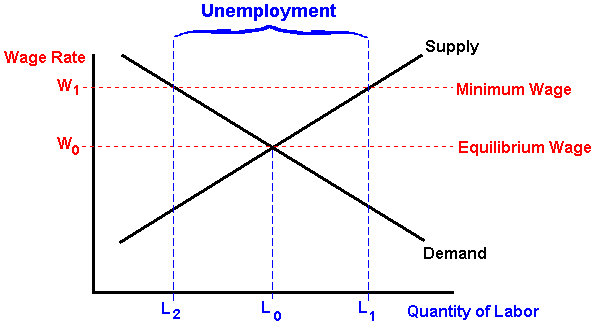



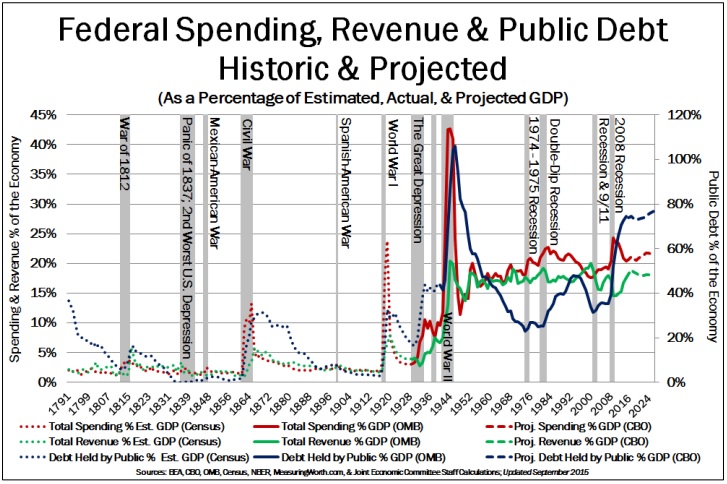
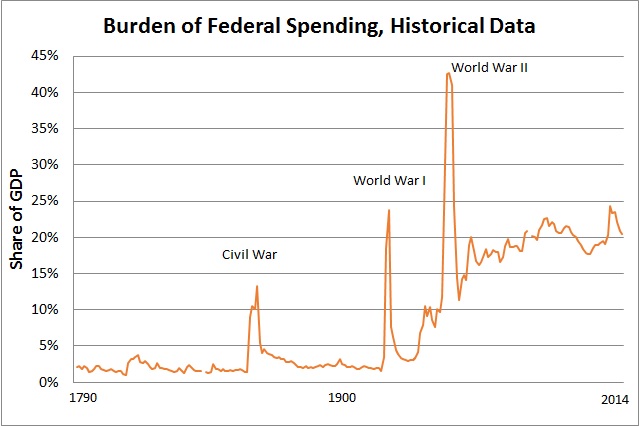
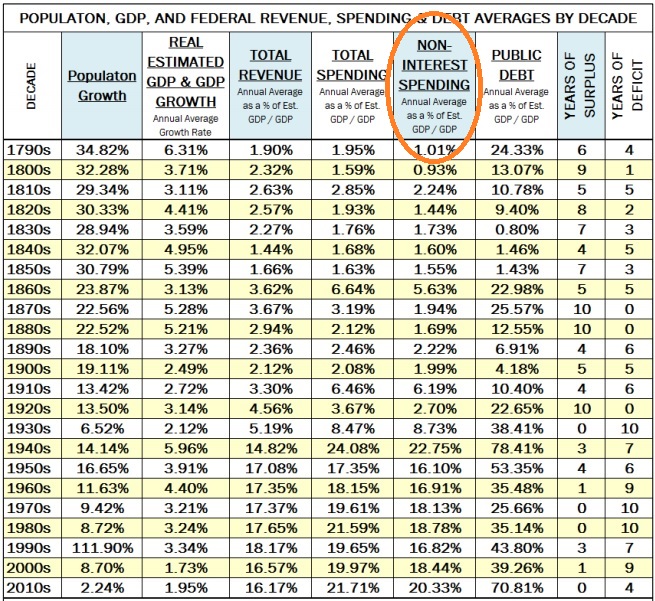

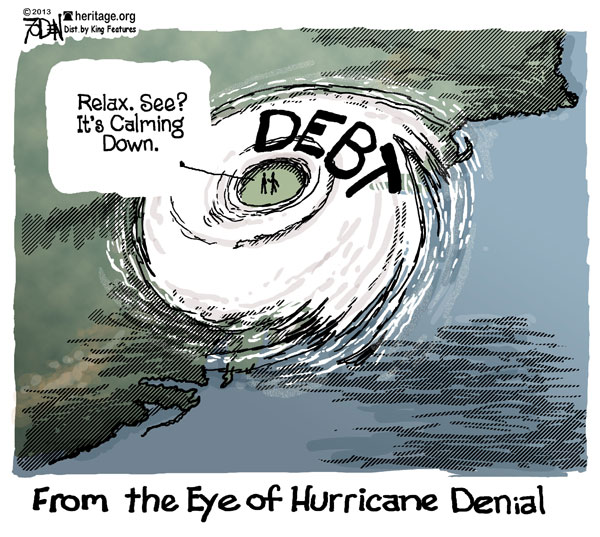
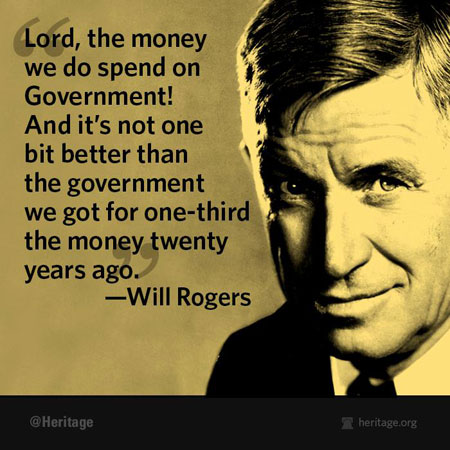
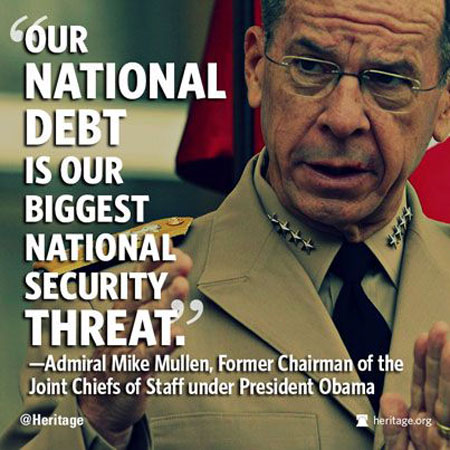

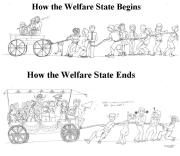




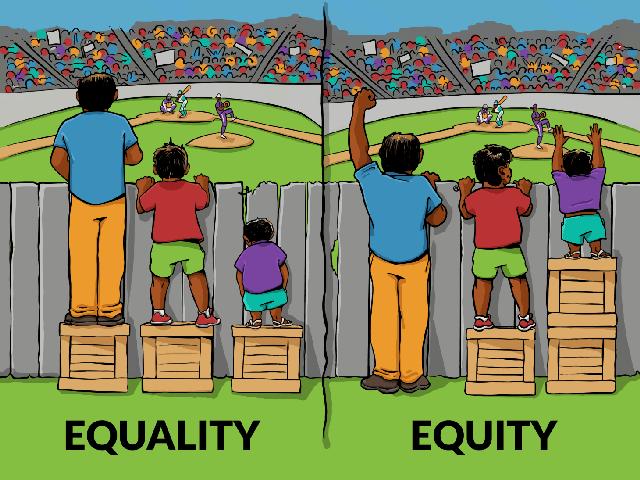

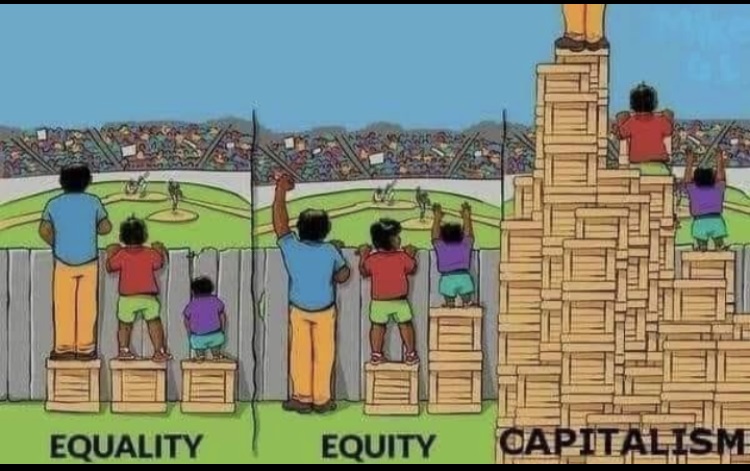


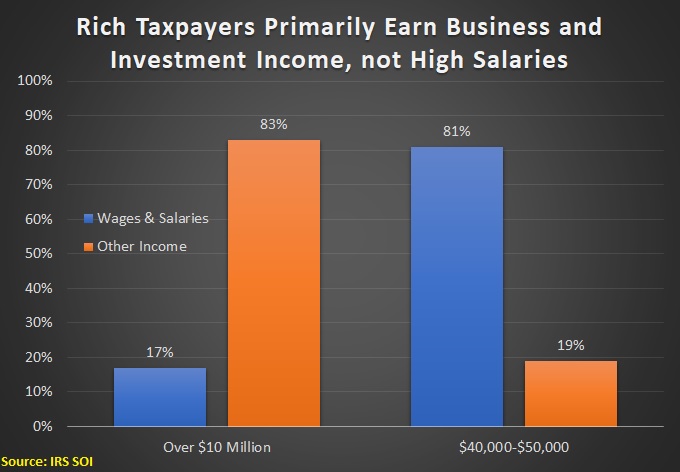
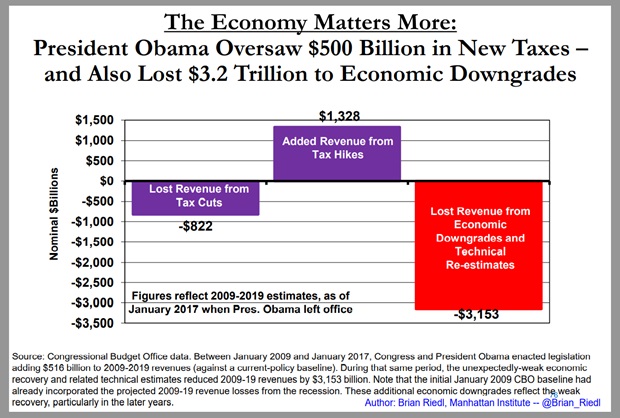

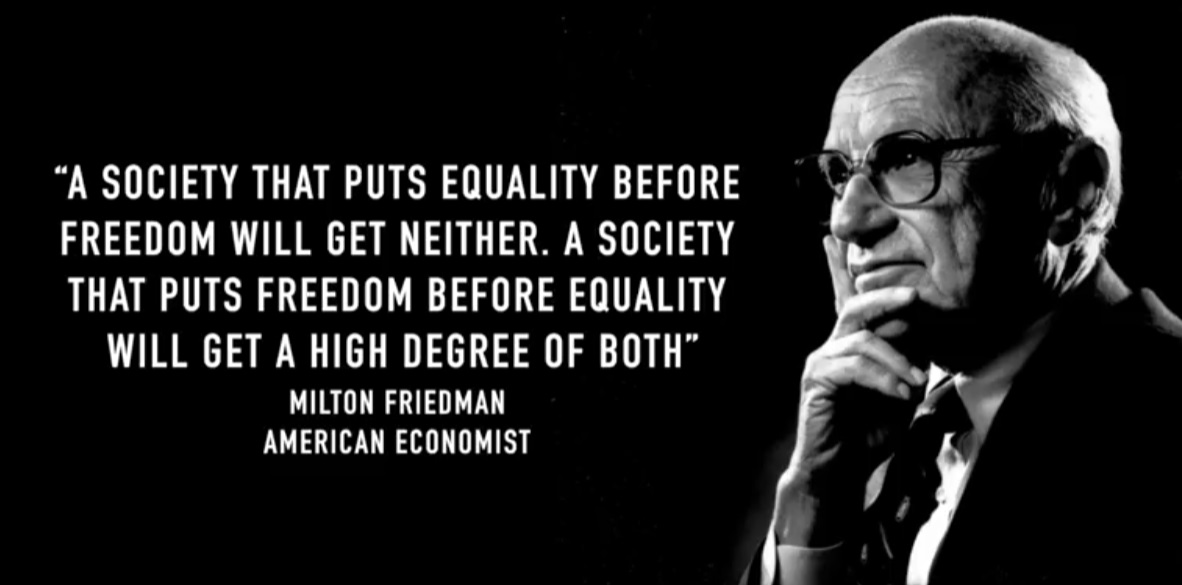



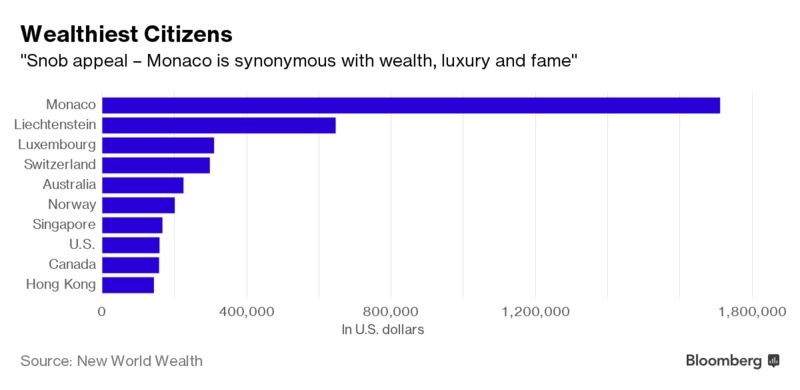





 The Daily Hatch