I meet with the young adult group on Friday nights for more targeted discussions. One of the things that Tammy and I have come to realize is that a lot of young adults do not see the value of gleaning wisdom from helpful folks who have come in generations before them. C.S. Lewis calls this “chronological snobbery.”
So, we have begun a series with our group called “Books You Should Have in Your Library.” We started with Francis Schaeffer’s “How Should We Then Live?” The plan is kick it off here and then work backwards. Although, I plan to get to some stuff from James White, who is certainly not backwards, except for the kilt, and Dan Phillips, who does have somewhat of an obsession with the band Chicago. But, alas, even Schaeffer had his knickers.
To encourage others to read some of these great works, I plan on posting some of the notes and quotes from our discussions under the category, oddly enough, Books You Should Have in Your Library. I trust that these will be helpful as an incentive to read the book, of course. If you would like to add some additional things that strike you in each chapter, please feel free to post them in the comment section.
Here are some of the things we discussed that were in Chapter 1.
Francis Schaeffer and Presuppositions
The book begins with this statement:
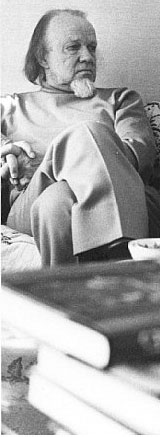
Francis Schaeffer | This Bread Always
There is a flow to history and culture. This flow is rooted and has its wellspring in the thoughts of people. People are unique in the inner life of the mind—what they are in their thought-world determines how they act. This is true of their value systems and it is true of their creativity. It is true of their corporate actions, such as political decisions, and it is true of their personal lives. The results of their thought-world flow through their fingers or from their tongues into the external world. This is true of Michelangelo’s chisel, and it is true of a dictator’s sword.
These basic starting points of understanding reality are called, “presuppositions.”
People have presuppositions, and they will live more consistently on the basis of these presuppositions than even they themselves may realize…Their presuppositions also provide the basis for their values and therefore the basis for their decisions.
Schaeffer defines presuppositions as “the basic way an individual looks at life, his basic world-view, the grid through which he sees the world.”
When it comes down to it, there are really only three ways that the thinkers of the past have posited that we can know reality. What we perceive through our senses; what we can reason from the inside out; and, what we can know because we have been told by someone outside of us who is trustworthy.
Paul said it this way:
But, as it is written, “What no eye has seen, nor ear heard, nor the heart of man imagined, what God has prepared for those who love him”— these things God has revealed to us through the Spirit. For the Spirit searches everything, even the depths of God. (1 Corinthians 2:9–10, ESV)
Everyone has a worldview, an ultimate grid through which they understand reality. “What no eye has seen, nor ear heard,” may be called in our day “empiricism” – reality is perceived by what is observed. We pile up pieces of data, “particulars” as Aristotle called them, and draw conclusions to make a unified whole. But, it fails. We cannot observe everything because we are limited creatures. That last piece of data might change the whole conclusion.
“Nor the heart of man imagined” may be called “rationalism,” or deriving a unified whole starting from the inside and reasoning out. “I think, therefore I am.” DeCartes posited. But, doesn’t everyone start from a different spot internally? Isn’t everyone flawed in their beginning?
There needs to be a Perfect Perceiver of reality, and their needs to be a Perfect starting point for reason. Paul points to the only viable source of knowing when he says, “these things God has revealed to us through the Spirit. For the Spirit searches everything, even the depths of God.”
All worldviews are designed to answer three basic questions:
1) What is real? The Theory of Reality (metaphysics)2) How do I know? The Theory of Knowledge (epistemology)3) How should I live? The Theory of Ethics (morality)
Schaeffer begins to demonstrate his thesis that “the inner thought-world determines the outward action” by looking at ancient Rome.
The Presuppositions of Rome
What caused Rome to fall? It wasn’t the barbarian attacks. It was that it rotted from the inside out.
In many ways Rome was great, but it had no real answers to the basic problems that all humanity faces.
The gods of Rome were glorified human beings. Petty, selfish, and without ultimate authority.
These gods depended on the society which had made them, and when this society collapsed the gods tumbled with it.
Is that not the way with any authority structure that depends upon humanity? Is that not true of the state as well? Fickle, changing, and ultimately unsupported. With Rome, each faction vied for its own special interest. Nothing was accomplished in the Roman Senate because Senators were only concerned with enlarging their power and perks of office. Chaos ruled the streets of Rome and Romans traded their freedoms as citizens for the security of subjugation. Ultimately, they worshipped Caesar and the genius of Rome. However, this ultimate authority was also finite and fickle as Caesar ultimately began to be ruled by the polls of his day.
Schaeffer contrasts the weakness of Rome and its worldview with the strength of Christianity and its worldview. Christianity survived intense persecution and the pressures of a cruel state power because Christian thought was not dependent upon the subjective wants of the culture. Christian thought is dependent upon objective truth, that of the revelation of God in Scripture.
The parallels to Rome and our current day are striking, there is no doubt. The solution is also striking. The Western church longs to be a power base in the secular political scene, to be accepted in the ever-godless culture. To do so, the Church must abandon her dependence upon objective truth and subject herself to the whims of the public. That has never ended well.
_______________________________________________
프란시스 쉐퍼 – 그러면 우리는 어떻게 살 것인가 introduction (Episode 1)
How Should We then Live Episode 7 small (Age of Nonreason)
#02 How Should We Then Live? (Promo Clip) Dr. Francis Schaeffer
The clip above is from episode 9 THE AGE OF PERSONAL PEACE AND AFFLUENCE
10 Worldview and Truth
In above clip Schaeffer quotes Paul’s speech in Greece from Romans 1 (from Episode FINAL CHOICES)
Two Minute Warning: How Then Should We Live?: Francis Schaeffer at 100
A Christian Manifesto Francis Schaeffer
Francis Schaeffer “BASIS FOR HUMAN DIGNITY” Whatever…HTTHR
______________ The Beatles documentary || A Long and Winding Road || Episode 5 (This video discusses Stg. Pepper’s creation I have dedicated several posts to this series on the Beatles and I don’t know when this series will end because Francis Schaeffer spent a lot of time listening to the Beatles and talking and writing […]
_______________________ When I’m Sixty-Four- The Beatles The Beatles first radio interview (10/27/1962) Published on Mar 3, 2013 The Beatles (John Lennon, Paul McCartney, George Harrison and Ringo Starr) with Monty Lister at their first radio interview, 27 October 1962. Before their fourth and final live appearance at the Hulme Hall in Birkenhead, The Beatles recorded […]
Great Album I have dedicated several posts to this series on the Beatles and I don’t know when this series will end because Francis Schaeffer spent a lot of time listening to the Beatles and talking and writing about them and their impact on the culture of the 1960’s. In this series we have […]
________________ _____________________________ Francis Schaeffer pictured below: ______________ I was impacted by this film series by Francis Schaeffer back in the 1970’s and I wanted to share it with you. Schaeffer makes three key points concerning the Reformation: “1. Erasmian Christian humanism rejected by Farel. 2. Bible gives needed answers not only as to how to be right […]
How Should We Then Live? outline Episode VII – The Age of Non Reason ____________________ Episode 8: The Age Of Fragmentation Published on Jul 24, 2012 Dr. Schaeffer’s sweeping epic on the rise and decline of Western thought and Culture _______________________ I love the works of Francis Schaeffer and I have been on the internet […]
___________________________________ 프란시스 쉐퍼 – 그러면 우리는 어떻게 살 것인가 introduction (Episode 1) How Should We then Live Episode 7 small (Age of Nonreason) #02 How Should We Then Live? (Promo Clip) Dr. Francis Schaeffer The clip above is from episode 9 THE AGE OF PERSONAL PEACE AND AFFLUENCE 10 Worldview and Truth In above clip […]
Open letter to President Obama (Part 491) (Emailed to White House on 5-3-13.) President Obama c/o The White House 1600 Pennsylvania Avenue NW Washington, DC 20500 Dear Mr. President, I know that you receive 20,000 letters a day and that you actually read 10 of them every day. I really do respect you for trying to get […]
__________________ Francis Schaeffer pictured below: _______________- I want to make two points today. First, Greg Koukl has rightly noted that the nudity of a ten year old girl in the art of Robert Mapplethorpe is not defensible, and it demonstrates where our culture is morally. It the same place morally where Rome was 2000 years […]
Review of Francis Schaeffer’s book and film series “How should we then live?” by Douglas Groothuis, Ph.D. Episode VII – The Age of Non Reason ____________________ Episode 8: The Age Of Fragmentation Published on Jul 24, 2012 Dr. Schaeffer’s sweeping epic on the rise and decline of Western thought and Culture _______________________ I love the […]
Francis Schaeffer Whatever Happened to the Human Race (Episode 1) ABORTION This essay below is worth the read. Schaeffer, Francis – “Francis Schaeffer and the Pro-Life Movement” [How Should We Then Live?, Whatever Happened to the Human Race?, A Christian Manifesto] Editor note: <p> </p> [The following essay explores the role that Francis Schaeffer played […]
How Should We Then Live? outline Episode VII – The Age of Non Reason ____________________ Episode 8: The Age Of Fragmentation Published on Jul 24, 2012 Dr. Schaeffer’s sweeping epic on the rise and decline of Western thought and Culture _______________________ I love the works of Francis Schaeffer and I have been on the internet […]
Review of Francis Schaeffer’s book and film series “How should we then live?” by Douglas Groothuis, Ph.D. How Should We then Live Episode 7 small (Age of Nonreason) #02 How Should We Then Live? (Promo Clip) Dr. Francis Schaeffer The clip above is from episode 9 THE AGE OF PERSONAL PEACE AND AFFLUENCE 10 Worldview […]
How Should We Then Live 4-1 I was impacted by this film series by Francis Schaeffer back in the 1970’s and I wanted to share it with you. Schaeffer makes three key points concerning the Reformation: “1. Erasmian Christian humanism rejected by Farel. 2. Bible gives needed answers not only as to how to be right with […]



 The Daily Hatch