Monthly Archives: September 2013

New Van Gogh identified!!!! (Also a look at the impressionists from a Christian perspective)

New Van Gogh identified!!!! (Also a look at the impressionists from a Christian perspective)

Art of Love – Part 1.flv

Uploaded on Apr 14, 2011

Stars: James Garner, Dick Van Dyke and Elke Sommer ; Paintings & Drawings: Don Cincone; (July 1965) A Struggling artist fakes his own death so his works will increase in value.

____________

Part 3

Part 4

Part 5

I was excited to read about a Van Gogh being found recently. Vincent Van Gogh was broke his whole life and then after he died his paintings sold very well. I love the movie “The Art of Love” which stars: James Garner, Dick Van Dyke and Elke Sommer from  July of 1965 and it is about a struggling artist that fakes his own death so his works will increase in value.  Today I am posting links to all the posts I have done on Van Gogh and posting clips both from the movie “Art of Love” and the film series HOW SHOULD WE THEN LIVE? from Francis Schaeffer that discusses Van Gogh and the other impressionist painters.

Van Gogh Museum: new Van Gogh identified

Museum identifies long-lost Van Gogh painting that lingered in Norwegian attic for decades

  • Dislike

Long-lost painting by Van Gogh is identified
.

View gallery

“Sunset at Montmajour” by Dutch painter Vincent van Gogh is seen during a press conference at the Van Gogh Museum in Amsterdam, Netherlands, Monday Sept. 9, 2013. The museum has identified the long-lost painting which was painted by the Dutch mater in 1888, the discovery is the first full size canvas that has been found since 1928 and will be on display from Sept. 24. (AP Photo/Peter Dejong)

Associated Press

AMSTERDAM (AP) — The first full-size Vincent Van Gogh painting to be discovered in 85 years has been authenticated as a genuine long-lost work of the Dutch master after an odyssey that included lingering for six decades in the attic of a Norwegian industrialist who had been told it was a fake.

“Sunset at Montmajour” depicts a dry landscape of twisting oak trees, bushes and sky, and it was done during the period when Van Gogh was increasingly adopting the thick brush strokes that became typical of his work in the final years of his short life, experts at the Van Gogh Museum in Amsterdam said Monday.

It can be dated to the exact day it was painted because Vincent described it in a letter to his brother, Theo, and said he had painted it the previous day — July 4, 1888.

“At sunset I was on a stony heath where very small, twisted oaks grow, in the background a ruin on the hill and wheat fields in the valley,” Van Gogh wrote.

“It was romantic…the sun was pouring its very yellow rays over the bushes and the ground, absolutely a shower of gold.”

But then Vincent confessed that the painting was “well below what I’d wished to do,” and later he sent it to Theo to keep.

Museum director Axel Rueger, at an unveiling ceremony in the museum, described the discovery as a “once-in-a-lifetime experience”.

“This is a great painting from what many see as the high point of his artistic achievement, his period in Arles, in southern France,” he said. “In the same period he painted works such as ‘Sunflowers,’ ‘The Yellow House’ and ‘The Bedroom’.”

Van Gogh struggled with bouts of mental distress throughout his life, and died of a self-inflicted gun wound in 1890. He sold only one painting while he was alive, though his work was just beginning to win acclaim when he died.

According to a reconstruction published in The Burlington Magazine by three researchers, the painting was recorded as number 180 in Theo’s collection, and given the title “Sun Setting at Arles.” It was sold to French art dealer Maurice Fabre in 1901.

Fabre never recorded selling the work, and the painting disappeared from history until it reappeared in 1970 in the estate of Norwegian industrialist Christian Nicolai Mustad.

The Mustad family said that Christian had purchased the work in 1908 as a young man in one of his first forays into art collecting, but he had soon after been told by the French ambassador to Sweden that it was a fake. Embarrassed, Mustad banished it to the attic.

After Mustad’s death in 1970, art dealer Daniel Wildenstein said he thought the painting was either a fake Van Gogh or possibly the work of a less-known German painter, and the painting was sold to a collector. The museum said it will not disclose who purchased it, or whether it has been resold since then.

In 1991 the museum itself declined to authenticate the painting.

“That may be a painful admission, given that the same museum is now attributing it to Van Gogh, but it is understandable” as experts had no information about what the painting depicted, the Burlington Magazine article said.

Teio Meedendorp, one of three experts who worked on the project, said his predecessors might also have been confused because the painting was done at a “transitional” moment in Van Gogh’s style.

“From then on, Van Gogh increasingly felt the need to paint with more and more impasto (thick strokes using lots of paint) and more and more layers,” he said.

The painting was unsigned. Some parts of the foreground were not “as well-observed as usual.” And part of the right side of the painting used a different style of brush strokes — possibly the same reasons Van Gogh himself considered the painting a failure.

But when the museum took a fresh look at the work in 2011, they had the advantage of a newly edited and published compendium of all Van Gogh’s letters, and were able for the first time to identify the exact location “Sunset” depicts: Monmajour hill, near Arles, France. The ruins of Monmajour abbey can be seen in the background on the left side of the painting.

Van Gogh mentioned the painting in two other letters the same summer.

The number 180 on the back of the canvas was an important clue, and new techniques of chemical analysis of the pigments showing they were identical to others Van Gogh used on his palette at Arles — including typical discolorations.

Meanwhile, an X-ray examination of the canvas showed it was of the same type Van Gogh used on other paintings from the period, such as “The Rocks,” which hangs in Houston’s Museum of Fine Arts.

Rueger described “Sunset” as ambitious, because the canvas is relatively large, at 93.3 by 73.3 centimeters (36.7 by 28.9 inches) — and because Van Gogh himself felt the result didn’t live up to his imagination of what it was meant to be.

The artist made similar remarks about some of his most famous paintings, including the 1889 “Starry Night” that hangs in the Museum of Modern Art in New York.

Meedendorp said that “Sunset” belongs “to a special group of experimental works that Van Gogh at times esteemed of lesser value than we tend to do nowadays.”

Meedendorp said it’s not impossible that another unknown or lost Van Gogh could be found someday. The artist destroyed some works himself when he wasn’t satisfied with the results, but others that are mentioned in his letters or early collection of his work have since disappeared. He is believed to have completed more than 800 works, painting at an accelerating pace before his death aged 37.

The Van Gogh Museum, which houses 140 paintings, receives more than a million visitors annually. Van Gogh paintings are among the most valuable in the world, selling for tens of millions of dollars on the rare occasions one is sold at an auction.

_____

Follow Toby Sterling on Twitter http://www.twitter.com/lbsterling

______________

Here below is episode 8 called “The Age of Fragmentation” from Francis Schaeffer’s film series HOW SHOULD WE THEN LIVE? and it talks about the impressionist painters at the beginning of the episode.

Schaeffer’s film series “How should we then live?  Wikipedia notes, “According to Schaeffer, How Should We Then Live traces Western history from Ancient Rome until the time of writing (1976) along three lines: the philosophic, scientific, and religious.[3] He also makes extensive references to art and architecture as a means of showing how these movements reflected changing patterns of thought through time. Schaeffer’s central premise is: when we base society on the Bible, on the infinite-personal God who is there and has spoken,[4] this provides an absolute by which we can conduct our lives and by which we can judge society.  Here are some posts I have done on this series: Francis Schaeffer’s “How should we then live?” Video and outline of episode 10 “Final Choices” episode 9 “The Age of Personal Peace and Affluence”episode 8 “The Age of Fragmentation”episode 7 “The Age of Non-Reason” episode 6 “The Scientific Age”  episode 5 “The Revolutionary Age” episode 4 “The Reformation” episode 3 “The Renaissance”episode 2 “The Middle Ages,”, and  episode 1 “The Roman Age,” .

E P I S O D E 8

How Should We Then Live? Episode 8: The Age Of Fragmentation

Published on Jul 24, 2012

Dr. Schaeffer’s sweeping epic on the rise and decline of Western thought and Culture

__________

I saw this film series in 1979 and it had a major impact on me.

T h e Age of FRAGMENTATION

I. Art As a Vehicle Of Modern Thought

A. Impressionism (Monet, Renoir, Pissarro, Sisley, Degas) and Post-Impressionism (Cézanne, Van Gogh, Gauguin, Seurat): appearance and reality.

1. Problem of reality in Impressionism: no universal.

2. Post-Impression seeks the universal behind appearances.

3. Painting expresses an idea in its own terms as a work of art; to discuss the idea in a painting is not to intellectualize art.

4. Parallel search for universal in art and philosophy; Cézanne.

B. Fragmentation.

1. Extremes of ultra-naturalism or abstraction: Wassily Kandinsky.

2. Picasso leads choice for abstraction: relevance of this choice.

3. Failure of Picasso (like Sartre, and for similar reasons) to be fully consistent with his choice.

C. Retreat to absurdity.

1. Dada , and Marcel Duchamp: art as absurd.

2. Art followed philosophy but came sooner to logical end.

3. Chance in his art technique as an art theory impossible to practice: Pollock.

II. Music As a Vehicle of Modern Thought

A. Non-resolution and fragmentation: German and French streams.

1. Influence of Beethoven’s last Quartets.

2. Direction and influence of Debussy.

3. Schoenberg’s non-resolution; contrast with Bach.

4. Stockhausen: electronic music and concern with the element of change.

B. Cage: a case study in confusion.

1. Deliberate chance and confusion in Cage’s music.

2. Cage’s inability to live the philosophy of his music.

C. Contrast of music-by-chance and the world around us.

1. Inconsistency of indulging in expression of chaos when we acknowledge order for practical matters like airplane design.

2. Art as anti-art when it is mere intellectual statement, divorced from reality of who people are and the fullness of what the universe is.

III. General Culture As the Vehicle of Modern Thought

A. Propagation of idea of fragmentation in literature.

1. Effect of Eliot’s Wasteland and Picasso’s Demoiselles d’ Avignon

compared; the drift of general culture.

2. Eliot’s change in his form of writing when he became a Christian.

3. Philosophic popularization by novel: Sartre, Camus, de Beauvoir.

B. Cinema as advanced medium of philosophy.

1. Cinema in the 1960s used to express Man’s destruction: e.g. Blow-up.

2. Cinema and the leap into fantasy:

The Hour of the Wolf, Belle de Jour, Juliet of the Spirits, The Last Year at Marienbad.

3. Bergman’s inability to live out his philosophy (see Cage): Silence and The Hour of the Wolf.

IV. Only on Christian Base Can Reality Be Faced Squarely

Questions

1. Explain what “fragmentation” means, as discussed by Dr. Schaeffer. What does it result from? Give examples of it.

2. Apart from the fact that modern printing and recording processes made the art and music of the past more accessible than ever before, do you think that the preference of many people for the art and music of the past is related to the matters discussed by Dr. Schaeffer? If so, how?

3. “A foolish consistency is the hobgoblin of little minds… With consistency a great soul has simply nothing to do.” Emerson wrote this over a century ago. Debate.

4. How far do you think that the opinion of some Christians that one should have nothing to do with philosophy, art and novels is a manifestation of the very fragmentation which is characteristic of modern secular thought? Discuss.

Key Events and Persons

Beethoven’s last Quartets: 1825-26

Claude Monet: 1840-1926

Poplars at Giverny, Sunrise: 1885

Paul Cézanne: 1839-1906

The Bathers: c.1905

Claude Debussy: 1862-1918

Wassily Kandinsky: 1866-1944

Arnold Schoenberg: 1874-1951

Picasso: 1881-1973

Les Demoiselles d’Avignon: 1906-7

Marcel Duchamp: 1887-1969

Nude Descending a Staircase: 1912

T.S. Eliot: 1888-1965

The Wasteland: 1922

John Cage: 1912-1992

Music for Marcel Duchamp: 1947

Jackson Pollock: 1912-1956

Karlheinz Stockhausen: 1928-

Sartre’s Nausea: 1938

Beauvoir’s L’Invitée: 1943

Camus’ The Stranger: 1942

Camus’ The Plague: 1947

Resnais’ The Last Year at Marienbad: 1961

Bergman’s The Silence: 1963

Fellini’s Juliet of the Spirits: 1965

Antonioni’s Blow-Up: 1966

Bergman’s The Hour of the Wolf: 1967

Buñel’s Belle de Jour: 1967

Further Study

Perhaps you have seen some of the films mentioned. You should try to see them if you haven’t.Watch for them in local art-film festivals, on TV, or in campus film series. They rarely return nowadays to the commercial circuit. The sex and violence which they treated philosophically have now taken over the screen in a more popular and crude form! Easier of access are the philosophic novels of Sartre, Camus and de Beauvoir. Read the titles Dr. Schaeffer mentions. Again, for the artwork and music mentioned, consult libraries and record shops. But spend time here—let the visual images and the musical sounds sink in.

Listening patiently to Cage and Webern, for example, will tell you more than volumes of musicology.

T.S. Eliot, The Wasteland (many editions, usually in collections of his verse).

Joseph Machlis, Introduction to Contemporary Music (1961).

H.R. Rookmaaker, Modern Art and the Death of a Culture (1970).

Donald J. Drew, Images of Man (1974).

Colin Wilson, The Outsider (1956).

_____________

Related posts:

Van Gogh Portrait Purchased for a Mere $3,000

Van Gogh Portrait Purchased for a Mere $3,000   The art world is buzzing after news broke that a British couple reportedly purchased the only full-length Vincent Van Gogh portrait in existence for a mere 1,500 pounds ($3,000). The potentially priceless picture was originally listed on an auction website as simply ‘portrait of a man,’ but after […]

The characters referenced in Woody Allen’s movie “Midnight in Paris” (Part 28,Van Gogh)

I have been going through the characters referenced in Woody Allen’s latest film “Midnight in Paris.” I only have a few characters left. Today is Vincent van Gogh who actually is not mentioned but his painting “The Starry Night” is featured in the poster to promote the movie. The Starry Night Vincent van Gogh (Dutch, […]

Oldest person in the world cursed? Jeanne Calment wasn’t, she lived to 122 yrs and told of meeting Van Gogh

Season 32, episode of Saturday Night Live, December 9th, 2006, Justin Timberlake hosting. During the news segment: Seth Meyers: Elizabeth “Lizzie” Bolden, the world’s oldest person, died Monday in a Memphis nursing home at the age of 116. Man, it’s like that title, “World’s Oldest Person”, is cursed or something. _____________________________________ Jeanne Calment was not […]

Kirk Douglas is turning 95, video clips of movies and interviews

You can’t  get more American than Kirk Douglas who turns 95 on Dec 9, 2011. President Reagan posing with Kirk Douglas and his wife Anne Buydens at a private dinner at Eldorado Country Club in Rancho Mirage, California. 12/30/87. I have a story to tell about Kirk Douglas. A good friend of mine was the […]


Tom Osborne at the Little Rock Touchdown Club Part 2

Tom Osborne at the Little Rock Touchdown Club Part 2

Nebraska Athletics Tribute to Tom Osborne Banquet

Published on Mar 19, 2013

Old rivals, teammates, and friends paid tribute to Coach Tom Osborne at the Century Link Center in Omaha, Nebraska as he retires as Athletic Director for the University of Nebraska-Lincoln.

___________

_______

1998 Orange Bowl – The Nebraska Cornhuskers vs. The Tennessee Volunteers

__________________

I really enjoyed hearing Tom Osborne speak at the Little Rock Touchdown Club on 9-9-13.

Tom Osborne won three national championships (National: (3) – 1994, 1995, 1997).

His last one came in 1997 against Tennessee. In that game there were 3 costly turnovers from Tennessee that put them down 14-0 at halftime and Peyton Manning could not dig himself out of that hole.  Nebraska had been in the national title game many times before but the breaks did not go their way but in this game which was Tom Osborne’s last game the breaks went their way.

Osborne talks athletic improvements, state of college football at Touchdown Club

By David Harten 

This article was published today at 1:03 p.m.

former-nebraska-coach-tom-osborne-signed-autographs-for-fans-at-the-little-rock-touchdown-club-on-monday-afternoon

PHOTO BY DAVID HARTEN

Former Nebraska coach Tom Osborne signed autographs for fans at the Little Rock Touchdown Club on Monday afternoon.

Osborne speaks to LRTD Club

Former Nebraska coach and athletic director Tom Osborne spoke to a crowd of about 300 people at the Little Rock Touchdown Club on Monday afternoon. Among the topics, Osborne spoke about the possibility of players earning some of the revenue in college football, his 13-1-1 record against the SEC and recent rule changes. (By David Harten)
[View Full-Size]

Former University of Nebraska Coach Tom Osborne told the Little Rock Touchdown Club on Monday that while some might say college athletics have deteriorated over time, in some ways they “have never been better.”

The 76-year-old Osborne was head coach at Nebraska for 25 years, winning three national championships in four years from 1994-97. The Hastings, Neb., native spent his entire coaching career with the Cornhuskers, starting as an offensive assistant in 1964, being named offensive coordinator in 1969 and taking over the program in 1973 on his way to 255 career wins.

Osborne entertained the crowd of about 300 with jokes and stories of his national title years with the Cornhuskers, particularly the 1997 Orange Bowl, joking about Peyton Manning and his own team that season.

The coaching great also shared his thoughts on collegiate athletics today, saying that while some “would have you think it’s worse,” in some ways, college sports have improved. For example, Osborne said, he was the only athletic academic counselor for the Cornhuskers while he was an assistant, something that isn’t the case now, with entire staffs on hand to help players academically.

He also noted that today, academics are better policed and athletes have more options toward obtaining degrees.

Osborne added that strength and training in modern college athletics have much improved over his playing and coaching days.

He also talked ethics in the game, noting that the demise of the Southwest Conference was keyed by improper benefits given to players and that those situations have led to tougher sanctions against teams that cheat heavily.

“As far as ethics and honesty, [there have been] tremendous changes,” Osborne said.

Later Osborne added that he doesn’t believe players should be paid, due to the fact that workmen’s compensation issues could arise, but he does believe a portion of the stadium attendance revenues should be included into a player’s scholarship.

But, he said, while hundreds of millions of dollars are in play with college athletics, players still don’t benefit. “The players are left behind so badly,” Osborne said. “…The players are at best, no better off than they were in 1962.”

In addition to the three national titles, Osborne won 13 conference titles in the Big 8 and Big 12, was named Big 8 Coach of the Year seven times and national coach of the year in 1994.

As a player, Osborne was a standout quarterback at Hastings High School and Hastings College before playing three years in the NFL with the San Francisco 49ers and Washington Redskins as a wide receiver.

Read more about this story in tomorrow’s Arkansas Democrat-Gazette.

Related posts:

Dan Hampton at the Little Rock Touchdown Club Part 4 (Learning a lesson from Hampton’s mistakes)

Dan Hampton at the Little Rock Touchdown Club Part 4 Mike Singletary: Christ Means Everything – CBN.com Uploaded on Aug 25, 2010 Shawn Brown talks to the tough-as-nails coach of the San Francisco 49ers about how he wins in life and in football… The Christian Broadcasting Network CBN http://www.cbn.com __________________________ No one has more respect […]

Dan Hampton at the Little Rock Touchdown Club Part 3

Dan Hampton at the Little Rock Touchdown Club Part 3 Before Dan Hampton got to speak at the touchdown club this week, Rex Nelson got up and spoke and when he talked about Bobby Petrino taking his Western Kentucky team into Knoxville, he asked, “How many of you think Petrino will get a victory in […]

Dan Hampton at the Little Rock Touchdown Club Part 2

Dan Hampton at the Little Rock Touchdown Club Part 2 https://www.youtube.com/watch?v=nCPWDMKzVs4 Dan Hampton told about the  year with the Chicago Bears when they took on the Vikings and they sacked Archie Manning 11 times.  In October on 1984 the Bears beat the Vikings but in the process Dan Hampton got to play against one of […]

Dan Hampton at the Little Rock Touchdown Club Part 1

Dan Hampton at the Little Rock Touchdown Club Part 1  Dan Hampton I really enjoyed the Little Rock Touchdown Club today when Dan Hampton was our speaker. Hampton said that Jimmy Johnson was a great defensive coordinator for him to learn under when he played for Frank Broyles in 1975. Then when Lou Holtz came […]

My favorite past speakers of the Little Rock Touchdown Club and the 2013 lineup (Part 4)

Rex Nelson impersonates Houston Nutt at LRTC 08 27 12 Published on Oct 2, 2012 Little Rock Touchdown Club has Rex Nelson do the stats for the games played that week. Rex does a lot of impersonations of different people but I like his Houston Nutt the best. Video by Popeye Video – Mrpopeyevideo I have […]

My favorite past speakers of the Little Rock Touchdown Club and the 2013 lineup (Part 3) (Vince Dooley did a great job)

I have written about my past visits to the Little Rock Touchdown Club many times and I have been amazed at the quality of the speakers. Frank Broyles was one of my favorites but Phillip Fulmer, Paul Finebaum, Mike Slive, Willie Roaf, Randy White, Howard Schnellenberger, John Robinson, Mark May, Gene Stallings, Bobby Bowden, Lloyd […]

My favorite past speakers of the Little Rock Touchdown Club and the 2013 lineup (Part 2) (Frank Broyles was outstanding!!)

I have written about my past visits to the Little Rock Touchdown Club many times and I have been amazed at the quality of the speakers. (Yesterday I talked about Phillip Fulmer.)Frank Broyles was one of my favorites but Phillip Fulmer, Paul Finebaum, Mike Slive, Willie Roaf, Randy White, Howard Schnellenberger, John Robinson, Mark May, […]

My favorite past speakers of the Little Rock Touchdown Club and the 2013 lineup (Part 1)

Rex Nelson impersonates Houston Nutt at LRTC 08 27 12 Published on Oct 2, 2012 Little Rock Touchdown Club has Rex Nelson do the stats for the games played that week. Rex does a lot of impersonations of different people but I like his Houston Nutt the best. Video by Popeye Video – Mrpopeyevideo ______________ I […]

Gus Malzahn does a great job at Little Rock Touchdown Club (Part 2)

I really enjoyed hearing Gus Malzahn speak at the final Little Rock Touchdown meeting on Nov 19, 2012. He covered several subjects that he covered a few days earlier at a touchdown club in Huntsville. Here are some of his comments from that meeting: But reports that he could be the next coach at Auburn, […]

Why Are Republicans Willing to Help Obama Make America More Like Europe When the Welfare State Is Collapsing? (includes cartoons)

Why can’t we learn from history?

Washington frustrates me. The entire town is based on legalized corruption as an unworthy elite figure out new ways of accumulating unearned wealth by skimming money from the nation’s producers.

But one thing that especially irks me is the way people focus on the trees and forget about the forest. Politicians and journalists are now engaged in an inside-baseball game of analyzing every twist and turn of the fiscal cliff negotiations.

That’s all fine and well, but perhaps it would be a good idea to talk about the need to fix the real crisis of excessive spending instead of arguing about how fast we should be traveling in the wrong direction.

And let’s not delude ourselves. In the absence of real entitlement reform, the United States is doomed to repeat Europe’s mistakes.

And how are things going in Europe? Well, I’m glad you ask. Let’s look at some excerpts from an Associated Press report.

Another month, another record unemployment rate for the economy of the 17 European Union countries that use the euro. Figures released Friday by Eurostat, the EU’s statistics office, showed that the recession in the eurozone pushed unemployment up in the currency bloc to 11.7 percent in October, the highest level since the introduction of the euro in 1999. …Eurostat found that 18.7 million people were out of work across the eurozone, an increase of 173,000 on the previous month and 2.2 million higher than the year before. The wider 27-nation EU that includes non-euro countries such as Britain and Poland had an unemployment rate of 10.7 percent in October and a total of 25.9 million out of work. …”Talk of a `lost generation’ of young people now looks like an alarming possibility,” said Andrea Broughton, principal research fellow at the Institute for Employment Studies.

In other words, we may complain about America’s miserable track record on jobs during the Obama years, but at some point in the future we may someday look back on 8 percent unemployment as good news.

Unfortunately, the crowd in Washington doesn’t want to acknowledge that the real problem is spending. And I’m particularly irked (but not surprised) that Republicans now seem willing to go along with Obama even though they won this fight back in 2010 when they didn’t control the House and had fewer seats in the Senate. Here’s what I said to one of the local DC stations.

Dan Mitchell Comments on Washington’s Spending Problem and GOP Appeasement

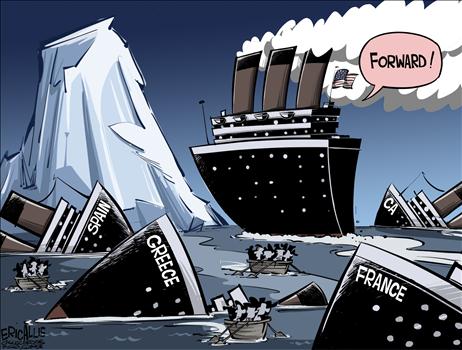
I realize I’m sounding glum, so let’s close out this post with a couple of amusing cartoons about America’s European future.

I’ve already shared the “European Lemming” cartoon. This one has the same theme.

Cartoon Obama Iceberg

Other Eric Allie cartoons can be enjoyed here, here , hereherehere, and here.

And here another cartoon with the same theme.

Cartoon Obama Cliff

If you like this Bok cartoon, some of my other favorites can be seen here,  hereherehereherehere, and here.

If you still haven’t cheered up, this bit of Dave Barry humor about the European fiscal crisis is a classic, and I’d also recommend this bit of unintentional satire.

Cole Porter’s song “Love for Sale”

______________

Love For Sale (De-Lovely)

Love for Sale (song)

From Wikipedia, the free encyclopedia
Jump to: navigation, search
Love for Sale
Written by Cole Porter
Published 1930
Form Show tune
Recorded by Libby Holman, Fred Waring’s Pennsylvanians, Eartha Kitt, Mel Torme, Dinah Washington, Liza Minnelli, Diane Schuur, Chris Barber, Fine Young Cannibals, Jazz Orchestra of the Delta, Chet Baker, Hal Kemp, Artie Shaw, Erroll Garner, Billie Holiday, Royce Campbell, Ella Fitzgerald, Tony Bennett, Miles Davis, Cannonball Adderley, Dexter Gordon, The Manhattan Transfer, Elvis Costello, Buddy Rich, Julie London, Dr. John, Anita O’Day, Amanda Lear, Frank Sinatra, Jr., Boney M., Martin Smith, Cyrille Aimée
Performed by Kathryn Crawford, Elisabeth Welch, Harvey Fierstein, Aretha Franklin, Martin Smith, Brian Stokes Mitchell, Idina Menzel, Jamie Cullum

“Love for Sale” is a song by Cole Porter, from the musical The New Yorkers which opened on Broadway on December 8, 1930 and closed in May 1931 after 168 performances. The song is written from the viewpoint of a prostitute advertising various kinds of “love for sale”: “Old love, new love, every love but true love“.

The song’s chorus, like many in the Great American Songbook, is written in the A-A-B-A format. However, instead of 32 bars, it has 64, plus an 8-bar tag. The tag is often dropped when the song is performed. The tune, using what is practically a trademark for Porter, shifts between a major and minor feeling.

“Love for Sale” was originally considered in bad taste, even scandalous. In the initial Broadway production, it was performed by Kathryn Crawford, portraying a streetwalker, with three girlfriends (Waring’s Three Girl Friends) as back-up singers, in front of Reuben’s, a popular restaurant of the time. As a response to the criticism, the song was transferred from the white Crawford to the African American singer Elisabeth Welch, who sang with back-up singers in a scene set in front of Harlem‘s Cotton Club.

Despite the fact the song was banned from radio airplay, or perhaps because of it, it became a hit, with Libby Holman‘s version going to #5 and the “Fred Waring’s Pennsylvanians” version going to #14, both in 1931. (All other 1931 recordings of the song were as an instrumental.)

Notable recordings since include Hal Kemp in 1939, Billie Holiday in 1945, Eartha Kitt in the 1950s, Ella Fitzgerald in 1956, and again in 1972 on her Ella Loves Cole album, Tony Bennett in 1957, Miles Davis and Cannonball Adderley for 1958 Miles and Somethin’ Else, Anita O’Day in 1959, Dexter Gordon in 1962, Al Hirt on his 1965 album, Live at Carnegie Hall,[1] The Manhattan Transfer in 1976, the German disco group Boney M in 1977, Donald Byrd on the Love Byrd album in 1981, Elvis Costello live on the remastered Rhino Entertainment CD of his 1981 record Trust. Harvey Fierstein performs a memorable (if interrupted) version in the movie version of his play Torch Song Trilogy. Martin Smith sang the song in the Cole Porter revue A Swell Party – A Celebration of Cole Porter at London’s Vaudeville Theatre in 1992. Simply Red led by Mick Hucknall sang this song at the Montreux Jazz Festival in 1992. Harry Connick, Jr. covered it in 1999 on his album Come by Me. Amanda Lear recorded a version in 2006.

Other vocal versions include Mel Torme‘s, Dinah Washington‘s, Liza Minnelli‘s, Diane Schuur‘s, Dianne Reeves‘, Cyrille Aimée‘s and Fine Young Cannibals‘. The song has become a jazz standard, and is often performed in solely instrumentalist versions. Notable among these is the Arthur Lyman version, which revived the song as a single record in 1963.

The song was also performed during a sequence in a gay night club in the Cole Porter biopic De-Lovely (performed by Vivian Green) and by k.d. Lang during a similar sequence in Brian De Palma‘s The Black Dahlia. A recording by Julie London featured in the film “Enron: The Smartest Guys in the Room” (2005).

Another notable recording of “Love for Sale” was made by Keely Smith at Capitol Studios, LA, for Concord Records in July 2002.[2]

There is another significant recording of “Love for Sale” by Jack Teagarden in 1940. The vocalist was 18 year old Kitty Kallen and, like the other versions of the song, was banned from radio.

Brazilian singer Zizi Possi recorded her own rendition for her album Para Inglês Ver… E Ouvir. Her rendition was picked as part of soap opera Belíssima soundtrack in 2006.

Idina Menzel covered the song on her 2010–2011 Symphony Tour as a mashup with The Police‘s “Roxanne“. The rendition of the mashup can be heard on her live album “Live: Barefoot at the Symphony.”

British Jazz Artist Jamie Cullum also did his own rendition for his album Momentum, entitled “Love For $ale”, featuring Roots Manuva. The allbum came out May 20th, 2013 in the UK, and May 21st, 2013 in the U.S.

See also

References

  1. ^ Al Hirt, Live at Carnegie Hall Retrieved April 11, 2013.
  2. ^ see Concord Records CCD-2138-2

External links

__________

Related posts:

Cole Porter “Let’s Do it, Let’s Fall in Love” in the movie MIDNIGHT IN PARIS

Cole Porter “Let’s Do it, Let’s Fall in Love” in the movie MIDNIGHT IN PARIS Midnight in Paris – Let’s Do It Let’s do it : Cole Porter.( Midnight in Paris ) Celebrate Wikipedia Loves Libraries at your institution in October/November. Let’s Do It, Let’s Fall in Love From Wikipedia, the free encyclopedia Jump to: […]

The Characters referenced in Woody Allen’s “Midnight in Paris” (Part 2 Cole Porter)

The song used in “Midnight in Paris” I am going through the famous characters that Woody Allen presents in his excellent movie “Midnight in Paris.”  By the way, I know that some of you are wondering how many posts I will have before I am finished. Right now I have plans to look at Fitzgerald, Heminingway, Juan […]


Truth Tuesday:Why Francis Schaeffer still matters by John Fischer

Episode 8: The Age Of Fragmentation

Published on Jul 24, 2012

Dr. Schaeffer’s sweeping epic on the rise and decline of Western thought and Culture

_______________________

I love the works of Francis Schaeffer and I have been on the internet reading several blogs that talk about Schaeffer’s work and the work below by John Fischer was really helpful. Schaeffer’s film series “How should we then live?  Wikipedia notes, “According to Schaeffer, How Should We Then Live traces Western history from Ancient Rome until the time of writing (1976) along three lines: the philosophic, scientific, and religious.[3] He also makes extensive references to art and architecture as a means of showing how these movements reflected changing patterns of thought through time. Schaeffer’s central premise is: when we base society on the Bible, on the infinite-personal God who is there and has spoken,[4] this provides an absolute by which we can conduct our lives and by which we can judge society.  Here are some posts I have done on this series: Francis Schaeffer’s “How should we then live?” Video and outline of episode 10 “Final Choices” episode 9 “The Age of Personal Peace and Affluence”episode 8 “The Age of Fragmentation”episode 7 “The Age of Non-Reason” episode 6 “The Scientific Age”  episode 5 “The Revolutionary Age” episode 4 “The Reformation” episode 3 “The Renaissance”episode 2 “The Middle Ages,”, and  episode 1 “The Roman Age,” .

In the film series “WHATEVER HAPPENED TO THE HUMAN RACE?” the arguments are presented  against abortion (Episode 1),  infanticide (Episode 2),   euthanasia (Episode 3), and then there is a discussion of the Christian versus Humanist worldview concerning the issue of “the basis for human dignity” in Episode 4 and then in the last episode a close look at the truth claims of the Bible.

Francis Schaeffer

__________________________

Here is the link:

Why Francis Schaeffer still matters

A few years ago I wrote an article in Christianity Today about the late Francis Schaeffer. Today’s Catch is edited from that article because I believe the sensitivity he modeled is much needed today in this mean-spirited, take-sides culture that only stands to get worse in America as a Presidential election approaches. True followers of Christ need to avoid joining in the bashing, and here is a good reason why.

He was a small man — barely five feet in his knickers, knee socks, and ballooning white shirts. For two weeks, first as a freshman, and then again as a senior, I sat in my assigned seat at Wheaton College chapel and heard him cry. He was the evangelical conscience at the end of the 20th century, weeping over a world that most of his peers dismissed as not worth saving, except to rescue a few souls in the doomed planet’s waning hours.

Francis Schaeffer was hard to listen to. His voice grated. It was a high-pitched scream, and when mixed with his eastern Pennsylvania accent, resulted in something like Elmer Fudd on speed. As freshmen, unfamiliar with the thought and works of modern man, we thought it was funny. As seniors, it wasn’t funny any more. After we had studied Kant, Hegel, Sartre, and Camus, the voice was now more like an existential shriek. If Edvard Munch’s The Scream had a voice, it would sound like Francis Schaeffer. Schaeffer, who died in 1984, understood the existential cry of a humanity trapped in a prison of its own making.

Schaeffer was the closest thing to a “man of sorrows” I have seen. He could not allow himself to be happy when most of the world was desperately lost and he knew why. He was the first Christian I found who could embrace faith and the despair of a lost humanity all at the same time. Though he had been found, he still knew what it was to be lost.

Schaeffer was the first Christian leader who taught me to weep over the world instead of judging it. Schaeffer modeled a caring and thoughtful engagement in the history of philosophy and its influence through movies, novels, plays, music, and art. Here was Schaeffer, teaching at Wheaton College about the existential dilemma expressed in Michelangelo Antonioni’s 1966 film, Blowup, when movies were still forbidden to students. He didn’t bat an eye. He ignored our legalism and went on teaching because he had been personally gripped by the desperation of such cultural statements.

Schaeffer taught his followers not to sneer at or dismiss the dissonance in modern art. He showed how these artists were merely expressing the outcome of the presuppositions of the modern era that did away with God and put all conclusions on a strictly human, rational level. Instead of shaking our heads at a depressing, dark, abstract work of art, the true Christian reaction should be to weep for the lost person who created it. Schaeffer was a rare Christian leader who advocated understanding and empathizing with non-Christians instead of taking issue with them.

The normal human reaction is to hate what we don’t understand. This is the stuff of prejudice and the cause of hate crimes and escalating culture wars. It is much more Christ-like to identify with those we don’t understand — to discover why people do what they do, because we care about them, even if they are our ideological enemies.

Anyway, Jesus asked us to love our enemies. Part of loving is learning to understand. Too few Christians today seek to understand why their enemies think in ways they find abhorrent. Too many of us are too busy bashing feminists, secular humanists, gay activists, and political liberals to consider why they believe what they do. It’s difficult to sympathize with people you see as threats to your children and your neighborhood. It’s hard to weep over those whom you have declared as your enemies.

Perhaps a good beginning would be to more fully grasp the depravity of our own souls, and the depth to which God’s grace had to go to reach us. I don’t think you can cry over the world if you’ve never cried over yourself.

To be sure, Francis Schaeffer’s influence has declined in recent years,as postmodernism has supplanted the modernity he dissected for so long. Schaeffer is not without critics, even among Christians. But perhaps, in the end, his greatest influence on the church will not be his words as much as his cry. The same things that made Francis Schaeffer cry in his day need to make us cry in ours.

Related posts:

Taking on Ark Times Bloggers on various issues Part A “The Pro-life Issue” (Francis Schaeffer Quotes Part 1 includes the film SLAUGHTER OF THE INNOCENTS) (editorial cartoon)

I have gone back and forth and back and forth with many liberals on the Arkansas Times Blog on many issues such as abortion, human rights, welfare, poverty, gun control  and issues dealing with popular culture. Here is another exchange I had with them a while back. My username at the Ark Times Blog is Saline […]

“Schaeffer Sunday” Francis Schaeffer: “Whatever Happened to the Human Race” (Episode 1) ABORTION OF THE HUMAN RACE

It is not possible to know where the pro-life evangelicals are coming from unless you look at the work of the person who inspired them the most. That person was Francis Schaeffer.  I do care about economic issues but the pro-life issue is the most important to me. Several years ago Adrian Rogers (past president of […]

The movie “Les Miserables” and Francis Schaeffer

I got this off a Christian blog spot. This person makes some good points and quotes my favorite Christian philosopher Francis Schaeffer too. Prostitution, Chaos, and Christian Art The newest theatrical release of Victor Hugo’s 1862 novel “Les Miserables” was released on Christmas, but many Christians are refusing to see the movie. The reason simple — […]

“Schaeffer Sunday” Francis Schaeffer is one of the great evangelical theologians of our modern day

Francis Schaeffer was truly a great man and I enjoyed reading his books. A theologian #2: Rev. Francis Schaeffer Duriez, Colin. Francis Schaeffer: An Authentic Life. Wheaton, IL: Crossway Books, 2008. Pp. 240. Francis Schaeffer is one of the great evangelical theologians of our modern day. I was already familiar with some of his books and his […]

“Schaeffer Sundays” Francis Schaeffer’s own words concerning infanticide and youth enthansia

Francis Schaeffer: “Whatever Happened to the Human Race?” (Episode 2) SLAUGHTER OF THE INNOCENTS Published on Oct 6, 2012 by AdamMetropolis ___________ The 45 minute video above is from the film series created from Francis Schaeffer’s book “Whatever Happened to the Human Race?” with Dr. C. Everett Koop. This book  really helped develop my political views […]

Francis Schaeffer’s wife Edith passes away on Easter weekend 2013 Part 7 (includes pro-life editorial cartoon)

The Francis and Edith Schaeffer Story Pt.1 – Today’s Christian Videos The Francis and Edith Schaeffer Story – Part 3 of 3 Francis Schaeffer: “Whatever Happened to the Human Race” (Episode 1) ABORTION OF THE HUMAN RACE Published on Oct 6, 2012 by AdamMetropolis ________________ Picture of Francis Schaeffer and his wife Edith from the […]

The Mark of the Christian by Francis Schaeffer Part 1

  THE MARK OF A CHRISTIAN – CLASS 1 – Introduction Published on Mar 7, 2012 This is the introductory class on “The Mark Of A Christian” by Francis Schaeffer. The class was originally taught at Redeemer Presbyterian Church in Overland Park, KS by Dan Guinn from FrancisSchaefferStudies.org as part of the adult Sunday School hour […]

“Schaeffer Sundays” Francis Schaeffer’s own words concerning humanist dominated public schools in USA even though country was founded on a Christian base

Francis Schaeffer: “Whatever Happened to the Human Race?” (Episode 2) SLAUGHTER OF THE INNOCENTS Published on Oct 6, 2012 by AdamMetropolis The 45 minute video above is from the film series created from Francis Schaeffer’s book “Whatever Happened to the Human Race?” with Dr. C. Everett Koop. This book  really helped develop my political views concerning […]

“Schaeffer Sundays” Francis Schaeffer’s own words concerning where the Bible-believing Christians been the last few decades

Francis Schaeffer: “Whatever Happened to the Human Race” (Episode 1) ABORTION OF THE HUMAN RACE Published on Oct 6, 2012 by AdamMetropolis The 45 minute video above is from the film series created from Francis Schaeffer’s book “Whatever Happened to the Human Race?” with Dr. C. Everett Koop. This book  really helped develop my political views […]

Taking on Ark Times Bloggers on various issues Part E “Moral absolutes and abortion” Francis Schaeffer Quotes part 5(includes the film SLAUGHTER OF THE INNOCENTS) (editorial cartoon)

I have gone back and forth and back and forth with many liberals on the Arkansas Times Blog on many issues such as abortion, human rights, welfare, poverty, gun control  and issues dealing with popular culture. Here is another exchange I had with them a while back. My username at the Ark Times Blog is Saline […]

“Schaeffer Sundays” Francis Schaeffer’s own words concerning religious liberals and humanists

Francis Schaeffer: “Whatever Happened to the Human Race” (Episode 5) TRUTH AND HISTORY Published on Oct 7, 2012 by AdamMetropolis The 45 minute video above is from the film series created from Francis Schaeffer’s book “Whatever Happened to the Human Race?” with Dr. C. Everett Koop. This book  really helped develop my political views concerning abortion, […]

By Everette Hatcher III | Posted in Francis Schaeffer | Edit | Comments (0)

FREE TO CHOOSE “Who protects the consumer?” Video and Transcript Part 2 of 7 “When governments do intervene in business, innovation is stifled. Railroads have been regulated for nearly a century and they are one of our most backward industries.”


In 1980 I read the book FREE TO CHOOSE by Milton Friedman and it really enlightened me a tremendous amount.  I suggest checking out these episodes and transcripts of Milton Friedman’s film series FREE TO CHOOSE: “The Failure of Socialism” and “What is wrong with our schools?”  and “Created Equal”  and  From Cradle to Grave, and – Power of the Market.

From the original Free To Choose series Milton asks: “Who Protects the Consumer?”. Many government agencies have been created for this purpose, yet they do so by restricting freedom and stifling beneficial innovation, and eventually become agents for the groups they have been created to regulate.

Milton Friedman noted how the government usually messes up things when they start regulating: “When governments do intervene in business, innovation is stifled. Railroads have been regulated for nearly a century and they are one of our most backward industries.”
Part 2
When governments do intervene in business, innovation is stifled. Railroads have been regulated for nearly a century and they are one of our most backward industries. The railroad story shows what so often results from the good intentions of consumer protection groups. In the 1860’s railroad rates were lower in the United States than anywhere else in the world. Yet many customers thought they were too high. They complained bitterly about the profits of the railroads.
Now the railway men of the time had their problems too. Problems that arose out of the fierce competitiveness among them. Many railroads all trying to get their share of the market, all trying to make a name for themselves. If you want to see what their problems were as they saw them, come and have a look at this.
From inside this private railroad car it may not look as if the people who ran the railroads had any real problems. Some, like the owner of this private car, had done very well. This was the equivalent of the private jet of today’s business tycoons. But for each one who succeeded, many didn’t survive the cutthroat competition.
What we have here is a railroad map of the United States for the year 1882. It shows every railroad then in existence. The country was literally crisscrossed with railroads going to every remote hamlet and covering the nation from coast to coast. Between points far distant like for example New York and Chicago, there might be a half a dozen lines that would be running between those two points. Each of the half dozen trying to get business would cut rates and rates would get very low. The people who benefited most from this competition were the customers shipping goods on a long trip.
On the other hand, between some segments of that trip, say for example, Harrisburg and Pittsburgh, there might be only a single line that was running and that line would take full advantage of its monopoly position. It would charge all that the traffic would bear. The result was that the sum of the fares charged for the short haul was typically larger than the total sum charged for the long haul between the two distant points. Of course, none of the consumers complained about the low price for the long haul, but the consumer certainly did complain about the higher prices for the short hauls. And that was one of the major sources of agitation leading ultimately to the establishment of the Interstate Commerce Commission.
The cartoonists of the day delighted in pointing out that railroads had tremendous political instinct. As indeed they did. They used the consumer’s complaints to get the government to establish a commission that would protect the railroad’s interest. It took about a decade to get the commission into full operation. By that time, needless to say, the consumer advocates had moved on to their next crusade. But the railway men were still there. They had soon learned how to use the commission to their own advantage. They solved the long haul/short haul problem, by raising the long haul rates. The customers ended up paying more, some protection. The first commissioner was Thomas Cooley, a lawyer who had represented the railroads for many years. The railroads continued to dominate the Commission.
In the 1920’s and 30’s when trucks emerged as serious competitors for long distance hauling, the railroads induced the Commission to extend control over trucking. Truckers, in their turn, learned how to use the Commission to protect themselves from competition. This firm carries freight to and from the Dayton, Ohio International Airport. Its the only one serving some routes and its customers depend on it. But Dayton Airfreight has real problems. Its ICC license only permits it to carry freight from Dayton to Detroit. To serve other routes it’s had to buy rights from other ICC license holders including one who doesn’t own a single truck. It’s paid as much as $100,000 a year for the privilege.
Secretary: Our company is in the process of trying to get rights to go there now. Yes, we’ll do that and thank you for calling sir.
The owners of the firm have been trying for years to get their license extended to cover more routes.
Air freight company: Now I don’t have any argument with the people who already have ICC permits except for the fact that this is a big country and since the inception of the ICC in 1936, there has been very few entrants into the business. They do not allow new entrants to come in and compete with those who are already in.
Unnamed individual: Of course, Dayton Airfreight suffers but so do the customers who pay higher freight charges. Quite frankly, I don’t know why the ICC is sitting on its hands doing nothing. This is the third time to my knowledge that we’ve support the application of Dayton Airfreight to help us save money, help free enterprise, help the country save energy, help, help, help. It all comes down to consumers ultimately going to pay for all of this and they are the blame. The ICC has to be the blame.
Friedman: Dayton Airfreight now has many of its trucks lying idle. Trucks that could be providing a valuable service. Far from protecting consumers, the ICC has ended up making them worse off.
As far as I’m concerned, there is no free enterprise in interstate commerce. It no longer exists in this country. You have to pay the price and you have to pay the price very dearly and I don’t mean we have to pay the price, it means that the consumer is paying that price.
The price consumers pay when it comes to medicine could be their lives. In the 19th Century pharmacies contained an impressive array of pills and potions. Most were ineffective and some were deadly. There was an outcry about drugs that maimed or killed. The Food and Drug Administration in response to consumer pressure succeeded in banning a whole range of medicines. The tonics and lotions with their excessive claims disappeared from the market. In 1962 the Kefauver Amendment gave the FDA power to regulate all drugs for effectiveness as well as for safety. Today, every drug marketed in the United States must pass the FDA. It’s clear that this has protected us from some drugs with horrific side effects like thalidomide. And we all know of people who have benefited from modern drugs. What we don’t hear much about however, are the beneficial drugs that the FDA has prohibited.
Well, if you examine the therapeutic benefits of significant drugs that haven’t arrived in the U.S. but are available somewhere in the rest of the world, such as in Britain, you can come across numerous examples where the patient has suffered. For example, there are one or two drugs called beta blockers which now can prevent death after heart attack, we call it secondary prevention of coronary death after myocardial infarction, which if available here, could be saving about 10,000 lives a year in the United States. In the ten years after the 1962 amendments no drug was approved for hypertension. That’s for the control the blood pressure in the United States, where as several were approve in Britain. In the entire cardiovascular area, only one drug was approved in the five year period from 67 to 72. And this can be correlated with known organizational problems at FDA.
These carts are taking to an FDA official the documents required to get just one drug approved.
Worker: Well, hi there, must be the new one they called me about.
Friedman: It took six years work by the drug company to get this drug passed.
Worker: This one right here, all 119 volumes.

Related posts:

“The Power of the Market” episode of Free to Choose in 1990 by Milton Friedman (Part 1)

Milton Friedman The Power of the Market 1-5 How can we have personal freedom without economic freedom? That is why I don’t understand why socialists who value individual freedoms want to take away our economic freedoms.  I wanted to share this info below with you from Milton Friedman who has influenced me greatly over the […]

“Friedman Friday,” EPISODE “The Failure of Socialism” of Free to Choose in 1990 by Milton Friedman (Part 1)

Milton Friedman: Free To Choose – The Failure Of Socialism With Ronald Reagan (Full) Published on Mar 19, 2012 by NoNationalityNeeded Milton Friedman’s writings affected me greatly when I first discovered them and I wanted to share with you. We must not head down the path of socialism like Greece has done. Abstract: Ronald Reagan […]

________________

“Friedman Friday” (“Free to Choose” episode 3 – Anatomy of a Crisis. part 3 of 7)

Worse still, America’s depression was to become worldwide because of what lies behind these doors. This is the vault of the Federal Reserve Bank of New York. Inside is the largest horde of gold in the world. Because the world was on a gold standard in 1929, these vaults, where the U.S. gold was stored, […]

“Friedman Friday” (Part 16) (“Free to Choose” episode 3 – Anatomy of a Crisis. part 2 of 7)

  George Eccles: Well, then we called all our employees together. And we told them to be at the bank at their place at 8:00 a.m. and just act as if nothing was happening, just have a smile on their face, if they could, and me too. And we have four savings windows and we […]

“Friedman Friday” (“Free to Choose” episode 3 – Anatomy of a Crisis. part 1of 7)

Milton Friedman’s Free to Choose (1980), episode 3 – Anatomy of a Crisis. part 1 FREE TO CHOOSE: Anatomy of Crisis Friedman Delancy Street in New York’s lower east side, hardly one of the city’s best known sites, yet what happened in this street nearly 50 years ago continues to effect all of us today. […]

By Everette Hatcher III | Also posted in Current Events | Edit | Comments (0)

____________________________

_____________


________________________________________________

_____________________________________________

Friedman Friday” Free to Choose by Milton Friedman: Episode “What is wrong with our schools?” (Part 3 of transcript and video)

Friedman Friday” Free to Choose by Milton Friedman: Episode “What is wrong with our schools?” (Part 3 of transcript and video) Here is the video clip and transcript of the film series FREE TO CHOOSE episode “What is wrong with our schools?” Part 3 of 6.   Volume 6 – What’s Wrong with our Schools Transcript: If it […]

Friedman Friday” Free to Choose by Milton Friedman: Episode “What is wrong with our schools?” (Part 2 of transcript and video)

Here is the video clip and transcript of the film series FREE TO CHOOSE episode “What is wrong with our schools?” Part 2 of 6.   Volume 6 – What’s Wrong with our Schools Transcript: Groups of concerned parents and teachers decided to do something about it. They used private funds to take over empty stores and they […]

By Everette Hatcher III | Also posted in Vouchers | Edit | Comments (1)

Friedman Friday” Free to Choose by Milton Friedman: Episode “What is wrong with our schools?” (Part 1 of transcript and video)

Here is the video clip and transcript of the film series FREE TO CHOOSE episode “What is wrong with our schools?” Part 1 of 6.   Volume 6 – What’s Wrong with our Schools Transcript: Friedman: These youngsters are beginning another day at one of America’s public schools, Hyde Park High School in Boston. What happens when […]

By Everette Hatcher III | Also posted in Vouchers | Tagged , , , , | Edit | Comments (0)

Friedman Friday” Free to Choose by Milton Friedman: Episode “Created Equal” (Part 3 of transcript and video)

Friedman Friday” Free to Choose by Milton Friedman: Episode “Created Equal” (Part 3 of transcript and video) Liberals like President Obama want to shoot for an equality of outcome. That system does not work. In fact, our free society allows for the closest gap between the wealthy and the poor. Unlike other countries where free enterprise and other […]

Free to Choose by Milton Friedman: Episode “Created Equal” (Part 2 of transcript and video)

Free to Choose by Milton Friedman: Episode “Created Equal” (Part 2 of transcript and video) Liberals like President Obama want to shoot for an equality of outcome. That system does not work. In fact, our free society allows for the closest gap between the wealthy and the poor. Unlike other countries where free enterprise and other freedoms are […]

Free to Choose by Milton Friedman: Episode “Created Equal” (Part 1 of transcript and video)

 Milton Friedman and Ronald Reagan Liberals like President Obama (and John Brummett) want to shoot for an equality of outcome. That system does not work. In fact, our free society allows for the closest gap between the wealthy and the poor. Unlike other countries where free enterprise and other freedoms are not present.  This is a seven part series. […]

Milton Friedman Friday: (“Free to Choose” episode 4 – From Cradle to Grave, Part 3 of 7)

 I am currently going through his film series “Free to Choose” which is one the most powerful film series I have ever seen. PART 3 OF 7 Worse still, America’s depression was to become worldwide because of what lies behind these doors. This is the vault of the Federal Reserve Bank of New York. Inside […]

By Everette Hatcher III | Edit | Comments (0)

Milton Friedman Friday:(“Free to Choose” episode 4 – From Cradle to Grave, Part 2 of 7)

 I am currently going through his film series “Free to Choose” which is one the most powerful film series I have ever seen. For the past 7 years Maureen Ramsey has had to buy food and clothes for her family out of a government handout. For the whole of that time, her husband, Steve, hasn’t […]

Friedman Friday:(“Free to Choose” episode 4 – From Cradle to Grave, Part 1 of 7)

Friedman Friday:(“Free to Choose” episode 4 – From Cradle to Grave, Part 1 of 7) Volume 4 – From Cradle to Grave Abstract: Since the Depression years of the 1930s, there has been almost continuous expansion of governmental efforts to provide for people’s welfare. First, there was a tremendous expansion of public works. The Social Security Act […]

By Everette Hatcher III | Edit | Comments (0)

“Friedman Friday” (“Free to Choose” episode 1 – Power of the Market. part 3 of 7)

  _________________________   Pt3  Nowadays there’s a considerable amount of traffic at this border. People cross a little more freely than they use to. Many people from Hong Kong trade in China and the market has helped bring the two countries closer together, but the barriers between them are still very real. On this side […]

“Friedman Friday” (“Free to Choose” episode 1 – Power of the Market. part 2 of 7)

  Aside from its harbor, the only other important resource of Hong Kong is people __ over 4_ million of them. Like America a century ago, Hong Kong in the past few decades has been a haven for people who sought the freedom to make the most of their own abilities. Many of them are […]

“Friedman Friday” (“Free to Choose” episode 1 – Power of the Market. part 1of 7)

“FREE TO CHOOSE” 1: The Power of the Market (Milton Friedman) Free to Choose ^ | 1980 | Milton Friedman Posted on Monday, July 17, 2006 4:20:46 PM by Choose Ye This Day FREE TO CHOOSE: The Power of the Market Friedman: Once all of this was a swamp, covered with forest. The Canarce Indians […]

By Everette Hatcher III | Posted in Current Events, Milton Friedman | Edit | Comments (0)

“Friedman Friday,” EPISODE “The Failure of Socialism” of Free to Choose in 1990 by Milton Friedman (Part 1)

Milton Friedman: Free To Choose – The Failure Of Socialism With Ronald Reagan (Full) Published on Mar 19, 2012 by NoNationalityNeeded Milton Friedman’s writings affected me greatly when I first discovered them and I wanted to share with you. We must not head down the path of socialism like Greece has done. Abstract: Ronald Reagan […]

By Everette Hatcher III | Posted in Milton FriedmanPresident Obama | Edit | Comments (1)

“The Failure of Socialism” episode of Free to Choose in 1990 by Milton Friedman (Part 1)

Milton Friedman: Free To Choose – The Failure Of Socialism With Ronald Reagan (Full) Published on Mar 19, 2012 by NoNationalityNeeded Milton Friedman’s writings affected me greatly when I first discovered them and I wanted to share with you. We must not head down the path of socialism like Greece has done. Abstract: Ronald Reagan […]

Open letter to President Obama (Part 404) Need to listen to ideas on cutting government spending from Senator Ted Cruz

(Emailed to White House on 1-3-13.)

President Obama c/o The White House
1600 Pennsylvania Avenue NW
Washington, DC 20500

Dear Mr. President,

I know that you receive 20,000 letters a day and that you actually read 10 of them every day. I really do respect you for trying to get a pulse on what is going on out here.

Ronald Reagan pictured above.

Ted Cruz has the right idea about cutting the size of government. He has some good ideas and he reminds me a lot of Rand Paul. He also has a great role model in Ronald Reagan who he quotes in the video clip below.

Less than one week ago, I identified three potential vehicles for some long-overdue fiscal reforms to restrain the burden of government spending.

In that post, I suggested that the “continuing resolution” was the best vehicle since lawmakers obviously would have to consider legislation to provide funding for the rest of the 2013 fiscal year.

The debt limit, by contrast, creates too many opportunities for demagoguery. Geithner and Bernanke have already demonstrated, for instance, that they’re willing to prevaricate and scare financial markets.

It’s much smarter to pick a fight on the “CR” since there not even a make-believe risk of default. Instead, the only thing that happens is that the “non-essential” parts of the federal government are shut down.

So I’m delighted to see that Ted Cruz, the new Senator from Texas, understands that the shutdown fight in 1995 led to very good results. I wrote a piece for National Review making the same point, so I’m delighted to hear someone else singing from the same sheet of music. Pay close attention at the 3:15 mark of this video.

Texas Sen. Ted Cruz on the Deficit, Gun Rights, Immigration

My only quibble is that he mentions the debt limit as the vehicle for the fight, when he should have mentioned the CR.

But I’m nit-picking. Cruz seems to get it. He puts the focus on the disease of too much government rather than fixating on the symptom of too much red ink.

He also understands that high tax rates discourage productive behavior, so he’s obviously not a fan of the President’s class-warfare approach.

Last but not least, you’ll also see he gave a very strong response on protecting the 2nd Amendment immediately following his discussion of fiscal policy.

Seems like there’s a chance he could be a second Rand Paul.

_________

Thank you so much for your time. I know how valuable it is. I also appreciate the fine family that you have and your commitment as a father and a husband.

Sincerely,

Everette Hatcher III, 13900 Cottontail Lane, Alexander, AR 72002, ph 501-920-5733, lowcostsqueegees@yahoo.com

Related posts:

Open letter to President Obama (Part 201)Tea Party favorite Representative links article “Prescott and Ohanian: Taxes Are Much Higher Than You Think”

    (Emailed to White House on 12-21-12.) President Obama c/o The White House 1600 Pennsylvania Avenue NW Washington, DC 20500 Dear Mr. President, I know that you receive 20,000 letters a day and that you actually read 10 of them every day. I really do respect you for trying to get a pulse on […]

Open letter to President Obama (Part 200.2)Tea Party Republican Representative takes on the President concerning fiscal cliff

(Emailed to White House on 12-21-12.) President Obama c/o The White House 1600 Pennsylvania Avenue NW Washington, DC 20500 Dear Mr. President, I know that you receive 20,000 letters a day and that you actually read 10 of them every day. I really do respect you for trying to get a pulse on what is […]

Open letter to President Obama (Part 200.1)Tea Party favorite Representative shares link on facebook

(Emailed to White House on 12-21-12) President Obama c/o The White House 1600 Pennsylvania Avenue NW Washington, DC 20500 Dear Mr. President, I know that you receive 20,000 letters a day and that you actually read 10 of them every day. I really do respect you for trying to get a pulse on what is […]

Open letter to President Obama (Part 199) Tea Party favorite takes on President

  The federal government has a spending problem and Milton Friedman came up with the negative income tax to help poor people get out of the welfare trap. It seems that the government screws up about everything. Then why is President Obama wanting more taxes? _______________ Milton Friedman – The Negative Income Tax Published on […]

Tea Party Heroes Rep. David Schweikert (R-AZ),Justin Amash (R-MI), Tim Huelskamp (R-KS) have been punished by Boehner

I was sad to read that the Speaker John Boehner has been involved in punishing tea  party republicans. Actually I have written letters to several of these same tea party heroes telling them that I have emailed Boehner encouraging him to listen to them. Rep. David Schweikert (R-AZ),Justin Amash (R-MI), and Tim Huelskamp (R-KS). have been contacted […]

Some Tea Party heroes (Part 10)

Michael Tanner of the Cato Institute in his article, “Hitting the Ceiling,” National Review Online, March 7, 2012 noted: After all, despite all the sturm und drang about spending cuts as part of last year’s debt-ceiling deal, federal spending not only increased from 2011 to 2012, it rose faster than inflation and population growth combined. […]

Some Tea Party heroes (Part 9)

Michael Tanner of the Cato Institute in his article, “Hitting the Ceiling,” National Review Online, March 7, 2012 noted: After all, despite all the sturm und drang about spending cuts as part of last year’s debt-ceiling deal, federal spending not only increased from 2011 to 2012, it rose faster than inflation and population growth combined. […]

49 posts on Tea Party heroes of mine

Some of the heroes are Mo Brooks, Martha Roby, Jeff Flake, Trent Franks, Duncan Hunter, Tom Mcclintock, Devin Nunes, Scott Tipton, Bill Posey, Steve Southerland and those others below in the following posts. THEY VOTED AGAINST THE DEBT CEILING INCREASE IN 2011 AND WE NEED THAT TYPE OF LEADERSHIP NOW SINCE PRESIDENT OBAMA HAS BEEN […]

Some Tea Party Republicans win and some lose

I hated to see that Allen West may be on the way out. ABC News reported: Nov 7, 2012 7:20am What Happened to the Tea Party (and the Blue Dogs?) Some of the Republican Party‘s most controversial House members are clinging to narrow leads in races where only a few votes are left to count. […]

Some Tea Party heroes (Part 8)

Rep Himes and Rep Schweikert Discuss the Debt and Budget Deal Michael Tanner of the Cato Institute in his article, “Hitting the Ceiling,” National Review Online, March 7, 2012 noted: After all, despite all the sturm und drang about spending cuts as part of last year’s debt-ceiling deal, federal spending not only increased from 2011 […]

Katy Perry and the material from the Prism Album!!!! Part 3

Katy Perry and the material from the Prism Album!!!! Part 3

Katy Perry Roar Live MTV VMA 2013)

Published on Aug 26, 2013

Katy Perry Roar Live MTV VMA 2013)

_____________________
By Justin Sarachik, Christian Post Reporter
January 3, 2012|4:44 pm

Last Friday Katy Perry and Russell Brand’s divorce rumors came true when Brand reportedly filed for divorce in Los Angeles citing, “irreconcilable differences.”

TMZ met up with Perry’s father, Keith Hudson, as he was out shopping and when they confronted him with questions of the marital status or info on the divorce of his daughter he stayed quiet.

“I can’t talk … I can’t talk to you … sorry about that,” he said.

The reporter asked him if he would have preferred the couple try to work their problems out in the church, to which he replied with the same “no comment.”

It has now been claimed, according to Female First, that Perry did not want to file for the divorce herself as her parents, Mary and Keith Hudson, who are both Evangelical Pastors, would be strongly against a divorce and breaking of their vows.

The couple has only been married since October 2010, and rumors already had emerged that their marriage was in difficulty two months ago. Those rumors hit fever pitch at Christmas time as Perry spent the holidays with friends in Hawaii whilst Brand went to Cornwall in South West England. It now looks like the couple’s marriage will be added to a long list of super-short celebrity marriages.

Follow us

If the divorce does go ahead the couple will have a $75 million estate to divide between them. It is believed Perry’s finances value just slightly more than double that of Brand’s.

Brand recently said, “Sadly, Katy and I are ending our marriage. I’ll always adore her and I know we’ll remain friends.”

This is not the first time Perry has “disappointed” her parents. Originally signing as a Christian artist in the early 2000s, Perry’s lifestyle began to shift along with her music. Her parents were really hurt by her first smash single, “I Kissed a Girl.”

Although Perry has stated she has grown up Christian and is still respectful to the beliefs, she has not fully acknowledged any participation in Christianity.

Related posts:

Katy Perry performs song “Beast of Burden” with Rolling Stones

News/ Katy Perry Sings With Mick Jagger at Rolling Stones Concert—Watch Now by Rebecca Macatee Today 5:45 AM PDT The Rolling Stones & Katy Perry – Beast Of Burden – Live – By Request Published on May 12, 2013 The Rolling Stones and special guest Katy Perry perform ‘Beast Of Burden’ at the Las Vegas […]

“Music Monday” Katy Perry

    Katy Perry Dedicates Song to Tim Tebow at Super Bowl Party Sun, Feb. 05, 2012 Posted: 07:01 PM EDT Flamboyant pop star Katy Perry dedicated suggestive song “Peacock” to evangelical quarterback Tim Tebow at a pre-Super Bowl party Saturday night. Perry, the daughter of Christian ministers, said “This one goes out to Tim […]

“Music Monday” Skillet is a Christian Heavy Metal Band from Memphis Part 1

Skillet – Monster (Video) Uploaded on Oct 2, 2009 © 2009 WMG Monster (Video) A good friend of our family told us back in the 1990′s that her cousin was part of a new group called Skillet and we had no idea that the group would grow into such a big national hit. The song […]

“If you were here” played in the movie 16 Candles

Thompson Twins – If You Were Here (Live in Liverpool) Uploaded on Jul 9, 2006 Live in Liverpool 1983 ____________________ Sixteen Candles Final Scene Movie Ending Video if you were here i could deceive you and if you were here you would believe but would you suspect my emotion wandering, yeah do not want a […]

Phoenix Part 2

Phoenix – Trying To Be Cool (Live on SNL) Bankrupt! (2013)[edit] On April 5, 2011, the band posted a blog update on their website entitled “Songwriting…” that revealed CCTV stills of a studio in which the band was working.[19] The band has stated in interviews that the album is going to be a departure from the pop sounds […]

Lykke Li Part 2

Lykke Li – Tonight Lykke Li – Will You Still Love Me Tomorrow? SEE RANK Lykke Li Soundtrack Official Photos » Trivia: Lykke Li has played sold out shows in Central Park (NYC), throughout the rest of the US Europe and the UK, and has appeared on television in the US and Europe including Jimmy Fallon, Conan […]

Lykke Li Part 1

Lykke Li ”I’m Good, I’m Gone” Uploaded on Jan 30, 2008 Acoustic live version with guests: Robyn, Adam & Bebban (Shout Out Louds), Daniel (The Concretes), Lars (Laakso) and Mikael (Hjalmar). Director: Ted Malmros + Christian Haag Album “Youth Novels” out jan 30 2008. ________________________   Lykke Li – Will You Still Love Me Tomorrow? Wikipedia has […]

The Daylights (Music Group) Part 2

The Daylights (Music Group) Part 2 Uploaded on Mar 23, 2011 Maggie Mae’s on 6th Street in Austin, Texas. _____________________ Ep 8: “The Daylights” on Stripped Down Live with Curt Smith Uploaded on Oct 14, 2010 The Daylights perform live on our Streamin’ Garage stage. Hosted by Curt Smith of Tears for fears, ; Stripped […]

The Daylights (Music Group) Part 1

The Daylights (Music Group) Part 1 Both Ricky and Ran Jackson went to school at Ouachita Baptist in Arkansas and here is a fine story on them at this link. _______________ The Daylights – Guess I Missed You.wmv The Daylights “Terra Firma” Music Video Uploaded on Nov 7, 2007 Music Video for The Daylights and […]

Ray Manzarek, founding member of The Doors, dies at 74, publicist says

I have written a lot in the past about Jim Morrison and the Doors and today there is some more sad news to pass along.  Ray Manzarek, founding member of The Doors, dies at 74, publicist says Published May 21, 2013 Associated Press Read more: http://www.foxnews.com/entertainment/2013/05/20/founding-member-doors-dies-at-74-publicist-says/#ixzz2TwPoC1LN Aug. 16, 2012″ In this file photo, Ray Manzarek […]

Tom Osborne at the Little Rock Touchdown Club Part 1

Tom Osborne at the Little Rock Touchdown Club Part 1

The Currens Story

Uploaded on Feb 4, 2010

Tom Osborne speaks about his grandfather who was mentored by a traveling minister who was spent four months with his grandfather. The minister encouraged his grandfather to pursue college

________

1998 Orange Bowl – The Nebraska Cornhuskers vs. The Tennessee Volunteers

__________________

Today I got to hear Tom Osborne speak at the Little Rock Touchdown Club and it was very good. Before he got up to speak Rex Nelson reviewed the games that were played last week in the SEC and those that were to be played this week. He mentioned these upcoming games:


#1 Alabama at #6 Texas A&M
Time: 3:30 PM ET
TV: CBS


Mississippi State at Auburn
Time: 7:00 PM ET
TV: ESPN2


Vanderbilt at #13 South Carolina
Time: 7:00 PM ET
TV: ESPN

#25 Ole Miss at Texas
Time: 8:00 PM ET
TV: Longhorn Network

Nelson asked for a show of hands concerning these games and most people thought Auburn would win but the crowd was mixed on the other games. Then he mentioned the Tennessee at Oregon game and the crowd groaned so he didn’t even ask for a show of hands on that game because the vast majority were giving the Vols much of a chance against the #2 ranked Oregon Ducks.

Tom Osborne spent time discussing the direction of college football and he is very concerned about the suit brought by players that asserts they should get paid when they images are used. He thinks the players have a very good chance of winning that case.

Below is a great interview of Osborne that shows his Christian faith.

Tom Osborne: Faith, Football, &; a Strong Foundation

Chris Carpenter

CBN.com – University of Nebraska athletic director Tom Osborne is certainly a person you can say has been there and done that.  He paced the sidelines for 25 years as a head football coach at a major university winning three national championships in the process.  He served six years as a U.S. Congressman, piloting several important bills into law.  He earned a doctoral degree in educational psychology and taught for many years at the collegiate level.  He even played three seasons in the NFL as a wide receiver.

In his new book, “Beyond the Final Score” (Regal Books), Osborne allows readers to glimpse the world through his eyes as he reflects on everything from leadership to changes in our culture to what he finds to be the most core principle in life – his faith.

CBN.com Program Director Chris Carpenter recently sat down with Osborne to discuss what success looks like, the importance of relationships in a person’s life, and why it is critical for every person to have a personal mission statement.


You have certainly worn a lot of different hats in your professional career.  You have been an educator, a coach, a congressman, and now an athletic director for a major university.  If you had to pick one of these which one do you consider yourself to be?

I think that typically the name that I’m called more than any of the others is coach.  Even when I was in Washington people referred to me as coach.  Maybe it was so they wouldn’t have to remember my name.  I was the only coach in Congress so all they had to do was remember coach.  I suppose that is my most significant role because I was an assistant for 11 years and then I was a head coach for 25 so most people, when they are doing something for 36 years that is probably your career.  That is probably the number one role I had.

How did your venture into politics prepare you to come back into your current role as athletic director at the University of Nebraska?  It is interesting to note you are now leading athletic programs that you helped build and cultivate.

Today, so many athletic directors are people who weren’t necessarily former players or coaches.  At one time, most athletic directors were people who had been coaches.  Now, it’s more business administration majors – people who have come from the business world or marketing.  So, I think having been a coach has been helpful in my relationship with other coaches that we have in our program.  I know what it is like to be on the sideline and have your first team quarterback hurt for the season.  I understand a lot of the frustrations that coaches go through.  I think I have been able through my experience in Washington to have some idea how organizations work and how they don’t work.  And of course some of the business aspects of being athletic director I have either picked up along the way or had to learn.  I think all of our background tends to prepare us for the next step in some way.  I feel fortunate to have had all of those experiences but I probably feel most comfortable in the athletic arena because that is where most of my life has been spent.

In reading through your book and just generally knowing a lot about you, you have had a lot of what society considers to be great success.  But I’m sure there was a fair amount of hardship along the way for you as well.  To you, and I know you dig into this in your book, what does success look like?

I have always been a big fan of John Wooden, the legendary basketball coach at UCLA.  John talks about success.  Essentially the way he defines success is very similar to the way I would define it.  It is doing the best you can with what you have been given.  Sometimes there are people who are in given coaching situations where maybe they don’t have much in the way of facilities or a large amount of players to come out for a sport.  And maybe they have losing season after losing season but they may have done a great job because they did the best job with what they had.  There are many families who, financially or for whatever reason struggle in many ways.  But if you have done all you can with what you have been given I feel that you are successful.  That is not the way our culture normally measures success but that is the way I would look at it.

Why are relationships so important to a person’s success?

I think in the final analysis that the legacy we all leave is the impact that we have had on other people and they have had on us.  I mention Stephen Covey’s approach in my book.  Stephen, in one of his books, “The Seven Habits of Highly Successful People”, suggests that it’s really important that you begin with the end in mind.  How would it be if you sat down and wrote your obituary?  Write down what you would want a family member to say.  What would you want a business associate to say?  What would you want a friend to say about you?  Once you have done that you have some core values and things that are going to be of long term importance to you.  I think that even though it is kind of a morbid idea, I have sat with a few people on their death bed and I knew and they knew we would never see each other again in this world.  I have always been amazed that we have never talked about money.  We have never talked about awards.  We have never talked about great accomplishments.  It’s almost always been about relationships, about family, and about caring for this person or that person.  Also, issues of faith have usually surfaced at that time.  It is so easy to get caught up in going from one thing to the next, one appointment to the next, and to lose track of where you are really headed.  Many times, you let your spiritual life go.  Eventually, it is going to be the most important thing about you.

You mention Stephen Covey and your admiration for him.  He writes about the importance of having a personal mission statement.  You stress that in your book as well.  Why is it important for an individual to have a personal mission statement?

I think it is sort of like the U.S. Constitution.  The Constitution supposedly has begun to veer off course brings us back.  It gives us a set of core fundamental values.  So, I begin with talking about having the end in mind.  Once you have decided what those things are that are really important, then the next step would be to sit down and write a personal mission statement.  What am I all about?  What am I going to accomplish with the number of years that I have in my life?  That mission statement should probably be based on those core values that come out of writing your obituary because ultimately you may be making a lot of money or pursuing a lot of pleasure, having certain titles and awards.  In the final analysis these things aren’t going to be that important.

In your book, you write a chapter or two about the importance of having a good foundation in your life.  Why is it so important for people to develop this?

We live in a world where there is a strong tendency toward something called post-modernism.  Post-modernism is really the idea that there are no moral absolutes.  Everything is relative and is dependent upon society and the people around us.  So, if enough people are cheating on their income taxes it is probably ok because there are no moral absolutes.  At Enron, everybody was cooking the books.  That’s ok because people are doing it.  My feeling is that you have to have a set of core fundamental values that you can live your life on.  One of the difficult things for so many young people today is that they are being pushed and pulled in all of these different directions without any compass, without anything that will keep them on track.  I think that getting a worldview that makes sense – in my case, I have a justification or a rationalization for a Christian worldview.  There are many different worldviews out there that are competing for our allegiance and our attention.  So, I think it is very important that we have a good understanding of where we are coming from.  And of course if you are of a Christian disposition you have the basic rule book – the Scriptures — that give you something to hang your hat on.  So many people don’t have this anymore.

Final question, after people have read this book what do you want them to take away with them for life application?

I think the basic theme behind it all is that no matter what role you are in that you do have a chance to serve.  You can honor God with whatever circumstances you have been given.  Maybe it is washing pots and pans, maybe it is carrying out the garbage, or maybe it is being a head football coach, but that is essentially what we are called to do — to honor Him with how we serve other people.  Hopefully, everybody can think about their role and how it applies to them.

___________

Related posts:

Dan Hampton at the Little Rock Touchdown Club Part 4 (Learning a lesson from Hampton’s mistakes)

Dan Hampton at the Little Rock Touchdown Club Part 4 Mike Singletary: Christ Means Everything – CBN.com Uploaded on Aug 25, 2010 Shawn Brown talks to the tough-as-nails coach of the San Francisco 49ers about how he wins in life and in football… The Christian Broadcasting Network CBN http://www.cbn.com __________________________ No one has more respect […]

Dan Hampton at the Little Rock Touchdown Club Part 3

Dan Hampton at the Little Rock Touchdown Club Part 3 Before Dan Hampton got to speak at the touchdown club this week, Rex Nelson got up and spoke and when he talked about Bobby Petrino taking his Western Kentucky team into Knoxville, he asked, “How many of you think Petrino will get a victory in […]

Dan Hampton at the Little Rock Touchdown Club Part 2

Dan Hampton at the Little Rock Touchdown Club Part 2 https://www.youtube.com/watch?v=nCPWDMKzVs4 Dan Hampton told about the  year with the Chicago Bears when they took on the Vikings and they sacked Archie Manning 11 times.  In October on 1984 the Bears beat the Vikings but in the process Dan Hampton got to play against one of […]

Dan Hampton at the Little Rock Touchdown Club Part 1

Dan Hampton at the Little Rock Touchdown Club Part 1  Dan Hampton I really enjoyed the Little Rock Touchdown Club today when Dan Hampton was our speaker. Hampton said that Jimmy Johnson was a great defensive coordinator for him to learn under when he played for Frank Broyles in 1975. Then when Lou Holtz came […]

My favorite past speakers of the Little Rock Touchdown Club and the 2013 lineup (Part 4)

Rex Nelson impersonates Houston Nutt at LRTC 08 27 12 Published on Oct 2, 2012 Little Rock Touchdown Club has Rex Nelson do the stats for the games played that week. Rex does a lot of impersonations of different people but I like his Houston Nutt the best. Video by Popeye Video – Mrpopeyevideo I have […]

My favorite past speakers of the Little Rock Touchdown Club and the 2013 lineup (Part 3) (Vince Dooley did a great job)

I have written about my past visits to the Little Rock Touchdown Club many times and I have been amazed at the quality of the speakers. Frank Broyles was one of my favorites but Phillip Fulmer, Paul Finebaum, Mike Slive, Willie Roaf, Randy White, Howard Schnellenberger, John Robinson, Mark May, Gene Stallings, Bobby Bowden, Lloyd […]

My favorite past speakers of the Little Rock Touchdown Club and the 2013 lineup (Part 2) (Frank Broyles was outstanding!!)

I have written about my past visits to the Little Rock Touchdown Club many times and I have been amazed at the quality of the speakers. (Yesterday I talked about Phillip Fulmer.)Frank Broyles was one of my favorites but Phillip Fulmer, Paul Finebaum, Mike Slive, Willie Roaf, Randy White, Howard Schnellenberger, John Robinson, Mark May, […]

My favorite past speakers of the Little Rock Touchdown Club and the 2013 lineup (Part 1)

Rex Nelson impersonates Houston Nutt at LRTC 08 27 12 Published on Oct 2, 2012 Little Rock Touchdown Club has Rex Nelson do the stats for the games played that week. Rex does a lot of impersonations of different people but I like his Houston Nutt the best. Video by Popeye Video – Mrpopeyevideo ______________ I […]

Gus Malzahn does a great job at Little Rock Touchdown Club (Part 2)

I really enjoyed hearing Gus Malzahn speak at the final Little Rock Touchdown meeting on Nov 19, 2012. He covered several subjects that he covered a few days earlier at a touchdown club in Huntsville. Here are some of his comments from that meeting: But reports that he could be the next coach at Auburn, […]

Why increase the stamp prices again when we could save money by privatizing the post office!!!!!

Why increase the stamp prices again when we could save money by privatizing the post office!!!!!

SEPTEMBER 5, 2013 4:57PM

U.S. Postal Service Likely to Seek “Emergency” Increase in Stamp Prices

The U.S. Postal Service is structured to subsist on the revenues it generates from the sale of its products and services. In recent years, however, USPS expenses have exceeded revenues and the government agency now finds itself effectively broke having maxed out its $15 billion line of credit with the U.S. Treasury.

Postal employee unions blame a 2006 law that forces the USPS to prefund retiree health benefits (a benefit that a small and declining number of private sector workers enjoy) for the government agency’s financial woes. But as a recent Congressional Research Service papernotes, the USPS would be in trouble even without the required payments:

While [Retiree Health Benefits Fund] payments have affected the USPS’s profitability, the USPS would have run deficits each of the past four years even if the agency did not have to make RHBF payments. These non-RHBF deficits would total $14.7 billion, an amount nearly equal to the USPS’s total borrowing authority. [T]hese deficits were produced by a sharp drop in revenues. (Expenses did not fall equivalently.)

Congress has been fumbling around with postal reform legislation for a couple of years now. And as I’ve noted more times than I can count, congressional micromanagement makes it difficult for the USPS to downsize its operations to match 21st century realities. So the USPS is reportedly looking to generate more revenue through higher stamp prices.

The USPS is limited in its ability to increase stamp prices. For “market-dominant” (the government’s amusing euphemism for “monopoly”) products, annual price increases cannot exceed inflation (as measured by the Consumer Price Index for All Urban Consumers). The USPS can, however, request a rate increase above inflation on the basis of extraordinary or exceptional circumstances from its regulator, the Postal Regulatory Commission (PRC).

The PRC rejected such a request in 2010, but it appears that the USPS will try again. And both the Washington Post and The Hill are reporting that industries forced to use the USPS (greeting card companies, magazines, direct marketers, etc) are non-too-pleased with the prospect of higher prices. The mailers argue that an excessive price increase to deliver their products will speed up the diversion from physical mail to electronic alternatives (and thus hurt their bottom lines).

Here’s my opinion on an exigent increase in stamp prices: the postal service should beprivatized and delivery charges should be determined by market forces. Maybe the mailing industry is paying too little; maybe it’s paying too much. I think it’s impossible to say so long as the government maintains a monopoly on the delivery of its products and delivery prices are set by politicians and regulators. Unfortunately, ending the government mail monopoly and privatizing the postal service isn’t even a topic for discussion in Congress.

Nope, those busy little bees have more important postal matters to attend to (from the New York Times):

As Congress has become less and less efficient, the numbers are all the more striking. In the 111th Congress, which met from 2009 to 2010, members passed 383 statutes, 70 of which named post offices. In the 112th Congress, the last Congress to meet before the current one convened in January, members passed 46 measures naming post offices, out of 240 statutes over all.

Related posts:

President Obama and government spending (GSA Govt waste tip of iceberg)

I wish President Obama would try to cut spending instead of increasing spending and our debt. Two Very Good GSA Waste Cartoons April 21, 2012 by Dan Mitchell One of my first blog posts back in 2009 featured a column about the Social Security Administration squandering $750,000 on a “conference” at a fancy golf resort in […]

A suggestion to cut some wasteful spending out of the government Part 8 (includes editorial cartoon)

Does Government Have a Revenue or Spending Problem? People say the government has a debt problem. Debt is caused by deficits, which is the difference between what the government collects in tax revenue and the amount of government spending. Every time the government runs a deficit, the government debt increases. So what’s to blame: too […]

A suggestion to cut some wasteful spending out of the government Part 7 (includes editorial cartoon)

What Are the Dangers of Too Much Debt? Published on Mar 20, 2012 Interest payments on U.S. government debt are three times spending in the Iraq and Afghanistan wars already, and that is with the lowest interest rate we have seen since the 1960s. A rise in interest rates would increase interest payments dramatically. What […]

A suggestion to cut some wasteful spending out of the government Part 6 (includes editorial cartoon)

Funding Government by the Minute Published on Mar 28, 2012 At the rate the federal government spends, it runs out of money on July 31. What programs should be cut to balance the budget and fund the government for the remaining five months of the year? Cutting NASA might buy two days; cutting the Navy […]

A suggestion to cut some wasteful spending out of the government Part 5 (includes editorial cartoon)

Does Government Have a Revenue or Spending Problem? People say the government has a debt problem. Debt is caused by deficits, which is the difference between what the government collects in tax revenue and the amount of government spending. Every time the government runs a deficit, the government debt increases. So what’s to blame: too […]

A suggestion to cut some wasteful spending out of the government Part 4 (includes editorial cartoon)

What Are the Dangers of Too Much Debt? Published on Mar 20, 2012 Interest payments on U.S. government debt are three times spending in the Iraq and Afghanistan wars already, and that is with the lowest interest rate we have seen since the 1960s. A rise in interest rates would increase interest payments dramatically. What […]

A suggestion to cut some wasteful spending out of the government Part 3 (includes editorial cartoon)

What Can We Cut to Balance the Budget Published on Oct 16, 2012 Will Rogers has a great quote that I love. He noted, “Lord, the money we do spend on Government and it’s not one bit better than the government we got for one-third the money twenty years ago”(Paula McSpadden Love, The Will Rogers Book, (1972) […]

A suggestion to cut some wasteful spending out of the government Part 2 (includes editorial cartoon)

Does Government Have a Revenue or Spending Problem? People say the government has a debt problem. Debt is caused by deficits, which is the difference between what the government collects in tax revenue and the amount of government spending. Every time the government runs a deficit, the government debt increases. So what’s to blame: too […]

A suggestion to cut some wasteful spending out of the government Part 1 (includes editorial cartoon)

What Are the Dangers of Too Much Debt? Published on Mar 20, 2012 Interest payments on U.S. government debt are three times spending in the Iraq and Afghanistan wars already, and that is with the lowest interest rate we have seen since the 1960s. A rise in interest rates would increase interest payments dramatically. What […]

Lots of wasteful spending by federal government

I wish the federal government would go back to spending less than 5% of GDP like they did the first 150 years of our country’s history. We could cut down on a lot of wasteful spending if we did that. Morning Bell: The Governing Class and Us Mike Brownfield April 19, 2012 at 8:57 am […]