Monthly Archives: May 2013

“Woody Wednesday” Trivia about Woody Allen Part 5

Dick & Woody talk about food & health

I have spent alot of time talking about Woody Allen films on this blog and looking at his worldview. He has a hopelessmeaningless, nihilistic worldview that believes we are going to turn to dust and there is no afterlife. Even though he has this view he has taken the opportunity to look at the weaknesses of his own secular view. I salute him for doing that. That is why I have returned to his work over and over and presented my own Christian worldview as an alternative.

My interest in Woody Allen is so great that I have a “Woody Wednesday” on my blog www.thedailyhatch.org every week. Also I have done over 30 posts on the historical characters mentioned in his film “Midnight in Paris.” (Salvador Dali, Ernest Hemingway,T.S.Elliot,  Cole Porter,Paul Gauguin,  Luis Bunuel, and Pablo Picasso were just a few of the characters.) Check out these trivia facts below.

Here is some trivia about Woody Allen:

As a homage to Gordon Willis, his long-time friend and cinematographer, he includes a scene where you hear the actors talking outside the shot. Willis encouraged him to do this when they were shooting Annie Hall (1977).

Match Point (2005) was his first film to make money in seven years.

In the early 1960’s, he did stand-up comedy at Enrico’s Café in San Francisco.

The oldest Academy Award winner for Best Original Screenplay (aged 76 in 2012 for Midnight in Paris (2011)).

He’s not a member of AMPAS.

His top ten films of all time are: La Grande Illusion (1937), Citizen Kane (1941), Bicycle Thieves (1948), Rashomon (1950), The Seventh Seal (1957), Paths of Glory (1957), The 400 Blows (1959), (1963), The Discreet Charm of the Bourgeoisie (1972) and Amarcord (1973).

Every film directed by Allen since Love and Death (1975) through To Rome with Love (2012), was cast by longtime friend and New York casting director Juliet Taylor.

Personal Quotes

I don’t want to achieve immortality through my work. I want to achieve it by not dying.

I’m not afraid of dying… I just don’t want to be there when it happens.

[in 1977] This year I’m a star, but what will I be next year? A black hole?

On the plus side, death is one of the few things that can be done just as easily as lying down.

[when asked if he liked the idea of living on on the silver screen] I’d rather live on in my apartment.

[on films] I can’t imagine that the business should be run any other way than that the director has complete control of his films. My situation may be unique, but that doesn’t speak well for the business — it shouldn’t be unique, because the director is the one who has the vision and he’s the one who should put that vision onto film.

Basically I am a low-culture person. I prefer watching baseball with a beer and some meatballs.

There are worse things in life than death. Have you ever spent an evening with an insurance salesman?

Money is better than poverty, if only for financial reasons.

I do the movies just for myself like an institutionalized person who basket-weaves. Busy fingers are happy fingers. I don’t care about the films. I don’t care if they’re flushed down the toilet after I die.

Most of the time I don’t have much fun. The rest of the time I don’t have any fun at all.

[at the Academy Awards in 2002, explaining why he was the one introducing a montage of New York movies] And I said, ‘You know, God, you can do much better than me. You know, you might want to get Martin Scorsese, or, or Mike Nichols, or Spike Lee, or Sidney Lumet…’ I kept naming names, you know, and um, I said, ‘Look, I’ve given you 15 names of guys who are more talented than I am, and, and smarter and classier…’ And they said, ‘Yes, but they weren’t available.’

If my film makes one more person miserable, I’ll feel I’ve done my job.

For some reason I’m more appreciated in France than I am back home. The subtitles must be incredibly good.

My relationship with Hollywood isn’t love-hate, it’s love-contempt. I’ve never had to suffer any of the indignities that one associates with the studio system. I’ve always been independent in New York by sheer good luck. But I have an affection for Hollywood because I’ve had so much pleasure from films that have come out of there. Not a whole lot of them, but a certain amount of them have been very meaningful to me.

Related posts:

I love the movie “Midnight in Paris” by Woody Allen and I have done over 30 posts on the historical characters mentioned in the film. Take a look below:

“Midnight in Paris” one of Woody Allen’s biggest movie hits in recent years, July 18, 2011 – 6:00 am

(Part 32, Jean-Paul Sartre)July 10, 2011 – 5:53 am

 (Part 29, Pablo Picasso) July 7, 2011 – 4:33 am

(Part 28,Van Gogh) July 6, 2011 – 4:03 am

(Part 27, Man Ray) July 5, 2011 – 4:49 am

(Part 26,James Joyce) July 4, 2011 – 5:55 am

(Part 25, T.S.Elliot) July 3, 2011 – 4:46 am

(Part 24, Djuna Barnes) July 2, 2011 – 7:28 am

(Part 23,Adriana, fictional mistress of Picasso) July 1, 2011 – 12:28 am

(Part 22, Silvia Beach and the Shakespeare and Company Bookstore) June 30, 2011 – 12:58 am

(Part 21,Versailles and the French Revolution) June 29, 2011 – 5:34 am

(Part 16, Josephine Baker) June 24, 2011 – 5:18 am

(Part 15, Luis Bunuel) June 23, 2011 – 5:37 am

“Woody Wednesday” A 2010 review of Woody Allen’s Annie Hall

I have spent alot of time talking about Woody Allen films on this blog and looking at his worldview. He has a hopeless, meaningless, nihilistic worldview that believes we are going to turn to dust and there is no afterlife. Even though he has this view he has taken the opportunity to look at the weaknesses of […]

“Woody Wednesday” In 2009 interview Woody Allen talks about the lack of meaning of life and the allure of younger women

I have spent alot of time talking about Woody Allen films on this blog and looking at his worldview. He has a hopeless, meaningless, nihilistic worldview that believes we are going to turn to dust and there is no afterlife. Even though he has this view he has taken the opportunity to look at the weaknesses of […]

Woody Allen video interview in France talk about making movies in Paris vs NY and other subjects like God, etc

Woody Allen video interview in France Related posts: “Woody Wednesdays” Woody Allen on God and Death June 6, 2012 – 6:00 am Good website on Woody Allen How can I believe in God when just last week I got my tongue caught in the roller of an electric typewriter? If Jesus Christ came back today and […]

“Woody Wednesday” Woody Allen on the Emptiness of Life by Toby Simmons

I have spent alot of time talking about Woody Allen films on this blog and looking at his worldview. He has a hopeless, meaningless, nihilistic worldview that believes we are going to turn to dust and there is no afterlife. Even though he has this view he has taken the opportunity to look at the weaknesses of […]

Woody Allen interviews Billy Graham (Woody Wednesday)

A surprisingly civil discussion between evangelical Billy Graham and agnostic comedian Woody Allen. Skip to 2:00 in the video to hear Graham discuss premarital sex, to 4:30 to hear him respond to Allen’s question about the worst sin and to 7:55 for the comparison between accepting Christ and taking LSD. ___________________ The Christian Post > […]

“Woody Allen Wednesdays” can be seen on the www.thedailyhatch.org

Crimes and Misdemeanors: A Discussion: Part 1 If you like Woody Allen films as much as I do then join me every Wednesday for another look the man and his movies. Below are some of the posts from the past: “Woody Wednesday” How Allen’s film “Crimes and Misdemeanors makes the point that hell is necessary […]

“Woody Wednesday” Great Documentary on Woody Allen

I really enjoyed this documentary on Woody Allen from PBS. Woody Allen: A Documentary, Part 1 Published on Mar 26, 2012 by NewVideoDigital Beginning with Allen’s childhood and his first professional gigs as a teen – furnishing jokes for comics and publicists – WOODY ALLEN: A DOCUMENTARY chronicles the trajectory and longevity of Allen’s career: […]

“Woody Wednesday” Discussion of Woody Allen’s 1989 movie “Crimes and Misdemeanors” (Part 6)

Crimes and Misdemeanors: A Discussion: Part 3 Uploaded by camdiscussion on Sep 23, 2007 Part 3 of 3: ‘Is Woody Allen A Romantic Or A Realist?’ A discussion of Woody Allen’s 1989 movie, Crimes and Misdemeanors, perhaps his finest. By Anton Scamvougeras. http://camdiscussion.blogspot.com/ antons@mail.ubc.ca ______________ One of my favorite Woody Allen movies and I reviewed […]

“Woody Wednesday” Discussion of Woody Allen’s 1989 movie “Crimes and Misdemeanors” (Part 5)

Crimes and Misdemeanors: A Discussion: Part 2 Uploaded by camdiscussion on Sep 23, 2007 Part 2 of 3: ‘What Does The Movie Tell Us About Ourselves?’ A discussion of Woody Allen’s 1989 movie, perhaps his finest. By Anton Scamvougeras. http://camdiscussion.blogspot.com/ antons@mail.ubc.ca _________________- One of my favorite Woody Allen movies and I reviewed it earlier but […]

In 2009 interview Woody Allen talks about the lack of meaning of life and the allure of younger women

I have spent alot of time talking about Woody Allen films on this blog and looking at his worldview. He has a hopeless, meaningless, nihilistic worldview that believes we are going to turn to dust and there is no afterlife. Even though he has this view he has taken the opportunity to look at the weaknesses of […]

“Woody Allen Wednesdays” can be seen on the www.thedailyhatch.org

Crimes and Misdemeanors: A Discussion: Part 1 If you like Woody Allen films as much as I do then join me every Wednesday for another look the man and his movies. Below are some of the posts from the past: “Woody Wednesday” How Allen’s film “Crimes and Misdemeanors makes the point that hell is necessary […]

Woody Allen on the Emptiness of Life by Toby Simmons

I have spent alot of time talking about Woody Allen films on this blog and looking at his worldview. He has a hopeless, meaningless, nihilistic worldview that believes we are going to turn to dust and there is no afterlife. Even though he has this view he has taken the opportunity to look at the weaknesses of […]

“Woody Wednesday” Discussion of Woody Allen’s 1989 movie “Crimes and Misdemeanors” (Part 4)

Crimes and Misdemeanors: A Discussion: Part 1 Uploaded by camdiscussion on Sep 23, 2007 Part 1 of 3: ‘What Does Judah Believe?’ A discussion of Woody Allen’s 1989 movie, perhaps his finest. By Anton Scamvougeras. http://camdiscussion.blogspot.com/ antons@mail.ubc.ca _____________ One of my favorite films is this gem by Woody Allen “Crimes and Misdemeanors”: Film Review By […]

“Woody Wednesday” Discussion of Woody Allen’s 1989 movie “Crimes and Misdemeanors” (Part 3)

Crimes and Misdemeanors: A Discussion: Part 3 Uploaded by camdiscussion on Sep 23, 2007 Part 3 of 3: ‘Is Woody Allen A Romantic Or A Realist?’ A discussion of Woody Allen’s 1989 movie, Crimes and Misdemeanors, perhaps his finest. By Anton Scamvougeras. http://camdiscussion.blogspot.com/ antons@mail.ubc.ca ______________ One of my favorite Woody Allen movies and I reviewed […]

“Woody Wednesday” Discussion of Woody Allen’s 1989 movie “Crimes and Misdemeanors” (Part 2)

Crimes and Misdemeanors: A Discussion: Part 2 Uploaded by camdiscussion on Sep 23, 2007 Part 2 of 3: ‘What Does The Movie Tell Us About Ourselves?’ A discussion of Woody Allen’s 1989 movie, perhaps his finest. By Anton Scamvougeras. http://camdiscussion.blogspot.com/ antons@mail.ubc.ca _________________- One of my favorite Woody Allen movies and I reviewed it earlier but […]

“Woody Wednesday” Discussion of Woody Allen’s 1989 movie “Crimes and Misdemeanors” (Part 1)

Crimes and Misdemeanors: A Discussion: Part 1 Uploaded by camdiscussion on Sep 23, 2007 Part 1 of 3: ‘What Does Judah Believe?’ A discussion of Woody Allen’s 1989 movie, perhaps his finest. By Anton Scamvougeras. http://camdiscussion.blogspot.com/ antons@mail.ubc.ca _____________ Today I am starting a discusssion of the movie “Crimes and Misdemeanors” by Woody Allen. This 1989 […]

Open letter to President Obama (Part 309)

3 Of 5 / The Bible’s Influence In America / American

Heritage Series / David Barton


President Obama c/o The White House
1600 Pennsylvania Avenue NW
Washington, DC 20500

Dear Mr. President,

I know that you receive 20,000 letters a day and that you actually read 10 of them every day. I really do respect you for trying to get a pulse on what is going on out here.

Evangelical leader Ken Ham rightly has noted, “Most of the founding fathers of this nation … built the worldview of this nation on the authority of the Word of God.” I strongly agree with this statement by Ham.

Dr. Michael Davis of California has asserted that he has no doubts that our President is a professing Christian, but his policies are those of a secular humanist. I share these same views. However, our founding fathers were anything but secular humanists in their views. John Adams actually wrote in a letter, “There is no authority, civil or religious – there can be no legitimate government – but that which is administered by this Holy Ghost.”

In June of 2011 David Barton of Wallbuilders wrote the article, “John Adams: Was He Really an Enemy of Christians?Addressing Modern Academic Shallowness,” and I wanted to share portions of that article with you.


 At WallBuilders, we are truly blessed by God, owning tens of thousands of original documents from the American Founding – documents clearly demonstrating the Christian and Biblical foundations both of America and of so many of her Founding Fathers and early statesmen. We frequently postoriginal documents on our website so that others may enjoy them and learn more about many important aspects of America’s rich moral, religious, and constitutional heritage that are widely unknown or misportrayed today.

_______________________________

Minimalism is an unreasonable insistence on over-simplicity – on using simplistic platitudes to reduce everything to monolithic causes and linear effects. As an example, citizens today are regularly taught that America separated from Great Britain because of “taxation without representation,” yet that issue was only one of twenty-seven grievances listed in the Declaration of Independence – and it was actually one of the lesser complaints. While only one grievance in the Declaration addressed taxation without representation, eleven addressed the abuse of representative powers; seven the abuse of military powers; four the abuse of judicial powers; and two the stirring up of domestic insurrection. Taxation without representation was only grievance number seventeen out of the twenty-seven, listed alongside Great Britain’s suppression of immigration and her interference with our foreign trade. While the taxation issue was given little emphasis in the Declaration, Minimalism causes it to virtually be the only issue covered today, thus giving citizens a skewed view of the American Revolution and what caused it.

Minimalism is what Pinto practices in his analysis of Adams’ letter. Rather than delving into the complex areas of church history that Adams directly references several times in the letter, Pinto just dismisses them out of hand, rashly claiming that Adams was being irreverent.

Six key phrases Adams used in the letter unequivocally prove that he was not mocking the Holy Spirit or Christianity:

  • “monarch to monarch”
  • “the holy oil in the vial at Rheims”
  • “brought down from Heaven by a dove”
  • “that other phial which I have seen in the Tower of London”
  • “king craft”
  • “priest craft”

Each of these phrases is a direct reference to a particular period and a definite incident in church history – a history early set forth and ably expounded by the Rev. John Wise (1652-1725) of Massachusetts, considered by prominent historians as one of the six greatest intellectual leaders responsible for shaping American thinking. 14 Wise’s works and sermons were read and widely studied across early America, including by the leading patriots and Founding Fathers. Wise divided the general history of Christianity into three epochs, and all six of Adams’ phrases refer to specific occurrences in one of those periods.

Pinto’s preposterous analysis of Adams’ letter is based on the flawed practices of Modernism and Minimalism. Unfortunately, he repeats these same practices throughout his other videos, frequently taking deep multi-faceted issues, failing to recognize or acknowledge crucial references to historical events or practices, and presenting an especially negative view of history. It is for this reason that Pinto is also a Deconstructionist.

Deconstructionism (another of the five malpractices in the modern study of history) is an approach that “tends to deemphasize or even efface the subject” – that is, to malign or smear the subject by posing “a continuous critique” to “lay low what was once high.” 58 It is a steady flow of belittling and malicious portrayals of traditional heroes, beliefs, values, and institutions. Deconstructionists happily point out everything that can possibly be portrayed as a flaw, even if they have to distort information to do it; yet they remain ominously silent about the multitude of reasons to be proud of America, her many heroes, and her many successes. As a result of the work of Deconstructionists, most Americans today can recite more of what’s wrong with America and the Founding Fathers than what’s right.

It is time for Americans, and especially Christians, to become better informed about America’s remarkable moral, religious, and constitutional foundations and to reject the efforts of Deconstructionists who attempt to undermine so many positive aspects of America’s extraordinary heritage – a heritage that has provided unprecedented blessings, and a heritage for which we should be humbly grateful to Almighty God.

14. Clinton Rossiter, Seedtime of the Republic: Origin of the American Tradition of Political Liberty (New York: Harcourt, Brace & Co., 1953), p. 2.(Return)

58. Jack M. Balkin, “Tradition, Betrayal, and the Politics of Deconstruction – Part II,” Yale University, 1998 (at:http://www.yale.edu/lawweb/jbalkin/articles/trad2.htm). (Return

Thank you so much for your time. I know how valuable it is. I also appreciate the fine family that you have and your commitment as a father and a husband.

Sincerely,

Everette Hatcher III, 13900 Cottontail Lane, Alexander, AR 72002, ph 501-920-5733, lowcostsqueegees@yahoo.com

If we want to cut back on the size of government then we have to cut our spending and not grow our spending

Does Government Have a Revenue or Spending Problem?

People say the government has a debt problem. Debt is caused by deficits, which is the difference between what the government collects in tax revenue and the amount of government spending. Every time the government runs a deficit, the government debt increases. So what’s to blame: too much spending, or too little tax revenue? Economics professor Antony Davies examines the data and concludes that the root cause of the debt is too much government spending.

_______________

If we want to cut back on the size of government then we have to cut our spending and not  grow our spending. Look at what is happening right now in the federal government with the foodstamp program.

April 30, 2013 at 12:45 pm

Joseph Sohm/Visions of America/Newscom

Joseph Sohm/Visions of America/Newscom

Across the country, states are courting participants for food stamps (now known as the Supplemental Nutrition Assistance Program, or SNAP). The U.S. Department of Agriculture (USDA) even has a webpage dedicated to helping states create “SNAP Outreach Plans.”

The argument from the USDA is that “Food Stamps Make America Stronger” by stimulating states’ economies. States are responding to the call. According to The Washington Post: “Rhode Island hosts SNAP-themed bingo games for the elderly. Alabama hands out fliers that read: ‘Be a patriot. Bring your food stamp money home.’ Three states in the Midwest throw food-stamp parties where new recipients sign up en masse.” And Florida even employs recruiters.

The recruiter profiled in the Post’s story, Dillie Nerios, is required to get “at least 150 seniors” to enroll in “food stamps each month, a quota she usually exceeds.”

“Help is available. You deserve it. So, yes or no?” she tells prospective food stamp recipients. “State-issued training manuals” even provides responses she can use when individuals protest.

Not surprisingly, food stamp enrollment in Florida has swelled in the past four years, rising from 1.45 million in 2008 to 3.35 million in 2012.

Policy changes over the years have also helped swell the numbers. For example, in 2000, the Clinton Administration broadened food stamp eligibility by allowing states to weaken income limits and waive asset limits. Then, in 2009, President Obama suspended food stamp work requirements for able-bodied adults. This was to be a temporary change, but he’s continued to allow states to waive work requirements.

The underlying mentality of all of this is one that completely overlooks helping individuals achieve self-sufficiency, instead promoting government dependence.

The U.S. welfare system—which today includes roughly 80 means-tested welfare programs that provide food, housing, cash, medical care, and social services—has operated under this mentality since the War on Poverty began in the 1960s. For decades now, welfare has failed to promote individual independence through addressing the causes of poverty, instead growing ever larger to merely band-aid the symptoms.

Americans are a generous people and want to help their neighbors—but they also know that work is the best way out of poverty. And helping individuals out of poverty should be the goal.

Said Senator Jeff Sessions (R–AL) in February of this year, “No longer can we measure compassion by how much we spend on poverty, but [instead we should measure it by] how many people we help to lift out of poverty.”

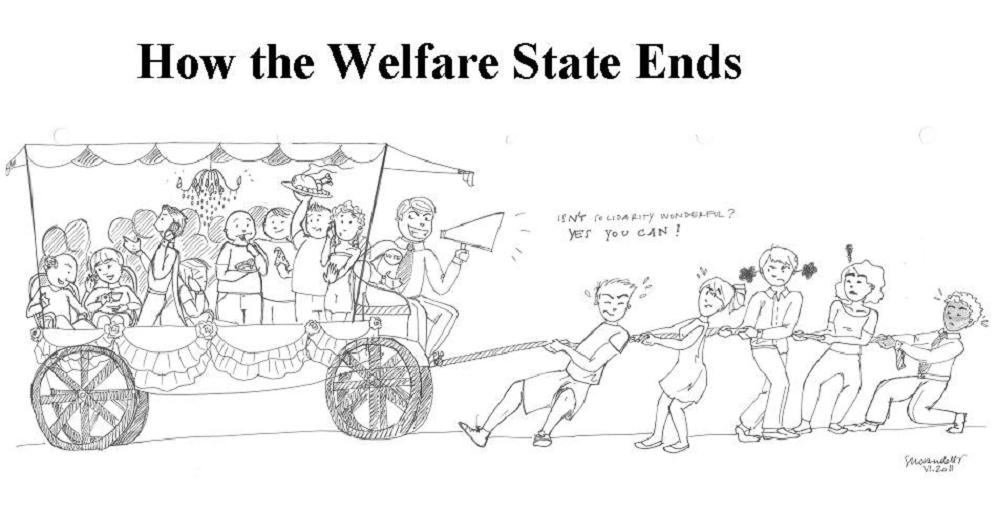
In my speeches, especially when talking about the fiscal crisis in Europe (or the future fiscal crisis in America), I often warn that the welfare state reaches a point-of-no-return when the number of people riding in the wagon begins to outnumber the number of people pulling the wagon.

To be more specific, if more than 50 percent of the population is dependent on government (employed in the bureaucracy, living off welfare, receiving pensions, etc), it becomes rather difficult to form a coalition to fix the mess. This may explain why Greek politicians have resisted significant reforms, even though the nation faces a fiscal death spiral.

But you don’t need me to explain this relationship. One of our Cato interns, Silvia Morandotti, used her artistic skills to create two images (click pictures for better resolution) that show what a welfare state looks like when it first begins and what it eventually becomes.

These images are remarkably accurate. The welfare state starts with small programs targeted at a handful of genuinely needy people. But as  politicians figure out the electoral benefits of expanding programs and people figure out the that they can let others work on their behalf, the ratio of producers to consumers begins to worsen.

Eventually, even though the moochers and looters should realize that it is not in their interest to over-burden the people pulling the wagon, the entire system breaks down.

Then things get really interesting. Small nations such as Greece can rely on permanent bailouts from bigger countries and the IMF, but sooner or later, as larger nations begin to go bankrupt, that approach won’t be feasible.

I often conclude my speeches by joking with the audience that it’s time to stock up on canned goods, bottled water, and ammo. Many people, I’m finding, don’t think that line very funny.

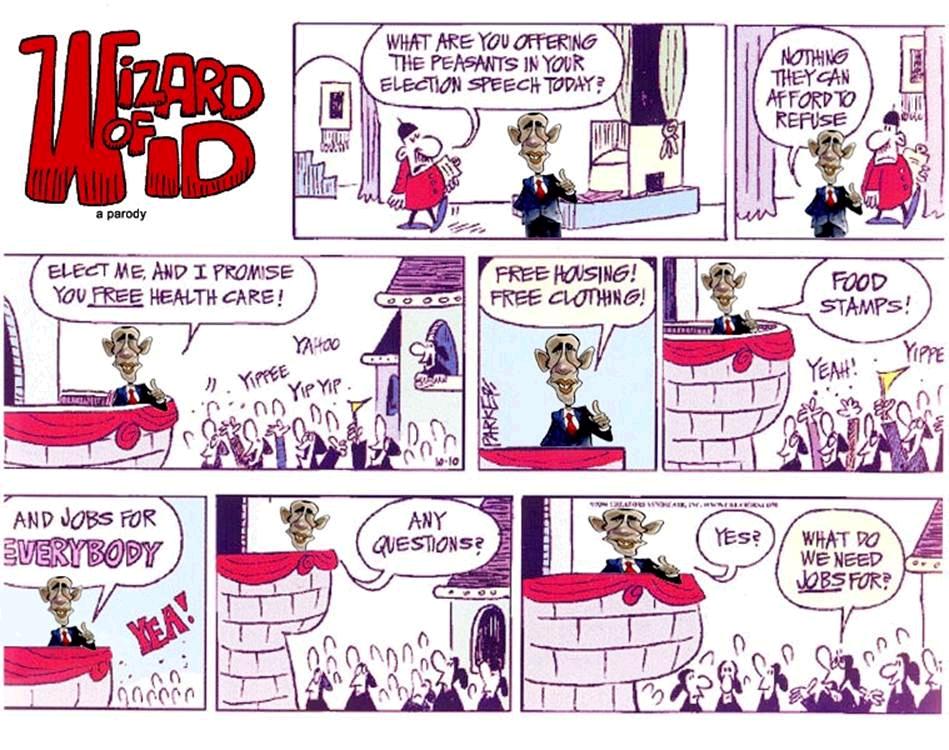
If you spend too much then people won’t want to work anymore.

Economists often do a crummy job of teaching people about the impact of fiscal policy on the labor force, largely because we put people to sleep with boring discussions about “labor supply” decisions (my blog post from last year perhaps being an example of this tendency).

From now on, I will try to remember to use this cartoon. It’s a parody of Obama’s policies, but the last slide (or is it a panel?) is a great teaching tool about what happens when politicians turn the safety net into a hammock.

_________

Bipartisan cliff cartoon

Related posts:

Tell the 48 million food stamps users to eat more broccoli!!!!

Welfare Can And Must Be Reformed             Uploaded on Jun 29, 2010 If America does not get welfare reform under control, it will bankrupt America. But the Heritage Foundation’s Robert Rector has a five-step plan to reform welfare while protecting our most vulnerable. __________________________ We got to slow down the growth of Food Stamps. One […]

Republicans for more food stamps?

Eight Reasons Why Big Government Hurts Economic Growth __________________ We got to cut spending and we must first start with food stamp program and we need some Senators that are willing to make the tough cuts. Food Stamp Republicans Posted by Chris Edwards Newt Gingrich had fun calling President Obama the “food stamp president,” but […]

Obama promotes food stamps but Milton Friedman had a better suggestion

Milton Friedman’s negative income tax explained by Friedman in 1968: We need to cut back on the Food Stamp program and not try to increase it. What really upsets me is that when the government gets involved in welfare there is a welfare trap created for those who become dependent on the program. Once they […]

400% increase in food stamps since 2000

Welfare Can And Must Be Reformed Uploaded by HeritageFoundation on Jun 29, 2010 If America does not get welfare reform under control, it will bankrupt America. But the Heritage Foundation’s Robert Rector has a five-step plan to reform welfare while protecting our most vulnerable. __________________________ If welfare increases as much as it has in the […]

Which states are the leaders in food stamp consumption?

I am glad that my state of Arkansas is not the leader in food stamps!!! Mirror, Mirror, on the Wall, Which State Has the Highest Food Stamp Usage of All? March 19, 2013 by Dan Mitchell The food stamp program seems to be a breeding ground of waste, fraud, and abuse. Some of the horror stories […]

Why not cancel the foodstamp program and let the churches step in?

Government Must Cut Spending Uploaded by HeritageFoundation on Dec 2, 2010 The government can cut roughly $343 billion from the federal budget and they can do so immediately. __________ We are becoming a country filled with people that dependent on the federal government when we should be growing our economy by lowering taxes and putting […]

Food Stamp Program is constantly ripped off and should be discontinued

Uploaded by oversightandreform on Mar 6, 2012 Learn More at http://oversight.house.gov The Oversight Committee is examining reports of food stamp merchants previously disqualified who continue to defraud the program. According to a Scripps Howard News Service report, food stamp fraud costs taxpayers hundreds of millions every year. Watch the Oversight hearing live tomorrow at 930 […]

Why are despicable people sometimes subsidized by taxpayers?

  Why are despicable people sometimes subsidized by taxpayers? Are You Happy that Your Tax Dollars Subsidized the Tsarnaev Family? April 28, 2013 by Dan Mitchell The bad news is that there are despicable and evil people seeking to kill innocents. The worse news is that some of these pathetic excuses for protoplasm are subsidized by […]

We got to stop encouraging people to stay on welfare

  We got to stop encouraging people to stay on welfare. How the Welfare State Erodes Social Capital, as Illustrated by a Chuck Asay Cartoon April 26, 2013 by Dan Mitchell I’m a big fan of Chuck Asay’s political cartoons. My favorite is his nothing-left-to-steal masterpiece. And his tractor cartoon and his regime-uncertainty cartoon are brilliant indictments […]

Moocher’s Hall of Fame is a hall of shame

  The Dangers of Government Dependency   Published on Jun 10, 2012 This video from the Center for Freedom and Prosperity Foundation contrasts the dependency mentality in the President’s “Life of Julia” campaign with the traditional American approach of self reliance and individual achievement. _____________________ Moocher’s Hall of Fame is a hall of shame. The Moocher […]

Francis Schaeffer’s wife Edith passes away on Easter weekend 2013 Part 10 (includes pro-life editorial cartoon and article from World Magazine)

The Francis and Edith Schaeffer Story Pt.1 – Today’s Christian Videos

The Francis and Edith Schaeffer Story – Part 3 of 3

Francis Schaeffer: “Whatever Happened to the Human Race” (Episode 1) ABORTION OF THE HUMAN RACE

Published on Oct 6, 2012 by

________________

Picture of Francis Schaeffer and his wife Edith from the 1930′s above. I was sad to read about Edith passing away on Easter weekend in 2013. I wanted to pass along this fine article below.

Edith Schaeffer, 1914-2013

Obituary | The widow of Francis Schaeffer and co-founder of L’Abri Fellowship is remembered for her humanity, humility, and hospitality

Edith and Francis SchaefferEnlarge Image

Photo by Sylvester Jacobs/Schaeffer Institute at Covenant Seminary
Edith and Francis Schaeffer

Edith Schaeffer, co-founder of L’Abri Fellowship, author of 17 books, and widow of pastor/author Francis Schaeffer, died today at age 98.

She was born Nov. 3, 1914, to missionary parents in Wenzhou, China, and met her husband-to-be at the First Presbyterian Church in Germantown, Pa., on June 26, 1932, where a Unitarian was explaining his reasons for denying the Bible’s teachings about God and about Christ’s deity. Even as Edith planned to stand up and argue her position, Francis stood up and began arguing his. Then Edith stood and spoke.

She wore a wreath of white flowers in her hair on July 6, 1935, leaving school a year early to marry the lean, clean-shaven, and determined “Fran.” Her hospitality complemented Francis’ anguish for the lost. The Schaeffers—then with three daughters, Priscilla, Deborah, and Susan—moved to Switzerland as missionaries in 1948. There the Schaeffers had a son, Frank.

Among Edith Schaeffer’s greatest contributions to the world: her humanity, artistic nature, humility, and hospitality. Sometimes Sunday lunch boasted as many as 36 guests, but she always made more food than she expected to need. She made rolls by hand, forming them individually, sometimes into the shapes of snails, topping them with different kinds of seeds, and turning the leftover dough into cinnamon rolls. She would sometimes stop in the process of roll making to take a phone call, then pray for the caller. “You keep making the rolls,” she’d say to her assistant Mary Jane Grooms. “I’ll pray.”

As introductions commenced at the 36-person Sunday lunch, Edith’s assistant Mike Sugimoto was astonished by her personal interest in every person in the room. He also expressed awe over Edith’s ability to connect with the cultural traditions of the people of Italy and France, her devoted praying (oral and written), and the notes she wrote all over her Bible.

Since L’Abri was never flush with money, its meals contained little meat, but Edith kept an extensive vegetable garden, and guests dined on what Grooms remembered as “wonderful, healthy food.” For Edith, Grooms said, hospitality meant a real love for strangers, and having time for them when she didn’t have time for them: “‘Sit at our dinner table, have a meal with us, sleep in our beds, under our roof.’ It’s a very costly thing to do with your life and family.”

Grooms described Edith as a homemaking artist with more energy than most human beings: Her credo and biggest lesson to the world was to do the Lord’s work in the Lord’s way in the Lord’s strength, not your own. Edith sometimes lectured on “The Art of Living and the Courage to Be Creative,” laughing a grainy laugh while exhorting her audience to do small artistic kindnesses: draw a banana beside “banana” on the grocery list, read aloud and try a Yiddish accent, or mimic the Queen of England. Or, even, think ahead to start the coffee.

Edith Schaeffer’s books include L’Abri, Christianity Is Jewish, and What Is a Family?

It is a fact that President Obama has done everything in his power to advance abortion rights as this editorial cartoon shows.

(Francis did a great job in his film series “How Should we then live?” in looking at how humanism has affected art and culture in the Western World in the last 2000 years. My favorite episodes include his study of the Renaissance, the Revolutionary age, the age of Nonreason, and the age of Fragmentation.)

Related posts:

Francis Schaeffer’s “How should we then live?” Video and outline of episode 10 “Final Choices” (Schaeffer Sundays)

E P I S O D E 1 0   Dr. Francis Schaeffer – Episode X – Final Choices 27 min FINAL CHOICES I. Authoritarianism the Only Humanistic Social Option One man or an elite giving authoritative arbitrary absolutes. A. Society is sole absolute in absence of other absolutes. B. But society has to be […]

Francis Schaeffer’s “How should we then live?” Video and outline of episode 9 “The Age of Personal Peace and Affluence” (Schaeffer Sundays)

E P I S O D E 9 Dr. Francis Schaeffer – Episode IX – The Age of Personal Peace and Affluence 27 min T h e Age of Personal Peace and Afflunce I. By the Early 1960s People Were Bombarded From Every Side by Modern Man’s Humanistic Thought II. Modern Form of Humanistic Thought Leads […]

Francis Schaeffer’s “How should we then live?” Video and outline of episode 8 “The Age of Fragmentation” (Schaeffer Sundays)

E P I S O D E 8 Dr. Francis Schaeffer – Episode VIII – The Age of Fragmentation 27 min I saw this film series in 1979 and it had a major impact on me. T h e Age of FRAGMENTATION I. Art As a Vehicle Of Modern Thought A. Impressionism (Monet, Renoir, Pissarro, Sisley, […]

Francis Schaeffer’s “How should we then live?” Video and outline of episode 7 “The Age of Non-Reason” (Schaeffer Sundays)

E P I S O D E 7 Dr. Francis Schaeffer – Episode VII – The Age of Non Reason I am thrilled to get this film series with you. I saw it first in 1979 and it had such a big impact on me. Today’s episode is where we see modern humanist man act […]

Francis Schaeffer’s “How should we then live?” Video and outline of episode 6 “The Scientific Age” (Schaeffer Sundays)

E P I S O D E 6 How Should We Then Live 6#1 Uploaded by NoMirrorHDDHrorriMoN on Oct 3, 2011 How Should We Then Live? Episode 6 of 12 ________ I am sharing with you a film series that I saw in 1979. In this film Francis Schaeffer asserted that was a shift in […]

Francis Schaeffer’s “How should we then live?” Video and outline of episode 5 “The Revolutionary Age” (Schaeffer Sundays)

E P I S O D E 5 How Should We Then Live? Episode 5: The Revolutionary Age I was impacted by this film series by Francis Schaeffer back in the 1970′s and I wanted to share it with you. Francis Schaeffer noted, “Reformation Did Not Bring Perfection. But gradually on basis of biblical teaching there […]

Francis Schaeffer’s “How should we then live?” Video and outline of episode 4 “The Reformation” (Schaeffer Sundays)

Dr. Francis Schaeffer – Episode IV – The Reformation 27 min I was impacted by this film series by Francis Schaeffer back in the 1970′s and I wanted to share it with you. Schaeffer makes three key points concerning the Reformation: “1. Erasmian Christian humanism rejected by Farel. 2. Bible gives needed answers not only as to […]

“Schaeffer Sundays” Francis Schaeffer’s “How should we then live?” Video and outline of episode 3 “The Renaissance”

Francis Schaeffer’s “How should we then live?” Video and outline of episode 3 “The Renaissance” Francis Schaeffer: “How Should We Then Live?” (Episode 3) THE RENAISSANCE I was impacted by this film series by Francis Schaeffer back in the 1970′s and I wanted to share it with you. Schaeffer really shows why we have so […]

Francis Schaeffer’s “How should we then live?” Video and outline of episode 2 “The Middle Ages” (Schaeffer Sundays)

  Francis Schaeffer: “How Should We Then Live?” (Episode 2) THE MIDDLE AGES I was impacted by this film series by Francis Schaeffer back in the 1970′s and I wanted to share it with you. Schaeffer points out that during this time period unfortunately we have the “Church’s deviation from early church’s teaching in regard […]

Francis Schaeffer’s “How should we then live?” Video and outline of episode 1 “The Roman Age” (Schaeffer Sundays)

Francis Schaeffer: “How Should We Then Live?” (Episode 1) THE ROMAN AGE   Today I am starting a series that really had a big impact on my life back in the 1970′s when I first saw it. There are ten parts and today is the first. Francis Schaeffer takes a look at Rome and why […]

A suggestion to cut some wasteful spending out of the government Part 5 (includes editorial cartoon)

Does Government Have a Revenue or Spending Problem?

People say the government has a debt problem. Debt is caused by deficits, which is the difference between what the government collects in tax revenue and the amount of government spending. Every time the government runs a deficit, the government debt increases. So what’s to blame: too much spending, or too little tax revenue? Economics professor Antony Davies examines the data and concludes that the root cause of the debt is too much government spending.

_______________

Will Rogers has a great quote that I love. He noted, “Lord, the money we do spend on Government and it’s not one bit better than the government we got for one-third the money twenty years ago”(Paula McSpadden Love, The Will Rogers Book, (1972) p. 20.)

We got to cut wasteful spending out of the government and here is another fine suggestion from the Heritage Foundation.

Todd Thurman

March 12, 2013 at 5:40 pm

Newscom

The massive spending bill, or continuing resolution, released by the Senate this week continues spending on programs which are inappropriate or wasteful and fails to adopt good policies in many areas. Here’s a rundown of some of the worst offenders in the Senate bill:

Supplemental Nutrition Assistance Program (SNAP): $77.2 billion. The recommendation continues record-high food stamp benefits. Food stamp spending has approximately doubled since President Obama came to office. It is one of the largest and fastest growing federal welfare programs. The federal government operates 80 federal welfare programs at a cost of nearly $1 trillion a year. Over 10 of these provide food assistance.

Food stamp spending should be rolled back to pre-recession levels. Able-bodied adults without dependents who receive food stamp benefits should be required to work or prepare for work as a condition of receiving benefits.

—Rachel Sheffield, Research Associate

Job Corps: $30 million added to the funding level already provided under sequestration. This program should be terminated, because a scientifically rigorous impact evaluation of Job Corps participants were less likely to obtain high school degrees, were no more likely to attend or complete college, and earned only $0.22 more in hourly wages than non-participants. Further, the Department of Labor Office of Inspector General estimates each Job Corps participant who is successfully placed into any job costs taxpayers $76,574.

Violence Against Women Act (VAWA) grants: $416.5 million. VAWA grants should be terminated, because these services should be funded locally. Using federal agencies to fund the routine operations of domestic violence programs that state and local governments could provide is a misuse of federal resources and a distraction from concerns that are truly the province of the federal government.

Office of Justice Programs (OJP) grants: $1.1 billion. OJP grants should be terminated, because these grants assign functions to the federal government that fall within the expertise, jurisdiction, and constitutional responsibilities of state and local governments. Further, the Edward Byrne Memorial Justice Assistance Grants ($392 million) within OJP have been used to place criminals on the street without posting bail.

Office of Juvenile Justice and Delinquency Prevention (OJJDP): $279.5 million. OJJDP grants should be terminated, because these grants fund juvenile justice and prevention programs that fall under the unique responsibilities of state and local governments. Further, there is little evidence that these grants are effective at preventing delinquency.

Community Oriented Policing Services (COPS): $225.5 million. COPS grants should be terminated, because these grants assign functions to the federal government that fall within the expertise, jurisdiction, and constitutional responsibilities of state and local governments. Further COPS grants were used to supplant local funds and had little to no effect on reducing crime.

FEMA Fire Grants: $675 million. Fire grants should be terminated. Fire grants, which subsidize the routine operations of local fire departments, are ineffective at reducing fire-related deaths and injuries of firefighters and civilians. Fire grants incorrectly encourage local fire departments to become increasingly dependent on federal funding.

David B. Muhlhausen, Ph.D., Research Fellow in Empirical Policy Analysis

In my speeches, especially when talking about the fiscal crisis in Europe (or the future fiscal crisis in America), I often warn that the welfare state reaches a point-of-no-return when the number of people riding in the wagon begins to outnumber the number of people pulling the wagon.

To be more specific, if more than 50 percent of the population is dependent on government (employed in the bureaucracy, living off welfare, receiving pensions, etc), it becomes rather difficult to form a coalition to fix the mess. This may explain why Greek politicians have resisted significant reforms, even though the nation faces a fiscal death spiral.

But you don’t need me to explain this relationship. One of our Cato interns, Silvia Morandotti, used her artistic skills to create two images (click pictures for better resolution) that show what a welfare state looks like when it first begins and what it eventually becomes.

These images are remarkably accurate. The welfare state starts with small programs targeted at a handful of genuinely needy people. But as  politicians figure out the electoral benefits of expanding programs and people figure out the that they can let others work on their behalf, the ratio of producers to consumers begins to worsen.

Eventually, even though the moochers and looters should realize that it is not in their interest to over-burden the people pulling the wagon, the entire system breaks down.

Then things get really interesting. Small nations such as Greece can rely on permanent bailouts from bigger countries and the IMF, but sooner or later, as larger nations begin to go bankrupt, that approach won’t be feasible.

I often conclude my speeches by joking with the audience that it’s time to stock up on canned goods, bottled water, and ammo. Many people, I’m finding, don’t think that line very funny.

If you spend too much then people won’t want to work anymore.

Guest Blog (Bruce Little): An Encounter with Francis Schaeffer

Guest Blog (Bruce Little): An Encounter with Francis Schaeffer

Episode 8: The Age Of Fragmentation

Published on Jul 24, 2012

Dr. Schaeffer’s sweeping epic on the rise and decline of Western thought and Culture

_______________________

I love the works of Francis Schaeffer and I have been on the internet reading several blogs that talk about Schaeffer’s work by Bruce Little and the work below was really helpful. Schaeffer’s film series “How should we then live?  Wikipedia notes, “According to Schaeffer, How Should We Then Live traces Western history from Ancient Rome until the time of writing (1976) along three lines: the philosophic, scientific, and religious.[3] He also makes extensive references to art and architecture as a means of showing how these movements reflected changing patterns of thought through time. Schaeffer’s central premise is: when we base society on the Bible, on the infinite-personal God who is there and has spoken,[4] this provides an absolute by which we can conduct our lives and by which we can judge society.  Here are some posts I have done on this series: Francis Schaeffer’s “How should we then live?” Video and outline of episode 10 “Final Choices” episode 9 “The Age of Personal Peace and Affluence”episode 8 “The Age of Fragmentation”episode 7 “The Age of Non-Reason” episode 6 “The Scientific Age”  episode 5 “The Revolutionary Age” episode 4 “The Reformation” episode 3 “The Renaissance”episode 2 “The Middle Ages,”, and  episode 1 “The Roman Age,” .

In the film series “WHATEVER HAPPENED TO THE HUMAN RACE?” the arguments are presented  against abortion (Episode 1),  infanticide (Episode 2),   euthanasia (Episode 3), and then there is a discussion of the Christian versus Humanist worldview concerning the issue of “the basis for human dignity” in Episode 4 and then in the last episode a close look at the truth claims of the Bible.

Guest Blog (Bruce Little): An Encounter with Francis Schaeffer

October 20, 2010 by Between the Times

A Personal Encounter with Francis Schaeffer

I remember hearing Francis A. Schaeffer (1912-1984) in person, several weeks before his death, at a large gathering on the campus of a Christian University. Schaeffer was of particular importance to me. At the time, in April 1984, I was attending a graduate seminar on Schaeffer so it was perfect timing. Just a few years before, I had first felt the force of Schaeffer’s thought through reading his books, and now I was having the opportunity to hear him in person as he was on a speaking tour promoting his latest book, The Great Evangelical Disaster. I have vivid memories of that night. I watched as he was helped to the platform and then remained seated even while he spoke. By this time cancer had so weakened him physically that standing was out of the question. In fact, at that time I was told that his diet consisted mainly of milkshakes.

After Schaeffer delivered his lecture, the audience was invited to ask questions. I remember one young man who began his question by reviewing some of what Schaeffer had just noted (and as many young men tend to do, he tried to impress the crowd with his knowledge, struggling to put his mini-speech into the form of a question). And alas, after the young man launched a rather dramatic presentation of his insights, he concluded by picturing the Church in the tenth round, bloody and beaten and on its knees. Then, at last, he asked his question. He wondered if there was any hope the Church could win given his analysis of the situation.

Dr. Schaeffer leaned forward and brought the microphone to his lips. A hush came over the audience as it awaited the response. Then Schaeffer said, “If we do it to win, we have lost already. We do not do it to win, but because our risen Lord has commanded us.” What an answer! I have told this story so many times I embarrass myself, but the power of that response moves me each time I think of it. In fact, I often have been encouraged as well as challenged by those words. And for this, I am forever grateful for that night I heard Dr. Schaeffer. That was 26 years ago, not so long when you think about it, but it has been long enough for the name of Francis Schaeffer to fade from the evangelical memory. My hope is that Francis Schaeffer’s life and ministry will not fade from memory, but will instead remain present to our minds as a model of faithful witness. Perhaps this blogpost will be the catalyst for some of our readers to read Schaeffer’s works and benefit from them.

A Brief Biography of Francis Schaeffer

Schaeffer spent most of his adult life in Europe with his wife Edith and their four children (three girls and one boy). Francis and Edith went to Switzerland shortly after World War II. I once asked his daughter, Deborah, why her dad chose Switzerland. She explained that many people in those days in Europe thought there would be another war and her dad wanted the family to be safe in the event such a concern materialized. For this reason, they chose a remote village in the Swiss Alps where they founded L’Abri Fellowship (only after they were told to leave one little community because Schaeffer was having a religious influence on their predominantly Roman Catholic populace). The story of the L’Abri (the word means Shelter) ministry can be found in Edith Schaeffer’s wonderful book, The Tapestry.

Over the years, hundreds and perhaps thousands of people journeyed to L’Abri (for stays that ranged from days to months) where some found Christ as Savior and others were strengthened in their faith. This was especially true in the 60s and 70s; those of us who lived through those times remember the political and social upheaval as students on both sides of the Atlantic went full throttle into a rebellious mode. Many evangelicals merely condemned the senseless destruction-of course, in one sense it needed to be condemned-while ignoring the questions raised by the rebels. Schaeffer, on the other hand, listened carefully to their questions and helped them to see how historic Christianity answered those questions coherently and consistently. Many of us remember those days and not without some residual anxiety. Many evangelicals responded by entrenching, but Schaeffer chose to engage the young people and the intellectuals (many were existentialist) on their own terms. He showed them that their explanation of the world was inconsistent with and insufficient for the world in which they lived., and that Christianity answered those questions consistently and sufficiently.

Consequently, Schaeffer eventually earned the reputation of having a mission to the European intellectual. In 1960, Time magazine suggested that the mission of Schaeffer was to target the European intellectual. The truth is that the Schaeffers had been sent to war-torn Europe in 1948 by the Presbyterian mission board to work among children, many who had been orphaned by the war. That often comes as a surprise to those not well acquainted with Schaeffer, because by the time he was well-known, it was not for children’s work, but work among young people and intellectuals. Furthermore, Schaeffer became known as an apologist (Some evangelicals loved him but others were suspicious of him, mainly because of the way he dressed!). He defended the faith in a way that challenged traditional categories. For this reason, he is difficult to label. Although some commentators claim that he was a presuppositionalist, Schaeffer tells us that he had no one method apologetically.

A Basic Overview of Schaeffer’s Apologetic

In order to understand Schaeffer’s approach to evangelism and apologetics, one must give attention to the three works that reveal the foundation of his understanding of man, reality, and the Bible. These three books serve as the foundation for all his other books, forming a trilogy: The God Who Is There, Escape from Reason, and He Is There and He Is Not Silent. According to Schaeffer all his other books fit into these as “spokes of the wheel into the hub.” In 1982, Schaeffer himself edited his works, which were published in a five-volume set, including the trilogy in the order in which they were written. This order reveals the development of his thinking apologetically and is essential to understanding Schaeffer and his apologetic method.

In these three books, one learns how Schaeffer’s view of man shaped his apologetic approach (which for him was part and parcel of his evangelism). According to Schaeffer, historic Christianity is creation-centered. Furthermore, central to creation is the truth that God created man in his image. The first apologetic implication of this truth is that man has intrinsic worth which means he is to be treated with respect and love. This truth shaped Schaeffer’s life and ministry as he was motivated and directed by love and compassion for man as a person. Apologetics, he urged, must be “shaped on the basis of love for the person as a person.”

While Schaeffer did not minimize the historic fall recorded in Genesis, he argued that the fall “did not lead to machineness, but to fallen-manness.” There was a greatness to man even though man could also be very cruel. Schaeffer spoke of man being noble, not because of man’s achievements, but because of who he was as a creation of God-man was not a “zero,” to use Schaeffer’s words. Only Christianity, Schaeffer said, could explain both the greatness and the cruelty of man. This truth moved Schaeffer to take all men seriously and to answer the honest questions of fallen man. Furthermore, he argued that the Christian must take care to understand the person by looking carefully at cultural artifacts (especially the arts) to understand the underlying worldviews and presuppositions revealed in them.

According to Schaeffer, the second apologetic implication of creation was the intelligibility of creation. The categories of the mind of man correspond to the structure of the world as God had created both. The result, Schaeffer argued, was that common ground existed between the Christian and the non-Christian. This is not something man put upon the universe; it is simply the way it is. Man lives in a morally structured, rational universe and no matter how he might try to live against the way the universe is, Schaeffer was sure it would push back at him and create tension for his non-Christian presuppositions.

The Christian’s apologetic task, according to Schaeffer, is to show man where the point of tension existed between his presuppositions and the way the world really is. Schaffer’s approach was to push man towards the logic of his position in the area of his own real interests. Schaeffer believed that man builds a sort of philosophical shelter to protect himself from the blows of the real world. The Christian must lovingly remove the shelter and allow man to feel the blows from the real world, both internally and externally.

Of course this was not a game for Schaeffer and he urged the Christian always to give the answer as understood in light of historic Christianity and to do so in a loving and compassionate tone. He was convinced that when speaking to the non-Christian the first truth to present was that of the truth of the real world and the reality of man himself. For Schaeffer, the real point of contact with the modern (and post modern mind) was reality. Regardless what presuppositions a man claims as grounds for his worldview, Schaeffer showed how they can be tested for truthfulness when pressed against the reality in which every person must live.

Schaeffer’s life, ministry, and writings are instructive for evangelicals today. One more than one level, he remains an important apologetic resource for Christians in the 21st century. For this reason, the L. Russ Bush Center at Southeastern Baptist Theological Seminary houses the Francis A. Schaeffer Archives. The Schaeffer Archives includes a voluminous collection of unpublished papers, source materials, correspondence, and recorded discussions of Schaeffer, thanks to the generosity of the Francis A. Schaeffer Foundation.

[Editor’s note: For further reading about the Schaeffer archives, see the articles at the L. Russ Bush Center for Faith and Culture (SEBTS) and the Evangelical Philosophical Society.]

Francis Schaeffer

__________________________

Related posts:

Taking on Ark Times Bloggers on various issues Part A “The Pro-life Issue” (Francis Schaeffer Quotes Part 1 includes the film SLAUGHTER OF THE INNOCENTS) (editorial cartoon)

I have gone back and forth and back and forth with many liberals on the Arkansas Times Blog on many issues such as abortion, human rights, welfare, poverty, gun control  and issues dealing with popular culture. Here is another exchange I had with them a while back. My username at the Ark Times Blog is Saline […]

“Schaeffer Sunday” Francis Schaeffer: “Whatever Happened to the Human Race” (Episode 1) ABORTION OF THE HUMAN RACE

It is not possible to know where the pro-life evangelicals are coming from unless you look at the work of the person who inspired them the most. That person was Francis Schaeffer.  I do care about economic issues but the pro-life issue is the most important to me. Several years ago Adrian Rogers (past president of […]

The movie “Les Miserables” and Francis Schaeffer

I got this off a Christian blog spot. This person makes some good points and quotes my favorite Christian philosopher Francis Schaeffer too. Prostitution, Chaos, and Christian Art The newest theatrical release of Victor Hugo’s 1862 novel “Les Miserables” was released on Christmas, but many Christians are refusing to see the movie. The reason simple — […]

“Schaeffer Sunday” Francis Schaeffer is one of the great evangelical theologians of our modern day

Francis Schaeffer was truly a great man and I enjoyed reading his books. A theologian #2: Rev. Francis Schaeffer Duriez, Colin. Francis Schaeffer: An Authentic Life. Wheaton, IL: Crossway Books, 2008. Pp. 240. Francis Schaeffer is one of the great evangelical theologians of our modern day. I was already familiar with some of his books and his […]

“Schaeffer Sundays” Francis Schaeffer’s own words concerning infanticide and youth enthansia

Francis Schaeffer: “Whatever Happened to the Human Race?” (Episode 2) SLAUGHTER OF THE INNOCENTS Published on Oct 6, 2012 by AdamMetropolis ___________ The 45 minute video above is from the film series created from Francis Schaeffer’s book “Whatever Happened to the Human Race?” with Dr. C. Everett Koop. This book  really helped develop my political views […]

Francis Schaeffer’s wife Edith passes away on Easter weekend 2013 Part 7 (includes pro-life editorial cartoon)

The Francis and Edith Schaeffer Story Pt.1 – Today’s Christian Videos The Francis and Edith Schaeffer Story – Part 3 of 3 Francis Schaeffer: “Whatever Happened to the Human Race” (Episode 1) ABORTION OF THE HUMAN RACE Published on Oct 6, 2012 by AdamMetropolis ________________ Picture of Francis Schaeffer and his wife Edith from the […]

The Mark of the Christian by Francis Schaeffer Part 1

  THE MARK OF A CHRISTIAN – CLASS 1 – Introduction Published on Mar 7, 2012 This is the introductory class on “The Mark Of A Christian” by Francis Schaeffer. The class was originally taught at Redeemer Presbyterian Church in Overland Park, KS by Dan Guinn from FrancisSchaefferStudies.org as part of the adult Sunday School hour […]

“Schaeffer Sundays” Francis Schaeffer’s own words concerning humanist dominated public schools in USA even though country was founded on a Christian base

Francis Schaeffer: “Whatever Happened to the Human Race?” (Episode 2) SLAUGHTER OF THE INNOCENTS Published on Oct 6, 2012 by AdamMetropolis The 45 minute video above is from the film series created from Francis Schaeffer’s book “Whatever Happened to the Human Race?” with Dr. C. Everett Koop. This book  really helped develop my political views concerning […]

“Schaeffer Sundays” Francis Schaeffer’s own words concerning where the Bible-believing Christians been the last few decades

Francis Schaeffer: “Whatever Happened to the Human Race” (Episode 1) ABORTION OF THE HUMAN RACE Published on Oct 6, 2012 by AdamMetropolis The 45 minute video above is from the film series created from Francis Schaeffer’s book “Whatever Happened to the Human Race?” with Dr. C. Everett Koop. This book  really helped develop my political views […]

Taking on Ark Times Bloggers on various issues Part E “Moral absolutes and abortion” Francis Schaeffer Quotes part 5(includes the film SLAUGHTER OF THE INNOCENTS) (editorial cartoon)

I have gone back and forth and back and forth with many liberals on the Arkansas Times Blog on many issues such as abortion, human rights, welfare, poverty, gun control  and issues dealing with popular culture. Here is another exchange I had with them a while back. My username at the Ark Times Blog is Saline […]

“Schaeffer Sundays” Francis Schaeffer’s own words concerning religious liberals and humanists

Francis Schaeffer: “Whatever Happened to the Human Race” (Episode 5) TRUTH AND HISTORY Published on Oct 7, 2012 by AdamMetropolis The 45 minute video above is from the film series created from Francis Schaeffer’s book “Whatever Happened to the Human Race?” with Dr. C. Everett Koop. This book  really helped develop my political views concerning abortion, […]

By Everette Hatcher III | Posted in Francis Schaeffer | Edit | Comments (0)