Monthly Archives: January 2013

Francis Schaeffer’s “How should we then live?” Video and outline of episode 7 “The Age of Non-Reason” (Schaeffer Sundays)

E P I S O D E 7

How Should We then Live Episode 7 small (Age of Nonreason)

#02 How Should We Then Live? (Promo Clip) Dr. Francis Schaeffer

10 Worldview and Truth

Two Minute Warning: How Then Should We Live?: Francis Schaeffer at 100

Francis Schaeffer Whatever Happened to the Human Race (Episode 1) ABORTION

Francis Schaeffer “BASIS FOR HUMAN DIGNITY” Whatever…HTTHR

I am thrilled to get this film series with you. I saw it first in 1979 and it had such a big impact on me. Today’s episode is where we see modern humanist man act on his belief that we live in a closed system that was produced by chance with no God. Therefore, man’s only alternative is to look to chance and nonreason for our search for meaning in life and for moral guidance. Schaeffer rightly points out “With what Christ and the Bible teach, Man can have life instead of death—in having knowledge that is more than finite Man can have from himself.”

T h e AGE OF NON-REASON

I. Optimism Of Older Humanist Philosophers:

The unity and true knowledge of reality defined as starting from Man alone.

II. Shift in Modern Philosophy

A. Eighteenth century as the vital watershed.

B. Rousseau: ideas and influence.

1. Rousseau and autonomous freedom.

2. Personal freedom and social necessity clash in Rousseau.

3. Rousseau’s influence.

a) Robespierre and the ideology of the Terror.

b) Gauguin, natural freedom, and disillusionment.

C. DeSade: If nature is the absolute, cruelty equals non-cruelty.

D. Impossible tension between autonomous freedom and autonomous reasons conclusion that the universe and people are a part of the total cosmic machine.

E. Kant, Hegel, and Kierkegaard and their followers sought for a unity but they did not solve the problem.

1. After these men and their followers, there came an absolute break between the area of meaning and values, and the area of reason.

2. Now humanistic philosophy sees reason as always leading to pessimism; any hope of optimism lies in non-reason.

III. Existentialism and Non-Reason

A. French existentialism.

1. Total separation of reason and will: Sartre.

2. Not possible to live consistently with this position.

B. German existentialism.

1. Jaspers and the “final experience.”

2. Heidegger and angst.

C. Influence of existentialism.

1. As a formal philosophy it is declining.

2. As a generalized attitude it dominates modern thought.

IV. Forms of Popularization of Nonrational Experience

A. Drug experience.

1. Aldous Huxley and “truth inside one’s head.”

2. Influence of rock groups in spreading the drug culture; psychedelic rock.

B. Eastern religious experience: from the drug trip to the Eastern religious trip.

C. The occult as a basis for “hope” in the area of non-reason.

V. Theological Liberalism and Existentialism

A. Preparation for theological existentialism.

1. Renaissance’s attempt to “synthesize” Greek philosophers and Christianity; religious liberals’ attempt to “synthesize” Enlightenment and Christianity.

2. Religious liberals denied supernatural but accepted reason.

3. Schweitzer’s demolition of liberal aim to separate the natural from the supernatural in the New Testament.

B. Theological existentialism.

1. Intellectual failure of rationalist theology opened door to theological existentialism.

2. Barth brought the existential methodology into theology.

a) Barth’s teaching led to theologians who said that the Bible is not true in the areas of science and history, but they nevertheless look for a religious experience from it.

b) For many adherents of this theology, the Bible does not give absolutes in regard to what is right or wrong in human behavior.

3. Theological existentialism as a cul-de-sac.

a) If Bible is divorced from its teaching concerning the cosmos and history, its values can’t be applied to a historic situation in either morals or law; theological pronouncements about morals or law are arbitrary.

b) No way to explain evil or distinguish good from evil. Therefore, these theologians are in same position as Hindu philosophers (as illustrated by Kali).

c) Tillich, prayer as reflection, and the deadness of “god.”

d) Religious words used for manipulation of society.

VI. Conclusion

With what Christ and the Bible teach, Man can have life instead of death—in having knowledge that is more than finite Man can have from himself.

Questions

1. What is the difference between theologians and philosophers of the rationalist tradition and those of the existentialist tradition?

2. “If the early church had embraced an existentialist theology, it would have been absorbed into the Roman pantheon.” It didn’t. Why not?

3. “It is true that existentialist theology is foreign to biblical religion. But biblical religion was the product of a particular culture and, though useful for societies in the same cultural stream, it is no longer suitable for an age in which an entire range of world cultures requires a common religious denominator. Religious existentialism provides that, without losing the universal instinct for the holy.” Study this statement carefully. What assumptions are betrayed by it?

4. Can you isolate attitudes and tendencies in yourself, your church, and your community which reflect the “existentialist methodology” described by Dr. Schaeffer?

Key Events and Persons

Rousseau: 1712-1778

Kant: 1724-1804

Marquis de Sade: 1740-1814

The Social Contract: 1762

Hegel: 1770-1831

Kierkegaard: 1813-1855

Paul Gauguin: 1848-1903

Whence, What Whither?: 1897-1898

Albert Schweitzer: 1875-1965

Quest for the Historical Jesus: 1906

Karl Jaspers: 1883-1969

Paul Tillich: 1886-1965

Karl Barth: 1886-1968

Martin Heidegger: 1889-1976

Aldous Huxley: 1894-1963

J.P. Sartre: 1905-1980

Beatles’ Sergeant Pepper: 1967

Further Study

Unless already familiar with them, take time to listen to the Beatles’ records, as well as to discs put out by other groups at the time.

Albert Camus, The Stranger (1942).

Aldous Huxley, The Doors of Perception (1954).

Rousseau, The Social Contract (1762).

J.P. Sartre, Nausea (1938).

Paul Tillich, The Courage to Be (1952).

Following Rousseau, the exaggeration of the delights and the pathos of nature and experience which marks Romanticism may be sampled in, for example, Wordsworth’s poems, Casper David Friedrich’s paintings, and Schubert’s songs.

J.G. Fichte, Addresses to the German Nation (1968).

J.W. von Goethe, The Sorrows of Young Werther (1962).

Erich Heller, The Disinherited Mind (1952).

Heritage Foundation Videos and Interviews are displayed on www.thedailyhatch.org

Sen. Mitch McConnell: Americans Don’t Approve of Anything Obama Has Done

Uploaded by on Dec 8, 2011

In an exclusive interview at The Heritage Foundation, Senate Minority Leader Mitch McConnell (R-KY) sharply criticized President Obama for engaging in class warfare and accused him of shifting the focus away from his own failed policies in advance of next year’s election.

“My view is he’ll have a hard time convincing Americans he deserves four more years of this,” McConnell said. “There’s nothing he’s done the American people approve of, so of course, he’s trying to change the subject.”

__________

I love these videos from the Heritage Foundation. They include great interviews and very good illustrations. Below are some links.

What is School Choice?

Uploaded by on Aug 2, 2011

School choice offers families the opportunity to select schools that meet their child’s needs. Watch the video from Heritage Foundation explaining school choice, how it benefits parents and children and why school choice is needed.

__________

HERITAGE FOUNDATION VIDEO:What is School Choice?

What is School Choice? Uploaded by HeritageFoundation on Aug 2, 2011 School choice offers families the opportunity to select schools that meet their child’s needs. Watch the video from Heritage Foundation explaining school choice, how it benefits parents and children and why school choice is needed.

HERITAGE FOUNDATION VIDEO:1,000 Days Without A Budget

1,000 Days Without A Budget Uploaded by HeritageFoundation on Jan 24, 2012 http://blog.heritage.org | Today marks the 1,000th day since the United States Senate has passed a budget. While the House has put forth (and passed) its own budget, the Senate has failed to do the same. To help illustrate how extraordinary this failure has […]

HERITAGE FOUNDATION INTERVIEW:Sen. Mitch McConnell: Americans Don’t Approve of Anything Obama Has Done

Sen. Mitch McConnell: Americans Don’t Approve of Anything Obama Has Done Uploaded by HeritageFoundation on Dec 8, 2011 In an exclusive interview at The Heritage Foundation, Senate Minority Leader Mitch McConnell (R-KY) sharply criticized President Obama for engaging in class warfare and accused him of shifting the focus away from his own failed policies in […]

HERITAGE FOUNDATION INTERVIEW:Senator Blunt Vows to Keep Pressure on President Obama Over Contraceptive Mandate

Senator Blunt Vows to Keep Pressure on President Obama Over Contraceptive Mandate Uploaded by HeritageFoundation on Feb 13, 2012 http://blog.heritage.org/2012/02/13/sen-blunt-vows-to-keep-pressure-on-obama-… | Sen. Roy Blunt (R-MO) introduced legislation to protect religious organizations from Obamacare’s overreach last summer. Now, as President Obama presses forward with his anti-conscience mandate, Blunt is prepared to keep the pressure on the […]

HERITAGE FOUNDATION INTERVIEW:Senator Lee Fights Back Against Obama’s Unconstitutional “Recess” Appointments

Senator Lee Fights Back Against Obama’s Unconstitutional “Recess” Appointments Uploaded by HeritageFoundation on Feb 13, 2012 Few lawmakers have expressed as much outrage over President Obama’s unconstitutional “recess” appointments as Sen. Mike Lee (R-UT). He was among the first to warn about the consequences of the president’s unilateral action on Jan. 4. More than a […]

HERITAGE FOUNDATION INTERVIEW:Senator John Barrasso On the Fight Against Obamacare

Senator John Barrasso On the Fight Against Obamacare Uploaded by HeritageFoundation on Mar 26, 2012 Sen. John Barrasso earned the nickname “Wyoming’s Doctor” after working for 24 years as an orthopedic surgeon in Casper. Today he represents the state in the U.S. Senate and is one of the leading critics of Obamacare. More than two […]

Historian David Barton’s videos and articles are displayed here on the www.thedailyhatch.org

David Barton on Glenn Beck – Part 3 of 5 Uploaded by ToRenewAmerica on Apr 9, 2010 Wallbuilders’ Founder and President David Barton joins Glenn Beck on the Fox News Channel for the full hour to discuss our Godly heritage and how faith was the foundational principle upon which America was built. _____________ David Barton is a historian  […]

HERITAGE FOUNDATION INTERVIEW:Rep. Paul Ryan Blames Obama for Dividing America

Rep. Paul Ryan Blames Obama for Dividing America Uploaded by HeritageFoundation on Oct 28, 2011 Rep. Paul Ryan (R-WI) is mighty disappointed with President Obama. The chairman of the House Budget Committee, who has bested Obama in head-to-head policy showdowns, blames the president for failing to outline a solution to the debt crisis while dividing […]

HERITAGE FOUNDATION VIDEO:The Role of Economic Freedom

The Role of Economic Freedom Uploaded by HeritageFoundation on Jan 6, 2012 According to the 2012 Index of Economic Freedom, a joint publication of The Heritage Foundation and The Wall Street Journal, global economic freedom has declined over the past year. But what does this mean for America and the world? Economic freedom empowers ordinary […]


How good is Arkansas doing in football recruiting in 2013?

It is truly sad that Arkansas is ranked #62 in recruiting in the 2013 football class so far. The thing that troubles me the most is that there are 4 schools in the SEC that have brought in new coaches and Arkansas is one of them. However, what upsets me most is that the other three are ranked higher than the Hogs. Auburn is ranked #20, Tennessee is ranked #29 and Kentucky is #37. I truly do understand that Tennessee is ranked ahead of Arkansas. They have always been ahead of us in recruiting it seems, but I am upset about Auburn being ahead of us for two reasons. First, we could have had Gus Malzahn as our coach. Second, we could have Tim Horton on our staff but we didn’t offer him a job and now he works for Auburn. WHAT REALLY MAKES ME MAD IS THAT KENTUCKY IS AHEAD OF US!!!!! THEY ARE A BASKETBALL SCHOOL!!!! I do think we have a great coach but he should have known that we need some former Hogs on this staff. I think he finally figured that out and hired Barry Lunny yesterday. Here is what Rivals has to say about our class at this point.

Florida 26 1 15 10 3.65 2790
#2 Notre Dame 22 3 13 6 3.86 2755
#3 Alabama 21 2 12 7 3.76 2732
#4 Ohio State 22 0 14 7 3.59 2684
#5 Michigan 26 1 15 9 3.62 2592
#6 LSU 25 0 17 8 3.68 2575
#7 USC 14 6 8 0 4.43 2496
#8 Texas A&M 34 0 15 18 3.41 2428
#9 Georgia 29 0 14 15 3.48 2235
#10 Florida State 17 0 8 8 3.41 1936
#11 Mississippi 22 1 5 16 3.32 1925
#12 Washington 21 0 8 13 3.38 1901
#13 UCLA 20 0 11 8 3.5 1886
#14 Oklahoma 20 0 6 11 3.21 1817
#15 Virginia Tech 19 1 4 14 3.32 1782
#16 Vanderbilt 21 0 2 19 3.1 1765
#17 South Carolina 19 0 5 14 3.26 1762
#18 Texas 13 1 8 4 3.77 1746
#19 Nebraska 20 0 5 12 3.1 1715
#20 Auburn 15 1 7 7 3.6 1649
#21 West Virginia 23 0 2 19 3.05 1638
#22 North Carolina 18 0 3 15 3.17 1608
#23 Oklahoma State 20 0 4 14 3.1 1580
#24 Mississippi State 22 0 3 15 2.95 1564
#25 Arizona 25 0 2 18 2.88 1556
#26 California 22 0 4 16 3.09 1541
#27 Clemson 15 0 7 7 3.4 1507
#28 Baylor 21 0 2 13 2.85 1498
#29 Tennessee 18 0 4 13 3.17 1488
#30 Pittsburgh 25 0 3 13 2.76 1485
#31 Virginia 18 1 2 13 3.18 1480
#32 Arizona State 22 0 2 16 2.95 1478
#33 Illinois 24 0 2 15 2.79 1456
#34 Utah 26 0 1 20 2.88 1425
#35 Kansas 24 0 2 19 2.96 1410
#36 Missouri 18 0 1 17 3.06 1389
#37 TCU 18 0 1 15 2.94 1380
#37 Kentucky 20 0 1 17 3 1380
#39 Rutgers 21 0 1 15 2.85 1377
#40 Maryland 19 1 3 9 2.95 1337
#41 Houston 25 0 0 17 2.68 1335
#42 Penn State 17 0 4 8 3 1326
#43 Northwestern 19 0 1 15 2.89 1320
#44 Oregon 13 1 5 5 3.38 1314
#45 Indiana 19 0 4 9 2.89 1307
#46 Washington State 23 0 1 15 2.77 1305
#46 Oregon State 21 0 1 15 2.89 1305
#48 Wisconsin 16 0 3 11 3.06 1299
#49 Michigan State 15 0 2 13 3.13 1283
#50 Kansas State 20 0 1 12 2.7 1260
#51 Iowa State 22 0 1 12 2.64 1245
#52 Stanford 12 0 4 8 3.33 1227
#53 Georgia Tech 16 0 0 15 2.94 1140
#53 Boise State 21 0 0 12 2.6 1140
#53 Wake Forest 19 0 0 13 2.68 1140
#56 Southern Methodist 25 0 0 9 2.36 1125
#57 North Carolina State 18 0 0 14 2.82 1095
#58 Miami (FL) 12 0 5 7 3.42 1093
#59 Brigham Young 26 0 1 8 2.42 1065
#59 Iowa 15 0 0 15 3 1065
#59 Louisville 13 0 3 9 3.15 1065
#62 Arkansas 13 0 1 11 3 1001


_______________

What was most tragic policy development of 2012 in USA?

Not much accomplished in the area of liberty and freedom in the USA in 2012. If the founding fathers were here today that would be horrified that their idea of limited government had been transformed into what the federal government is today.

I’m not sure I could pick out a significant victory for human freedom in 2012.

Maybe I’m missing something, but the only good policy that’s even worth mentioning was the decision in Wisconsin to rein in the special privileges and excessive compensation for government workers.

But there definitely have been lots of sad developments.

The hard part is picking the most disappointing story.

1. Was it the craven decision by John Roberts to put politics before the Constitution and cast the deciding vote for Obamacare? This certainly could be the most disappointing event of the year, but technically it didn’t represent a step in the wrong direction since the Supreme Court basically gave a green light to unlimited federal power back in the 1930s and 1940s. The Obamacare case is best characterized as a failure to do the right thing. A very tragic decision, to be sure, but it maintained the status quo.

2. Was it the lawless decision by the Internal Revenue Service to impose a horrible regulation that forces American banks to put foreign law above U.S. law? This was a very bad development in the battle for tax competition, financial privacy, and fiscal sovereignty. But in the grand scheme of things, it’s just another in a long line of policies (such as FATCA) designed to increase the power of governments to impose and enforce bad tax policy.

3. Was it the Japanese government’s decision to double the value-added tax? I’m definitely not a fan of adding a VAT on top of the income tax, but Japan made that mistake years ago. The choice to increase the tax rate just shows why it’s dangerous to give politicians any new source of revenue. So this isn’t the worst policy development of 2012, particularly since the new Japanese government may suspend the tax hike.

4. Was it the delusional decision by 54 percent of California voters to impose a big, class-warfare tax hike? I thought the vote for Prop 30 was a very troubling development since it signaled that voters could be tricked into enacting class-warfare tax policy, even though they should have realized that more revenue for the state’s politicians would simply exacerbate the eventual fiscal collapse. But since I think this will be a learning experience on what not to do, I can’t put this at the top of my list.

5. Was it the French government’s punitive decision to impose a 75-percent top tax rate? This is a spectacularly misguided policy, and it’s already resulting in an exodus of entrepreneurs and other successful people. But just as I enjoy have California as a negative role model, I like using France as an example of bad policy. So it would be a bit hypocritical for me to list this as the worst policy of 2012.

6. Or was it the envy-motivated decisions by politicians in both Slovakia and the Czech Republic to replace flat tax systems with so-called progressive tax regimes? This is a strong candidate for the worst policy of the year. It’s very rare to see governments do the right thing, so it’s really tragic when politicians implement good reforms and later decide to reinstate class-warfare policies.

All things considered, I think this last option is the worst policy development of 2012. To be sure, I’m a bit biased since my work focuses on public finance issues and I’ve spent 20 years advocating for tax reform.

But I think there’s a strong case to be made, by anyone who believes in freedom, that politicians from Slovakia and the Czech Republic deserve the booby prize for worst public policy development of 2012.

Alvin Rabushka, sometimes referred to as the Father of the Flat Tax , summarizes the grim news.

On December 4, 2013, the center-left parliament of Slovakia modified the country’s historic 19% flat-rate tax…  Effective January 1, 2013, the income tax rate for corporations was raised from 19% to 23%, while that on individuals earning more than €39,600 (€1=$1.30) a year was raised to 25%, thereby creating two brackets of 19% and 25%. …On November 7, 2012, the lower house (Chamber of Deputies) of the national parliament approved a proposal to impose a second higher rate of 22% on annual income exceeding Czech Koruna (CZK) 100,000 ($5,200) per month.  President Vaclav Klaus signed the bill on December 22, 2012, which will take effect on January 1, 2013.

What’s especially depressing about these two defeats is that the supposedly right-wing parties deserve the blame.

Two nations filled with brain-dead conservative politicians

In Slovakia, all but one of the right-leaning parties in the old government decided to support the Greek bailout, leading to the collapse of the government and the election of a new socialist government that then sabotaged tax reform.

And in the Czech Republic, the current right-of-center government decided to scrap the flat tax for “fairness” reasons. I’m sure that will really be comforting to the Czech people as the economy suffers from less growth.

To understand what the people of those nations are losing, here’s my video on the flat tax.

Now for a bit of good news. There are still more than 25 flat tax jurisdictions in the world, including two of my favorite places – Hong Kong and Estonia.

So there are still some pockets of rationality. It’s just very unfortunate that the scope of human liberty is getting smaller every year.

P.S. The absolute worst thing that happened in 2012, if we look beyond public policy, was Georgia falling 4 yards short of beating Alabama in the Southeastern Conference Championship.

P.P.S. Speaking of sports, the best thing about 2012 occurred in Virginia Beach back in October.

Open letter to President Obama (Part 222 B)

What Ever Happened to the Human Race?


President Obama c/o The White House
1600 Pennsylvania Avenue NW
Washington, DC 20500

Dear Mr. President,

I know that you receive 20,000 letters a day and that you actually read 10 of them every day. I really do respect you for trying to get a pulse on what is going on out here. I know you are not pro-life but I wanted to share some pro-life material with you regardless.

Francis Schaeffer told us that abortion was a huge issue and evangelicals paid attention to his words!!!

We really need some pro-life judges appointed soon  that will respect the sanctity of human life including that of unborn children. It is truly a holocaust now in the USA.

The Abortion Holocaust

Article ID: DA375

By: Hank Hanegraaff

The following is an excerpt from article DA375 by Hank Hanegraaff. The full article can be found by following the link below the excerpt.


For hundreds of years the Lord had warned the Israelites through His prophets. Now it was too late! Darkness had descended upon the Promised Land. The people of Israel had become the slaves of the mighty Assyrians. Although the tribe of Judah to the south had miraculously survived the initial onslaught, they somehow blithely managed to ignore the lesson of history.

2 Kings tells us that Ahaz, king of Judah, “walked in the ways of the kings of Israel and even sacrificed his son in the fire, following the detestable ways of the nations the Lord had driven out before the Israelites” (16:3).

The nation of Israel had indeed become a mirror reflection of the pagan culture by which they found themselves surrounded. True prophets continued to warn God’s people that their wickedness would inexorably lead to destruction, but their words fell on deaf ears. The rulers of the land had become so corrupt that they even hired false prophets to tell them what their itching ears wanted to hear.

Finally, the inevitable occurred. The ax of God’s judgment fell. Babylon leveled Jerusalem, and the people of Judah were driven from their land of promise.

Today America, like ancient Israel, is turning a deaf ear to the lesson of history. We have repeatedly violated God’s commands, as if we could do so with impunity. We have failed to heed the warnings of His prophets and have embraced the new paganism of our times. Indeed, our ways have become detestable to the Lord; we have forgotten His command: “When you enter the land the Lord your God is giving you, do not learn to imitate the detestable ways of the nations there. Let no one be found among you who sacrifices his son or daughter in the fire, who practices divination or sorcery, interprets omens, engages in witchcraft, or casts spells, or who is a medium or spiritist or who consults the dead. Anyone who does these things is detestable to the Lord, and because of these detestable practices the Lord your God will drive out those nations before you. You must be blameless before the Lord your God” (Deut. 18:9-12; emphasis added).

Christian philosopher Francis Schaeffer warned us that abortion would be the watershed issue of our era. He said, “Of all the subjects relating to the erosion of the sanctity of human life, abortion is the keystone. It is the first and crucial issue that has been overwhelming in changing attitudes toward the value of life in general.”1

Schaeffer’s warning has tragically fallen on deaf ears. For more than two decades we have sacrificed our children on the altars of hedonism. And even now, the ax of God’s judgment has been laid to the root.

Two thousand years ago Christ warned us that “the days are coming when they will say, ‘Blessed are the barren, and the wombs that never bore, and the breasts that never nursed!’” (Luke 23:29). The present day abortion holocaust has driven those words home in dramatic fashion. Consider the statements of some of the spiritual and secular leaders of our age:

• Beverly Harrison (professor of Christian ethics at Union Theological Seminary) —“Infanticide is not a great wrong. I do not want to be construed as condemning women who, under certain circumstances, quietly put their infants to death” (emphasis in original).2

• Esther Langston (professor of social work at the University of Nevada, Las Vegas): “What we are saying is that abortion becomes one of the choices and the person has the right to choose whatever it is that is…best for them in the situation in which they find themselves, be it abortion, to keep the baby, to adopt it, to sell it, to leave it in a dumpster, to put it on your porch, whatever; it’s the person’s right to choose.”3

• Mary S. Calderone, M.D. (head of SIECUS — Sex Information and Education Council of the United States): “We have yet to beat our drums for birth control in the way we beat them for polio vaccine, we are still unable to put babies in the class of dangerous epidemics, even though this is the exact truth.”4

• Margaret Sanger (the late founder of Planned Parenthood): “The most merciful thing a large family can do for one of its infant members is to kill it.”5

• Nobel Prize laureate James Watson (co-discoverer of DNA) — “Because of the limitations of present detection methods, most birth defects are not discovered until birth. . . . However if a child was not declared alive until 3 days after birth . . . the doctor could allow the child to die if the parents so choose and save a lot of misery and suffering.”6

Perhaps most frightening of all, President Clinton signed into law the National Institute of Health Revitalization Act. As a direct result it is now legal not only to kill but also to carve up murdered babies and use them for fetal tissue research.7

While pondering this horrifying reality, remember that the present-day holocaust is government-funded. It means that you and I are footing the bill!8

Make no mistake: “Choice” advocates like Clinton, Congress, and the Courts are not the friends of children. America’s unthinking submission to their twisted arguments is moving us progressively toward social genocide of a magnitude eclipsing that of Hitler, Stalin, Somalia, and the Serb-Croate conflict.

The movement’s own label — “pro-choice” — is a twisted deception, covering up a nationally sanctioned holocaust in which the “right” to choose to kill a child reigns supreme over:

• the baby’s human rights;

• the rights of the parents of a pregnant minor;

• the rights of the preborn’s father;

• the mother’s right to accurate information about fetal development and the negative consequences of abortion;

• the rights of society to protect all its members — no matter what their social status, economic situation, or physical limitations.

____________

Thank you so much for your time. I know how valuable it is. I also appreciate the fine family that you have and your commitment as a father and a husband.

Sincerely,

Everette Hatcher III, 13900 Cottontail Lane, Alexander, AR 72002, ph 501-920-5733, lowcostsqueegees@yahoo.com

Listing of transcripts and videos of Free to Choose by Milton Friedman: Episode “Created Equal” on www.theDailyHatch.org


Milton Friedman in his series “Free to Choose” used a pencil as a simple example to should have the “invisible hand” of the freemarket works (phrase originally used by Adam Smith).
 
 
Milton Friedman congratulated by President Ronald Reagan. © 2008 Free To Choose Media, courtesy of the Power of Choice press kit

Here are some great quotes about Milton Friedman:

“Milton Friedman is a scholar of first rank whose original contributions to economic science have made him one of the greatest thinkers in modern history.”
President Ronald Reagan

“How grateful I have been over the years for the cogency of Friedman’s ideas which have influenced me. Cherishers of freedom will be indebted to him for generations to come.”
Alan Greenspan, former Chairman, Federal Reserve System

“Right at this moment there are people all over the land, I could put dots on the map, who are trying to prove Milton wrong. At some point, somebody else is trying to prove he’s right That’s what I call influence.”
Paul Samuelson, Nobel Laureate in Economic Science

“Friedman’s influence reaches far beyond the academic community and the world of economics. Rather than lock himself in an ivory tower, he has joined the fray to fight for the survival of this great country of ours.”
William E. Simon, former Secretary of the Treasury

“Milton Friedman is the most original social thinker of the era.”
John Kenneth Galbraith, former Professor of Economics, Harvard University

Perhaps Friedman’s greatest success began in 1979 when he and his wife Rose authored the book, Free to Choose, based on the famous ten-part TV series for PBS by the same title. Both the TV program and the book were drawn from an earlier series of lectures presented by Friedman. Because it aired during a period of critical economic distress during the Carter Administration and in the aftermath of the Vietnam War, Watergate scandal, and Richard Nixon’s resignation as President, the program is widely regarded as being a major factor in shifting American public opinion toward appreciating the need to dismantle government largess. The series was shown in England, Japan, Italy, Australia, Germany, Canada, and many other countries, and the book was translated for distribution around the world, selling more than one million copies.

__________

No other issue is more misunderstood today than equality. President Obama has used class warfare over and over the last few months and according to him equality at the finish line is the equality that we should all be talking about. However, socialism has never worked and it has always killed incentive to produce more. Milton Friedman expressed the conversative’s best and I am glad that I had the chance to be studying his work for over 30 years now.

In 1980 when I first sat down and read the book “Free to Choose” I was involved in Ronald Reagan’s campaign for president and excited about the race. Milton Friedman’s books and film series really helped form my conservative views. Take a look at one of my favorite films of his:

Created Equal [1/7]. Milton Friedman’s Free to Choose (1980)

Uploaded by on May 30, 2010

In this program, Milton Friedman visits India, the U.S., and Britain, examining the question of equality. He points out that our society traditionally has embraced two kinds of equality: equality before God and equality of opportunity. The first of these implies that human beings enjoy a certain dignity simply because they are members of the human community. The second suggests societies should allow the talents and inclinations of individuals to unfold, free from arbitrary barriers. Both of these concepts of equality are consistent with the goal of personal freedom.

In recent years, there has been growing support for a third type of equality, which Dr. Friedman calls “equality of outcome.” This concept of equality assumes that justice demands a more equal distribution of the economic fruits of society. While admitting the good intentions of those supporting the idea of equality of outcome, Dr. Friedman points out that government policies undertaken in support of this objective are inconsistent with the ideal of personal freedom. Advocates of equality of outcome typically argue that consumers must be protected by government from the insensitivities of the free market place.

Dr. Friedman demonstrates that in countries where governments have pursued the goal of equality of outcome, the differences in wealth and well being between the top and the bottom are actually much greater than in countries that have relied on free markets to coordinate economic activity. Indeed, says Dr. Friedman, it is the ordinary citizen who benefits most from the free market system. Dr. Friedman concludes that any society that puts equality ahead of freedom will end up with neither. But the society that puts freedom before equality will end up with both greater freedom and great equality.

___________________________

FREE TO CHOOSE 5: “Created Equal” (Milton Friedman)
Free to Choose ^ | 1980 | Milton Friedman

Posted on Friday, July 21, 2006 3:58:44 PM by Choose Ye This Day

FREE TO CHOOSE: Created Equal

Friedman: From the Victorian novelists to modern reformers, a favorite device to stir our emotions is to contrast extremes of wealth and of poverty. We are expected to conclude that the rich are responsible for the deprivations of the poor __ that they are rich at the expense of the poor.

Whether it is in the slums of New Delhi or in the affluence of Las Vegas, it simply isn’t fair that there should be any losers. Life is unfair __ there is nothing fair about one man being born blind and another man being born with sight. There is nothing fair about one man being born of a wealthy parent and one of an indigenous parent. There is nothing fair about Mohammed Ali having been born with a skill that enables him to make millions of dollars one night. There is nothing fair about Marleena Detrich having great legs that we all want to watch. There is nothing fair about any of that. But on the other hand, don’t you think a lot of people who like to look at Marleena Detrich’s legs benefited from nature’s unfairness in producing a Marleena Detrich. What kind of a world would it be if everybody was an absolute identical duplicate of anybody else. You might as well destroy the whole world and just keep one specimen left for a museum. In the same way, it’s unfair that Muhammed Ali should be a great fighter and should be able to earn millions. But would it not be even more unfair to the people who like to watch him if you said that in the pursuit of some abstract idea of equality we’re not going to let Muhammed Ali get more for one nights fight than the lowest man on the totem pole can get for a days unskilled work on the docks. You can do that but the result of that would be to deny people the opportunity to watch Mohammad Ali. I doubt very much he would be willing to subject himself to the kind of fights he’s gone through if he were to get the pay of an unskilled docker.

This beautiful estate, its manicured lawns, its trees, its shrubs, was built by men and women who were taken by force in Africa and sold as slaves in America. These kitchen gardens were planted and tended by them to furnish food for themselves and their master, Thomas Jefferson, the Squire of Monticello. It was Jefferson who wrote these words: We hold these truths to be self-evident that all men are created equal. That they are endowed by their creator with certain inalienable rights, that among these are life, liberty and the pursuit of happiness. These words penned by Thomas Jefferson at the age of 33 when he wrote the Declaration of Independence, have served to define a basic ideal of the United States throughout its history.

Much of our history has revolved about the definition and redefinition of the concept of equality, about the intent to translate it into practice. What did Thomas Jefferson mean by the words all men are created equal? He surely did not mean that they were equal and/or identical in what they could do and what they believed. After all, he was himself a most remarkable person. At the age of 26, he designed this beautiful house of Monticello, supervised its construction and indeed is said to have worked on it with his own hands. He was an inventor, a scholar, an author, a statesman, governor of Virginia, President of the United States, minister to France, he helped shape and create the United States. What he meant by the word “equal” can be seen in the phrase “endowed by their creator”. To Thomas Jefferson, all men are equal in the eyes of God. They all must be treated as individuals who have each separately a right to life, liberty and the pursuit of happiness.

Of course, practice did not conform to the ideals. In Jefferson’s life or in ours as a nation, he agonized repeatedly during his lifetime about the conflict between the institution of slavery and the fine words of the declaration. Yet, during his whole life, he was a slave owner.

This is the City Palace in Jaipur, the capitol of the Indian state of Rajasthan, is just one of the elegant houses that were built here 150 years ago by the prince who ruled this land. There are no more princes, no more Maharajas in India today. All titles were swept away by the government of India in its quest for equality. But as you can see, there are still some people here who live a very privileged life. The descendants of the Maharajas financed this kind of life partly by using other palaces as hotels for tourists __ tourists who come to India to see how the other half lives. This side of India, the exotic glamorous side, is still very real. Everywhere in the world there are gross inequalities of income and wealth. They offend most of us.

A myth has grown up that free market capitalism increases such inequalities, that the rich benefit at the expense of the poor. Nothing could be further from the truth. Wherever the free market has been permitted to operate, the ordinary man has been able to attain levels of living never dreamed of before. Nowhere is the gap between rich and poor. Nowhere are the rich richer and the poor poorer than in those societies that do not permit the free market to operate, whether they be feudal societies where status determines position, or modern, centrally-planned economies where access to government determines position.

Central planning was introduced in India in considerable part in the name of equality. The tragedy is that after 30 years, it is hard to see any significant improvement in the lot of the ordinary person.

__________________

Other segments:

Free to Choose by Milton Friedman: Episode “Created Equal” (Part 7 of transcript and video)

Liberals like President Obama want to shoot for an equality of outcome. That system does not work. In fact, our free society allows for the closest gap between the wealthy and the poor. Unlike other countries where free enterprise and other freedoms are not present.  This is a seven part series. Created Equal [7/7]. Milton Friedman’s Free to Choose […]

Liberals’ solution for the poor is more welfare, but that will not work

Milton Friedman’s solution to limiting poverty Liberals like Michael Cook just don’t get it. They should listen to Milton Friedman (who is quoted in this video below concerning the best way to limit poverty). New Video Shows the War on Poverty Is a Failure Posted by Daniel J. Mitchell The Center for Freedom and Prosperity has […]

Free to Choose by Milton Friedman: Episode “Created Equal” (Part 6 of transcript and video)

Liberals like President Obama want to shoot for an equality of outcome. That system does not work. In fact, our free society allows for the closest gap between the wealthy and the poor. Unlike other countries where free enterprise and other freedoms are not present.  This is a seven part series. Created Equal [6/7]. Milton Friedman’s Free to Choose […]

“Friedman Friday” Free to Choose by Milton Friedman: Episode “Created Equal” (Part 5 of transcript and video)

Liberals like President Obama want to shoot for an equality of outcome. That system does not work. In fact, our free society allows for the closest gap between the wealthy and the poor. Unlike other countries where free enterprise and other freedoms are not present.  This is a seven part series. Created Equal [5/7]. Milton Friedman’s Free to Choose […]

Republican debate Oct 18, 2011 (last part) with video clips and transcript

Republican debate Oct 18, 2011 (last part) with video clips and transcript Below are video clips and the transcript. pt 5 pt 6 pt 7 COOPER: We’re going to move on to an issue very important here in the state of Nevada and throughout the West. We have a question from the hall. QUESTION: Yeah, […]

Milton Friedman discusses Reagan and Reagan discusses Friedman

Uploaded by YAFTV on Aug 19, 2009 Nobel Laureate Dr. Milton Friedman discusses the principles of Ronald Reagan during this talk for students at Young America’s Foundation’s 25th annual National Conservative Student Conference MILTON FRIEDMAN ON RONALD REAGAN In Friday’s WSJ, Milton Friedman reflectedon Ronald Reagan’s legacy. (The link should work for a few more […]

Free to Choose by Milton Friedman: Episode “Created Equal” (Part 4 of transcript and video)

Liberals like President Obama want to shoot for an equality of outcome. That system does not work. In fact, our free society allows for the closest gap between the wealthy and the poor. Unlike other countries where free enterprise and other freedoms are not present.  This is a seven part series. Created Equal [4/7]. Milton Friedman’s Free to Choose […]

Friedman Friday” Free to Choose by Milton Friedman: Episode “Created Equal” (Part 3 of transcript and video)

Friedman Friday” Free to Choose by Milton Friedman: Episode “Created Equal” (Part 3 of transcript and video) Liberals like President Obama want to shoot for an equality of outcome. That system does not work. In fact, our free society allows for the closest gap between the wealthy and the poor. Unlike other countries where free enterprise and other […]

Free to Choose by Milton Friedman: Episode “Created Equal” (Part 2 of transcript and video)

Free to Choose by Milton Friedman: Episode “Created Equal” (Part 2 of transcript and video) Liberals like President Obama want to shoot for an equality of outcome. That system does not work. In fact, our free society allows for the closest gap between the wealthy and the poor. Unlike other countries where free enterprise and other freedoms are […]

Free to Choose by Milton Friedman: Episode “Created Equal” (Part 1 of transcript and video)

 Milton Friedman and Ronald Reagan Liberals like President Obama (and John Brummett) want to shoot for an equality of outcome. That system does not work. In fact, our free society allows for the closest gap between the wealthy and the poor. Unlike other countries where free enterprise and other freedoms are not present.  This is a seven part series. […]


March for Life in Little Rock on Jan 20, 2013!!!Pro-life posts can be seen on the www.thedailyhatch.org

I was thinking about the March for Life that is coming up on Jan 20, 2013 in Little Rock and that is why I posted this today.

Uploaded by on Jan 29, 2011

The Miracle of Life by Valley Baptist Church of Bakersfield, California.

_________

If you want to see some more great pro-life videos and articles then check out these links below:

Kathy Ireland’s argument with Planned Parenthood over abortion

  Science Matters #2: Former supermodel Kathy Ireland tells Mike Huckabee about how she became pro-life after reading what the science books have to say. Everyone remembers Kathy Ireland from her Sports Illustrated days and actually she has became a very successful business person.  However, I wanted to talk about her pro-life views. Back on […]

Richard Dawkins comments on Tim Tebow pro-life commercial. I am sad today because Susan G. Komen reversed their decision and will continue to supports Planned Parenthood which the USA’s largest abortion provider. The Arkansas Times Blog reported that the leader of Susan G. Komen apologized and explained that Planned Parenthood would be receiving funds from […]

Obama, Garry Smith, Jesus, the Republicans and Abortion (Part 1)

This is going to take two posts to cover. Jason Tolbert hit the nail on the head in his recent post: It seems Democratic Rep. Garry Smith of El Dorado stepped into a bit of a mess this week when speaking to the newly formed Union County Democratic Club. Perhaps he wasn’t aware that intrepid […]

Does human life begin at birth or conception?

On the Arkansas Times blog in the comment section the person using username “Hackett” asserted: Life begins when the fetus is viable outside the womb, prior to that it is parasitical and lives at the discretion of the host. I responded with this post today: It seems to me the real argument lies in the […]

Answering pro-abortion questions

Richard Dawkins comments on Tim Tebow pro-life commercial. _________________________ On the Arkansas Times Blog, a person with the username “November” posted: You dont have the “choice” to kill and innocent child in the womb. No one gave the child a trial before killing it. The child is innocent, and the U S Constitution says you […]

Prolife March in Little Rock has 20 to 1 ratio more than abortion march of previous day

PHOTO BY STATON BREIDENTHAL Marchers arrive at the state Capitol on Sunday after beginning the Arkansas March for Life in downtown Little Rock As in the past, the pr0-life March in Little Rock had at least twenty times the people in attendance that the pr0-abortion march did the previous day. In fact, last year Channel […]

Loretta Ross’ son: A case for pro-life position

Superbowl commercial with Tim Tebow and Mom. In Little Rock on January 21, 2012 in front of 100 pro-choice advocates met next to the Capitol to hear Loretta Ross speak. In that talk she pointed out something about her own experience. (Below is from another speech in which she recounts some of the same details.) […]

A man of pro-life convictions: Bernard Nathanson (part4)

ABORTION – THE SILENT SCREAM 1 / Extended, High-Resolution Version (with permission from APF). Republished with Permission from Roy Tidwell of American Portrait Films as long as the following credits are shown: VHS/DVDs Available American Portrait Films Call 1-800-736-4567 http://www.amport.com The Hand of God-Selected Quotes from Bernard N. Nathanson, M.D., Unjust laws exist. Shall we […]

Dr. William F. Harrison : “I would have advised her to have an abortion…Now, years later, that baby is grown and about to finish her doctorate..”

Superbowl commercial with Tim Tebow and Mom. I used to write letters to the editor a whole lot back in the 1990′s.  I am pro-life and many times my letters would discuss current political debates, and I got to know several names of people that would often write in response letters to my published letters. […]

We can befriend those who are considering abortion

Development of the Unborn Baby.  Prolife Video There are people all around you who have been affected by humanism. Abortion is one of the results of humanism. Nevertheless, we can befriend those who are considering abortion and speak into their lives with love and truth. There may be those who say hateful things to us […]

Norma McCorvey is now pro-life

“Jane Roe” or Roe v Wade is now a prolife Christian. She’s recently done a commercial about it. Around 1993 my wife Jill and I peacefully walked the streets of Little Rock with  Rev Flip Benham who was working with Operation Rescue at the time. We held pro-life signs up and heard some moving stories […]

Prolife quotes

Bill O’Reilly Interviews Jehmu Greene About Pro-Life Super Bowl Ad about Tim Tebow I got these quotes from someone off the internet that lives in England. The funny thing is the video is put to music and the song they picked won a grammy for an Arkansas band that lives in Little Rock. Here is […]


“Friedman Friday” EPISODE “The Power of the Market” of Free to Choose in 1990 by Milton Friedman (Part 2)

Milton Friedman The Power of the Market 2-5

How can we have personal freedom without economic freedom? That is why I don’t understand why socialists who value individual freedoms want to take away our economic freedoms.  I wanted to share this info below with you from Milton Friedman who has influenced me greatly over the last 30 plus years. Here is part two.

Friedman: Of course she didn’t stay here a long time, she stayed here while she learned the language, while she developed some feeling for the country, and gradually she was able to make a better life for herself.Similarly, the people who are here now, they are like my mother. Most of the immigrants from the distant countries __ they came here because they liked it here better and had more opportunities. A place like this gives them a chance to get started. They are not going to stay here very long or forever. On the contrary, they and their children will make a better life for themselves as they take advantage of the opportunities that a free market provides to them.The irony is that this place violates many of the standards that we now regard as every worker’s right. It is poorly ventilated, it is overcrowded, the workers accept less than union rate __ it breaks every rule in the book. But if it were closed down, who would benefit? Certainly not the people here. Their life may seem pretty tough compared to our own, but that is only because our parents or grandparents went through that stage for us. We have been able to start at a higher point.Frank Visalli’s father was 12 years old when he arrived all alone in the United States. He had come from Sicily. That was 53 years ago. Frank is a successful dentist with a wife and family. They live in Lexington, Massachusetts. There is no doubt in Frank’s mind what freedom combined with opportunity meant to his father and then to him, or what his Italian grandparents would think if they could see how he lives now.

Frank Visalli: They would not believe what they would see __ that a person could immigrate from a small island and make such success out of their life because to them they were mostly related to the fields, working in the field as a peasant. My father came over, he made something for himself and then he tried to build a family structure. Whatever he did was for his family. It was for a better life for his family. And I can always remember him telling me that the number one thing in life is that you should get an education to become a professional person.

Friedman: The Visalli family, like all of us who live in the United States today, owe much to the climate of freedom we inherited from the founders of our country. The climate that gave full scope to the poor from other lands who came here and were able to make better lives for themselves and their children.

But in the past 50 years, we’ve been squandering that inheritance by allowing government to control more and more of our lives, instead of relying on ourselves. We need to rediscover the old truths that the immigrants knew in their bones; what economic freedom is and the role it plays in preserving personal freedom.

That’s why I came here to the South China Sea. It’s a place where there is an almost laboratory experiment in what happens when government is limited to its proper function and leaves people free to pursue their own objectives. If you want to see how the free market really works this is the place to come. Hong Kong, a place with hardly any natural resources. About the only one you can name is a great harbor, yet the absence of natural resources hasn’t prevented rapid economic development. Ships from all nations come here to trade because there are no duties, no tariffs on imports or exports. The power of the free market has enabled the industrious people of Hong Kong to transform what was once barren rock into one of the most thriving and successful places in Asia. Aside from its harbor, the only other important resource of Hong Kong is people __ over 4_ million of them.

Like America a century ago, Hong Kong in the past few decades has been a haven for people who sought the freedom to make the most of their own abilities. Many of them are refugees from countries that don’t allow the economic and political freedom that is taken for granted in Hong Kong.

Despite rapid population growth, despite the lack of natural resources, the standard of living is one of the highest in all of Asia. People work hard, but Hong Kong’s success is not based on the exploitation of workers. Wages in Hong Kong have gone up fourfold since the War, and that’s after allowing for inflation. The workers are free. Free to work what hours they choose, free to move to other jobs if they wish. The market gives them that choice. It also determines what they make. You can be sure that somebody somewhere is willing to pay for these cheap, plastic toys. Otherwise they simply wouldn’t be made.

Competition from places like South Korea and Taiwan has made cheap products less profitable, so Hong Kong businessmen have been adapting. They have been developing more sophisticated products and new technology that can match anything in the West or East and their employees have been developing new skills.

Hong Kong never stops. There’s always some business to be done, some opportunity to be seized. Its long been a tourist center and a shoppers paradise and it’s now one of the business centers of the East. It’s the ordinary people of Hong Kong who benefit from all this effort and enterprise.

This thriving, bustling, dynamic city, has been made possible by the free market __ indeed the freest market in the world. The free market enables people to go into any industry that they want; to trade with whomever they want; to buy in the cheapest market around the world; to sell in the dearest around the world. But most important of all, if they fail, they bear the cost. If they succeed, they get the benefit and it’s that atmosphere of incentive that has induced them to work, to adjust, to save, to produce a miracle. This miracle hasn’t been achieved by government action __ by someone sitting in one of those tall buildings and telling people what to do. It’s been achieved by allowing the market to work. Walk down any street in Hong Kong and you will see the impersonal forces of the market in operation.

Mr. Chung makes metal containers. Nobody has ordered him to. He does it because he has found that he can do better for himself that way than by making anything else. But if demand for metal containers went down, or somebody found a way of making them cheaper, Mr. Chung would soon get that message.

A few doors away, Mr. Yu’s firm has been making traditional Cantonese wedding gowns for 42 years. But the demand for these elaborate garments is falling. The firm has already gotten that message and is now looking for another product. The market tells producers not only what to produce, but how best to produce it through another set of prices __ the cost of materials, the wages of labor, and so on. For example, if these workers could earn more doing something else, Mr. Ho would soon find a way to mechanize his picture frame production.

Inside this Chinese medicine shop, a market transaction is going on. The customer’s confidence that this painful looking ordeal will help him doesn’t rest on any official certification of the bone doctor’s qualifications __ it comes from experience __ his own or his friends. In his turn, the doctor treats him not because he has been ordered to, but because he gets paid. The transaction is voluntary so both parties must expect to benefit or it will not take place.

Believe it or not, this backyard is an entrance to a factory. The workers here are some of the best paid in Hong Kong. It’s hot, sticky, and extremely noisy. The workers are highly skilled so they can command high wages. They could induce their employer to improve working conditions by offering to work for less, but they would rather accept the conditions, take the high wages, and spend them as they wish. That’s their choice. The best known statement of the principles of a free market, the kind of free market that operates in Hong Kong, was written on the other side of the world.

Dr. C. Everett Koop on abortion’s 1973 Roe v. Wade impact on child abuse

Dr. C. Everett Koop with Ronald Reagan. Dr. Koop was delayed in his confirmation by Ted Kennedy because of his film Whatever Happened to the Human Race?

Watch the film below starting at the 19 minute mark and that will lead into a powerful question from Dr. C. Everett Koop. This 1979 film is WHATEVER HAPPENED TO THE HUMAN RACE? by Francis Schaeffer and Dr. C. Everett Koop.

Child abuse has been rising dramatically in the last forty years.

In 1972 there were 60,000 reported child-abuse incidents in the U.S.  In
1976, the number had soared to over 500,000!  Child Abuse is now the fifth most frequent cause of death among children.  (Francis Shaeffer and Dr.  C.  Everett Koop, “Whatever Happened to the Human Race?”, Crossway Books, Westchester, IL.)

At the 32 minute mark in the above film you will see Dr. C. Everett Koop make this comment (in 1979):

There are those who try and justify abortions by saying that abortions get rid of unwanted children and therefore will cut down on child abuse, but consider this, since 1973 there have been 6 million abortions in the USA and there are therefore 6 million fewer children than there would have been without the liberal abortion ruling and yet child abuse has increased in incidents year by year from that date.

Related posts:

Francis Schaeffer’s prayer for us in USA

 Francis Schaeffer: “Whatever Happened to the Human Race” (Episode 1) ABORTION OF THE HUMAN RACE Published on Oct 6, 2012 by AdamMetropolis The 45 minute video above is from the film series created from Francis Schaeffer’s book “Whatever Happened to the Human Race?” with Dr. C. Everett Koop. This book  really helped develop my political views […]

Francis Schaeffer’s “How should we then live?” Video and outline of episode 10 “Final Choices” (Schaeffer Sundays)

E P I S O D E 1 0   Dr. Francis Schaeffer – Episode X – Final Choices 27 min FINAL CHOICES I. Authoritarianism the Only Humanistic Social Option One man or an elite giving authoritative arbitrary absolutes. A. Society is sole absolute in absence of other absolutes. B. But society has to be […]

Francis Schaeffer’s “How should we then live?” Video and outline of episode 9 “The Age of Personal Peace and Affluence” (Schaeffer Sundays)

E P I S O D E 9 Dr. Francis Schaeffer – Episode IX – The Age of Personal Peace and Affluence 27 min T h e Age of Personal Peace and Afflunce I. By the Early 1960s People Were Bombarded From Every Side by Modern Man’s Humanistic Thought II. Modern Form of Humanistic Thought Leads […]

Francis Schaeffer’s “How should we then live?” Video and outline of episode 8 “The Age of Fragmentation” (Schaeffer Sundays)

E P I S O D E 8 Dr. Francis Schaeffer – Episode VIII – The Age of Fragmentation 27 min I saw this film series in 1979 and it had a major impact on me. T h e Age of FRAGMENTATION I. Art As a Vehicle Of Modern Thought A. Impressionism (Monet, Renoir, Pissarro, Sisley, […]

Francis Schaeffer’s “How should we then live?” Video and outline of episode 7 “The Age of Non-Reason” (Schaeffer Sundays)

E P I S O D E 7 Dr. Francis Schaeffer – Episode VII – The Age of Non Reason I am thrilled to get this film series with you. I saw it first in 1979 and it had such a big impact on me. Today’s episode is where we see modern humanist man act […]

Francis Schaeffer’s “How should we then live?” Video and outline of episode 6 “The Scientific Age” (Schaeffer Sundays)

E P I S O D E 6 How Should We Then Live 6#1 Uploaded by NoMirrorHDDHrorriMoN on Oct 3, 2011 How Should We Then Live? Episode 6 of 12 ________ I am sharing with you a film series that I saw in 1979. In this film Francis Schaeffer asserted that was a shift in […]

Francis Schaeffer’s “How should we then live?” Video and outline of episode 5 “The Revolutionary Age” (Schaeffer Sundays)

E P I S O D E 5 How Should We Then Live? Episode 5: The Revolutionary Age I was impacted by this film series by Francis Schaeffer back in the 1970′s and I wanted to share it with you. Francis Schaeffer noted, “Reformation Did Not Bring Perfection. But gradually on basis of biblical teaching there […]

Francis Schaeffer’s “How should we then live?” Video and outline of episode 4 “The Reformation” (Schaeffer Sundays)

Dr. Francis Schaeffer – Episode IV – The Reformation 27 min I was impacted by this film series by Francis Schaeffer back in the 1970′s and I wanted to share it with you. Schaeffer makes three key points concerning the Reformation: “1. Erasmian Christian humanism rejected by Farel. 2. Bible gives needed answers not only as to […]

“Schaeffer Sundays” Francis Schaeffer’s “How should we then live?” Video and outline of episode 3 “The Renaissance”

Francis Schaeffer’s “How should we then live?” Video and outline of episode 3 “The Renaissance” Francis Schaeffer: “How Should We Then Live?” (Episode 3) THE RENAISSANCE I was impacted by this film series by Francis Schaeffer back in the 1970′s and I wanted to share it with you. Schaeffer really shows why we have so […]

Francis Schaeffer’s “How should we then live?” Video and outline of episode 2 “The Middle Ages” (Schaeffer Sundays)

  Francis Schaeffer: “How Should We Then Live?” (Episode 2) THE MIDDLE AGES I was impacted by this film series by Francis Schaeffer back in the 1970′s and I wanted to share it with you. Schaeffer points out that during this time period unfortunately we have the “Church’s deviation from early church’s teaching in regard […]

Francis Schaeffer’s “How should we then live?” Video and outline of episode 1 “The Roman Age” (Schaeffer Sundays)

Francis Schaeffer: “How Should We Then Live?” (Episode 1) THE ROMAN AGE   Today I am starting a series that really had a big impact on my life back in the 1970′s when I first saw it. There are ten parts and today is the first. Francis Schaeffer takes a look at Rome and why […]

Francis Schaeffer: “Whatever Happened to the Human Race” (Episode 5) TRUTH AND HISTORY

Francis Schaeffer: “Whatever Happened to the Human Race” (Episode 5) TRUTH AND HISTORY Published on Oct 7, 2012 by AdamMetropolis This crucial series is narrated by the late Dr. Francis Schaeffer and former Surgeon General Dr. C. Everett Koop. Today, choices are being made that undermine human rights at their most basic level. Practices once […]

Francis Schaeffer: “Whatever Happened to the Human Race” (Episode 4) THE BASIS FOR HUMAN DIGNITY

The opening song at the beginning of this episode is very insightful. Francis Schaeffer: “Whatever Happened to the Human Race” (Episode 4) THE BASIS FOR HUMAN DIGNITY Published on Oct 7, 2012 by AdamMetropolis This crucial series is narrated by the late Dr. Francis Schaeffer and former Surgeon General Dr. C. Everett Koop. Today, choices […]

Francis Schaeffer: “Whatever Happened to the Human Race” (Episode 3) DEATH BY SOMEONE’S CHOICE

Francis Schaeffer: “Whatever Happened to the Human Race” (Episode 3) DEATH BY SOMEONE’S CHOICE Published on Oct 6, 2012 by AdamMetropolis This crucial series is narrated by the late Dr. Francis Schaeffer and former Surgeon General Dr. C. Everett Koop. Today, choices are being made that undermine human rights at their most basic level. Practices […]

Francis Schaeffer: “Whatever Happened to the Human Race?” (Episode 2) SLAUGHTER OF THE INNOCENTS

Francis Schaeffer: “Whatever Happened to the Human Race?” (Episode 2) SLAUGHTER OF THE INNOCENTS Published on Oct 6, 2012 by AdamMetropolis This crucial series is narrated by the late Dr. Francis Schaeffer and former Surgeon General Dr. C. Everett Koop. Today, choices are being made that undermine human rights at their most basic level. Practices […]

Francis Schaeffer: “Whatever Happened to the Human Race” (Episode 1) ABORTION OF THE HUMAN RACE

It is not possible to know where the pro-life evangelicals are coming from unless you look at the work of the person who inspired them the most. That person was Francis Schaeffer.  I do care about economic issues but the pro-life issue is the most important to me. Several years ago Adrian Rogers (past president of […]

The following essay explores the role that Francis Schaeffer played in the rise of the pro-life movement. It examines the place of How Should We Then Live?, Whatever Happened to the Human Race?, and A Christian Manifesto in that process.

This essay below is worth the read. Schaeffer, Francis – “Francis Schaeffer and the Pro-Life Movement” [How Should We Then Live?, Whatever Happened to the Human Race?, A Christian Manifesto] Editor note: <p> </p> [The following essay explores the role that Francis Schaeffer played in the rise of the pro-life movement.  It examines the place of […]

Who was Francis Schaeffer? by Udo Middelmann

Great article on Schaeffer. Who was Dr. Francis A. Schaeffer? By Francis Schaeffer The unique contribution of Dr. Francis Schaeffer on a whole generation was the ability to communicate the truth of historic Biblical Christianity in a way that combined intellectual integrity with practical, loving care. This grew out of his extensive understanding of the Bible […]

When are limits going to be placed on federal government?

I think the federal government needs a lot of limitations put on it but it still keeps growing and growing in power.

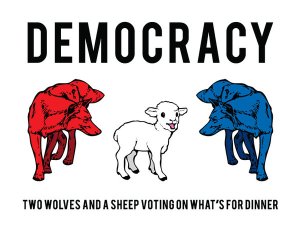
Thomas Sowell, George Will, and Walter Williams have all explained that the Constitution imposes strict limits on the powers of the federal government. This means, for all intents and purposes, that it is a somewhat anti-democratic document.

And by anti-democratic, I mean the Constitution puts restrictions on democracy (not restrictions on the Democratic Party, though in this case…).

More specifically, it doesn’t matter if a majority of people want Obamacare or a Department of Education. We live in a constitutional republic, a system specifically designed to protect individual liberties from tyranny.

The Founding Fathers obviously didn’t want our freedoms to be subject to the whims of a king, but they also wanted to protect us from the tyranny of the majority.

This is one of the reasons why I’m so happy to share this short video from the folks at the Institute of Humane Studies. The Supreme Court may have wimped out in fulfilling its role of  protecting us against untrammeled majoritarianism, but at least we can understand why it’s a good idea to protect economic liberty.

Published on Sep 6, 2012 by

Under a democratic system of government, how is an individual protected from the tyranny of the majority? According to Professor Munger, democratic constitutions consist of two parts: one defining the limits within which decisions can be made democratically, and the other establishing the process by which decisions will be made. In the United States Constitution, the individual is protected from majority decisions. Professor Munger warns, however, that these protections are slowly being stripped away as American courts of law fail to recognize the limits of what can be decided by majority rule. Professor Munger uses the case of Kelo v. New London to illustrate the dangers of confusing majority rule with a democratic system.

_______________

I particularly like the fact that the video cites the Supreme Court’s horrific Kelo decision.

By the way, if you want to understand the other side of the debate (or if you want to enjoy a good laugh), you can peruse my post on E.J. Dionne’s failure to understand history and constitutional governance.

P.S. I applied the lessons of this video in my post about why the U.S. government should promote liberty rather than democracy in the Middle East.

P.P.S. They probably don’t realize it, but Republicans actually came out against marjoritarianism in their party platform.

P.P.P.S. There is at least one Republican who is against majoritarianism (and for the right reason). Click here for the answer.