Yearly Archives: 2012

Evangelical review of the question: “Was Ayn Rand right?” (Part 1)

Was Ayn Rand Right?

Article ID: JAF1324

By: Jay W. Richards

Synopsis

In response to the critics of capitalism, many conservative Christians turn to philosopher Ayn Rand for ammunition. Rand was a staunch defender of capitalism, but also an anti-Christian atheist who argued that capitalism was based on greed. Greed, for Rand, is good. But if Rand is right, then Christians can’t be capitalists, because greed is a sin. Fortunately, Rand was wrong. She missed the subtleties of capitalism. First, we should distinguish self-interest from selfishness. Adam Smith, the father of capitalism, famously wrote, “It is not from the benevolence of the butcher, the brewer, or the baker, that we expect our dinner, but from their regard to their own interest.” True enough; but that alone isn’t a problem. Every time you wash your hands or look both ways before you cross the street, you’re pursuing your self-interest—but neither activity is selfish. Second, Smith never argued that the more selfish we are, the better a market works. His point, rather, is that in a free market, each of us can pursue ends within our narrow sphere of competence and concern—our “self-interest”—and yet an order will emerge that vastly exceeds anyone’s deliberations. Finally, Smith argued that capitalism channels greed, which is a good thing. The point is that even if the butcher is selfish, he can’t make you buy his meat. He has to offer you meat at a price you’ll willingly buy. So capitalism doesn’t need greed. What it does need is rule of law, freedom, and human creativity and initiative. And we can point that out without any help from Ayn Rand.

_____

If you’re over forty, you probably remember the 1987 movie Wall Street. Kirk Douglas played the key role, a ruthless corporate raider named Gordon Gekko. Gekko is famous for his defense of selfishness: “Greed…is good,” he tells a young broker. “Greed is right. Greed works. Greed clarifies, cuts through and captures the essence of the evolutionary spirit. Greed, in all its forms…has marked the upward surge of mankind.” Gekko embodies the enduring stereotype of the greedy businessman.

Given the coverage of the current financial crisis, it’s no surprise that Twentieth Century Fox is now producing a sequel. Many people, including many Christians, believe that the crisis is the product of greedy capitalism—pure and simple. Others, including many Christians, want to defend capitalism, but end up drawing on the work of philosopher and playwright Ayn Rand, who called greed a virtue. That puts most of us between the proverbial rock and the hard place.

As if in response, some prominent evangelicals such as Tony Campolo, Jim Wallis, and Ron Sider have criticized capitalism as based on the “greed principle” (to quote Campolo).1 And it’s hard to blame them, since even many fans of capitalism, such as Rand, seem to agree. And certainly for Christians, greed is not good. Greed, selfishness, or “avarice” is one of the seven deadly sins, and the Bible has nothing good to say about it. In the Gospels, when Jesus was asked to settle an inheritance dispute, He responded: “Watch Out! Be on your guard against all kinds of greed; life does not consist in an abundance of possessions” (Luke 12:15 TNIV). The Tenth Commandment says, “Do not covet,” which no doubt applies to greed as well. Jesus includes greed with murder and adultery in a long list of sins (Mark 7:21– 22). Paul tells the Ephesians that no greedy person—“that is, an idolater,” he explains—will inherit the kingdom of God (Eph. 5:5 ESV). These are just a few of the dozens of biblical passages condemning greed.

So what do we do? Must we embrace Rand’s anti-Christian philosophy to defend capitalism? Or must we reject capitalism because it’s based on greed? I don’t think we have to do either. The truth is much more interesting, and much more encouraging.

THE BEEHIVE

Rand wasn’t the first one to identify capitalism with greed. That honor goes to a Dutchman named Bernard Mandeville. In 1705, he wrote a poem called The Fable of the Bees. Nobody noticed it. So in 1714, he republished it with a lengthy commentary explaining that the poem was a metaphor for English society. Mandeville saw humans and bees as little more than bundles of vicious passions. The Parable reflected that belief.

In the beehive, different bees do different tasks, but they all have the same motivation—vice. The poem describes avarice, pride, and vanity as producing great wealth for the hive. The bees, however, are discontent. They grumble at the lack of virtue around them. They gripe so incessantly that Jove eventually gives them what they ask for. Honesty and virtue now fill the hive. And everything collapses. The bees’ virtuous actions led to disaster whereas the individual acts of evil had led to social good.

Taken literally, Mandeville’s claim is ridiculous. Good doesn’t come from evil. Virtue isn’t born from vice. Virtue doesn’t destroy society. Still, he did get one thing right: bad intentions don’t always yield bad results. Recall that the Apostle Paul once delighted that some were preaching the gospel out of envy of him. He didn’t delight in the envy, but in the preaching. So even private sinful acts may lead to a social good.

THE VIRTUE OF SELFISHNESS?

After Mandeville came the Scottish philosopher Adam Smith, who in 1776 wrote the most famous book in the history of economics, The Wealth of Nations. Though the book is long on pages and detail, its basic purpose was simple. Smith wanted to defend what he called the natural system of liberty: rule of law, unobtrusive government, private property, specialization of labor, and free trade. To prosper, a society needed “little else,” he said, “but peace, easy taxes, and a tolerable administration of justice.”2 But so far from flattering the business class, Smith famously said that “people of the same trade seldom meet together, even for merriment and diversion, but the conversation ends in a conspiracy against the public, or in some contrivance to raise prices.”3 Not exactly a ringing endorsement.

Smith never credited the happy outcomes of trade and business to the virtues of business people. “It is not from the benevolence of the butcher, the brewer, or the baker,” he wrote, only to be quoted by every economics textbook ever written, “that we expect our dinner, but from their regard to their own interest.”4 Nevertheless, through the invisible hand of the market, individuals will “promote an end which is no part of [their] intention.”5 That end often benefits society overall.

If you don’t read Smith carefully, you might think that he’s making the same argument as Mandeville: individual greed is good for society. That’s a misreading of Smith, which was made wildly popular by Ayn Rand.

THEN COMES RAND

Perhaps more than anyone else, Ayn Rand not only identified capitalism with greed, but defended it in those terms. She even wrote a book called The Virtue of Selfishness.6 For Rand, greed was the basis for a free economy. Capitalism and greed go together like fat cats and big cigars. To prevent readers from thinking she was using hyperbole, Rand went out of her way to espouse atheism and stridently denounce Christian altruism as antithetical to capitalism: “Capitalism and altruism are incompatible,” she said, “they are philosophical opposites; they cannot co-exist in the same man or in the same society.”7 In fact, she had a hard time distinguishing Christian altruism from socialism.

Rand was born in Russia in 1905 as Alisa Zinov’yevna Rosenbaum, and immigrated to the United States in 1925, just as communism was securing its stranglehold on the Soviet Union. Her hatred of the collectivism she saw in her youth was etched into her worldview, her writings, even her strange personality. After coming to the U.S., she worked as a script writer in various Hollywood studios. The release of her novel The Fountainhead in 1943 made her famous. Atlas Shrugged, published in 1957, made her a sensation.

In her novels, she developed characters that expressed her philosophy “of man as a heroic being, with his own happiness as the moral purpose of his life, with productive achievement as his noblest activity, and reason as his only absolute.”8 Her books read more like tracts for her philosophy of “objectivism” than ordinary novels. As Daniel Flynn puts it, “The themes of Rand’s four novels—We the Living, Anthem, The Fountainhead, Atlas Shrugged—are identical. As far as the philosophy of her novels goes, to read one is to read them all.”9

But for millions of readers, her books still inspire. I discovered Rand during my senior year in college. Her books were like a blow to the chest. She mercilessly skewered every leftist cliché that I had taken for granted. I found her bracing prose and iconic heroes attractive and repellant at the same time. For a few months, she seized me. I frittered away a week of my senior year reading Atlas Shrugged rather than studying for a German final.

The book tells about an elite group of creative entrepreneurs and inventors, “individuals of the mind,” who go on strike against a state that implements the communist principle “from each according to his ability, to each according to his need.” For Rand, these entrepreneurial heroes, like Atlas in Greek mythology, hold up the world. By pursuing their long-term self-interest, they create value for everyone. So when they shrug—that is, strike—society begins to decay.

The hero of Atlas Shrugged, John Galt, founds a secret community off the collectivist grid, called Galt’s Gulch. Here in this New Jerusalem, individuality and self-interest are prized above all else. One long chapter of the book, “This is John Galt Speaking,” is nothing but a speech by Galt. It’s the perfect distillation of Rand’s philosophy.

Despite Rand’s official praise of selfishness, however, John Galt doesn’t look anything like Ebenezer Scrooge or that fat, cigar-smoking, tuxedo-clad guy in Monopoly. On the contrary, Galt is a pioneer, a brave creator of wealth who pursues his vision despite powerful obstacles, including a malevolent state bent on destroying him. In fact, although Rand despised Christian self-sacrifice, Galt is suspiciously Christ-like. He preaches a message of salvation, founds a community, challenges the status quo and official powers-that-be, who hunt him down, torture him, but ultimately fail to conquer him.

To be sure, there are dissonant notes. His symbol is not a cross, but the dollar sign. The book ends with Galt and his lover tracing the sign of the dollar across a dry valley. But insofar as Galt’s character works, it’s because he contradicts the miserly stereotype that Rand’s philosophy leads the reader to expect. In fact, not one of Rand’s best fictional characters fits her philosophy very well.

Rand convinced me that collectivism was a false moral pretense. She also taught me the importance of entrepreneurs in creating wealth. Rand knew, better than some economists, that you can’t have capitalism without capitalists. Rand continues to be popular with some conservatives, including some Christians. Based on my brief description of her work, that might seem unlikely. But the lack of robust moral defenses of capitalism has left a void. And for many, Rand has filled it.

That’s a problem, of course, since her philosophy as a whole is clearly incompatible with the Christian worldview. Fortunately, we don’t need Rand’s philosophy to defend capitalism. Capitalism and Rand’s defense of it are two different things. This is clear once you realize that Rand bought into a myth more common among critics of capitalism, that the essence of capitalism is greed.

notes:

1 Tony Campolo, Letters to a Young Evangelical (New York: Basic Books, 2006), 142.

2 Adam Smith, An Inquiry into the Nature and Causes of the Wealth of Nations, ed. Edwin Cannan (New York: Modern Library, 1994), xliii.

3 Ibid., 148.

4 Ibid., 15.

5 Ibid., 485.

6 With Nathaniel Branden (New York: Signet, 1964).

7 Ayn Rand, Capitalism: The Unknown Ideal (New York: Signet, 1967), 195.

8 Ayn Rand, Atlas Shrugged (New York: Random House, 1957), appendix.

9 Daniel J. Flynn, Intellectual Morons: How Ideology Makes Smart People Fall for Stupid Ideas (New York: Crown Forum, 2004), 200–201.

Related posts:

Christian view versus Ayn Rand on altruism (Part 4)

Ayn Rand on the Purpose of Life Uploaded by prosumption on Apr 27, 2010 Ayn Rand on the Purpose of Life _________________ I ran across a fine article that takes a look at Ayn Rand’s view of capitalism and selfishness and compares it to the Christian view found in the Bible. I have decided to […]

Christians welcome nonbelievers like Dan Mitchell in their criticism of Ayn Rand’s view of altruism

Nonbelievers like Rand really do not have an answer to the question “What is the meaning of life?” Ayn Rand on the Purpose of Life Christians are commanded to help others by Christ. However, many Christians do believe in the free market and think that system best suits the ideas that flow from Christianity. (Doug […]

Christian view versus Ayn Rand on altruism (Part 3)

Uploaded by MetrazolElectricity on Oct 30, 2010 Talking to Rose, patron-saint of the conservative movement , Bill buckley chats about ayn and her magnum opus atlas shrugged. On atlas shrugged, WFB:”I had to flog myself to read it.” On ayn, WFB : “Her scorn for charity,for altruism was such as to build up an unfeeling […]

Christian view versus Ayn Rand on altruism (Part 2)

Uploaded by LibertyPen on Jul 17, 2009 Questioned by Mike Wallace, Ayn Rand explains her philosophy of objective reality and contrasts it with altruism. _________________ I ran across a fine article that takes a look at Ayn Rand’s view of capitalism and selfishness and compares it to the Christian view found in the Bible. I […]

Christian view versus Ayn Rand on altruism (Part 1)

Uploaded by LibertyPen on Oct 26, 2009 Ayn Rand makes the case that altruism is evil. ___________________  I ran across a fine article that takes a look at Ayn Rand’s view of capitalism and selfishness and compares it to the Christian view found in the Bible. I have decided to start a series on this […]

By Everette Hatcher III | Posted in Current Events | Edit | Comments (0)

Ranking the football teams in the SEC East in 2012

Here are my rankings:

In the SEC East it will be 1. Georgia, 2. Tennessee, 3. South Carolina, 4. Florida.

I really do think that Georgia has a big advantage with their schedule. They don’t play the big three in the West (Ala, LSU and Arkansas). Tennessee has the element of surprise on their size with that excellent passing game.

SEC: Very Early Predictions for 2012


By Braden Gall (@BradenGall on twitter) and Steven Lassan (@AthlonSteven)

Very Early 2012 SEC East Predictions

1. Georgia Bulldogs

Key Returnees: QB Aaron Murray, RB Isaiah Crowell, WR Malcolm Mitchell, WR Michael Bennett, WR Marlon Brown, WR Tavarres King, DL Arby Jones, DL John Jenkins, LB Jarvis Jones, LB Alec Ogletree LB Cornelius Washington, LB Michael Gilliard, DB Bacarri Rambo, DB Shawn Williams, DB Sanders Commings, DB Brandon Smith

Key Losses: TE Orson Charles, OL Cordy Glenn, OL Ben Jones, OL Justin Anderson, DT DeAngelo Tyson, CB/RET Brandon Boykin, K Blair Walsh, P Drew Butler

The story on offense should be pretty clear heading into 2012 for the Dawgs. Aaron Murray and a host of electric young skill players will return to a unit that has to replace its three best blockers. Can UGA establish the run better with an older, and more mature Isaiah Crowell, and new star Keith Marshall? The offensive line could be the only thing keeping Georgia from the national championship game.

If UGA does have a special season in 2012, it will be because of the defense. Todd Grantham in two short years turned the Dawgs into one of the stingiest units in the nation. And he has 10 starters back with elite level talent and depth at nearly every position. All-American candidates Jarvis Jones and Bacarri Rambo lead the way on the backend.

Special teams will take a big hit for Mark Richt as both kickers and return dynamo Brandon Boykin have moved on. However, the schedule is powerful reason why Georgia is the early favorite to win the East. Richt’s squad misses the three best teams from the West in LSU, Alabama and Arkansas — all of whom could be preseason top-10 teams. Trips to Missouri (to start SEC play) and South Carolina will be the toughest road tests of the year.

2. South Carolina Gamecocks

Key Returnees: QB Connor Shaw, RB Marcus Lattimore, RB Brandon Wilds, WR Ace Sanders, TE Justice Cunningham, DE Jadeveon Clowney, DE Devin Taylor, DT Kelcy Quarles, LB Shaq Wilson, DB D.J. Swearinger, DB DeVonte Holloman

Key Losses: OL Rokevious Watkins, WR Alshon Jeffery, DE Melvin Ingram, DT Travian Robertson, LB Rodney Paulk, CB Stephon Gilmore, LB/S Antonio Allen, C.C. Whitlock

Dismissing Stephen Garcia in the middle of the season might have been the best decision Steve Spurrier has made at South Carolina. The only disappointment is that new quarterback Connor Shaw didn’t get a full year of seasoning. The dual-threat quarterback played his best football down the stretch in 2011 and will welcome back the best running back in the nation when Marcus Lattimore returns to the field in 2012. Replacing Alshon Jeffery’s talent will be virtually impossible, but replacing his underwhelming (at times) production won’t. If the pass protection can improve, this entire offense has an opportunity to be much better in 2012.

Defensively, the front line has some holes to fill with the loss of Melvin Ingram and Travian Roberston, but Devin Taylor is back and Jadeveon Clowney proved his lofty recruiting status was totally justified. Toss in Kelcy Quarles and Carolina will have another stellar D-Line. Replacing some of the key pieces in the back seven, as well as the loss of coordinator Ellis Johnson, will determine if this defense can rank in the top-10 nationally once again.

The real issue with South Carolina, despite coming off its first 11-win season in school history, will be the schedule. The cross-over slate features a trip to LSU and a visit from Arkansas – two of the preseason top-10 teams in the nation. The schedule was the reason Athlon Sports picked Georgia to win the East in 2011 and a repeat decision is likely from America’s Premier Sports Publisher.

3. Missouri Tigers

Key Returnees: QB James Franklin, RB Kendial Lawrence, RB Henry Josey (injury), WR T.J. Moe, WR Marcus Lucas, WR L’Damian Washington, DL Brad Madison, DL Sheldon Richardson, DL Brayden Burnett, LB Andrew Wilson, LB Will Ebner, LB Zaviar Gooden, DB E.J. Gaines, DB Kip Edwards, DB Matt White, DB Kenronte Walker

Key Losses: WR Wes Kemp, TE Michael Egnew, OL Elvis Fisher, DE Jacquies Smith, DT Dominique Hamilton, DT Terrell Resonno, LB Luke Lambert, DB Kenji Jackson

The SEC’s other James Franklin enters America’s best conference with the potential to be an all-conference performer at quarterback. Whether or not his style of play can be effective against the extraordinarily talented SEC front sevens still remains to be seen. The good news is Gary Pinkel has plenty of talent coming back in the backfield and out wide for Franklin to utilize. But a great offensive line is a necessity to succeed in this league and how quickly this new group can gel will have the biggest impact on the offense. 

One look at the NFC playoffs in San Francisco and fans should understand how well Pinkel has recruited the defensive line. The Aldon-Justin Smith combo has proven that Mizzou has been one of the stronger Big 12 teams in the trenches since he arrived in Columbia. Brad Madison and Sheldon Richardson return to lead what should be one of the better units in the East — or at least one that is on par with Florida, South Carolina and Georgia. Can they hold up week-in, and week-out against SEC power rushing attacks? Only time will tell, but Missouri isn’t entering a new conference empty handed.

Hosting four of its first five conference games will help to ease Missouri into SEC play. However, the maiden voyage through the southeast culminates with three straight road games in three of the most hostile stadiums in the country: At Florida, Tennessee and Texas A&M. The second half of the year will likely determine if the Tigers are successful in their first SEC campaign.

4. Florida Gators

Key Returnees: QB Jacoby Brissett, QB Jeff Driskel, RB Mike Gillislee, ATH Trey Burton, WR Andre Debose, WR Quinton Dunbar, TE Jordan Reed, OL Xavier Nixon, OL Jonotthan Harrison, OL Matt Patchan, OL Jon Halapio, DL Sharrif Floyd, DL Ronald Powell, DL Dominique Easley, LB Jon Bostic, LB Jelani Jenkins, LB Michael Taylor, DB Matt Elam, DB Josh Evans, DB Jaylen Watkins, DB Cody Riggs

Key Losses: QB John Brantley, RB Chris Rainey, RB Jeff Demps, OL Dan Wenger, DT Jaye Howard

Another year, another offensive scheme. Will Muschamp hired former Boise State offensive coordinator Brent Pease as his new offensive guru. In case you are counting at home, that makes four coordinators in four seasons in Ganiesville. And Pease’s first order of business is to find a quarterback. Uber-recruits Jacoby Brissett and Jeff Driskel will likely compete for the starting job, but how do their skills fit with the new scheme? And can Pease find offensive playmakers to help out – which sounds unfathomable at a school like Florida. How quickly Pease settles into his new office will likely determine if the Gators challenge for an SEC title or lose another five games.

While the offense has huge question marks heading into 2012, the defense has all the potential to be a dominant unit. It finished eighth nationally against the run, allowed only 20.3 points per game (20th nationally) and returns NFL talent at every position. This team has a chance to be very stout in 2012.

There are few breaks, as is the case with most SEC schools, on the Gators’ schedule. Muschamp starts the year visiting a rebuilding Texas A&M team and a developing Tennessee squad. LSU also comes to The Swamp in October in cross-over play with a very tough but potentially manageable finish to the year: South Carolina at home, Georgia in Jacksonville and Missouri at home.

5. Vanderbilt Commodores

Key Returnees: QB Jordan Rodgers, RB Zac Stacy, RB Warren Norman, WR Jordan Matthews, WR Chris Boyd, OL Wes Johnson, OL Ryan Seymour, DL Rob Lohr, DL Walker May, LB Chase Garnham, DB Kenny Ladler, DB Javon Marshall, DB Trey Wilson

Key Losses: TE Brandon Barden, OL Kyle Fischer, OL Logan Stewart, DL Tim Fugger, LB Chris Marve, CB Casey Hayward, S Sean Richardson

Other than Alabama, there might not have been a fan base more excited about its program in 2011 than Vanderbilt. Much of the credit belongs to cult of personality head coach James Franklin — and a host of experienced seniors on defense. Finding a way to replace names like Marve, Hayward, Fugger and Richardson will be key for Franklin.

Ideally, an experienced and developing offense should help mask some of the holes on defense. Jordan Rodgers returns for a full season under center (and back-up Wyoming transfer Austyn Carta-Samuels is talented as well) and has all-SEC type players to work with in skill talents Zac Stacy, Warren Norman and Jordan Matthews. The offensive line won’t be a strength, but won’t be a weakness either as it is deep and beginning to develop experience.

The real reason Vandy fans are thinking bowl game for the second-straight season is the schedule. Like Georgia, the Dores miss the big three from the West (LSU, Alabama, Arkansas). However, Franklin and Rodgers will have to be ready to compete right out of the gate as South Carolina visits West End in the Thursday night primetime season kickoff in Week 1. Two non-conference road tilts with Northwestern and Wake Forest will also figure heavily into postseason play.

6. Tennessee Volunteers

Key Returnees: QB Tyler Bray, RB Marlin Lane, WR Justin Hunter, WR Da’Rick Rogers, OL Ja’Wuan James, OL Alex Bullard, OL Marcus Jackson, OL Dallas Thomas, DL Corey Miller, DL Jacques Smith, DL Daniel Hood, DL Maurice Couch, DL Willie Bohannon, LB A.J. Johnson, LB Curt Maggitt, DB Prentiss Waggner, DB Brian Randolph, DB Izauea Lanier

Key Losses: RB Tauren Poole, DE Malik Jackson, DE Ben Martin, LB Austin Johnson

There is a lot on the line for Derek Dooley in 2012. His career hangs in the balance as Tyler Bray and Justin Hunter return healthy as potentially one of the top QB-WR combos in the nation. There is loads of talent, and now experience, along the offensive line, so improving upon the 117th-ranked rushing offense will go a long way to keeping Dooley in Knoxville. Easier said than done.

Defensively, Dooley has an entirely new staff in place as he hired Sal Suneri from Alabama to run his defense. Like the offense, fans can finally point to talented, upside youngsters at key positions. Curt Maggitt and A.J. Johnson likely had to play too much as freshman, but went along way in accelerating the development process for the future star sophomores. The secondary has a lot of bodies and should be decent, but Sunseri’s ability to develop the front line will likely be the most important aspect of the defense. Maurice Couch and Daniel Hood showed consistency, but Corey Miller and Jacques Smith have the talent to be much better players. It falls to Sunseri, who developed stars like Rolando McClain, Courtney Upshaw and Dont’a Hightower, to turn them into the stars fans thought they would be as recruits.

Missing Arkansas and LSU helps this Tennessee team immensely in 2012, but will still have to face Florida, Georgia and Alabama in its first four SEC contests. The Vols likely have to reach seven or eight wins to save Dooley’s job and will undoubtedly need to pull one, if not two, upsets throughout the course of the season.

7. Kentucky Wildcats

Key Returnees: RB CoShik Williams, WR La’Rod King, OL Larry Warford, DL Collins Ukwu, LB Avery Williamson, LB Ridge Wilson, DB Martavius Neloms

Key Losses: WR Matt Roark, LB Danny Trevathan, LB Ronnie Sneed, S Winston Guy, DB Randall Burden

This team is in dire need of improvement in all areas. The offense failed to score more than 16 points in any SEC game in 2011 and topped 10 points in only two of eight games. Developing a quarterback will go a long way to making Joker Phillips’ group competitive once again in 2012. La’Rod King returns as the leading receiver and top offensive playmaker and blocker Larry Warford is a very talented start to building an offensive line.

Defensively, Phillips has to plug massive voids left by Danny Trevathan and Winston Guy. And with one of the toughest schedules in the league, finding defensive play-makers becomes magnified. Road trips to Florida, Arkansas, Missouri and Tennessee packaged with homes games against South Carolina, Georgia, Mississippi State and Vanderbilt does not afford many chances for wins in 2012 for Kentucky.

Who will win the SEC East this year in football? Possibly Tennesee!!!

I definately think the SEC West is the best this year in football. Just look at the last 3 national championships and where they have come from. However, they have lots of talent in the SEC East too. Let’s look at who will win that side of the bracket because the SEC West  champion (and eventual national champion) will have to win over them to advance up the national BSC rankings.]

Everybody would love to play Tennessee’s schedule in November: Nov. 3 Troy,Nov. 10 Missouri, Nov. 17 at Vanderbilt, and Nov. 24 Kentucky, but the truth is that you have to front load the schedule with tough teams in order to get the easy November.

NC State is beatable but the passing game is going to have to be clicking. Beating Florida is a possibility because I think they still have some problems down there. Alabama on the “Third Saturday of October” may prove to be a little more difficult.

I really do think this could be the year that things come together for Dooley. He got a lucky break when Arkansas was taken off the schedule for 2012. I predict a 6-2 record for the Vols this year and that may be good enough to win the SEC East.

Tennessee Volunteers 2012 Spring Preview


Can the Vols get back to a bowl game after missing postseason play a year ago?

By Braden Gall (@BradenGall on Twitter)

The journey to claim the 2012 national title begins in February, March and April, as 124 college football teams open up spring practice over the next three months. Athlon will preview some of the top teams and storylines across the nation, as the countdown to 2012 inches closer.

Tennessee Volunteers 2012 Spring Preview

2011 Record: 5-7, 1-7 SEC

Spring Practice: March 26-April 21

Returning Starters: Offense – 9, Defense – 8

Returning Leaders:

Passing: Tyler Bray, 147-of-247, 1,983 yards, 17 TD, 6 INT
Rushing: Marlin Lane, 75 att., 280 yards, 2 TD
Receiving: Da’Rick Rogers, 67 rec., 1,040 yards, 9 TD
Tackles: A.J. Johnson, 80
Sacks: Prentiss Waggner, 2
Interceptions: Prentiss Waggner and Eric Gordon, 2

Redshirts to Watch: OL Alan Posey, OL Mack Crowder, S Geraldo Orta

Early Enrollees:

Cody Blanc, ATH (6-1, 200), Knoxville (Tenn.) Central
Alden Hill, RB (5-11, 180), Alliance (Ohio) Marlington
Justin Meredith, TE (6-5, 225), Anderson (S.C.) T.L. Hanna
Nathan Peterman, QB (6-3, 210), Fruit Cove (Fla.) Bartram Trail
Darrington Sentimore, DL (6-2, 273), Norco (La.) Destrehan (Gulf Coast C.C.)
Trent Taylor, DL (6-2, 271), Lakeland (Fla.) Lake Gibson
Tino Thomas, DB (5-11, 195), Memphis (Tenn.) Melrose

2012 Schedule

SEC 2012 Schedule Analysis

Aug. 31 NC State
Sept. 8 Georgia State
Sept. 15 Florida
Sept. 22 Akron
Sept. 29 at Georgia
Oct. 6 Bye Week
Oct. 13 at Mississippi State
Oct. 20 Alabama
Oct. 27 at South Carolina
Nov. 3 Troy
Nov. 10 Missouri
Nov. 17 at Vanderbilt
Nov. 24 Kentucky

Offensive Strength: The passing game. Quarterback Tyler Bray and wideouts Da’Rick Rogers (maybe) and Justin Hunter form one of the most talented QB-WR combos in the nation. Toss in an elite recruiting class at wideout and tight end Mychal Rivera and the Vols boast one of the best passing attacks in the country.

Offensive Weakness: Everything else. The running game was seriously lacking last fall and will once again be an area of concern for the Big Orange faithful. Finding a feature back and linemen who can create holes will be the top priority for offensive coordinator Jim Chaney.

Defensive Strength: The secondary. At least, the depth and experience in the defensive backfield. Veteran Prentiss Waggner is on the move from safety to corner. The top ten DBs from a year ago return to Knoxville.

Defensive Weakness: The linebackers, and more specifically, the pass rush are a major concern. New coordinator Sal Sunseri will be installing a new 3-4 scheme and needs to find playmakers to fill the starting linebacker positions.

Spring Storylines Facing the Volunteers:

1. Dealing with the Dooley drama. Head coach Derek Dooley is squarely on the hot seat after two losing seasons in Knoxville. He dealt admirably with a massive coaching exodus (more on this in a moment) by rebuilding his staff with quality coaches. And for the first time in years, this program returns a deep, talented and experienced roster. The expectation to win has to weigh heavy on not just Dooley but every member of the Vols program. The circus surrounding his tenure isn’t going to slow anytime soon, so the quicker he can answer questions the better his team will be. 
2. Stabilizing and integrating seven new coaches into the program. With 19 starters back, it will be the coaching staff that needs to get acclimated, not the players. Chaney is still in place as the OC, but new running backs coach Jay Graham and offensive line coach Sam Pittman will have their hands full trying to restablish the dormant Big Orange rushing attack. There is plenty of talent to work with on that side of the ball, however, and the quarterback position is stable. With the implementation of the new 3-4 scheme, it is the defensive coaching staff that has the most work to do this spring. New DC Sal Sunseri brings an extraodinary track record with him to Knoxville in terms of developing linebackers — something that could be the difference between a bowl game and sitting at home this winter (and an employment check for everyone). Additionally, Sunseri and defensive line coach John Palermo will need to develop a scheme that can somehow put pressure on opposing quarterbacks (Tennessee finished 11th in the SEC in sacks, 100th nationally).

3. All of the above issues would be helped with much-needed growth and maturity from team leaders like Bray. Dooley and Sunseri can lead the horse to water, but it is up to the horse to actually drink. Names like Bray need take it upon themselves to prove that they can make others around them better by leading by example. The Corey Millers (currently dealing with academic issues) and Jacques Smiths need to live up to the massive recruiting hype and develop into every down performers. The last two seasons featured so much youth and inexperience, that mental mistakes — both on and off the field — were almost expected. This will not be the case in 2012 and it should not just be the coaching staff holding the team accountable — it needs to be the players. The star quarterback even admitted as much in his first media session of the spring, “Last year I wasn’t the smartest guy. Kind of dumb. This year I’m trying to get my act together and trying to get this team where it needs to be.”

4. Settling on a linebacker rotation and getting pressure on the quarterback is the top priority for Sunseri and Palmero. Smith seems to possess a perfect skillset for the Jack Back position, but will be pushed by Willie Bohannon. Youngsters A.J. Johnson and Curt Maggitt had quality first seasons, but have to adjust to the new scheme. Maggitt might be one of the biggest hitters in the SEC and is apparently loving his shift inside to the Mike position. His recognition skills now need to catch-up with his physical ability. He will be pushed by the contact-craved Herman Lathers, who returns after sitting out an entire year from a severe ankle injury. Former strong safety Brent Brewer, who tore his ACL in November, is gaining weight in order to play backer and also feels more comfortable because of it. Former fullback Channing Fugate might be making the biggest adjustment after being shifted to weakside linebacker. This was a thin position coming into spring and the shift to a 3-4 only puts added pressure on the depth chart. There are some nice pieces to this puzzle but Sunseri must implement a new system with players at new positions without wearing out his first stringers.

5. Helping the backers will be the new three-man front line. Maurice Couch needs to play the way he appears to be capable of more consistently on the interior. He has the ability to stabilize the front and allow for names like Miller, Marlon Walls and Daniel Hood to develop. Organizing this group will go a long way in helping to stabilize the totally reworked linebacker rotation. Junior college transfer — and former Crimson Tider in his own right — Darrington Sentimore might be the most intriguing new piece to the puzzle to watch this spring.

6. Dooley wants a feature back. There is only one issue – he may not have one on the roster. Marlin Lane is the leading returning rusher and might be the most talented, but is generously listed at 6-0, 205 pounds. He will most certainly split time with more physical Raijon Neal. Look also for diminutive sophomore Devrin Young (5-8, 171) to also get plenty of chances as well. Graham and Dooley know that 90.1 yards per game — where the Vols finished 2011, good for 12th in the SEC — is completely unacceptable in Knoxville. With another year of growth, an offensive line that has collectively become an upperclass unit together must develop into a strength for this team.

Emails on Solyndra surface from Obama administration

The government shouldn’t pick winners and losers in the private market place like President Obama has done.

Lachlan Markay

August 3, 2012 at 12:40 pm

On Thursday, the House Energy and Commerce Committee released a bombshell report, 18 months in the making and 147 pages long, detailing its investigation into bankrupt solar company Solyndra.

Along with the report, the committee released a trove of emails between Solyndra stakeholders and administration officials. They paint a troubling picture of efforts to prop up the company despite its bleak economic outlook, and reactions to the company’s eventual bankruptcy.

Scribe has compiled a list of the top 10 most revealing emails released as part of the investigation.

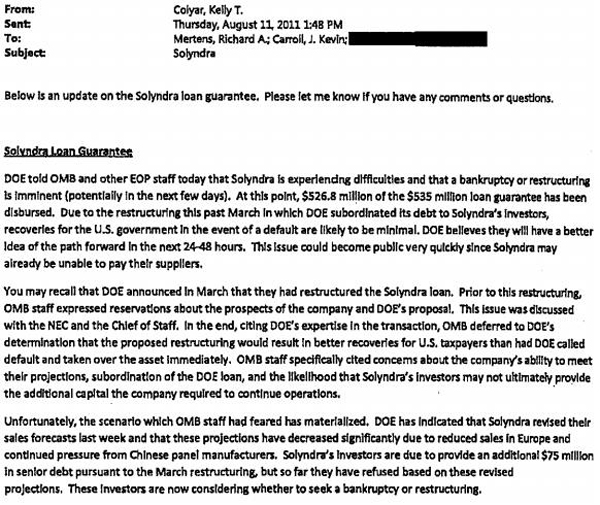
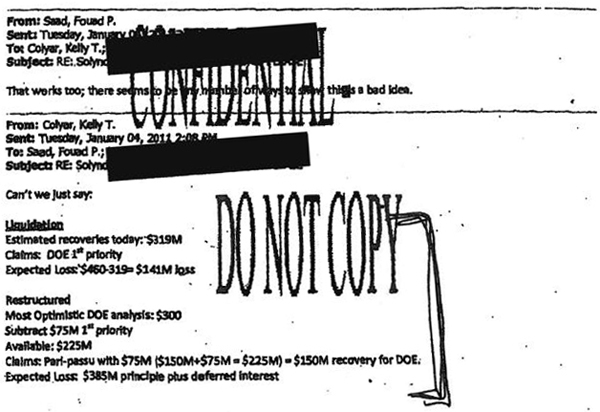
1. The White House Office of Management and Budget held that the Energy Department’s decision to restructure Solyndra’s loan was “a bad idea” and would result in greater taxpayer losses.

In March of 2011, DOE ignored the advice of White House budget officials and restructured Solyndra’s federally-backed loan, giving private investors priority in the repayment of their investments. DOE insisted that this would produce the greatest returns for taxpayers, but OMB officials, in a series of emails earlier that year, pondered ways to demonstrate to DOE that restructuring the loan would be “a bad idea.”

OMB analyst Kelly Coylar crunched the numbers, and found that DOE would lose about $141 million if it allowed Solyndra to go bankrupt and liquidated its assets. A restructuring agreement, on the other hand, could more than double taxpayer losses, she wrote.

2. White House Chief of Staff Bill Daley was briefed on Solyndra’s troubles before the Energy Department restructured Solyndra’s loan.

The eventual restructuring agreement may have violated federal law, according to the Energy and Commerce Committee. It is of particular note, then, that then-White House Chief of Staff Bill Daley was briefed on the possibility of restructuring Solyndra’s federally-backed loan before that decision was made.

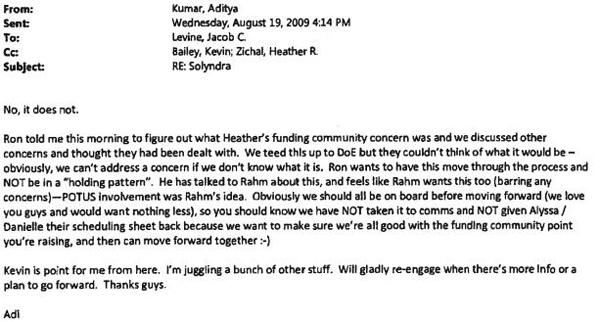
3. President Obama’s Solyndra photo-op was then-CoS Rahm Emanuel’s idea.

Emanuel has repeatedly said that he doesn’t remember anything about the Solyndra loan guarantee process. This email shows that he was heavily involved in White House efforts to promote the loan guarantee, most notably by suggesting the president conduct a photo-op at the company’s Fremont, CA headquarters.

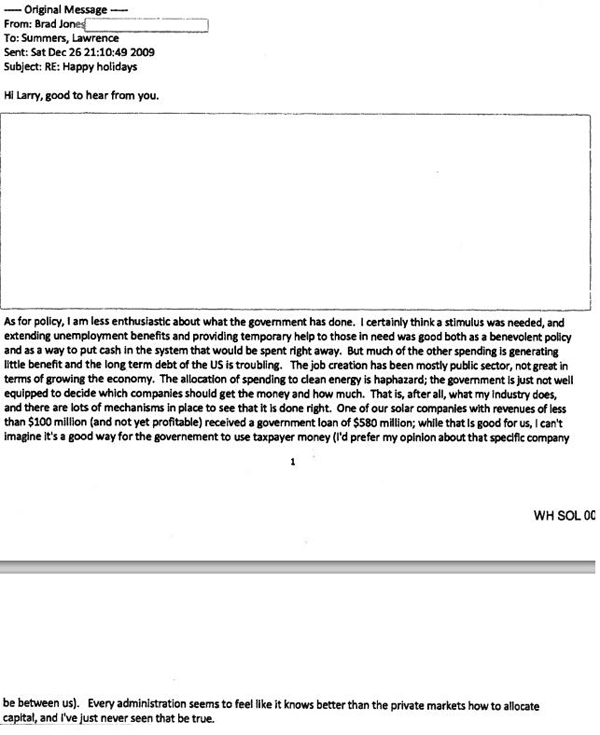
4. Even Solyndra’s investors knew that the company was a bad bet for taxpayers.

In an email to Lawrence Summers, then the chair of the White House’s National Economic Council, Brad Jones, an advisor with Solyndra investor Redpoint Ventures, said that while the loan guarantee for Solyndra would prove beneficial for Redpoint, “I can’t imagine it’s a good way for the government to use taxpayer money.”

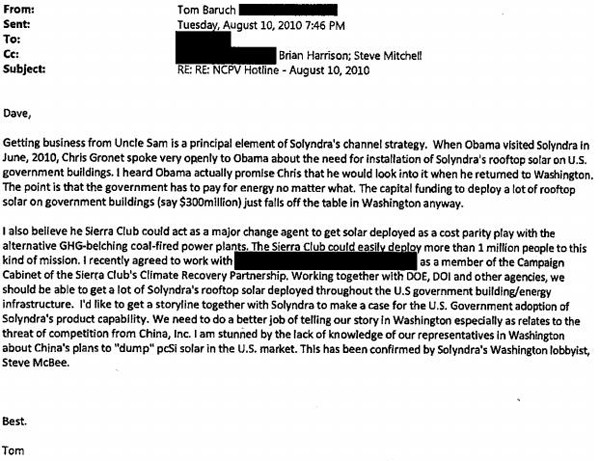
5. Getting federal money was integral to Solyndra’s business model.

“Getting business from Uncle Sam is a principal element of Solyndra’s channel strategy,” wrote Tom Baruch, founder of Solyndra investor CEMA Capital, in a August 10, 2010 email. When government takes it upon itself to pick winners and losers in the marketplace, securing government funds can be just as lucrative as conducting standard business activities, which inevitably directs more resources into unproductive political activities.

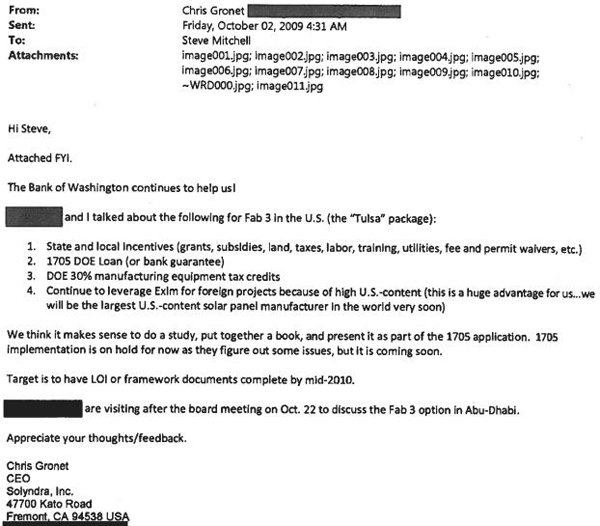
6. Solyndra’s CEO referred to the federal government as the “Bank of Washington.”

Solyndra was quite brazen about its government-centric business strategy, as this email from CEO Chris Gronet demonstrates.

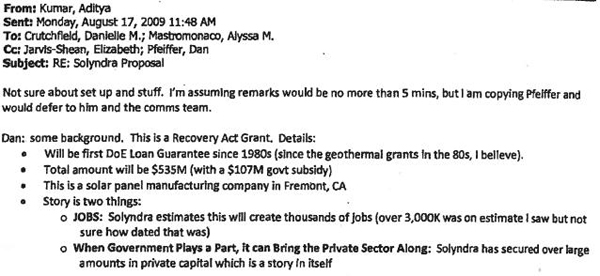
7. Solyndra was supposed to be a model of how government could empower the private sector.

In an email to White House communications staffer Dan Pfeiffer, Aditya Kumar, a senior advisor to the Vice President, said Solyndra exemplified an oft-repeated administration talking point on green energy “investment”: “When Government Plays a Part, it can Bring the Private Sector Along.”

Solyndra did bring the private sector along – all the way to its bankruptcy.

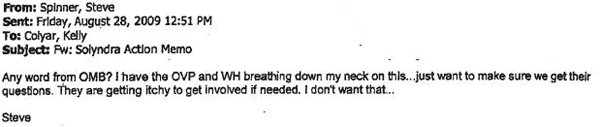
8. The White House and Vice President’s office pressured DOE to move on the Solyndra loan guarantee, which in turn pressured OMB.

In an August 28, 2009 email to Coylar, DOE official Steve Spinner, who headed up the Department’s Solyndra activities, said, “the OVP [Office of the Vice President] and WH [White House]” were “breathing down my neck” on the proposed Solyndra loan guarantee.

Spinner was trying to speed up OMB’s analysis of the Solyndra project to fit with the White House’s schedule, which had already set a date for the president’s Solyndra photo-op. OMB would later confirm that it had rushed its Solyndra analysis under pressure from the White House.

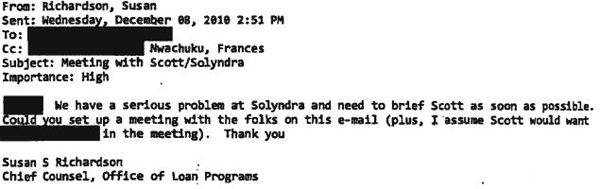
9. Upon news of the bankruptcy, DOE admitted it had “a serious problem at Solyndra.”

Despite numerous attempts since Solyndra’s bankruptcy to downplay the scandal, emails exchanged upon news that the company would go under reveal that the DOE knew just how bad the bankruptcy was. “We have a serious problem at Solyndra,” Susan Richardson, chief counsel of DOE’s Loan Program’s Office, wrote.

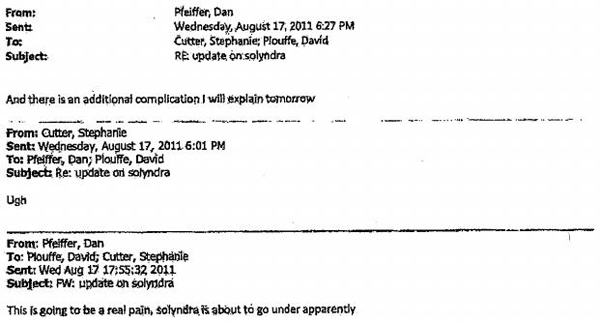
10. The White House’s reaction to Solyndra’s bankruptcy: “Ugh.”

The White House also knew that Solyndra’s bankruptcy posed a problem, as evinced by then-White House advisor Stephanie Cutter’s reaction to the news – in one word: “ugh.”

In an effort to downplay the scandal, Cutter has since insisted that Solyndra was “widely praised as successful and innovative.”

_____________

12 Questions for Woody Allen (Woody Wednesday)

Above is a clip of 12 questions for Woody Allen. Below is a list of some of his movies.

WOODY’S FINEST: Philip French’s favourite five

Annie Hall (1977)
In his first fully achieved masterwork, a semi-autobiographical comedy in which his ex-lover Diane Keaton and best friend Tony Roberts play versions of themselves, Allen created a new genre, the “relationship movie”.

Manhattan (1979)
Allen’s wryly comic film captures the magic of his home town with help from a fine cast, Gordon Willis’s monochrome widescreen images and 13 Gershwin songs. His pursuit of a much younger woman was to become a career obsession.

Zelig (1983) (above)
Dazzling satire on America’s permanent identity crisis in the form of a wholly convincing, wholly fake documentary about Leonard Zelig, a prewar celebrity known as the “Human Chameleon”. Saul Bellow, Susan Sontag and Bruno Bettelheim appear as witnesses.

Hannah and Her Sisters (1986)
Allen’s wittiest disquisition on love, life and death in Manhattan with a great ensemble cast that includes Michael Caine, Mia Farrow and Max von Sydow. The 1986 Cannes jury would have given it the Palme d’Or unanimously had it been in competition.

Radio Days (1987)
Taking as his model Fellini’s similarly episodic autobiographical Amarcord, Allen as writer-director-narrator looks back with warmth, wit and insight to the great days of sound broadcasting in the 1930s and 40s. A varied succession of often hilarious anecdotes bathed in a golden glow.

Related posts:

“Woody Wednesday” The heart wants what it wants”jh67

I read this on http://www.crosswalk.com which is one of my favorite websites. Life Lessons from Woody Allen Stephen McGarvey I confess I am a huge film buff. But I’ve never really been a Woody Allen fan, even though most film critics consider him to be one of the most gifted and influential filmmakers of our […]

“Music Monday”:Coldplay’s best songs of all time (Part 6)

  “Music Monday”:Coldplay’s best songs of all time (Part 6) This is “Music Monday” and I always look at a band with some of their best music. I am currently looking at Coldplay’s best songs. Here are a few followed by another person’s preference: My son Hunter Hatcher’s 15th favorite song is “trouble.” Even though […]

“Woody Wednesday” Allen once wrote these words: “Do you realize what a thread were all hanging by? Can you understand how meaningless everything is? Everything. I gotta get some answers.” jh31

Woody Allen, the film writer, director, and actor, has consistently populated his scripts with characters who exchange dialogue concerning meaning and purpose. In Hannah and Her Sisters a character named Mickey says, “Do you realize what a thread were all hanging by? Can you understand how meaningless everything is? Everything. I gotta get some answers.”{7} […]

“Music Monday”:Coldplay’s best songs of all time (Part 5)

“Music Monday”:Coldplay’s best songs of all time (Part 5) This is “Music Monday” and I always look at a band with some of their best music. I am currently looking at Coldplay’s best songs. Here are a few followed by another person’s preference: Hunter picked “Don’t Panic,” as his number 16 pick of Coldplay’s best […]

Steve Jobs’ view of death and what the Bible has to say about it jh55

(If you want to check out other posts I have done about about Steve Jobs:Some say Steve Jobs was an atheist , Steve Jobs and Adoption , What is the eternal impact of Steve Jobs’ life? ,Steve Jobs versus President Obama: Who created more jobs? ,Steve Jobs’ view of death and what the Bible has to say about it ,8 things you might not know about Steve Jobs ,Steve […]

“Woody Wednesday” A review of some of the past Allen films jh32

I am a big Woody Allen fan. Not all his films can be recommended but he does look at some great issues and he causes the viewer to ask the right questions. My favorite is “Crimes and Misdemeanors” but the recent film “Midnight in Paris” was excellent too. Looking at the (sometimes skewed) morality of […]

Good without God?

(The signs are up on the buses in Little Rock now and the leader of the movement to put them up said on the radio today that he does not anticipate any physical actions against the signs by Christians. He noted that the Christians that he knows would never stoop to that level.) Debate: Christianity […]

“Music Monday”:Coldplay’s best songs of all time (Part 4)

Dave Hogan/ Getty Images This is “Music Monday” and I always look at a band with some of their best music. I am currently looking at Coldplay’s best songs. Here are a few followed by another person’s preference: For the 17th best Coldplay song of all-time, Hunter picks “42.” He notes, “You thought you might […]

Open letter to President Obama (Part 121)

President Obama c/o The White House
1600 Pennsylvania Avenue NW
Washington, DC 20500

Dear Mr. President,

I know that you receive 20,000 letters a day and that you actually read 10 of them every day. I really do respect you for trying to get a pulse on what is going on out here.

The stimulus did not work for the USA and it has never worked.

There’s an old saying that insanity is doing the same thing over and over again while expecting different results. This certainly is a good description of Keynesians, who relentlessly push more government spending as some sort of magic potion for the economy – notwithstanding a record of failure.

The latest example if Larry Summers, the former economist for the Obama White House, who says Europeans need to make government bigger.

Here is some of what he writes for today’s Washington Post.

European efforts to contain crisis have fallen short. …Much of what is being urged on and in Europe is likely to be not just ineffective but counterproductive to maintaining the monetary union, restoring normal financial conditions and government access to markets, and reestablishing economic growth. The premise of European policymaking is that countries are overindebted and so unable to access markets on reasonable terms, and that the high interest rates associated with excessive debt hurt the financial system and inhibit growth. The strategy is to provide financing while insisting on austerity, in hopes that countries can rein in their excessive spending enough to restore credibility, bring down interest rates and restart economic growth.

The good news is that Summers recognizes that there has been “excessive spending.” The bad news is that he uses the wrong definition of austerity.

Many European nations seem to think higher taxes are a sign of fiscal conservatism (see this post by Veronique de Rugy for a good discussion of this confusion). Summers accepts that approach, and says that policy makers should choose a Keynesian policy instead.

Unfortunately, Europe has misdiagnosed its problems in important respects and set the wrong strategic course. …Europe’s problem countries are in trouble because the financial crisis underway since 2008 has damaged their financial systems and led to a collapse in growth. High deficits are much more a symptom than a cause of their problems. And treating symptoms rather than underlying causes is usually a good way to make a patient worse. …The right focus for Europe is on growth; in this dimension, increased austerity is a step in the wrong direction.

There’s more good news. Summers is right in stating that Europe suffers from low growth. And I agree with him that the European version of austerity – higher taxes – is not a solution.

But, as always, there is a catch. Summers has the wrong approach on how to encourage growth. He wants Keynesian spending, and here is his defense.

 Skeptics will rightly wonder how a prescription for more spending by countries that already have trouble borrowing can be correct. The answer lies in the difference between borrowing by individuals and countries. Normally, an individual helps his creditors by borrowing less; but a person who stops borrowing to finance commuting to his job does his creditors no favor. A country’s income is determined by spending, so a country that pursues austerity to the point where its economy is driven into a downward spiral does its creditors no favor.

Sounds semi-reasonable. After all, everyone understands that it is important to get to their place of employment. Sometimes you spend money to make money.

But here’s the problem. Can anyone name anything in so-called stimulus schemes that actually increase a nation’s productive capacity? As we saw with Obama’s failed stimulus, lots of money gets distributed, but the main purpose seems to be buying votes and creating dependency.

What about jobs? A miserable failure.

Adding insult to injury, you probably won’t be surprised to learn that American taxpayers are supposed to pick up the lion’s share of the tab for the new spending in Europe since Summers wants the IMF to be the sugar daddy.

Going forward, the IMF and international community should condition further support not merely on individual countries’ actions but on a common European commitment to growth.

This approach is illogical, as explained in this video.

And let’s consider the historical record. Nations that have tried this type of “stimulus” have not fared well. Big spending increase under Hoover and Roosevelt failed in the 1930s. Japan tried several Keynesian packages and failed in the 1990s. Bush failed in 2008 and Obama failed in 2009.

Germany did not go with a big program of government spending, and they did better than the United States. The same is true about Canada. But the real success story is the Baltic nations. They imposed real spending restraint, not the fake austerity found in places such as the United Kingdom.

And even though it caused some short-term pain since there’s a short-term cost when labor and capital get redeployed to more productive uses, the Baltic nations are now in much better shape that the European nations that have floundered because they limited themselves to the no-win choice of Keynesianism and tax hikes.

_______________

Thank you so much for your time. I know how valuable it is. I also appreciate the fine family that you have and your commitment as a father and a husband.

Sincerely,

Everette Hatcher III, 13900 Cottontail Lane, Alexander, AR 72002, ph 501-920-5733, lowcostsqueegees@yahoo.com

“Schaeffer Sundays” can be seen on the www.thedailyhatch.org

What Ever Happened to the Human Race?

Francis Schaeffer  

  I learned so much from Francis Schaeffer and as a result I have posted a lot of posts with his film clips and articles. Below are a few.

Related posts:

Francis Schaeffer: We can’t possess ultimate answers apart from the reference point of the infinite personal God himself (Schaeffer Sunday)

Dr. Francis Schaeffer – The Biblical flow of Truth & History (intro) Uploaded by Scott87508 on Oct 3, 2010 __________________ Some wise words below I got off the internet: Tuesday, July 01, 2008 The Infinite-Personal God: Thoughts from Francis Schaeffer’s Escape from Reason   Perhaps you are familiar with the indie band Arcade Fire. Their […]

Francis Schaeffer’s L’Abri Fellowship in Switzerland (Schaeffer Sunday)

L’Abri : Sounds & Sites of a Shelter Uploaded by mdshivers on Nov 12, 2006 A fun video of the day in the life at L’Abri Fellowship in Switzerland. I made this video in 2003 while there and I was trying to capture the sounds and everyday life of it. Was on the Labri.org site […]

Francis Schaeffer would be 100 years old this year (Schaeffer Sunday)

Dr. Francis Schaeffer – Extra – Interview – Part 2 Francis Schaeffer had a big impact on me in the late 1970′s and I have been enjoying his books and films ever since. Here is great video clip of an interview and below is a fine article about him. Francis Schaeffer 1912-1984 Christian Theologian, Philosopher, […]

Francis Schaeffer’s “How should we then live?” Video and outline of episode 10 “Final Choices” (Schaeffer Sundays)

E P I S O D E 1 0 How Should We Then Live 10#1 FINAL CHOICES I. Authoritarianism the Only Humanistic Social Option One man or an elite giving authoritative arbitrary absolutes. A. Society is sole absolute in absence of other absolutes. B. But society has to be led by an elite: John Kenneth […]

A Christian Manifesto by Francis Schaeffer (Part 9) (Schaeffer Sundays)

Part 1 Part 2 Below is a summary of “A Christian Manifesto” which is a very important book written by Francis Schaeffer just a couple of years before his death in 1984. A Christian Manifesto by Dr. Francis A. Schaeffer This address was delivered by the late Dr. Schaeffer in 1982 at the Coral Ridge Presbyterian […]

Francis Schaeffer and C. Everett Koop were prophetic (jh29)

Francis Schaeffer and C. Everett Koop were prophetic (jh29) What Ever Happened to the Human Race? I recently heard this Breakpoint Commentary by Chuck Colson and it just reminded me of how prophetic Francis Schaeffer and C. Everett Koop were in the late 1970′s with their book and film series “Whatever happened to the human […]

Francis Schaeffer noted “If there are no absolutes by which to judge society, then society is absolute.” (“Schaeffer Sundays” Part 4)

___________________________________________ Francis Schaeffer is a hero of mine and I want to honor him with a series of posts on Sundays called “Schaeffer Sundays” which will include his writings and clips from his film series. I have posted many times in the past using his material. Philosopher and Theologian, Francis A. Schaeffer has argued, “If […]

Communism catches the attention of the young at heart but it has always brought repression wherever it is tried (“Schaeffer Sundays” Part 1)

 (“Schaeffer Sundays” Part 1)   Francis Schaeffer is a hero of mine and I want to honor him with a series of posts on Sundays called “Schaeffer Sundays” which will include his writings and clips from his film series. I have posted many times in the past using his material.   Communism has never been […]


Who will win the SEC East this year in football? Possibly Florida!!!

I definately think the SEC West is the best this year in football. Just look at the last 3 national championships and where they have come from. However, they have lots of talent in the SEC East too. Let’s look at who will win that side of the bracket because the SEC West  champion (and eventual national champion) will have to win over them to advance up the national BSC rankings.]

With 18 starters returning you have to say that Florida has a chance to be a special team this year. I am not sold yet on their offense and if doesn’t improve then they could be in for a long year.

Florida Gators 2012 Spring Preview

The Gators’ defense returns intact, but what will happen with the offense in 2012?

By Braden Gall (@BradenGall on Twitter)

The journey to claim the 2012 national title begins in February, March and April, as 124 college football teams open up spring practice over the next three months. Athlon will preview some of the top teams and storylines across the nation, as the countdown to 2012 inches closer.

Florida Gators 2012 Spring Preview

2011 Record: 7-6, 3-5 SEC

Spring practice: March 14-April 7

Returning Starters: Offense – 7, Defense – 11

Returning Leaders:

Passing: Jacoby Brissett, 18 of 39, 206 yards, 2 TD, 4 INT
Rushing: Mike Gillislee, 56 att., 328 yards, 2 TD
Receiving: Andre Debose, 16 rec., 432 yards, 4 TD
Tackles: Jon Bostic, 94
Sacks: Ronald Powell, 6
Interceptions: Matt Elam and De’Ante Saunders, 2

Redshirts to watch: WR JaJuan Story, S Valdez Showers

Early Enrollees:

Willie Bailey, DB (6-1, 167), Hallandale (Fla.) High
Jessamen Dunker, OL (6-4, 320), Boynton Beach (Fla.) High
D.J. Humphries, OL (6-6, 271), Charlotte (N.C.) Mallard Creek
Damien Jacobs, DL (6-3, 310), Scooba (Miss.) East Miss. C.C.
Antonio Morrison, LB (6-1, 209), Bollingbrook (Ill.) High

JUCO Transfers to watch: DT Damien Jacobs

2012 Schedule

SEC 2012 Schedule Analysis

Sept. 1 Bowling Green
Sept. 8 at Texas A&M
Sept. 15 at Tennessee
Sept. 22 Kentucky
Sept. 27 Bye Week
Oct. 6 LSU
Oct. 13 at Vanderbilt
Oct. 20 South Carolina
Oct. 27 Georgia
Nov. 3 Missouri
Nov. 10 UL-Lafayette
Nov. 17 Jacksonville State
Nov. 24 at Florida State

Offensive Strength: On a unit that has struggled ever since Urban Meyer left town, is it okay to say none? There is still plenty of offensive skill depth and versatility, but none of those hefty recruiting rankings have panned out. It’s not to say that there is loads of potential, especially in the receiving corps. There is plenty of speed with Andre Debose, Quinton Dunbar and Frankie Hammond on the outside while Jordan Reed and A.C. Leonard were two of the most highly-touted tight ends in the nation. This group can only improve.

Offensive Weakness: Since this entire offense was “highly-touted” and has yet to stabilize in any sense of the word, really every position could be listed as a weakness. However, the offensive line could feature two true freshman this fall and therefore gets the nod as the biggest area of concern. But make no mistake, the quarterbacks or running game (or receivers for that matter) aren’t in much better shape.

Defensive Strength: All areas of this defense are supremely talented and return intact, but if one area is the strength it would have to be the defensive line. Fourteen players registered a sack last fall for Florida and 12 of them are returning, including six of the top seven D-Linemen. This is an active, explosive, versatile and extremely talented front line. Fans have high expectations for uber-recruits Ronald Powell, Dominique Easley, Omar Hunter and Sharrif Floyd.

Defensive Weakness: This unit is quite the opposite of the offense. With 11 starters returning, there really isn’t a glaring weakness. Finding tall corners that fit Wil Muschamp’s scheme might be an area of focus for the spring. Developing a physical Alabama-esque edge in the extremely athletic linebacking corps is important. And adding bulk up front are small areas of development for a defense that could be the SEC East’s most talented unit.

Spring Storylines Facing the Gators

1. Stablizing the offensive coaching staff had to be Muschamp’s top priority this offseason. With the hiring of former Boise State offensive coordinator Brent Pease to call plays, the Gators will be featuring its fourth OC in four seasons. Hardly stable. Yet, Pease helped develop one of the most prolific offensive attacks in the nation in Boise and is charged with the continued shift from Meyer spread to Muschamp pro-style. There are a lot of moving parts on the offense and figuring out how they all fit together needs to be done quickly if Pease expects to complete the transition to the more traditional power offense.

2. Finding a quarterback will be Pease’s main focus this spring. For the first time in nearly a decade, the Gators truly have no clue who will be the starting quarterback on September 1. Both Jacoby Brissett and Jeff Driskel are dripping with talent, arm strength and size. Yet, both are young, inexperienced and need development. Additionally, Pease has no loyalty to either as he didn’t recruit them to Gainesville. It is a quarterback competition in its truest form and the winner of the job will get the keys to one of the most prolific offensive programs in the modern history of college football.

3. Does there seem to be a developing theme with Florida football this spring? With a new coordinator and new quarterback, the next step for the Gators is to develop the offensive line. Both in pass pro and the running game, the Gators front line struggled mightily a year ago. So even though 50 starts return to the O-Line, Pease knows he needs an influx of young talent to advance this bunch. Look for incoming freshmen and early enrollees D.J. Humphries, who was the No. 1 offensive lineman recruit in the nation, and Jessamen Dunker to push for starting spots in the trenches. These two big-time recruits cannot be asked to step in and be stars right away, but if they can simply play effective football, it should press the incumbents to improve. For a team that finished 73rd in the nation in rushing and 105th nationally in total offense, it all starts up front.

4. Last but not least is the running game. If the new coordinator can design an effective game plan, the quarterback can protect the football and the offensive line can develop, it will fall to the undistinguished ball carriers to pick up the tough yards in SEC play. Ironing out who will be will get the lion’s share of the touches is completely up in the air. Mike Gillislee is likely the most dependable. Trey Burton might be the most physical (and best suited for a pro-style attack) but is more of a fullback and H-Back than tailback. And sophomore Mack Brown might have the most upside. Someone in the backfield has to step up after the loss of Chris Rainey and Jeff Demps — who didn’t really fit Muschamp’s desired power scheme anyway despite their success. All three should be pressing in spring camp as they may simply be keeping the seat warm for 6-foot-2, 213-pound star recruit Matt Jones (who is definitely keeping the seat warm for 2013 superstar Kelvin Taylor).

The “Death tax” is immoral

Dan Mitchell notes, “To make matters worse, the United States also has one of the most onerous death taxes in the world.” I just don’t understand why a person has to pay a death tax when he dies. If a person is a very talented pianist is he allowed to pass that teaching and skill along to his children? Parents should not be encouraged to spend their money on wild living versus building up their businesses for their children. How would that affect the economy to encourage people to divide and sell their businesses versus building them up?

On Death Tax, the U.S. Is Worse than Greece, Worse than France, and Even Worse than Venezuela

July 29, 2012 by Dan Mitchell

Considering that every economic theory agrees that living standards and worker compensation are closely correlated with the amount of capital in an economy (this picture is a compelling illustration of the relationship), one would think that politicians – particularly those who say they want to improve wages – would be very anxious not to create tax penalties on saving and investment.

Yet the United States imposes very harsh tax burdens on capital formation, largely thanks to multiple layers of tax on income that is saved and invested.

But we compound the damage with very high tax rates, including the highest corporate tax burden in the developed world.

And the double taxation of dividends and capital gains is nearly the worst in the world (and will get even worse if Obama’s class-warfare proposals are approved).

To make matters worse, the United States also has one of the most onerous death taxes in the world. As you can see from this chart prepared by the Joint Economic Committee, it is more punitive than places such as Greece, France, and Venezuela.

Who would have ever thought that Russia would have the correct death tax rate, while the United States would have one of the world’s worst systems?

Fortunately, not all U.S. tax policies are this bad. Our taxation of labor income is generally not as bad as other industrialized nations. And the burden of government spending in the United States tends to be lower than European nations (though both Bush and Obama have undermined that advantage).

And if you look at broad measures of economic freedom, America tends to be in – or near – the top 10 (though that’s more a reflection of how bad other nations are).

But these mitigating factors don’t change the fact that the U.S. needlessly punishes saving and investment, and workers are the biggest victims. So let’s junk the internal revenue code and adopt a simple and fair flat tax.

Free or equal? 30 years after Milton Friedman’s Free to Choose (Part 3)

Johan Norberg – Free or Equal – Free to Choose 30 years later 3/5

Published on Jun 10, 2012 by

In 1980 economist and Nobel laureate Milton Friedman inspired market reform in the West and revolutions in the East with his celebrated television series “Free To Choose.”
Thirty years later, in this one-hour documentary, the young Swedish writer, analyst and Cato Institute Fellow Johan Norberg travels in Friedman’s footsteps to see what has
actually happened in the places Friedman’s ideas helped transform. In location after location Norberg examines the contemporary relevance of Friedman’s ideas in the 2011 world of globalization and financial crisis. Central to his examination are the perennial questions concerning power and prosperity, and the trade-offs between individual liberty and income equality.

___________

I have enjoyed reading this series of reviews by T. Kurt Jaros on Milton and Rose Friedman’s book “Free to Choose.” I hope you enjoy it as much as I did.

I have posted several transcripts and videos of the FREE TO CHOOSE film series on my blog. My favorite episodes are the “Failure of Socialism” and  “Power of the Market.” (This is the 1990 version but the 1980 version is good too.) Today with the increase of the welfare state maybe people should take a long look again at the episode “From Cradle to Grave.” 

Milton Friedman’s  view on vouchers for the schools needs to be heeded now more than ever too. “Created Equal” is probably the episode that I wanted President Obama to see the most and I wrote several letters to him suggesting that.

T. Kurt Jaros is currently a Master’s student studying Systematic Theology at King’s College in London.  He holds a B.A. in Philosophy and Political Science cum laude and an M.A. in Christian Apologetics high honors from Biola University, an evangelical Christian university outside of Los Angeles.

He enjoys learning and thinking about theology, specifically historical theology, philosophical theology and philosophy of religion, and issues pertaining to monergism and synergism.  Additionally, he enjoys learning and thinking about political philosophy, economics, American political history, and campaigns.

The Power of the Market: Part 2

T. Kurt Jaros on Economics
5 comments

This is part of a series on Milton Friedman’s “Free to Choose.”

In my previous post I explained the three ways a market economy naturally regulates prices in a way that is more efficient than a command economy. This is part three of a book series on Free to Choose by Milton Friedman.

Some people think the free market is full of greedy men who respond to monetary stimuli. But this isn’t the essence of a market (despite some types of those men acting within the free market). Rather, self-interest is “whatever it is that interests the participants, whatever they value, whatever goals they pursue.” This is why an economy is very much like any industry: science, linguistics, theology, etc. In each industry there is the attempt to build and grow the knowledge within the field, so that the bad ideas will dissolve over time and the good ideas succeed and live on.

So what is the role of the government in all of this? In a way, the government is like a market because people voluntarily choose what they believe is the most effective way of achieving something (like universal healthcare). Friedman points to local governments as entities where we can object to what the government does because we can move. And yet government is more than a voluntary cooperation of individuals because “it is also the agency that is widely regarded as having a monopoly on the legitimate use of force or the threat of force as the means through which some of us can legitimately imposes restraints through force upon others.”

Friedman cites three points from Adam Smith. First, a government has a duty to protect its people from violence and invasion from other societies. Second, a government has a duty to protect its people from people within the society (and to set up a system that administers justice). Third, a government should erect and maintain certain public works and institutions. This third point has been grossly misused to defend all sorts of government programs. “In our view it describes a valid duty of a government directed to preserving and strengthening a free society; but it can also be interpreted to justify unlimited extensions of government power.”

Consider the example of road building. The costs may be too high for any one organization to build roads and then collect tolls to cover their costs. Therefore we give this task to the government to handle. However, despite the benefits there are also costs, and often, unforeseen costs. Aside from poorly budgeted projects, delays and unions to work with, there are third parties that are affected. Parties that do not use the roads and would otherwise never have paid to use such a government program or institution. Friedman writes, “as a result a government attempt to rectify the situation may very well end up making matters worse rather than better—imposing costs on innocent third parties or conferring benefits on lucky bystanders.” Moreover, there is a greater risk with power for some of the citizens to take advantage of others. This is seen on the low-income end where people may abuse the system or on the high-income end where the crony capitalism takes place.

The lesson to be learned is that there ought to be a very clear cost-benefit analysis where the burden of proof is on the bureaucrats before any plan is implemented. Even still, “experience shows that once government undertakes an activity, it is seldom terminated.” Rather than its abolition, a license for more power and more money is granted. Today we are suffering under the size and power of the federal government. Some of us are suffering from the size of our state governments, too! We need to elect wise individuals who have a basic knowledge of economics and markets, who can understand that the government is not the solution to our problems, but the cause.

Related posts:

Reason Magazine’s rightly praises Milton Friedman but makes foolish claim along the way

I must say that I have lots of respect for Reason Magazine and for their admiration of Milton Friedman. However, I do disagree with one phrase below. At the end of this post I will tell you what sentence it is. Uploaded by ReasonTV on Jul 28, 2011 There’s no way to appreciate fully the […]

Video clip:Milton Friedman discusses his view of numerous political figures and policy issues in (Part 1)

Milton Friedman on Hayek’s “Road to Serfdom” 1994 Interview 1 of 2 Uploaded by PenguinProseMedia on Oct 25, 2011 Says Federal Reserve should be abolished, criticizes Keynes. One of Friedman’s best interviews, discussion spans Friedman’s career and his view of numerous political figures and public policy issues. ___________________ Two Lucky People by Milton and Rose Friedman […]

Milton Friedman remembered at 100 years from his birth (Part 1)

What a great man Milton Friedman was. The Legacy of Milton Friedman November 18, 2006 Alexander Tabarrok Great economist by day and crusading public intellectual by night, Milton Friedman was my hero. Friedman’s contributions to economics are profound, the permanent income hypothesis, the resurrection of the quantity theory of money, and his magnum opus with […]

Milton Friedman videos and transcripts Part 7

Milton Friedman videos and transcripts Part 7 On my blog http://www.thedailyhatch.org I have an extensive list of posts that have both videos and transcripts of MiltonFriedman’s interviews and speeches. Here below is just small list of those and more can be accessed by clicking on “Milton Friedman” on the side of this page or searching […]

Milton Friedman at Hillsdale College 2006 (part 1)

Milton Friedman at Hillsdale College 2006 July 2006 Free to Choose: A Conversation with Milton Friedman Milton Friedman Economist Milton Friedman is a senior research fellow at the Hoover Institution at Stanford University and a professor emeritus of economics at the University of Chicago, where he taught from 1946-1976. Dr. Friedman received the Nobel Memorial […]

Open letter to President Obama (Part 116.6)

Milton Friedman said that getting George Bush I to be his vice president was his biggest mistake because he knew that Bush was not a true conservative and sure enough George Bush did raise taxes when he later became President. Below is a speech by George W. Bush honoring Milton Friedman: Milton Friedman Honored for […]

Transcript and video of Milton Friedman on Bill Clinton and Ronald Reagan (Part 1)

Below is a discussion from Milton Friedman on Bill Clinton and Ronald Reagan. February 10, 1999 | Recorded on February 10, 1999 audio, video, and blogs » uncommon knowledge PRESIDENTIAL REPORT CARD: Milton Friedman on the State of the Union with guest Milton Friedman Milton Friedman, Senior Research Fellow, Hoover Institution and Nobel Laureate in […]

Dan Mitchell’s article on Chili and video clip on Milton Friedman’s influence

Milton Friedman and Chile – The Power of Choice Uploaded by FreeToChooseNetwork on May 13, 2011 In this excerpt from Free To Choose Network’s “The Power of Choice (2006)”, we set the record straight on Milton Friedman’s dealings with Chile — including training the Chicago Boys and his meeting with Augusto Pinochet. Was the tremendous […]

Open letter to President Obama (Part 116.5)

Milton Friedman’s negative income tax explained by Friedman in 1968: President Obama c/o The White House 1600 Pennsylvania Avenue NW Washington, DC 20500 Dear Mr. President, I know that you receive 20,000 letters a day and that you actually read 10 of them every day. I really do respect you for trying to get a […]

“Friedman Friday” :“A Nobel Laureate on the American Economy” VTR: 5/31/77 Transcript and video clip (Part 5)

Milton Friedman on the American Economy (5 of 6)   Uploaded by donotswallow on Aug 9, 2009 THE OPEN MIND Host: Richard D. Heffner Guest: Milton Friedman Title: A Nobel Laureate on the American Economy VTR: 5/31/77 _____________________________________ Below is a transcipt from a portion of an interview that Milton Friedman gave on 5-31-77: Friedman: […]