Yearly Archives: 2012

In 2009 47 percent of all tax filers paid no federal individual income taxes

Cato Institute’s Dan Mitchell on WMAL 07-10-12

Published on Jul 10, 2012 by

INTERVIEW: DAN MITCHELL — Senior Fellow, Cato Institute — discussed the ObamaCare tax vs. penalty rhetoric, the growing number of people on disability, whether America is becoming Europe and President Obama’s tax-the-rich speech yesterday.

ObamaCare: Is It a Tax or a Penalty? Dan examines the messaging.
Obama’s Class Warfare: President Obama Monday proposed a one-year extension of the Bush-era tax cuts for American families earning less than $250,000 a year.
Spain Given Extra Year To Reach Deficit Reduction Targets. Spain is getting another year to meet its deficit-reduction targets. The country was given until 2014 to meet its goals in exchange for budget savings and an aid package for banks. Euro zone ministers were concerned that Spain, their fourth-largest economy, was on the path to a full bailout which they could not afford. Spain has been hit hard with bad debts from the housing crash and worldwide recession.
AEI’s Arthur Brooks writes in the WSJ: “America Already Is Europe: In spending, debt and progressivity of taxes, the U.S. is as much a social-welfare state as Spain.

________________

Not as many people are pulling the cart but it seems more are now jumping in the cart!!!

Amy Payne

September 19, 2012 at 9:30 am

The leak of a video featuring former Governor Mitt Romney (R-MA) has sparked debate about government dependency and the number of people in the United States who do not pay federal income tax.

In the video, Romney refers to “47 percent” of Americans and says that they are “dependent upon government” and “pay no income tax.” While these groups are not necessarily one in the same, there is overlap between the two, and the percentages on government dependency and non-tax-paying are very similar.

It is true that nearly half of all tax filers—those who are filing an income form with the IRS—pay no federal income tax. It’s also true that millions of Americans receive direct government support in a host of ways, including income, food, housing, medical care, school lunches, and more.

In 2009, 47 percent of all tax filers paid no federal individual income taxes, and in 2011 that figure was 46 percent. This raises a crucial question, as Heritage’s Alison Fraser points out: “Should nearly 50 percent of Americans really be exempt from funding the most basic constitutional functions of government—along with education, food stamps, energy, welfare, foreign aid, veterans’ benefits, housing, and so forth?”

It stands to reason that those who have skin in the game—who are helping to pay for all of the government programs—will be more concerned about reining in out-of-control government spending, because they see their taxes going up and the country’s credit rating going down.

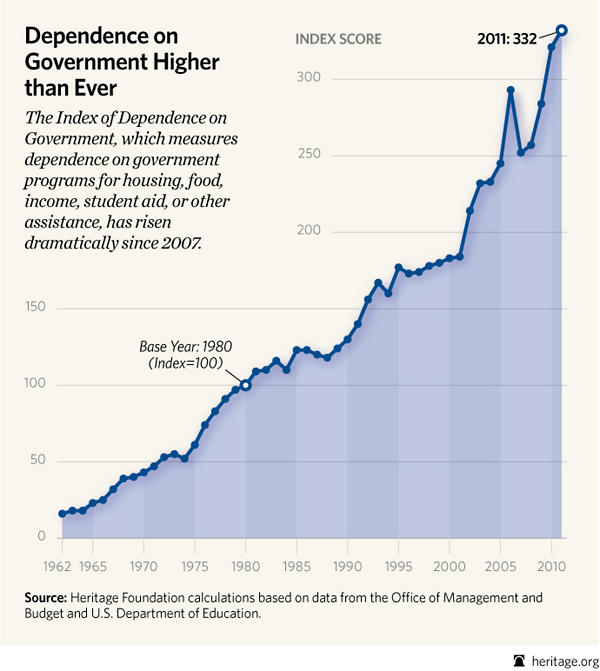
On the other hand, if you are on the receiving end of government benefits, that is likely to color your perception of how taxpayers’ money should be spent. According to the Heritage Foundation’s 2012 Index of Dependence on Government, 63.7 million Americans, or about one in five, is receiving direct government support from Social Security, welfare, or Pell Grants—and that is at its highest level ever. (continues below chart)

These individuals are very likely to be receiving additional benefits from other government programs such as Medicare or Medicaid, food stamps, etc., and the total share of Americans receiving benefits is likely to be even higher when considering benefits available on everything from housing to school lunches. The Wall Street Journal found that in 2011, 49 percent of Americans lived in a household where at least one member of the family received a government benefit.

Heritage has been publishing the Index of Dependence on Government for the past 10 years, and the Center for Data Analysis offered a preview yesterday of what next year’s report will look like, as it updates with the most recent data becoming available for 2011.

The outlook is grim: Government dependency is jumping for the fourth year in a row, and the Index has risen more than 31 percent in that time.

This is bad news for three reasons. First, the economy is so weak that people are going to the government for help. This is a stark repudiation of President Obama’s big-spending, “spread the wealth around” approach, because “giving everyone a shot” does not work unless the “shot” comes at the expense of the taxpayers.

Second, the nation can’t afford to continue increasing spending on these programs, as President Obama has proposed in each of his budgets. Federal spending is exploding—and it is already an eye-popping reality that 70.5 percent of federal spending goes to dependency-creating programs. We are spending more on dependency-creating programs while an ever-shrinking number of taxpayers are paying for them.

But third, and most importantly, it’s bad for Americans. The American Dream is about life, liberty, and the pursuit of happiness, through independence—not dependence on government. Government dependency erodes human dignity and civil society.

These programs were originally designed to help those who fall on hard times and need a safety net. Public policy should head back in that direction. The welfare reform of 1996 helped lift recipients out of poverty and back into jobs by requiring, among other things, that they work. President Obama has undone that requirement. And there are dozens more anti-poverty programs that should be revamped to help those who are able toward self-sufficiency.

At the same time, we must address the looming entitlements crisis: 78 million baby boomers are heading into retirement, and many of them will be entirely dependent on Social Security and Medicare for their income and health care. This dependency is a huge driver of future budget deficits.

We cannot continue on a course of unlimited government spending when fewer and fewer taxpayers are paying for that spending. That is the financial fact. But we also cannot sustain the American Dream on this course—and that is a fact that is intensely personal for every American.

Open letter to President Obama (Part 149)

President Obama c/o The White House
1600 Pennsylvania Avenue NW
Washington, DC 20500

Dear Mr. President,

I know that you receive 20,000 letters a day and that you actually read 10 of them every day. I really do respect you for trying to get a pulse on what is going on out here.

Max Brantley of the Arkansas Times Blog and other liberals like him  brag about the Social Security fund lasting till 2033, but here are the cold hard facts and why don’t you support the best solution to the problem which is private accounts?

Sometimes, Governments Lie (6th Anniversary Ed.)

Posted by Michael F. Cannon

(This blog post first appeared at Cato@Liberty following the release of the 2006 Medicare and Social Security trustees’ reports. I repost it, with updated links and “exhaustion dates” because sadly nothing else has changed.)

Sometimes, Governments Lie

Year after year, federal officials speak of the Social Security and Medicare trust funds as if they were real.  Yesterday Today, the government announced that the Social Security trust fund will be exhausted in 2040 2033 and that the Medicare hospital insurance trust fund will be exhausted in 2018 2024— projections that the media dutifully reported.

But those dates are meaningless, because there are no assets for these “trust funds” to exhaust.  The Bush administration wrote in its FY2007 budget proposal:

These balances are available to finance future benefit payments and other trust fund expenditures—but only in a bookkeeping sense. These funds…are not assets…that can be drawn down in the future to fund benefits…When trust fund holdings are redeemed to pay benefits, Treasury will have to finance the expenditure in the same way as any other Federal expenditure: out of current receipts, by borrowing from the public, or by reducing benefits or other expenditures. The existence of large trust fund balances, therefore, does not, by itself, increase the Government’s ability to pay benefits.

This is similar to language in the Clinton administration’s FY2000 budget, which noted that the size of the trust fund “does not…have any impact on the Government’s ability to pay benefits” (emphasis added).

I offer the following proposition:

If the government knows that there are no assets in the Social Security and Medicare “trust funds,” and yet projects the interest earned on those non-assets and the date on which those non-assets will be exhausted, then the government is lying.

If that’s the case, then these annual trustees reports constitute an institutionalized, ritualistic lie.  Also ritualistic is the media’s uncritical repetition of the lie.

______________

Thank you so much for your time. I know how valuable it is. I also appreciate the fine family that you have and your commitment as a father and a husband.

Sincerely,

Everette Hatcher III, 13900 Cottontail Lane, Alexander, AR 72002, ph 501-920-5733, lowcostsqueegees@yahoo.com

“Tennis Tuesday” David Wheaton (Part 3)

Andre Agassi – 1991 Post-Match Interview

Uploaded by on Jan 25, 2008

This is a post-match interview after a tough loss to fellow American David Wheaton at the 1991 Wimbledon Championships. Andre had the opportunity to close out the match early in the fourth set, but allowed Wheaton to break back forcing them into a tie-breaker. David won the tie-breaker and had momentum going into the fifth which he won with little difficulty. The final score was 3-6, 6-0, 6-2, 6-7, 2-6.

___________________

July 5, 1991 | BILL DWYRE, TIMES SPORTS EDITOR
It was late on the Fourth of July, approaching the twilight’s last gleaming, when David Wheaton of the United States flagged down the last of Andre Agassi’s offerings. Wheaton stepped perfectly into the backhand volley, right shoulder pointed toward his target area in the deep forehand corner of Agassi’s court, and flicked the ball beyond Agassi’s final lunge.

Testimony David Wheaton Tennis

Uploaded by on Sep 23, 2011

Testimony David Wheaton Tennis

_______________

David Wheaton has an excellent show and website at www.Christianworldview.org Below is some material from his website:

How To Be Right With God

Posted by David Wheaton | Wednesday, June 9, 2010 | 3:00 am CT

We consider this page to be the most important page on our site, for there is nothing, absolutely nothing, more important than being right with God.  That is what the first section of this page details.

Further down in the second section, you can read the short story of how David Wheaton (the host and editor of The Christian Worldview) became right with God.

“What must I do to be saved?” This question was asked to one of the followers of Jesus Christ nearly 2000 years ago and is still just as important and relevant of a question for you today.  Have you ever thought about this question?  Do you know the answer to the question?

I would like you to seriously consider this question today because your response will determine how you will live your life and where you will spend eternity after you die.  So please, read this column carefully in its entirety.

“What must I do to be saved?”  Here is how the follower of Jesus answered the question:  “Believe in the Lord Jesus Christ, and you will be saved” (Acts 16:31).

It is a simple response, but what exactly does it mean to “believe in the Lord Jesus Christ”?  And from what do you need to be “saved”?  Let’s answer the latter question first.

SAVED FROM WHAT?

The Bible, which claims to be the inspired word of God (2 Timothy 3:16) and entirely truthful (John 17:17; Psalm 119:160), gives a straightforward answer to what you need to be saved from:  you need to saved from God Himself.

The Bible says that God created and sustains everything in the universe (Genesis 1:1; Job 38:1-41) … including you (Psalm 139:13-16).  It is He who established the unchanging laws of nature and morality.  It is He who has ultimate authority over His creation.  It is He who desires for you to be in a right relationship with Him (1 Timothy 2:3-4).

In addition to being the Creator, God has another title — Judge.  He has established good and righteous laws for our benefit, but sadly you (and I and everyone else) have disobeyed His laws in one way or another: by lying, lusting, gossiping, slandering, envying, coveting, stealing, cheating, using God’s or Jesus’ name as a curse word, or loving someone or something more than God.  Some of God’s laws that we’ve broken are listed in Exodus 20:1-17 (The 10 Commandments) or in Matthew 5 (Jesus’ Sermon on the Mount).  If your violations of God’s laws aren’t resolved on His terms, you will stand before Him as Judge someday.

There will be no injustice in God’s court; no one will get away with any crime against Him; God has seen and recorded in His “books” every single sin ever committed and He will be completely just in pronouncing His sentence.

That is what you need to be saved from: God’s judgment and wrath.  Or to put it the terrifying way one of the final chapters of the Bible does, you need to be saved from God “throwing” you into the “lake of fire” (Revelation 20:15).

While it is certainly true that God is loving, forgiving, merciful, and gracious — as will be shown in the following sections — the Bible also presents God as being full of wrath against those who break His laws and reject His offer of reconciliation.

While many people wrongly conclude that hell isn’t an actual place, “and if it is, a loving God certainly wouldn’t send anyone there,” the Bible states clearly that God, the just Judge of the universe, has the authority, the power, and the intention of sending all those who reject His Son Jesus Christ there.  Consider the following passages from the Bible:

“He who believes in the Son [Jesus Christ] has eternal life; but he who does not obey the Son will not see life, but the wrath of God abides on him” (John 3:36).

“Then I saw a great white throne and Him [God] who sat upon it, from whose presence earth and heaven fled away, and no place was found for them.  And I saw the dead, the great and the small, standing before the throne, and books were opened; and another book was opened, which is the book of life; and the dead were judged from the things which were written in the books, according to their deeds.  And the sea gave up the dead which were in it, and death and Hades gave up the dead which were in them; and they were judged, every one of them according to their deeds.  Then death and Hades were thrown into the lake of fire.  This is the second death, the lake of fire.  And if anyone’s name was not found written in the book of life, he was thrown into the lake of fire” (Revelation 20:11-15).

“God is now declaring to men that all people everywhere should repent, because He has fixed a day in which He will judge the world in righteousness through a Man [Jesus Christ] whom He has appointed, having furnished proof to all men by raising Him from the dead” (Acts 17:30-31).

The concept of God sending those who reject His Son to a literal hell may seem unlikely, unfair, or even crazy to you.  Yet the Bible plainly and consistently speaks of its reality (Luke 16:19-31; 2 Thessalonians 1:8-10) which leaves two options: either hell is real or hell is not real.  Since nothing else in the Bible has ever been proven false — historical events, places, people, prophecies — it would be wise to take the Bible at its word — hell is real.

Being separated from God and punished in hell for eternity should cause everyone to ask, “What can I do to be saved from God sending me there?  The answer is clear: “believe in the Lord Jesus Christ.”

What does that mean though?  Does that simply mean that you believe Jesus existed like some other historical figure, like Plato, Napolean, George Washington, or Alexander the Great, or is there something more to belief than that?

To “believe in the Lord Jesus Christ” is much more than intellectual assent to the fact that He existed; it means that you place your trust, your faith, your expectant hope for being saved in who Jesus is and what He did for you.

WHO IS JESUS CHRIST?

Jesus Christ is without question the most significant person in the history of the world.  The Bible says much about Jesus — that He was born of a virgin woman, that He performed supernatural acts like healing people of diseases and turning water into wine, that He was crucified on a cross and rose from the dead.  Here are a few more things the Bible says about Jesus:

Jesus is the Son of God:

“And the Word [Jesus] became flesh, and dwelt among us, and we saw His glory, glory as of the only begotten from the Father, full of grace and truth” (John 1:14).

Jesus is equal with God:

“In the beginning was the Word [Jesus], and the Word was with God, and the Word was God.  He was in the beginning with God” (John 1:1-2).  “I and the Father are one” – Jesus (John 10:30).

Jesus is the only way to God:

“I am the way, and the truth, and the life; no one comes to the Father but through Me” – Jesus (John 14:6).

“And there is salvation in no one else; for there is no other name under heaven that has been given among men by which we must be saved” (Acts 4:12).

“For there is one God, and one mediator also between God and men, the man Christ Jesus” (1 Timothy 2:5).

WHAT DID JESUS DO FOR YOU?

Jesus is all of the above and much more.  So what did He do for you that He is calling you to believe in?

Jesus lived a perfect life so that He could offer Himself on the cross in your place as the only sacrifice that would satisfy God’s justice for your sin:

“He [God] made Him [Jesus] who knew no sin to be sin on our behalf, so that we might become the righteousness of God in Him” (2 Corinthians 5:21).

“The next day he [John the Baptist] saw Jesus coming to him and said, “Behold, the Lamb of God who takes away the sin of the world!” (John 1:29)

Jesus died so that God could demonstrate His love for sinners and so that God’s just punishment for sin could be placed on Jesus and not on you:

“For while we were still helpless, at the right time Christ died for the ungodly.  For one will hardly die for a righteous man; though perhaps for the good man someone would dare even to die.  But God demonstrates His own love toward us, in that while we were yet sinners, Christ died for us.  Much more then, having now been justified by His blood, we shall be saved from the wrath of God through Him.  (Romans 5:8-9).

“In this is love, not that we loved God, but that He loved us and sent His Son to be the propitiation [i.e. satisfying God’s justice] for our sins” (1 John 4:10).

“And according to the Law, one may almost say, all things are cleansed with blood, and without shedding of blood there is no forgiveness” (Hebrews 9:22).

Jesus rose from the grave and appeared to hundreds of people so that you would have a living Savior and Lord:

“For I delivered to you as of first importance what I also received, that Christ died for our sins according to the Scriptures, and that He was buried, and that He was raised on the third day according to the Scriptures, and that He appeared to Cephas [Peter], then to the twelve.  After that He appeared to more than five hundred brethren at one time, most of whom remain until now, but some have fallen asleep; then He appeared to James, then to all the apostles; and last of all, as to one untimely born, He appeared to me also” (1 Corinthians 15:3-8).

Therefore, to “believe in the Lord Jesus Christ” means to place your trust, your faith, your hope in the person and work of Jesus Christ, whose sinless life and sacrificial death are alone able to reconcile the broken relationship you have created with God as a result of your sins against Him.

PUTTING IT ALL TOGETHER

So let’s go back to the very first question and put it all together: What must you do to be saved?

1. You must agree with God that you have sinned against Him and that you deserve judgment for it.  If your crimes against God aren’t settled on His terms, you will have to pay the awful penalty yourself — eternal separation from God in hell.

“For all have sinned and fall short of the glory of God” (Romans 3:23).

“If we say that we have not sinned, we make Him a liar and His word is not in us” (1 John 1:10).

“For the wages of sin is death, but the free gift of God is eternal life in Christ Jesus our Lord” (Romans 6:23).

2. You must repent of your sin, which means that you turn in a new direction away from your sin and commit to following God, relying on Him for the strength to do so.

“Now after John had been taken into custody, Jesus came into Galilee, preaching the gospel of God, and saying, “The time is fulfilled, and the kingdom of God is at hand; repent and believe in the gospel’ [literally, the good news about Jesus Christ] (Mark 1:14-15).

“God is now declaring to men that all people everywhere should repent, because He has fixed a day in which He will judge the world in righteousness through a Man [Jesus Christ] whom He has appointed, having furnished proof to all men by raising Him from the dead” (Acts 17:30-31).

3. You must respond to and receive God’s merciful and gracious offer to save you and place your faith, hope, trust, belief in Jesus Christ’s righteousness and His perfect sacrifice of Himself on the cross as the only payment God will accept for the sin debt you have accrued against Him and the only means of your being reconciled to Him.

“For God so loved the world, that He gave His only begotten Son, that whoever believes in Him shall not perish, but have eternal life.  For God did not send the Son into the world to judge the world, but that the world might be saved through Him.  He who believes in Him is not judged; he who does not believe has been judged already, because he has not believed in the name of the only begotten Son of God.  This is the judgment, that the Light has come into the world, and men loved the darkness rather than the Light, for their deeds were evil.  For everyone who does evil hates the Light, and does not come to the Light for fear that his deeds will be exposed.  But he who practices the truth comes to the Light, so that his deeds may be manifested as having been wrought in God” (John 3:16-21).

“The Word is near you, in your mouth and in your heart — that is, the word of faith which we are preaching, that if you confess with your mouth Jesus as Lord, and believe in your heart that God raised Him from the dead, you will be saved; for with the heart a person believes, resulting in righteousness, and with the mouth he confesses, resulting in salvation.  For the Scripture says, “whoever believes on Him will not be disappointed.”  For there is no distinction between Jew and Greek [Gentile]; for the same Lord is Lord of all, abounding in riches for all who call on Him; for “whoever will call on the name of the Lord will be saved” (Romans 10:8-13).

4. You must reject any and all of your own supposed good works as completely ineffective to save yourself and mend your separation from God — church attendance, religious activities like communion, baptism, or prayer, charitable giving, personal goodness and kindness, helping the poor and disadvantaged, good intentions, etc.

“Now to the one who works, his wage is not credited as a favor, but as what is due.  But to the one who does not work, but believes in Him who justifies the ungodly, his faith is credited as righteousness” (Romans 4:4-5).

5. You must follow Jesus Christ as your Lord (master) by obeying Him and His Words — this is the evidence of one who is saved.

“My little children, I am writing these things to you so that you may not sin.  And if anyone sins, we have an Advocate with the Father, Jesus Christ the righteous; and He Himself is the propitiation [one who satisfies God’s justice] for our sins; and not for ours only, but also for those of the whole world.  By this we know that we have come to know Him, if we keep His commandments.  The one who says, “I have come to know Him,” and does not keep His commandments, is a liar, and the truth is not in him; but whoever keeps His word, in him the love of God has truly been perfected By this we know that we are in Him: the one who says he abides in Him ought himself to walk in the same manner as He walked” (1 John 2:1-6).

“Not everyone who says to Me, ‘Lord, Lord,’ will enter the kingdom of heaven, but he who does the will of My Father who is in heaven will enter.  Many will say to Me on that day, ‘Lord, Lord, did we not prophesy in Your name, and in Your name cast out demons, and in Your name perform many miracles?’  And then I will declare to them, ‘I never knew you; depart from me, you who practice lawlessness’” (Matthew 7:21-23).

David Wheaton
The Christian Worldview

Phone:  1-888-646-2233 toll-free
Email:  feedback@TheChristianWorldview.org

Related posts:

“Tennis Tuesday” David Wheaton (Part 1)

Testimony David Wheaton Tennis Uploaded by TheTrueSeven on Sep 23, 2011 Testimony David Wheaton Tennis _______________ Wikipedia reports: Country  United States Residence Lake Minnetonka, Minnesota Born June 2, 1969 (1969-06-02) (age 42) Minneapolis, Minnesota Height 1.93 m (6 ft 4 in) Weight 84 kg (190 lb; 13.2 st) Turned pro 1988 Retired 2001 Plays Right-handed Career prize money US$5,238,401 Singles Career record 232–191 […]

“Soccer Saturday” USA beats Italy for first time in soccer

Uploaded by ussoccerdotcom on Feb 29, 2012 The U.S. Men’s National Team defeated Italy for the first time on Wednesday, Feb. 29, 2012 in Genoa. Clint Dempsey’s goal gave the USA the lead and a resilient team defensive performance kept the Italian’s off the scoresheet for a historic win. __________________________ Related posts: Thierry Henry Part […]

“Tennis Tuesday” John McEnroe part 6

McEnroe was McNasty on and off the court By Larry Schwartz Special to ESPN.com “I wanted to spend [the night] with my family and friends and the people who had supported me, not a bunch of stiffs who were 70-80 years old, telling you that you’re acting like a jerk,” says John McEnroe on ESPN […]

“Tennis Tuesday” John McEnroe part 5

Head-to-head [edit] Borg 9–11 McEnroe (7-7 at the main tour) No. Year Tournament Surface Round Winner Score 1 1978 Stockholm Hard SF McEnroe 6–3, 6–4 2 1979 Richmond Carpet SF Borg 4–6, 7–6(10-8), 6–3 3 1979 New Orleans Carpet SF McEnroe 5–7, 6–1, 7–6(8-6) 4 1979 Rotterdam Carpet F Borg 6–4, 6–2 5 1979 Dallas […]

“Tennis Tuesday” John McEnroe part 4

  Born: February 16, 1959 Wiesbaden, Germany American tennis player and television commentator John McEnroe was one of the most successful and high-profile players in the history of tennis. Throughout his career, McEnroe won seventeen Grand Slam titles, seventy-seven career single titles, and seventy-seven doubles titles. Childhood on the court John Patrick McEnroe Jr. was […]

“Tennis Tuesday” John McEnroe part 3

Above is a video I used to like a lot which features MacEnroe’s wife. _________________________ The tennis players Björn Borg and John McEnroe met 14 times at the regular tour during their careers with their on-court rivalry highlighted by their contrasting temperaments and styles.[1] Borg was known for his cool and emotionless demeanor on court, […]

“Tennis Tuesday” John McEnroe part 2

From Wikipedia: John Patrick McEnroe, Jr. (born February 16, 1959) is a former world no. 1 professional tennis player from the United States. During his career, he won seven Grand Slam singles titles (three at Wimbledon and four at the US Open), nine Grand Slam men’s doubles titles, and one Grand Slam mixed doubles title. […]

“Tennis Tuesday” John McEnroe part 1 (Greatest tennis match of all time, versus Borg)

From Wikipedia: McEnroe won a total of 148 ATP titles (a record for a male professional) during his career — 77 in singles, 71 in men’s doubles, and 1 in mixed doubles (not counted as ATP title).He won seven Grand Slam singles titles. He also won a record eight year end championship titles overall, the […]

Andy Roddick retires at US Open “Tennis Tuesday”

Published on Aug 30, 2012 by USOPEN Andy Roddick holds press conference to announce his retirement from professional tennis at the age of 30. Roddick is a former world #1 and won the 2003 US Open. ____________ Juan Carlos Ferrero vs Andy Roddick Final US Open 2003 Highlights Pt. 1 Andy has some impressive stats: […]

“Tennis Tuesday” John McEnroe part 3

Above is a video I used to like a lot which features MacEnroe’s wife. _________________________ The tennis players Björn Borg and John McEnroe met 14 times at the regular tour during their careers with their on-court rivalry highlighted by their contrasting temperaments and styles.[1] Borg was known for his cool and emotionless demeanor on court, […]

“Tennis Tuesday” John McEnroe part 2

From Wikipedia: John Patrick McEnroe, Jr. (born February 16, 1959) is a former world no. 1 professional tennis player from the United States. During his career, he won seven Grand Slam singles titles (three at Wimbledon and four at the US Open), nine Grand Slam men’s doubles titles, and one Grand Slam mixed doubles title. […]

“Tennis Tuesday” John McEnroe part 1 (Greatest tennis match of all time, versus Borg)

From Wikipedia: McEnroe won a total of 148 ATP titles (a record for a male professional) during his career — 77 in singles, 71 in men’s doubles, and 1 in mixed doubles (not counted as ATP title).He won seven Grand Slam singles titles. He also won a record eight year end championship titles overall, the […]

Rebecca Marino “Tennis Tuesday”

Rebecca Marino Interview at Saguenay National Bank Challenger Uploaded by TCtenniscanada on Sep 22, 2010 Rebecca Marino speaks to media following her 2nd round win over fellow Canadian Gabriela Dabrowski at the $50,000 Saguenay National Bank Challenger. ___________________ Wikipedia notes: From Wikipedia, the free encyclopedia Jump to: navigation, search Rebecca Marino Rebecca Marino at the […]

Marina Erakovic “Tennis Tuesday”

One on One With Marina Erakovic Uploaded by ASBClassicvideo on Jan 1, 2011 James McOnie talks with Marina Erakovic and gets some positive reinforcement. __________________________________ From Wikipedia: Jump to: navigation, search Marina Erakovic Erakovic at the 2009 ASB Classic Country  New Zealand Residence Auckland, New Zealand Born 6 March 1988 (1988-03-06) (age 23) Split, SFR Yugoslavia […]

Johanna Larsson “Tennis Tuesday”

From Wikipedia: Johanna Larsson Country  Sweden Residence Helsingborg, Sweden Born 17 August 1988 (1988-08-17) (age 23) Boden, Sweden Height 1.74m (5′ 9″) Weight 66 kg Turned pro 2006 Plays Right-handed (two-handed backhand) Career prize money $449.950 Singles Career record 220–124 Career titles 11 ITF Highest ranking No. 46 (July 11, 2011) Current ranking No. 58 (January […]

Nadia Petrova “Tennis Tuesday”

Petrova Interview Wimbledon 2008 Day 8 Uploaded by MZTennis on Jul 1, 2008 Download Match http://tinyurl.com/579jxq Petrova Wimbledon 2008 Interview Day 8 ________________________________ From Wikipedia: Nadia Petrova Надежда Петрова Country  Russia Residence Miami, USA Born June 8, 1982 (1982-06-08) (age 29) Moscow, Soviet Union Height 1.78 m (5 ft 10 in) Weight 65 kg (140 lb; 10.2 st) Turned pro September 6, 1999 […]

Elena Baltacha “Tennis Tuesday”

Uploaded by HobartInternational on Jan 8, 2011 British star Elena Baltacha talks ahead of the Moorilla Hobart International. The Scotswoman, known as “Bally”, is one of many top international players competing at the WTA AO Series event in the Tasmanian capital. She faces Tamarine Tansugarn in Thailand. __________________________ From Wikipedia: Jump to: navigation, search Elena […]

Bethanie Mattek-Sands “Tennis Tuesday”

2011 Australian Open – Bethanie Mattek-Sands Uploaded by tennis on Jan 24, 2011 In an exclusive interview with USTA.com’s Craig Gabriel from the 2011 Australian Open in Melbourne, American Bethanie Mattek-Sands talks about finding doubles success down under, the atmosphere of the Aussie Open, maintaining a solid ranking, the mindset of trying to qualify, losing […]

“Tennis Tuesday” every week here on www.thedailyhatch.org

Every Tuesday you can find a great post like this one and below you can find some links to past posts. From Wikipedia: McEnroe won a total of 148 ATP titles (a record for a male professional) during his career — 77 in singles, 71 in men’s doubles, and 1 in mixed doubles (not counted […]

“Tennis Tuesday” Top Ten paid tennis players in the world

Here are the top ten paid tennis players in the world: Hey people, here we have this post about the top 10 highest paid tennis players of the world, for a little introduction let me tell you that a sum of $1.7 million is given to men’s and women’s US open champion for the title. […]

Andy Roddick has impressive stats “Tennis Tuesday”

Juan Carlos Ferrero vs Andy Roddick Final US Open 2003 Highlights Pt. 1 Andy has some impressive stats: Serve records: Fastest serve in Australian open: 148 mph . Fastest serve in Dubai: 150 mph. Fastest average in first serve: 134 mph. Fastest serve in Beijing: 148 mph. Fastest serve in San Jose: 150 mph. Fastest serve in Madrid: 151 mph. Fastest […]

James Blake “Tennis Tuesday”

ESPN on James Blake’s tennis career winding down From Wikipedia: James Riley Blake[1] (born December 28, 1979) is an American professional tennis player. Blake is known for his speed and powerful, flat forehand. As of August 2011, Blake is ranked no. 63 among active male players with 24 career finals appearances (10–14 record). His career […]

Lleyton Hewitt “Tennis Tuesday”

Uploaded by TennisAustralia on Sep 16, 2011 Lleyton Hewitt and Roger Federer speak to the media following Federer’s win in the second rubber. _________________________ Wikipedia noted: Lleyton Glynn Hewitt ( /ˈleɪtən ˈhjuːɨt/;[2] born 24 February 1981) is an Australian professional tennis player and former world no. 1. In 2000, Hewitt had won ATP titles on all […]

Radek Stepanek “Tennis Tuesday”

Uploaded by TennisPiu on Feb 23, 2009 Highlights of the final between Andy Roddick and Radek Stepanek of the Regions Morgan Keegan Championships 2009 in Memphis. ______________________________ From Wikipedia: Radek Štěpánek Country  Czech Republic Residence Monte Carlo, Monaco Born 27 November 1978 (1978-11-27) (age 33) Karviná, Czechoslovakia Height 1.85 m (6 ft 1 in) Weight 76 kg (170 lb; 12.0 st) Turned pro […]

David Wheaton, editor

Willie Roaf at Little Rock Touchdown Club Part 1

I enjoyed hearing Willie speak today at the Little Rock Touchdown Club. He actually played with the New Orleans Saints the same time that Wayne Martin did. He got block some NFL greats like Reggie White, Kevin Green and Tim Harris.

Here is a great story about Willie below:

Wright Thompson [ARCHIVE]
ESPN.com
August 4, 2012
Comment on this story
CANTON, Ohio — A party swung all around Willie Roaf’s dad — John Madden holding court, Bill Parcells making a beeline for the ice cream bar, rapper Luther Campbell strolling in late asking for Bacardi Limon — but Cliff Roaf sat on a couch in the corner of the hotel lobby. The night before his son would be inducted into the Pro Football Hall of Fame, he needed to “marinate,” he said, just watch and soak it all in. A woman wandered past, the wife of a Hall of Famer, and when she saw Cliff, she exclaimed, simply, “You’re the daddy!”She’d been there. A few hours before, Cliff and Will — that’s what he calls his son — stood on stage at the civic center for the first event of the induction, the presentation of the gold jacket. As the man who’d introduce his son, Cliff was included, and there in the packed arena, he hugged Will. Only he didn’t let go, and as the hug lasted longer and longer, six or seven seconds, people around the building started to understand. More than a few Hall of Famers wiped their eyes. “Most emotional thing I’ve ever seen,” Joe DeLamielleure said. “There wasn’t a dry eye in the house.”

Back at the hotel, Cliff saw Phoebe Layton, the 95-year-old mother of his late wife — Andree Roaf died three years ago — and he said, “I just wish … ”

Earlier that morning, as the Hall of Fame weekend began, a half dozen members of the Roaf and Layton families hung around their room on the second floor of the McKinley Grand Hotel in downtown Canton. Mostly, they told stories. It was time to laugh and celebrate.

“Willie won a jacket when he left the peewee team,” grandmother Phoebe is saying, cracking everyone up, “and he wanted to sleep in his jacket that night. He was gonna wear it over his pajamas.”

They pull up a cell phone photo of Willie being fitted for his yellow Hall of Fame jacket, size 60 extra long, and the circular nature of life is lost on none of them, a family of overachievers: Willie’s mother was an Arkansas Supreme Court justice, his dad a dentist, one of his sisters a graduate of Georgetown, another a Harvard- and Princeton-educated Episcopal minister. Phoebe, the priest, offered a prayer last night at dinner, and she mentioned all the members of the family who died, a list she repeats in the hotel room: Willie’s mom, three of his grandparents, aunts, uncles.

Cliff speaks up from the corner.

“One of the things that saddens me is that his mother is not here,” he says. “In person … She’s here in spirit. But she did so much for the development of the character of this child, and she put so much into all these children. Even though she was truly an academic and an intellect, she did love sports. And this would just make her heart glow.”

The conversation is about to move on, but Cliff is still thinking about the names from Phoebe’s prayer, remembering those people, and the ones who came before them, the long lines of invisible ghosts that trail each one of us. He thinks about all of their secret desires and struggles, and what started as a hilarious recounting of Big Willie stories is about to become something else entirely.

“I want you to get the essence of what she just said,” he says. “In order for you to understand what she said, I have to go back a little bit in history.”

He apologizes before he even begins, trying to stop himself from turning this into a sermon. The rest of the family sees the passion on his face and falls quiet. The floor is his.

“It starts a long time ago off the west coast of Africa,” he says.

He tells of slave ships, people crammed in so tight they couldn’t sit up, how the “cargo” was thrown overboard if they got sick or if an anti-slave vessel approached. Sharks, he says, learned to follow the boat, and when he describes it, everyone can see the fins lurking in the wake.

The room is silent.

“When we got to America, we had absolutely nothing,” he says. “We had no clothes, no food, no place to go. And now I’m gonna get into my preaching mode. … One of those slaves heard a name, and I don’t know what your religious affiliations are, he heard a name called Jesus. Those people that had nothing had God.”

His voice cracks for the first time when he says “Jesus.”

“And because they called Jesus,” he says, his voice cracking again, “we are sitting in this room and Will Roaf is gonna walk across that stage. Because of Jesus. I know there are people who feel so sophisticated and they are so … ”

Cliff Roaf is crying.

“We didn’t have anything but Jesus,” he sobs, “and Jesus answered the prayers starting way back yonder, and when Will Roaf walks across that stage, for the Layton family and the Roaf family, he is a personification of God’s majesty. For all of my people that grew up as sharecroppers and woodcutters, for all of those people, Will Roaf is the essence of their hopes, their aspirations, and thankfulness to this entity that we call Jesus. I’m gonna get up, because I get a little bit emotional.”

Someone makes a joke about it being dusty in this hotel room.

“No,” he says, his voice strong again, “it’s not dusty. Ain’t no dust in my eyes. It’s an emotion of happiness. It’s an emotion of thankfulness because this wonderful creator did not forget what he promised to generation after generation after generation. God promised people in our families that if we loved him, and served him, and honored him, he would bring blessings to our children and their children and their children. That is what is the essence of Will Roaf.”

Phoebe Layton hugs him. He wipes his eyes with a tissue. He remembers his own father, who worked at a lumberyard, riding a bike or walking every day, making $12 a week. “From my father to me to Will Roaf,” he says, “that went to over $4 million a year. Only in America will you have a grandfather making $12 a week to a grandson making millions. Only here in America.”

His voice cracks again, and he seems one powerful memory away from being unable to continue. He can see his childhood in rural Arkansas, and the road from those hot fields to a hotel room in Canton.

“See, I’m a cotton chopper,” he says, fighting the sobs. “That’s what I am. I grew up in a four-room shack. I didn’t even have a bed to sleep in. I ate out of pot tops and drank out of jelly jars.”

Then he stood up straight and walked out, headed downstairs to a Hall of Fame luncheon with his son — the grandson of a man who chopped wood for two dollars a day.

Cliff’s story, followed by his swift exit, did something to the equilibrium in the room, and in the time it takes to recover, everyone stays quiet.

“I’ve never seen him like that,” Willie’s aunt says finally.

“Things changed a lot since Mom died,” his sister Mary says. “He’s opened up a lot. He’s like that a lot.”

“Willie is nervous,” his aunt says, “and your dad is emotional.”

The following night, the introduction video plays on huge screens, telling the story of Willie’s rise from a skinny kid in Pine Bluff, Ark., to this stage.

The star of the film is Cliff.

The crowd laughs when he remembers talking Willie out of a future in basketball, guiding him toward football instead, which had been Cliff’s game in college. “I knew if Will ate the way I ate,” he says, smiling, “he was gonna put on weight.”

Near the end, though, Cliff voice starts to change. His family knows why.

“Will played the game because he loved it,” he says, fighting his emotions. “Normally the father is the hero to the son but in this case, the son is the hero to the father. When Will Roaf and I walk across that stage in Canton, Ohio, it means that I’ve made it. I am honored to present my son, Will Roaf, for enshrinement into the Pro Football Hall of Fame.”

They walk out together and the crowd rises. Cliff’s lip quivers. For all the years Will played football, in college, then in New Orleans and Kansas City, Cliff drove to every game. When each one ended, he waited to speak to Will, then turned around and drove back home. During almost two decades, he missed only one game.

He’s been there every step of the way, guiding, sacrificing, dreaming, and they have arrived here together, on a green stage, just before sundown. They hug, and like the night before, he doesn’t want it to end, gripping his son, patting him on the shoulder. Cliff finally lets him go and walks toward the back of the stage.

Willie stands alone at the microphone and begins his speech.

Related posts:

Willie Roaf at Little Rock Touchdown Club Part 2

I really enjoyed the Little Rock Touchdown Club on Monday Oct 1, 2012. He was passed over by the Razorbacks and other big time schools because of his size but he turned out to be a very special player. Jim Harris: Willie Roaf Stands Tall For Pine Bluff, State As NFL Hall Of Famer by […]

Willie Roaf at Little Rock Touchdown Club Part 1

I enjoyed hearing Willie speak today at the Little Rock Touchdown Club. He actually played with the New Orleans Saints the same time that Wayne Martin did. He got block some NFL greats like Reggie White, Kevin Green and Tim Harris. Here is a great story about Willie below: Willie Roaf’s road to greatness Wright […]

John L. Smith speaks to Little Rock Touchdown Club (part1)

I enjoyed the speech today. It was extremely short then he took questions. Here is a rundown from Arkansas Sports 360. John L. Smith Was Apparently John L. Smith Today At The Little Rock Touchdown Club <!– 51 –> by ArkansasSports360.com Staff 9/24/2012 at 1:04pm Image by Trent Ogle John L. Smith is apparently being […]

John L. Smith to speak today at Little Rock Touchdown Club

John L. Smith is to speak at the Little Rock Touchdown Club on Monday Sept 24, 2011. I am proud of him for showing up. Bill Vickery had some comments on the debacle on Saturday. Vickery said it totally removed the earlier nightmare he had since he was 7 years old when he witnessed his […]

Randy White speaks to Little Rock Touchdown Club Part 2

Randy White spoke at the Little Rock Touchdown Club yesterday. He did a great job. I have always been a big Dallas Cowboy fan. Here is a story from Arkansas Sports 360: HOW ‘BOUT THEM COWBOYS: The Touchdown Club welcomed Randy White to town this Monday. The former Dallas Cowboy defensive tackle is one of […]

Randy White speaks to Little Rock Touchdown Club Part 1

I have written a lot about the Dallas Cowboys in the past. One of my favorite stories is getting to ask Pat Summerall a question about Tom Landry and his answer was a classic one.  I simply asked him if he had a chance to interact with any Christian Coaches like Tony Dungy or Tom […]

Matt Jones speaks at Little Rock Touchdown Club Part 2

I got to see Matt Jones speak on 9-10-12 at the Little Rock Touchdown Club and I was proud of him for opening up concerning what brought his career to an end. Drugs can derail a great career. Take a look at what happened to Matt Jones: Taken in the first round by the Jacksonville […]

Matt Jones speaks at Little Rock Touchdown Club Part 1

My son Hunter and I got to hear Matt Jones speak on 9-10-12 at the Little Rock Touchdown Club. When asked about what to do when you are up against a wall like this team is, he responded that he remembers how it felt to lose in the 6 overtime game in Knoxville and to […]

Howard Schnellenberger speaks at Little Rock Touchdown Club Part 4

I got to hear Howard Schnellenberger speak on Sept 4, 2012 at the Little Rock Touchdown Club. I did not know that he played football for the University of Kentucky. In fact, just last year Kentucky ended a long losing streak to Tennessee by winning in Lexington. Schnellenberger was responsible for catching the winning touchdown […]

Howard Schnellenberger speaks at Little Rock Touchdown Club Part 3

I got to hear Howard Schnellenberger speak at the Little Rock Touchdown Club on Tuesday Sept 4, 2012. Schnellenberger was good at building programs. Ex-coach enjoyed building programs By Jeff Halpern Posted: September 5, 2012 at 5:10 a.m. Staton Breidenthal Howard Schnellenberger speaks Tuesday at the Little Rock Touchdown Club. LITTLE ROCK — Howard Schnellenberger […]

The impact of Francis Schaeffer on the pro-life community

Three of my role models are President Ronald Reagan, Economist Milton Friedman and Christian Philosopher Francis Schaeffer. Let me share with you something I read the other day. President Ronald Reagan summed up Francis Schaeffer’s life nicely when he said “It can rarely be said of an individual that his life touched many others and affected them for the better; it will be said of Dr. Francis Schaeffer that his life touched millions of souls and brought them to the truth of their Creator.”

I also read what a great impact Schaeffer had on Jerry Falwell. Today I read Max Brantley of the Arkansas Times quote Schaeffer’s misguided son Frankie. It is truly sad that Frankie has gone off the deep end.

Francis Schaffer has a long history of taking up for the unborn children and he has deeply affected the pro-life movement. Below are some examples of his work.

Part 1

Part 2

Francis and Edith Schaeffer January 1975
Huemoz sur Ollon at L’abri, Switzerland

America has some big choices to make and Francis Schaeffer does a great job of showing what the problems are and what choices we have. Below is a portion of this episode with links below to the complete episodes:

E P I S O D E 1 0

How Should We Then Live 10#1

FINAL CHOICES

I. Authoritarianism the Only Humanistic Social Option

One man or an elite giving authoritative arbitrary absolutes.

A. Society is sole absolute in absence of other absolutes.

B. But society has to be led by an elite: John Kenneth Galbraith, Robert Theobald.

C. Daniel Bell’s prophecy of technocratic elite.

D. Bell’s warning of cultural contradiction: no absolute ethic to accompany absolute power.

II. Nature of the New Authoritarianism

A. Do not think of the model of Hitler and Stalin.

B. Probably a manipulative, authoritarian elite.

III. Possible Forms of Manipulation

A. Review from Episode Six: Koestler—chemical agents; Krantz—birth control in world’s drinking supply; Clark—political leaders should take anti-aggression pills; Lee—psychological tests for public officials; Skinner—reinforcers to modify behavior.

B. Genetic condition: Francis Crick.

1. He advocates:

a) That some group of people is to decide who should be the parents of the next generation and who should be born.

b) That some group of people should determine what kind of people they want in the future and will set out genetically to make them.

2. Once Man is no longer seen as made in God’s image, there is no reason not to “tinker” with Man genetically.

C. The mass media.

1. TV conditions by selective editing. Illustration: simulated riot filmed in San Jose.

2. No collusion needed if views of elite and newsmakers coincide. Media not monolithic, but total control not needed to achieve manipulation.

IV Authoritarianism in Government. Illustration: United States

A. The dilemma of people who speak out for civil liberties but are also committed to the government’s having a responsibility to solve every problem.

B. Christian freedoms without Christian base produce chaos.

C. In the United States an authoritarian, manipulating government could come from the administrative (executive) side, the legislature, or from the courts functioning on variable, sociological law.

President Obama’s car manufacturing company

Published on Sep 3, 2012 by

Obama is citing his bailout of General Motors as proof that other industries should receive bailouts. Is Obama adopting the central planning principles of Joseph Stalin? Find out as Terry Jones of IBD and Doug Altner of the Ayn Rand Center discuss industrial policy and Obama’s plans for American industry.

_______________

The federal government needs to get out of the way it seems when it comes to making cars. No one can do any worse in my view.

While I often complain about government waste and stupidity, I’m not even sure what to say about this grim bit of news from Reuters.

General Motors Co sold a record number of Chevrolet Volt sedans in August — but that probably isn’t a good thing for the automaker’s bottom line. Nearly two years after the introduction of the path-breaking plug-in hybrid, GM is still losing as much as $49,000 on each Volt it builds, according to estimates provided to Reuters by industry analysts and manufacturing experts. Cheap Volt lease offers meant to drive more customers to Chevy showrooms this summer may have pushed that loss even higher. There are some Americans paying just $5,050 to drive around for two years in a vehicle that cost as much as $89,000 to produce. …The weak sales are forcing GM to idle the Detroit-Hamtramck assembly plant that makes the Chevrolet Volt for four weeks from September 17, according to plant suppliers and union sources. It is the second time GM has had to call a Volt production halt this year. GM acknowledges the Volt continues to lose money, and suggests it might not reach break even until the next-generation model is launched in about three years.

Gee, it’s almost as if everything that critics have said all along is right.

But not to worry, taxpayers are underwriting the costs. So if bigger subsidies are the price of buying support from the UAW and allowing fat-cat incompetent managers to stay on the job, that just means a bigger tab to pay for the rest of us.

How comforting.

P.S. If you’re a taxpayer and need to be cheered up, these cartoons may help.

P.P.S. This spoof video on the Volt may be even funnier.

P.P.P.S. Last but not least, Government Motors plans to build on the success of the Volt with the Obummer. It was due in 2011, but standard government incompetence has pushed back the release date.

Open letter to President Obama (Part 148B)

Milton Friedman: Free To Choose – The Failure Of Socialism With Ronald Reagan (Full)

Published on Mar 19, 2012 by

_________

President Obama c/o The White House
1600 Pennsylvania Avenue NW
Washington, DC 20500

Dear Mr. President,

I know that you receive 20,000 letters a day and that you actually read 10 of them every day. I really do respect you for trying to get a pulse on what is going on out here.

Milton Friedman’s writings affected me greatly when I first discovered them and I wanted to share with you. Pay attention to the words of Gary Becker too. He is very good.

Ronald Reagan introduces this program, and traces a line from Adam Smith’s “The Wealth of Nations” to Milton Friedman’s work, describing Free to Choose as “a survival kit for you, for our nation and for freedom.” Dr. Friedman travels to Hungary and Czechoslovakia to learn how Eastern Europeans are rebuilding their collapsed economies. His conclusion: they must accept the verdict of history that governments create no wealth. Economic freedom is the only source of prosperity. That means free, private markets. Attempts to find a “third way” between socialism and free markets are doomed from the start. If the people of Eastern Europe are given the chance to make their own choices they will achieve a high level of prosperity. Friedman tells us individual stories about how small businesses struggle to survive against the remains of extensive government control. Friedman says, “Everybody knows what needs to be done. The property that is now in the hands of the state, needs to be gotten into the hands of private people who can use it in accordance with their own interests and values.” Eastern Europe has observed the history of free markets in the United States and wants to copy our success. After the documentary, Dr. Friedman talks further about government and the economy with Gary Becker of the University of Chicago and Samuel Bowles of the University of Massachusetts. In a wide-ranging discussion, they disagree about the results of economic controls in countries around the world, with Friedman defending his thesis that the best government role is the smallest one.
___________
Below is a portion of the transcript of the program and above you will find the complete video of the program:
 

DISCUSSION

Hello, I am Linda Chavez and welcome to Free to Choose. Joining Dr. Friedman for a discussion of the failure of socialism are Gary Becker from the University of Chicago and Samuel Bowles of the University of Massachusetts. Dr. Bowles, I think we can all agree that socialism has failed Eastern Europe. Dr. Friedman believes that the path out of that is the free market and I think he thinks there are lessons for the United States.

Chavez: I would like to bring this discussion back to the United States for a moment. What about socialism in the United States. There has been one area where we have tried to redistribute wealth. We have done that through our welfare policies and social security. Has that worked?

Friedman: For some people, it benefited, but taken as a whole, I think it has been a failure.

Becker: I agree with that. I think the big problem in the United States has been, of course, some of the welfare programs have been successful. But by trying to do too many things, the government is no longer doing the things that it should be doing. We all agree there are many things government should be doing. I agree with Milton __ he is a strong man to be say this is an issue between no government and 100% government. The question is what are the tasks that government should be doing. I believe the tasks are, of course, defense against outside aggression, internal protection, some infrastructure, protection of the people can’t make it. In every one of these areas, we are not doing very well. I think we are not doing well mainly because we are trying to do a lot of things we shouldn’t be doing. They can’t do all of them.

Chavez: I couldn’t help but think, Dr. Bowles, as I watched that film that the public housing area that we saw in Eastern Europe and the problems that we have here in the United States. Aren’t there some lessons to be learned?

Bowles: There is absolutely no reason why housing shouldn’t be privately owned. That does not mean that the government has no role in housing. It seems to me that housing is precisely something that ought to be a matter of private property. But we also know, from the experience of this country, that the market itself doesn’t provide housing that the rest of the public thinks is adequate for the vast majority of poor people in this country. Now that doesn’t mean it has to be done by government building the houses, but it certainly does mean that something has to be done or we are going to have the kind of homeless crisis that we have in this country and they are getting one in Eastern Europe too.

Becker: The homeless crisis is a tiny fraction of the population of the United States. Let’s not make that a major part of the housing problem in the United States. I am not at all convinced that there is any evidence suggesting that the private system cannot provide adequate housing. I think there is a good case to be made that there are poor people in this country and the government obviously has to help them out. We all agree on that. But should they be doing it by building housing or by giving them income and permitting them to spend as they see fit. I see no evidence from the U.S. or any other country who were better off when then government takes a major role in housing or any of these other particular activities that allocate resources.

Friedman: What role has been played in the difficulty of getting housing by government interventions? By rent control? By excessive building code regulations, many of which are designed to protect the interests of special groups. Government played a very large role.

______________

Thank you so much for your time. I know how valuable it is. I also appreciate the fine family that you have and your committment as a father and a husband.

Sincerely,

Everette Hatcher III, 13900 Cottontail Lane, Alexander, AR 72002, ph 501-920-5733, lowcostsqueegees@yahoo.com

I really enjoyed this documentary on Woody Allen from PBS.

I really enjoyed this documentary on Woody Allen from PBS.

Woody Allen: A Documentary, Part 1

Published on Mar 26, 2012 by

Beginning with Allen’s childhood and his first professional gigs as a teen – furnishing jokes for comics and publicists – WOODY ALLEN: A DOCUMENTARY chronicles the trajectory and longevity of Allen’s career: from his work in the 1950s-60s as a TV scribe for Sid Caesar, standup comedian and frequent TV talk show guest, to a writer-director averaging one film-per-year for more than 40 years. Director Bob Weide covers Allen’s earliest film work in “Take the Money and Run,” “Bananas,” “Sleeper,” and “Love and Death”; frequent Oscar® favorites such as “Annie Hall,” “Manhattan,” “Zelig,” “Broadway Danny Rose,” “Purple Rose of Cairo,” “Crimes and Misdemeanors,” “Husbands & Wives,” “Bullets Over Broadway,” and “Mighty Aphrodite”; and his recent globetrotting phase with “Match Point,” “Vicky Christina Barcelona,” and his latest success “Midnight in Paris.”

Woody Allen: A Documentary, Part 2

Italy Woddy Allen New Film

US Director Woody Allen is seen in central Rome, Thursday, July 14, 2011, during the shooting of his latest movie “The Bop Decameron”. Spanish actress Penelope Cruz will act in the comedy that will also feature among others Roberto Benigni, Jesse Eisenbergh, Ellen Page and Judy Davis. (AP Photo/Andrew Medichini)

 Fine article below:

 Woody Allen searches for meaning of life in new documentaryBY NEAL JUSTIN • Minneapolis Star Tribune stltoday.com
 
November 19, 2011 2:15 pm  •  BY NEAL JUSTIN • Minneapolis Star Tribune

Early in PBS’ “Woody Allen: A Documentary,” a two-part film made with the subject’s cooperation, the young comic is seen on a variety of talk shows, doing a falsetto voice on a game show, boxing a real kangaroo and dueting with a talking dog. “Nothing was beneath me,” recalls Allen.

Fans may consider Allen one of the most consistent, entertaining filmmakers ever to pick up a camera. Others may have dismissed him as a creep after he married his girlfriend’s adopted daughter.

But the Allen in this 3 1/2-hour piece, directed by Robert Weide, is a comic who would once do anything to get to the top, even if it meant getting clobbered by an angry marsupial.

Weide’s running theme — as he explores Allen’s canon and interviews dozens of big names, including Diane Keaton, ex-wife Louise Lasser, Martin Scorsese and Mira Sorvino — is that Allen is always looking for the meaning of life.

In the early days, he thought he could come closest by getting laughs, either as a gag writer for New York newspapers while still in high school, or by doing rapid-fire bits on “The Dick Cavett Show.”

The film suggests that Allen changed tactics after the first film he wrote, “What’s New Pussycat?” He was dismayed by the finished product, and vowed to direct — and control — his own work after that. For better or worse, that’s exactly what he’s done.

Sean Penn talks about being petrified that Allen was going to fire him after his first week on “Sweet and Lowdown.” Penn kept his job, and nabbed an Oscar nomination.

Weide, best known as a regular director on “Curb Your Enthusiasm,” doesn’t sugarcoat the disasters, most notably “Stardust Memories.” He even explores Allen’s relationship with wife Soon-Yi Previn.

The result is a film that will give Allen fans whole new reasons to gush — and detractors some fresh ammunition.


‘Woody Allen: A Documentary,’ 8 p.m. Sunday and Monday on PBS

Music Monday:Religion and Chris Martin part 5

Coldplay “paradise” Dallas Texas 6/22/12 ( Floor View )

Published on Jun 23, 2012 by

Awesome concert

Coldplay brought confetti, lights and thousands of fans to the American Airlines Center; see photos from their colorful show


9/11

Chris Martin was brought up as an evangelical Christian but he left the faith once he left his childhood home. However, there are been some actions in his life in the last few years that demonstrate that he still is grappling with his childhood Chistian beliefs. This is the fifth part of a series I am starting on this subject.

On June 23, 2012 my son Wilson and I got to attend a Coldplay Concert in Dallas. It was great.

In the past four years I have written many posts concerning the spiritual meaning of the Coldplay songs. There is something going on with them. 

Rare picture: Elusive couple Gwyneth Paltrow and Chris Martin are photographed together at a beach party in the Hamptons

Elusive: Gwyneth Paltrow and Chris Martin in a rare shot together at a beach party in the Hamptons

 
I told you guys earlier that in 2008 Coldplay and Chris in particular was on a spiritual search. I predicted that it would continue. With the song “Major Minus” we have some very interesting lyrics. Take a look:

_______

Coldplay – ” Major Minus ” ( Mylo Xyloto ) HQ Live @ Rock am Ring festival : Germany

Uploaded by on Jun 4, 2011

First Live recorded HQ performance of the New Coldplay Official song of the ” MYLO XYLOTO ” Studio Album released the 24th October of 2011 Worldwide

_______

They got one eye on what you knew

And one eye on what you do
So be careful who it is you’re talking to

They got one eye on what you knew
And one eye on what you do
So be careful what it is you’re trying to do

And be careful when you’re walking in the view
Just be careful when you’re walking in the view!

Ooh-oooh-oooh
Ooh-oooh-oooh-ooh
Got one eye on the road and one on you!

Ooh-oooh-oooh
Ooh-oooh-oooh-ooh
Got one eye on the road and one on

They got one eye on what you knew
And one eye on what you do
So be careful ’cause nothing they say is true

But they don’t believe a word
It’s just us against the world
And we just gotta turn up to be heard 

Hear those crocodiles ticking ’round the world
Hear those crocodiles ticking (they go) ticking ’round the world

Ooh-oooh-oooh
Ooh-oooh-oooh-ooh
Got one eye on the road and one on you!
Ooh-oooh-oooh
Ooh-oooh-oooh-ooh
Got one eye on the road.

She can’t hear them climbing the stairs
I got my right side fighting
While my left eye’s on the chairs

Ooh-oooh-oooh
Ooh-oooh-oooh-ooh
Got one eye on the road and one on you!

Ooh-oooh-oooh
Ooh-oooh-oooh-ooh
Got one eye on the road and one on you

___________________________________

Here are the main points of the song.

1. Heaven is watching us constantly. (They got one eye on what you knew,And one eye on what you do)

2. We should be careful because what we do does matter to God. (And be careful when you’re walking in the view, Just be careful when you’re walking in the view!)

3. There are dangers in this world that you must avoid because they will eat you up.(Hear those crocodiles ticking ’round the world, Hear those crocodiles ticking (they go) ticking ’round the world )

4.Chris Martin’s plan is to keep one eye on the road ahead and one on the wife that he loves. (Got one eye on the road and one on you!)

___________________________

 Feel free to share with me your thoughts.

Coldplay brought confetti, lights and thousands of fans to the American Airlines Center; see photos from their colorful show


11/11  
Coldplay brought confetti, lights and thousands of fans to the American Airlines Center; see photos from their colorful show


10/11

Videos by Cato Institute on failed stimulus plans

In this post I have gathered several videos from the Cato Institute concerning the subject of failed stimulus plans.

_____

Government Spending Doesn’t Create Jobs

Uploaded by on Sep 7, 2011

Share this on Facebook: http://on.fb.me/qnjkn9 Tweet it: http://tiny.cc/o9v9t

In the debate of job creation and how best to pursue it as a policy goal, one point is forgotten: Government doesn’t create jobs. Government only diverts resources from one use to another, which doesn’t create new employment.

Video produced by Caleb Brown and Austin Bragg.

___________________________

Keynesian Catastrophe: Big Money, Big Government & Big Lies

Uploaded by on Jan 19, 2012

The Cato Institute’s Dan Mitchell explains why Obama’s stimulus was a flop! With Glenn Reynolds.

See more at http://www.pjtv.com and http://www.cato.org

___________________

Keynesian Economics Is Wrong: Bigger Gov’t Is Not Stimulus

Uploaded by on Dec 15, 2008

Based on a theory known as Keynesianism, politicians are resuscitating the notion that more government spending can stimulate an economy. This mini-documentary produced by the Center for Freedom and Prosperity Foundation examines both theory and evidence and finds that allowing politicians to spend more money is not a recipe for better economic performance.

___________________

Obama’s So-Called Stimulus: Good For Government, Bad For the Economy

Uploaded by on Jan 26, 2009

President Obama wants Congress to dramatically expand the burden of government spending. This CF&P Foundation mini-documentary explains why such a policy, based on the discredited Keynesian theory of economics, will not be successful. Indeed, the video demonstrates that Obama is proposing – for all intents and purposes – to repeat Bush’s mistakes. Government will be bigger, even though global evidence shows that nations with small governments are more prosperous.

____________

Big Government Is Not Stimulus: Why Keynes Was Wrong (The Condensed Version)

Uploaded by on Jan 13, 2009

The CF&P Foundation has released a condensed version of our successful mini-documentary explaining why so-called stimulus schemes do not work. Based on a theory known as Keynesianism, politicians are resuscitating the notion that more government spending can stimulate an economy. This mini-documentary produced by the Center for Freedom and Prosperity Foundation examines both theory and evidence and finds that allowing politicians to spend more money is not a recipe for better economic performance.

_________________

Eight Reasons Why Big Government Hurts Economic Growth

Uploaded by on Aug 17, 2009

This Center for Freedom and Prosperity Foundation video analyzes how excessive government spending undermines economic performance. While acknowledging that a very modest level of government spending on things such as “public goods” can facilitate growth, the video outlines eight different ways that that big government hinders prosperity. This video focuses on theory and will be augmented by a second video looking at the empirical evidence favoring smaller government.

___________________

Keynesian Economics Is Wrong: Economic Growth Causes Consumer Spending, Not the Other Way

Uploaded by on Nov 29, 2010

Politicians and journalists who fixate on consumer spending are putting the cart before the horse. Consumer spending generally is a consequence of growth, not the cause of growth. This Center for Freedom and Prosperity video helps explain how to achieve more prosperity by looking at the differences between gross domestic product and gross domestic income. www.freedomandprosperity.org

_____________

Deficits, Debts and Unfunded Liabilities: The Consequences of Excessive Government Spending

Uploaded by on May 10, 2010

Huge budget deficits and record levels of national debt are getting a lot of attention, but this video explains that unfunded liabilities for entitlement programs are Americas real red-ink challenge. More important, this CF&P mini-documentary reveals that deficits and debt are symptoms of the real problem of an excessive burden of government spending. www.freedomandprosperity.org

___________

Now that I have been critical of the Democrat President, I wanted to show that I am not concerned about taking up for Republicans but looking at the facts. President Clinton did increase government spending at a slower rate than many other presidents. Here are two  videos that praise both Reagan and Clinton for both accomplished this feat.

Spending Restraint, Part I: Lessons from Ronald Reagan and Bill Clinton

Uploaded by on Feb 14, 2011

Ronald Reagan and Bill Clinton both reduced the relative burden of government, largely because they were able to restrain the growth of domestic spending. The mini-documentary from the Center for Freedom and Prosperity uses data from the Historical Tables of the Budget to show how Reagan and Clinton succeeded and compares their record to the fiscal profligacy of the Bush-Obama years.

______________

Spending Restraint, Part II: Lessons from Canada, Ireland, Slovakia, and New Zealand

Uploaded by on Feb 22, 2011

Nations can make remarkable fiscal progress if policy makers simply limit the growth of government spending. This video, which is Part II of a series, uses examples from recent history in Canada, Ireland, Slovakia, and New Zealand to demonstrate how it is possible to achieve rapid improvements in fiscal policy by restraining the burden of government spending. Part I of the series examined how Ronald Reagan and Bill Clinton were successful in controlling government outlays — particularly the burden of domestic spending programs. www.freedomandprosperity.org

______________

It seems that liberals will never wake up. On 3-8-12 a Arkansas Times blogger pointed out that Obama’s stimulus in 2009 was not made up of just increased but also tax cuts. That is true but the real truth is that there have been about 1/2 dozen stimulus efforts by President Obama and all of them have failed.  Over and over they have tried stimulus plans but they don’t work. Take a look at this excellent article from the Cato Institute:

Keynesian Policies Have Failed

by Chris Edwards

Chris Edwards is the director of tax policy studies at the Cato Institute and the editor of Downsizing Government.org.

Added to cato.org on December 2, 2011

This article appeared on U.S. News & World Report Online on December 2, 2011

Lawmakers are considering extending temporary payroll tax cuts. But the policy is based on faulty Keynesian theories and misplaced confidence in the government’s ability to micromanage short-run growth.

In textbook Keynesian terms, federal deficits stimulate growth by goosing “aggregate demand,” or consumer spending. Since the recession began, we’ve had a lot of goosing — deficits were $459 billion in 2008, $1.4 trillion in 2009, $1.3 trillion in 2010, and $1.3 trillion in 2011. Despite that huge supposed stimulus, unemployment remains remarkably high and the recovery has been the slowest since World War II.

Policymakers should ignore the Keynesians and their faulty models, and instead focus on reforms to aid long-run growth…

Yet supporters of extending payroll tax cuts think that adding another $265 billion to the deficit next year will somehow spur growth. That “stimulus” would be on top of the $1 trillion in deficit spending that is already expected in 2012. Far from helping the economy, all this deficit spending is destabilizing financial markets, scaring businesses away from investing, and imposing crushing debt burdens on young people.

For three years, policymakers have tried to manipulate short-run economic growth, and they have failed. They have put too much trust in macroeconomists, who are frankly lousy at modeling the complex workings of the short-run economy. In early 2008, the Congressional Budget Office projected that economic growth would strengthen in subsequent years, and thus completely missed the deep recession that had already begun. And then there was the infamously bad projection by Obama’s macroeconomists that unemployment would peak at 8 percent and then fall steadily if the 2009 stimulus plan was passed.

Chris Edwards is the director of tax policy studies at the Cato Institute and the editor of Downsizing Government.org.


More by Chris Edwards

Some of the same Keynesian macroeconomists who got it wrong on the recession and stimulus are now claiming that a temporary payroll tax break would boost growth. But as Stanford University economist John Taylor has argued, the supposed benefits of government stimulus have been “built in” or predetermined by the underlying assumptions of the Keynesian models.

Policymakers should ignore the Keynesians and their faulty models, and instead focus on reforms to aid long-run growth, which economists know a lot more about. Cutting the corporate tax rate, for example, is an overdue reform with bipartisan support that would enhance America’s long-run productivity and competitiveness.

If Congress is intent on cutting payroll taxes, it should do so within the context of long-run fiscal reforms. One idea is to allow workers to steer a portion of their payroll taxes into personal retirement accounts, as Chile and other nations have done. That reform would feel like a tax cut to workers because they would retain ownership of the funds, and it would begin solving the long-term budget crisis that looms over the economy.

Related posts:

Stimulus plans do not work (part 2)

Dan Mitchell discusses the effectiveness of the stimulus Uploaded by catoinstitutevideo on Nov 3, 2009 11-2-09 When I think of all our hard earned money that has been wasted on stimulus programs it makes me sad. It has never worked and will not in the future too. Take a look at a few thoughts from […]

Stimulus plans do not work (Part 1)

Government Spending Doesn’t Create Jobs Uploaded by catoinstitutevideo on Sep 7, 2011 Share this on Facebook: http://on.fb.me/qnjkn9 Tweet it: http://tiny.cc/o9v9t In the debate of job creation and how best to pursue it as a policy goal, one point is forgotten: Government doesn’t create jobs. Government only diverts resources from one use to another, which doesn’t […]

Dumas thinks we don’t need Balanced Budget Amendment but should balance it on our own

In his recent article Ernie Dumas sticks to his guns that we should balance the budget without being forced to with a “Balanced Budget Amendment,” but I wonder how well that has worked so far? I have made this a key issue for this blog in the past as you can tell below: Dear Senator […]

Maybe the “Occupy Wall Street” crowd should be angry at Obama

(Picture from Arkansas Times Blog) When I think about all the anger and hate coming from the Occupy Wall Street crowd, I wonder if they have read this story below? Solyndra: Crooked Politics or Just Bad Economics? Posted by David Boaz Amy Harder has a good take on the Solyndra issue in National Journal Daily […]

Dear Senator Pryor, why not pass the Balanced Budget Amendment? (Part 13 Thirsty Thursday, Open letter to Senator Pryor)

Dear Senator Pryor, why not pass the Balanced Budget Amendment? (Part 13 Thirsty Thursday, Open letter to Senator Pryor) Office of the Majority Whip | Balanced Budget Amendment Video In 1995, Congress nearly passed a constitutional amendment mandating a balanced budget. The Balanced Budget Amendment would have forced the federal government to live within its […]

Mark Pryor not for President’s job bill even though he voted for it

Andrew Demillo pointed this out  and also Jason Tolbert noted: PRYOR OPPOSES THE OBAMA JOBS BILL THAT HE VOTED TO ADVANCE  Sen. Mark Pryor has been traveling around the state touting a six-part jobs plan that he says “includes a number of bipartisan initiatives, is aimed at creating jobs by setting the table for growth, encouraging new […]

Is a lack of money the problem for our public schools?

Is a lack of money the problem for our public schools? Everything You Need to Know About Public School Spending in Less Than 2½ Minutes Posted by Adam Schaeffer Neal McCluskey gutted the President’s new “Save the Teachers” American Jobs Act sales pitch a good while back, as did Andrew Coulson here. Thankfully, it seems […]