Yearly Archives: 2012

Should we still be making horse-drawn buggies today instead of cars?

The Arkansas Times jumped on this story as many other liberals outlets.

Change in the marketplace is driven by the wants and needs of consumers. Are we to protect the jobs of those who work for companies that want to cling to the past?

I posted about this before but I have decided to revisit this issue. Below is liberal piece by Newt on Romney followed by a great article that sets the record straight.

What Happened to the GOP’s Free-Market Principles?

by David Boaz 

David Boaz is the executive vice president of the Cato Institute and has played a key role in the development of the Cato Institute and the libertarian movement.

Added to cato.org on January 13, 2012

This article appeared in Daily Caller on January 13, 2012.


You expect Democrats to accuse former businessman Mitt Romney of “putting profits over people — making a buck or a few million of them no matter what it took or who it hurt,” as Democratic National Committee spokesman Brad Woodhouse did in releasing a new Web video.

But it’s sad to see the economic ignorance displayed by Romney’s Republican rivals. Rick Tyler, long the closest aide to Newt Gingrich who is now running the pro-Gingrich super PAC, Winning Our Future, declares, “His business success comes from raiding and destroy businesses — putting people out of work, stealing their health care.” The PAC’s ad calls Romney “a predatory corporate raider.”

Gingrich himself says that Romney’s work buying and selling companies at the investment firm Bain Capital was comparable to “rich people figuring out clever legal ways to loot a company.”

Rick Perry ran TV ads in Iowa saying that Romney “made millions buying companies and laying off workers.”

Somehow the candidates of the party that claims to defend free enterprise and a dynamic economy are railing against economic change in action.

Somehow the candidates of the party that claims to defend free enterprise and a dynamic economy are railing against economic change in action.

In a growing economy, companies succeed and fail every day. Technology changes. Consumer tastes change. New competitors offer a better product or a better price. Raw materials or labor becomes too expensive. Some companies just aren’t viable, and some investments turn out to have been mistaken.

That’s what the “creative destruction” of a market economy is all about. Companies constantly seek to serve consumers better. And often one company’s success means that other companies fail. Manufacturers of obsolete products often go out of business. Jobs and investments are lost, but what’s the alternative? Should we be keeping the firms that once made horse-drawn buggies, gramophones, and slide rules in business? No, we understand that the process of economic change makes us all better off, even though there can be short-term pain for the owners and employees of failed firms.

Republicans are supposed to know all this. That’s why they proclaim their devotion to free markets and oppose industrial policy, government subsidies, bailouts, and other schemes to override the market process and keep current firms in business even when they’re no longer meeting consumers’ needs.

David Boaz is the executive vice president of the Cato Institute and has played a key role in the development of the Cato Institute and the libertarian movement.


More by David Boaz

But when a businessman runs for president, all bets are off. Republicans let fly with the same denunciations of normal business practices that Democrats do.

Think back to the 2008 campaign when Romney first ran for president. During a Republican debate at the Reagan Library on May 3, 2007, Sen. John McCain derided Romney’s leadership ability, saying, “I led … out of patriotism, not for profit.” Challenged on his statement, McCain elaborated that Romney “managed companies, and he bought, and he sold, and sometimes people lost their jobs. That’s the nature of that business.” He could have been channeling Barack Obama.

There are plenty of good criticisms of Mitt Romney. His health care mandate in Massachusetts was a model for President Obama’s national mandate. No one knows what he really thinks about abortion and same-sex marriage, after he dramatically changed his positions at age 57 as he prepared to run for president. He wants to increase military spending by $2 trillion. Many of his foreign policy advisers helped to get us into the disastrous Iraq war.

But the fact that sometimes he closed companies and laid off workers is not a good reason to criticize him. We’d never get new companies like Staples, Domino’s, Bright Horizons, and Sports Authority — companies that Romney helped fund and nurture at Bain Capital — if investment capital was locked into existing companies.

And sometimes, as the movie “Other People’s Money” demonstrated, it takes a “predatory corporate raider” to go in and shake up a company, moving the land, labor, and capital to places where they can be more productive.

Republicans should stop attacking Romney for his role in the dynamic market process and spend more time explaining how they would limit government and improve the environment for business and economic growth.


Republican delegate count and future primaries

Great website below tracks the delegates for the Republican nomination:

The delegate race

There are 2,286 delegates up for grabs. A candidate needs 1,144 to win the GOP presidential nomination.

Total delegates won, by candidate
Delegates needed: 1,144


Romney
 
20
Santorum
 
12
Paul
 
3
Huntsman
 
2
Perry
 
0
Gingrich
 
0
 
Delegates by state


Date
State /
Territory

Gingrich

Huntsman

Paul

Perry

Romney

Santorum
Delegate Allocation
Jan. 3
0
0
0
0
13
12
Non-binding
Jan. 10
0
2
3
0
7
0
Proportional
Jan. 21
25 delegates at stake
Winner take all
Jan. 31
50 delegates at stake
Winner take all
Feb. 4
28 delegates at stake
Proportional
Feb. 7
36 delegates at stake
Non-binding
Feb. 7
40 delegates at stake
Non-binding
Feb. 11
24 delegates at stake
Non-binding
Feb. 28
29 delegates at stake
Winner take all
Feb. 28
30 delegates at stake
Hybrid proportional
March 3
43 delegates at stake
Non-binding
March 6
27 delegates at stake
Proportional
March 6
76 delegates at stake
Proportional
March 6
32 delegates at stake
Non-binding
March 6
41 delegates at stake
Proportional
March 6
28 delegates at stake
Proportional
March 6
Ohio
66 delegates at stake
Hybrid proportional
March 6
43 delegates at stake
Proportional
March 6
58 delegates at stake
Proportional
March 6
17 delegates at stake
Hybrid proportional
March 6
49 delegates at stake
Hybrid proportional
March 10
Kan.
40 delegates at stake
Hybrid proportional
March 10
Virgin I.
9 delegates at stake
Direct election
March 10
29 delegates at stake
Non-binding
March 13
Ala.
50 delegates at stake
Proportional
March 13
Am. Sam.
9 delegates at stake
Direct election
March 13
Hawaii
20 delegates at stake
Proportional
March 13
Miss.
40 delegates at stake
Proportional
March 17
52 delegates at stake
Non-binding
March 18
P.R.
23 delegates at stake
Winner take all
March 20
Ill.
69 delegates at stake
Direct election
March 24
La.
46 delegates at stake
Proportional
April 3
D.C.
19 delegates at stake
Winner take all
April 3
Md.
37 delegates at stake
Winner take all
April 3
155 delegates at stake
Proportional
April 3
Wis.
42 delegates at stake
Winner take all
April 24
Conn.
28 delegates at stake
Proportional
April 24
Del,
17 delegates at stake
Winner take all
April 24
N.Y.
95 delegates at stake
Proportional
April 24
Penn.
72 delegates at stake
Direct election
April 24
R.I.
19 delegates at stake
Proportional
May 8
Ind.
46 delegates at stake
Hybrid winner take all
May 8
N.C.
55 delegates at stake
Proportional
May 8
W. Va.
31 delegates at stake
Direct election
May 15
Neb.
35 delegates at stake
Advisory
May 15
Ore.
28 delegates at stake
Proportional
May 22
Ark.
36 delegates at stake
Proportional
May 22
Ky.
45 delegates at stake
Proportional
June 5
Calif.
172 delegates at stake
Winner take all
June 5
Mont.
26 delegates at stake
Non-binding
June 5
N.J.
50 delegates at stake
Winner take all
June 5
N.M.
23 delegates at stake
Proportional
June 5
S.D.
28 delegates at stake
Proportional
June 26
Utah
40 delegates at stake
Winner take all
June 30
Guam
9 delegates at stake
Direct election
July 31
N. Mar.
9 delegates at stake
Direct election


SOURCE: AP; Staff reports; GRAPHIC: Sisi Wei, Dan Keating, Karen Yourish and Aaron Blake, The Washington Post. Published Jan. 11, 2012.

The debate continues on Tim Tebow

Another good article I found on Tebow:

  • JANUARY 12, 2012

Does God Care Who Wins Football Games?

After a moment of devotion, our team would all shout in unison, ‘Now let’s go kill those S.O.B.’s!’

By FRAN TARKENTON

On Sunday, when Denver Bronco wide receiver Demaryius Thomas caught a pass from Tim Tebow on the first play of overtime and ran it all the way for a game-winning touchdown, the stadium erupted. At once, people cried that it was a miracle, and Mr. Tebow went down to pray on one knee in his signature pose. Millions of viewers already knew the first words he would say whenever a reporter caught up to him for a postgame interview: “First of all, I want to thank my Lord and Savior, Jesus Christ!”

Tim Tebow is not unique. Even on his own team, there are notably devout players like safety Brian Dawkins. In fact, the NFL has had a number of players who were outspoken in their faith. Think of quarterback Kurt Warner, who famously went from stocking shelves at a grocery store to a pair of league most-valuable-player awards and three Super Bowl appearances. Or Reggie White, one of the greatest defensive linemen of all time, who was also an ordained minister, nicknamed the “Minister of Defense.” The list goes on.

Religion certainly played a role in the game when I played. I grew up the son of a Pentecostal Holiness minister—we were charismatic before charismatic was cool. I was in church Wednesday night, Friday night, Sunday morning and Sunday night—every week of my childhood. I was there at the first-ever national camp for the Fellowship of Christian Athletes, in Estes Park, Co., in 1956, along with everyone from legendary NFL quarterback Otto Graham to a young Don Meredith (although fellow quarterback Don and I didn’t make it to many of the meetings). When I went to the NFL, I needed special dispensation from the church to play on Sundays.

ReutersDenver Broncos quarterback Tim Tebow prays after the Broncos defeated the Pittsburgh Steelers in Denver on Sunday.

As a player, though, I never understood why God would care who won a game between my team and another. It seemed like there were many far more important things going on in the world. There were religious guys on both teams. If God gets credit for the win, does he also take blame for defeat?

For what it’s worth, my forays into hoping for divine intervention didn’t work out. I prayed fervently before each of the three Super Bowls we Minnesota Vikings played in. We played against the Dolphins, the Steelers and the Raiders. I don’t know about the first two games, but I was sure God would be on our side for the game against the Raiders! After all, they were the villains of the league, and it was hard to believe they had more Christians on their team than on our saintly Vikings. We lost.

Faith had a place in every locker room I was in. When I played for the New York Giants, team owner Wellington Mara, a devout Catholic, invited half the priests in New York City into the locker room before games. Sometimes it was hard to find my teammates among all the priests. I’m sure Mara hoped it would somehow help the team win, but it was never enough to get us into the playoffs.

Before every game, no matter what team I was on at the time, the coach would always ask the most devout player to say a prayer. This would happen after we’d already been out warming up—so we’d all seen the crowd, we were in full uniform (complete with eye black doubling as war paint), and the intensity of the week had built up to a near frenzy in the locker room.

The prayer was always pretty much for the same thing: Let there not be any injuries, let everybody play a good game—anything except to win the game. No one ever asked to win the game, probably for fear that God would punish us for asking. After this moment of devotion, the team would all shout in unison, “Now let’s go kill those S.O.B.’s!”

We often attribute supernatural origins to football success, from Roger Staubach’s 1975 “Hail Mary” pass to Franco Harris’s “Immaculate Reception” in 1972, and we enshrine plays with names like the “Holy Roller” in 1978 and the “Music City Miracle” in 2000.

Although faith has been a part of football so long, a player like Mr. Tebow can still be extremely controversial among fans and pundits. But seriously, isn’t it refreshing that the chatter around the NFL is about a great athlete with great character who says and does all the right things and is a relentless leader for his team—and not about more arrests and bad behavior from our presumptive “heroes”?

Tim Tebow is the story of this football season, and a great story it is.

Mr. Tarkenton, an NFL quarterback from 1961-1978, is the chairman and founder of OneMoreCustomer.com.

Related posts:

Tim Tebow and John 3:16

Very interesting article below: The NFL bans eye-black messagers. Tebow’s numbers did the preaching on Sunday. (Lynn Sladky/AP)   You ever feel like there’s too much Tim Tebow news? Neither do I. Here’s a roundup of some of the most interesting Timbits from the aftermath of the Denver Broncos 29-23 overtime victory over the Pittsburgh […]

Barrett Jones and Tim Tebow are very similar

For   Barrett Jones is a Tim Tebow type of person and I am glad that people like Jones and Tebow are not ashamed of their Savior Jesus Christ. They don’t try to live two lives, one in church and one that is different in the lockerroom. Barrett Jones is the 2011 Outland Trophy winner […]

Tebow does it again

He did it again. Tebow does it again. It is simply amazing. With all the odds against him he comes through. I guess that will ruin Bill Maher’s jokes for the week. Can Tebow rally the team for another unlikely victory? The Steelers were 8 point favorites and I am sure the Patriots will be […]

Prolife quotes

Bill O’Reilly Interviews Jehmu Greene About Pro-Life Super Bowl Ad about Tim Tebow I got these quotes from someone off the internet that lives in England. The funny thing is the video is put to music and the song they picked won a grammy for an Arkansas band that lives in Little Rock. Here is […]

Max Brantley and Ark Times bloggers poke fun at Tebow after 3rd straight loss

Arkansas Times Blogger who goes by the name “Elwood” remarked (The New Year line | Arkansas Blog ): I tuned in late to the KC v Denver Bronco game, just the last few minutes to see CBS giving adequate coverage to Tebow on his knees at his team’s bench in deep prayer. He seemed so isolated. Other […]

Tim Tebow attacked by Bill Maher

  Tebow attacked by Bill Maher: Even in defeat, Tim Tebow creates controversy — this time in Tinseltown. HBO’s Bill Maher created a firestorm over the Christmas weekend with a scathing reaction to Tebow’s subpar performance in Buffalo. Shortly after Tebow threw four interceptions in the Broncos’ lopsided defeat to the Bills, Maher turned to […]

Why We Love Tim Tebow

I really enjoyed this article and wanted to share it with you. Why We Love Tim Tebow posted by Linda Mintle | 7:33am Wednesday December 14, 2011   Yesterday I was asked to do a TV interview on Tim Tebow. This time the focus was positive. Tebow is very polarizing. People either love or hate him […]

Tim Tebow: Bestselling religious author of 2011

Tim Tebow seems to win at everything he tries. The Good Book: Tim Tebow A No. 1 Author Monday, December 26, 2011 12:45 pm Written by: Ben Maller Sports experts go crazy debating whether Tim Tebow can win NFL games, but there’s no question he can win over readers. Tebow’s Christian life story, “Through My […]

10 Reasons for Tim Tebow Hate

I enjoyed this article below: 10 Reasons for Tim Tebow Hate posted by Linda Mintle | 7:25am Tuesday December 6, 2011   I walked in to a radio station focused on doing an interview totally unrelated to football and the producer starts ranting about how much he hates Tim Tebow. This was a day after Tebow […]

A man of pro-life convictions: Bernard Nathanson (part 3)

The Hand of God-Selected Quotes from Bernard N. Nathanson, M.D.,

Chapter 12 is titled To The Thanatoriums, an allusion the Walker Percy’s terrific book Thanatos.

Nathanson explains the reason for the acrimonious debate continuing still over abortion: It was decided by the courts and not through the public opinion in a public vote. Judges were legislating from the bench,

Like Dred Scott, Roe v. Wade…attempted to remove the abortion decision from politics and thus effectively radicalized the debate, discouraging compromise, political half-measures, or even edifying discussion. In particular it denied to pro-life forces the ordinary tools of politics…They were left with only two options, one largely illusory.

Politically, they could pursue a constitutional amendment banning abortion…But…in the absence of a national moral consensus on the issue, it is simply too large a step to be the first step. An America capable of passing a pro-life amendment would not need one; an America that needs one cannot possibly pass it. Emphasis mine. p. 178

Nathanson suggests another,
[A]lternative that seemed open to pro-lifers was to wage a war of conscience, to educate, advocate, and nonviolently protest the horror until the nation was moved to reconsider. Meanwhile, if the protesters, advocates, educators, and pamphleteers could not move the nation at least they might save individual mothers and children from the monster. p. 178

“Resistance to the injustice [of abortion] may take many forms. Henry David Thoreau wrote the following in his monumental treatise “Civil Disobedience”:

Margaret Thatcher (Part 3)

Margaret Thatcher is one of my heroes and I have a three part series on her I am posting. “What We Can Learn from Margaret Thatcher,”By Sir Rhodes Boyson and Antonio Martino, Heritage Foundation, November 24, 1999, is an excellent article and here is a portion of it below:

The Role of Ideas 6

The epochal change in public policy began as an intellectual revolution. This is not as obvious as it sounds. On the practical importance of their ideas, economists disagree. As is well-known, Keynes was very sanguine: “the ideas of economists and political philosophers, both when they are right and when they are wrong, are more powerful than is commonly understood. Indeed the world is ruled by little else.”7 Alfred Marshall, his Economics teacher, on the other hand, was convinced that economists should preach unpopular truths:

Students of social sciences must fear popular approval, evil is with them when all men speak well of them…. It is almost impossible for a student to be a true patriot and to have the reputation of being one at the same time.8

This was also Hayek’s view, when he stressed that the economist “must not look for public approval or sympathy for his efforts”9 Finally, George J. Stigler was convinced that the practical relevance of the Economics profession’s intellectual output was minimal: “economists are subject to the coercion of the ruling ideologies of their times.”10

I tend to disagree with Stigler on this point.11 There is no doubt in my mind that “the Great U-turn” of our times has been initiated by a legendary revolution in economic thinking. From the perspective of the ideological confrontation, I am convinced that — thanks to the work of the great liberal scholars of this century — we live in one of the happiest times in the contemporary history of mankind. It seems to me that never before has the case for freedom been more thoroughly analyzed and better understood. Also, more people are aware of the importance of freedom on a theoretical level today than at any other time in the past 50 or 100 years.12

The “British Disease”

In the 1970s, Britain’s economy was in a sorry state: Many people were regularly referring to the “British disease.” This was not an exaggeration: “during the nineteenth century and the first three fifths of the twentieth century the United Kingdom remained ahead [in terms of output per head] of nearly all the main European countries.”13 “Since 1960, however, an absolute gap emerged…[and] by 1973 most European Economic Community countries were 30 to 40 per cent ahead of Britain.”14

Productivity was much lower than in continental Europe: According to studies by international corporations, at the end of the 1970s net output per head was over 50 percent higher in German and French plants than in corresponding plants in the United Kingdom.15 To top this all, Britain experienced rampant inflation — from 1972 to 1977, while the OECD price level rose by 60 percent, the British level rose by 120 percent — and high unemployment — by 1977, the British unemployment rate was 7 percent, or 2.5 percent above the OECD average.

This appalling record seemed paradoxical to the late Mancur Olson: “Britain has had more giants of economic thought than any other country,” and “[m]ost of the great early economists, and certainly men like David Ricardo and John Stuart Mill, were classical liberals.” Their work had a definite impact on British public opinion: “classical liberalism was more popular in 19th-century Britain than…in most countries of continental Europe.” And yet, “Britain has suffered from the `British disease’ of slow growth.” He concluded: “[W]e need something besides the level of economic understanding to explain economic performance.”16

It seems to me that Olson makes a mistake in lumping together the British economic thinkers of the 18th and 19th centuries with those of the 20th. First of all, while it is hard to dispute British supremacy in economic thought in the 18th and 19th centuries, I very much doubt that the same can be said of British economists in the 20th century. There have been notable exceptions, no doubt, but it seems to me that, compared to the previous centuries, the 20th century has been one of mediocrity as far as British economic thinkers are concerned.

Nor am I impressed by John Maynard Keynes — whom Olson quotes as evidence that British supremacy in economic theory continued in the 20th century — because his influence, in my view, has been disastrous. Britain and the world would have definitely been better off had Keynes devoted his tremendous intellectual powers to some other subject.

Finally, the majority of the Economics profession in Britain after Keynes’ death in 1946 has been notable for its mediocrity and its contempt for the free market: Let’s not forget the manifesto of 364 British economists against Mrs. Thatcher’s policies. Contrary to what Olson thought, the “British disease” was another example of the power of ideas, of wrong ideas: The anti-capitalistic consensus among British economists has undoubtedly contributed to Britain’s decline.17 In particular, let us see why Britain’s stagflation in the 1970s and her relative economic decline did not take place despite the influence of John Maynard Keynes, but because of it.

Keynesianism

Following Keynes’ teaching, British economists were convinced that inflation was the unavoidable price of economic growth and a cure for unemployment.18 They also believed that it was possible to reduce interest rates through monetary expansion and that the economy could be “fine tuned” in the short term, thus avoiding the ups and downs of the economic cycle. Furthermore, inflation was not considered a monetary phenomenon but the result of excessive increases in wages due to what Samuel Brittan calls “union pushfulness,” so that in order to combat inflation, one had to resort to wage and price controls, and come to terms with the unions, while at the same time pursuing expansionary monetary and fiscal policies to stimulate demand.

All of this sounds absurd today, and it certainly is, but it was the general Keynesian consensus at that time, shared by the Labour Party and to some extent also by the Tories. Everybody seemed to agree to the same Keynesian concoction: easy money, high taxation, deficit spending, and wage and price controls (incomes policy, as it was called in England).

Needless to add, all of these views have succumbed to the empirical evidence and the theoretical analyses of the last 30 years. The heroes of the counter-revolution are the great liberal thinkers I mentioned before: Milton Friedman, Friedrich Hayek, etc. We now know that there is no evidence that economic growth inevitably involves price inflation.19 The idea that one can reduce unemployment through inflation is thoroughly discredited. Only an accelerating inflation could keep unemployment below its “natural rate,” but even that unappetizing possibility is dubious.20

Finally, as for the desirability of wage and price controls, we now know that the remedy was not only ineffective but also positively harmful.21 A side effect of these policies was that of making the problem of the excessive power of labor unions much worse. Britain in the 1970s confirmed the wisdom of Henry Simons who, in a famous 1944 article,22 had denounced the danger of labor unions:

labor monopolies…once established…enjoy an access to violence which is unparalleled in other monopolies…. Unions may deal with scabs in ways which make even Rockefeller’s early methods seem polite and legitimate. They have little to fear…from Congress or the courts.23

It may be argued that Simons, writing in the U.S. in the 1940s, was slightly too pessimistic. His analysis, however, describes perfectly the U.K. of the 1970s. Keynesianism had convinced the overwhelming majority of politicians of both parties that there was no alternative to a policy aimed at appeasing the unions, while at the same time following an expansionary demand policy, through easy money and budget deficits. Wrong ideas resulted in stagflation — slow growth, unemployment, and inflation — and a rapid growth of the size of government.

Ideas and Interests: The Case of Britain

To put it bluntly, by the 1970s Britain was a basket case. Many economists agree that the excessive power of labor unions was responsible for the sorry state of Britain’s economy.24 For example, according to Samuel Brittan:

[M]any of the particular perversities of British economic policy stem from the belief that inflation must be fought by regulation of specific pay settlements. To create a climate in which the unions will tolerate such intervention has been the object of much government activity. This has involved price controls, high marginal tax rates, and a special sensitivity to union leaders’ views on many aspects of policy. The post-1972 period of especially perverse intervention began, not with a change of government, but with the conversion of the Heath Conservative government to pay and price controls.25

Brittan is referring to the disastrous economic policies uniformly pursued by Conservative and Labour governments in Britain during the 1970s.26 In particular, the Conservative government to which Brittan is referring started with admirable intentions. In the Conservative manifesto for the 1970 election, one reads:

[W]e reject the detailed intervention of socialism, which usurps the function of management, and seeks to dictate prices and earnings in industry…. Our aim is to identify and remove obstacles that prevent effective competition and restrict initiative.27

These admirable intentions were not followed by equally commendable policies. In fact,

[T]he Conservative government of 1970-74 was the most corporatist of the post-war years. Its economic policies ended in disaster and the Conservative party lost two elections in succession. Not surprisingly, Mr. Heath lost the leadership of the party….28

According to Brittan, the excessive power of organized labor also influenced the tax code, with devastating consequences:

For most of the postwar period the real trouble has been…not average tax rates but the very high marginal rates of tax, both at the top and at the bottom of the income scale. The top marginal rates are not only higher than in other industrial countries, but reached at a much lower level of income. These are entirely political taxes. The revenue collected at the top is trivial in statistical terms; and the real effect is certainly to lower revenue…. As important…is the diversion of scarce energy and talent into trying to convert income into capital, or into benefits in kind not taxable at these rates.29

“Friedman Friday” (“Free to Choose” episode 3 – Anatomy of a Crisis. part 5 of 7)

MCKENZIE: Ah, well, that’s not on our agenda actually. (Laughter)
VOICE OFF SCREEN: Why not?
MCKENZIE: I boldly repeat the question, though, the expectation having been __ having been raised in the public mind, can you reverse this process where government is expected to produce the happy result?
LEKACHMAN: Oh, no way. And it would be very foolish of the public which is on the whole more sensible than academic, to come to this conclusion. They look around them, what do they see? They see a whole collection of visible hands attached to EXXON, other large corporations. These are not small, independent competitors jostling with each other for the patronage of the public. These are large organizations, with substantial influence on their markets. Government’s interference, clumsy as it often is, is an almost unavoidable response to the very visible manipulations of large organizations.
FRIEDMAN: If there again, you’re an academic, we’re talking about fact in history. Now the history is that the growth of government has not been as a result of the things you’re pointing out. It isn’t the large corporations. It isn’t the large unions. It isn’t the technological development that has produced the major growth of government. The major growth of government in our time has come in the redistributive area. It’s come in the area of designing programs which take from some people and give to others. We’re not going to go into those here, because we discuss those in our next two programs which deal with exactly the question of whether the government intervention that was stimulated by The Great Depression has been a success or a failure. But to your point, the grounds that you give for greater government intervention have almost nothing whatsoever to do with the actual factual growth of government. Now at the end of the war, immediately after World War II, it was thought that government was going to get involved, especially in Britain, in France, in central economic planning on a large scale.
JAY: Partly because of the war experience, too, when government was very much involved.
FRIEDMAN: Partly.
MCKENZIE: In Germany and Japan as well.
FRIEDMAN: Germany and Japan as well, it was a war. It created a myth just as the, as The Great Depression created myth.
MCKENZIE: Or rather reinforced the myth of government responsibility.
FRIEDMAN: Yes, but it created a different myth. This is a subject we don’t discuss much in the film. We’ve discussed it in a book that we’re bringing out with the same title to go along with it but __ but the great, but the great myth that was created by the war, was the myth that government was inefficient. And it was.
MCKENZIE: We won the war.
FRIEDMAN: For wartime purposes in, at least in Britain and the United States. It wasn’t so inefficient in Germany and the losing countries. But why is that a myth? It was a myth because it is one thing for government to plan and to control an economy for a single overriding objective. One solitary objective __ win the war. It’s a very different thing for government to control the economy for the many numerous tastes of all us, of a very large number of people in a complex world. And I __ you ask the question of whether people’s opinions can be changed.
MCKENZIE: Yes.
FRIEDMAN: I can’t change their opinions. You can’t change their opinions, but experience is changing their opinions. Is there anybody, anywhere now who believes that government is an efficient way to run an industrial enterprise?
JAY: I think your question, can you get the genie back into the bottle, is a very important one. It is undoubtedly true that in democratic countries there will be a public urge expressed through the political process, for something to be done about anything that seems to be wrong. The one thing that inhibits that is the belief that it can’t be done. There is not politically expressed desire for the government to do something about the weather because it is widely believed that the government does not control the weather. It was widely believed under the gold standard and pre-Keynes that there was nothing the government could do about the kind of economic traits I call in depressions that we had before that time. Since then it is very widely believed, Milton may believe, I may believe wrongly, but nonetheless, it’s very widely believed that is now a manageable thing, and therefore the demand is expressed that unemployment should not rise too high, inflation should not rise too high, and so forth.
MCKENZIE: That we keep a war on want or a war on poverty.
JAY: If you believe, as Milton does, and on this issue I agree with him, that in fact government cannot handle this issue, and you want to get that genie back into the bottle, you can’t simply do it by authorities, or pundits, or academics, or others saying, “Here is a new rule. The government will do nothing. It will not intervene; it will not perform, but will just be a simple monetary rule.” You’ve got politically to persuade people that this is part of a system which they can understand, which will, in fact, deliver for them the minimal economic objectives that they have, which are basically high employment __ high employment and stability of prices, and one of two other things. Now in order to do that you’ve got to describe a political economic system which will in fact deliver that result. And they will not believe, and in my opinion they will rightfully not believe, that simply going back to where we were, or where we imagined that we were in 1930 or 1870, by withdrawing the government form the game and doing nothing else, will produce that result. And they’re right not to believe it.
TEMIN: The kind of pristine view that you appear to be putting up of no government isn’t really a consistent view because if you __
FRIEDMAN: I’m not putting up a view of no government. I’m putting up a view of a limited government. Limited __
TEMIN: Just how do you, how do you impose the limit?
FRIEDMAN: Note __ note that today the budget of HEW is one-and-a-half times the whole defense budget. That is not where the major growth of government has come. Whether we spend too little of too much on the military is very a arguable issue which I’m not competent to discuss.
TEMIN: Okay.
FRIEDMAN: But it is not the cutting edge of the dispute that we’re engaged in. That cutting edge is on all these other functions which government has increasingly taken on its shoulders.
TEMIN: Yes, but the question __
VON HOFFMAN: How do you get from here to there?
FRIEDMAN: By persuading people to do it, and by doing it gradually. You do not get it overnight. CAB was a very, very persuasive element on __ on getting rid of one branch of regulation. The failure of government to produce the full employment and the stable prices that was promised is another. You know what is __ who are we kidding? Is there anybody around any more who really believes that government knows how to prevent by its present methods inflation or unemployment? We’ve had increasing inflation. We’ve had increasing unemployment. Not only in the United States __
VON HOFFMAN: Well we __ we know that this government doesn’t __
VOICE OFF SCREEN: Wait, wait.
LEKACHMAN: It seems to me that we’re talking about at least four kinds of government intervention of different popularity among the public. One is redistributive __ via the Social Security System and so on __ and lots of that is popular. Welfare is unpopular, but Social Security is quite popular. Medicare has a mixed reputation, Medicaid a bad reputation. The redistributive system is a mixed bag from the public’s standpoint. Another kind of intervention deals with unemployment; a third kind deals with prices; and a fourth kind deals with regulation. Now, again, there is a cry about regulation which itself breaks down, it seems to me, into two parts: Partly a safety kind of thing, partly an economic kind of thing. I doubt that the public is prepared, for example, to eliminate the Food and Drug Administration.
FRIEDMAN: Take the way of trying to smooth out the business cycle.
LEKACHMAN: All right, now wait on that. I think that the record of doing this, in its clumsy way, Republicans, Democrats, assorted administrations in England and elsewhere, between 1945 and 1973 was quite good. Average unemployment during this considerable span of years was lower than had been probably in any previous spell of modern economic history. Inflation was not a persistent problem in this. Now I would say, putting the claim at a very modest one, that Keynesian intervention, if we use that as a label,

Christopher Hitchens’ debate with Douglas Wilson (Part 11)

Christopher Hitchens vs. Douglas Wilson Debate at Westminster Theological Seminary, Part 11 of 12

PART 5 

5/25/2007 08:49 AM

Christopher Hitchens

If you insist, I shall concede that the significance of the Samaritan lies in his ethnicity. It’s not a very impressive parable to begin with, though when I was taught it first in Sunday school, it was held up as an example of universal charity (with the added implication, not strange to us for some reason, that pious people are no more likely to behave with love and compassion than are others). Incidentally, what do we know about the ethnicity of the man who fell among thieves, or of the tribal character of those thieves if it comes to that? Surely you should be able to pronounce with authority on those details, too?

I agree that the origins of the cosmos are obscure—mysterious, if you like—to both of us. It’s still you who makes the mystery, though, by insisting that very recent developments on this tiny speck of a planet on the edge of a galaxy are what impart significance to the entire “Big Bang” or divine first cause. To ask what caused either is to invite, as you are aware, an infinite regression of questions about what caused either of those causes. In my book I cite the great [Pierre-Simon, Marquis de] LaPlace, who opened the modern era by saying that accounts of the cosmos and its workings were now complete, or incomplete, on their own terms. They did not require a “god.”

Belief in a deity has been optional ever since. Believe it if you choose, but be aware that it raises more questions than it answers (actually it doesn’t answer any important questions) and is thus highly vulnerable to Ockham’s trusty edge. Deists used to agree with you about a Creator but were not religious in that the assumption of such an entity did not license the further assumption that he or she desired to intervene in human affairs, let alone the assumption that the torture and death of a single individual in a backward part of the Middle East was the solution that we had been awaiting for tens of thousands of years of brutish Homo sapiens existence.

Apply something of the same reasoning to the origins of morality. I say that our “innate” predisposition to both good and wicked behavior is precisely what one would expect to find of a recently-evolved species that is (as we now know from the study of DNA) half a chromosome away from chimpanzees. By the way, do not take that as a denigration of humankind. Primate and elephant and even pig societies show considerable evidence of care for others, parent-child bonding, solidarity in the face of danger, and so on. As Darwin put it:

Any animal whatever, endowed with well-marked social instincts, the parental and filial affections being here included, would inevitably acquire a moral sense or conscience, as soon as its intellectual powers had become as well-developed, or nearly as well-developed, as in man.

We can now observe this to be the case. But animal and human “altruism” is contradicted by the way in which species are also designed to fight with, kill, dominate, and even consume each other. Humans are capable of even greater cruelty because only they have the imagination to inflict it. I do not think that this indicts the Creator who made them this way, because I long ago dispensed with the assumption that there is any such entity. Thus, it is you and not I who are left with the questions about God’s coexistence with evil. See where your talent for needless complexity has left you.

The fluctuations between social and anti-social conduct are fairly consistent across time and space: some societies have licensed cannibalism but they tend to die out, and others have licensed human sacrifice and infanticide (usually under the influence of some priesthood). But I answer your question by making the pragmatic observation that, if we surrendered to our lower instincts all the time, there would be no language in which to write this argument between us and no society in which we could find an audience. The struggle to assert what is positive in our human capacity—I don’t mind Lincoln’s metaphor of our “better angels” if you promise not to take it too

literally—is arduous enough. If I take myself, I find that I can derive pleasure from giving blood for free and also from contemplating the deaths of my clerical-fascist enemies in the ranks of Al Qaeda and even from the misfortunes of others who do not threaten me. I am sure you could give parallel examples of your own. But telling us that we are created sick and then ordered to be well is no help in clarifying this problem. And telling us that the solution to it only became available some two thousand years ago, according to some highly discrepant and selfcontradictory accounts, cannot strike me as anything but absurd. What on earth is proven— except your own vulnerability to making tautologous statements—by the claim that “Jesus Christ is good for the world because he came as the life of the world”? You cannot possibly “know” this. Nor can you present any evidence for it. And its corollary—that without Jesus we are abandoned to wickedness in all its forms—has the horrible implication that worthy actions are pointless unless accompanied by your own rather ill-grounded faith. As I say, believe it if it helps you. But do not insult the millions of people who have done the right thing without requiring any such supernatural authority. And do not tell me that I must be in love with death if I dissent from your view. That’s too much. Your Christianity, in case you have not noticed, has actually made you a less compassionate and thoughtful person than, without its exorbitant presumptions, you would otherwise be.

CH

Related posts: 

Christopher Hitchens’ view on abortion may surprise you

Christopher Hitchens – Against Abortion Uploaded by BritishNeoCon on Dec 2, 2010 An issue Christopher doesn’t seem to have addressed much in his life. He doesn’t explicitly say that he is against abortion in this segment, but that he does believe that the ‘unborn child’ is a real concept. ___________________________ I was suprised when I […]

Christopher Hitchens discusses Ron Paul in 3-2-11 inteview

Max Brantley in the Arkansas Times Blog reports that Ron Paul is leading in Iowa. Maybe it is time to take a closer look at his views. In the above clip you will see Chistopher Hitchens discuss Ron Paul’s views. In the clip below you will find Ron Paul’s latest commercial. Below is a short […]

Evangelicals react to Christopher Hitchens’ death plus video clips of Hitchens debate (part 3)

DEBATE William Lane Craig vs Christopher Hitchens Does God Exist 07 Below are some reactions of evangelical leaders to the news of Christopher Hitchens’ death:   Christian leaders react to Hitchens’ death Posted on Dec 16, 2011 | by Michael Foust   DEBATE William Lane Craig vs Christopher Hitchens Does God Exist 08 Author and […]

Evangelicals react to Christopher Hitchens’ death plus video clips of Hitchens debate (part 2)

DEBATE William Lane Craig vs Christopher Hitchens Does God Exist 04 Below are some reactions of evangelical leaders to the news of Christopher Hitchens’ death: Christian leaders react to Hitchens’ death Posted on Dec 16, 2011 | by Michael Foust DEBATE William Lane Craig vs Christopher Hitchens Does God Exist 05 Author and speaker Christopher […]

Evangelicals react to Christopher Hitchens’ death plus video clips of Hitchens debate (part 1)

DEBATE William Lane Craig vs Christopher Hitchens Does God Exist 01 Below are some reactions of evangelical leaders to the news of Christopher Hitchens’ death: Christian leaders react to Hitchens’ death Posted on Dec 16, 2011 | by Michael Foust Author and speaker Christopher Hitchens, a leader of an aggressive form of atheism that eventually […]

Surrealists Salvador Dali, Man Ray and Luis Bunuel provide funniest scene in “Midnight in Paris”

Adrien Brody 3

Associated Press

Dali and his surrealist friends provide the funniest scene of Woody Allen’s latest film “Midnight in Paris.” Here are links to what I have written about these gentlemen before:

(Part 27, Man Ray) July 5, 2011 – 4:49 am

(Part 15, Luis Bunuel) June 23, 2011 – 5:37 am

December 31, 2015

Hugh Hefner
Playboy Mansion  

Dear Mr. Hefner,

Every year people get out and celebrate New Years Eve and they toast the arrival of the new year at MIDNIGHT  and I am sure that a lot of babies are born about nine months later. That reminds me of one of my favorite Woody Allen movies MIDNIGHT IN PARIS. I know that you are a big Woody Allen fan so I wanted to discuss with you this movie.

Woody Allen believes that we live in a cold, violent and meaningless universe and it seems that his main character (Gil Pender, played by Owen Wilson) in the movie MIDNIGHT IN PARIS shares that view. Pender’s meeting with the Surrealists (Man Ray, Salvador Dali and Luis Bunuel) is by far the best scene in the movie because they are ones who can understand his predicament concerning the absurdity of life UNDER THE SUN (as Solomon used to phrase it.) If we are here as a result of chance then what lasting purpose can be found? The Surrealists truly grasped the problem and it seems that Gil does too realize the full weight of the predicament.

In the movie MIDNIGHT IN PARIS the main character Gil Pender gives his book to Gertrude Stein  and she commented to him:

Gil Pender realizes that it is difficult to come up with a meaning for life. At one point he tells Adriana concerning their mutual love of Paris:

You know, I sometimes think,”How’s anyone gonna come up with a book, or a painting, or a symphony or a sculpture that can compete with a great city?”You can’t, ’cause, like,you look around, every…every street, every boulevard is its own special art form.And when you think that in the cold,violent, meaningless universe,that Paris exists, these lights…I mean, come on, there’s nothing happening on Jupiter or Neptune,but from way out in space you can see these lights, the cafe’s, people drinking, and singing…I mean, for all we know, Paris is the hottest spot in the universe.-

This admiration of the city of Paris does not change Pender’s view that the universe brought to us by Darwinian chance plus time must be ultimately meaningless.

Let’s see what King Solomon had to say about that. Solomon said in Ecclesiastes 9:11-13 “I have seen something else UNDER THE SUN:  The race is not to the swift or the battle to the strong, nor does food come to the wise or wealth to the brilliant  or favor to the learned; but time and chance happen to them all.  Moreover, no one knows when their hour will come: As fish are caught in a cruel net, or birds are taken in a snare, so people are trapped by evil times  that fall unexpectedly upon them.”

WHY IS SOLOMON CAUGHT IN DESPAIR IN THE BOOK OF ECCLESIASTES?  Christian scholar Ravi Zacharias has noted, “The key to understanding the Book of Ecclesiastes is the term ‘UNDER THE SUN.’ What that literally means is you lock God out of a closed system, and you are left with only this world of time plus chance plus matter.” THIS IS EXACT POINT SCHAEFFER SAYS SECULAR ARTISTS ARE PAINTING FROM TODAY BECAUSE THEY BELIEVED ARE A RESULT OF MINDLESS CHANCE.

By the way, the final chapter of Ecclesiastes finishes with Solomon emphasizing that serving God is the only proper response of man. Solomon LOOKS ABOVE THE SUN AND BRINGS GOD BACK INTO THE PICTURE in the final chapter of the book in Ecclesiastes 12:13-14, “ Now all has been heard; here is the conclusion of the matter: Fear God and keep his commandments, for this is the whole duty of man.  For God will bring every deed into judgment, including every hidden thing, whether it is good or evil.”

WITHOUT GOD IN THE PICTURE WHERE DOES MODERN MAN TURN AND THE ANSWER IS YOU BRING CHANCE INTO YOUR ARTWORK!!! The SURREALISTS were the same men who started the “Dada Movement” and Francis Schaeffer noted concerning that movement: 

Dada was started in Zurich and came along in modern art. Dada means nothing. The word “Dada” means rocking horse, but it was chosen by chance. The whole concept of Dada is everything means nothing. [In this materialistic mindset Chance and Time have determined the past, and they will determine the future according to Solomon in life UNDER THE SUN]…  Dada carried to its logical conclusion the notion of all having come about by chance; the result was the final absurdity of everything, including humanity.

(Surrealists: Man Ray, Jean Arp, Yves Tanguy, André Breton; Tristan Tzara, Salvador Dalí, Paul Eluard, Max Ernst and Rene Clevel, 1930.)

_________

Art attack ... (l-r) tycoon Hefner, a Matisse and Lennon
Art attack … (l-r) tycoon Hefner, a Matisse and Lennon
Lennon picture: REX

___________

Henri Matisse, 1913, photograph by Alvin Langdon Coburn.jpg

__________

kimmelman_1-042612.jpgEstate of Daniel M. Stein

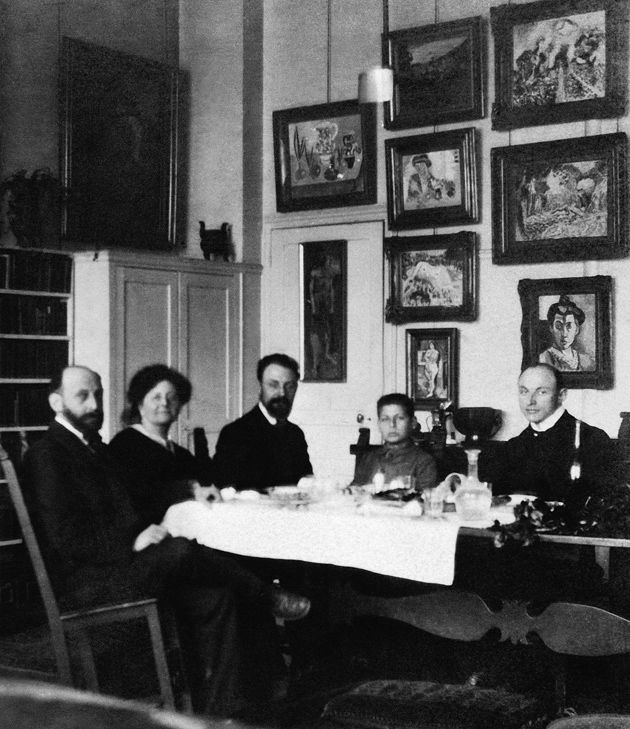
Henri Matisse (center) and Hans Purrmann (right) dining with Michael, Sarah, and Allan Stein at their apartment at 58 rue Madame, Paris, circa 1908. The paintings in the background, all by Matisse, are The Young Sailor I (far left); Pink Onions and Male Nude(left column); Fruit Trees in Blossom, Woman in a Kimono, Nude Reclining Woman, andNude before a Screen (center column);Madame Matisse in the Olive Grove, a sketch for Le Bonheur de Vivre, and Madame Matisse (The Green Line) (right column).

____

Paris: The Luminous Years

The sights and scenes of Paris from the eyes of Woody Allen

View from Northwest

Notre-Dame Cathedral attracts 13 million visitors each year.

The first 4 minutes of the movie “Midnight in Paris” by Woody Allen does the best job of capturing the sights of Paris. I have 40 posts concerning the movie “Midnight in Paris” by Woody Allen. Below are the links to all of the posts.

“Midnight in Paris” one of Woody Allen’s biggest movie hits in recent years July 18, 2011 – 6:00 am


(Part 32, Jean-Paul Sartre)July 10, 2011 – 5:53 am


 (Part 29, Pablo Picasso) July 7, 2011 – 4:33 am

(Part 28,Van Gogh) July 6, 2011 – 4:03 am

(Part 27, Man Ray) July 5, 2011 – 4:49 am

(Part 26,James Joyce) July 4, 2011 – 5:55 am

(Part 25, T.S.Elliot) July 3, 2011 – 4:46 am

(Part 24, Djuna Barnes) July 2, 2011 – 7:28 am

(Part 23,Adriana, fictional mistress of Picasso) July 1, 2011 – 12:28 am

(Part 22, Silvia Beach and the Shakespeare and Company Bookstore) June 30, 2011 – 12:58 am

(Part 21,Versailles and the French Revolution) June 29, 2011 – 5:34 am

(Part 16, Josephine Baker) June 24, 2011 – 5:18 am

(Part 15, Luis Bunuel) June 23, 2011 – 5:37 am

Did President Obama overreach?

An Abuse of Power: President Obama’s “Recess” Appointments

Uploaded by on Jan 7, 2012

President Obama’s stunning appointments of Richard Cordray to the Consumer Financial Protection Bureau and of three more bureaucrats to the National Labor Relations Board has been described by many observers as a serious blow to the Constitution and the separation of powers.

___________________

Did President Obama do something unlawful? (Another great article on this is linked here.)

  • JANUARY 10, 2012

Democrats and Executive Overreach

It’s a mistake to excuse Obama’s disregard for the Constitution. Precedents set now will be exploited by the next administration.

By MICHAEL MCCONNELL

One reason so many Americans entrusted Barack Obama with the presidency was his pledge to correct the prior administration’s tendency to push unilateral executive power beyond constitutional and customary limits.

Yet last week’s recess appointments of Richard Cordray as the first chief of the Consumer Financial Protection Bureau and three new members to the President’s National Labor Relations Board—taken together with other aggressive and probably unconstitutional executive actions—suggest that this president lacks a proper respect for constitutional checks and balances.

The Obama administration has offered no considered legal defense for the recess appointments. It even appears that it got no opinion from the Office of Legal Counsel in advance of the action—a sure sign the administration understood it was on shaky legal ground.

It is hard to imagine a plausible constitutional basis for the appointments. The president has power to make recess appointments only when the Senate is in recess. Several years ago—under the leadership of Harry Reid and with the vote of then-Sen. Obama—the Senate adopted a practice of holding pro forma sessions every three days during its holidays with the expressed purpose of preventing President George W. Bush from making recess appointments during intrasession adjournments. This administration must think the rules made to hamstring President Bush do not apply to President Obama. But an essential bedrock of any functioning democratic republic is that the same rules apply regardless of who holds office.

It does not matter, constitutionally, that congressional Republicans have abused their authority by refusing to confirm qualified nominees—just as congressional Democrats did in the previous administration. Governance in a divided system is by nature frustrating. But the president cannot use unconstitutional means to combat political shenanigans. If the filibuster is a problem, the Senate majority has power to eliminate or weaken it, by an amendment to Senate Rule 22. They just need to be aware that the same rules will apply to them if and when they return to minority status and wish to use the filibuster to obstruct Republican appointments and policies.

AFP/Getty ImagesPresident Obama alongside Richard Cordray, head of the Consumer Financial Protection Bureau, in Shaker Heights, Ohio, Jan. 4.

Moreover, in this case, two of the recess appointees to the National Labor Relations Board had just been nominated and sent to the Senate on Dec. 15—two days before the holiday. So it is simply not true that they were victims of Republican obstructionism, even if that mattered.

Some of the administration’s supporters have tried to argue that the pro forma sessions are a sham and thus that the Senate has been in recess since Dec. 17. Aside from the fact that these sessions are not, in fact, a sham—the Senate enacted the payroll tax holiday extension, President Obama’s leading legislative priority, on Dec. 23 during one of those pro forma sessions—the plain language of the Constitution precludes any such conclusion.

Article I, Section 5, Clause 4 requires the concurrence of the other house to any adjournment of more than three days. The Senate did not request, and the House did not agree to, any such adjournment. This means that the Senate was not in adjournment according to the Constitution (let alone in “recess,” which requires a longer break).

Others have argued that the president can make recess appointments during any adjournment, however brief, including the three days between pro forma sessions. That cannot be right, because it would allow the president free rein to avoid senatorial advice and consent, which is a major structural feature of the Constitution. He could, for example, make an appointment overnight, or during a lunch break. In a brief in the Supreme Court in 2004, Harvard law professor Laurence Tribe dismissed as “absurd” any suggestion that a period of “a fortnight, or a weekend, or overnight” is a “recess” for purposes of the Recess Appointments Clause.

This is not the first time this administration has asserted unilateral executive power beyond past presidential practice and the seeming letter of the Constitution. Its slender justification for going to war in Libya without a congressional declaration persuaded almost no one, and its evasion of the reporting requirements of the War Powers Resolution—over the legal objections of Justice Department lawyers—was even more brazen. According to the administration, not only was our involvement in Libya not a “war” for constitutional purposes; it did not even amount to “hostilities” that trigger a reporting requirement and a 60-day deadline for congressional authorization.

Indeed, the Obama administration has admitted to a strategy of governing by executive order when it cannot prevail through proper legislative channels. Rather than work with Congress to get reasonable changes to President Bush’s No Child Left Behind education law, it has used an aggressive interpretation of its waiver authority to substitute the president’s favored policies for the law passed by Congress. When the president’s preferred cap-and-trade legislation to limit carbon emissions failed in Congress, the Environmental Protection Agency announced it would proceed by regulation instead. And when Congress refused to enact “card check” legislation doing away with secret ballots in union elections, the president’s National Labor Relations Board announced plans to impose the change by administrative fiat—one of the reasons Senate Republicans have tried to block appointments.

The English philosopher John Locke, who so influenced our Founding Fathers, wrote that a “good prince” is more dangerous than a bad one because the people are less vigilant to protect against the aggrandizement of power when they perceive the ruler as beneficent.

I fear many Democrats are falling into this trap. They like President Obama and his policies, and they are willing to look the other way when it comes to constitutional niceties. The problem is that checks and balances are important, precedents created by one administration will be exploited by the next, and not all princes are good.

Mr. McConnell, a former federal judge, is a professor of law and director of the Constitutional Law Center at Stanford Law School, and a senior fellow at the Hoover Institution.