Yearly Archives: 2012

Steve Jobs to the President: “You’re headed for a one-term presidency,”

I have posted a lot about Steve Jobs and I have the links below after this fine aricle:

Lachlan Markay

October 21, 2011 at 12:04 pm

Steve Jobs, the late Apple founder and digital pioneer, told President Obama in a 2010 meeting that his anti-business attitude and enthusiasm for federal regulations could spell doom for his re-election bid, according to an upcoming biography of the iconic entrepreneur.

Jobs specifically cited a number of impediments to job creation and future economic growth, including onerous business regulations and stubborn teachers’ unions preventing reform of the country’s education system.

The Huffington Post, which obtained an advance copy of the book – titled “Steve Jobs” – said the man “seemed to have transformed from a liberal into a conservative.”

“You’re headed for a one-term presidency,” he told Obama at the start of their meeting, insisting that the administration needed to be more business-friendly. As an example, Jobs described the ease with which companies can build factories in China compared to the United States, where “regulations and unnecessary costs” make it difficult for them.

Jobs also criticized America’s education system, saying it was “crippled by union work rules,” noted Isaacson. “Until the teachers’ unions were broken, there was almost no hope for education reform.” Jobs proposed allowing principals to hire and fire teachers based on merit, that schools stay open until 6 p.m. and that they be open 11 months a year.

If Obama did not become more business friendly, Jobs warned, he would be “headed for a one-term presidency.”

Jobs’s legacy, wrote Heritage President Ed Feulner, is antithetical to the president’s approach to governing. The man “was a living refutation of all that liberals constantly tell us about our country,” Feulner wrote.

Related posts:

Steve Jobs left conservative Lutheran upbringing behind

Steve Jobs was raised as a conservative Lutheran but he chose to leave those beliefs behind. Below is a very good article on his life. COVER STORY ARTICLE | Issue: “Steve Jobs 1955-2011″ October 22, 2011 A god of our age Who was Steve Jobs? A revered technology pioneer and a relentless innovator, the Apple […]

Occupy Wall Street vs. Steve Jobs

COUNTER-DEMONSTRATION: At Kappa Sigma house in Fayetteville. The Drew Wilson photo above went viral last night — at least in Arkansas e-mail and social media users — after the Fayetteville Flyer posted it in coverage of an Occupy Northwest Arkansas demonstration in Fayetteville. The 1 percent banner was unfurled briefly on the Kappa Sigma frat […]

Steve Jobs’ Father

(If you want to check out other posts I have done about about Steve Jobs:Some say Steve Jobs was an atheist , Steve Jobs and Adoption , What is the eternal impact of Steve Jobs’ life? ,Steve Jobs versus President Obama: Who created more jobs? ,Steve Jobs’ view of death and what the Bible has to say about it ,8 things you might not know about Steve Jobs ,Steve […]

Steve Jobs at Stanford

(If you want to check out other posts I have done about about Steve Jobs:Some say Steve Jobs was an atheist , Steve Jobs and Adoption , What is the eternal impact of Steve Jobs’ life? ,Steve Jobs versus President Obama: Who created more jobs? ,Steve Jobs’ view of death and what the Bible has to say about it ,8 things you might not know about Steve Jobs ,Steve […]

Steve Jobs depicted at pearly gates with Saint Peter

It is strange that the New Yorker Magazine did no research. (If you want to check out other posts I have done about about Steve Jobs:Some say Steve Jobs was an atheist , Steve Jobs and Adoption , What is the eternal impact of Steve Jobs’ life? ,Steve Jobs versus President Obama: Who created more jobs? ,Steve Jobs’ view of death and what the Bible […]

___________________________

Some say Steve Jobs was an atheist

According to published reports Steve Jobs was a Buddhist and he had a very interesting quote on death which I discussed in another post. Back in 1979 I saw the film series HOW SHOULD WE THEN LIVE? by Francis Schaeffer and I also read the book. Francis Schaeffer observes in How Should We Then Live: The Rise […]

Steve Jobs and Adoption

Steve Jobs’ 2005 Stanford Commencement Address Uploaded by StanfordUniversity on Mar 7, 2008 It was a quite moving story to hear about Steve Jobs’ adoption. Ryan Scott Bomberger (www.toomanyaborted.com), co-founder of The Radiance Foundation, an adoptee and adoptive father: “As a creative professional, [Jobs’] visionary work has helped my own visions become reality. But his […]

What is the eternal impact of Steve Jobs’ life?

I have written several posts on Steve Jobs and they are listed below. Today I want to look at the eternal impact of Steve Jobs’ life. Below are the words of – R. Albert Mohler Jr., president of Southern Baptist Theological Seminary in Louisville, Ky.: “Christians cannot leave the matter where the secular world will […]

Steve Jobs versus President Obama: Who created more jobs?

I loved reading this article below. (Take a look at the link to other posts I have done on Steve Jobs.) David Boaz makes some great observations: How much value is the Post Office creating this year? Or Amtrak? Or Solyndra? And if you point out that the Post Office does create value for its […]

Steve Jobs’ view of death and what the Bible has to say about it

Steve Jobs’ 2005 Stanford Commencement Address Uploaded by StanfordUniversity on Mar 7, 2008 Drawing from some of the most pivotal points in his life, Steve Jobs, chief executive officer and co-founder of Apple Computer and of Pixar Animation Studios, urged graduates to pursue their dreams and see the opportunities in life’s setbacks — including death […]

8 things you might not know about Steve Jobs

Things you may not know about Steve Jobs: Steve Jobs leans against his wife, Laurene Powell Jobs (Lea Suzuki/San Francisco Chronicle/Corbis) For all of his years in the spotlight at the helm of Apple, Steve Jobs in many ways remains an inscrutable figure — even in his death. Fiercely private, Jobs concealed most specifics about […]

Steve Jobs was a Buddhist: What is Buddhism?

Steve Jobs passed away on October 5, 2011. I personally am very grateful to him for helping the world so much with his ideas and I have written about that before. Dan Mitchell of the Cato Institute noted: He’s built a $360 billion company. That presumably means at least $352 billion of wealth in the […]

  Did Steve Jobs help people even though he did not give away a lot of money? (I just finished a post concerning Steve’s religious beliefs and a post about 8 things you may not know about Steve Jobs) Uploaded by UM0kusha0kusha on Sep 16, 2010 clip from The First Round Up *1934* ~~enjoy!! ______________________________________________ In the short film […]

Dear Senator Pryor, why not pass the Balanced Budget Amendment? ( “Thirsty Thursday,” Open letter to Senator Pryor)

Dear Senator Pryor,

Why not pass the Balanced Budget Amendment? As you know that federal deficit is at all time high (1.6 trillion deficit with revenues of 2.2 trillion and spending at 3.8 trillion).

On my blog www.HaltingArkansasLiberalswithTruth.com I took you at your word and sent you over 100 emails with specific spending cut ideas. However, I did not see any of them in the recent debt deal that Congress adopted. Now I am trying another approach. Every week from now on I will send you an email explaining different reasons why we need the Balanced Budget Amendment. It will appear on my blog on “Thirsty Thursday” because the government is always thirsty for more money to spend.

Huntsman Supports Radical Balanced Budget Amendment

Huntsman Supports Radical Balanced Budget Amendment

Brian Beutler | June 20, 2011, 20digg

Jon Huntsman
In a private conference call with a handful of university students across the country, GOP Presidential hopeful — and President Obama’s former Ambassador to China — Jon Huntsman argued in support of one of the most far-reaching, controversial elements of the conservative political agenda.

As first reported in a broader piece by theHuffington Post, Huntsman argued in favor of a constitutional amendment requiring the federal government to maintain a balanced budget — an innocuous-sounding, but radical plan pushed by Sen. Jim DeMint (R-SC) and numerous other congressional conservatives.

“We’re going to have to fight for a balanced budget amendment,” Huntsman said. “Every governor in this country has a balanced budget amendment. It keeps everybody honest. It’s the best safeguard imaginable.”

At its core, a balanced-budget amendment would make it unconstitutional for the government to spend more than it collects in revenue — a requirement that, without safeguards, would make stimulus and emergency spending impossible.

Faced with a similar requirement, states responded to the recession with budget cuts that exacerbated the downturn.

But Republicans on the Hill have taken the idea a step further to the right by including a provision that would make it functionally impossible for the government to raise taxes. The goal, then, is to force future Congresses to slash or eliminate federal spending programs — which disproportionately benefit the needy and elderly — to bring them in line with a revenue base that’s likely to shrink over time.

It’s unclear whether Huntsman supports this version of a Balanced Budget Amendment, or a less extreme one. But the nature of the idea is such that it allows conservatives to signal their support for slashing programs without providing the unpopular details. And in the GOP primary, this will likely be a key test for candidates hoping to curry favor with influential conservatives like DeMint

Obama has taken us past most bankrupt European countries already

Over the last 20 or 30 years I have heard conservatives say that it is  a real shame that we are headed towards a bankrupt European liberal socialist kind of state. However, we are now there.

We’re Already Europe

by Michael D. Tanner

Michael Tanner is a senior fellow at the Cato Institute and author of Leviathan on the Right: How Big-Government Conservatism Brought Down the Republican Revolution.

Added to cato.org on February 22, 2012

This article appeared in National Review (Online) on February 22, 2012.

With seemingly every day bringing more bad news from Europe, many are beginning to ask how much longer the United States has before our welfare state follows the European model into bankruptcy. The bad news is: It may already have.

This year, the fourth straight year that we borrowed more than $1 trillion to support the U.S. government, our budget deficit will top $1.3 trillion, 8.7 percent of our GDP. If you think that sounds bad, it’s because it is. In fact, only two European countries, Greece and Ireland, have larger budget deficits as a percentage of GDP. Things are only slightly better when you look at the size of our national debt, which now exceeds $15.3 trillion, 102 percent of GDP. Just four European countries have larger national debts than we do — Greece and Ireland again, plus Portugal and Italy. That means the U.S. government is actually less fiscally responsible than countries like France, Belgium, or Spain.

And as bad as things are right now, we are on an even worse course for the future. If one adds the unfunded liabilities of Social Security and Medicare to our official national debt, we really owe $72 trillion, by the Obama administration’s projections for future Medicare savings under Obamacare, and as much as $137 trillion if you use more realistic projections. Under the best-case scenario, then, this amounts to more than 480 percent of GDP. And, under more realistic projections, we owe an astounding 911 percent of GDP.

At that point does the United States cease being the United States as we have known it?

Meanwhile, counting both official debt and unfunded pension and health-care liabilities, the most indebted nation in Europe is Greece, which owes 875 percent of GDP. That’s right, the United States potentially owes more than Greece. France, the second most insolvent nation in Europe, owes just 549 percent of GDP. Even under the most optimistic scenario, we owe more than such fiscal basket cases as Ireland, Italy, Portugal, and Spain.

So far we have been able to avoid the consequences of our profligate ways because the very public turmoil in Europe has helped prop us up as the world’s safe haven for foreign investment. Compared to the euro’s problems, the dollar looks pretty safe. This means that others are still willing to lend us money at absurdly low rates. But that won’t last forever. In fact, already seven European countries, including Germany and Sweden, have better credit ratings than the U.S.

Perhaps we can take some solace in the fact that our welfare state is not yet as big as Europe’s. But the key word here is “yet.” Today, our federal government spends more than 24 percent of GDP. Throw in state and local spending, and government at all levels consumes over 43 percent of everything produced in this country over the course of a year. As bad as that is, it’s still less than Europe, where the average of government spending at all levels is slightly more than 50 percent of GDP. But the Congressional Budget Office projects that federal-government spending in this country is currently on a path to exceed 42 percent of GDP by 2050. Government spending at all levels will exceed 59 percent of GDP. And CBO assumes state and local spending will decline in the future, which seems unlikely.

By way of comparison, today, Ireland is the only country in Europe with a bigger government than the U.S.’s will be in 2050. That’s right, one can look at countries like France and Greece, or even Denmark and Sweden, and realize that we will eventually have bigger governments than those quintessential welfare states have today.

At that point does the United States cease being the United States as we have known it? At the very least, can our economy survive such a crushing burden of government spending, and its attendant level of taxes and debt?

Given this looming disaster, President Obama has just submitted a budget that explicitly rejects “austerity,” avoids any reform of Medicare or Social Security, and adds some $7 trillion to the national debt over the next ten years….

Minimum wage could be eliminating jobs

Minimum wage could be eliminating jobs

Liberals just don’t have a clue.

The Job-Killing Impact of Minimum Wage Laws

Uploaded by  on Jun 14, 2010

Minimum wage laws seem like a good idea, but arbitrarily mandating a certain wage can have terrible consequences. This CF&P Foundation mini-documentary reveals that business are not charities, so if the minimum wage is set above the market level, this eliminates job opportunities — particularly for the less fortunate members of society. Since employees and employers should have freedom of contract, the right minimum wage is zero. www.freedomandprosperity.org

_____________________

Minimum Wage Hikes Deserve Share of Blame for High Unemployment

Posted by Daniel J. Mitchell

Even though the Obama Administration claimed that squandering $800 billion on so-called stimulus would  keep the joblessness rate below 8 percent, the unemployment rate today is almost 10 percent. There are many reasons for the economy’s tepid performance, including a larger burden of government spendingand the dampening effect of future tax rate increases (tax rates will jump significantly on January 1, 2011, when the 2003 tax cuts expire).

A closer look at the unemployment data, though , suggests that minimum wage laws also deserve a big share of the blame. In this Center for Freedom and Prosperity video, a former intern of mine (continuing a great tradition) explains that politicians destroyed jobs when they increased the minimum wage by more than 40 percent over a three-year period.

Mr. Divounguy is correct when he says businesses are not charities and that they only create jobs when they think a worker will generate net revenue. Higher minimum wages, needless to say, are especially destructive for people with poor work skills and limited work experience. This is why young people and minorities tend to suffer most – which is exactly what we see in the government data, with the teenage unemployment rates now at an astounding (and depressing) 26 percent level and blacks suffering from a joblessness rate of more than 15 percent.

In a free society, there should be no minimum wage law. From a philosophical perspective, such requirements interfere with the freedom of contract. In the imperfect world of politics, thought, the best we can hope for is that politicians occasionally do the right thing. Sadly, the recent minimum wage increases that have done so much damage were signed into law by President Bush. It’s worth noting that President Obama’s hands also are dirty on this issue, since he supported the job-killing measure when it passed the Senate in 2007. When the stupid party and the evil party both agree on a certain policy, that’s known as bipartisanship. In the real world, however, it’s called unemployment.

Milton Friedman: GM and other failing businesses should have been allowed to fail

Businesses should be allowed to fail if they lose money. It is amazing to me that GM was not allowed to go out of business and the same is true for any other business that is losing money.


Uploaded by on Dec 28, 2009.

I got this following part off of youtube:

In the video clip above Milton Friedman explains the necessity in a free market system of allowing unsuccessful businesses to go bankrupt w/out the government bailing them out. Profit/Loss system where the consumer decides who wins, NOT the federal government.

The same misguided arguments for a government bailout of GM made 30 years ago are being made today by President Barack Obama and the other statists in congress.

I hope there are more people out there as concerned as I am about this Administration’s assault on the free market. We need more Milton Friedmans in public policy today making the case for free enterprise and forcfully advocating on behalf of the market. We need more voices sounding the alarm about the ever-increasing attacks on our nation’s creators of wealth–small business.

The barons of big government in Washington are replacing our nation’s history of free-market capitalism with Crony Capitalism, where success depends not on your ability to produce a product the consumer wants to buy, but on how many lobbyists you have in Washington to force taxpayers to subsidize your company.

I agree with Milton Friedman 100 percent that government bailouts are an abomination and a disgrace.


Rush Limbaugh’s response to Santorum on Satan

BEGIN TRANSCRIPT


RUSH: I mentioned earlier in the program that Santorum, people have dug deep and they found a speech that he gave back in 2008 in Ave Maria, Florida, at Ave Maria University. Drudge has this plastered up. The Democrats have found it. It’s all over the place. Think Progress and whatever leftist think tanks have dug this up, and it’s part of the predictable attempt to impugn Santorum as an absolute religious nut and wacko. But he did say these things and he’ll to have an answer for these things when queried. Let’s play these sound bites. We have three of them. This is where Santorum has said that Satan has set his sights on America. Again, this is at Ave Maria University, August of 2008, in Ave Maria, Florida.

SANTORUM: The Father of Lies has his sights on what you would think the Father of Lies, Satan, would have his sights on: a good, decent, powerful, influential country — the United States of America. If you were Satan, who would you attack in this day and age? There is no one else to go after other than the United States, and that’s been the case for now almost 200 years, once America’s preeminence was sown by our great Founding Fathers.

RUSH: Okay, so he said it. Can we take you back to the United Nations? What was it, 2000… I don’t know, three or four or five or six. Hugo Chavez shows up, he speaks either the afternoon Bush spoke earlier or the next day, but he gets to the microphone at the United Nations and the General Assembly and starts sniffing around. (Sniffing) He says, “I can still smell the sulfur. The Devil was here,” and he had accused Bush of being the Devil. And the assembled monsters that look like they’re out of Star Wars bar scene that made up the UN General Assembly all started laughing. So we’re back to the double standard. Hugo Chavez can show up and call George W. Bush Satan. “Hey, hey! You know what, that’s right! That’s great. Let’s laugh about it. Let’s applaud it.” Santorum gives a speech in Ave Maria, Florida, back in 2008. “Oh, my God, we’re dealing with a nutcase! Oh, wow, what a fanatic weirdo. What are we gonna get next, an exorcism?” So the double standard does exist. Here’s more from the same speech from Santorum.

SANTORUM: Satan has done so by attacking the great institutions of America, using those great vices of pride, vanity, and sensuality as the root to attack all of these strong plants that have so deeply rooted in American tradition. He was successful. The place where he was, in my mind, the most successful and first successful was in academia. He understood pride of “smart” people. He attacked them at their weakest, that they were in fact smarter than everybody else and could come up with something new and different, pursue new truths, deny the existence of truth, play with it, “because we’re smart;” and so academia a long time ago fell.

RUSH: Satan conquered academia: Rick Santorum, August 29, 2008. And it was in 2006, September 20th, to be exact, where Hugo Chavez strode confidently to the microphones of the UN and was sniffing around and said, “The Devil came here yesterday. It still smells of sulfur today.” And let’s not forget, ladies and gentlemen, Saul Alinsky, who’s the primary mentor of “Barack Hussein Obama! Mmm, mmm, mmm!” Saul Alinsky, the author of the book Rules for Radicals — a book about which Hillary Clinton wrote her masters or doctoral thesis, whatever it was, when she was at Wellesley. Saul Alinsky, who Obama has studied and implements to this day and whose tactics he taught while ostensibly teaching law at the University of Chicago.

Saul Alinsky dedicated his book that all these leftists love to Lucifer, the Devil! Here’s Alinsky’s dedication: “Lest we forget, at least an over the-shoulder acknowledgement to the very first radical from all our legends, mythology and history — and who is to know where mythology leaves off and history begins or which is which? The first radical known to man who rebelled against the establishment and did it so effectively that he at least won his own kingdom: Lucifer.” Saul Alinsky made that dedication in his book Rules for Radicals. So Santorum is just joining the crowd here in discussing this. Here is the final sound bite.

SANTORUM: The next was the church. Now, you say, “Well, wait. The Catholic Church?” No. We all know that this country was founded on a Judeo-Christian ethic, but the Judeo-Christian ethic was a Protestant Judeo-Christian ethic. Sure, the Catholics had some influence, but this was a Protestant country, and the Protestant ethic. Mainstream, mainline Protestantism. And of course we look at the shape of mainline Protestantism in this country, and it is a shambles.

RUSH: That’s Rick Santorum August 29, 2008. That stuff is out there. It’s headlined on Drudge and the left has it, and Santorum will have to deal with it. He’ll have to answer it. I don’t know. It’s just not the kind of stuff you hear a presidential candidate talk about. It’s not ordinary in that sense. Snerdley says, “Yeah, yeah, it’s kind of refreshing.” Snerdley likes devil stuff. I mean, he watches movies about it. He has The Exorcist on a loop at home and it helps with his sciatic pain.

Remembering Francis Schaeffer at 100 (Part 7)

schaeffer

Two Minute Warning: How Then Should We Live?: Francis Schaeffer at 100

Uploaded by on Jan 31, 2012

Under Francis Schaeffer’s tutelage, Evangelicals like Chuck Colson learned to see life through the lens of a Christian worldview. Join Chuck as he celebrates a life well lived.

_______________________

This year Francis Schaeffer would have turned 100 on Jan 30, 2012. I remember like yesterday when I first was introduced to his books. I was even more amazed when I first saw his films. I was so influenced by them that I bought every one of his 30 something books and his two film series. Chuck Colson’s website www.breakpoint.org  and I was directed from there to Probe’s website where I found this great article below. I will share it in 4 parts. Todd Kappelman is the author and here is some info on him and Probe.

Todd KappelmanTodd A. Kappelman is a field associate with Probe Ministries. He is a graduate of Dallas Baptist University (B.A. and M.A.B.S., religion and Greek), and the University of Dallas (M.A., philosophy/humanities). Currently he is pursuing a Ph.D. in philosophy at the University of Dallas. He has served as assistant director of the Trinity Institute, a study center devoted to Christian thought and inquiry. He has been the managing editor of The Antithesis, a bi-monthly publication devoted to the critique of foreign and independent film. His central area of expertise is Continental philosophy (especially nineteenth and twentieth century) and postmodern thought.

What is Probe?

Probe Ministries is a non-profit ministry whose mission is to assist the church in renewing the minds of believers with a Christian worldview and to equip the church to engage the world for Christ. Probe fulfills this mission through our Mind Games conferences for youth and adults, our 3-minute daily radio program, and our extensive Web site at www.probe.org.

Further information about Probe’s materials and ministry may be obtained by contacting us at:

Probe Ministries
2001 W. Plano Parkway, Suite 2000
Plano TX 75075
(972) 941-4565
info@probe.org
www.probe.org
Copyright information

This is the first part:

The Need to Read: Francis Schaeffer Print E-mail

Todd Kappelman Written by Todd Kappelman

The Need to Read series began several months ago with a program on C.S. Lewis . The rationale for this series is that many of the great writers who have helped many Christians mature are now either unknown or neglected by many who could use these authors insights into the faith.

This installment focuses on Francis Schaeffer (1912-1984), one of the most recognized and respected Christian authors of the twentieth century.

He saw so much more in what he was looking at and agonized over it much more that the rest of us. He was one of the truly great Christians of our time.{1} If this is the case, and I and many others believe that it is, then this question follows: What was Schaeffer looking at? The remarkable answer to this question is all of human history and the long chain of events which have led to modern man as we see him today.

In a time when true scholarship is often equated with specialization in a particular period, people, or subject, Schaeffer was a grand generalist. He was a true Renaissance man who knew something about everything, as opposed to everything about something. In addition to his remarkable and encyclopedic knowledge of human history, he was able to connect important events together such that Christians can see what has happened in human history, what is happening now, and what will happen if man continues on his present course. Schaeffer was a visionary who had an uncanny understanding of the times we live in and what mankind can expect in the near future.

Schaeffers greatest gift, like that of C.S. Lewis, was his concern for the average Christian. He believed philosophy, theology, and ethics should not be reserved for the conversation of learned academics; rather they should be the daily concern of the man on the street. The price for ignorance of the subjects could be our life, or more importantly, our very souls. The Scriptures are very clear concerning the price of ignorance. The prophet Hosea said that Gods people perish for lack of knowledge.{2} In light of this observation, Schaeffers genius was his ability to communicate extremely difficult philosophical and theological issues on a non- technical level. His writings provide Christians with access to some of the most pressing concerns of our times.

Several aspects of Schaeffers style and sweeping concerns will be discussed in this essay. First, he perceived the wholeness of the created order. There is a basic need in all human beings to know the answers to the great questions of life, and Schaeffer believed that God has given man the answers in the form of natural and specific revelation.

Second, Schaeffer believed that man has a natural inclination to desire the reasonable. Schaeffer argued that the Christian faith is not only true, but that it is the most plausible account for the existence of man and his place in the universe. He contended that an irrational faith is not what God intended to communicate to man.

Third, Schaeffer was one of the original cultural critics of the twentieth century. He believed that mankind, both Christians and non-Christians, was adrift on a sea of irrationality. He further believed that this drift was intensifying to the point that true, orthodox Christianity was being lost.

Related posts:

Francis Schaeffer would be 100 years old this year (Schaeffer Sunday)

Dr. Francis Schaeffer – Extra – Interview – Part 2 Francis Schaeffer had a big impact on me in the late 1970′s and I have been enjoying his books and films ever since. Here is great video clip of an interview and below is a fine article about him. Francis Schaeffer 1912-1984 Christian Theologian, Philosopher, […]

Francis Schaeffer’s “How should we then live?” Video and outline of episode 10 “Final Choices” (Schaeffer Sundays)

E P I S O D E 1 0 How Should We Then Live 10#1 FINAL CHOICES I. Authoritarianism the Only Humanistic Social Option One man or an elite giving authoritative arbitrary absolutes. A. Society is sole absolute in absence of other absolutes. B. But society has to be led by an elite: John Kenneth […]

Fellow admirer of Francis Schaeffer, Michele Bachmann quits presidential race

What Ever Happened to the Human Race? Bachmann was a student of the works of Francis Schaeffer like I am and I know she was pro-life because of it. (Observe video clip above and picture of Schaeffer.) I hated to see her go.  DES MOINES, Iowa — Last night, Minnesota Rep. Michele Bachmann vowed to […]

Francis Schaeffer’s “How should we then live?” Video and outline of episode 9 “The Age of Personal Peace and Affluence” (Schaeffer Sundays)

E P I S O D E 9 How Should We Then Live 9#1 T h e Age of Personal Peace and Afflunce I. By the Early 1960s People Were Bombarded From Every Side by Modern Man’s Humanistic Thought II. Modern Form of Humanistic Thought Leads to Pessimism Regarding a Meaning for Life and for Fixed […]

Francis Schaeffer’s “How should we then live?” Video and outline of episode 8 “The Age of Fragmentation” (Schaeffer Sundays)

E P I S O D E 8 How Should We Then Live 8#1 I saw this film series in 1979 and it had a major impact on me. T h e Age of FRAGMENTATION I. Art As a Vehicle Of Modern Thought A. Impressionism (Monet, Renoir, Pissarro, Sisley, Degas) and Post-Impressionism (Cézanne, Van Gogh, Gauguin, […]

Francis Schaeffer’s “How should we then live?” Video and outline of episode 7 “The Age of Non-Reason” (Schaeffer Sundays)

E P I S O D E 7 How Should We Then Live 7#1 I am thrilled to get this film series with you. I saw it first in 1979 and it had such a big impact on me. Today’s episode is where we see modern humanist man act on his belief that we live […]

Francis Schaeffer would be 100 years old this year (Schaeffer Sunday)

Dr. Francis Schaeffer – Extra – Interview – Part 2 Francis Schaeffer had a big impact on me in the late 1970′s and I have been enjoying his books and films ever since. Here is great video clip of an interview and below is a fine article about him. Francis Schaeffer 1912-1984 Christian Theologian, Philosopher, […]

Francis Schaeffer’s “How should we then live?” Video and outline of episode 6 “The Scientific Age” (Schaeffer Sundays)

E P I S O D E 6 How Should We Then Live 6#1 I am sharing with you a film series that I saw in 1979. In this film Francis Schaeffer asserted that was a shift in Modern Science. A. Change in conviction from earlier modern scientists.B. From an open to a closed natural system: […]

Francis Schaeffer’s “How should we then live?” Video and outline of episode 5 “The Revolutionary Age” (Schaeffer Sundays)

E P I S O D E 5 How Should We Then Live 5-1 I was impacted by this film series by Francis Schaeffer back in the 1970′s and I wanted to share it with you. Francis Schaeffer noted, “Reformation Did Not Bring Perfection. But gradually on basis of biblical teaching there was a unique improvement. A. […]

Francis Schaeffer’s “How should we then live?” Video and outline of episode 4 “The Reformation” (Schaeffer Sundays)

How Should We Then Live 4-1 I was impacted by this film series by Francis Schaeffer back in the 1970′s and I wanted to share it with you. Schaeffer makes three key points concerning the Reformation: “1. Erasmian Christian humanism rejected by Farel. 2. Bible gives needed answers not only as to how to be right with […]

Francis Schaeffer’s “How should we then live?” Video and outline of episode 3 “The Renaissance”

How Should We Then Live 3-1 I was impacted by this film series by Francis Schaeffer back in the 1970′s and I wanted to share it with you. Schaeffer really shows why we have so many problems today with this excellent episode. He noted, “Could have gone either way—with emphasis on real people living in […]

Francis Schaeffer’s “How should we then live?” Video and outline of episode 2 “The Middle Ages” (Schaeffer Sundays)

How Should We Then Live 2-1 I was impacted by this film series by Francis Schaeffer back in the 1970′s and I wanted to share it with you. Schaeffer points out that during this time period unfortunately we have the “Church’s deviation from early church’s teaching in regard to authority and the approach to God.” […]

Francis Schaeffer’s “How should we then live?” Video and outline of episode 1 “The Roman Age” (Schaeffer Sundays)

How Should We Then Live 1-1 Today I am starting a series that really had a big impact on my life back in the 1970′s when I first saw it. There are ten parts and today is the first. Francis Schaeffer takes a look at Rome and why it fell. It fell because of inward […]

Andy Rooney was an atheist

How Now Shall We LiveClick here to purchase Chuck Colson and Nancy Pearcey’s How Now Shall We Live?, dedicated to Francis Schaeffer.


Click here for a list of Francis Schaeffer’s greatest works, from the Colson Center store!
SchaefferBooks

Video clip on youtube compares Obama to wicked king from Coldplay song

Uploaded by on Nov 9, 2010

My Democratic friends are pretty glum lately. I put this together to help them remember happier times.

DISCLAIMER: I do not own the audio and images used in this video. All audio and images belong to their rightful owner. No copyright infringement intended. This video is made for entertainment and non-profit purposes only.

_____________________

I found this video on the internet called “When Democrats ruled” and it was uploaded by on Nov 9, 2010 on youtube with these words: “My Democratic friends are pretty glum lately. I put this together to help them remember happier times.”

Then it shows these 43 events in pictures and plays the Coldplay song “Viva La Vida.”

I have written about this song by Coldplay before and I thought it was proper to discuss some of that again after first listing the 43 events pictured in the video:
1. House Speaker Nancy Pelosi on taking up the gavel in January 2007. She lost her speakership as a result of the 2010 election.

3. Rep. John Spratt (D-SC), to Pelosi’s left, first elected in 1982, lost re-election.

4. White House Chief of Staff Rahm Emanuel has resigned to run for Mayor of Chicago.

7. The S-CHIP bill raised taxes on cigarettes to pay for an expansion of the children’s health care program, although expenses will outstrip the new tax revenue.

10. Sen. Blanche Lincoln (D-AR) lost her re-election.

12. Rep. Chet Edwards (D-TX), first elected in 1990, lost re-election.

13. Rep. Charlie Rangel (D-NY) gave up the chairmanship of the Ways and Means Committee after a series of ethics complaints, although he survived a primary challenge and was re-elected in 2010.

14. Rep. Ike Skelton (D-MO), first elected in 1976, lost re-election.

16. Rep. Steve Kagen (D-WI), first elected in 2006, lost re-election.

17. The cap and trade bill passed the House but was never voted on by the Senate, and is now considered dead.

18. Rep. Rick Boucher (D-VA), first elected in 1982, lost re-election.

19. Scandal-plagued Gov. Rod Blagojevich (D-IL) appointed Sen. Roland Burris (D-IL) to President Obama’s old Senate seat, despite allegations that Blagojevich sought to sell the seat. Burris decided not to run for election, and a Republican won the seat.

20. Rep. Walt Minnick (D-ID), first elected in 2008, lost re-election.

21. Gov. Jon Corzine (D-NJ) lost re-election despite a strong campaign effort by President Obama.

22. Rep. Paul Kanjorski (D-PA), first elected in 1984, lost re-election.

23. During President Obama’s State of the Union, Rep. Joe Wilson (R-NC) interrupted by yelling, “You lie!” Wilson apologized; despite being a top Democratic target, won re-election.

24. Rep. Bobby Bright (D-AL), first elected in 2008, lost re-election.

25. Against the background of the health care law debate and despite a strong campaign effort by President Obama, Democratic candidate Martha Coakley unbelievably lost the Massachusetts Senate seat to Republican Scott Brown.

26. Rep. James Oberstar (D-MN), first elected in 1974, lost re-election.

27. Rep. Dave Obey (D-WI), first elected in 1969 and the third longest serving member of the House, retired rather than face re-election.

29. Rep. Patrick Murphy (D-PA), first elected in 2006, lost re-election.

30. Sen. Arlen Specter (PA) switched to the Democratic Party after it became clear he would lose the Republican Party primary, then lost the Democratic Party primary.

31. Rep. Bart Stupak (D-MI), first elected in 1992, retired rather than face re-election. He had been the focus of a bitter debate over the health care law’s funding of abortions.

32. President Obama and his advisers routinely speak of complete agreement among economists regarding additional stimulus spending. The Cato Institute took out an ad signed by hundreds of economists, including Nobel Prize winners, who disagreed.

33. Rep. Earl Pomeroy (D-ND), first elected in 1992, lost re-election.

34. Rep. Alan Grayson (D-FL), first elected in 2008 and considered a progressive hero for his biting criticism of Republicans, lost re-election by 18 points.

35. Sen. Russ Feingold (D-WI), first elected in 1992, lost re-election.

37. Rep. Bob Etheridge (D-NC), first elected in 1996, lost re-election. He had been caught on video manhandling students asking him questions on the street.

38. Rep. Kendrick Meek (D-FL), first elected in 2002, chose to retire and instead run unsuccessfully for the Senate seat, coming in third place.

39. Continuing the Bush Administration policy of defending DOMA and retaining Don’t Ask Don’t Tell alienated gays who supported the Democrats.

40. Sen. Harry Reid (D-NV) hung on to his Senate seat but is severely weakened as Senate Majority Leader.

41. The Obama Administration described how unemployment would drop once the stimulus was enacted, but the actuals have gone in the other direction.

42. Sen. Evan Bayh (D-IN), first elected in 1998, retired rather than run for re-election. He has been critical of his party’s legislative agenda.

43. After the election, President Obama admitted in a morose press conference that his party had suffered a “shellacking.”

__________

Here is a portion of an article I wrote a couple of years ago about Chris Martin’s view of hell. He says he does not believe in it but for some reason he writes a song that teaches that it exists:
 
Belief of Eternal Punishment in Grammy Winning Song
By Everette Hatcher
 
Chris Martin of the rock group Coldplay wrote the song Viva La Vida, and the song just won both the grammy for the “Song of the Year” and “Best Pop Performance by a duo or Group with Vocals.”
 
In this song, Martin is discussing an evil king that has been disposed. “I used to rule the world…Feel the fear in my enemy’s eyes…there was never an honest word and that was when I ruled the world, It was the wicked and wild wind, Blew down the doors to let me in, Shattered windows and the sound of drums, People couldn’t believe what I’d become…For some reason I can’t explain, I know Saint Peter won’t call my name,  Never an honest word, But that was when I ruled the world.”
 
Q Magazine asked Chris Martin about the lyric in this song “I know Saint Peter won’t call my name.” Martin replied, “It’s about…You’re not on the list. I was a naughty boy. Its always fascinated me that idea of finishing your life and then being analyzed on it…That is the most frightening thing you could possibly say to somebody. Eternal damnation. I know about this stuff because I studied it. I was into it all. I know it. It’s mildly terrifying to me. And this is serious.”
 
I have been following the career of Chris Martin for the last decade. He grew up in a Christian home that believed in Heaven and Hell, but made it clear several years ago that he actually resents those who hold to those same religious dogmatic views he did as a youth. Yet it seems his view on the possibility of an afterlife has changed again….
 
Let me give a suggestion on why Chris Martin’s view may have changed. Here is a couple of scripture verses from the Bible that may give insight into a possible explanation. God “has planted eternity in the human heart…” (Ecclesiastes 3:11). This is a direct result of our God-given conscience. The apostle Paul said it best in Romans 1:19, “For that which is known about God is evident to them and made plain in their inner consciousness, because God  has shown it to them” (Amplified Version).
 
Evidently  Chris Martin who said he resented dogmatic religious views a few years ago, has now written a grammy winning song that pictures an evil king being punished in an afterlife. Could it be that his God-given conscience prompted him to put that line in?
 
______________
It is my belief that unborn babies have the same human rights that we have. I do think that evil kings will be punished for their evil deeds unless they repent. Deep down I really believe that everyone knows that God exists. I am glad I ran across this video and I will continue to pray for both Chris Martin and for my president.

Chicago style politics?

In this video above you will see a lot of President Obama’s friends who lost in 2010 and hear the song by Coldplay talking about the wicked king who used to rule the world.
_________________________

I know that some underhanded politics has existed in Chicago for a long time and now our president is from Chicago. Are some of those same type of politics being now practiced in Washington?


Lachlan Markay

February 21, 2012 at 8:37 am

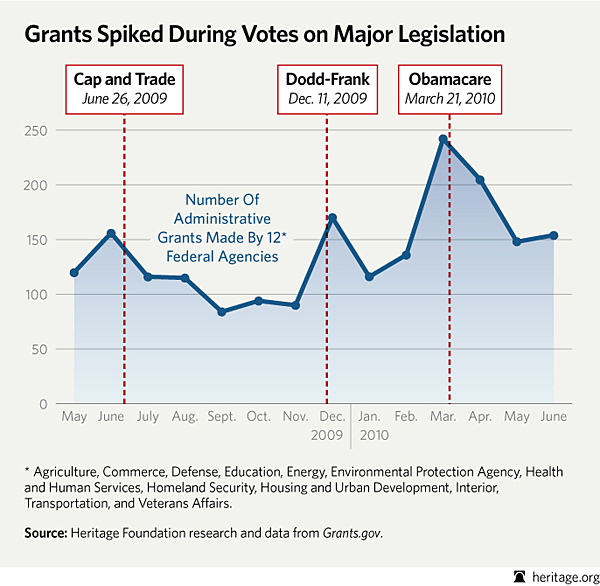
An examination of “administrative earmarks” around the time of congressional votes on key pieces of President Obama’s agenda suggests the White House used its power to fund local projects as a means to “buy” votes for major legislative efforts.

Administrative earmarking refers to the federal government’s allocation of funds from its discretionary budget for specific projects. The practice is less transparent than legislative earmarking, since, according to the Congressional Research Service, “[t]here is no source that defines and comprehensively identifies Administrative earmarks.”

But an analysis of grants from agencies during the early years of the Obama administration shows that the districts of moderate Democrats, whose support was so crucial for Obama during the 111th Congress, received large sums right around the passage of three key pieces of legislation: Obamacare, Dodd-Frank financial regulations, and the cap-and-trade bill.

During the run-up to votes in the House of Representatives for each of those pieces of legislation, the rate of administrative earmarking spiked. This chart shows the number of grants requested by 12 federal agencies, as documented at Grants.gov.

The number of grants given by those agencies spiked precisely when the House was considering each of the three pieces of legislation.

Even more troubling: during the same time periods, significant grant money went to the districts of numerous Democratic representatives who looked to face tough battles for re-election. The legislation Obama was attempting to get through Congress was generally unpopular, and vulnerable members needed other ways to appeal to constituents. Federal grants made for a perfect opportunity.

Then-Rep. Chris Carney (D-PA), for instance, kept his support for Dodd-Frank quiet. His website never posted a press release announcing his “yes” vote on the bill. It did, however, tout two federal grants totaling $3.6 million for businesses in his district two days before the Dodd-Frank vote.

Then-Rep. Zach Space (D-OH) hailed from a district reliant on the coal industry, which would have been hit particularly hard by cap and trade. He voted for the measure, but neglected to publicize the vote on his website. He did, however, announce eight federal grants totaling roughly $1.8 million all made during the month before the House passed cap and trade.

At least 32 vulnerable House Democrats received significant federal grant money in the periods leading up to or directly after their votes on at least one of these three pieces of legislation (see charts below), raising concerns that those grants may have been used either to encourage or reward votes in favor of the administration’s position.

The use of administrative earmarks to “buy votes” is not new. President Richard Nixon saw the practice as “a way to gain political support for Nixon’s re-election by using federal resources and grants to influence key states and voting blocs.”

President Franklin Roosevelt was an early pioneer of the political use of administrative earmarking. He “deliver[ed] large defense projects to key states whose electoral votes he wanted to secure,” according to historian Burt Folsom.

But while administrative earmarking is a practice used by nearly every administration, CRS found in a report published in April 2010 — immediately after the time period at issue — that “[b]oth the number and value of earmarks requested solely by the President increased since FY2008.” The number of earmarks had increased by 54 percent, CRS found, while the value of those requests had increased by a whopping 126 percent.

The timing of those requests also suggests political factors at play. Heritage’s Hans von Spakovsky, a former Federal Elections Commissioner, said the administration’s actions “show how taxpayer funds are used for crass political purposes — it is a rank abuse of the government’s power and another sign of this administration’s lack of a moral compass.”

While speculating on the motives of individuals responsible for these grants is difficult, this administration has a history of using its powers for political purposes. In the case of “vote-buying” in particular, the administration offered to expand Medicaid funding to residents of Louisiana and Nebraska to the tune of roughly $145 million to secure the votes of Sens. Mary Landrieu (D-LA) and Ben Nelson (D-NE) for the Obamacare bill.

Member2008 vote for member2008 percentage of vote for McCain in district2004 percentage of vote for Bush in district2000 percentage of vote for Bush in districtIdentified by DCCC as vulnerable?Identified by NRCC as target?Partisan Voting Index.Alan Grayson (FL-08)52.01%47%55%53%YesYesR + 2.

Bart Stupak (MI-01)65.04%48%53%53%NoNoR + 3.

Bill Foster (IL-14)57.74%44%55%54%YesYesR + 1.

Bruce Braley (IA-01)64.56%41%46%45%NoNoD + 5.

Carol Shea-Porter (NH-01)51.73%46%51%49%YesYesR + 0.

Chris Carney (PA-10)56.33%54%60%56%YesYesR + 8.

Ciro Rodriguez (TX-23)55.76%48%57.3%53.6%YesYesR + 4.

Debbie Halvorson (IL-11)58.4%45%53%50%YesYesR + 1.

Frank Kratovil (MD-01)49.12%58%62%57%YesYesR + 13.

Gabrielle Giffords (AZ-08)54.72%52%53%49%YesYesR + 4.

Heath Shuler (NC-11)61.96%52%57%58%NoYesR + 6.

Jim Himes (CT-04)51.32%40%46%43%YesYesD + 5.

John Boccieri (OH-16)55.36%50%54%56%YesYesR + 4.

John Hall (NY-19)58.67%48%53%49%NoYesR + 3.

John Varmuth (KY-03)59.37%43%49%48%NoNoD + 2.

Kathy Dahlkemper (PA-03)51.24%49%53%50%YesYesR + 3.

Kurt Schrader (OR-05)54.25%43%50%49%YesYesD + 1.

Leonard Boswell (IA-03)56.31%45%49.7%48%YesYesD +1.

Mark Schauer (MI-07)48.78%46%54%53%YesYesR + 2.

Mary Jo Kilroy (OH-15)45.94%45%50%54%YesYesD + 1.

Mike McMahon (NY-13)60.94%51%55%44%YesYesR + 4.

Nick Rahall (WV-03)66.92%56%53%47%NoYesR + 6.

Patrick Murphy (PA-08)56.77%45%48%46%NoYesD + 2.

Paul Hodes (NH-02)856.4%43%47%47%NoYesD + 3.

Paul Kanjorski (PA-11)51.63%42%47%43%NoYesD + 4.

Rick Boucher (VA-09)Unopposed59%59%55%NoYesR + 11.

Scott Murphy (NY-20)50.2%48%53%51%YesYesR + 2.

Steve Driehaus (OH-01)52.47%44%50%53%YesYesD + 1.

Steve Kagen (WI-08)54%53%57%58%YesYesR + 2.

Suzanne Kosmas (FL-24)57.2%51%56%52%YesYesR + 4.

Tim Bishop (NY-01)58.38%48%49.4%43%NoYesR + 0.

Zack Space (OH-18)59.87%53%57%58%YesYesR + 7

Private entrepreneurs can solve our post office problem

When you look at how good the private enterprise does with deliveries and then compare it to how bad the federal government does with the same duties it is laughable. The answer to the federal post office problem is to encourage private entrepreneurs to fill the gap and provide competition for the post office in the delivery of first class mail.

I grew up in Memphis and I am very familar with a company called Federal Express and its president Fred Smith. Actually I have lived in Little Rock since 1983 and Federal Express was started in Little Rock in 1971 and then moved to Memphis in 1972. Entrepreneurs like Fred Smith need to be encouraged, not discouraged by government. Here is a funny Fed Ex Commercial from the 1980’s.

 
On July 3, 1981, I was in Prague, Czechoslovakia in the middle of a 20 country student tour. Our group of 48 American students had the opportunity to speak to a Communist government official for over an hour. We asked him several questions. My questions were quite direct and I share some of them at a later time.
 
However, I did want to share one question that I asked. I told the official about an entrepreneur from Memphis named Fred Smith. Back in the early 1970’s we heard about how Smith had this crazy idea about delivering overnight packages from LA to San Francisco via Memphis. Sounded like it would not work, but Smith was able to invest all his money and eventually it paid off. His idea was successful.
 
I asked the simple question: Could something like this happen here in Communist Czechoslovakia? He responded, “No. That is because no private citizen is allowed to own that much capital. The government must do things like that.”
 
There was no chance for entrepreneurs to exist in communist countries. I was simply pointing out that economic freedom allows an environment for entrepreneurs. Why would someone put the time and energy in putting together a grand plan like Fed Ex when the benefit and reward would just go to a communist government? Entrepreneurship should be encouraged, but many times today in the USA we find that our lawmakers pass laws that discourage entrepreneurs.

USPS: Stuck With the Government Business Model

Posted by Tad DeHaven

The U.S. Postal Service has released a new five-year plan for congressional consideration that it says would get the beleaguered government mail monopoly on sounder financial footing and thus avoid a taxpayer bailout. The plan repeats previous suggestions (i.e., workforce reductions, postal network consolidations, elimination of Saturday delivery, elimination of the retiree healthcare benefit funding requirement) and proposes an increase in the price of a first-class stamp from forty-five to fifty cents.

Whether or not it would achieve what the USPS hopes, it probably doesn’t matter given that asking Congress for greater operational flexibility is like asking a two year old to stop playing with their food. That’s why the focus should be on completely transitioning the USPS from a government-run business to a privately-run business (or perhaps businesses).

Over at the Courier Express and Postal Observer blog, Alan Robinson says that “just like all plans that came before, [the new USPS plan] started with the assumption that the Postal Service remains a quasi-governmental entity.” As a result, Robinson notes that the plan is missing two key ingredients for success that foreign posts have utilized: private capital and an expanded range of products and services.

In an essay on the U.S. Postal Service, I discuss how liberalization in other countries has enabled foreign mailers to diversify into non-postal activities:

Consultants at Accenture have found that diversification not only has a measurable impact on the performance of international posts, but that it is what ultimately distinguishes high performers from low performers. America’s relatively dynamic economy is particularly suited for the diversification opportunities that would arise under postal liberalization.

Germany’s former postal monopoly, Deutsche Post, illustrates the type of transformation possible by liberalization. Today, the private Deutsche Post World Net has changed its compensation structure, imported managers from other industries, modernized the mail and parcels network within Germany, and developed new products such as hybrid mail and e-commerce. The company now has interests in not only the traditional mail and parcels business but also express mail logistics, banking, and more.

Given that the USPS’s plan is going to be unpopular with various postal stakeholders (i.e., special interests), Alan says that they should consider the advantages of privatization:

It is clear that the business plan that the Postal Service has chosen is not the one that has worked in other countries. The plan avoids talking about either private capital or expanding the breadth of service offerings as neither is on the legislative table.    Introducing thinking about how private capital could be introduced and the product offerings could be expanded forces stakeholders to think about privatization, an idea that is nearly as unpopular as the changes that the proposed business model introduced.   However, as this brief post notes, privatization offers significant financial advantages that could reduce the operating and price changes envisions by the Postal Service’s business plan. Therefore, those who see the greatest harm from this plan need to see if the advantages of privatization could benefit their interests sufficiently to overcome long-held objections to the idea.

I think Robinson is right, but I suspect that the “stakeholders” believe there’s a good chance that Congress will ultimately come to their aid with some sort of taxpayer bailout. Therefore, it’s possible that they believe that it is in their best interest to continue fighting for the status quo. Unfortunately, the recent bipartisan federal bailouts of the financial industry and the automakers suggest that they could be correct.

Related posts:

Privatize the post office

The Arkansas Times rightly jumped on Republicans for whining about the local post office branches that were closing.  (It is sad to me that Republican Presidential Candidates are not very brave about offering any spending cuts.) The real answer is privatizing the post office. Here is a good article from the Cato Institute:   The USPS […]

Post Office on the brink of financial collapse

Post Office on the brink of financial collapse You’ve Got (No) Mail: Is the End Near for the Postal Service? By James Gattuso September 29, 2011 The United States Postal Service (USPS) stands on the brink of financial collapse. According to the Postmaster General, by next month, USPS coffers will be down to a week’s […]