NCAA Championship game, March 29, 1976 — Bob Knight’s first NCAA title capped a 32-0 season, the last any men’s team has completed a season without a loss. Six teams had logged unbeaten season in 20 seasons before the Hoosiers did so. Yet in the more than 30 years since, only two teams even entered the NCAA tournament without a loss, let alone won the title. The Hoosiers may be the last of their kind.
Kansas vs. Memphis – 2008 NCAA Title Game Highlights (HD) We are looking at the picks of the Hatcher family in the next four days leading up to the tip off of the big NCAA Tournament on Thursday March 15th. Wilson Hatcher’s bracket looks like this: Four play in games (which are called the First […]
I have March Madness fever this time every year and here are the locations and dates for the NCAA Tournament this year: March 15/17, 2012 Albuquerque, NM The Pit Arena University of New Mexico Louisville, KY KFC Yum! Arena University of Louisville Pittsburgh, PA Consol Energy Center Duquesne University Portland, OR Rose Garden Arena University […]
It was hard to listen to but the Razorbacks missed many layups on their way to a 70-54 loss to LSU in the SEC Basketball Tournament. ESPN reported: Arkansas 54 (18-14, 6-10 SEC) LSU 70 (18-13, 7-9 SEC) 1 2 T ARK 28 26 54 LSU 28 42 70 Top Performers Arkansas: B. Young […]
After getting beat at home by Florida by 30 points (the worst ever loss at Bud Walton) and then getting beat by Alabama at Bud Walton, it appears we have nothing to cheer about at Arkansas. However, hold the presses. The Arkansas ladybacks beat Tennessee for the first time ever in basketball last night. The […]
SEC Basketball race for 4th places heats up Does anyone want 4th place? It seems that everytime a team gets a few wins under their belt and it appears they are going to sew up 4th place then they lose. Look at Tennessee. The Vols played against a Bama team that had their two leading […]
President Obama’s fiscal year 2013 budget proposal explicitly claims a $1.561 trillion tax hike over 10 years, as reported by the White House Office of Management and Budget (OMB).[1] This is a vast understatement, because that figure fails to account for all of the President’s tax increases and improperly claims credit for reducing tax receipts from tax cuts that are not new policies.
Numbers Do Not Match
The indication that something is amiss with the $1.561 trillion tax hike figure is that it is substantially smaller than the estimate in the Treasury Department’s “Green Book.” The Green Book provides an in-depth explanation of the President’s numerous tax policy changes in the budget. Treasury releases it separately when OMB releases the budget. The Green Book estimates that the President wants to raise taxes by $1.689 trillion.[2] That is $128 billion more than the OMB figure.
The OMB and Treasury estimates should match. The Treasury Department is responsible for estimating the revenue effects of the President’s tax policies for OMB, and OMB uses those estimates in its budget tables.
The reason for the difference is that OMB puts more than $154 billion of tax hikes the President wants outside the tax section of the table, where OMB lists the revenue effect of most of the President’s tax policy changes. This is also where OMB calculates the net revenue effect of the President’s tax hikes and cuts.[3] The Treasury estimate in the Green Book properly accounts for these tax hikes with the other tax changes in the budget.[4]
While OMB does account for these other tax hikes elsewhere in the table, putting them in areas other than the tax section misleads readers to believe that the President’s tax hikes are smaller than they are in reality. After all, it is sensible to find the line in the OMB table that states the net effect of the President’s tax policies and assume that it is the total amount.
The biggest missing tax hike from the tax section is the “Financial Crisis Responsibility Fee,” better known as the bank tax. OMB put this tax in the Treasury Department’s section of the table.[5] This tax hike adds another $61 billion to the President’s tax hike total. Also included in the Treasury Department’s section is a $44 billion tax hike from allowing the IRS to adjust a program integrity cap. OMB put a $48 billion increase of the unemployment tax in a footnote of the Labor Department’s section[6] and a $1 billion hike of user fees for commercial navigation of inland waterways in the Veterans Affairs’ section (Corps of Engineers).[7] These hidden tax hikes account for the missing $154 billion.
OMB also failed to account for a relatively small amount of tax cuts in its total tax hike figure. Those tax cuts total $26 billion. Subtracting that sum from the $154 billion missing tax hikes figure arrives at the missing $128 billion of net tax hikes OMB misclassified that should be included in President Obama’s total tax hike.
Credit Where Credit Is Not Due
Adding the missing tax hikes that OMB misplaced is necessary, but not sufficient, to arrive at the final tally of President Obama’s tax hikes. Both OMB and Treasury give the President credit for tax cuts that are not new policies and therefore wrongly reduce the amount he plans to increase revenue.
These policies include extending the payroll tax holiday ($31 billion), the American Opportunity Tax Credit ($137 billion), the Research and Experimentation Credit ($109 billion), the group of tax-reducing policies known as the “tax extenders” ($34 billion), and several other tax provisions that have long been part of the tax code ($6 billion).[8] These pre-existing tax cuts that President Obama does not deserve credit for equal $317 billion.
Properly remove that $317 billion of previous tax cuts from the President’s net tax hike as reported by OMB, add the missing $128 billion of tax hikes, and the President actually calls for raising taxes by more than $2 trillion over 10 years. That is 31 percent more than the OMB figure suggests the President wants to raise taxes.
Use the Correct Figure
Congress should disregard the misleading tax hike figure from OMB’s table and use the correct $2 trillion amount when referring to the total tax hikes in the President’s budget. Members of Congress should question OMB as to why they chose to mislead readers about the total tax hike that President Obama has called for on American taxpayers.
Curtis S. Dubay is a Senior Analyst in Tax Policy in the Thomas A. Roe Institute for Economic Policy Studies at The Heritage Foundation.
March 16, 1990 — Hank Gathers, the nation’s leading scorer and rebounder as a junior, was part of Loyola Marymount’s 122 point-per-game offense when he collapsed during a conference tournament game and later died. His teammate, Bo Kimble, shot his first free throw during each of the Lions’ three NCAA tourney games left-handed in honor of Gathers. He made all three in a surpring run for the No. 11 seed.
Kansas vs. Memphis – 2008 NCAA Title Game Highlights (HD) We are looking at the picks of the Hatcher family in the next four days leading up to the tip off of the big NCAA Tournament on Thursday March 15th. Wilson Hatcher’s bracket looks like this: Four play in games (which are called the First […]
I have March Madness fever this time every year and here are the locations and dates for the NCAA Tournament this year: March 15/17, 2012 Albuquerque, NM The Pit Arena University of New Mexico Louisville, KY KFC Yum! Arena University of Louisville Pittsburgh, PA Consol Energy Center Duquesne University Portland, OR Rose Garden Arena University […]
It was hard to listen to but the Razorbacks missed many layups on their way to a 70-54 loss to LSU in the SEC Basketball Tournament. ESPN reported: Arkansas 54 (18-14, 6-10 SEC) LSU 70 (18-13, 7-9 SEC) 1 2 T ARK 28 26 54 LSU 28 42 70 Top Performers Arkansas: B. Young […]
After getting beat at home by Florida by 30 points (the worst ever loss at Bud Walton) and then getting beat by Alabama at Bud Walton, it appears we have nothing to cheer about at Arkansas. However, hold the presses. The Arkansas ladybacks beat Tennessee for the first time ever in basketball last night. The […]
SEC Basketball race for 4th places heats up Does anyone want 4th place? It seems that everytime a team gets a few wins under their belt and it appears they are going to sew up 4th place then they lose. Look at Tennessee. The Vols played against a Bama team that had their two leading […]
Vice President Biden didn’t get the story quite straight.
As the Obama Administration reels from the backlash for Obamacare’s anti-conscience mandate that forces religious employers to provide coverage and pay for abortion-inducing drugs, Biden yesterday set out to convince America that the Administration has a “new” version of the mandate that respects religion. The only problem is, the version is neither new nor respectful of religious liberty.
______________________
I just don’t see where there is an remedy that works for people of conscience concerning abortion and the healthcare plan proposed.
Vice President Biden didn’t get the story quite straight.
As the Obama Administration reels from the backlash for Obamacare’s anti-conscience mandate that forces religious employers to provide coverage and pay for abortion-inducing drugs, Biden yesterday set out to convince America that the Administration has a “new” version of the mandate that respects religion. The only problem is, the version is neither new nor respectful of religious liberty.
To set the record straight, we’ve put together a point-counterpoint response to the Vice President’s remarks. Simply put, the federal government should not be meddling with religious freedom, and the American people need to know the truth about Obamacare’s liberty-trampling dictates.
http://www.tinshipproductions.com Chattanooga Tea Party’s Liberty Forum Saturday, February 25, 2012
This speech is unedited and shown in it’s entire 55 minutes.
In the Super Tuesday primary, the economy was the number one issue on voters’ minds, be they in Massachusetts, Georgia, Ohio, or Virginia. And that wasn’t because they were happy about high unemployment and slow wage growth. Yet according to President Barack Obama, “the economy is getting stronger, and the recovery is speeding up.” Of course, these things are relative. A disappointing recovery is underway. It just hasn’t touched the millions of Americans who remain out of work, the millions more whose wages can’t keep up with inflation, and it doesn’t offset the effects of high gas prices on family budgets.
Voters’ old-fashioned common sense about the economy was backed up by the numbers in the February jobs report just released this morning. According to the Bureau of Labor Statistics, the U.S. economy added 227,000 jobs last month. That’s the good news, and it does evidence that the recovery continues, albeit slowly. And this slow-trot recovery is why the unemployment rate remains at 8.3 percent, while the number of long-term unemployed workers remained at 5.4 million, accounting for 42.6 percent of the unemployed.
What’s more, an extraordinarily high number of Americans have dropped out of the work force, either choosing not to work, losing heart and abandoning the hunt for jobs, or accepting disability benefits. Because of the meager recovery, very few potential workers have returned to the job market to find work. With fewer people in the work force, the unemployment rate appears lower than it should as a matter of simple arithmetic. But this artificially low rate does not disguise the fact that talented, experienced, discouraged workers are choosing to sit on the sidelines instead of participating in the economy. In short, though the labor market is improving, it’s nowhere near where it should be given America’s potential.
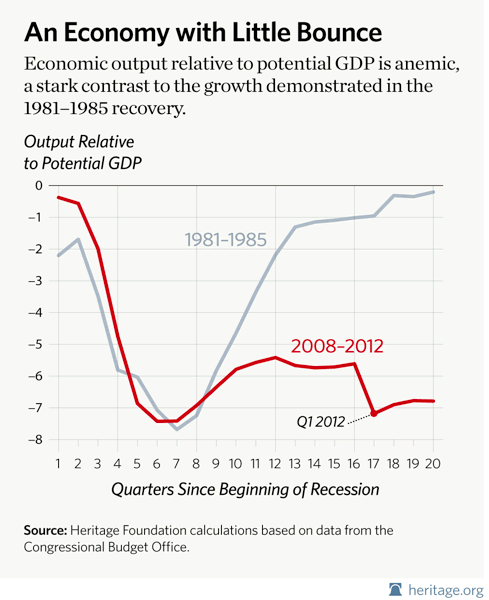
What should the economy’s recovery look like? Take a glance at history (and the chart below). Following the 1981-1982 recession — which looked a lot like the one America saw in 2008 in both depth and duration — the economy returned to near-full employment (which is around 5.5 percent) by 1984. Today, nearly three years after the most recent recession ended, the unemployment rate remains stuck well above 8 percent. So while the economy has grown for 10 straight quarters, it’s only done so at a measly 2.4 percent rate. In fact, it’s the slowest recovery America has seen in the post-war era. No wonder millions of Americans aren’t feeling the effects of the economic rebound and are voting their displeasure. (Article continued below chart.)
Even liberal economist / columnist Paul Krugman sees the economy for what it is. In a recent column in The New York Times, he wrote, “our economy remains deeply depressed” and that “every silver lining comes with a cloud.” So what’s bringing about that cloud? Why is this economy growing, and yet growing so slowly by comparison to the 1980s recovery?
While President Obama might like to take credit for the meager growth the economy is seeing, there’s an important fact to keep in mind. It’s the natural tendency for the economy to grow — and taking credit for its meager improvement is sort of like accepting kudos for the rising and setting of the sun. In fact, the President should of course (but never will) accept some blame for the fact that the economy isn’t growing faster. The policies Obama ushered in are markedly different from those that President Ronald Reagan adopted to unleash the economic recovery in the 1980s, and the results show the difference — a powerful recovery under Reagan, and weak recovery under Obama.
For starters, President Obama says he wants to encourage job creators to ramp up their economic engines, while at the same time he has proposed $2 trillion in higher taxes, much of which would fall on small businesses — the job creators. Add onto that a discouragingly successful policy of encouraging higher gas prices by opposing domestic energy production. This policy is so unpopular that eleven Democratic Senators voted with their Republican colleagues on Thursday to overturn the Obama decision to kill the Keystone XL pipeline. Proponents failed to get the 60 votes necessary to overturn the Keystone decision, but with Democratic support it came very close. Instead of tapping proven resources, Obama puts his faith in pie-in-the-sky renewable energy projects like Solyndra. No wonder Super Tuesday’s voters were worried about the economy.
On top of job-killing tax hikes and higher gas prices, President Obama continues to embrace the burden of untenably high spending and debt — which will of course motivate the left to call for even higher taxes — and you’re left with a mess of policies emanating from Washington signaling small businesses to hunker down instead of investing for the future. A better path for growth would be to enact a budget that curbs spending, reforms entitlements, and reforms the tax code to focus it on economic growth as proposed in Heritage’s Saving the American Dream plan — all of which would free the economy to grow at a faster rate than we’re witnessing today.
While any economic growth and job creation is welcome, a barely perceptible, incremental recovery doesn’t offer much hope for those Americans who can’t feel, see, or touch the fruits of recovery. Millions remain unemployed in the Obama economy, and Washington can and should do better for the American people.
Milton Friedman, recipient of the 1976 Nobel Memorial Prize in Economic Science, is a Senior Research Fellow at the Hoover Institution. This article is reprinted with the permission of Encounter and The Fraser Institute.
“Capitalism and the Jews” was originally presented as a lecture before the Mont Pelerin Society in 1972. It subsequently was published in England and Canada and appears here without significant revision.
The Jews as an Example of the Paradox
My aim here is not to give a ready answer—for I have none. My aim is rather to examine a particular case of paradox–the attitude of Jews toward capitalism. Two propositions can be readily demonstrated: first, the Jews owe an enormous debt to free enterprise and competitive capitalism; second, for at least the past century the Jews have been consistently opposed to capitalism and have done much on an ideological level to undermine it. How can these propositions be reconciled?
I was led to examine this paradox partly for obvious personal reasons. Some of us are accustomed to being members of an intellectual minority, to being accused by fellow intellectuals of being reactionaries or apologists or just plain nuts. But those of us who are also Jewish are even more embattled, being regarded not only as intellectual deviants but also as traitors to a supposed cultural and national tradition.
This personal interest was reinforced by the hope that study of this special case might offer a clue to the general paradox—typified by West Germany where Jews play a minor role. Unfortunately, that hope has not been fulfilled. I believe that I can explain to a very large extent the anti-capitalist tendency among Jews, but the most important elements of the explanation are peculiar to the special case and cannot readily be generalized. I trust that others will be more successful.
II. The Benefit Jews Have Derived from Capitalism
An Anecdote and Some History
Let me start by briefly documenting the first proposition: that the Jews owe an enormous debt to capitalism. The feature of capitalism that has benefited the Jews has, of course, been competition.[1] Wherever there is a monopoly, whether it be private or governmental, there is room for the application of arbitrary criteria in the selection of the beneficiaries of the monopoly—whether these criteria be color of skin, religion, national origin or what not. Where there is free competition, only performance counts. The market is color blind. No one who goes to the market to buy bread knows or cares whether the wheat was grown by a Jew, Catholic, Protestant, Muslim, or atheist; by whites or blacks. Any miller who wishes to express his personal prejudices by buying only from preferred groups is at a competitive disadvantage, since he is keeping himself from buying from the cheapest source. He can express his prejudice, but he will have to do so at his own expense, accepting a lower monetary income than he could otherwise earn.
A recent personal experience illuminates sharply the importance of competition. Some years ago, I attended an International Monetary Conference held in Montreal. The persons there consisted, on the one hand, of members of the Conference, who include the two top executives of the major commercial banks throughout the world; on the other, of persons like myself invited as speakers or participants in panel discussions. A conversation with an American banker present who recounted a tale of anti-Semitism in American banking led me to estimate roughly the fraction of the two groups who were Jewish. Of the first group—the bankers proper—I estimated that about 1 per cent were Jewish. Of the much smaller second group, the invited participants in the program, roughly 25 per cent were Jewish.
Why the difference? Because banking today is everywhere monopolistic in the sense that there is no free entry. Government permission or a franchise is required. On the other hand, intellectual activity of the kind that would recommend persons for the program is a highly competitive industry with almost completely free entry.
This example is particularly striking because banking is hardly a field, like, say, iron and steel, in which Jews have never played an important role. On the contrary, for centuries Jews were a major if not dominant element in banking and particularly in international banking. But when that was true, banking was an industry with rather free entry. Jews prospered in it for that reason and also because they had a comparative advantage arising from the Church’s views on usury, the dispersion of Jews throughout the world, and their usefulness to ruling monarchs precisely because of the isolation of the Jews from the rest of the community.[2]
This anecdote illuminates much history. Throughout the nearly two thousand years of the Diaspora, Jews were repeatedly discriminated against, restricted in the activities they could undertake, on occasion expelled en masse, as in 1492 from Spain, and often the object of the extreme hostility of the peoples among whom they lived. They were able nonetheless to exist because of the absence of a totalitarian state, so that there were always some market elements, some activities open to them to enter. In particular, the fragmented political structure and the numerous separate sovereignties meant that international trade and finance in particular escaped close control, which is why Jews were so prominent in this area. It is no accident that Nazi Germany and Soviet Russia, the two most totalitarian societies in the past two thousand years (modern China perhaps excepted), also offer the most extreme examples of official and effective anti-Semitism.
If we come to more recent time, Jews have flourished most in those countries in which competitive capitalism had the greatest scope: Holland in the sixteenth and seventeenth centuries, and Britain and the U.S. in the nineteenth and twentieth centuries, Germany in the late nineteenth and early twentieth century—a case that is particularly pertinent when that period is compared with the Hitler period.[3]
1. The only other writer I have come across who explicitly stresses the benefits Jews have derived from capitalism is Ellis Rivkin, The Shaping of Jewish History (New York: Scribner’s, 1971). Unfortunately, Rivkin’s interesting analysis is marred by misconceptions about the nature and operation of capitalism. He takes the accumulation of capital rather than free entry as its distinguishing feature.
2. See for example Hannah Arendt, The Origins of Totalitarianism (New York: Harcourt, Brace & Co., 1951), on “court Jews,” also Werner Sombart, The Jews and Modern Capitalism (London: T.Fisher Unwin, 1913) [translated from 1911 German original].
3. Sombart argues that the relation is the reverse: that capitalism flourished where it did because Jews were given a considerable measure of freedom. But he would not have denied that the relation is reciprocal. And his version has been seriously questioned by economic historians. See Introduction by Bert F. Hoselitz to the American edition of Sombart’s book, Jewish Contributions to Civilization, 1919, chapter viia, pp. 247-267.
Why not pass the Balanced Budget amendment? As you know that federal deficit is at all time high (1.6 trillion deficit with revenues of 2.2 trillion and spending at 3.8 trillion).
On my blog www.HaltingArkansasLiberalswithTruth.com I took you at your word and sent you over 100 emails with specific spending cut ideas. However, I did not see any of them in the recent debt deal that Congress adopted. Now I am trying another approach. Every week from now on I will send you an email explaining different reasons why we need the Balanced Budget Amendment. It will appear on my blog on “Thirsty Thursday” because the government is always thirsty for more money to spend.
Marco Rubio is one of your fellow citizens and he noted:
A balanced budget amendment would be a necessary step in reversing Washington’s tax-borrow-spend mantra. It would force Congress to balance its budget each year – not allow it to pass our problems on to the next generation any longer.
The Balanced Budget Amendment is the only thing I can think of that would force Washington to cut spending. We have only a handful of balanced budgets in the last 60 years, so obviously what we are doing is not working. We are passing along this debt to the next generation.
Thank you for this opportunity to share my ideas with you.
In my two short months in office, it has become clear to me that the spending problem in Washington is far worse than many of us feared. For years, politicians have blindly poured more and more borrowed money into ineffective government programs, leaving us with trillion dollar deficits and a crippling debt burden that threatens prosperity and economic growth.
In the Florida House of Representatives, where a balanced budget is a requirement, we had to make the tough choices to cut spending where necessary because it was required by state law. By no means was this an easy process, but it was our duty as elected officials to be accountable to our constituents and to future generations of Floridians. In Washington, a balanced budget amendment is not just a fiscally-responsible proposal, it’s a necessary step to curb politicians’ decades-long penchant for overspending.
Several senators have proposed balanced budget amendments that ensure Congress will not spend a penny more than we take in, while setting a high hurdle for future tax hikes. I am a co-sponsor of two balanced budget amendments, since it is clear that these measures would go a long way to reversing the spending gusher we’ve seen from Washington in recent years.
During my Senate campaign, while surrounded by the employees of Jacksonville’s Meridian Technologies, I proposed 12 simple ways to cut spending in Washington. That company, founded 13 years ago, has grown into a 200-employee, high-tech business, and the ideas I proposed would help ensure that similar companies have the opportunity to start or expand just like Meridian did.
To be clear, our unsustainable debt and deficits are threatening companies like Meridian and impeding job creation. In addition to proposing a balanced budget amendment, I recommended canceling unspent “stimulus” funds, banning all earmarks and returning discretionary spending to 2008 levels.
Fortunately, some of my ideas have found their way to the Senate chamber. The first bill I co-sponsored in the Senate was to repeal ObamaCare, the costly overhaul of our nation’s health care system that destroys jobs and impedes our economic recovery. Democratic leaders in the Senate have expressed their willingness to ban earmarks for two years after the Senate Republican conference adopted a moratorium. I have also co-sponsored the REINS Act, a common-sense measure that would increase accountability and transparency in our outdated and burdensome regulatory process. These bills, along with a balanced budget amendment, would help get our country back on a sustainable path and provide certainty to job creators.
While Republicans are proposing a variety of ideas to rein in Washington’s out-of-control spending, unfortunately, President Obama’s budget for the upcoming fiscal year proposes to spend $46 trillion, and even in its best year, the deficit would remain above $600 billion. Worst of all, the President’s budget completely avoids addressing the biggest drivers of our long-term debt – Social Security, Medicare and Medicaid.
Rather than tackle these tough, serious issues, President Obama is proposing a litany of tax hikes on small businesses and entrepreneurs, to the tune of more than $1.6 trillion. These tax increases destroy jobs, make us less competitive internationally and hurt our efforts to grow the economy and get our fiscal house in order.
A balanced budget amendment would be a necessary step in reversing Washington’s tax-borrow-spend mantra. It would force Congress to balance its budget each year – not allow it to pass our problems on to the next generation any longer.
Marco Rubio
Marco Rubio, a Republican, is a U.S. senator from Florida and former speaker of the Florida House of Representatives
http://blog.heritage.org/2012/02/22/morning-bell-religious-liberty-under-attack/ | The controversy over the Obama Administration’s anti-conscience mandate and the fight for religious liberty only serves to highlight the inherent flaws in Obamacare. This conflict is a natural result of the centralization laid out under Obamacare and will only continue until the law is repealed in full.
My son Wilson and I went to the Tennessee Vols at Arkansas Razorback game in Fayetteville last year. During a restroom stop in Ozark, Arkansas I got to hear a lot of Tennessee fans talking. One said that Dooley will be gone at the end of 2011 and the other said that they have to give him time. The first gentleman argued that they had never had such a bad SEC conference record in 50 years.
I really do wonder if they will give him time. Back in 2010 Vince Dooley spoke at the Little Rock Touchdown Club and he also wondered if the fans would be patient enough for Derek to put together the pieces for a winning program. Now I read today a comment that makes me think they will not. Take a look at the article below:
Uncertainty a reason Eric Russell left UT
By News Sentinel staff
Wednesday, March 7, 2012
Former Tennessee tight ends/special teams coach Eric Russell, who took a job as new coach Mike Leach’s special teams coordinator at Washington State in December, said uncertainty at UT contributed toward his decision to leave Derek Dooley’s staff.
Russell, who was the second of seven assistants to leave UT since the end of the 2011 season, told the Spokane (Wash.) Spokesman-Review that his decision had little to do with the fact that he would be closer to his hometown of St. Maries, Idaho.
“I think at Tennessee, it was going to come down to how many games you won the next year, and unfortunately nobody’s got a crystal ball,” said Russell, making his first public comments since his departure. “I tried to take the sentimental stuff out of it. A chance to be an assistant head coach and concentrate purely on special teams was a little bit of a unique situation.”
Russell worked with Dooley at Louisiana Tech 2007-08 before joining Leach at Texas Tech in 2009. He reunited with Dooley at UT in 2010.
Russell was set to make $275,000 at UT in 2012. He will make $225,000 at Washington State, according to the Spokesman-Review.
The most recent coach to leave Dooley’s staff, former safeties coach/recruiting coordinator Terry Joseph, was officially announced as the new defensive backs coach at Nebraska on Wednesday.
Terms of Joseph’s agreement were not disclosed.
“Coming to a place like Nebraska was a great opportunity for me,” Joseph said in a university release. “And then to throw in the chance to work with (Coach) Bo (Pelini) again, it was the perfect fit. I am excited to get to work with our players and other coaches as we start spring ball and get prepared for the season.”
Arkansas wide receiver Joe Adams runs back a punt for a touchdown against Tennessee at Donald W. Reynolds Razorback Stadium in Fayetteville on Nov. 12, 2011. (AMY SMOTHERMAN BURGESS/NEWS SENTINEL)
Arkansas wide receiver Joe Adams breaks tackles to return a punt for a touchdown against Tennessee at Donald W. Reynolds Razorback Stadium in Fayetteville on Nov. 12, 2011. UT lost the game 49-7. (AMY SMOTHERMAN BURGESS/NEWS SENTINEL)
Arkansas wide receiver Joe Adams breaks past Tennessee defensive back Brian Randolph to return a punt for a touchdown at Donald W. Reynolds Razorback Stadium in Fayetteville on Nov. 12, 2011. UT lost the game 49-7. (AMY SMOTHERMAN BURGESS/NEWS
Terry Rice quoted my political hero Ronald Wilson Reagan in his speech last week. I have a son named Wilson Daniel Hatcher and he is named after two of the most respected men I have ever read about : Daniel from the Old Testament and Ronald Wilson Reagan.
One of the thrills of my life was getting to hear President Reagan speak in the beginning of November of 1984 at the State House Convention Center in Little Rock. Immediately after that program I was standing outside on Markham with my girlfriend Jill Sawyer (now wife of 25 years) and we were alone on a corner and the President was driven by and he waved at us and we waved back.
My former pastor from Memphis, Adrian Rogers, got the opportunity to visit with President Ronald Reagan on several occasions and my St Senator Jeremy Hutchinson got to meet him too. I am very jealous.
Then the Republican candidate for speaker of the House, Rep. Terry Rice, made this pitch last week for his election—next year if his party wins enough House races: He and his party will see to it that the state income tax is cut so that the “depopulation of Arkansas” will end and the state can start to grow.
Depopulation? The state has been gaining population for 50 years and grew by 9.1 percent over the past decade. He said people were fleeing across the border to Texas and Tennessee to live to escape Arkansas’s income tax (and to live in communities with higher property and excise taxes). Texas does not have a personal income tax and Tennessee’s only applies to investment income. Arkansas lost population back in the days when its state and local taxes were the lowest in the United States.
That tax-and-growth record under Reagan and Bush? It was like that in Arkansas, too. When the current income tax rates were set, in 1971, and other taxes raised as well, the state set records for job growth the next three years. When Bill Clinton raised taxes in 1983 and 1987, we led the nation in manufacturing job growth. When Mike Huckabee cut capital gains taxes, the economy and the treasury fell into a slump…
Here is my response to these key points.
Ernie Dumas has beat on this drum over and over in the past, but the facts don’t support this view that Arkansas has benefited from having the high state income tax while bordering states like Tennessee and Texas do not have one. There is an effort to move from Arkansas to states that don’t have a state income tax.
Milton Friedman served as economic advisor for two American Presidents – Richard Nixon and Ronald Reagan. Although Friedman was inevitably drawn into the national political spotlight, he never held public office. I am going to post some clips from his film series that demonstrate how powerful the private market is if you just get out-of-the-way and let it work.
Milton Friedman’s Free to Choose (1980), episode 1 – Power of the Market. part 1
Mike Huckabee moved last year to Florida? Why? The answer is easy. Huckabee wants to avoid Arkansas’ high state income tax. Max Brantley of the Arkansas Times wants to call Huckabee a tax fugitive, but who can blame him.
Liberals like Brantley and Ernie Dumas want to praise former Arkansas governor Dale Bumpers for raising the state income tax to 7%, but that is the reason our state has the highest state income tax in the area (all bordering states have either lower state income taxes or no state income tax).
Is it any surprise that during the last census that the seven states that do not have an income tax grew in population? Arkansas has suffered from bracket creep and in 1929 you had to make 5 times the average wage to pay any state income tax at all, but now over 66% of tax payers in Arkansas pay at least some of their income at the 7% level.
Take a look at all the Milton Friedman clips that I have posted today. These liberals I mentioned above have truly forgotten how powerful the market is if not interfered with by the government.
Milton Friedman’s Free to Choose (1980), episode 1 – Power of the Market. part 2
Until Gov. Dale Bumpers raised income-tax rates and other taxes in 1971, Arkansas had by far the lowest per-capita state and local taxes in the United States. Afterward, we were still 50th but within shouting distance of 49th.
(June 2006) Democratic Gov. Dale Bumpers and the General Assembly raised Arkansas’ top income tax rate to “broaden the tax base” in 1971(1). Yet Arkansas’ per capita income, expressed as a percentage of the U.S. total, has barely improved, moving from 71 (1971) to 77.7 percent (2005) over the 34-year period, according to data from the U.S. Bureau of Economic Analysis. The 1971 income tax increase reversed a decades-long strong growth trend and left Arkansas with the highest income tax rate among bordering states (Mississippi, Missouri, Louisiana, Oklahoma, Tennessee and Texas).
Income Stagnation: The 1930s
One has to turn to the 1930s-the decade of the Great Depression-to find weaker income growth than in recent years.
Arkansas per capita personal income was 44 percent of the U.S. in 1929, the first year data was compiled in the BEA time series. The Great Depression started that year, and by the time it ended in 1933 Arkansas per capita income had fallen to 41 percent of the U.S. By decade’s end (1939) it had returned to 44 percent.
Growth Decades: The 1940s, 1950s & 1960s
Arkansas per capita income increased as a percentage of the U.S. in the next three decades.
In 1941, at the onset of World War II, Arkansas per capita income was 47 percent of the U.S. It was 59 percent at war’s end in 1945 and again in 1949. It was 56 percent in 1950, 62 percent a decade later in 1960, and 68 percent in 1969. If this growth rate had continued Arkansas would have exceeded 100 percent of the U.S. average in the current decade (2000-2009).
To summarize, Arkansas per capita income increased from 44 to 71 percent of the U.S. total between 1939 and 1971.
Anemic Income Growth (1971-2005)
The trend in recent decades is anemic growth in Arkansas per capita personal income. Fiscal policy changes effect economic behavior with a time lag. Arkansas per capita income was 71 percent of the U.S. in 1971 and 76 percent in 1973. Income growth stagnated for the rest of the decade, reaching 77 percent of the U.S. in 1979. It fell to 75 percent in 1989, and was 76 percent in 1999. Today, Arkansas per capita income, at 77.7 percent of the U.S., is barely above its high point of the 1970s.
Milton Friedman’s Free to Choose (1980), episode 1 – Power of the Market. part 3
Since its introduction in 1929, Arkansas‘ statutory incometax structure has changed very little. However, due to changes in the economy and in inflation, the real effects of that tax structure has changed substantially. This report looks at the effects that rising incomes and inflation have had on the Arkansasincometax structure. In addition, the report looks at the changing profile of Arkansas taxpayers in recent years, and provides a brief comparison of Arkansas taxes in relation to other states and the federal tax system.
Arkansas‘ IncomeTax Structure: Original and Revised
In 1929 Arkansas became 12th among the states to adopt an individual incometax. The structure contained five rates and net income brackets with a top rate of five percent applying to net income over $25,000. That original structure remained in place until 1971 when a new middle income bracket was added and the rate on net income over $25,000 was increased to 7.0 percent. The rates and brackets revised in 1971 remain in place today. The 1929 original and the revised current tax structure are shown in Table 1.
Table 1 Arkansas Individual IncomeTax Structure
 1929 Original Net Income Rate first $3,000 1.0%
next$3,001 to $6,000  2.0%
next$6,001 to $11,000 3.0%
next $11,001 to $25,000  4.0%
over $25,000 5.0%
1971 Revision (Current)
Net Income Rate first $2,999 1.0%
 next$3,000 to $5,999 2.5%
next$6,000 to $8,999 3.5%
next$9,000 to $14,999 4.5%
next $15,000 to $24,999 6.0%
 over $25,000 7.0%
Source: Arkansas Legislative Tax Handbook, 1992, Bureau of Legislative Research.
In 1975, the earliest year for which records on income tax collections by income group is available, only the top 4.0 percent of Arkansas taxpayers would have had any of their income subjected to the top 7.0 percent rate. By 1991, around 66.0 percent of the state’s taxpayers would have had some of their income subjected to this top rate–a rate once reserved for only the highest income earners.
The 1929 tax structure provided for exemptions of $1,500 for a single person and $2,500 for married individuals. In 1947 the state raised the exemption to $2,500 for singles and $3,500 for married persons. In 1957 the personal exemption was converted to a credit of $17.50 for singles and $35.00 for married persons. In 1987 the credits were increased to $20 per person. Finally, in 1991, low income Arkansans were exempted from paying incometax if their gross income did not exceed $5,500 for an individual or $10,000 for a married couple. For most taxpayers, the $20.00 credit remains in effect today.
The Value of Exemptions as a Share of Per Capita Income
Table 2 shows how the value of the personal tax exemption or credit has diminished over time. The figures shown represent the personal exemption or credit for a single individual as a ratio of the per capita personal income in the year in which the credit was first enacted. In 1929, for instance, an individual would have been exempted from any tax until their income reached a level which was equal to 490 percent of the Arkansas per capita income for that year. In 1947 with the first statutory change in the exemption, that individual would have still been exempted up to an amount equal to 340 percent of the per capita income level. By 1957 the value of the exemption (which was changed to a tax credit that year) had declined substantially, falling to 130 percent of per capita income. At the time of the next change in the personal credit (1987), the value of that credit was only 17 percent of the per capita income level. For most taxpayers (all those not officially classified as low income) in 1992, the value of the personal credit was only 13 percent of per capita income.
Table 2 Personal Exemptions and Credits As a Percent of Per Capita Income
Arkansas Year of Value of Per Capita Enactment ExemptionIncome Ratio 1929 $1,500 $ 308 490% 19472,500 737 340% 19571,6001,247 130% 19872,000 11,980 17% 19922,000 15,439 13%
Source: Arkansas Legislative Tax Handbook, 1992, Bureau of Legislative Research; Per capita personal income data is from the Bureau of Economic Analysis, unpublished data, April, 1993.
In other words, whereas in the first year of enactment of the incometax, the personal exemption would have allowed an Arkansan to earn almost five times the average per capita income before paying any tax.
Milton Friedman’s Free to Choose (1980), episode 1 – Power of the Market. part 4
For those of us who are demographic buffs, Christmas came four days early when Census Bureau director Robert Groves announced on Tuesday the first results of the 2010 census and the reapportionment of House seats (and therefore electoral votes) among the states.
The resident population of the United States, he told us in a webcast, was 308,745,538. That’s an increase of 9.7 percent from the 281,421,906 in the 2000 census — the smallest proportional increase than in any decade other than the Depression 1930s but a pretty robust increase for an advanced nation. It’s hard to get a grasp on such large numbers. So let me share a few observations on what they mean.
First, the great engine of growth in America is not the Northeast Megalopolis, which was growing faster than average in the mid-20th century, or California, which grew lustily in the succeeding half-century. It is Texas.
Its population grew 21 percent in the past decade, from nearly 21 million to more than 25 million. That was more rapid growth than in any states except for four much smaller ones (Nevada, Arizona, Utah and Idaho).
Texas’ diversified economy, business-friendly regulations and low taxes have attracted not only immigrants but substantial inflow from the other 49 states. As a result, the 2010 reapportionment gives Texas four additional House seats. In contrast, California gets no new House seats, for the first time since it was admitted to the Union in 1850.
There’s a similar lesson in the fact that Florida gains two seats in the reapportionment and New York loses two.
This leads to a second point, which is that growth tends to be stronger where taxes are lower. Seven of the nine states that do not levy an income tax grew faster than the national average. The other two, South Dakota and New Hampshire, had the fastest growth in their regions, the Midwest and New England.
Altogether, 35 percent of the nation’s total population growth occurred in these nine non-taxing states, which accounted for just 19 percent of total population at the beginning of the decade.
Milton Friedman’s Free to Choose (1980), episode 1 – Power of the Market. part 5




 The Daily Hatch