Yearly Archives: 2012

Our founding fathers knew a lot about the dangers of our sin nature

1 Of 5 / The Bible’s Influence In America / American Heritage Series / David Barton

_________________

Our founding fathers had some wise things to say about government. They realized that angels don’t govern us.

Because Angels Don’t Govern Us

by Michael D. Tanner

Michael Tanner is a senior fellow at the Cato Institute and author of Leviathan on the Right: How Big-Government Conservatism Brought Down the Republican Revolution.

Added to cato.org on May 2, 2012

This article appeared in National Review (Online) on May 2, 2012.

Now that the first round of spin has passed, we can take a second look at the lessons to be learned from the recent GSA and Secret Service scandals.

First, it really is a bit unfair to blame them on President Obama. The president is not directly involved in the day-to-day management of these agencies. Nor should he be. Moreover, misbehavior by government employees predates the Obama administration by quite a bit. In 460b.c., for example, the Greek Delian League put nine government administrators to death for misusing public funds.

However, none of that lets President Obama entirely off the hook.

Too many on both the left and the right believe that government intervention in the economy or in the lives of individual citizens is necessary because only government can see the larger picture and act in a disinterested way for the benefit of the greater good. Businesses can be corrupt or self-seeking, and individuals may be myopic or make choices that others see as either morally or economically wrong. No doubt this view is correct, at least in some cases. In one way or another, we are all imperfect.

The Obama administration persists in believing that government is wiser than and morally superior to the average American.

President Obama believes that government is different.

Given our flaws as individuals, the Obama administration believes that government should run our health-care system. Left to our own devices, we might fail to buy health insurance or buy insurance that doesn’t include the right package of benefits. Government needs to subsidize “green energy,” because we might decide to buy fuel-inefficient cars. Government needs to oversee the banking industry and housing markets, because banks made loans to people who couldn’t afford to pay them back.

People are prejudiced and selfish. Government is altruistic and “fair.” Markets fail, but not government. As President Obama sees it, government can make us better and lead us to the promised land.

But, as the GSA and Secret Service scandals should remind us, government is made up not of philosopher-economist-saints but of men and women like the rest of us — afflicted by failures, corruption, short-sightedness, and self-interest. The difference is that government gives those imperfect individuals the power to impose their views and desires on the rest of us.

The Founding Fathers understood this. They knew that some government is necessary to protect our rights to “life, liberty, and the pursuit of happiness.” For this reason, they noted in the Declaration of Independence, “governments are instituted among men.” But they also understood that government needs to be carefully limited in its scope and power.

As James Madison wrote in Federalist 51:

If men were angels, no government would be necessary. If angels were to govern men, neither external nor internal controls on government would be necessary. In framing a government which is to be administered by men over men, the great difficulty lies in this: you must first enable the government to control the governed; and in the next place oblige it to control itself.

Indeed, the damage that government can do is far greater than the damage that can be done by business or individuals, because ultimately the state holds a monopoly on the use of force. If I make a mistake, it affects my life and perhaps the lives of my family and a few others. If a business makes a mistake, it can affect thousands more. But if government makes a mistake, it can affect everyone. That is what makes the growing reach of government so dangerous.

That means that, necessary though some restraint on the freedom of individuals and businesses may be, it is even more important to have internal and external controls on the power of government.

The Obama administration’s failure, therefore, is not that it neglected to micromanage the GSA’s expenses or that it couldn’t keep Secret Service agents out of brothels. It is that it wants the practical equivalent of GSA employees and Secret Service agents to run our lives. The Obama administration persists in believing that government is wiser than and morally superior to the average American.

That is a real scandal.

Should Christians support Obama’s re-election?

1 Of 5 / The Bible’s Influence In America / American Heritage Series / David Barton

2 Of 5 / The Bible’s Influence In America / American Heritage Series / David Barton

We need to see more Christian values in our government.

SBC leader questions judgment of Christians who support Obama

By Bob Allen

1-30-12

NASHVILLE, Tenn. (ABP) – The Southern Baptist Convention’s top public-policy expert says that Christians who still support President Obama are not using their heads.

Richard Land, president of the SBC Ethics and Religious Liberty Commission, said on the Jan. 28 broadcast of Richard Land Live that while he believes Obama faces an uphill battle for re-election, he is surprised that so many Christians still back the president.

“I know Christians who support Obama,” Land said. “I don’t question their faith, but I do question their judgment.”

Land said the Obama administration has waged a “full-fledged war to move us from freedom of religion to merely freedom of worship, implying that one’s faith is only a private matter and that exercising that faith in public is not a protected right.”

Land called a new rule requiring insurance plans to cover birth control — including those paid for by religious employers that believe artificial birth control is a sin — a “horrible decision” that poses a problem not just for faiths that object to birth control.

“Will our religious affiliated groups be forced to hire people who oppose our faith?” he asked. “Will the government force a curriculum on our schools and our homeschoolers? Just a few years ago these possibilities seemed beyond the realm of possibility. Now they seem very real.”

Land said people who claim to be conservative, evangelical Christians “are exercising very poor judgment” if “they continue to support a president who is squelching their religious freedoms.” The reason it happens, he said, is that “people are not terribly rational.”

“We have what are called compartmentalized attitude structures,” Land said. “Jimmy Carter is a good example. Jimmy Carter went around campaigning for president in 1976 and said ‘I believe in the basic goodness of the American people,’ and ‘I’m a born-again Christian.’ Well, if you’re a born-again Christian you don’t believe in the basic goodness of anybody, because you believe in original sin. But, you see, he was holding these two contradictory attitudes in the same brain.”

“Many of us of a certain age know people — who when we were children they were adults — who gave every evidence of being really pious Christians but who were racists, and didn’t see any contradiction between their racism and their Christian faith,” he continued.

Land said those people supported candidates like four-time presidential candidate George Wallace and segregationist Mississippi Gov. Ross Barnett “because they failed to see the contradiction between what they were voting and what they believed.”

“I don’t question those people’s faith,” Land said. “I knew some of them. Some of them were older men when I was younger, when I was a boy, and they gave every evidence of being Christians, but they had a huge blind spot on race. So I question their judgment, and I would in fact say that their racism was a sin, but that doesn’t mean they weren’t Christian. So I don’t question their faith; I question their faith understanding when it came to certain issues.”

Land said the Obama administration “has shown from the very beginning that it is hostile to free religious expression.”

“There’s no question about that,” he said. “They have done thing after thing after thing after thing.”

“This is really serious,” Land said. “You’ll hear the Obama administration; they are disciplined in their talking about this. They talk about freedom of worship. They talk about freedom of worship overseas and they talk about freedom of worship at home. We do not have a guarantee of freedom of worship. We have a guarantee to freedom of religion.”

Land said the free-exercise of religion protected by the Constitution “will involve us in much more than just worship.”

“And the government under the Obama administration wants to curtail that and to restrict it to the private sector only,” Land said. “There can be no other explanation for what they have done the last three and a half years.”

Land urged Christians concerned about religious liberty to sign the Manhattan Declaration, a 4,700-word manifesto that has garnered nearly 500,000 online signatures. The document, drafted by Catholic scholar Robert George and Southern Baptists Chuck Colson and Timothy George, says Christians are to respect and obey those who are in authority but not required to obey laws that are “gravely unjust or require those subject to them to do something unjust or otherwise immoral.”

Land said a prime example of effective civil disobedience was Martin Luther King Jr.’s famous letter written from the Birmingham, Ala., jail. “That’s what gave it moral stature,” Land said. “If he had written it from an Atlanta hotel room, it wouldn’t have had the impact it had.”

Land said the question of when civil disobedience becomes a moral option hinges on whether other means of protest are available. “The threshold was lower for Dr. King than it is for us, and the reason is that he and most of the people he was seeking to free couldn’t vote,” Land said.

“We have the right to vote. We have the right to file suit in court,” Land said. “I would argue that there are certain means that need to be exhausted before we reach civil disobedience, but that civil disobedience must always remain the ultimate option if the government forces us to choose between obeying God or man.”

“What I’ve argued is that if we all say we’re going to obey God rather than man — we’re going to not allow them to restrict our religious freedom — if we all hang together, then none of us will have to go to jail,” he said. “If we don’t, we may all end up in jail.”

-30-

Bob Allen is managing editor of Associated Baptist Press.

_______________

3 Of 5 / The Bible’s Influence In America / American

Heritage Series / David Barton

Milton Friedman: The free market price system promotes cooperation and harmony among those with no common interest

Milton Friedman’s illustration of a pencil makes the point in a clear way.

Milton Friedman – Lesson of the Pencil

Uploaded by on Nov 13, 2009

Milton Friedman uses a pencil to illustrate how the free market price system promotes cooperation and harmony among those with no common interest.

_____________

November 21, 2006

Milton Friedman 1912-2006

Milton Friedman’s book “Free to Choose”, co-authored with his wife Rose, was among the first tracts I’ve read on the topic. I don’t remember exactly when I read it, probably in college. I would not be able to explain well the intracacies of monetarist policies and its alternatives, but Friedman’s simple message about free markets has always stuck with me.

He summed up the workings and the benefits of free markets with a simple idea: a pencil. Here is Friedman in his own words, taken from a transcript of a TV version of “Free to Choose”:

“Look at this lead pencil, there is not a single person in the world who could make this pencil. Remarkable statement? Not at all. The wood from which it’s made, for all I know, comes from a tree that was cut down in the State of Washington. To cut down that tree, it took a saw. To make the saw, it took steel. To make the steel, it took iron ore.

“This black center, we call it lead but it’s really compressed graphite, I am not sure where it comes from but I think it comes from some mines in South America. This red top up here, the eraser, a bit of rubber, probably comes from Malaya, where the rubber tree isn’t even native. It was imported from South America by some businessman with the help of the British government. This brass feral – I haven’t the slightest idea where it came from or the yellow paint or the paint that made the black lines – or the glue that holds it together.

“Literally thousands of people cooperated to make this pencil. People who don’t speak the same language; who practice different religions; who might hate one another if they ever met. When you go down to the store and buy this pencil, you are, in effect, trading a few minutes of your time for a few seconds of the time of all of those thousands of people. What brought them together and induced them to cooperate to make this pencil? There was no Commissar sending out orders from some central office. It was the magic of the price system – the impersonal operation of prices that brought them together and got them to cooperate to make this pencil so that you could have it for a trifling sum.

“That is why the operation of the free market is so essential. Not only to promote productive efficiency, but even more, to foster harmony and peace among the peoples of the world.”

Johnny Cash a Christian?

I got to see Johnny Cash perform in Memphis in 1978 and I actually knew his nephew very well. He was an outspoken Christian and evangelical. Here is an article that discusses this.

Johnny Cash’s Complicated Faith

Dave Urbanski

<!–

var fbShare = {
google_analytics: ‘true’,
}

tweetmeme_source = ‘RELEVANTMag’;

–>

photograph of Johnny Cash

Unwrapping the enigma of the Man in Black.

Johnny Cash’s musical accomplishments are storied and staggering. He occupies spots in the Rock and Roll Hall of Fame, the Songwriter’s Hall of Fame, and the Country Music Hall of Fame—he, in fact, was the youngest living person ever inducted into the latter. He sold 50 million albums, recorded more than 1,500 songs, boasted fourteen number-one hits, won scads of awards, and is mentioned in the same breath as The Beatles when it comes to musical impact.

His legendary bass-baritone was a force of nature. Equal parts rolling thunder and John the Baptist, when Cash sang or spoke, his voice commanded attention. And respect. And believability.

But more importantly, throughout his magical career that ended just shy of the half-century mark when he died from diabetes complications on September 12, 2003, Cash tore apart the rulebook more than once, paving the way for other artists to do the same; he always stood up for the underdog (the poor, Native Americans, prisoners, and others) and always stood up to the oppressive; and he beat just about every odd that was stacked against him.

And it’s for those reasons that pinning down Johnny Cash in any way, shape, or form is impossible. He made it impossible. He never intended to be categorized or pigeonholed. He recorded with Bob Dylan, then turned around and played for Richard Nixon. He embraced the radical social justice movements of the ’60s and flew high Old Glory. He protested Vietnam and played for the troops.

The revelation is that Cash lived long enough and hard enough to embody a host of personas—and they’re all true. Songwriter. Six-string strummer. Storyteller. Country boy. Rock star. Folk hero. Preacher. Poet. Drug addict. Rebel. Sinner. Saint. Victim. Survivor. Home wrecker. Husband. Father. And more.

As songwriting friend Kris Kristofferson recently said, “He’s as comfortable with the poor and prisoners as he is with presidents. He’s crossed over all age boundaries. I like to think of him as Abraham Lincoln with a wild side.”

Cash’s cluster of enigmas was so impenetrably deep that even those closest to him never got to see every part of him, every thought, every emotion.

“I think Johnny’s as complex as anything God or man put on this earth,” his brother Tommy once noted. “He’s a man of uncommon characteristics, mentally or physically. Even though you’re his brother, or his wife, or his mother, you never know him completely. I’ve felt myself at times trembling because of my inadequacy around him. ”

“Don’t Put Me in Another Box”

A writer once tried to paint Cash into a corner, baiting him to acknowledge a single denominational persuasion at the center of his heart. Finally, Cash laid down the law: “I—as a believer that Jesus of Nazareth, a Jew, the Christ of the Greeks, was the Anointed One of God (born of the seed of David, upon faith as Abraham has faith, and it was accounted to him for righteousness)—am grafted onto the true vine, and am one of the heirs of God’s covenant with Israel.”

“What?” the writer replied.

“I’m a Christian,” Cash shot back. “Don’t put me in another box.”

So, exactly what “kind” of Christian was Cash?

A staunch, conservative, Bible thumper? It sure seems so if you read the introduction to his 1986 novel about the life of the apostle Paul, Man in White: “Please understand that I believe the Bible, the whole Bible, to be the infallible, indisputable Word of God. I have been careful to take no liberties with the timeless Word.”

But based on a passage from his 1997 autobiography, Cash doesn’t seem as steadfast:

“Once I learned what the Bible is the inspired Word of God (most of it anyway) … “(To be fair, he continues this shadow of doubt with a gushing endorsement of Scripture, noting how “truly exciting” it is to discover new interpretations and applications to his own life.)

“Being a Christian Isn’t for Sissies”

Further, it certainly can be argued that Cash was a private man and preferred to keep his faith to himself. “I don’t compromise my religion,” Cash once declared. “If I’m with someone who doesn’t want to talk about it, I don’t talk about it. I don’t impose myself on anybody in any way, including religion. When you’re imposing you’re offending, I feel. Although I am evangelical, and I’ll give the message to anyone that wants to hear it, or anybody that is willing to listen. But if they let me know that they don’t want to hear it, they ain’t never going to hear it from me. If I think they don’t want to hear it, then I will not bring it up. ”

In short, “telling others is part of our faith all right, but the way we live it speaks louder than we can say it,” Cash said. “The gospel of Christ must always be an open door with a welcome sign for all. ”

“There’s nothing hypocritical about it,” Cash told Rolling Stone scribe Anthony DeCurtis. “There is a spiritual side to me that goes real deep, but I confess right up front that I’m the biggest sinner of them all.” To Cash, even his near deadly bout with drug addiction contained a crucial spiritual element. “I used drugs to escape, and they worked pretty well when I was younger. But they devastated me physically and emotionally—and spiritually … [they put me] in such a low state that I couldn’t communicate with God. There’s no lonelier place to be. I was separated from God, and I wasn’t even trying to call on Him. I knew that there was no line of communication. But He came back. And I came back.”

And while his body suffered under the strain wrought by years of abuse, Cash’s mind stayed strong … and his spirit stayed stronger.

“Being a Christian isn’t for sissies,” Cash said once. “It takes a real man to live for God-a lot more man than to live for the devil, you know? If you really want to live right these days, you gotta be tough.” What’s more, he’s intimately aware of the hard truths about living God’s way: “If you’re going to be a Christian, you’re going to change. You’re going to lose some old friends, not because you want to, but because you need to.”

“I Don’t Give Up”

Even after many people had assumed his career was over, Cash headed back into the studio to begin work on more songs with fellow rebel and producer of nearly a decade, Rick Rubin. Today’s release of American VI: Ain’t No Grave marks the last of those albums. 

And in his final days, despite moment-by-moment battles with various debilitating ailments, the Man in Black was anything but in a black mood. In fact, he was celebrating life-sopping up every second he could, while he could.

”I’m thrilled to death with life,” he told Larry King during an interview. “Life is—the way God has given it to me—was just a platter. A golden platter of life laid out there for me. It’s been beautiful.”

“I don’t give up … and it’s not out of frustration and desperation that I say ‘I don’t give up.’ I don’t give up because I don’t give up. I don’t believe in it.”

Amen to that, Brother Cash.

This article is adapted from The Man Comes Around: The Spiritual Journey of Johnny Cash (RELEVANTBooks).


Liberalism’s great question: What do we do when all the money runs out?

Why raise taxes when we have not made real cuts yet? By the way we are about to run out of money!!!!

Question for Leftists: What Happens When There’s Nothing Left to Steal?

December 4, 2011 by Dan Mitchell

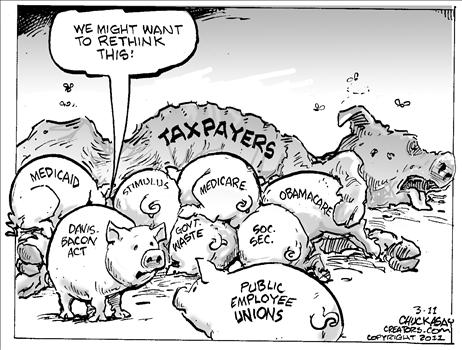
More than two years ago, I explained in a TV interview that the looters and moochers should be careful that they don’t kill the geese that lay the golden eggs. After all, parasites need a healthy host.

The collapse of Europe’s welfare states should be a wake-up call for these people, but that hasn’t stopped the demands for more redistribution in Washington. As Michael Barone noted, the folks on the left assume that there will always be someone to plunder.

But at least the piglets in this Chuck Asay cartoon are finally waking up to reality.

Unfortunately, I don’t expect the crowd in Washington to change. Most politicians don’t think more than a couple of years into the future, so they will continue to lure more people into riding in the wagon and continue to penalize those who pull the wagon.

This won’t end well.

Exclusive Interview with Heritage Foundation: John Stossel Says Government Can’t Solve Our Problems

Rob Bluey and Brandon Stewart

April 12, 2012 at 11:51 am

John Stossel on Government, Free Enterprise, and Media

Published on Apr 12, 2012 by

http://blog.heritage.org/2012/04/12/exclusive-interview-john-stossel-says-gov… | John Stossel’s skepticism of government and his storytelling approach about free-market economics have made him a rock star in conservative and libertarian circles.

He spoke at The Heritage Foundation on Wednesday about his new book, “No, They Can’t: Why Government Fails—But Individuals Succeed.” It is Stossel’s latest attempt to debunk the myths that government can solve America’s problems. He tackles everything from crony capitalism and federal regulations to teachers’ unions and gun control.

______________________

John Stossel’s skepticism of government and his storytelling approach about free-market economics have made him a rock star in conservative and libertarian circles.

He spoke at The Heritage Foundation on Wednesday about his new book, “No, They Can’t: Why Government Fails—But Individuals Succeed.” It is Stossel’s latest attempt to debunk the myths that government can solve America’s problems. He tackles everything from crony capitalism and federal regulations to teachers’ unions and gun control.

“Our instinct is to believe in the central planners,” Stossel said in the interview. “It was nuts in the Obama election. It was like he was a magic politician who was going to do these things.”

Yet despite government’s failures, the left never retreats. President Obama’s class-warfare rhetoric, Stossel conceded, is a current example of how liberals shape the narrative.

“I live in the shallow media world,” Stossel said, “and on a subject like that, shallow wins.”

In the interview, Stossel didn’t mince words when asked why he left ABC News in 2009: “Because it sucked there.”

He currently hosts “Stossel,” a one-hour weekly Fox Business Network show and other specials on Fox News. The book reveals his rift with ABC and why Stossel approached Fox for a job.

Here’s what he told us:

They were hostile to these ideas that have made us prosperous and I consider so important. I mean, they tolerated me for years. I got good ratings, so they put the stuff on. They sort of held their nose and put it on. But by the end, they were saying, ‘Ah, you’re predictable Stossel. You use libertarian economics all the time. I don’t want to watch that.’ … I was not offered a job by Fox. I went over and begged, ‘Please, hire me, I cannot stand it anymore.’

The interview runs about five minutes. Hosted by Rob Bluey and produced by Brandon Stewart. For more videos from Heritage, subscribe to our YouTube channel.

Got to avoid raising taxes if we want the economy to grow and eventually balance the budget

Dan Mitchell on Austerity in Europe 2012

In order to balance the budget we must make deep cuts. Take a look at the study refers to below by Dan Mitchell of the Cato Institute in his fine article on the French mess. Raising taxes has not worked in the thirty countries studied.

Having written several times about crazy French statism, you will understand why I like this cartoon.

Though, to be fair, France hasn’t gotten to the point where it’s being bailed out (it’s probably just a matter of time).

If you want some good analysis of the situation in Europe, Veronique de Rugy of the Mercatus Center hits the nail on the head in her column in today’s Washington Examiner.

France has yet to cut spending. In fact, to the extent that the French are frustrated with “budget cuts,” it’s only because the increase in future spending won’t be as large as they had planned. The same can be said about the United Kingdom. Spain, Italy and Greece have had no choice to cut some spending. However, in the case of these particular countries, the cuts were implemented alongside large tax increases. …This approach to austerity, also known in the United States as the “balanced approach,” has unfortunately proven a recipe for disaster. In a 2009 paper, Harvard University’s Alberto Alesina and Silvia Ardagna looked at 107 attempts to reduce the ratio of debt to gross domestic product over 30 years in countries in the Organisation for Economic Co-operation and Development. They found fiscal adjustments consisting of both tax increases and spending cuts generally failed to stabilize the debt and were also more likely to cause economic contractions. On the other hand, successful austerity packages resulted from making spending cuts without tax increases. They also found this form of austerity is more likely associated with economic expansion rather than with recession. …While the debate over austerity continues, the evidence seems to point to the conclusion that austerity can be successful, if it isn’t modeled after the “balanced approach.” It’s a lesson for the French and other European countries, as well as for American lawmakers who often seem tempted by the lure of closing budget gaps with higher taxes.

This is similar to my recent analysis, and Veronique also is kind enough to cite my analysis of how the Baltic nations have done the right thing and cut spending.

There are obvious lessons from Europe for the United States. If politicians don’t reform entitlement programs, we’re doomed to have our own fiscal crisis at some point in the not-too-distant future.

Only there won’t be anybody there to bail us out.

Obama’s stupid idea that did not work!!!


Why did Obama’s idea not work in 2009?

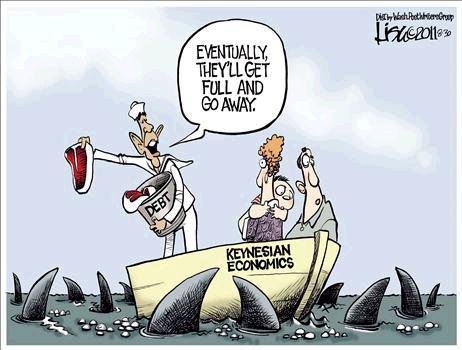
Keynesian Economics in a Cartoon

September 1, 2011 by Dan Mitchell

I’ve written extensively about the flaws of Keynesian economics, and I’ve even narrated a video on the flaws of Keynesian theory.

But this clever cartoon may be more effective than anything I’ve ever done.

If you like cartoons that teach economics, check out this gem. It’s not on Keynesianism, but it’s very good.

Top football stadiums in the country (Part 7)

Final Moments of Kentucky vs. Tennessee Football Game 2011

Uploaded by on Nov 27, 2011

Kentucky wins 10-7 and ends the 26 year losing streak!!

Here is a list of the top football stadiums in the country.

Power Ranking All 124 College Football Stadiums  

By Alex Callos

(Featured Columnist) on April 19, 2012 

When it comes to college football stadiums, for some teams, it is simply not fair. Home-field advantage is a big thing in college football, and some teams have it way more than others.

There are 124 FBS college football teams, and when it comes to the stadiums they play in, they are obviously not all created equal.

There is a monumental difference from the top teams on the list to the bottom teams on the list. Either way, here it is: a complete ranking of the college football stadiums 1-124.

_________________

I want to talk about two Kentucky games that I got to see on tv. Both games were in Lexington.

Here is some info on the Tennessee at Kentucky game in 2011 that ended a 26 year in row of victories for the Vols. Below is a picture of the Vols walking off the field after the game.

Tennessee players leave the field after the 10-7 loss to Kentucky at Commonwealth Stadium in Lexington on Saturday, Nov. 26, 2011. UT lost to UK for the first time since 1984. (AMY SMOTHERMAN BURGESS/NEWS SENTINEL)<br /><br /><br />

Photo by Amy Smotherman Burgess, ©KNS/2011

Tennessee players leave the field after the 10-7 loss to Kentucky at Commonwealth Stadium in Lexington on Saturday, Nov. 26, 2011. UT lost to UK for the first time since 1984. (AMY SMOTHERMAN BURGESS/NEWS SENTINEL)

In the 2003 game, Arkansas won in 7 overtimes. Wikipedia notes:

Seventh overtime

Matt Jones threw an incomplete pass before Decori Birmingham scored on a 25 yard touchdown run to give the Hogs a 69-63 advantage.[4] The all-important two point conversion was a completion to Jason Peters, giving Arkansas a 71-63 cushion.[3] Kentucky first completed a pass for twelve yards, but a fourth and three on the Razorback five proved the game winner, as a Lorenzen fumble was recovered by all-SEC linebacker Tony Bua of Arkansas.[4]

[edit] Aftermath

The game ended at 12:01 am on November 2, 2003.[4] This game also set an NCAA record for the most points scored in a game (after 1950). Arkansas scored 47 points in overtime, breaking their own record of 41. Both teams combined for 86 overtime points, six more than the 2001 seven overtime affair.[3] The game lasted 4 hours and 56 minutes.[4]

78. Davis Wade Stadium: Mississippi State Bulldogs

6a00e553e551d18834010534aaaf06970c-500wi_display_image

Davis Wade Stadium could be considered tiny when it comes to other SEC stadiums.

Built in 1914, it is one of the oldest stadiums out there, with a seating capacity of 55,082. It underwent major renovations about 10 years ago, and while it is still not up to par with some of the larger SEC stadiums, it is improving.

The unique thing about David Wade Stadium is the cowbells that constantly ring out. The atmosphere here is the best of any stadium so far on the list.


77. Carrier Dome: Syracuse Orange

450781027jafaqf_fs_display_image

The Carrier Dome is perhaps better known as the largest college basketball arena in the country.

When it comes to football, it is much less known, but is not a bad place to see a game.

With a seating capacity of 49,262, it is middle of the pack as far as Big East schools are concerned.

Built in 1980, this dome has an excellent atmosphere when the Orange are good.


76. UB Stadium: Buffalo Bulls

386_display_image

This stadium is large by MAC standards with a seating capacity of 29,013 and is relatively new, having been built in 1993.

Buffalo is a newcomer to FBS, and this stadium is one of the best in the MAC.

While everything here is average, the $15 price of a game ticket makes this one of the best deals in the country.

There are a lot of positives as far as this stadium is concerned.


75. Sun Bowl Stadium: UTEP Miners

Sun_bowl_stadium_front_display_image

Originally opening its doors in 1963, this 51,500-seat stadium is home to the Sun Bowl every year, and also the UTEP Miners.

There is beautiful scenery in the surrounding area, and this stadium is a great place to take in a football game, as there is not a bad seat in the house.

It is almost shaped like a bowl and is one big level.


74. Arizona Stadium: Arizona Wildcats

Arizonastadium-arizona_display_image_display_image

Arizona Stadium is known for being loud, and that it certainly is. As far as the rest of the stadium goes, it is average at best.

The stadium is extremely old and was originally built in 1928. It now has a seating capacity of 57,803, and if it was larger, it would be much higher on the list.

While it can get loud and the atmosphere is great, the place is slightly outdated to be ranked any higher.


73. Michie Stadium: Army Black Knights

West_point_michie2_display_image

Built in 1924, Michie Stadium is one of the older stadiums around.

It has that old feel to it and has beautiful scenery in the surrounding area. The stadium, however, leaves a lot to be desired and is outdated to say the least.

Still, the tradition and other interesting aspects of the stadium make it middle of the pack on this list.


72. Reser Stadium: Oregon State Beavers

Reser-280-c_display_image

This medium sized stadium was built in 1953 and seats 45,674. It does offer an excellent home-field advantage for the Beavers, however.

The atmosphere here is great, and it can get really loud, but with the Oregon State team struggling the past few seasons, there is not much to cheer about in here.

Still, a nice venue to take in a game.


71. Glass Bowl: Toledo Rockets

University_of_toledo_glass_bowl_uto2_large_display_image

The Glass Bowl is the cream of the crop when it comes to MAC stadiums.

It was originally built in 1936 and seats 26,248, which is on the higher end as far as MAC standards are concerned.

The outside almost looks like visitors are walking into a fort. The atmosphere here is very good, and things can get a little rowdy on gameday. 


70. Commonwealth Stadium: Kentucky Wildcats

Commonwealth2_display_image

Kentucky is certainly a basketball school, but they have a decent football stadium as well.

Built in 1973 with a capacity of 67,606, Commonwealth Stadium has played host to some major upsets.

It is not nearly as loud as the other SEC fields, but the people here love their Wildcats and be prepared to endure a sea of blue when visiting Lexington.


Woody Allen on politics “Woody Wednesday”

Woody Allen on politics.

Top political strategist Woody Allen thinks Obama would get much more done as dictator; No, really

May 18, 2010 |  2:22 am

Woody Allen

The notorious and formerly funny movie director Woody Allen is apparently frustrated with the cumbersome operations of American democracy too.

The one-time-father-now-husband-of-his-daughter tells the Spanish-language magazine La Vanguardia that the United States’ Democratic Smoker-in-Chief could accomplish a whole lot more from his White House if he didn’t have so many disorderly, annoying people objecting, distracting and criticizing him all the time.

Such social messiness has been known to occur in functioning democracies, even cinematic ones, although less often on celebrity-strewn movie sets under the direction of a dictatorial director.

“It would be good…if (Obama) could be dictator for a few years because he could do a lot of good things quickly,” Allen is quoted as saying.

Allen is also said to have said:

I am pleased with Obama. I think he is brilliant. The Republican Party should get out of his way and stop trying to hurt him.

With healthcare and the economy now fully fixed, no doubt one area in urgent need of sweeping Obama-style reforms would be targeting movie reviewers who write negatively about Hollywood. Or about its politician favorites