Yearly Archives: 2012

Open letter to President Obama (Part 84.4)

Cato’s Michael F. Cannon Discusses ObamaCare’s Individual Mandate

Uploaded by on Mar 26, 2012

http://www.cato.org/event.php?eventid=9074

The individual mandate to purchase health insurance is the linchpin of the Patient Protection and Affordable Care Act. It is among the issues to be handled by the Supreme Court beginning March 26, 2012.

Michael F. Cannon is the director of health policy studies at the Cato Institute.

____________________

President Obama c/o The White House
1600 Pennsylvania Avenue NW
Washington, DC 20500

Dear Mr. President,

I know that you receive 20,000 letters a day and that you actually read 10 of them every day. I really do respect you for trying to get a pulse on what is going on out here.

I have always opposed Obamacare because it gives  anyone the right to have an abortion paid for by the government and I think that is wrong. However, there are some constitution problems with this power grab of Obamacare too. This article below from the Cato Institute makes this point:

Obamacare Gives Congress License to Micromanage Every Facet of Our Lives

by Timothy Sandefur

Timothy Sandefur is an adjunct scholar with the Cato Institute and author of The Right to Earn A Living: Economic Freedom And The Law (2010).

Added to cato.org on March 27, 2012

This article appeared in Christian Science Monitor on March 27, 2012.

The US Supreme Court today heard arguments today on what may be the most important constitutional case in a generation. Some of the nation’s top attorneys are debating the Patient Protection and Affordable Care Act, often known as Obamacare.

The eventual ruling could chart the boundaries of federal power for generations to come — not only for health care, but across the policy spectrum.

A major focus of the Supreme Court hearings is the individual mandate — the law’s requirement that almost all Americans who aren’t covered by employers must purchase a health-care plan, whether they want to or not.

The plaintiffs — including 26 states as well as individuals and businesses — argue that Congress has no authority to force people to buy insurance. Most Americans agree: A recent Gallup poll found that 72 percent — including 56 percent of Democrats – consider the mandate unconstitutional.

If Congress can force us to buy health insurance, what can’t it order us to buy?

Obama administration attorneys counter that Article I, Section 8 of the Constitution, known as “the commerce clause” — giving Congress power to “regulate commerce among the several states” — is more than expansive enough to validate the mandate.

They rely on a list of Supreme Court precedents that stretch the definition of “interstate commerce” pretty far.

In the 1940s, the court allowed Congress to punish a farmer for growing wheat on his own land for his own use, on the theory that wheat prices would be affected if everyone did that. In the 1960s, the court classified civil rights laws as “regulations of commerce” even when they involved businesses that did practically no interstate business. And in 2005, the court ruled that Congress could prohibit someone from growing marijuana in her yard for her personal medical use, because federal laws against drugs are a kind of economic regulation.

Still, the court has never held that the federal government may compel people to participate in commerce. And this is what makes the individual mandate unprecedented: Never before has Congress presumed to order average Americans to purchase a good or a service in the marketplace.

Simply from the standpoint of semantics, the law’s defenders face a challenge. As ordinarily understood, the word, “regulate,” implies rules for activity that people have freely chosen to engage in (running a business, for instance). The word doesn’t imply forcing people, say, to start a business in the first place.

Likewise, “commerce” implies economic activity — but someone who fails to buy health insurance is not engaged in economic activity.

Beyond these disputes over definitions lies a fundamental question about the extent of federal power: If Congress can force us to buy health insurance, what can’t it order us to buy?

Practically any individual decision to buy something, or not to do so, has some theoretical effect on the economy as a whole. And if that’s all that’s needed to justify federal intrusion, limitless dictates could be imagined. For example, what’s to stop Congress from forcing us to buy spa memberships — or electric cars — in the name of making us healthier, or more fuel-efficient, consumers?

As Federal District Court Judge Henry Hudson, who ruled in favor of Virginia’s challenge to the individual mandate in December 2012, put it: The argument for the mandate’s constitutionality “lacks logical limitation.”

Remarkably, the Obama administration has never offered a principled explanation of how to square the mandate with constitutional principles of limited federal government.

Instead, Americans are offered more semantic games. We’re told the mandate only moves forward a purchase that would have happened in any case. People will now pay up-front for health care that they would have eventually paid for, on their own, when they received it.

But again, this is a rationale without “logical limitation.” Some version of this argument could be offered for practically any kind of forced purchase. If Congress commands you to buy something because lawmakers deem it “good for you,” then almost by definition, it’s something you might have bought on your own, eventually — so, voila, the mandate isn’t really a mandate at all!

Bottom line: Upholding the individual mandate would set a treacherous precedent by licensing Congress to start micromanaging every facet of our lives.

Striking down the mandate, on the other hand, could pressure Congress to finally get creative about reforming America’s ailing health care delivery system. With the mandate off the table, Congress could be forced to de-emphasize rigid bureaucratic prescriptions in favor of market-based reforms to expand competition and consumer choice.

So this case is not just a pulse check for constitutional principles of limited government. The health of health care could also be on the line.

____

Thank you so much for your time. I know how valuable it is. I also appreciate the fine family that you have and your commitment as a father and a husband.

Sincerely,

Everette Hatcher III, 13900 Cottontail Lane, Alexander, AR 72002, ph 501-920-5733, lowcostsqueegees@yahoo.com

Some Tea Party heroes (Part 3)

I read some wise comments by Idaho First District Congressman Raúl R. Labrador concerning the passage of the Budget Control Act on August 1, 2011 and I wanted to point them out: “The legislation  lacks a rock solid commitment to passage of a balanced budget amendment, which I believe is necessary to saving our nation.”

I just don’t understand why we don’t have a Balanced Budget Amendment in this country. In Arkansas we have balanced our budget every year because we have a Balanced Budget Law!!!

Michael Tanner of the Cato Institute in his article, “Hitting the Ceiling,” National Review Online, March 7, 2012 noted:

After all, despite all the sturm und drang about spending cuts as part of last year’s debt-ceiling deal, federal spending not only increased from 2011 to 2012, it rose faster than inflation and population growth combined.

We need some national statesmen (and ladies) who are willing to stop running up the nation’s credit card.

Ted DeHaven noted his his article, “Freshman Republicans switch from Tea to Kool-Aid,”  Cato Institute Blog, May 17, 2012:

This week the Club for Growth released a study of votes cast in 2011 by the 87 Republicans elected to the House in November 2010. The Club found that “In many cases, the rhetoric of the so-called “Tea Party” freshmen simply didn’t match their records.” Particularly disconcerting is the fact that so many GOP newcomers cast votes against spending cuts.

The study comes on the heels of three telling votes taken last week in the House that should have been slam-dunks for members who possess the slightest regard for limited government and free markets. Alas, only 26 of the 87 members of the “Tea Party class” voted to defund both the Economic Development Administration and the president’s new Advanced Manufacturing Technology Consortia program (see my previous discussion of these votes here) and against reauthorizing the Export-Import Bank (see my colleague Sallie James’s excoriation of that vote here).

One of those Tea Party heroes was Congressman Labrodor of Idaho. Last year I posted this below concerning his conservative views and his willingness to vote against the debt ceiling increase:

Labrador Statement on Budget Control Act

Aug 1, 2011 Issues: Budget and Spending


Washington, D.C.—Idaho First District Congressman Raúl R. Labrador today issued the following statement following the passage of the Budget Control Act of 2011.

“The debt ceiling agreement that was considered by Congress today represents a good plan to resolve the uncertainty surrounding the debt ceiling debate.  It immediately cuts federal spending and implements new spending caps to prevent government expansion when our economy begins to recover.  While this bill has the potential to reduce the size of our budget and the trajectory of government spending, this bill doesn’t go far enough to make the changes necessary to get us out of our fiscal mess.

“I promised my constituents that I would come to Congress to fundamentally change the way the federal government operates. While this legislation is a good first step towards that goal, it also relies on the time honored Washington tradition of delegating problems to commissions instead of solving them ourselves. It places more confidence in its Super Commission than is warranted.  The legislation also lacks a rock solid commitment to passage of a balanced budget amendment, which I believe is necessary to saving our nation. With the help of the new members of Congress, the standard operating procedure in Washington has begun to change from spending recklessly to cutting spending sensibly, but there is a lot more that needs to change.  ”

Hank Hanegraaff on the issue of abortion (Part 1)

Dr. Francis schaeffer – The flow of Materialism

It is clear that the unborn child feels pain and should be protected from abortion. I am including below this two part series on this subject of abortion from the pro-life point of view. (Notice that some nonbelievers claim that the Bible does not recognize people until they are born, but Hank destroys that view below. My debating opponent Elwood recently made that claim on the Arkansas Times Blog.)

Pro-Life vs Pro-Choice: Annihilating the Abortion Argument

Article ID: DA375

By: Hank Hanegraaff

The following is an excerpt from article DA375 by Hank Hanegraaff. The full article can be found by following the link below the excerpt.


In light of the fact that both science and Scripture corroborate the view that abortion is the painful killing of an innocent human being, it is incumbent upon Christians to do everything in their power to halt the spread of this enormous evil. There are indeed many fronts on which our battle must be waged. Ultimately, however, lasting change only comes when the hearts of people are transformed. For when the heart is transformed, a person’s behavior is revolutionized as well. Because of the transcendent importance of this issue, I’ve developed the acronym A-B-O-R-T-I-O-N as a memorable tool to help believers annihilate abortion arguments.

Remember, however, the goal is not to win an argument but rather to use well-reasoned answers to the arguments of abortion advocates as springboards or opportunities to share a message of life and light.

Pro-Life VS Pro-Choice- A = AD HOMINEM

Attacking people rather than arguing principles, ad hominem arguments are a trick designed to distract attention from the real issue — namely, that abortion is the killing of an innocent human being. Comedienne Whoopi Goldberg used this tactic when she suggested that abortion rights advocates would take pro-lifers more seriously if they were willing to adopt babies slated for abortion.13

What this ad hominem argument is really saying is, “If you won’t adopt my babies, don’t tell me I can’t kill them!” That, of course, makes as much sense as forbidding me from intervening when I see my neighbor physically abusing a child unless I am willing to adopt that child.

The “adoption argument” completely evades the basic morality or immorality of abortion. Instead, it is an attempt to attack character in order to avoid the case against abortion.

Another common ad hominem attack involves the media portrayal of pro-lifers as wild-eyed fanatics. For instance, the death of abortionist Dr. David Gunn has been widely-used to stereotype those who believe in the sanctity of life as “social terrorists.” Senator Edward M. Kennedy has gone so far as to say, “Attacks on clinics are not isolated incidents and health care providers are living in fear for their lives…No doctors should be forced to go to work in a bullet-proof vest.14 Senator Barbara Boxer exudes, “American women have seen their doctors’ offices transformed from safety zones into war zones.15

A final ad hominem attack worth mentioning is the fallacy that pro-lifers are inconsistent because they denounce abortion while supporting capital punishment. In fact, many pro-lifers do not support capital punishment. But for the many others that do, this argument still falls on many counts. The most obvious rebuttal is that abortion involves the killing of an innocent human being while capital punishment involves the killing of someone who has been found guilty of a capital crime.

Pro-Life VS Pro-Choice- B = BIBLICAL PRETEXTS

Using biblical texts out of context as a pretext for abortion, pro-abortionists seek to retain some semblance of religiosity while at the same time espousing the radical planks of the pro-abortion movement. The most common argument in this area is that Scripture nowhere specifically condemns abortion or identifies it as the killing of an innocent human being. Such an argument, however, obscures the fact that the Bible depicts preborn children as living beings who are fully human (see, e.g., Ps. 139:13-16). Furthermore, Scripture clearly denounces the killing of an innocent human being as murder. Thus, abortion is a violation of the Sixth Commandment (Exod. 20:13).

Ironically, one of the most commonly used biblical pretexts for abortion is found only one chapter after God’s explicit command, “Thou shall not murder”: “If men struggle with each other and strike a woman with child so that she has a miscarriage, yet there is no further injury, he shall surely be fined…But if there is any further injury, then you shall appoint as a penalty life for life, eye for eye, tooth for tooth, hand for hand, foot for foot, burn for burn, wound for wound, bruise for bruise.” (Exod. 21:22-25; NASB). The argument goes something like this: If a man strikes a pregnant woman and causes her to have a spontaneous abortion, the penalty is merely a fine. However, if the woman dies, the penalty is death. Thus, no life was taken, according to Exodus 21, unless the woman died.

Thus interpreted, this passage is not being used but abused to support abortion. Let’s take a closer look at what the Hebrew text (as correctly translated by the NIV) really says: “If men who are fighting hit a pregnant woman and she gives birth prematurely but there is no serious injury [the implication here is that no death is involved], the offender must be fined whatever the woman’s husband demands and the court allows. But if there is serious injury, you are to take life for life [in other words, if the woman or child should die, the appropriate punishment is death].”

Another biblical pretext, typically referred to as the “argument from breath,” involves Genesis 2:7: “The Lord God formed man from dust of the ground and breathed into his nostrils the breath of life, and man became a living being.”

The “argument from breath” is frequently presented in the following manner: God did not consider Adam to be a “living soul” until He had breathed the “breath of life” into him. Thus a child does not become a human being until he or she begins to breathe.

Dispensing with this argument is a simple matter. Adam was inanimate before God breathed the breath of life into him. Conversely, as science demonstrates, the conceptus or preborn child is alive from the very moment of conception. It is important to note that the breath of life exists in the preborn child from the moment of conception. In reality, it is the form, not the fact, of oxygen transfer (breath) that changes at birth.

Pro-Life VS Pro-Choice- O = OPIUM

As opium dulls the senses chemically, so the term-twisting tactics of pro-abortionists deaden the perception of the human carnage caused by abortion. In 1844, Karl Marx wrote, “Religion … is the opium of the people.16 While history has demonstrated that true religion doesn’t deaden but rather brings life, it may well be said that the terminology of pro-abortionists is specifically designed to mentally dull the senses of an unquestioning public. For example, pro-abortion is called pro-choice; babies are demoted to the status of POCs or products of conception; killing unwanted children is repositioned as exercising freedom of choice; and committed pro-lifers are tagged as political extremists or even social terrorists.

The list of camouflaged terms employed by pro-abortionists is seemingly endless. Unless we learn to unmask the language of the pro-abortion lobby, millions will continue to become morally numb on the opium of clever code words.

NOTES

1Francis A. Schaeffer and C. Everett Koop, “Whatever Happened to the Human Race?” reprinted in The Complete Works of Francis A. Schaeffer: A Christian Worldview, 5 vols. (Wheaton, IL: Crossway, 1982), 5:293.2Quoted in Policy Review, Spring 1985, 15. This, along with the following four quotes, can be found in Francis J. Beckwith, Politically Correct Death: Answering the Arguments for Abortion Rights (Grand Rapids: Baker, 1993), 174.3Debate with Francis J. Beckwith on the campus of the University of Nevada, Las Vegas, December 1989. 4Quoted in Robert Marshall and Charles Donovan, Blessed Are the Barren: The Social Policy of Planned Parenthood (San Francisco: Ignatius, 1991), 182.5Margaret Sanger, Women and the New Race (New York: Brentano’s, 1920), 63.6AMA Prism, May 1993, 2.7See James C. Dobson, Focus on the Family newsletter, July 1993.8Ibid.9Ibid., 2.10The Human Life Bill , S. 158, Report Together with Additional and Minority Views to the Committee on the Judiciary, United States Senate, made by its Subcommittee on Separation of Powers, 97th Congress, 1st Session (1981), 11; quoted in Beckwith, 43.11The Human Life Bill, Hearings on S. 158 before the Subcommittee on Separation of Powers of the Senate Judiciary Committee, 97th Congress, 1st Session (1981), as quoted in Norman L. Geisler, Christian Ethics: Options and Issues (Grand Rapids: Baker, 1989), 149; cited in Beckwith, 42.12The Human Life Bill, S. 158, Report, 9; quoted in Beckwith, 42.13See Beckwith, 88.14Quoted in Michael Ross, “Senate Bans Use of Force against Abortion Clinics,” Los Angeles Times, 17 November 1993, A1.15Ibid., A1, A22.16From Critique of Hegel’s Philosophy of Right (1843-44).

Top football stadiums in the country (Part 8)

Vanderbilt Highlights vs. Arkansas – Oct. 29, 2011

Memphis 21 Tennessee 17 excerpt from “1996 Tiger Football

Here is a list of the top football stadiums in the country.

Power Ranking All 124 College Football Stadiums  

By Alex Callos

(Featured Columnist) on April 19, 2012 

When it comes to college football stadiums, for some teams, it is simply not fair. Home-field advantage is a big thing in college football, and some teams have it way more than others.

There are 124 FBS college football teams, and when it comes to the stadiums they play in, they are obviously not all created equal.

There is a monumental difference from the top teams on the list to the bottom teams on the list. Either way, here it is: a complete ranking of the college football stadiums 1-124.

_________________

I will never forget the 1989 Houston v. Arkansas football game in Little Rock. It was the loudest game I have ever been to. Arkansas barely won over the highpowered Houston offense. Ken Hatfield later said that stopping Houston when the score was 14-14 was the biggest break in the game since it gave the defense the confidence that they could stop them.

I also went to the 1996 Tennessee at Memphis game and Peyton Manning was slowed down in that game as the Tigers pulled their biggest upset of all time when they beat the #6 ranked Vols.

69. Robertson Stadium: Houston Cougars
Robertson_cusa-champ_display_image

There is not a lot of seating here, as the stadium only holds 32,000, and it is starting to age a little bit, as it is now 70 years old, having been built in 1942.

There are, however, a lot of positives in Robertson Stadium.

The stadium is usually packed, and the fans can get very rowdy. A relaxing day at a football game is not possible here.


68. Liberty Bowl Memorial Stadium: Memphis Tigers

Liberty_bowl_a_display_image

This stadium is rather oddly-shaped and is home to the Memphis Tigers.

Built in 1965 with a capacity of 62,380, Liberty Bowl Memorial Stadium is great. It seems very well updated, and it kept up nicely.

Everything is excellent, except not a lot of fans show up to root on their Tigers. With a little more support, this stadium could be much higher on the list.


67. High Point Solutions Stadium: Rutgers Scarlet Knights

Rutgers_display_image

Rutgers has come a long way over the past two decades, and it all started when this stadium was built in 1994.

It seats 52,454 and is bigger than a lot of other stadiums in the Big East.

The Rutgers campus is huge, and when the football team is good, this is an excellent place to watch a football game.

A game is not complete without the “R-U” chant ringing throughout.


66. Aggie Memorial Stadium: New Mexico State Aggies

Card00196_fr_display_image

This stadium may not seem like much, but has an atmosphere and a feel to it that is different from a lot of places.

It was built in 1978 and seats 30,343. What makes Aggie Memorial Stadium stand out is how nice it is compared to a lot of others.

Even though it is 35 years old, it has been kept up nice, and if the Aggies can find their winning ways, a lot of the fans will come back to cheer them on.


65. Vanderbilt Stadium: Vanderbilt Commodores

Vand-stadium-night_display_image

Vanderbilt Stadium is old and worn down. It was built in 1922 and is the smallest stadium in the SEC as far as seating capacity goes.

Only 39,790 fans can fit inside the stadium.

Usually, the Commodores are not good enough to even support that few people, but things may be changing for a program that looks to be on the rise.


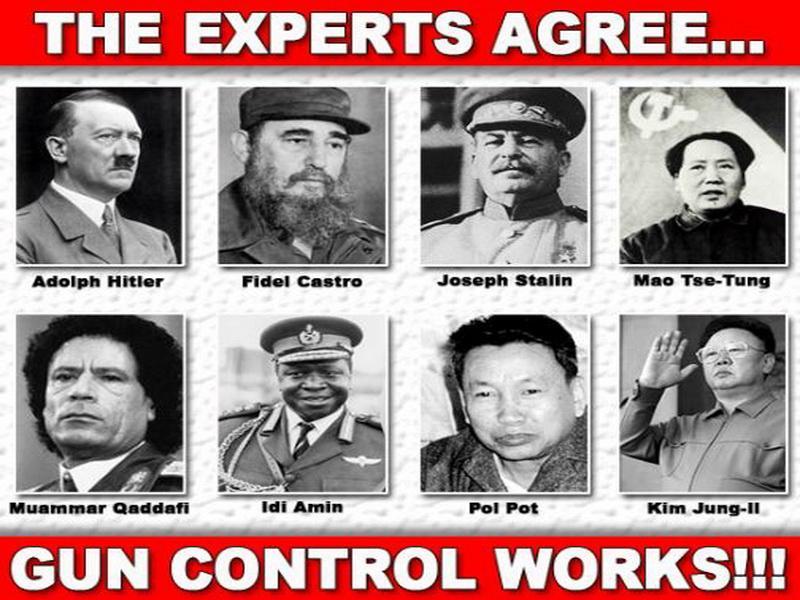
“Feedback Friday” Letter to White House generated form letter response May 23, 2012 on gun control (part 7)

I have been writing President Obama letters and have not received a personal response yet.  (He reads 10 letters a day personally and responds to each of them.) However, I did receive a form letter in the form of an email on May 23, 2012. I don’t know which letter of mine generated this response so I have linked several of the letters I sent to him below with the email that I received. However, I think it was probably this one below:

President Obama c/o The White House
1600 Pennsylvania Avenue NW
Washington, DC 20500

Dear Mr. President,

I know that you receive 20,000 letters a day and that you actually read 10 of them every day. I really do respect you for trying to get a pulse on what is going on out here.

Great post from Dan Mitchell:

This image really captures the essence of the issue. Share this with your statist friends and maybe they’ll begin to understand.

Thank you so much for your time. I know how valuable it is. I also appreciate the fine family that you have and your commitment as a father and a husband.

Sincerely,

Everette Hatcher III, 13900 Cottontail Lane, Alexander, AR 72002, ph 501-920-5733, lowcostsqueegees@yahoo.com

The White House, Washington


May 23, 2012

Dear Everette:

Thank you for taking the time to write.  I have heard from many Americans regarding firearms policy, and I appreciate your perspective.

I am committed to making my Administration the most open and transparent in history, and part of delivering on that promise is hearing from people like you.  I take seriously your opinions and respect your point of view on this important issue.  Please know that your concerns will be on my mind in the days ahead.

Thank you, again, for writing.  I encourage you to visit www.WhiteHouse.gov to learn more about my Administration or to contact me in the future.

Sincerely,

Barack Obama

Visit WhiteHouse.gov

Related posts:

“Feedback Friday” Letter to White House generated form letter response May 9, 2012 (part 6)

I have been writing President Obama letters and have not received a personal response yet.  (He reads 10 letters a day personally and responds to each of them.) However, I did receive a form letter in the form of an email on May 9, 2012. I don’t know which letter of mine generated this response so I have […]

“Feedback Friday” Letter to White House generated form letter response Jan 27, 2011 (part 5)

I have been writing President Obama letters and have not received a personal response yet.  (He reads 10 letters a day personally and responds to each of them.) However, I did receive a form letter in the form of an email on April 16, 2011. First you will see my letter to him which was mailed around April 9th. […]

Open letter to President Obama (Part 84.2)

__________ Milton Friedman – Socialized Medicine at Mayo Clinic in 1978 President Obama c/o The White House 1600 Pennsylvania Avenue NW Washington, DC 20500 Dear Mr. President, I know that you receive 20,000 letters a day and that you actually read 10 of them every day. I really do respect you for trying to get […]

Dear Senator Pryor, why not pass the Balanced Budget Amendment? ( Thirsty Thursday, Open letter to Senator Pryor)

Dear Senator Pryor, Why not pass the Balanced  Budget Amendment? As you know that federal deficit is at all time high (1.6 trillion deficit with revenues of 2.2 trillion and spending at 3.8 trillion). On my blog www.HaltingArkansasLiberalswithTruth.com I took you at your word and sent you over 100 emails with specific spending cut ideas. However, I did […]

Open letter to President Obama (Part 84.1)

President Obama c/o The White House 1600 Pennsylvania Avenue NW Washington, DC 20500 Dear Mr. President, I know that you receive 20,000 letters a day and that you actually read 10 of them every day. I really do respect you for trying to get a pulse on what is going on out here. It seems […]

An open letter to President Obama (Part 84, A response to your budget)

1,000 Days Without A Budget Uploaded by HeritageFoundation on Jan 24, 2012 http://blog.heritage.org | Today marks the 1,000th day since the United States Senate has passed a budget. While the House has put forth (and passed) its own budget, the Senate has failed to do the same. To help illustrate how extraordinary this failure has […]

An open letter to President Obama (Part 83)

Congressman Rick Crawford State of the Union Response 2012 Uploaded by RepRickCrawford on Jan 24, 2012 Rep. Rick Crawford responds to the State of the Union address January 24, 2012 __________ President Obama c/o The White House 1600 Pennsylvania Avenue NW Washington, DC 20500 Dear Mr. President, I know that you receive 20,000 letters a day […]

Open letter to President Obama (Part 82)

Sen Obama in 2006 Against Raising Debt Ceiling Uploaded by RepCliffStearns on Jun 20, 2011 Rep. Stearns on the House Floor cites Sen. Obama’s opposition in 2006 to increasing the debt ceiling, 6-14-11 ________________________ President Obama c/o The White House 1600 Pennsylvania Avenue NW Washington, DC 20500 Dear Mr. President, I know that you receive […]

Open letter to President Obama (Part 81)

President Obama c/o The White House 1600 Pennsylvania Avenue NW Washington, DC 20500 Dear Mr. President, I know that you receive 20,000 letters a day and that you actually read 10 of them every day. I really do respect you for trying to get a pulse on what is going on out here.  Here is […]

Open letter to President Obama (Part 80)

President Obama c/o The White House 1600 Pennsylvania Avenue NW Washington, DC 20500 Dear Mr. President, I know that you receive 20,000 letters a day and that you actually read 10 of them every day. I really do respect you for trying to get a pulse on what is going on out here. It seems […]

Open letter to President Obama (Part 79)

_ President Obama c/o The White House 1600 Pennsylvania Avenue NW Washington, DC 20500 Dear Mr. President, I know that you receive 20,000 letters a day and that you actually read 10 of them every day. I really do respect you for trying to get a pulse on what is going on out here. I […]

Open letter to President Obama (Part 78)

Milton Friedman – Redistribution of Wealth Uploaded by LibertyPen on Feb 12, 2010 Milton Friedman clears up misconceptions about wealth redistribution, in general, and inheritance tax, in particular. http://www.LibertyPen.com __________________ President Obama c/o The White House 1600 Pennsylvania Avenue NW Washington, DC 20500 Dear Mr. President, I know that you receive 20,000 letters a day […]

The Dissatisfaction of Francis Schaeffer part 1

Two Minute Warning: How Then Should We Live?: Francis Schaeffer at 100

Uploaded by on Jan 31, 2012

Under Francis Schaeffer’s tutelage, Evangelicals like Chuck Colson learned to see life through the lens of a Christian worldview. Join Chuck as he celebrates a life well lived.

_____________

I learned so much from the books and films of Francis Schaeffer. He really got me excited about the pro-life movement. In order to understand where I am coming from it is best to take a look at where Schaeffer was coming from and his thought processes. Take a look at this article below that appeared 13 years after his death in Christianity Today.

Francis Schaeffer engaged the society and he took a long hard look at where the society was going. Michael Hamilton observed:

Francis met a Dutch student of art history, Hans Rookmaaker, who shared Schaeffer’s commitment to Kuyperian thought. Together they discussed how art could be a window into the general philosophy of society. This became a trademark both of Rookmaaker’s career as an art historian and of Francis’s portrait of the decline of Western society. In later years, Francis gave Rookmaaker international exposure, and Rookmaaker in turn inspired and assisted a number of young evangelical artists such as Theodore Prescott and art historians such as Mary Leigh Morbey and E. John Walford of Redeemer and Wheaton colleges, respectively.

Thirteen years after his death, Schaeffer’s vision and frustrations continue to haunt evangelicalism.
by Michael S. Hamilton | posted 3/03/1997 12:00AM

When Francis Schaeffer first appeared on the American scene in 1965, evangelicals hardly knew what to make of him. He was 53 years old. His Christian faith had been formed in the furnace of the fundamentalist-modernist controversies of the 1930s, and he was a card-carrying member of the impeccably fundamentalist Bible Presbyterian Church. He defended passionately the idea of the inerrancy of Scripture, a doctrine that had already seen some slippage in evangelical circles.

Yet this was no ordinary fundamentalist preacher. He and his wife, Edith, had lived for ten years in a student commune they had started in the Swiss Alps. When he lectured, he wore an alpine hiking outfit—knickers, knee socks, walking shoes. By 1972 he had added to his already singular appearance long hair and a white tufted goat’s-chin beard. Most curious of all, he seldom quoted from the Bible. He was more apt to talk about the philosophical importance of Henry Miller (then regarded as the most pornographic writer in American letters).

During the next two decades the Schaeffers organized a multiple-thrust ministry that reshaped American evangelicalism. Perhaps no intellectual save C. S. Lewis affected the thinking of evangelicals more profoundly; perhaps no leader of the period save Billy Graham left a deeper stamp on the movement as a whole. Together the Schaeffers gave currency to the idea of intentional Christian community, prodded evangelicals out of their cultural ghetto, inspired an army of evangelicals to become serious scholars, encouraged women who chose roles as mothers and homemakers, mentored the leaders of the New Christian Right, and solidified popular evangelical opposition to abortion.

The Schaeffers left an imprint on the wildly diverse careers of Jesus People organizer Jack Sparks; musicians Larry Norman and Mark Heard; political figures Jerry Falwell, Pat Robertson, Jack Kemp, Chuck Colson, Randall Terry, C. Everett Koop, Cal Thomas, and Tim and Beverly LaHaye; and scholars Harold O. J. Brown, Os Guinness, Thomas Morris, Clark Pinnock, and Ronald Wells. Strange bedfellows, indeed, and this is part of the puzzle of Francis Schaeffer. Clues to its solution are spread across a half-century and two continents—from Westminster Seminary, the art galleries of Europe, and an English boarding school to the Mayo Clinic and the U.S. Supreme Court. And in the end, when the pieces of the puzzle are all assembled, the life of Francis Schaeffer gives us a picture of a side of evangelicalism quite at odds with the trajectory of the modern world.

Agents for fundamentalism
The Schaeffers’ story properly begins with the fundamentalist-modernist conflict of the 1920s. Edith and Francis first caught each other’s eye when they both stood up to defend Christian orthodoxy at a church youth meeting. She was the daughter of missionaries to China and grew up with table talk about the evils of theological modernism. In high school she listened to J. Gresham Machen on the radio, debated evolution with her science teachers, and searched out liberalism in theology books. Francis, in contrast, was raised in a nonreligious home. His teenage conversion led him to a more devotional style of fundamentalism, his reading interests running to inspirational books like Geraldine Guinness (Mrs. Howard) Taylor’s Borden of Yale ’09.

Early in their relationship, Edith schooled Francis in the particulars and personalities of the northern Presbyterian arguments. When considering where to receive his pastoral training, Francis was put off by the prickly militancy of students at Machen’s Westminster Seminary. He leaned toward attending the irenic Biblical Seminary of New York, but Edith, a steadfast Machen partisan, persuaded him to enroll at Westminster. There Francis learned from Machen the doctrine of inerrancy and from Cornelius Van Til the presuppositional apologetics of Dutch theologian-statesman Abraham Kuyper.

He also learned the art of 1930s Presbyterian polemics. Before Francis had finished his degree, Machen was dead and Westminster’s people were at each other’s throats. So in 1937 Francis and Edith helped set up Faith Seminary as an alternative. The split was a bitter one, giving birth to personal animosities that lasted for years. In the short term, it made of Francis a sharp-tongued partisan for separatist fundamentalism. But in later years, wounds inflicted and received spurred him to serious reflection about how to handle theological disagreement in a spirit of genuine Christian love.

After nine years of pastoring Bible Presbyterian churches and youth work, the Independent Board for Foreign Missions sent Francis on a three-month trip to Europe to build networks among “Bible-believing” churches, pastors, and institutions. Between appointments, he spent his time in art galleries. Then, in 1948, the board sent the Schaeffers to Europe as long-term missionaries.

The Schaeffers located in Switzerland, where they took up the tasks of spreading their Children for Christ program throughout Europe and organizing an international arm of the separatist fundamentalist movement. On the side, they entertained groups of schoolgirls on ski holidays, hosting evening religious discussions by the fire in their chalet. They kept a relentless schedule, most days working until well past midnight.

A year later, Francis met a Dutch student of art history, Hans Rookmaaker, who shared Schaeffer’s commitment to Kuyperian thought. Together they discussed how art could be a window into the general philosophy of society. This became a trademark both of Rookmaaker’s career as an art historian and of Francis’s portrait of the decline of Western society. In later years, Francis gave Rookmaaker international exposure, and Rookmaaker in turn inspired and assisted a number of young evangelical artists such as Theodore Prescott and art historians such as Mary Leigh Morbey and E. John Walford of Redeemer and Wheaton colleges, respectively.

Schaeffer’s separatist preaching frequently decried the weaknesses of Karl Barth’s theology: “Neo-orthodoxy gave no new answer. What existential philosophy had already said in secular language, it now said in theological language.” In 1950 Schaeffer visited the renowned theologian at his home in Switzerland. There he asked Barth, “Did God create the world?” Barth answered, “God created the world in the first century a.d.” Francis gestured out the window to the forested hillside and asked, “This world?” Barth replied, “This world does not matter.” This was a signal moment for Schaeffer, confirming that modern thought presumed that religious truth and material truth consisted of two separate realities. He spent the rest of his life dissenting from this view, insisting that “Christianity speaks of true truth.” His commitment to the unity of truth reinforced his lifetime insistence that the Bible was inerrant in all respects. He refused to countenance the idea that the Bible’s history and science might be less true, or even differently true, than the Bible’s theology.

Though certain that Barth was wrong, Schaeffer harbored growing doubts about whether or not he himself was right. He could no longer avoid the fact that his party of fundamentalist separatists displayed little Christian love, and that his own spiritual life had become dry and joyless. In 1951 and 1952 he struggled through a lengthy spiritual crisis, questioning his beliefs. Edith was frightened, prayed a lot, and tried to keep from intervening. In the end, he found a new assurance that his doctrine was correct and that the “real battle for men is in the world of ideas,” but also a new conviction that orthodox belief must travel hand in hand with demonstrative love. “The local church or Christian group should be right, but it should also be beautiful. The local group should be the example of the supernatural, of the substantially healed relationship in this present life between men and men. … How many orthodox local churches are dead at this point, with so little sign of love and communication: orthodox, but dead and ugly! If there is no reality on the local level, we deny what we say we believe.”

Dan Mitchell: Rex Nutting’s recent claim that Obama is not a big spender is false

Dan Mitchell explains in the above video that Europe can grow and prosper, but only if politicians are willing to reduce the burden of government spending and lower tax rates.

_____________

I have a lot of respect for Tea Party heroes like Tim Huelskamp , Idaho First District Congressman Raúl R. Labrador, and Justin Amash who are willing to propose deep spending cuts so we can eventually balance our budget.  

It is a fact that we must balance the budget soon. I do not believe that we can wait to balance the budget at some distant time in the future. The financial markets will not allow us a long time to get our house in order. Look at how things have been going the last four years and no matter how anyone tries to spin it, we are going down the financial drain fast.

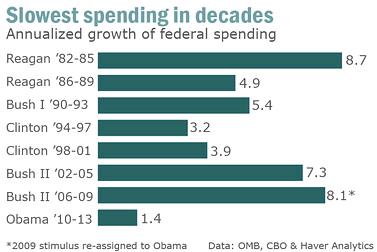
A financial columnist named Rex Nutting recently triggered a firestorm of controversy by claiming that Barack Obama is not a big spender.

Here’s the chart he prepared, which certainly seems to indicate that Obama is a fiscal conservative. Not only that, it shows that Republicans generally are the big spenders, while Democrats are frugal with other people’s money.

In some ways, these numbers don’t surprise me. I’ve explained before that Bush bears a lot of blame for the big expansion in the burden of government this century, and I’ve specifically pointed out that he deserves the blame for most of the higher spending from the 2009 fiscal year (which began October 1, 2008).

That being said, Nutting’s numbers seemed a bit nutty. Sorry, couldn’t resist. Nutting’s numbers actually seem accurate, including the fact that he decided that Obama should be responsible for $140 billion of the spending in Bush’s last fiscal year (a number he may have taken from one of my posts).

But sometimes accurate can be misleading, so I decided to dig into the data.

I went to the Historical Tables of the Budget from the Office of Management and Budget, and I calculated all the numbers for every President since LBJ (with the exception of Gerald Ford, whose 2-year reign didn’t seem worth including).

But I corrected a big mistake in Nutting’s analysis. I adjusted the numbers for inflation, using OMB’s GDP deflator.

As you can see, this changes the results. My chart isn’t as pretty, but based on the inflation-adjusted average annual growth of outlays, it shows that Clinton was the most frugal president, followed by the first President Bush and Obama.

With his guns-n-butter Keynesianism, it’s no big surprise that LBJ ranks last. And “W” also gets a very low grade.

But then I figured we should take interest payments out of the budget and focus on inflation-adjusted “primary spending.” After all, Presidents shouldn’t be held responsible for the national debt that existed before they took office.

Looking at these numbers, it turns out that Obama does win the prize for being the most fiscally conservative president in recent memory. Reagan jumps to second place. Clinton is in third place, which won’t surprise people who watched this video, while W and LBJ again are in last place.

But I don’t want my Republican friends to get too angry with me, so let’s expand our analysis. Just as we don’t want to blame Presidents for net interest payments on debt that was accrued before their tenure, perhaps we should make sure they don’t get credit or blame for defense outlays that often are dictated by external events.

There’s obviously room for disagreement, but most people will agree that the Cold War and 9/11 meant higher defense spending, regardless of which party controlled the White House. Similarly, the collapse of the Soviet Empire inevitably meant lower military expenditures, regardless of whether Republicans or Democrats were in charge.

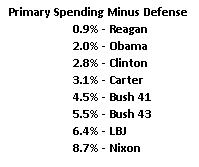
So let’s now look at primary spending after subtracting defense outlays (still adjusting for inflation, of course). All of a sudden, Reagan jumps to the top of the list by a comfortable margin. LBJ and W continue to score poorly, but Nixon takes over last place.

But it’s also worth noting that Obama still scores relatively well, beating Clinton for second place. Inflation-adjusted domestic spending (which is mostly what we’re measuring) has grown by 2.0 percent annually during his three years in office.

So does that mean Obama deserves re-election? Well, before you answer, I want to make one final calculation. Just as there are good reasons to exclude interest payments because they’re not something a president can control, we also should take a look at what spending would be if we don’t count the cost of bailouts.

To be sure, these types of expenditures can be controlled, but if we go with the assumption that the federal government was going to re-capitalize the banking system (whether using the good FDIC-resolution approach or the corrupt TARP approach), then it seems that Presidents shouldn’t get arbitrary blame or credit simply because some financial institutions failed during their tenure.

So let’s take the preceding set of numbers and subtract out the long-run numbers for deposit insurance, as well as the TARP outlays since 2009. And keep in mind that repayments of TARP monies (as well as deposit insurance premiums) show up in the budget as “negative spending.”

As you can see, this produces a remarkable result. All of a sudden, Obama drops from second to second-to-last.

This is because there was a lot of TARP spending in Bush’s last fiscal year (FY2009), which created an artificially high benchmark. And then repayments by banks during Obama’s fiscal years counted as negative spending.

When you subtract out the big TARP spending surge, as well as the repayments, then Bush 43 doesn’t look quite as bad (though still worse than Carter and Clinton), while Obama takes a big fall.

In other words, Obama’s track record does show that he favors an expanding social welfare state. Outlays on those programs have jumped by 7.0 percent annually. And that’s after adjusting for inflation! Not as bad as Nixon, but that’s not saying much since he was one of America’s most statist presidents.

Allow me to conclude with some caveats. None of the tables perfectly captures what any president’s fiscal record. Even my first table may be wrong if you want to blame or credit presidents for the inflation that occurs on their watch. And there certainly are strong arguments that bailout spending and defense spending are affected by presidential policies rather than external events.

And keep in mind that presidents don’t have full power over fiscal policy. The folks on Capitol Hill are the ones who actually enact the bills and appropriate the money.

Moreover, the federal government is akin to a big rusty cargo ship that is traveling in a certain direction, and presidents are like tugboats trying to nudge the boat one way or the other.

But enough equivocating. The four different tables at least show more clearly which presidents presided over faster-growing government or slower-growing government. More importantly, the various tables provide a good idea of where most of the new spending was taking place.

We can presumably say Reagan and Clinton were comparatively frugal, and we can also say that Nixon, LBJ, and Bush 43 were relatively profligate. As for Obama, I think his tugboat is pushing in the wrong direction, but it’s only apparent when you strip out the distorting budgetary impact of TARP.

Related posts:

Some Tea Party heroes (Part 1)

DEBT LIMIT – A GUIDE TO AMERICAN FEDERAL DEBT MADE EASY. Uploaded by debtlimitusa on Nov 4, 2011 A satirical short film taking a look at the national debt and how it applies to just one family. Watch the guy from the Ferris Bueller Superbowl Spot! Produced by Seth William Meier, DP/Edited by Craig Evans, […]

Some Tea Party heroes (Part 2)

Congressmen Tim Huelskamp on the debt ceiling I just don’t understand why people think we can go on and act like everything is okay when we have a trillion dollar deficit. Sometimes you run across some very wise words like I did the other day. Kansas Congressman Tim Huelskamp made the following comment on the […]


Dan Mitchell of Cato Institute: low taxes best for creating jobs

Dan Mitchell on Soaking the Rich

There are many economic approaches out there but the one that works best is the free market approach of low taxes and low amounts of government spending and intervention.

I posted yesterday about visiting the United Nations to participate in “The High Level Thematic Debate on the State of the World Economy.”

There were five speakers on my panel, including yours truly. Here are my thoughts on what the others said.

Dr. Supachai Panitchpakdi, Secretary-General of the United Nations Conference on Trade and Development, must have been part of the buzz-word contest I mentioned yesterday. Lots of rhetoric that theoretically was inoffensive, but I had the feeling that it translated into a call for more government. But maybe I’m paranoid SOB, so who knows.

Professor Dato’ Dr. Zaleha Kamaruddin, Rector of the International Islamic University of Malaysia, was an interesting mix. At some points, she sounded like Ron Paul, saying nice things about the gold standard and low tax rates. But she also called for debt forgiveness and other forms of intervention. She explicitly said she was providing Islamic insights, so perhaps the strange mix makes sense from that perspective.

Former Senator Alan K. Simpson also was a mixed bag. Simpson was co-chair of Obama’s fiscal commission, which I thought was a disappointment because it endorsed higher taxes and urged sub-par entitlement changes rather than much-needed structural reforms. He also went after Grover Norquist because of the no-tax pledge, which I think is a valuable tool to keep Republicans from selling out for bigger government. All that being said, Senator Simpson is a promoter of smaller government and he wants lower tax rates. So while I disagree with some of his tactical decisions, he was an ally on the panel and would probably do a pretty good job if he was economic czar.

Last but not least, Professor Jeffrey Sachs of Columbia University was a statist, as one would expect based on what I wrote about him last year. We clashed the most, arguing about everything from tax havens to the size of government. Interestingly, we both said nice things about Sweden, but I was focusing on policies such as school choice and pension reform, while he admired the large public sector. But I will admit he was a nice guy. We sat next to each other and did find a bit of common ground in that we both were sympathetic to the way Sweden dealt with its financial crisis about 20 years ago (a version of the FDIC-resolution approach rather than the corrupt TARP bailout approach).

My message, by the way, was very simple. Higher taxes won’t work. The “growth” vs. “austerity” debate in Europe is really a no-win fight between those who want higher spending vs. those who want higher taxes. The only good answer is to restrain spending with…you guessed it, Mitchell’s Golden Rule.

I’m not safely out of New York City, and I promise I didn’t drink any of the Kool-Aid. I’m still a critic of international bureaucracies. And I wouldn’t allow myself to be bought off by a lavish, tax-free job at the United Nations.

Unless, perhaps, it was a Special Envoy position with Angelina Jolie.

Some Tea Party heroes (Part 2)

Congressmen Tim Huelskamp on the debt ceiling

I just don’t understand why people think we can go on and act like everything is okay when we have a trillion dollar deficit. Sometimes you run across some very wise words like I did the other day. Kansas Congressman Tim Huelskamp made the following comment on the irresponsible  Budget Control Act of August 1, 2011:

I refuse to dig America into a deeper and un-scalable hole. I refuse to be complicit in recklessly spending and borrowing on the backs of the next generation. And, I believe conservatives should make good on their promises to cut trillions in spending…”

Ted DeHaven noted his his article, “Freshman Republicans switch from Tea to Kool-Aid,”  Cato Institute Blog, May 17, 2012:

This week the Club for Growth released a study of votes cast in 2011 by the 87 Republicans elected to the House in November 2010. The Club found that “In many cases, the rhetoric of the so-called “Tea Party” freshmen simply didn’t match their records.” Particularly disconcerting is the fact that so many GOP newcomers cast votes against spending cuts.

The study comes on the heels of three telling votes taken last week in the House that should have been slam-dunks for members who possess the slightest regard for limited government and free markets. Alas, only 26 of the 87 members of the “Tea Party class” voted to defund both the Economic Development Administration and the president’s new Advanced Manufacturing Technology Consortia program (see my previous discussion of these votes here) and against reauthorizing the Export-Import Bank (see my colleague Sallie James’s excoriation of that vote here).

One of those Tea Party heroes was Tim Huelskamp of Kansas. Last year I posted this below concerning his conservative views and his willingness to vote against the debt ceiling increase:

August 1, 2011

Congressman Huelskamp: My Constituents and Our Economy Deserve a Long-Term Solution

(WASHINGTON) – Kansas Congressman Tim Huelskamp issued the following statement after voting against the Budget Control Act:

“My fellow freshmen and I were sent to Washington to end tricks and gimmicks that put America in this position,” Congressman Tim Huelskamp said. “I voted ‘no’ today because I refuse to dig America into a deeper and un-scalable hole. I refuse to be complicit in recklessly spending and borrowing on the backs of the next generation. And, I believe conservatives should make good on their promises to cut trillions in spending, enact structural reforms, and fill the role of elected representatives, rather than hand control to an exclusive committee.”

“Back in April – when I voted against the continuing resolution for this year – I said ‘no’ because the cuts were minimal. I came to the same conclusion today: these are paltry cuts compared to the $14.3 trillion in debt we already have and the $7 trillion in new debt we can expect in the next decade. This is not a path to fiscal solvency, it’s a path to fiscal insanity. My constituents and our economy deserve a long-term solution that ends the biggest problem: we simply spend too much.”

“Despite having pledged to the American people an open and transparent process and despite having months to fix this problem, we were asked to vote in the 11th hour for a bill that the public had less than 16 hours to read and understand. The culture of fiscal irresponsibility may not have been created by this Congress, but we were sent here to put an end to it; I’m afraid this bill does not rise to that occasion.”

Milton Friedman discusses Reagan and Reagan discusses Friedman “Friedman Friday”

Uploaded by on Aug 19, 2009

Nobel Laureate Dr. Milton Friedman discusses the principles of Ronald Reagan during this talk for students at Young America’s Foundation’s 25th annual National Conservative Student Conference

MILTON FRIEDMAN ON RONALD REAGAN

In Friday’s WSJ, Milton Friedman reflectedon Ronald Reagan’s legacy. (The link should work for a few more days.)

I first realized what a truly extraordinary person he was in early 1973 when I spent an unforgettable day with him barnstorming across California to promote his Proposition 1 — an amendment to the state constitution that would set a limit to the amount the state could spend in any year. We flew in a small private plane from place to place and at each stop held a press conference. In between, Gov. Reagan talked freely about his life and views. By the time we returned to our final press interview in Los Angeles, I was able to give an enthusiastic yes to a reporter’s question whether I would support Reagan for president. And, I may say, I have never been disappointed since.

As a good social scientist, Frieman also has data. It doesn’t make Bush I look too good, but it does bust the myth–popular among some libertarians–that Reagan did nothing real to shrink government.


_____________________

Image Detail

 Milton Friedman and Ronald Reagan
Related posts:

Free to Choose by Milton Friedman: Episode “Created Equal” (Part 1 of transcript and video)

 Milton Friedman and Ronald Reagan Liberals like President Obama (and John Brummett) want to shoot for an equality of outcome. That system does not work. In fact, our free society allows for the closest gap between the wealthy and the poor. Unlike other countries where free enterprise and other freedoms are not present.  This is a seven part series. […]

Milton Friedman Friday:(“Free to Choose” episode 4 – From Cradle to Grave, Part 2 of 7)

 I am currently going through his film series “Free to Choose” which is one the most powerful film series I have ever seen. For the past 7 years Maureen Ramsey has had to buy food and clothes for her family out of a government handout. For the whole of that time, her husband, Steve, hasn’t […]

The poor in the USA have best chance in the world to go up

I love Milton Friedman’s film series “Free to Choose.” In that film series over and over it is shown that the ability to move from poor to rich is more abundant here than any other country in the world. This article below reminded me of that that. Are Poor Really Helpless Without Government? By Michael […]

Despite Brantley’s view,Social Security really is a Ponzi scheme (Part 1) (jh1d)

Social Security is a Ponzi scheme (Part 1) Governor Rick Perry got in trouble for calling Social Security a Ponzi scheme and I totally agree with that. Max Brantley wants to keep insisting that this will be Perry’s downfall but  think that truth will win out this time around. This is a series of articles […]

Friedman Friday:(“Free to Choose” episode 4 – From Cradle to Grave, Part 1 of 7)

Volume 4 – From Cradle to Grave Abstract: Since the Depression years of the 1930s, there has been almost continuous expansion of governmental efforts to provide for people’s welfare. First, there was a tremendous expansion of public works. The Social Security Act followed close behind. Soon other efforts extended governmental activities in all areas of the welfare […]

“Friedman Friday” Tribute to Milton Friedman (Part 5)

 Milton Friedman: Life and ideas – Part 05 99th anniversary of Milton Friedman’s birth (Part 13) Milton Friedman was born on July 31, 1912 and he died November 16, 2006. I started posting tributes of him on July 31 and I hope to continue them until his 100th birthday. Here is another tribute below: Sheldon […]

Social Security a Ponzi scheme?

Uploaded by LibertyPen on Jan 8, 2009 Professor Williams explains what’s ahead for Social Security Dan Mitchell on Social Security I have said that Social Security is a Ponzi scheme and sometimes you will hear someone in the public say the same thing. Yes, It Is a Ponzi Scheme by Michael D. Tanner Michael Tanner […]

Famous Milton Friedman Quotes(“Friedman Friday” Part 4)

Milton Friedman on the Causes of Inflation (“Friedman Friday” Part 4) FRIEDMAN FRIDAY APPEARS EVERY FRIDAY AND IS HONOR OF THE NOBEL PRIZE WINNING ECONOMIST MILTON FRIEDMAN Famous Friedman Quotes By John Beagle Milton Friedman – University of Chicago School of Economics Professor As I read the comments by Milton Friedman, I can’t help but think […]

99th anniversary of Milton Friedman’s birth (Part 12)

Milton Friedman: Life and ideas – Part 04 99th anniversary of Milton Friedman’s birth (Part 12) Milton Friedman was born on July 31, 1912 and he died November 16, 2006. I started posting tributes of him on July 31 and I hope to continue them until his 100th birthday. Here is another tribute below:  Perspective […]

Milton Friedman on the power of choice (“Friedman Friday” Part 3)

FRIEDMAN FRIDAY APPEARS EVERY FRIDAY AND IS HONOR OF THE NOBEL PRIZE WINNING ECONOMIST MILTON FRIEDMAN. The Power Of Choice By John Beagle An interesting compilation of Milton Freeman as an economic freedom philosopher. Milton makes the case for economic freedom as a precondition for political freedom. The title of this video, The Power of Choice […]