Yearly Archives: 2012

Is President Obama going to bankrupt our country by going from 10 trillion to 22 trillion in debt?(Part 21)

Cronyism in the Solyndra Scandal

These posts are all dealing with issues that President Obama did not help on in his first term. I am hopeful that he will continue to respond to my letters that I have written him and that he will especially reconsider his view on the following import issue which deals with holding down federal spending!!! (We can not throw money out the window on stupid give-away programs like this below. Is President Obama going to bankrupt our country by going from 10 trillion to 22 trillion in debt? Getting more taxes in will not help cure our spending addiction.

We have to encourage the private market to do it’s thing without interference from Washington. However,  you have  dished out billions of dollars to politically favored companies in pursuit of job creation and a new “green” economy as the article below points out. That is simply “taxpayer-funded crony capitalism that has neither created new jobs nor produced the green-energy payout that the president was looking for. In fact, it’s a policy that has failed miserably, leading to bankruptcy after bankruptcy. Yet despite all the failures — and zero successes — the president and his Administration are defending the indefensible and standing by a policy that has squandered taxpayer money.”

The best policy is to leave the private market alone!!! 

Morning Bell: The White House Defends Public Equity

Mike Brownfield

May 30, 2012 at 9:03 am

Up is down, left is right, good is bad, and day is night. If you wander inside the Washington, D.C., beltway, you’ll enter a bizarro world where, at times, commonsense is replaced by a localized logic that is completely divorced from the reality.

The latest example of political gobbledygook comes courtesy of White House press secretary Jay Carney, who yesterday lapsed into rambling rhetoric when asked to explain how President Obama can defend the failed Solyndra solar boondoggle, yet attack private sector investments that sometimes fail but oftentimes succeed. Here’s his response:

Look…there, there, there is the…the…difference in that, your overall view of what…huh, your responsibilities are as president and what your view of the economic future is.

And the president believes as he’s made clear that a president’s responsibility is not just to, ah, those who win but those who, for example in a company where ah, there have been layoffs or a company that has gone bankrupt, that we have to ah make sure that those folks have the means to find other employment, that they have the ability to train for other kinds of work and that’s part of the overall responsibility a president has.

Got all that?

For the duration of his Administration, President Obama has dished out billions of dollars to politically favored companies in pursuit of job creation and a new “green” economy. It’s taxpayer-funded crony capitalism that has neither created new jobs nor produced the green-energy payout that the president was looking for. In fact, it’s a policy that has failed miserably, leading to bankruptcy after bankruptcy. Yet despite all the failures — and zero successes — the president and his Administration are defending the indefensible and standing by a policy that has squandered taxpayer money.

In one instance, President Obama committed $465 million of taxpayer money to Tesla, which was founded by a campaign mega-donor and the 63rd richest man in the world, Elon Musk, to build a $130,000 battery-powered sports car that becomes permanently inoperable if left uncharged for 30 days.

It’s gotten so bad that Congress is launching probes of federal green energy programs, including the Energy Department loan program, over concerns that lawmakers fast-tracked approval for politically connected companies. Heritage’s Lachlan Markay reports that according to a Republican aide on the Senate Budget Committee, “Politically favored, and often connected, renewable energy plans [receive] less rigorous review than traditional energy projects.” In one program, of the $20.5 billion in loans granted, $16.4 billion went to companies linked to donors who contributed to Obama and the Democratic Party.

At the same time the president is defending his taxpayer-funded failures, he’s attacking free enterprise, including in private equity and venture capitalism — enterprises in which investors voluntarily put up their own money to invest in new ideas and rescue existing companies. Sometimes those ventures fail, sometimes their inevitable failure is delayed but temporarily saves jobs amid restructuring, but many times they succeed — generating profits and producing new jobs.

When Carney was asked to justify the president’s defense of one, but criticism of the other, he just couldn’t do it. That’s no surprise, in that the two positions are logically inconsistent.

This episode calls to mind a quote from George Orwell, a frequent and pointed critic of modern political discourse:

In our time, political speech and writing are largely the defence of the indefensible… Thus political language has to consist largely of euphemism, question-begging and sheer cloudy vagueness… the great enemy of clear language is insincerity. Where there is a gap between one’s real and one’s declared aims, one turns as it were instinctively to long words and exhausted idioms …

Maybe Jay Carney’s confused speech is the result of the unbearable heat and humidity that has descended on Washington all too early this year. Or maybe it’s a bad case of Potomac fever. But no matter the cause, the results are the same. In Washington, the Obama Administration is hard at work defending the crony capitalist machine while lambasting the free market system — and it shows no signs of letting up.

Bret Bielema’s coach in college was Broyles’ good friend Hayden Fry

I have done several posts on the new Arkansas football coach Bret Bielema. Bielema said he remembered hearing Frank Broyles speak at coaches’ conferences, but there is a connection between his former coach Hayden Fry and Frank Broyles.


Hayden Fry

From Wikipedia, the free encyclopedia


Jump to: navigation, search

This article needs additional citations for verification. Please help improve this article by adding citations to reliable sources. Unsourced material may be challenged and removed. (January 2010)
Hayden Fry
Sport(s) Football
Biographical details
Born (1929-02-28) February 28, 1929 (age 83)
Eastland, Texas
Playing career
1947–1950 Baylor
Position(s) Quarterback
Coaching career (HC unless noted)
1956–1958
1959–1960
1961
1962–1972
1973–1978
1979–1998
Odessa HS (TX)
Baylor (DB)
Arkansas (QB/RB)
SMU
North Texas State
Iowa
Administrative career (AD unless noted)
1973–1978 North Texas State
Head coaching record
Overall 232–178–10
Bowls 7–9–1
Statistics
College Football Data Warehouse
Accomplishments and honors
Championships
1 SWC (1966)
1 MVC (1973)
3 Big Ten (1981, 1985, 1990)
Awards
Sporting News College Football COY (1981)
Amos Alonzo Stagg Award (2005)
SWC Coach of the Year (1963)
MVC Coach of the Year (1973)
3x Big Ten Coach of the Year (1981, 1990–1991)
 
College Football Hall of Fame
Inducted in 2003 (profile)

John Hayden Fry (born February 28, 1929) is a former American football player and coach. He played college football for Baylor University. He served as the head coach at Southern Methodist University (1962–1972), North Texas State University, now the University of North Texas (1973–1978), and the University of Iowa (1979–1998), compiling a career college football record of 232–178–10. He was inducted into the College Football Hall of Fame as a coach in 2003.

Contents

 [hide

[edit] Background

Born in Eastland, Texas, Hayden Fry was descended from one of the Texas First Families; his great-great-grandfather fought beside General Sam Houston in the Mexican War against Santa Anna in the battle of San Jacinto.[1] Fry’s family moved to Odessa, Texas, when he was eight years old.

Fry worked multiple jobs as a child to help his family through the Great Depression. He also played sports, partly to stay out of trouble. Hayden played basketball, football, and track, but he most loved and was most successful at football, and Odessa was a football town.

When Fry played safety and quarterback for Odessa High School in the 1940s, their stands routinely had sellout crowds. In Fry’s senior year, Odessa won 14 straight games, scoring almost 400 points and allowing about 50. Odessa did not commit a single turnover all season. The Texas state playoffs placed every school into a single bracket. At the end of the year, Hayden Fry quarterbacked Odessa to the Texas state high school championship in 1946.

Fry then played at Baylor University from 1947–1950. Baylor had a 26–13–2 record during Fry’s four years there. Fry started a few games as an upperclassman at Baylor, but he could never win the full-time starting quarterback job. He graduated from Baylor with a degree in psychology in 1951.

Fry was an American history teacher and assistant football coach at Odessa High School for a year in 1951 before joining the U.S. Marine Corps in 1952. During his time in Odessa, Fry met and befriended a young George H. W. Bush, who would become the 41st President of the United States.

Fry served in the U.S. Marine Corps from 1952–1955. He played with the Quantico Marines football team in 1953, winning the Marine Corps championship and playing in the Poinsettia Bowl. Fry also coached a six man football team while in the Marines, and the unique style of play allowed Fry to innovate and invent new creative schemes. He became friends with Al Davis, who was coaching a rival military team; Davis would later become the famous owner of the Oakland Raiders. Fry’s time coaching and serving in the Marines were an asset as he began his coaching career. Fry was discharged from the Marines in February 1955 with the rank of captain.

[edit] High school and assistant coach

In 1955, Hayden returned to Odessa as a teacher and assistant football coach. The following season, Odessa head coach and former Texas A&M freshmen varsity coach Cooper Robbins was promoted to athletic director, and Hayden Fry took his first head coaching job. At 26 years old, he was coaching the high school he had led to the state title less than 10 years earlier.

He served as Odessa’s head football coach for three years. During that time, he first met and befriended the head coach at Texas A&M, Bear Bryant. Fry also continued as a history teacher at Odessa, and one of his students, Roy Orbison, later became a musical star.

After the 1958 season, the new head football coach at Baylor hired Hayden Fry as an assistant coach. Fry spent two years at Baylor coaching the defensive backs. In 1960, Baylor had an 8–2 record in the regular season and finished the year with a one point loss to Florida in the Gator Bowl. That season, Fry’s defensive secondary helped Baylor lead the nation in pass defense.

Fry left Baylor to become an assistant coach at Arkansas under Frank Broyles. Broyles had been Fry’s position coach when Fry played at Baylor. Fry was the offensive backfield coach at Arkansas in 1961. Arkansas won the Southwest Conference co-championship with an 8–2 record and narrowly lost the Sugar Bowl to Bear Bryant’s Alabama squad. After one year at Arkansas, Southern Methodist University tabbed Fry as their next head football coach for the 1962 season.

[edit] Head coaching career

The SMU Mustangs were members of the Southwest Conference at the time. Fry won the conference coach of the year award in his first season. In 1963, SMU opened the season with a 27–16 loss to a Michigan team coached by Bump Elliott, Fry’s future boss at Iowa. SMU lost to Oregon in the 1963 Sun Bowl, 21–14. After the season, Fry was also appointed as SMU’s athletic director.

When Fry took the job at SMU, he was promised that he would be allowed to recruit black athletes. Fry and the school wanted to make certain that the player they recruited was not only a good athlete but also a good student and citizen and someone with the mental toughness to be one of the first black players in conference history. Fry found that player in Jerry LeVias. LeVias was a great player, an exceptional student, and mentally tough. He had never had discipline problems and was deeply religious. LeVias was the perfect player for SMU.

Jerry LeVias had many other scholarship offers to good integrated schools, but he chose to attend SMU. LeVias became the first black player signed to a football scholarship in the Southwest Conference. In 1966, LeVias made his debut, one week after John Hill Westbrook of Baylor became the first black player to play for a conference team.[2] Fry received abuse for recruiting a black player to SMU in the form of hate mail and threatening phone calls, but he downplayed the treatment, because the harassment of LeVias was much, much worse.

SMU had an 8–2 record in 1966 and won its first Southwest Conference title in 18 years. LeVias was named to the all-conference team and handled the racial incidents well. SMU lost in the Cotton Bowl Classic to Georgia but finished the year ranked #10 in the nation. SMU had a down year in 1967, but LeVias was again an all-conference selection.

In 1968, SMU went 7–3 and defeated Oklahoma in the Bluebonnet Bowl. LeVias was selected as an all-conference player as a senior for the third time. Fry’s Mustangs then had just a 12–20 record over the next three years from 1969–1971. That put Fry’s job in jeopardy, and rumors started to swirl after Fry’s Mustangs started the 1972 season at 4–4. Not even a three game winning streak could save Fry. After a 7–4 season in 1972, Fry was fired at SMU, which robbed the Mustangs of a bowl berth.

Hayden Fry compiled a 49–66–1 record in 11 seasons at SMU, including the school’s only three winning seasons since the late 1940s. In Fry’s autobiography, Fry stated that he believed his firing was related to several boosters’ desire to start a slush fund to pay players and recruits. SMU was the second-smallest school in the Southwest Conference, and had found it difficult to compete over the last two decades against schools double its size or more. When he refused to go along with the plan, Fry said, the boosters pressured the school’s new president to fire him. As it turned out, SMU would be hit with NCAA sanctions five times after Fry’s departure before having its program completely shut down for the 1987 season due to a massive litany of misconduct. Most of the violations were related to the slush fund Fry had opposed several years earlier.

Hayden Fry was hired as the coach and athletic director at North Texas State University (now the University of North Texas) before the 1973 season. North Texas appeared to be on the verge of dropping from Division I football or even ending the sport altogether. In 1973, North Texas won a share of the Missouri Valley Conference title. However, North Texas left the conference after the year in hopes of joining a more football-oriented conference. While Fry was there, North Texas never did. He also coached three of his sons while at North Texas.

Fry turned North Texas’ program around, compiling a 40–23–3 record over six seasons from 1973–1978. In his final four seasons, North Texas had winning records, including a 10–1 mark in 1977 and a 9–2 record in 1978. Still, North Texas never received a bowl invitation. Fry wanted to go to a school where he would be assured of a bowl game with a solid record and where he did not need to also serve as athletic director.

[edit] Iowa coaching career

Hayden Fry was hired as Iowa’s 25th head football coach after the 1978 season. Fry had never been to Iowa, but he knew and liked Bump Elliott, by this time the university’s athletic director. Iowa had had 17 straight non-winning seasons, but Fry was impressed at the fan support for a program that had struggled for so long.

Fry turned his attention to changing a losing attitude and starting new traditions at Iowa. Hayden would not celebrate close losses or moral victories. He hired a marketing group to create the Tigerhawk, a logo to represent the University of Iowa’s athletic programs. Since both shared the colors of black and gold, Fry gained permission from the Pittsburgh Steelers, the dominant NFL program of the time, to overhaul Iowa’s uniforms in the Steelers’ image. Fry had the team “swarm” onto the field together as they left the locker room, holding hands in a show of solidarity. And Fry had the visitors’ locker room painted pink. Fry, a psychology major at Baylor, knew that pink is occasionally used in jails and mental institutions to relax and pacify the residents, and Fry claimed that it might have the same effect on the visiting team. Principally, though, Fry hoped that the unusual color would distract and fluster the opposing players and coaches. Visiting head coaches, particularly Michigan head coach Bo Schembechler, would occasionally try to cover the pink walls with paper to shield their players from the color.[3]

On the field, Hayden assembled a terrific coaching staff, bringing his assistant coaches with him from North Texas, including Bill Brashier, his defensive coordinator and a childhood friend from Eastland, Texas, and Bill Snyder, his offensive coordinator. Fry retained some of the Iowa coaches from the previous staff, including Dan McCarney and Bernie Wyatt. Finally, Fry hired the head coach at Mason City High School, Barry Alvarez. Fry would later add Kirk Ferentz as his offensive line coach and hire his former players Bob Stoops, Mike Stoops, Chuck Long, and Bret Bielema as assistant coaches. Fry also gave former USF Head Coach Jim Leavitt one of his first breaks in college football, making him a graduate assistant coach at Iowa in 1989.

[edit] Big Ten Title (1979–1981)

Fry brought a wide-open passing game to the Big Ten for the first time. He had his tight ends stand at the line of scrimmage at the snap, creating a unique looking offensive formation. He tried a number of trick plays, or “exotics”, to keep the opposition on its toes. All this did not immediately translate into wins. Iowa had losing seasons in 1979 and 1980, and some began to wonder if Fry would suffer the same fate as the four coaches before him, who had left Iowa after failing to produce a winning season.

But the team broke through in 1981, a magical season for Hawkeye fans. Iowa began the year by upsetting sixth ranked Nebraska, a team that had defeated Iowa 57–0 the previous season. Two weeks later, Iowa defeated sixth ranked UCLA to give Fry win #100 in his career. Later that season, Iowa defeated Michigan in Ann Arbor for its first victory over the Wolverines in 19 years. A victory over Purdue in 1981 snapped a 20 game losing streak to the Boilermakers and clinched Iowa’s first winning season in 19 years, as well as its first bowl appearance in 23 years.

In the final game of the 1981 regular season, Iowa’s win over Michigan State, coupled with an Ohio State upset of Michigan in Ann Arbor, gave Iowa a share of the 1981 Big Ten title. Since Iowa had last been to the Rose Bowl in 1959, the Hawkeyes got the conference’s berth in the 1982 Rose Bowl. Either Michigan or Ohio State had gone to the Rose Bowl in each of the last 12 seasons, prompting critics to nickname the Big Ten the “Big Two and Little Eight”. While the Hawks lost to Washington, they had nonetheless altered the balance of the Big Ten.

[edit] Three more bowls (1982–1984)

Iowa started the 1982 season with an 0–2 record, but the Hawkeyes compiled a 6–2 record in the Big Ten to earn a berth in the Peach Bowl. The Hawkeyes defeated Tennessee in the 1982 Peach Bowl to earn Iowa’s first bowl victory since 1959.

In 1983, Fry’s Hawkeyes had a 9–2 record overall and a 7–2 mark in the Big Ten as the Hawks earned an invitation to the Gator Bowl. Iowa’s seven Big Ten wins set a school record, and Iowa’s nine wins overall tied the school record for wins in a single season set in 1903. Iowa was ranked in the top ten in the country before losing in the Gator Bowl to Florida.

A five game conference winning streak in 1984 helped put Fry and Iowa in contention for the league title, but injuries contributed to Iowa’s 0–2–1 finish to the conference schedule. Iowa carried a 7–4–1 record into the 1984 Freedom Bowl against Texas. It was Fry’s first game against a Texas school since leaving the state in 1978. The Hawkeyes set the stage for the 1985 season by routing Texas, 55–17. It was the most points scored against Texas in eighty years and the second most points ever allowed by the Longhorns.

[edit] Another title and more bowls (1985–1987)

1985 was arguably Fry’s best season at Iowa. Iowa was ranked #1 in AP poll for the first time in 24 years and remained there for 5 weeks. During that time, the Hawkeyes scored two thrilling, last-minute victories as America’s top team. Iowa quarterback Chuck Long scored a last minute touchdown on a bootleg run to clinch a 35–31 victory over Michigan State. Two weeks later, one of the most celebrated games in Iowa history was set to be played.

The Michigan Wolverines came into Iowa City with a perfect 5–0 record and the #2 ranking in the AP poll. It was just the 12th time in college football history that the #1 and #2 ranked teams in the AP poll would meet for a regular season game. It was the first such meeting where the victor scored the winning points on the game’s final play. With two seconds remaining in the game and Iowa trailing 10–9, kicker Rob Houghtlin booted his fourth field goal of the day, this one from 29 yards out, as time expired to give Iowa a dramatic 12–10 victory over Michigan at Kinnick Stadium.

Iowa would finish the season with a 10–1 record, losing only in Columbus to Ohio State. Still, Iowa would win its first outright Big Ten title in 27 years and secure Fry’s second Rose Bowl berth and a top ten final ranking. The Hawkeyes set a new school record for wins in 1985, and Long finished second to Bo Jackson for the Heisman Trophy by the narrowest margin in the history of the award.

A win in 1986 over Iowa State was Fry’s 53rd at Iowa, giving him more wins than any coach in Hawkeye history. Iowa had an 8–3 record in 1986 and accepted an invitation to the Holiday Bowl. The Hawkeyes won the 1986 Holiday Bowl, 39–38, again on a kick by Houghtlin as time expired.

In 1987, the Hawkeyes had a 9–3 record and returned to San Diego for the Holiday Bowl. A second straight Holiday Bowl victory gave Iowa another ten win season. Iowa’s 62 victories from 1981–1987 were the most of any Big Ten team in that span, more than Michigan or Ohio State. Fry had taken a team with 19 consecutive non-winning seasons and turned them into one of the best teams in the Big Ten conference.

[edit] Third Big Ten title (1988–1991)

The 1988 season marked the 100th season of Iowa football. It was also Fry’s tenth at the school, making him the first Iowa football coach to lead the Hawkeyes for a full decade. Iowa compiled a 6–3–3 record and accepted its eighth consecutive invitation to a bowl game by playing in the 1988 Peach Bowl.

In 1989, the television show Coach debuted, starring Craig T Nelson as “Hayden Fox”. The title character, created by Iowa alumnus Barry Kemp, was loosely based on Hayden Fry (Fry later appeared in commercials for the NCAA with the female lead of the TV series, Shelley Fabares), and exterior scenes for the show were shot on campus, mainly around Hillcrest Dormitory. Iowa had a disappointing season, however, as a season ending loss to Minnesota cost Iowa a ninth straight bowl game and a Copper Bowl berth, as the Hawkeyes finished the year 5–6.

The Hawks bounced right back in 1990, as Iowa started the season with a 7–1 record. Iowa’s final regular season game in 1990 was against Minnesota, and Iowa entered the game with records of 8–2 overall and 6–1 in the Big Ten. Early in the game, results of other Big Ten games gave Fry his third conference title and third Rose Bowl berth in ten years more than any other Big Ten Conference team. However, Iowa’s loss to Minnesota cost the Hawkeyes the outright conference crown; the Hawks finished tied atop the Big Ten Conference standings with Illinois, Michigan, and Michigan State, all of which compiled 6–2 league records. Iowa earned the trip to Pasadena, since the Hawks had beaten all three teams during the regular season, and all of them on the road. Although the Hawkeyes lost in Pasadena for the third time under Fry, many fans expected 1991 to be an even better year.

The Hawks had a better record in 1991, posting a 10–1 record, but the lone loss to Michigan cost Fry a fourth Big Ten title and Rose Bowl berth. Iowa’s season ending win against Minnesota in 1991 was win number ten on the season, tying the school record for wins in a season. The win over Minnesota was also Fry’s 100th victory at Iowa. The Hawkeyes accepted a third invitation to the Holiday Bowl, and the 13–13 tie with BYU gave Iowa a 10–1–1 final record and a top ten finish in the final AP rankings.

Iowa’s winning percentage from 1981 to 1991 ranked second in the Big Ten behind Michigan and ahead of Ohio State. The Hawkeyes played in 10 bowl games in 11 years and won three Big Ten titles during that span.

[edit] Winning two more bowl games (1992–1996)

As Fry got older and several assistant coaches departed for other coaching jobs, Iowa had a down period from 1992–1994. A season ending loss to Minnesota in 1992 gave Fry just his second losing season in the last 12 years, as Iowa finished with a 5–7 record. After starting the 1993 season at 2–5, the Hawkeyes rebounded with four straight wins to garner an Alamo Bowl berth. Iowa’s final win of the 1993 season over Minnesota gave Fry the 200th victory of his coaching career.

However, Iowa lost the inaugural Alamo Bowl to California, 37–3. The Hawkeyes then struggled to a 5–5–1 record the following year in 1994, and some critics wondered if Fry’s coaching career was at an end.

But Fry had one last run of winning seasons. In 1995, the Hawkeyes had a 7–4 record and played Pacific-10 Conference co-champion Washington in the Sun Bowl. Fry got a measure of revenge against Washington, who had defeated Iowa in two of their three trips to the Rose Bowl under Fry, by defeating the heavily favored Huskies, 38–18. The Hawks then had an 8–3 record in 1996 and ended the year by recording the first bowl shutout in school history with a 27–0 victory over Texas Tech in the Alamo Bowl.

[edit] Retirement (1997–1998)

In 1997, the Hawkeyes were expected to again challenge for the Big Ten title. Instead, Iowa settled for a disappointing 7–5 record. Although Iowa defeated Iowa State for the 15th consecutive time, Wisconsin defeated Iowa for the first time in 20 years. Iowa also led eventual co-national champion Michigan at halftime, 21–7, before falling in Ann Arbor, 28–24. The Hawkeyes ended the disappointing year in fitting fashion, losing in the Sun Bowl to Arizona State.

The 1998 season marked Fry’s 20th at the University of Iowa. It was his worst season at Iowa, as the Hawks finished with a 3–8 record. That season included a home loss to intrastate rival Iowa State (Fry’s first loss to Iowa State in 15 years). It would be his last season at Iowa. Fry, who was secretly undergoing radiation treatments for prostate cancer all year, announced his retirement on November 22, 1998.

In 2002, Fry reportedly expressed an interest in the open head coaching position at Baylor University (his Alma Mater) that ultimately went to Guy Morriss.

[edit] Legacy and honors

Hayden Fry during the official dedication of the "Hayden Fry Way" in Coralville, Iowa at the 2009 "Fry Fest."

Hayden Fry during the official dedication of the “Hayden Fry Way” in Coralville, Iowa at the 2009 “Fry Fest.”

It is difficult to overstate Fry’s positive impact on Iowa football. Fry coached two decades at Iowa, more than twice as long as any coach before him. Hayden had a 143–89–6 record at Iowa, easily the most in school history. He led the Hawkeyes to 14 bowl games; before his arrival they had only been to two bowl games in 90 years. He also led the Hawkeyes to three Big Ten titles and three Rose Bowl appearances. But more than that, Fry established a winning tradition at Iowa, on and off the field. Iowa was no longer considered a coaching graveyard but rather, a place where a great coach could excel. Several of Fry’s former assistants followed Fry’s example in resurrecting other struggling football programs.

Former Fry assistants or players who have taken over as head coach at a Division I-A college football programs include:

After undergoing successful treatment for prostate cancer, Fry moved to Nevada to live in retirement. He was inducted into the College Football Hall of Fame in 2003, alongside former SMU star Jerry LeVias. He received the Amos Alonzo Stagg Award, presented by the American Football Coaches Association, in 2005.

In 2009, prior to the first football game of the Hawkeye’s season, First Avenue in adjoining Coralville was co-named Hayden Fry Way in his honor. This road is one of the main routes that can be taken to Kinnick Stadium from Interstate 80.[4]

On December 30, 2010, Fry was inducted into the Rose Bowl Hall of Fame in a ceremony at the Pasadena Convention Center. As part of being honored, Fry participated in the 122nd Annual Tournament of Roses Parade and was recognized for his induction at the 2011 Rose Bowl following the 3rd quarter. In the Rose Bowl game during which Fry was honored, his former player Bret Bielema’s Wisconsin Badgers lost to the TCU Horned Frogs.

[edit] Head coaching record

Year Team Overall Conference Standing Bowl/playoffs Coaches# AP°
SMU Mustangs (Southwest Conference) (1962–1972)
1962 SMU 2–8 2–5 7th      
1963 SMU 4–7 2–5 T–6th L Sun    
1964 SMU 1–9 0–7 8th      
1965 SMU 4–5–1 3–4 T–4th      
1966 SMU 8–3 6–1 1st L Cotton 9 10
1967 SMU 3–7 3–4 6th      
1968 SMU 8–3 5–2 3rd W Bluebonnet 16 14
1969 SMU 3–7 3–4 5th      
1970 SMU 5–6 3–4 T–4th      
1971 SMU 4–7 3–4 5th      
1972 SMU 7–4 4–3 T–2nd      
SMU: 49–66–1 34–43  
North Texas State Eagles (Missouri Valley Conference) (1973–1974)
1973 North Texas State 5–5–1 5–1 T–1st      
1974 North Texas State 2–7–2 1–3–2 6th      
North Texas State Eagles (Independent) (1975–1978)
1975 North Texas State 7–4          
1976 North Texas State 7–4          
1977 North Texas State 10–1       16  
1978 North Texas State 9–2          
North Texas: 40–23–3 6–4–2  
Iowa Hawkeyes (Big Ten Conference) (1979–1998)
1979 Iowa 5–6 4–4 5th      
1980 Iowa 4–7 4–4 4th      
1981 Iowa 8–4 6–2 T–1st L Rose 15 18
1982 Iowa 8–4 6–2 3rd W Peach    
1983 Iowa 9–3 7–2 3rd L Gator 14 14
1984 Iowa 8–4–1 5–3–1 T–4th W Freedom 15 16
1985 Iowa 10–2 7–1 1st L Rose 9 10
1986 Iowa 9–3 5–3 T–3rd W Holiday 15 16
1987 Iowa 10–3 6–2 T–2nd W Holiday 16 16
1988 Iowa 6–4–3 4–1–3 T–3rd L Peach    
1989 Iowa 5–6 3–5 T–6th      
1990 Iowa 8–4 6–2 T–1st L Rose 16 18
1991 Iowa 10–1–1 7–1 2nd T Holiday 10 10
1992 Iowa 5–7 4–4 5th      
1993 Iowa 6–6 3–5 8th L Alamo    
1994 Iowa 5–5–1 3–4–1 7th      
1995 Iowa 8–4 4–4 6th W Sun 22 25
1996 Iowa 9–3 6–2 T–3rd W Alamo 18 18
1997 Iowa 7–5 4–4 T–6th L Sun    
1998 Iowa 3–8 2–6 T–7th      
Iowa: 143–89–6 98–61–5  
Total: 232–178–10  
      National championship         Conference title         Conference division title
#Rankings from final Coaches’ Poll.
°Rankings from final

Pearl Harbor 71 years ago

Below is a story from One News Now:

Pearl Harbor survivors share stories of attack

AUDREY McAVOY- Associated Press – 12/5/2011 5:55:00 AMBookmark and Share

HONOLULU- Clarence Pfundheller was standing in front of his locker on the USS Maryland when a fellow sailor told him they were being bombed by Japanese planes.

“We never did call him a liar but he could stretch the truth pretty good,” Pfundheller said. “But once you seen him, you knew he wasn’t lying.”

The 21-year-old Iowa native ran up to the deck that Sunday morning to man a five-inch anti-aircraft gun. Seventy years later, he remembers struggling to shoot low-flying Japanese planes as smoke from burning oil billowed through the air.

“This was the worst thing about it _ yeah, your eyes _ it bothered you. It bothered your throat too, because there was so much of that black smoke rolling around that a lot of times you could hardly see,” he said.

Now 91, Pfundheller will be returning to Pearl Harbor on Wednesday for the 70th anniversary ceremony honoring those lost in the Dec. 7, 1941 attack that brought the United States into World War II.

Accompanying him will be fellow survivors, other World War II veterans, and a handful of college students eager to hear their stories. The student and veteran group will be among 3,000 people attending a ceremony the Navy and the National Park Service hoist jointly each year at a site overlooking where the USS Arizona sank in the attack.

The College of the Ozarks program aims to preserve the stories of veterans _ something that’s becoming increasingly urgent for Pearl Harbor survivors as the youngest are in their late 80s.

Pfundheller said he enlisted in the Navy in 1939 because he kept hearing there was going to be a war and he wanted to know what to do when the fighting started. By the time Japanese fighter planes and torpedo bombers invaded the skies above Hawaii, he was well-trained.

Even so, the scene was utterly chaotic.

Commanders hadn’t expected Japan to strike from the air, so Pfundheller’s anti-aircraft ammunition was locked away in a gun locker. Then, when he gained access to the 3-foot-long, 75-pound shells, Pfundheller said the Japanese planes were flying too close for him to take aim.

“You could see them pumping their fists and laughing at you,” he said.

The Maryland’s crew scrambled to prevent their battleship from going down with the USS Oklahoma, which rolled over after being hit by multiple torpedoes.

“We had to cut her lines tied up to us because it was pulling us away,” he said.

Altogether, 2,390 Americans lost their lives in the attack. Twelve ships sank or were beached, and nine were damaged. The U.S. lost 164 aircraft. On the Japanese side, 64 people died, five ships sank, and 29 planes were destroyed.

After the war, Pfundfeller returned to Iowa where he worked as a district feed salesman and became an elementary school custodian. He now lives in Greenfield just 12 miles from Bridgewater, the town where he was raised.

Many veterans didn’t talk much about their experiences after World War II, and Pfundheller’s own children didn’t hear what he went through until he began sharing his stories at schools and libraries.

“People in the Midwest where I lived _ why, you just went back, got your job and went to work and nobody asked anything,” he said.

Today, efforts are under way to make sure stories like his are handed down to younger generations.

Pfundheller and four other World War II veterans are traveling to Hawaii with 10 students from the College of the Ozarks, a Christian school in Branson, Mo. After Hawaii, the group will travel to Japan to visit Okinawa, where the U.S. and Japan fought a brutal battle in the last few months of the war, and Hiroshima, where the U.S. dropped the first atomic bomb.

Heather Isringhausen, a 21-year-old senior who will be one of Pfundheller’s two student escorts, said she wanted to join the trip in part because she’s never been able to get her grandfather to tell her about his experiences serving in World War II.

She wants to know what the veterans were thinking at the time, and what life was like in the 1940s.

“If most of the veterans are anything like my grandpa, they probably haven’t talked much about it,” Isringhausen said. “Once they’re gone, all we’ll have left are history books and movies and different tales that people have been told and written down.”

Guy Piper, who was brushing his teeth in his barracks on Ford Island when the attack began, said he was honored to go on the trip. He said programs like this make “us older people feel good.”

The sailor who served in World War II and the Korean War said he would share with the students his hope that younger generations won’t have war.

“When you see young men like I saw on Dec. 7 _ a bunch of blood _ it just stays with you. You can’t get rid of it. That’s what war is about. Just plain hell,” he said.  “I’d like people to stop and think about staying away from wars.”

Daniel Martinez, the National Park Service’s chief historian for Pearl Harbor, said the program fits in with the theme of this year’s events: how the legacy of Pearl Harbor will be carried on by future generations. But he lamented more survivors aren’t alive to tell their stories.

“It’s a little sad because it’s coming a little late,” he said. “I wish it could have happened at the 50th anniversary when there were so many of them around.”

In a reminder of how many are passing on, the ashes of two survivors who died after living until their 90s will be interred within their sunken battleships this week.

Navy and National Park Service divers on Tuesday will lower Lee Soucy’s cremated remains into the USS Utah, which rolled over and sank next to Ford Island after being hit by a torpedo. Soucy died last year at the age of 90 in Plainview, Texas. He’ll be joining some 50 men who perished when the ship sank and eight survivors whose ashes were interred there after their deaths decades later.

On Wednesday, divers will place Vernon Olsen’s ashes in the USS Arizona, where many of the sailors and Marines who served on the ship are still entombed. The Arizona lost 1,117 crew members during the attack. Olsen was one of the 334 who survived. Olsen died in Port Charlotte, Fla. in April at the age of 91.

Dec. 7 events in Hawaii this year will feature a parade. Marching bands, military families, and dignitaries are expected to walk along Waikiki’s main drag, Kalakaua Avenue. Sen. Daniel Inouye of Hawaii, who received the Medal of Honor for his actions as a soldier in Italy in 1945, will be grand marshal.

Related posts:

Veterans Day 2011 Part 9:Roy “Roxy” Oxenrider survived Korean War’s Toughest Battle

Picture of Roy after he had recovered at the hospital. Picture of Roy below in the hospital recovering from his injuries followed by a picture of Roy encouraging another soldier who was in the hospital:  Below is an article that was published in November of 2010 in the Saline Courier: Saline County War Hero Bryant […]

Veterans Day 2011 Part 8 Leon McDaniel of World War II (second post)

Okinawa – At the Emperor’s Doorstep” episode from “WWII: GI Diary”….. This old 1978 TV docu-drama was narrated by Lloyd Bridges and told the stories of real soldiers/sailors/pilots and their first-hand experiences in battle. Archival footage and good background music really made the stories come alive…..about 25 episodes were made. Video converted from really old […]

Veterans Day 2011 Part 7:You have heard of Jimmy Doolittle, but what about Leon A. McDaniel?

President Reagan and Senator Barry Goldwater present the fourth star to General Jimmy Doolittle during a White House ceremony in the Indian Treaty room, OEOB. 6/20/85. I love the movie “Pearl Harbor” with Ben Affleck and it tells the story of Jimmy Doolittle.  He was born in 1896 and died in 1993. He is pictured […]

Veterans Day 2011 Part 6 (A look back at Okinawa)

This portion below appeared in an article I did for the Saline Courier about 18 months ago: I went to the First Baptist Church in Little Rock from 1983 to 1997, and during that time I became friends with Walter Dickinson Sr. In fact, we used to attend a weekly luncheon together on Thursdays.  Just […]

Veterans Day 2011 Part 5 (A look back at the “Battle of the Bulge”)

The Lost Evidence: The Battle Of The Bulge (1/5) This article was published in the Saline Courier about 18 months ago: When we celebrate July 4th we are focusing on the freedoms that so many soldiers have fought for over the last 234 years. That focus has been highlighted for me since my son Hunter […]

Veterans Day 2011 Part 4

  This is taken from an article that appeared in the Saline Courier about a year ago: Bravery is not just limited to one generation, but Americans have had it in every generation. It makes me think about those who are currently serving in our military. Jon Chris Roberts who is graduate of Benton High […]

Veterans Day 2011 Part 3 (A look back at World War 1)

I was born in Tennessee and everyone in Tennessee knows the name of Alvin York. Above is a clip about his accomplishments in War World I. Cara Gist of Shannon Hills tells me that her grandfather Herbert S. Apple of Salado, Arkansas (near Batesville) fought in World War I. He served in France and fought […]

Veterans Day 2011 Part 2 (Bataan Death March)

My longtime friend Craig Carney is originally  from Jacksonville, and  he told me a couple of years ago about a friend of his parents from Jacksonville, Arkansas named Silas Legrow. Legrow  was going to speak at the Jacksonville Museum of Military History on April 17, 2008 about his experience in the March of 1942 when […]

Veterans Day 2011 (Black Hawk Down and North Little Rock’s Donavan “Bull” Briley)

The Background Facts of The Black Hawk Down (1/7) Uploaded by WarDocumentary on Feb 14, 2011 The movie Black Hawk Down was based on an actual event that took place in Mogadishu, Somalia. This documentary explains the event. _______________________________ On October 3, 2003 my son  played quarterback at the Arkansas Baptist High School Football game […]

War Hero Joe Speaks and D Day pictures

 Below I have the story of Joe Speaks who fought in Europe and was captured twice by the Germans. Photo by Associated Press American GI’s clamber into a landing craft as they prepare to hit the beaches along France’s Normandy coast in June 1944. The World War II operation was part of the massive Allied […]

Open letter to President Obama (Part 187)

President Obama c/o The White House
1600 Pennsylvania Avenue NW
Washington, DC 20500Dear Mr. President,I know that you receive 20,000 letters a day and that you actually read 10 of them every day.I really do respect you for trying to get a pulse on what is going on out here.

I read back on Dec 8, 2011 that Tony Perkins, president of Family Research Council, a social conservative advocacy organization, said in 2011 that President Obama has been “hostile” and “disdainful” toward Christianity. Rick Perry actually said President Obama had a war on religion. One of the most basic things that our founding fathers did is base our laws on the ten commandments. At the Supreme Court there is one depiction showing Moses sitting, holding two blank stone tablets. There is one depiction showing Moses standing holding one stone tablet. There are two stone tablets depicted with Roman Numbers I-X carved in the oak doors. 

David Barton has studied the history of the founding of our country for many years and I wanted to share a portion of adocument he wrote concerning the 10 Commandments:

David Barton – 01/03/2001
(View the footnoted version on Liberty Council’s website)

UNITED STATES DISTRICT COURT

EASTERN DISTRICT OF KENTUCKY

LONDON DIVISION

SARAH DOE and THOMAS DOE, on behalf

of themselves and their minor child, JAN DOE

Plaintiffs,

v Civil Action No. 99-508

HARLAN COUNTY SCHOOL DISTRICT;

DON MUSSELMAN, in his official capacity

as Superintendent of the Harlan Country

School District,

Defendents.

______________________________________________

AFFIDAVIT OF DAVID BARTON IN SUPPORT OF DEFENDANTS’ OPPOSITION TO PLAINTIFFS’ MOTION FOR CONTEMPT, OR, IN THE ALTERNATIVE, FOR SUPPLEMENTAL PRELIMINARY INJUNCTION

STATE OF TEXAS

COUNTY OF PARKER

HOW THE TEN COMMANDMENTS ARE EXPRESSED

IN CIVIL LAW IN AMERICAN HISTORY

Do not murder.

56. The next several commands form much of the heart of our criminal laws, and, as noted by Noah Webster, one of the first founders to call for the Constitutional Convention, the divine law is the original source of several of those criminal laws:

The opinion that human reason left without the constant control of Divine laws and commands will . . . give duration to a popular government is as chimerical as the most extravagant ideas that enter the head of a maniac. . . . Where will you find any code of laws among civilized men in which the commands and prohibitions are not founded on Christian principles? I need not specify the prohibition of murder, robbery, theft, [and] trespass.

57. The early civil laws against murder substantiate the influence of the Decalogue and divine laws on American criminal laws. For example, a 1641 Massachusetts law declared:

4. Ex. 21.12, Numb. 35.13, 14, 30, 31. If any person commit any willful murder, which is manslaughter committed upon premeditated malice, hatred, or cruelty, not in a man’s necessary and just defense nor by mere casualty against his will, he shall be put to death.

5. Numb. 25.20, 21. Lev. 24.17. If any person slayeth another suddenly in his anger or cruelty of passion, he shall be put to death.

6. Ex. 21.14. If any person shall slay another through guile, either by poisoning or other such devilish practice, he shall be put to death.

58. Perhaps the point is too obvious to belabor, but similar provisions can be found in the Connecticut laws of 1642, the New Hampshire laws of 1680, etc.

59. Courts, too, have been very candid in tracing civil murder laws back to the Decalogue. For example, a 1932 Kentucky appeals court declared:

The rights of society as well as those of appellant are involved and are also to be protected, and to that end all forms of governments following the promulgation of Moses at Mt. Sinai has required of each and every one of its citizens that “Thou shalt not murder.” If that law is violated, the one guilty of it has no right to demand more than a fair trial, and if, as a result thereof, the severest punishment for the crime is visited upon him, he has no one to blame but himself.

60. Even the “severest punishment for the crime” is traced back to divine laws. As first Chief Justice John Jay explained:

There were several divine, positive ordinances . . . of universal obligation, as . . . the particular punishment for murder.

61. There certainly exist more than sufficient cases with declarations similar to that made by the Kentucky court above to demonstrate that the sixth commandment of the Decalogue exerted substantial force on American civil law and jurisprudence.

___________________

Thank you so much for your time. I know how valuable it is. I also appreciate the fine family that you have and your commitment as a father and a husband.

Sincerely,

Everette Hatcher III, 13900 Cottontail Lane, Alexander, AR 72002, ph 501-920-5733, lowcostsqueegees@yahoo.com

Francis Schaeffer’s own words concerning tyranny as anti-God agenda pushed through courts


________

Pt 1 of 2 Listen to this Important Message by Francis Schaeffer

Published on Sep 30, 2013

This message “A Christian Manifesto” was given in 1982 by the late Christian Philosopher Francis Schaeffer when he was age 70 at D. James Kennedy’s Corral Ridge Presbyterian Church.
Listen to this important message where Dr. Schaeffer says it is the duty of Christians to disobey the government when it comes in conflict with God’s laws. So many have misinterpreted Romans 13 to mean unconditional obedience to the state. When the state promotes an evil agenda and anti-Christian statues we must obey God rather than men. Acts
I use to watch James Kennedy preach from his TV pulpit with great delight in the 1980’s. Both of these men are gone to be with the Lord now. We need new Christian leaders to rise up in their stead.
To view Part 2 See Francis Schaeffer Lecture- Christian Manifesto Pt 2 of 2 video
The religious and political freedom’s we enjoy as Americans was based on the Bible and the legacy of the Reformation according to Francis Schaeffer. These freedoms will continue to diminish as we cast off the authority of Holy Scripture.
In public schools there is no other view of reality but that final reality is shaped by chance.
Likewise, public television gives us many things that we like culturally but so much of it is mere propaganda shaped by a humanistic world and life view.

_____________________________

I was able to watch Francis Schaeffer deliver a speech on a book he wrote called “A Christian Manifesto” and I heard him in several interviews on it in 1981 and 1982. I listened with great interest since I also read that book over and over again. Below is a portion of one of Schaeffer’s talks  on a crucial subject that is very important today too.
A Christian Manifesto
by Dr. Francis A. Schaeffer
This address was delivered by the late Dr. Schaeffer in 1982 at the Coral Ridge Presbyterian Church, Fort Lauderdale, Florida. It is based on one of his books, which bears the same title.

——–

TYRANNY as anti-God agenda pushed through courts in USA
———-_

It is about us on every side, and especially the government and the courts have become the vehicle to force this anti-God view on the total population. It’s exactly where we are.
The abortion ruling is a very clear one. The abortion ruling, of course, is also a natural result of this other world view because with this other world view, human life — your individual life — has no intrinsic value. You are a wart upon the face of an absolutely impersonal universe. Your aspirations have no fulfillment in the “what-isness” of what is. Your aspirations damn you. Many of the young people who come to us understand this very well because their aspirations as Humanists have no fulfillment, if indeed the final reality is only material or energy shaped by pure chance.
The universe cannot fulfill anything that you say when you say, “It is beautiful”; “I love”; “It is right”; “It is wrong.” These words are meaningless words against the backdrop of this other world view. So what we find is that the abortion case should not have been a surprise because it boiled up out of, quite naturally, (I would use the word again) mathematically, this other world view. In this case, human life has no distinct value whatsoever, and we find this Supreme Court in one ruling overthrew the abortion laws of all 50 states, and they made this form of killing human life (because that’s what it is) the law. The law declared that this form of killing human life was to be accepted, and for many people, because they had no set ethic, when the Supreme Court said that it was legal, in the intervening years, it has become ethical.
The courts of this country have forced this view and its results on the total population. What we find is that as the courts have done this, without any longer that which the founding fathers comprehended of law (A man like Blackstone, with his Commentaries, understood, and the other lawgivers in this country in the beginning): That there is a law of God which gives foundation. It becomes quite natural then, that they would also cut themselves loose from a strict constructionism concerning the Constitution.
Everything is relative. So as you cut yourself loose from the Law of God, in any concept whatsoever, you also soon are cutting yourself loose from a strict constructionism and each ruling is to be seen as an arbitrary choice by a group of people as to what they may honestly think is for the sociological good of the community, of the country, for the given moment.
Now, along with that is the fact that the courts are increasingly making law and thus we find that the legislatures’ powers are increasingly diminished in relationship to the power of the courts. Now the pro-abortion people have been very wise about this in the last, say, 10 years, and Christians very silly. I wonder sometimes where we’ve been because the pro-abortion people have used the courts for their end rather than the legislatures — because the courts are not subject to the people’s thinking, nor their will, either by election nor by a re-election. Consequently, the courts have been the vehicle used to bring this whole view and to force it on our total population. It has not been largely the legislatures. It has been rather, the courts.
The result is a relativistic value system. A lack of a final meaning to life — that’s first. Why does human life have any value at all, if that is all that reality is? Not only are you going to die individually, but the whole human race is going to die, someday. It may not take the falling of the atom bombs, but someday the world will grow too hot, too cold. That’s what we are told on this other final reality, and someday all you people not only will be individually dead, but the whole conscious life on this world will be dead, and nobody will see the birds fly. And there’s no meaning to life.
As you know, I don’t speak academically, shut off in some scholastic cubicle, as it were. I have lots of young people and older ones come to us from the ends of the earth. And as they come to us, they have gone to the end of this logically and they are not living in a romantic setting. They realize what the situation is. They can’t find any meaning to life. It’s the meaning to the black poetry. It’s the meaning of the black plays. It’s the meaning of all this. It’s the meaning of the words “punk rock.” And I must say, that on the basis of what they are being taught in school, that the final reality is only this material thing, they are not wrong. They’re right! On this other basis there is no meaning to life and not only is there no meaning to life, but there is no value system that is fixed, and we find that the law is based then only on a relativistic basis and that law becomes purely arbitrary.
And this is brought to bear, specifically, and perhaps most clearly, in the public schools (I’ll come to that now) in this country. In the courts of this country, they are saying that it’s absolutely illegal, from the lowest grades up through university, for the public schools of this country to teach any other world view except this world view of final material or energy. Now this is done, no matter what the parents may wish. This is done regardless of what those who pay the taxes for their schools may wish. I’m giving you an illustration, as well as making a point. The way the courts force their view, and this false view of reality on the total population, no matter what the total population wants.
We find that in the January 18 — just recently — Time magazine, there was an article that said there was a poll that pointed out that about 76% of the people in this country thought it would be a good idea to have both creation and evolution taught in the public schools. I don’t know if the poll was accurate, but assuming that the poll was accurate, what does it mean? It means that your public schools are told by the courts that they cannot teach this, even though 76% of the people in the United States want it taught. I’ll give you a word. It’s TYRANNY. There is no other word that fits at such a point.
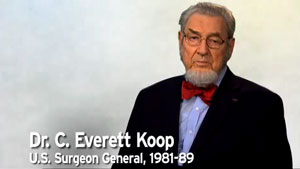
And at the same time we find the medical profession has radically changed. Dr. Koop, in our seminars for Whatever Happened to the Human Race, often said that (speaking for himself), “When I graduated from medical school, the idea was ‘how can I save this life?’ But for a great number of the medical students now, it’s not, ‘How can I save this life?’, but ‘Should I save this life?'”
Believe me, it’s everywhere. It isn’t just abortion. It’s infanticide. It’s allowing the babies to starve to death after they are born. If they do not come up to some doctor’s concept of a quality of life worth living. I’ll just say in passing — and never forget it – it takes about 15 days, often, for these babies to starve to death. And I’d say something else that we haven’t stressed enough. In abortion itself, there is no abortion method that is not painful to the child — just as painful that month before birth as the baby you see a month after birth in one of these cribs down here that I passed — just as painful.
Related posts:

Francis Schaeffer’s prayer for us in USA

 Francis Schaeffer: “Whatever Happened to the Human Race” (Episode 1) ABORTION OF THE HUMAN RACE Published on Oct 6, 2012 by AdamMetropolis The 45 minute video above is from the film series created from Francis Schaeffer’s book “Whatever Happened to the Human Race?” with Dr. C. Everett Koop. This book  really helped develop my political views […]

Francis Schaeffer’s “How should we then live?” Video and outline of episode 10 “Final Choices” (Schaeffer Sundays)

E P I S O D E 1 0   Dr. Francis Schaeffer – Episode X – Final Choices 27 min FINAL CHOICES I. Authoritarianism the Only Humanistic Social Option One man or an elite giving authoritative arbitrary absolutes. A. Society is sole absolute in absence of other absolutes. B. But society has to be […]

Francis Schaeffer’s “How should we then live?” Video and outline of episode 9 “The Age of Personal Peace and Affluence” (Schaeffer Sundays)

E P I S O D E 9 Dr. Francis Schaeffer – Episode IX – The Age of Personal Peace and Affluence 27 min T h e Age of Personal Peace and Afflunce I. By the Early 1960s People Were Bombarded From Every Side by Modern Man’s Humanistic Thought II. Modern Form of Humanistic Thought Leads […]

Francis Schaeffer’s “How should we then live?” Video and outline of episode 8 “The Age of Fragmentation” (Schaeffer Sundays)

E P I S O D E 8 Dr. Francis Schaeffer – Episode VIII – The Age of Fragmentation 27 min I saw this film series in 1979 and it had a major impact on me. T h e Age of FRAGMENTATION I. Art As a Vehicle Of Modern Thought A. Impressionism (Monet, Renoir, Pissarro, Sisley, […]

Francis Schaeffer’s “How should we then live?” Video and outline of episode 7 “The Age of Non-Reason” (Schaeffer Sundays)

E P I S O D E 7 Dr. Francis Schaeffer – Episode VII – The Age of Non Reason I am thrilled to get this film series with you. I saw it first in 1979 and it had such a big impact on me. Today’s episode is where we see modern humanist man act […]

Francis Schaeffer’s “How should we then live?” Video and outline of episode 6 “The Scientific Age” (Schaeffer Sundays)

E P I S O D E 6 How Should We Then Live 6#1 Uploaded by NoMirrorHDDHrorriMoN on Oct 3, 2011 How Should We Then Live? Episode 6 of 12 ________ I am sharing with you a film series that I saw in 1979. In this film Francis Schaeffer asserted that was a shift in […]

Francis Schaeffer’s “How should we then live?” Video and outline of episode 5 “The Revolutionary Age” (Schaeffer Sundays)

E P I S O D E 5 How Should We Then Live? Episode 5: The Revolutionary Age I was impacted by this film series by Francis Schaeffer back in the 1970′s and I wanted to share it with you. Francis Schaeffer noted, “Reformation Did Not Bring Perfection. But gradually on basis of biblical teaching there […]

Francis Schaeffer’s “How should we then live?” Video and outline of episode 4 “The Reformation” (Schaeffer Sundays)

Dr. Francis Schaeffer – Episode IV – The Reformation 27 min I was impacted by this film series by Francis Schaeffer back in the 1970′s and I wanted to share it with you. Schaeffer makes three key points concerning the Reformation: “1. Erasmian Christian humanism rejected by Farel. 2. Bible gives needed answers not only as to […]

“Schaeffer Sundays” Francis Schaeffer’s “How should we then live?” Video and outline of episode 3 “The Renaissance”

Francis Schaeffer’s “How should we then live?” Video and outline of episode 3 “The Renaissance” Francis Schaeffer: “How Should We Then Live?” (Episode 3) THE RENAISSANCE I was impacted by this film series by Francis Schaeffer back in the 1970′s and I wanted to share it with you. Schaeffer really shows why we have so […]

Francis Schaeffer’s “How should we then live?” Video and outline of episode 2 “The Middle Ages” (Schaeffer Sundays)

  Francis Schaeffer: “How Should We Then Live?” (Episode 2) THE MIDDLE AGES I was impacted by this film series by Francis Schaeffer back in the 1970′s and I wanted to share it with you. Schaeffer points out that during this time period unfortunately we have the “Church’s deviation from early church’s teaching in regard […]

Francis Schaeffer’s “How should we then live?” Video and outline of episode 1 “The Roman Age” (Schaeffer Sundays)

Francis Schaeffer: “How Should We Then Live?” (Episode 1) THE ROMAN AGE   Today I am starting a series that really had a big impact on my life back in the 1970′s when I first saw it. There are ten parts and today is the first. Francis Schaeffer takes a look at Rome and why […]

Francis Schaeffer: “Whatever Happened to the Human Race” (Episode 5) TRUTH AND HISTORY

Francis Schaeffer: “Whatever Happened to the Human Race” (Episode 5) TRUTH AND HISTORY Published on Oct 7, 2012 by AdamMetropolis This crucial series is narrated by the late Dr. Francis Schaeffer and former Surgeon General Dr. C. Everett Koop. Today, choices are being made that undermine human rights at their most basic level. Practices once […]

Francis Schaeffer: “Whatever Happened to the Human Race” (Episode 4) THE BASIS FOR HUMAN DIGNITY

The opening song at the beginning of this episode is very insightful. Francis Schaeffer: “Whatever Happened to the Human Race” (Episode 4) THE BASIS FOR HUMAN DIGNITY Published on Oct 7, 2012 by AdamMetropolis This crucial series is narrated by the late Dr. Francis Schaeffer and former Surgeon General Dr. C. Everett Koop. Today, choices […]

Francis Schaeffer: “Whatever Happened to the Human Race” (Episode 3) DEATH BY SOMEONE’S CHOICE

Francis Schaeffer: “Whatever Happened to the Human Race” (Episode 3) DEATH BY SOMEONE’S CHOICE Published on Oct 6, 2012 by AdamMetropolis This crucial series is narrated by the late Dr. Francis Schaeffer and former Surgeon General Dr. C. Everett Koop. Today, choices are being made that undermine human rights at their most basic level. Practices […]

Francis Schaeffer: “Whatever Happened to the Human Race?” (Episode 2) SLAUGHTER OF THE INNOCENTS

Francis Schaeffer: “Whatever Happened to the Human Race?” (Episode 2) SLAUGHTER OF THE INNOCENTS Published on Oct 6, 2012 by AdamMetropolis This crucial series is narrated by the late Dr. Francis Schaeffer and former Surgeon General Dr. C. Everett Koop. Today, choices are being made that undermine human rights at their most basic level. Practices […]

Francis Schaeffer: “Whatever Happened to the Human Race” (Episode 1) ABORTION OF THE HUMAN RACE

It is not possible to know where the pro-life evangelicals are coming from unless you look at the work of the person who inspired them the most. That person was Francis Schaeffer.  I do care about economic issues but the pro-life issue is the most important to me. Several years ago Adrian Rogers (past president of […]

The following essay explores the role that Francis Schaeffer played in the rise of the pro-life movement. It examines the place of How Should We Then Live?, Whatever Happened to the Human Race?, and A Christian Manifesto in that process.

This essay below is worth the read. Schaeffer, Francis – “Francis Schaeffer and the Pro-Life Movement” [How Should We Then Live?, Whatever Happened to the Human Race?, A Christian Manifesto] Editor note: <p> </p> [The following essay explores the role that Francis Schaeffer played in the rise of the pro-life movement.  It examines the place of […]

Who was Francis Schaeffer? by Udo Middelmann

Great article on Schaeffer. Who was Dr. Francis A. Schaeffer? By Francis Schaeffer The unique contribution of Dr. Francis Schaeffer on a whole generation was the ability to communicate the truth of historic Biblical Christianity in a way that combined intellectual integrity with practical, loving care. This grew out of his extensive understanding of the Bible […]

Buffett’s advice to President Obama is bad

The Laffer Curve – Explained

Uploaded by on Nov 14, 2011

This video explains the relationship between tax rates, taxable income, and tax revenue. The key lesson is that the Laffer Curve is not an all-or-nothing proposition, where we have to choose between the exaggerated claim that “all tax cuts pay for themselves” and the equally silly assumption that tax policy doesn’t effect the economy and there is never any revenue feedback. From http://www.freedomandprosperity.org 202-285-0244

____________

You would think that Buffett’s ideas about what grows the economy would include some knowledge of the Laffer Curve. You got to lower taxes on the job creators if you want to grow the economy!!!!

Amy Payne and Alison Acosta Fraser

November 27, 2012 at 9:40 am

Let’s talk taxes. In a New York Times op-ed yesterday, famed investor and Berkshire Hathaway CEO Warren Buffett once again argued that the wealthy should be taxed more.

This isn’t the first time Buffett has made the case for higher taxes, and it’s not the first time he’s been wrong. Here are four reasons he is wrong to push for tax hikes.

1. Buffett says tax hikes won’t hurt jobs.

Fact: Tax hikes, especially those he espouses, hurt jobs.

Buffett cites periods when tax rates were high and says that “Under those burdensome rates,” employment “increased at a rapid clip.”

This country has an employment problem right now, and tax rates aren’t even as high as Buffett wants. The tax increases President Obama champions would hit small businesses that create jobs. According to Treasury figures, 1.2 million Americans who employ people are paying their taxes through the individual income tax, and they would be hit head-on. The amount that their taxes would go up could be roughly equivalent to one employee’s salary, meaning that’s one person they can’t hire in the new year. A study by Ernst and Young estimates that these tax hikes would kill 710,000 jobs.

2. Buffett says tax hikes won’t stop investors from investing.

Fact: Any time you tax something, you get less of it.

Buffett says: “So let’s forget about the rich and ultrarich going on strike and stuffing their ample funds under their mattresses if—gasp—capital gains rates and ordinary income rates are increased. The ultrarich, including me, will forever pursue investment opportunities.”

Let’s think about what taxes are intended to do. The cigarette tax is intended to curb smoking. Proponents of a carbon tax want to curb the amount of carbon emissions we are producing. In Washington, D.C., a plastic bag tax is intended to curb the number of plastic bags people use.

When you tax something more, people do less of it. This is how taxes work. It doesn’t change because the behavior being taxed is investing rather than smoking.

3. Buffett says the wealthy aren’t even paying a minimum tax.

Fact: We already have an Alternative Minimum Tax.

Buffett says, “We need Congress, right now, to enact a minimum tax on high incomes.”

We already have this. It’s called the Alternative Minimum Tax. As Heritage’s Curtis Dubay explains:

Congress passed the Alternative Minimum Tax (AMT) in the early 1970s to ensure that a few high-income taxpayers did not reduce their tax liability too much by taking advantage of all the deductions, exemptions, and credits Congress put in the tax code. But Congress did not index for inflation the income threshold over which families qualify for this extra tax. So now Congress must annually “patch” the AMT by raising the threshold to correct this mistake. Even with the patch, the AMT still ends up falling on almost 4 million taxpayers; Congress initially intended for it to hit only a few hundred.

But here’s where the rubber meets the road: “According to the Congressional Budget Office (CBO), the top 1 percent of earners (those with incomes over $1.2 million in 2009) pay an effective tax rate on all federal taxes of 29 percent. That’s almost three times as high as the 11 percent average rate paid by the middle class.”

The top 10 percent of earners in the United States already pay more than 70 percent of federal income taxes. To move forward in this debate, those who argue that we just need to “tax the rich” will have to get real. We can’t close the budget deficit by taxing the rich. Even though Buffett also claims…

4. Buffett says we need to raise taxes to bring in more revenue for the government.

Fact: The problem is government spending, not government revenue.

Buffett says, “Our government’s goal should be to bring in revenues of 18.5 percent of [gross domestic product] and spend about 21 percent of G.D.P.”

Revenues are lower now today than normal, not because of tax rates, but because of the slow-growing economy. As the economy recovers, so will revenues. And they will continue to grow as the economy thrives. Why? Because more people are investing, saving, working, and enjoying higher wages. The nifty little benefit for the government of a strong, growing economy is that people pay more in taxes.

But on to spending. The White House already estimates that federal spending will be 23.1 percent of GDP this year—well above Buffett’s target. But, unlike taxes—which will return to the historical levels Buffett aims for, spending will continue to spiral ever upwards. In 25 years, spending will be 35.7 percent of GDP. In 2025, the big three entitlements will gobble up a full 18.5 percent of GDP—the entire amount of revenue that Buffett would like to raise.

In Buffett’s world, then, after funding entitlements, that leaves only 2.5 percent of GDP for everything else (assuming that interest rates don’t go through the roof). The fact is that ever-growing entitlements have put spending on a trajectory toward a European-level implosion. If they are not reined in, taxes on everyone will have to rise perpetually just to keep pace.

While Warren Buffett is right about many things, he is wrong about tax hikes. Which leads us to the real questions: Why are we even talking about tax hikes? Where are the spending cuts?

Does President Obama have a mandate to take us to Greece?

DEBT LIMIT – A GUIDE TO AMERICAN FEDERAL DEBT MADE EASY.

Uploaded by on Nov 4, 2011

A satirical short film taking a look at the national debt and how it applies to just one family. Watch the guy from the Ferris Bueller Superbowl Spot! Produced by Seth William Meier, DP/Edited by Craig Evans, 1st AC Brian Andrews, Sound Mixer Gus Salazar, Written and Directed by Brian Stepanek. Help us spread the word by clicking ads or at http://www.debtlimitusa.org.

________

I am hoping that this last election fell short of giving a mandate to take us to Greece but I do wonder.

As I explained in my election post-mortem, I don’t think Obama has a mandate.

But that doesn’t mean we can’t enjoy a good cartoon about his interpretation of the results, and this Bob Gorrell cartoon definitely is amusing.

But it’s amusing – albeit in a disturbing way – because it hinges on something that is true.

America is heading into the fiscal toilet. Indeed, both the BIS and OECD predict that our long-run fiscal situation is more perilous than Europe’s welfare states.

To be fair, we were in a mess even before Obama took office. But Obama wants us to move in the wrong direction at an even faster pace. And he definitely opposes the types of entitlement reforms that could save the country.

That’s why the cartoon has some bite.

And speaking of cartoons about Obama and Greece, here’s another one with the same message. And the final cartoon in this post also has a Greek theme.

P.S. If you like Greek-related humor, I have two more posts that have been very popular. The first one features a video about…well, I’m not sure, but we’ll call it a European romantic comedy and the second one has some very un-PC maps of how various peoples – including the Greeks – view different European nations.

Open letter to Gwyneth Paltrow and Chris Martin concerning their choice to raise their kids in the Jewish Faith (part 11)

Gwyneth Paltrow

The Arab Israeli Conflict – part 4: Egyptian Revolution 1952

I have posted before about the religious views of Gwyneth Paltrow and Chris Martin. Now it appears they have rejected their agnostic statements of the past and have decided to raise their children in the Jewish faith.

Here is a post from the Huffington Post:

After appearing on the television program, “Who Do You Think You Are,” Gwyneth Paltrow has decided to raise children Apple, 7, and Moses, 5, as Jewish.

According to The Daily Mail, the NBC ancestry show sparked the discovery that the actress descended from a notable line of Eastern European rabbis. Though she’s long practiced Kabbalah, Gwyneth had previously stayed neutral about a formal religion upbringing in her household, which includes crooner husband Chris Martin, who is of Christian background.

“I don’t believe in religion. I believe in spirituality. Religion is the cause of all the problems in the world,” the actress once told The Daily Mail.

_______________

Below is a letter I mailed to Chris and Gwyneth recently:

To Chris Martin and Gwyneth Paltrow, c/o Go Go Pictures, 12 Cleveland Row, London, SW1A 1DH, United Kingdom, , From Everette Hatcher, 13900 Cottontail Lane, Alexander, AR 72002, USA:

I have been a huge fan of both of you and have posted many times on my blog about your religious views which have seemed to have changed over the years. I know that Chris was brought up as an evangelical Christian, but has long ago left the faith behind although he did revisit many biblical themes in his 2008 and 2011 cds.

In fact, on June 3, 2011 on my blog (www.thedailyhatch.org) I wrote:

I have shown what thought processes Solomon went through in Ecclesiastes and then compared them to the evident changes that are occurring with Coldplay. By the way, the final chapter of Ecclesiastes finishes with Solomon emphasizing that serving God is the only proper response of man. My prediction: I am hoping that Coldplay’s next album will also come to that same conclusion that Solomon came to in Ecclesiastes 12:13-14:
13 Now all has been heard;
here is the conclusion of the matter:
Fear God and keep his commandments,
for this is the whole duty of man.

14 For God will bring every deed into judgment,
including every hidden thing,
whether it is good or evil.

I have also written before about Gwyneth’s famous Jewish relatives which includes a famous Rabbi and I have wondered if she would decide to return to those roots. Actually that is what has happened. I salute you for rejecting your earlier statements against organized religion and for making the decision to teach your children the Bible and to have faith in God. 

I know that you will spending lots of time in the scriptures and I wanted to share with you some key scriptures that talk about the Messiah. Greg Koukl wrote the article below:

When we come upon apparently disparate parts of a thing that clearly fit together in a precise and complicated way, we naturally conclude there is a designer behind it. And as the design and function become more complicated, it would be absurd to suggest otherwise.

Let me give you an example. I turned on my Macintosh this morning, inserted a disk, the Macintosh read the information on the disk, and I did my work. Would anyone be the least bit tempted to think that the disk I just inserted had been developed in a vacuum, so to speak, and coincidentally “just happened” to do meaningful work on my computer? Would anyone suppose that the disk was developed apart from the computer itself and they just work together? No one would ever say that.

The absurdity is obvious from two different angles. First, the fit, the hardware issue. The disk fits right in, a little mechanism sucks the disk down and engages it on a spinning affair that allows the computer to read the disk. There’s an amazing fit there. In fact, the fit has to be very precise.

Second, there is all of the highly sophisticated computer interactions that are associated with the fit, in other words, the software. The computer is able to “read” the information on the disk that allows the computer to do work. This is not the kind of thing you’d expect to happen outside of the general computer design itself. Things don’t just happen to fit like that accidentally, and things don’t work together like that accidentally.

Now think a moment with the previous illustration in mind about human sexuality (or any kind of bisexual reproduction). You’ve got a hardware problem and a software problem. Both are pretty complex because of the nature of sexual response. You’ve got to have parts that have to fit in a particular way. I’m trying to think of a way to say this delicately–the software problem, in this case, is very closely connected to the hardware problem. If the software isn’t right then there is no hardware (if you catch my drift). It’s a very delicate balance. Not only does the hardware have to fit, but it has to function. Sperm have to go into the woman’s body and connect with the egg that comes down at just the right time. Those things have to work together. They can’t just be swimming around in there like protozoa that don’t go together. The sperm and the egg have to go together, and that’s all part of the hardware problem.

Even if you get the hardware problem solved, you’ve got the software problem. You’ve got the problem with men being attracted to women and visa versa. You’ve got the problem of all the issues that relate to the intricacies of sexual response, the things that make people appealing, that turn people on, the things that cause people to even desire to put the hardware together to begin with. Do you see what I’m saying? A lot of times we don’t even think about this because it’s very natural, but the software has got to be there that would cause us to think that one thing goes into another in that fashion for a particular purpose. We don’t think about that. We just do it because it comes so naturally. Where did that come from?

My point is that this is very much like the computer and the disk issue on both levels. It’s a parallel with my Macintosh illustration because both the hardware of the computer and the hardware of the disk, and also the software of the computer and the software of the disk would have to coincidentally develop with no thought of design. Not only that, it would have to develop at the same time (it can’t develop sixty years apart from each other) and in the same general location on earth.

Do you see what I’m talking about here? The same thing applies to human bodies and any kind of bisexual reproduction because for evolution to be true all of the hardware has to happen by chance. All of the software has to happen by chance. The software and hardware have to be synchronized in a very delicate fashion. And it not only all has to happen by chance, it’s got to happen at the same time and in the same place.

divider

Only someone who is intent on ignoring what is obvious will deny that there is design involved.

divider

The simple point is, only someone who is intent on ignoring what is obvious will deny that there is design involved. There is no way that people can apply the rules of the natural development of living things, which are highly integrated machines with hardware and software, to any other area of life because you’d be considered a fool. But of course, many people do deny that there is design involved.

By the way, this same argument applies to the whole question of whether Jesus was Messiah or not. Some of you may have listened a while back when a caller was quoting Messianic prophecy and I cautioned him about using Messianic prophecy because there is a lot of prophecy that is identified as Messianic in the New Testament, but it’s clear in the Old Testament that those writing it didn’t think it was prophecy. So if you quote it, it won’t be compelling because it looks like the New Testament authors made it up. I believe it’s prophecy because we have a divinely inspired New Testament and the writers were given the testimony of the Holy Spirit to apply it. But it won’t be compelling to a non-Christian because it wasn’t clearly prophecy at the time it was given. When you read about Rachel weeping for her children you don’t get the sense that the slaughter of babies is being anticipated by the author who wrote it originally. I believe it is a prophecy because Matthew, moved by the Holy Spirit, identifies it as such. But I was reluctant to encourage people to use passages like that from the Old Testament to prove Jesus’ Messiahship. Even the prophecy of the virgin birth is like that.

I did that for the best of reasons. I work very, very hard to be evenhanded and fair, and not to misrepresent a point or to play a point too strongly. If we overplay our hands and people see that our hand is weaker than we presented it, then it may destroy our entire argument.

Well, ladies and gentlemen, I was wrong. I was mistaken. I’ll tell you why I was wrong and why you ought to use that as a powerful example for the design behind the Bible. And I’ll tell you how that all fits in just a moment.

I’m going to explain to you how I was mistaken because if we understand the design of prophecy in the Old Testament properly, this could not only be a great defense for Jesus’ Messiahship, but go far beyond that and refute all of the higher critics who criticize the Old Testament.

Let me go back to machines for a moment to bring you up to speed on how information and function work with prophecy.

What if you had a machine shop and you liked to make things. Sometimes you made things because they accomplished a certain function, and other times you made things just because you liked the way they looked. It had an aesthetic appeal. Sometimes you just whittled with wood and machinery just because it was fun to do but you had no particular goal in mind.

Then one day you got together with a bunch of other tinkerers and everybody brought their tinker toys, so to speak, the things that they had made. As you looked at each other’s inventions and parts, one person noticed that his part fit together with your part and when you put them together it was a perfect fit. You all were amazed at how well it went together and you were stunned by the coincidence. Then a third person noticed that his part went in a space your parts created and it fit together. Lo and behold, all of you had parts that fit together. When you got it all together it had a little knob that invited twisting. And when someone twisted it the little thing you just assembled began ticking.

What would you conclude? You would conclude that something was going on here. Someone behind the scenes was involved with all of your tinkering such that even though you may have had your own purposes for your tinker toy, someone else was guiding the whole process, even guided your meeting, and had a broader design and purpose in mind. That design was the watch. You could not conclude otherwise.

divider

Who would deny that all of these efforts, whether purposeful or apparently accidental, were not part of a grand, intelligent design that far transcended all the individual efforts?

divider

Now, what if the inventors were from different continents, came from different walks of life, and lived at different periods of history? Some made parts that had no current function but parts that they believed (and said so) would serve a future purpose, though they weren’t entirely clear on what that purpose would be. In other words, what if someone invented a carburetor 150 years before the internal combustion engine? He didn’t know what it was, but he had to put it together and he believed that someday in the future it would have a function. Still other of the inventors made parts for their own purposes with no anticipation that they would “accidentally” fit into a larger, more complex mechanism in the future.

Ladies and gentlemen, when that mechanism was assembled, who would deny that all of these efforts, whether purposeful or apparently accidental, were not part of a grand, intelligent design that far transcended all the individual efforts that contributed to the specific parts? Who would deny that? In spite of the fact that the individual workers did not intend the parts to fit.

Then you go to Psalm 22 and you realize that in the context this was probably David’s groaning because of the anguish he felt at being pursued by his enemies, even though he was a godly man. He was being hounded and he poured out his heart in this Psalm. Then someone 1000 years later, with the Psalm hidden in their heart, is standing at the foot of the cross. They are looking at Jesus and this Psalm comes to mind and they realize that something is going on here.

Or they think of Isaiah 53 and the details seem to fit perfectly. In fact, in the movie Jesus of Nazareth , Nicodemus is watching the crucifixion and the words of Isaiah 53 come to his lips. It fell into place. This is why the apostles said often that they realized afterwards that it was a fulfillment of prophecy because they saw time after time after time again, not just the times in the Old Testament that the writers said this is about Messiah, but the dozens and dozens of details in the Old Testament that they weren’t sure about and then it fit in the life of Christ. Who would deny that there was a grand design behind it all?

There was a grand design.

By the way, even if the higher critics are right, even if Moses never wrote the Pentateuch, even if Isaiah never wrote Isaiah, even if Daniel never wrote the book of Daniel, the fact is that according to the Septuagint, which was the Greek translation of the Old Testament two centuries before Jesus, and the Dead Sea Scrolls, which preceded Jesus by a century and a half, all of these writings predate the life of Christ. They all have these prophecies in them regardless of who wrote them. And they all show the grand design of God coming to its final culmination in the person of Jesus Christ.

Now that’s something to think about this Easter.


This is a transcript of a commentary from the radio show“Stand to Reason,” with Gregory Koukl. It is made available to you at no charge through the faithful giving of those who support Stand to Reason. Reproduction permitted for non-commercial use only. ©1994 Gregory Koukl

For more information, contact Stand to Reason at 1438 East 33rd St., Signal Hill, CA 90755
(800) 2-REASON (562) 595-7333 www.str.org

“Friedman Friday,” EPISODE “The Failure of Socialism” of Free to Choose in 1990 by Milton Friedman (Part 1)

Milton Friedman: Free To Choose – The Failure Of Socialism With Ronald Reagan (Full)

Published on Mar 19, 2012 by

Milton Friedman’s writings affected me greatly when I first discovered them and I wanted to share with you. We must not head down the path of socialism like Greece has done.

Ronald Reagan introduces this program, and traces a line from Adam Smith’s “The Wealth of Nations” to Milton Friedman’s work, describing Free to Choose as “a survival kit for you, for our nation and for freedom.” Dr. Friedman travels to Hungary and Czechoslovakia to learn how Eastern Europeans are rebuilding their collapsed economies. His conclusion: they must accept the verdict of history that governments create no wealth. Economic freedom is the only source of prosperity. That means free, private markets. Attempts to find a “third way” between socialism and free markets are doomed from the start. If the people of Eastern Europe are given the chance to make their own choices they will achieve a high level of prosperity. Friedman tells us individual stories about how small businesses struggle to survive against the remains of extensive government control. Friedman says, “Everybody knows what needs to be done. The property that is now in the hands of the state, needs to be gotten into the hands of private people who can use it in accordance with their own interests and values.” Eastern Europe has observed the history of free markets in the United States and wants to copy our success. After the documentary, Dr. Friedman talks further about government and the economy with Gary Becker of the University of Chicago and Samuel Bowles of the University of Massachusetts. In a wide-ranging discussion, they disagree about the results of economic controls in countries around the world, with Friedman defending his thesis that the best government role is the smallest one.
___________
Below is a portion of the transcript of the program and above you will find the complete video of the program:
 

Ronald Reagan: In 1980, a friend of mine did something of rare importance that some historians might miss. Dr. Milton Friedman, a scientist, a careful thinker, and a great teacher first presented his TV series Free to Choose. His TV series was about choices, risks, freedom, equality, and making a better future for all of us.

In 1976, the 200th birth of our nation, Milton Friedman won the Nobel Peace Prize in economics. Two hundred years earlier, in the same year as the Declaration of Independence, Adam Smith, the Scotsman, published a book entitled The Wealth Of Nations. The United States was the first country to apply the ideas in Adam Smith’s book. Those ideas have led to our prosperity and given us our freedom.

In Free to Choose, Milton Friedman shows us how those ideas can help us today. In this program, Milton and his wife Rose, take us on a brief tour of Eastern Europe. They wanted to see if the Czechs, Hungarians and Poles were taking the steps needed to achieve prosperity and a lasting freedom. In fact, a member of the Polish Parliament has said that Milton Friedman’s Free to Choose was a major influence on the Polish drive for freedom.

I find it exciting to watch the rebirth of freedom in Eastern Europe. Being free to choose should be every person’s birthright. Everywhere in the world, and especially here in the United States, we need to keep government on the sidelines. Let the people develop their own skills, solve their own problems, better their own lives. I don’t think it is an exaggeration to call Milton Friedman’s Free to Choose, a survival kit for you, for our nation and for freedom.

Friedman: Those are the parliament buildings. This is the river Danube and I am in Budapest, the capitol of Hungary. Over there somewhere is Czechoslovakia, over there Poland, and farther away yet, the Soviet Union. Socialist states that started out with the very best of intentions, intending only to improve the lots of their citizens, they all ended up making the people poor, miserable and into slaves. And every one of them has been learning that lesson that socialism is a failure. They are all trying to move in the direction of a free, private market.

What happened here in Eastern Europe was a major event. The first time in history that the totalitarian countries decided to move toward free markets. Will they succeed? That is a question that brought my wife Rose and me here. As economists, we wanted to witness the most exciting experiment in political and economic organization that is likely to occur in our lifetime.

In the center of Prague, there is a famous cafe, a relic from the days when Czechoslovakia was one of the wealthiest countries in the world. Today, we find only faded elegance, a pale echo of a productive past that was created by market incentives. What happened? Communist central control __ that is what happened. The same culture, the same people, the same resources who wanted different outcomes of vastly lower standard of living, the result of substituting orders from the top for incentives from below. Who says economic institutions don’t matter?

A year ago, right outside that cafe, hundreds of thousands of Czechs massed in Wensisloss Square to demand their freedom. This is where it all happened. In three days they got political freedom. The hopes were high. They thought economic miracles would follow quickly. Yet now it is a year later and almost nothing has happened. Political freedom can be achieved rapidly; economic freedom and prosperity is a very different thing. That’s what is beginning to dawn on these people. In reality they are not yet free. They are still the victims of thousands of controls the communists put in place.

If the newly elected governments are going to keep the support of the people, they must give them real freedom and they’ve got to do it fast. That was the secret of Margaret Thatcher’s success in England. She had a well worked out program and she put it into effect right after coming into office. It was the secret of Ronald Reagan’s program. On the other hand, Manahem Began in Israel came in without any plans whatsoever, and he ended up a failure. If Czechoslovakia is going to achieve the objectives of its revolution, it must move rapidly to put into effect the economic institutions which alone can convert political freedom into economic and human freedom. Those institutions are the institutions of free, private markets.

There are examples all over the place of both the opportunities and the problems. Yuri Malick wants to publish a magazine for people who are trying to set up their own private businesses in Czechoslovakia. He runs it from his living room. It’s a small family enterprise. The magazine is packed with information for would-be businessmen on how to thread their way through the jungle of bureaucratic regulations that still exist. The irony is that some of those very regulations are preventing him from getting his business off the ground. For a start, he needs to obtain 15 separate government licenses before he can distribute the magazine. After nearly a year, he still hasn’t got them. He has had to come here again and again to this government licensing bureau to try to persuade a bureaucrat to allow him to do business.

Yet again, it’s not his lucky day. Yuri Malick doesn’t give in easily, but things are not looking too hopeful. The man he has got to see is not available and no one else is interested in his problem. The Cheque government owns all the newsstands, the book shops, the nationwide distribution system which is controlled from here. There is one way, and only one way, to put an end to all this nonsense, the government must get out of business and stay out. It must transfer these assets into private hands.

These are the kinds of forms you have to fill out in this country in a place like that if you want to start a business or get anything done. But if you think that only happens here, tell me when was the last time you stood in line to get a driver’s license or a registration plate, or do you know anybody in Britain, France, Germany or the United States who has built a house sometime in the last 10 years. Ask him what he went through.

Remembering Francis Schaeffer at 100 (Part 9)

THE FRANCIS SCHAEFFER CENTENNIAL – SCHAEFFER’S CULTURAL APOLOGETIC PT 1 – DONALD WILLAIMS

schaeffer

This year Francis Schaeffer would have turned 100 on Jan 30, 2012. I remember like yesterday when I first was introduced to his books. I was even more amazed when I first saw his films. I was so influenced by them that I bought every one of his 30 something books and his two film series. Chuck Colson’s website www.breakpoint.org  and I was directed from there to Probe’s website where I found this great article below. I will share it in 4 parts. Todd Kappelman is the author and here is some info on him and Probe.

Todd KappelmanTodd A. Kappelman is a field associate with Probe Ministries. He is a graduate of Dallas Baptist University (B.A. and M.A.B.S., religion and Greek), and the University of Dallas (M.A., philosophy/humanities). Currently he is pursuing a Ph.D. in philosophy at the University of Dallas. He has served as assistant director of the Trinity Institute, a study center devoted to Christian thought and inquiry. He has been the managing editor of The Antithesis, a bi-monthly publication devoted to the critique of foreign and independent film. His central area of expertise is Continental philosophy (especially nineteenth and twentieth century) and postmodern thought.

What is Probe?

Probe Ministries is a non-profit ministry whose mission is to assist the church in renewing the minds of believers with a Christian worldview and to equip the church to engage the world for Christ. Probe fulfills this mission through our Mind Games conferences for youth and adults, our 3-minute daily radio program, and our extensive Web site at www.probe.org.

Further information about Probe’s materials and ministry may be obtained by contacting us at:

Probe Ministries
2001 W. Plano Parkway, Suite 2000
Plano TX 75075
(972) 941-4565
info@probe.org
www.probe.org
Copyright information

This is the third part:

The Need to Read: Francis Schaeffer Print E-mail

Todd Kappelman Written by Todd Kappelman

The Need to Read series began several months ago with a program on C.S. Lewis . The rationale for this series is that many of the great writers who have helped many Christians mature are now either unknown or neglected by many who could use these authors insights into the faith.

This installment focuses on Francis Schaeffer (1912-1984), one of the most recognized and respected Christian authors of the twentieth century.

Escape from Reason

In The God Who Is There, Schaeffers main thesis is that modern man is characterized by his willingness to live a life of contradictions. In the book Escape from Reason, he shows how we arrived at this position, and what can be done about it.

Francis Schaeffer believed that one of the great watershed periods of human history occurred in the late sixteenth and early seventeenth centuries. The Reformation was a fifteenth and sixteenth century movement, but it was religious in nature and ultimately resulted in the formation of the Protestant churches. The Renaissance, argues Schaeffer, largely emphasized human reason and the achievements of man. In sharp contrast, the Reformation emphasized the will of God and the authority of the Holy Scriptures. It must be remembered that Schaeffer is generalizing in much of what is said here and that both movements had good and bad aspects.

Schaeffer maintains that men in the Renaissance believed they were great because of the wonderful art, literature, and architecture they produced. The Reformation man believed he was great because of the God who had made him. Man was made to have a relationship with his creator, but the Renaissance man found himself more and more concerned with the things of this world.{5}

As the emphasis on man increased, the importance of God decreased. This movement was further facilitated by discoveries in the sciences which allowed man to understand the universe on purely naturalistic principles. The result of mans success in explaining some aspects of the universe through reason alone was that he began to try to explain every aspect of the universe through reason alone.

Men found that they were able to explain much through reason, but the larger philosophical questions proved to be too great. In addition, they discovered that there were many questions that could not be answered by reason alone. Some of these questions were: How did everything begin? Why is there something rather than nothing? What happens to us after we die? These questions are traditionally answered by theology, and the answers usually included an appeal to a divine being called God.

Modern man, thus, was faced with two possibilities. Either he could return to the answers found in the Scriptures, or he could live as though life had meaning even though he did not believe that it really did.{6} Schaeffer argued that men in the Western philosophical tradition largely opted for irrational existence, escaping the requirements of reason, hence the title Escape from Reason. Schaeffers conclusion to this problem is that Christians must return to a serious belief in the Scriptures and their ability to answer the big philosophical problems, and that we must live our faith consistently in front of the world.{7} In addition, Schaeffer believed that the days are gone when the average man on the street would respond to the Gospel. The language has changed, and we must learn to speak in this new language.{8} We must educate ourselves and be ready to give an account of how modern man got into his present state of affairs.

Related posts:

Francis Schaeffer would be 100 years old this year (Schaeffer Sunday)

Dr. Francis Schaeffer – Extra – Interview – Part 2 Francis Schaeffer had a big impact on me in the late 1970′s and I have been enjoying his books and films ever since. Here is great video clip of an interview and below is a fine article about him. Francis Schaeffer 1912-1984 Christian Theologian, Philosopher, […]

Francis Schaeffer’s “How should we then live?” Video and outline of episode 10 “Final Choices” (Schaeffer Sundays)

E P I S O D E 1 0 How Should We Then Live 10#1 FINAL CHOICES I. Authoritarianism the Only Humanistic Social Option One man or an elite giving authoritative arbitrary absolutes. A. Society is sole absolute in absence of other absolutes. B. But society has to be led by an elite: John Kenneth […]

Fellow admirer of Francis Schaeffer, Michele Bachmann quits presidential race

What Ever Happened to the Human Race? Bachmann was a student of the works of Francis Schaeffer like I am and I know she was pro-life because of it. (Observe video clip above and picture of Schaeffer.) I hated to see her go.  DES MOINES, Iowa — Last night, Minnesota Rep. Michele Bachmann vowed to […]

Francis Schaeffer’s “How should we then live?” Video and outline of episode 9 “The Age of Personal Peace and Affluence” (Schaeffer Sundays)

E P I S O D E 9 How Should We Then Live 9#1 T h e Age of Personal Peace and Afflunce I. By the Early 1960s People Were Bombarded From Every Side by Modern Man’s Humanistic Thought II. Modern Form of Humanistic Thought Leads to Pessimism Regarding a Meaning for Life and for Fixed […]

Francis Schaeffer’s “How should we then live?” Video and outline of episode 8 “The Age of Fragmentation” (Schaeffer Sundays)

E P I S O D E 8 How Should We Then Live 8#1 I saw this film series in 1979 and it had a major impact on me. T h e Age of FRAGMENTATION I. Art As a Vehicle Of Modern Thought A. Impressionism (Monet, Renoir, Pissarro, Sisley, Degas) and Post-Impressionism (Cézanne, Van Gogh, Gauguin, […]

Francis Schaeffer’s “How should we then live?” Video and outline of episode 7 “The Age of Non-Reason” (Schaeffer Sundays)

E P I S O D E 7 How Should We Then Live 7#1 I am thrilled to get this film series with you. I saw it first in 1979 and it had such a big impact on me. Today’s episode is where we see modern humanist man act on his belief that we live […]

Francis Schaeffer would be 100 years old this year (Schaeffer Sunday)

Dr. Francis Schaeffer – Extra – Interview – Part 2 Francis Schaeffer had a big impact on me in the late 1970′s and I have been enjoying his books and films ever since. Here is great video clip of an interview and below is a fine article about him. Francis Schaeffer 1912-1984 Christian Theologian, Philosopher, […]

Francis Schaeffer’s “How should we then live?” Video and outline of episode 6 “The Scientific Age” (Schaeffer Sundays)

E P I S O D E 6 How Should We Then Live 6#1 I am sharing with you a film series that I saw in 1979. In this film Francis Schaeffer asserted that was a shift in Modern Science. A. Change in conviction from earlier modern scientists.B. From an open to a closed natural system: […]

Francis Schaeffer’s “How should we then live?” Video and outline of episode 5 “The Revolutionary Age” (Schaeffer Sundays)

E P I S O D E 5 How Should We Then Live 5-1 I was impacted by this film series by Francis Schaeffer back in the 1970′s and I wanted to share it with you. Francis Schaeffer noted, “Reformation Did Not Bring Perfection. But gradually on basis of biblical teaching there was a unique improvement. A. […]

Francis Schaeffer’s “How should we then live?” Video and outline of episode 4 “The Reformation” (Schaeffer Sundays)

How Should We Then Live 4-1 I was impacted by this film series by Francis Schaeffer back in the 1970′s and I wanted to share it with you. Schaeffer makes three key points concerning the Reformation: “1. Erasmian Christian humanism rejected by Farel. 2. Bible gives needed answers not only as to how to be right with […]

Francis Schaeffer’s “How should we then live?” Video and outline of episode 3 “The Renaissance”

How Should We Then Live 3-1 I was impacted by this film series by Francis Schaeffer back in the 1970′s and I wanted to share it with you. Schaeffer really shows why we have so many problems today with this excellent episode. He noted, “Could have gone either way—with emphasis on real people living in […]

Francis Schaeffer’s “How should we then live?” Video and outline of episode 2 “The Middle Ages” (Schaeffer Sundays)

How Should We Then Live 2-1 I was impacted by this film series by Francis Schaeffer back in the 1970′s and I wanted to share it with you. Schaeffer points out that during this time period unfortunately we have the “Church’s deviation from early church’s teaching in regard to authority and the approach to God.” […]

Francis Schaeffer’s “How should we then live?” Video and outline of episode 1 “The Roman Age” (Schaeffer Sundays)

How Should We Then Live 1-1 Today I am starting a series that really had a big impact on my life back in the 1970′s when I first saw it. There are ten parts and today is the first. Francis Schaeffer takes a look at Rome and why it fell. It fell because of inward […]

Andy Rooney was an atheist

How Now Shall We LiveClick here to purchase Chuck Colson and Nancy Pearcey’s How Now Shall We Live?, dedicated to Francis Schaeffer.

Click here for a list of Francis Schaeffer’s greatest works, from the Colson Center store!
SchaefferBooks