Ms. Jackson’s agency takes over automobile design.
re’s one good way to consider the vote in 2012: It’s about whether to re-elect President Lisa Jackson, the head of the Environmental Protection Agency, which these days runs most the U.S. economy.
The EPA heaved its weight against another industry this month, issuing a regulation to sharply increase fuel economy. Under this new rule, America’s fleet of passenger cars and light trucks will have to meet an average of 54.5 miles per gallon by 2025, a doubling of today’s average of about 27 mpg. By the EPA’s estimate the rule will cost $157 billion, meaning the real number is vastly greater.
The fuel-economy rule is classic Obama EPA. Until this Administration, fuel standards were the remit of Congress, via its Corporate Average Fuel Economy (CAFE) program. In 2007, the legislative branch raised those standards with a bill requiring the U.S. fleet to hit 35 miles per gallon by 2020, a 40% increase. The industry is struggling to keep pace with those steep requirements.
President Jackson is now casting aside 35 years of Congressional prerogative. Because the Obama EPA has declared carbon dioxide a “pollutant,” and because cars emit CO2, Ms. Jackson is citing the Clean Air Act in her bid to commandeer Detroit. While the EPA officially worked with the National Highway Traffic Safety Administration (Nhtsa, the agency previously in charge of efficiency standards), it’s clear the EPA is calling the shots.
At least when Nhtsa was overseeing efficiency, it was charged by Congress with taking into account vehicle safety and a rule’s effect on the economy and consumer demand. The EPA can’t be bothered with such detail.
Associated PressEnvironmental Protection Agency Administrator Lisa Jackson
The National Automobile Dealers Association, which has opposed the EPA rule, has compiled Obama Administration documents showing the average price of a new vehicle will increase by $3,100 by 2025, thanks to the cumulative fuel-efficiency rules. Vehicles that currently cost $15,000 or less will effectively be regulated out of existence. The rule will reduce the mass of a car by 15% to 25%, decreasing safety.
The only way Detroit can hit these averages will be by turning at least 25% of its fleet into hybrids. But hybrid sales peaked in the U.S. two years ago at 3% of the market and are declining. The EPA’s $157 billion price tag includes only the estimate of what manufacturers will have to invest in new technology, not the billions more that will hemorrhage when nobody buys their EPA-approved products.
Yes, 13 automakers agreed to this standard in July, confirming behavioral science on hostages. The industry has been living for years under the threat of California’s strict efficiency mandate. Federal law pre-empts states from setting their own standards, and the Bush Administration refused to grant California a waiver. But the Obama administration made clear to automakers that their choice was between one crushing EPA-devised rule, or a national patchwork of crushing rules from California and acolyte states. They chose the federal poison.
House Republicans are pushing to return efficiency standards to the one regulator Congress has decreed: Nhtsa. They note that not only are California bureaucrats dictating federal policy, but the EPA has wasted $25 million to duplicate or demolish Nhtsa rules.
The EPA is seeking to impose, by fiat, greenhouse gas reductions that even a Democratic Congress rejected with the Waxman-Markey bill in 2009, and that would drive policy at least 13 years past this Administration. It’s all more than a tad authoritarian. Welcome to the Obama-Jackson Presidency.
Francis Schaeffer discussed modern films and how they showed the state of man. That is why I like Woody Allen’s films so much. He knows what the big issues are in life and even though he present the right answers he does grapple with the right questions. Michelangelo Antonioni heavily influenced Allen and below is a picture from one of his best well known films.
<The Kobal Collection
Blow-Up (1966). Michelangelo Antonioni created waves with his first English-language film when he turned his camera on swinging London as personified by a cocky fashion photographer (David Hemmings) who believes his lens has accidentally captured a murder.
Allen’s observation: “Not in the same class as the other films, but interesting to see.”
Learning to Cry for the Culture Let’s remember Francis Schaeffer’s most crucial legacy–tears.
John FischerMarch 19, 2007He was a small man—barely five feet in his knickers, knee socks, and ballooning white shirts. For two weeks, first as a freshman and then again as a senior, I sat in my assigned seat at Wheaton College’s chapel and heard him cry. He was the evangelical conscience at the end of the 20th century, weeping over a world that most of his peers dismissed as not worth saving, except to rescue a few souls in the doomed planet’s waning hours. While Hal Lindsey was disseminating an exit strategy in The Late Great Planet Earth, Francis Schaeffer was trying to understand and care for people still trapped on the planet in The God Who Is There.Francis Schaeffer was hard to listen to. His voice grated. It was a high-pitched scream that, when mixed with his eastern Pennsylvania accent, sounded something like Elmer Fudd on speed. As freshmen, unfamiliar with the thought and works of modern man, we thought it was funny. As seniors, it wasn’t funny any more. After we had studied Kant, Hegel, Sartre, and Camus, the voice sounded more like an existential shriek. If Edvard Munch’s The Screamhad a voice, it would have sounded like Francis Schaeffer. Schaeffer, who died in 1984, understood the existential cry of humanity trapped in a prison of its own making. He was the closest thing to a “man of sorrows” I have seen.I grew up with a Christianity that was predisposed against sorrow. To be sad was to deny your faith or your salvation. Jesus had made us happy, and we had an obligation to always show that happiness. Then Francis Schaeffer came along. He could not allow himself to be happy when most of the world was desperately lost and he knew why. He was the first Christian I found who could embrace faith and the despair of a lost humanity at the same time. Though he had been found, he still knew what it was to be lost.How different from the perception of conservative Christians held by so many people today! Today, the Religious Right is caricatured in society as a theocratic movement with no concern for the poor and downtrodden. Of course, such an ugly stereotype, presented as fact in a spate of pre-election books ranging from American Theocracy to Thy Kingdom Come, overlooks crisis pregnancy centers, humanitarian work, and generous giving to causes sacred and secular by members of the Christian Right.Schaeffer’s Way
However, like most stereotypes, this one of politically engaged conservative Christians contains a painful element of truth. Too often we confuse our agendas with God’s agenda and demonize our opponents in a desperate attempt to score political points. What’s ironic is that many of today’s culture warriors look to Schaeffer as the man who fired the first shot.
Yes, in two of Schaeffer’s later works, How Should We Then Live? (1976) and A Christian Manifesto (1981), he took a strong stand against abortion and euthanasia and even called for serious measures, including political intervention, to stop what he saw as impending cultural suicide. But to conclude that this invocation to war was Schaeffer’s crowning achievement is to truncate the man and his work.
Though his last words may have resounded like a battle cry to the next generation of Christians locked in a culture war, everything leading up to them said something else. Schaeffer’s work is ultimately not a call to arms, but a call to care. Those who have taken up arms and claimed him as their champion have gotten only part of his message.
Schaeffer never meant for Christians to take a combative stance in society without first experiencing empathy for the human predicament that brought us to this place. Those who go back only as far as A Christian Manifesto—without also understanding Escape from Reason (1968), The God Who Is There (1968), and Death in the City (1970)—are doing Schaeffer’s life and work a great disservice. The later Schaeffer cannot be divorced from the former.
Weeping over the World
Schaeffer was the first Christian leader who taught me to weep over the world instead of judging it. Schaeffer modeled a caring and thoughtful engagement with the history of philosophy and its influence through movies, novels, plays, music, and art. Schaeffer was teaching at Wheaton College about the existential dilemma expressed in Michelangelo Antonioni’s 1966 film, Blowup, when movies were still forbidden to students. He didn’t bat an eye. He ignored our legalism and went on teaching, because he had been personally gripped by the desperation of such cultural statements.
Death in the City is the book of Lamentations in the Old Testament applied to America. It is all about weeping over the death of a culture. Schaeffer saw the most brilliant thinkers and artists of his day as trapped under what he called a line of despair—in a lower-story hopelessness without any access to upper-story revelation. Schaeffer taught his followers not to sneer at or dismiss the dissonance in modern art. He showed how these artists were merely expressing the outcome of the presuppositions of the modern era that did away with God and put all conclusions on a strictly human, rational level. Instead of shaking our heads at a depressing, dark, abstract work of art, the true Christian reaction should be to weep for the lost person who created it. Schaeffer was a rare Christian leader who advocated understanding and empathizing with non-Christians instead of taking issue with them.
Francis Schaeffer was not afraid to ask why, and he did not rest until he had an answer. Why are our most brilliant thinkers in despair? Why is our art so dark? Why have abortion and euthanasia become so easy on the conscience of a generation? What process of thinking has led to this ultimate denial of the value of human life? Though some may disagree with his answers, no one can gainsay the passion with which he sought them.
The normal human reaction is to hate what we don’t understand. This is the stuff of prejudice and the cause of hate crimes and escalating social evil. It is much more Christ-like to identify with those we don’t understand—to discover why people do what they do, because we care about them, even if they are our ideological enemies.
Jesus asked us to love our enemies. Part of loving is learning to understand. Too few Christians today seek to understand why their enemies think in ways that we find abhorrent. Too many of us are too busy bashing feminists, secular humanists, gay activists, and political liberals to consider why they believe what they do. It’s difficult to sympathize with people we see as threats to our children and our neighborhoods. It’s hard to weep over those whom we have declared enemies.
Perhaps a good beginning would be to more fully grasp the depravity of our own souls and the depth to which God’s grace had to go to reach us. I doubt we can cry over the world if we’ve never cried over ourselves.
To be sure, Francis Schaeffer’s influence has declined in recent years, as postmodernism has supplanted the modernity he dissected for so long. Schaeffer is not without his critics, even among Christians. But perhaps, in the end, his greatest influence on the church will not be his words as much as his tears. The same things that made Francis Schaeffer cry in his day should make us cry in ours.
Singer-songwriter John Fischer has recorded 12 albums and is the author of 15 books.
In 1955, Schaeffer founded L’Abri fellowship, “where individuals have the opportunity to seek answers to honest questions about God and the significance of human life.”
The Dissatisfaction of Francis Schaeffer (Parts 1 and 2) | Thirteen years after his death, Schaeffer’s vision and frustrations continue to haunt evangelicalism. (March 1997)
Here is an episode of Schaeffer’s film series that discusses the philosophic movies that show man’s desperation:
E P I S O D E 8
How Should We Then Live 8#1
I saw this film series in 1979 and it had a major impact on me.
T h e Age of FRAGMENTATION
I. Art As a Vehicle Of Modern Thought
A. Impressionism (Monet, Renoir, Pissarro, Sisley, Degas) and Post-Impressionism (Cézanne, Van Gogh, Gauguin, Seurat): appearance and reality.
1. Problem of reality in Impressionism: no universal.
2. Post-Impression seeks the universal behind appearances.
3. Painting expresses an idea in its own terms as a work of art; to discuss the idea in a painting is not to intellectualize art.
4. Parallel search for universal in art and philosophy; Cézanne.
B. Fragmentation.
1. Extremes of ultra-naturalism or abstraction: Wassily Kandinsky.
2. Picasso leads choice for abstraction: relevance of this choice.
3. Failure of Picasso (like Sartre, and for similar reasons) to be fully consistent with his choice.
C. Retreat to absurdity.
1. Dada , and Marcel Duchamp: art as absurd.
2. Art followed philosophy but came sooner to logical end.
3. Chance in his art technique as an art theory impossible to practice: Pollock.
II. Music As a Vehicle of Modern Thought
A. Non-resolution and fragmentation: German and French streams.
1. Influence of Beethoven’s last Quartets.
2. Direction and influence of Debussy.
3. Schoenberg’s non-resolution; contrast with Bach.
4. Stockhausen: electronic music and concern with the element of change.
B. Cage: a case study in confusion.
1. Deliberate chance and confusion in Cage’s music.
2. Cage’s inability to live the philosophy of his music.
C. Contrast of music-by-chance and the world around us.
1. Inconsistency of indulging in expression of chaos when we acknowledge order for practical matters like airplane design.
2. Art as anti-art when it is mere intellectual statement, divorced from reality of who people are and the fullness of what the universe is.
III. General Culture As the Vehicle of Modern Thought
A. Propagation of idea of fragmentation in literature.
1. Effect of Eliot’s Wasteland and Picasso’s Demoiselles d’ Avignon
compared; the drift of general culture.
2. Eliot’s change in his form of writing when he became a Christian.
3. Philosophic popularization by novel: Sartre, Camus, de Beauvoir.
B. Cinema as advanced medium of philosophy.
1. Cinema in the 1960s used to express Man’s destruction: e.g. Blow-up.
2. Cinema and the leap into fantasy:
The Hour of the Wolf, Belle de Jour, Juliet of the Spirits, The Last Year at Marienbad.
3. Bergman’s inability to live out his philosophy (see Cage): Silence and The Hour of the Wolf.
IV. Only on Christian Base Can Reality Be Faced Squarely
Questions
1. Explain what “fragmentation” means, as discussed by Dr. Schaeffer. What does it result from? Give examples of it.
2. Apart from the fact that modern printing and recording processes made the art and music of the past more accessible than ever before, do you think that the preference of many people for the art and music of the past is related to the matters discussed by Dr. Schaeffer? If so, how?
3. “A foolish consistency is the hobgoblin of little minds… With consistency a great soul has simply nothing to do.” Emerson wrote this over a century ago. Debate.
4. How far do you think that the opinion of some Christians that one should have nothing to do with philosophy, art and novels is a manifestation of the very fragmentation which is characteristic of modern secular thought? Discuss.
Key Events and Persons
Beethoven’s last Quartets: 1825-26
Claude Monet: 1840-1926
Poplars at Giverny, Sunrise: 1885
Paul Cézanne: 1839-1906
The Bathers: c.1905
Claude Debussy: 1862-1918
Wassily Kandinsky: 1866-1944
Arnold Schoenberg: 1874-1951
Picasso: 1881-1973
Les Demoiselles d’Avignon: 1906-7
Marcel Duchamp: 1887-1969
Nude Descending a Staircase: 1912
T.S. Eliot: 1888-1965
The Wasteland: 1922
John Cage: 1912-1992
Music for Marcel Duchamp: 1947
Jackson Pollock: 1912-1956
Karlheinz Stockhausen: 1928-
Sartre’s Nausea: 1938
Beauvoir’s L’Invitée: 1943
Camus’ The Stranger: 1942
Camus’ The Plague: 1947
Resnais’ The Last Year at Marienbad: 1961
Bergman’s The Silence: 1963
Fellini’s Juliet of the Spirits: 1965
Antonioni’s Blow-Up: 1966
Bergman’s The Hour of the Wolf: 1967
Buñel’s Belle de Jour: 1967
Further Study
Perhaps you have seen some of the films mentioned. You should try to see them if you haven’t.Watch for them in local art-film festivals, on TV, or in campus film series. They rarely return nowadays to the commercial circuit. The sex and violence which they treated philosophically have now taken over the screen in a more popular and crude form! Easier of access are the philosophic novels of Sartre, Camus and de Beauvoir. Read the titles Dr. Schaeffer mentions. Again, for the artwork and music mentioned, consult libraries and record shops. But spend time here—let the visual images and the musical sounds sink in.
Listening patiently to Cage and Webern, for example, will tell you more than volumes of musicology.
In an exclusive interview at The Heritage Foundation, Senate Minority Leader Mitch McConnell (R-KY) sharply criticized President Obama for engaging in class warfare and accused him of shifting the focus away from his own failed policies in advance of next year’s election.
“My view is he’ll have a hard time convincing Americans he deserves four more years of this,” McConnell said. “There’s nothing he’s done the American people approve of, so of course, he’s trying to change the subject.”
__________
I love these videos from the Heritage Foundation. They include great interviews and very good illustrations. Below are some links.
School choice offers families the opportunity to select schools that meet their child’s needs. Watch the video from Heritage Foundation explaining school choice, how it benefits parents and children and why school choice is needed.
What is School Choice? Uploaded by HeritageFoundation on Aug 2, 2011 School choice offers families the opportunity to select schools that meet their child’s needs. Watch the video from Heritage Foundation explaining school choice, how it benefits parents and children and why school choice is needed.
1,000 Days Without A Budget Uploaded by HeritageFoundation on Jan 24, 2012 http://blog.heritage.org | Today marks the 1,000th day since the United States Senate has passed a budget. While the House has put forth (and passed) its own budget, the Senate has failed to do the same. To help illustrate how extraordinary this failure has […]
Sen. Mitch McConnell: Americans Don’t Approve of Anything Obama Has Done Uploaded by HeritageFoundation on Dec 8, 2011 In an exclusive interview at The Heritage Foundation, Senate Minority Leader Mitch McConnell (R-KY) sharply criticized President Obama for engaging in class warfare and accused him of shifting the focus away from his own failed policies in […]
Senator Blunt Vows to Keep Pressure on President Obama Over Contraceptive Mandate Uploaded by HeritageFoundation on Feb 13, 2012 http://blog.heritage.org/2012/02/13/sen-blunt-vows-to-keep-pressure-on-obama-… | Sen. Roy Blunt (R-MO) introduced legislation to protect religious organizations from Obamacare’s overreach last summer. Now, as President Obama presses forward with his anti-conscience mandate, Blunt is prepared to keep the pressure on the […]
Senator Lee Fights Back Against Obama’s Unconstitutional “Recess” Appointments Uploaded by HeritageFoundation on Feb 13, 2012 Few lawmakers have expressed as much outrage over President Obama’s unconstitutional “recess” appointments as Sen. Mike Lee (R-UT). He was among the first to warn about the consequences of the president’s unilateral action on Jan. 4. More than a […]
Senator John Barrasso On the Fight Against Obamacare Uploaded by HeritageFoundation on Mar 26, 2012 Sen. John Barrasso earned the nickname “Wyoming’s Doctor” after working for 24 years as an orthopedic surgeon in Casper. Today he represents the state in the U.S. Senate and is one of the leading critics of Obamacare. More than two […]
David Barton on Glenn Beck – Part 3 of 5 Uploaded by ToRenewAmerica on Apr 9, 2010 Wallbuilders’ Founder and President David Barton joins Glenn Beck on the Fox News Channel for the full hour to discuss our Godly heritage and how faith was the foundational principle upon which America was built. _____________ David Barton is a historian […]
Rep. Paul Ryan Blames Obama for Dividing America Uploaded by HeritageFoundation on Oct 28, 2011 Rep. Paul Ryan (R-WI) is mighty disappointed with President Obama. The chairman of the House Budget Committee, who has bested Obama in head-to-head policy showdowns, blames the president for failing to outline a solution to the debt crisis while dividing […]
The Role of Economic Freedom Uploaded by HeritageFoundation on Jan 6, 2012 According to the 2012 Index of Economic Freedom, a joint publication of The Heritage Foundation and The Wall Street Journal, global economic freedom has declined over the past year. But what does this mean for America and the world? Economic freedom empowers ordinary […]
President Obama and Republicans in Congress continue to wage war over an extension of the payroll tax cut. But missing from the debate is any discussion of comprehensive tax reform that would eliminate payroll taxes altogether.
Social Security and Medicare payroll taxes are the second-largest source of federal revenue, surpassed only by personal income taxes. This week’s chart from Heritage’s 2011 Budget Chart Book depicts federal revenue by source.
That chart would look quite different if Heritage’s tax-reform plan were enacted into law. That plan, part of the Saving the American Dream proposal, prescribes a single, low rate for individuals, replacing all federal income taxes, payroll taxes, the death tax, and most excises.
The business tax code will also be replaced by a new flat business tax, thereby giving all businesses equal treatment and providing the framework for them to compete better in global markets.
This simplified system enables taxpayers to anticipate their tax burden and plan accordingly. The Heritage tax plan encourages economic growth through a lower rate and by removing multiple taxation on the same income. Because the plan taxes income spent on consumption, it eliminates the disincentives families currently face to build savings. Enacting the plan would result in greater economic freedom and opportunity, and it would encourage Americans to be proactive in building financial security for themselves and their families.
Arkansas wide receiver Joe Adams (3) is held by guard Grant Cook (72) as they celebrate Adams’ touchdown with offensive tackle Grant Freeman, right, during the second half of the NCAA college football game in Fayetteville, Ark., Saturday, Nov. 12, 2011. Arkansas defeated Tennessee 49-7. (AP Photo/Danny Johnston)
_________
I have always been a firm believer in putting your best players on the defensive side of the ball because defense wins championships. The main reason I have always believed that is very simple. Offensive players seem to have off days more often than defensive players. How often have you seen a quarterback have an off day passing the ball?
However, I will be the first to admit that Arkansas last year was able to finish ranked in the top 5 with a subpar defensive team and an explosive passing game. Could Tennessee experience the same type of success this year?
The offense ranked 81st nationally in rushing. The defense was ninth in the SEC.
That’s no way to win a championship, right?
No. But Arkansas did OK for itself with a below-average running game and a pedestrian defense last season.
The Razorbacks passed their way to an 11-2 record and a fifth-place finish in both top-25 polls. Tennessee fans couldn’t ask for a better role model.
Arkansas had an accomplished passer in Tyler Wilson. UT has an accomplished passer in Tyler Bray.
The strength of Arkansas’ team was its receiving corps. The strength of UT’s team is its receiving corps.
So far, so good for the Vols. There’s a catch, though.
Although Arkansas proved you can pass your way to national prominence without honoring such traditional SEC virtues as running and defense, its special teams played a huge complementary role in its success.
You might remember Joe Adams, who seemingly became invisible in the face of five UT defenders on a touchdown punt return.
He led the SEC in punt returns last season, and two other Razorbacks ranked third and fourth in the conference in kickoff returns.
Arkansas’ Dylan Breeding led the SEC in punting average, and placekicker Zach Hocker ranked second in field goals made.
UT has a potentially explosive passing game like Arkansas’. Its defense could be just as good or better than the Razorbacks’ was last season. And its running game can’t help but be improved after outrushing only four other FBS teams.
But imagine if the Vols had special teams comparable to the 2011 Razorbacks. If that’s too much to ask, imagine what improvement top-40 special teams could provide.
The Vols ranked 61st last season in punt returns, 41st in kickoff returns, and 104th in net punting. They didn’t have any Lou Groza
candidates, either.
Maybe experience will help. Punter Matt Darr and placekicker/punter Michael Palardy, who wowed no one last season, return. Palardy needed only one scrimmage to boost special-teams optimism. He made all four of his field-goal attempts in Saturday’s first preseason scrimmage.
Punt/kick returner Devrin Young also returns. Though not in Adams’ class, he qualified as an upgrade for UT last season.
Recruiting could be a factor, too. Much has been made of the impact wide receiver Cordarrelle Patterson could have on the passing game. He also could impact the return game.
“It’s hard to find better than Devrin from what I saw,” UT special-teams coach Charlie Coiner said. “But CP brings something to the table.”
He brings track speed. That was evident last season at Hutchinson Community College, where he returned 10 kicks for 482 yards and three touchdowns.
“CP is one of those guys,” Coiner said. “How good is he? I can tell you he’s fast and we’re glad we have him.”
Adams repeatedly showed the difference a big-play return man could make, But you don’t need last season’s Razorbacks to appreciate the impact of special teams. Just check out the last two college games played in the Georgia Dome.
Auburn recovered an onside kick, blocked two punts and had a 62-yard kick return in beating Virginia 43-24 in last December’s Chick-fil-A Bowl. A few weeks earlier, LSU defeated Georgia 42-10 in the SEC championship game, thanks in part, to special-teams play.
LSU’s Tyrann Mathieu had a 62-yard return for a touchdown and averaged 29.8 yards on four punt returns. Tigers punter Brad Wing averaged 50.8 yards on eight punts.
Those are other examples worth following when the Vols open their 2012 season in the Georgia Dome.
Tenn Football Coach Derek Dooley’s Mom on the Radio Uploaded by jebusfubar4 on Oct 7, 2011 I really enjoyed hearing Vince Dooley speak a couple of years ago at the Little Rock Touchdown Club and he said that his son Derek would do a good job at Tennessee if given enough time. Evidently Derek’s mom […]
Photo by HEATHER STONE/KNOXVILLE NEWS SENTINEL University of tennessee football Coach Phillip Fulmer signals for a time out during an October 9, 1993 game against Arkansas. Here are the records for the first 11 eleven years in SEC: OpponentsW-L929394959697989900010203Alabama4-7LLLWLWWLWLL Auburn5-1-5TLLWLLWWLWW Florida0-3 LLL Georgia1-4LW LLL Kentucky1-2 WL L LSU5-6WWLLLLWLWLW Mississippi6-5LLWWWLWLLWW Mississippi State7-1-3LTLWWWLWWWW South Carolina7-4WWLWLLWWLWW Tennessee2-9WLLLLLLWLLL Vanderbilt2-0 WW Summary40-2-483-1-43-1-42-66-32-62-66-24-43-54-45-4 I hate to reveal this but Arkansas’ worst record against a SEC football foe […]
Third Saturday in October Uploaded by GrossE254 on Oct 24, 2006 The 2006 matchup proved to be another classic in the Tennessee Alabama rivalry. ____________ I like the new SEC schedule plan. Of course, the one permanent between divisions were hard to come up with although the Tennessee-Alabama game has a longtime history as does […]
Photo by BYRON SMALL/KNOXVILLE NEWS SENTINEL Septermber 2, 1997 – University of tennessee football Coach Phillip Fulmer announced Monday, Nov, 3, 2008, his plans to step down. Here’s Fulmer talks with then UT quarterback Peyton Manning on the sidelines. The hogs made the list twice: Tennessee Football’s 10 Most Heartbreaking Losses, 1989-2007 By Will Shelton […]
Vanderbilt Highlights vs. Arkansas – Oct. 29, 2011 Memphis 21 Tennessee 17 excerpt from “1996 Tiger Football Here is a list of the top football stadiums in the country. Power Ranking All 124 College Football Stadiums By Alex Callos (Featured Columnist) on April 19, 2012 When it comes to college football stadiums, for some teams, […]
Photo by HEATHER STONE/KNOXVILLE NEWS SENTINEL University of tennessee football Coach Phillip Fulmer signals for a time out during an October 9, 1993 game against Arkansas. I will never forget this game as long as I live. What a sad way for a great game to end for my razorbacks. Tennessee Volunteers’ 1998 National Championship: […]
Tennessee defensive back Izauea Lanier is unable to stop a touchdown run by Arkansas running back De’Anthony Curtis at Donald W. Reynolds Razorback Stadium in Fayetteville on Nov. 12, 2011. UT lost the game 49-7. (AMY SMOTHERMAN BURGESS/NEWS SENTINEL)
Tennessee quarterbacks coach Darrin Hinshaw sends in Matt Simms in the fourth quarter against Arkansas at Donald W. Reynolds Razorback Stadium in Fayetteville on Nov. 12, 2011. UT lost the game 49-7. (AMY SMOTHERMAN BURGESS/NEWS SENTINEL)
In the article “Where the Tax Money Is: Obama targets the middle class while pretending to tax only the rich,” Wall Street Journal, April 17, 2011 the truth comes out. Here is a portion of the article:
A dominant theme of President Obama’s budget speech last Wednesday was that our fiscal problems would vanish if only the wealthiest Americans were asked “to pay a little more.” Since he’s asking, imagine that instead of proposing to raise the top income tax rate well north of 40%, the President decided to go all the way to 100%.
Let’s stipulate that this is a thought experiment, because Democrats don’t need any more ideas. But it’s still a useful experiment because it exposes the fiscal futility of raising rates on the top 2%, or even the top 5% or 10%, of taxpayers to close the deficit. The mathematical reality is that in the absence of entitlement reform on the Paul Ryan model, Washington will need to soak the middle class—because that’s where the big money is.
***
Consider the Internal Revenue Service’s income tax statistics for 2008, the latest year for which data are available. The top 1% of taxpayers—those with salaries, dividends and capital gains roughly above about $380,000—paid 38% of taxes. But assume that tax policy confiscated all the taxable income of all the “millionaires and billionaires” Mr. Obama singled out. That yields merely about $938 billion, which is sand on the beach amid the $4 trillion White House budget, a $1.65 trillion deficit, and spending at 25% as a share of the economy, a post-World War II record.
Say we take it up to the top 10%, or everyone with income over $114,000, including joint filers. That’s five times Mr. Obama’s 2% promise. The IRS data are broken down at $100,000, yet taxing all income above that level throws up only $3.4 trillion. And remember, the top 10% already pay 69% of all total income taxes, while the top 5% pay more than all of the other 95%.
We recognize that 2008 was a bad year for the economy and thus for tax receipts, as payments by the rich fell along with their income. So let’s perform the same exercise in 2005, a boom year and among the best ever for federal revenue. (Ahem, 2005 comes after the Bush tax cuts that Mr. Obama holds responsible for all the world’s problems.)
In 2005 the top 5% earned over $145,000. If you took all the income of people over $200,000, it would yield about $1.89 trillion, enough revenue to cover the 2012 bill for Medicare, Medicaid and Social Security—but not the same bill in 2016, as the costs of those entitlements are expected to grow rapidly. The rich, in short, aren’t nearly rich enough to finance Mr. Obama’s entitlement state ambitions—even before his health-care plan kicks in.
So who else is there to tax? Well, in 2008, there was about $5.65 trillion in total taxable income from all individual taxpayers, and most of that came from middle income earners. The nearby chart shows the distribution, and the big hump in the center is where Democrats are inevitably headed for the same reason that Willie Sutton robbed banks.
This is politically risky, however, so Mr. Obama’s game has always been to pretend not to increase taxes for middle class voters while looking for sneaky ways to do it. His first budget in 2009 included a “climate revenues” section from the indirect carbon tax of cap and trade, which of course would be passed down to all consumers. Such Democratic luminaries as Nancy Pelosi have often chattered about a European-style value-added tax, or VAT, which from a liberal perspective has the virtue of applying to every level of production or service and therefore is largely hidden from the people who pay it.
Now that those two ideas have failed politically, Mr. Obama is turning as he did last week to limiting tax deductions and other “loopholes,” such as for mortgage interest payments. We support doing away with these distortions too, and so does Mr. Ryan, but in return for lower tax rates. Mr. Obama just wants the extra money, which he says will reduce the deficit but in practice will merely enable more spending.
Keep in mind that the most expensive tax deductions, in terms of lost tax revenue, go mainly to the middle class. These include the deductions for state and local tax payments (especially property taxes), mortgage interest, employer-sponsored health insurance, 401(k) contributions and charitable donations. The irony is that even as Mr. Obama says he merely wants the rich to pay a little bit more, his proposals would make the tax code less progressive than it is today.
Mr. Ryan isn’t proposing controversial entitlement reforms because he likes pointless political risk, or because he likes being berated to his face from a front row seat, as he was on Wednesday. Medicare and Medicaid spending are consistently growing two to three times faster than the rest of the economy, while Medicare’s cash-in-cash-out financing model means that seniors collect far more in benefits than they paid in taxes over their working lifetime. The entitlement state was designed for another era.
***
Mr. Obama’s speech was disgraceful for its demagoguery but also because it contained nothing remotely commensurate to the scale of the problem. If the President had come out for a large tax on the middle class, like a VAT, then at least the country could have debated the choice of paying for the government we have or modernizing it a la Mr. Ryan so it is affordable.
Instead the President will continue targeting the middle class for tax increases to pay for an entitlement state on autopilot, while claiming he only wants to tax the rich. Oh, and we almost forgot: Happy Tax Day.
In this article below you will see that the American people do not want Obamacare but yet it is being crammed down their throats and all the regulations that go with that too. Sickening Regulation by Michael D. Tanner Michael Tanner is a senior fellow at the Cato Institute and author of Leviathan on the […]
Gerard Matthews wrote on March 21, 2012 in the Arkansas Times: Children cannot be denied coverage because of a pre-existing condition. Young people can stay on their parents’ health insurance plan until they are 26 years old. Preventive services, which will ultimately help control health care costs, have been added to some plans at no […]
Michael Cannon on Medicare and Healthcare In his article, “Medicaid and the consequences,” Arkansas Democrat-Gazette, March 20, 2012, (paywall), Brummett admits, “Medicaid will break the bank of state government if we don’t do something.” However, he never gets around to saying that Obamacare is going to ruin the state financially. It will expand this failing […]
On March 19, 2012 Jason Tolbert pointed out that the Democrats in Little Rock were using Obama’s talking points concerning Obamacare, but it appears to me that they go down with the ship according to the mood in the country. Take a look at this fine article from the Cato Institute. In this article below […]
Setting Biden Straight on Obamacare’s Anti-Conscience Mandate Uploaded by HeritageFoundation on Mar 3, 2012 Vice President Biden didn’t get the story quite straight. As the Obama Administration reels from the backlash for Obamacare’s anti-conscience mandate that forces religious employers to provide coverage and pay for abortion-inducing drugs, Biden yesterday set out to convince America that […]
It seems that government was in control of the desert then we would have a shortage of sand as Milton Friedman used to quip. You Keep Using the Word ‘Affordable.’ I Do Not Think It Means What You Think It Means. Posted by Michael F. Cannon The federal government gave a $10 million “affordability” prize […]
Uploaded by HarrysRetroArchive on Aug 7, 2010 The stooges join the “Women Haters” club and vow to have nothing to do with the fair sex. Larry marries a girl anyway and attempts to hide the fact from Moe and Curly as they take a train trip. Director: Archie Gottler Cast: Marjorie White, A.R. Haysel, Monte […]
Religious Liberty: Obamacare’s First Casualty Uploaded by HeritageFoundation on Feb 22, 2012 http://blog.heritage.org/2012/02/22/morning-bell-religious-liberty-under-attack/ | The controversy over the Obama Administration’s anti-conscience mandate and the fight for religious liberty only serves to highlight the inherent flaws in Obamacare. This conflict is a natural result of the centralization laid out under Obamacare and will only continue until […]
Religious Liberty: Obamacare’s First Casualty Uploaded by HeritageFoundation on Feb 22, 2012 http://blog.heritage.org/2012/02/22/morning-bell-religious-liberty-under-attack/ | The controversy over the Obama Administration’s anti-conscience mandate and the fight for religious liberty only serves to highlight the inherent flaws in Obamacare. This conflict is a natural result of the centralization laid out under Obamacare and will only continue until […]
Somebody will pay. You can bet on that. Obama’s Political Prophylactic Posted by Roger Pilon “White House compromise still guarantees contraceptive coverage for women,” reads theWashington Post headline coming out of President Obama’s press conference this afternoon. Trying to tamp down the escalating political storm his administration created three weeks ago when it ruled that, under Obamacare, employers with […]
_____________________________________________________ I would like to respond the idea of a single payer healthcare system by quoting from David Hogberg’s article “Free Market Cure – The Myths of Single-Payer Health Care.” He notes: A single-payer health care system is one in which a single-entity — the government — collects almost all of the revenue for and pays almost all of […]
The federal government screws up so many things it is truly amazing. I have been ranting and raving about the U.S. Postal Service on here over and over and over. Now it is time to move on to some other areas where the federal government is involved when they have no business being. (Read below how the Soviets were very impressed when Reagan put the Air Traffic Controllers union in their place. They looked at each other and said that their days were numbered if Reagan was that direct with them.)
The Washington Post today describes the latest near-miss disaster at National Airport, apparently the result of screw-ups by our government-run air traffic control (ATC) system. The Post notes that this near-accident is one of many troubling incidents in recent years:
…the near-collision was another among several thousand recorded errors by air traffic controllers nationwide in recent years. National has been the site of some of the most notable incidents, including one revealed last year in which the lone controller supervisor on duty was asleep and didn’t respond when regional controllers sought to hand off planes to National for the final approach.
News of the sleeping controller at National last year led to the revelation that controllers on overnight shifts at several other airports were napping on the job.
Is our ATC system is so troubled because it is
a government bureaucracy,
a monopoly that doesn’t face competitive pressures to improve quality, or
a union-dominated organization?
I don’t know the answer; maybe it’s all three. But news stories like the one today usually don’t mention the role of the unions, and newspaper readers may just conclude that the fault is simply one of a bumbling Federal Aviation Administration (FAA) bureaucracy.
However, I coincidentally received a letter in the mail today from an anonymous FAA official who points to some of the problems caused by the militant National Air Traffic Controllers Association (NATCA). He or she says that the “NATCA union holds the FAA management hostage and little is done to correct the problems … The NATCA union is too powerful and management is too intimidated to do their jobs.”
The letter writer may or may not have all his or her facts straight–the letter is here [PDF] so you can judge for yourself. However, I do think that the media could do a better job probing the role of unionization in the FAA’s substandard performance. People remember Ronald Reagan’s battle with the air traffic controllers, but that was just a blip in a much longer story. Unions have been creating problems for the ATC system since the 1960s, as I mention in this essay.
His most underestimated political achievement? In the spring of 1981 the Professional Air Traffic Controllers Organization called an illegal strike. It was early in Reagan’s presidency. He’d been a union president. He didn’t want to come across as an anti-union Republican. And Patco had been one of the few unions to support him in 1980. But the strike was illegal. He would not accept it. He gave them a grace period, two days, to come back. If they didn’t, they’d be fired. They didn’t believe him. Most didn’t come back. So he fired them. It broke the union. Federal workers got the system back up. The Soviet Union, and others, were watching. They thought: This guy means business. It had deeply positive implications for U.S. foreign policy. But here’s the thing: Reagan didn’t know that would happen, didn’t know the bounty he’d reap. He was just trying to do what was right.
President and Nancy Reagan with Ray Charles after acceptance speech at the Republican National Convention, Dallas, Texas. 8/23/84.
Uploaded by YAFTV on Aug 19, 2009 Nobel Laureate Dr. Milton Friedman discusses the principles of Ronald Reagan during this talk for students at Young America’s Foundation’s 25th annual National Conservative Student Conference MILTON FRIEDMAN ON RONALD REAGAN In Friday’s WSJ, Milton Friedman reflectedon Ronald Reagan’s legacy. (The link should work for a few more […]
Ronald Reagan was my favorite president. Read this excellent article on his accomplishments from the Heritage Foundation: What Were Ronald Reagan’s Achievements? Julia Shaw February 3, 2012 at 1:00 pm February 6 is Ronald Reagan’s birthday. While the right has long looked to Reagan as the standard-bearer of conservative leadership, over the past few years, even […]
Unfortunately Hollywood has their own agenda many times. Great article from the Heritage Foundation. Morning Bell: The Real ‘Iron Lady’ Theodore Bromund January 11, 2012 at 9:24 am Streep referred to the challenge of portraying Lady Thatcher as “daunting and exciting,” and as requiring “as much zeal, fervour and attention to detail as the real […]
Uploaded by HeritageFoundation on Dec 16, 2010 http://blog.heritage.org/2010/12/16/new-video-pork-filled-spending-bill-just-… Despite promises from President Obama last year and again last month that he opposed reckless omnibus spending bills and earmarks, the White House and members of Congress are now supporting a reckless $1.1 trillion spending bill reportedly stuffed with roughly 6,500 earmarks. ________________________ Below you see an […]
I have a son named Wilson Daniel Hatcher and he is named after two of the most respected men I have ever read about : Daniel from the Old Testament and Ronald Wilson Reagan. One of the thrills of my life was getting to hear President Reagan speak in the beginning of November of […]
President Reagan, Nancy Reagan, Bill Clinton and Hillary Clinton attending the Dinner Honoring the Nation’s Governors. 2/22/87. Ronald Reagan is my favorite president and I have devoted several hundred looking at his ideas. Take a look at these links below: President Reagan and Nancy Reagan attending “All Star Tribute to Dutch Reagan” at NBC Studios(from […]
My favorite president is Ronald Wilson Reagan. President Reagan with Nancy Reagan, William Wilson, Betty Wilson, Walter Annenberg, Leonore Annenberg, Earle Jorgensen, Marion Jorgensen, Harriet Deutsch and Armand Deutschat at a private birthday party in honor of President Reagan’s 75th Birthday in the White House Residence. 2/7/86. Milton Friedman’s book “Free to Choose” did influence […]
Government Spending Doesn’t Create Jobs Uploaded by catoinstitutevideo on Sep 7, 2011 Share this on Facebook: http://on.fb.me/qnjkn9 Tweet it: http://tiny.cc/o9v9t In the debate of job creation and how best to pursue it as a policy goal, one point is forgotten: Government doesn’t create jobs. Government only diverts resources from one use to another, which doesn’t […]
I really wish that President Obama would have not had the federal government buy up General Motors. We need to keep the federal government out of the private market as much as possible. This goes for the post office too. It should be in private hands. Senators voted recently to hold off closing some post […]
President Obama c/o The White House 1600 Pennsylvania Avenue NW Washington, DC 20500 Dear Mr. President, I know that you receive 20,000 letters a day and that you actually read 10 of them every day. I really do respect you for trying to get a pulse on what is going on out here. When you […]
When you look at how good the private enterprise does with deliveries and then compare it to how bad the federal government does with the same duties it is laughable. The answer to the federal post office problem is to encourage private entrepreneurs to fill the gap and provide competition for the post office in […]
Senator Mark Pryor wants our ideas on how to cut federal spending. Take a look at this video clip below: Senator Pryor has asked us to send our ideas to him at cutspending@pryor.senate.gov and I have done so in the past and will continue to do so in the future. On May 11, 2011, I emailed to […]
The Arkansas Times rightly jumped on Republicans for whining about the local post office branches that were closing. (It is sad to me that Republican Presidential Candidates are not very brave about offering any spending cuts.) The real answer is privatizing the post office. Here is a good article from the Cato Institute: The USPS […]
We need to close U.S.Post Office There is only one option in my view. We can not keep on losing money every year like the U.S.Postal Service (7 billion this year). Closing Post Offices PrintThe U.S. Postal Service just posted a $3.1 billion loss for the third quarter and the outlook for the rest […]
I have been writing President Obama letters and have not received a personal response yet. (He reads 10 letters a day personally and responds to each of them.) However, I did receive a form letter in the form of an email on July 10, 2012. I don’t know which letter of mine generated this response so I have linked several of the letters I sent to him below with the email that I received. All these letters listed below include articles by Dan Mitchell of the Cato Institute. However, I think it was probably this one below:
The Rahn Curve and the Growth-Maximizing Level of Government
Government spending can promote economic growth if money is used for core “public goods” such as rule of law and property rights. But the burden of government spending in the United States and other industrialized nations is far higher than needed to finance such activities. Citing scholarly studies, this CF&P Foundation video examines the Rahn Curve, which graphically illustrates the negative impact of excessive government spending. www.freedomandprosperity.org
___________
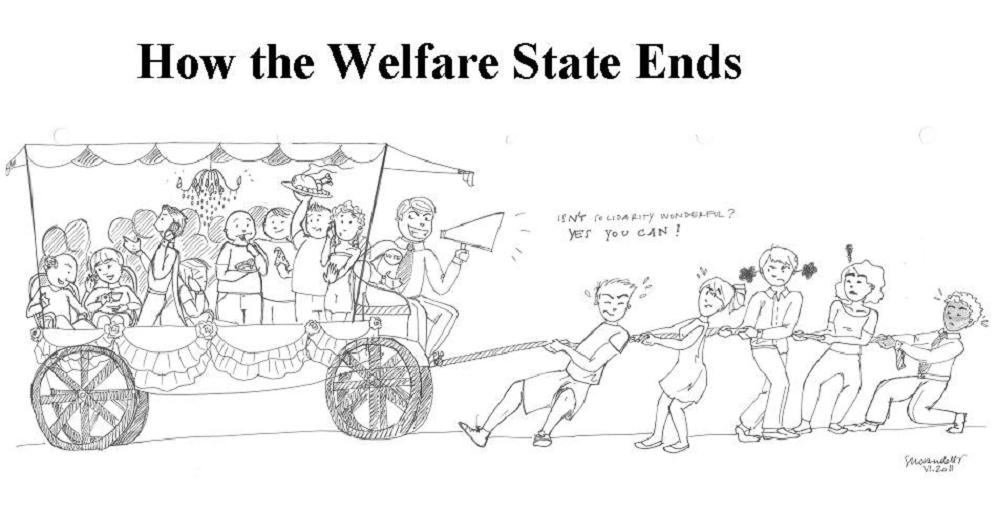
These images are remarkably accurate. The welfare state starts with small programs targeted at a handful of genuinely needy people. But as politicians figure out the electoral benefits of expanding programs and people figure out the that they can let others work on their behalf, the ratio of producers to consumers begins to worsen.
_________
President Obama c/o The White House
1600 Pennsylvania Avenue NW
Washington, DC 20500
When the government gets so big that it distorts the behavior of the private market then it is too big. The federal government is now spending 24.8% of GDP and traditionally for the first 150 years of our nation’s history we spent under 5% unless in wartime. This massive spending now by the federal encourages people to lie in order to get money for the government too instead of trying to work hard to earn money in the private market.
Why is big government bad for an economy? The easy answer is that big government usually means high tax rates, and this penalizes work, saving, investment, and entrepreneurship. And perhaps some of the spending is financed by borrowing, and this diverts money from private investment.
That’s a correct answer, but it’s only part of the story. In most cases, there is added damage because politicians spend money in ways that further undermine incentives to produce.
For instance, let’s assume a government spends $1 billion on some sort of redistribution program. Extracting that money from the productive sector of the economy obviously will cause some damage, but it’s also important to estimate how the supposed beneficiaries of the money will react. What if they decide to earn less income in order to be eligible for the handouts, as even the statists at the OECD have recognized?
In other words, it hurts the economy when government collects money, and it often hurts the economy when government spends money. Sort of a perverse 2-for-1 special (though “Rahn Curve” analysis does show that some types of spending – on core public goods – is correlated with better economic performance)
Let’s look at an example from Greece, showing how handouts distort behavior and corrupt people. Here are some remarkable tidbits from a Wall Street Journal story.
The Greek health ministry is investigating on Zakynthos after local officials flagged records showing what they said is an implausibly high number of disability claims for blindness. About 1.8% of the island’s population of 39,000 claimed the benefit last year, according to the health ministry. That is around nine times the prevalence of blindness estimated for many European countries in a 2004 study published in a World Health Organization journal. Among those who put in for the blindness benefit on Zakynthos, a local official said, were a taxi driver and a bird hunter. …But the island is hardly alone, according to health ministry officials, who say fraudulent disability claims are a problem across the nation… Zakynthos Mayor Stelios Bozikis on a Greek television talk show said residents angry about the benefits crackdown and other financial overhauls pelted him with yogurt at a recent event.
Let’s go back to the story and look at a rough estimate of how much fraud exists.
In an attempt to root out fraud, the Greek health ministry recently required disability claimants nationwide to register in a centralized database, appearing in person or sending a representative. The registration resulted in 36,000 fewer disability claims than in 2011, the health ministry said. The ministry alleges these dropped claims were fraudulent, in many cases reflecting multiple claims for the same disability or payments in the name of dead beneficiaries. It also alleges that some doctors accepted money for false diagnoses and some local politicians signed off on the benefits to win support, and said it is giving public prosecutors information about areas where it suspects a high level of fraud. Only 190 of the nearly 700 people it says had been collecting the blindness benefit on Zakynthos participated in the registration, the ministry said.
I have no idea if Zakynthos is representative, but that’s an incredibly high fraud rate. And this is just a glimpse at the workings of one government program. Now multiply that by some large number and you’ll begin to understand the damage caused by government.
And America is not immune. When politicians make it easier to ride in the wagon than to pull the wagon (as this cartoon illustrates), society sooner or later gets in trouble.
____________
Thank you so much for your time. I know how valuable it is. I also appreciate the fine family that you have and your commitment as a father and a husband.
Sincerely,
Everette Hatcher III, 13900 Cottontail Lane, Alexander, AR 72002, ph 501-920-5733, lowcostsqueegees@yahoo.com
July 10, 2012
Dear Everette:
Thank you for writing. As President, it is my privilege to hear from Americans like you who take time to offer their perspective on the serious issues facing our Nation. I appreciate your message and value your input.
From putting Americans back to work to expanding access to medical care, my Administration continues to take bold action to do what is right for our Nation. We have enacted the most comprehensive financial reforms in decades, rescued and helped retool our auto industry, expanded student aid to millions of young people, helped level the playing field for working women, and made the largest investment in clean energy in our history. Because of the courageous acts of our service members, we have been able to end the war in Iraq and take down Osama bin Laden. We have also made historic commitments to provide for our troops as they return home. Securing our country’s future will take time, but I will not stop working to rebuild the kind of America where everyone gets a fair shot, everyone does their fair share, and everyone plays by the same rules.
I am always eager to hear ideas that will help our country adapt to changing times and lead us toward a brighter day. The enduring American spirit is revealed in the letters I receive, and I remain dedicated to ensuring it is reflected in our efforts to improve the lives of all Americans.
Thank you, again, for sharing your views. I encourage you to explore www.WhiteHouse.gov to learn more about the ways we are moving America forward.
Dan Mitchell on Austerity in Europe 2012 President Obama c/o The White House 1600 Pennsylvania Avenue NW Washington, DC 20500 Dear Mr. President, I know that you receive 20,000 letters a day and that you actually read 10 of them every day. I really do respect you for trying to get a pulse on what […]
I got this off the internet. U.S. Tax revenue: $2,170,000,000,000 Fed budget: $3,820,000,000,000 New debt: $1,650,000,000,000 National debt: $14,271,000,000,000 Recent budget cut: $38,500,000,000 Now, remove 8 zeros and pretend it’s a household budget Annual family income: $21,700 Money the family spent: $38,200 New debt on the credit card: $16,500 Outstanding balance on credit card: $142,710 […]
President Obama c/o The White House 1600 Pennsylvania Avenue NW Washington, DC 20500 Dear Mr. President, I know that you receive 20,000 letters a day and that you actually read 10 of them every day. I really do respect you for trying to get a pulse on what is going on out here. If our […]
The Rahn Curve and the Growth-Maximizing Level of Government Uploaded by afq2007 on Jun 29, 2010 Government spending can promote economic growth if money is used for core “public goods” such as rule of law and property rights. But the burden of government spending in the United States and other industrialized nations is far higher […]
Government Spending Doesn’t Create Jobs Uploaded by catoinstitutevideo on Sep 7, 2011 Share this on Facebook: http://on.fb.me/qnjkn9 Tweet it: http://tiny.cc/o9v9t In the debate of job creation and how best to pursue it as a policy goal, one point is forgotten: Government doesn’t create jobs. Government only diverts resources from one use to another, which doesn’t […]
The Economic Case for Tax Havens Uploaded by afq2007 on Sep 10, 2008 Statist politicians and international bureaucracies such as the OECD and UN routinely attack tax havens, claiming that they lead to “harmful tax competition.” Yet at no point do critics bother to provide any evidence for this claim. This mini-documentary from the Center […]
Sweden produced ABBA in the 1970′s, but now they are producing some pretty good economic policies. One of my favorite groups growing up was ABBA. Here are some of my favorite songs: _______________ President Obama c/o The White House 1600 Pennsylvania Avenue NW Washington, DC 20500 Dear Mr. President, I know that you receive 20,000 letters a […]
President Obama c/o The White House 1600 Pennsylvania Avenue NW Washington, DC 20500 Dear Mr. President, I know that you receive 20,000 letters a day and that you actually read 10 of them every day. I really do respect you for trying to get a pulse on what is going on out here. You want […]
Six years ago, President Bill Clinton signed legislation overhauling part of the nation’s welfare system. The Personal Responsibility and Work Opportunity Reconciliation Act of 1996 (P.L. 104-193) replaced the failed social program known as Aid to Families with Dependent Children (AFDC) with a new program called Temporary Assistance to Needy Families (TANF). The reform legislation had three goals: (1) to reduce welfare dependence and increase employment; (2) to reduce child poverty; and (3) to reduce illegitimacy and strengthen marriage.
At the time of its enactment, liberal groups passionately denounced the welfare reform legislation, predicting that it would result in substantial increases in poverty, Hunger, and other social ills. Contrary to these alarming forecasts, welfare reform has been effective in meeting each of its goals.
Overall poverty, child poverty, and black child poverty have all dropped substantially Although liberals predicted that welfare reform would push an additional 2.6 million persons into poverty, the U.S. Bureau of the Census reports there are 3.5 million fewer people living in poverty today than there were in 1995 (the last year before the reform).
Some 2.9 million fewer children live in poverty today than in 1995
Decreases in poverty have been greatest among black children In fact, the poverty rate for black children is now at the lowest point in U.S. history. There are 1.2 million fewer black children in poverty today than there were in the mid-1990s.
Hunger among children has been cut roughly in half According to the U.S. Department of Agriculture (USDA), there are 420,000 fewer hungry children today than at the time welfare reform was enacted.
welfare caseloads have been cut nearly in half and employment of the most disadvantaged single mothers has increased from 50 percent to 100 percent.
The explosive growth of out-of-wedlock childbearing has come to a virtual halt The share of children living in single-mother families has fallen, and the share living in married-couple families has increased, especially among black families.
Some attribute these positive trends to the strong economy in the late 1990s. Although a strong economy contributed to some of these trends, most of the positive changes greatly exceed similar trends that occurred in prior economic expansions. The difference this time is welfare reform.
welfare reform has substantially reduced welfare’s rewards for non-work, but much more remains to be done. When TANF is reauthorized next year, federal work requirements should be strengthened to ensure that states require all able-bodied parents to engage in a supervised job search, community service work, or skills training as a condition of receiving aid. Even more important, Congress must recognize that the most effective way to reduce child poverty and increase child well-being is to increase the number of stable, productive marriages. In the future, Congress must take active steps to reduce welfare dependence by rebuilding and strengthening marriage.
PREDICTIONS OF SOCIAL DISASTER DUE TO WELFARE REFORM
Six years ago, when the welfare reform legislation was signed into law, Senator Daniel Patrick Moynihan (D-NY) proclaimed the new law to be “the most brutal act of social policy since reconstruction.”1 He predicted, “Those involved will take this disgrace to their graves.”2
Marian Wright Edelman, president of the Children’s Defense Fund, declared the new reform law an “outrage…that will hurt and impoverish millions of American children.” The reform, she said, “will leave a moral blot on [Clinton’s] presidency and on our nation that will never be forgotten.”3
The Children’s Defense Fund predicted that the reform law would increase
child poverty nationwide by 12 percent…make children hungrier…[and] reduce the incomes of one-fifth of all families with children in the nation.4
The Urban Institute issued a widely cited report predicting that the new law would push 2.6 million people, including 1.1 million children, into poverty. In addition, the study announced the new law would cause one-tenth of all American families, including 8 million families with children, to lose income.5
The Center on Budget and Policy Priorities asserted the new law would increase the number of children who are poor and “make many children who are already poor poorer still…. No piece of legislation in U.S. history has increased the severity of poverty so sharply [as the welfare reform will].”6
Patricia Ireland, president of the National Organization for Women, stated that the new welfare law “places 12.8 million people on welfare at risk of sinking further into poverty and homelessness.”7
Peter Edelman, husband of Marian Wright Edelman and then Assistant Secretary for Planning and Evaluation at the Department of Health and Human Services, resigned from the Clinton Administration in protest over the signing of the new welfare law. In an article entitled “The Worst Thing Bill Clinton Has Done,” Edelman dubbed the new law “awful” policy that would do “serious injury to American children.”8
Peter Edelman believed the reform law would not merely throw millions into poverty, but also would actively worsen virtually every existing social problem. “There will be more malnutrition and more crime, increased infant mortality, and increased drug and alcohol abuse,” claimed Edelman. “There will be increased family violence and abuse against children and women.” Moreover, the bill would fail even in the simple task of “effectively” promoting work because “there simply are not enough jobs now.”9
WHAT ACTUALLY HAPPENED
In the six years since the welfare reform law was enacted, social conditions have changed in exactly the opposite direction from that predicted by liberal policy organizations. As noted above, overall poverty, child poverty, black child poverty, poverty of single mothers, and child Hunger have declined substantially. Employment of single mothers increased dramatically, and welfare rolls plummeted. The share of children living in single-mother families fell, and — more important — the share of children living in married-couple families grew, especially among black families.10
Opponents of reform would like to credit many of these positive changes to a “good economy.” However, according to their predictions in 1996 and 1997, liberals expected the welfare reform law to have disastrous results during good economic times. They expected reform to increase poverty substantially even during periods of economic growth; if a recession did occur, they expected that far greater increases in poverty than those mentioned above would follow. Thus, it is disingenuous for opponents to argue in retrospect that the good economy was responsible for the frustration of pessimistic forecasts since the predicted dire outcomes were expected to occur even in a strong economy.
Less Poverty Since the enactment of welfare reform in 1996, the poverty rate has fallen from 13.8 percent in 1995 to 11.7 percent in 2001. Liberals predicted that welfare reform would push an additional 2.6 million people into poverty, but there are actually 3.5 million fewer people living in poverty today than there were when the welfare reform law was enacted.11
Less Child poverty The child poverty rate has fallen from 20.8 percent in 1995 to 16.3 percent in 2001. In 1995, there were 14.6 million children in poverty compared with 11.7 million in 2001. Though liberals predicted that welfare reform would throw more than 1 million additional children into poverty, there are some 2.9 million fewer children living in poverty today than there were when welfare reform was enacted.12
Less Black Child poverty The decline in poverty since welfare reform has been particularly dramatic among black children. As Chart 1 shows, for a quarter-century prior to welfare reform, there was little change in black child poverty. Black child poverty was actually higher in 1995 (41.5 percent) than in 1971 (40.4 percent).
With the enactment of welfare reform in 1996, black child poverty plummeted at an unprecedented rate, falling by more than a quarter to 30.0 percent in 2001. Over a six-year period after welfare reform, 1.2 million black children were lifted out of poverty. In 2001, despite the recession, the poverty rate for black children was at the lowest point in national history.13
Less Poverty Among Children of Single Mothers Since the enactment of welfare reform, the drop in child poverty among children in single-mother families has been equally dramatic. For a quarter-century before welfare reform, there was little net decline in poverty in this group. poverty was only slightly lower in 1995 (50.3 percent) than it had been in 1971 (53.1 percent). After the enactment of welfare reform, the poverty rate for children of single mothers fell at a dramatic rate, from 50.3 percent in 1995 to 39.8 percent in 2001. In 2001, despite the recession, the poverty rate for children in single-mother families was at the lowest point in U.S. history.14
Dramatic Reduction in Child Hunger The number of children who are “hungry” has been cut roughly in half since the enactment of welfare reform, according to the U.S. Department of Agriculture. The USDA reports that in 1995, the year before welfare reform was enacted, 887,000 children were hungry; by 2001, the number had fallen to 467,000.15 In percentage terms, the numbers fell from 1.3 percent of children in 1995 to 0.6 percent in 2001. Overall, there are more than 400,000 fewer hungry children today than at the time welfare reform was enacted. (See Chart 2.)
Decrease in “Severe poverty” Liberals predicted that welfare reform would increase “the severity of poverty.” However, the number of children living in “deep poverty” has declined appreciably. (Families in “deep poverty” have incomes that are less than half the poverty income level.) In 1995, there were 5.9 million children living in deep poverty; by 2001, the number had fallen to 5.1 million.16


 Amy Smotherman Burgess, ©KNS/2011
 Amy Smotherman Burgess, ©KNS/2011




 The Daily Hatch
