Monthly Archives: November 2012

Dear Senator Pryor, why not pass the Balanced Budget Amendment? (“Thirsty Thursday”, Open letter to Senator Pryor, quotes Milton Friedman)

Broun Introduces Balanced Budget Amendment

Uploaded by on Feb 23, 2010

No description available.

_______________

Dear Senator Pryor,

Why not pass the Balanced  Budget Amendment? As you know that federal deficit is at all time high (1.6 trillion deficit with revenues of 2.2 trillion and spending at 3.8 trillion).

On my blog www.HaltingArkansasLiberalswithTruth.com I took you at your word and sent you over 100 emails with specific spending cut ideas. However, I did not see any of them in the recent debt deal that Congress adopted. Now I am trying another approach. Every week from now on I will send you an email explaining different reasons why we need the Balanced Budget Amendment. It will appear on my blog on “Thirsty Thursday” because the government is always thirsty for more money to spend.

When I think about the life work of Milton Friedman two issues keep coming up. Private vouchers for schools and lowering federal government spending. Those two issues were very close to his heart. I am hoping in the future our leaders will see that after increasing spending every year for the last 40 years and at the same time our test results have dropped that we must gave private vouchers a chance.

Also as our national debt keep rising we must adopt the Balanced Budget Amendment which was also close to Friedman’s heart.

The US Needs Milton Friedman More Than Ever


In compiling a list of the greatest economists of all time, Milton Friedman’s name will surely be one of the first to come to mind.  There is of course his technical work, such as his famous Monetary History of the United States (co-authored with Anna Schwartz), that established him as the chief architect of the theory of monetarism. More important was his ability to explain in clear layman’s terms the basic principles of our economic system, how it creates wealth for all members of society, and the importance to a successful society of individual liberty.  If one were to pick two books that our country’s leaders should read, they would be his Capitalism and Freedom and Free to Choose.  They are a treasure trove of solutions to the social problems of today.

Freidman wrote the first of these in 1962.  In a period where we were about to launch The Great Society, as is the case today, people were looking to the federal government to improve their lives. Friedman offered an alternative based upon market forces and individual liberty. His cogent examination of the effect of incentives on people’s behavior led him to offer solutions to societal problems that were both insightful and effective.  He offered ideas such as allowing individuals to invest in the education of others, so poor children would be able to obtain funding for high school and college in return for the investor receiving a fraction of their future earnings.  This innovative idea would be much more successful than Pell Grants in encouraging and enabling students to finish high school and graduate from college.  

Today we are more than ever in need of a resurgence and rediscovery of Milton Friedman’s ideas. Examples of this need abound.  The stimulus package was supposed to keep the unemployment rate below 8 percent. Instead we have unemployment between 9.5 and 10 percent and $800 billion added to the federal debt.  The Obama administration is now pushing for a second stimulus package. Thirty years ago Friedman explained that fiscal policy is not an effective method of reducing unemployment.  Had we followed Friedman’s advice, we would be less burdened in debt and further along in economic recovery. 

His argument for vouchers as a mechanism of moving public education from a socialist system to a market system has found traction in the last decade.  Nonetheless, voucher proposals are very difficult to pass due to the power of the teachers unions.  As a consequence of not following Friedman’s advice thousands of children in our urban schools have lost their chance for a good education.   

Due to a massive 2000 page health care bill, the federal government is now managing the entire health care and health insurance industry.  Freidman explained in a cogent article in The Public Interest, that health care costs are so high and customer satisfaction with the system is so low because government intervention has pushed us into an employer and government-based third party payment system.  In typical Friedman fashion he forces us to observe that advances in technology in every area other than health care have led to reduced costs and increased satisfaction with the product or service and to ask why this is so.  He asks why we single out medical care for tax-free status.  Food is more important than medical care and yet we do not exempt the cost of food if provided by the employer. He must be surely rolling over in his grave the new health care legislation will compound the problem of third-party payment.

The President recently signed a 2300 page bill granting the federal government control over the entire financial industry.  Professor Friedman wrote famously of how the Federal Reserve was not capable of determining how to manipulate the credit markets effectively due to its inability to know the information necessary to conduct effective monetary policy, and thus argued that the Federal Reserve should be constrained by rules. He certainly would have argued strenuously against giving the Federal Reserve and Securities and Exchange Commission the enormous powers that they received under the financial regulation legislation.

In Free to Choose, Friedman and his wife, Rose, argued for a constitutional amendment requiring a balanced budget.  As we see deficits of nearly $1.5 trillion staring us in the face for at least the next few years, this suggestion too has gained new relevance.

Concluding Free to Choose, he wrote:

“The two ideas of human freedom and economic freedom working together cane to their greatest fruition in the United States.  Those ideas are still very much with us. But we have been straying from them.  We have been forgetting the basic truth that the greatest threat to human freedom is the concentration of power, whether in the hands of government or anyone else.  We have persuaded ourselves that it is safe to grant power, provided it is for good purposes.”

Some thirty years later those words again ring true.  Our hope should be that his final statement also is true:

“Fortunately, we are waking up….Fortunately, also, we are as a people still free to choose which way we should go—whether to continue along the road we have been following to ever bigger government, or to call a halt and change direction.”

This post originally appeared at The Business and Media Insitute’s Balance Sheet of July 28, 2010

__________

Thank you again for your time and for this opportunity to share my ideas with you.

Sincerely,

Everette Hatcher
Is Michael Cannon of the Cato Institute right about states blocking Obamacare, factchecker says he is wrong.

Cato’s Michael F. Cannon Discusses ObamaCare’s Individual Mandate

Is Michael Cannon of the Cato Institute right about states blocking Obamacare, factchecker says he is wrong.

I Have Been False*

Posted by Michael F. Cannon

*According to PolitiFact.

In an unconscious parody of everything that’s wrong with the “fact-checker” movement in journalism, PolitiFact Georgia (a project of the Atlanta Journal-Constitution) has rated false my claim that operating an ObamaCare Exchange would violate Georgia law. (For some of the “fact-checker” genre’s greatest worst hits, see Ben Domenech’s top 10 list.)

PolitiFact’s analysis is one-sided. It confuses opinions with facts. It was written with “no particular policy domain knowledge.” It therefore not only reaches the wrong result — it analyzes a claim I did not make and never would make.

PolitiFact began by saying that it was fact-checking the following claim, which I made in a November 9 opinion piece at National Review Online:

[O]perating an Obamacare exchange would be illegal in 14 states. Alabama, Arizona, Georgia, Idaho, Indiana, Kansas, Louisiana, Missouri, Montana, Ohio, Oklahoma, Tennessee, Utah, and Virginia have enacted either statutes or constitutional amendments (or both) forbidding state employees to participate in an essential exchange function: implementing Obamacare’s individual and employer mandates.

Lest anyone think I meant it would be illegal for the federal government to operate Exchanges in those states, the context and the text (“forbidding state employees”) of that opinion piece make it clear I was discussing whether states should establish Exchanges. Unfortunately, the context was lost on PolitiFact readers, because PolitiFact provided neither a citation nor a link to the opinion piece it was fact-checking.

In Georgia’s case, the relevant statute is that state’s version of the “Health Care Freedom Act” (GA. CODE ANN. § 31-1-11), enacted in 2010. It reads:

To preserve the freedom of citizens of this state to provide for their health care: No law or rule or regulation shall compel, directly or indirectly, any person, employer, or health care provider to participate in any health care system.

The statute defines “compel” as including “‘penalties or fines.”

PolitiFact notes that I cited that provision to “an Atlanta Journal-Constitution health reporter [Carrie Teegardin] via email.” Thus PolitiFact presumably had access to the rest of my November 9 email to Teegardin, in which I explained why that provision precludes Georgia from establishing an ObamaCare Exchange:

Determining eligibility for and distributing ObamaCare’s “premium assistance tax credits” is a key function of an Exchange. Those tax credits trigger penalties against employers (under the employer mandate) and residents (under the individual mandate).

Indeed, there are many ways Exchanges assist the federal government in the enforcement of those mandates. State-run Exchanges must report to the IRS on which residents have dropped their coverage and when (Section 1311(d)(4)(I)). State-run Exchanges must notify employers when one of their employees receives a tax credit  (Section 1411(e)(4)(B)(iii)). That very notification triggers penalties against the employer (Section 1513/I.R.C. Section 4980H(a)). State-run Exchanges must collect all the information the federal government needs to determine eligibility for tax credits and deliver it to the federal government (Section 1401/I.R.C. Section 36B(f)(3)) – a crucial component of enforcing both the individual and employer mandates. The  Secretary can require state-run Exchanges to verify that information for the federal government (Section 1411(d)), and state-run Exchanges must resolve any inconsistencies between the information provided by applicants and official records (Section 1411(e)). If a state-run Exchange can’t resolve an inconsistency between the application and the official records within a certain time period, it has to notify residents that they will be penalized under the individual mandate (Section 1411(e)(4)(B)(iv)). State-run Exchanges must maintain an appeals process for individuals and employers who believe they were wrongly assessed penalties (Section 1411(f)).

My email to Teegardin continued:

Ergo, if Georgia establishes an Exchange, then a Georgia law and state employees would be indirectly compelling employers and residents to participate in a health care system.

In other words, the activities required of an ObamaCare Exchange are exactly the sorts of things that the Health Care Freedom Acts in Georgia and 13 other states exist to prohibit those states’ employees from doing. In a November 15 opinion piece Atlanta Journal-Constitution, no less, I reiterated that same point: legislatures and voters in those 14 states have enacted state laws that make it illegal (and in some cases unconstitutional) for state employees to operate an ObamaCare Exchange.

Rather than evaluate that claim, PolitiFact asked a handful of Georgia scholars about something completely different: whether Georgia’s Health Care Freedom Act prevents the federal government from creating an Exchange for Georgia, or otherwise trumps federal law. It’s difficult to see how anyone who had read my two opinion pieces, much less my email to Teegardin, could think I was saying anything of the sort. Of course such a claim would be false; that’s why I never made it. (ObamaCare does itself give each state the power to stop the federal government from running an Exchange within its borders. But that’s a topic for another day.)

Then again, I could have set them straight. PolitiFact contacted me for help with this “fact-check.” I politely refused, citing my ongoing boycott of their organization. One might say my refusal to assist with this “fact-check” means I have no right to complain.

Another way of looking at it is that this episode validates my boycott. Consider how they responded to my refusal to help: Cannon won’t speak to us because he says we’re not reputable. Should we try to find someone else who might argue his side? Nah. PolitiFact could have proven me wrong by conducting a thorough analysis. Off the top of my head, I can think of seven other experts they might have consulted. A simple online search would have produced two attorneys who have threatened to sue the State of Arizona under the Health Care Freedom Amendment to its Constitution if state officials establish an Exchange. Instead, PolitiFact considered a discussion of my email auto-signature – “Tyrannis delenda est” — more worthy of inclusion in their “fact-check” than another expert who would take up my side.

My boycott of PolitiFact hasn’t succeeded in bringing about the desired behavior change. But if they keep this up, I don’t see how I can fail.

Related posts:

Can states stop Obamacare from becoming law in their states?

Sen. Max Baucus admits the PPACA conditions tax credits on state compliance Published on Sep 21, 2012 by Michael F. Cannon I really don’t know the answer to this question and would love it if someone would enlighten me. This article below from the Cato Institute makes the case that States can stop Obamacare from […]

Obamacare going to happen?

What is going to happen with Obamacare? November 18, 2012, 5:53 p.m. ET Capretta and Levin: Why ObamaCare Is Still No Sure Thing The majority of state governors are Republicans, and they have the power to disarm the health-care law. By JAMES C. CAPRETTA AND YUVAL LEVIN Champions of ObamaCare want Americans to believe that […]

Open letter to President Obama (Part 168.2)

  President Obama c/o The White House 1600 Pennsylvania Avenue NW Washington, DC 20500 Dear Mr. President, I know that you receive 20,000 letters a day and that you actually read 10 of them every day. I really do respect you for trying to get a pulse on what is going on out here. Obamacare […]

Obamacare going down no matter who wins?

It seems that Obamacare is going to go down according to this article below: GOP Vows to Keep Fighting IRS’s Illegal ObamaCare Taxes if Obama Wins Posted by Michael F. Cannon Roll Call reports that if President Obama wins re-election, House and Senate Republicans will hold votes on rescinding his illegal IRS rule that unlawfully […]


Francis Schaeffer’s prayer for us in USA


In the film series “WHATEVER HAPPENED TO THE HUMAN RACE?” the arguments are presented  against abortion (Episode 1),  infanticide (Episode 2),   euthanasia (Episode 3), and then there is a discussion of the Christian versus Humanist worldview concerning the issue of “the basis for human dignity” in Episode 4 and then in the last episode a close look at the truth claims of the Bible.

Francis Schaeffer: How Should We Then Live? (Full-Length Documentary)

Francis Schaeffer Whatever Happened to the Human Race (Episode 1) ABORTION

Francis Schaeffer: What Ever Happened to the Human Race? (Full-Length Documentary)

Part 1 on abortion runs from 00:00 to 39:50, Part 2 on Infanticide runs from 39:50 to 1:21:30, Part 3 on Youth Euthanasia runs from 1:21:30 to 1:45:40, Part 4 on the basis of human dignity runs from 1:45:40 to 2:24:45 and Part 5 on the basis of truth runs from 2:24:45 to 3:00:04


Dr. Francis schaeffer – The flow of Materialism(from Part 4 of Whatever happened to human race?)

Dr. Francis Schaeffer – The Biblical flow of Truth & History (intro)

Francis Schaeffer – The Biblical Flow of History & Truth (1)

Dr. Francis Schaeffer – The Biblical Flow of Truth & History (part 2)

The 45 minute video above is from the film series created from Francis Schaeffer’s book “Whatever Happened to the Human Race?” with Dr. C. Everett Koop. This book  really helped develop my political views concerning abortion, infanticide, and youth euthanasia, and it gave me a good understanding of those issues.
I was able to watch Francis Schaeffer deliver a speech on a book he wrote called “A Christian Manifesto” and I heard him in several interviews on it in 1981 and 1982. I listened with great interest since I also read that book over and over again. Below is a portion of one of Schaeffer’s talks  on a crucial subject that is very important today too.
A Christian Manifesto
by Dr. Francis A. Schaeffer
This address was delivered by the late Dr. Schaeffer in 1982 at the Coral Ridge Presbyterian Church, Fort Lauderdale, Florida. It is based on one of his books, which bears the same title.

——-

Schaeffer’s prayer for Christians in this post Christian era:
—–

May we pray together?

Our heavenly Father, we come together, and we have no illusions that these things are serious, but have no illusions, either, that they were serious to the early Church when they watched their loved ones dragged off and thrown to their death when all they had to do was say that they worshipped Caesar.
We have no illusions that it was easy for Peter to stand and say that he would obey God rather than the Sanhedrin. We have no illusion that for our Reformation forefathers who won the liberties that we have, not only in the church but in state, that it was easy for them in those hard and difficult days.
And, our heavenly Father, we would ask tonight that you will forgive the Christians of the United States. May we be repentant for the silence of the last forty years, when we have denied what we say we believe by our silence.
We ask Thee, that you will stir the Church of the Lord Jesus, across this country, across northern Europe, across other places. Give us that which, our heavenly Father, Wesley really understood, and Finney, the evangelist that most people know in this country and Whitefield and many of the others. A call for the individual to accept Christ as Savior and come under the shed blood of Christ and pass from death to life. A call for those of us who are Christians, oh God, to bow our hearts more completely and not let other things get in the way — to let the Holy Spirit have His place under the teaching of Scripture and within the circle of the teaching of Scripture, and then, Heavenly Father, to realize that everything belongs to the Lord Jesus. That He died not only to take our souls to heaven — but that our bodies will be raised one day from the dead.
The one day, as Peter said, just right after His ascension, “He’s going to heaven until He comes back to restore all things.” That His death there on Calvary’s cross is for us individually, but it’s not egotistically individualistic. Our individual salvation will one day be a portion of the restoration of all things. It is our calling until He comes back again that happy day, to do all we can — while it won’t be perfect as when He comes back — to see substantial healing in every area that He will then perfectly heal, and that Wesley did understand. Finney understood. Men like Blanchard, who founded Wheaton College, understood that if there is a true preaching of the Gospel, it carries with it then an action out into the social life around us into the world. That the Church is to preach the Gospel, but it is also to live the Good News — that there are answers to these horrendous questions, and that we might see a turning back from the absolute tragedy and tyranny which we face in our Western culture and in this country tonight. Help us! Forgive us! Use us!
And Father, as we just think of the number of people sitting here from so many backgrounds and different churches and different levels of life: If only these things were carried out into something in the power of the Holy Spirit… into the totality of life, as salt and light… that we might make a change and save this country from utter tragedy. Help Thou us, so we ask, and we ask it in no lesser name than the Lord Jesus Christ, our Lamb and our God. Amen.
___________
Related posts:

Francis Schaeffer: “Whatever Happened to the Human Race” (Episode 1) ABORTION OF THE HUMAN RACE

It is not possible to know where the pro-life evangelicals are coming from unless you look at the work of the person who inspired them the most. That person was Francis Schaeffer.  I do care about economic issues but the pro-life issue is the most important to me. Several years ago Adrian Rogers (past president of […]

Francis Schaeffer affected pro-life movement (Part 12) “Schaeffer Sunday”

If you want to understand why the evangelical pro-life movement then you need to read the material from Francis Schaeffer. Here is some good material about both Schaeffer and his good friend Dr. C. Everett Koop. Francis Schaeffer and C. Everett Koop’s Invaluable Impact on Pro-Life Evangelicalism By Dr. Richard Land It is difficult to […]

Francis Schaeffer affected pro-life movement (Part 11) “Schaeffer Sunday”

Many evangelicals today are pro-life because of Francis Schaeffer. Francis Schaeffer On Tax Funded Abortion On July 28, 2010 · Leave a Comment First published in 1981, Francis Schaeffer’s A Christian Manifestois increasingly relevant today in 2010. The book, penned as a Christian response to the Communist and Humanist Manifestos, describes how the United States […]

Francis Schaeffer: “Whatever Happened to the Human Race” (Episode 5) TRUTH AND HISTORY

Francis Schaeffer: “Whatever Happened to the Human Race” (Episode 5) TRUTH AND HISTORY Published on Oct 7, 2012 by AdamMetropolis This crucial series is narrated by the late Dr. Francis Schaeffer and former Surgeon General Dr. C. Everett Koop. Today, choices are being made that undermine human rights at their most basic level. Practices once […]

Francis Schaeffer: “Whatever Happened to the Human Race” (Episode 4) THE BASIS FOR HUMAN DIGNITY

The opening song at the beginning of this episode is very insightful. Francis Schaeffer: “Whatever Happened to the Human Race” (Episode 4) THE BASIS FOR HUMAN DIGNITY Published on Oct 7, 2012 by AdamMetropolis This crucial series is narrated by the late Dr. Francis Schaeffer and former Surgeon General Dr. C. Everett Koop. Today, choices […]

Francis Schaeffer: “Whatever Happened to the Human Race” (Episode 3) DEATH BY SOMEONE’S CHOICE

Francis Schaeffer: “Whatever Happened to the Human Race” (Episode 3) DEATH BY SOMEONE’S CHOICE Published on Oct 6, 2012 by AdamMetropolis This crucial series is narrated by the late Dr. Francis Schaeffer and former Surgeon General Dr. C. Everett Koop. Today, choices are being made that undermine human rights at their most basic level. Practices […]

Francis Schaeffer: “Whatever Happened to the Human Race?” (Episode 2) SLAUGHTER OF THE INNOCENTS

Francis Schaeffer: “Whatever Happened to the Human Race?” (Episode 2) SLAUGHTER OF THE INNOCENTS Published on Oct 6, 2012 by AdamMetropolis This crucial series is narrated by the late Dr. Francis Schaeffer and former Surgeon General Dr. C. Everett Koop. Today, choices are being made that undermine human rights at their most basic level. Practices […]

Francis Schaeffer affected pro-life movement (Part 10) “Schaeffer Sunday”

A Ronald Reagan radio address from 1975 addresses the topics of abortion and adoption. This comes from a collection of audio commentaries titled “Reagan in His Own Voice.” Francis Schaeffer said in the book CHRISTIAN MANIFESTO: Certainly every Christian ought to be praying and working to nullify the abominable abortion law. But as we work […]

The following essay explores the role that Francis Schaeffer played in the rise of the pro-life movement. It examines the place of How Should We Then Live?, Whatever Happened to the Human Race?, and A Christian Manifesto in that process.

This essay below is worth the read. Schaeffer, Francis – “Francis Schaeffer and the Pro-Life Movement” [How Should We Then Live?, Whatever Happened to the Human Race?, A Christian Manifesto] Editor note: <p> </p> [The following essay explores the role that Francis Schaeffer played in the rise of the pro-life movement.  It examines the place of […]

Who was Francis Schaeffer? by Udo Middelmann

Great article on Schaeffer. Who was Dr. Francis A. Schaeffer? By Francis Schaeffer The unique contribution of Dr. Francis Schaeffer on a whole generation was the ability to communicate the truth of historic Biblical Christianity in a way that combined intellectual integrity with practical, loving care. This grew out of his extensive understanding of the Bible […]

Is President Obama going to bankrupt our country by going from 10 trillion to 22 trillion in debt? (Part 15)

Dan Mitchell explains in the above video that Europe can grow and prosper, but only if politicians are willing to reduce the burden of government spending and lower tax rates.

_____________

These posts are all dealing with issues that President Obama did not help on in his first term. I am hopeful that he will continue to respond to my letters that I have written him and that he will especially reconsider his view on the following import issue which deals with holding down federal spending!!! Is President Obama going to bankrupt our country by going from 10 trillion to 22 trillion in debt?

I have a lot of respect for Tea Party heroes like Tim Huelskamp and Justin Amash who are willing to propose deep spending cuts so we can eventually balance our budget.  

It is a fact that we must balance the budget soon. I do not believe that we can wait to balance the budget at some distant time in the future. The financial markets will not allow us a long time to get our house in order. Look at how things have been going the last four years and no matter how anyone tries to spin it, we are going down the financial drain fast.

That is why I am so thrilled that you are no longer president because you were not willing to make the deep cuts to balance our budget.

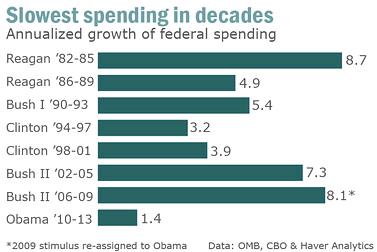
A financial columnist named Rex Nutting recently triggered a firestorm of controversy by claiming that Barack Obama is not a big spender.

Here’s the chart he prepared, which certainly seems to indicate that Obama is a fiscal conservative. Not only that, it shows that Republicans generally are the big spenders, while Democrats are frugal with other people’s money.

In some ways, these numbers don’t surprise me. I’ve explained before that Bush bears a lot of blame for the big expansion in the burden of government this century, and I’ve specifically pointed out that he deserves the blame for most of the higher spending from the 2009 fiscal year (which began October 1, 2008).

That being said, Nutting’s numbers seemed a bit nutty. Sorry, couldn’t resist. Nutting’s numbers actually seem accurate, including the fact that he decided that Obama should be responsible for $140 billion of the spending in Bush’s last fiscal year (a number he may have taken from one of my posts).

But sometimes accurate can be misleading, so I decided to dig into the data.

I went to the Historical Tables of the Budget from the Office of Management and Budget, and I calculated all the numbers for every President since LBJ (with the exception of Gerald Ford, whose 2-year reign didn’t seem worth including).

But I corrected a big mistake in Nutting’s analysis. I adjusted the numbers for inflation, using OMB’s GDP deflator.

As you can see, this changes the results. My chart isn’t as pretty, but based on the inflation-adjusted average annual growth of outlays, it shows that Clinton was the most frugal president, followed by the first President Bush and Obama.

With his guns-n-butter Keynesianism, it’s no big surprise that LBJ ranks last. And “W” also gets a very low grade.

But then I figured we should take interest payments out of the budget and focus on inflation-adjusted “primary spending.” After all, Presidents shouldn’t be held responsible for the national debt that existed before they took office.

Looking at these numbers, it turns out that Obama does win the prize for being the most fiscally conservative president in recent memory. Reagan jumps to second place. Clinton is in third place, which won’t surprise people who watched this video, while W and LBJ again are in last place.

But I don’t want my Republican friends to get too angry with me, so let’s expand our analysis. Just as we don’t want to blame Presidents for net interest payments on debt that was accrued before their tenure, perhaps we should make sure they don’t get credit or blame for defense outlays that often are dictated by external events.

There’s obviously room for disagreement, but most people will agree that the Cold War and 9/11 meant higher defense spending, regardless of which party controlled the White House. Similarly, the collapse of the Soviet Empire inevitably meant lower military expenditures, regardless of whether Republicans or Democrats were in charge.

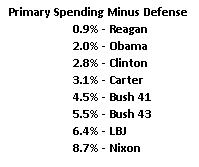
So let’s now look at primary spending after subtracting defense outlays (still adjusting for inflation, of course). All of a sudden, Reagan jumps to the top of the list by a comfortable margin. LBJ and W continue to score poorly, but Nixon takes over last place.

But it’s also worth noting that Obama still scores relatively well, beating Clinton for second place. Inflation-adjusted domestic spending (which is mostly what we’re measuring) has grown by 2.0 percent annually during his three years in office.

So does that mean Obama deserves re-election? Well, before you answer, I want to make one final calculation. Just as there are good reasons to exclude interest payments because they’re not something a president can control, we also should take a look at what spending would be if we don’t count the cost of bailouts.

To be sure, these types of expenditures can be controlled, but if we go with the assumption that the federal government was going to re-capitalize the banking system (whether using the good FDIC-resolution approach or the corrupt TARP approach), then it seems that Presidents shouldn’t get arbitrary blame or credit simply because some financial institutions failed during their tenure.

So let’s take the preceding set of numbers and subtract out the long-run numbers for deposit insurance, as well as the TARP outlays since 2009. And keep in mind that repayments of TARP monies (as well as deposit insurance premiums) show up in the budget as “negative spending.”

As you can see, this produces a remarkable result. All of a sudden, Obama drops from second to second-to-last.

This is because there was a lot of TARP spending in Bush’s last fiscal year (FY2009), which created an artificially high benchmark. And then repayments by banks during Obama’s fiscal years counted as negative spending.

When you subtract out the big TARP spending surge, as well as the repayments, then Bush 43 doesn’t look quite as bad (though still worse than Carter and Clinton), while Obama takes a big fall.

In other words, Obama’s track record does show that he favors an expanding social welfare state. Outlays on those programs have jumped by 7.0 percent annually. And that’s after adjusting for inflation! Not as bad as Nixon, but that’s not saying much since he was one of America’s most statist presidents.

Allow me to conclude with some caveats. None of the tables perfectly captures what any president’s fiscal record. Even my first table may be wrong if you want to blame or credit presidents for the inflation that occurs on their watch. And there certainly are strong arguments that bailout spending and defense spending are affected by presidential policies rather than external events.

And keep in mind that presidents don’t have full power over fiscal policy. The folks on Capitol Hill are the ones who actually enact the bills and appropriate the money.

Moreover, the federal government is akin to a big rusty cargo ship that is traveling in a certain direction, and presidents are like tugboats trying to nudge the boat one way or the other.

But enough equivocating. The four different tables at least show more clearly which presidents presided over faster-growing government or slower-growing government. More importantly, the various tables provide a good idea of where most of the new spending was taking place.

We can presumably say Reagan and Clinton were comparatively frugal, and we can also say that Nixon, LBJ, and Bush 43 were relatively profligate. As for Obama, I think his tugboat is pushing in the wrong direction, but it’s only apparent when you strip out the distorting budgetary impact of TARP.

Related posts:

Some Tea Party heroes (Part 1)

DEBT LIMIT – A GUIDE TO AMERICAN FEDERAL DEBT MADE EASY. Uploaded by debtlimitusa on Nov 4, 2011 A satirical short film taking a look at the national debt and how it applies to just one family. Watch the guy from the Ferris Bueller Superbowl Spot! Produced by Seth William Meier, DP/Edited by Craig Evans, […]

Some Tea Party heroes (Part 2)

Congressmen Tim Huelskamp on the debt ceiling I just don’t understand why people think we can go on and act like everything is okay when we have a trillion dollar deficit. Sometimes you run across some very wise words like I did the other day. Kansas Congressman Tim Huelskamp made the following comment on the […]


Open letter to President Obama (Part 180)


President Obama c/o The White House
1600 Pennsylvania Avenue NW
Washington, DC 20500

Dear Mr. President,

I know that you receive 20,000 letters a day and that you actually read 10 of them every day.I really do respect you for trying to get a pulse on what is going on out here.

When think of how simple the ten commandments are it is impossible to see how anyone can argue against them.

I read back on Dec 8, 2011 that Tony Perkins, president of Family Research Council, a social conservative advocacy organization, said in 2011 that President Obama has been “hostile” and “disdainful” toward Christianity. Rick Perry actually said President Obama had a war on religion. One of the most basic things that our founding fathers did is base our laws on the ten commandments. At the Supreme Court there is one depiction showing Moses sitting, holding two blank stone tablets. There is one depiction showing Moses standing holding one stone tablet. There are two stone tablets depicted with Roman Numbers I-X carved in the oak doors.

David Barton has studied the history of the founding of our country for many years and I wanted to share a portion of adocument he wrote concerning the 10 Commandments:


David Barton – 01/03/2001
(View the footnoted version on Liberty Council’s website)UNITED STATES DISTRICT COURT

EASTERN DISTRICT OF KENTUCKY

LONDON DIVISION

SARAH DOE and THOMAS DOE, on behalf

of themselves and their minor child, JAN DOE

Plaintiffs,

v Civil Action No. 99-508

HARLAN COUNTY SCHOOL DISTRICT;

DON MUSSELMAN, in his official capacity

as Superintendent of the Harlan Country

School District,

Defendents.

______________________________________________

AFFIDAVIT OF DAVID BARTON IN SUPPORT OF DEFENDANTS’ OPPOSITION TO PLAINTIFFS’ MOTION FOR CONTEMPT, OR, IN THE ALTERNATIVE, FOR SUPPLEMENTAL PRELIMINARY INJUNCTION

STATE OF TEXAS

COUNTY OF PARKER


WHICH ARE THE TEN COMMANDMENTS ?

18. In order to avoid the alleged misunderstanding that critics claim accompanies the reading of the Decalogue, for the purposes of this affidavit, these Commandments as listed in the Bible in Exodus 20:3-17 and Deuteronomy 5:7-21 (and in a shortened version in Exodus 34:14-28) will be summarized as

1. Have no other gods.

2. Have no idols.

3. Honor God’s name.

4. Honor the Sabbath day.

5. Honor your parents.

6. Do not murder.

7. Do not commit adultery.

8. Do not steal.

9. Do not perjure yourself.

10. Do not covet.


19. The following sections will fully demonstrate that each of these commandments was individually encoded in the civil laws, and consequently became a part of the common law of the various colonies.


______________

Thank you so much for your time. I know how valuable it is. I also appreciate the fine family that you have and your commitment as a father and a husband.

Sincerely,

Everette Hatcher III, 13900 Cottontail Lane, Alexander, AR 72002, ph 501-920-5733, lowcostsqueegees@yahoo.com

Remembering Francis Schaeffer at 100 (Part 3)

schaeffer

Truth With Tears – A Story of Dr. Schaeffer Shedding Tears At the Lausanne Congress, 1974

Uploaded by on Dec 10, 2011

This video is a segment of an interview we did with Dr. David Calhoun of Covenant Theological Seminary where he described a touching moment with Dr. Schaeffer when he sheds tears at the Lausanne Congress, 1974. The significance of this event is that it depicts both the character of Dr. Schaeffer over schisms in the church but also the deep hurt that he felt over divisions in the church during the early splits with in the church over modernism (Religious Liberalism). The results of these deep feelings would eventually produce a crisis in Schaeffer, and out of that crisis came the work True Spirituality, which is at the foundation of all of Schaeffer’s works. He further elaborated on this topic in a more succinct way in his work The Mark Of A Christian.

__________________________

This year Francis Schaeffer would have turned 100 on Jan 30, 2012. I remember like yesterday when I first was introduced to his books. I was even more amazed when I first saw his films. I was so influenced by them that I bought every one of his 30 something books and his two film series. Here is a tribute that I got off the internet from Chuck Colson’s website www.breakpoint.org :

Everyday Art
By Chuck Colson|Published Date: January 30, 2012

office_space_1

Living the Full Image of God

Francis Schaeffer emphasize the beauty of God – a message Tom Pratt, former PF president, understood very well, as Chuck recalls in the BreakPoint archive remembering Francis Schaeffer.

When you walk into the office of Tom Pratt, the president of Prison Fellowship, immediately you sense that this is no ordinary office. There’s no imposing, executive-style desk. Instead the room is centered on a round table, small enough for easy conversation. On one side is a reading stand with a high perch; on the other, a reclining chaise.

If you ask Tom about the unusual design, you discover that everything is carefully thought out. The round table sends a message that there is no hierarchy in the world of ideas. The perch and the chaise give opportunities for altering one’s physical position, which refreshes the mind and stimulates creativity.

It’s rare to find an executive who has such a sensitive eye for artistic design. And office decor really is a form of art. Art is any expression of form and beauty that elevates and inspires.

Some people say they’re not interested in art. What they mean is they don’t like to visit art museums and gaze at paintings. But the same people may sew their own clothes, cook gourmet meals, or renovate their homes.

Our lives are permeated with art.

When you think back through history, most cultures never had museums. For the ancient Hebrews or the South American Indians, art was embedded in the staples of ordinary life-in the pottery they made, the blankets they wove, the beads they strung.

This is really a more Biblical view of art, says Gene Veith in State of the Arts. A sense of beauty ought to be expressed in everything we do.

After all, the first artist was God Himself. It was God who created the silvery beauty of the moon, the delicate netting of a grasshopper wing, the golden brown of a friend’s eyes.

When God made the world, He cared enough to make it beautiful. And if God cared, so should we. We are made in His image, and a sense of beauty is part of our nature.

It’s also part of the message we preach-whether we mean to or not. In Pollution and the Death of Man, Francis Schaeffer says he was once invited to lecture at a Christian school. The building was ugly and stark, staked out on bare ground. In sharp contrast a nearby bohemian community was surrounded by a rich profusion of trees and vines. What message were these Christians conveying about the God they worshipped?

There are times, Schaeffer concludes, when planting a tree can be a form of evangelism.

You see, our lives are meant to be a visible representation of the invisible God. If our schools or offices are dull and ugly-if they are filled with impersonal, mass-produced products-what an impoverished image of God we project.

When Christians hear words like duty, we think of going to church, reading the Bible, giving money to Christian ministries. But a biblical concept of duty is much broader: We are called to do nothing less than live out the full image of God-so that the world might come to know the God who made the roses and the sunsets.

A God of beauty.Next steps

What opportunities do you have today to bring the God of beauty into your everyday experience? See if you can strike up a conversation with someone today about beauty – What is it? Why do we have this idea of beauty? How can we contribute to the beauty of the world? Look for an opportunity to inject Psalm 27:4 into the conversation: the God of beauty!

Francis Schaeffer was one of the great defenders of the faith of the previous generation. You can order this Trilogy of his most seminal works and discover the power of a reasonable faith all over again. You might also benefit from reading the article, “Truth with Love: The Apologetics of Francis Schaeffer,” by Bing Davis.


Related posts:

Francis Schaeffer would be 100 years old this year (Schaeffer Sunday)

Dr. Francis Schaeffer – Extra – Interview – Part 2 Francis Schaeffer had a big impact on me in the late 1970′s and I have been enjoying his books and films ever since. Here is great video clip of an interview and below is a fine article about him. Francis Schaeffer 1912-1984 Christian Theologian, Philosopher, […]

Francis Schaeffer’s “How should we then live?” Video and outline of episode 10 “Final Choices” (Schaeffer Sundays)

E P I S O D E 1 0 How Should We Then Live 10#1 FINAL CHOICES I. Authoritarianism the Only Humanistic Social Option One man or an elite giving authoritative arbitrary absolutes. A. Society is sole absolute in absence of other absolutes. B. But society has to be led by an elite: John Kenneth […]

Fellow admirer of Francis Schaeffer, Michele Bachmann quits presidential race

What Ever Happened to the Human Race? Bachmann was a student of the works of Francis Schaeffer like I am and I know she was pro-life because of it. (Observe video clip above and picture of Schaeffer.) I hated to see her go.  DES MOINES, Iowa — Last night, Minnesota Rep. Michele Bachmann vowed to […]

Francis Schaeffer’s “How should we then live?” Video and outline of episode 9 “The Age of Personal Peace and Affluence” (Schaeffer Sundays)

E P I S O D E 9 How Should We Then Live 9#1 T h e Age of Personal Peace and Afflunce I. By the Early 1960s People Were Bombarded From Every Side by Modern Man’s Humanistic Thought II. Modern Form of Humanistic Thought Leads to Pessimism Regarding a Meaning for Life and for Fixed […]

Francis Schaeffer’s “How should we then live?” Video and outline of episode 8 “The Age of Fragmentation” (Schaeffer Sundays)

E P I S O D E 8 How Should We Then Live 8#1 I saw this film series in 1979 and it had a major impact on me. T h e Age of FRAGMENTATION I. Art As a Vehicle Of Modern Thought A. Impressionism (Monet, Renoir, Pissarro, Sisley, Degas) and Post-Impressionism (Cézanne, Van Gogh, Gauguin, […]

Francis Schaeffer’s “How should we then live?” Video and outline of episode 7 “The Age of Non-Reason” (Schaeffer Sundays)

E P I S O D E 7 How Should We Then Live 7#1 I am thrilled to get this film series with you. I saw it first in 1979 and it had such a big impact on me. Today’s episode is where we see modern humanist man act on his belief that we live […]

Francis Schaeffer would be 100 years old this year (Schaeffer Sunday)

Dr. Francis Schaeffer – Extra – Interview – Part 2 Francis Schaeffer had a big impact on me in the late 1970′s and I have been enjoying his books and films ever since. Here is great video clip of an interview and below is a fine article about him. Francis Schaeffer 1912-1984 Christian Theologian, Philosopher, […]

Francis Schaeffer’s “How should we then live?” Video and outline of episode 6 “The Scientific Age” (Schaeffer Sundays)

E P I S O D E 6 How Should We Then Live 6#1 I am sharing with you a film series that I saw in 1979. In this film Francis Schaeffer asserted that was a shift in Modern Science. A. Change in conviction from earlier modern scientists.B. From an open to a closed natural system: […]

Francis Schaeffer’s “How should we then live?” Video and outline of episode 5 “The Revolutionary Age” (Schaeffer Sundays)

E P I S O D E 5 How Should We Then Live 5-1 I was impacted by this film series by Francis Schaeffer back in the 1970′s and I wanted to share it with you. Francis Schaeffer noted, “Reformation Did Not Bring Perfection. But gradually on basis of biblical teaching there was a unique improvement. A. […]

Francis Schaeffer’s “How should we then live?” Video and outline of episode 4 “The Reformation” (Schaeffer Sundays)

How Should We Then Live 4-1 I was impacted by this film series by Francis Schaeffer back in the 1970′s and I wanted to share it with you. Schaeffer makes three key points concerning the Reformation: “1. Erasmian Christian humanism rejected by Farel. 2. Bible gives needed answers not only as to how to be right with […]

Francis Schaeffer’s “How should we then live?” Video and outline of episode 3 “The Renaissance”

How Should We Then Live 3-1 I was impacted by this film series by Francis Schaeffer back in the 1970′s and I wanted to share it with you. Schaeffer really shows why we have so many problems today with this excellent episode. He noted, “Could have gone either way—with emphasis on real people living in […]

Francis Schaeffer’s “How should we then live?” Video and outline of episode 2 “The Middle Ages” (Schaeffer Sundays)

How Should We Then Live 2-1 I was impacted by this film series by Francis Schaeffer back in the 1970′s and I wanted to share it with you. Schaeffer points out that during this time period unfortunately we have the “Church’s deviation from early church’s teaching in regard to authority and the approach to God.” […]

Francis Schaeffer’s “How should we then live?” Video and outline of episode 1 “The Roman Age” (Schaeffer Sundays)

How Should We Then Live 1-1 Today I am starting a series that really had a big impact on my life back in the 1970′s when I first saw it. There are ten parts and today is the first. Francis Schaeffer takes a look at Rome and why it fell. It fell because of inward […]

Andy Rooney was an atheist

How Now Shall We LiveClick here to purchase Chuck Colson and Nancy Pearcey’s How Now Shall We Live?, dedicated to Francis Schaeffer.

Click here for a list of Francis Schaeffer’s greatest works, from the Colson Center store!
SchaefferBooks

“Soccer Saturdays” can be seen on the www.thedailyhatch.org

Cristiano Ronaldo; Real Madrid vs LA Galaxy Game

My son was at this game in LA when Ronaldo got this goal. Wilson said it was unreal. You can access more video clips and articles by checking out these links below:


Top 10 most Controversial World Cup Games (W. Hatcher v. E. Hatcher, Part 5)

Italy Four Time World Cup Winner 1934 – 1938 – 1982 – 2006 AP Photo With Europe on the brink of war, Mussolini’s Italian team, defending champions, reveled in their role as tournament heel. Their fixtures in France drew boisterous mobs of exiled Italian anti-fascists, up to 10,000 strong, who came to jeer their country’s […]


Goalkeeper is lucky sometimes (Soccer Saturday)

Vegalta Sendai were up 1-0 in the first half of their J-League match against defending champions Nagoya Grampus Eight when the losing home side’s keeper, Yoshinari Takagi, came out of his area to collect the ball. He took too long to clear it., allowing Atsushi Yanagisawa to take the ball off him for a seemingly […]

“Soccer Saturday” Top Ten Best Players of all time by E. Hatcher

My 10th best player is Brian McBride and I think this video clip says it all. Brian McBride – US soccer legend Brian McBride From Wikipedia, the free encyclopedia   Jump to: navigation, search For other people of the same name, see Brian McBride (disambiguation). Brian McBride Personal information Full name Brian Robert McBride[1] Date […]

“Soccer Saturday” Best Soccer teams ever (Part 1)

World Cup 2010 – Spain – All Goals Wilson’s 10th pick for the greatest soccer team ever! Every other player is a superstar!!! Everette Hatcher says that Italy in 2006 had the 10th best team. By the way, the USA tied them!! Italy – 2006 World Cup Highlights _______________________________________ World Cup 1958 Final – Sweden […]

SOCCER SATURDAY: W. Hatcher v. E. Hatcher top ten soccer videos (Part 4)

I thought about this one to be number one but I changed my mind. George Best- ‘The Best Tribute’! George Best _______________________________ Wilson’s 1st pick is both Young Lionel Messi – Rare Clips HD shows rare clips of the best player ever, Messi!!! Lionel Messi 2011 – This is my life story I love this […]

David and Hope Solo

Hope Solo: ‘I will be a better sister’ By BOB PADECKY PRESS DEMOCRAT COLUMNIST Published: Wednesday, July 20, 2011 at 11:03 a.m. The text sent to U.S. goalkeeper Hope Solo, the day before America was to play Japan for the Women’s World Cup championship, contained encouragement and affection from her half-brother, David, CEO and president […]

USA wins 3-1 over France to get in World Cup Final

United States’ Abby Wambach celebrates scoring her side’s 2nd goal during the semifinal match between France and the United States at the Women’s Soccer World Cup in Moenchengladbach, Germany, Wednesday, July 13, 2011. (AP Photo/Martin Meissner) MOENCHENGLADBACH, Germany (AP) — The United States is in the World Cup final for the first time since it […]

The real truth about our deficit

If you want the rest of the story then read this article from the Wall Street Journal about how bad it is now in Washington. Our federal government is truly broke and will not have any money to bail out anybody in a few years.

  • November 26, 2012, 6:41 p.m. ET

Cox and Archer: Why $16 Trillion Only Hints at the True U.S. Debt

Hiding the government’s liabilities from the public makes it seem that we can tax our way out of mounting deficits. We can’t.

By CHRIS COX AND BILL ARCHER

A decade and a half ago, both of us served on President Clinton’s Bipartisan Commission on Entitlement and Tax Reform, the forerunner to President Obama’s recent National Commission on Fiscal Responsibility and Reform. In 1994 we predicted that, unless something was done to control runaway entitlement spending, Medicare and Social Security would eventually go bankrupt or confront severe benefit cuts.

Eighteen years later, nothing has been done. Why? The usual reason is that entitlement reform is the third rail of American politics. That explanation presupposes voter demand for entitlements at any cost, even if it means bankrupting the nation.

A better explanation is that the full extent of the problem has remained hidden from policy makers and the public because of less than transparent government financial statements. How else could responsible officials claim that Medicare and Social Security have the resources they need to fulfill their commitments for years to come?

As Washington wrestles with the roughly $600 billion “fiscal cliff” and the 2013 budget, the far greater fiscal challenge of the U.S. government’s unfunded pension and health-care liabilities remains offstage. The truly important figures would appear on the federal balance sheet—if the government prepared an accurate one.

But it hasn’t. For years, the government has gotten by without having to produce the kind of financial statements that are required of most significant for-profit and nonprofit enterprises. The U.S. Treasury “balance sheet” does list liabilities such as Treasury debt issued to the public, federal employee pensions, and post-retirement health benefits. But it does not include the unfunded liabilities of Medicare, Social Security and other outsized and very real obligations.

As a result, fiscal policy discussions generally focus on current-year budget deficits, the accumulated national debt, and the relationships between these two items and gross domestic product. We most often hear about the alarming $15.96 trillion national debt (more than 100% of GDP), and the 2012 budget deficit of $1.1 trillion (6.97% of GDP). As dangerous as those numbers are, they do not begin to tell the story of the federal government’s true liabilities.

David Klein

The actual liabilities of the federal government—including Social Security, Medicare, and federal employees’ future retirement benefits—already exceed $86.8 trillion, or 550% of GDP. For the year ending Dec. 31, 2011, the annual accrued expense of Medicare and Social Security was $7 trillion. Nothing like that figure is used in calculating the deficit. In reality, the reported budget deficit is less than one-fifth of the more accurate figure.

Why haven’t Americans heard about the titanic $86.8 trillion liability from these programs? One reason: The actual figures do not appear in black and white on any balance sheet. But it is possible to discover them. Included in the annual Medicare Trustees’ report are separate actuarial estimates of the unfunded liability for Medicare Part A (the hospital portion), Part B (medical insurance) and Part D (prescription drug coverage).

As of the most recent Trustees’ report in April, the net present value of the unfunded liability of Medicare was $42.8 trillion. The comparable balance sheet liability for Social Security is $20.5 trillion.

Were American policy makers to have the benefit of transparent financial statements prepared the way public companies must report their pension liabilities, they would see clearly the magnitude of the future borrowing that these liabilities imply. Borrowing on this scale could eclipse the capacity of global capital markets—and bankrupt not only the programs themselves but the entire federal government.

These real-world impacts will be felt when currently unfunded liabilities need to be paid. In theory, the Medicare and Social Security trust funds have at least some money to pay a portion of the bills that are coming due. In actuality, the cupboard is bare: 100% of the payroll taxes for these programs were spent in the same year they were collected.

In exchange for the payroll taxes that aren’t paid out in benefits to current retirees in any given year, the trust funds got nonmarketable Treasury debt. Now, as the baby boomers’ promised benefits swamp the payroll-tax collections from today’s workers, the government has to swap the trust funds’ nonmarketable securities for marketable Treasury debt. The Treasury will then have to sell not only this debt, but far more, in order to pay the benefits as they come due.

When combined with funding the general cash deficits, these multitrillion-dollar Treasury operations will dominate the capital markets in the years ahead, particularly given China’s de-emphasis of new investment in U.S. Treasurys in favor of increasing foreign direct investment, and Japan’s and Europe’s own sovereign-debt challenges.

When the accrued expenses of the government’s entitlement programs are counted, it becomes clear that to collect enough tax revenue just to avoid going deeper into debt would require over $8 trillion in tax collections annually. That is the total of the average annual accrued liabilities of just the two largest entitlement programs, plus the annual cash deficit.

Nothing like that $8 trillion amount is available for the IRS to target. According to the most recent tax data, all individuals filing tax returns in America and earning more than $66,193 per year have a total adjusted gross income of $5.1 trillion. In 2006, when corporate taxable income peaked before the recession, all corporations in the U.S. had total income for tax purposes of $1.6 trillion. That comes to $6.7 trillion available to tax from these individuals and corporations under existing tax laws.

In short, if the government confiscated the entire adjusted gross income of these American taxpayers, plus all of the corporate taxable income in the year before the recession, it wouldn’t be nearly enough to fund the over $8 trillion per year in the growth of U.S. liabilities. Some public officials and pundits claim we can dig our way out through tax increases on upper-income earners, or even all taxpayers. In reality, that would amount to bailing out the Pacific Ocean with a teaspoon. Only by addressing these unsustainable spending commitments can the nation’s debt and deficit problems be solved.

Neither the public nor policy makers will be able to fully understand and deal with these issues unless the government publishes financial statements that present the government’s largest financial liabilities in accordance with well-established norms in the private sector. When the new Congress convenes in January, making the numbers clear—and establishing policies that finally address them before it is too late—should be a top order of business.

Mr. Cox, a former chairman of the House Republican Policy Committee and the Securities and Exchange Commission, is president of Bingham Consulting LLC. Mr. Archer, a former chairman of the House Ways & Means Committee, is a senior policy adviser at PricewaterhouseCoopers LLP.

President Obama ignores warnings about Laffer Curve

The Laffer Curve – Explained

Uploaded by on Nov 14, 2011

This video explains the relationship between tax rates, taxable income, and tax revenue. The key lesson is that the Laffer Curve is not an all-or-nothing proposition, where we have to choose between the exaggerated claim that “all tax cuts pay for themselves” and the equally silly assumption that tax policy doesn’t effect the economy and there is never any revenue feedback. From http://www.freedomandprosperity.org 202-285-0244

____________

President Obama truly does not believe the Laffer Curve is correct. We will have to wait and see if his ideas work. It is my view that the Laffer Curve is correct and raising tax rates does not always give you more revenue. We will just have to wait and see how it works out this time around. I have emailed and mailed letters to the White House in the past about the Laffer Curve but I doubt if President Obama ever was convinced.

Being a thoughtful and kind person, I offered some advice last year to Barack Obama. I cited some powerful IRS data from the 1980s to demonstrate that there is not a simplistic linear relationship between tax rates and tax revenue.

In other words, just as a restaurant owner knows that a 20-percent increase in prices doesn’t translate into a 20-percent increase in revenue because of lost sales, politicians should understand that higher tax rates don’t mean an automatic and concomitant increase in tax revenue.

This is the infamous Laffer Curve, and it’s simply the common-sense recognition that you should include changes in taxable income in your calculations when trying to measure the impact of higher or lower tax rates on tax revenues.

No, it doesn’t mean lower tax rates “pay for themselves” or that higher tax rates lead to less revenue. That only happens in unusual circumstances. But it does mean that lawmakers should exercise some prudence and judgment when deciding tax policy.

Moreover, even though I’m a strong believer in the importance of good tax policy, it’s also important to understand that taxation is just one of many factors that determine economic performance. So lower tax rates, by themselves, are no guarantee of economic vitality, and higher tax rates don’t necessarily mean the world is coming to an end.

With those caveats in mind, take a look at this table from the Congressional Budget Office’s most recent Budget and Economic Outlook. Taken from page 109, it shows what will happen if the economy grows just a tiny bit less than the baseline projection. Not a recession, by any means, just a drop in the projected growth rate of just 1/10th of 1 percent.

As you can see, the 10-year impact is $314 billion, mostly due to lower tax receipts, though there is some impact on outlays because of  higher interest costs and a bit of additional entitlement spending.

So why am I sharing these numbers? Because let’s now think about President Obama’s proposed class-warfare tax hike. He wants higher tax rates on investors, entrepreneurs, small business owners and other “rich” taxpayers. And he wants more double taxation of dividends and capital gains. And a higher death tax rate, even higher than the ones imposed by France and Venezuela.

I think some opponents are exaggerating when they claim that this tax hike will cause a recession and cripple the economy. But I do think that it’s reasonable to contemplate the degree to which the Obama tax hikes will slow growth. More than 1/10th of 1 percent? Less than that? Would the damage occur in the first few years? Would it be spread out over time?

Those questions are hard to answer. Ask five economists and you’ll get nine answers, but there is compelling evidence that higher tax rates do have a negative impact.

But some people assume that taxes don’t matter at all. Using models that, for all intents and purposes, naively assume a simplistic linear relationship between tax rates and tax revenue, the number-crunching bureaucrats in Washington estimate that Obama’s proposed tax hikes will generate about $800 billion over 10 years.

I’m not going to pretend I know the economic impact of those higher tax rates, but for the sake of argument, let’s assume that the impact is minor. Indeed, let’s assume that it’s only 1/10th of 1 percent. Based on the CBO sensitivity analysis above, that means that about 40 percent of the projected deficit reduction will fail to materialize.

And that’s not even considering the fact that politicians will probably increase the burden of government spending because of the expectation of additional tax revenue.

Just something to keep in mind as this debate unfolds.

P.S. I actually shared this exact same data when testifying to the Senate Budget Committee earlier this year. Needless to say,  in some cases I think my testimony went in one ear and out the other.

P.P.S. The revenue-maximizing tax rate is not the ideal point on the Laffer Curve.

___________

Related posts:

Harding,Kennedy and Reagan proved that the Laffer Curve works

 I enjoyed this article below because it demonstrates that the Laffer Curve has been working for almost 100 years now when it is put to the test in the USA. I actually got to hear Arthur Laffer speak in person in 1981 and he told us in advance what was going to happen the 1980′s […]

The Laffer Curve Wreaks Havoc in the United Kingdom

I got to hear Arthur Laffer speak back in 1981 and he predicted what would happen in the next few years with the Reagan tax cuts and he was right with every prediction. The Laffer Curve Wreaks Havoc in the United Kingdom July 1, 2012 by Dan Mitchell Back in 2010, I excoriated the new […]

Liberals act like the Laffer Curve does not exist.

Raising taxes will not work. Liberals act like the Laffer Curve does not exist. The Laffer Curve Shows that Tax Increases Are a Very Bad Idea – even if They Generate More Tax Revenue April 10, 2012 by Dan Mitchell The Laffer Curve is a graphical representation of the relationship between tax rates, tax revenue, and […]

I have done everything in my power to get Republicans in Congress to vote against debt ceiling increase

It is obvious to me that if President Obama gets his hands on more money then he will continue to spend away our children’s future. He has already taken the national debt from 11 trillion to 16 trillion in just 4 years. Over, and over, and over, and over, and over and over I have […]

Open letter to Speaker of the House John Boehner (Part 12)

John Boehner, Speaker of the House H-232, The Capital, Washington, DC 20515 Dear Mr. Speaker, I know that you will have to meet with newly re-elected President Obama soon and he will probably be anxious for you to raise taxes and  federal spending, but he will want you to leave runaway entitlement programs alone. If we want the economy […]

Open letter to President Obama (Part 168.7)

President Obama c/o The White House 1600 Pennsylvania Avenue NW Washington, DC 20500 Dear Mr. President, I know that you receive 20,000 letters a day and that you actually read 10 of them every day. I really do respect you for trying to get a pulse on what is going on out here. As a […]

Open letter to Speaker of the House John Boehner (Part 6)

John Boehner, Speaker of the House H-232, The Capital, Washington, DC 20515 Dear Mr. Speaker, I know that you will have to meet with newly re-elected President Obama soon and he will probably be anxious for you to raise taxes and  federal spending, but he will want you to leave runaway entitlement programs alone. DON’T LET THEM RAISE THAT […]

Open letter to my congressman Tim Griffin

November 12, 2012 Congressman Tim Griffin, c/o Little Rock Office, 1501 N. University, Suite 150, Little Rock, AR 72207 Dear Congressman Griffin, I have met you several times and I have always enjoyed visiting with you. I got to hear you speak at a town meeting at Shannon Hills about a year ago and I […]

More Leftists Let Their Masks Slip, Admit They Want Big Tax Hikes on the Middle Class

Washington Could Learn a Lot from a Drug Addict Uploaded by WashingtonCouldLearn on Jul 8, 2011 Washington’s chronic overspending is just like a junkie’s addiction to drugs. Unless the cycle of addiction is broken, our economic and unemployment situation will continue to suffer. Washington is out of time. To avoid hitting rock bottom, Washington must […]


37 letters that were emailed to Speaker Boehner about debt ceiling increase

Here is one of my favorite videos on this subject below:

What Is The Debt Ceiling?

Published on May 19, 2013

What is the debt ceiling and why does it matter? Find out:http://BankruptingAmerica.org/DebtCei…

Congress’s dance with the debt limit can be confusing and, frankly, the details can be a real snooze fest for many Americans. Sometimes a little humor clarifies the absurdities of Washington antics better than flow charts and talk of trillions.

The 31-second video and accompanying infographic “The Debt Ceiling Explained” by Bankrupting America offers the facts, leavened with a dose of levity. The conclusion is serious, however: The country’s debt threatens economic growth, and spending cuts are the answer.

_________________________

It is obvious to me that if President Obama gets his hands on more money then he will continue to spend away our children’s future. He has already taken the national debt from 11 trillion to 16 trillion in just 4 years. Over, and over, and over, and over, and over and over I have written Speaker Boehner and written every Republican that represents Arkansans in Arkansas before (GriffinWomackCrawford, and only Senator Boozman got a chance to respond) concerning this. I am hoping they will stand up against this reckless spending that our federal government has done and will continue to do if given the chance.

Why don’t the Republicans  just vote no on the next increase to the debt ceiling limit. I have praised over and over and over the 66 House Republicans that voted no on that before. If they did not raise the debt ceiling then we would have a balanced budget instantly.  I agree that the Tea Party has made a difference and I have personally posted 49 posts on my blog on different Tea Party heroes of mine.

What would happen if the debt ceiling was not increased? Yes President Obama would probably cancel White House tours and he would try to stop mail service or something else to get on our nerves but that is what the Republicans need to do.

I have written and emailed Senator Pryor over, and over again with spending cut suggestions but he has ignored all of these good ideas in favor of keeping the printing presses going as we plunge our future generations further in debt. I am convinced if he does not change his liberal voting record that he will no longer be our senator in 2014.

I have written hundreds of letters and emails to President Obama and I must say that I have been impressed that he has had the White House staff answer so many of my letters. The White House answered concerning Social Security (two times), Green Technologieswelfaresmall businessesObamacare (twice),  federal overspendingexpanding unemployment benefits to 99 weeks,  gun controlnational debtabortionjumpstarting the economy, and various other  issues.   However, his policies have not changed, and by the way the White House after answering over 50 of my letters before November of 2012 has not answered one since.   President Obama is committed to cutting nothing from the budget that I can tell.

 I have praised over and over and over the 66 House Republicans that voted no on that before. If they did not raise the debt ceiling then we would have a balanced budget instantly.  I agree that the Tea Party has made a difference and I have personally posted 49 posts on my blog on different Tea Party heroes of mine.

_________________________

It is obvious to me that if President Obama gets his hands on more money then he will continue to spend away our children’s future. He has already taken the national debt from 11 trillion to 16 trillion in just 4 years. Over, and over, and over, and over, and over and over I have written Speaker Boehner and the Congressmen (Griffin, Womack, Crawford) in Arkansas concerning this. I am hoping they will stand up against this reckless spending that our federal government has done and will continue to do if given the chance.

Here are the 37 letters:

Open letter to Speaker of the House John Boehner (Part 37)

Open letter to Speaker of the House John Boehner (Part 37) John Boehner, Speaker of the House H-232, The Capital, Washington, DC 20515 Dear Mr. Speaker, I know that you will have to meet with newly re-elected President Obama soon and he will probably be anxious for you to raise taxes and  federal spending, but […]

Open letter to Speaker of the House John Boehner (Part 36)

Open letter to Speaker of the House John Boehner (Part 36) John Boehner, Speaker of the House H-232, The Capital, Washington, DC 20515 Dear Mr. Speaker, I know that you will have to meet with newly re-elected President Obama soon and he will probably be anxious for you to raise taxes and  federal spending, but […]

Open letter to Speaker of the House John Boehner (Part 35)

Open letter to Speaker of the House John Boehner (Part 35) John Boehner, Speaker of the House H-232, The Capital, Washington, DC 20515 Dear Mr. Speaker, I know that you will have to meet with newly re-elected President Obama soon and he will probably be anxious for you to raise taxes and  federal spending, but […]

Open letter to Speaker of the House John Boehner (Part 34)

Open letter to Speaker of the House John Boehner (Part 34) John Boehner, Speaker of the House H-232, The Capital, Washington, DC 20515 Dear Mr. Speaker, I know that you will have to meet with newly re-elected President Obama soon and he will probably be anxious for you to raise taxes and  federal spending, but […]

Open letter to Speaker of the House John Boehner (Part 33)

Open letter to Speaker of the House John Boehner (Part 33) John Boehner, Speaker of the House H-232, The Capital, Washington, DC 20515 Dear Mr. Speaker, I know that you will have to meet with newly re-elected President Obama soon and he will probably be anxious for you to raise taxes and  federal spending, but […]

Open letter to Speaker of the House John Boehner (Part 32)

Open letter to Speaker of the House John Boehner (Part 32) John Boehner, Speaker of the House H-232, The Capital, Washington, DC 20515 Dear Mr. Speaker, I know that you will have to meet with newly re-elected President Obama soon and he will probably be anxious for you to raise taxes and  federal spending, but […]

Open letter to Speaker of the House John Boehner (Part 31)

Open letter to Speaker of the House John Boehner (Part 31) John Boehner, Speaker of the House H-232, The Capital, Washington, DC 20515 Dear Mr. Speaker, I know that you will have to meet with newly re-elected President Obama soon and he will probably be anxious for you to raise taxes and  federal spending, but […]

Open letter to Speaker of the House John Boehner (Part 30)

Open letter to Speaker of the House John Boehner (Part 30) John Boehner, Speaker of the House H-232, The Capital, Washington, DC 20515 Dear Mr. Speaker, I know that you will have to meet with newly re-elected President Obama soon and he will probably be anxious for you to raise taxes and  federal spending, but […]

Open letter to Speaker of the House John Boehner (Part 29)

Open letter to Speaker of the House John Boehner (Part 29) John Boehner, Speaker of the House H-232, The Capital, Washington, DC 20515 Dear Mr. Speaker, I know that you will have to meet with newly re-elected President Obama soon and he will probably be anxious for you to raise taxes and  federal spending, but […]

Open letter to Speaker of the House John Boehner (Part 28)

Open letter to Speaker of the House John Boehner (Part 28) John Boehner, Speaker of the House H-232, The Capital, Washington, DC 20515 Dear Mr. Speaker, I know that you will have to meet with newly re-elected President Obama soon and he will probably be anxious for you to raise taxes and  federal spending, but […]

Open letter to Speaker of the House John Boehner (Part 27)

Open letter to Speaker of the House John Boehner (Part 27) John Boehner, Speaker of the House H-232, The Capital, Washington, DC 20515 Dear Mr. Speaker, I know that you will have to meet with newly re-elected President Obama soon and he will probably be anxious for you to raise taxes and  federal spending, but […]

Open letter to Speaker of the House John Boehner (Part 26)

Open letter to Speaker of the House John Boehner (Part 26) John Boehner, Speaker of the House H-232, The Capital, Washington, DC 20515 Dear Mr. Speaker, I know that you will have to meet with newly re-elected President Obama soon and he will probably be anxious for you to raise taxes and  federal spending, but […]

Open letter to Speaker of the House John Boehner (Part 25)

Open letter to Speaker of the House John Boehner (Part 25) John Boehner, Speaker of the House H-232, The Capital, Washington, DC 20515 Dear Mr. Speaker, I know that you will have to meet with newly re-elected President Obama soon and he will probably be anxious for you to raise taxes and  federal spending, but […]

Open letter to Speaker of the House John Boehner (Part 24)

Open letter to Speaker of the House John Boehner (Part 24) John Boehner, Speaker of the House H-232, The Capital, Washington, DC 20515 Dear Mr. Speaker, I know that you will have to meet with newly re-elected President Obama soon and he will probably be anxious for you to raise taxes and  federal spending, but […]

Open letter to Speaker of the House John Boehner (Part 23)

Open letter to Speaker of the House John Boehner (Part 23) John Boehner, Speaker of the House H-232, The Capital, Washington, DC 20515 Dear Mr. Speaker, I know that you will have to meet with newly re-elected President Obama soon and he will probably be anxious for you to raise taxes and  federal spending, but […]

Open letter to Speaker of the House John Boehner (Part 22)

Open letter to Speaker of the House John Boehner (Part 22) John Boehner, Speaker of the House H-232, The Capital, Washington, DC 20515 Dear Mr. Speaker, I know that you will have to meet with newly re-elected President Obama soon and he will probably be anxious for you to raise taxes and  federal spending, but […]

Open letter to Speaker of the House John Boehner (Part 21)

Open letter to Speaker of the House John Boehner (Part 21) John Boehner, Speaker of the House H-232, The Capital, Washington, DC 20515 Dear Mr. Speaker, I know that you will have to meet with newly re-elected President Obama soon and he will probably be anxious for you to raise taxes and  federal spending, but […]

Open letter to Speaker of the House John Boehner (Part 20)

Open letter to Speaker of the House John Boehner (Part 20) John Boehner, Speaker of the House H-232, The Capital, Washington, DC 20515 Dear Mr. Speaker, I know that you will have to meet with newly re-elected President Obama soon and he will probably be anxious for you to raise taxes and  federal spending, but […]

Open letter to Speaker of the House John Boehner (Part 19)

Open letter to Speaker of the House John Boehner (Part 19) John Boehner, Speaker of the House H-232, The Capital, Washington, DC 20515 Dear Mr. Speaker, I know that you will have to meet with newly re-elected President Obama soon and he will probably be anxious for you to raise taxes and  federal spending, but […]

Open letter to Speaker of the House John Boehner (Part 18)

Open letter to Speaker of the House John Boehner (Part 18) John Boehner, Speaker of the House H-232, The Capital, Washington, DC 20515 Dear Mr. Speaker, I know that you will have to meet with newly re-elected President Obama soon and he will probably be anxious for you to raise taxes and  federal spending, but […]

Open letter to Speaker of the House John Boehner (Part 17)

Open letter to Speaker of the House John Boehner (Part 17) John Boehner, Speaker of the House H-232, The Capital, Washington, DC 20515 Dear Mr. Speaker, I know that you will have to meet with newly re-elected President Obama soon and he will probably be anxious for you to raise taxes and  federal spending, but […]

Open letter to Speaker of the House John Boehner (Part 16)

Open letter to Speaker of the House John Boehner (Part 16) John Boehner, Speaker of the House H-232, The Capital, Washington, DC 20515 Dear Mr. Speaker, I know that you will have to meet with newly re-elected President Obama soon and he will probably be anxious for you to raise taxes and  federal spending, but […]

Open letter to Speaker of the House John Boehner (Part 15)

Open letter to Speaker of the House John Boehner (Part 15) John Boehner, Speaker of the House H-232, The Capital, Washington, DC 20515 Dear Mr. Speaker, I know that you will have to meet with newly re-elected President Obama soon and he will probably be anxious for you to raise taxes and  federal spending, but he will want […]

Open letter to Speaker of the House John Boehner (Part 14)

John Boehner, Speaker of the House H-232, The Capital, Washington, DC 20515 Dear Mr. Speaker, I know that you will have to meet with newly re-elected President Obama soon and he will probably be anxious for you to raise taxes and  federal spending, but he will want you to leave runaway entitlement programs alone. ___________ Sen. Rand Paul Urges […]

Open letter to Speaker of the House John Boehner (Part 13)

John Boehner, Speaker of the House H-232, The Capital, Washington, DC 20515 Dear Mr. Speaker, I know that you will have to meet with newly re-elected President Obama soon and he will probably be anxious for you to raise taxes and  federal spending, but he will want you to leave runaway entitlement programs alone. When that happens then you […]

Open letter to Speaker of the House John Boehner (Part 12)

John Boehner, Speaker of the House H-232, The Capital, Washington, DC 20515 Dear Mr. Speaker, I know that you will have to meet with newly re-elected President Obama soon and he will probably be anxious for you to raise taxes and  federal spending, but he will want you to leave runaway entitlement programs alone. If we want the economy […]

Open letter to Speaker of the House John Boehner (Part 11)

John Boehner, Speaker of the House H-232, The Capital, Washington, DC 20515 Dear Mr. Speaker, I know that you will have to meet with newly re-elected President Obama soon and he will probably be anxious for you to raise taxes and  federal spending, but he will want you to leave runaway entitlement programs alone. When that happens then you […]

Open letter to Speaker of the House John Boehner (Part 10)

John Boehner, Speaker of the House H-232, The Capital, Washington, DC 20515 Dear Mr. Speaker, I know that you will have to meet with newly re-elected President Obama soon and he will probably be anxious for you to raise taxes and  federal spending, but he will want you to leave runaway entitlement programs alone. Dan Mitchell of the Cato […]

Open letter to Speaker of the House John Boehner (Part 9)

John Boehner, Speaker of the House H-232, The Capital, Washington, DC 20515 Dear Mr. Speaker, I know that you will have to meet with newly re-elected President Obama soon and he will probably be anxious for you to raise taxes and  federal spending, but he will want you to leave runaway entitlement programs alone. When that happens then you […]

Open letter to Speaker of the House John Boehner (Part 8)

Government Must Cut Spending Uploaded by HeritageFoundation on Dec 2, 2010 The government can cut roughly $343 billion from the federal budget and they can do so immediately. __________ John Boehner, Speaker of the House H-232, The Capital, Washington, DC 20515 Dear Mr. Speaker, I know that you will have to meet with newly re-elected […]

Open letter to Speaker of the House John Boehner (Part 7)

John Boehner, Speaker of the House H-232, The Capital, Washington, DC 20515 Dear Mr. Speaker, I know that you will have to meet with newly re-elected President Obama soon and he will probably be anxious for you to raise taxes and  federal spending, but he will want you to leave runaway entitlement programs alone. When that happens then you […]

Open letter to Speaker of the House John Boehner (Part 6)

John Boehner, Speaker of the House H-232, The Capital, Washington, DC 20515 Dear Mr. Speaker, I know that you will have to meet with newly re-elected President Obama soon and he will probably be anxious for you to raise taxes and  federal spending, but he will want you to leave runaway entitlement programs alone. DON’T LET THEM RAISE THAT […]

Open letter to Speaker of the House John Boehner (Part 5 on debt ceiling)

John Boehner, Speaker of the House H-232, The Capital, Washington, DC 20515 Dear Mr. Speaker, I know that you will have to meet with newly re-elected President Obama soon and he will probably be anxious for you to raise taxes and  federal spending, but he will want you to leave runaway entitlement programs alone. When that happens then you […]

Open letter to Speaker of the House John Boehner (Part 4 on ‘TEFRA Debacle of 1982′)

  John Boehner, Speaker of the House H-232, The Capital, Washington, DC 20515 Dear Mr. Speaker, I know that you will have to meet with newly re-elected President Obama soon and he will probably be anxious for you to raise taxes and  federal spending, but he will want you to leave runaway entitlement programs alone. DO NOT TAKE THE […]

Open letter to Speaker of the House John Boehner (Part 3 on debt ceiling)

John Boehner, Speaker of the House H-232, The Capital, Washington, DC 20515 Dear Mr. Speaker, I know that you will have to meet with newly re-elected President Obama soon and he will probably be anxious for you to raise taxes and  federal spending, but he will want you to leave runaway entitlement programs alone. When that happens then you […]

Open letter to Speaker of the House John Boehner (Part 2 on raising taxes)

 Open letter to Speaker of the House John Boehner (Part 2 on raising taxes) John Boehner, Speaker of the House H-232, The Capital, Washington, DC 20515 Dear Mr. Speaker, I know that you will have to meet with newly re-elected President Obama soon and he will probably be anxious for you to raise taxes and  federal spending, but […]

Open letter to Speaker of the House John Boehner (Part 1 on debt ceiling)

John Boehner, Speaker of the House H-232, The Capital, Washington, DC 20515 Dear Mr. Speaker, I know that you will have to meet with newly re-elected President Obama soon and he will probably be anxious for you to raise taxes and  federal spending, but he will want you to leave runaway entitlement programs alone. When that happens then you […]