Monthly Archives: November 2012

“Friedman Friday” Milton Friedman and the Heritage Foundation on what equality of opportunity really means

No other issue is more misunderstood today than equality. President Obama has used class warfare over and over the last few months and according to him equality at the finish line is the equality that we should all be talking about. However, socialism has never worked and it has always killed incentive to produce more. Milton Friedman expressed the conversative’s best and I am glad that I had the chance to be studying his work for over 30 years now.

In 1980 when I first sat down and read the book “Free to Choose” I was involved in Ronald Reagan’s campaign for president and excited about the race. Milton Friedman’s books and film series really helped form my conservative views. Take a look at one of my favorite films of his:

Created Equal [1/7]. Milton Friedman’s Free to Choose (1980)

Uploaded by on May 30, 2010

In this program, Milton Friedman visits India, the U.S., and Britain, examining the question of equality. He points out that our society traditionally has embraced two kinds of equality: equality before God and equality of opportunity. The first of these implies that human beings enjoy a certain dignity simply because they are members of the human community. The second suggests societies should allow the talents and inclinations of individuals to unfold, free from arbitrary barriers. Both of these concepts of equality are consistent with the goal of personal freedom.

In recent years, there has been growing support for a third type of equality, which Dr. Friedman calls “equality of outcome.” This concept of equality assumes that justice demands a more equal distribution of the economic fruits of society. While admitting the good intentions of those supporting the idea of equality of outcome, Dr. Friedman points out that government policies undertaken in support of this objective are inconsistent with the ideal of personal freedom. Advocates of equality of outcome typically argue that consumers must be protected by government from the insensitivities of the free market place.

Dr. Friedman demonstrates that in countries where governments have pursued the goal of equality of outcome, the differences in wealth and well being between the top and the bottom are actually much greater than in countries that have relied on free markets to coordinate economic activity. Indeed, says Dr. Friedman, it is the ordinary citizen who benefits most from the free market system. Dr. Friedman concludes that any society that puts equality ahead of freedom will end up with neither. But the society that puts freedom before equality will end up with both greater freedom and great equality.

___________________________

Great article on equality below:

David Weinberger

April 20, 2012 at 10:52 am

New York Times columnist Paul Krugman recently steamed about the lack of equal opportunity in America. In his view, “government falls down on the job of creating equal opportunity.” He’s also huffed that:

When you hear conservatives talk about how our goal should be equality of opportunity, not equality of outcomes, your first response should be that if they really believe in equality of opportunity, they must be in favor of radical changes in American society.

This begs the question: What is equal opportunity? It’s certainly an idea claimed by both the right and the left, so why is it that the right insists it exists while the left stridently claims it has yet to be achieved?

The answer has to do with the two sides’ differing concepts of equality of opportunity.

Conservatives maintain that all humans possess inherently equal rights and should therefore be treated equally before the law. They do, however, recognize that people are unequal in many other regards: People are born into different situations and with different talents and abilities. But no one should face interference or legal obstacles in cultivating his talents and industry.

The great Frederick Douglass eloquently advanced this idea:

If men were born in need of crutches, instead of having legs, the fact would be otherwise. We should then be in need of help, and would require outside aide; but according to the wiser and better arrangement of nature, our duty is done better by not hindering than by helping our fellow-men; or, in other words, the best way to help them is just to let them help themselves.

The left has transformed this traditional understanding of equal opportunity into one where it is not enough that people possess equal inherent rights and receive equal treatment before the law. People must all be given the same opportunities—no one may have more opportunities than someone else. Under this belief, when one is born in a city where some people have more opportunities than others, it is the duty of government to equalize them, by taking resources from the well-off and giving them to the less well-off. As founder Nathaniel Chipman wrote, this violates justice twice:

To exclude the meritorious from riches and honors, and to perpetuate either to the undeserving, are equally injurious to the rights of man in society. In both it is to counteract the laws of nature, which have, by the connection of cause and effect, annexed the proper rewards and punishments to the actions of men. Wealth, or at least, a competency, is the reward, provided by the laws of nature, for prudent industry; want, the punishment of idleness and profligacy.

Utilizing government to equalize groups contradicts the proposition that everyone is equal before the law and possesses equal rights: How can resources be directed toward those with less without implying that they’re different before the law and in the rights they possess?

This worldview by definition cannot ever be satisfied, because, short of socialism, there will always be individuals who own and command more resources than the rest.

Furthermore, equality of opportunity encompasses much more than mere economic condition. Consider natural athletic talent, intelligence, work ethic—are we going to handicap the most talented athletes, dumb down the most intelligent people, and restrain the hardest workers?

The debate about equality is not merely between equality of opportunity and equality of outcome. It’s also about the meaning of equality of opportunity. For the left, it means government must manufacture an equalized starting point in life. Short of socialism, this is impossible. Even so, an equal economic start would be no guarantor of equal opportunity, for that would also require controlling natural talents, abilities, and work ethics, which start on different levels. For the right, equal opportunity is about clearing obstacles and removing legal impediments to moving ahead in life. The difference explains why both sides can claim the mantle of equal opportunity yet be talking right past one another.

Rand Paul’s plan more popular than Obama’s?

Sen. Rand Paul Urges Colleagues to Vote for his Budget Resolution – 05/16/12

What are our choices here in the USA with our huge budget deficit? We could head to Greece or cut our budget until we have it balanced. Obama would never even consider getting close to a balanced budget while Paul would put in the spending cuts that we need to get the job done.

A few months ago, I wrote some very nice things about a budget plan put together by Senator Rand Paul of Kentucky, noting that:

Senator Paul and his colleagues are highlighting the fact that the plan generates a balanced budget in just five years. That’s a good outcome, but it should be a secondary selling point. All the good results in the plan – including the reduction in red ink and the flat tax – are made possible because the overall burden of federal spending is lowered.

Not surprising, one of the columnists at the Washington Post has a different perspective. In his hyperventilating column today, Dana Milbank says that Senator’s Paul’s proposal is “monstrous” and “nasty” for reining in the federal government.

The tea party darling’s plan would, among other things, cut the average Social Security recipient’s benefits by nearly 40 percent, reduce defense spending by nearly $100 billion below a level the Pentagon calls “devastating,” and end the current Medicare program in two years — even for current recipients, according to the Senate Budget Committee staff. It would eliminate the education, energy, housing and commerce departments, decimate homeland security, eviscerate programs for the poor, and give the wealthy a bonanza by reducing tax rates to 17 percent and eliminating taxes on capital gains and dividends. It is, all in all, quite a nasty piece of work.

Setting aside some of the inaccuracies (Social Security benefits would rise, for instance, but not as fast as they would under current law), I have two reactions to Milbank’s screed.

1. Milbank seems to think that Rand Paul’s budget is heartless and mean. Does that mean it would be nice and caring to let America descend into Greek-style fiscal chaos and economic decline? Should the United States be more like Europe, even though living standards are about 30 percent lower?

2. More amusingly, what does he think about the fact that the Senate voted against Obama’s tax-and-spend budget by a stunning margin of 99-0? That’s even worse than the 97-0 vote against the budget Obama proposed last year. The 16 votes for Rand Paul’s budget may not sound like much, but 16 is a lot more than zero.

Setting aside the snarky comments, all that Rand Paul is proposing is to limit the growth of government so that the federal budget grows by an average of about 2 percent annually.

Other nations, such as Canada and New Zealand were much more frugal when they solved their fiscal problems. But for leftists such as Milbank, any fiscal restraint apparently is “nasty” and “monsrous.”

Dan Mitchell’s solution to the “Fiscal Cliff”

Dan Mitchell of the Cato Institute has a simple good solution to our fiscal cliff problem right now in Washington. I agree it is a serious problem right now. There are not many people in our corner either. There were 66 brave Republicans that voted against the debt ceiling increase in August of 2011 and I have written posts about 49 of them. Again today we have newly re-elected President Obama coming back for another debt ceiling increase and we need more brave Republicans who will not give in.  

Below is Mitchell’s solution.

Augmented by some amusing cartoons, I’ve already warned that the hysteria about the fiscal cliff is basically a ploy by the politicians to extract more revenue to finance bigger government.

Obama Fiscal Manual

Elaborating on this concern, I wrote a column for today’s New York Daily News. I started with a description of the three issues that are getting lumped together.

…we face the threat of higher tax rates for some or all taxpayers on Jan. 1. …there’s also a possibility of a “sequester” — automatic budget cuts that also are scheduled to take place on Jan. 1. And politicians have been spending so much money that we’re about to bump up against the nation’s debt limit. So it’s likely that all these issues will get joined as President Obama and congressional leaders attempt to negotiate a deal.

I then outlined what might happen if the 2001 and 2003 tax cuts expire.

The higher tax rate portion of the fiscal cliff exists because 2001 and 2003 tax cuts are scheduled to expire at the end of the year. All taxpayers would see more of their earnings confiscated by the IRS beginning in January if Washington fails to act. All tax brackets would increase, taxes on dividends and capital gains would rise… The total yearly hike would be in the range of $400 billion. This could have profound implications, both because of immediate reductions in take-home pay and the negative long-run impact of economic stagnation.

And I explained how the problem should be solved, but warned that the biggest stumbling block is President Obama’s fixation on class-warfare tax policy.

Many are worried about these potential changes, with Congressional Budget Director Doug Elmendorf warning that Americans should expect a “significant recession” and the loss of some 2 million jobs. From my point of view, all the tax cuts should be made permanent. The bad news, to me, is that Obama wants to raise rates on investors, entrepreneurs, small business owners and other “rich” taxpayers. The sequester should be replaced by a more targeted set of fiscal reforms to restrain the growth of the entitlement state. Finally, the debt limit should be raised in exchange for a workable and enforceable cap on government spending.

I originally included an explanation of why the CBO estimate is flawed because of Keynesian methodology, but those sentences fell victim to space constraints. Nonetheless, it’s worth noting that even folks on the left think big tax hikes aren’t a good idea (though they’re perfectly happy to have a series of small tax hikes that get you to the same Greek destination).

But set that aside. Is there any chance of seeing my solution adopted? Well, there’s no chance of a spending cap. The sequester will be stopped, but it won’t be replaced by better reforms.

The great unknown is what will happen on the tax side. I fear GOPers will surrender, even though they won the very same battle back in 2010 when they didn’t even control the House and had fewer seats in the Senate.

Francis Schaeffer is one of the great evangelical theologians of our modern day

Francis Schaeffer was truly a great man and I enjoyed reading his books.

A theologian #2: Rev. Francis Schaeffer

Duriez, Colin. Francis Schaeffer: An Authentic Life. Wheaton, IL: Crossway Books, 2008. Pp. 240.

Francis Schaeffer is one of the great evangelical theologians of our modern day. I was already familiar with some of his books and his published video series:How Should We Then Live? Having just read this biography of this great man of faith, authored by Colin Duriez, I now have even greater respect for Francis Schaeffer than before. This book takes the reader chronologically through his Schaeffer’s early beginnings from a bright young student at Westminster Theological Seminary (Presbyterian) into his last days in this world as an established and reknown theologian who was hugely influential within evangelical circles.

The author dived into some interesting details of Schaeffer’s early life during the days of the separatist movement away from Princeton Theological Seminary and the Presbyterian Church, USA. He makes mention of the theological disruption at Princeton Seminary, and the defrocking of J. Gresham Machen and the story of the founding of a new denomination, the Presbyterian Church of America.

Schaeffer’s early days of ministry as a separatist and the founding of the Presbyterian Church in America reminds me about the similar situation that is happening in many of our other mainline churches today that are currently undergoing theological disruption and separation, e.g., Episcopalian, Anglican, Methodist and Lutheran. The past of work of Francis Schaeffer has set the tone and ethos for the future of evangelical Reformed churches in the United States. His ministry to young people, and in particular, to children was a phenomenal success. Many of our churches would benefit from learning how this was done through his evangelistic and faith-building ministry called Children for Christ.

Schaeffer’s ministry in Champery, Switzerland was certainly very impressive. His example of hard work, dedication and calling is what is required today in most fledgling ministries. His work in establishing L’Abri, a ground-breaking ministry beginning in Switzerland, was foundational to his written works that were published later. Schaeffer’s personal life and his family’s involvement in this ministry was eye-opening for me. I deeply value learning about the wonderful family support that Schaeffer received during his entire ministry. It makes me yearn for the same type of family support that he had because I know that without it, effective ministry would be impossible. His ministry is an example of what is required of our modern day missionaries and pioneers of new ministries. If I was a missionary, I do not think I could do even half of what the Schaeffers have done without the empowering of God’s Holy Spirit.

Finally, what also impressed me was the sharp mind of Francis Schaeffer. His apologetic defence of the reality of God and the gospel of Christ has stirred within me a renewed passion to continue to pursue the training of the intellect. Who says the evangelical faith and the intellect were not compatible?! Christians with a pious evangelical faith will be deeply encouraged by Schaeffer’s deep intellectual discussion of the faith. His work in bringing many to faith through intellectual discussion was what attracted so many young intellectual people to his work of L’Abri. His work in Europe was what made Francis Schaeffer so well known in America later in his life. This biography of Francis Schaeffer, theologian and pastor, has sparked an interest in me to re-read some of his early works: Escape from Reason (1968), The God Who is There (1968), and He Is There and He Is Not Silent (1972). If you are an apologist, a Christian who is concerned the direction our society is moving toward, Francis Schaeffer is a man you ought to get to know better. Francis Schaeffer: An Authentic Life, is a fabulous biography on one of the greatest theologians of the late 20th century

Open letter to Speaker of the House John Boehner (Part 2 on raising taxes)

 Open letter to Speaker of the House John Boehner (Part 2 on raising taxes)

John Boehner, Speaker of the House

H-232, The Capital, Washington, DC 20515

Dear Mr. Speaker,

I know that you will have to meet with newly re-elected President Obama soon and he will probably be anxious for you to raise taxes and  federal spending, but he will want you to leave runaway entitlement programs alone. DON’T RAISE TAXES BECAUSE THE DEMOCRATS WILL JUST SPEND MORE.

Below is a speech by George W. Bush honoring Milton Friedman:

Milton Friedman Honored for Lifetime Achievements 2002/5/9

Milton Friedman said that getting George Bush I to be his vice president was his biggest mistake because he knew that Bush was not a true conservative and sure enough George Bush did raise taxes when he later became President. I wonder if Jeb Bush has the same genes as his father.

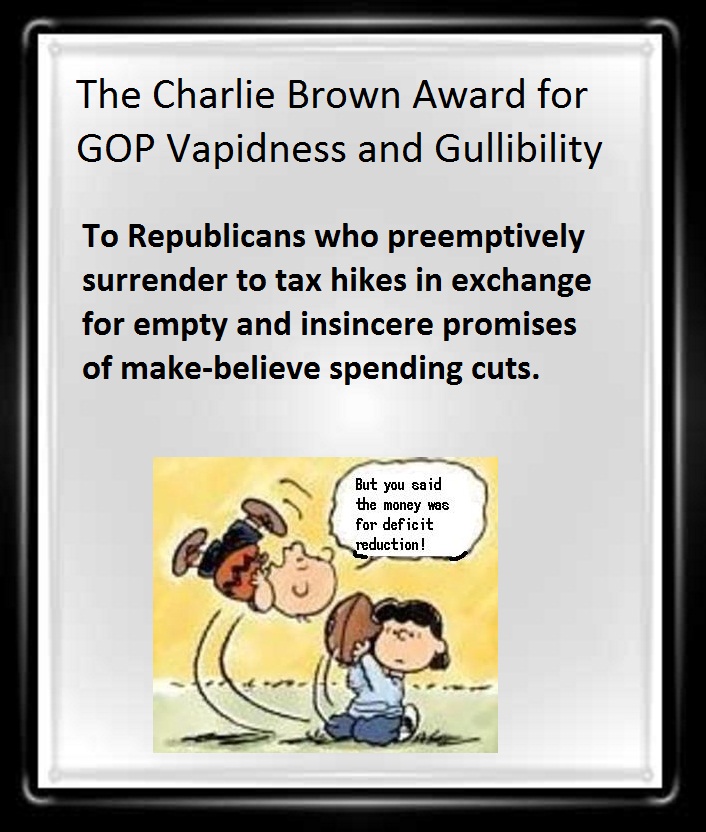
What we need is some people in Washington that are brave enough to say that we have taken too much of the american people’s money and we have to make the painful spending cuts in order to balance the budget and not ask for any more tax increases!!!! Arkansas’ congressman Rick Crawford has also made the Charlie Brown mistake.

Even though America’s fiscal problem is entirely the result of too much government spending, I wrote earlier this year that there were all sorts of scenarios where I would agree to a tax increase.

But I then pointed out that all of those scenarios were total fantasies and that it would be more realistic to envision me playing center field for the New York Yankees.

The fundamental problem is that politicians never follow through on promises to reduce spending – even if you use the dishonest Washington definition that a spending cut occurs whenever the budget doesn’t rise as fast as previously planned.

And to make matters worse, they always seem to want class-warfare tax hikes that do heavy economic damage rather than the loophole closers that at least get rid of some of the inefficient corruption in the tax code.

That’s why I like the anti-tax pledge of Americans for Tax Reform. You don’t solve America’s fiscal problems by saying no to all tax increases, but at least you don’t move in the wrong direction at a faster rate.

Notwithstanding the principled and pragmatic arguments against putting tax increases on the table, some Republicans – in a triumph of hope over experience – are preemptively acquiescing to tax hikes.

Here’s what Jeb Bush said.

Jeb Bush, the former Florida governor, said Friday that he could back a broad deficit plan that increased taxes, a stance that puts him at odds with other prominent Republicans. Bush told a House panel he could get behind a plan that combined 10 dollars in spending cuts for every dollar of new revenue… “The problem is the 10 never materializes,” [Congressman Paul] Ryan said after Bush said he could support a revenue-increasing deficit deal. Norquist also has criticized deficit deals crafted in 1982 and 1990 – the latter agreed to by then-President George H.W. Bush, Jeb’s father – for failing to deliver on the spending side.

Kudos to Paul Ryan for making the obvious point about make-believe spending cuts. And Grover is correct about the failure of previous budget deals.

Indeed, I cited a New York Times column that inadvertently revealed that the only budget deal that worked was the 1997 pact that cut taxes rather than raised them.

Jeb Bush isn’t the only apostate. Here’s what Senator Graham had to say.

Sen. Lindsey Graham (R-S.C.) said Tuesday he believed Republicans should consider eliminating loopholes in the tax code even if they aren’t replaced by additional tax cuts, a move that would break with an anti-tax pledge many GOP lawmakers have signed with activist Grover Norquist. “When you eliminate a deduction, it’s OK with me to use some of that money to get us out of debt. That’s where I disagree with the pledge,” Graham told ABC News. …”I’m willing to move my party, or try to, on the tax issue. I need someone on the Democratic side being willing to move their party on structural changes to entitlements.” Graham said, for instance, he would support a plan that included $4 in spending cuts for every $1 in tax increases. During a Republican debate last August, all eight Republican candidates in attendance said they would reject a proposal to trade $10 in spending cuts for even $1 in tax increases.

In some sense, Senator Graham’s comments are reasonable. With real spending cuts and less-damaging forms of tax hikes, an acceptable deal is possible. But only in Fantasia, not in Washington.

In the real world, all that Senator Graham has done is to move the debate slightly to the left.

I’ve noted that tax increases are political poison for the Republican Party, but I don’t lose sleep worrying about the GOP.

But I do have nightmares about government getting even bigger, and that’s why I don’t want tax increases on the table. I don’t even want them in the room. Or the house. Or the neighborhood.

That’s why Jeb Bush and Lindsey Graham are the newest winners of the Charlie Brown Award. They’ve put blood in the water. I wonder if they’ll act surprised when hungry sharks show up looking for a meal?

Sincerely,

Everette Hatcher, 13900 Cottontail Lane, Alexander, AR 72002, lowcostsqueegees@yahoo.com, www.thedailyhatch.org, ph 501-920-5733

Related posts:

Government shutdown coming, will there be any tea party heroes available to stand up to Obama?

DEBT LIMIT – A GUIDE TO AMERICAN FEDERAL DEBT MADE EASY. Uploaded by debtlimitusa on Nov 4, 2011 A satirical short film taking a look at the national debt and how it applies to just one family. Watch the guy from the Ferris Bueller Superbowl Spot! Produced by Seth William Meier, DP/Edited by Craig Evans, […]

Some Tea Party heroes (Part 1)

DEBT LIMIT – A GUIDE TO AMERICAN FEDERAL DEBT MADE EASY. Uploaded by debtlimitusa on Nov 4, 2011 A satirical short film taking a look at the national debt and how it applies to just one family. Watch the guy from the Ferris Bueller Superbowl Spot! Produced by Seth William Meier, DP/Edited by Craig Evans, […]

Some Tea Party heroes (Part 8)

Rep Himes and Rep Schweikert Discuss the Debt and Budget Deal Michael Tanner of the Cato Institute in his article, “Hitting the Ceiling,” National Review Online, March 7, 2012 noted: After all, despite all the sturm und drang about spending cuts as part of last year’s debt-ceiling deal, federal spending not only increased from 2011 […]

Some Tea Party heroes (Part 7)

Michael Tanner of the Cato Institute in his article, “Hitting the Ceiling,” National Review Online, March 7, 2012 noted: After all, despite all the sturm und drang about spending cuts as part of last year’s debt-ceiling deal, federal spending not only increased from 2011 to 2012, it rose faster than inflation and population growth combined. […]

Who are the Tea Party Heroes from the 87 Freshmen Republicans?

Here is a study done on the votes of the 87 incoming freshman republicans frm the Club for Growth. Freshman Vote Study In the 2010 election, 87 freshmen House Republicans came to Washington pledging fealty to the Tea Party movement and the ideals of limited government and economic freedom. The mainstream media likes to say […]

Tea Party Conservative Senator Mike Lee interview

Tea Party Conservative Senator Mike Lee interview Here is an excellent interview above with Senator Lee with a fine article below from the Heritage Foundation. Sen. Mike Lee (R-UT) came to Washington as the a tea-party conservative with the goal of fixing the economy, addressing the debt crisis and curbing the growth of the federal […]

Some Tea Party heroes (Part 6)

I feel so strongly about the evil practice of running up our national debt. I was so proud of Rep. Todd Rokita who voted against the Budget Control Act of 2011 on August 11, 2011. He made this comment:   For decades now, we have spent too much money on ourselves and have intentionally allowed our […]

Some Tea Party heroes (Part 5)

Rep. Quayle on Fox News with Neil Cavuto __________________ We have to get people realize that the most important issue is the debt!!! Recently I read a comment by Congressman Ben Quayle (R-AZ) made  after voting against the amended Budget Control Act on August 1, 2011. He said it was important to compel “Congressional Democrats and […]

Some Tea Party heroes (Part 4)

What future does our country have if we never even attempt to balance our budget. I read some wise words by Congressman Jeff Landry (R, LA-03) regarding the  debt ceiling deal that was passed on August 1, 2011:”Throughout this debate, the American people have demanded a real cure to America’s spending addiction – a Balanced Budget […]

Some Tea Party heroes (Part 3)

I read some wise comments by Idaho First District Congressman Raúl R. Labrador concerning the passage of the Budget Control Act on August 1, 2011 and I wanted to point them out: “The legislation  lacks a rock solid commitment to passage of a balanced budget amendment, which I believe is necessary to saving our nation.” I just […]

Some Tea Party heroes (Part 2)

Congressmen Tim Huelskamp on the debt ceiling I just don’t understand why people think we can go on and act like everything is okay when we have a trillion dollar deficit. Sometimes you run across some very wise words like I did the other day. Kansas Congressman Tim Huelskamp made the following comment on the […]

Francis Schaeffer: “Whatever Happened to the Human Race” (Episode 5) TRUTH AND HISTORY

In the film series “WHATEVER HAPPENED TO THE HUMAN RACE?” the arguments are presented  against abortion (Episode 1),  infanticide (Episode 2),   euthanasia (Episode 3), and then there is a discussion of the Christian versus Humanist worldview concerning the issue of “the basis for human dignity” in Episode 4 and then in the last episode a close look at the truth claims of the Bible.

Francis Schaeffer: How Should We Then Live? (Full-Length Documentary)

Francis Schaeffer Whatever Happened to the Human Race (Episode 1) ABORTION

Francis Schaeffer: What Ever Happened to the Human Race? (Full-Length Documentary)

Part 1 on abortion runs from 00:00 to 39:50, Part 2 on Infanticide runs from 39:50 to 1:21:30, Part 3 on Youth Euthanasia runs from 1:21:30 to 1:45:40, Part 4 on the basis of human dignity runs from 1:45:40 to 2:24:45 and Part 5 on the basis of truth runs from 2:24:45 to 3:00:04


Dr. Francis schaeffer – The flow of Materialism(from Part 4 of Whatever happened to human race?)

Dr. Francis Schaeffer – The Biblical flow of Truth & History (intro)

Francis Schaeffer – The Biblical Flow of History & Truth (1)

Dr. Francis Schaeffer – The Biblical Flow of Truth & History (part 2)

Published on Oct 7, 2012 by

This crucial series is narrated by the late Dr. Francis Schaeffer and former Surgeon General Dr. C. Everett Koop. Today, choices are being made that undermine human rights at their most basic level. Practices once considered unthinkable are now acceptable – abortion, infanticide and euthanasia. The destruction of human life, young and old, is being sanctioned on an ever-increasing scale by the medical profession, by the courts, by parents and by silent Christians. The five episodes in this series examine the sanctity of life as a social, moral and spiritual issue which the Christian must not ignore. The conclusion presents the Christian alternative as the only real solution to man’s problems.

President Obama should be protecting unborn children!!!!(Part 2)

Two Minute Warning: How Then Should We Live?: Francis Schaeffer at 100

Uploaded by on Jan 31, 2012

Under Francis Schaeffer’s tutelage, Evangelicals like Chuck Colson learned to see life through the lens of a Christian worldview. Join Chuck as he celebrates a life well lived.

______________

These posts are all dealing with issues that President Obama did not help on in his first term. I am hopeful that he will continue to respond to my letters that I have written him and that he will especially reconsider his view on the following important issue. President Obama should be protecting unborn children!!!!

It is clear that the unborn child feels pain and should be protected from abortion. I am including below this two part series on this subject of abortion from the pro-life point of view.

Pro-Life vs Pro-Choice: Annihilating the Abortion Argument

Article ID: DA375

By: Hank Hanegraaff

The following is an excerpt from article DA375 by Hank Hanegraaff. The full article can be found by following the link below the excerpt.

Pro-Life VS Pro-Choice- R = RAPE AND INCEST

An emotional appeal designed to avoid the serious consideration of the pro-life platform, rape and incest are the hard-case “what-ifs” pro-abortionists raise in almost every public forum: “How can you deny a hurting young girl safe medical care and freedom from the terror of rape or incest by forcing her to maintain a pregnancy resulting from the cruel and criminal invasion of her body?” The emotion of this argument often deflects serious examination of its merits and is commonly used as a pretext for abortion on demand.

It is important to note that the incidence of pregnancy as a result of rape is extremely small (one study put it at 0.6 percent).17 As philosopher Francis Beckwith astutely points out, “To argue for abortion on demand from the hard cases of rape and incest is like trying to argue for the elimination of traffic laws from the fact that one might have to violate some of them in rare instances, such as when one’s spouse or child needs to be rushed to the hospital.”18 If we had legislation restricting abortion for all reasons other than rape or incest, we would save the vast majority of the 1.8 million preborn babies who die annually in America through abortion.

Furthermore, one does not obviate the real pain of rape or incest by compounding it with the murder of an innocent preborn child; two wrongs obviously do not make a right. The very thing that makes rape evil also makes abortion evil. In both cases, an innocent human being is brutally dehumanized. The real question that must be answered is whether or not preborn children are indeed fully human. As has been already documented, the answer is a resounding Yes.

Pro-Life VS Pro-Choice- T = TOLERATION

Serving as the “great commandment” of the pro-abortion movement, the argument from toleration is perhaps the most common argument pro-abortionists level against their opponents. For example: “We’re not making you have an abortion, so why can’t you be tolerant of those who choose to?” Translated: “Don’t impose your antiquated morals on me!” At first blush this argument may seem reasonable, but on closer examination its inherent weakness becomes readily apparent. Imagine applying this line of reasoning to the issue of rape by saying, “Don’t like rape? Don’t rape anyone. Just don’t impose your morality on me!”

This false standard of tolerance is frequently supported by an appeal to religious pluralism. In this context, pro-abortionists argue that government should not take one theory of life and impose it on others. The obvious problem with this line of argumentation is that not only is the pro-abortion position forced on Christians, but they are required to fund it as well. Incredibly, pro-abortionists fail to perceive their violation of this ridiculous standard: they’re intolerant of those who think tolerance is less important than preserving innocent human lives!

Yet every society has the obligation to universally impose morals on its citizens. Toleration works in the world of expressing opinions, not in a crowded movie theater when someone chooses to yell “Fire!” We may be tolerant of one’s religious views, but not if they include enslaving grandmothers or cannibalizing teenagers.

Separation between church and state does not extend to divorcing all moral values from the state. If this were the case, we would need to eliminate all legislation that has anything in common with a religious point of view — including the very idea of social law itself.

Remember, tolerance when it comes to personal relationships is a virtue, but tolerance when it comes to truth is a travesty.

Pro-Life VS Pro-Choice- I = INEQUALITY

Inequality between the sexes is one of the most bizarre arguments put forth by the pro-abortion movement. “Women who are forced to be pregnant,” it is said, “can’t compete in employment with men and so cannot be truly equal unless they have an escape from unwanted pregnancy.” Translated, this is like saying, “Women can’t be equal to men without reconstructive surgery”! How much more sexist can an argument become?

Imagine, however, applying this standard to children outside the womb. Following this “logic” would mean that women should be permitted to abandon their children whenever they pose a threat to the mother’s opportunities for advancement.

Another form of the “inequality argument” is graphically portrayed through the image of a rusty coat hanger. Prior to Roe v. Wade, pro-abortionists claimed that because of financial inequality, women who could not afford to fly to another country to get an abortion were condemned to performing abortions on themselves with rusty coat hangers. To add credibility to this assertion, statistics ranging from 5,000 to 10,000 deaths per year due to illegal abortions continue to be widely circulated.19

Dr. Bernard Nathanson, a former leader of the National Abortion Rights Action League (NARAL), had this to say about these preposterous statistics: “I confess I knew the figures were totally false, and I suppose the others did too . . . But in the ‘morality’ of the revolution, it was a useful figure” (emphasis added).20

According to the U. S. Bureau of Vital Statistics, the true figure of the women who died from illegal abortions in 1972 — the year prior to Roe v. Wade — is 39. It is also questionable whether any one of these 39 women died as a result of using a coat hanger. As unpleasant as it may be, consider for a moment the dexterity needed to dislodge a conceptus from a uterine wall using a crude tool like a coat hanger. The truth of the matter is that the pro-abortion argument from inequality is not only illogical, but deliberately deceptive as well.

Pro-Life VS Pro-Choice- O = OPERATION RESCUE

The no. 1 straw-man argument of the pro-abortion lobby, Operation Rescue has been unfairly condemned for using the same lines of argumentation and social protest popularized by the civil rights movement — a movement pro-abortion advocates usually extol. Furthermore, Operation Rescue has been grossly misrepresented, presumably to dismiss all pro-life activities as “extremist.” The truth, however, is that just as abolitionists harbored escaped slaves in defiance of the laws before the Civil War, compassionate Europeans hid Jews from the legally sanctioned extermination of the Nazis, and civil rights marchers violated segregation laws, so Operation Rescue members believe their nonviolent, peaceful interventions to protect preborn children are obeying God rather than man (see Acts 4:19). Nonetheless, it needs to be recognized that many of the mainstream pro-life groups do not approve of using civil disobedience and do not identify with Operation Rescue. Thus pro-abortionists cannot fairly cite Operation Rescue as a reason for rejecting the entire pro-life movement.

While it might be argued that the tactics of Operation Rescue are not the most effective means of stemming the tide of abortion, it is patently false to caricature members of Operation Rescue as social terrorists or worse. Any unbiased evaluation of the principles and procedures employed by the leadership of this organization must conclude that they have consistently advocated nonviolent civil disobedience. It is therefore inexcusable when pro-abortionists attempt to tie Operation Rescue and pro-lifers generally to the few tragic instances in which pro-life extremists have resorted to violence and murder.

On a personal note, I am grateful to God for the documented evidence of lives that have been saved through the self-sacrifice of dedicated men, women, and children involved in this movement.

Pro-Life VS Pro-Choice- N = NONPERSONHOOD

The emerging embryo may not have a fully developed personality, but it does have complete personhood. Nonpersonhood is perhaps the trickiest of the contemporary pro-abortion arguments. Pro-abortionists once argued that the preborn baby was not fully human. Now, however, advances in science have forced most people to concede that the “product of conception” is truly human. As a result, a new version of this argument goes something like this: “The preborn child may be a human life, but it does not possess personhood.”

Dr. Francis Beckwith exploded the latest version of this myth when he wrote, “From a strictly scientific point of view, there is no doubt that the development of an individual human life begins at conception. Consequently, it is vital that the reader understand that she did not come from a zygote, she once was a zygote; she did not come from an embryo, she once was an embryo; she did not come from a fetus, she once was a fetus; she did not come from an adolescent, she once was an adolescent.”21

The abortion epidemic ravaging America today is the tragic consequence of a decadent society that no longer values the individual human worth of each member; that worships the idol of “Selfism”; and that replaces the objective Word of God with subjective preferences and social morés.

One-third of the children conceived in America this year will be savagely slaughtered before they are born. Yet this horrifying holocaust can be halted if those who value human life, worship the true God, and obey His Word will become informed, committed, and involved.

NOTES:

17Charles R. Hayman, M.D., and Charlene Lanza, “Sexual Assault in Women and Girls,” American Journal of Obstetrics and Gynecology 109 (1971): 480-86; cited in Beckwith, 241 n. 69.18Beckwith, 69.19Bernard Nathanson, M.D., Aborting America (New York: Doubleday, 1979), 193; quoted in Beckwith, 55.20Ibid.21Beckwith, 43.

Open letter to President Obama (Part 168.1)

Dan Mitchell Defending Tax Havens (and Mitt Romney) on Wall Street Journal Online TV

Published on Jul 13, 2012 by

No description available.

__________________

(This letter was mailed before September 1, 2012)

President Obama c/o The White House
1600 Pennsylvania Avenue NW
Washington, DC 20500

Dear Mr. President,

I know that you receive 20,000 letters a day and that you actually read 10 of them every day. I really do respect you for trying to get a pulse on what is going on out here.

It worries me more about how my tax dollars are being spent by you than what Mitt Romney did with his private money.

I’ve defended Mitt Romney for utilizing the efficient financial services sectors of so-called tax havens.

But I may have been focusing on the trees and missed the forest. By highlighting the perfectly legal nature of Romney’s investments and commenting on the valuable role of tax havens in the global economy, I’ve neglected the main argument, which is that people have a right to do whatever they want with their own money and it’s none of our damn business.

What is our business, by contrast, is what politicians are doing with the money they confiscate from us. This Lisa Benson cartoon helps to make that point, though it would be even better if she had written “Romney’s Stash for His Own Money” and “Obama’s Stash for Our Money.”

Obama, needless to say, is an expert at squandering other people’s money, as illustrated by money pits such as the faux stimulus and the green energy scam.

P.S. Lest anyone think I’m being partisan, the headline of this would be just as accurate if I added “How Bush Spent My Money” or “How Romney Would Spend My Money.” Bush, after all, followed the same fiscal agenda as Obama, and Romney’s track record suggests he will be similarly profligate.

P.P.S. Which makes me miss Bill Clinton, who was frugal by comparison. Or Ronald Reagan, who actually did the right things for the right reason.

P.P.P.S. You can find more Lisa Benson cartoons herehere, here, here, herehere, and here.

____________

Thank you so much for your time. I know how valuable it is. I also appreciate the fine family that you have and your commitment as a father and a husband.

Sincerely,

Everette Hatcher III, 13900 Cottontail Lane, Alexander, AR 72002, ph 501-920-5733, lowcostsqueegees@yahoo.com

Johnny Cash (Part 2)

I got to hear Johnny Cash sing in person back in 1978 at a Billy Graham Crusade in Memphis. Here is a portion of an article about his Christian Testimony.

Cash also made major headlines when he shared his faith on The Johnny Cash Show, a popular variety program on ABC that ran from 1969 to 1971: “Well, folks,” he began, “I’ve introduced lots of hymns and gospel songs on this show. I just want to make it clear that I’m feeling what I’m singing about in this next one. I am a Christian … I want to dedicate this song to the proposition that God is the victor in my life. I’d be nothing without him. I want to get in a good lick right now for Number One.” (Yet there are those in the Church who questioned his decision, during one momentous episode of show, to sing the controversial lyric, “wishing Lord that I was stoned” from Kris Kristofferson’s hit “Sunday Morning Coming Down.”)

And while Cash longed to play only gospel music from the start—and would have if Sam Phillips hadn’t nixed his desires as economically unfeasible for Sun Records—he never shied away from performing secular-themed songs in the studio or on the concert stage throughout his career.

A huge influence on Cash in this potentially problematic area was, believe or not, evangelist Billy Graham, who sought out Johnny in the early ’70s when he heard of his commitment to God.

“He and I spent a lot of time talking the issues over, and we determined that I wasn’t called to be an evangelist …” Cash recalled of his first face-to-face conversations with Graham. “He had advised me to keep singing ‘Folsom Prison Blues’ and ‘A Boy Named Sue’ and all those other outlaw songs if that’s what people wanted to hear and then, when it came time to do a gospel song, give it everything I had. Put my heart and soul into all my music, in fact; never compromise; take no prisoners. ‘Don’t apologize for who you are and what you’ve done in the past,’ he told me. ‘Be who you are and do what you do.'”

“I think I just like to share my faith, you know?” he said in recent years. “I don’t preach to people. I don’t ever push it on anybody, and I wouldn’t sing a gospel song on any show if I didn’t think the people would enjoy it. They seem to enjoy those as much or more than anything else. It’s not that I’m proselytizing. I’m not out there tryin’ to convince people, just to spread a little good news.”

As it turns out, Cash quickly became a welcome figure at both Billy Graham Crusades and on the ostentatious stages of Las Vegas. And while he insisted that these (seemingly) diametrically opposed venues were equally home in his heart and mind, U2’s Bono wasn’t convinced: “Johnny Cash doesn’t sing to the damned, he sings with the damned, and sometimes you feel he might prefer their company … ”

Dear Senator Pryor, why not pass the Balanced Budget Amendment? (“Thirsty Thursday”, Open letter to Senator Pryor)

Balance the Budget: Now is the Time

Uploaded by on Jul 27, 2011

__________

Dear Senator Pryor,

Why not pass the Balanced  Budget Amendment? As you know that federal deficit is at all time high (1.6 trillion deficit with revenues of 2.2 trillion and spending at 3.8 trillion).

On my blog www.HaltingArkansasLiberalswithTruth.com I took you at your word and sent you over 100 emails with specific spending cut ideas. However, I did not see any of them in the recent debt deal that Congress adopted. Now I am trying another approach. Every week from now on I will send you an email explaining different reasons why we need the Balanced Budget Amendment. It will appear on my blog on “Thirsty Thursday” because the government is always thirsty for more money to spend.

I really wish we could pass a Balanced Budget Amendment and control the amount of money the federal government could spend. Milton Friedman in his 1980 film series “Free to Choose” got me thinking about this and in that same film series I got introduced to the brilliant Dr. Walter Williams. Take a look at this article below by him.

How To Control Congress

Let’s assume that each of our 535 congressmen cares about the destructive impact of deficits and debt on the future of our country. Regardless of party, congressmen face enormous lobbying pressures and awards to spend more and little or no pressure and awards to spend less. The nation’s founders would be horrified by today’s congressional spending that consumes 25 percent of our GDP. Contrast that to the years 1787 to the 1920s when federal government spending never exceeded 4 percent of our GDP except in wartime. Today, federal, state and local government consumes 43 percent of what Americans produce each year. The Washington, D.C.-based Tax Foundation computes that the average taxpayer is forced to work from Jan. 1 to mid-April to pay federal, state and local taxes. If he were taxed enough to pay the $1.5 trillion federal deficit, he’d be forced to work until mid-May.

Tax revenue is not the problem. The federal government has collected just about 20 percent of the nation’s GDP almost every year since 1960. Federal spending has exceeded revenue for most of that period and has taken an unprecedented leap since 2008 to produce today’s massive deficit. Since federal spending is the problem, that’s where our focus should be.

Cutting spending is politically challenging. Every spending constituency sees its handout as vital, whether it’s Social Security, Medicare and Medicaid recipients or farmers, poor people, educators or the military. It’s easy for congressmen to say yes to these spending constituencies because whether it’s Democrats or Republicans in control, they face no hard and fast bottom line.

The bottom line that Americans need is a constitutional amendment limiting congressional spending to some fraction, say 20 percent, of the GDP. That limit could be exceeded only if the president declared a state of emergency along with a two-thirds vote of approval in both houses of Congress.


Each year of a declared state of emergency would require another two-thirds vote in each house.

During the early ’80s, I was a member of the National Tax Limitation Committee’s distinguished blue-ribbon drafting committee that included notables such as Milton Friedman, James Buchanan, Paul McCracken, Bill Niskanen, Craig Stubblebine, Robert Bork, Aaron Wildavsky, Robert Nisbet, Robert Carleson and others. We drafted a Balanced Budget/Spending Limitation amendment to the U.S. Constitution. The U.S. Senate passed that amendment on Aug. 4, 1982, by a vote of 69 to 31, two more than the two-thirds vote required for approval of a constitutional amendment. The vote was bipartisan: 47 Republicans, 21 Democrats and 1 Independent voted for the amendment.

It was a different story in the House of Representatives. Its leadership, under Tip O’Neill tried to prevent a vote on the amendment; however, a discharge petition forced a vote on it. While the amendment was approved by a majority (236 to 187), it did not meet the two-thirds required by Article V of the Constitution. The vote was again bipartisan: 167 Republicans, 69 Democrats. The amendment can be found in Milton and Rose Friedman’s “Tyranny of the Status Quo.”

The benefit of a balanced budget/spending limitation amendment is that it would give Congress a bottom line just as we in the private sector have a bottom line. Congress would be forced to play one spending constituency off against another, rather than, as it does today, satisfy most spending constituents and pass the buck to the rest of us and future generations in the forms of federal deficits and debt.

The 1980s discussions settled on giving Congress a spending limit of 18 or 20 percent of our GDP. I thought a 10 percent limit was better. When queried by a reporter as to why 10 percent, I told him that if 10 percent is good enough for the Baptist Church, it ought to be good enough for Congress.

Walter E. Williams is a professor of economics at George Mason University. To find out more about Walter E. Williams and read features by other Creators Syndicate writers and cartoonists, visit the Creators Syndicate Web page at http://www.creators.com.

COPYRIGHT 2010 CREATORS.COM

__________

Thank you again for your time and for this opportunity to share my ideas with you.

Sincerely,

Everette Hatcher