Monthly Archives: October 2012

Many in communist countries longed for the freedom that Milton Friedman and Ronald Reagan talked about

People all the world love freedom and those that had to live under the rule of communism hungered for freedom. When I think about the actions of Ronald Reagan and Milton Friedman during the 1980’s I am grateful for their love of freedom. Ronald Reagan is responsible for bringing down the Russian communist state and the ones in Eastern Europe.

Below you will read how the 1980 book and film series “Free to Choose” was being smuggled into these countries and was giving the people a hunger for freedom. I wish the USA would reduce the size of our federal government spending and regulations and return more freedom to our people too. Below is an article that talks about the making of that film series.

Celebrating Milton Friedman

by Andrew J. Coulson

Andrew Coulson directs the Cato Institute’s Center for Educational Freedom and is the author of Market Education: The Unknown History.

Added to cato.org on July 31, 2012

This article appeared in Cato.org on July 31, 2012.

For us, who lived in the communist world, Milton Friedman was the greatest champion of freedom, of limited and unobtrusive government and of free markets. Because of him I became a true believer in the unrestricted market economy.

Those are the words of Czech President Vaclav Klaus. Both Friedman’s writings and his landmark 1980 documentary series “Free to Choose”were smuggled into totalitarian communist states, inspiring a generation of future scholars, activists, and politicians.

July 31st, 2012 is the 100th anniversary of Friedman’s birth. To commemorate that occasion, the Cato Institute has put together a video interview with Bob Chitester, producer of “Free to Choose,” recounting how it came to be, its impact, and what it was like working with Milton Friedman.

Bob Chitester Discusses Milton Friedman and ‘Free to Choose’

Published on Jul 30, 2012 by

“There are very few people over the generations who have ideas that are sufficiently original to materially alter the direction of civilization. Milton is one of those very few people.”

That is how former Federal Reserve Chairman Alan Greenspan described the Nobel laureate economist Milton Friedman. But it is not for his technical work in monetary economics that Friedman is best known. Like mathematician Jacob Bronowski and astronomer Carl Sagan, Friedman had a gift for communicating complex ideas to a general audience.

It was this gift that brought him to the attention of filmmaker Bob Chitester. At Chitester’s urging, Friedman agreed to make a 10 part documentary series explaining the power of economic freedom. It was called “Free to Choose,” and became one of the most watched documentaries in history.

The series not only reached audiences in liberal democracies, but was smuggled behind the iron curtain where it played, in secret, to large audiences.

__________

Aside from those who lived under communism, there is another group for whom Friedman was and is a colossal figure: advocates of educational freedom. At a time when state-run schooling had been the norm for nearly a century, and had long ceased to be questioned by America’s elites, Friedman offered a modest observation: there was no good reason for the government of a free society to actually run schools and many good reasons for it not to do so.

He made this case in his essay “On the Role of Government in Education,” first published in 1955. The idea had been floated by others, including Adam Smith and Thomas Paine, but Friedman eloquently and powerfully introduced it to the American policy debate. In so doing, he, more than any other individual, can be credited with giving rise to the modern school choice movement.

Not only did Friedman spark the creation of this movement, he helped to fan the flame of educational freedom, writing popular commentaries and book chapters, speaking with and encouraging activists, founding a leading school choice institution, and dedicating the entire sixth episode of “Free to Choose” to this subject.

I had the good fortune to speak and correspond with Milton occasionally, starting in the late 1990s, and what struck me most about him was his personal integrity. He once told me that he never said anything negative about a person in private that he would not be willing to say openly in that person’s presence. So far as I know, he never violated that principle. And while he staunchly defended his conclusions as long as he remained convinced of their correctness, he would amend them if the weight of evidence shifted.

Indeed the rigorous empiricism that Friedman applied in his scholarly work is generally regarded as one of his most influential contributions to the field of economics—for a long time controversial but eventually the norm, at least in principle. His view, published in the 1953 collection Essays in Positive Economics, was that

the ultimate test of the validity of a theory is… the ability to deduce facts that have not yet been observed, that are capable of being contradicted by observation, and that subsequent observation does not contradict. [p. 300]

Equally wise, though not yet as widely accepted, is the long time horizon against which Friedman measured policy outcomes. Economist and philosopher of science James R. Wible notes that Friedman’s greatest contribution “may be his constant reminder not to forget the long run consequences of short run policies.”

In the 1982 edition of his book Capitalism and Freedom, Friedman observed that scholars cannot single-handedly bring about change. Their real role, he wrote, is to “keep the lights on”—to remind us which policies work and which do not, and to show us how to advance our understanding even further. His own unfailing empiricism and concern for the long term remain valuable beacons today, both for advocates of educational freedom and the broader policy community.
Paul Ryan on vouchers

I have always favored the voucher system to create more competition between schools.

Lindsey Burke

October 25, 2012 at 12:00 pm


House Budget Committee chairman Paul Ryan (R–WI) made a strong case yesterday for the need to ensure that every child in America has the opportunity to attend a school of choice. “If we want to restore the promise of America,” Ryan stated, “then we must reform our broken public-school system.”

Ryan is right.

Millions of children pass through our nation’s broken public schools year after year. Too many of those children have no other choice. Confined by their parent’s zip codes and economic means, they are assigned to government schools, where, in some of our nation’s largest cities, they are just as likely to drop out as they are to graduate.

Providing those children with a choice isn’t a radical idea: School choice means funding children instead of institutions and allowing dollars to follow them to educational options that best meet their unique learning needs. But no matter how common-sense school choice might seem, the usual suspects—special interest groups concerned with maintaining a self-serving status quo—will try to stand in the way. As Ryan noted:

The special interests that dominate this system always seem to have their own futures lined up pretty nicely. But when you think about the future of the young adults that the system has failed, many will face a lot of grief and disappointment—and their country owes them better than that.

School choice places the interests of children (and parents, teachers, and taxpayers) before the interests of the adults in the antiquated assignment-by-zip-code public education system. Above all, school choice creates freedom in a moribund system stifled by government regulation and based on a monopolistic design that is alien to nearly every other aspect of American life. To improve American education, that has to change. As Ryan concluded:

When you set aside all the obstacles to education reform, you are left with one obvious fact: Every child in America should have this kind of opportunity. Sending your child to a great school should not be a privilege of the well-to-do.… I believe that choice should be available to every parent in our country, wherever they live. Education reform is urgent, and freedom is the key.

Comparing Obama’s job creation record to other presidents

You got to lower taxes on the job creators if you want to create jobs!!!

If it wasn’t for the fact that so many people are suffering and being seduced into empty lives of government dependency (symbolized by Julia, the world’s most disappointing daughter), I might feel sorry for President Obama.

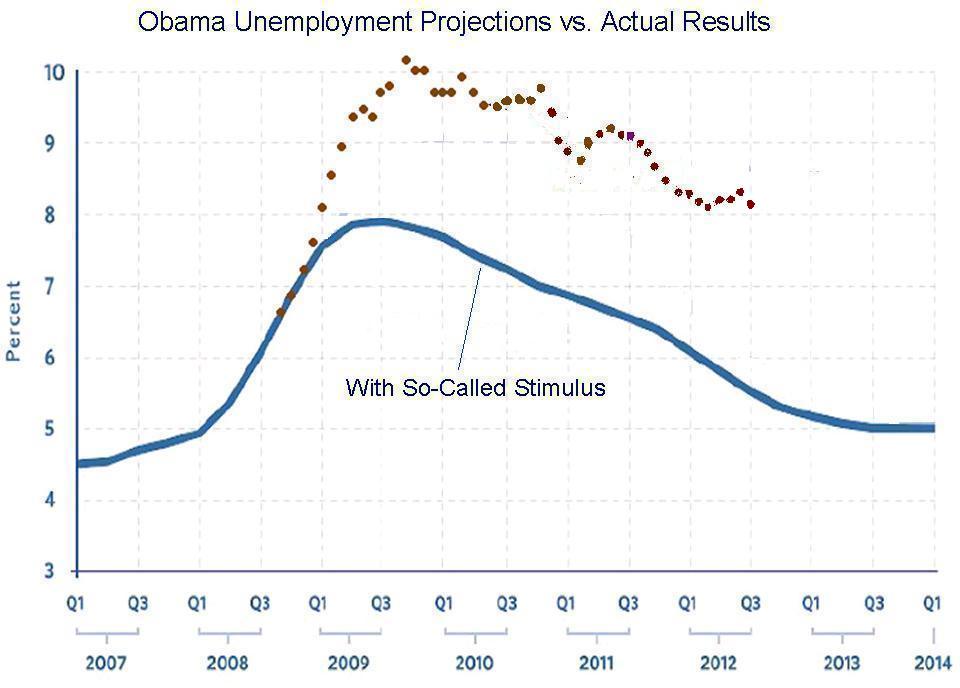
He promised unemployment would never climb above 8 percent if Congress squandered $800 billion on a Keynesian stimulus scheme.

Well, Congress said yes and the results have not been pretty. And every month we get new numbers to show us that the Administration’s policies have failed. It’s like Chinese water torture for the White House.

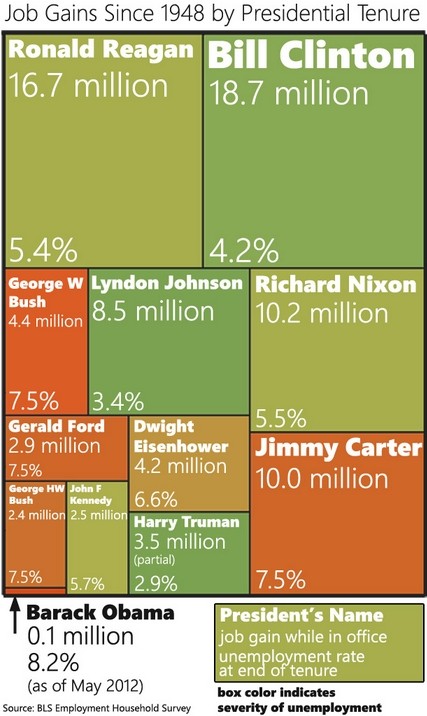
The numbers released this morning from the Department of Labor don’t change the narrative. The Republican and Democratic spin-doctors obviously will spit out their talking points, but here’s a visual put together by Political Math that trumps all the political maneuvering. If you’re wondering where Obama is, look at the lower left portion of the image.

This image is a couple of months old, but job creation has been so anemic that the naked eye wouldn’t be able to tell the difference if it was updated.

Since I normally show a graph with the actual unemployment rate compared to what Obama promised, I’ll add that as well. Not a pretty picture. I wrote that last month’s version would cause anxiety for Obama, and see no reason to change that assessment.

Yes, the official unemployment rate dropped to 8.1 percent, but that was because more Americans dropped out of the labor force.

Most important, the rate of joblessness is about 2-1/2 to 3 percentage points higher than what Obama promised. Now he wants a second term, yet all he’s promising is more of the same.

Actually, I retract that statement. He wants to maintain his current approach, but then add some class-warfare taxes to the mix.

Do we want “Bipartisanship” or do we want to look out for the taxpayers?

Milton Friedman said that getting George Bush I to be his vice president was his biggest mistake because he knew that Bush was not a true conservative and sure enough George Bush did raise taxes when he later became President. Below is a speech by George W. Bush honoring Milton Friedman:

Milton Friedman Honored for Lifetime Achievements 2002/5/9

______________

Bipartisanship has not served us well in the past. It has resulted in going further and further in debt. We need conservatives who know what the problem is and are willing to cut spending no matter what in order to balance the budget and get our percentage of federal spending under 18% of GDP like it has been the last 50 years and not at 24.8% like it is now.

Bipartisanship versus Taxpayers

Posted by David Boaz

Last month George Will pushed back against the bipartisan Washington wish for bipartisanship:

Bipartisanship, the supposed scarcity of which so distresses the high-minded, actually is disastrously prevalent.

Since 2001, it has produced No Child Left Behind, a counterproductive federal intrusion in primary and secondary education; the McCain-Feingold speech rationing law (the Bipartisan Campaign Reform Act); an unfunded prescription drug entitlement; troublemaking by Fannie Mae and Freddie Mac; government-directed capitalism from the Export-Import Bank; crony capitalism from energy subsidies; unseemly agriculture and transportation bills; continuous bailouts of an unreformed Postal Service; housing subsidies; subsidies for state and local governments; and many other bipartisan deeds, including most appropriations bills.

And today I see this banner headline in the (actual paper edition of the) Washington Post:

In Senate, farm bill produces a rarity: cooperation
Some see signs of renewed bipartisanship

Paul Kane reports:

To the purported short­list of certainties in life — death and taxes — add large, bipartisan support in the Senate for the farm bill.

Despite the pattern in recent years of intense partisan acrimony, backroom bickering and publicly staged fights over nearly every piece of legislation, the Senate has begun to plod through a nearly $1 trillion farm bill that is likely to get a bipartisan vote for its approval by week’s end.

A trillion dollars. For a farm bill. Have we become so accustomed to throwing around the phrase “a trillion dollars” that this isn’t headline news?  Not to worry, though, Congress is thinking of the taxpayers: They say they’ve cut $23 billion out of the trillion. Sure, let’s look back in a decade and see if those cuts really happened.

Meanwhile, shoveling out money to the farmers isn’t the only time Congress can be bipartisan. There’s also shoveling out money to Boeing and a handful of other big companies with the Export-Import Bank, as the Los Angeles Times reported on May 30:

President Obama has signed into law a bill reauthorizing the Export-Import Bank, saying the rare example of bipartisan cooperation should be a model for a future legislation.

Yessiree, as George Will said, the one thing Congress can join hands and agree on is giving taxpayers’ money to interest groups — whether it’s farmers or airplane manufacturers or college students and their parents or Medicare recipients. Bipartisanship is typically a conspiracy against the taxpayers.

Senator Pryor asks for Spending Cut Suggestions! Here are a few!(Part 163)

Senator Pryor asks for Spending Cut Suggestions! Here are a few!(Part 163)

Senator Mark Pryor wants our ideas on how to cut federal spending. Take a look at this video clip below:

Senator Pryor has asked us to send our ideas to him at cutspending@pryor.senate.gov and I have done so in the past and will continue to do so in the future.

On May 11, 2011,  I emailed to this above address and I got this email back from Senator Pryor’s office:

Please note, this is not a monitored email account. Due to the sheer volume of correspondence I receive, I ask that constituents please contact me via my website with any responses or additional concerns. If you would like a specific reply to your message, please visit http://pryor.senate.gov/contact. This system ensures that I will continue to keep Arkansas First by allowing me to better organize the thousands of emails I get from Arkansans each week and ensuring that I have all the information I need to respond to your particular communication in timely manner.  I appreciate you writing. I always welcome your input and suggestions. Please do not hesitate to contact me on any issue of concern to you in the future.

I just did. I went to the Senator’s website and sent this below:

Here are some great suggestions from the Heritage Foundation.  Alison Acosta Fraser Director, Thomas A. Roe Institute for Economic Policy Studies

Nowhere to Cut?

  • In 2008 and 2009 alone, the Department of Justice spent (DOJ)$121 million to host or participate in 1,832conferences.
    • At one conference, petite Beef Wellington made the hors d’oeuvres menu, at a cost of $7.32 per serving.
    • An internal audit found DOJ did not keep costs to a minimum, despite federal guidelines. The most expensive conference reviewed in the audit was held in Istanbul, Turkey, and cost $1.18 million.
  • The General Services Administration (GSA), which is responsible for managing federal buildings and helping to cut costs, held a conference costing $822,751 in Las Vegas. At more than $2,500 per employee, it included $44-per-person breakfasts and commemorative coins for conference participants that cost $6,325.
  • In fiscal year 2010, the federal government spent nearly $1.7 billion to maintain 77,700 underused or unused buildings.
  • Eliminating both the New Starts and Small Starts transit grants programs would save taxpayers $5.6 billion over the next five years and $16.3 billion over 10 years. It would get the federal government out of the business of subsidizing high-cost, low-value local transit projects, such as $900 million for a 10-mile extension of the Bay Area rail system in San Jose and a $1.6 billion grant to construct a Honolulu rail line.
  • The Department of Agriculture’s Office of the Chief Information Officer funded a $2 million intern program. Only one intern was hired full time as a result.
  • Fifteen federal agencies are involved in administering 30 food safety laws, resulting in fragmented food safety oversight.
  • The U.S. Navy bought 450,000 gallons of biofuels for $12 million, or almost $27 per gallon, to conduct exercises to showcase the fuel and bring it closer toward commercialization. It is the largest biofuel purchase ever made by the government.
  • The Internal Revenue Service stored 22,486 items of unused furniture in a warehouse at an annual cost of $862,000.

Open letter to President Obama (Part 158B)(Libya comments by President at 2nd debate discussed, part M)

Know The TRUTH ~ Step By Step ~ Bret Baier’s ~ ‘Death and Deceit in Benghazi’

Published on Oct 19, 2012 by

Second Presidential Debate 2012- Obama and Romney on Foreign Policy

Published on Oct 16, 2012 by

With just 21 days to go until the presidential election in the United States, President Obama and his challenger Governor Romney meet for their second debate at Hofstra University in Hempstead, New York.

________________________

President Obama c/o The White House
1600 Pennsylvania Avenue NW
Washington, DC 20500

Dear Mr. President,

I know that you receive 20,000 letters a day and that you actually read 10 of them every day. I really do respect you for trying to get a pulse on what is going on out here. 

In the second presidential debate which I watched on 10-18-12, I was very sad that the administration did not come out in the first week and say that this was a terrorist attack instead of talking about a youtube video that HAD NO PLACE IN THE CONVERSATION SINCE THIS WAS A PLANNED ATTACK!!!!! I don’t understand why you talked about this youtube video for about two weeks and I am hoping you will respond to this letter or I am going to keep writing you about this till you do.

NY Post

Benghazi: Bam booted it

  • Last Updated: 1:42 AM, October 23, 2012
  • Posted: October 23, 2012
Team Obama insists it was led astray by the CIA and that the White House was deaf and blind about the coordinated terrorist strike in Libya on Sept. 11, believing intelligence assessments that the attack was merely a protest that got out of hand.But the claim is looking shakier than ever: Turns out the administration had eyes and ears in Benghazi the entire time.Their eyes? During the attack, an unarmed Predator drone was flying over the city, watching the events in real time.Their ears? According to reporter Eli Lake, “The State Department, monitoring the phone calls from the consulate’s operations center, knew virtually from the first minutes . . . that the attack on the consulate was no protest gone astray.”

<br /><br /><br />

AP
President Barack Obama

Though administration officials would spend days blaming the strike on an obscure filmmaker, basic facts were already clear to the White House at that early hour.

“When a major CIA outpost nearby came under attack . . . there was little doubt about that being an operation by well-trained terrorists,” Lake reported.

Which suggests two possibilities:

One, that Team Obama has been lying like a rug.

Two, that the US intelligence establishment is utterly broken.

Trouble is, both possibilities may be true.

The Wall Street Journal reported yesterday that the CIA’s daily briefing for Obama as late as Sept. 21 said that the attack grew out of a spontaneous protest over a video that mocked the prophet Mohammed.

But the claim was based in large part on a conversation intercepted between al Qaeda members and allied terrorists in Libya.

Here’s a simple rule: When intel comes straight from a terrorist, safe to say he’s not discussing a random act of violence.

So why did the CIA insist that the attack began as a protest in the face of so much contrary information — and why did the White House believe it for a moment?

If Team Obama’s eyes and ears were in working order on Sept. 11, they didn’t have the sense or the honesty to admit what they saw and heard and knew so clearly:

That there was never a protest at all.

That the administration had refused requests for more security in Benghazi in the months before the attack, as al Qaeda and other terrorist groups grew in strength.

That the killers then tore into the consulate with ease, and slipped away as easily.

That Chris Stevens didn’t have to die.

Blaming their mistakes and their dishonesty on the CIA simply drops the White House to a new and shameful low.

________

Thank you so much for your time. I know how valuable it is. I also appreciate the fine family that you have and your commitment as a father and a husband.

Sincerely,

Everette Hatcher III, 13900 Cottontail Lane, Alexander, AR 72002, ph 501-920-5733, lowcostsqueegees@yahoo.com

Related posts:

Why can’t we get an apology from the President concerning Libya?

I have emailed and written the President over 200 times in the last year and I have received over 20 emails and 5 letters back from the White House. However, I have been most urgent in my emails and letter writing concerning this issue about the youtube video being blamed for the attack in Libya. […]

Open letter to President Obama (Part 158))(Libya comments by President at 2nd debate discussed, part C)

Second Presidential Debate 2012- Obama and Romney on Foreign Policy Published on Oct 16, 2012 by AussieNews1 With just 21 days to go until the presidential election in the United States, President Obama and his challenger Governor Romney meet for their second debate at Hofstra University in Hempstead, New York. ________________________ President Obama c/o The […]

Open letter to President Obama (Part 157B)(Libya comments by President at 2nd debate discussed, part B)

Second Presidential Debate 2012- Obama and Romney on Foreign Policy Published on Oct 16, 2012 by AussieNews1 With just 21 days to go until the presidential election in the United States, President Obama and his challenger Governor Romney meet for their second debate at Hofstra University in Hempstead, New York. ________________________ President Obama c/o The […]

Open letter to President Obama (Part 157) (Libya comments by President at 2nd debate discussed, part A)

Second Presidential Debate 2012- Obama and Romney on Foreign Policy Published on Oct 16, 2012 by AussieNews1 With just 21 days to go until the presidential election in the United States, President Obama and his challenger Governor Romney meet for their second debate at Hofstra University in Hempstead, New York. ________________________ President Obama c/o The […]

President now tells us the truth about Libya

The White House Disinformation Campaign on Libya Published on Oct 7, 2012 by HeritageFoundation New evidence shows there were security threats in Libya in the months prior to the deadly September 11 attack that killed U.S. Ambassador Christopher Stevens and three other Americans. Despite these threats, the State Department left its personnel there to fend […]

Lybia timeline

The White House Disinformation Campaign on Libya Published on Oct 7, 2012 by HeritageFoundation An Incriminating Timeline: http://herit.ag/WMfTr6 | New evidence shows there were security threats in Benghazi, Libya, in the months prior to the deadly September 11, 2012, attack that killed U.S. Ambassador Christopher Stevens and three other Americans. Despite these threats, the Obama […]

Music Monday “Ringo Starr tour Part 1”

Ringo Starr - Ringo and Barbara«

I went  to a Ringo Starr concert on July 4, 2012 at Orange Beach, AL and enjoyed it very much and here are some of the songs I heard that night:

Ringo Starr – Ringo 2012  *Interview (Jan.31/12)

Alert iconUploaded by     on Feb  1, 2012

Late Late Show with Craig Ferguson http://www.ringostarr.com/

Ringo  Starr’s All Starr Band Members Talk 2012 Tour, Which Launches Thursday
Read On ABC News Radio: http://abcnewsradioonline.com/music-news/2012/6/14/ringo-starrs-all-starr-band-members-talk-2012-tour-which-lau.html#ixzz1zlpv2acl

Ringo Starr and His All Starr Band shine brightly at State Theatre – REVIEW

Published: Tuesday, June 26, 2012, 10:43 PM Updated: Tuesday, June 26, 2012, 11:29 PM

Photo: Rob  ShannahanThe 13th installment of Ringo Starr‘s All Starr Band Tour kicks off Thursday night in Toronto.   Joining the Beatles drummer on the 2012 edition of the trek are Todd Rundgren,  ex-Santana/Journey singer/keyboardist Gregg Rolie, Toto guitarist Steve  Lukather and Mr. Mister‘s Richard  Page, as well as longtime Billy Joel saxophonist Mark Rivera and veteran session drummer Gregg  Bissonnette.   As usual, the jaunt will feature the various  artists performing some of  their own hits, as well as backing Ringo on his solo  and Fab Four  classics.

This will be Rundgren’s third go-round on an All-Starr  Band trek, having  previously been part of the 1992 and 1999 lineups.   The prolific  singer/songwriter recently told ABC News Radio that he’s  really looking forward  to hitting the road with Starr.

“It’s  always a pleasure to play with and hang out with Ringo, because he’s   just a ray of sunshine,” notes Rundgren.  “He’s always looking on the   bright side and he’s always giving the peace sign and he’s bringing the   entertainments to the peoples, and that’s where I want to be when I’m  70.   I want to do it until I can’t do it anymore.”

Francis Schaeffer’s film series “How should we then live?” (Final Choices) can be seen on the www.thedailyhatch.org

Francis and Edith Schaeffer January 1975
Huemoz sur Ollon at L’abri, Switzerland

America has some big choices to make and Francis Schaeffer does a great job of showing what the problems are and what choices we have. Below is a portion of this episode with links below to the complete episodes:

E P I S O D E 1 0

How Should We Then Live 10#1

FINAL CHOICES

I. Authoritarianism the Only Humanistic Social Option

One man or an elite giving authoritative arbitrary absolutes.

A. Society is sole absolute in absence of other absolutes.

B. But society has to be led by an elite: John Kenneth Galbraith, Robert Theobald.

C. Daniel Bell’s prophecy of technocratic elite.

D. Bell’s warning of cultural contradiction: no absolute ethic to accompany absolute power.

II. Nature of the New Authoritarianism

A. Do not think of the model of Hitler and Stalin.

B. Probably a manipulative, authoritarian elite.

III. Possible Forms of Manipulation

A. Review from Episode Six: Koestler—chemical agents; Krantz—birth control in world’s drinking supply; Clark—political leaders should take anti-aggression pills; Lee—psychological tests for public officials; Skinner—reinforcers to modify behavior.

B. Genetic condition: Francis Crick.

1. He advocates:

a) That some group of people is to decide who should be the parents of the next generation and who should be born.

b) That some group of people should determine what kind of people they want in the future and will set out genetically to make them.

2. Once Man is no longer seen as made in God’s image, there is no reason not to “tinker” with Man genetically.

C. The mass media.

1. TV conditions by selective editing. Illustration: simulated riot filmed in San Jose.

2. No collusion needed if views of elite and newsmakers coincide. Media not monolithic, but total control not needed to achieve manipulation.

IV Authoritarianism in Government. Illustration: United States

A. The dilemma of people who speak out for civil liberties but are also committed to the government’s having a responsibility to solve every problem.

B. Christian freedoms without Christian base produce chaos.

C. In the United States an authoritarian, manipulating government could come from the administrative (executive) side, the legislature, or from the courts functioning on variable, sociological law.

Other segments:

Francis Schaeffer’s “How should we then live?” Video and outline of episode 10 “Final Choices” (Schaeffer Sundays)

E P I S O D E 1 0 How Should We Then Live 10#1 FINAL CHOICES I. Authoritarianism the Only Humanistic Social Option One man or an elite giving authoritative arbitrary absolutes. A. Society is sole absolute in absence of other absolutes. B. But society has to be led by an elite: John Kenneth […]

Francis Schaeffer’s “How should we then live?” Video and outline of episode 9 “The Age of Personal Peace and Affluence” (Schaeffer Sundays)

E P I S O D E 9 How Should We Then Live 9#1 T h e Age of Personal Peace and Afflunce I. By the Early 1960s People Were Bombarded From Every Side by Modern Man’s Humanistic Thought II. Modern Form of Humanistic Thought Leads to Pessimism Regarding a Meaning for Life and for Fixed […]

Francis Schaeffer’s “How should we then live?” Video and outline of episode 8 “The Age of Fragmentation” (Schaeffer Sundays)

E P I S O D E 8 How Should We Then Live 8#1 I saw this film series in 1979 and it had a major impact on me. T h e Age of FRAGMENTATION I. Art As a Vehicle Of Modern Thought A. Impressionism (Monet, Renoir, Pissarro, Sisley, Degas) and Post-Impressionism (Cézanne, Van Gogh, Gauguin, […]

Francis Schaeffer’s “How should we then live?” Video and outline of episode 7 “The Age of Non-Reason” (Schaeffer Sundays)

E P I S O D E 7 How Should We Then Live 7#1 I am thrilled to get this film series with you. I saw it first in 1979 and it had such a big impact on me. Today’s episode is where we see modern humanist man act on his belief that we live […]

Francis Schaeffer’s “How should we then live?” Video and outline of episode 6 “The Scientific Age” (Schaeffer Sundays)

E P I S O D E 6 How Should We Then Live 6#1 I am sharing with you a film series that I saw in 1979. In this film Francis Schaeffer asserted that was a shift in Modern Science. A. Change in conviction from earlier modern scientists.B. From an open to a closed natural system: […]

Francis Schaeffer’s “How should we then live?” Video and outline of episode 5 “The Revolutionary Age” (Schaeffer Sundays)

E P I S O D E 5 How Should We Then Live 5-1 I was impacted by this film series by Francis Schaeffer back in the 1970′s and I wanted to share it with you. Francis Schaeffer noted, “Reformation Did Not Bring Perfection. But gradually on basis of biblical teaching there was a unique improvement. A. […]

Francis Schaeffer’s “How should we then live?” Video and outline of episode 4 “The Reformation” (Schaeffer Sundays)

How Should We Then Live 4-1 I was impacted by this film series by Francis Schaeffer back in the 1970′s and I wanted to share it with you. Schaeffer makes three key points concerning the Reformation: “1. Erasmian Christian humanism rejected by Farel. 2. Bible gives needed answers not only as to how to be right with […]

Francis Schaeffer’s “How should we then live?” Video and outline of episode 3 “The Renaissance”

How Should We Then Live 3-1 I was impacted by this film series by Francis Schaeffer back in the 1970′s and I wanted to share it with you. Schaeffer really shows why we have so many problems today with this excellent episode. He noted, “Could have gone either way—with emphasis on real people living in […]

Francis Schaeffer’s “How should we then live?” Video and outline of episode 2 “The Middle Ages” (Schaeffer Sundays)

How Should We Then Live 2-1 I was impacted by this film series by Francis Schaeffer back in the 1970′s and I wanted to share it with you. Schaeffer points out that during this time period unfortunately we have the “Church’s deviation from early church’s teaching in regard to authority and the approach to God.” […]

Francis Schaeffer’s “How should we then live?” Video and outline of episode 1 “The Roman Age” (Schaeffer Sundays)

How Should We Then Live 1-1 Today I am starting a series that really had a big impact on my life back in the 1970′s when I first saw it. There are ten parts and today is the first. Francis Schaeffer takes a look at Rome and why it fell. It fell because of inward […]

Every Friday you need to click on www.theDailyHatch.org for “Friedman Friday”

Every Friday you need to click on www.theDailyHatch.org if you would like to see a video clip of Milton Friedman as he shares his common sense conservative economic views. Many of his articles are posted too. I remember growing up and reading those great articles every week in Newsweek. They are just as relevant today as they were then.

So many points brought up by liberals sound so good at first but really are easy to answer logically. Take the example below.

I remember like yesterday when I saw Milton Friedman on the Phil Donahue Show. Donahue had thrown up one of those liberal accusations against the free enterprise system. Below is the exchange that I saw that day:

Phil Donahue: When you see around the globe, the mal-distribution of wealth, a desperate plight of millions of people in underdeveloped countries. When you see so few “haves” and so many “have-nots.” When you see the greed and the concentration of power. Did you ever have a moment of doubt about capitalism and whether greed is a good idea to run on?

Milton Friedman: Well first of all tell me is there some society you know that doesn’t run on Greed? You think Russia doesn’t run on greed? You think China doesn’t run on greed? What is greed? Of course none of us are greedy, it’s only the other fellow who is greedy. The world runs on individuals pursuing their separate interests.

The great achievements of civilization have not come from government bureaus. Einstein didn’t construct his theory under order from a bureaucrat. Henry Ford didn’t revolutionize the automobile industry that way.

In the only cases in which the masses have escaped from the kind of grinding poverty you’re talking about – the only cases in recorded history – are where they have had capitalism and largely free trade.

If you want to know where the masses are worst off, it’s exactly in the kinds of societies that depart from that. So that the record of history is absolutely crystal clear that there is no alternative way so far discovered of improving the lot of the ordinary people that can hold a candle to the productive activities that are unleashed by a free enterprise system.

Donahue: But it seems to reward not virtue as much as ability to manipulate the system…

Friedman: And what does reward virtue? You think the Communist commissar rewarded virtue? You think a Hitler rewarded virtue? You think – excuse me – if you’ll pardon me – do you think American Presidents reward virtue ?

Do they choose their appointees on the basis of the virtue of the people appointed or on the basis of their political clout ?

Is it really true that political self-interest is nobler somehow than economic self-interest ? You know, I think you’re taking a lot of things for granted. Just tell me where in the world you find these angels who are going to organize society for us ? Well, I don’t even trust you to do that.

Below are links to some of the past posts:

Discussion on Equality from Milton Friedman and Bradley Gitz

Milton Friedman – Redistribution of Wealth Uploaded by LibertyPen on Feb 12, 2010 Milton Friedman clears up misconceptions about wealth redistribution, in general, and inheritance tax, in particular. http://www.LibertyPen.com __________________ Check out this excellent article below on equality from today’s Arkansas Democrat-Gazette (paywall): What is equality? By Bradley Gitz This article was published today at 3:00 […]

“Friedman Friday” Tribute to Milton Friedman (Part 5)

 Milton Friedman: Life and ideas – Part 05 99th anniversary of Milton Friedman’s birth (Part 13) Milton Friedman was born on July 31, 1912 and he died November 16, 2006. I started posting tributes of him on July 31 and I hope to continue them until his 100th birthday. Here is another tribute below: Sheldon […]

Famous Milton Friedman Quotes(“Friedman Friday” Part 4)

Milton Friedman on the Causes of Inflation (“Friedman Friday” Part 4) FRIEDMAN FRIDAY APPEARS EVERY FRIDAY AND IS HONOR OF THE NOBEL PRIZE WINNING ECONOMIST MILTON FRIEDMAN Famous Friedman Quotes By John Beagle Milton Friedman – University of Chicago School of Economics Professor As I read the comments by Milton Friedman, I can’t help but think […]

Milton Friedman on the power of choice (“Friedman Friday” Part 3)

FRIEDMAN FRIDAY APPEARS EVERY FRIDAY AND IS HONOR OF THE NOBEL PRIZE WINNING ECONOMIST MILTON FRIEDMAN. The Power Of Choice By John Beagle An interesting compilation of Milton Freeman as an economic freedom philosopher. Milton makes the case for economic freedom as a precondition for political freedom. The title of this video, The Power of Choice […]

The stimulus did not work, Milton Friedman knew that 40 yrs ago (“Friedman Friday” Part 2)

Happy Birthday, Milton Friedman! Author: Jonathan Wood Milton Friedman, one of the greatest minds of the 20th century, would have turned 99 on Sunday.  Though few individuals have been as deserving of praise, Milton Friedman was “much more interested in having people thinking about the ideas” than the person having them.  In that spirit, we […]

John Fund’s talk in Little Rock 4-27-11(Part 2):Arkansas is a right to work state and gets new businesses because of it, Obama does not get that, but Milton Friedman does!!!(Royal Wedding Part 18)

Ep. 8 – Who Protects the Worker [1/7]. Milton Friedman’s Free to Choose (1980) Speakers at the First Richmond Tea Party, October 8-9, 2010 John Fund   John Fund is a columnist for The Wall Street Journal and its OpinionJournal.com and an on-air contributor to 24-hour cable news networks CNBC and MSNBC. He is the […]

Balanced Budget Amendment the answer? Boozman says yes, Pryor no (Part 13, Milton Friedman’s view is yes)(The Conspirator Part 18, Lewis Powell Part A)

Dallas Fed president and CEO Richard W. Fisher sat down with economist Milton Friedman on October 19, 2005, as part of ongoing discussions with the Nobel Prize winner. In this clip, Friedman argues for a reduction in government spending. I really wish that Senator Pryor would see the wisdom of supporting the Balanced Budget amendment. […]

Senator Pryor asks for Spending Cut Suggestions! Here are a few!(Part 14)(“The Conspirator” movie, part 1)

  Senator Mark Pryor wants our ideas on how to cut federal spending. Take a look at this video clip below: Senator Pryor has asked us to send our ideas to him at cutspending@pryor.senate.gov and I have done so in the past and will continue to do so in the future. Here are a few […]


Francis Schaeffer affected pro-life movement (Part 9) “Schaeffer Sunday”

Francis Schaeffer and Dr. Koop impacted the pro-life movement in a great way.


Vice Admiral C. Everett Koop, USPHS
Surgeon General of the United States

Francis Schaeffer

Author photo.

Francis Schaeffer and Dr. C. Everett Koop put together this wonderful film series “Whatever happened to the human race?” and my senior class teacher Mark Brink taught us a semester long course on it in 1979. I was so impacted by it that I returned the following two years to sit in and watch the series again even though I had graduated and was in college. I knew the impact this film series would have on the pro-life movement and I wanted to soak it all in.

We got to hear about Hunter and Wilson’s trip to California to help our friend Rev Sherwood Haisty and his street preaching ministry. They got to see a group of diverse people and they had the opportunity to interact with them concerning the gospel. I hope to put up some of the video clips soon.

I posted this on the Arkansas Times Blog and got a very strongly worded response from someone with the username “”Outlier” who was obviously very angry about my post.

Max, you are right to say that the economy is a very important issue. However, the sanctity of life is a big issue too. I just got finished reading about the life of Dr. Bernard Nathanson and his transformation from being a founder of NARAL to putting together the film “The Silent Scream.” Ronald Reagan rightly said that all Representatives and Senators should see this film and then it would be easy to pass pro-life laws. Want to know more then check outhttp://haltingarkansasliberalswithtruth.co…

(I know that President Reagan made the remark about our representatives in Washington needing to watch this pro-life film of Nathanson, but after reading Jason Tolbert’s recent article on our representatives in the Arkansas State Government, I think they need to watch it too.)

Posted by SalineRepublican on March 27, 2011 at 10:47 AM | Report this comment
Cecile Richards, president of Planned Parenthood and daughter of Anne Richards, former governor of Texas and Mollie Ivins cohort, is on C-Span Newsmakers talking about the consequences of defunding Planned Parenthood. The care women (and men since there is nothing like a case of the clap and no insurance to send one scurrying to their door) are receiving is essential. One in five women in America have used their services for birth control and health screening. Life saving screening for both women and men won’t be available through PP. And they are very cost effective compared to ERs.

All these Republican a**holes and some cowardly dems would hie their daughters off to wherever for an abortion if it so happened that the father was not a suitable boy. Poor women get to go the coat hangar route, or die in back alleys.Posted by the outlier on March 27, 2011 at 10:49 AM | Report this comment_________________________________________

I think this post by “the outlier” overlooks the basic issue of the personhood of the unborn baby and Dr. Nathanson was forced by scientific advances to admit that the unborn baby is a person. “Poor women get to go the coat hanger route or die in back alleys” is the concern of “the outlier” but what about the unborn baby? Is there any consideration of the mass murder of these unborn babies?

I wanted to pass along a portion of the excellent article “Bernard Nathanson: A Life Transformed by the Truth about Abortion.” (Feb 11, 2011)

LifeNews.com Note: Robert P. George is McCormick Professor of Jurisprudence and Director of the James Madison Program in American Ideals and Institutions at Princeton University. He is a member of the President’s Council on Bioethics and previously served on the United States Commission on Civil Rights. This article previously appeared in Public Discourse:

Within a year after Roe v. Wade, however, Nathanson began to have moral doubts about the cause to which he had been so single-mindedly devoted. In a widely noticed 1974 essay in the prestigious New England Journal of Medicine, he revealed his growing doubts about the “pro-choice” dogma that abortion was merely the removal of an “undifferentiated mass of cells,” and not the killing of a developing human being. Referring to abortions that he had supervised or performed, he confessed to an “increasing certainty that I had in fact presided over 60,000 deaths.”

Still, he was not ready to abandon support for legal abortion. It was, he continued to insist, necessary to prevent the bad consequences of illegal abortions. But he was moving from viewing abortion itself as a legitimate solution to a woman’s personal problem, to seeing it as an evil that should be discouraged, even if for practical reasons it had to be tolerated. Over the next several years, while continuing to perform abortions for what he regarded as legitimate “health” reasons, Nathanson would be moved still further toward the pro-life position by the emergence of new technologies, especially fetoscopy and ultrasound, that made it increasingly difficult, and finally impossible, to deny that abortion is the deliberate killing of a unique human being–a child in the womb.

By 1980, the weight of evidence in favor of the pro-life position had overwhelmed Nathanson and driven him out of the practice of abortion. He had come to regard the procedure as unjustified homicide and refused to perform it. Soon he was dedicating himself to the fight against abortion and revealing to the world the lies he and his abortion movement colleagues had told to break down public opposition.

In 1985, Nathanson employed the new fetal imaging technology to produce a documentary film, “The Silent Scream,” which energized the pro-life movement and threw the pro-choice side onto the defensive by showing in graphic detail the killing of a twelve-week-old fetus in a suction abortion. Nathanson used the footage to describe the facts of fetal development and to make the case for the humanity and dignity of the child in the womb. At one point, viewers see the child draw back from the surgical instrument and open his mouth: “This,” Nathanson says in the narration, “is the silent scream of a child threatened imminently with extinction.”

Publicity for “The Silent Scream” was provided by no less a figure than President Ronald Reagan, who showed the film in the White House and touted it in speeches. Like Nathanson, Reagan, who had signed one of the first abortion-legalization bills when he was Governor of California, was a zealous convert to the pro-life cause. During his term as president, Reagan wrote and published a powerful pro-life book entitled Abortion and the Conscience of the Nation–a book that Nathanson praised for telling the truth about the life of the child in the womb and the injustice of abortion

The Silent Scream part 3