Monthly Archives: October 2012

Open letter to President Obama (Part 158B)(Libya comments by President at 2nd debate discussed, part N)

Know The TRUTH ~ Step By Step ~ Bret Baier’s ~ ‘Death and Deceit in Benghazi’

Published on Oct 19, 2012 by

Second Presidential Debate 2012- Obama and Romney on Foreign Policy

Published on Oct 16, 2012 by

With just 21 days to go until the presidential election in the United States, President Obama and his challenger Governor Romney meet for their second debate at Hofstra University in Hempstead, New York.

________________________

(This letter was mailed before Oct 31, 2012.)

President Obama c/o The White House
1600 Pennsylvania Avenue NW
Washington, DC 20500

Dear Mr. President,

I know that you receive 20,000 letters a day and that you actually read 10 of them every day. I really do respect you for trying to get a pulse on what is going on out here. 

In the second presidential debate which I watched on 10-18-12, I was very sad that the administration did not come out in the first week and say that this was a terrorist attack instead of talking about a youtube video that HAD NO PLACE IN THE CONVERSATION SINCE THIS WAS A PLANNED ATTACK!!!!! I don’t understand why you talked about this youtube video for about two weeks and I am hoping you will respond to this letter or I am going to keep writing you about this till you do.

WND EXCLUSIVE

Benghazi cover-up: ‘This dwarfs Watergate’

‘The regime is barely holding its campaign together’

PALM BEACH, Fla. – New information suggesting the Obama administration was fully aware of the terror attack at the U.S. consulate in Benghazi, Libya, within two hours of the breakout of violence is being blasted as a cover-up of major proportions, with the help of national media who are ignoring the revelation.

“This dwarfs Watergate, weapons of mass destruction, whatever,” said radio host Rush Limbaugh Wednesday afternoon.

“This dwarfs Iran-Contra, about which the media spent three solid years trying to take out Ronald Reagan. The latest shoe to drop in the Benghazi disaster is the news that the State Department was e-mailing about the attack on the consulate and the terrorists who they thought were behind it within two hours, and the e-mails went to the Situation Room of the White House. Obama knew.”

For weeks after the Sept. 11 attack in Benghazi, Obama and his surrogates proffered that the violence was merely an improptu response to an anti-Muslim video.

But reports today from several agencies including Reuters and CBS News reveal the administration knew precisely what was going on almost immediately, courtesy of emails.

Sharyl Attkisson at CBS says: “At 4:05 p.m. Eastern time, on September 11, an alert from the State Department Operations Center was issued to a number government and intelligence agencies. Included were the White House Situation Room, the office of the Director of National Intelligence, and the FBI.

“‘US Diplomatic Mission in Benghazi Under Attack” — “approximately 20 armed people fired shots; explosions have been heard as well. Ambassador Stevens, who is currently in Benghazi, and four COM (Chief of Mission/embassy) personnel are in the compound safe haven.’”

And Reuters reports the emails specifically mention the Libyan group called Ansar al-Sharia had asserted responsibility for the attacks.

Limbaugh said for the administration to keep claiming it was reaction to a video was worse than misleading.

“They lied, folks. I don’t know how else to say it,” he said. “They knew exactly what happened and who was responsible for it and they knew what was happening. They knew it was not a video, they knew it was not a protest that had gotten out of hand … . It was a preplanned terror attack. There was real-time video of it.”

Limbaugh also scorched Obama for not sending in U.S. military to help the Americans at the consulate:

“The president may not have been aware that he had aircraft carriers in the region that planes land on and take off from and they go out and complete missions and they come back and they land. And we got these things they call submarines. They go under the water so the bad guys can’t see ‘em. They’re in the region, too. We got some naval assets in that region that could have been used.

“They could have been authorized to take action to save the lives of Americans. Remember: Four dead in a seven-hour attack, two of them died in the final hours. This government made not one move, with full knowledge of what was going on, to protect those Americans. We had hundreds of people watching in real time, folks, as 30 Americans were being attacked for seven hours. Nobody rode to their rescue.”

Limbaugh says most of the national media is now ignoring the revelations from the emails.

“What we’re watching here today is the equivalent of Woodward and Bernstein helping Nixon cover up Watergate,” he said. “The mainstream media is Woodward and Bernstein. Watergate is Benghazi. Except this time, Woodward and Bernstein are helping Nixon cover it up.”

“It’s just maddening,” he continued, “and to have the story basically ignored and covered up today is evidence to me of just how devastating it is. I think the regime is barely holding its campaign together. I think this campaign is leaking. Imagine a dike with all the holes in it, and the holes are the states, and the regime has got people plugging the holes with fingers and doing everything they can to stop the flow. I think they’re very close here to being swept away by a tidal wave. I think everybody involved knows it.”

He suggested several theories as to why the events have transpired as they have, including “gross, unbelievable, incalculable incompetence;” “bald-faced lying;” and a political calculation since Obama has been claiming al-Qaida terrorists have been decimated under his watch.

“There’s another possibility here,” added Limbaugh. “It could be very simple. Obama simply wasn’t engaged when this was going on. He wasn’t around. He didn’t want to be engaged. He didn’t want to be told. He didn’t want to have to do anything. And therefore, they were paralyzed. Nobody knew what to do because he didn’t care.”

________

Thank you so much for your time. I know how valuable it is. I also appreciate the fine family that you have and your commitment as a father and a husband.

Sincerely,

Everette Hatcher III, 13900 Cottontail Lane, Alexander, AR 72002, ph 501-920-5733, lowcostsqueegees@yahoo.com

Related posts:

Why can’t we get an apology from the President concerning Libya?

I have emailed and written the President over 200 times in the last year and I have received over 20 emails and 5 letters back from the White House. However, I have been most urgent in my emails and letter writing concerning this issue about the youtube video being blamed for the attack in Libya. […]

Open letter to President Obama (Part 158))(Libya comments by President at 2nd debate discussed, part C)

Second Presidential Debate 2012- Obama and Romney on Foreign Policy Published on Oct 16, 2012 by AussieNews1 With just 21 days to go until the presidential election in the United States, President Obama and his challenger Governor Romney meet for their second debate at Hofstra University in Hempstead, New York. ________________________ President Obama c/o The […]

Open letter to President Obama (Part 157B)(Libya comments by President at 2nd debate discussed, part B)

Second Presidential Debate 2012- Obama and Romney on Foreign Policy Published on Oct 16, 2012 by AussieNews1 With just 21 days to go until the presidential election in the United States, President Obama and his challenger Governor Romney meet for their second debate at Hofstra University in Hempstead, New York. ________________________ President Obama c/o The […]

Open letter to President Obama (Part 157) (Libya comments by President at 2nd debate discussed, part A)

Second Presidential Debate 2012- Obama and Romney on Foreign Policy Published on Oct 16, 2012 by AussieNews1 With just 21 days to go until the presidential election in the United States, President Obama and his challenger Governor Romney meet for their second debate at Hofstra University in Hempstead, New York. ________________________ President Obama c/o The […]

President now tells us the truth about Libya

The White House Disinformation Campaign on Libya Published on Oct 7, 2012 by HeritageFoundation New evidence shows there were security threats in Libya in the months prior to the deadly September 11 attack that killed U.S. Ambassador Christopher Stevens and three other Americans. Despite these threats, the State Department left its personnel there to fend […]

Lybia timeline

The White House Disinformation Campaign on Libya Published on Oct 7, 2012 by HeritageFoundation An Incriminating Timeline: http://herit.ag/WMfTr6 | New evidence shows there were security threats in Benghazi, Libya, in the months prior to the deadly September 11, 2012, attack that killed U.S. Ambassador Christopher Stevens and three other Americans. Despite these threats, the Obama […]
In Free to Choose, Milton Friedman and his wife, Rose, argued for a constitutional amendment requiring a balanced budget.

Broun Introduces Balanced Budget Amendment

Uploaded by on Feb 23, 2010

No description available.

_______________


When I think about the life work of Milton Friedman two issues keep coming up. Private vouchers for schools and lowering federal government spending. Those two issues were very close to his heart. I am hoping in the future our leaders will see that after increasing spending every year for the last 40 years and at the same time our test results have dropped that we must gave private vouchers a chance.

Also as our national debt keep rising we must adopt the Balanced Budget Amendment which was also close to Friedman’s heart.

The US Needs Milton Friedman More Than Ever


In compiling a list of the greatest economists of all time, Milton Friedman’s name will surely be one of the first to come to mind.  There is of course his technical work, such as his famous Monetary History of the United States (co-authored with Anna Schwartz), that established him as the chief architect of the theory of monetarism. More important was his ability to explain in clear layman’s terms the basic principles of our economic system, how it creates wealth for all members of society, and the importance to a successful society of individual liberty.  If one were to pick two books that our country’s leaders should read, they would be his Capitalism and Freedom and Free to Choose.  They are a treasure trove of solutions to the social problems of today.

Freidman wrote the first of these in 1962.  In a period where we were about to launch The Great Society, as is the case today, people were looking to the federal government to improve their lives. Friedman offered an alternative based upon market forces and individual liberty. His cogent examination of the effect of incentives on people’s behavior led him to offer solutions to societal problems that were both insightful and effective.  He offered ideas such as allowing individuals to invest in the education of others, so poor children would be able to obtain funding for high school and college in return for the investor receiving a fraction of their future earnings.  This innovative idea would be much more successful than Pell Grants in encouraging and enabling students to finish high school and graduate from college.  

Today we are more than ever in need of a resurgence and rediscovery of Milton Friedman’s ideas. Examples of this need abound.  The stimulus package was supposed to keep the unemployment rate below 8 percent. Instead we have unemployment between 9.5 and 10 percent and $800 billion added to the federal debt.  The Obama administration is now pushing for a second stimulus package. Thirty years ago Friedman explained that fiscal policy is not an effective method of reducing unemployment.  Had we followed Friedman’s advice, we would be less burdened in debt and further along in economic recovery. 

His argument for vouchers as a mechanism of moving public education from a socialist system to a market system has found traction in the last decade.  Nonetheless, voucher proposals are very difficult to pass due to the power of the teachers unions.  As a consequence of not following Friedman’s advice thousands of children in our urban schools have lost their chance for a good education.   

Due to a massive 2000 page health care bill, the federal government is now managing the entire health care and health insurance industry.  Freidman explained in a cogent article in The Public Interest, that health care costs are so high and customer satisfaction with the system is so low because government intervention has pushed us into an employer and government-based third party payment system.  In typical Friedman fashion he forces us to observe that advances in technology in every area other than health care have led to reduced costs and increased satisfaction with the product or service and to ask why this is so.  He asks why we single out medical care for tax-free status.  Food is more important than medical care and yet we do not exempt the cost of food if provided by the employer. He must be surely rolling over in his grave the new health care legislation will compound the problem of third-party payment.

The President recently signed a 2300 page bill granting the federal government control over the entire financial industry.  Professor Friedman wrote famously of how the Federal Reserve was not capable of determining how to manipulate the credit markets effectively due to its inability to know the information necessary to conduct effective monetary policy, and thus argued that the Federal Reserve should be constrained by rules. He certainly would have argued strenuously against giving the Federal Reserve and Securities and Exchange Commission the enormous powers that they received under the financial regulation legislation.

In Free to Choose, Friedman and his wife, Rose, argued for a constitutional amendment requiring a balanced budget.  As we see deficits of nearly $1.5 trillion staring us in the face for at least the next few years, this suggestion too has gained new relevance.

Concluding Free to Choose, he wrote:

“The two ideas of human freedom and economic freedom working together cane to their greatest fruition in the United States.  Those ideas are still very much with us. But we have been straying from them.  We have been forgetting the basic truth that the greatest threat to human freedom is the concentration of power, whether in the hands of government or anyone else.  We have persuaded ourselves that it is safe to grant power, provided it is for good purposes.”

Some thirty years later those words again ring true.  Our hope should be that his final statement also is true:

“Fortunately, we are waking up….Fortunately, also, we are as a people still free to choose which way we should go—whether to continue along the road we have been following to ever bigger government, or to call a halt and change direction.”

This post originally appeared at The Business and Media Insitute’s Balance Sheet of July 28, 2010

Videos by Dan Mitchell of the Cato Institute found here on www.thedailyhatch.org

Dan Mitchell of the Cato Institute has some great videos and I have posted lots of them on my blog. I like to go to Dan’s blog too. Take a look at some of them below and then the links to my blog.

It’s Simple to Balance The Budget Without Higher Taxes

Uploaded by on Oct 4, 2010

Politicians and interest groups claim higher taxes are necessary because it would be impossible to cut spending by enough to get rid of red ink. This Center for Freedom and Prosperity video shows that these assertions are nonsense. The budget can be balanced very quickly by simply limiting the annual growth of federal spending.

_______

Six Reasons Why the Capital Gains Tax Should Be Abolished

Uploaded by on May 3, 2010

The correct capital gains tax rate is zero because there should be no double taxation of income that is saved and invested. This is why all pro-growth tax reform plans, such as the flat tax and national sales tax, eliminate the capital gains tax. Unfortunately, the President wants to boost the official capital gains tax rate to 20 percent, and that is in addition to the higher tax rate on capital gains included in the government-run healthcare legislation. http://www.freedomandprosperity.org


______________

Keynesian Economics Is Wrong: Bigger Gov’t Is Not Stimulus

Uploaded by on Dec 15, 2008

Based on a theory known as Keynesianism, politicians are resuscitating the notion that more government spending can stimulate an economy. This mini-documentary produced by the Center for Freedom and Prosperity Foundation examines both theory and evidence and finds that allowing politicians to spend more money is not a recipe for better economic performance.

___________________

Obama’s So-Called Stimulus: Good For Government, Bad For the Economy

Uploaded by on Jan 26, 2009

President Obama wants Congress to dramatically expand the burden of government spending. This CF&P Foundation mini-documentary explains why such a policy, based on the discredited Keynesian theory of economics, will not be successful. Indeed, the video demonstrates that Obama is proposing – for all intents and purposes – to repeat Bush’s mistakes. Government will be bigger, even though global evidence shows that nations with small governments are more prosperous.

____________

Big Government Is Not Stimulus: Why Keynes Was Wrong (The Condensed Version)

Uploaded by on Jan 13, 2009

The CF&P Foundation has released a condensed version of our successful mini-documentary explaining why so-called stimulus schemes do not work. Based on a theory known as Keynesianism, politicians are resuscitating the notion that more government spending can stimulate an economy. This mini-documentary produced by the Center for Freedom and Prosperity Foundation examines both theory and evidence and finds that allowing politicians to spend more money is not a recipe for better economic performance.

_________________

Eight Reasons Why Big Government Hurts Economic Growth

Uploaded by on Aug 17, 2009

This Center for Freedom and Prosperity Foundation video analyzes how excessive government spending undermines economic performance. While acknowledging that a very modest level of government spending on things such as “public goods” can facilitate growth, the video outlines eight different ways that that big government hinders prosperity. This video focuses on theory and will be augmented by a second video looking at the empirical evidence favoring smaller government.

___________________

Now that I have been critical of the Democrat President, I wanted to show that I am not concerned about taking up for Republicans but looking at the facts. President Clinton did increase government spending at a slower rate than many other presidents. Here are two  videos that praise both Reagan and Clinton for both accomplished this feat.

Spending Restraint, Part I: Lessons from Ronald Reagan and Bill Clinton

Uploaded by on Feb 14, 2011

Ronald Reagan and Bill Clinton both reduced the relative burden of government, largely because they were able to restrain the growth of domestic spending. The mini-documentary from the Center for Freedom and Prosperity uses data from the Historical Tables of the Budget to show how Reagan and Clinton succeeded and compares their record to the fiscal profligacy of the Bush-Obama years.

______________

Spending Restraint, Part II: Lessons from Canada, Ireland, Slovakia, and New Zealand

Uploaded by on Feb 22, 2011

Nations can make remarkable fiscal progress if policy makers simply limit the growth of government spending. This video, which is Part II of a series, uses examples from recent history in Canada, Ireland, Slovakia, and New Zealand to demonstrate how it is possible to achieve rapid improvements in fiscal policy by restraining the burden of government spending. Part I of the series examined how Ronald Reagan and Bill Clinton were successful in controlling government outlays — particularly the burden of domestic spending programs. www.freedomandprosperity.org

Here are some posts that include videos from Dan Mitchell:

Videos by Cato Institute on failed stimulus plans

In this post I have gathered several videos from the Cato Institute concerning the subject of failed stimulus plans. _____ Government Spending Doesn’t Create Jobs Uploaded by catoinstitutevideo on Sep 7, 2011 Share this on Facebook: http://on.fb.me/qnjkn9 Tweet it: http://tiny.cc/o9v9t In the debate of job creation and how best to pursue it as a policy […]

Balanced Budget Amendment the answer? Boozman says yes, Pryor no, Part 28 (Input from Norm Coleman, former Republican Senator from MN)

  It’s Simple to Balance The Budget Without Higher Taxes Steve Brawner in his article “Safer roads and balanced budgets,” Arkansas News Bureau, April 13, 2011, noted: The disagreement is over the solutions — on what spending to cut; what taxes to raise (basically none ever, according to Boozman); whether or not to enact a […]

Obama’s plan is not too smart on taxes

Dan Mitchell did a great article concerning the affect of raising taxes in these two areas and horrible results: How Can Obama Look at these Two Charts and Conclude that America Should Have Higher Double Taxation of Dividends and Capital Gains? Posted by Daniel J. Mitchell As discussed yesterday, the most important number in Obama’s […]

______________

We need less federal government control and more economic freedom in the USA!!!

The Role of Economic Freedom

Uploaded by on Jan 6, 2012

According to the 2012 Index of Economic Freedom, a joint publication of The Heritage Foundation and The Wall Street Journal, global economic freedom has declined over the past year. But what does this mean for America and the world?

Economic freedom empowers ordinary people with greater opportunity and individual choice, and it lets people decide for themselves how best to achieve their highest aspirations. From the amount a government spends, to the individual property rights extended to its citizens, a nation’s economic freedom is closely tied to key values like the elimination of poverty and freedom from corruption.

To learn more about economic freedom and view the 2012 Index country rankings, visit us online at heritage.org/Index

___________

We need less federal government control and more economic freedom in the USA!!!

Wow. I wasn’t surprised to learn that the United States dropped in the new rankings unveiled today in Economic Freedom of the World.

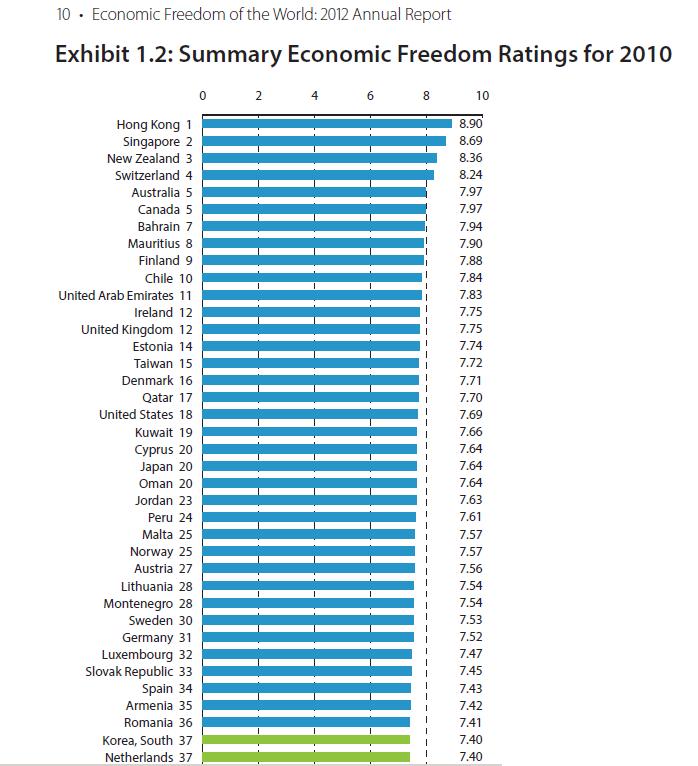
But I’m somewhat shocked to learn that we fell from 10th last year all the way down to 18th this year, as can be seen on the chart (click to enlarge).

Last year, the U.S. fell from 7th to 10th, and I though dropping three spots was bad. But falling by eight spots this past year is a stunning decline.

Who would have thought that Scandinavian welfare states such as Denmark and Finland would rank higher than the United States? Or that Ireland, with all its problems, would be above America?

But since I’m not a misery-loves-company guy, I’m happy to see some nations doing well. I’ve previously highlighted the good policies in Hong Kong and Singapore. And I’ve trumpeted the good policies in Switzerland and Australia, as well as Canada, Chile, and Estonia.

So kudos to the leaders in those nations.

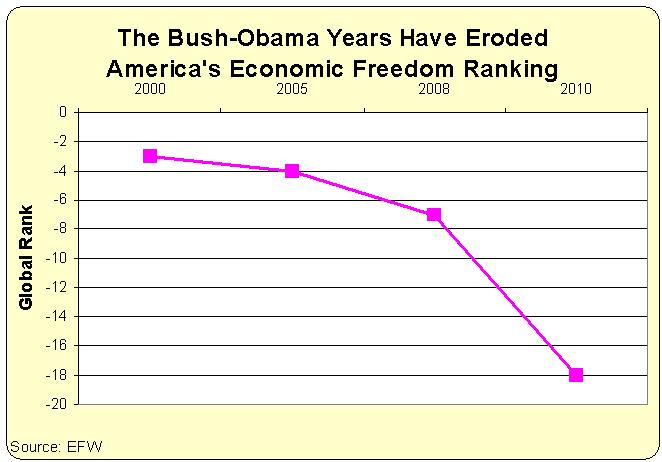
American politicians, by contrast, deserve scorn. Let’s update the chart I posted when last year’s report was issued.

As you can see, it’s an understatement to say that the United States is heading in the wrong direction. We’re still considerably ahead of interventionist welfare states such as France and Italy, though I’m afraid to think about what the U.S. score will be five years from now.

Here’s what the authors of the report had to say about America’s decline.

The United States, long considered the standard bearer for economic freedom among large industrial nations, has experienced a substantial decline in economic freedom during the past decade. From 1980 to 2000, the United States was generally rated the third freest economy in the world, ranking behind only Hong Kong and Singapore. After increasing steadily during the period from 1980 to 2000, the chainlinked EFW rating of the United States fell from 8.65 in 2000 to 8.21 in 2005 and 7.70 in 2010. The chain-linked ranking of the United States has fallen precipitously from second in 2000 to eighth in 2005 and 19th in 2010 (unadjusted ranking of 18th).

For those interested in why the United States has dropped, the “size of government” score has fallen from 8.65 in 2000 to 7.70 in the latest report. That’s not a surprise since the burden of government spending has exploded during the Bush-Obama years.

But the trade score also dropped significantly over the same period, from 8.78 to 7.65. So the protectionists should be happy, even though the rest of us have less prosperity.

The most dramatic decline, though, was the in the “legal system and property rights” category, where the U.S. plummeted from 9.23 in 2000 down to 7.12 in the new report. We’re not quite Argentina (3.76!), to be sure, but the trend is very troubling.

Must keep spending down

Got to get rid of all the huge increases in spending. Milton Friedman believed the Balanced Budget Amendment would be the best way to slow down government spending as long as it is tied to a percentage of GDP.

Below is an excellent article by Dan Mitchell on this issue of keeping government spending down.

I have many frustrations in my life, and near the top of the list is the conservative fixation about balancing the budget.

This view is very misguided. Red ink isn’t good, but the fiscal problem in America (as well as Europe, Japan, etc) is that the public sector is too big. Milton Friedman was right when he wrote, “I would rather have government spend one trillion dollars with a deficit of a half a trillion dollars than have government spend two trillion dollars with no deficit.”

To put it in simple terms, government spending is the disease and deficits and debt are the symptoms.

But even that analogy is inadequate. When politicians focus on borrowing rather than spending, it opens a door allowing the left to argue that tax increases are a solution.

Yet we know from historical experience that higher taxes encourage more spending and slow economic growth, and the combination of those two factors leads to more red ink.

Consider, for example, the experience in Europe. Beginning about 20 years ago with the adoption of the Maastricht Treaty, all members of the European Union agreed to limit annual budget deficits to 3 percent of GDP and total national debt to 60 percent of GDP.

And what happened after these rules were instituted? Well, according to data from the OECD, government got bigger, the tax burden rose, and there was more red ink.

Heck, the Europeans are in the middle of a fiscal crisis, so their rules to limit deficits and debt obviously haven’t been very successful.

Seems like maybe it’s time for them to realize that the problem is too much spending. But, no, that would make too much sense.

Amazingly, but not surprisingly, the Europeans now want to double-down on their failed policies by imposing, as part of a new fiscal pact, even more rules to supposedly control deficits and debt.

The EU Observer reports that: “Countries must introduce a ‘debt brake’ into their constitutions or at an “equivalent” legal level, requiring balanced budgets, which are defined as not exceeding deficits of 0.5 percent of GDP.” Furthermore, another EU Observer report says that “rules will have to include automatic correction mechanisms.” Knowing the mindset of the Euro-crats, this probably means automatic tax increases.

The obvious problem, of course, is that the Europeans have adopted the wrong measuring stick. When they talk about a “golden rule,” they mean limits on deficits and debt. Instead, they should be following Mitchell’s Golden Rule, which requires that government spending grow slower than the private economy.

This video is less than six minutes, but it provides all the key arguments about why the goal should be smaller government rather than fiscal balance.

Deficits are Bad, but the Real Problem is Spending

Uploaded by on Dec 15, 2009

Huge deficits and skyrocketing debt levels are creating considerable worry. This Center for Freedom and Prosperity Foundation video explains that that government borrowing is excessive – and will get worse in coming decades. But this mini-documentary explains that deficits and debt are merely the symptoms, and a rising burden of government spending is the real problem.

____________

Last but not least, it’s worth noting that Europe’s new fiscal agreement (assuming it ever gets implemented) is bound to fail. In part, this is because they are targeting red ink, which is the wrong variable.

But it’s also because the supposed enforcement mechanisms won’t work. The tentative pact assumes that European Commission bureaucrats in Brussels somehow will impose fiscal discipline.

To be more specific, a report in the EU Observer says: “The European Commission will carry a big stick: it will look at national budgets before national MPs and make demands.” Does anyone believe this will have any impact on Italian politicians?

And another story in the EU Observer notes: “Under the proposals, almost all fiscal policy-making would be taken out of the hands of national assemblies and delivered up to European civil servants.” Good luck with that. Does anyone think Spanish parliamentarians will cede budget authority to Brussels?

This is why I stand by my original arguments that bailouts won’t work and that a tough-love policy of benign neglect is the only feasible solution.

Ron Paul quotes Milton Friedman concerning Balanced Budget Amendment

Rand Paul A balanced Budget Amendment is the only way (29-Jul-11)(GLOBAL FOCUS series – US)

Uploaded by on Jul 31, 2011

_______________

The main reason we need a Balanced Budget Amendment is to control spending. Milton Friedman was right about that. Notice below that Ron Paul quotes Friedman on this issue.

Ron Paul: Constitutional Amendment Needed to Limit Taxes and Spending

Submitted by bobbyw24 on Wed, 07/20/2011– 07:09

Congressman Ron Paul (R-Texas) says merely scaling back to 2008 spending levels is nowhere near enough to fix the massive government debt problems.

“As Milton Friedman famously argued, what we really need is a constitutional amendment to limit taxes and spending, not simply to balance the budget,” Paul said in a speech to the House of Representatives made prior to the vote on the “Cut, Cap and Balance” bill. The bill is expected to pass the House tonight, but President Barack Obama has said he will veto it if it clears the Senate and reaches his desk.

What is needed is a dramatically smaller federal government, says Paul. “If we achieve this, a balanced budget will take care of itself,” he says. “We need to cut back at least to where spending was a decade ago.”

Despite their Moral Preening, Statists Would Not Want to Live in a World without Capitalism

I have a real problem with the “Occupy Wall Street” protesters. Do the liberal protesters that attack the greed of capitalism ever take the time to look at what the world would look like without capitalism?

Part of my job at the Cato Institute is to educate people about free markets and fiscal policy.

In some cases, that means providing information and analysis to those already sympathetic to limited government. There are many people who like the idea of lower tax burdens, for instance, but they may not have given much thought to the interaction of tax rates, taxable income, and tax revenue, so that’s why I put together my Laffer Curve tutorial and why I wrote about this amazing data from the Reagan tax cuts.

The harder part of my job is reaching people with statist instincts. I wrote a post last week mocking an absurd example of Swedish egalitarianism, but I included some serious thoughts about why some people oppose liberty. How do I reach those people, especially when there’s some very interesting evidence showing fundamental differences in how liberals, conservatives, and libertarians see the world?

I don’t have a single answer to that question. Sometimes I use the utilitarian approach and show how capitalist nations outperform statist nations, as you can see in this comparison of North Korea and South Korea, and this post comparing Argentina, Chile, and Venezuela.

In other cases, I try a philosophical approach, one example of which is this video arguing against majoritarianism.

And sometimes I use horrifying anecdotes in hopes that people will realize the risks of unconstrained government.

But perhaps the folks at the Fund for American Studies have discovered a good way of educating statists. Take a look at this clever video.

It’s a Wonderful Life! (with capitalism)

Published on Oct 17, 2012 by

Ever wonder what life would be like without capitalism? Join The Fund for American Studies on a journey to an alternate universe — one where capitalism no longer exists. You may find it’s not quite what you expected.

____________

P.S. Here’s another video from TFAS that uses an unusual tactic to get people to think about the value of capitalism and free markets.

Welfare Spending Shattering All-Time Highs


We got to act fast and get off this path of socialism.

Morning Bell: Welfare Spending Shattering All-Time Highs

Robert Rector and Amy Payne

October 18, 2012 at 9:03 am

It’s been a pretty big year for welfare—and a new report shows welfare is bigger than ever.

The Obama Administration turned a giant spotlight on the welfare system in July when the Department of Health and Human Services (HHS) proclaimed it had the authority to gut the work requirements from the welfare reform that had helped lift so many people out of poverty after 1996.

This morning, a new report by the nonpartisan Congressional Research Service (CRS) shows the staggering reality of the growing welfare state—echoing Heritage’s own research that reveals welfare spending is approaching the $1 trillion mark.

Roughly 100 million people—one-third of the U.S. population—receive aid from at least one means-tested welfare program each month. Average benefits come to around $9,000 per recipient. If converted to cash, means-tested welfare spending is more than five times the amount needed to eliminate all poverty in the United States.

Despite the fact that welfare spending was already at record levels when he took office, President Obama has increased federal means-tested welfare spending by more than a third. Benefits under “means-tested” programs are calculated based on a recipient’s means to support himself; in other words, they are intended to assist low-income Americans. The character of this aid is hand-out more than hand-up. Able-bodied recipients rarely are required to work or prepare for work to receive aid.

At the beginning of this year, only four of the 80-plus federal welfare programs had work requirements; the Obama Administration has now suspended the work requirements in two of these. After the Obama Administration suspended the work requirement from the food stamp program in 2009, the number of people on food stamps doubled.

The more than 80 federal means-tested aid programs provide cash, food, housing, medical care, and social services to low-income people. Here’s how the spending breaks down:

Some might argue that this is a reasonable, temporary response to the recession, but Obama seeks a permanent increase in the size of the welfare state.

According to the President’s budget plans for fiscal year 2013, means-tested welfare will not decline as the recession ends, but will continue to grow rapidly for the next decade. Overall, President Obama plans to spend $12.7 trillion on means-tested welfare over the next decade.

Welfare spending has long passed the amount spent on defense. In 1993, welfare spending exceeded defense spending for the first time since the Great Depression of the 1930s. In subsequent years, the ratio of welfare to defense spending averaged about $1.33 to $1. Obama’s spending plans would inflate this disparity: By 2022, there will be $2.33 in federal and state welfare spending for every $1 spent on national defense.

Needless to say—but we’ll say it anyway—Obama’s big spending plans will result in ruinous and unsustainable budget deficits. These deficits are, in part, the result of dramatic, permanent increases in means-tested welfare. An important step in reducing the federal deficit would be to return welfare spending to pre-recession levels.

Doubling the welfare rolls, handing out benefits without any work requirements, and spending twice as much on welfare as we spend on defense: This is Obama’s new normal.

Why can’t we attack the debt and get rid of it?

It seems like everyone is not concerned with coming up with real solutions to our debt problem.

We Need a Better Debt Debate

by Michael D. Tanner

Michael Tanner is a senior fellow at the Cato Institute and author of Leviathan on the Right: How Big-Government Conservatism Brought Down the Republican Revolution.

Added to cato.org on October 10, 2012

This article appeared on National Review (Online) on October 10, 2012

If there was a bigger loser than President Obama on that Denver debate stage last week, it was the conversation about our national debt and the fiscal crisis threatening this country. Throughout the 90-minute debate, both candidates made frequent references to the deficit, the debt, or balancing the budget, but showed little willingness to actually do anything about it.

As of the night of the debate, last Wednesday, our national debt was $16.153 trillion. Let’s put that in perspective: The New York Yankees have the biggest payroll in baseball. For $16 trillion, you could pay the Yankees for 81,000 years, and still have money left over for a couple of free-agent pitchers. And, speaking of New York, $16 trillion could buy all the real estate in New York City — 20 times over. If we were to stack $16 trillion of one-dollar bills on a football field, it would cover the field to a depth of more than two miles. Alternatively, a single stack of 16 trillion one-dollar bills would be 1.085 million miles high, enough to reach the moon and back, twice over. If we were to pay our national debt back at the rate of $1 per second, we could wipe it out in a mere 507,000 years.

Beginning to get the idea? We are talking about a lot of money. Each American’s share of that debt is nearly $53,000.

Our official national debt numbers do not include the unfunded future liabilities of entitlement programs such as Social Security and Medicare. But even under the most optimistic projections, those liabilities, the difference between projected benefits and revenue, total more than $59 trillion. Other projections suggest that they could run to more than $111 trillion. Thus, our true debt actually is somewhere between $75 trillion and $127 trillion.

Romney and Obama didn’t seriously tackle debt and deficits in their first debate.

But in the face of this looming wave of red ink, both candidates more or less ducked.

Governor Romney laid down a useful marker, promising that he would cut any program that was not worth “borrowing money from China to pay for it.” Yet he was so unwilling to offend any potential voting group that he proposed no serious budget cuts. In fact, Romney seemed to spend most of his time explaining all the spending that he wouldn’t cut: defense spending, Medicare, Social Security, education spending; basically, nothing except Big Bird and Obamacare. Public broadcasting is certainly ripe for the cutting block, but given that PBS accounts for 0.01 percent of federal spending, we’ll still be doing a lot of borrowing from China.

Meanwhile, President Obama has not quite doubled the federal debt, as Governor Romney suggested, but he has increased it by $6 trillion during his first four years in office, compared to a $4.9 trillion increase over George Bush’s eight years. Instead, he attacked Romney for wanting to cut much of anything at all.

The president did trot out the old and discredited $4 trillion deficit-reduction plan that he has periodically offered over the past couple of years. But most of the spending cuts he vaguely hinted at were little more than smoke and mirrors: reductions already enacted as part of last year’s budget agreement, savings from previously scheduled pull-outs from Iraq and Afghanistan, interest savings from these budget gimmicks, etc.

The heart of the president’s plan was another call for raising taxes on the rich (and the not-quite-so rich, such as those earning $250,000 per year). But the president’s idea of balancing the budget on the backs of the evil 1 percent is as much of a myth as his proposed spending cuts. If the president received every penny in tax increases that he wants, he would raise roughly $390 billion annually. That might be enough to wreck the economy, but it isn’t going to come close to solving the problem. In fact, it will barely cover all the new spending that the president wants, let alone pay down the debt. As the president likes to say: It’s not ideology; it’s arithmetic.

On the other hand, Romney rejected any tax hike to reduce the deficit, even if part of a deal that included $10 in spending cuts to $1 in tax hikes. Of course, such a deal is pure fantasy. No Democrat has ever supported anything even close to that. Governor Romney correctly puts the blame for our debt where it belongs; federal spending that has averaged 24.4 percent of GDP during the Obama years, and is projected to reach 43 percent by mid-century.

Given Paul Ryan’s legitimate reputation as both a budget wonk and a deficit hawk, we can expect more of a focus on the debt and deficit at this Thursday’s debate. (We can have a new drinking game every time someone mentions the “Ryan budget.”)

Biden is expected to be on the attack, warning that any cut of anything will cause death and destruction unprecedented since the Bush administration or the Black Death, whichever was worse. No one is better situated than Ryan to answer those charges. The question will be whether the vice-presidential candidates will be more honest than the top of their tickets in telling the American people that the federal government is going to have to cut spending, even on programs that might be politically popular.

Yes, election season is a difficult time to call for such cuts. But as Governor Romney noted during the Denver debate, the debt is “not just an economic issue… it’s a moral issue. I think it’s, frankly, not moral for my generation to keep spending massively more than we take in, knowing those burdens are going to be passed on to the next generation and they’re going to be paying the interest and the principal all their lives.”

One hopes that sometime before November, one of the candidates offers a serious plan to deal with that moral issue.

SEC football coaches on the hot seat

It is no surprise that John L. Smith and Derek Dooley may be heading out the door at the end of this season. That was expected by most people that watch SEC football. However, could Gene Chizik of Auburn being out the door too? If that happens then I must admit that I did not see that coming down the pike.

I have tickets to the Little Rock Razorback games and it is sad that we lost both games this year on the last play of the game. Some have used this to say that we can not win in Little Rock and we should move the games. This is stupid logic. Actually I did attend the Arkansas game in Fayetteville against Alabama and that game ended 52-0. Also the Rutgers game in Fayetteville did not even come down to the last play.

Hopefully we will keep two games in Little Rock in the future, but most people are bracing for a reduction of games at some point in the future.

10 Coaches Who Could Be Bracing for Bad News

By RALPH D. RUSSO AP College Football Writer
October 23, 2012 (AP) 

The first firing of the college football season came Sunday. Idaho let go of Robb Akey in a move that was not unexpected.

With a little more than a month to go, there are other axes to fall. It’s safe to say Arkansas will not be signing up for another year of the John L. Smith experience.

Here are 10 more coaches who could be bracing for bad news.

———

— Gene Chizik, Auburn

Two years removed from a national championship, Chizik is in trouble. No team had ever started a season 1-6 two years after finishing No. 1 in the AP poll — until the Tigers. It’ll cost $7.5 million for Auburn to buyout Chizik as of Dec. 1, but if the Iron Bowl gets really ugly, money might not be an issue. “I’m the head coach at Auburn,” Chizik said. “It’s really not about me. It’s about everybody else, and everybody else’s expectations. I don’t take that lightly. I feel a very, very high sense of responsibility.”

— Jeff Tedford, California

The Bears’ 21-3 loss to archrival Stanford at their newly remodeled stadium (cost: $321 million) felt like the final blow. Tedford has been at Cal for 11 years and won 82 games. He’ll leave the program in far better shape than when he arrived, but it has slipped over the past few years.

— Frank Spaziani, Boston College

FBC Going Deep.JPEG
AP
FILE – In a Saturday, Sept. 22, 2012 file… View Full Caption
FILE – In a Saturday, Sept. 22, 2012 file photo, Auburn coach Gene Chizik watches from the sidelines in the first half of an NCAA college football game against LSU at Jordan-Hare Stadium in Auburn, Ala. Two years removed from a national championship, Chizik is in trouble. No team had ever started a season 1-6 two years removed from finishing No. 1 in the AP poll _ until the Tigers. (AP Photo/Dave Martin, File) Close

The Eagles have been moving backward in four years under the former longtime BC assistant. Boston College was 4-8 last year and is 1-6 this season, with its only victory coming against Maine. This seems a more a matter of when then if.

— Joker Phillips, Kentucky

Phillips is only in his third season as Rich Brooks’ successor, but each season has gotten worse. The Wildcats (1-7) have been hammered by injuries, but they are staring at a winless SEC season, and even at a basketball school, that’s hard abide.

— Derek Dooley, Tennessee

Dooley took over a program in disarray, following Lane Kiffin’s one-and-done in Knoxville. The Vols have improved, but there have been no big wins. Dooley is 0-14 against ranked opponents. A $5 million buyout might not stand in the way of AD Dave Hart, who did not hire Dooley.

— David Bailiff, Rice

Bailiff has had one winning season in six at Rice since taking over for Todd Graham, and is 2-6 this season, 0-4 in Conference USA. It’s a tough place to win, but other than that 10-3 season in 2008, Bailiff is 15-41.

— Mike Price, UTEP

Price is 66 years old, so retirement might be on his mind anyway. The Miners are 2-6, 1-3 in C-USA, and haven’t finished over .500 since his second season in El Paso, Texas, which was 2005.

— Dan Enos, Central Michigan

The former Michigan State quarterback is only in his third season at CMU, but this is a program that grew accustomed to being a Mid-American Conference contender under Brian Kelly and Butch Jones. Enos has only eight victories. The Chippewas are 2-5 overall and 0-3 in the league this season, though they did beat Iowa.

— Bobby Hauck, UNLV

Another guy only in his third season, but even at places such as UNLV, patience is thin these days. Hauck reached three national title games at Montana, so clearly he knows how to coach. But the Rebels are 1-7 and have won only five games total under Hauck.

— Doug Marrone, Syracuse